




Abstract
The current study investigates the effects of work centrality and materialistic values on organizational citizenship behaviors (OCBs). The importance of organizational citizenship behaviors has been well documented in the management literature. Although OCBs are hard to define, researchers emphasize that these behaviors are more or less discretionary, less likely to be formally linked with organizational rewards and contribute to the organization by promoting a positive social and psychological climate. Although the accumulation of research on OCBs and related constructs is vast, materialistic values as an antecedent have received scant attention. In the current study, materialistic values and work centrality are investigated as predictors of OCB, which have inverse effects on the construct. In a cross-sectional design, 439 employees from various companies in Turkey participated in an online survey. The findings support the claim that inverse effects from work centrality and materialistic values influenced OCB. Upon deconstructing the antecedents’ impact on the dimensions of OCB, the results revealed a positive predictive effect of work centrality on helping and civic virtue. In contrast, materialistic values exerted a negative influence only on helping behaviors. Implications and future research directions are discussed in line with the findings.
Plain Language Summary
The purpose of the current study is to investigate the effects of work centrality and materialistic values on organizational citizenship behaviors (OCBs). The accumulation of research on OCBs and related constructs is vast, however, materialistic values as an antecedent have received scant attention. In the current study, materialistic values and work centrality are investigated as predictors of OCB, which have inverse effects on the construct. In a cross-sectional design, 439 employees from various companies in Turkey participated in an online survey. The findings support the claim that inverse effects from work centrality and materialistic values influenced OCB. Upon deconstructing the antecedents’ impact on the dimensions of OCB, the results revealed a positive predictive effect of work centrality on helping and civic virtue. In contrast, materialistic values exerted a negative influence only on helping behaviors. Implications and future research directions are discussed in line with the findings.
Introduction
Over the past 30 years, organizational scholars have studied the various correlates of organizational citizenship behavior. The primary interest in the citizenship construct stemmed mainly from its contribution to organizational performance (Podsakoff et al., 2009), organizational productivity, sustainability (Hafeez et al., 2022), and harmonious work climate (Zhuang, 2021), and, more recently, from its mitigating effects of crises on organizations. Organizational citizenship behaviors (OCBs) are not explicitly tied to formal rewards (Organ, 2006) and include putting extra effort and time into responsibilities, volunteering for extra tasks, and helping colleagues, clients/customers, which allow organizations to become more resilient and more responsive, thus, enabling quick recovery from crises such as the COVID-19 pandemic (Kong & Belkin, 2022). OCB has mainly been depicted as a desirable and positive outcome, assumed to stem from non-self-serving motives (such as job satisfaction and organizational commitment) (see Bolino et al., 2004 for a review). However, a recent discussion on the darker side of organizational citizenship impelled scholars to shift focus to more instrumental, materialistic antecedents (Bolino et al., 2013; Deckop et al., 2015). The personal and professional costs and darker motives associated with OCBs, such as impression management and counterproductive work behaviors, found support (Bolino et al., 2010; Vigoda-Gadot, 2006, 2007). Impression management refers to behaviors that individuals activate to present a favorable image of themselves to others that streamline self-serving and instrumental motives (Bolino et al., 2008). Thus, employees may engage in impression management if they perceive citizenship behaviors to induce self-interest and material outcomes.
Materialism has conceptually been associated with impression management (Grant & Mayer, 2009; Tuominen et al., 2022; Yun et al., 2007) and has consistently been coined as the cause of undesirable outcomes for both employees and organizations in terms of well-being, attitudes, and behaviors (Isham et al., 2022; Unanue et al., 2021). Among the documented negative consequences of materialism in the work setting, OCBs bear critical attrition from materialistic motives (Deckop et al., 2015). This suggests that through instrumental and self-serving incentives, materialism plays a role in exploring the subtle aspects of citizenship behaviors. Even though materialism has been studied extensively in non-work settings (Deckop et al., 2010, 2015; Diener & Seligman, 2004; Karabati & Cemalcilar, 2010; Kasser et al., 2004; Unanue et al., 2014) it has been documented to impose negative consequences in the work domain as well (Deckop et al., 2010).
Materialism has been operationalized as a value construct that the individual places on possessions. One of the distinguishing features of material values is that acquiring possessions not only reflects an instrumental component but also enhances an individual’s self-identity. For instance, SDT (Self Determination Theory) highlights that material outcomes may function as an instrument in achieving happiness and well-being. Materialism is widely conceptualized and measured as an emphasis on extrinsic values (i.e., reputation, popularity, money, and possessions) contrary to intrinsic values (i.e., social relations, autonomy, and responsibility; Unanue et al., 2017). In the organizational context, extrinsic values emphasize high pay, status, and power, while intrinsic values reflect a mindset on self-development, affiliation, and altruistic acts (Vansteenkiste et al., 2007).
Deckop et al. (2010) frame organizations as presenting rich contexts to investigate various effects of materialism on attitudes and behaviors. They underline that organizations are systems where materialistic concerns are salient. Due to the primacy and dominance of money in organizational settings, the implications of materialism are pervasive and manipulative, even to those who do not attach high levels of importance to instrumental outcomes. Thus, there is a pressing need for further research covering the effects of materialism on workplace outcomes.
In line with this conception, the following section introduces materialism in the work context, discussing its relationship with work centrality. The subsequent section builds a framework to make sense of the effects of materialism and work centrality on organizational citizenship behaviors by presenting a foundation for the current research. A cross-sectional design, which was based on data collected through a non-official directory of Turkish SMEs, is introduced in the methods section. The following section presents results indicating the inverse effects of material values and work centrality on organizational citizenship behaviors, which are later discussed with reference to recent studies and relevant theories in the concluding section.
Materialism in Context
Materialism consists of values and goals emphasizing possessions, reputation, wealth, and social status (Kasser & Linn, 2016). Richins and Dawson (1992) treat materialism as a personal value that manifests itself as the importance placed on possessions and their acquisition as a necessary form of conduct to reach a desirable end-state, such as happiness. Materialists are characterized by being considerably purchase-oriented, channeling their resources to acquire more money and possessions with the expectation that they will attain happiness, well-being, and life satisfaction (Fitzmaurice & Comegys, 2006). Richins’ (1994) formulation of materialism taps into these characteristics and defines it as a multi-faceted construct comprising of material centrality, happiness, and success.
Materialist individuals find meaning by acquiring certain possessions and structuring their lives around sources of material outcomes. Christopher and Schlenker (2004) extend this argument, suggesting that materialists tend to direct their thoughts and actions toward material possessions over other pursuits, including intellectual enrichment, personal growth, and interpersonal relationships. Thus, they depend on owning the right possessions for happiness (Ahuvia & Wong, 2002) and consider possessions essential to their satisfaction with life and well-being (Górnik-Durose, 2020). Happiness becomes conditional to extrinsic goals and outcomes (Cui et al., 2023). Within this context, material possessions assume a symbolic role in the pursuit of success and the cultivation of a desirable image. Consumption patterns often serve as indicators of social status, leading individuals to derive pleasure from showcasing their material wealth and possessions to garner recognition. However, this material-centeredness can have detrimental consequences for individuals, potentially hindering their pursuit of personal growth, meaningful relationships, and a broader commitment to societal well-being, as highlighted by Isham et al. (2022). Substantial evidence shows that people who give precedence to material goals have lower-quality interpersonal relationships, behave in antisocial and competitive ways, incur more debt, and engage in unethical and unhealthy behaviors like smoking, alcohol consumption, and drug use (Cui et al., 2023; Duriez et al., 2007; Kasser, 2016; Sheldon et al., 2018; Vohs et al., 2006). Ecological sustainability and pro-environmental behaviors have also been found to be inversely related to materialism. Those prioritizing material possessions are more likely to undermine environmental resources, adopting a lifestyle with a high ecological footprint (Hurst et al., 2013; Unanue et al., 2016; Wang et al., 2019).
Motivation and willingness to achieve physical and psychological well-being in work and educational settings are also hampered by materialist tendencies (see Dittmar et al., 2014; Isham et al., 2022). Self-determination theory elucidates the underlying psychological process of such adverse association of materialism with various attitudes (see Unanue et al., 2017). A strong focus on extrinsic outcomes like wealth, fame, or appearances debilitates intrinsically motivated attitudes and behaviors regardless of one’s attainments (Ryan et al., 2022). If basic psychological needs are unmet, materialistic motives harm the individual, obstruct conscious and intentional endeavors (autonomy), hamper self-efficacy (competence), and impede meaningful relations with others (relatedness) (Dittmar et al. 2014; Unanue et al., 2017).
Research on materialism and its consequences covers mostly non-work interactions (Kasser et al., 2006). Several studies have addressed the role of materialism in the workplace, examining its relationship with work-family conflict (Promislo et al., 2010), well-being (Deckop et al., 2010), workplace deviance, and organizational citizenship behaviors (Deckop et al., 2015). Although incorporating materialism as a predictor of work-related phenomena is recently gaining attention, its implications for organizational efficiency and productivity have long been a subject of interest within the field of management. Material rewards, pay, and other incentives in the hands of organizations are used as means of control to achieve expected outcomes (Dyck & Schroeder, 2005). Hence, one can observe indications of materialistic incentives in work motivation, emphasizing its significance as a key predictor of work-related phenomena.
Materialistic Values and Work Centrality
Existing evidence suggests that materialism carries negative influences over work-related attitudes and behaviors. Work centrality and materialism have been negatively associated across different studies. In Twenge and Kasser’s (2013) investigation of three generations of high school students in the United States, decreasing work centrality was accompanied by increasing materialism, documenting an inverse relationship between the two variables (Bjarnason & Håkansson, 2019). This result may be interpreted as an inconsistency as work is a central domain for earning money, and materialistic values reflect a mindset that motivates earning more, acquiring, and spending more money. Although conceptually, there seems to be a resemblance between work centrality and materialistic values regarding extrinsic gains, the two constructs are indeed negatively associated (Twenge & Kasser, 2013). The inverse association may indicate an inclination among the new generation toward entitlement (i.e., reflected in the notion that one deserves things even without working for them), narcissism, inflated views of one’s talents, and, consequently, unrealistic expectations of success, fame, and fortune (Bjarnason & Håkansson, 2019).
A salient aspect that elucidates the inverse relationship may be traced in the conceptualization of the two constructs. Work centrality is a belief about the value of work in one’s life and a function of past cultural conditioning or socialization (Kanungo, 1982). It can be formulated as a state of psychological identification with work, which implies a willingness to work even if not necessary for pure extrinsic and financial reasons (Haller et al., 2023). Such identification depends on the saliency of one’s needs and the perceptions about the need-satisfying potentialities of work. Individuals holding materialistic values would be expected to identify with their work only if they are convinced that their success and happiness will emanate from such psychological investment. In other words, people with a materialistic value orientation prioritize their pros and cons, aiming to secure personal wealth or power (De Groot and Steg, 2008). Thus, a materialistic person’s sense of identification with work rests on an instrumental basis and not on the value ascribed to work as an end. This disparity in the source of identification with work may explain why materialism is associated with lower levels of work centrality. While individuals holding strong materialistic values are more attached to extrinsic target outcomes (such as success, money, rewards, etc.), those high on work centrality develop an identification with work as an end in itself. To further study the relationship between these two constructs, the study aims to investigate the following research question:
Research Question (1) What is the relationship between materialistic values and work centrality?
As outlined above, work centrality and materialistic values demonstrate an inverse relationship with one another and transfer inverse influences on other work-related outcomes. For instance, prosocial behaviors (i.e., OCBs) were found to be promoted via work centrality and, on the contrary, obstructed when subjected to the influence of materialistic values (Kabasakal et al., 2011; Torlak & Koç, 2007). Building on the notion that materialism and work centrality hold significant ramifications for organizations, the current study investigates their impact on organizational citizenship, a noteworthy collection of behaviors organizations strive to promote. In doing so, the following research question constructs the backbone of the current study:
Research Question (2) Do materialistic values and work centrality relate differently to organizational citizenship behaviors (OCBs)?
The Current Study Framework
Organizational citizenship behaviors (OCBs) are one of the constructs resorted to in predicting the effective functioning of organizations and the achievement of organizational objectives. OCBs are discretionary behaviors not enforceable by the person’s employment contract. The most widely used conceptualization of OCBs includes a five-factor structure, including altruism, conscientiousness, civic virtue, courtesy, and sportsmanship dimensions (i.e., Organ, 2006). More recent research found support for a three-factor model where “conscientiousness” is removed, and “altruism” and “courtesy” are combined to form a single “helping” dimension (Uçanok & Karabatı, 2013). These three factors, namely helping behavior, civic virtue, and sportsmanship, include voluntarily helping others, preventing the occurrence of work-related problems (helping), participating actively in its governance (civic virtue), and willingness to tolerate the inevitable inconveniences and impositions of work without complaining (sportsmanship). In the face of increased global competition and crises such as the COVID-19 pandemic, organizations depend more on these positive work behaviors that typically emanate from an exchange between the organization and employees.
The main exchange channels between the organization and the employee are built on economic and social domains. An economic exchange is a short-term, tangible relationship between employee performance and monetary rewards. In contrast, a quid pro quo in the short term is not expected in social exchange. In social exchange, employees expect their contributions to be recognized irrespective of the form and timing of recognition (Deckop et al., 2015). The social exchange relationship between employees and organizations incubates positive work-related attitudes and behaviors, such as organizational citizenship (Bowler & Brass, 2006; A. Cohen & Blecher, 2022; Pham et al., 2023). On the contrary, an economic exchange may discourage employee OCB on the premise that such behaviors do not guarantee immediate economic rewards. Given the importance of organizational citizenship behavior, researchers have long been interested in identifying its predictors or antecedents (LePine et al., 2002; Ocampo et al., 2018). To expand our understanding, materialistic values, and work centrality are formulated as antecedents of OCBs (see Figure 1). It is presumed that the relationship between materialistic values and OCB leans on an economic exchange (materialistic values), whereas work centrality and OCB concentrate on an exchange less controlled by materialistic motives and inclined toward a more relationship-based social exchange. The following section reflects on these relationships and lays the groundwork for the proposed research model.
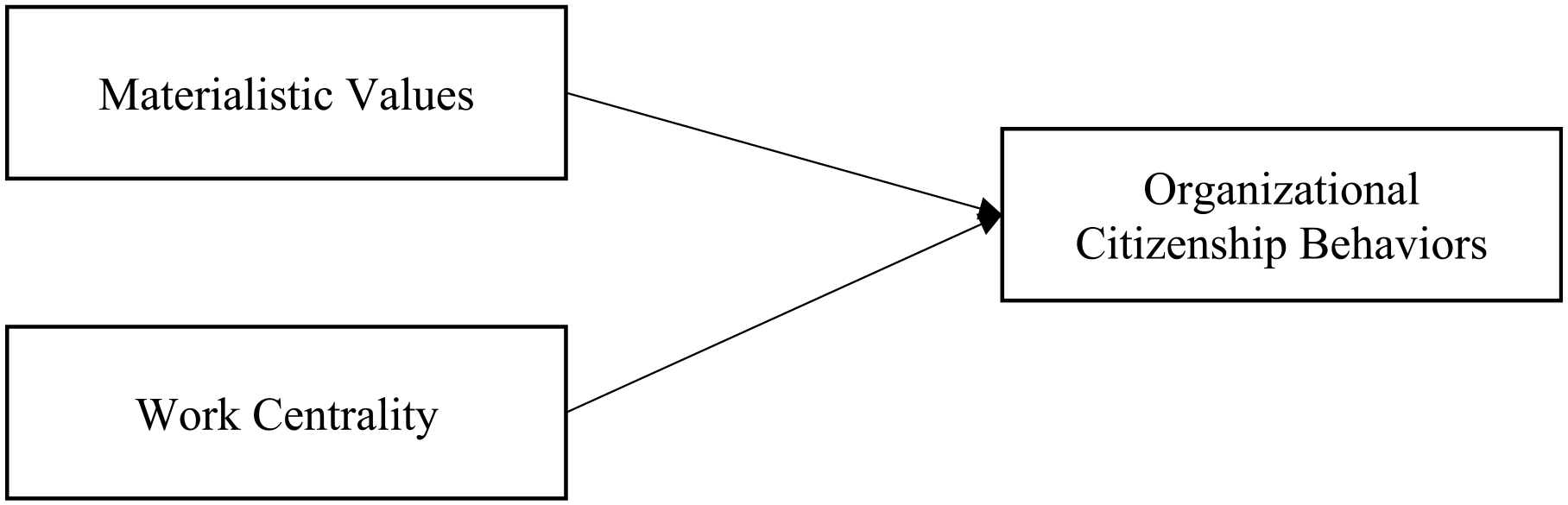
Theoretical model.
Materialistic Values and Organizational Citizenship Behaviors
It has been documented that materialists view their relationship with their organization and fellow employees as an economic exchange where extrinsic financial rewards (Vansteenkiste et al., 2006) and seeking social status among groups (Goldsmith & Clark, 2012) act as primary motivators. Materialist individuals give precedence to material outcomes such as making money (Promislo et al., 2010; Tang et al., 2008), safety, and physical comfort (Ahuvia & Wong, 2002; Pieters, 2013) rather than the quality of relationships with and within the organization.
From the Self-Determination Theory (SDT) perspective, materialistic values detract employees from pursuing intrinsic need-satisfying activities (Reyes et al., 2022) and, thus, are associated with lower satisfaction, resulting in lower levels of well-being (Vansteenkiste et al., 2007). SDT may help explain the foundation for why materialism and performance outcomes such as OCBs can be interlinked. Self-determination theory (SDT) asserts that people may possess different and unique extrinsic reasons to invest their time and energy in particular goal-related behaviors (Deci & Ryan, 2000). These motivations encompass external (i.e., being pressured by others), introjected (i.e., putting pressure on oneself through ego-involvement), identified (i.e., doing an activity because one finds it meaningful), and integrated regulations (i.e., engaging in an activity because this is fully aligned with one’s values and sense of self). Each of these motivation types can be ordered along a continuum of self-determination, ranging from more controlled to more autonomous or volitional types of motivation. External and introjected regulations are regarded as controlled, whereas identified and integrated regulations are more self-determined and autonomous type motivations. SDT scholars have long argued that when goal-directed behaviors are controlled rather than autonomous, the consequences are more detrimental to the individual and their organizations (Deci et al., 2017).
Materialistic values mimic external regulation in predicting work-related outcomes by motivating individual behavior via external contingencies such as obtaining rewards, gaining social status, and approval from managers, colleagues, and clients. According to a recent meta-analysis by (Van den Broeck et al., 2021), external regulation was negatively related to organizational citizenship behaviors (OCBs). The possession of money, a signifier of materialism, and pay plans associated with material motives also demonstrated a negative effect on organizational citizenship behaviors (Deckop et al., 2004; Tang et al., 2008). These findings imply that materialism associated with expecting rewards (e.g., money, status) is not the best type of motivation; it offers a limited contribution to employee performance and inhibits OCBs.
Studies looking into the motives that drive materialistic people toward voluntary behaviors found external gratifications, such as fame, wealth, or social power, enforced by egoistical motives rather than agapic, self-sacrifice, or altruistic motivations (Bock et al., 2018). This finding further substantiates the argument that materialistic individuals attach less importance to growth, intimacy, and community than extrinsic outcomes. These extrinsic pursuits often fail to align with the autonomous and intrinsic aspirations that underlie voluntary behaviors, such as OCBs (Martela et al., 2019).
Several studies with an indirect potential to elucidate the relationship between materialism and OCBs are also worth noting. In their analyses, Kasser et al. (2004) materialistic values exhibited a weaker association with “civil” behaviors, such as helping one another, cooperation, and mutual trust in establishing a healthy community. Additionally, Giacalone et al. (2008) identified a negative correlation between materialism and various facets of corporate conduct, encompassing safeguarding and bolstering organizational interests, ethical and social responsibility, and the commitment to employee and societal welfare.
These results imply that materialistic individuals are less likely to behave pro-socially and ethically, distancing themselves from taking extra responsibility if such civic behaviors are not instrumental in attaining financial success, material rewards, or an appealing image (Wang et al., 2019). Building on the documented effects of external regulation and extrinsic motivation on organizational outcomes, materialistic individuals engage in an economic and instrumental relationship with the organization, abstaining from organizational citizenship behaviors.
Work Centrality and Organizational Citizenship Behaviors
Work centrality describes being immersed in work both cognitively and at an attitudinal level (Mannheim, et al., 1997). Employment is an important part of adult life, and those high in work centrality positions work at the center of their lives (Kanungo, 1982), holding work in a particular regard (Bal & Kooij, 2011). Eventually, employees who identify with their work invest more time and resources and contribute to favorable organizational outcomes. For instance, work centrality is linked to higher organizational commitment (Duffy et al., 2014; Uçanok Tan, 2016), organizational citizenship behaviors (Uçanok & Karabati, 2013; Ugwu & Igbende, 2017; Zúñiga et al., 2022), job satisfaction (Ziegler & Schlett, 2016), and achievement goal orientation (Moura & Oliveira-Silva, 2019). In other words, work centrality provides an impetus for the individual to engage in conscious, volitional behaviors and step above the formal requirements of the job. Early findings have systematically displayed this positive relationship between the two constructs (see Diefendorff et al., 2002; Uçanok & Karabati, 2013), and more recently, Zuniga et al. (2022) documented a positive significant relationship between the centrality of work and OCBs.
The foundation behind this relationship can be explained through different perspectives. The social exchange perspective argues that when employees attach meaning to their work, they will likely increase OCBs to maintain the quality of their employment relationship (Wayne et al., 1997). Secondly, the value-based approach presumes that meaningful work builds a sense of commitment by framing organizations as important vehicles for accomplishing goals consistent with employee values. Employees thus form beliefs regarding their work as significant and worthy, attaching greater meaning to it (Allan et al., 2019). This intrinsic cognition, in turn, facilitates employees’ OCB toward their employer (Lee & Allen, 2002) by keeping up with work changes, helping others, complying with rules and regulations, and not complaining about small issues (Kong & Belkin, 2022).
Another explanation rests on the motivational force engrained in the concept of work centrality, which drives behaviors such as citizenship in the work context. Work centrality embodies cognition about the importance and value of work and contains predispositions to behave in a certain way concerning work. The motivational force within work centrality resembles that of which identified regulation has over behavior as proposed by the self-determination theory (SDT). In identified regulation, individuals personally identify with the importance and value of their work roles and behaviors, as in the case of work centrality. In this type of motivation, individuals are more autonomously self-regulated since they accept their rationale for acting and are flexible in selecting and sustaining behaviors and activities, such as citizenship behaviors (Deci et al., 2017). Van den Broeck et al.’s (2021) meta-analysis illustrates that engaging in a particular behavior because one considers it meaningful or valuable (as in work centrality) is more important for continuous effort investment, goal-directed behavior, or “going the extra mile” than engaging in a behavior because it is inherently enjoyable. This result implies that work centrality, which mimics the pattern of integrated regulation in driving work behaviors, may lead to higher levels of extra-role or helping, which comprise the essence of organizational citizenship behaviors.
The Current Investigation
Based on the theoretical underpinnings and previous evidence, the current study aims to elucidate the effects of materialistic values and work centrality on organizational citizenship behaviors. The investigation is anchored on the proposition that materialism and work centrality are negatively associated, thus transmitting inverse effects on OCBs. In other words, (a) materialistic values impair, whereas (b) work centrality fosters these behaviors. To address the research objectives, the following hypotheses are formulated:
Hypothesis 1: Materialistic values and work centrality are negatively associated.
Hypothesis 2: Materialistic values significantly negatively affect organizational citizenship behaviors.
Hypothesis 3: Work centrality significantly positively affects organizational citizenship behaviors.
Finally, in addition to the above hypotheses, the study aims to explore how materialistic values and work centrality are linked to the sub-dimensions of OCBs, investigating if any subtle differences exist. Based on the literature, specific hypotheses could not be established regarding the sub-dimensions of OCB therefore, the following research question is proposed.
Research Question (3) How are materialistic values and work centrality linked to the sub-dimensions of OCBs?
Methodology
A cross-sectional design was adopted, which collected data from employees listed in a non-official directory of Turkish small and medium-sized enterprises (SMEs). SMEs were deliberately selected for investigation since they represent the Turkish workforce owing to their large share in the total number of enterprises (99.8%) and total employment (73.5%). The directory from which the employee information was extracted includes over 10,000 registered members. A random sample of 1,000 employees was selected from SMEs scattered throughout different regions in Turkey. Among the members who received the invitation, 511 filled out the questionnaire. After a careful elimination, 439 responses were obtained for analyses. The distribution of the total sample was unequal based on gender: 150 (34%) males versus 289 (66%) females. Approximately half of the participants (51.3%) were single, and the majority of them (78.5%) had a minimum degree of bachelors.
Procedure and Data Analysis
The measures were administered through an online survey program. The participants filled out a consent form before they began the questionnaire. The analyses were undertaken using IBM Statistical Package for Social Sciences (SPSS Version No. 28), where the moderation effect model was tested via the macro-SPSS PROCESS and the confirmatory factor analyses (CFA) via IBM AMOS 28.
Measures
All constructs used in the study have been adapted from previous research that translated the scales into Turkish. The confirmatory factor analyses of the original scales included the items with satisfactory loadings, and all scales were examined for reliability. Table 1 presents the confirmatory factor analysis results of the original three-factor models for material values and OCB.
Confirmatory Factor Analysis.

Note.χ2 = model unscaled chi-square statistic; df = model degrees of freedom; CFA = confirmatory factor analysis; CFI = comparative fit index; RMSEA = root mean square of approximation; SRMR = standardized root mean square residual.
Organizational Citizenship Behaviors
OCB is measured by the short version of the scale developed by Organ (1988). The items in this scale were rated on a six-point scale ranging from (1) “definitely disagree” to (6) “definitely agree.” The Turkish version of the original three-factor OCB scale translated by (Uçanok, 2008) was used. The confirmatory factor analysis of the OCB items revealed a good fit (CFI = 0.936, RMSEA = 0.066, NFI = 0.946, TLI = 0.956). The overall reliability of the scale was 0.874, and the alpha scores of the three dimensions were 0.905 for helping (five items), 0.875 for civic virtue (five items), and 0.808 for sportsmanship (four items), respectively.
Materialism
The 18-item scale developed by Richins and Dawson (1992) was completed by the participants using a 1 (strongly disagree with this statement) to 5 (strongly agree with this statement) Likert-type scale. The original scale measured three dimensions of material values: success (e.g., The things I own say a lot about how well I’m doing in life), centrality (e.g., Buying things gives me much pleasure), and happiness (e.g., I wouldn’t be any happier if I owned nicer things). Confirmatory factor analysis revealed good fit (CFI = 0.944, RMSEA = 0.044, NFI = 0.956, TLI = 0.962) and the overall reliability of the scale was acceptable (α = 0.850). Further analyses confirmed acceptable reliabilities for success (α = 0.747) and the construct’s material centrality (α = 0.759) dimensions.
Work Centrality
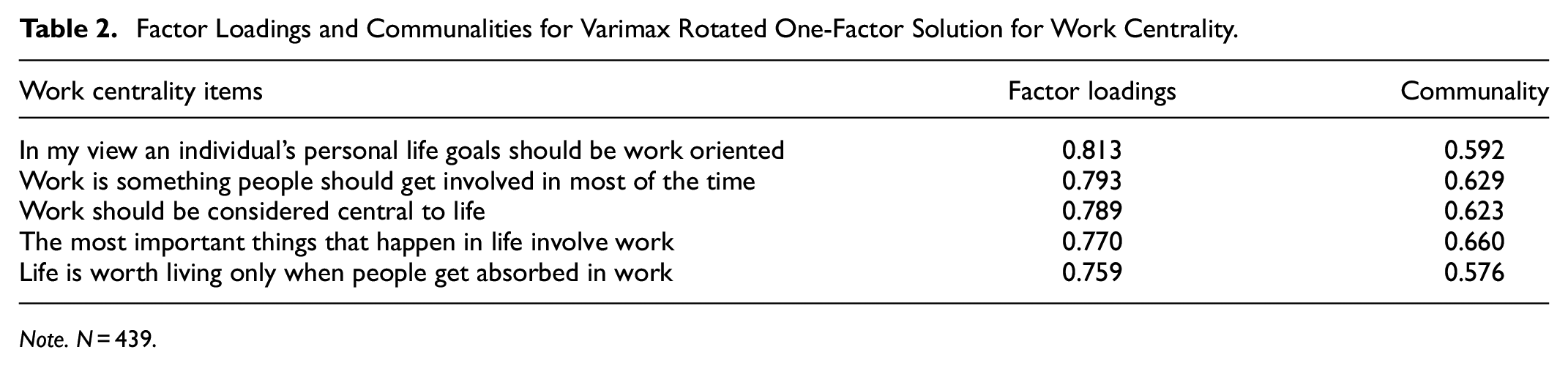
The six-item work centrality scale that Kanungo (1982) developed was used to measure the construct. The participants completed the scale ranging from “definitely agree” (1) to “definitely disagree” (6). The scale translated into Turkish by Uçanok (2008) revealed an alpha score of 0.868. The exploratory factor analysis determined a uni-dimensional structure of work centrality (KMO = 0.829 and Bartlett’s test significant at 0.000 level), explaining 61% of the total variance (see Table 2). The reverse item in the scale (i.e., Work should only be a small part of one’s life) was removed from the factor analysis due to a low factor loading (loading = 0.272).
Factor Loadings and Communalities for Varimax Rotated One-Factor Solution for Work Centrality.
Note. N = 439.
Findings
Table 3 presents the means, standard deviations, and correlations among the variables in the study. The statistical analyses revealed that OCB exhibited a positive correlation with work centrality while demonstrating a negative correlation with total materialism scores. Further exploration of the sub-dimensions revealed significant positive associations between the helping and civic virtue dimensions of OCB with work centrality. Additionally, it was observed that helping displayed significant correlations with materialism’s centrality and success dimensions.
Means, Standard Deviations, and Correlations.
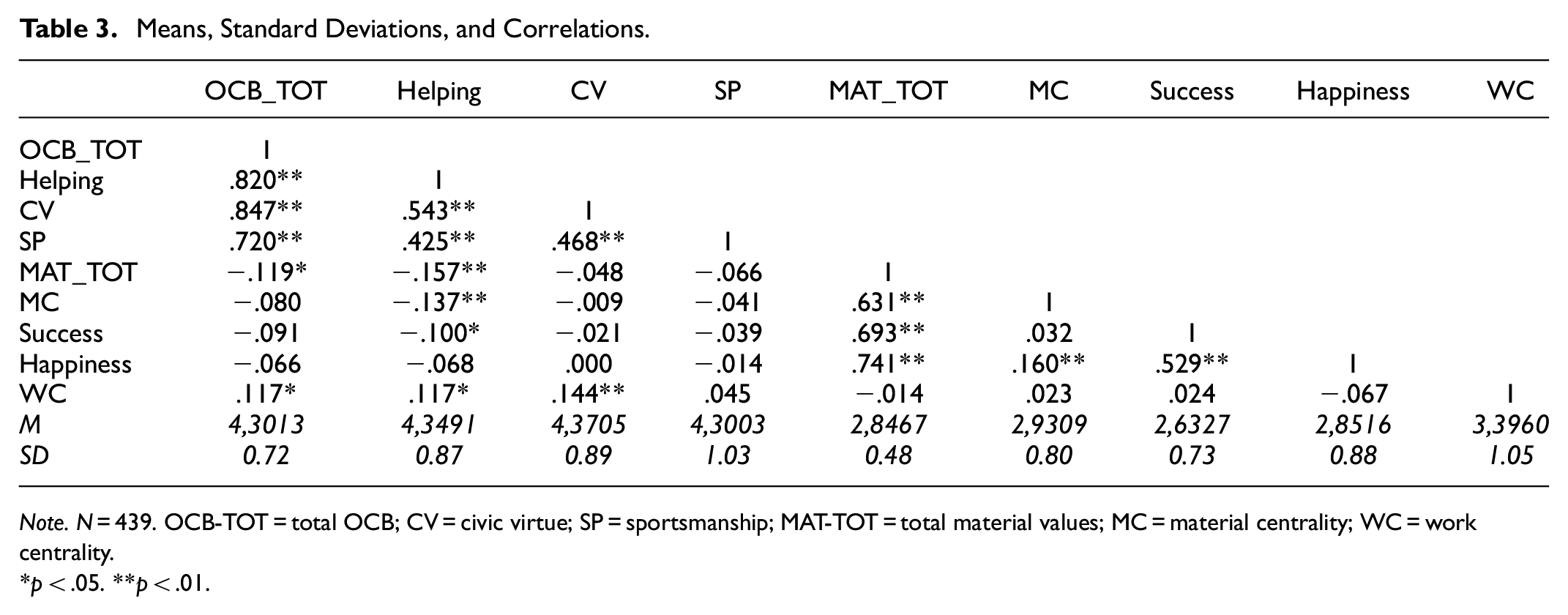
Note. N = 439. OCB-TOT = total OCB; CV = civic virtue; SP = sportsmanship; MAT-TOT = total material values; MC = material centrality; WC = work centrality.
p < .05. **p < .01.
Regression analyses have shown that material values (r = 0.119, p ≤ 0.05) and work centrality (r = 0.116, p ≤ 0.05) had significant inverse effects on OCB as predicted (see Table 4).
Regression Analysis Predicting OCB.

Note. N = 439. MAT-TOT = total material values.
p < .05.
Further analyses to investigate the effects of materialism and work centrality on the sub-dimensions of OCBs demonstrated that only the helping dimension of OCBs (R2 = 0.043, F = 6.297, p ≤ 0.05) could be predicted by material centrality (β = −0.149, p ≤ 0.05), success (β = −0.118, p ≤ 0.05), and work centrality (β = 0.102, p ≤ 0.05). Also, the assertion that work centrality is a significant and positive predictor of OCB dimensions was only confirmed for the helping (r = 0.117, p ≤ 0.05) and civic virtue (r = 0.144, p ≤ 0.01) dimensions of OCB (see Table 5).
Regression Analysis Predicting Helping Dimension of OCB.

Note. N = 439.
p < .05. **p < .01.
Discussion
The current macro developments, coupled with crises such as the COVID-19 pandemic, created an environment where workplace practices are altered and the pre-existing meanings surrounding work re-formulated. In such complexity, organizations depend heavily on their employees and their efforts in supporting their organizations to overcome challenges presented by the confusing and dynamically uncertain series of events. Thus, voluntary, and supportive behaviors have been acknowledged to play an important role in creating more responsive, resilient, and effective organizations (Kong & Belkin, 2022). The current study was designed on the premise that materialistic values and work centrality have substantial potential in predicting supportive work behaviors, that is, organizational citizenship behaviors (OCB) in the 21st-century workplace.
Among the determinants of OCB, materialistic values have not garnered much attention until recently. Incorporating materialistic values as a predictor of work-related attitudes and behaviors paves the way for a new discussion around organizational phenomena. The first hypothesis of the current study that anticipated a negative association between materialistic values and work centrality was an initial attempt to frame materialism as a potential construct in understanding workplace phenomena. The analyses revealed no significant relationship between the two variables. This finding prompts an inquiry into the catalyzers of materialism and work centrality. SDT (self-determination theory), a macro theory of human motivation, suggests that employee attitudes and behavior are affected by the type of motivation for work activities. Each type of motivation, ranging from controlled to more autonomous, has different concomitants and consequences (Deci et al., 2017). Autonomously regulated activities are intrinsically motivated and are characterized by an engagement in work with a sense of willingness and vitality. Conversely, when motivation is regulated by material incentives such as contingent rewards and authoritative power, individuals may deviate from cultivating a sense of meaning in their work. Materialistic values reflect elements of extrinsically controlled motivation, which involves doing an activity to attain separable consequences. In contrast, work centrality represents a more autonomously motivated disposition, wherein individuals perceive a sense of ownership and understand the worth and purpose inherent in their work. These motivations are distinct, do not oppose one another, and are driven by unrelated motives. Hence, the disjunction between materialistic values and work centrality could be viewed as an extension of the disparity concerning the types of motivation behind the constructs.
Although the analyses failed to provide empirical support for the negative relationship between materialism and work centrality, their simultaneous inclusion in predicting OCB found support. Materialistic values and work centrality had inverse effects on OCB, where the former had a significant negative and the latter a positive effect as hypothesized. These significant inverse effects on OCB may be attributed to how the constructs are conceptually formulated. Hence, a reassessment of the definitions and the emphases regarding the target domains of the constructs might facilitate a clearer comprehension of the associations in question. Material centrality underscores the importance of possessions and their acquisition in a person’s life. Those who prioritize possessions and material acquisition are less willing to engage in civic and altruistic behaviors since these acts of extra-role conduct echo as incompatible with their materialistic interests. Similarly, the success dimension of materialistic values translates into an inclination to admire people with expensive material possessions and tie achievement to material gain. Thus, those who believe in achieving success through materialistic motives would be likelier to engage in behaviors that directly bring instrumental outcomes, contrary to altruistic behaviors not elicited via materialistic motives. This contention aligns with the empirical findings that OCBs are positively affected by intrinsic and social values (see Kabasakal et al., 2011) and negatively by extrinsic motivators (see Deckop et al., 2004). Thus, the negative influence of materialism on OCB can be traced in the extrinsic value component engraved in the construct (see Deckop et al., 2015; Torlak & Koç, 2007). This result highlights that material-dependent motives, as in materialistic values, should not be considered a reliable motivator for desirable work outcomes.
On the other spectrum, work centrality significantly positively impacted OCB, as hypothesized. This aligns with the conceptualization that work centrality involves deep cognitive and attitudinal immersion in work and leads individuals to invest significant time and resources to achieve favorable organizational outcomes. As documented in earlier studies, work centrality is a sound predictor of organizational citizenship behaviors, injecting motivation to engage in conscious, voluntary acts surpassing formal job requirements. The foundation of this relationship can be explained from various perspectives. The social exchange perspective suggests that when employees find meaning in work, they are more likely to engage in OCBs to maintain the quality of their employment relationship. The value-based approach posits that meaningful work fosters a sense of commitment by aligning organizational goals with employee values, encouraging them to perceive their work as significant and valuable, thus promoting OCBs. Additionally, the motivational force inherent in work centrality drives behaviors like citizenship within the work context, mimicking identified regulation in the self-determination continuum. In this motivational framework, individuals autonomously self-regulate behavior based on the meaning and value derived by the act of work, which aligns with the work centrality concept. Van den Broeck et al.’s (2021) meta-analysis further supports this, suggesting that engaging in a behavior because one considers it meaningful (as in work centrality) is more conducive to sustained effort and goal-directed actions, such as organizational citizenship behaviors.
The research question regarding the effect of work centrality on the different dimensions of OCBs found stronger support for helping behaviors. Employees for whom work is highly central care deeply about work and are more inclined to help others. This finding highlights a promotive behavior activation potential of work centrality that entails contribution through investment in interpersonal relations. Both altruism and civic virtue are proactive sets of behavior that promote the effective functioning of organizations. Altruism is characterized by its interpersonal orientation, whereas civic virtue encompasses behaviors that signify engagement, active participation, and concern for an organization’s life. Protective OCBs, on the contrary, are rather passive sets of behavior, primarily focused on ensuring stability and smooth operations, safeguarding, and adhering to written and unwritten organizational norms (Turner & Connelly, 2021), exemplified by sportsmanship behaviors. Sportsmanship was not significantly correlated with work centrality, contravening findings in previous studies (see Kabasakal et al., 2011; Uçanok & Karabati, 2013). It may be that sportsmanship reflected in the willingness to tolerate inevitable inconveniences, not complaining about organizational matters, and holding a positive attitude even when things do not go as desired emphasizes a transcendence over self and work. It is possible to denote that when people believe the most important things in their lives revolve around work, they may refrain from sportsmanship (Kabasakal et al., 2011) and not be willing to sacrifice for the organization. This finding may also draw attention to the pacifistic stance of sportsmanship, where not complaining and holding a positive attitude at all times may be interpreted as neutralizing individual power at work. Thus, it may be speculated that sportsmanship is not necessarily an outcome of identification with work.
Upon closer examination, it was indicated that materialist values only exert a significant effect on helping behaviors among the dimensions of OCB. This aligns with existing research findings that link materialism with less prosocial behaviors, such as helping others (Shrum et al., 2022). Materialism is generally associated with self-focus, treating others in self-serving ways (Kasser, 2016), and a lack of generosity (Chaplin et al., 2019), which prohibits the desire to volunteer and feelings of obligation to help others (Bauer et al., 2012). Moreover, considering helping behaviors are other-focused and perceived as costs, individuals high on materialistic values may be less motivated by prosocial concerns in organizational settings where materialist aspirations are more salient.
The current study brings some thought to understanding OCB, a complex phenomenon, by incorporating materialistic values and work centrality, contributing to the discussion revolving around creating more supportive and resilient work organizations.
Implications for Future Research
The dominant model of modern mainstream business is based on a materialistic conception (Illes & Zsolnai, 2015). The recent pandemic has shown that the business mentality based on such an understanding is left dormant in a rapidly changing and complex environment, which calls for greater collaboration between organizations and their employees. When uncertainty and complexity penetrate organizational systems, it may generate detrimental effects on work behavior and employee well-being. In such circumstances, employees may re-evaluate the meaning they attach to work and their organizational engagement. Thus, organizations must invest in finding ways to re-establish motivation channels that feed a sense of meaning around work, which is critical for fostering positive organizational outcomes such as OCBs.
The current study’s findings have practical implications for future OB research, specifically on designing reward mechanisms based on extrinsic vs intrinsic outcomes. The current study suggests that materialistic values may hinder employee OCBs, such as helping behaviors, thus cautioning managers not to rely solely on extrinsic motivators (e.g., performance-contingent pay and employee-of-the-month programs). As self-determination theory proposes, more autonomous forms of motivation are increasingly associated with optimal employee functioning (Van den Broeck et al., 2021). Work centrality has features overlapping with identified regulation is associated with more beneficial outcomes. Thus, future research on work centrality and the meaning of work has potential to shed light on how more autonomous forms of motivation, may lead to favorable results (Allan et al., 2019). Additionally, when individuals strongly identify with work, they integrate their experiences into a cohesive sense of self. This serves other objectives, such as OCBs, and fosters an internally derived attitude. Although the literature within HRM strongly supports the effectiveness of reward-based incentives (Shaw & Gupta, 2015) and the prevalence of individual reward schemes on employee outcomes, the finding that materialistic values have a negative impact on OCB signals otherwise. In line with the findings, managers are encouraged to incorporate human resource practices that wire autonomous motives with work behavior, such as activities that fit with employees’ values and goals that generate meaning and attachment.
Another avenue for research can focus on the direction and orientation of OCBs, which indicate a typology regarding the multi-dimensionality of the construct (Turner & Connelly, 2021). Direction in this context pertains to the specific target of the OCB, which can either be interpersonal (OCBI), directed toward others within the organization, or organizational (OCBO), directed toward the organization itself. Moreover, the orientation of an OCB refers to its purpose, with some OCBs designed to facilitate adaptation to unforeseen contingencies (referred to as promotive OCBs), while others aim to safeguard stability and ensure smooth operational processes within the organization (referred to as protective OCBs). Despite the holistic approach of this typology, the findings suggest looking into more distal antecedents, such as dispositional variables and values, on promotive and protective citizenship.
The data was collected before the onset of the COVID-19 pandemic when the work ecosystem had not been altered drastically by remote work. Thus, the effects of the pandemic on work centrality, materialistic values, and organizational citizenship behaviors are not captured in the current research. Therefore, replicating the study would serve as a valuable endeavor to enhance our comprehension of how work-related attitudes and behaviors may have evolved in the post-pandemic landscape, as demonstrated in recent studies (Kong & Belkin, 2022; Vu et al., 2022; Yu et al., 2021).
Limitations
The present study is subject to limitations, the first of which concerns methodological constraints. Specifically, data collection relied on self-report measures, with the underlying assumption that respondents’ self-reports are an adequate indicator of their internal states and that they can provide accurate reports. Nevertheless, it is important to acknowledge that self-report measures inherently carry the potential for common method bias, which warrants careful consideration in interpreting results.
To minimize the potential for social desirability bias, respondents’ anonymity was guaranteed, and to alleviate evaluation apprehension, participants were reminded that there were no correct answers. Nonetheless, all these can only minimize, but not eliminate, the limitations of the self-report studies. Thus, experimental or longitudinal designs are needed to verify the preliminary findings presented in this article.
The subsequent limitation pertains to the composition of the research sample. The participants were predominantly female, working within Small and Medium-sized Enterprises (SMEs), which raises concerns regarding the generalizability of the findings. Also, age, an important exogenous variable, was not systematically incorporated into the analysis. As indicated in recent studies, age-materialism (Martin et al., 2019; Singh, 2020), age-OCB (Pletzer, 2021), and age-work centrality (Zhou et al., 2023) relationships are critical and research on HR practices targeting different age groups are limited. Future research should be conducted with larger, more demographically diverse samples to enhance representativeness, and to make sense of the impact of work practices on different demographic groups.
Footnotes
Declaration of Conflicting Interests
The author declared no potential conflicts of interest with respect to the research, authorship, and/or publication of this article.
Funding
The author received no financial support for the research, authorship, and/or publication of this article.
