




Abstract
Information and communication technologies have changed and created a ubiquitous work environment for employees to work at any place and at any time. But it also caused technology overload for them. This study aims to evaluate the previously published literature to examine the effects of technology overload in the workplace. This systematic literature review employed a qualitative research design and reviewed articles on technology overload from the workplace perspective. N-Vivo, a qualitative software, was used to create and analyze codes and themes. This study looked at factors that create technology overload such as interruption overload, work-life conflict/work-family conflict, stress, social network service addiction/email addiction, social overload, and lost productivity. This study also established the challenges that knowledge workers/employees have to face at the workplace. Results indicate that self-efficacy, training, and time management are the key strategies to overcome technology overload. This study would contribute to the literature by examining the technology overload in the workplace. It will increase the employees’ awareness of strategies to overcome technology overload. It reviewed only empirical studies published about technology overload from the employees’ perspective. Future research may be conducted focusing on the employers’ perspective regarding technology overload. It has implications for the administration of the workplace to conduct training for the employees before the implementation of new technology. Organizations should establish laws for timings after work hours and disconnection from the internet at home to reduce technology overload.
Introduction
Technology has the whole world in its grip and cannot avoid the use of technology in this era. Multiple technology gadgets are being used by almost every person everywhere and it has changed the environment of every workplace. Employees can easily access, as well as be accessed by technology like the internet, mobile phones, emails, and messages can be checked at any time and any place (K. J. Harris et al., 2015). Therefore, technology has become an “organizational actor” that increases the employees’ availability to organizations (Delpechitre et al., 2019). This organizational actor negatively affects the organizations (Yu & Mylopoulos, 1994).
Information and communication technology at the workplace is designed to help workers and enhance their work productivity as well as increase collaboration among workers. However, studies showed that employees are becoming frustrated by the extensive use of technology in the workplace (Brumberg, 2018). The increased connectivity by technology can place a burden on the employees as they access them at anytime and anywhere (Ayyagari et al., 2011). Technologies frequently create interruptions that reduced workers’ productivity and decreased the use of technology (Tams et al., 2020). Devices and tools that are designed to decrease the burden on human cognition are inadequate; in fact, they have truly added overload on human cognition (Grandhi et al., 2005). Specifically, these facets show feelings of technology overload (Karr-Wisniewski & Lu, 2010). Technology overload is described as “techno-stress” or “techno-invasion.” Technology interferes between the work and life domain of workers and negatively affects the employees’ productivity because of stress, dissatisfaction, job strain, and interruptions (Gaudioso et al., 2017; McFarlane & Latorella, 2002; Srivastava et al., 2015).
Technology overload is defined as “the point in which a marginal addition of new technology reaches the point of diminishing marginal returns” (Karr-Wisniewski & Lu, 2010, p. 1061). Others defined it as “the extent to which perceptions of the technology-related task performance requirements are excessive and the feeling that computers have compounded the overall workload” (K. J. Harris et al., 2013). This study defined technology overload as “technology overload is a specific condition, phenomenon or a point where technology users feel the physical and mental burden to use a technology during their everyday life.”
Technology has become a vital part of our everyday life. Even a user can use multiple gadgets at a time. The fourth industrial revolution is normally called Industry 4.0. Industry 4.0 refers to” the intelligent networking of machines and processes for the industry with the help of information and communication technology” (Plattform Industrie 4.0, 2019).
Maisiri et al. (2019) established that Industry 4.0 is built on technological advancement and brought a great change in all industries. Industry 4.0 technologies include IoT (Internet of Things), AI (artificial intelligence) and machine learning and cloud computing, and analytics.
Chowdhury and Murzi (2020) described that industry 4.0 implemented the information and commination technologies in the form of automation, enhanced network connections as well as improved communication. It also enhanced teamwork and collaboration in addition to advanced workplace production. Similarly, Dalenogare et al. (2018) found that Industry 4.0 technologies helped companies to attain higher performance and it is positively linked with the estimated industrial aids. Likewise, Júnior et al. (2021) mentioned that Industry 4.0 increased the work safety in the manufacturing industries, reduced accidents at work as well as collaborated in innovation. Moreover, Cimini et al. (2020) concluded that Industry 4.0 technologies develop new job profiles and create a higher level of technical competencies at the organizational level.
Moreover, Ras et al. (2017) described that Industry 4.0 is a challenge of complexity for the industries. Workers required more skills in this changing environment. They need higher-order thinking and decision-making skills in this innovative working environment. Besides this, Mohd Adnan et al. (2019) described the disruption of Education 4.0 technologies and Industry 4.0. Authors declared that advanced knowledge and skills are dominant in the era of industry 4.0 to stay pertinent in the workplace. The authors examined the application of Education 4.0 technologies to English educators at public universities in Malaysia. They discussed the challenges faced by the educators in the implementation of education 4.0, that is, budget, resources, and not attaining any support.
Brahma et al. (2020) findings identified that the digital workplace showed challenges like, work fragmentation, disconnect among team members, and ambiguity regarding the valuation of efforts and output. They also described that knowledge sharing, sympathy, shared goals, and instructors’ assistance may alleviate these challenges and workers can take real advantage of a technology-based workplace.
Industry 4.0 has reshaped work, workers, and the workplace. Workers required workplace literacy to full fill the requirements of industry 4.0. Farrell et al. (2021) conducted a study on the impact of technologies on the work practices, organization, and workers as well as workplace literacy in the era of industry 4.0. They identified that generic literacy skills are needed for the workforce in this fourth industrial revolution. Similarly, Industry 4.0 has transformed the traditional workplace manual setup into automation, robotics, and algorithms. Studies found that organizations face challenges due to this transformation in the existing staff. They tackled it with learning scholarships to workers, reskilling the staff, and support in learning activities for industry 4.0 (Rangraz & Pareto, 2021).
The excessive use of technology in the workplace has created feelings of technology overload among employees (Karr-Wisniewski & Lu, 2010). Literature proposed that technology overload leads to stress, burnout, and loss of productivity among knowledge workers, teachers, salespeople, students, and other employees (Beveridge, 2018; Diaz et al., 2012; Delpechitre et al., 2019; Gaudioso et al., 2017; Karr-Wisniewski & Lu, 2010; Mano & Mesch, 2010; Srivastava et al., 2015; Tarafdar et al., 2010, 2015; Thomee et al., 2007).
The review of the literature shows that there is essentially needed to conduct a systematic literature review on the topic of technology overload to identify a research gap in the literature for future research directions. This study also finds out research trends of the previous research studies. This study may provide a relationship among published studies on the topic and provide a comprehensive picture of the reviewed articles in one study. It may provide a stage for the reader to get an inclusive representation of published articles on the topic of technology overload. This study may place a good case in the existing literature showing the need for further studies in the field.
Statement of the Problem
Research studies on technology overload have been conducted in the fields of computer science, business, and psychology on knowledge workers (K. J. Harris et al., 2013, 2015; Karr-Wisniewski & Lu, 2010; Karr-Wisniewski et al., 2011), students (Choi & Lim, 2016; Lee et al., 2016; Zhang et al., 2016), and salespersons (Delpechitre et al., 2019). However, the researchers did not find a systematic literature review study on technology overload from the workplace perspective. Therefore, a research gap exists to assess published studies on technology overload from the workplace perspective. Thus, there is a real need to fill this research gap by conducting a study to evaluate studies published about technology overload.
Significance of the Study
Technology in the workplace offers a lot of facilities to workers. However, the excessive use of technology at the workplace negatively impacts the workers’ job performance and level of satisfaction and creates stress, and ultimately leads to mistakes, delays in task completion, and loss of time (Ayyagari et al., 2011; Farhoomand & Drury, 2002; Ho & Tang, 2001). This study aims to evaluate the previously published studies on technology overload from the perspective of the workplace. This study examined the effects of technology overload on the employees’ job performance and described challenges that employees faced overcoming technology overload. This study also found strategies to overcome technology overload in the workplace. This is the first-ever study focused on the systematic literature review on technology overload from the perspective of the workplace. This study may create a new understanding of the employees and administrations of the workplace about information and communication technologies. This study has provided strategies to overcome technology overload which has also been a sound addition to the literature and helpful in the workplace. This study has implications for the administration of the workplace to conduct training for employees before the implementation of new technology. Organizations should have established laws for timings after work hours and disconnection from the internet to reduce technology overload. This study will also increase employees’ awareness of the strategies to overcome technology overload.
Research Questions
This study aims to evaluate previously published studies on technology overload.
The subsequent research questions were developed to achieve the main objective of the study:
How does technology overload affect the employees’ performance?
Why technology overload has challenges for employees at the workplace?
What are the strategies to overcome technology overload?
Method
Guidelines for systematic review, “Preferred reporting items for systematic review and meta-analysis protocols (PRISMA-P) 2015 statement were followed in this article (Moher et al., 2015).
Literature was searched by using this search query (“technology overload” OR “techno-overload” OR “technostress” and “workplace”). Research databases; Web of Science, Science Direct, SpringerLink, Emerald Insight, InformIT, Taylor & Francis, ACM Digital Library, and IEEE Digital Library were used to search literature in February 2020. Researchers used these databases and digital libraries to search extensive literature related to technology overload. The search method was narrowed down to the TITLE-ABSTR-KEY field. The search was updated in April 2020. During the phase of the search for the relevant literature, search term (“technology overload” OR “techno-overload” OR “technostress” and “workplace”) was narrowed down in the TITLE-ABSTR-KEY field. Seventy-six results were retrieved including journal articles, conference proceedings, and book chapters published in any language from the Web of Science = 29, ScienceDirect = 9, SpringerLink = 11, Emerald Insight = 7, InformIT = 1, Taylor & Francis = 3, ACM digital library = 1, and IEEE digital library = 15.
This study has chosen research databases, and digital libraries platforms to get extensive results on the topic. Table 1 shows a complete picture of the retrieved documents including articles, conference papers, book chapters, etc. from these databases.
Retrieved Results on Technology Overload (n = 76).

Inclusion and Exclusion Criteria
This study has chosen studies published about technology overload for review. There was no restriction on the year of publication for the studies. Conference papers, journal articles, dissertations, book chapters, reports, etc. were included. The only limited number of empirical studies are available on the topic so the authors included conference papers. English language is an international language and spoken in the whole world, hence, only English language studies were selected for the review. Empirical-based full-text available articles on technology overload from the perspective of the workplace were selected in this systematic review.
Procedure of Selection or Extraction of Studies
Web of Science, ScienceDirect, SpringerLink, Emerald Insight, InformIT, Taylor & Francis, ACM Digital Library, and IEEE Digital Library were explored. The authors included both publishers and indexing platforms because authors noted that some key studies are missing in searching just publisher databases so, for the comprehensive coverage, indexing platforms are also included. Seventy-six studies were identified by using the Boolean search operator AND/OR. The complete inclusion and exclusion procedure for a systematic review is shown in Figure 1. Twenty-four studies were relevant after screening the studies’ title and abstract. Thirteen articles were included for the review that met the objectives of this study and was available in full text. Figure 1 clearly describes the inclusion and exclusion criteria of studies, that is, title, abstract, full text, etc. Only full-text available studies were selected for the review. The topics, abstracts, and objectives of the studies were scanned for the final inclusion stage. The publication year, authors, method, sample, and findings of selected studies were assessed for review purposes.
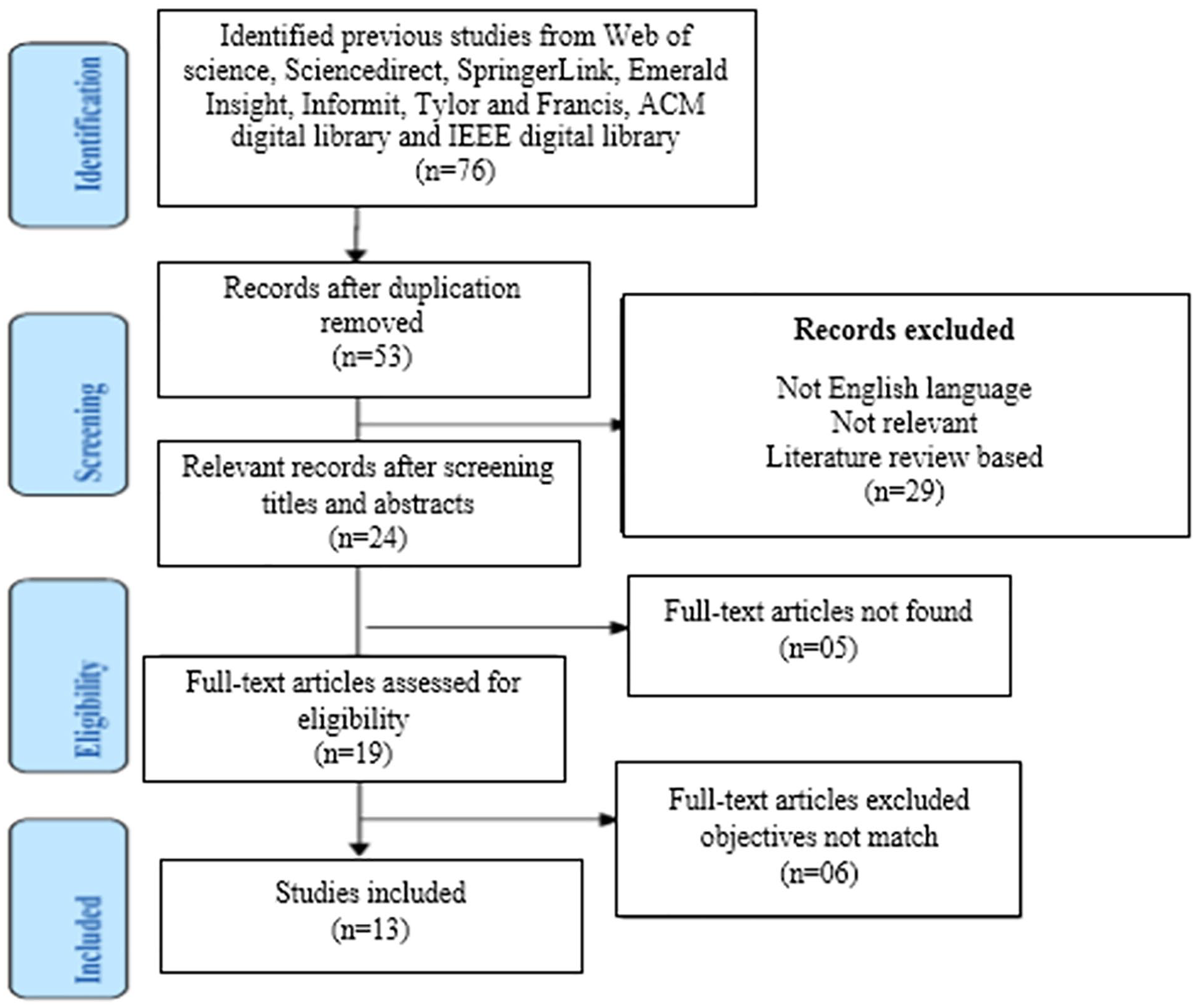
Flow diagram of the selection process of studies.
Analysis and Synthesis
Researchers scrutinized all selected articles. NVivo software was used to create themes related to the research questions. Researchers read all selected articles again and again according to the objectives of the study. The open coding scheme was chosen and all relevant themes were organized under a broader theme. Open coding is usually used at the first stage of qualitative data analysis. Open coding is helpful in the creation of themes and categories (Khandkar, 2009). Furthermore, open coding is essential for the identification of a basic concept and then interpreting the concept indicators. Open coding permits the investigators to understand the way where to acquire their study therefore they can develop careful and focused concepts about a social issue. Open coding stops a researcher from the conceptual description (Glaser, 2016). Therefore, this study used an open coding scheme to identify the basic concept in the reviewed studies according to the objectives. Once, the coding process was completed, the most relevant themes were developed and arranged. Moreover, the researchers again rechecked, corrected where possible, and merged themes wherever appropriate. The study found themes; interruption overload, work-life conflict/work-family conflict, stress, social network service addiction/email addiction, social overload, and lost productivity that created technology overload. Internet accessibility, the complexity of technology, training, mobile technology, social networking sites, and time management issues were challenges that employees were facing to overcome technology overload. Self-efficacy, training, and time management are strategies to overcome technology overload at the workplace.
Results
This study found 13 studies of technology overload for systematic review. These studies were published from 2010 to 2020 and were conducted in China, Qatar, South Korea, the United Kingdom, and the USA. The reviewed studies were published in different research journals, that is, information systems, internet research, computers in human behavior, educational leadership, economics, occupational health, technology, business, and industrial marketing. The sample population of the reviewed studies was from diverse fields; knowledge workers, managers, students, teachers, doctors, business employees, and salespeople made up the sample size of 61 to 601 with age 20 to 58 years. The qualification of the sample population was secondary school certification for a Ph.D. degree. The reviewed studies used survey questionnaires as data collection instruments. Moreover, reviewed studies used a diversity of theories and models such as bounded rationality, cognitive load theory, human interruption theory, job demand and resource model (JD-R model), conservation of resources theory, the transactional theory of stress and coping, the plan-do-study-act (PDSA) model, social cognitive theory, coping theory, technology fit theory, pertinent stress theory, theory of the law of diminishing return, and demand-control model (Table 2).
Review of Studies on Technology Overload (n = 13).

How Does Technology Overload Affects the Employees’ Performance?
The literature described the following technology overload factors which affected the employees’ performance, that is, interruption overload, work-life conflict/work-family conflict, stress, social network service addiction/email addiction, social overload, and lost productivity (Figure 2).

Factors of technology overload affect employees’ job performance.
Interruption overload
Interruption overload is problematic and it is a result of swapping among several tasks through using multiple technologies at the same time (Aral et al., 2012). Interruption Overload negatively affects the work-related technology usage of workers. Interruptions include task and message reminders, instant messages, email notifications, beep, buzz, and blink of smartphones and tablets (Tams et al., 2020). Communication overload diverts users’ intention and creates an interruption in their tasks. Else, they can save their time and energy and focus on the task at hand (Cao & Sun, 2018). Interruption overload has a significant effect on the job satisfaction of employees and ultimately decreases their productivity (Yin et al., 2018).
Work-life and work-family conflict
Work-family conflict is “a form of inter-role conflict that occurs when the energy, time, or behavioral demands of the work role conflict with those of the family role” (Greenhaus & Beutell, 1985). Work-life conflict is “an extension of work-family conflict reflecting the reality that the work role may interfere with individuals’ other personal life roles and interests. Besides the family role, these can range from time for friends, exercise, military service, education, having time for self and recovery, volunteering, or being active in religious organizations” (Kossek, 2016). Kossek and Lee (2017) conducted a study on “Work-Family Conflict and Work-Life Conflict” and demonstrated that there is strong evidence about distinguishing between work-family conflict and work-life conflict. The current study found evidence that technology overload at the workplace creates interruption overloads which leads to work-life conflict (Tams et al., 2020). This study also found in the reviewed studies that technology overload creates work-family conflict. K. J. Harris et al. (2015) investigated that technology overload is significantly associated with work-family conflict (WFC). This conflict decreases employees’ performance and affects their family life (Tarafdar et al., 2007).
Stress
Technology overload creates work-life conflict, which in turn creates stress and affects the workers’ job performance (Tams et al., 2020). A massive amount of information in the workplace can cause stress. When too complex functions of ICT in the workplace are implemented and empower complicated multitasking, it may cause conflict between employees and ICT functions, increasing stress. This stress leads to job dissatisfaction (Yin et al., 2018). Increased stress level leads to inefficiency in job performance (Delpechitre et al., 2019; K. J. Harris et al., 2013; Karr-Wisniewski & Lu, 2010). Excessive demands of ICT at the workplace may cause an overload on human cognition, which leads to stress. Technology overload creates social networking sites stress (Choi & Lim, 2016; Lee et al., 2016). Communication which required fewer intellectual and cognitive resources in return create less stress level and overwhelmed people (Cao & Sun, 2018). ICT-related stress and role stress decrease the productivity of employees. Low levels of technology-related stress and role stress increase the productivity level of employees (Tarafdar et al., 2007). System features are external stressors which updated frequently in the social media context. Social media comprises stressors that crate internal strain that motivate users to continue or discontinue social media (Fu et al., 2020). Saunders et al. (2017) findings showed that polychronic individuals have faceless technology overload than monochronic.
Social network service addiction/email addiction
Social Network Service (SNS) addiction and e-mail addiction are found that are being causes of technology overload. The terms “excessive use,” “addiction,” “dependency,” and “problematic use” are often used interchangeably to state the negative usage of SNS (Chan et al., 2014). This SNS addiction negatively impacts the psychological well-being of employees (Choi & Lim, 2016). Addiction to using social media and the internet negatively impacts people. To prevent addiction, an addiction system should be introduced to save users’ time (Cao & Sun, 2018).
Social overload
Technology overload may cause social overload. Choi and Lim (2016) showed that social overload created by the increased SNS usage duration affects the job performance of employees. Social overload creates tiredness in users which leads them to discontinuity of social media usage (Fu et al., 2020). Social overloads were considered a predictor to create exhaustion and negative emotions among scholars (Cao & Sun, 2018).
Lost productivity
Technology overload loses the productivity of employees in the workplace (Tams et al., 2020; Yin et al., 2018). Complexity in the design and functionality of new technology creates technology overload which drops the productivity level of employees (Lee et al., 2016; Schwartz, 2016). Technology overload leads to loss of productivity instead of gain (Karr-Wisniewski & Lu, 2010; Karr-Wisniewski et al., 2011). Technology advancement leads to technology overload which creates interruptions and forces employees to spend the least effort in adapting and using technologies at the workplace. This leads to low productivity and inefficiency in the workplace (Delpechitre et al., 2019). The complex features of ICTs create stress and decrease the productivity of employees (Tarafdar et al., 2007).
Why Technology Overload Has Challenges for Employees at the Workplace?
This study found different challenges faced by employees at the workplace, that is, internet accessibility, the complexity of technology, training, mobile technology, social networking sites, and time management issues (Figure 3).
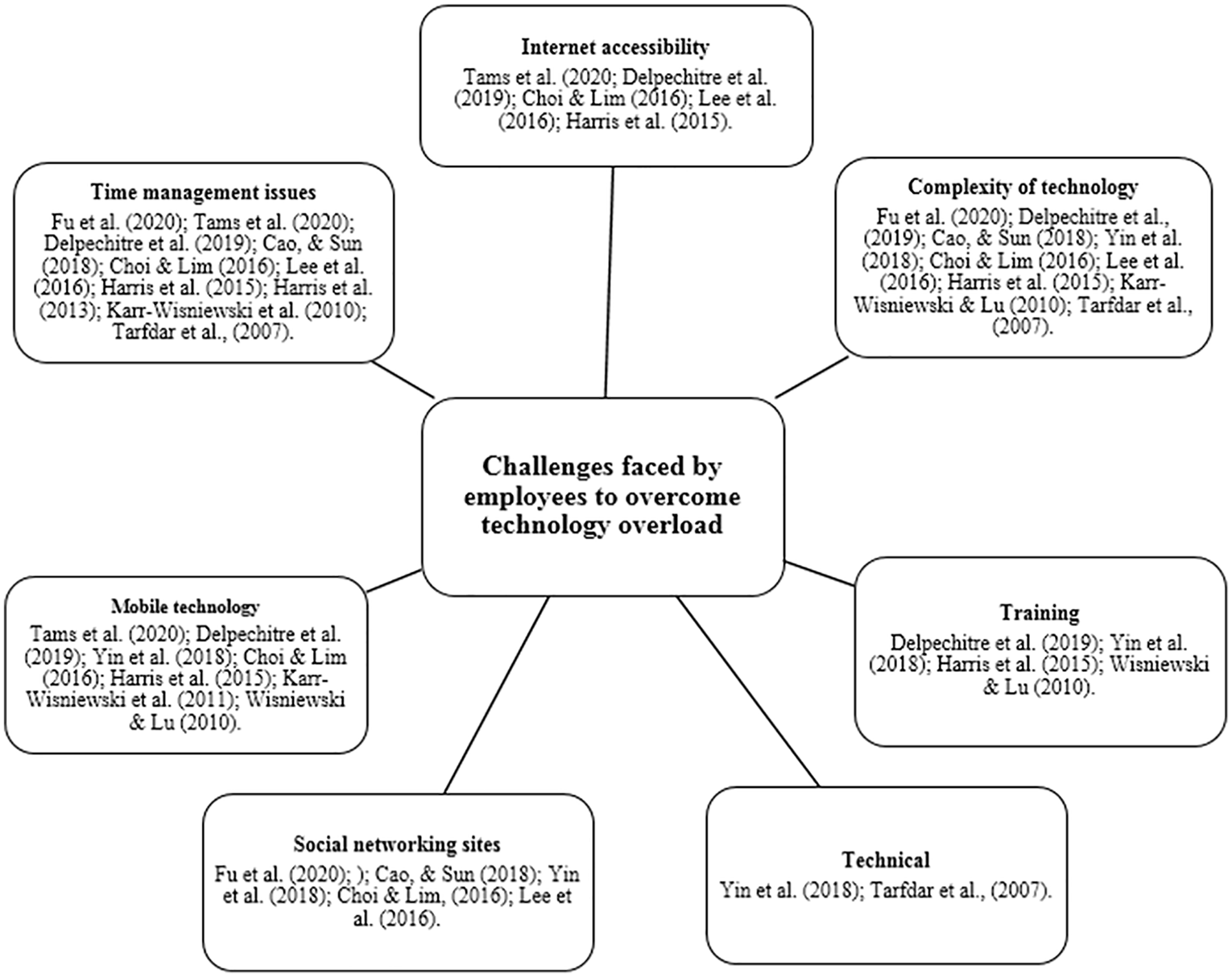
Challenges faced by employees to overcome technology overload.
Internet accessibility
Internet accessibility has negative consequences on the job performance of employees (Choi & Lim, 2016; Delpechitre et al., 2019). The explosion of the internet introduced information overload and changed technology features rapidly (K. J. Harris et al., 2015; Lee et al., 2016).
Complexity of technology
Technology features, design, and functions are more complex which creates technology overload. A complex technology environment forced employees to complete a task efficiently and communicate and coordinate with others. Specifically, mobile technology increased workplace complexity (Yin et al., 2018). Technology complexity increased the workload of employees and created uncertainty (Choi & Lim, 2016). Technology complexity created system feature overload which produced system fatigue and stress. Employees have to face technology overload due to too many new and complex functions in system software (Lee et al., 2016). Employees have to spend more energy, effort, and time to complete a task in a complex technology environment. Complex systems at the workplace created work-family conflict (K. J. Harris et al., 2015). Complex technology impacts the performance of employees and creates stress. It affects negatively the use of technology in the workplace (Delpechitre et al., 2019). Employees feel frustrated by the complex features of new technology that affect negatively their productivity at the workplace. They showed incapability to deal with complex technology features (Tarafdar et al., 2007). People feel social media overload due to the complexity of the system (Cao & Sun, 2018). Complex software packages reduce systems’ usability and affect employees’ job performance (Karr-Wisniewski & Lu, 2010). The complex system features lead users toward discontinuous behavior (Fu et al., 2020).
Training
Limited training at the workplace created stress, anxiety, and loss of productivity. It leads workers toward technology overload. Better training in full software packages can increase productivity and reduce unnecessary distractions instigated by technology overload (Karr-Wisniewski & Lu, 2010). Insufficient training of employees before implementing new technology in the workplace reduces the performance and productivity of employees. The technology that is implemented without adequate training may create technology overload. Delpechitre et al., 2019; K. J. Harris et al., 2015).
Technical skills
Low technical skills in employees become a hurdle to using new technology in the workplace (Yin et al. (2018). Employees have inadequate skills to use new technologies and they have to spend more effort and time understanding technical aspects and completing a task (Tarafdar et al., 2007).
Mobile technology
Mobile technology usage has rapidly increased in the workplace and has affected employees’ work and family life (Tams et al., 2020). Mobile technology reduced job satisfaction and work production of employees. However, it is difficult for employees and employers to reduce the negative effects of mobile technology overload in the workplace (Yin et al., 2018). Smartphone usage at the workplace is problematic and a source of technology overload (Choi & Lim, 2016). Mobile phones can be checked at any time and any place. It causes interruptions at the workplace and reduces the productivity of knowledge workers. Mobile devices have harmed the performance and daily life activities of workers (Delpechitre et al., 2019; K. J. Harris et al., 2015; Karr-Wisniewski et al., 2011; Karr-Wisniewski & Lu, 2010).
Social networking sites
Social networking sites (SNS) produce technology overload and create stress in users as well as distract employees from their given tasks (Lee et al., 2016). Social media has changed communication mediums from face-to-face to online. Social media provide more information than the users’ capability to process it which in turn creates social media exhaustion and discontinuous behavior (Fu et al., 2020). The frequent use of SNS leads to SNS addiction, which creates technology and social overload (Choi & Lim, 2016). Social media impacts negatively the employees’ job performance (Yin et al., 2018). Social networking sites bring uncontrollable information and communication which exhaust SNS users. An unpleasant situation is created for the users and they divert their intention from their’ original purpose (Cao & Sun, 2018).
Time management issues
Time management issues at the workplace have created stress and reduced productivity. Employees spend more time replying to business e-mails which reduces their daily job performance. Technology overload leads employees to disconnect their devices after work hours. More complex and time-consuming tasks are the demands of a workplace that create technology overload. New technology implementation requires extra time to learn complex features which creates stress and burden on employees and reduces overall organizations’ productivity (Delpechitre et al., 2019; Karr-Wisniewski et al., 2011). Technology overload is associated with long working hours, which create job dissatisfaction and reduce job performance. Extended time at work hours creates technology overload (K. J. Harris et al., 2013, 2015). Employees spend more time completing a task and facing stress that they have limited time for family and friends, creative thinking, and analysis. It affects the mental health of employees and creates technology overload (Lee et al., 2016). Employees have very limited time to complete a task and more time spent on SNS reduces job performance and creates stress and burden. Social media addiction creates issues of time management. Uncontrollable information and communication overload also create time management issues (Cao & Sun, 2018; Fu et al., 2020). Due to limited time, employees cannot perform a task effectively (Choi & Lim, 2016; Yin et al., 2018). Increased time at the workplace creates work-family conflict and reduces job performance (Tams et al., 2020). Employees have to spend more effort and time in understanding technical aspects and completing a task. Modifications in the systems sometimes slow down the systems and take more time in troubleshooting creating dissatisfaction among employees and leading to low productivity. People have to spend more time learning to use new information and communication technologies. . Multitasking also required more time to complete tasks at hand and increases role stress and decreases job productivity. Information and communication technology is creating more information and employees have to spend more time and effort sorting relevant information (Tarafdar et al., 2007).
What Are the Strategies to Overcome Technology Overload?
This article found some strategies that can be used to overcome technology overload in the workplace, that is, self-efficacy, training, and time management (Figure 4).

Strategies to overcome technology overload.
Self-efficacy
Self-efficacy is a belief of an individual that his abilities are supported to fulfill a given task (Bandura, 1977). In technology self-efficacy, employees believe that they are capable of using new technology and can complete a given task (Gelbrich & Sattler, 2014). Self-efficacy of individuals helps them to enhance their technical skills and control their overload behavior as well as reduce stress (Tams et al., 2020; Yin et al., 2018). Technology self-efficacy of salespeople helped them to reduce technology overload and employees more confidently handled technology devices. Technology self-efficacy enhanced employees’ perceived effort to use new technology and had a positive impact on the employees’ job performance (Delpechitre et al., 2019; Karr-Wisniewski et al., 2011).
Training
Training programs help employees to overcome technology overload. Training support people to use technology confidently, which reduces technology overload and increases job performance and it is a major driver of productivity. Effective training increases employees’ effort to use technology (K. J. Harris et al., 2013). Training decreases information overload and supports employees to use complex systems (K. J. Harris et al., 2015). Training of employees in new technology at the workplace may reduce stress and increase the productivity of employees (Tarafdar et al., 2007). Without sufficient training, employees cannot improve learning even when they put their full potential to use the best technology in the world. Technology overload can be released by proper training of teachers to use new technology. Better training and IT support in an organization increases employees’ job performance and decreases technology overload. Training motivates employees to complete complex tasks at the workplace and boosts their productivity (Delpechitre et al., 2019; Karr-Wisniewski et al., 2011).
Time management
Time management can reduce technology overload. Fixed time slots for the different tasks at work can decrease technology overload and help to increase job performance (Delpechitre et al., 2019; Karr-Wisniewski et al., 2011; Karr-Wisniewski & Lu, 2010; Tarafdar et al., 2007). A centralized reply system and delay in response can control time management issues. Logging out is also a tactic to manage time after using social media in the workplace or at home (Cao & Sun, 2018). Technology overload can decrease effective time management for a given task at the workplace (K. J. Harris et al., 2013; Table 3).
Comparison of Review of Studies on Technology Overload (n = 13).

Discussions
This is a systematic review study. This study found 13 relevant articles on the topic of technology overload with the perspective of the workplace to investigate the effect of technology overload on the employees’ performance as well as find out challenges that employees are facing at the workplace. Furthermore, this study also finds out strategies by the review of the relevant selected studies to overcome technology overload. The study has employed three research questions to explore the phenomenon of technology overload in the workplace. The findings of the study presented that interruption overload leads to inefficiency of work performance of employees and creates negative emotional feelings as well as negative impacts on job satisfaction. It also impacts individuals’ behavior to do the task at hand (Duke & Montag, 2017; Montag & Walla, 2016; Yin et al., 2018). When digital devices are not involved, they reduced interruptions in the workplace, and efficiency and productivity increase (Miksch & Schulz, 2018). Interruptions create stress and reduce workers’ interest to use work-related technologies and shift the attention of employees from a task and affect their performance (Iqbal & Horvitz, 2010). Work-life conflict is a factor that occurs when family demands and work demands conflict with each other. Due to technology frequently being used at the workplace, employees have to make themselves available after working hours and check emails and messages. This conflict decreases employees’ performance and affects their family life (Ciolfi & Lockley, 2018; Sarker et al., 2018; Tams et al., 2020; Tarafdar et al., 2007, 2010, 2011). Work-family conflict is “a form of inter-role conflict in which the role pressures from the work and family domains are mutually incompatible in some respect” (Greenhaus & Beutell, 1985, p. 77). Employees have to work longer hours than work hours, so they go back home with feelings of burden, stress, and with an energy-less mind. This creates conflict between work and family of workers and ultimately negatively affects job performance and family life (R. B. Harris et al., 2012; K. J. Harris et al., 2015). Information and communication technology has disturbed the work time and family time due to the easiest and fastest sources of information sharing and complex technology features (Tarafdar et al., 2007). Employees’ home has been extended into offices due to the implementation of the latest technology at the workplace, employees can work more flexibly by using mobile at home; on the other hand, it leads to increased levels of stress, anxiety, email, and SNS addiction as well as unhealthy work patterns (Rutter, 2016). Technology overload enhances stress levels that lead to inefficiency in job performance (Delpechitre et al., 2019; K. J. Harris et al., 2013; Karr-Wisniewski & Lu, 2010; Ragu-Nathan et al., 2008; Tarafdar et al., 2011).
SNS addiction is another factor; leads to spending too much time using SNS and “losing track of given task and control of time.” Technology overload refers to SNS addiction. Technology inspires users for information seeking, entertainment, pastime, a complete organizational task which ultimately encourages addiction and distract workers from a given task, and effect on job performance of employees (Chan et al., 2014; Choi & Lim, 2016; Greenfield, 2011). SNS addiction negatively impacts the psychological well-being of employees (Choi & Lim, 2016; Kim & Lee, 2011). Technology overload leads to SNS addiction which creates conflict in job performance (Koc & Gulyagci, 2013; Turel & Serenko, 2012). SNS addiction negatively affects the everyday life of employees and individual concerns, that is, psychological well-being (Helms & Demo, 2005). E-mail addiction is the result of technology accessible to employees at home. It is causing technology overload which leads to email addition and affects the job performance of employees (Rutter, 2016).
The findings of the study showed that technology overload may cause social overload. Users are forced to respond and increase SNS usage duration which creates social overload and affects employees’ job performance. Social overload has bad psychological and social consequences (Choi & Lim, 2016). Technology overload results in the loss of focus and productivity of employees in the workplace (Hung et al., 2011; Tams et al., 2020; Yin et al., 2018). Complexity in the design and functionality of new technology creates technology overload which drops the productivity level of employees (Lee et al., 2016; Schwartz, 2016), that is, accuracy, efficiency, and performance (McFarlane & Latorella, 2002). Technology overload is linked to undesirable results, that is, higher levels of stress, tension, and lower productivity (Diaz et al., 2012). When technology overload happens, it leads to a loss of productivity instead of gains (Delpechitre et al., 2019; Karr-Wisniewski et al., 2011). Mobile and internet usage were the main productivity killers at the workplace. Employees are being distracted by their devices and resulting in proximately 3 hours of productivity lost (www.careerbuilder.com). More dependency on technology leads to technology overload and the lost productivity of knowledge workers (Karr-Wisniewski & Lu, 2010; Ragu-Nathan et al., 2008).
The study found challenges that employees have to face to overcome technology overload. Internet accessibility is found as a challenge that has negative consequences. Due to internet connectivity, employees can be accessed at anytime and anywhere (Ayyagari et al., 2011; Choi & Lim, 2016; Delpechitre et al., 2019). Too many ways of connectivity interrupt people at the workplace and create technology overload (Karr-Wisniewski & Lu, 2010).
The other studies also supported the findings that with the adoption of technology in the workplace, work task has been more complex, and the cognitive overload of employees has been increased (Speier et al., 2003). ICT leads to more complicated functions and complex multiple tasks at the workplace, due to this, a misfit situation was created between employees and technology, as a result, it leads to technology overload (Ragu-Nathan et al., 2008). System complexity needs more effort to learn a new technology resulting in creating stress, burden, and anxiety in workers (Ayyagari, 2012; Ayyagari et al., 2011; Çoklar & Sahin, 2011). When technology is too complex for the given task, system feature overload arises. The complex design of software may cause “feature fatigue” or feature creep,” which affects human cognition negatively. Too many complex software packages slow down the usability of the system and reduce the productivity of employees (Hsi & Potts, 2000; Karr-Wisniewski & Lu, 2010; Thompson et al., 2005). Teachers have to spend their precious time handling complex technology (Beveridge, 2018). Limited technical skills and training for employees at the workplace lead them to technology overload (Beveridge, 2018; Delpechitre et al., 2019; K. J. Harris et al., 2015; Karr-Wisniewski & Lu, 2010; Schwartz, 2016; Yin et al., 2018).
Mobile technology is the source of technology overload. It has impacted work behavior and technology usage at the workplace (Ayyagari et al., 2011). Many employees even don’t know a lot of the functions of smartphones (Oulasvirta et al., 2012). Mobile phones can cause interruptions in the workplace and reduce the productivity of knowledge workers. Mobile devices have harmed the performance and daily life activities of workers. Employees feel they are always at their workplace (Delpechitre et al., 2019; Duke & Montag, 2017; K. J. Harris et al., 2015; Karr-Wisniewski et al., 2011; Karr-Wisniewski & Lu, 2010; Montag & Walla, 2016).
The findings showed that social networking sites (SNS) yield technology overload and produce stress in users as well as distract employees from their given task (Lee et al., 2016). Too much information creates frustration and anxiety. SNS provides an explosion of information regarding personal life, jobs, skills, news, and entertainment without the interest of users, which creates information overload and affects negatively the performance of workers. SNS increase stress level and mental fatigue (Çoklar & Sahin, 2011; Lee et al., 2016; Ravindran et al., 2014). Users spend more time and energy which cause SNS fatigue (Cao et al., 2016; Choi & Lim, 2016; Fox & Moreland, 2015). Social media impacts negatively the employees’ job performance (Cao et al., 2016; Yin et al., 2018).
The findings showed that time management is a challenge that employees and organizations have to face to overcome technology overload. Long working hours create stress. Globalization refers to work across different time zones, which creates work-family conflict. SNS requires more time to respond to received messages which creates stress and technology overload (LaRose et al., 2014; Lee et al., 2016; Rutter, 2016). ICT requires adequate time to use for a specific purpose. Increased time at the workplace creates work-family conflict and reduces job performance (Riedl & Fischer 2018; Tams et al., 2020; Tarafdar et al., 2007).
This study also explored strategies to overcome technology overload. Self-efficacy reduces social networking site addiction. More computer self-efficacy of men than woman help them to decrease technology overload. Technology self-efficacy enhanced employees’ perceived effort to use new technology and had a positive impact on the employees’ job performance (Choi & Lim, 2016; Delpechitre et al., 2019; Karr-Wisniewski et al., 2011).
Training helps employees to use complicated systems effectively and reduce information overload (K. J. Harris et al., 2015; Soucek & Moser, 2010). Training educates employees about new technology and they gain new skills. It encourages employees to use new technology with full effort, energy and confidence and better understand its features. Training protects employees’ emotional health and decreases stress levels (Rutter, 2016). Employees can better perform organizational tasks due to effective training in the art workplace (Ahearne et al., 2005; Beveridge, 2018; Delpechitre et al., 2019; Karr-Wisniewski et al., 2010). Time-saving technologies reduced technology overload. Full-time employees face frustration and mental fatigue (Schwartz, 2016). Time management helps reduce technology overload at the workplace. Employees should choose one communication medium at a time for a specific time to respond after work hours and fix a time slot to unplug for rest and recharge for the next day (Tucker, 2016). In 2017, the French Government established a law that during personal time, employees can no longer be expected to respond to office emails (www.time.com).
Theoretical and Practical Implications
Technology overload is a new phenomenon in the field of human-computer interactions. The awareness of this phenomenon at the workplace may motivate technology users to adopt strategies to overcome it and increase their job performance. The findings may offer precious insights on behalf of organizations, workplace managers, and administrations to adopt technology that are more convenient for the workers or users as well as provide training aids to use new technologies. There should be defined policies to disconnect the internet after work hours to eliminate work-family and work-life conflicts.
The findings of the systematic review may a comprehensive addition to the field of information and communication studies, especially in computers and human behavior. Furthermore, researchers may identify the phenomenon of technology overload in the workplace and its factors, and challenges as well as may be aware of strategies to overcome technology overload.
Research Limitations and Future Research
This study has reviewed articles and identified remarkable insights into technology overload in the workplace. Though, the study has certain limitations; first, this study has found a limited number of empirical studies on the topic of technology overload. Secondly, reviewed articles only focused on the citizens’ perspective regarding technology overload in the workplace. Thirdly, this study was limited to published articles in the language of English on technology overload that might be missing valuable studies in this field other than the English language. Fourthly, this study used the search query “technology overload” OR “techno-overload,” “technostress,” and “workplace,” search terms techno-invasion, technophobia, and other related terms may be missed in some important studies. Furthermore, this study has also limitations regarding selected studies for the review. This study selected only those articles which more suitable according to the objective of the study.
This study has found limited studies on the topic of technology overload so more literature needs to be published on this topic. Future studies may have the potential to assess factors of technology overload affecting the other major group of technology users, that is, students. A comprehensive study might be possible to conduct a meta-analysis on technology overload or techno-overload.
Conclusion
We reviewed the studies published on technology overload from a workplace perspective. We found multiple factors that affect the workers to eliminate their job performance, as well as work-family and work-life conflicts, increased that ultimately produce job dissatisfaction and stress. Moreover, the study established findings that technology overload has a challenge in terms of the internet accessibility, the complexity of technology, less training, mobile technology, social networking sites, and time management. Furthermore, this study also identified strategies to overcome technology overload challenges and reduce factors that are affecting employees such as self-efficacy, good training, and time management techniques. We have recommendations for the organizations to offer training programs and workshops before the implementation of new technology or software packages at the workplace. Administrations should implement the “right to disconnect” policies at the workplace to overcome technology overload.
Supplemental Material
sj-docx-1-sgo-10.1177_21582440221114320 – Supplemental material for Examining the Impact of Technology Overload at the Workplace: A Systematic Review
Supplemental material, sj-docx-1-sgo-10.1177_21582440221114320 for Examining the Impact of Technology Overload at the Workplace: A Systematic Review by Tayyba Rasool, Nosheen Fatima Warraich and Muhammad Sajid in SAGE Open
Footnotes
Declaration of Conflicting Interests
The author(s) declared no potential conflicts of interest with respect to the research, authorship, and/or publication of this article.
Funding
The author(s) received no financial support for the research, authorship, and/or publication of this article.

Supplemental Material
Supplemental material for this article is available online.
References
Supplementary Material
Please find the following supplemental material available below.
For Open Access articles published under a Creative Commons License, all supplemental material carries the same license as the article it is associated with.
For non-Open Access articles published, all supplemental material carries a non-exclusive license, and permission requests for re-use of supplemental material or any part of supplemental material shall be sent directly to the copyright owner as specified in the copyright notice associated with the article.
