




Abstract
With the rapid advancement of artificial intelligence (AI) technology, the advertising industry is at a crossroads of new opportunities and challenges. This pioneering study provides an in-depth review of AI’s application in advertising, focusing especially on four key elements: Targeting, Personalization, Content Creation, and Ad Optimization. By delving deep into these areas, we uncover the potential of AI in revolutionizing the advertising sector. At the same time, we discuss the pressing ethical issues arising from the current applications of AI in advertising-related fields. Using the VOSviewer software, this study conducts an in-depth analysis of the literature, revealing the intrinsic connections of these four key elements in AI advertising based on computational advertising: Targeting and Personalization are closely linked, jointly determining who gets shown which advertisements. Content Creation generates appealing advertising content through AI during the Personalization process, while Ad Optimization relies on the outcomes of the first three elements, adjusting ad displays to achieve the highest return on investment. This research offers a fresh perspective on understanding AI’s application in advertising, aiding in the responsible and effective use of AI technology for superior ad delivery.
Introduction
With the rapid progress of artificial intelligence (AI) technology in recent years, we are witnessing its expanding applications across various domains, bringing significant transformations to industries such as advertising, media, e-commerce, education, and more (B. Gao, 2023; B. Gao & Huang, 2021; Kietzmann et al., 2018; Murgai, 2018). The advent and growth of AI have laid a technical foundation for intelligent operations in the advertising industry (Lai, 2021).
Specifically, AI is increasingly employed in advertising Targeting, Personalization, Content Creation, and Ad Optimization (Bhatt, 2021; Campbell, Plangger, Sands, Kietzmann, Bates, 2022; Jaiwant, 2023; Malthouse & Copulsky, 2023; Nikolajeva & Teilans, 2021). By analyzing consumer behavior, AI technology offers valuable insights that aid advertisers in formulating more effective strategies, this enhances the efficiency of advertisement information processing and decision-making (e.g., Malthouse & Copulsky, 2023; Mühlhoff & Willem, 2023), representing breakthroughs in the field. In the realm of advertising Targeting, various machine learning techniques can be employed to enhance targeted online advertising (Dwivedi, Hughes, et al., 2021; Mühlhoff & Willem, 2023), especially in optimizing target audience scope, significantly improving the ability to segment target users (Chandra et al., 2022; Choi & Lim, 2020). For instance, McDonald’s has adopted advanced AI decision-making techniques to optimize its ad Targeting strategies. By analyzing real-time data on weather, time, popular menu items, and current restaurant traffic, McDonald’s AI system dynamically adapts the menu board presentation in advertisements, ensuring the most suitable menu options are precisely pushed to the target users (Haleem et al., 2022). Regarding advertising Personalization, nowadays, with the aid of advanced AI technologies, personalized recommendation systems have become indispensable tools (Laux et al., 2022; Nikolajeva & Teilans, 2021) for internet giants like Amazon, YouTube, Netflix, Yahoo, and Facebook. This allows them to provide users with personalized ad content that better aligns with their needs and interests (Q. Zhang et al., 2021). Speaking of advertising Content Creation, in the era of Generative AI, the accessibility threshold for AI technology has considerably decreased. Generative AI technologies can help creative teams generate diverse and rich advertising content by analyzing vast amounts of data and information (Wiredu, 2023; C. Zhang et al., 2023). For example, Lexus cars generated an “intuition-driven” ad script. The ad content can be real-time optimized based on location, time, and various customer profiles (Huang & Rust, 2021). Incorporating Generative AI into advertising campaigns and content creation processes can enhance creative quality and ad impact. Furthermore, with Deep Learning and Reinforcement Learning techniques, Ad Optimization tailors advertisements more closely to users’ actual needs, enhancing advertisement efficacy and user purchase conversion rates (Mühlhoff & Willem, 2023; Nikolajeva & Teilans, 2021; X. Zhang et al., 2017). For instance, eBay supports its AI initiatives by constructing descriptive and predictive models, which can provide users with precise or near-precise ad content based on price points and other requirements (Kumar et al., 2019).
The aforementioned Targeting, Personalization, Content Creation, and Ad Optimization can be viewed as the four key pillars of AI advertising based on Computational Advertising. They each cover essential parts of Computational Advertising and collaboratively function within the entire advertising ecosystem, aiming to maximize advertising effectiveness and return on investment (ROI).
The theoretical foundations of Computational Advertising primarily focus on four main concepts, providing a theoretical framework for this study. First, user modeling as a common approach in Computational Advertising is to construct user models that predict a user’s response to specific ad content, typically based on the user’s browsing and purchase history, social media engagement, and demographic information (C. Gao et al., 2019; Kesharwani, 2020; Mogaji, Olaleye, & Ukpabi, 2020). This analysis can identify patterns and trends in consumer behavior (Mogaji, Olaleye, & Ukpabi, 2020; Mogaji, Soetan, & Kieu, 2020; Shah et al., 2020; Tan et al., 2010), which forms the theoretical foundation of Targeting. Second, personalized recommendation systems are specialized information filtering systems that can predict a user’s liking for a particular item or product (Paschen et al., 2020). They can present in a quantifiable form the consumers’ emotional state towards the advertisement (Kietzmann et al., 2018), providing reference information for ad messaging and tone. Thus, recommendation systems can push ads to users that they might be interested in (Wu & Liu, 2022). These personalized advertisements can increase emotional resonance with consumers (Ziafat & Shakeri, 2014). This concept forms the theoretical foundation for Personalization (Chandra et al., 2022; Viktoratos & Tsadiras, 2021). Third, the theoretical foundation of the Content Creation element comes from Natural Language Processing (NLP), Generative AI, and so on. Their methods and tools can be used to generate or optimize ad texts, images, and videos (Aguilar & Garcia, 2017; Bakpayev et al., 2022). Fourth, Ad Optimization as a core issue in Computational Advertising concerns how to effectively display ads to the most interested users within a limited budget (Nikolajeva & Teilans, 2021), enhancing advertising effectiveness and efficiency using AI technology (Huang & Rust, 2021). The theoretical foundation of this element comes from concepts like the Multi-armed Bandit Problem, Deep Learning, Reinforcement Learning, and Real-Time Bidding (RTB) (Aggarwal et al., 2019).
The four key pillars of AI advertising based on Computational Advertising (Targeting, Personalization, Content Creation, and Ad Optimization) have attracted widespread attention from the academic community and have been extensively studied. For example, a group of researchers studied the domain of Targeting (Bateni et al., 2017; Choi & Lim, 2020; Helsloot et al., 2018; Mühlhoff & Willem, 2023; Theodoridis & Gkikas, 2019). Another group explored the domain of Personalization (Bansal & Gupta, 2023; Campbell, Plangger, Sands, Kietzmann, Bates, 2022; Chandra et al., 2022; Nikolajeva & Teilans, 2021). Some researchers have also studied content creation (Aguilar & Garcia, 2017; Bakpayev et al., 2022; Omar et al., 2022; Smith, 2020; Sun et al., 2022). Researchers also delved into the domain of Ad Optimization (Argan et al., 2022; Gupta et al., 2020; Malthouse & Copulsky, 2023; Nair & Gupta, 2021; Wen et al., 2022). However, the relationships among these elements and how they can be better integrated in the context of AI advertising have not been systematically reviewed. Additionally, existing studies have also highlighted some challenges and ethical issues related to digital advertising, including potential Algorithmic Bias (Dalenberg, 2018), Data Privacy Issues (Helsloot et al., 2018), and Ethical Considerations (Alshurideh et al., 2017; Dwivedi, Hughes, et al., 2021; Munjal, 2016). But overall, when applying AI in advertising, how to handle the accompanying challenges and Ethical Considerations is an essential topic that has not been thoroughly discussed.
Against this backdrop, this study raises a series of research questions: First, how to integrate AI technology to comprehend the interplay between Targeting, Personalization, and Content Creation in the domain of Computational Advertising? Second, how can the understanding of the interplay between Targeting, Personalization, and Content Creation be harnessed to further enhance Ad Optimization through AI technology? Third, what challenges and ethical issues are likely to be encountered in the application process of AI in advertising?
To tackle the aforementioned research questions, the objectives of this study are outlined as follows: First, to review and understand the three elements of Targeting, Personalization, and Content Creation, and their interplay in AI advertising based on Computational Advertising. Second, to explore Ad Optimization and how understanding the interplay among Targeting, Personalization, and Content Creation can be harnessed to promote Ad Optimization further. Third, to reveal and analyze the challenges and ethical issues that might be encountered when applying AI in the advertising domain, and to propose effective resolution strategies.
Methodology
Systematic Literature Review is categorized into domain-, theory-, and method-based reviews (e.g., (He & Zhang, 2023; Palmatier et al., 2018)). Specifically, when conducting a domain-based Systematic Literature Review, researchers can choose multiple methods, including but not limited to literature reviews and bibliometric analyses (Lim et al., 2022).
We adopted a literature review combined with bibliometric analysis methods to achieve our research objectives. The literature review ensures an in-depth exploration of key themes and findings in the literature; meanwhile, Bibliometric analysis provides insights into the developmental trends of literature in the field, the dynamic changes of disciplines, and the collaboration and communication among scientists. This includes Keyword Co-occurrence Analysis, Bibliographic Coupling Analysis, Co-citation Analysis, Citation Analysis, Co-authorship Analysis, and more (e.g., Baker et al., 2020; Mariani et al., 2023). Our study not only emphasizes the depth and breadth of the literature but also underscores structured visualization. We filtered and categorized the literature based on pre-defined key elements and then quantitatively analyzed the literature using bibliometric analysis, deeply identifying the main research trends, keywords, and themes. Finally, we conducted an in-depth analysis and discussion of the reviewed literature.
Search Strategy
For this study, we selected Scopus as our retrieval database. Among the several citation databases, Scopus is renowned for its extensive and extensive coverage and is considered one of the most authoritative peer-reviewed literature databases. Both in breadth and depth, Scopus offers a rich array of materials, earning it widespread recognition and acceptance in the global academic community (Pranckutė, 2021).
Using Scopus as a single database for bibliometric analysis offers several distinct advantages. Firstly, Scopus ensures data consistency and standardization, avoiding discrepancies in standards and policies across different databases. As one of the world’s largest abstract and citation databases, it provides a comprehensive view of literature. Its high-quality data is frequently updated, ensuring accuracy and timeliness. Scopus boasts robust citation data functionality, supporting in-depth citation analysis and offering advanced search tools. Moreover, its integration capabilities with tools like VOSviewer enhance the complexity of bibliometric analysis. Utilizing Scopus also helps prevent data redundancy and enhances research efficiency.
To gather data, based on the research objectives of this paper, we devised a Search String to retrieve the required literature for this study. The systematic literature review’s retrieval took place in July 2023. We selected keywords related to AI and the advertising domain for the Search String. Specifically, the keywords were AI, advertising, targeting, personalization, content, and optimization. We then linked these keywords using Boolean operators, resulting in the Search String: “AI” AND “Advertising” AND “Targeting” OR “Personalization” OR “Content” OR “Optimization.”
Selection of Considered Literature
After conducting the search using the Search String, we retrieved 269 publications. We first filtered a dataset encompassing subjects such as Computer Science, Business, Management and Accounting, and Social Sciences, totaling 249 publications. After retaining only English publications, we finally obtained 241 publications, which included various types of literature, such as articles, conference papers, and books. We downloaded the complete records of the literature, including the full names of authors, the corresponding countries of authors, publication date, abstract, keywords, journal source, references, citation count, average citation per paper, and the number of citing references. Figure 1 displays the search and selection steps of the literature.

Search and selection of considered literature in this study.
Figure 2 represents the annual distribution of literature in AI in the advertising domain, showcasing the overall growth trend of the literature. As shown in Figure 2, the considered literature ranged from 1998 (1 publication) to 2023 (21 publications, provided until July). There is only one publication before 2001, which was in 1998.

Annual distribution of considered literature.
Results
Keyword Co-Occurrence Analysis
Keyword co-occurrence network diagrams depict the research hotspots within a discipline. To understand the research progress of AI in the advertising domain, we utilized the most recent official version of the VOSviewer software, which is VOSviewer_1.6.19., to create a keyword co-occurrence network diagram for the 241 publications, selecting 117 key keywords related to the study for visualization. The results are shown in Figure 3. The more frequently a keyword appears in the diagram, the larger the node, indicating that it represents a research hotspot in the AI advertising domain. The lines between nodes represent the connections between keywords. The thicker the line, the more often the two keywords appear together in the same publication. The colors indicate different clusters. Based on Figure 3, four main Clusters can be distinguished regarding the application of AI in the advertising industry.
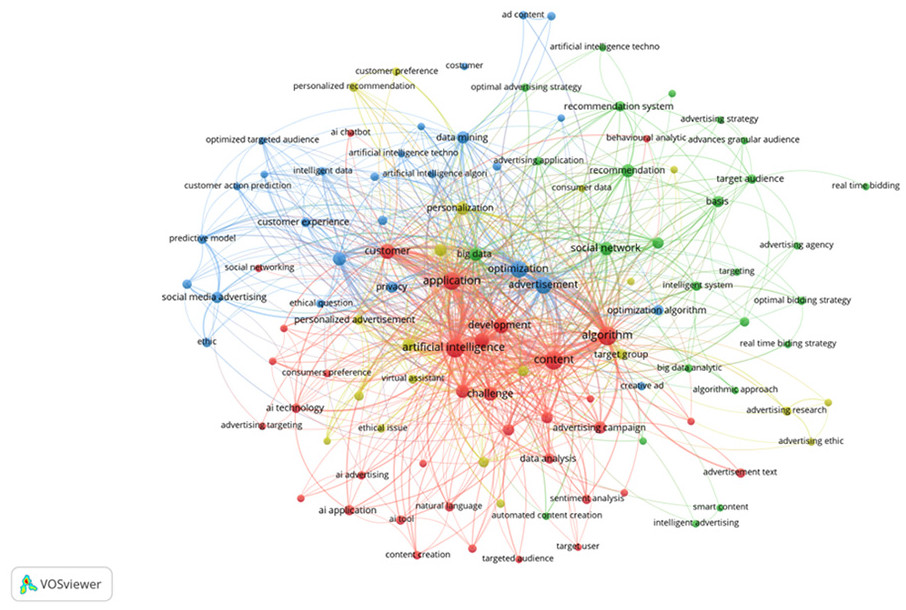
Keyword co-occurrence network in the Scopus dataset.
In the green Cluster, the most common keywords include big data, prediction, and Targeting. This suggests that domains such as Big Data Analytics, Machine Learning Algorithms, and Behavioral Prediction are related to the crucial element of Targeting in the advertising industry. Literature analysis indicates that advertisers can use AI to identify target audiences, predict consumer behaviors, and control ad placements’ content, frequency, and timing, creating more effective advertising campaigns.
In the yellow Cluster, the keywords Personalization, personalized recommendation, and Virtual Assistant are strongly associated. The keywords in this Cluster indicate that personalized advertising is closely related to personalized recommendations, Virtual Assistants, and consumer preferences. Personalized advertising, with the help of AI technology, can increase consumer engagement in advertising campaigns.
In the red Cluster, the most frequent keywords are AI, content, and algorithm. In this Cluster, domains like NLP, data analysis, and Content Creation are associated with AI and advertising content. The literature suggests that AI is a vital tool for advertising Content Creation. Advertisers use NLP and Generative AI to analyze consumer information, helping create more personalized and appealing advertising content.
In the blue Cluster, the most frequent keywords related to Ad Optimization are advertisement, optimization, optimized targeted audience, and keywords related to data mining and analysis like data mining, data collection, and predictive model. This Cluster corresponds to the element of Ad Optimization in the advertising industry application, which is closely related to machine learning algorithms. Literature analysis indicates that advertisers can use algorithms to analyze user data, optimize user metrics, monitor advertising user trends, devise ad optimization strategies, and enhance advertising effectiveness.
Moreover, in the above Clusters, keywords like challenge, privacy, and ethical questions also appear, implying that scholars have given attention to the challenges and ethical issues faced by AI applications in advertising.
Bibliographic Coupling Analysis
We also delved into the connections between literature through a Bibliographic Coupling Analysis. Bibliographic coupling assesses whether two pieces of literature cite the same references, so the more common references they have, the stronger their bibliographic coupling relationship. An analysis through VOSviewer software revealed that out of the 241 publications, 52 cited the same references. As shown in Figure 4, the bibliographic coupling network diagram comprises five Clusters.

Bibliographic-coupling network in the Scopus dataset.
The first Cluster, represented in red, consists of 13 publications, mainly focusing on the current developments and analysis related to AI and digital marketing research. The second Cluster, in green, encompasses 11 publications related to Machine Learning algorithms in AI technology and advertising Content Creation. A significant number of publications in this Cluster involve AI technology and the generation and creation of advertising content. The third Cluster, in blue, comprises 10 publications emphasizing consumer experience and personalized advertising. The fourth Cluster, in yellow, consists of nine publications that revolve around algorithms, models, and Machine Learning, related to Targeting in the application of AI in the advertising industry. The fifth Cluster, in purple, contains eight articles and one conference collection, exploring RTB, predictive analysis, and other Ad Optimization applications of AI in advertising.
Co-Citation Analysis
The analysis results show that, among the 8,119 cited publications referenced by the 241 publications, setting the threshold for the minimum number of citations of a cited reference to 3, 19 pieces of literature (including books, journal literature, and conference literature) remained for co-citation analysis, as shown in Figure 5. The co-citation network of the 19 highly co-cited publications can be divided into six Clusters.

Co-citation network in the Scopus dataset.
Cluster 1, in red, consists of eight publications, mainly pertaining to relevant studies on the application of AI in the advertising and marketing domain. Cluster 2, in green, consists of seven publications, mostly review studies in the AI and advertising marketing-related domain. Cluster 3, in blue, consists of four publications related to AI technology and algorithms.
Citation Analysis
Table 1 lists the top five publications with the most citations, all indexed by Scopus. The paper with the most citations is “Setting the future of digital and social media marketing research: Perspectives and research propositions” (Dwivedi, Ismagilova, et al., 2021), published in the “International Journal of Information Management.” One possible reason for the extensive citations of this article is its ability to consolidate the combined expertise of several top experts in the field of digital and social media advertising marketing. Furthermore, the article offers a detailed exploration of ethical considerations associated with AI, advertising, marketing, and related domains.
Most Cited Papers.

Co-authorship Analysis
Co-authorship Analysis reveals the connections between scholars from different institutions and countries, involving 241 publications with a network co-authored by 662 authors. Authors like Yibo Wang and 19 others form the most strongly connected co-authorship group, as shown in Figure 6. They published “Setting the future of digital and social media marketing research: Perspectives and research propositions” and “IBBAS: A Visual Analytics System of Large-Scale Traffic Data for Bus Body Advertising.” These two papers provide references for the application of AI technology in the advertising domain. Figure 6 illustrates the co-authorship network within the Scopus dataset.

Co-authorship network in the Scopus dataset.
In addition to the co-authorship network among authors, the co-authorship among countries in the network is also significant (Donthu et al., 2020). Figure 7 depicts the co-authorship relationships between countries or regions of the authors of the 241 publications. The global research network on the application of AI in advertising comprises 53 countries or regions. Among them, 13 countries or regions published more than 5 publications, and 7 countries or regions published more than 10 publications. The three countries with larger nodes in Figure 7 are the USA, China, and India, indicating that these three countries have the highest number of publications. The link strength between the nodes shows the intensity of collaboration between countries or regions. The USA has strong linkages with Australia, Canada, and the UK, indicating that these countries collaborate most frequently.
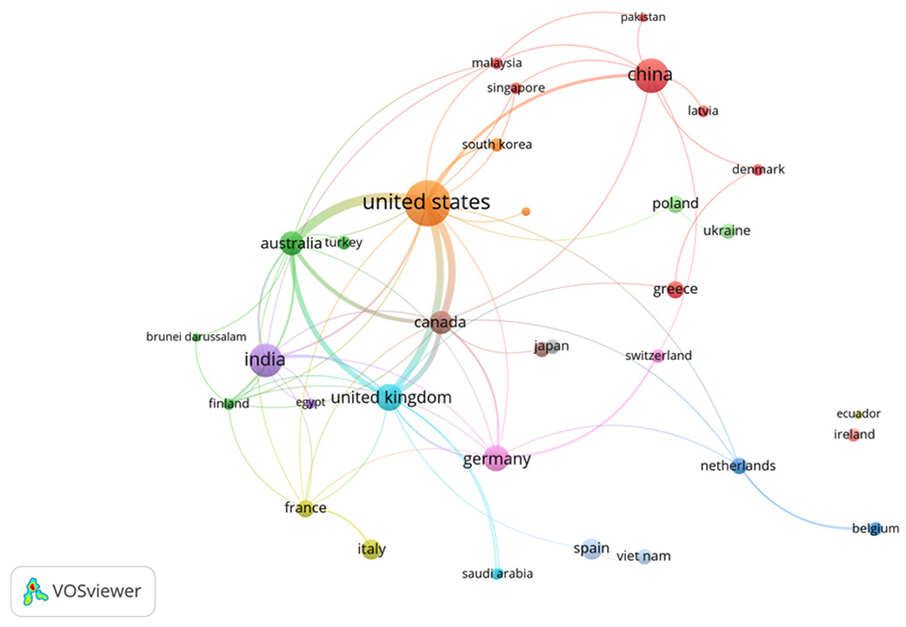
Co-authorship of countries network in the Scopus dataset.
Based on the data analysis, we found that literature regarding AI in advertising can be mainly categorized into four aspects: Targeting, Personalization, Content Creation, and Ad Optimization. There is also attention given to Ethical Considerations related to AI. In the following section, we will delve deeper into these findings.
Discussion
Drawing upon our analysis of the existing literature, we present a theoretical framework centered on AI advertising based on computational advertising. This framework highlights four pivotal dimensions of AI in advertising: Targeting, Personalization, Content Creation, and Ad Optimization. The logic of this study is depicted in Figure 8:

The logic of the discussion section.
From the literature analyzed in this paper, we found that the application of AI in the advertising domain mainly focuses on four aspects: Firstly, Targeting primarily relies on Machine Learning technology to precisely identify and target the audience group most likely to respond positively to the advertisement. Secondly, Personalization mainly uses technologies like the Recommendation System and Virtual Assistant to tailor the most relevant and appealing advertising content for each user. Thirdly, Content Creation utilizes Generative AI and NLP technology to generate creative content that can pique users’ interest. Lastly, Ad Optimization leverages Deep Learning and Reinforcement Learning techniques to adjust advertising strategies dynamically, maximizing advertising effectiveness and ROI. We will delve deeper into these four aspects’ specific applications and practices in the following sections.
Application of AI in Advertising Targeting
Many of the reviewed publications consider Targeting as a crucial element of the application of AI in the advertising industry. Targeting represents a critical application domain of AI in the advertising sector. With the help of AI, advertisers can effectively reach the right audience with the appropriate information at the appropriate moment (Bhatt, 2021; Jaiwant, 2023; Nair & Gupta, 2021; Thareja & Jain, 2019).
Machine Learning serves as the technological foundation for achieving this kind of Targeting (Choi & Lim, 2020; Dwivedi, Hughes, et al., 2021; Thareja & Jain, 2019). Machine Learning plays an essential role in the application of AI technology in the advertising industry, especially for Targeting to identify target audiences (Helsloot et al., 2018; Mühlhoff & Willem, 2023). Studies by Choi and Lim (2020) and Helsloot et al. (2018) explored the technical characteristics that machine learning should possess in the advertising domain and pointed out that machine learning algorithms can recognize consumer behavioral patterns and trends.
Initially, we need to consider audience segmentation. Algorithms can analyze consumer data and target specific user subsets through very refined descriptive targeting criteria (Bateni et al., 2017), identifying different customer groups (Chandra et al., 2022). Based on this, algorithms can reflect each group’s unique needs and preferences, predicting which ads are most likely to succeed, thus achieving scientific Targeting. By segmenting customer data, advertisers can more accurately target their audiences and tailor a personalized advertising experience based on consumer habits, interests, and needs (Theodoridis & Gkikas, 2019). This precise Targeting significantly enhances the effectiveness of advertising campaigns.
The second point that requires attention is Target Analysis. By applying AI algorithms, advertisers can identify consumers with characteristics similar to their existing customers, effectively expanding their coverage and locking in new potential user groups (Mühlhoff & Willem, 2023). Although no two consumers are entirely the same, AI’s precise analysis can identify shared characteristics or behavioral patterns between them. In this way, advertisers can more accurately predict consumer needs, thus formulating more personalized advertising strategies and more effectively meeting the specific needs of different consumer groups.
Lastly, contextual targeting deserves consideration. AI technology can deeply analyze content on websites and social media platforms, understanding and grasping its background and context. This capability enables it to calculate automatic ad pushes combined with user scenarios, precisely determining the best background for placing ads to ensure the content’s relevance and adaptability to its placement environment and target audience (Bansal & Gupta, 2023). This targeting strategy not only improves the adaptability and effectiveness of the advertisement but also reduces user antipathy and interference, enhancing user acceptance. As a result, advertisers can obtain optimal advertising placement suggestions, such as the best placement time, placement location, and the advertising style and content that best matches the target audience.
Targeting and Personalization are two complementary and closely related links in the AI advertising strategy. On the one hand, Targeting uses AI technology to analyze user demographic information, behavioral habits, and preferences, precisely determining which users are most likely to respond positively to a specific advertisement. This step provides in-depth insights into potential audiences, allowing advertisers to push their information more specifically towards interested users. Then, based on these insights, personalized advertising strategies are executed, pushing the most relevant ad content according to each user’s characteristics and needs, enhancing the ad’s appeal and acceptance. These two steps complement each other, jointly achieving the precise delivery of advertising content, significantly improving advertising effectiveness.
Application of AI in Advertising Personalization
Many reviewed studies have focused on the personalization element of AI advertising. It’s recognized as a vital component in enhancing users’ receptivity to advertisements (Nikolajeva & Teilans, 2021). AI technology enables advertisers to offer personalized content on a large scale, enhancing consumer engagement throughout the advertising process (Laux et al., 2022; Peng et al., 2010). Based on consumer online reviews and ratings, technologies like recommendation systems are assisting advertisers in creating more effective advertising campaigns that resonate with consumers (Campbell, Plangger, Sands, Kietzmann, 2022; Pathak et al., 2010).
Many publications under review regard personalized advertising as a primary focus. By employing AI technologies such as Recommendation Systems and Virtual Assistants, advertisers can present advertising content tailored to individual consumer interests. This strategy of Personalization allows advertisers to engage more profoundly with each consumer, fulfilling their personalized requirements, and ultimately heightening the overall effectiveness of the advertisement. In this context, we will further discuss how technologies like Recommendation Systems and Virtual Assistants operate in practice for Personalization.
Firstly, recommendation engines utilize AI algorithms to analyze user behavior data, suggesting products and services in line with consumer interests (Chandra et al., 2022; Helsloot et al., 2018; Viktoratos & Tsadiras, 2021), offer consumers a tailored experience (Campbell, Plangger, Sands, Kietzmann, 2022) and produces more persuasive outcomes (Du & Chen, 2015), thus elevating the relevance and efficacy of advertising messages (Argan et al., 2022; Calderon-Vilca et al., 2020; Nikolajeva & Teilans, 2021). For example, platforms like Facebook, Google, and Instagram deploy AI to deliver suitable personalized advertising based on additional user information (such as gender, age, and interests) by assessing user needs or interests (Farnadi et al., 2013).
Secondly, AI-driven Virtual Assistants facilitate personalized consumer recommendations and support, such as analyzing user data, suggesting complementary products or services, and enhancing user engagement and satisfaction, thereby increasing the added value the system provides to users (Pathak et al., 2010). Virtual Assistants employ NLP technology to simulate dialogues between systems and users, accurately analyzing and understanding user intentions and responding accordingly (Luo et al., 2019). Devices like Amazon’s “Alexa” smart speaker, an AI wireless device activated by voice commands, interact with users in the form of a Virtual Assistant (Smith, 2020).
Application of AI in Advertising Content Creation
Some of the studies reviewed have explored various ways AI is employed for advertising content creation. AI plays an increasingly significant role in the content creation realm of advertising (Campbell, Plangger, Sands, Kietzmann, Bates, 2022). For instance, Lexus employed AI to script advertisements, and McCann Worldgroup Japan established the first AI Creative Director position after discovering consumers’ preferences for AI-created advertisements (Bakpayev et al., 2022).
Generative AI is an AI technique aimed at generating new, original content by learning data distribution patterns (Jovanovic & Campbell, 2022). NLP technology, crucial to Generative AI, offers the capability to understand and produce natural language text, facilitating its engagement with human language, and enabling machines to analyze and comprehend human language (Tunca et al., 2023). By utilizing NLP to analyze vast data concerning consumer behavior and preferences (Tunca et al., 2023), advertisers can craft personalized ad messages, spanning diverse media forms like images, videos, and written text, establishing direct interaction with individual users.
Dynamic Content Creation and creative optimization allow for the real-time generation of personalized advertising messages based on consumer behavior and preferences (Nikolajeva & Teilans, 2021), leading to more personalized ad content. Advertisers can deploy Dynamic Creative Optimization (DCO) to produce various ad combinations, as different combinations might appeal to distinct audience groups.
AI’s specific applications in advertising content creation mainly encompass three modules: image/video creation, copywriting, and content planning. Firstly, in image and video creation, AI can generate custom images and videos in real-time based on individual user data and preferences, offering consumers a more personalized and engaging experience (Jovanovic & Campbell, 2022). Secondly, in copywriting, AI can analyze consumer behavior and preference data to tailor-make advertising copies for individual users (Aguilar & Garcia, 2017). Lastly, in content planning, AI can employ NLP for sentiment analysis of consumer behavior and preference data, that is, analyzing consumer feedback on online platforms like social media, assisting in identifying and analyzing data-driven preferences (Sun et al., 2022). This data aids in adjusting advertising messages to curate better dynamic Content Creation (Oc et al., 2023). NLP-based sentiment analysis helps overcome the high costs of obtaining labeled data.
The roles of Personalization and Content Creation in advertising are complementary. In the advertising Personalization process, AI-driven Content Creation plays a pivotal role. This content creation is not restricted to generating text information aligned with user interests and preferences; it covers various media forms, including images, audio, and videos. AI can craft more innovative and captivating content by deeply understanding consumer data and preferences. AI technology, in the content generated in real-time for advertisements, creates an advertising experience tailored to each user’s data and preferences. This results in more personalized and appealing advertisements. This strategy, which blends Personalization with Content Creation, amplifies the impact of the advertisements, heightens user engagement and satisfaction, and ultimately significantly enhances advertising effectiveness.
Application of AI in Ad Optimization
A segment of the reviewed studies delves into the ad optimization element of AI advertising, primarily encompassing foundational technologies like Machine Learning and Reinforcement Learning. Machine Learning algorithms play a pivotal role in optimizing advertising campaigns. They can predict user performance within an ad and select the most appropriate advertisement based on the interests and characteristics of the target audience (Choi & Lim, 2020). This effectively explores the famous conundrum posed by advertising magnate John Wanamaker: “I know half the money I spend on advertising is wasted, but I don’t know which half” (Wen et al., 2022). Machine Learning algorithms identify trends and patterns by running existing customer databases. Advertisers can craft more reliable user profiles for reference as external data concerning consumer activities or interests grows (Neumann, 2016). With Machine Learning algorithms, advertisers can heighten their investment efficiency in areas like advertising content design, deployment, and targeting, thereby gaining a competitive edge in the industry. Leveraging this technology, advertisers optimize their advertising campaigns by analyzing extensive consumer behavior and preferences data, enhancing advertising effectiveness (Thareja & Jain, 2019; X. Zhang et al., 2017).
Specifically, there are four main ways AI technology optimizes advertising campaigns. Firstly, RTB is employed in new platforms called ad exchanges. When a user generates an Advertising Impression, it’s auctioned off to advertisers in real-time (Aggarwal et al., 2019). AI algorithms can analyze real-time consumer behavior and ad performance data, making automatic bidding decisions. This optimizes advertising expenditure and ensures ads reach the most relevant audience, increasing ROI (Spentzouris et al., 2018).
Secondly, A/B testing should be highlighted. AI can automate the A/B testing process to test different ad formats, messages, and targets. A/B testing allows advertisers to understand which primary format or content on a website is most appealing (Gupta et al., 2020), determining the most effective combination. AI technology can efficiently retrieve, analyze, and present data through this testing, assisting advertisers in formulating specific marketing plans.
Thirdly, programmatic advertising deserves attention. AI can automate the ad buying and placement process, allowing advertisers to precisely and effectively target specific audiences. It controls the content, frequency, and timing of ad placements based on analyzing advertising performance data. This determines which ads and messages are most effective, helping advertisers optimize their campaigns to achieve maximum engagement and conversion rates (Mühlhoff & Willem, 2023). This approach is conducive to maximizing the Click Through Rate (CTR) and advertising campaign revenue (Nikolajeva & Teilans, 2021), offering advertisers a direct and efficient method to identify the most effective advertisements.
Lastly, optimizing ad placement is crucial. AI has the capability to analyze the performance across various channels and ad placements to determine which avenues effectively reach and engage the target audience (Malthouse & Copulsky, 2023). Additionally, Machine Learning algorithms assess advertisement performance data to pinpoint the most effective ad creatives and, in turn, tailor future ads, optimizing forthcoming ad placements (Gupta et al., 2020).
Ad Optimization is a data-driven strategy aimed at maximizing advertising effectiveness and ROI. Its optimization process is intricately tied to previously mentioned elements such as Targeting, Personalization, and Content Creation. After understanding the target users, precisely pushing personalized ads, and crafting compelling ad content, Ad Optimization plays the role of the perfect finish. It delves deep into the accumulated user data from earlier stages, adjusts ad strategies in real-time, further refines the display methods, frequency, and timing of ads, and even drills down to the feedback patterns of each individual user, enhancing the performance of the entire ad campaign. This holistic Ad Optimization strategy, leveraging AI technology, significantly boosts advertisements’ efficacy and ROI, making it an indispensable facet of AI advertising.
Relationship of the Four Key Elements of AI Advertising Based on Computational Advertising
In AI advertising grounded in Computational Advertising, Targeting, Personalization, Content Creation, and Ad Optimization are interconnected key components that influence each other.
Firstly, Targeting is closely related to Personalization. Targeting determines which user groups are most likely to respond positively to advertisements based on demographic information, behavior, preferences, and other data. Personalization, on the other hand, utilizes this data to push the most relevant advertising content to each user, which is most likely to receive a positive response. Simply put, Targeting answers the question, “Who should see the ad?” while Personalization answers, “What type of ad should they see?”.
Secondly, Content Creation complements Personalization. When implementing a Personalization strategy, Content Creation powered by AI can generate appealing advertising content that matches user preferences. This encompasses not just textual information but also a variety of media forms like images, audio, and video. Evidently, the creativity and appeal of content directly impacts advertising effectiveness.
Thirdly, Ad Optimization is a data-driven strategy aiming to maximize advertising effectiveness and ROI. It relies on the outputs of the first three concepts (Targeting, Personalization, Content Creation) and often builds upon them. While Targeting helps identify users most likely to respond to ads, Personalization and Content Creation ensure the delivery of the most compelling content. Ad Optimization then adjusts the ad displays’ frequency, timing, and location based on this data and information. It also involves testing and adjusting various ad strategies to achieve the highest possible ROI. The relationship between the four critical elements of AI advertising is depicted in Figure 9:

Relationship between the four key elements of AI advertising.
Ethical Considerations in AI Advertising Applications
While AI holds the potential to transform the advertising industry fundamentally, it also introduces challenges and ethical concerns that warrant active exploration and resolution to ensure its responsible use.
A primary challenge lies in the potential biases embedded within AI algorithms, which could lead to unfair or discriminatory targeting and dissemination of information. Machine bias refers to programming biases that exist due to their creators or the data utilized (Shadowen, 2019). Information relayed with unfairness or discrimination by machine bias can have detrimental effects on people’s lives (Devlin, 2017). For instance, if AI algorithms are trained on biased or incomplete data, they may replicate or amplify these biases, leading to unpredictable consequences.
Another concern pertains to privacy, as AI necessitates vast amounts of data to function effectively (Helsloot et al., 2018). Advertisers must ensure transparency and ethicality in the gathering and utilization of consumer data, respect privacy rights, and provide clear opt-out options. Balancing the benefits of retaining personalized information for advertisers while avoiding potential negative repercussions requires a clearer understanding of consumer perceptions of privacy and the expected use of personalized information (Wang et al., 2018).
Moreover, the transparency and interpretability of AI algorithms have garnered widespread attention, encompassing the potential for biases and privacy concerns spanning societal, contractual, ethical, legal, and philosophical realms. Indeed, research has identified 84 ethical guidelines concerning AI issues on a global scale, with information transparency being one of the most recurrent issues (Larsson & Heintz, 2020). AI technologies risk a lack of accountability and trust, presenting regulatory and legal challenges.
This conclusion further underscores the importance of collaboration between multiple stakeholders - advertisers, researchers, policymakers, and others across relevant industries and domains (Campbell, Plangger, Sands, Kietzmann, Bates, 2022), to ensure the responsible and ethical use of AI in the advertising industry (Berthelot-Guiet, 2022). This collaboration aims to maximize its potential benefits while minimizing risks and limitations.
In summary, while systematic research on AI in advertising may reveal many advantages, it’s imperative to consider the challenges and ethical issues associated with this technology. Advertisers and researchers must collaborate to deal with these challenges, ensuring AI’s responsible and ethical application in the advertising domain.
Conclusion
This study summarizes the applications and impacts of AI in the advertising industry, covering four key elements: Targeting, Personalization, Content Creation, and Ad Optimization. Our research findings indicate that AI will have a profound impact on advertising, fundamentally altering the landscape of the industry. Moreover, we offer an in-depth review of the latest research advancements in AI within the realm of advertising. However, we also acknowledge that there are many challenges and ethical considerations when implementing AI in advertising. As such, we recommend that future studies concentrate on exploring these concerns.
Theoretical Contributions
A notable theoretical contribution of this pioneering study is its foundation on Computational Advertising, wherein we delineate and elaborate upon the four critical elements of AI advertising: Targeting, Personalization, Content Creation, and Optimization. This study also uncovers the intricate interplay and mutual influences among these elements.
Starting with advertising Targeting, our research reveals how AI enhances ad precision and efficiency by accurately identifying and understanding consumer needs. This theoretical insight aids the advertising domain in better harnessing AI technology for precision marketing. Furthermore, our research emphasizes the significance of Personalization in AI advertising, underscoring the pivotal role of personalized advertising in amplifying user engagement and boosting advertising efficacy. Then, this research further illuminates the significant influence of AI on the creation of advertising content, thereby reshaping our comprehension within the realm of computational advertising. Additionally, we discuss Ad Optimization from a theoretical perspective, showing how AI, through Machine Learning and big data analytics, realizes automatic advertisement optimization. Collectively, these insights furnish the advertising industry with novel theoretical backing.
Building upon this, we illuminate the intrinsic relationships among the four key elements of AI advertising grounded in Computational Advertising. Targeting and Personalization are intricately intertwined, with Targeting determining “who to display the advertisement to” and Personalization deciding “what type of advertisement to display.” Moreover, Content Creation is closely linked to Personalization, producing captivating ad content in line with user preferences using AI during the personalization process. Lastly, Ad Optimization leverages the outcomes of the preceding three elements, adjusting advertisement display frequency, timing, and location to achieve maximum ROI. This novel theoretical perspective offers insights into AI’s application in advertising, revealing how AI, through the synergy of these four elements, actualizes more effective ad deployment.
Last but not least, our study underscores the critical ethical considerations that must be explored while implementing and leveraging AI in advertising. We highlight that the application of AI in advertisements must be approached with caution, especially when it comes to avoiding algorithmic biases, ensuring the protection of privacy, and guaranteeing algorithmic transparency and interpretability. These considerations hold profound theoretical significance for the commercial ethics of AI-driven advertising.
Practical Implications
This study provides valuable insights and practical guidance for advertising practitioners and policymakers, aiding them in navigating the complex AI-driven advertising landscape.
Our research delves deep into the application of AI in advertising, particularly focusing on the four crucial areas of Targeting, Personalization, Content Creation, and Ad Optimization. In terms of Targeting, AI consolidates vast amounts of user data, providing advertisers with precise target audience information, which enhances advertising benefits and reduces ineffective ad placements. In the realm of Personalization, the advertising industry is leveraging AI technologies such as Recommendation Systems and Virtual Assistants to offer users a tailored advertising experience. In the area of Content Creation, technologies like NLP and Generative AI empower advertisers to craft creative and captivating ad content. For Ad Optimization, AI aids advertisers in the smart allocation of resources and strategy refinement. Building on this, our study further elaborates on the foundational AI technologies supporting these four elements. This knowledge equips advertisers with a deeper understanding of how AI operates and how it can be effectively applied in advertising. These profound insights not only offer invaluable guidance for advertising professionals but also provide policymakers with information on how to better manage and direct AI applications in the advertising sector.
Our discussion on the ethical issues surrounding AI advertising reminds advertisers that when utilizing AI technologies, it’s imperative to avoid algorithmic bias, protect consumer privacy, and ensure algorithmic transparency and interpretability. This is crucial guidance for advertisers to evade potential risks in practice. By understanding these risks, industry professionals can devise strategies to promote the responsible application of AI in advertising, ensuring the success and sustainability of advertising campaigns. For policymakers, our research offers an in-depth understanding of the challenges and opportunities present in AI advertising. Policymakers can draw from our findings to establish corresponding guidelines and regulations, especially when approaching sensitive issues related to data privacy, algorithmic fairness, and transparency. This not only ensures the healthy, sustainable development of the AI advertising industry but also serves to safeguard the public’s interest and trust.
Future Research Directions
Our findings suggest that AI has the potential to usher in significant transformations in the advertising industry (Kietzmann et al., 2018; Sadiku et al., 2021), including effective Targeting, personalized ad delivery (Chen et al., 2019; Van Esch & Stewart Black, 2021), as well as Content Creation and Ad Optimization (Chen et al., 2019; Tong et al., 2020). Simultaneously, the ethical considerations stemming from AI applications in advertising (Gouda et al., 2020; Luccioni & Bengio, 2020) should not be overlooked. This study will further explore the future research directions for the application of AI technology in advertising, as shown in Table 2. We’ve taken inspiration from the table design of Mariani et al. (2023) to showcase the relevant future research agenda for AI advertising.
Agenda for Future Research Directions.

Future Research Directions for AI in Advertising Targeting
Targeting holds a prominent position in future research directions for AI applications in advertising. Below is a perspective on potential research domains for Targeting: First, with diversifying information formats, advertisements are evolving. Further research on AI’s application in ad targeting, especially concerning the processing of Multimodal Information like images, audio, and videos, is warranted. Future studies can investigate how AI leverages this information to amplify ad appeal and efficacy. Second, AI technology boasts immense advantages in ad targeting. Future inquiries can delve into harnessing AI to analyze ad target data and location information, dynamically adjusting ad deployment strategies to pinpoint target audiences with precision. Third, with the proliferation of mobile devices, cross-device ad targeting has emerged as a research hotspot. Future research could intensively explore AI’s prowess in recognizing and integrating key variables from different devices, and their user characteristics, supporting more precise ad pushes. Fourth, relying on users’ historical data and behavioral traits, AI aids in more accurate ad targeting. Future studies might further probe multi-level analysis strategies for optimal targeting and explore the mechanisms behind precise recommendations. Fifth, based on AI’s mechanism in enhancing ad appeal, future research could delve into how AI boosts appeal through multi-dimensional analysis and algorithmic optimization in targeting.
Future Research Directions for AI in Advertising Personalization
AI technology enables advertisers to target specific audiences, delivering personalized advertising messages. The following are the potential research areas for the future in the domain of Personalization: First, AI has the ability to extract valuable information from vast amounts of data, leading to accurate user analysis. Future research can explore how this data can be utilized to enhance the degree of advertising personalization and its effectiveness. Second, recommendation systems can handle a vast amount of data, enhancing the efficiency and accuracy of recommendation models. Future studies can assess the operational mechanisms of these systems in advertising personalization. Third, collecting and processing real-time user data is vital for customizing personalized advertising content. Future studies can analyze the mechanisms by which real-time user data plays a role in customizing advertising content. Fourth, AI technology can be used for sentiment analysis, parsing, and interpreting the emotional sentiments of users for personalization. Future research can delve into how AI technology can be employed for sentiment analysis and how NLP technologies can be used to create personalized advertising. Fifth, as AI technology continually evolves and improves, personalized advertising will more precisely cater to user interests and needs. This enhancement will further elevate the effectiveness of the brand promotion. Future research can predict how these advancements will impact the outcomes of brand promotions.
Future Research Directions for AI in Advertising Content Creation
As AI technology continues to advance and refine, the realm of content creation in the advertising industry will undoubtedly experience heightened creativity and automation, offering new opportunities for advertisers. In the domain of advertising content creation, future research directions for AI advertising encompass: First, Generative AI’s capability to transform audio content into human-like speech, delivering a more vibrant and engaging advertising experience. Future studies could explore how to utilize Generative AI to achieve more natural and fluid voice synthesis.
Second, Generative AI presents infinite possibilities for visual advertisements by creating high-quality animations and online content within a short timeframe. Prospective research could investigate how Generative AI generates images and videos in the visual advertising sphere and how it swiftly crafts high-caliber animated online content. Third, data serves as a crucial source of inspiration for ad creativity. AI’s prowess lies in accurately interpreting data through analysis and pattern recognition, which paves the way for better understanding and crafting ad content. Future endeavors might dissect the role of data in spawning ad creativity and how AI, through variable analysis and pattern recognition, deciphers data with precision. Fourth, AI promises to elevate innovativeness and automation in advertising content creation, effectively catering to interactive ad requirements. Upcoming studies can forecast how content creation in advertising will amplify its innovativeness and automation. Fifth, AI technology optimally aligns with user demands, furnishing more personalized and precise ad content. Prospective research could delve into how AI is employed for automated ad creation to more adeptly meet user demands. Sixth, AI can meld varying technological methodologies and creative ideologies to fabricate more targeted and appealing ad content. Future investigations could explore how to integrate diverse technological methodologies and creative ideologies to produce more targeted and enticing ad content.
Future Research Directions for AI in Ad Optimization
Future development directions for AI in ad optimization encompass several facets:
First, AI can conduct real-time analysis and decision-making for every ad spot on the platform, realizing more intelligent, selective, and efficient ad placements. Upcoming research could delve into how Deep Learning and Reinforcement Learning technologies can be harnessed to achieve smarter, adaptive ad placement strategies. Second, through the collection and analysis of extensive data, AI can make precise forecasts regarding market trends and shifts within the industry, enabling businesses to swiftly respond to market demands and revamp marketing strategies and objectives. Future studies can dissect how AI conducts real-time data analysis and interpretation to refine ad placement strategies and amplify advertising effectiveness and ROI. Third, with shifting consumer behaviors and demands, AI aids platforms and advertisers in exploring innovative ad formats that integrate emerging technologies like Virtual Reality and Augmented Reality. This approach facilitates active consumer participation in ad campaigns, thereby enhancing advertising effectiveness. Future research can explore how AI optimizes advertising deployment strategies in response to changes in consumer behavior and demands. Fourth, AI can integrate diverse AI models and algorithms to holistically optimize ad placements, thereby boosting advertising effectiveness and ROI. Anticipated research could delve into how integrating various AI models and algorithms can achieve significant ad placement optimization. Fifth, with the help of Deep Learning and Reinforcement Learning technologies, AI can support the automatic adjustment and optimization of ad placement strategies. Future studies could focus on researching the mechanisms and variables by which Deep Learning and Reinforcement Learning technologies enhance the automation and fine-tuning of advertising deployment tactics.
Future Research Directions for AI in Advertising Applications: Ethical Considerations
Future research in this domain should aim to explore these challenges and ethical issues to ensure AI’s responsible and ethical use in the advertising industry. Firstly, when using AI for Targeting, it’s imperative to ensure that algorithms don’t produce potentially discriminatory outcomes. Future studies can delve into how AI can avoid privacy violations and discriminatory outcomes through multi-dimensional feature analysis. Secondly, AI advertising systems need to balance user needs with ethical standards and privacy protection. Future research can explore how to ensure the implementation of ethical standards and privacy protection in the advertising field when using AI, through variable regulation and constraint optimization. Thirdly, data cleaning and management in a complex, dynamic advertising environment is a significant concern. Future studies can investigate how AI can implement data cleaning and management through high-dimensional filtering and feature selection. Fourthly, the transparency and interpretability of AI algorithms are crucial. Future research should focus on enhancing the transparency and interpretability of AI algorithms in the advertising industry and the role mechanisms of techniques like multi-layer neural networks and model visualization in improving algorithm comprehensibility. Lastly, there’s an imperative for AI to evolve through multivariate analysis and cross-cultural algorithm adjustments, especially when confronting ethical challenges in advertising on a global scale. Future investigations might delve into the nuances of how AI can best adapt using multivariate techniques and cross-cultural algorithmic refinements to navigate global advertising ethics responsibly.
Research Limitations
This study has certain potential limitations. Firstly, the scope of our research is confined to literature indexed in the Scopus database. Although the Scopus database is renowned for its extensive and large-scale peer-reviewed journal inclusion, incorporating studies from other databases could provide a more extensive understanding of the research domain. Secondly, the publications we analyzed are only up to July 2023; however, new publications have emerged in recent weeks. Including these newer publications might enrich our research findings. We hope future studies will consider these limitations and undertake a more in-depth and extensive exploration and investigation.
Footnotes
Authors’ Note
Yi Hu2 and Yi Hu1 are two different individuals who have the same full name. Yi Hu2 (email:
Declaration of Conflicting Interests
The author(s) declared no potential conflicts of interest with respect to the research, authorship, and/or publication of this article.
Funding
The author(s) disclosed receipt of the following financial support for the research, authorship, and/or publication of this article: This work was supported by the Science and Technology Research Project of the Jiangxi Provincial Department of Education: [Grant Number GJJ2200517]. This work was also supported by Jiangxi Provincial University Humanities and Social Sciences Research Project [Grant Number GL22223].

Data Availability
The datasets generated during and/or analyzed during the current study are available from the corresponding author upon reasonable request.