




Abstract
The authors approached women’s and men’s personality styles within a gender socialization framework, as it appears that personality operates differently for males and females not only as a function of their sex but also as a function of their conformity to gender norms and roles. In total, 604 college students (202 men and 402 women) completed the Millon Index of Personality Styles, and the women also completed the Conformity to Feminine Norms Inventory. Significant sex differences in personality emerged. However, the number and magnitude differed as a function of women’s conformity to feminine norms to the extent that, in the case of the lower conformity group, the differences between women and men decreased. Conformity to feminine norms also explained from 4% to 33% of the variance in each personality style. The findings support previous research and highlight the importance of studying gender differences and gender roles on the effects of personality.
The first broad reviews of research on personality differences between men and women began with Maccoby and Jacklin (1974) and was continued by Feingold (1994), Lynn and Martin (1997; using the Eysenck model), and Costa, Terracciano, and McCrae (2001; using the Big-Five model). These authors showed that males and females were similar regarding many, but not all, personality traits.
Based on Millon’s personality model (1981, 1986a, 1986b, 1990, 1994) and on other personality studies that used the Millon Index of Personality Styles (MIPS; Millon, 1994, 2004), differences between men and women have also been found (Bonilla-Campos & Castro-Solano, 2000; Cardenal & Fierro, 2001; Díaz-Morales, 2007; Limiñana & Patró, 2004; Papadopoulos & Walker, 2003; Sánchez-López, Casullo, & Aparicio, 1999). This instrument also has some advantages over other personality questionnaires because it has a solid theoretical basis and a dynamic perspective of human behavior, which enables the evaluation of styles rather than fixed or static personality traits. Millon (1990) suggested that evolutionary concepts are insufficient to distinguish and shape sex differences, contending that personality characteristics are the result of cultural values and social learning as much as of genes and biological factors. Therefore, the differences between men and women are the outcome of biological and sociocultural factors.
The concept of personality style represents an important step in capturing the diversity of people’s stable behavior. As opposed to the rigid view of the traits, styles are associated with dimensions subject to change. Millon’s personality styles emphasize how people adapt to their usual environment, given the complexity and multireferentiality of this adaptation, which is structured around three areas: motivational goals, cognitive modes, and interpersonal relationships. They collect all the relevant dimensions of personality, using bipolar-type constructions. Millon’s personality styles are linked to significant clinical theory that supports them. As such, they rely on the sources of classification established for the differentiation in personality psychopathology: self–others, pleasure–pain, and activity–passivity polarities. Cognitive criteria are also used, such as introversion–extraversion, realistic–imaginative, thought–feeling guided, and conservation–innovation seeking. Finally, the way relationships with others are given, constitutes a third source of classification of personality styles.
Bonilla-Campos and Castro-Solano (2000) studied differences between women and men in normal personality using the MIPS in a Spanish population. These authors found that women were characterized by giving priority to fulfilling others (Other-Nurturing), being guided by their emotional reactions and personal values (Feeling-Guided), and relating to others via very strong emotional bonds, while concealing their negative feelings (Cooperative/Agreeing). Men, on the other hand, had a greater tendency to fulfill their own needs (Self-Indulging), process knowledge by using logic and being analytical (Thought-Guided), and being more forceful, competitive, and dominant when relating to others (Dominant/Controlling). Díaz-Morales (2007), Sánchez-López et al. (1999), and Limiñana and Patró (2004) found similar results.
Sociocultural model addresses the proximal causes of sex differences in personality traits, and posits that social and cultural factors directly produce these differences (Feingold, 1994). Mahalik (2000), Mahalik et al. (2003), and Mahalik et al. (2005) have pointed out that the social learning of gender can be considered a process by which men and women incorporate and endorse expectations and sociocultural standards regarding the fact of being masculine and feminine, and that gender roles can be measured or assessed as psychological and behavioral dimensions. They use the concept of the social norm of gender to operationalize gender roles. In our context, social norm can be defined as the rules that guide and prescribe what men and women should do, think, or feel and have the same properties as any other social norm (for a definition of social norm, see Cialdini & Trost, 1999). There are many gender norms, depending on the cultural and social context, and are transmitted in the same way as social norms, that is, by means of models and social agents (such as parents, classmates, mass media, etc.). These transmit what is and is not expected from boys and girls, and confer rewards or punishments for such behaviors (Mahalik et al., 2003). However, after an individual understands what society expects of her or him, she or he may or may not conform to these norms as a function of a host of contextual and individual variables.
Mahalik’s new theoretical framework regarding masculinity/femininity could help to broaden the study of the relationships between personality and the psychosocial factors involved in differences between men and women. Although studying the association between gender roles and personality is not new (e.g., Balgiu, 2003; Digman, 1990; Kimlicka‚ Sheppard‚ Sheppard‚ & Wakefield, 1988 [using the Eysenck model]; Whitley & Gridley, 1993 [using the Big-Five model]), there are several limitations. On one hand, the type of instrument used to evaluate gender roles (Bem Sex Role Inventory; Bem, 1974) has received criticism, as it seems to describe some personality traits predefined by a theory rather than by the sexual roles themselves (Auster & Ohm, 2000; Taylor & Hall, 1982; Woodhill & Samuels, 2003, 2004). This instrument also takes a very general approach, which hinders investigating the multidimensionality of gender roles (Mahalik et al., 2003). Furthermore, none of the aforementioned studies used the MIPS to evaluate personality styles, despite the fact that it is supported by a theoretical model that justifies the results and evaluates personality from a more dynamic perspective. In addition, the fact that this kind of research has not been developed in Spain is of relevance.
Based on the review of the literature, we chose the personality model of Millon (1990) and the conformity to gender roles inventory of Mahalik (2000) as they provide a unique perspective for these kinds of studies. Specifically, we suggest that there are meaningful differences between the personality styles of men and women (Hypothesis 1), but, because gender is a determining factor in the development of personality (Akrami, Ekehammar, & Yang-Wallentin, 2011), women will differ from men “in general” (whether conforming or not with the gender norms of masculinity), in personality styles as a function of their conformity to feminine norms (Hypothesis 2). Finally, the level of conformity to feminine norms will explain to some extent the personality styles and the level of adaptability of women (Hypothesis 3).
Method
Participants
The study included 604 people (202 men and 402 women). This made it possible to create two different groups of women to keep the number of women and men the same in each comparison. The final sample was selected from a larger one (n = 620) after excluding those who scored <3 on the MIPS consistency scale, which was used to control for the validity of the answers (Millon, 2001). In the final group, the mean age of men and women was 24.7 years (SD = 6.83) and 29.67 years (SD = 12.88), respectively, ranging from 18 years to 86 years among women, and from 18 years to 66 years among men. All participants lived in Madrid (Spain). About 80% of the women and 90% of men had a university education. Regarding working life, 41.1% of women and 61% of men were students, and the rest had a job. All participants had a self-reported medium socioeconomic level.
Measures
Social and demographic data: Age, educational status, working status, and socioeconomic level.
MIPS: This instrument assesses normal personality. It consists of 180 items using a true/false format. It includes 24 scales grouped into 12 pairs, and each pair contains 2 bipolar scales. The 12 pairs are also arranged into three areas: Motivating Styles, Thinking Styles, and Behaving Styles. In addition to these 12 scales, the MIPS (Millon, 1994, 2004) includes three validity indices: Positive Impression, Negative Impression, and Consistency. The MIPS was adapted to and standardized for the Spanish population, and was published in Spain (Millon, 2001). The internal consistency obtained in the Spanish population is satisfactory (α = .72). In the group participating in this study, the α value was .73 for all the scales, ranging from .61 (for the Realistic/Sensing scale) to .82 (for Anxious/Hesitating scale).
The Conformity to Feminine Norms Inventory (CFNI): The CFNI (Mahalik et al., 2005) was only completed by women, as its purpose was to study the impact of gender among females. This questionnaire has 84 items that evaluate the degree of conformity women show to some gender norms traditionally associated with women (eight norms in particular: nice in relationships, care for children, thinness, sexual fidelity, modesty, involvement in romantic relationship, domestic, and invest in appearance). It uses a Likert-type scale of four points (0 = completely disagree, 1 = disagree, 2 = agree, 3 = completely agree). The inventory has been adapted to the Spanish population with satisfactory results regarding its psychometric characteristics. The mean internal consistency for all subscales was α = .74 (Sánchez-López, Cuéllar-Flores, Dresch, & Aparicio, 2009). Internal consistency for the group under study was also calculated. The α values ranged from α = .63 (for the Romantic Relationship scale) to α = .87 (for thinness), and the value for the full scale was α = .84. In other words, the internal consistency of the inventory is similar to the Spanish population as a whole and suitable for the statistical analysis suggested.
Procedure
The study was conducted on a nonrandom sample of voluntary participants. The instruments were administered in the classrooms of students enrolled in different university courses (mainly Psychology, Engineering, and Social Sciences) and in the workplaces of professionals working in several centers related to health and social services (mainly hospitals and geriatric centers) in the Community of Madrid, Spain. All the participants gave informed consent after the aim of the investigation was explained, a description of the study procedures provided, alternatives to participation described, their freedom to withdraw from any part of the study without consequences guaranteed, and the risks and benefits of participating in the study described. We also guaranteed the anonymity of their data. All participants were asked to be as honest as possible. The participants received the questionnaires and completed them in around 30 min. All participants completed the personal, social, and demographic data as well as the MIPS, but only women completed the CFNI.
Results
Differences in Personality Styles Between Men and Women (Hypothesis 1)
The results obtained for men and women with the MIPS scales were compared using the Student t test. The effect sizes were calculated using Cohen’s d based on sample size (Hedges Adjustment) to control for size differences in the two study groups. The purpose of these comparisons was to verify the differences in personality styles taking only sex into account.
The results of the mean differences between men and women according to the Student t test (see Table 1) show that the women scored significantly higher on 9 styles: Pain-Avoiding, Other-Nurturing, Realistic/Sensing, Feeling-Guided, Conservation-Seeking, Anxious/Hesitating, Dutiful/ Conforming, Submissive/Yielding, and Cooperative/Agreeing. Men obtain higher scores on 10 styles: Pleasure-Enhancing, Self-Indulging, Thought-Guided, Innovation-Seeking, Asocial/Withdrawing, Gregarious/Outgoing, Confident/Asserting, Unconventional/Dissenting, Dominant/Controlling, and Dissatisfied/Complaining. The effect size of these differences, according to Cohen’s (1988) recommendations, is mainly between low (d = 0.20) and moderate (d = 0.50).
Means, Standard Deviations, Student t, and Cohen’s d for Women and Men on MIPS Scales

Note: MIPS = Millon Index of Personality Styles; mod. = moderate.
Difference is significant at the .05 level (two-tailed).
Difference is significant at the .01 level (two-tailed).
Difference is significant at the .001 level (two-tailed).
Differences in Personality Styles Modulated by Conformity to Feminine Norms Between Men and Women (Hypothesis 2)
Based on the scores of women on the CFNI, women were divided into two similar-sized subgroups: one group was formed by women scoring high in conformity to feminine norms (high conformity to feminine norms [HCFN] group) and the other by women scoring low (low conformity to feminine norms [LCFN] group; the cutoff point was 148). The personality styles of men and the two groups of women were compared using the Student t test. Cohen’s d was also calculated. The purpose of these comparisons was to analyze the modulating effect of gender (understood as a measure of individual conformity to feminine norms) on differences in personality styles according to sex.
Before carrying out the comparisons between men and the two subgroups of women, the two subgroups were analyzed regarding differences in social and demographic characteristics. No meaningful differences were found between groups in age, t(389) = 1.41, p = .15; socioeconomic level, χ2(2) = 1.39, p = .49; educational level, χ2(4) = 5.4, p = .14; and work status, χ2(4) = 2.22, p = .69. There were meaningful differences regarding marital status, χ2(4) = 14.11, p < .001, with a greater number of single women in the LCFN group (72.5% vs. 59.7%) and more married women in the HCFN group (25.4% vs. 15.5%).
Tables 2 and 3 show the means, standard deviations, and the results of comparing men and the two subgroups of women based on their level of conformity to feminine norms.
Means, Standard Deviations, Student t, and Cohen’s d for Women With Low Conformity to Feminine Norms and Men on MIPS Scales

Note: MIPS = Millon Index of Personality Styles; mod. = moderate.
Difference is significant at the .05 level (two-tailed).
Difference is significant at the .01 level (two-tailed).
Difference is significant at the .001 level (two-tailed).
Means, Standard Deviations, Student t, and Cohen’s d for Women With High Conformity to Feminine Norms and Men on MIPS Scales

Note: MIPS = Millon Index of Personality Styles; mod. = moderate.
Difference is significant at the .05 level (two-tailed).
Difference is significant at the .01 level (two-tailed).
Difference is significant at the .001 level (two-tailed).
The results of comparing men and the LCFN group show that the women scored higher on six scales and men scored significantly higher on other six scales. The effect size of such differences decreased, when men were compared with both groups of women taken as a whole.
A greater number of meaningful differences were found when men and the HCFN group were compared. The women in this subgroup obtained greater scores on 9 scales and men scored higher on 11 scales. The number of scales yielding meaningful differences was greater than that obtained when men and the group of women as a whole were compared. The effect size of these differences also increased considerably on most scales.
Analysis of the Influence of Sex and Gender Norms on Personality Styles (Hypothesis 3)
Multiple stepwise regression analysis was conducted for each MIPS scale, taking each scale as a criterion variable and the CFNI subscales as independent variables. We used this regression analysis technique as there was no a priori hypothesis on how the CFNI scales might relate to personality styles. The purpose of this analysis was to calculate the extent to which sex and gender explained personality, using a multidimensional approach.
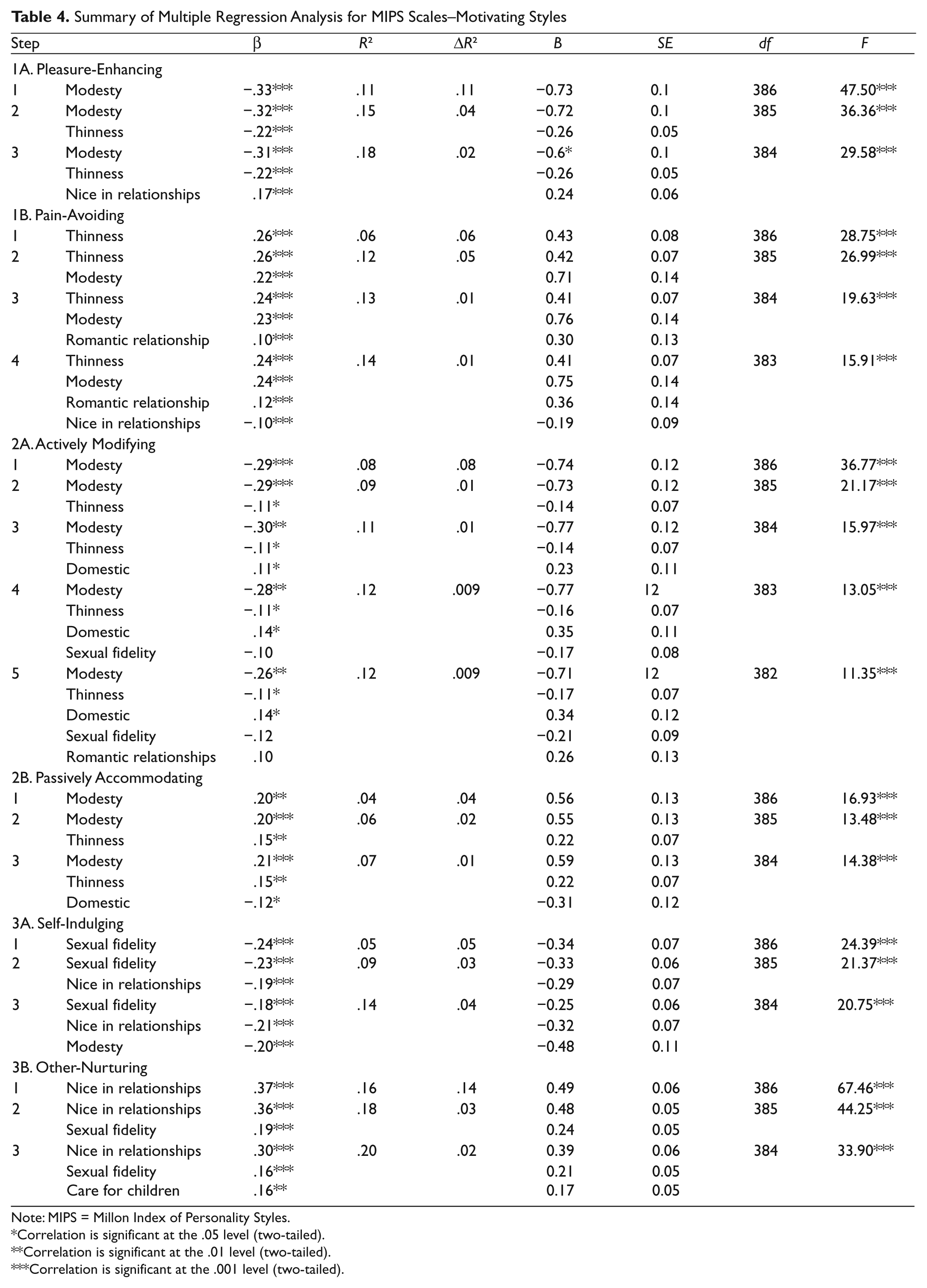
The regression models obtained were meaningful for most of the MIPS scales (except for Thought-Guided). All the independent variables included in each model fulfilled the assumption of nonmulticollinearity (Tolerance values higher than .80). Tables 4 to 6 show the results of the regression analyses for the three dimensions of the MIPS. We report unadjusted R2 for all analyses.
Summary of Multiple Regression Analysis for MIPS Scales–Motivating Styles
Note: MIPS = Millon Index of Personality Styles.
Correlation is significant at the .05 level (two-tailed).
Correlation is significant at the .01 level (two-tailed).
Correlation is significant at the .001 level (two-tailed).
Summary of Multiple Regression Analysis for MIPS Scales–Thinking Styles

Note: MIPS = Millon Index of Personality Styles.
Correlation is significant at the .05 level (two-tailed).
Correlation is significant at the .01 level (two-tailed).
Correlation is significant at the .001 level (two-tailed).
Summary of Multiple Regression Analysis for MIPS Scales–Behaving Styles

Note: MIPS = Millon Index of Personality Styles.
Correlation is significant at the .05 level (two-tailed).
Correlation is significant at the .01 level (two-tailed).
Correlation is significant at the .001 level (two-tailed).
The results show that the CFNI subscales explain from 4% to 33% of the variance in each personality style, depending on the MIPS scale under study.
Regarding Motivating Styles, some CFNI subscales explained the scores on certain MIPS styles in such a way that those women with greater conformity to given feminine norms have higher scores on the styles Pain-Avoiding, Passively Accommodating (except domestic, which predicted lower scores), and Other-Nurturing, and were associated with lower scores in Pleasure-Enhancing (except for nice in relationships, which predicted higher scores), Actively Modifying (except for domestic, which was directly associated), and Self-Indulging.
Concerning Thinking Styles, greater conformity on some CFNI subscales were associated with higher scores on Internally Focused (except for nice in relationships, which predicted lower scores), Realistic/Sensing, Feeling-Guided, and Conservation-Seeking. However, higher conformity was related to lower scores on Externally Focused (except for nice in relationships, which had a direct association), Imaginative/Intuiting, Thought-Guided, and Innovation-Seeking (except for care for children, which had a direct association).
Regarding Behaving Styles, higher scores on some CFNI subscales were related to higher scores in Dutiful/Conforming, Submissive/Yielding (except for Invest in Appearance that predicted lower scores), and Cooperative/Agreeing; the scores predicted for Confident/Asserting, Unconventional/Dissenting, and Dominant/Controlling are low.
Discussion and Conclusion
The differences found between men and women in this study (Hypothesis 1) quite closely replicate the findings of previous studies that have applied the MIPS (Bonilla-Campos & Castro-Solano, 2000; Sánchez-López et al., 1999). The women in this study tended to have Motivating Styles more oriented to pain and pessimism (Pain-Avoiding), and to fulfilling the needs of others (Other-Nurturing). With respect to Thinking Styles, the women tended to follow their personal values and feelings (Feeling-Guided), whereas in Behaving Styles they were more shy and fearful of social rejection (Anxious/Hesitating), used to suffering (Submissive/Yielding), and had a tendency to bond (Cooperative/Agreeing) more than men. However, men were motivationally oriented toward pleasure and optimism (Pleasure-Enhancing) and to satisfying their own needs before those of others (Self-Indulging). With respect to Thinking Styles, men tended to be more reflexive and logical when processing data (Thought-Guided). In the area of Behaving Styles, men sought more social attention and may be more demanding and manipulative in their relationships (Gregarious/Outgoing), but in their interactions they also were less emotive and more socially indifferent than women (Asocial/Withdrawing), more self-confident and more ambitious (Confident/Asserting), tended to be more dominating and aggressive in their relationships (Dominant/Controlling), and tended to act independently and in unconventional ways (Unconventional/Dissenting).
However, some previous results were not confirmed. On styles such as Innovation-Seeking and Dissatisfied/Complaining (greater in men), and Realistic/Sensing and Dutiful/Conforming (greater in women), the differences in scores were statistically meaningful, but this was not reported in earlier studies. These differences may be due to the composition of the samples. In our sample, a high percentage of the women worked in health and caregiving professions, which might account for their greater tendency toward focusing on the specific (Realistic/Sensing), being systematic (Conservation-Seeking) and obedient (Dutiful/Conforming). Nevertheless, our findings generally replicated those of other research. In fact, as in previous studies, most differences were found on the Motivating and Behaving Styles scales, with few differences found on the Thinking Styles scales.
Regarding the modulating effect of conforming to feminine norms on personality differences between women and men (Hypothesis 2), the results confirm that women who conform less differ less from men regarding their personality styles, and that the women who conform more differ more from men. In fact, in the first case, only 12 out of 19 differences between men and the women taken as a whole were statistically meaningful, and the effect sizes decreased. In the second case, differences were found in 20 personality styles and the effect sizes of the differences increased. Furthermore, these differences did not seem to have any relationship to social and demographic characteristics, as the HCFN and LCFN groups had the same socioeconomic level, age, and educational and work status. The only difference found between them was the number of married and unmarried women in both groups, which indeed might be associated with the level of conformity to traditional feminine norms.
When the predictive capacity of conformity to each of the feminine norms assessed with the CFNI on personality styles is analyzed (Hypothesis 3), the results show that compliance to certain gender roles and norms account for part of the variance in most personality styles. For example, in Motivating Styles, the level of conformity to the feminine norm of being thin, modest, humble, and interested in romantic relationships predicts a more pessimistic and problem-centered personality style, and one that is less oriented to pleasure. Greater conformity to modesty and thinness, and lower conformity to being concerned with domestic affairs predicts a style characterized by passive adaptation to life circumstances and by less tendency to take initiatives. In fact, one of the primary features of feminine gender role socialization has been identified as the suppression of aggression (Kagan, 1964). Compliance to gender norms regarding interest in social relationships, child care, and sexual fidelity predicts a significant part of the personality style that is less individualistic and more oriented to fulfilling others first. Although there is no previous research regarding this personality model and compliance with gender roles or norms, several studies have related the Big-Five model with femininity and masculinity measures. Marušic and Bratko (1998) confirmed that the femininity scale obtained the highest correlation with the altruism aspect of being agreeable. However, in women, gender conformity to sexual fidelity, modesty, and interest in relationships predicts less focus on fulfilling their own needs.
Concerning Thinking Styles, the high levels of gender conformity to norms on modesty, sexual fidelity, and thinness, and low levels of conformity to the relevance of social relationships predict a more introverted personality style, less oriented toward others as a source of stimulation and self-esteem. Compliance to gender norms on interest in domestic matters and sexual fidelity predicts a more practical and realistic personality style, which, together with low conformity to romantic relationships, predicts a decreased tendency toward a symbolic and abstract style. Conformity to an interest in romantic and social relationships and children predicts a personality style guided by affection, whereas low conformity to an interest in social and romantic relations predicts a style more focused on reflection and logical thinking. Combining high conformity to norms on romantic relationships and an orientation to domestic life predicts a conservative, foreseeable, and systematic personality style, whereas combining low conformity to norms on sexual fidelity, modesty, and an orientation to domestic life predicts more creativity with a tendency toward risk and a more creative and innovative personality style. This relationship between creativity and low conformity with gender stereotypes has also been reported from gender approaches (Balgiu, 2003).
Finally, concerning Behavior Styles, combining high conformity to gender norms on modesty, thinness, and sexual fidelity, and low conformity to gender norms on being pleasant in relationships, predicts a more withdrawn personality style and one that is indifferent toward others, whereas low conformity to gender norms on modesty, thinness, sexual fidelity, together with high conformity to gender norms on being pleasant in relationships and caring for appearance, predicts a decreased tendency toward gregariousness and searching for attention and social reinforcement. A high level of conformity to gender norms on modesty, thinness, and sexual fidelity, together with low conformity to gender norms on interest in romantic relationships, predicts a shy and insecure personality, whereas low conformity to norms related to modesty and thinness predicts a personality style that is more assertive and self-confident. The level of conformity to being oriented toward domestic tasks, social relationships, and sexual fidelity predicts a conventional, cooperative personality style with a tendency to be less independent and dissenting. In fact, Ramanaiah and Detwiler (1992) reported that female participants achieved the highest scores on agreeableness, one of the Big-Five that is related to a tendency to being compassionate and cooperative. Greater or lower conformity to gender norms on modesty seems to have a strong impact on the submission/control pair. Thus, high conformity to modesty, thinness, and fidelity, and low conformity to caring for appearance predicts a more submissive personality style and being used to suffering; however, lower conformity to being modest, agreeable in relationships, thinness, and sexual fidelity predicts a more dominant and competitive personality style. Finally, a high level of conformity to feminine norms on thinness and a low level of conformity on interest in social relationships predicts part of the passive–aggressive and dissatisfied personality style, whereas conformity to being modest, agreeable in social relationships, being faithful, and oriented to child care predicts a greater orientation toward emotional bonding and social affinity.
Together, these results clearly indicate that the social learning of gender, operationalized as the level of conformity to gender norms, plays an important role in personality styles. This would mean that greater or lower compliance to a given set of gender norms leads to differences in personality, and that, regardless of sex, the degree of conformity to these norms establishes differences between people, even within the same sex. Furthermore, those women who adopt and are more identified with what is traditionally expected from them regarding what they should do, think, or feel have personality styles that differ more from those found in men, and those women who comply less with the expectations and feminine norms differ less from men regarding personality styles. Thus, we can state that our data suggest that gender socialization plays an important role in personality differences between men and women, because, when the degree of adherence to gender norms in women is taken into account, the differences with respect to men decrease.
However, in this study, although most personality styles can be predicted by conformity to a certain combination of feminine norms, some norms, especially in the case of nice in relationships, predict opposite directions in some instances (i.e., greater or lower intensity in personality styles). It confirms the importance of applying a multidimensional approach to the study of gender roles and differences between men and women, which furthers our understanding of the diversity of gender role norms (DiDonato & Berenbaum, 2011). The findings also suggest that some constructions of femininity may be more important than others in understanding femininity’s relationship to women’s personality. For example, care for children only is included by the regression model in three personality subscales. It suggests that personality styles in women would be differentially associated with different aspects of feminine norms: minimally with gender-typed activity interests and moderately with gender attributes.
These results suggest that gender, and the way women incorporate it into their identity, seems to fulfill an important role in the configuration of personality styles. However, this study has a comparative–correlational design that limits the explanatory power of the result or the possibility of specifying the direction of influence between the variables. We think that this study could function as a starting point for a more specific statistical model (such as structural equation modeling). Similarly, the effect on men and their personality of their level of conformity to typically masculine norms could be a subject of future research. In addition, other aspects, such as age, ethnic group, and nationality (Costa et al., 2001), may have a differential impact on personality styles but have not been taken into account in the present study. It is reasonable to assume that adding such variables would lead to changes in group diversity and outcomes.
Footnotes
Declaration of Conflicting Interests
The author(s) declared no potential conflicts of interest with respect to the research, authorship, and/or publication of this article.
Funding
The author(s) received no financial support for the research and/or authorship of this article.