




Abstract
The goal of this study was to examine the factorial structure, internal consistency, test-retest reliability, criterion validity, convergent validity, and discriminant validity of the Brief Strengths Scale-12 (BSS-12) in Korean population. The Korean sample comprised 288 college students (68.1% were female), ranging in age 19 to 30 years (mean age = 21.65 years, SD = 1.98). Results showed that a three-factor model with exploratory structural equation modeling provided a better model fit than the other competing models. Indices of internal consistency reliability, criterion validity, convergent validity, and discriminant validity of the BSS-12 were acceptable. These results suggest that the BSS-12 can be used as an effective tool for measuring character strengths in Korean population.
Introduction
Recently, many researchers have noted that it is important to focus on positive traits as much as negative traits (Schutte & Malouff, 2019). By focusing on positive traits, we can elevate average people to great levels instead of moving struggling people to normal levels. One of the most comprehensive and universal system of concepts describing positive traits is the Values in Action system of character strengths (Snow, 2019). A scale was developed to the Values in Action system of character strengths and was named as the VIA Inventory of Strengths (VIA-IS). The VIA-IS is a 240-item, self-report questionnaire that assesses the extent to which respondents agree with character strength statements about themselves using a 5-point Likert scale.
However, this scale has been reported to have two shortcomings. An important problem is related to the length of the VIA-IS. As already mentioned, the VIA-IS consists of 240 items. Thus, people with mental health problems would have difficulty completing the long questionnaire that requires patience and concentration. Second, factorial invariance of VIA-IS are questionable, especially when applied to people from different cultures. The developer of the scale proposed six factors, but subsequent researchers reported various factorial structures such as one factor (Noronha et al., 2015; Seibel et al., 2015), three factor (McGrath & Wallace, 2021), four factor (Anjum & Amjad, 2021), and five factor solution (Höfer et al., 2020). In addition, the strengths that make up each factor varied from study to study.
The Brief Strengths Scale-12 (BSS-12) was developed to address these two issues (Ho et al., 2016). The factors that make up this measure include temperance, intellectual, and interpersonal strengths (Ho et al., 2016). Temperance strength reflects the ability to persist and self-regulate to achieve goals; Intellectual strength denotes curiosity and passion for creativity; Interpersonal strength refers to love, concern, and appreciation for others (Yu & Chan, 2019). These three factors have been repeatedly reported in various validation studies of the VIA-IS. Also, the BSS-12 consists of only twelve items which might facilitate people with mental health problems to answer the scale (Ho et al., 2016). After this scale was developed, it has been widely used across cultures. It seems that the brevity of this scale helps to enable cross-cultural use of the scale.
The BSS-12 has not been validated in Korea. Therefore, the aim of this study was to evaluate whether the BSS-12 has proper psychometric properties in Korean population. The first aim (1) was to evaluate competing models of the factor structure of the BSS-12. The second aim (2) was to examine internal consistency and test-retest reliability. The third aim (3) was to examine criterion validity. It has been shown that most character strengths contribute to positive mental health and they are significantly and positively correlated with positive mental health (Lim, 2015). Thus, it was hypothesized that the correlation between the BIS-12 and positive mental health would be significantly positive. The final aim (4) was to evaluate convergent/discriminant validity. It has been shown that the character strengths correspond to the five factors of personality. For example, it has been shown that intellectual strength corresponds to openness, temperance strength to conscientiousness, and interpersonal strength to agreeableness (Macdonald et al., 2008). Thus (4a), it was hypothesized that correlation between the interpersonal strength of the BSS-12 and agreeableness on the five-factor model would be stronger than the correlation existing between the interpersonal strength of the BSS-12 and the other factors of the five-factor model. Also (4b), it was hypothesized that the correlation between the temperance strength of the BSS-12 and conscientiousness on the five-factor model would be greater than the correlation existing between the temperance strength of the BSS-12 and the other factors of the five-factor model. In addition (4c), it was hypothesized that correlation between the intellectual strength of the BSS-12 and openness on the five-factor model would be stronger than the correlation existing between the intellectual strength of the BSS-12 and the other factors of the five-factor model.
Methods
Research Design
The study was conducted as a methodological design to adapt the Brief Strengths Scale-12 into Korean and to determine its validity and reliability.
Qualitative Phase
In quantitative phase, the researcher contacted the developer of the BSS-12 and obtained permission for the scale adaptation and obtained the English version of the BSS-12. A psychologist translated the twelve items of the BSS-12 from English to Korean. A person who can speak both English and Korean with no prior knowledge of the BSS-12 translated the Korean scale back into English. The process of back-translation confirmed the technical and conceptual equivalence between the original and the translation versions (Brislin, 1970). Next, a pilot pretest of the Korean version of the BSS-12 was conducted with some college students. Participants provided feedback on the scale’s directives, format, and content. As a result of the pilot test, minor modifications were derived, and the final version of the BSS-12 was completed by correcting them.
Quantitative Phase
In quantitative phase, the factorial structure, internal consistency, test-retest reliability, criterion validity, convergent validity, and discriminant validity of the BSS-12 were examined. In this study, exploratory structural equation modeling (ESEM), a new method rarely used in the field of character strengths, was introduced. ESEM is a technique for factor analysis. This approach was developed by Asparouhov and Muthén (2009) and extended by Marsh et al. (2009). It integrates the merits of exploratory factor analysis and confirmatory factor analysis (CFA). ESEM has been used to identify the factor structure of personality scales with multiple factors (Mann et al., 2021; Marsh et al., 2010).
In research in this field, CFA is mainly used to examine the factor structure of character strengths. However, ESEM has several advantages over CFA, making it more advantageous for studying multi-dimensional constructs such as character strengths.
CFA does not allow cross-loadings. That is, 1 item is loaded only on one factor and not on other factors. The assumption of CFA is overly strict and does not reflect reality. By contrast, ESEM allows cross-loadings. That is, 1 item can be loaded onto one or more factors. This assumption better reflects the actual reality.
In factor analysis using CFA, the correlation between factors is too high, so the discrimination between factors is relatively low. High correlation between factors may cause problems of multicollinearity. However, the correlation between factors when using ESEM is generally lower than the correlation between factors when using CFA, so the problem of multicollinearity can be solved.
Participants
The participants were 288 college students in South Korea. They aged from 19 to 30 years (mean age = 21.65 years, SD = 1.98). Females composed 68.1% of the participants.
Data Collection
The current study used convenience sampling method to collect data with 288 participants. The data collection was performed online through the survey platform. To minimize possible selection bias, study advertisements were posted on a bulletin board that all students taking the course could log in and read freely. Because only college students can access the site, the researcher was able to verify that the participants were the students taking the course. After accessing the site, participants were given a participation ID, answered sociodemographic information questions, and responded to three scales. All participants received partial course credit for their participation. The purpose of the study was explained to all participants. They provided online informed consent prior to participation and were free to withdraw at any time during assessment. No exclusion criteria were established before enrollment of the participants. If the section for entering socioeconomic information or the response of the scale was omitted, it was considered that the questionnaire response was not completed and was not included in the study data. The procedure used in this study complied with the tenets of the Declaration of Helsinki and was carried out with the approval of an Institutional Review Board (IRB#1040621-202005-HR-014).
Measures
The Brief Strengths Scale-12 (BSS-12)
The BSS-12 was developed by Ho et al. (2016). It consists of 12 items, each representing one of the three subscales, that is, temperance strength (“I ask myself to persist in face of difficulty”), intellectual strength (“I am a person who likes to find new things”), and interpersonal strength (“I feel happy for other people’s happiness”). Each subscale has 4 items. Participants rate these items using a 7-point Likert scale, where 1 = totally disagree and 7 = totally agree.
The Mental Health Continuum–Short Form (MHC-SF)
The MHC-SF consists of 14 items designed to measure positive mental health (Keyes et al., 2008). Participants rated the items on a 7-point Likert scale, ranging from 0 (never) to 6 (everyday). The MHC-SF consists of three dimensions of positive mental health (emotional, social, and psychological well-being). Emotional well-being denotes the evaluation of one's emotion. Social well-being reflects the evaluation of one's functioning in public life. Psychological well-being reflects functioning in private life (Keyes et al., 2008). Lim (2022) reported that the Korean version of the MHC-SF has a Cronbach’s α of .90. This scale was used to determine the criterion validity.
The International Personality Item Pool (IPIP)
The International Personality Item Pool (IPIP) is a scale that assesses the five factors of personality using 50 questions (Goldberg, 1999): extroversion, neuroticism, openness, conscientiousness, and agreeableness. Participants rated the items on a 5-point Likert scale, ranging from 1 (very inaccurate) to 5 (very accurate). The five factors of the Korean version of the IPIP have good internal consistency (Cronbach’s α range, .80–.87; Yoo et al., 2004). This scale was used to determine convergent and discriminant validity.
Data Analyses
Data analyses were carried out by SPSS 27 (IBM Corp., Armonk, NY, USA) and Mplus 8.8 (Muthén & Muthén, Los Angeles, CA, USA). The examination of the factor structure of the BSS-12 was performed using the maximum likelihood robust (MLR) estimation method. Five alternative models were compared using CFA, bifactor confirmatory factor analysis (bifactor-CFA), ESEM and bifactor exploratory structural equation modeling (bifactor-ESEM): a single-factor model with CFA (model 1); a three-factor model comprising temperance, intellectual, and interpersonal strengths with CFA (model 2); a three-factor model with bifactor-CFA (model 3); a three-factor model with ESEM (model 4); and a three-factor model with bifactor-ESEM (model 5). In the CFA models, each item of the BSS-12 has a non-zero loading on the targeted factor and a zero loading on the non-targeted factors. In the bifactor models, each item of the BSS-12 loaded on the general factor as well as on the specific factor and the factors were not allowed to correlate. In the ESEM models, all cross-loadings were estimated via oblique target rotation procedure. The omega hierarchical coefficients and the explained common variance were computed to reveal how general and specific factors contribute to the BSS-12’s score in the bifactor-ESEM. The mean and lowest target loadings from ESEM and bifactor-ESEM were examined. To be a well-defined factor, the mean target loadings must be .50 or greater and the lowest target loading should be .30 or greater. Alamer’s (2022) study provided guidelines for applying ESEM, examples of ESEM application, and the syntax needed to apply ESEM on Mplus. Pearson r correlations were used to calculate the correlations of the BSS-12, the MHC-SF, and the IPIP. The internal consistency of the scales was calculated via Cronbach’s alpha. Internal consistency was considered good when the value of Cronbach’s α is .70 or higher (Cortina, 1993).
Assessment of Model Fit
The goodness of fit of the alternative models was examined via the comparative fit index (CFI), the Tucker–Lewis index (TLI), standardized root mean square residual (SRMR), and root mean square error of approximation (RMSEA). Model fit was evaluated by the following criteria (West et al., 2023): RMSEA (≤.06), SRMR (≤.08), CFI (≥.95), TLI (≥.95). Also, relative model fit was assessed via Akaike information criterion (AIC), with lower values representing better model fit. AIC differences above 6 indicate that the model with the smaller AIC value has better fit (Symonds & Moussalli, 2011).
Results
Factor Analysis
The Mardia’s multivariate kurtosis and skewness test (Mardia, 1970) was used to examine multivariate normality. The test rejected the null hypothesis (p < .0001), suggesting a deviation from multivariate normality of the BSS-12 scores for the sample. Thus, factor analysis was conducted using MLR estimation.
As seen from the model fit in Table 1, the one-factor model was inadequate (CFI = 0.481; TLI = 0.365; SRMR = 0.125; RMSEA = 0.160). The fit of the three-factor model with bifactor-CFA was acceptable (CFI = 0.964; TLI = 0.948; RMSEA = 0.045) except for the SRMR value (SRMR = 0.110). In addition, the model fit for the three-factor model with CFA was good (CFI = 0.985; TLI = 0.980; SRMR = 0.049; RMSEA = 0.028). The goodness of fit indices for the three-factor model with ESEM (CFI = 1.000; TLI = 1.000; SRMR = 0.020; RMSEA = 0.000) and with bifactor-ESEM (CFI = 1.000; TLI = 1.000; SRMR = 0.013; RMSEA = 0.000) indicated excellent fit.
Goodness-of-Fit From Factor Analysis With Robust Maximum Likelihood Estimation.

Note. χ2 = chi-square goodness of fit test; df = degree of freedom; CFI = comparative fit index; TLI = Tucker-Lewis index; SRMR = standardized root mean square residual; RMSEA = root mean square error of approximation; AIC = Akaike information criteria.
The relative quality of alternative models was examined using AIC. The three-factor model with bifactor-CFA (model 3) had better fit than the one-factor CFA model (model 1) (ΔAIC = −447.762). The three-factor model with CFA (model 2) had a superior fit to the three-factor model with bifactor-CFA (model 3) (ΔAIC = −18.798). Also, the fit of the three-factor solution with ESEM (model 4) was better than the three-factor model with CFA (model 2) (ΔAIC = −8.626), though the difference was slight. The three-factor solution with bifactor-ESEM (model 5) showed similar fit indices to the three-factor solution with ESEM (model 4) (ΔAIC = −0.364). The three-factor model with ESEM and with bifactor-ESEM showed a better fit than the other competing models.
Table 2 presents the standardized factor loadings and the correlation between the latent factors of the three-factor model with ESEM. When examining parameter estimates in the three-factor model with ESEM, three well-defined first-order factors were revealed. The interpersonal strength factor (λ = .501–.791, M = 0.674), the temperance strength factor (λ = .357–.882, M = 0.674), and the intellectual strength factor (λ = .557–.917, M = .681) explained a significant amount of variance. In each strength factor, all items had a salient loading on the targeted factor (λ ≥ .30) while no items loaded onto more than one factor (λ < .30). Factor correlations in the three-factor model with ESEM (r = 0.214–0.444, M = 0.327) were lower than those in the three-factor model with CFA (r = 0.237–0.514, M = 0.421).
Parameter Estimates for the Three-Factor Model With ESEM.
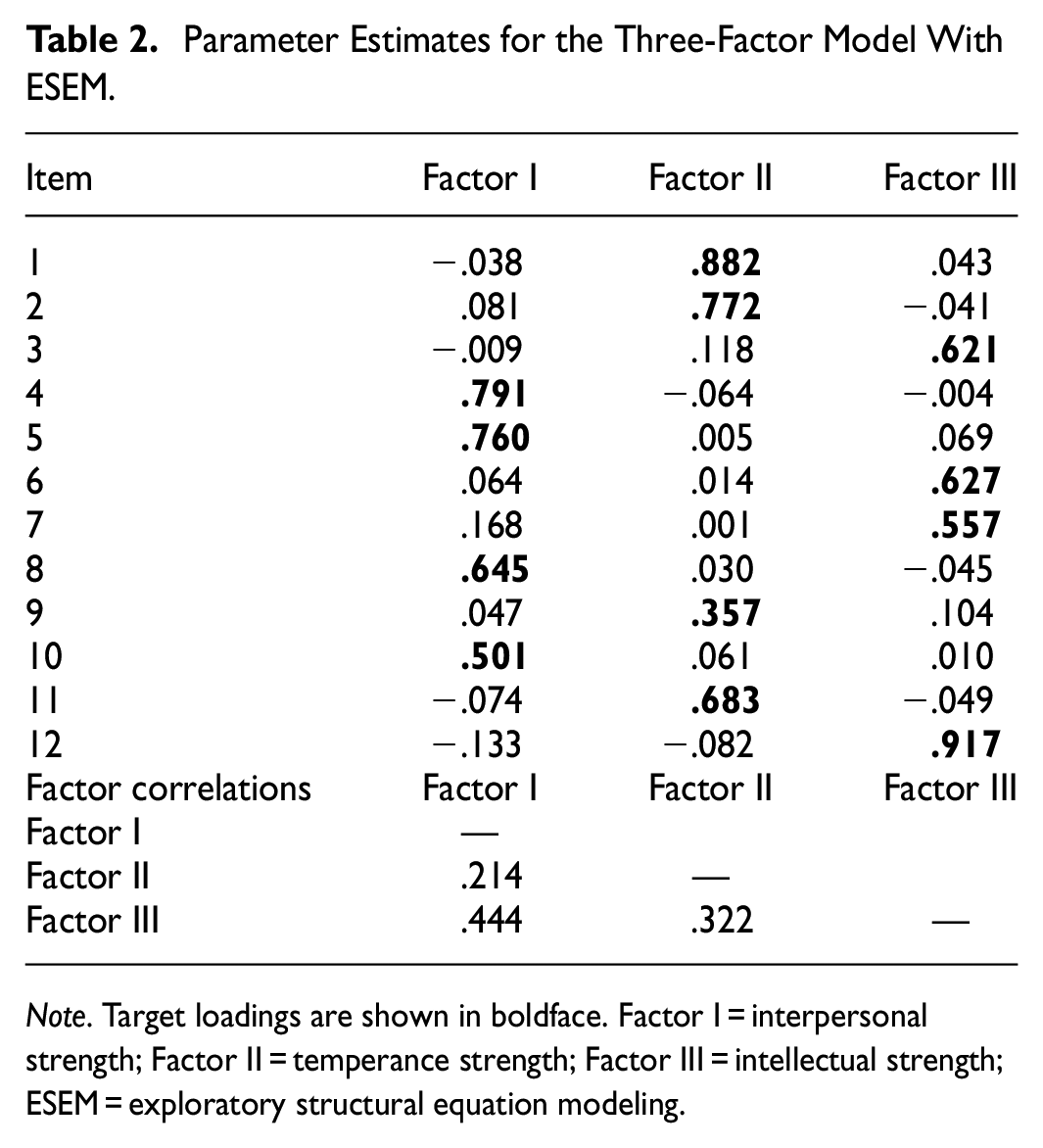
Note. Target loadings are shown in boldface. Factor I = interpersonal strength; Factor II = temperance strength; Factor III = intellectual strength; ESEM = exploratory structural equation modeling.
Table 3 provides the standardized factor loadings of the three-factor model with bifactor-ESEM. Factor loading estimates showed that general factor was poorly defined by all items with loadings below .50 (λ = .005–.432, M = 0.177). However, even after controlling for the general factor, the interpersonal strength factor (λ = .465–.769, M = 0.652), the temperance strength factor (λ = .352–.874, M = 0.670), and the intellectual strength factor (λ = .519–.853, M = 0.677) still explained a significant amount of variance. In each factor, all items had a salient loading on the targeted factor (λ ≥ .30). However, no items loaded on more than one factor (λ < .30). Omega coefficient hierarchical for the general factor (12 items) was .128, whereas omega coefficient hierarchical for the interpersonal strength factor (4 items) was .716, for the temperance strength factor (4 items) was .772, and for the intellectual strength factor (4 items) was .739. Omega coefficient hierarchical for the three specific factors all exceeded the recommended threshold level of .500 whereas omega coefficient hierarchical for the general factor did not. The explained common variance (ECV) for the general factor was .081. On the other hand, the ECV for interpersonal strength factor (4 items) was .289, for the temperance strength factor (4 items) was .320, and for the intellectual strength factor (4 items) was .310. Each specific factor accounted for a larger amount of the common variance than the general factor. Thus, the three-factor model with ESEM is seen as the model that best describes the data among the alternative models.
Parameter Estimates for the Three-Factor Model With Bifactor-ESEM.

Note. Target loadings are shown in boldface. Factor I = interpersonal strength; Factor II = temperance strength; Factor III = intellectual strength; ESEM = exploratory structural equation modeling; ωh = omega hierarchical; ωhs = omega hierarchical subscales; ECV = explained common variance.
Internal Consistency and Test-Retest Reliability
Internal consistency tests showed a Cronbach’s α of .765 for the interpersonal factor (4 items), of .762 for the temperance factor (4 items), and of .784 for the intellectual factor (4 items). All Cronbach’s αs exceeded the recommended threshold level of .70 level (Table 4). Test-retest reliability tests, which were conducted with a 3-week interval, provided a coefficient of .896 for the interpersonal factor, of .889 for the temperance factor, and of .786 for the intellectual factor.
Correlations, Descriptive Statistics, and Reliability.

Note. Interpersonal = the interpersonal factor of the K-BSS-12; temperance = the temperance factor of the K-BSS-12; intellectual = the intellectual factor of the K-BSS-12; MHC-SF = the Mental Health Continuum-Short Form; extroversion = the extroversion factor of the IPIP; neuroticism = the neuroticism factor of the IPIP; openness = the openness factor of the IPIP; agreeableness = the agreeableness factor of the IPIP; conscientiousness = the conscientiousness factor of the IPIP.
p < .05. **p < .01. ***p < .001.
Criterion, Convergent, and Discriminant Validity
Table 4 presents correlation coefficients among the subscales of the BSS-12, the MHC-SF, and the factors of the IPIP. The BSS-12 factors (the interpersonal, temperance, and intellectual strength factors) were found to be positively and significantly associated with each other (range = 0.19–0.37), and the three BSS-12 factors were positively and significantly correlated with the MHS-SF (range = 0.32–0.47). These findings support criterion validity of the BSS-12.
It has been hypothesized that correlation between the interpersonal factor on the BSS-12 and the agreeableness factor on the IPIP would be stronger than the correlation existing between the interpersonal factor of the BSS-12 and the other factors of the IPIP. This prediction was bolstered (agreeableness vs. extroversion, Z = 6.572, p < .001; agreeableness vs. neuroticism, Z = 9.583, p < .001; agreeableness vs. openness, Z = 7.749, p < .001; agreeableness vs. conscientiousness, Z = 9.018, p < .001). It was hypothesized that the correlation between the temperance factor of the BSS-12 and the conscientiousness factor of the IPIP would be greater than the correlation existing between temperance factor of the BSS-12 and the other factors of the IPIP. The method suggested by Steiger (1980) to determine the significant difference between two dependent correlation coefficients was used in this study. This prediction was bolstered (conscientiousness vs. extroversion, Z = 4.394, p < .001; conscientiousness vs. neuroticism, Z = 4.515, p < .001; conscientiousness vs. openness, Z = 4.560, p < .001; conscientiousness vs. agreeableness, Z = 4.515, p < .001). It was also hypothesized that correlation between the intellectual factor of the BSS-12 and the openness factor on the IPIP would be stronger than the correlation existing between the intellectual factor of the BSS-12 and the other factors of the IPIP. This prediction was also supported (openness vs. extroversion, Z = 2.459, p < .01; openness vs. neuroticism, Z = 5.004, p < .001; openness vs. agreeableness, Z = 3.838, p < .001; openness vs. conscientiousness, Z = 5.869, p < .001). These results indicate convergent and discriminant validity of the BSS-12.
Discussion
The present study was conducted to examine the psychometric properties of the BSS-12 for Korean population. The factor analysis of the BSS-12 showed that the three-dimensional ESEM model yielded best fit among the alternative models. The analysis partially supported the proposed three latent structures in the development of this scale (Ho et al., 2016). That is, the BSS-12 was found to consist of three factors: (1) the interpersonal strength, (2) the temperance strength, and (3) the intellectual strength. Also, the three-factor model that allowed cross-loadings explained the data better than the three-factor model proposed by the developer of the BSS-12.
The three-factor model of character strengths demonstrated in this study has also been observed in previous studies and theoretical models. Duan and Bu (2017) reported that 15 items measuring character strengths were grouped into three higher-order factors. The three factors were caring, inquisitiveness, and self-control, and each factor reflected the interpersonal strength, the intellectual strength, and the temperance strength in this study, respectively. Han and McGrath (2023) developed two scales to measure character strengths, the VIA Inventory of Strengths-Revised and the Global Assessment of Character Strength. They examined the factor structure of the two measures using residual network modeling. In their study, a three-factor structure of caring, inquisitiveness, and self-control was derived. McGrath (2015) examined factor structure using multiple scales measuring character strengths. As a result, all scales were divided into two components of goodness and inquisitiveness, and the goodness component was further divided into two components of caring and self-control.
In the present study, the BSS-12 was found to have adequate internal reliability and test-retest reliability in Korean population. All factors of the BSS-12 were found to be highly or moderately related to positive mental health. This result indicates criterion validity. In addition, this finding shows that all factors of the BSS-12 can not only serve as important determinants for predicting mental health, but also serve as a mediating variable between the known predictors of mental health (e.g., mindfulness or prosocial behavior; Duan, 2016; Padilla-Walker et al., 2020). Therefore, the findings will be of interest to those studying the origins and processes of positive mental health.
The present study also shows the convergent and discriminant validity of the BSS-12. Specifically, comparisons of the correlations indicated that the conscientiousness factor of the IPIP was more profoundly connected to the temperance factor of the BSS-12 than was the other factors of the IPIP, and that the openness factor of the IPIP was more closely related with the intellectual factor of the K-BSS-12 than was the other factors of the IPIP, and also that the agreeableness factor of the IPIP was more strongly associated with the interpersonal factor of the BSS-12 than was the other factors of the IPIP. This demonstrates that three factors of the K-BSS-12 are distinct components of character strengths, rather than single construct.
This study has shown that BSS-12 has good psychometric properties and is associated with positive mental health, so this scale is expected to be useful to mental health professionals in various mental health settings. Specifically, evaluation of character strengths using the BSS-12 can provide an important guideline for the development of intervention programs focusing on positive mental health.
Limitations
There are some limitations to this study. First, the sample consisted of college students, so caution should be used in applying these findings to other populations. Character strengths are characteristics deemed desirable by the society to which the individual belongs, and because desirable characteristics are different for each age, the frequency of character strengths and the correlation between character strengths and other variables may vary according to age. Second, because only self-reported data was used to assess positive mental health, the relationship between character strengths and positive mental health may be inflated by common method variance, so objective rating methods assessing positive mental health should be included in future studies. Finally, because this validation study was not performed in a clinical environment, caution needs to be taken in applying the BSS-12 to individuals with mental problems. Further research is needed in various clinical settings and fields.
Conclusion
Nevertheless, current research provides initial support for the use of the BSS-12 which is a reliable and valid measure of character strengths in Korean population. However, further validation studies are needed to determine the reliability and validity of BSS-12 in people with mental problems. In addition, further research is required to validate the BSS-12 using the objective rating method.
Footnotes
Declaration of Conflicting Interests
The author(s) declared no potential conflicts of interest with respect to the research, authorship, and/or publication of this article.
Funding
The author(s) received no financial support for the research, authorship, and/or publication of this article.
Informed Consent
All participants signed informed consent before investigation.
Ethical Standards
I complied with the APA ethical standards in the treatment of human subjects.

Data Availability
All data generated or analyzed in this study are available from the corresponding author for the reasonable request.