




Abstract
The aim of this present study is to determine the self-evaluation of learning outcomes of students using flipped classroom versus traditional learning education models in the senior year (fourth year) interior architecture students. This research was conducted for one full semester of senior year interior architecture graduate students, which takes 14-weeks of a time period each lasted 6 hr of a week which makes a total of 84 hr for a semester. Two different education models were used for a one-semester course for a total number of 112 students. The students were all informed about flipped and traditional educational models prior to the class selection. The groups were designated by the students’ education model choice. Class A was 57 students who attended to the flipped classroom model and Class B were 55 students who attended to the traditional lecture-based education Both courses have the same credit. The GPA scores of flipped classroom attendees were found to be higher than the traditional class GPA score rates. The student evaluation forms were determined to be better in the flipped classroom. The change of students to using flipped classroom from the traditional method leads to a student-centered education instead of teacher-centered education.
Keywords
Introduction
The educational concept known as the “flipped classroom” blends classroom instruction with learning that takes place outside of the classroom to provide knowledge. Although there are varying interpretations on how the phrase “flipped class” was initially created, high school chemistry professors Jonathan Bergmann and Aaron Sams produced the first audio recordings in 2006. Later, innovative teaching and learning strategies including problem-based learning, blended learning, and student participation were used in the classroom. Two unique components are defined by the class. One of them involves learning from digital records, and the other involves interactive learning in a classroom setting where students may do tasks that have practical application (Bergmann & Sams, 2012).
The students watch a video course whenever it is convenient for them prior to the course while using the internal classroom course approach to evaluate education, and they then prepare questions about the themes that they find complicated or confusing. Then, prior to the course, the students electronically submit their queries to the teacher or instructor. According to the kind of the questions in the first course, the faculty member divides the students into groups. Students research these issues in groups while working on group projects. The instructor tries to assist the attendants by circling the groups. By responding to questions, the instructor helps the students understand the solutions they won’t be able to in the following class. The instructor can create new group studies by assessing the students’ aptitude for the material through questions and, if required, practice (Akcayir & Akcayir, 2018; Arnold-Garza, 2014; Vogelsang & Hoppe, 2018).
Instructors and students spend time on higher levels of learning, such as application and synthesis, through guided problem-solving, clinical reasoning, small-group discussions, and other cooperative activities in the classroom (Gagnon et al., 2020).
This teaching approach has been suggested as a technique to engage students for the students especially in graduate education by allowing the faculty guide rather than active learning (Bayliss & Warden, 2011; Betihavas et al., 2016; Zipp et al., 2017). The flipped classroom education model also has the potential to improve several aspects of education by encouraging deeper learning and application of information rather than merely memorization and knowledge (Boucher et al., 2013; Chung & Lee, 2018; Deprey, 2018; Murray et al., 2014; Veneri & Gannotti, 2014). Itokazu (2019) has pointed out that given the flexibility within a course, a flipped classroom model also has the power to influence students’ motivation and attitudes toward learning.
According to Boud and Falchikov (1989), self-assessment is defined as the involvement of learners in making judgments about their achievements and the outcomes of their learning. Boud (1995) has declared that self-assessment is identifying standards and/or criteria to apply to their work and making judgments about the extent to which they have met these standards and criteria. Self-evaluation is so closely related to questions of power, control, and authority as well as the degree to which they are transmitted from instructor to students (Brew, 1999).
In order for self-assessment method to be useful, students first need to acquire the idea. All evaluations of a student’s work are referred to as “self-assessments,” which includes terminology like “self-evaluation” and “self-appraisal” and they are all connected. Self-assessment serves a variety of functions, including gauging how well learners comprehend the material, demonstrating progress toward objectives and results, and fostering the learners’ own growth. These three parts of self-assessment are interconnected and will each be given a distinct emphasis at certain points throughout the learning process (Taras, 2010; Wride, 2017).
Benefits of Flipped Classroom
Students are given access to the whole course material, whether it is available video recordings, online or handout form prior to class. Architectural and interior architecture education programs often involve students meeting in classrooms to listen to lectures from the faculty teaching staff—will be mentioned as instructor—take notes, and then study at home after doing some drawing-related homework. Despite the fact that completing these drawings is one of the learning objectives for the faculties of architecture and interior architecture, students who have taken these traditional classes typically do not properly acquire these skills because they spend too much time coming up with ideas and trying to study in class. The notion that students who learn at home get the primary idea and have more time to sketch in class rather than listening to lectures might enhance the drawing abilities of architecture students.
The paradigm in which lectures are recorded on video or audio in advance by the instructor so that class time may be used for problem-solving activities is referred to as the “flipped classroom,” according to its basic definition. Flipped classroom uses a revised version of Bloom’s taxonomy as an inverted form for cognitive objectives. Applying and analyzing take the role of remembering and learning, which are the main activities in a traditional classroom, as seen in Figure 1 (Gariou-Papalexiou et al., 2017; Yildirim Yakar, 2021).

Flipped versus traditional classroom education models according to Bloom’s taxonomy of cognitive objectives.
Many social and educational aspects have shifted as a result of the COVID-19 issue. Both students and teachers will need to have some flexibility in their learning and the use of educational methods that are simple to adjust to changing situations in order to keep up with the rapid evolution that this global crisis is driving. According to Latorre-Cosculluela et al. (2021) it was successful to deploy the Flipped Classroom experiences both before and throughout the first several months of COVID-19.
Deficits of Flipped Classroom
The reality still depends on the individual students’ efforts, even if the flipped classroom encourages students to prepare for the course by studying beforehand. If the student is willing to learn that much prior to the course, then this instructional model could be helpful (Herreid & Schiller, 2013).
Aim
The aim of this present study is to determine the self-assessment and evaluation of learning outcomes of students using flipped classroom versus traditional classroom education models in the senior year (fourth year) interior architectural students.
The information gathered for this study was intended to address the following research question as “When the flipped classroom is used throughout the entirety of the course, will students' opinions of it be the same?”
Method
Study Design
A written consent form has been obtained from the students who participated in this study prior to the study. The research protocol was approved by local ethical review board (IRB) (No: 1272/271). This research was conducted for a one full semester course named Interior Architecture-IV for senior year interior architecture graduate students, which takes 14-weeks of a time period each lasted 6 hr of a week which makes a total of 84 hr for a semester. Two different education models were used for this one-semester course with a total number of 112 students. All content of the course, regardless of education method, was presented sequentially as all the students were informed prior to the study about flipped classroom and traditional educational models by the program faculty, instructor who has a Ph.D. degree in Architectural Design Computing. Flipped classroom and traditional lecture-based education models were explained in detail to these 112 students prior to the course selection. Self-enrollment class system was activated for this course. Students who were willing to attend to these courses enrolled to these classes from these two educational models independently, flipped and traditional as class A and B respectively.
Academic progress, learning involvement, and satisfaction levels of students are the dependent factors whereas learning modalities as the flipped classroom and traditional classroom learning are the independent variables.
Course and Curricular Designations
Class A was the students who enrolled themselves in the flipped classroom course. These were 57 students who watched 14 preparatory videos prior to courses which last 30-minutes each.
Class B was the students who enrolled themselves in the traditional lecture-based course. These were 55 students who attend to Power-Point based lectures by the same program faculty. These courses were recorded as video lectures in-class for using in the flipped classroom modules.
Both courses were having the same credit. There was only one instructor for both courses.
Course Requirements
The classroom attendances were recorded for both classes since the credit of these both courses require 80% attendance score. The students attend to this course for approximately 6 hr a week except the break periods where a full semester has 14 weeks that makes the course last approximately for 84 hr for a semester. Two formative exams were performed at the end of semester.
Evaluation of Learning Outcomes
A total number of six homework assignments were given to each student for both classes for a full semester. There were two formative exams and a final exam which was a summative exam. The summative exam was performed at the end of the semester for the evaluation of learning outcomes of this course. The learning outcomes of the students were evaluated with Grade Points Average (GPA) scores. The GPAs were recorded according to the formative exam scores, summative exam score and the homework assignment scores. The exam scores were scaled over 100. The GPA scores were unweighted GPAs and the converted points from a 100 scale from 0.0 to 4.0. The homework drawing scores were graded and assigned a weight of 25% to the final GPA.
All the students were asked to fill-out a questionnaire at the end of 14 weeks about their self-assessment related to the course education method.
Details of the Course
The students enrolled in Class A and Class B were both provided the course handouts and online video tutorials prior to the courses.
The students enrolled in Class A were asked to watch the recorded 30-minutes video recordings prior to course every week, whereas the students enrolled in Class B did not prepare prior to the course. Class A students draw their architectural project as in-class activities for the 6 hr per week where they have a brainstorming session prior to each week’s course drawing session. Class B students attend to the Power-point presentation lectures given by the same faculty which lasted 45-min per week within the 6 hr per week time period. There is a brainstorming session after the presentation. There is a one-hour limitation per week in total for the brainstorming session for both classes. The details of the course designations according to the education models are seen at Figure 2.

The course designations according to the education models for Class A and B.
Data Collection and Using Self-Assessment
The students enrolled in Classes A and B are asked to fill the questionnaire in terms of a range of self-assessment methods, the phrases in the study of Taras (2010) were used as “weaker,” “median,” and “stronger” refer to how much authority and control students have over the evaluation process in comparison to the instructor or lecturer.
The subjects for the students’ self-assessment determination emphasized in the questionnaire involved learning skills, problem solving skills, analytic skills, desire to learn, collaborative skills, communication skills, critical thinking skills, gaining time. The self-assessment techniques presented here go from behaviorist to more cognitive and social constructivist theories of learning as they become “stronger” and “weaker,” respectively (Carlile & Jordan, 2005). Each strategy, however, has merit because it forces students to consider, debate, and agree upon standards, value the caliber of their work, and defend the grade that reflects the caliber of their work (Taras, 2010).
Statistical Analysis
All the data were recorded and the standard mean, and standard deviations were calculated. Data were analyzed with SPSS 24.0 software package program. Shapiro-Wilk Test was used prior to the statistical analysis and the p-value was found to be the larger than .05, therefore a normal distribution was calculated. Student t-test and Pearson correlation tests were used by setting the significance level of p value to .05.
Results
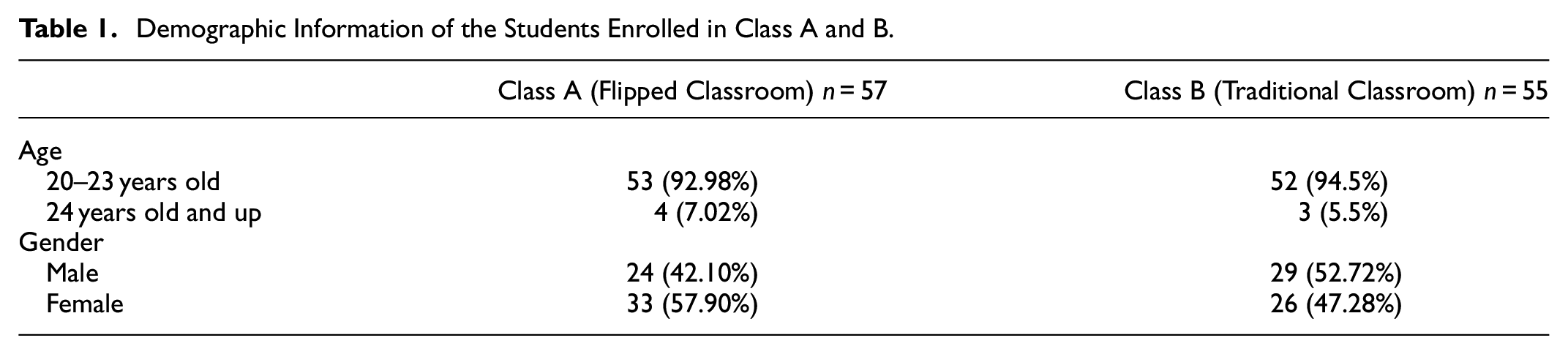
The demographic information of the students was calculated and recorded are shown at Table 1. One hundred twelve (112) students enrolled in these classes. The ages of the students were mostly between 20 and 23 years-old. The gender of the students for both classes were distributed evenly.
Demographic Information of the Students Enrolled in Class A and B.
The questionnaire consisted questions about learning skills, problem solving skills, analytic skills, desire to learn, collaborative skills, communication skills, critical thinking skills, gaining time of the students.
The students were asked to answer the self-assessment questions, using “weaker,” “median,” and “stronger” phrases. The students of Class A who used the flipped model were found to be significantly strong for developing self-directed skills, increasing problem-solving skills, improving analytic skills, increasing collaborative skills, gaining time for thinking/designing as well as drawing their projects comparing with the students’ answers from Class B who used the traditional lecture based-model (Table 2). Student t-test was used to compare the means between Class A and Class B.
Student Self-Assessment Scores and Percentages After Enrolling in Courses with Different Education Models for Class A and B.

(Bold text highlights the values that exhibit significant differences; *Indicates p < .05.
The table provided presents the self-assessment scores and percentages of students from Class A (Flipped Classroom) and Class B (Traditional Classroom) after enrolling in courses with different education models. The table includes p-values indicating statistical significance and effect size values indicating the magnitude of the observed differences between the two classes for each self-assessment category.
Effect size is a measure used to quantify the magnitude of the difference between two groups in a study. It helps to determine the practical significance or importance of the observed differences beyond just statistical significance. In your table, effect size is indicated by the last column.
The breakdown of the effect size results based on the table is as follows;
Self-Directed Learning Skills: The effect size is 0.34, indicating a moderate practical significance. This suggests that the Flipped Classroom approach had a meaningful impact on developing students’ self-directed learning skills compared to the Traditional Classroom approach.
Problem-Solving Skills: The effect size is 0.28, which is also moderate. This suggests that the Flipped Classroom approach had a notable effect on improving students’ problem-solving skills compared to the Traditional Classroom approach.
Analytic Skills: The effect size is 0.25, indicating a small to moderate practical significance. This suggests that the Flipped Classroom approach had a positive impact on enhancing students’ analytic skills compared to the Traditional Classroom approach.
Desire to Learn: The effect size is 0.15, indicating a small practical significance. This suggests that the Flipped Classroom approach had a limited effect on inspiring students’ desire to learn compared to the Traditional Classroom approach.
Collaborative Skills: The effect size is 0.35, which is moderate. This suggests that the Flipped Classroom approach significantly enhanced students’ collaborative skills compared to the Traditional Classroom approach.
Communication Skills: The effect size is 0.19, indicating a small practical significance. This suggests that the Flipped Classroom approach had a minor impact on improving students’ communication skills compared to the Traditional Classroom approach.
Critical Thinking Skills: The effect size is 0.22, which is again small to moderate. This suggests that the Flipped Classroom approach had a notable impact on facilitating students’ critical thinking skills compared to the Traditional Classroom approach.
Time for Thinking/Designing Project: The effect size is 0.31, indicating a moderate practical significance. This suggests that the Flipped Classroom approach significantly provided students more time for thinking and designing their projects compared to the Traditional Classroom approach.
Time for Drawing Project: The effect size is 0.33, indicating a moderate practical significance. This suggests that the Flipped Classroom approach significantly allowed students more time for drawing their projects compared to the Traditional Classroom approach.
The effect size results suggest that the Flipped Classroom approach generally had moderate practical significance in positively influencing various self-assessment categories among students in Class A compared to Class B. These effect sizes help interpret the importance of the observed differences beyond the statistical significance reported in the table.
The attendants of flipped classroom answered the self-assessment questions as they have mostly (felt themselves as “strong” after the course with a percentage of 96.3 (Figure 3) whereas the percentage of “strong” replies were only 60.2% for the attendants of traditional classroom (Figure 4).

Student’s self-assessment in the flipped classroom.

Student’s self-assessment in the traditional classroom.
The exam scores and Grade Points Average (GPA) scores of the two classes were compared as well. There were three exams along the whole course which consisted of two formative exams and one summative exam. The GPA score were calculated with the formative exams, summative exam, and the homework assignment scores. The first formative exam scores of students from flipped classroom were higher although the value was not significant. The second formative exam and summative exam scores for the students at Class A which were attending to the flipped classroom were significantly higher than the students’ scores at traditional classroom (Table 3). Pearson correlation was used for identification of the relationship between two Exam and GPA scores of the students enrolled in Class A and B.
Exam and GPA Scores of the Students Enrolled in Class A and B.

(Bold text highlights the values that exhibit significant differences; *Indicates p < .05.
Overall, the exam scores of the students who attended to the flipped classroom were higher than the exam scores of the students who attended to the traditional classroom (Figure 5).
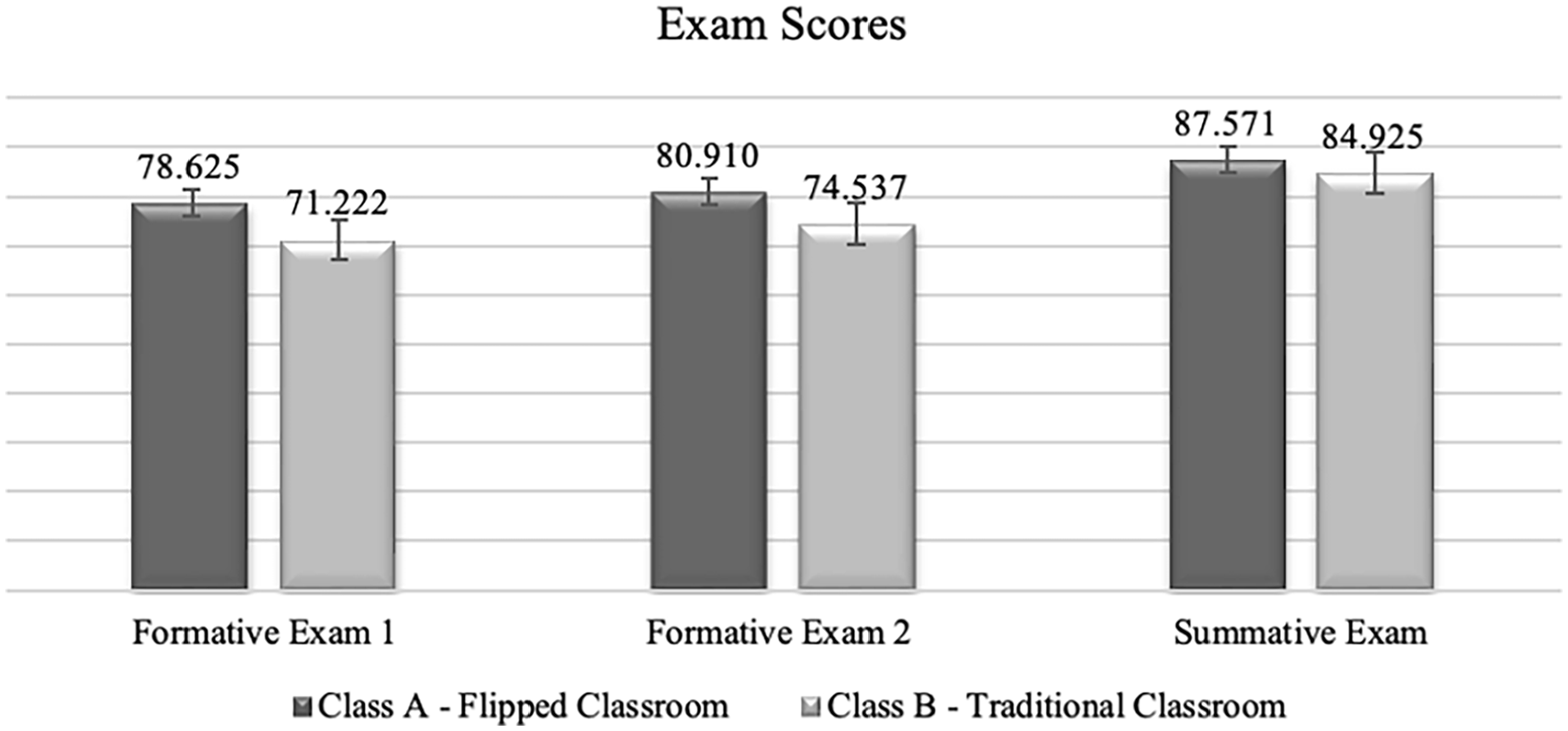
The exam scores of the students for Class A and Class B.
The GPA scores of the students who attended to the flipped classroom were also higher than the exam scores of the students who attended to the lecture-based education model, 3.0 and 2.7, respectively (Figure 6).

The GPA scores of the students for Class A and Class B.
Discussion
The research question used in this study was “when the flipped classroom is used throughout the entirety of the course, will students’ opinions of it be the same?.” The results of the survey revealed the students in the flipped classroom had a positive assessment of this education model. The vast majority of students concurred that the flipped classroom helped them learn the topic and gain confidence in their understanding of it. The majority of students felt that the video modules and in-class activities used in flipping the classroom helped them understand the information and finish their course projects. The change of students to using flipped classroom from the traditional method leads to a student-centered education instead of teacher-centered education.
The adoption of the flipped classroom education model concept is anticipated to improve learning. The students would refer to this query as this education model is promoting the learning activity (Fraga & Harmon, 2014). Although Moffett and Mill (2014) declared that the model did not improve students’ exam results, they recommended that the assessment methods shall be changed as well. Toraman and Demir (2016) stated in their study that constructivist theory states that assessment and evaluation should be altered in a similar manner following educational processes in which active education models are frequently employed. Mok (2014) declared that participating in the evaluation of active in-class educational activities for formative or decision-making objectives is the most typical approach for flipped classroom education.
The flipped classroom practice has also altered students’ perceptions of assessment and evaluation, which is the most intriguing conclusion related to assessment and evaluation. It was reported in two different studies (Findlay-Thompson & Mombourquette, 2014; Mason et al., 2013) that the students were evaluated more fairly and received better grades with the flipped classroom education model, even though the evaluation and assessment methodology was the same with the traditional education model. The students who attended to the flipped education model also received better grades in this present study which are similar with these two studies.
One of the most common advantages of flipped classroom application is enhanced student-instructor interaction. Increased student-instructor interaction is mentioned in some studies. The instructor is the person who is active at learning activities and guides the learning process in flipped classroom education. As a consequence, interactions between students and instructors naturally improve. Furthermore, this approach served as a new platform for the students to give detailed feedback and comments as well as self-assessment (Galway et al., 2014; Pierce & Fox, 2012).
The study by Johnson et al. (2007) explores the effectiveness of cooperative learning strategies in postsecondary and professional settings. Their research aligns with the findings in the presented table, particularly in terms of collaborative skills and self-directed learning. Collaborative learning models, such as the Flipped Classroom, promote active engagement, shared problem-solving, and peer-to-peer interaction, which lead to improved collaborative skills. The effect size observed in the current study for collaborative skills (0.35) falls within the range of collaborative learning’s positive impact observed in Johnson et al.’s research.
Furthermore, the work of Michaelsen et al. (2004) on Team-Based Learning (TBL) provides insights into collaborative learning’s potential to enhance critical thinking and problem-solving skills. The effect size for critical thinking skills (0.22) observed in the current study indicates a meaningful improvement attributed to the Flipped Classroom approach. This aligns with TBL’s emphasis on fostering higher-order thinking through group discussions and application-based activities.
Karabulut-Ilgu et al. (2018) conducted a study similar to the presented one, focusing on the effects of flipped learning on engineering students. While not directly related to architecture, their findings support the observed effect sizes in problem-solving and self-directed learning. Flipped learning’s student-centered approach and interactive pre-class activities are likely contributors to these positive outcomes.
The presented results align with existing research in the field of collaborative and active learning. The effect sizes observed in various self-assessment categories are consistent with the positive impact of collaborative learning approaches like the Flipped Classroom. The discussed references provide additional support for the significance of the observed results, emphasizing the effectiveness of collaborative learning in enhancing various skills and academic performance.
Alhasani (2015) asserts that traditional classrooms rely mostly on textbooks and assignments to convey the classes basic education material, and therefore the instructors play administrator roles while students are only passive recipients of that basic information. Chen Hsieh et al. (2017) mentioned the traditional classrooms as an environment where students learn the essential information in the classroom and apply it outside of the classroom along with the home assignments. Afrilyasanti et al. (2017) opposed such a learning environment on the grounds that students wouldn’t receive any help in resolving issues at home and teachers wouldn’t be able to identify the misconceptions of the students that would hinder their growth.
As technology is sometimes widely utilized in flipped classrooms, it is frequently necessary for students to have high-speed internet connectivity when off campus. Some flipped classrooms have students watch the course material on video before class. Outside of school, students might not have access to a computer or high-speed internet. Flipped classroom model has not been subject to criticism in a negative way. Even nevertheless, most personal comments that are presented online tend to be in relation to K–12 education (kindergarten to 12th grade which indicates the primary and secondary education). The majority of these students claim that they don’t always have access to a computer and the internet. In reality, students take less classes to prepare for exams, which is justified by claims like “time will remain,” as opposed to studying a lot of difficult material or watching video lectures as homework which was an obvious fact in COVID-19 online studies as well (Latorre-Cosculluela et al., 2021). The fact that flipped classroom education is a technology dependent education which may reflect as a significant disadvantage. Additionally, it has been asserted that students would not complete video assignments if they lack motivation because merely the location of homework has changed (Ramírez et al., 2014).
Kovach (2014) claimed that, this model adds an excessive workload for the instructors. Starting from the premise that the student who watched the video lesson prior to the class has understood although this may not always be the case. Particularly when relocating course material or certain classroom activities online, it is asserted that flipped classroom demands more prior planning and time required for content development than would a traditional classroom.
Flipped classrooms are different from traditional classes in a number of ways, including the use of various resources. Halili and Zainuddin (2015) suggested that students may not be prepared for such inverted learning, which makes it tough and causes them to respond adversely to flipped classrooms. Nawi et al. (2015) suggest that flipped classrooms demand that students take responsibility for their education; yet, if students have not reached that point at home, they could find it challenging to focus to and participate in class activities from its effects to its pursuits. A flipped classroom, according to Bergmann et al. (2013), is a learning environment where every student may get individualized education while participating in more learning activities that will help them to improve themselves. According to Kenna (2014), flipped classrooms provide a learning climate that is conducive to student motivation, and classroom time is utilized to reinforce home-learning through worksheets, discussions, or interactive activities that help students develop their critical thinking abilities.
The interior architecture students need to be in more interaction with their peers and their instructors. This study points out that flipped classroom education model tends to create a student-centered environment by encouraging the interior architecture students to collaborate in group projects, creating individual self-centered education space, and involving the students in class activities with less lecture time.
Limitations
According to recent studies, the paradigm of the flipped classroom’s assessment and evaluation has a number of shortcomings, in terms of validity and reliability (Bishop & Verleger, 2013; McLean et al., 2016; McNally et al., 2017). This present study uses self-assessment, exam scores, and GPAs of students as a tool for showing the effectiveness of flipped classroom courses. Therefore, the outcome of this study highlights the deficiencies for developing more methodical critiques of the assessment and evaluation of flipped classroom education model.
The results are only applicable to this particular course, even if the study’s timeframe depicts a one-year academic program.
Conclusion
The findings in this study confirm previous findings in the literature that the flipped classroom can be successful in enhancing students’ learning experiences. The students demonstrated greater compliance in completing the online learning material and had better impressions, mostly because they had more time to become used to the new teaching approach. The student evaluation grades overall showed a modest improvement, but they remained within the range seen in the flipped class implementation. These improved grades will offer more longitudinal data to support the flipped classroom model. It is also essential to consider the students’ astute suggestions for potential changes to the course delivery materials and flipped classroom modules.
The flipped classroom education model for interior architecture students could be improved with more study and application of different and revised education models. A well-defined action plan must be constructed and inferred from more instances because the education model offered is suitable for identifying sectors that need improvement. In order to improve a structural interior architecture educational model, it would be quite beneficial to increase the number of courses and attendees to the courses with different education models.
Footnotes
Declaration of Conflicting Interests
The author(s) declared no potential conflicts of interest with respect to the research, authorship, and/or publication of this article.
Funding
The author(s) received no financial support for the research, authorship, and/or publication of this article.
