




Abstract
This study was conducted to find out how high school students responded to pair tests: the collaboration of two students in taking a test together. The objectives of pair tests were intended to create excitement, a higher motivation to study, increase learning through discussion, and close collaboration during a test. The outcome of the study indicated that the majority of the students enjoyed pair tests, and there were increases in motivation, discussion, learning, and collaboration. The main downsides of pair tests were disagreements over answers and the laziness of some test takers as this behavior created negative impacts on their responsible partners. The overall picture of pair tests was positive, and it is recommended that they are administered not more than once a quarter.
Keywords
Introduction
Student assessment is a compulsory component at all levels of education and comes in various forms. Educators have increased student empowerment in classroom assessments to increase motivation, interest, and student engagement to enhance learning (Sanders, Boss, Boss, & McConkie, 2011). Students’ collaborative efforts are positive as “students learn best when they take an active role in the education process, discussing what they read, practicing what they learn, and applying concepts and ideas” (Davis, 1993, as cited in Smart & Csapo, 2007, p. 451). Moreover, Farooq and Regnier (2011) mentioned that “learning experiences are being manifest in the form of new approaches, theories, philosophies and meta-cognition” (p. 28).
With this in mind, the researcher began to introduce the concept of student collaboration during tests to create excitement and motivate students to study harder for tests. This is in line with the findings of Zapatero, Maheshwari, and Chen (2012) that “students’ performance in traditional examination does not improve at the same rate with higher level of collaborative environment” and that “while changing the classroom environment, testing methods and tools must also change according to reflect the full effect of the collaborative learning” (p. 102).
It took the researcher a period of 7 years (2005-2012) to experiment with cooperative tests that were administered either quarterly, semi-annually, or annually during a class period of 45 min. The initial tests were experimented with group tests of two students, four students, and even a class test (one test for the entire class). After a few years of experimentation, she discovered that the best test was the one with two options open to all students: (a) individual test and (b) pair test (two persons taking one test together). She also realized that disagreements over answers could be easily resolved by simply allowing students to have an option of having their own individual answer sheets (two answer sheets) instead of one. Students opting to take pair tests were allowed the privilege of choosing whom to work with. Although there might be a concern regarding disturbances as a result of discussions, it had never been a problem as discussions had always been done very quietly. The usual percentage of students opting for pair tests is approximately 95% while the remaining students worked individually on their tests, either because of the student’s preference to work alone, or simply because the student did not have a partner to work with.
The literature that exists in pair testing pertains to computer software development where two members work together as a team to test the application of the software (Balijepally, Mahapatra, Nerur, & Price, 2009; Dawande, Johar, Kumar, & Mookerjee, 2008; di Bella et al., 2013; Porter, Guzdial, McDowell, & Simon, 2013; Salleh, Mendes, & Grundy, 2011). Although there is limited literature to be found in the area of taking tests in pairs (pair tests), there is plentiful literature on cooperative learning in pairs. This article presents the proposal of using pair tests in the high school classroom as another alternative assessment for both teachers and students and acts as a contribution to scarce literature. This contribution is supported by Zapatero et al. (2012) who stated that the emphasis on measurement techniques in a collaborative environment is minimal, and “there is a need for more research in the area of assessment of the active/collaborative learning environment” (p. 103).
Literature Review
Assessment
Assessment is the primary tool used in student placement, grade assignment, grade-level promotion, and graduation. However, there has been an evolution in the definition of assessment today. Moon (2005) defines it as “the process of observing student learning by collaborating with students to collect and interpret data about their academic strengths and weaknesses, interests, and learning preferences, with the goal of making decisions that benefit their instruction” (p. 227).
Traditional classroom measurement assessments such as quizzes, tests, projects, or other similar assessment tools, have had to a large extent, failed to take into consideration, the “collaborative and constructivist learning taking place in the active learning environment” (Zapatero et al., 2012, p. 103). Zapatero et al. (2012) also went on to state that the “traditional testing mechanism may not capture all different aspects of the learning taking place in the active learning environment classrooms” (p. 104).
The availability of assessment alternatives are plentiful today for educators to choose from and special care is needed in the “selection or development of proper assessment tools” (Stiggins & Chappuis, 2005, p. 16). Aside from traditional assessment methods, assessment technologies are readily available and widely used, thus providing a wide array of benefits to not only students but also to educators as well. Assessments act as a useful feedback tool for educators in supporting student achievement, motivation, and in helping them toward their learning targets (Heritage, 2007; Nolen, 2011; Starkman, 2006; Stiggins & Chappuis, 2005; William, 2006).
Student as Learners
There has been a tremendous transformation in school learning during the past few decades, with deviation away from the traditional, teacher-centered classroom toward a more student-centered classroom with a greater emphasis on the learners’ needs (I-Ying & Wan-Yu, 2012). Numerous studies have also found out that learning is enhanced with positive learning outcomes when students are actively involved in the learning process, also known as active learning. Active learning is student centered rather than teacher centered, as students are more engaged, gain deep learning, acquire greater problem-solving and critical thinking abilities, and enjoy themselves (Benek-Rivera & Matthews, 2004; Sarason & Banbury, 2004; Smart & Csapo, 2007; Watkins, 2005; Zapatero et al., 2012).
Student Collaboration
As the significance of teamwork increases in organizations, preparing students to collaborate by working in teams has entered institutions with training starting at a very young age, and all the way up to higher education in the form of assignments and projects (Cox & Bobrowski, 2004; Fredrick, 2008; Kalliath & Laiken, 2006; Nickels, Parris, Gossett, & Alexander, 2010; Stewart & Barrick, 2000; Tabatabaei & Lam, 2013). This collaborative effort is found distinctively in cooperative small group learning that is reputed in promoting socialization and learning across K-12 schools and colleges. By working cooperatively with each other, students learn to (a) share their ideas, (b) be open to other perspectives, (c) cultivate better listening skills, (d) give and gain, (e) be conflict managers, (f) gain academic and social support, (g) have a higher self-esteem, and (h) apply knowledge as they gain greater understanding (Bertucci, Conte, Johnson, & Johnson, 2010; Cox & Bobrowski, 2004; Dewey, 1938, and Locke, 1693/2000, as cited in Smart & Csapo, 2007; Gillies, 2003; Johnson & Johnson, 2005; Kalliath & Laiken, 2006; Koppenhaver & Shrader, 2003; Ukens, 2004; Zapatero et al., 2012).
Working in Pairs, Groups, and Individually
Collaboration is frequently seen in groups or pairs because “groups collaborate more effectively when individuals learn from each other” (“Pair Up to Foster More Learning,” 2014, p. 6). Moreover, the social independence theory state that there are higher achievements in cooperative groups compared with those who work individually (Bertucci et al., 2010; Johnson & Johnson, 2005).
While some researchers believe that productivity increases with group size, others state that the bigger the group size, the more social loafing and complexities are involved in coordination (Bertucci et al., 2010). This is supported by a study conducted by Bertucci et al. (2010), where “students in groups of four did not achieve higher results than students working in pairs” (p. 267). By working in pairs, students gain a higher self-esteem, and bond faster at a more personal level as there are only two individuals (Bertucci et al., 2010).
Living in a digital age where information technology is widespread, and increasing in significance, student collaboration has changed tremendously. There is active student collaboration in chat rooms, discussion forums, through e-mail, groupware, and text messages. This digital collaboration is a form of virtual teamwork, which is commonplace in business, and being capable of working effectively in virtual teams is a necessity (Fletcher, 2009; Hunsaker, Pavett, & Hunsaker, 2011; Nunamaker, Reinig, & Briggs, 2009; Shea, Sherer, Quilling, & Blewett, 2011; Yassine, 2011). Pair testing or pair programming, consists of members working in pairs by using one computer on the same task. Findings on pair testing are positive as working in pairs has resulted in higher levels of performance, communication, learning to give and accept suggestions, satisfaction, grades, and confidence compared with working individually (Balijepally et al., 2009; Dawande et al., 2008; di Bella et al., 2013; Porter et al., 2013; Salleh et al., 2011).
Research Methodology
The quantitative research design was chosen for this study, and descriptive statistics was used in data analysis. Participants of the study included 55 high school students who were engaged in pair tests administered quarterly for the entire school year during a normal class period of 45 min. Paper questionnaires were administered in class at the end of the academic school year in 2012 and excel was used in data analysis. The purpose of the study was to find out the effectiveness of pair tests in the classroom and this was answered by the following three research questions:
These research questions were answered through a semi-structured questionnaire consisting of four sections, and a total of 28 questions. In Section A, the first 4 open-ended questions sought to find out if pair tests should be administered, whereas the next 16 open-ended questions found in Section B sought to find out students’ perceptions of pair tests. Two open-ended questions had been added to the questionnaire in Section C with the goal of giving students the opportunity to express their opinions in their own words regarding the positive and negative effects of pair tests. The 6 last questions in Section D provided basic demographic profile of participants.
Research Findings
Respondents’ Profile
Out of the total of 55 respondents, 64% were female, and 36% were male, and up to 77.2% of the respondents were represented by Thais, followed by Indians (7%), Chinese and Korean (5.2% each), and French, Taiwanese, and others (1.8% each). These respondents were aged between 15 and 18 years (Figure 1) and were currently enrolled in Grades 10 to 12 (Figure 2) at the time of the study. Up to 57.4% were students enrolled in the General Business classes and 42.6% were enrolled in the Economics classes. Figure 3 is a graphical illustration of the number of times students had changed their partner in pair tests.

Respondents by age.

Respondents by grade.

Number of times students have changed their partner in pair tests.
More than half of the students stuck to their old partners in every pair test. There was an inverse relationship between the number of times students changed their partners and the number of students. That is, the greater the frequency of partner changes, the lower the percentage of students who changed partners.
Data Analysis
Students’ thoughts on the administration of pair tests
Up to 87.5% of the respondents felt that it was a good idea for the teacher to allow pair test testing, 3.6% did not think so, and 8.9% were uncertain about it. The majority of the students amounting up to 80% enjoyed pair tests (strongly agree and agree responses), 18.2% were neutral, and 1.8% disagreed.
More than half the respondents (58.9%) had pair tests for the first time in the researcher’s class, 28.6% had been previously exposed to it, and a small percentage (12.5%) was uncertain. Although the findings indicated that more than half of the students (57.1%) felt that pair tests should always be administered, up to 39.3% felt that it should be administered quarterly. Only 1.8% thought that it should be administered yearly and the same percentage thought that pair tests should not be administered at all.
Students’ experiences with pair tests
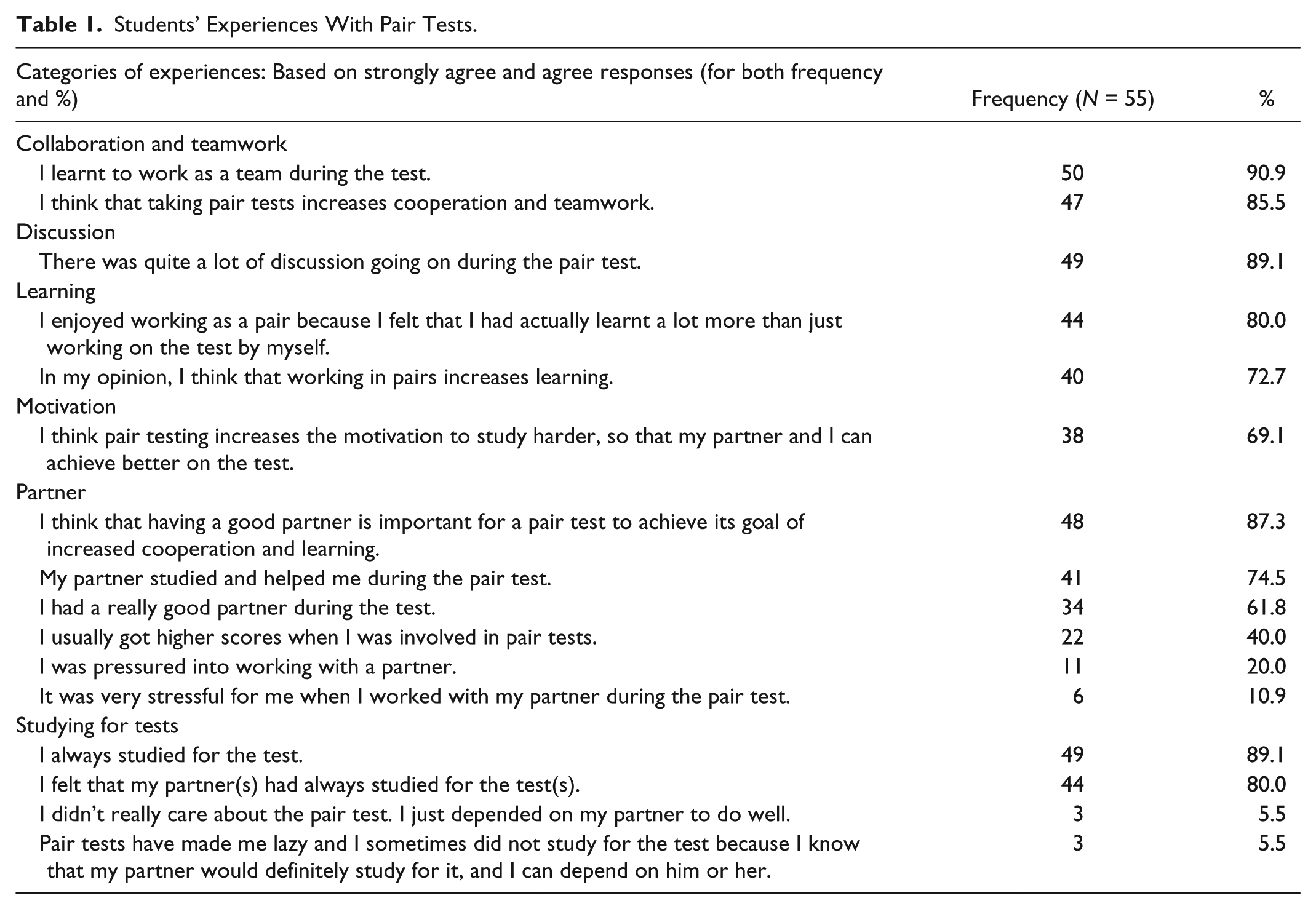
The second research question that focused on students’ experiences with pair tests was answered by 16 closed-ended questions and their responses (Table 1) have been categorized into six main groupings for easier analysis and understanding: (a) collaboration and teamwork, (b) discussion, (c) learning, (d) motivation, (e) test partner, and (f) studying for tests. These reported responses were based on “strongly agree” and “agree” answers in terms of frequency and percent, with N = 55.
Students’ Experiences With Pair Tests.
Students’ opinions about pair tests
In an effort to allow students to freely express themselves in their own words regarding the positive and negative effects of pair tests, two open-ended questions had been incorporated into the questionnaire to address RQ3. A total of 88 positive comments and 46 negative comments were made, thus demonstrating the greater inclination positive attitude toward pair tests. Only four highest frequencies are reported for both positive effects and negative effects. The four most frequent opinions on positive effects presented in Table 2 indicated the four issues ranked from the highest to the lowest responses (14 to 7) and they included (a) develop greater teamwork and cooperation, (b) discuss and analyze test questions and answers, (c) helping each other, and (d) greater motivation to study more/more hardworking. On the other hand, the ones for negative effects as found in Table 3, are numerous, with the four highest issues ranking from the most frequent first, included (a) disagreement over the answer for a question, (b) partner doesn’t study for a test, (c) being lazy to study and knowing you can depend on the other partner, and (d) bad partners take advantage of good ones.
The Positive Effects of Pair Tests as Perceived by Students.

The Negative Effects of Pair Tests as Perceived by Students.

Discussion
The purpose of this study was to find out the effectiveness of pair test administration. The findings of the study presented a strong indication that pair tests were well accepted by high school students who were studying business and economics subjects. The large majority were in favor of the administration of pair tests as they enjoyed it, and even though approximately half of the students indicated that it should be administered every time, the educator-researcher is in favor with the second majority group of students who felt that it should be administered quarterly. This is because she believes that a greater weight should be assigned to individual testing assessment and pair tests is just another collaborative activity that is a small but yet significant portion of a student’s total assessment.
Pair tests is an effective and successful alternative assessment tool in engaging students as there were high levels of student collaboration, teamwork, discussion, analysis, and learning. Students also felt that having a good partner was an important component of increased cooperation and learning in pair tests. Although only two thirds of the respondents felt more motivated to study harder, so that the team could do better on the test, it was still a good representation of motivation. It was amazing to discover that up to almost 90% always studied for the tests, and 80% felt that their partner always studied for the test. It was interesting to note, however, that even though pair tests did not always result in higher scores, the majority of the students were still in favor of it.
The downsides of pair tests, as portrayed from the closed-ended questions were the pressures of working with a partner, accounting for one fifth of the students. These pressures were probably from academically weaker students who wanted to be paired with stronger students, or partnering with someone they did not want to be but had to due to peer pressure. The stress associated with working with partners was at approximately 10%, which is relatively low, but nevertheless existent. On a positive note regarding stress, a number of students had mentioned that pair tests had reduced the stress and pressure they were facing. A very small percentage of students reported being lazy to study for tests and being dependent on their partner in studying for the tests, thus confirming the statement made by Sauer and Mertens (2013) that “some students do diligently prepare for exams; some do not” (p. 93). This created frustration for a few students who had irresponsible and “bad” partners who were lazy and took advantage of them. Although collaboration had produced positive comments, some discussions had resulted in disagreements over answers for a question. A few students also complained about the longer time spent in discussion before coming up with an answer.
It can be summarized from the findings that pair tests had both positive and negative effects (Figure 4) with the positive outweighing the negative. The positive effects of pair tests included increased collaboration, discussion, learning, and motivation, while reducing stress. The negative effects involved disagreements over answers, peer pressure, laziness, and the existence of free riders.

Impacts of pair tests.
Conclusion and Recommendations
In conclusion, the researcher was pleased with the results of the study as it has provided valuable insights into the administration of pair tests. It was an excellent feedback instrument for the researcher to find out if the years of administration of collaborative tests in the form of pair tests was in fact, a step that was well implemented. The researcher was pleased to know for a fact that the brainstorming and discussion that occurred had resulted in more learning. She was also delighted to know that she could play a small part in reducing students’ stress and anxiety levels through pair tests as students were overburdened with other school-related responsibilities. Despite the presence of free riders, the percentage was minimal. Any disagreements over answers and time-consuming discussions were valuable experiences that would greatly benefit students in times of needed collaboration in teams and managing conflict.
While there are numerous advantages to pair tests, and the dark side appears to blacken out the bright side, it is recommended that pair tests be another test assessment tool available to educators, as the benefits outweigh the costs. Educators who contemplate on experimenting pair tests in their own classrooms can be creative in making any adjustments necessary accordingly to their students’ needs, learning styles, and subjects.
Limitations and Future Research
There were a couple of limitations to this study. The sample size of 55 was relatively small and the study was limited to only high school students in Grades 10 through 12 who were taking business and economics classes. It is recommended that further research in pair tests be conducted in an experimental design study encompassing a larger sample size at various subjects and levels in a school setting. As this study’s findings were largely dependent on the students’ opinions, it is recommended that any other sources of information, such as teacher observation, peer reviews, and statistical testing be used to indicate the effectiveness of pair tests. Further research could also be based on classroom research with achievement as a dependent variable apart from the ones that had used in this study. Another limitation would be the bias in responding to the questions, thus reducing the reliability of the results.
Footnotes
Declaration of Conflicting Interests
The author(s) declared no potential conflicts of interest with respect to the research, authorship, and/or publication of this article.
Funding
The author(s) received no financial support for the research and/or authorship of this article.