




Abstract
This article delves into the intersection of performance and recognition by taking an example from Sere Bissu Maggiriq (SBM) dance, a self-stabbing ritual performance of the transvestite shaman in South Sulawesi called bissu. Drawing on performance theory that mediates the distinction between ritual and performance, and recognition theory that emphasizes the intersubjective relation, we argue that SBM serves as a means for the bissu to be gradually recognized in the wider public. First, SBM is becoming the most noticeable way for the bissu to show their magic, beauty and invulnerable body in the face of marginalization they have experienced caused by cultural rationalization driven by modern science and technology that render the bissu’s rituals and practices irrelevant. Second, SBM represents the bissu subject position, representing the interchangeability of femininity and masculinity within the ritual performance, which challenges the hegemony of gender construction that only recognize male and female identities. Third, the shift of SBM from ritual to ritual performance has made the bissu more visible, and thereby provides an entry point for the wider public to gradually recognize the bissu subject position as androgynous beings. Fourth, due to its growing popularity, SBM also serves as a means of survival for the bissu, as it becomes a portal for them to establish a new generation.
Introduction
In her comprehensive research on the bissu (transvestite shamans) in South Sulawesi, Davies (2010) argues that despite attempts to delegitimize them, the bissu have found avenues for gaining legitimacy through cultural performances. While Davies does not delve into the extent to which this performance serves as a form of recognition for the bissu, her book provides a starting point for this article to explore this possibility.
The intersection between cultural performance and recognition of the minority group remains relatively understudied. On the one hand, academic discussion on performing arts, especially in the Indonesian traditional community, has largely centered around Geertzian approach which “tends to idealize certain performance as more authentic tradition than others” (Cohen et al., 2007, p. 3). Consequently, when modernization transforms the traditional performance which was once sacred into entertainment, proponents of this approach may suggest revitalizing and protecting it to keep its pure authenticity from commodification and tokenism. Recognition, in this context, is understood as protectionism whereby the indigenous are considered victims, powerless, and simply uprooted from their “original” culture (Tyson, 2010, p. 2). On the other hand, recognition studies in Indonesia, particularly South Sulawesi, have largely focused on the normative aspect of recognition such as how the states granted recognition to indigenous groups in Enrekang (Tamma & Duile, 2020) and the politics of land-rights recognition in Kajang, Bulukumba (Fisher, 2019).
This article aims to bridge the gap between recognition theory and performance studies by analyzing the significance and the extent to which Sere Bissu Maggiriq (SBM), a ritual performance of the bissu, serves as an entry point in recognizing the bissu subject position. Resulting from a series of interviews with the bissu in Bone, Segeri, and Soppeng as well as direct observation from February 2017 up to December 2021, this article is divided into three sections.
The first section provides a brief introduction about the bissu and examines the conditions of emergence that prompt the bissu to undergo various changes of their role through time. The second section elaborates on the extent to which the preparations, the movements, and the musical accompaniments of SBM represent the androgynous nature of the bissu. This section also explores the differences between SBM performed in sacred ceremonies and SBM performed ceremonies for the commoners, which is a relatively new development as SBM was traditionally only performed in sacred ceremonies.
The last section of this article examines the consequence of these adjustments, which have enables the bissu to become more visible and recognized in the broader public discourse will be explored in the last section of the article. By analyzing the intersection of recognition theory and performance studies, this article seeks to contribute to a better understanding of the role of cultural performances in recognizing marginalized groups.
Literature Review
Recognizability, Recognition, and Visibility
This article draws on Honneth (1995) and Butler (2009) notion of recognition which they approached from positive and ambivalent perspectives, respectively (Ikäheimo et al., 2021, p. 2). Honneth’s concept of recognition lies on cumulative acquisition of the three spheres of interaction that accordingly forms the very possibility of recognition; (1). Love, whereby one develops self-confidence over her needs and emotions to be recognized by the parents, (2). Rights, whereby one develops self-respect as a morally and legally responsible person equal to others, and (3). Solidarity, whereby one’s particular traits and abilities that are significantly valuable can be recognized and contribute to the creation of common goods within the community (Honneth, 1995, pp. 91–130; Balaton-Chrimes & Stead, 2017, p. 5). In this regard, recognition also requires a sense of mutuality between the members of the society that can entail “one-sided relationship of dependence” (Ikäheimo et al., 2021, p. 3). If these conditions are met, recognition can “provide the intersubjective protection that safeguards the conditions for external and internal freedom, upon which the process of articulating and realizing individual life-goals without coercion depends” (Honneth, 1995, p. 174).
However, Honnet’s idea of recognition fails to address the relation between recognition and the nexus of power produced by prevailing discourse and institutions (McQueen, 2015). Unlike Butler (2009) acknowledges the mutually constituted between the subject and also requires reciprocity, her focus lies on the general condition or field that enable and disable the possibility and the impossibility of who is intelligibly recognize. She refers to this as “recognizability,” which operates to “prepare or shape a subject for recognition-the general terms, conventions, and norms ‘act’ in their own way, crafting a living being into a recognizable subject, though not without errancy or, indeed, unanticipated results” (Butler, 2009, p. 5). Recognizability, she continued, precedes recognition.
Despite departing from Michel Foucault’s notion of power and discourse, which situate the subjects as being produced by the discourse, Butler believes that the subjects also produce themselves and thereby recognizability does not operate deterministically (Butler, 2009, p. 4; Butler, 2021, pp. 39–40). This concept is inextricably linked to Butler’s idea of performativity in gender, which seeks to challenge prevailing order through improvisation within social constraints (Butler, 2004, p. 1). Gender performativity, Butler argues, is “repeated stylization of the body, a set of repeated acts within a highly rigid regulatory frame that congeal over time to produce the appearance of substance” (Butler, 2011, p. 45). By framing gender as performative act rather than inherent characteristics, Butler expands the meaning of gender to be constructively contingent and temporal. Thus, it offers the possibility for “affirmative recontextualizations and subversive redeployments that constitute a more effective response to hate speech than legal measures” (Salih, 2002, p. 103).
In addition, Butler (2009) distinguishes the term recognition with apprehension. Drawing on Hegel’s understanding of recognition, as elaborated by Honneth, Butler defines apprehension as a form of knowing that is not always conceptual form of knowledge and implies acknowledging that is not yet recognition (Butler, 2009, pp. 5–6). Prevailing norms of recognition can facilitate apprehension and provide a basis to criticize the norms. As such, apprehension can be seen as the first step toward recognition, since the demand for recognition cannot be made without being understood in advance (Butler, 2009, p. 34). In a similar fashion, by taking an example Black British experienced in the United Kingdom, Hall (1988) argues that affirming the rights for black subjects to represent themselves and counter-positioning the negative marginalization by turning negative imagery of black subjects into positive terms of identification implies visibility in the public discourse, which Hall terms a “politics of representation” and which has an effect of a “slow recognition of deep ambivalence of identification and desire” (Hall, 1988, p. 250).
However, while Hall does not clearly define what he meant by slow recognition, this article uses the term “gradual recognition” which we define as the process of recognition that takes place gradually through the politics of representation, which increases the visibility of minority groups. As Edenborg (2019) shows in global queer politics, the visibility of minority groups has varied meaning and effects depending on the specific context. While visibility offers promises to challenge the notion of homophobia and invoke social changes, and therefore is seen as necessary, it can also lead to a process of normalization, depoliticization, and even appropriation. Thus, as an entry point of recognition, visibility also has its ambivalence.
Ritual Performance
Using the term “ritual” and “performance” concomitantly can be somewhat elusive. While the semantics of ritual refers to a particular ceremonial act that is strictly prescribed by the rule of tradition which is intended to convey something about a system of beliefs and one’s submission to “forces” larger than one’s own (Schechner, 1988, p. 13). Performance can also mean “to pretend,” and “to plot,” which implies manipulating one’s own body (Stephenson, 2015, p. 88). This definition distinguishes the sacred as the realm of ritual and the profane as the realm of performance. However, the performance theory of ritual, closely associated with Butler’s theory of gender discussed earlier, attempts to reconcile the two by arguing that “action is ritual by the virtue of its efficacy” (Stephenson, 2015, p. 86).
To clarify this argument, it is worthwhile to consider Schechner’s (1988) notion on performance which is reorienting ritual studies. For Schechner, theater, play, games, and ritual are all considered as performance that run in and between efficacy and entertainment, which establish a form of continuum (Figure 1). On the continuum of efficacy lies the qualities of ritual such as symbolic time, link to an absent other, collective creativity, performers possessed or in trance, and purposely affecting transformation. On the continuum of entertainment lies the qualities of theater such as emphasis on now, only for those there, individual creativity, performers know what he/she is doing, and is done for fun. The more it has more qualities on the pole of efficacy, the more ritual the performance is. And the more it has more qualities on the pole of entertainment, the more theater the performance is. Therefore, “no performance is pure efficacy or pure entertainment” (Schechner, 1988, p. 116), and subsequently, there is not so much opposition between the sacred and the profane.
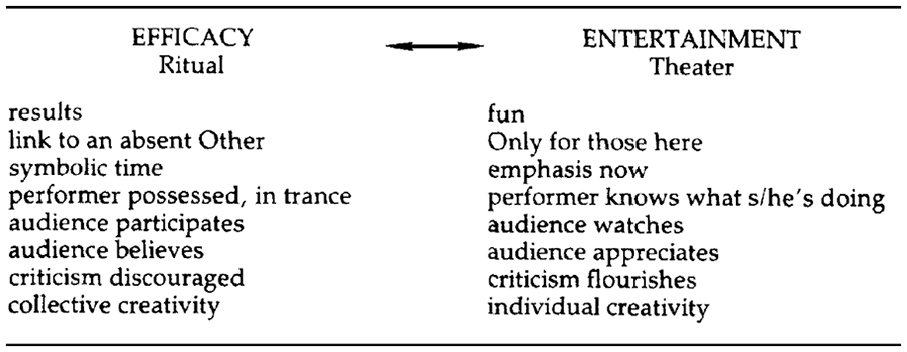
Schechner’s (1988) conception of ritual and performance.
Furthermore, the performance theory of ritual also explores the relation between embodiment and knowing. As Stephenson argues, “ritual, as bodily action, is a way of knowing the world, and the kinds of ways the body is used is constitutive of our subjectivity and ideas” (Stephenson, 2015, p. 87). Therefore, the bodily action is an important element to apprehend one’s subjectivity, as the first step of recognition.
Methods
The data collection for this study began in February 2017 and continued to December 2021. First, we conducted participant observations by observing the bissu in performing SBM in festivals, wedding ceremonies, and opening of the cultural events in Segeri (Pangkep, South Sulawesi) and Bone (South Sulawesi). We also observed the dance performed in annual sacred ceremonies, namely mappalili arajang in Segeri and mattompang arajang in Bone during the period of research. To ensure a comprehensive understanding of the SBM’s steps, we created a list of components of SBM (i.e., clothes, accessories, musical instruments, properties of the dance, and movements) to analyze. Additionally, due to one of the co-authors’ longstanding relationship with the bissu, we were able to observe how they prepared for the dance in both sacred ceremonies and festivals, tracking the bissu before and after SBM performances.
Second, we carried out in-depth interviews with the bissu both in person on the spot while they were on their group preparing for the dance. The interview was conducted in two phases. The first phase, which took place from March 2017 to April 2020, focused on exploring each step of the SBM and its variations accross different occasions. The second phase, conducted from August 2020 to December 2021, aimed to investigate the bissu perception of SBM and its significance for their recognition in the public. While the research primarily focuses on the bissu in Bone and Segeri, we also interviewed the bissu in Soppeng, South Sulawesi, to explore the significance of maggiriq for the bissu’s subject position. The authors’ fluency in Bugis language facilitated more relaxed and casual interview with the participants. We also examine into audience’s perception of the SBM both during live performances and through comments of the SBM videos posted on YouTube.
The complied data of SBM’s components is subsequently analyzed by using the continuum of efficacy (Schechner, 1988). Finally, we employed content and narrative analysis to examine the interviews, using recognition and visibility theories to draw conclusions on SBM’s significance for the bissu’s recognition in the broader public.
Bissu: The Changing Role in the Postcolonial State
The Bugis people of South Sulawesi acknowledge the existence of five genders (Pelras, 1996; Davies, 2010; oroane (male), makkunrai (female), calabai (a female soul in a male body), calalai (a male soul in a female body), and bissu (transvestite shaman that embody the feminine and masculine qualities). Most, if not all, of the contemporary bissu were previously calabai, although there is evidence of female bissu in the Buginese epic poem La Galigo, believed to have been written around the 14th century (Caldwell, 1988, p. 169). While calabai dress and appear like female, the bissu may appear male while embodying female qualities in their speech and behavior (Davies, 2010, p. 24). Like hijra in India, one of the essential characteristics of the bissu is their ascetic principals of avoiding sexual and romantic desire. Becoming a bissu is therefore a spiritual path to renounce worldly pleasure they once had as calabai. Unlike ludruk transvestites in East Java, the bissu do not have wives and children, but some live with a male assistant called toboto who provides emotional bonding and companionship. In some cases, after living together for 3 years, the bissu is responsible to find him a wife.
To become a bissu one must follow a series of training and a special ritual (irebba) which lasts for 3 days and 3 nights. During the ritual, which aims to clean the bissu from earthly desire, they are wrapped in a shroud while their soul goes to heaven to ask for permission from the gods to become bissu (Davies, 2010, p. 183). After the ritual ends, the bissu is formally inaugurated by the bissu leader or Puang Matowa (Latief, 2005, p. 464). The role of Puang Matowa, the supreme leader of the bissu, is not limited to inaugurate a new bissu, as they also responsible for leading the rituals and make decisions on the appropriate times to perform them. In serving their role, Puang Matowa is assisted by Puang Lolo (a younger bissu leader) who act as the bissu’s public relation. However, one cannot freely choose to become a bissu, as it is occasionally a call from supernatural beings (Pelras, 1996, p. 83) and in some cases the calling comes through dream. Some of the young bissu we interviewed did not become bissu through irreba, but through dreams.
There are varied hypotheses on the cultural origin of the bissu. One of which is Christian Pelras (1996) who argues that the word bissu derives from bhiksu, a Sanskrit word that refers to a Buddhist monk, suggesting a possible Indic influence. However, as Pelras notes, there is little evidence of Indic elements in Bugis architecture and archeological findings. Another hypothesis, put forward by Lathief (2009, p. 1), suggests that “bissu” derives from a Bugis word mabessi, meaning clean. Lathief further argues that the bissu share some similarities with the Budhist monk in terms of clothing and ritual ceremonies, but differ in their lifestyle as bissu do not live in monasteries. Nevertheless, it is clear that the transgendered ritual specialist 1 like bissu, who serve as the intermediaries to the spirit world, are not exclusively unique to the Bugis culture. As Hamonic (1987) suggests, the priest with sexual ambivalence and shamanistic elements can be found in Austronesia, Siberia, and even Amerindian shamans. Thus, further exploration is required to understand the cultural influence and possible contacts between bissu and other similar figures.
The earliest written record of bissu is found in La Galigo, which describes the role of bissu in various capacities such as advising the ruler, facilitating marriage to ensure the hierarchy of white-blood in Bugis kingdom, ensuring the fertility and the prosperity of the land through ritual ceremony, nursing the royal family, assisting in royal birth. Descended from the upperworld along with regalia (arajang) and the first noble ruler of the earth, they are responsible for guarding and cleaning the regalia (mattompang arajang) which becomes a symbol of a legitimate kingdom, and so it was also the bissu who inaugurated the king (Andaya, 2004, pp. 257–258; Akhmar, 2018, pp. 487–488; Davies, 2010, pp. 71–86). Because of their vital role within the court, the rulers provide bissu a piece of land to produce food for their sustenance. The lack of evidence on the cultural origin of the bissu brought the hypothesis that the bissu emerge as an inseparable part of the Bugis Kingdom as told in La Galigo, the only sources of their origin.
Apart from the role of bissu written in La Galigo, the bissu also function as traditional healer (sanro) who can restore health, not only to the human but also to the crops. 2 They can also predict the future (to boto), sing to the god (pasabo), assist the warriors during the war by preparing special weapons and plants to stun the enemy. They also have ability to select appropriate woods for ships and house construction (Andaya, 2004, p. 263; Hamonic, 1987, pp. 156–158). According to Hamonic (2003), the most important ability that bissu have is to speak the language of god (basa to ri langiq), which enables them to read the La Galigo and summon the god during the ritual ceremonies, thereby making them a specialist in trance ritual from which they “mediate between humankind and the world of gods” (Pelras, 1996, p. 83). Due to their significant role in both inside and outside of the royal court as well as their cultural roots found in La Galigo, bissu enjoy a more respected social status in the society than the calabai (Davies, 2010, p. 165).
However, the bissu’s respected position in the society started to be delegitimized in at least 1,600 onward. As Blackwood (2006, p. 326) suggests, the incorporation of Islam in the Bugis kingdom and people in South Sulawesi in 16th century as well as colonial state structure, has contributed to displace the traditional gendered cosmologies as found in La Galigo by replacing its diverse gender identity to only male and female. This shift became more pronounced after the 17th century when the La Galigo was Islamized, as evidenced by the uses of Islamic teaching and vocabularies in the manuscript. Islamic elements also influenced the bissu’s songs used in rituals, as seen in the bissu’s manuscript found in Segeri, Pangkep, which uses words like “Allah Taala,” “Nabi Muhammad,” and “bismillahir-rahmanir-rahim” (Latief, 2005, pp. 572–591). Additionally, the syncretism of Islam and Bugis religion is evident when the bissu conduct the rituals by facing west toward Mecca, rather than the east as in old Bugis religion, while chanting spells in Bugis language (Akhmar, 2018, pp. 509–510). However, this is by no means that Islamic features totally replace the old Buginese belief. The bissu belief system, so to speak, is a mixture of Islam and La Galigo. While in the pre-Islamic belief the bissu and Bugis people call their god as dewata, it is then reconceptualized in which the position of Dewata becomes Allah’s helper. Consequently, in their ritual chanting, the bissu begin by “recognizing the pre-eminence of Allah” (Davies, 2010, p. 200), and the spirit of the Dewata who enters the bissu’s body during the ritual, after seeking permission to Allah Taala.
Furthermore, the spread of ideologies of high modernity that promoted modern science and education imbued by cultural rationalization, the shift from traditional authority to modern political institutions, and the increasing power of conservative Islam have added reasons for the disenfranchisement of transvestite ritual particularly in South Sulawesi (Peletz, 2006, pp. 315–316). These factors were particularly apparent in the half of the 20th century when the bissu’s status in society significantly declined. Two important events mark this decline. The first was the formal transition of Bugis royal court to a modern political institution in 1957 in South Sulawesi, which resulted in the bissu lost their primary source of living previously provided by the local kingdom (Davies, 2010, p. 204). The second was Kahar Muzakar’s Operasi Taubat (Operation Repent) to establish an Islamic state in South Sulawesi through a guerilla movement in the 1960s. The bissu were forced to become male or were persecuted and killed. Many were thrown into the ocean, and their sacred ritual instruments were burnt and destroyed (Lathief, 2003, p. 524; Sutton, 2002, p. 49).
During the New Order regime (1965–1998), characterized by its authoritarian nature, the government and political party exoticized bissu for their political ends. One example is bissu’s authority in determining the auspicious day for conducting mappalili (ritual ceremony for land’s prosperity), was exploited to attract tourists (Lathief, 2003, p. 528). However, after the fall of the dictatorship, there was a growing discourse around indigeneity and adat revivalism to gain recognition, with all of its contradictory (Tyson, 2010). There was also an attempt to revitalize bissu, which reflected romanticized version of adat for its glorious past (Boelstorff, 2005, p. 39). Despite the seemingly failed attempt for revitalization, the bissu started to receive positive reception in the society while becoming more engaged in public activities by showing their ritual performance in both national and international audiences as well as becoming the subject of documentaries and stage plays during the early 2000s (Davies, 2010, p. 205; Sutton, 2002, pp. 38, 78). One of the significant exposures is Robert Wilson’s La Galigo stage production which cast bissu to performed, appeared, and also discussed on national and international level. Despite some criticism of its authenticity, the performance was bravely enough to not to exploit the bissu by asking them to perform their actual ritual (Davies, 2015). Although SBM was not performed in Wilson’s La Galigo, it had given the bissu exposure and visibility to wider audiences, which benefited the bissu later on to be invited on national and international stages.
Despite the opportunity for minority groups to claim their rights following the fall of the New Order, the first decade of 21st century has also seen a rise in Islamic conservativism, which has provoked anti-LGBT sentiment (Wijaya, 2020). The bissu has also been directly affected by the pressure and prosecution from conservative Islam. In 2017, for instance, the police banned the waria (male-to-female transvestite) sport and cultural event or Porseni Waria in Soppeng due to the pressure from FPI (Islam Congregation Forum) (Hajramurni, 2017). The FPI reported to the police that the event was linked to LGBTQ after they discovered that the committee involved the calabai and bissu to perform maggiriq, which is considered musyrik by conservative Islamic sect. The police stopped the event on the grounds that it could promote LGBTQ and harm the morality of society. The Porseni Waria, which provided space for the bissu to perform and parade through the city, was last held in Bone in 2018 and has not been run since then.
Following the loss of their primary source previously provided by the royal court, the bissu have turned to alternative means of survival by opening salons and becoming indo botting (a wedding mother whose role is to manage the wedding and reception). Despite these changes, the bissu have continued to perform their sacred duties of guarding and cleaning the sacred regalia (mattompang arajang), 3 facilitating marriage, and ensuring the fertility of the land by cleaning the sacred plow and bringing it from its resting place to the rice field (mappalili arajang). However, with the advancement of science and technology that promote cultural rationalization, people are no longer convinced to consult the bissu for predictions of the future or to cure the disease. 4 As a result, the most noticeable way for bissu to demonstrate their power and invulnerability of sharp objects to the public is now through Sere Bissu Maggiriq (SBM), a self-stabbing ritual performance to prove that the bissu possesses the spirit of gods.
Dancing With the Gods: Sere Bissu Maggiriq and the Embodiment of Femininity/Masculinity
The Sere Bissu Maggiriq (SBM) holds a central role in virtually all ritual conducted by the bissu. The sere (dance) is intended to ask permission, pray, and worship the god to bring prosperity and sustain life especially in the liminal events (Umar, 2016, p. 132). In the past, SBM was solely performed in sacred ceremony such as mappalili arajang (conducted by the bissu in Segeri, Pangkep), mattompang arajang (conducted by the bissu in Bone), noble-blood wedding ceremony, and the king’s inauguration ceremony. 5 The earliest recorded instance of SBM being performed outside of a ritual context dates back to 1938 when the bissu, along with dancers from Makassar, Toraja, and Bugis were invited to perform local dances to welcome the Dutch guests (Claire, 1939). However, the transformation of traditional dances, previously reserved for ritual purposes, into secular performances or entertainment began a few decades later, particularly after Indonesian independence in 1945. These local performances became become valuable for “diplomatic missions” overseas, quests for legitimacy in the national level, and later, as a tourist attraction during the period of New Order (Sutton, 2002, pp. 49–50).
Since the fall of the New Order, SBM has been frequently performed as a part of entertainment in art or cultural festivals on the local, national, and international stages, even at the opening ceremony of a seminar and inauguration for cultural organizations. By 2011, SBM has been registered as intangible cultural heritage in the Ministry of Education, Culture, Research, and Technology (Kemendikbudristekdikti) of Indonesia, Yet, SBM still serves its function in the sacred ritual of mappalili arajang and mattompang arajang. This has situated SBM in the continuum between efficacy and entertainment, and between the sacred and the profane.
In addition to serving as the most visible demonstration of the bissu’s possession of the spirit of gods and their magical power to the people, SBM also plays a crucial role in the bissu’s subject formation. It is important to note here that not all bissu are capable of performing the SBM. The bissu in Soppeng, for instance, are considered as bissu mamata (incomplete bissu) because they are unable to perform the maggiriq part. 6 Performing maggiriq, in other words, is what makes one’s fully bissu. This is because during the maggiriq part, the spirit of gods enters the bissu’s body, causing them to fall into a trance and lose consciousness, gaining power to be invulnerable to sharp objects. The state of trance, moreover, can only be achieved if the bissu embodies the mixture quality of femininity/masculinity interplayed through their movement or bodily action and appearances when performing the SBM. 7
Among all the space and events where SBM is performed, mattompang arajang and mappalili capture considerable public attention not only due to their state of sacredness, but also because of their annual nature. With particular regards to SBM, it is during the mattompang arajang that the dance is performed with more complete steps, movements, and durations than in other ceremonies. Generally, SBM is performed by 4 to 24 bissu, either in sacred rituals or wedding ceremonies (Lathief, 2009, p. 52). The space where SBM is performed depends on the types of ceremony. It can be on the hall stage or in bola arajang (the house where the sacred regalia is rested). The ritual performance is carried out with basa bissu (bissu language) considered as the divine language of old Buginese (basa to ri langiq) which occurs frequently in La Galigo (Sirk, 1975, pp. 234–235). Therefore, for SBM to proceed, at least two bissu should be able to understand and recite the chants in basa bissu (Lathief, 2009, p. 52).
Moreover, the performance is accompanied by musical instruments such as gong, kancing-kancing (a pair of cymbals facing one another), pui-pui (clarinet), genrang (drum), and few other Bugis traditional instruments to produce the sound, arrange the rhythm, and help the transition from one movement to another (see Supplemental Appendix B).
The following are the processes, steps, and movements of SBM in the sacred ritual of mattompang arajang in Bone that we have identified through direct observation, literature review, and interviews with the bissu (to see the illustration of the movements see Supplemental Appendix C). 8
SBM in mattompang arajang begins with mappacceraq or a ritual of cutting off the crest of sacrificed animals such as chickens, cows, or goats in order to awaken the spirit energy (sumangeq) for the ritual performance. The bissu leader (Puang Matowa) recites chants that seek permission from the gods to conduct SBM in matompang arajang as well as in mappalili arajang. This ritual is carried out in the morning before the sacred ceremonies take place.
Straight after conducting mappacceraq, the bissu takes the holy water from an old well to clean the sacred regalia (mallekkeq tojja) and brings it to bola arajang where the sacred regalia is kept.
While mappacceraq and mallekkeq tojja are rituals prepared for and part of larger ritual, namely mattompang arajang and mappalili arajang, mabbello (make-up and dress-up) is an exceptional preparation for SBM both in sacred ceremonies or in ceremonies for the commoners. The bissu use various beauty cosmetics such as foundation or powder, lipstick, eyeshadow, blush, eye liner, eye brow, mascara, and many others. While wearing make-up, the bissu apply canning rara (seduction chanting) to their face, not only to attract viewers but also to demonstrate that the makeup will not fade away even if they move swiftly. They also wear Buginese attire called bella-dada (a shirt covering the neck in either long or short sleeve), passapu (head covering decorated with colorful paper flowers), a scarf wrapped around the body, a belt used to tuck the kris, and a silk sarong that matches the color of the shirt. In contrast, the appearance of the bissu as seen in the ritual of the mattompang arajang of Bone Kingdom in 1931 was rather simple; they wore traditional silk clothes, sarongs, and brimless caps (songkoq) as their passapu (see Supplemental Appendix A, Image 1). The use of these modern make-up products and colorful costumes is relatively a recent development; make-up and skin-whitening products arrived in Indonesia in the late 1950s and becoming more prominent in the 1990s (Saraswati, 2013, pp. 68–75). Regarding clothes, there are some differences between bissu in Bone and Segeri. The bissu in Bone wear baju bodo (a short sleeved transparent blouse worn by Bugis women in weddings), while the bissu in Segeri wear jas tutup (a long-sleeved shirt with a tightly closed neck worn by Bugis men in weddings). However, in many cases, the bissu in Bone also wear jas tutup and the bissu in Segeri wear baju bodo.
After dressing up and applying make-up, the bissu is now ready to perform SBM. The performance opens with Puang Matowa (the bissu leader) walking onto the stage while carrying dupa (burning incense) in a jar to welcome and attract Dewata (gods) to come. Upon reaching the center of the stage, Puang Matowa sits and places the jar on the floor. 9 They close their eyes and sprinkle frankincense onto the jar, which produces smoke and a scent that spreads around the stage.
The movement begins with the bissu pasere (bissu dancers) entering the stage while holding alusu (see Supplemental Appendix B). Alusu is a piece of bamboo, around 50 to 75 cm long, wrapped with red silk as the interior and covered with weaved palm leaf as the exterior. The head of the alusu is carved like a chicken head and decorated with a rope that resembles the chicken’s tail at the other end. After the sound of genrang with slow beat carries the bissu onto the stage, they gradually create a circular formation while gently moving the alusu to the left and right in harmony.
As the bissu pasere orbit around Puang Matowa, who sits in the center, the latter pulls the sinto (a headband made of two palm leaves with 25 cm long wrapped in cloth) in and out to produce sound while chanting the mantra in basa to ri langiq. The mantra ends with Assalamualaikum (Peace be upon you), an Islamic salutation or greeting, signifying the end of sere alusu.
In the Bugis language, mappabbitte means “to make fight.” The term is mostly used to refer to cockfighting. In this movement, the beat of the genrang is intensified and the bissu remain in a circular formation. This time, they swing the head of alusu back and forth as though they are about to start cockfighting. Symbolically, they are ready to embrace the spirit entities that are about to come to the stage. Meanwhile, Puang Matowa remains seated in the center, pulling the sinto in and out, until memmang.
The initial movement of sere bibbiq is marked by the genrang beat becoming slower. Putting the alusu aside, the bissu pasere start to pinch (bibbiq) their sarongs with both hands while swaying it gently to the right and left and moving their feet in the same direction with their pinch synchronously following the rhythm of the genrang. The formation is still the same as before.
Sere mangkoq is a movement that unites the right hand with the left hand so that it forms like a mangkoq (bowl). The bissu pasere’s hands that form the bowl are swung to the left and right in a circular formation. The movement aims at holding the spirit that comes from many directions onto the “bowl.”
In this movement, the bissu pasere pull out their kris (maddampu alameng) which is tucked into the waistband of each bissu pasere. They keep moving to the right and left and occasionally make a circular motion while holding the kris. After several movements, they tuck their kris again.
Lemmaq comes from the Bugis language which means gentle. This movement resembles sere bibbiq and sere mangkoq, but both of bissu pasere’s do wrist circles while swinging them gracefully to the left and right. Sere lemmaq serves to unite sere alusu, sere bibbiq, and sere mangko. It aims to allow the spirit to enter the bissu’s bodies.
Memmang is a mantra that uses basa to ri langiq chanted by the bissu during the rituals. In mattompang arrajang and mappalili the chanted memmang is more complete than in festivals or wedding ceremonies. In this step, Puang Matowa stops pulling the sinto and starts chanting the mantra while holding the dupa. The bissu pasere sit in a circular formation around Puang Matowa. This is the moment when the spirit of gods is about to enter the bissu’s bodies.
Maggiriq (stabbing oneself by drilling a sharp object to one’s body) is the most vital element of SBM. After chanting the mantra, Puang Matowa along with bissu pasere stand up and again create a circular formation while doing a similar movement with sere lemmaq. The beat of genrang is increased brutally and Puang Matowa pull out their kris from their waistband, followed by the bissu pasere. Suddenly, they lose consciousness and fall into a trance, indicating that the spirits of gods have entered their bodies. Puang Matowa takes the first move by stabbing the kris in the soft parts of their body; eyelid, palm, neck, belly, and thighs without bleeding. The circular formation from the beginning is suddenly dispersed as the bissu pasere joins Puang Matowa to perform maggiriq and scatter around the stage.
The beat of the genrang begins to slow down. The bissu pasere, including Puang Matowa, begin to return to their circular formation and slowly regain their consciousness. Facing the audience, the bissu make a line and kiss their kris as an expression of respect, then put it back to their waistband. They perform massimang (ask to leave) by making a circular formation once again (like sere lemmaq) while holding the dupa. Ultimately, the beat of genrang slows down and fades away until the bissu leave the stage.
To analyze the embodiment of femininity/masculinity interplayed in SBM, it is first necessary to understand the dichotomy of Buginese gender construction in Bugis culture. Specifically, women are expected to be malebbi (modest) by behaving gracefully, gently, calmly, timidly, patiently, and not showing aggressiveness. This implies that a woman should not openly express her desire, must maintain a steady state, and avoiding wildness, as she holds the siriq (honor/shame) of the family. Conversely, men are expected to behave aggressively by showing his warani (bravery), and thus is supposed to openly express their desires while being for defending the siriq, even if it means facing death. Nevertheless, it is the woman’s unexpressed desire that controls the men’s desire (Idrus, 2016, pp. 53–55). A female who behaves aggressively can be considered as calalai, while a male who exhibits malebbi behavior can be considered as calabai. However, this is not to suggest essentialist notions of identity, but rather illustrate how such discourse is constituted in the movements of SBM. During the dance, the bissu interchangeably exhibit the qualities of malebbi and warani in each movement. The movements and bodily actions that represent malebbi include sere alusu, sere bibbiq, sere mangkoq, and sere lemmaq, while those that represent warani include sere mappabbitte, sere maddampu alameng, and sere maggiriq.
Before delving into a more detailed analysis of each movement, it is essential to start with mabbello. This step reveals how the bissu have incorporated traditional mantra with modern cosmetic products to emphasize the visibility of their femininity while performing on the stage (See Supplemental Appendix A, Image 2, and Image 3). The bigger the occasions such as mattompang arrajang, the shinier the make-up they use (see the differences between Image 3 and Image 4). The makeup not only enhances their appearance during the performance, but it also allows the bissu to display their expertise in maintaining long-lasting and immaculate make-up, thereby gaining symbolic capital as beauticians and indo botting. The clothing choices during the performance reveal the masculine aspect of the bissu. The use of a short-sleeved baju bodo allows the bissu to showcase their muscularity, while the long-sleeved jas tutup enables them to “appear” like men. While mabbello relates to the sight as a sensory device, madduppa engages the viewers with the smell of incense. As Fleischer (2007) suggests, the smell has the capacity to dissolve the boundaries between the subject and the object, creating a single atmospheric scent that involves both performers and viewers.
Sere alusu, the opening movement, represents the graceful feminine movement that resembles a mother lullabying the baby. The mantra chanted in sere alusu also reveals the bissu subject position that has syncretically embraced the Islam with Bugis traditional religion based on La Galigo. Sere mappabbitte, which is closely associated with cockfighting, sees the bissu transitioning to a masculine movement. Cockfighting displays a siriq (honor/shame) of which the men are ready to fight to defend it, indicating their warani (Errington, 1987, p. 153). The tradition dates back to the period of La Galigo when cockfighting used to indicate a prince’s manhood. In sere bibbiq and sere mangkoq, the bissu move their hand gracefully, displaying their malebbi qualities again, before transitioning back to a masculine move in sere maddampu alameng.
Advancing to sere lemmaq, the bissu show their last feminine movement. Lemmaq is an important aspect of malebbi women. During lemmaq, the drumbeat reaches its nadir while the bissu show the slowest graceful movement compared to previous movements. The term lemmaq, which means weak, alludes to the notion of female vulnerability that is conveyed in Buginese manuscripts, such as La Toa, which likens women to “glass” (Mattulada, 1985, p. 441). Memmang, in this context, represent a transition from the most vulnerable movement to the invulnerable sere maggiriq. This is where warani is manifested by the sheer aggressiveness in a transgressive chaotic formless movement that is characterized by indiscriminate stabbing of the body’s most vulnerable parts. This suggests that, just as the Buginese idealization of men, the bissu are willing to defend their siriq even if it means death. 10 It is in the liminal space between life and death that the bissu regain their sumangeq (energy of life).
The malebbi and warani modalities of SBM are also represented in the genrang beat. When the movement is masculine the genrang beat is fast and intense, while it is slow and mild during the feminine movements. The interchangeability of warani and malebbi in SBM eventually implies that the bissu are against the dichotomy of feminine and masculine ideal construction of Bugis not by rejecting such qualities, but by incorporating both through the movements, drum beats, and appearances (make-up and clothing) of SBM.
However, despite the identical genrang beats used in all SBM performed in various ceremonies, there are several differences in movements, appearances, preparations, and durations between the bissu of Bone and Segeri. Sere mappabbitte, sere bibbiq, sere mangkoq, sere maddampu alameng, sere lemmaq, are not performed by the bissu in Segeri. It can be also seen from Table 1 that there are essential movements performed in all ceremonies, namely madduppa, sere alusu, memmang, sere maggiriq, and massimang.
The Comparison of Preparations and Movements of SBM in Various Events.

Note. Description of preparations and movements: 1: mappacceraq, 2: mallekkeq tojja, 3: mabbello, 4: madduppa, 5: sere alusu, 6: sere mappabbitte, 7: sere bibbiq, 8: sere mangkoq, 9: sere maddampu alameng, 10: sere lemmaq, 11: memmang, 12: sere maggiriq, 13: massimang.
While SBM performed in festivals, weddings, opening ceremonies of a seminar and inauguration for art or cultural organizations is more flexible and allows for the removal of certain movements, the bissu still maintain movements that embody the qualities of malebi and warani, particularly sere maggiriq. Such flexibility is also apparent in terms of the duration and the basa to ri langiq used. Whereas in sacred ceremonies, the duration of SBM spans from 25 to 30 min, it takes 10 to 25 min in other ceremonies depending on the availability of the time determined by the committees of ceremonies. Basa to ri langiq used in SBM in mattompang arrajang and mapalili rituals is more complete than in festivals or wedding ceremonies. In addition, there is also a hierarchy of significance in the make-up and dress. The more sacred and vital the ceremony is, the more cillaq (shiny) the make-up and the dress will be. This is especially observable in the bissu Bone.
Ultimately, SBM represents a continuum between efficacy and entertainment, embodying movements that blur the boundaries between femininity and masculinity (See Table 2). While traditionally performed solely in ritual ceremonies, SBM has expanded its reach to non-ritual ceremonies and non-symbolic time, blurring the lines between ritual and performance. However, despite its incorporation of entertainment elements, SBM still contains essential ritualistic elements that allow the bissu to connect with absent forces and others. The fusion of ritual and performance in SBM creates what is known as “ritual performance,” providing the bissu with increased visibility and allowing them to gradually be recognized by the public.
The Continuum of SBM as Ritual Performance.

Ritual Performance as Gradual Recognition
The bissu’s struggle of recognition is distinct from other struggles over recognition in Indonesia such as land dispossession and resettlement (Umar, 2016, p. 53). Instead, the bissu seek recognition of their identity to live their lives without any coercion and prosecution, particularly in everyday life. Performing SBM enables them to gradually gain recognition from the public, albeit with some ambivalence.
However, as the bissu increasingly visible in cultural events, some critics argue that their role has shifted from sacred to a mere spectacle (Suliyati, 2018) and that their ritual performance is viewed as peculiar entertainment, especially by the young people (Lathief, 2009, p. 35). Lathief (2009) contends that, as a result of this visibility, the government “sells” the bissu as a souvenir, and political parties use them to cater their interest, making SBM lose its pure authenticity. The fact that the government takes advantage over the bissu, especially in tourism, is indeed undeniable, but such arguments locate the bissu subject position as simply victims and thereby undermine the bissu’s agency to strategically articulate their interest and to survive as transgender ritual specialist.
Prior to serving ceremonies for the commoners, SBM only appeared in sacred rituals that involve large gatherings of the public once in a year, particularly in mattompang arajang and mappalili arajang. 11 It was the time when the bissu lived in a closed environment of the royal court, which provided them with resources. Whenever the bissu were needed, people came to the royal court to use their services. 12 However, the transition to the modern state where the bissu no longer receive resources from the local kingdom, has prompted them to find their source of living and mode of existence amidst the historical trauma of physical violence during Operasi Taubat that forced them to hide. Moreover, they face cultural violence of verbal abuse in everyday life, which stems from cultural rationalization and binary view of gender enhanced by conservative Islamic teaching that forbid their ritual performance and delegitimize their existence as transgender ritual specialist. 13 In such contexts, SBM, now performed in wedding ceremonies and festivals, enables the bissu to appear more repetitively and frequently in the public, SBM, in this sense, is vital for two subjects; for the wider public and for the bissu themselves.
As previously discussed, SBM represents the bissu subject position that embodies femininity/masculinity as transgender ritual specialist. By doing so, SBM challenges the heteronormative ideal construction of gender and offers a way for the wider public to gradually recognize the existence of bissu. The bissu’s visibility has increased significantly in recent years, with their appearances on local, national, and international stages, and the widespread availability of photo and video shooting, particularly with the advent of cellphone cameras. Social media platforms like YouTube, Instagram, Facebook, and many others have further facilitated the self-uploading videos, increasing the circulation and the social reproduction of SBM and the bissu’s visibility not only for people in South Sulawesi, but also for individuals outside of the island. For example, a video uploaded on Youtube by Ongkona Bone Arts in September 2017 titled “Atraksi Kekebalan Bissu Bone (Maggiri) di Festival Kraton Nusantara XI di Cirebon” (The Attraction of Bissu Bone’s Invulnerability (Maggiri) in Festival Kraton Nusantara XI in Cirebon), has been viewed over 13,000 times and has attracted comments from individuals across Indonesia. 14
“Salute, as Bugis people we are proud, even though we are overseas” - Aswil Andi “Although I now live in East Kalimantan, I am proud of my Buginese.” - Subhan Gnb “It makes me homesick.” - PapahAfiyah
The comments regarding SBM on the uploaded video often reflect a sense of attachment and solidarity, as Honneth argues, wherein the bissu’s particular traits and abilities such as invulnerability, are highly valued, especially for the Bugis immigrant communities. At first glance, these comments may appear to promote an essentialist point of view of identity. However, it points to what Spivak calls as strategic essentialism, from which the essentialist category of identity is strategically used as a short-term strategy for the affirmation of minority groups (Stephen, 2003, p. 75).
The visibility of SBM in social media is not without ambivalence. Other comments on the same YouTube video suggest different responses. For instance, some viewers commented that SBM contradicts Islamic values. In a video uploaded by Weka Art Project in 2019, which has been viewed around 6,000 times, a similar comment appeared, “Bissu is not Buginese Islam tradition, their practice is animism and is considered shirk and mushrik.”
15
These comments indicate that increased visibility can also trigger hatred especially from the groups of people who have been subjected into the prevailing discourse that disregards the transgender ritual practices. The quintessence of such hatred was shown in 2017 where the pressure of Islamic conservative groups led the police to Porseni Waria in Soppeng that included the bissu to perform. Commenting upon the increased visibility of the bissu in wider public, Bissu Yuyun spoke: “I am particularly deeply grateful for that, because people can know about our Bugis culture, as long as they can value it from a positive point of view, not from a negative side. Although, we cannot limit other people’s opinions on the bissu.”
16
Although it is apparent that the Islamic conservative groups directly segregate the bissu, it does not immediately prompt the bissu to be passively subjected by such a discourse. This is observable not only from the inclusion of Islamic elements in SBM, but also from the bissu appearances in everyday life (Image 5). Although some bissu still maintain their sarungan (sarong) tradition closely associated with Islamic traditionalist ideology (Saenong, 2021, p. 136). In everyday life, they wear the jubbah (an ankle-length garment) that is closely associated the fashion style with Arab descents and Salafis (a conservative and revivalist Islamic sect), as well as to those who have just returned from Pilgrimage to Mecca (Amrullah, 2008, p. 23). The adoption of such fashion styles subsequently suggests that the bissu are able to performatively play with the freedom and improvise even amidst social constraints (Butler, 2004) by using Islamic elements to be gradually recognized by the wider public without undoing their gender.
SBM also serves as a portal for the bissu to build a new generation. One of the key particular events is Pelatihan Sere Bissu di Kabupaten Bone (Sere Bissu Training in Bone, South Sulawesi) on 10 to 11 January 2022, in which Bissu Yuyun took part as the chair of the committee. The training not only to teach basic movements of sere bissu (without the maggiriq part) to 40 calabai in Bone, but also to share the story, history, role, and ethics of the bissu.
17
Although it only lasted for 2 days, the training was just the beginning. The long-term goal is to use a space facilitated by the government for training, with the hope that few or some of the calabai will be encouraged to become bissu. This is in line with the story of Bissu Yuyun whose curiosity was evoked after watching SBM before they finally dreamed of becoming bissu: “Through the training, we teach the calabai the history and the origin of bissu, also how to become a bissu. Few days ago, I met calabai friends and told them; let’s try to learn the movement of sere bissu first. If we then do not want to become bissu, it depends on each personality. At least we already know the history and we know the movements, whether we are interested in learning or becoming bissu later on, depending on our personality again.”
18
What Bissu Yuyun said finally suggests that becoming bissu is a call from the heart. So does comprehending the bissu subject position, as one cannot limit other people’s opinion. Gradual recognition of the bissu, in this sense, is more of an impact of their visibility rather than something that they are exhaustingly struggling to look for. What the bissu do is becoming a good Muslim—some of the bissu even already have their pilgrimage to Mecca and have a haji title—while maintaining ties to traditional beliefs as transgender ritual specialist.
Conclusions
Throughout this article, we have demonstrated the significance of SBM as a means of enabling the bissu to be gradually recognized by the wider public. In a world dominated by modern science and technology, the rituals of the bissu may appear incomprehensible to many. However, SBM provides a highly visible way for the bissu to showcase their magic, beauty, and power to the public.
Moreover, SBM movements and musical accompaniments represent the interchangeable embodiment of ideal construction of Bugis femininity (malebbi) and masculinity (warani). This embodiment is accentuated by the use of make-up and dress to emphasize their androgynous qualities, which also serves to legitimize the bissu job as beauticians. By presenting an amalgamation of both male and female ideals, the bissu contests the binary opposition between the two genders, not by rejecting it, but by putting together the ideal construction of both.
The shift of SBM from ritual to ritual performance has amplified the visibility of the bissu, which has been further enhanced by the widespread availability of cellphone cameras and social media platforms, enabling the reproduction of the performance in video format. While this visibility can lead to hateful comments and prosecution from the group of people adhering to conservatism, it can also foster acceptance among others, serving as a means for understanding the bissu’s subject positions and gradual recognition from society.
Finally, this increased visibility and the growing popularity of SBM have provided an entry point to establish a new generation of the bissu. From SBM, the bissu have demonstrated that it is possible to attach to traditional beliefs while embracing Islam and becoming transgender ritual specialist. Visibility, in this sense, is seen as necessary especially for the minority group like the bissu. This can potentially become the foundation of queer movements, especially in South Sulawesi.
Supplemental Material
sj-docx-1-sgo-10.1177_21582440231209634 – Supplemental material for Ritual Performance as Gradual Recognition: Sere Bissu Maggiriq Dance of South Sulawesi Indonesia
Supplemental material, sj-docx-1-sgo-10.1177_21582440231209634 for Ritual Performance as Gradual Recognition: Sere Bissu Maggiriq Dance of South Sulawesi Indonesia by Andi Muhammad Akhmar, Harry Isra Muhammad, Muhammad Hasyim and Fathu Rahman in SAGE Open
Supplemental Material
sj-docx-2-sgo-10.1177_21582440231209634 – Supplemental material for Ritual Performance as Gradual Recognition: Sere Bissu Maggiriq Dance of South Sulawesi Indonesia
Supplemental material, sj-docx-2-sgo-10.1177_21582440231209634 for Ritual Performance as Gradual Recognition: Sere Bissu Maggiriq Dance of South Sulawesi Indonesia by Andi Muhammad Akhmar, Harry Isra Muhammad, Muhammad Hasyim and Fathu Rahman in SAGE Open
Supplemental Material
sj-docx-3-sgo-10.1177_21582440231209634 – Supplemental material for Ritual Performance as Gradual Recognition: Sere Bissu Maggiriq Dance of South Sulawesi Indonesia
Supplemental material, sj-docx-3-sgo-10.1177_21582440231209634 for Ritual Performance as Gradual Recognition: Sere Bissu Maggiriq Dance of South Sulawesi Indonesia by Andi Muhammad Akhmar, Harry Isra Muhammad, Muhammad Hasyim and Fathu Rahman in SAGE Open
Footnotes
Declaration of Conflicting Interests
The author(s) declared no potential conflicts of interest with respect to the research, authorship, and/or publication of this article.
Funding
The author(s) disclosed receipt of the following financial support for the research, authorship, and/or publication of this article: This research was funded by Universitas Hasanuddin (Hasanuddin University), Makassar, South Sulawesi, Indonesia. However, the research results presented in this paper only represent the views of the authors, which do not necessarily represent the views of Universitas Hasanuddin.

Supplemental Material
Supplemental material for this article is available online.
Notes
Data Availability Statement
Data sharing not applicable to this article as no datasets were generated or analyzed during the current study.
References
Supplementary Material
Please find the following supplemental material available below.
For Open Access articles published under a Creative Commons License, all supplemental material carries the same license as the article it is associated with.
For non-Open Access articles published, all supplemental material carries a non-exclusive license, and permission requests for re-use of supplemental material or any part of supplemental material shall be sent directly to the copyright owner as specified in the copyright notice associated with the article.
