




Abstract
Learning does not occur through one-way lecturing. Rather, it occurs through reciprocal interactions. This means that a student’s response to a teacher’s guidance is critical in their learning. Moreover, it has been known that student learning can be influenced by school mean SES (socioeconomic status) insofar as it impacts the shared learning environment. In the present study, we examine (1) the relationship between math teacher support and student motivation on student mathematics achievement; and (2) whether student motivation interacts with teacher support in learning mathematics and how those interactions affect student mathematics achievement across various school mean SES (low, medium, high). The Programme for International Student Assessment 2012 survey data for 5,033 South Korean students was used in this research. In this study, the results show that (1) the effects of math teacher support and student motivation differ by school mean SES; and (2) there is no interaction between student motivation and math teacher support. Therefore, the findings of this study indicate that school SES impacts the shared learning environment and has a strong influence on student response to math teacher support and the relationship between student motivation and math achievement. Based on these results, implications for teacher education to improve teacher support are suggested.
Introduction
Vygotsky (1978) insisted that interaction and cooperation with others, such as that which occurs between teachers and peers, can stimulate learners’ cognitive development. Namely, with the guidance of more competent individuals such as teachers, learners can internalize a certain function as a new ability (Kozulin, 2003). Therefore, learning does not occur through one-way lecturing; rather, learning occurs through reciprocal interactions within learning environments. This indicates that a student’s response to a teacher’s guidance is a critical factor for their learning, and that student beliefs can influence their responses to their teacher’s guidance and produce different results for each teacher-student interaction (Yıldırım, 2012). Reeve (2009) stressed the importance of reciprocal relationships between teachers and students, particularly with regards to student motivation. Reeve (2009) also pointed out that a teacher’s motivating behavior greatly influences a student’s need for teacher support. When students ask for teacher support, this can be interpreted as expressing a willingness to learn. Following the report of the Carnegie Council on Adolescent Development (1989), which stressed middle school students’ critical need for caring relationships with adults, many subsequent studies have emphasized the importance of a teacher’s care and support in student learning (Mata et al., 2012; Sakiz et al., 2012; Stipek et al., 1998). Sakiz et al. (2012) argued that a teacher’s affective support exerts a significant influence on a student’s mathematics learning. In their study involving 317 seventh- and eighth-grade students, students who perceived more positive teacher affective support presented higher scores in sense of belonging, academic enjoyment, academic self-efficacy, academic effort, and lower scores in academic hopelessness. In sum, interactions with teachers are a critical factor for student achievement, and simultaneously influence a student’s motivation. Therefore, these factors are highly likely to affect students’ learning behavior and the consequences of their achievement-related choices.
In addition to students learning in schools, it is necessary to examine not only the teacher student relationship but also macro-level social phenomena. East Asian countries, including South Korea, have undergone significant socioeconomic changes as a result of their economic development; thereby, education has played a crucial role in these changes by serving as a means for individuals to attain higher social status (Kim, 2019). Education has served as a means of social mobility, creating a new middle class. Generations that have experienced this social mobility has led to the phenomenon of education fever, which is characterized by the desire to maintain one’s socioeconomic status through education. This has resulted in the expansion of private supplementary tutoring or shadow education (Kim et al., 2020). However, they have been criticized for solidifying a new class structure through education. This is a problem not only in Korea but also in the other county, where education tends to work in an unequal way for students from low socioeconomic status (SES) backgrounds, leading to continued low academic achievement for these students. Therefore, efforts must be made to find solutions to prevent students from disadvantaged backgrounds from experiencing continued low academic achievement due to unequal access to education (Berkowitz et al., 2017; OECD, 2019).
Recent studies (Ho, 2009; Jiang et al., 2021; Lee, 2021; Lin et al., 2020) seem to have corroborated the notion that Confucianism influences teacher-student interaction in East Asian countries (e.g., China and South Korea). Such research findings suggest that teacher behavior is strict, and students are likely to consider the teacher an authority figure in countries where Confucianism is dominant (Li & Wegerif, 2014; Tan, 2016). For example, Shin and Koh (2005) pointed out that “Korean culture grants teachers the same authority as parents. In addition the culture norms attribute to teachers even greater responsibility for [a] student’s moral and academic development” (p. 7). Therefore, interactions between teachers and students in these countries (e.g., China and South Korea) differ from those in their Western counterparts. Based on the results of international surveys such as the Programme for International Student Assessment (PISA) and Trends in International Mathematics and Science Study (TIMSS), the high achievement of students in countries grounded in Confucian culture has attracted researchers’ attention. However, the role of Confucianism in student achievement requires further investigation to better understand how it impacts interactions between students and teachers.
In the present study, we explore interactions between teachers and students in South Korea, one of the high achievement countries indicated by PISA and TIMSS and one in which Confucianism is still a strong social-cultural framework. This study uses multilevel analysis to investigate the association between student motivations, teacher support, and mathematics achievement for 15-year-old students in South Korea.
Literature Review
Extensive research has shown that teacher behavior and teacher-student interactions present differently depending on a student’s origin or cultural background (Kim & Choi, 2021; Maelasari et al., 2020). Recent research on Confucianism has pointed out that it exerts a strong influence on students and families from East Asian cultural backgrounds (Huang & Gove, 2015; Park & Kim, 2006; Stankov, 2010). Students from East Asian cultural backgrounds acknowledge their common characteristics and habits—for example, respect for a teacher as an absolute authority, difficulties in expressing their thoughts during class, and a lack of participation in class activities (Lee & Carrasquillo, 2006). Therefore, their attitude toward schooling differs from that of their Western counterparts. Moreover, teachers from Confucian backgrounds exhibit different behaviors toward and expectations of students, and vice versa. In this section, we review the meaning of education from the perspective of Confucianism and “education fever” in Korea, along with the role of school mean SES in student learning.
Education in Confucianism
Confucianism is the most influential ethical philosophy in Eastern countries. Confucianism derives from the works of the ancient Chinese philosopher Confucius (551–479 BC), and was transmitted to China’s neighboring countries by the first century BC (Tu, 1998). Korea, one such neighbor, started to develop its own version of Confucianism soon after. Ironically, Korea became affected more by Confucianism than any other East Asian country, including China (Ferguson, 2001). From the establishment of the Chosn dynasty era (1392) until Confucianism was politically abolished in the 19th century, the philosophy took the form of a civic religion (Park, 2011). During the Chosn era (1392–1897), Confucianism set the most powerful rules and standards in politics, diplomacy, ethics, and education. To become bureaucrats in the Chosn dynasty, the class of intellectuals known as yangban had to take Kwako, a civil service examination. Yangban were eligible to take Kwako and even fewer successfully passed by demonstrating outstanding knowledge of Confucianism and thus subsequently selected for civil service. These individuals were regarded as cultivated bureaucrats with the capacity for leadership (Lee, 2006). Meritocracy in the civil service examination stressed scholastic bureaucratism through Confucian education. However, only the privileged classes could access education regarding Confucian philosophy and the Chinese classics. That is, in this era, education was not only discriminatory, but also represented inviolable privilege. Therefore, the system equated social success with education, which in turn led people to place a strong social value on it.
Education Fever in Contemporary Korea
After experiencing centuries of historical upheavals such as the collapse of the Chosn dynasty, the Japanese colonial era, the Korean war, and finally the division of Korea into northern and southern nations, the resources necessary for the restoration of the country were depleted. Due to the additional aggravating factors of its small size and poor natural resources, human resources were the only ones available for reconstructing the country. That is, education remained a vital task for society, and also for individual families. Parents believed that they had a responsibility to educate their children so that they could contribute to society and achieve a shared goal, social success. In Confucian familism, social success refers not only to individual honor, but to the honor of the entire family and especially the parents (Donohue, 2021). For parents, education is the most reasonable and plausible avenue to social success. This strong belief in education is summarized in the popular Korean phrase, “The dragon born in a small stream,” in which the “small stream” refers to a lower-class background and the “dragon” indicates a person who achieves social status through high educational attainment.
Park and Kim (2006) argue that Korean parents view sacrifice, devotion, and educational aspiration as their duties to their children. Traditionally, Korean parents see their children as part of themselves. Therefore, their aspirations for their children’s social success are strong not only because such success is viewed as the result of good parenting but also because it reflects their own good qualities. Therefore, it is unsurprising that public education alone cannot satisfy parental zeal for education. As a result of a feverish social atmosphere aimed at gaining admittance to a prestigious university, the private education market has grown outrageously in recent years. Hwang (2001) reported that about 16.5% of a family income in South Korea is spent on their children’s private additional schooling, such as private tutoring or cram school. However, these private schools are not affordable for everyone. That is, the expensive cost of private schooling could explain why teacher support in learning mathematics is important for students from low-income families (Wang, 2009). Conversely, for students from high SES families, a teacher’s practical help may not be necessary, because private schooling is available for students. Education fever in Korea is not a pure aspiration for education in its own right; rather, it is an aspiration for the social status gained through coveted educational attainments.
The Influence of School Socioeconomic Status on Learning Environments
As mentioned above, family SES is critical for the quality of a child’s learning environment. And school mean SES is one of the critical factors that shapes a learning environment and impacts student learning. School mean SES can indicate the contextual effects of community and neighborhood as resources that people in that community and neighborhood can share outside of their families (Brooks-Gunn et al., 1995; Sirin, 2016). Brooks-Gunn et al. (1995) insisted that the strong effect of school SES indicates the influence of the concentration of poverty in urban areas. Students in such areas are highly likely to experience troubles related to violence, racial segregation, and poverty (Suárez-Orozco et al., 2009), and students have no choice but to be surrounded by such these elements.
In 1974, Korea adopted the High School Equalization Policy (HSEP), which randomly allocates all high school students to schools within their residential area. This policy aims to reduce the educational inequality that had previously separated students from different SES backgrounds (Byun et al., 2012; Byun et al., 2012). Before the HSEP, students could choose a given high school and apply for admission to it. High schools could also choose students based on their grades in middle school and their scores on the entrance examination. Thus, low SES students were likely to be disadvantaged first from a lack of financial support in preparing for the high school entrance examination. Then, after failing this examination, they would usually attend school in their own low SES residential area, where the composition of students in their school would in turn impact their learning. According to previous research, the composition of students in a school plays a vital role in student achievement (Winston & Zimmerman, 2003; Zimmer & Toma, 2000; Zimmerman, 2003). Furthermore, Kim and Choi (2021) pointed out that collectivism and Confucianism can reinforce the peer effect on student achievement among Korean students, as peers are a vital social-psychological resource for students. In the present study, we hypothesize that school mean SES, as indicative of the level of accessible student resources, can affect the teacher-student relationship. Considering education fever in Korea and the cost of private schooling, school mean SES can affect teacher-student interactions because it may be associated with the quality of extra support that students can obtain from a private school.
Purpose of the Study
Under Confucian educational culture, the relatively rigid form of teacher-student relationships has shown its positive effect on students’ learning. In Confucian-oriented education in Korea, the teacher-student interaction is typically characterized by a hierarchical relationship in which the teacher is viewed as an authority figure and the student is expected to show respect and obedience (Lee & Kim, 2019). Teachers often employ didactic teaching methods and deliver lectures to their students. Students are expected to listen attentively and take notes, with little room for student-initiated questions or discussions. However, this can also lead to a lack of critical thinking and active student participation in the classroom (Karjanto, 2019; Sum & Kwon, 2020). Other studies have suggested that Confucian values can contribute to positive student-teacher relationships, as teachers who embody Confucian values are perceived as warm, caring, and empathetic. For example, Lee (2021) found that high affective qualities in teachers were associated with higher mathematics performance in Confucian Asian countries. A more recent meta-analytic study conducted in China (Lei et al., 2023) found that a positive teacher-student relationship is associated with improved academic achievement. The authors suggest that this is because a positive relationship can help students feel more connected to their teachers and their school, and it can also help them feel more motivated to learn. Those studies emphasize the role of teachers in students’ mathematics achievement, which is consistent with the topic being explored in this study. However, it is possible that educational fever and private schooling reduce the positive influence of traditional forms of teacher-student relationships in Confucian educational cultures. Educational fever and private schooling have long been issues of concern in education in South Korea. Moreover, they are known to have a strong association with a student’s family SES. As a result of this high dependency on private schooling, students may lose their respect for teachers as authority figures. Therefore, we assume that the teacher-student relationship and its effect on student’s mathematics learning differ according to school SES. Additionally, the HSEP has influenced the composition of students in school by gathering students from the same SES group in their neighborhoods. Kim and Choi (2021) indicated that Korean student’s individual educational aspirations for higher education interacts with the collective educational aspiration in school. Educational aspiration, which is a strong source of motivation for learning, is highly likely to be influenced by school mean SES (Watson et al., 2016). Therefore, we explore the teacher-student interactions in learning mathematics depending on the level of school SES. The following hypotheses were proposed:
Hypothesis 1: The relationship between a student’s level of motivation and mathematics achievement differs by school SES.
Hypothesis 2: The relationship between a mathematics teacher’s support and mathematics achievement differs by school SES.
Hypothesis 3: Math teacher support in learning is moderated by student motivation (intrinsic and extrinsic motivation).
Method
Participants
Data derived from the Programme for International Student Assessment (PISA) 2012 survey of 5,033 15-year-old South Korean students was used for this research. PISA has measured student performance in mathematics, science, and reading every 3 years since 2000. In each iteration of the survey, PISA selects one main subject (mathematics, science, or reading) for deeper assessment than the other subjects. For example, PISA 2000 focused on reading literacy. In PISA 2003, mathematics was the main subject. PISA 2006 explored science in the most depth. As such, PISA 2012 data was selected for this study because this is the most recent survey focusing on mathematics. Participating schools were randomly selected via a validated sampling frame by the OECD’s international sampling contractor. For schools that agreed to take part in PISA, participating students were then randomly selected according to population composition and individual eligibility. Because of the complex survey design of PISA 2012, we calculated a level 1 weight with a final student weight (W_FSTUWT) provided by PISA 2012, with a method suggested by Pfeffermann et al. (1998).
Missing
The main predictors at level 1 in this research had some missing data. Among those variables with missing data, the missing data in students’ perception of teacher support in learning mathematics (
Measures
For student perception of teacher support in learning mathematics, the student questionnaire in PISA 2012 asked the following six items with a four-point response structure (i.e., strongly agree, agree, disagree, strongly disagree), indicating higher scores better teacher support. Student responses to the six items were summarized as the index of their perception of the student-teacher relationship (MTSUP).
Q. How often do these things happen in your mathematics lessons?
(1) My teacher lets us know we need to work hard.
(2) The teacher shows an interest in every student’s learning.
(3) The teacher gives extra help when students need it.
(4) The teacher helps students with their learning.
(5) The teacher continues teaching until the students understand.
(6) The teacher gives students an opportunity to express opinions.
For students’ interest in mathematics, the student questionnaire in PISA 2012 asked the following four items with a four-point Likert scale (i.e., strongly agree, agree, disagree, strongly disagree), indicating higher scores higher students’ interest in mathematics. Student responses to the four items were summarized in the index of student perception of the student-teacher relationship (INTMAT).
Q. Thinking about your views on mathematics: to what extent do you agree with the following statements?
(1) I enjoy reading about mathematics.
(2) I look forward to my mathematics lessons.
(3) I do mathematics because I enjoy it.
(4) I am interested in the things I learn in mathematics.
For students’ instrumental motivation, the student questionnaire in PISA 2012 asked following four items with a four-point response scale (i.e., strongly agree, agree, disagree, strongly disagree), indicating higher scores higher students’ instrumental motivation. Student responses for these four items were summarized in the index of student perception of the student-teacher relationship (INSTMOT).
Q. Thinking about your views on mathematics: to what extent do you agree with the following statements?
(1) Making an effort in mathematics is worth it because it will help me in the work that I want to do later on.
(2) Learning mathematics is worthwhile for me because it will improve my career (prospects, chances).
(3) Mathematics is an important subject for me because I need it for what I want to study later on.
(4) I will learn many things in mathematics that will help me get a job.
Design
The student’s level data (level 1) was nested within the schools (level 2). The outcome variable was students’ mathematics proficiency (
To obtain the school mean SES scores, we computed the average ESCS score of all students who participated in the PISA assessment from a given school. After calculating the school mean SES, schools with scores for school mean SES lower than −0.35 (mean of school SES − standard deviation of school SES) are categorized as low SES schools. And schools with scores of mean SES higher than 0.38 (mean of school SES + standard deviation of school SES) are categorized as higher SES schools. Finally, schools with a score of school mean SES between −0.35 and 0.38 are categorized as medium SES schools.
Analyses
Multilevel analysis was performed for this research, with a maximum likelihood estimation method with robust standard error. We began by estimating a series of unconditional models for level 1 variables to compute intra-class correlations (ICCs).
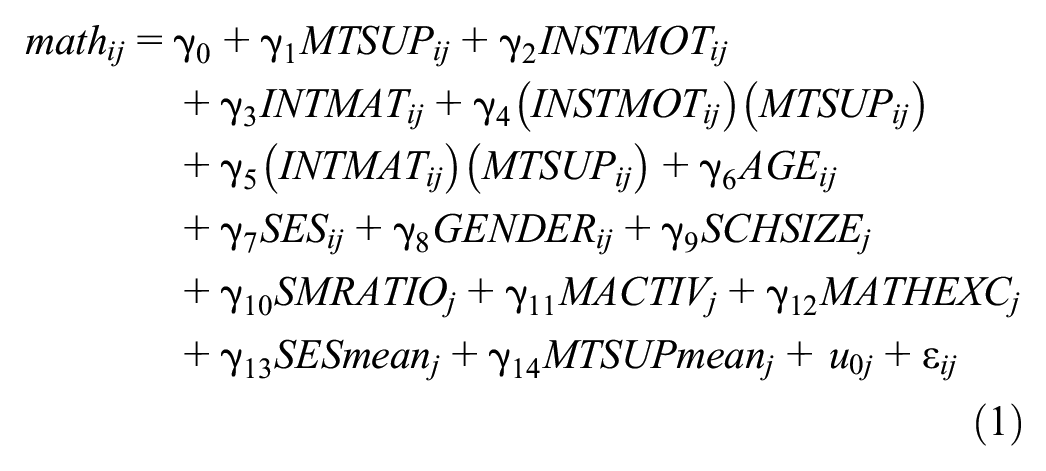
To examine the moderation effect of students’ instrumental motivation and mathematics interest on the relationship between teacher support in learning mathematics and mathematics achievement, we added interaction terms into each model below:
The model is as follows:
where
Results
Descriptive Statistics
Among data, 2,691 students are male, and 2,342 students are female. Tables 1 and 2 provide the means and standard deviations, minimum, maximum, range, skewness, and kurtosis of the measures used in this study for total, low, medium, high SES group. Table 1 shows that mean mathematics performance of the low SES school group is the lowest (489.01) and the mean mathematics performance of the high SES school group is the highest (629.58). Likewise, the mean instrumental motivation and math interest of the low SES school group is the lowest (−0.74 and −0.49) and the instrumental motivation and math interest of the high SES school group is the highest (−0.02 and 0.12).
Descriptive Statistics for Total Students.

Descriptive Statistics for Low, Medium, and High School Mean SES Group.

Multilevel Analysis
We began by estimating a series of unconditional models for all level 1 variables to compute intra-class correlations (ICCs). Students’ mathematics proficiency (math_ij) produced ICC = 0.23, meaning that between between-school mean differences accounted for approximately 23% of the total variance. The ICCs for the other level 1 predictors range between 0.01 and 0.27.
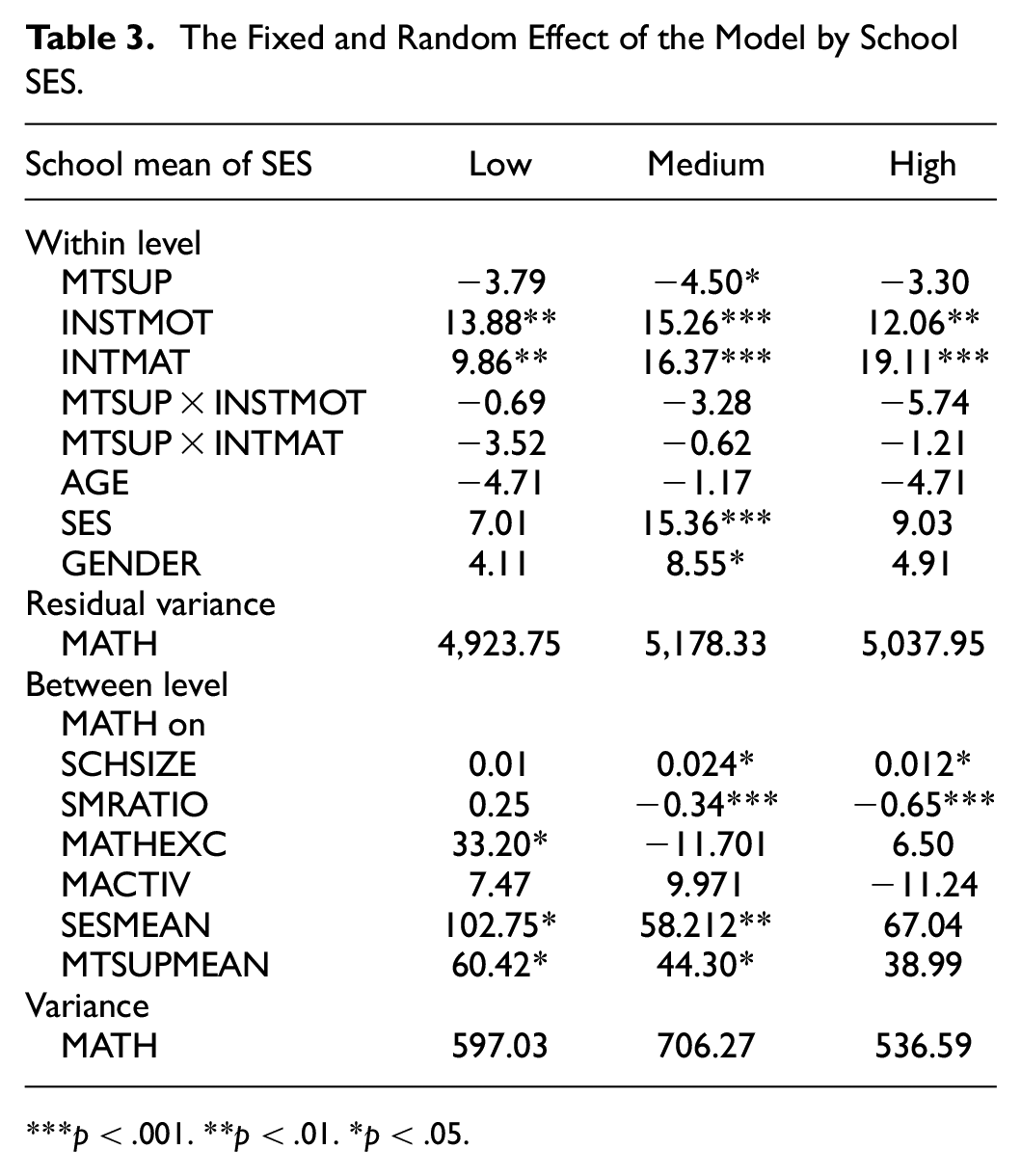
Table 3 gives the fixed and random effects estimates, and significant levels with Satterthwaite degrees of freedom adjustment from the model. The result shows that math teacher support in learning mathematics has a statistically significant relationship with student’s mathematics proficiency only for students in the medium SES school mean group (γ = −4.49, p < .05). That is, a one unit increase in student perception of math teacher support indicates a 4.49 unit decrease in student mathematics achievement.
The Fixed and Random Effect of the Model by School SES.
p < .001. **p < .01. *p < .05.
Regarding instrumental motivation and math interest, both variables have a statistically significant relationship with student’s mathematics performance across all school mean SES groups. For low SES school mean group, instrumental motivation (γ = 13.89, p < .05) has a stronger relationship with student mathematics performance than does math interest (γ = 9.86, p < .05). For the medium SES school mean group, student math interest (γ = 16.37, p < .001) has a stronger relationship with mathematics performance than does instrumental motivation (γ = 15.26, p < .001). For the high SES school mean group, student math interest (γ = 19.11, p < .001) has a stronger relationship with mathematics performance than does instrumental motivation (γ = 12,06, p < .01).
However, both instrumental motivation and math interest don’t have any interaction with student perception of math teacher support.
Regarding SES and gender, those variables are significantly related to student mathematics performance only for medium SES school mean group (γSES = 15.36, p < .001; γgender = 8.55, p < .01). Conversely, age has no significant relationship with student mathematics achievement across all groups.
Regarding level 2 variables, school size and teacher-student ratio have a significant relationship with student mathematics achievement for the medium and high SES school mean groups, but not for the low SES school mean group. Regarding mathematics extracurricular activities at school (MACTIVij) and mathematics extension course types offered (MATHEXCij), only mathematics extracurricular activities at school can predict student mathematics performance in low SES school mean groups (γMATHEXC = 33.20, p < .05). The effects of school mean SES and school mean of math teacher support are significant for low and medium SES school mean groups, but not for the high SES school mean group (see Table 3).
Discussion and Conclusion
The findings of the research indicate that the relationship between intrinsic and extrinsic motivation and a student’s math proficiency, and the relationship between mathematics teacher support and a student’s math proficiency, can vary depending on which schools the students attend. School SES, as an important aspect of a shared learning environment, has a strong effect on how students respond to math teacher support, and also on how they can be motivated. Three hypotheses are examined in this study.
Hypothesis 1: The relationship between student’s level of motivation and mathematics achievement differs by school SES.
The present study shows the various effect sizes of students’ learning beliefs on their mathematics achievement. This result is aligned with other studies examining the relationship between different motivation orientations and task outcomes (Appelgren et al., 2016; Baker, 2003; Kuvaas et al., 2017). For the low school SES group, instrumental motivation has the strongest relationship with students’ mathematics achievement. These results indicate that, for students in the low school SES group, increasing instrumental motivation in learning mathematics can be more effective than facilitating a student’s math interest. On the other hand, for students in medium and high SES school groups, facilitating their math interest can be more effective than increasing instrumental motivation for learning mathematics. Therefore, school mean SES, and the shared resources of the school and community, seem to account for these different relationships between student beliefs and their mathematics achievement. Considering that school mean mathematics achievement decreases as school mean SES does, it is plausible that learned helplessness regarding learning mathematics can make students lose their interest in school.
Hypothesis 2: The relationship between a student’s level of mathematics teacher support and mathematics achievement differs by school SES.
Students’ perceived teacher support in learning mathematics exhibits a negative association with student mathematics proficiency. That is, when students perceive that their math teachers are trying to aid in their learning of mathematics, a student’s mathematics proficiency is likely to decrease. However, this relationship is significant only for students in the medium SES school group. This result contradicts the findings of Rimm-Kaufman et al. (2015), which indicated that students who receive emotional support in the classroom show better social-emotional cognitive engagement. While Rimm-Kaufman et al.’s (2015) research supports the essential role of a teacher’s emotional care, such as by demonstrating their interest in a student’s mathematics learning and their willingness to assist in this process, the findings of this study also show that a teacher’s care and help can, counterintuitively, disturb student learning.
This result could be expected given how the teacher-student relationship is established in Confucianist culture. Regarding a math course in Korea, Sum and Kwon (2020) point out that “Korean classrooms are teacher-dominated with minimal oral interactions. Students are reticent and rarely speak/communicate their mathematical ideas” (p. 1). It seems that Korean students feel reluctant even to ask questions in the math classroom. Considering that the assessment of math teacher support in PISA 2012 focused on how math teachers demonstrate caring behavior, the responses of Korean students to math teacher support are predictably low. For example, item 2, “The teacher gives extra help when students need it,” assessed how a student feels when a teacher exhibits personal interest in their struggles. Considering teacher-student interactions in Korean math classrooms, frequent caring behavior between students and teachers is unlikely.
Hypothesis 3: Math teacher support in learning is moderated by student motivation (intrinsic and extrinsic motivation).
This hypothesis was not supported by the data. The student’s beliefs (intrinsic and extrinsic motivation) may be independent of the math teacher’s support, or teacher support may be ineffective for utilizing motivation to increase a student’s math achievement. As we mentioned in Section “Literature Review,” Korea has a very competitive educational environment, and parents and students alike often distrust public education and spend a considerable amount of money on private tutoring so that they can excel in this highly competitive environment. Many students take pre-class tutoring; English and mathematics are the most commonly taught subjects such tutoring programs and cram schools (Son, 1993). Much debate has centered on the effects of these educational supplements, and one of the important side effects of pre-class tutoring and cram school is that students show less engagement and less curiosity in their school classrooms. So, less engaged students in the math classroom may not need their math teacher’s support and respond less to it. Therefore, it is hardly likely that there is less interaction between math teacher support and student motivation.
In this study, we found that 15-year-old Korean students’ perceptions of math teacher support had no positive association with their math proficiency and did not interact with their motivation for learning mathematics. A student’s perception of math teacher support had a negative association with their math proficiency for students in the medium school mean SES group only. These findings confirm the possibility of the influence of Confucianism in the Korean math classroom and the influence of private schooling. Also the findings suggests that even without caring behavior from a math teacher, a positive teacher-student relationship can be established and students can achieve high math proficiency. Moreover, the findings have shown that a student’s motivation for learning mathematics and their perception of their teacher’s support differ by school mean SES. So, the role of school mean SES in the math classroom has also been confirmed by the study. However, how school mean SES works in students’ math learning and in the interactions between math teachers and students is beyond the scope of this research. In sum, the findings of this study indicate that school mean SES impacts the shared learning environment, has a strong influence on student responses to math teacher support, and affects the relationship between student motivation and math achievement.
The desire for upward mobility through education and maintaining SES across generations has led to a competitive environment in South Korean schools. This competition has led to students feeling pressure to perform well, and it has also led to teachers feeling pressure to get their students to perform well. This pressure can make it difficult for teachers to build close relationships with their students, as they are constantly focused on academics. One interesting finding of this study is that students’ perception of math teacher support had a negative association with their math proficiency. When analyzing the secondary data, it is important to consider the cultural context in which they were collected. In Confucian-oriented education systems, such as the one in Korea, there is often a strong emphasis on a hierarchical teacher-student relationship. This may lead to less emphasis on student expression of opinions in the classroom. Thus, it is possible that the provision of opportunities for students to express opinions may be perceived as less supportive in this context, which could potentially explain the negative relationship with mathematics achievement observed in Korean students.
Furthermore, it would be useful to consider the potential influence of cultural norms and expectations on how students perceive and respond to be given an opportunity to express their opinions. For example, Korean students may feel uncomfortable expressing opinions in front of the teacher or their peers, which could affect their perception of the teacher’s supportiveness. Overall, a deeper understanding of the cultural and educational context is needed to fully interpret the relationship between teacher support and mathematics achievement in East Asian countries. Future research is needed to explore these potential factors and their impact on student achievement.
Some limitations should be noted for future study. All the items in the survey aimed to measure a student’s perceived emotional and motivational support from math teachers. For example, “how much teachers care about their students’ learning in mathematics,”“how they express this care,” etc., which are not elements under the influence of teacher behavior or classroom pedagogy. So, the teaching approaches of math teachers should be investigated specifically. Even though the negative effect of teacher support holds only for students in the medium school mean SES group, the behaviors of math teachers that are negatively associated with student math proficiency should be examined. By examining the interactions between a math teacher and a student in a classroom, supportive teacher behaviors can be modified and improved. Therefore, a deep investigation of teacher behavior and the interactions between teachers and students is needed to enhance teacher guidance and help increase student achievement. Lastly, another analytic methodology should be used to investigate the structural relationship between the variables examined in this research, since these variables (i.e., student motivation) were latent constructs containing measurement errors, and controlled by a structural equation modeling technique used to compare the results from these findings.
Footnotes
Declaration of Conflicting Interests
The author(s) declared no potential conflicts of interest with respect to the research, authorship, and/or publication of this article.
Funding
The author(s) received no financial support for the research, authorship, and/or publication of this article.

Data Availability Statement
Data sharing not applicable to this article as no datasets were generated or analyzed during the current study.