




Abstract
Teacher job satisfaction has been investigated as a critical influence on teacher turnout and the development of high-quality schools. Employing hierarchical linear modeling (HLM), the present study examined the effects of both teacher- and school-level factors on teacher job satisfaction in Japan and South Korea. Education in both countries is rooted in an East Asian cultural setting, and a comparison across the two countries will contribute to the discovery of underlying factors that affect teacher job satisfaction. The current study, based on the 2018 Teaching and Learning International Survey, showed that gender, teaching experience, social utility motivation to teach, self-efficacy, teacher-student relations, professional development, and team innovativeness exerted a crucial influence on teacher job satisfaction at teacher-level for Japan and South Korea. Furthermore, school sector, school delinquency and violence, and lack of special needs personnel were distinctive factors at school-level related to teacher job satisfaction for the two countries. The findings were discussed within the East Asian cultural context as well as comparatively, regarding East Asian versus Western cultures.
Introduction
Teacher job satisfaction is viewed as teachers’ affective reactions and subjective attitudes to their work or teaching role, which refers to the functional relationship between what one expects from teaching and what one is actually offered as a teacher (Skaalvik & Skaalvik, 2011; Zembylas & Papanastasiou, 2004). It is of great importance in the development of high-quality education and has been a key focus for researchers over recent decades (Crossman & Harris, 2006; Duyar et al., 2013; Evans, 1997; Toropova et al., 2021). Higher levels of teacher job satisfaction may translate into favorable classroom and school climate, which are conducive to teacher-student relationships, student learning, and teacher turnout, especially dwindling potential achievement gaps between the normal and socio-economically-disadvantaged students (Griffith, 2004; Skaalvik & Skaalvik, 2011). Also, more teacher job satisfaction and better cooperative working relationships are beneficial for the implementation of school programs and goal-directed outcomes, leading to highly effective organizational performance (Griffith, 2004; Torres, 2019).
Many variables have been reported to be related to teacher job satisfaction. The effects of gender, teaching experience, motivation to teach, and self-efficacy on teacher job satisfaction are classified as intrinsic factors (e.g., Klassen & Chiu, 2010; Liu et al., 2023; Skaalvik & Skaalvik, 2014; Watt et al., 2012), whereas leadership patterns, working conditions, school climate, and social culture are categorized as extrinsic factors (e.g., Kapa & Gimbert, 2018; Kelchtermans, 2006; Y. Liu et al., 2021 Özcan, 2021). All these factors form a multi-dimensional concept within both internal and external environments (Alfuraih et al., 2022), indicating that teacher job satisfaction is affected by both teachers themselves and school contexts. Nevertheless, it is noteworthy that when correspondingly supportive intrinsic and extrinsic conditions are insufficient, teachers are more likely to be dissatisfied, and suffer from turnover and even completely leave the teaching profession (Griffith, 2004; Torres, 2019). Teacher turnover negatively influences institutional collegiality, reciprocal trust, and student learning motivation (Ingersoll, 2001; Skaalvik & Skaalvik, 2011; Toropova et al., 2021). Therefore, it is necessary to maintain a generally high degree of job satisfaction for teachers.
On the one hand, there has been an increase in literature regarding which factors can influence teacher job satisfaction in recent years. Existent cases, however, are featured by conducting a single-country sample, transnational comparative studies on the relationships between teacher job satisfaction and other circumstances restricted to a certain region or specific domain are limited. On the other hand, although both teachers themselves and school contexts are closely linked to teacher job satisfaction, there have been few studies that address teacher- and school-level conditions simultaneously (e.g., Liu et al., 2023; Shen et al., 2012). Traditionally, teaching is highly valued as an attractive and representative profession in East Asian cultural circles, and recruitment to the occupation is considered as a drastically competitive process (Hargreaves, 2009; Klassen et al., 2010; OECD, 2019a). In particular, as two typical and influential East Asian countries, Japan and South Korea share similar cultural contexts and educational systems, where teachers enjoy a respected social status and a high prestige (Byun et al., 2012; Hargreaves, 2009; Yamamoto & Brinton, 2010). Therefore, it is reasonable and worthy to comparatively explore similar and different factors influencing teacher job satisfaction across the two countries.
The present study attempts to conduct a multinational comparison of teacher job satisfaction based on the data set from the 2018 Teaching and Learning International Survey (TALIS 2018). TALIS 2018 contains a great deal of data, providing a valuable opportunity for the comparative study of teacher job satisfaction in Japan and South Korea. Considering the complexity of the educational contexts, teacher job satisfaction in light of both teacher- and school-level factors would be examined, with special attention to the reasons for relatively low versus high job satisfaction recorded for teachers in the two countries. In addition, issues related to teacher job satisfaction would be discussed with regard to East Asian culture as well as comparatively, with regard to East Asian and Western cultures.
Literature Review
Teacher Job Satisfaction
Job satisfaction has long been a heated topic because it is viewed as a crucial element for enhancing efficiency and quality in various fields (Hagedorn, 2000; Judge et al., 2012; Locke, 1969). Evidence has shown that job satisfaction is a psychological state as well as an emotional experience that people have, reflecting the work itself, salary, promotion, work pressure, and interpersonal relationships with leaders and colleagues in the work environment (Dou et al., 2017; Evans, 1997; Locke, 1969; Wang et al., 2021). In addition, studies showed that job satisfaction is related to teachers’ expectations about their work, with satisfaction varying among teachers based on the shared work conditions (Hagedorn, 2000; Judge & Church, 2000; Judge et al., 2012; Wang et al., 2021).
Teacher job satisfaction concerns teachers’ affective attitudes regarding the relationship between their expectations about what the teaching profession can provide for them and what the teaching profession actually brings them (Wang et al., 2021; Zembylas & Papanastasiou, 2004). Teachers tend to experience a sense of fulfillment and gratification through their work, and two components in teacher job satisfaction have been confirmed, that is, job comfort and job fulfillment (Evans, 1997). It has been found that teacher job satisfaction can undoubtedly provide numerous educational benefits for both schools and students, such as organizational and school performance, faculty collegiality and trust, and student motivation and achievement (Griffith, 2004; Ingersoll, 2001; Toropova et al., 2021). However, there is no consensus as to the factors that bring about teacher job satisfaction. Some research has shown a number of different determinants that help in the understanding of teacher job satisfaction. It was found that teacher job satisfaction is positively related to teaching motivation (Admiraal, 2021; Fokkens-Bruinsma & Canrinus, 2014; Liu et al., 2023), self-efficacy (Edinger & Edinger, 2018; Skaalvik & Skaalvik, 2014), a safe working environment (Y. Liu et al., 2021), leadership patterns (S. J. Liu et al., 2021; Torres, 2019), and social recognition of the teaching profession (Kapa & Gimbert, 2018; Watt et al., 2012). Clearly, a variety of personal characters and organizational variables are relevant to teacher job satisfaction (Shen et al., 2012).
Teacher-Level Characters and Teacher Job Satisfaction
Teachers’ personal characteristics, as intrinsic constituents of the teaching profession, can crucially affect their job satisfaction (Toropova et al., 2021; You et al., 2017). The relationship between gender differences and job satisfaction, for example, has been extensively studied and shown to be inconsistent. Based on an East Asian setting, You et al. (2017) proposed that, a link between gender and all dimensions of job satisfaction has not been found for South Korean teachers, and a Chinese case showed the similar result (Liu et al., 2023). Another research from Western Canada suggested that male teachers tend to be more satisfied with their work than female teachers (Klassen & Chiu, 2010), whereas several studies showed that female teachers report generally higher job satisfaction than their male counterparts based on the US and Swedish contexts, respectively (Conley & You, 2016; Toropova et al., 2021). Such mixed findings may be probably attributed to teacher perceptions of working conditions, different operationalizations of job satisfaction, as well as unique cultural settings (Klassen et al., 2010; Toropova et al., 2021).
Research on the relationship between teaching experience and job satisfaction has also yielded mixed results. Topchyan and Woehler (2021) argued that teaching experience did not have a significant influence on teacher job satisfaction. However, Conley and You (2016) found that more experienced teachers reported significantly higher job satisfaction than those who are less experienced in the US. Additionally, some studies from East Asia revealed diversiform and complicated relationships between more experienced and less experienced teachers regarding job satisfaction. Ghavifekr and Pillai (2016) suggested that Malaysian teachers with teaching experience less than 2 years reported the least job satisfaction, followed by a sharp increase for teachers serving 2 to 5 years, next a sharp fall with 6 to 10 years, and then a continuously steady increase for those serving 11 to 15 years and above. Similarly, a Chinese study found that teachers with less than five years of teaching experience were the most satisfied with their profession, whereas the professional satisfaction of teachers who had been teaching for 16 to 20 years was relatively lower (Chen, 2017).
Teacher motivation, comprised of intrinsic as well as extrinsic factors influencing individuals to become and remain a teacher, has also been found to be associated with teacher job satisfaction (Fokkens-Bruinsma & Canrinus, 2014; Liu et al., 2023; Watt et al., 2012). Job security, salary, and teaching responsibility have been found to be important extrinsic motivation for teachers (Fokkens-Bruinsma & Canrinus, 2014), whereas intrinsic motivation for teaching is simply viewed as the reasons why people tend to be a teacher, that is, as a reflection of their desire to contribute to children’s outcomes and social development (Liu et al., 2023). The motivation for teachers regarded as a social value concerns the development of a favorable learning and working climate in schools, and has been found to be positively related to teacher job satisfaction (Admiraal, 2021). Types of the variables that motivate people to join the teaching profession have been shown to correlate strongly with extent of job satisfaction, whereas the motives to teach appeared to differ in accordance with diverse cultures, resulting in various outcomes (Fokkens-Bruinsma & Canrinus, 2014; Watt et al., 2012).
Teacher self-efficacy is proved to be a very important determinant of job satisfaction (e.g., Skaalvik & Skaalvik, 2010; You et al., 2017). Evidence from the United States, Canada, and Norway all demonstrated that teachers with stronger self-efficacy in their teaching processes reported being more satisfied with their work (Edinger & Edinger, 2018; Klassen & Chiu 2010; Skaalvik & Skaalvik, 2010). Inversely, a comparative study across Japan, South Korea, and China suggested that job satisfaction is also a positive predictor of teacher self-efficacy (An et al., 2021). Furthermore, in China, Huang et al. (2021) showed that self-efficacy in both teacher-student relations and school decision-making ranked as more important than self-efficacy in classroom teaching, indicating that self-efficacy related to the school climate rather than the profession itself has a greater effect on job satisfaction. Several studies, however, reached thoroughly contradictory outcomes. For example, by employing a longitudinal interplay process model, Granziera and Perera (2019) argued no association between self-efficacy and job satisfaction was found for Australian teachers. Similarly, Vettori et al. (2022) noted that Italian teachers’ self-efficacy cannot directly predict their job satisfaction.
Professional development is considered as a significant predictor of teacher job satisfaction (e.g., Nir & Bogler, 2008; Song et al., 2018; Toropova et al., 2021). Song et al. (2018) found that although the level of teachers’ professional development was generally low across 50 countries in the 2007 Trends of International Mathematics and Science Study (TIMSS 2007), professional development was positively associated with job satisfaction, expectations for student performance, and attitudes on implementing schools’ curriculum. Further, professional development barriers have received much attention from researchers. Yoo and Jang (2022) revealed that uniform learning projects are more likely to result in a lack of voice in the decision-making processes related to teachers’ career plans, and bureaucratic strategies with top-down training programs impede the progress of high-quality professional development in South Korea. In addition, Japanese experience also suggested that deficient professional preparation is a potential problem in the accommodating of context-specific practices in teaching careers (Fujimura & Mistilina, 2020). Therefore, professional development programs only tailored to teachers’ practical requirements and different career stages could boost their specialized skills and confidence for effective teaching (Klassen & Chiu, 2010).
School-Level Characters and Teacher Job Satisfaction
School-level variables are also considered to crucially influence teacher job satisfaction (e.g., Shen et al., 2012; Wang et al., 2021). School climate is formed by a multidimensional concept, mainly consisting of interpersonal relationships, teaching and learning, and safety concerns (Cohen et al., 2009; Liu et al., 2023; Thapa et al., 2013). Environmental factors related to the school climate can magnify or reduce teacher job satisfaction, and constructively affect school delinquency and violence, collaboration, and teacher-student relationships (An et al., 2021; Lassila & Uitto, 2016; Liu et al., 2023; Malinen & Savolainen, 2016).
There is a large body of empirical evidence on relationships between various aspects of the school climate and teacher job satisfaction. Results from TALIS 2008, TALIS 2013, and the 2015 Programme for International Student Assessment (PISA 2015) all showed that professional collaboration among teachers can improve their job satisfaction (Chen, 2017; Duyar et al., 2013; Sims, 2017). Using an SEM analysis, Skaalvik and Skaalvik (2021) also argued that common values increase the motivation for collaboration and interactions among Norwegian teachers, thereby enhancing their autonomy, belonging, and job satisfaction. Furthermore, teachers’ perception of social support from colleagues and teaching principles has also been found to be instrumental determinants of teacher job satisfaction, with several studies from China and England revealing that positive and supportive relationships among teachers increase their job satisfaction (Dou et al., 2017; Sims, 2017).
School delinquency and violence, as a serious problem across the world, has been found to be closely linked to teacher job satisfaction (Kapa & Gimbert, 2018). Teachers in schools with more delinquency and violence have been shown to be less satisfied with their work and more likely to resign their positions (Liu et al., 2023; Torres, 2019). School aggression from students is highly correlated with reductions in teachers’ physical and emotional well-being (Moon et al., 2015), and victimized teachers are vulnerable to psychological distress as well as impaired personal relationships (Moon & McCluskey, 2016). Such teachers are probably dissatisfied, being subjected to an unsafe environment (Kapa & Gimbert, 2018).
Several research has suggested that certain factors related to school organization can improve and sustain teacher job satisfaction (e.g., Dou et al., 2017; S. J. Liu et al., 2021; Shen et al., 2012; Torres, 2019). Dou et al. (2017) developed a path model which demonstrated a significant influence of instructional and transformational leadership, mediated by the indirect impact of school climate, on teacher job satisfaction. S. J. Liu et al. (2021) investigated the relationship between distributed leadership and teacher job satisfaction through the mediating effects of teacher autonomy and collaboration, emphasizing the key role of a supportive school culture (Wang et al., 2021). Further, it has been shown that administrative leadership, when focused on promoting a collaborative culture and a supportive structure, enhances teachers’ job satisfaction (Shen et al., 2012; Torres, 2019). Likewise, servant leadership, ethical leadership, individual- and task-oriented leadership, and laissez-faire leadership have been found to be important for teacher job satisfaction (Cansoy, 2019; Torres, 2019). For instance, transformational leadership improves teacher job satisfaction when there is an increased support for teachers, whereas there is a negative relationship between laissez-faire leadership and teacher job satisfaction (Cansoy, 2019). Variables related to school leadership models have been widely considered to be potential predictors of teacher job satisfaction, as the attitudes and behaviors of principals have been shown to exert a substantial influence on the working climate and quality of teaching and learning within schools (Pietsch & Tulowitzki, 2017; Wang et al., 2021).
Physical context is considered to be another school-level variable related to teacher job satisfaction. Research found that an unsuitable school size exerts a negative impact on teacher job satisfaction, which has been shown to be higher at small schools than that at large schools (Shen et al., 2012). Studies on urban versus rural contexts have produced mixed results. Chen (2017) suggested, on the basis of TALIS 2015 data set from China, that the satisfaction of teachers in rural areas is significantly lower than that in urban areas, but other cases showed that teachers at urban schools have the lowest job satisfaction (e.g., Shen et al., 2012). Additionally, Liu et al. (2023) argued that school location has no significant effect on teacher job satisfaction. In terms of the private versus public sector, research has shown that the private sector is a significant predictor for teacher job satisfaction in England (Crossman & Harris, 2006), whereas teaching in the public system is linked to lower teacher satisfaction in Malaysia (Ghavifekr & Pillai, 2016). These manifestations suggest that teacher job satisfaction varies according to specific school contexts, where variables such as teacher empowerment, career and working conditions, and administrative leadership are at play (Shen et al., 2012).
Research Questions
The current study was designed to answer the following research questions:
RQ1: How do teacher-level factors influence teacher job satisfaction in Japan and South Korea?
RQ2: How do school-level factors influence teacher job satisfaction in Japan and South Korea?
RQ3: What are the common and distinct factors involved in teacher job satisfaction across Japan and South Korea?
Methodology
Data Sources
The data in the current research was obtained from the 2018 Teaching and Learning International Survey (TALIS 2018), which involved primary, lower secondary, and upper secondary schools from 48 countries
Variables
Dependent Variable
Teacher job satisfaction (T3JOBSA) formed the dependent variable and was assessed with a composite scale that contained two sub-scales: job satisfaction with work environment (T3JSENV) and job satisfaction with profession (T3JSPRO), both of which were formed from the teacher questionnaire. All indicators were measured with a Likert-type format with ratings from 1 to 4, respectively, as follows: “strongly disagree,”“disagree,”“agree,” and “strongly agree.”
Teacher-Level Predictor Variables
The present study contained two sorts of teacher-level predictors: firstly (a) teachers’ individual characteristics, including gender (TT3G01; 0 for female, 1 for male), educational background (TT3G03; from below <ISCED 2011 Level 3> to <ISCED 2011 Level 8>), and teaching experience (TT3G11B); and secondly (b) teachers’ professional characteristics, including social utility motivation to teach (T3SOCUT), self-efficacy (T3SELF), cooperation (T3COOP), teacher-student relations (T3STUD), team innovativeness (T3TEAM), needs for professional development (T3PDPED), and professional development barriers (T3PDBAR). All variables were measured by items from the teacher questionnaire. Specifically, social utility motivation to teach was assessed with a Likert-type format ranging from 1 to 4, with 1 for “not important at all” and 4 for “of high importance”; self-efficacy was evaluated with a composite scale that contained three sub-scales: self-efficacy in classroom management (T3SECLS), self-efficacy in instruction (T3SEINS), and self-efficacy in student engagement (T3SEENG), which were all on a 4-point Likert-type response with 1 for “not at all” and 4 for “a lot”; cooperation was also assessed with a composite scale that contained two sub-scales: exchange and co-ordination among teachers (T3EXCH) and professional collaboration in lessons among teachers (T3COLES), which were all responded with a six-point Likert scale: 1 for “never” and 6 for “once a week or more”; teacher-student relations, team innovativeness, and professional development barriers were all answered on a 4-point Likert scale, with 1 for “strongly disagree” and 4 for “strongly agree”; and needs for professional development was responded with a 4-point Likert scale: 1 for “no need at present” and 4 for “high level of need.”
School-Level Predictor Variables
School-level predictors included school location (TC3G10; from rural area coded as 1 to large city coded as 5), school sector (TC3G12; 0 for public school, 1 for private school), participation among stakeholders (T3PLEADP), school delinquency and violence (T3PDELI), and lack of special needs personnel (T3PLACSN). All variables were measured by items from the principal questionnaire. Specifically, participation among stakeholders was answered on a 4-point Likert scale, with 1 for “strongly disagree” and 4 for “strongly agree”; school delinquency and violence was assessed with one scale in a Likert-type format ranging from 1 to 5: 1 for “never” and 5 for “daily”; and lack of special needs personnel was on a 4-point Likert-type response with 1 for “not at all” and 4 for “a lot.”
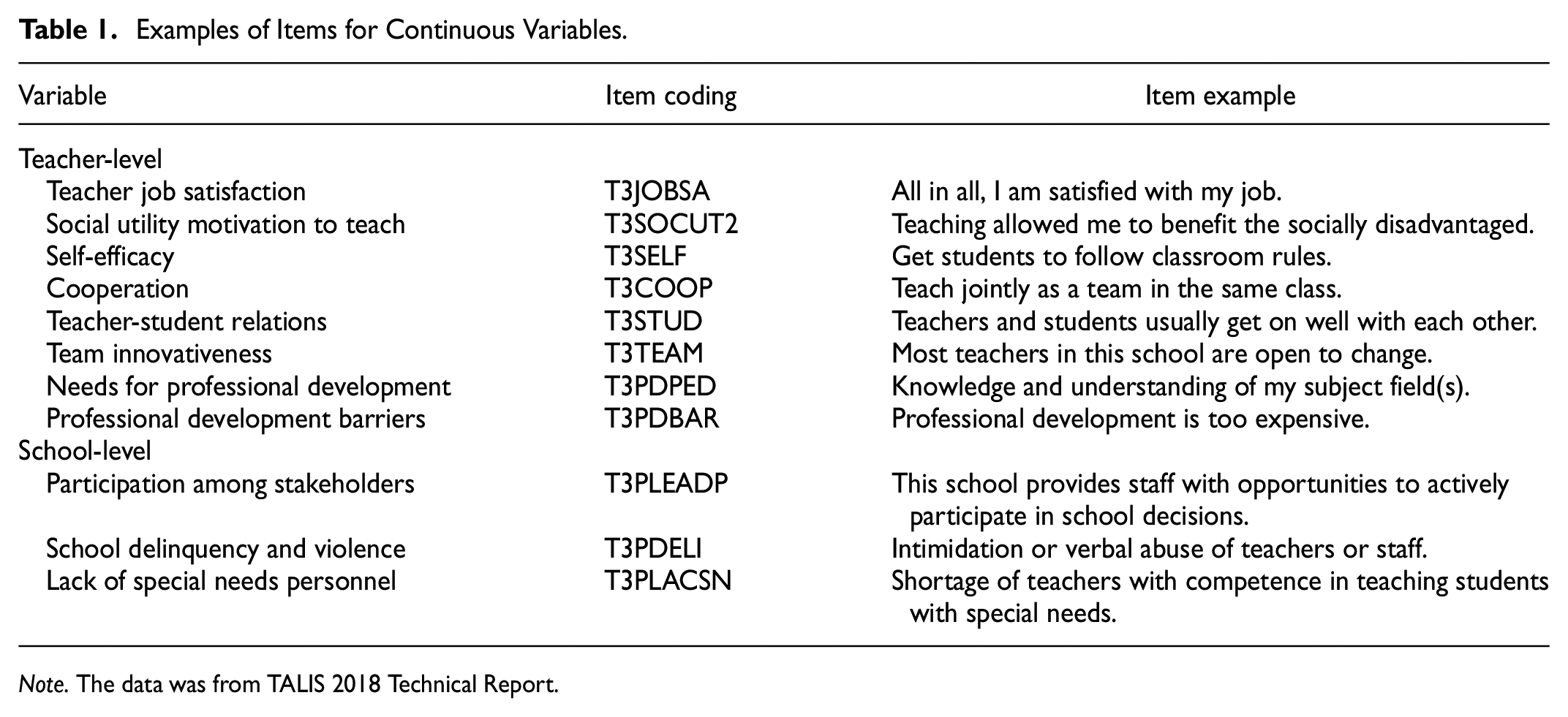
Table 1 displays all continuous variables and corresponding examples of survey items at teacher-level and school-level.
Examples of Items for Continuous Variables.
Note. The data was from TALIS 2018 Technical Report.
Models and Analytic Methods
Multilevel models are designed to analyze variables from different levels simultaneously, using a statistical program that properly includes the various dependencies (Hox, 2010). Considering that the teacher-level predictors and school-level variables in the present study were typically nested structure data (teachers nested within schools), hierarchical linear modeling (HLM) is a reasonably effective method for taking both teacher and school factors into consideration, simultaneously (Raudenbush & Bryk, 2002). The multi-level software program, HLM 6.08 (Raudenbush et al., 2004) was employed to analyze the data in the current study.
According to our research questions, this study was comprised of three models. The first one was a fully unconditional model or one-way random-effects ANOVA model, without any predictor variable. The one-way random-effects ANOVA model can partition the total variance in overall teacher job satisfaction into within- and between-school variances. Then, the second one was a partially conditional model, adding predictors at the teacher level. Finally, based on the second model, a fully conditional model was formed by adding school-level predictor variables. The regression equations of the final model, consisting of both teacher- and school-level variables, was displayed below.
Level-1 Model:

Level-2 Model:

In the first equation, Yij represents job satisfaction of teacher i in school j, β0j is the regression intercept embodying average level of teacher job satisfaction of school j, and β1j to β10j refers to regression slopes of the level-1 variables, standing for gender (TT3G01), educational background (TT3G03), teaching experience (TT3G11B), social utility motivation to teach (T3SOCUT), self-efficacy (T3SELF), cooperation (T3COOP), teacher-student relations (T3STUD), team innovativeness (T3TEAM), needs for professional development (T3PDPED), and professional development barriers (T3PDBAR), respectively. rij was the random effect of teacher i in school j.
In the second equation, γ00 is the overall average teacher job satisfaction for all schools, and γ00 to γ05 are the regression coefficients of level-2 variables, representing school location (TC3G10), school sector (TC3G12), participation among stakeholders (T3PLEADP), school delinquency and violence (T3PDELI), and lack of special needs personnel (T3PLACSN), respectively. μ0j was the random effect of school j.
Results
Descriptive Statistics
Table 2 shows the mean (M) and standard deviation (SD) for relevant variables across Japan and South Korea. The results revealed that Japan had a higher mean for teaching experience and needs for professional development, whereas South Korea had higher scores for social utility motivation to teach, self-efficacy, cooperation, teacher-student relations, and team innovativeness. Both countries shared the same average value for professional development barriers of teacher-level predictors. In addition, Japan had a higher mean in participation among stakeholders and lack of special needs personnel, whereas South Korea had higher averages for school delinquency and violence related to school-level factors.
Mean (M)/Standard Deviation (SD) of all Predictor Variables.

Multi-Level Analysis
The fully unconditional model in the HLM analysis is shown in Table 3. The intraclass correlation coefficients (ICC) demonstrated that the total variance in teacher job satisfaction was 6.3% for schools in Japan and 10.8% for schools in South Korea, indicating that the subsequent multilevel analyses were appropriately employed, according to previous studies (Gümüş & Bellibaş, 2023; Tang et al., 2020; Torres, 2019). The fixed effect demonstrated that the grand mean of teacher job satisfaction in Japan (β = 12.060, p < .001) was higher than it was in South Korea (β = 12.058, p < .001). While the random effect revealed a significant variation among schools for teacher job satisfaction in Japan (β = .255, p < .001) and South Korea (β = .580, p < .001), indicating that teachers job satisfaction ratings varied significantly across schools for the two countries.
Fully Unconditional Model of the HLM Analysis (Japan/South Korea).

p < .001.
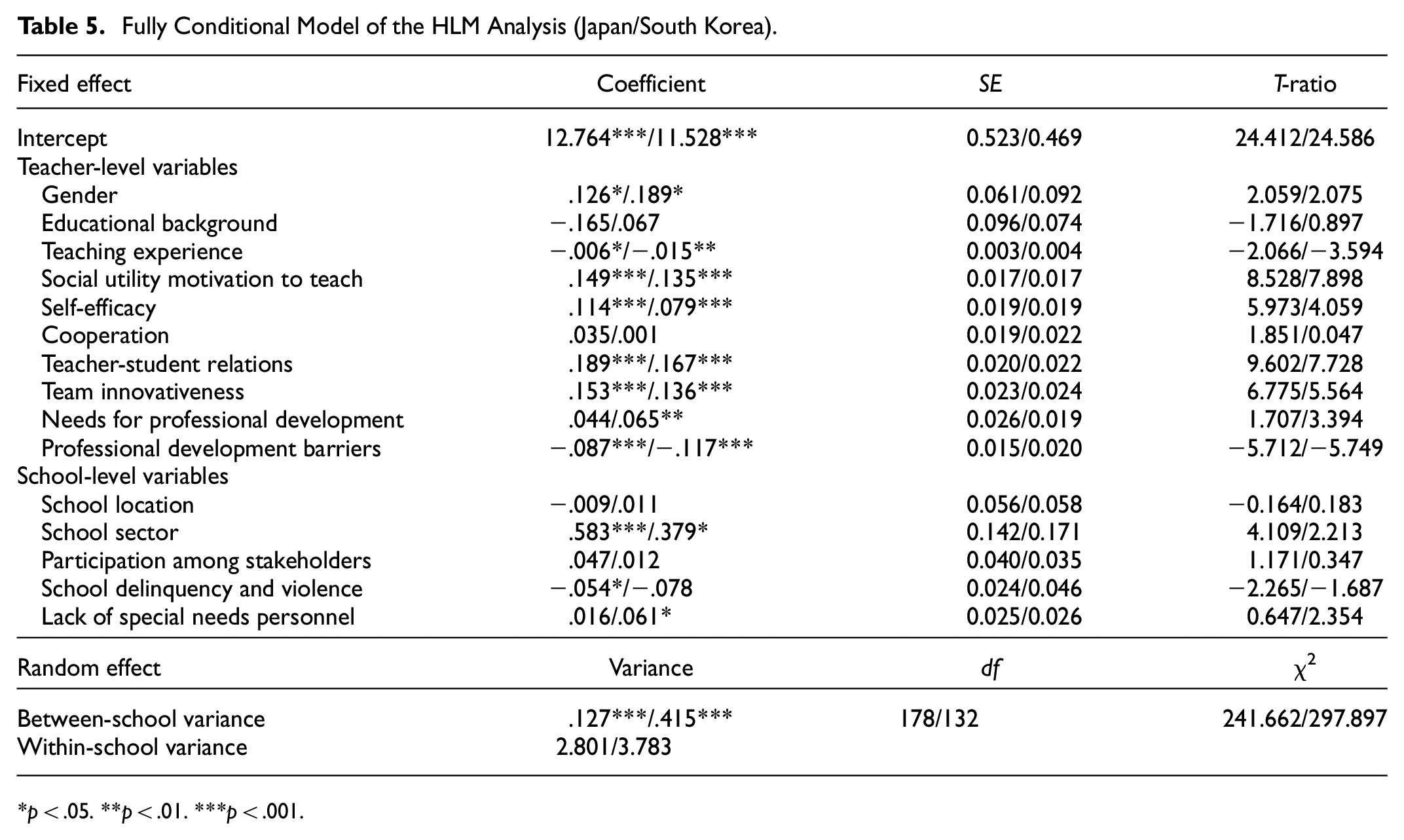
The partially conditional model is shown in Table 4 and the fully conditional model is displayed in Table 5. Being comprised of both teacher- and school-level predictors in the HLM analysis, the fully conditional model revealed the following results: (1) Gender significantly predicted teacher job satisfaction in both Japan and South Korea , with females having a lower level of job satisfaction than males; teaching experience was a significant predictor, and teachers who had worked longer had lower job satisfaction for both countries; however, educational background had no significant effect on teacher job satisfaction in the two countries. (2) Social utility motivation to teach, self-efficacy, teacher-student relations, team innovativeness, and professional development barriers were all significant predictors for teacher job satisfaction in both countries, whereas the effect of professional development barriers was negative; as well, cooperation had no significant effect on teacher job satisfaction in the two countries. (3) The predictor of needs for professional development had different effects on teacher job satisfaction, which was positively associated with teacher job satisfaction in South Korea but exerted no significant effect in Japan.
Partially Conditional Model of the HLM Analysis (Japan/South Korea).

p < .05. **p < .01. ***p < .001.
Fully Conditional Model of the HLM Analysis (Japan/South Korea).
p < .05. **p < .01. ***p < .001.
Additionally, school sector demonstrated a significant association with teacher job satisfaction in both Japan and South Korea. Specifically, teachers had a higher level of job satisfaction in private rather than that in public schools. School delinquency and violence negatively affected teacher job satisfaction in Japan but had no significant impact in South Korea. Lack of special needs personnel was a positively significant predictor for South Korea but had no significant effect for Japan. Further, school location and participation among stakeholders did not significantly predict teacher job satisfaction for both countries. The proportion of variance explained in teacher job satisfaction was 25.2% at the teacher level and 14.2% at the school level in Japan, but 21% at the teacher level and 8.4% at the school level in South Korea.
Discussion
Using a two-level HLM analysis, the present study investigated associations between teacher job satisfaction and both teacher- and school-level factors in Japan and South Korea based on TALIS 2018 data set, addressing the first two research questions. Additionally, the similarities and differences of factors influencing teacher job satisfaction in both countries were explored, in accordance with East Asian culture and via comparisons between East and West cultures, addressing the last research question.
Teacher-Level Crucial Factors on Teacher Job Satisfaction
The mechanisms influencing teacher job satisfaction were generally shown to vary across Japan and South Korea, with the crucial factors existing at teacher-level rather than school-level for the two countries.
It was found that self-efficacy and teacher-student relations each positively predicted teacher job satisfaction for both Japan and South Korea, which is consistent with those of previous studies conducted in the East Asian context (e.g., An et al., 2021; Huang et al., 2021; Liu et al., 2023; Malinen & Savolainen, 2016). However, cross-cultural evidence on self-efficacy varies. The study conducted in Australia suggested that teachers’ self-efficacy is not significantly related to their job satisfaction (Granziera & Perera, 2019). Likewise, the Italian case also found that self-efficacy is associated with teachers’ job satisfaction only when there is a moderating effect of positive emotion, thereby emphasizing the key role of cognitive-affective variables (Vettori et al., 2022). These may involve concrete operational methods as well as discrepancies on microscopic psychology across multi-culture. Additionally, in Japanese schools, studies showed that good teacher-student relations can facilitate students’ personal growth on campus, suggesting that those teachers generally place a strong emphasis on emotional connections with students and foster close relatedness within the community as a whole (Shimahara, 2002). Conversely, teachers’ dissatisfaction and disappointment are closely linked with insufficient emotional interchanges or being in an extremely tense environment (Lassila & Uitto, 2016). Given that the positive associations among teacher-student relations, self-efficacy, and job satisfaction (Liu et al., 2023; Skaalvik & Skaalvik, 2010), participation among stakeholders - including school administrators, teachers, students, and parents - should comprehensively promote a favorable interactive atmosphere and harmonious teacher-student relationships. This can probably enhance teachers’ confidence in classroom management and self-efficacy, thereby increasing their job satisfaction.
Professional development barriers and team innovativeness were significantly linked to teacher job satisfaction for both Japan and South Korea, but needs for professional development was a significant predictor only for South Korea, which were all dissected among previous studies (e.g., Nir & Bogler, 2008; Song et al., 2018; Toropova et al., 2021; Yoo & Jang, 2022). In all probability the discrepant effects for career development found in the present study reflect the different professional training systems that Japan and South Korea employ. These signify a generally high quality of teacher education in Japan, whereas teachers working under unified patterns and bureaucratic systems are eager for efficient professional development in South Korea (An et al., 2021; Fujimura & Mistilina, 2020; Yoo & Jang, 2022). South Korean teachers are more likely to regard training as a precious opportunity to improve their professionalism, as it can bring increased self-confidence, self-efficacy, and job satisfaction (Nir & Bogler, 2008; Yoo & Jang, 2022). In view of the various forms of professional development activities and the diverse needs of teachers, rationally targeted training measures are required rather than a ‘one-size-fits-all’ approach.
With regard to the relationships between individual characteristics and teacher job satisfaction, it exhibited the following outcomes. Female teachers were shown to have a lower level of job satisfaction than male teachers in both Japan and South Korea, which is in accord with some previous studies (e.g., Klassen & Chiu, 2010), but inconsistent with others (e.g., Conley & You, 2016; Toropova et al., 2021). The present results may be due to cultural norms within the East Asian context, whereby female teachers in Japan and South Korea generally share the greater responsibility of daily domestic tasks (An et al., 2021), and they are more vulnerable in dealing with the pressure caused by student behavioral problems (Klassen & Chiu, 2010). Our findings also showed that the longer the teaching experience was, the less satisfied the Japanese and South Korean teachers were. This result is in line with the Chinese case (Liu et al., 2023) but differs from the Malaysian experience (Ghavifekr & Pillai, 2016). Other cross-cultural studies revealed conflicting effects as well. Scholars found that experienced teachers reported higher job satisfaction and lower separation rates in the US (Shen et al., 2012). While in England, the relationship between teaching experience and job satisfaction shows a U-shaped pattern, with relatively lower satisfaction in the middle career time period (Crossman & Harris, 2006). A similar nonlinear relationship was also reported in an empirical study based on PASA 2015 (Chen, 2017). In sum, a variety of evidence has shown that teaching experience, as an important predictor, exerts different effects on teacher job satisfaction in accordance with cultural contexts and human resources.
School-Level Distinctive Factors on Teacher Job Satisfaction
The greatest differences across Japan and South Korea relating to teacher job satisfaction were found at the school-level. While lack of special needs personnel was not a significant predictor in Japan, it was a significantly positive predictor in South Korea, suggesting that the fewer the South Korean special education teachers were, the higher the level of overall job satisfaction was. This finding probably signifies when South Korean teachers are confronted with a great number of students with special needs or with those from socio-economically disadvantaged homes, they tend to be less satisfied, thereby reducing the overall level of teacher job satisfaction. In reality, teachers are likely to undertake excessive stress and burnout in face of more disadvantaged students, and such a situation may throw a deleterious effect on teachers’ physical and mental health, leading to lower job satisfaction and commitment whereas higher intention to leave (Conley & You, 2016). Given this dilemma, besides improving teachers’ welfare benefits and working conditions to enhance their job satisfaction, it is more important to promote fair educational strategies to equally develop all students. For example, in South Korea, sufficient after-school programs efficaciously improve educational equality by providing more learning opportunities for disadvantaged students from low-income homes or rural areas, which potentially avail students’ performance and teachers’ job satisfaction (Bae et al., 2010; Conley & You, 2016).
The present study demonstrated that school delinquency and violence had a substantially inverse association with teacher job satisfaction for Japan but had no significant effect for South Korea. This probably shows that the traditionally harmonious teacher-student relationships have been challenged in Japan (Shimahara, 2002), where school violence exerts a deleterious factor threatening teachers’ job satisfaction. Nevertheless, much more research related to South Korea and China indicated that teacher victimization is inversely correlated with their job satisfaction and psychological well-being (e.g., Liu et al., 2023; Moon et al., 2015; Moon & McCluskey, 2016). In support of these findings, teachers in the US have also been found to be dissatisfied and even to resign when they are subjected to an unsafe environment, such as threats and attacks (Kapa & Gimbert, 2018; Torres, 2019). Thus, the disciplinary climate with an integrated structure, should be constructed in schools, where cohesion is of great importance for teachers, students, and school managers.
The findings also showed that school sector was a significant predictor for both Japan and South Korea, and that teachers in private schools were inclined to have higher job satisfaction than those in public ones, reflecting the study in England (Crossman & Harris, 2006). These effects can probably be attributed to the management systems in private schools as they have more financial and non-financial resources, and teachers experience less bureaucratic interference, greater autonomy, and more psychological well-being (Crossman & Harris, 2006). Furthermore, the Malaysian educational system demonstrates that highly uniform rules within the government school lower teachers’ job satisfaction (Ghavifekr & Pillai, 2016).
Broadly speaking, the associations shown in the present study between school-level factors and teacher job satisfaction very likely reveal a universal phenomenon that ranges across cultures. If this is the case, it would mean that enhancing teachers’ work conditions and satisfaction, as well as decreasing school violence would make a great deal of sense on a global scale.
Teacher Job Satisfaction in a Contextual Culture
As a core element of social cultures and values, cooperation in the present study was shown to have no association with teacher job satisfaction in both Japan and South Korea. A reasonable explanation for this finding is that Japanese and South Korean teachers expect to be engaged in collaborative activities merely as a professional requirement, and the educational systems and lesson study processes in the two countries are structured to allow teachers to regularly interact with each other (Reeves et al., 2017; Yoo & Jang, 2022). A relevant case from China also revealed that exchanging teaching material and co-ordination have no significant effect on teacher job satisfaction with both profession and work environment (S. J. Liu et al., 2021). Differently, although the cooperation variable has been found to be a positive predictor for teacher perceptions of job satisfaction in Sweden (Toropova et al., 2021), it was negatively linked to teachers’ job satisfaction in the United States, perhaps reflecting that American teachers may become discontented when engaged in collaborative activities (Reeves et al., 2017). Further evidence from the US also indicated that collaboration can be difficult in a culture that values autonomy, privacy, and noninterference, where exchanging suggestions or sharing teaching practices publicly runs counter to teachers’ individualized norms (Levine & Marcus, 2007). The existing evidence suggests that teacher collaboration and collegiality may not necessarily be valued; here, the unique organizational contexts of the schools may also be involved, whereby both cultural and micropolitical perspectives are needed to disentangle and understand the effects (Kelchtermans, 2006). These findings show that various relationships between cooperation and job satisfaction are probably problematic depending on relatively common measure indicators, country-specific features of school systems, and teachers’ social values in distinct cultural contexts.
Existing findings indicate that both trans-situational commonalities and particularities contribute to influencing teacher job satisfaction. The cultural dimension of collectivism has been found to be associated with teacher job satisfaction in Japan, South Korea, China, and Malaysia, whereas it has no effect for teachers from Canada and the United States who espouse individualism rooted in the Western culture (Ghavifekr & Pillai, 2016; Klassen et al., 2010; Lassila & Uitto, 2016; Liu et al., 2023). Likewise, perception about teaching has been shown to be not strongly related to the satisfaction of a teaching career in Australia, US, Germany, and Norway, which are all Western societies (Triandis, 1996; Watt et al., 2012). Social motivations for choosing teaching are also rated consistently lower across the above four countries, with social utility values especially impairing Norwegian teachers’ professional motivation (Watt et al., 2012). Contextual perspectives might provide an underlying explanation for the effect that Western culture is individualistic and focuses on internal psychological processes, whereas Eastern cultural norms favor external processes and contexts that have collective self-definitions and values (Klassen et al., 2010; Triandis, 1996). People from the East Asian cultural setting share a Confucian philosophical heritage that stresses responsibility and service to the community (Kim & Park, 2006). Therefore, the exploration of relevant factors related to teacher job satisfaction in Japan and South Korea, based on the East Asian collective culture, is required.
Final Remarks, Limitations, and Future Directions
Based on the TALIS 2018 data set, we discussed similarities and differences concerning factors related to teacher job satisfaction in Japan and South Korea. Also, many cross-cultural cases have been used to illustrate the various influences on teacher job satisfaction in different cultural backgrounds. It was worth noting that several predictors, such as gender, teaching experience, cooperation, and social utility motivation to teach exert quite different impacts on job satisfaction in East Asian versus Western studies. In fact, these effects highlight essential discrepancies between Eastern and Western cultures, which represent collectivism and individualism, respectively. Moreover, our results showed that needs for professional development, school delinquency and violence, and lack of special needs personnel have expressly different effects on teacher job satisfaction across Japan versus South Korea, a finding that can be attributed to unique school climates and complex educational contexts. Therefore, relevant measures to improve teacher job satisfaction must take into account specific cultural settings, educational systems, and social structures.
There are also several limitations to this study. Firstly, using an HLM analysis, the present study verified the effects of intrinsic and extrinsic factors on teacher job satisfaction across Japan and South Korea. Therefore, future studies could further test whether the effects of relevant factors on teacher job satisfaction vary across different groups, such as gender, age, and educational background, by means of a structural equation modeling (SEM) method. Secondly, given that this study explored teacher job satisfaction with teacher and principal data, future research concerning teacher job satisfaction may be investigated from the perspective of students. Thirdly, underlying discrepancies regarding job satisfaction of teachers serving as different subjects might be tested, such as science, mathematics, and arts. Finally, it is hard to explore potential changes in teacher job satisfaction over time with the cross-sectional data in TALIS 2018, thus robust longitudinal designs should be undertaken in future analyses.
Footnotes
Declaration of Conflicting Interests
The author(s) declared no potential conflicts of interest with respect to the research, authorship, and/or publication of this article.
Funding
The author(s) received no financial support for the research, authorship, and/or publication of this article.
Ethical Approval
As the international organization OECD has completed the ethical norm for all participating countries/economies in the 2018 Teaching and Learning International Survey (TALIS), and the informed consent for all samples (teachers and principals) has been completed in each country, there is no any scruple for the ethical issue.
