




Abstract
The study aimed to investigate students’ final grades in a linked course or chain course to determine any effect on students’ academic performance in their next linked course. Courses with high D, F, and W grades were selected with their subsequent linked courses to form a chain so that each chain consisted of two courses or more. More specifically, Arabic (n = 11,780), English (n = 7,714), and mathematical (n = 1,367) chains were investigated through the years 2012 to 2016. High positive correlations between the grades of the chain courses and the transitional grade are C. Factors were examined to identify any effects on final grades. Findings indicate that 60% to 75% of low-performing students in one link of any chain will demonstrate low performance in the following link.
Introduction
The Core Curriculum (CC) is a group of common courses necessary for all undergraduates, regardless of their major (Columbia University, 2020). The CC is designed to provide all undergraduate students with a selected breadth of knowledge and develop diverse thinking skills. The purpose of CC is to provide a foundation that students can use in future courses. The curriculum is built on a set of objectives integrated into CC courses. Included in many CCs are courses in language, social sciences, natural sciences, humanities, and other disciplines, all designed to achieve the various learning outcomes established by the specific university. The thought is that students from different backgrounds and those applying for different academic programs will have the advantage of developing their intellectual skills and broad knowledge related to college-level disciplines. This will undoubtedly help to achieve a successful academic performance.
Recently, liberal education has begun to play a more prominent role in Middle Eastern public universities (Hemmy & Mehta, 2021; Reilly, 2010). Unsurprisingly, CC programs have been developed and implemented throughout various Gulf Cooperation Council Countries (GCC) universities. More specifically, Qatar University (QU) offers CC courses for undergraduate students in all fields and majors in the university. QU has stated in the Undergraduate Student Catalogue of the Academic Year 2018/2019 that the CC program consists of seven packages comprised of multiple specialized courses. Some courses are required by undergraduate students, like English and Arabic. These courses are linked and act as a chain because students have to study them in a particular order. For instance, students who only passed English Language (I) can take English Language (II) (i.e., English Language (I) is a prerequisite course for English Language (II)) because it is a continuation of English Language (I) and focuses on more advanced skills, noting that both courses are compulsory for all the new admitted students. The same concept applies to the Arabic and mathematical courses. Any student receiving a W or F in any course must repeat that course before being allowed to take the next course.
The curriculum depends on a thoughtful method of sequencing knowledge for many subjects since one concept might rely on the comprehension of previous knowledge and what will come next (Howard & Hill, 2021). Sequencing courses and content are techniques that simplify learners’ processes and help them understand information (Lange & Costley, 2022). Since mathematical learning is sequential, knowledge transfer from one course to another is crucial (Brower et al., 2018; Hiebert, 2013). In this sense, sequencing is based on stages of skill acquisition when one skill must be learned before another and is used to design instruction that fosters learning these skills (Doroudi et al., 2019; Renkl, 2014). However, sequencing has limitations, such as when skills are broken into smaller components, the instruction is often fragmented, which can reduce learners’ motivation (Doroudi et al., 2019).
With that in mind, the purpose of this article is to investigate student performance among the CC courses identified as sequenced courses or what we call chain courses, especially students with D (Pass), F (Fail), and W (Withdrawal) final grades. In what follows, we present background information about grades and chain courses at QU. Next, a brief literature review is provided, followed by the methodology, analysis, and results. Finally, the results are discussed, and pedagogical implications are addressed.
Literature Review
As previously stated, this study aims to investigate student performance among the CC courses identified as chain courses, specific students with D, F, and W final grades. Chain courses, often referred to as linked courses, refer to two or more courses in which students are concurrently enrolled. It can be defined as “classes from different disciplines or inter-disciplines that are connected in content, purpose, and organization” (Cargill & Kalikoff, 2007, p. 181).
Various studies have examined this issue from different aspects and highlighted the factors that affect student performance in linked courses. Alanzi (2015) studied the chain of two courses, principles of financial accounting (I) and principles of financial accounting (II), offered at the College of Business Studies, Kuwait, through the academic year 2012/2013. Alanzi used the multiple linear regression model to examine the effect of student performance in principles of financial accounting (I), concentrating on the influence of age, gender, and major on the response variable principle of financial accounting (II) scores. Findings reported that the two courses are highly correlated (R = .761), and the assessment of the regression model indicates that gender, age, and major were not affecting the score of the principle of financial accounting (II).
Similarly, Al-Twaijry (2010) examined the concept of chain courses, but the chain consisted of three managerial-accounting courses in Saudi Arabia. The courses are managerial accounting, cost accounting, and advanced managerial accounting. The correlation analysis showed that student performance in managerial accounting affects their cost and advanced managerial accounting success. However, academic performance in cost accounting has no impact on student performance in advanced managerial accounting.
On the other hand, Al-Twaijry (2010) concluded that the factors of gender, grade point average (GPA), transferred students from a community college, students’ working hours per week, and organizational involvement significantly influenced the business student performance in introductory corporate finance during 1994/1995 in the University of Central Florida. Krause-Levy et al. (2020) found that in the organizational behavior course, the grade in the prerequisite was positively related to subsequent performance.
Simpson and Fernandez (2014) investigated how mathematics and physics (prerequisite courses) overall scores affect the subsequent electrical and computer engineering (ECE) courses at Indiana University-Purdue University Indianapolis. In addition, they examined how Calculus (I) overall scores affect student performance in Calculus (II). They also determined the minimum grade required in each course to succeed in the following link in the chain. The authors concluded that a positive mutual relationship exists between the overall scores in the chain courses. On the other side, t-tests were conducted to determine the minimum pass grade for each prerequisite course and the expected score in the following link in the chain. Therefore, at least C+ in Calculus (I) would increase one entire grade letter in Calculus (II).
Opstad and Årethun (2020) found that mathematics course performance positively and significantly impacted the chosen finance course outcomes. They further explained that the results make sense since finance subjects require mathematical skills. However, they also found that in accounting, students’ performance is less significantly impacted by the mathematics course.
Pillay and Jugoo (2005) investigated the prerequisite or elementary mathematics and computer development courses in a South African tertiary institution. Findings indicated that these positively affected junior programing students’ performance in Java programing. Allmen (1996) indicated that mathematical prerequisites are crucial for intermediate microeconomics students at Moravian College. In this study, chain courses were not considered, per se. On the contrary, the author studied the effect of the final scores in calculus as a prerequisite for intermediate microeconomics. The author used the Probit model where the response variable takes values from 0 to 9 as follows, D = 0, D+ = 1, C− = 2, C = 3, C+ = 4, B− = 5, B = 6, B+ = 7, A− = 8, and A = 9. Results showed that a better grade in calculus significantly positively affects academic performance in intermediate microeconomics. Equally important, the author stated in his results that a one-grade increase in calculus would increase the chances of performing well in microeconomics. Also, the author presented an inquisitive percentage regarding the distribution of grades across the prerequisite calculus course and intermediate microeconomics. For instance, students who receive a C grade in calculus have a probability of 17% receiving a C or less, while the probability of receiving an A grade is 3.7%.
Similarly, the response variable in McMillan-Capehart and Adeyemi-Bello’s (2008). prerequisite longitudinal study was the grade letters received in the organizational behavior course (A = 4, B = 3, C = 2, and F = 1). The effect of the prerequisite course comparative management on the graduate student performance in organizational behavior in the MBA programs at East Carolina University is positively significant, as indicated by the regression model results. The authors considered other factors in the regression model besides the overall score of the prerequisite course, such as gender, race, status (whether the students took the prerequisite course or not), and the mode of instruction (online or campus-based courses).
Background
Before introducing the chain courses in the CC investigated in this study paper, a brief overview of grade letters and the chain courses at QU is necessary. Grades used in this study are A (excellent), B (very good), C (good), D (pass), F (fail), and W (withdrawal). For this study, the grades of D, F, and withdrawal of the course (DFW) were combined to represent the low-performance students. Three main chains will be addressed, where the courses (links) involved under these chains represent courses with high DFW grades within the CC program.
This research will focus on studying the chain courses at QU and the effect of the student grade in the prerequisite courses (indicated in Figure 1) and other factors on student performance. The first chain consists of a pair of links to Arabic courses (each course in the chain is denoted as a link), the second chain consists of a pair of links to the English courses, and the last chain consists of five consecutive links to the mathematical courses.

Arabic, English, and Math chains.
The subsequent parts of this study will handle multiple statistical analyses to discuss the research objective, yielding inferential results. Whereas the main purpose of this paper is as follows:
- Investigating whether the grades of a link affect the students’ performance in the following link under the chain.
- Identifying other characteristics or factors that affect the students’ final grades (grade letters) in the courses under investigation.
- Identifying the importance of each character or factor in the students’ final grade.
- Determining the optimal transitional grade from one link to the next.
Regarding the analysis, conditional probability explores the association between two courses (links). In the chain courses, the final grade of a prerequisite course is the cause link. In contrast, the final grade in the next course is the effect link. Using Pearson chi-square, crosstabulation, and the Gamma statistic to determine whether the dependency relationship exists and to envision the strength of the association between two links. In short, these tests aim to identify whether a link is systematically changing when the following link changes. Furthermore, ordinal logistic regression is the analysis technique that extends the Pearson Chi-square test to allow the potential influence of other characteristics plus the prerequisite courses on the effect link (i.e., response variable in regression analysis). The characteristics used to predict their behavior on the response variable are listed in Table 1. Finally, several regression models will be assessed using the final grades of each course from the Arabic, English, and Math chains as the response variable. The response variable is at the ordinal level of measurement. It consists of multiple levels coded numerically; the lowest level is the DFW grade, and the highest is the A grade.
Demographic Characteristics.

What we call a Liberal Arts and Sciences cluster is our grouping of Arts and Sciences, Education, Sharia, Islamic Studies, and Law for statistical analysis purposes.
The health cluster is an established cluster of the colleges of Health Sciences, Medicine, Dentistry, and Pharmacy.
High-school GPA is a continuous variable.
Methodology
Student grades and performance are recorded in Qatar university’s database if the external reviewers can examine and assess whether the students achieved the learning outcomes in each course. This research involves the data collected from the university database (COGNOS). The data set implemented in this research was collected across four academic years, 2012 to 2016, starting from Spring 2012 through Spring 2016 (excluding summer semesters). A simple random sample (without replacement) for student records was acquired from QU through official data acquisition from the corresponding institution of courses that meet pre-specified enrollment chain course criteria. Therefore, the sampling frame comprises a list of courses that formulate a chain of two consecutive courses or more. The randomly chosen sample is 11,780 students in Arabic, out of which 7,714 are in English, and 1,367 are in mathematics. Three chains were used in this research, Arabic (ARAB100 and ARAB200), English (ENGL110 and ENGL111), and Math (MATH P100, MATH 101, MATH 102, MATH 211, MATH 217).
The subsequent sections will evaluate each chain using conditional probability and regression analysis.
This study attempts to answer the following questions:
1- Do prerequisites affect letter grades in subsequent courses?
2- What minimum grade should a student get in a prerequisite to ensure good performance in subsequent courses?
3- Do demographical characteristics affect academic performance in CC courses?
The variables included in COGNOS were chosen to evaluate the factors affecting student grades in each course. The factors considered are gender (female and male), high school GPA, nationality (Qatari and Non-Qatari), admission type (First year, Not First Year), honors, minor, academic status (Vice President’s List, Good Standing, and Probation and Dismissal), and college (Liberal Arts and Sciences Cluster, Business and Economics, Engineering, and Health Cluster). Most of these factors are categorical, either nominal or ordinal. A quantitative indicator is utilized by employing whole units for possible outcomes. For example, the grade letters for each course, highlighted in Figure 1, were recoded. We adopt Allmen’s (1996) approach to recoding subsequent grades. Observing student grades in the nine courses, it is realized that the lowest grades were W, F, and D. Therefore, these grades recoded by 0 under a general label, DFW. Using the median and mean imputation approach, all missing data were replaced with suitable values to retrieve the entire dataset.
Results and Analysis
Descriptive Statistics
Student demographic characteristics included in the three chains are given in Table 1. Female students in the Arabic and English chains are the majority, in contrast to the math chain, where both female and male students are approximately the same. Furthermore, around 99.9% of the registered students in the English Chain are from the liberal arts and sciences cluster (Arts and Sciences, Education, Sharia and Islamic Studies, and Law) and the College of Business and Economics. Regarding nationality, as in the Arabic chain, most students registered for the English courses are Qatari. But in the math Chain, non-Qatari students are the majority.
In the Math Chain, 97.1% of the students included in the dataset are from the College of Engineering. Statistics indicate that the Vice President’s (VP) List students achieved high grades in all the courses.
Twenty-eight percent of the total number of students registering in ARAB 200 (Arabic Language II) earned DFW grades, suggesting a significant indicator of a high number of students with low performance. Another analysis showed that approximately 25% of the Good Standing students got DFW grades in Arabic Language II, while 67.6% got B and C grades. Approximately half of the students got a C in ARAB 100 (Arabic Language I).
Unlike the Arabic chain, approximately half of the students got A and B grades in ENGL 110 (English I). However, a high percentage of students got DFW grades in ENGL 111 (English II). In addition, 59% of students who registered for MATH P100 (Pre-Calculus) showed a good performance, getting A and B grades. However, a large number of students received DFW grades in MATH 101 (Calculus I), MATH 102 (Calculus II), MATH 211 (Calculus III), and MATH 217 (Mathematics Engineering). Table 2,
Percentages of Student Grades in Chain Courses.

Regarding the Honors Program (total of 184), these students predominantly earn A and B grades in both courses of the Arabic Chain. Concerning the grade distribution by gender in Arabic Language I, female and male students have approximately the exact percentages of getting the same grade letter. No student from the Honours Program got DFW grades in Arabic Language I, whereas 11 students got DFW grades in Arabic Language II. Also, a high percentage of students earned a C in Arabic Language I, regardless of having a minor. On the other hand, students with minors are less likely to get DFW grades in Arabic Language I than students with no minor, while more than a quarter of the total students with no minors got DFW grades in Arabic Language II. In contrast, it is interesting to consider the minor and its influence on student grades in English I and English II. Results indicated that 81.4% of students with a minor in English Language, English Literature, and Translation got an A in English I, while 69.6% got an A in English II, which is the grade with the highest percentage among this category of students.
It is worth mentioning that 79.8% of the VP list students got an A in English I, while 73.3% got an A in English II. Note that only one student from the VP list got a DFW grade in English I, and 13 got DFW grades in English II. Performance of students with Good Standing in the English Chain varied, where most achieved B in English I, and students were equally distributed among the letter grades in English II.
Table 3 illustrates that male and female students achieve similar grades in pre-calculus and calculus III. Accordingly, 107 male students received a C in pre-calculus compared to 83 female students, while the probabilities of achieving A, B, and DFW grades are approximately similar among both genders. However, in Calculus I, female students receiving an A demonstrate a similar percentage to those with DFW grades, unlike male students. Considering Calculus II, female students with DFW approximately twice as many as female students with A grades, and almost half of the male students got DFW in Calculus II. Around 25% of the female students got a B, and nearly a quarter of the male students got C in Calculus II and Mathematics Engineering. Overall, more students (regardless of gender) are getting DFW grades in the last two links in the Math chain (Calculus III and Mathematics Engineering) than other letter grades.
Gender by MATH Grade.

The Conditional Probability Approach
Conditional probability is the likelihood that an event occurs, given that another event has already happened. This concept applies to chain courses, where knowing the grades in a link (course) helps predict the probability of grades in the following link. A measure of independence is required before finding the conditional probability and assessing the student grades in the chain courses. The Pearson chi-square test investigated the statistical association between two categorical variables. The two categorical variables are the grade letters for two linked courses considered in this study. The two courses, Arabic Language I and Arabic Language II, depend on each other. The grades of Arabic Language I will help determine the grades of Arabic Language II to some extent. Also, English II can be affected by English I. Finally, the exact approach has revealed the same results for the five Math courses. These relationships are highly statistically significant, where the p-value of the Pearson Chi-Square tests is .00 (<.05).
Multiple statistical tests are available to assess the strength of the statistical association between any pair of the categorical variables mentioned above (grade letters). In this study, the Gamma Coefficient is used. Gamma is an asymmetric measurement which is a preferred method for ordinal variables. The Gamma coefficient can vary from −1, indicating a perfect negative correlation, through 0, indicating no correlation, to +1, indicating a perfect positive correlation. The analysis shows that associations between the chain courses have a moderate to high positive relationship because the Gamma values are close to 1. In particular, the gamma coefficient between Arabic Language I and Arabic Language II is 0.65, between English I and English II is 0.77, and between Pre-Calculus and Calculus, I is 0.52, while it is approximately 0.7 for the remaining Math pairs of links.
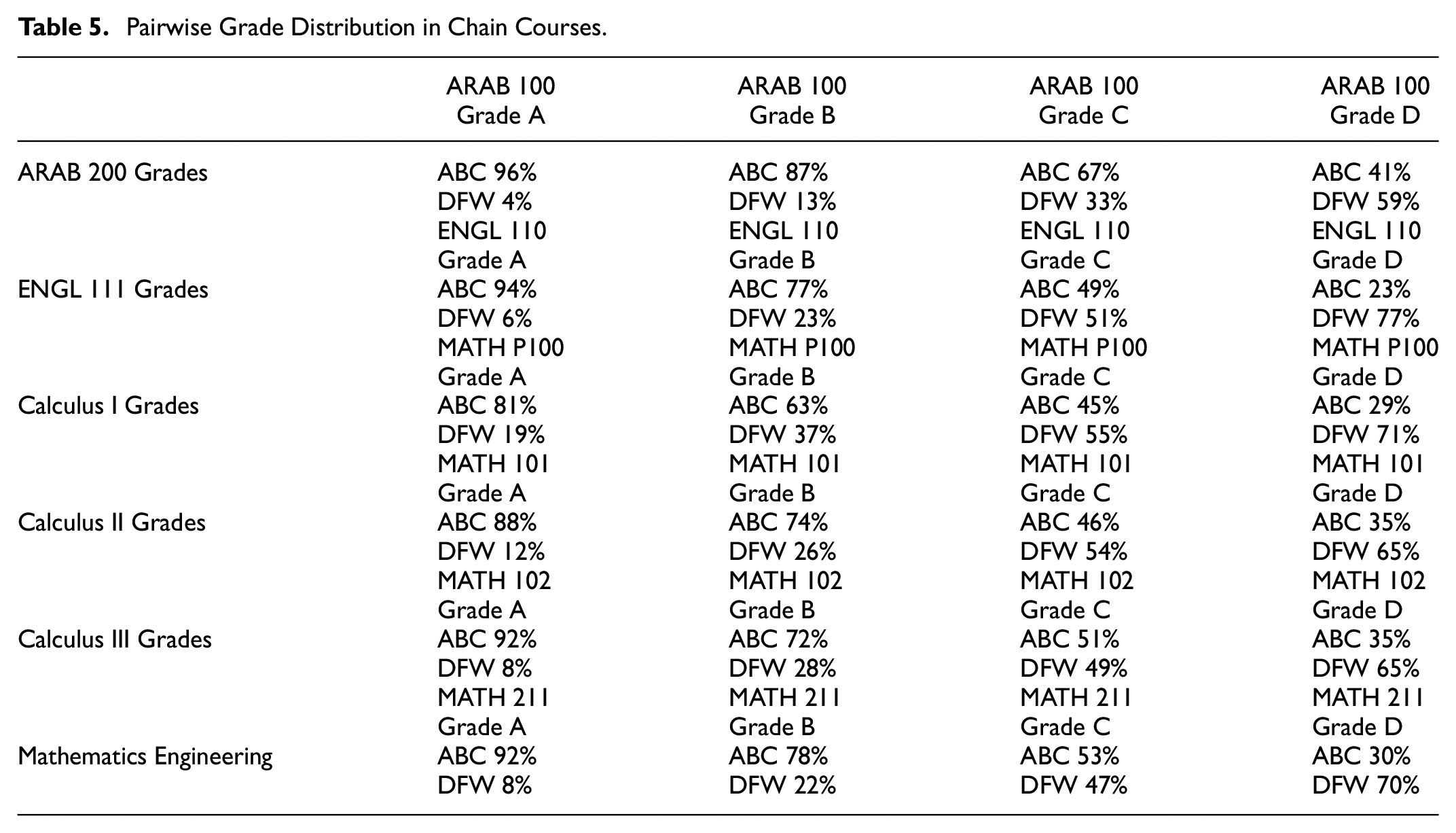
The crosstabulation in Table 4 shows the probability that a student with a DFW grade in Arabic Language I will receive a DFW grade in Arabic Language II is 57.9%, and 32% chance of receiving a C grade in Arabic Language II. In general, students with a specific grade in Arabic Language I have a high probability of getting the same grade in Arabic Language II. On the other hand, students with a B grade in Arabic Language I have a probability of 39.5% of receiving a higher grade in Arabic Language II. Other close results regarding the other chain courses in English and Math are available upon request. These outcomes are similarly presented in Table 5.
ARAB200 and ARAB100 Crosstabulation.
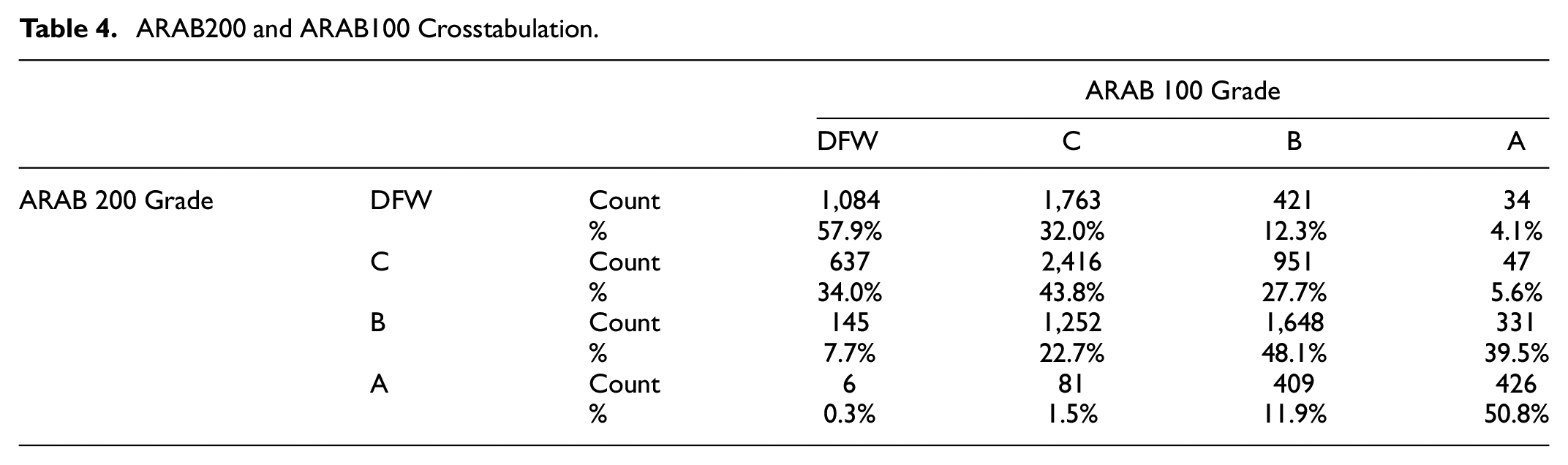
Table 5 illustrates that students with A and B grades in a linked course (either in Arabic, English, or Mathematics courses) have the highest probability of getting ABC grades in the next link. At the same time, students with a D in Pre-Calculus are likely to get DFW grades in Calculus I. The same results hold in the English and Arabic chains. On the other hand, C seems to be a critical grade because students who got C in English I, Pre-Calculus, Calculus I, Calculus II, and Calculus III have approximately the same probability of getting either ABC or DFW grades in the following link in the chain.
Pairwise Grade Distribution in Chain Courses.
Ordinal Logistic Regression Model
The ordinal logistic regression is used in this research to identify the most statistically influential factors that may affect the student’s grade. Ordinal logistic regression is employed when the response variable (variable of interest) is categorical with two or more possible levels of ordinal measurement scale (Kutner et al., 2004). Several regression models were developed in this study. For instance, the model for the Arabic Language I course has the grades as the response variable has four levels, DFW, C, B, and A. Here the response variable levels are ordered, where each level is assigned a whole number from 0 to 3 representing the order of ascendance.
Before evaluating the effect of each predictor factor on the response and interpreting the parameter estimates for the ordinal logistic regression, Goodness-of-fit tests, and model assumptions are validated during the analysis. Verma and Abdel-Salam (2019) comprehensively clarified the assumptions about the dataset and regression analysis. Also, Reddy and Alemayehu (2015) discussed the assumptions of Ordinal logistic regression.
Modeling the Arabic Chain
In this chain, two ordinal logistic regression models (A1 and A2) will be implemented, one that tests whether the demographic characteristics, gender, nationality, admission type, honors, minor, high school GPA, academic standing, and college affect the response variable, namely the grades in Arabic Language I. On the other hand, another regression model would assess whether there is a relationship between the demographic characteristics mentioned above and the grades in Arabic Language I and Arabic Language II. In both models, the highest level of the response variable (grade A) is the reference category of all other levels. Moreover, the last category from each demographic characteristic is taken as the reference level. For example, in the gender variable (0 = female and 1 = male), male students will be the reference level, and female students’ regression coefficient will be the reference level.
Since the significance level is 0.05, model A1 confirms that there are effects on the grades of Arabic Language I related to all the predictor variables except the gender and the admission type. The following table (Table 6) and the three estimated models preview the regression coefficients for model A1.

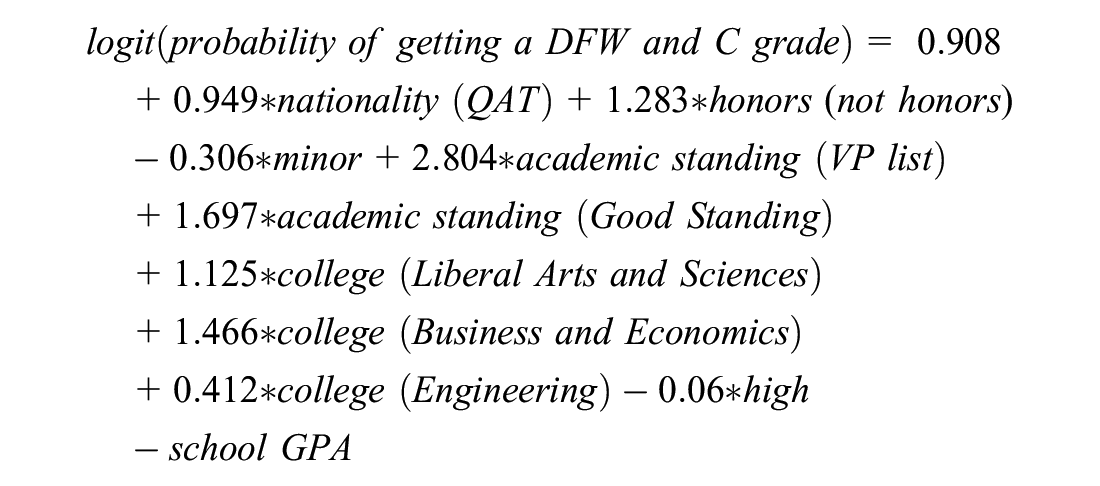
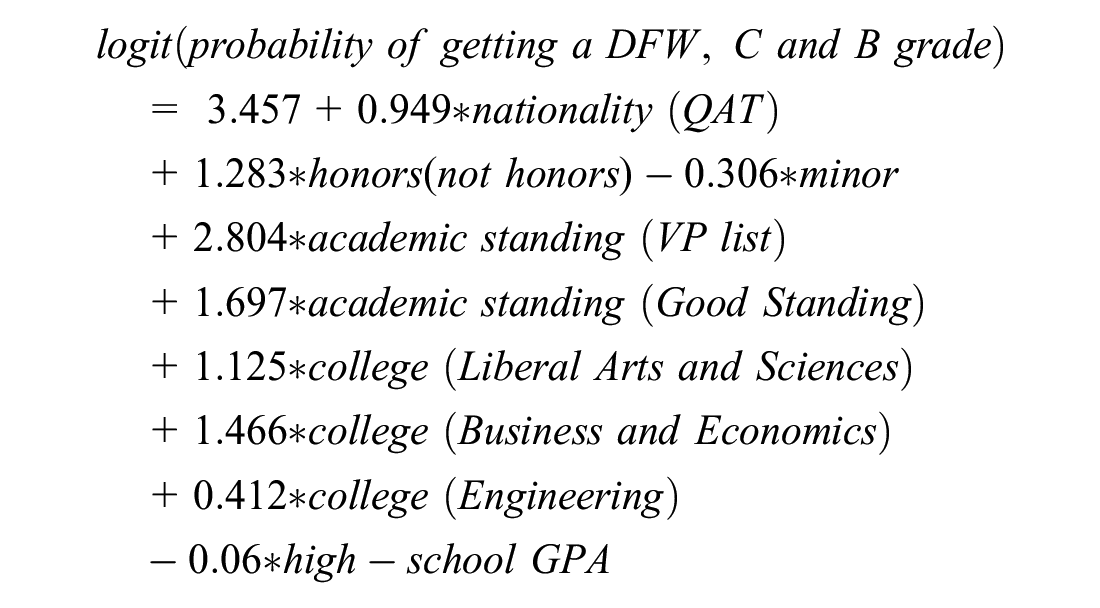
Estimated Regression Coefficients for A1.
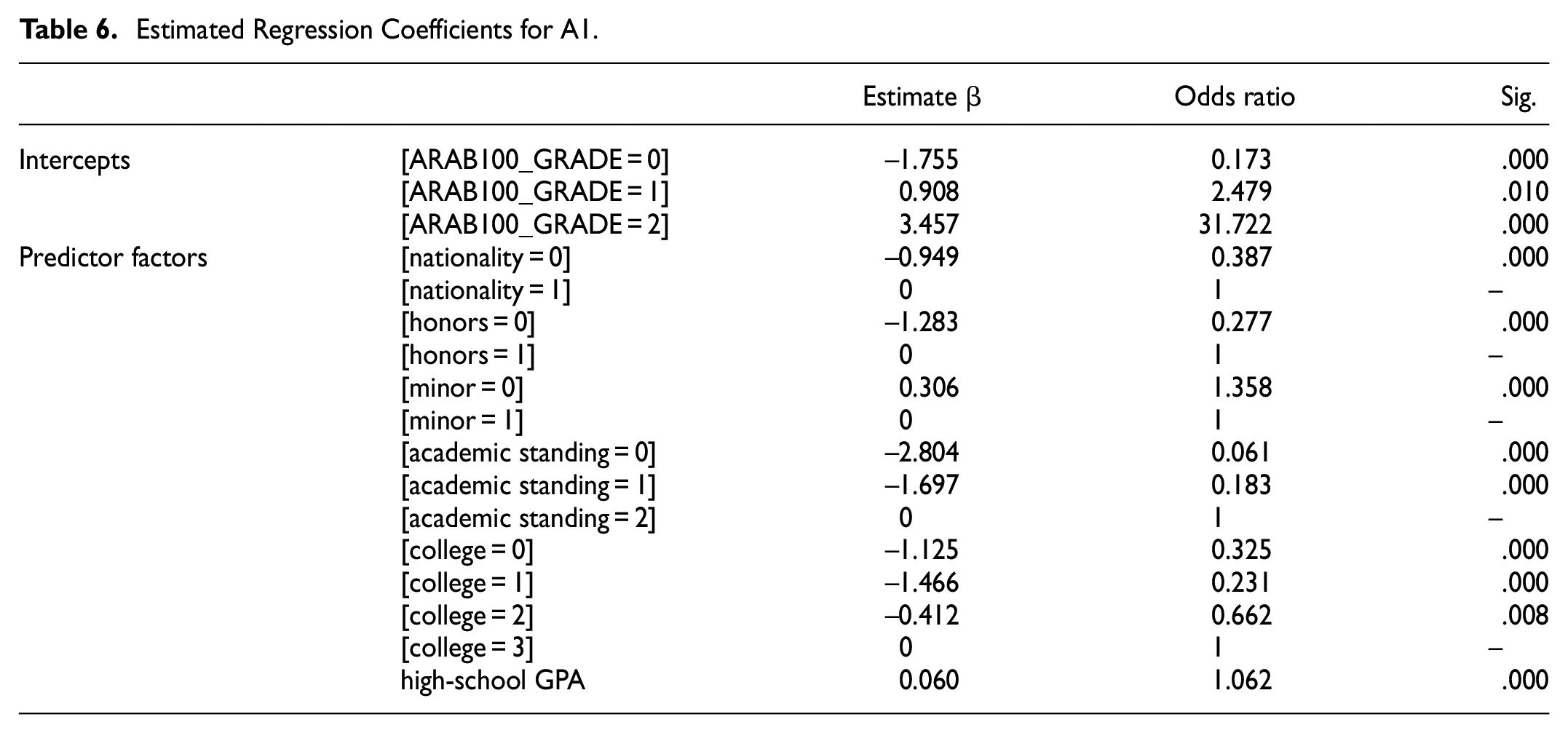
Considering the high-school GPA indicates that the odds of getting higher grades in Arabic Language I will increase by 1.06 for each unit change in high-school GPA when all other demographic characteristics are held constant. Qatari students are significantly less likely to get higher grades when compared with non-Qatari students, with an odds ratio 0.39. Concerning honors, the odds ratio of students not enrolled in the honors program is 0.28 less likely to get higher grades than honors students. Moreover, students in the VP list (GPA no less than 3.5) are more likely to get higher grades than regular good-standing students (GPA no less than 2.0). In terms of the minors, the odds ratio of the students with minors is 1.36 more likely to get higher grades in Arabic Language I than students with no minor. Furthermore, students in Liberal Arts and Sciences Cluster, Business and Economics, and Engineering colleges are less likely to get higher grades than those in colleges of the Health Cluster.
From the regression model A2, gender significantly affects student grades in Arabic Language II, where the odds ratio of female students is 1.39 more likely to get higher grades than their male counterparts. The results regarding minors, honors, academic standing, and nationality are represented in model A1. Conversely, Engineering students have no statistically significant difference, while other colleges have. Regression estimates for model A2 are detailed in Appendix A.
Some noteworthy results are stated to examine the other objectives of this research. Students with DFW grades in Arabic Language I are more likely to get a DFW in Arabic Language II, with a predicted probability of 58.7%. While students with a C in Arabic Language I are more likely to get a C in Arabic Language II, with a probability of 42.3%.
Students with a B in Arabic Language I have a probability of 48.1% of getting a B in Arabic Language II and are less likely to get higher grades in Arabic Language II than A students. On the other hand, students who got an A in Arabic Language I are more likely to get an A in Arabic Language II, with a probability of 48.7%, and more likely to get a B, with a probability of 43%.
Modeling the English Chain
The English chain consists of two links. Regression model E1 will assess the effect of several student characteristics on English I. The regression model E2 will assess these characteristics in addition to the grades in English I and their influence on English II grades.
From model E1, results indicate that there is no statistically significant relationship between nationality, minor, and college, on the one hand, and the probability of getting higher grades in English I, on the other hand.
Regression model E2 confirms a systematic effect in English II grades to all the demographic characteristics except nationality, minor, and college. The estimated models and regression coefficients are calculated as in model A1. English I grades have the largest absolute value for the coefficient estimate. Thus, students’ performance in English I is the most influential factor in English II grades. Estimated coefficients, p-value, and confidence intervals for models E1 and E2 are provided in Tables A1 to A8 in the Appendix. The following are the results regarding the association between the grades of ENGL 110 and ENGL 111.
Students with DFW grades in ENGL 110 are statistically less likely to get higher grades in ENGL 111 than A students and have a probability of 79.5% of getting a DFW grade in ENGL 111. Also, students with C in ENGL 110 are more likely to get DFW grades in ENGL 111, with a predicted probability of 52.6%, and getting a C in ENGL 11,1, with a probability of 29.4%. Furthermore, B students are 36.5% more likely to get B and 31.1% more likely to get C in ENGL 111. Finally, students who got an A in ENGL 110 are likelier to get an A in ENGL 111, with a high predicted probability of 56%.
Modeling the Mathematics Chain
Unlike the two previous chains, Mathematics consists of five links, comprised of five consecutive courses. Therefore, five regression models (M1, M2, M3, M4, and M5) were investigated. Model M1 explores the relationship between the aforementioned demographic characteristics and the Pre-Calculus grades. The statistical significance associated with each characteristic shows that gender, admission type, college, honors, and minor are not statistically related to the grades in Pre-Calculus, while other characteristics are related.
Unlike M1, different results are obtained from the regression model M2, where gender does not statistically affect the grades of Calculus I. Important outcomes and relations between the two-consecutive links, Pre-Calculus, and Calculus I, are as follows:
Students with DFW in Pre-Calculus will get DFW in Calculus I with a probability of 74.3%, and students who got C in Pre-Calculus are more likely to get DFW grades in Calculus I with a probability of 59.6%. Furthermore, students with a B in Pre-Calculus will get DFW grades in Calculus I with a probability of 37.7%. Students who got an A in Pre-Calculus will get an A in Calculus I with a predicted probability of 37.1%.
In model M3, the effect of the pair of links (Pre-Calculus and Calculus I) are studied together, and their influence on the grades of the next link Calculus II is assessed using an odds ratio. Results provided that only the academic standing and the two prerequisite courses are statistically related to Calculus II. Simplifying, the three predictors of academic standing, Pre-Calculus and Calculus I have a significant effect on the grades of Calculus II. The following results were extracted using odds ratio and predicted probability:
The students who got DFW grades in Calculus I are more likely to get DFW in Calculus II, with a probability of 72.1%. Students with C in Calculus I are more likely to get DFW in Calculus II, with a probability of 53.7%, and C in Calculus II, with a probability of 26.9%. Students with a B in Calculus I are equally likely to get either DFW or C or B in Calculus II, with an average probability of 28.9%. However, students, who got an A in Calculus I are more likely to get an A in Calculus II with a predicted probability of 38.2% and a B with a probability of 33.2%.
Model M4 is more extensive than model M3, where three links are examined for their statistical association with Calculus III. Similar to model M3, gender, nationality, college, minor, honors, high school GPA, and admission type should be omitted because of their insignificance. DFW and B grades in Pre-Calculus are not significant.
Students who got DFW grades in Calculus II are more likely to get DFW in Calculus III, with a predicted probability of 72.3%. In contrast, students with C in Calculus II are more likely to get DFW in Calculus III with a predicted probability of 45.7% and C with a probability of 30.8%. Students with B in Calculus II are equally likely to get either C or B in Calculus III, with an average predicted probability of 30.5%. Finally, students who got an A in Calculus II are more likely to get an A in Calculus III, with a predicted probability of 47.3%, and a B, with a probability of 31.9%.
The last model, M5 includes all the links in the chain and the demographic characteristics that may affect the students’ performance in the last link (Mathematics Engineering, as a MATH 217). Results indicate that the relation between the two courses, Pre-Calculus and Calculus I, and the response variable (Mathematics Engineering) is insignificant. Also, all other characteristics were dropped from the model except academic standing.
Rerunning the ordinal logistic regression model after dropping all the above insignificant variables, it was observed that the two courses, Calculus II and Calculus III, and the academic standing are statistically significant.
Students who got DFW grades in Calculus III are more likely to get DFW in Mathematics Engineering, with a probability of 71.7%. Additionally, students with C in Calculus III are more likely to get DFW in Mathematics Engineering, with a predicted probability of 51.3%, and C, with a probability of 27.2%. Besides, students with a B in Calculus III are more likely to get a B in Mathematics Engineering with a predicted probability of 34.8%, and those who got an A in Calculus III are more likely to get an A in Mathematics Engineering with a predicted probability of 42.1% and B with a probability of 37.9%.
Discussion
The study aimed to investigate students’ final grades in a linked course or chain course to determine any effect on students’ academic performance in their next linked course. To answer the study’s first question (Do prerequisites affect letter grades in subsequent courses?), the researchers found, similar to some of the prior publications of Opstad and Årethun (2020), that there was a close relationship between the prerequisite course and the related selected course. In the mathematics chain, the nearest prerequisite links (Calculus II and Calculus III) affect the student’s grade in Mathematics Engineering. Specifically, the odds ratio of Calculus II students with DFW grades is 0.25 less likely to get higher grades in Mathematics Engineering than A students (p-value < .05). Besides, the Pearson Chi-Square test and the Gamma coefficient revealed a moderate to a high association between the chain courses. The ordinal logistic regression emphasized results from the conditional probability approach. This may be the result of the persistence effect, which is, in most cases, ignored by the researchers when studying the impact of prerequisites. It can be explained that more qualified students who take the target course after taking the prerequisite course may do better than those who are not. It is because they are better students and not necessarily because of the benefits resulting from the prerequisite (Wolfle & Williams, 2014).
To answer the second question (What minimum grade should a student get in a prerequisite to ensure good performance in subsequent courses?), the results showed that in the Arabic chain, a student who received DFW grades in Arabic Language I had approximately a 41.3% chance of receiving a higher grade in Arabic Language II. It can be inferred that a higher probability of Arabic can be attributed to Arabic being the students’ native language. The English chain indicated that students with low performance in English I will receive a higher grade in English II with a probability of 20.5%. In contrast, in the mathematics chain, students with low performance will get higher grades in the next links, with an average probability of 27.4%. Allmen’s (1996) study notably declared the percentage of receiving an A grade in microeconomics when the student got a C in Calculus. His results are confirming with this study. Accordingly, the student who received DFW in Pre-Calculus has a 3.8% chance of receiving an A in Calculus I.
Concerning the English and Math chains, the analyses show that getting a C in a link increases the odds of performing well in the subsequent link. Results from the conditional probability approach and ordinal regression have confirmed that when a student receives a C in a link, they will have the exact probability of getting either DFW or ABC in the next link within the chain. Simpson and Fernandez’s (2014) results are nearly comparable with this result’s findings that C+ is an indication grade for getting higher grades in the subsequent course.
Regarding the third question (Do demographical characteristics affect academic performance in CC courses?), the regression analysis showed that gender does not affect the students’ performance in Arabic Language I. Both male and female students have the same academic performance in Arabic Language I. These findings are comparable with the results obtained by Alanzi (2015). However, the results of Crowther and Briant (2022) and Opstad and Årethun (2020) contradict this study, where male students perform better than females in the Organizational Behaviour and finance courses.
Several pedagogical implications can be raised regarding the findings from this study. An essential factor influencing learning and student achievement is prior knowledge that students can use when faced with new information. Prior knowledge is considered to be one of the essential factors that influence learning and student achievement, and learners need different levels and relevant prior knowledge to construct accurate new knowledge (Dong et al., 2020; Dunlosky et al., 2013; Kosiol et al., 2019).
Prior knowledge is crucial for students in chain courses. When learning, students initiate their prior knowledge and employ it to solve problems and new learning, refine their current knowledge, and construct new understanding (Darling-Hammond et al., 2020; Lu et al., 2014). Therefore, instructors must be aware of students’ prior knowledge, learn to use prior knowledge, and develop a learning environment in which learning means actively constructing knowledge and skills based on prior knowledge.
The standard classroom contains students with a wide range of abilities, intelligence, and motivation. It is important to note that diverse students bring to the classroom different prior knowledge, expectations, and assumptions that influence learning (Darling-Hammond et al., 2020; Diallo & Maizonniaux, 2016; Dong et al., 2020; Sarı & Yüce, 2020). Student diversity and learning are vital for this context since, according to Times Higher Education, QU was the most international university in 2016 (Wazen, 2016). For optimal learning to occur, professors need to consider the individual characteristics of all students and use pedagogical approaches that allow for more active learning and address different learning styles.
Professors can use these findings to improve learning. First, Brower et al. (2018) point out that since mathematical learning is sequential, transferring knowledge from one course to another is vital for learning. Coordination among professors promotes knowledge transfer and helps students to make commitments and clarify their values (Cope et al., 2021). Therefore, coordination enables professors to identify and understand the skills needed in the various chain courses, which could improve student learning and academic performance. Professors should also be aware of students who enter their class being considered at-risk and the probability of receiving a low grade based on past performance. In addition, Brower et al. (2018) suggest a close integration of professors and academic support. Universities should schedule students with the same course instructor for the chain courses when possible.
Limitations and Future Research
There are several limitations to the study. While the grades in prerequisite courses were significantly and positively related, we cannot imply causality. The factors of performance included in this study are by no means exhaustive. Future studies should examine other variables that could influence students’ grades in chain courses. These include but are limited to students’ study skills, teaching styles and assessments used within the courses, and grade inflation and non-academic factors that might influence students’ grades and performance. Also, it would be essential to examine some non-academic factors, such as the psychological influences on students’ academic performance.
Footnotes
Appendix A
Declaration of Conflicting Interests
The author(s) declared no potential conflicts of interest with respect to the research, authorship, and/or publication of this article.
Funding
The author(s) received no financial support for the research, authorship, and/or publication of this article. Open Access funding provided by the Qatar National Library.
