




Abstract
This study determined the prevalence and correlates of victimization among girls and young women in Kampala. The study population, a convenience sample of youth living in the slums, were 14 to 24 years of age, and participants in community-based drop-in centers (N = 313). Overall, the prevalence of physical fights (37%), being threatened or injured with a weapon (28%), and being raped (30%) was high and increased with age. Multivariate analyses revealed that sadness, drunkenness, and hunger were associated with multiple forms of victimization. Findings suggest that additional services are needed to address the cumulative impact of victimizations, depression, and living conditions.
Keywords
Introduction
Violence is a major global public health problem (WHO; 2014; Krug, Mercy, Dahlberg, & Zwi, 2002). This is a particularly important issue for adolescents and young adults who are most often the primary perpetrators and victims of interpersonal violence (WHO, 2002, 2014). However, data are scarce on issues pertaining to the scope and factors contributing to interpersonal violence, particularly in low- and middle-income regions such as Africa and South America (Brown et al., 2009; Krug et al., 2002; WHO, 2014). Unfortunately, limited existing data suggest that these areas of the world are those in which youth homicide rates are the highest (Reza, Mercy, & Krug, 2001; WHO, 2002, 2014).
Violence among children and adolescents living in the slums of sub-Saharan Africa is of particular concern because of their dire circumstances and unmet health needs (Blum, 2007). Previous research, although limited in scope, indicates relatively high levels of interpersonal violence among youth in Kampala (Swahn, Gressard, Palmier, et al., 2012). This may not be surprising given that economic hardship, family conflict or disruption, abuse, and maltreatment are often predisposing situational factors that result in living on the streets, in the slums, or in other compromised living situations (Ali & De Muynck, 2005; Densley & Joss, 2000; Jacob Jacob, Smith, Hite, & Cheng2004; LeRoux & Smith, 1998; Mufune, 2000, Tyler., Gervais, & Davidson, 2012). Clearly, street children are exposed to high levels of poverty, family conflict, and low parental attachment, as well as alcohol and drug use, which have been well established risk factors for interpersonal violence and further victimization (Sethi, 2010; WHO, 2002, 2014).
Although reproductive health broadly defined has been prioritized to reduce the spread of HIV/AIDS and other sexually transmitted infections, the role of sexual violence victimization is rarely addressed in this context among vulnerable youth. Girls and young adult women living in compromised living situations seem particularly exposed to victimization, not only sexually but also physically. As such, there is a need to empirically quantify these experiences and to determine potential modifiable risk factors that may be addressed. Hence, this study seeks to determine the level of victimization, both sexually and physically, and to determine the range of victimizations overall that these girls and young women have experienced. Moreover, it is recognized that it is important to determine the correlates for multiple victimizations. In addition, fatalism, the concept of not making necessary investments in one’s well-being, such as being cynical about difficult life circumstances, is particularly pervasive in poor communities worldwide (Bernard, Dercon, & Taffesse, 2011; Dalton, Ghosal, & Mani, 2014; Dercon & Singh, 2013; Whelan, 1996). Therefore, there is a need to determine how sexual victimization, in particular, in the form of rape victimization shapes the future investments and orientation of these girls and young adult women.
The purpose of this study is to address four overarching research questions:
Our approach is to quantitatively answer these questions among girls and young women in a convenience sample of service-seeking youth who live in the slums of Kampala, the capital city of Uganda while also addressing commonly indicated psychosocial and confounding factors that may place these youth at increased risk of violence (Hugheset al., 2014; WHO, 2002, 2014).
The results of this study may be used to provide guidance on the development of prevention strategies to address the violence experiences this disparate population faces as well as service provision of those who have already been victims of violence.
Method
The overarching goal of the cross-sectional survey called the “Kampala Youth Survey,” conducted in May and June of 2011, was to examine the exposure of alcohol marketing and its associations with problem drinking and drunkenness in a convenience sample of urban youth living in the slums, 14 to 24 years of age. The methodology and findings from this study have been reported previously (Swahn, Braunstein, & Kasirye, 2014; Swahn, Braunstein, Palmier, Kasirye, & Yao, 2014; Swahn, Haberlen, Palmier, & Kasirye, 2014; Swahn, Palmier, & Kasirye, 2013; Swahn, Palmier, Kasirye, & Babihuga, 2014; Swahn, Palmier, Kasirye, & Yao, 2012; Swahn, Gressard, Palmier, et al., 2012). The youth participants were receiving services in Uganda Youth Development Link (UYDEL) drop-in centers for disadvantaged street youth (UYDEL, 2014). UYDEL at that time, served on average about 650 youth per month through these drop-in centers. Face-to-face surveys, lasting about 30 min, were administered by social workers/peer educators employed by UYDEL. The study was implemented across eight drop-in centers across Kampala. Participating youth received snacks and transportation for completing the survey. No identifying information was collected, and the surveys were completely anonymous. Surveys were administered in English or Luganda, to the extent possible, in private settings and rooms, to ensure privacy of survey questions and responses. Each social worker/peer educator received training on the study methodology, and each of the survey questions and its translation into Luganda (local language) if needed, and recruited potential participants among attendants at their specific drop-in center. Recruitment took place using word-of-mouth, and each attendant was eligible for participation if he or she was between 14 and 24 years of age. No exclusion criteria were applied beyond the age range. Participants were informed about the study and read (or were read) the consent forms to indicate their willingness to take the survey. The consent process required that emancipated street youth 14 to 17 years of age provide their own consent for participating in the survey because youth 14 to 17 years of age who “cater for their own livelihood” are considered emancipated in Uganda, thereby waiving parental permission. The same consenting process was followed for youth 18 to 24 years of age.
Over the 10-day survey period, 507 youth were approached for participating in the survey. Among these youth, 46 declined, and 461 agreed to participate, yielding a participation rate of 90.9%. Four of the surveys were missing substantial numbers of responses and were therefore excluded, yielding 457 completed surveys for the final analytic sample of youth between the ages of 14 and 24 (31.1% boys and 68.5% girls). The mode for age was 17 years (n = 81), and 67% of the participants were between ages 16 and 20. These analyses, based on girls and young women, included 313 participants.
Measures
The survey questionnaire was modeled from existing surveys, including the U.S.-based Youth Risk Behavior Survey conducted by the Centers for Disease Control and Prevention (CDC,2012) and the international Global School–Based Student Health Survey supported by the WHO (WHO, 2015). Survey questions addressed demographic characteristics, family context, alcohol and drug use, injuries, violence and suicidal behaviors, sexual behaviors, and sexually transmitted diseases, including HIV/AIDS. The study protocol was approved by the Georgia State University Institutional Review Board and also by the Uganda National Council for Science and Technology. Funding to conduct the study were obtained from the Georgia State University Office of International Initiatives and also from funds leveraged through collaboration with the Emory Center for Injury Control, funded by the CDC.
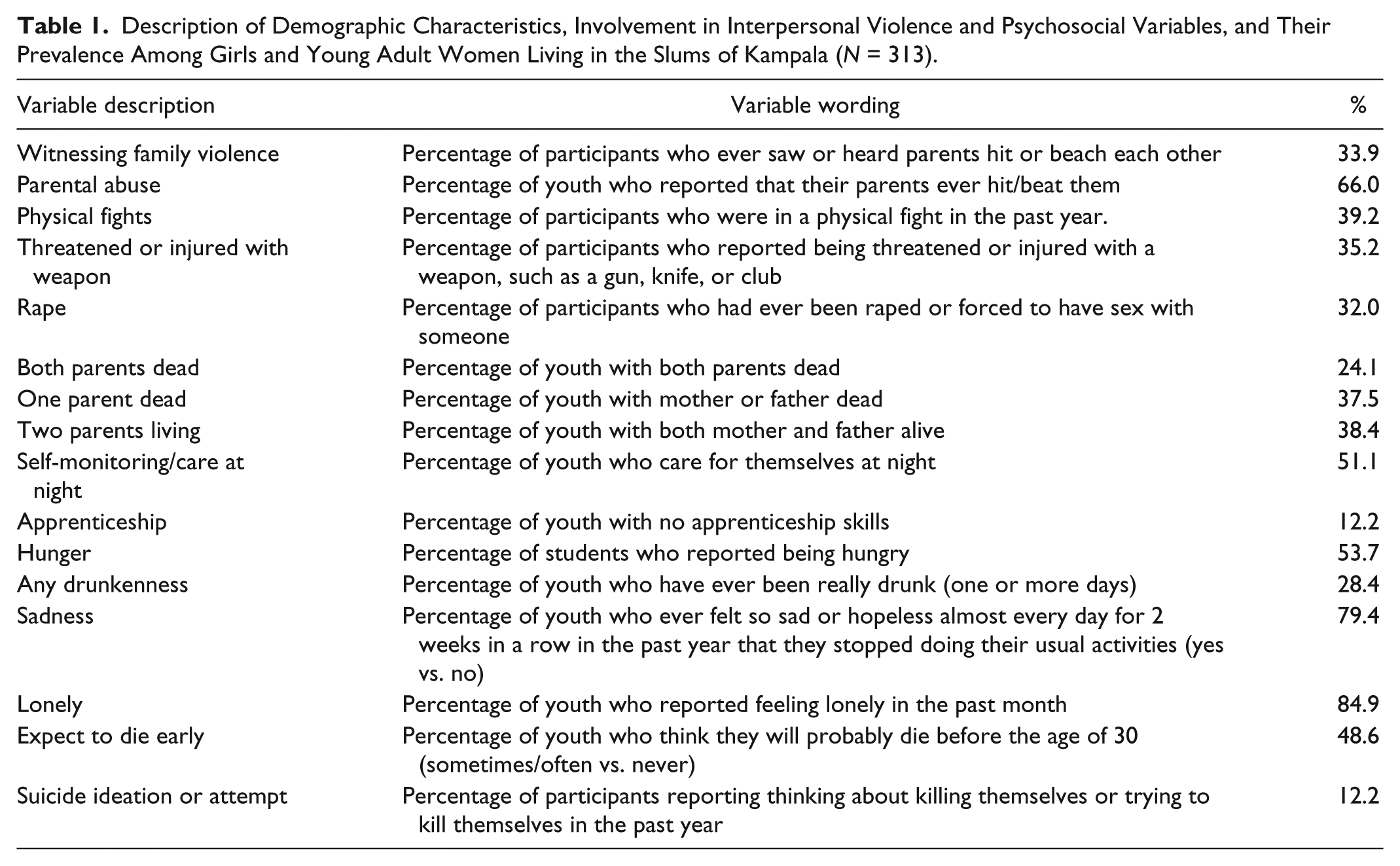
The measures included in the analyses and their prevalence among study participants are described in Table 1. Demographic and psychosocial characteristics assessed included age; living circumstances (whether parents were alive); whether the youth had apprenticeship skills; whether they were taking care of themselves at night; whether they reported hunger, drunkenness, sadness, loneliness, or expected to die early; and whether they had made a suicide attempt. In terms of the violence variables, the survey asked whether they had (a) witnessed family violence, (b) reported parental abuse, (c) been involved in physical fights, (d) threatened or injured with a weapon, and (e) been raped. These five variables were dichotomized to indicate the presence of any or none of each form of violence and then combined into a summative scale, ranging from 0 to 5 to indicate exposures to multiple forms of violence. The cell sizes for the prevalence of exposure to multiple forms of violence were relatively low, and as such, the outcome measure was recoded to reflect three levels of violence: zero, one to two forms of violence, and three to five forms of violence. Finally, future outlook was assessed using 6 measures asking if in the past month they had thought about the following:, whether they felt hopeful about the future, whether they felt they would never have enough money, whether they expected to die prior to age 30, that bad things would happen, whether they thought they would be unhappy and whether or not they expected to have a nice family when they were older. Four of the six measures were from the “Positive Outlook-Individual Protective Factors Index” developed by Phillips and Springer, 1992 (and psychometric properties reported by Gabriel, 1994), as presented in a compendium of assessment tools (Dahlberg, Toal, Swahn, & Behrens, 2005). Response options were “never,” “sometimes,” and “often.” Measures were dichotomized to indicate presence of outlook factor if respondents reported “often.”
Description of Demographic Characteristics, Involvement in Interpersonal Violence and Psychosocial Variables, and Their Prevalence Among Girls and Young Adult Women Living in the Slums of Kampala (N = 313).
Analyses
Three sets of analyses are presented in the article. The first descriptive chi-square analyses present the prevalence of violence exposure and test for significant differences for those less than 18 years of age versus those 18 years and older (Table 2). The second analyses present bivariate and multivariate logistic regression analyses to determine the psychosocial correlates associated with rape (coded raped vs. not raped; Table 3). The multivariate analyses included all those variables in the model that were significant in the bivariate analyses (e.g., age, hunger, drunkenness, sadness, loneliness, and expecting to die early). Finally, the third descriptive chi-square analyses present the prevalence for each of the six outlook questions by rape victimization (Figure 1). Both SAS 9.2 and SUDAAN 10 statistical software packages were used for these analyses (RTI International, 2008; SAS Institute Inc. 2010).
Violence Experiences by Age Among Vulnerable Girls and Young Women in the Slums of Kampala (N = 313).

Wald chi-square test of the association between age and violence experiences.
Psychosocial Correlate Associated With Multiple Violence Experiences Among Vulnerable Girls and Young Women in the Slums of Kampala (N = 313).

Note. OR = odds ratio; CI = confidence interval.
Boldfaced values significant at .05 (95% Confidence Intervals).

Prevalence of six future aspirations and outlook by rape among girls and young adult women in the slums of Kampala (N = 313).
Results
The prevalence of violent experiences overall and by age (less than and equal to or older than age 18) is outlined in Table 2. All forms of violence measures (e.g., witnessing family violence, parental abuse, involvement in physical fights, threatened or injured with weapon, and rape) were frequently reported. Parental abuse was most frequently reported (by 65.1%), followed by physical fights, rape, witnessing family violence, and being threatened or injured with a weapon. All forms of violence examined were more frequently reported by young women age 18 and above than among girls younger than age 18.
In terms of experiencing multiple forms of violence, 53.6% of the participants reported experiencing one to two forms of violence, and 29.6% reported experiencing three to five forms of violence. Bivariate associations between demographic and psychosocial correlates, and multiple violence experiences are presented in Table 3. Self-monitoring at night, hunger, drunkenness, and expecting to die early were associated with reporting three to five forms of violence. In multivariate analyses, hunger and sadness were statistically associated with reporting three to five forms of violence.
In bivariate analyses of the factors associated with rape specifically (Table 4), self-monitoring at night, hunger, and drunkenness were statistically associated with rape. In multivariate analyses, hunger and drunkenness remained statistically significantly associated with rape.
Bivariate and Multivariate Logistic Regression Analyses of the Psychosocial Correlates Associated With Rape Among Vulnerable Girls and Young Women in the Slums of Kampala (N = 313).
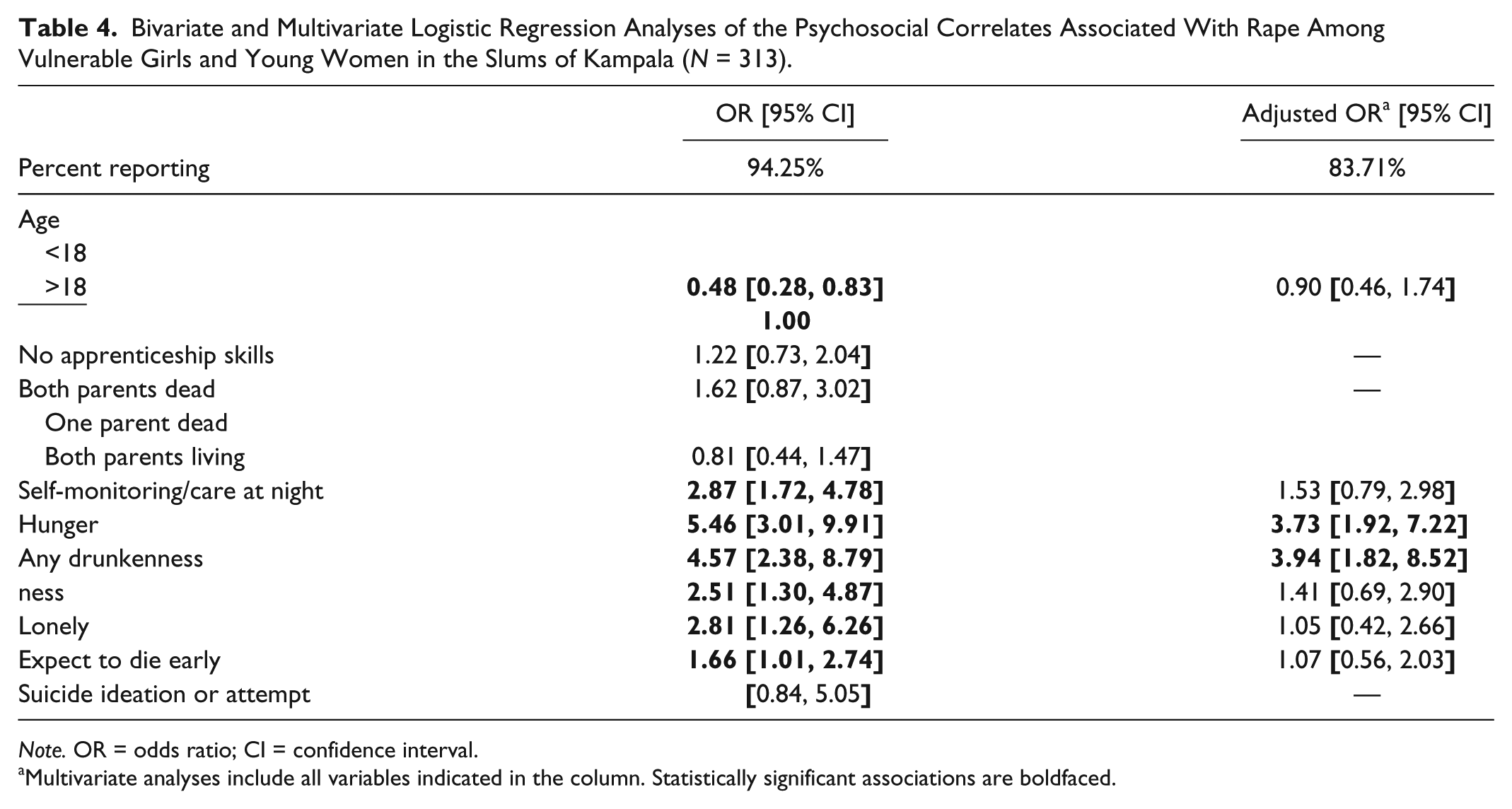
Note. OR = odds ratio; CI = confidence interval.
Multivariate analyses include all variables indicated in the column. Statistically significant associations are boldfaced.
Finally, intests of associations between rape and future outlook, four of the six measures were statistically significant. Girls and young women who were raped were more likely to expect not to have enough money, to die early, to be unhappy, and to have bad things happen to them.
Discussion
In this study of girls and young women living in the slums of Kampala, the findings show that there are substantial reports of experiencing multiple forms of violence, which remains an issue that is not typically addressed. Violence was also reported more frequently among young women than among the girls suggesting that potential strategies for violence prevention should be implemented earlier in life. We also found that violence was common and that hunger and drunkenness emerged as important factors associated with reporting multiple forms of violence and specifically also with rape. Although the context for these violent experiences were not assessed, it is clear that the circumstances of these youth living in the slums may present a range of situations involving conflict and altercation with respect to obtaining resources, such as money, food, and shelter.These youth also report many adverse childhood experiences with high levels of violence within the homes. Moreover, a substantial number are orphans with one or two deceased parents. Thus, the family context of these youth is grim and further exacerbated by reports of food insufficiency and limited care, nurturing, or supervision, which increases risk of further victimization.
Among the girls and young women in our study, drunkenness was a significant correlate of reporting multiple forms of violence as well as of rape specifically. These findings are similar to previous research conducted in the United States that underscores the link between a range of alcohol measures and involvement in violence, as a perpetrator or victim, and also within gang cultures and marginalized youth (Brewer & Swahn, 2005; Swahn, Bossarte, West & Topalli, 2010). Swahn, Simon, Hammig, & Guerrero, 2004). Alcohol use is an important concern, particularly among vulnerable youth in Kampala, because estimates indicate that Uganda has one of the highest per capita alcohol consumption in the world (WHO, 2004). However, studies of alcohol use specifically in violent behaviors in this population or region remain scarce.
Given the dire context of these youth and in particular of the many girls and young adult women who reported having been raped, it would be expected that their outlook for the future would be affected. Extant research suggests that socially disadvantaged youth have lower levels of collective cognitive and social resources on which to encourage them to have high aspirations or expectations for the future (Clinkinbeard & Zohra, 2012; Foster & Spencer, 2011). Oftentimes, economic independence as a goal increases the desirable futures of young people (Foster & Spencer, 2011). In our study, the girls and women who reported being raped differed from those who were not on four of the six measures assessed. Girls and young women who were raped were more likely to expect to not have enough money, to expect to die early, to be unhappy, and to have bad things happen to them. However, they did not differ with respect to being hopeful about the future or having a nice family. With respect to the measures that were significantly different, expecting to be unhappy in the future is troubling and signals the need for interventions to ameliorate the impact of social disadvantage on their lives, such as multi-level interventions that seek to raise young women’s self-esteem, improving their sense of safety, and economic security and social mobility.
Some limitations restrict the interpretation of the findings of this study. First, the study utilized a broad definition of youth living in the slums, including both homeless youth living on the streets and youth reporting a variety of living arrangements. Second, because the participants in this study were recruited from UYDEL drop-in centers, the study sample is not a random selection of youth in the slums of Kampala. Although it is unclear how the sample selection affects the results, we speculate that the findings observed in the present study are an underestimate of the true burden of violence and disadvantage in this community. Third, the survey instrument used in this study had not been previously piloted among Ugandan youth. However, the majority of the survey items were adopted from previously validated surveys, including the U.S. Youth Risk Behavior Survey and the Global School–Based Health Survey. Fourth, the low literacy level of many of the study participants required that the survey was read aloud to the participants. The direct face-to-face interaction between the interviewer and the participant may have resulted in underreporting of certain risk behaviors and experiences because of social desirability. A fifth limitation is that several study participants provided their responses to survey items in their local language of Luganda, thus requiring the interviewers to translate the answers into English. Sixth, some of the statistical analyses included relatively small sample sizes and yielded relatively wide confidence intervals indicating that findings may be less stable. Last, our findings are limited by the cross-sectional nature of this study. A temporal relationship between the psychosocial variables and violence experiences cannot be determined, nor can causation be inferred.
Despite these important limitations, the findings from this study describe the prevalence and correlates of relatively severe forms of violence including rape among these vulnerable girls and young women. Hunger, drunkenness, and sadness were the most important factors associated with multiple violence experiences. In addition, hunger and drunkenness were also specifically associated with rape. More troubling perhaps is that being victimized by rape also shapes the future outlook with respect to expecting future unhappiness, death, and bad things compared with those not raped. Because of the scarcity of data related to violence experiences, and in particular sexual victimization among girls and young women in sub-Saharan Africa, additional research is needed to validate these findings. Future research should also assess the extent to which trading sex for necessary food and shelter is a key concern among vulnerable girls and women, not only in sub-Saharan Africa (Ntozi, Mulindwa, Ahimbisibwe, Ayiga, & Odwee, 2003) but also elsewhere (Potdar & Mmari, 2010) and its potential role in increasing risk for violent victimization. Efforts should also be made to determine modifiable factors that can be incorporated into prevention programs that may reduce, at least partially, the consequences of the adverse childhood experiences and violence victimizations experienced by these girls and young women.
Footnotes
Declaration of Conflicting Interests
The author(s) declared no potential conflicts of interest with respect to the research, authorship, and/or publication of this article.
Funding
The author(s) disclosed receipt of the following financial support for the research and/or authorship of this article: Funding to conduct the study were obtained from the Georgia State University Office of International Initiatives and also from funds leveraged through collaboration with the Emory Center for Injury Control, funded by the CDC.