




Abstract
This study explores adaptive response mechanisms as an appraisal of confronted stress through people’s activities of sending and receiving tweets with other Twitter users to share their thoughts, opinions or information on responses to a man-made disaster. We propose a model with a theoretical integration that represents the varying relations between stress and individuals’ responses over time. Using Twitter data from April 16, 2014, on the Sewol ferry disaster in Korea, our study found that the development of the collective response was characterized by individuals’ recurrent attempts to make sense of the causes and outcomes of an unexpected event in terms of time-dependent flows during the occurrence of the event. Collective sensemaking recurred when people could not make sense of the causes and results of unexpected events to facilitate the coping process. Our model provides insights into when and how a trigger event such as a disaster influences the development of shared collective response patterns.
In a disaster situation, the public becomes aware of a disturbance that creates discontinuity in the flow of experience due to physical or psychological stimuli. To return to “a state where they can feel and be autonomous, competent, and attached to others” (Hobfoll et al., 2007), individuals are motivated to find ways to avoid or reduce perceived uncertainty (Lovallo & Kahneman, 2000), which can create negative emotional reactions (e.g., anxiety: Grupe & Nitschke, 2013; Hou et al., 2021). Thus, they may rely on formal sources (i.e., mass media or government reports; Austin et al., 2012) and try to interpret crisis information collected from their surroundings driven by the emergence of a common concern (i.e., human survival; McMillan & Chavis, 1986). Recently, many individuals have exchanged their information, thoughts or opinions via social media as decentralized communication such as Twitter (M. E. Brown et al., 2021; Murthy & Gross, 2017) to understand the causes and outcomes of the impact of potential future threats in a disaster situation (Karami et al., 2020). The impact of traumatic events may spread throughout communities rather than being limited to a few individuals as primary victims (Ursano & McCaughey, 1995), which can lead to the development of community that shares a common purpose regarding saving persons or maintaining well-being.
In man-made disasters, such as the breakdown of existing safety systems resulting from human error (Shaluf, 2007), individuals affected either directly or indirectly in the community will engage in a social context and hope to achieve the satisfaction of their physiological or psychological needs through personal responsibility for collective well-being according to the theory of the sense of community responsibility (Boyd & Martin, 2022). Thus, people are willing to pay to appraise the appropriateness and effectiveness of conducting governmental support during, after, and even before a disaster to find reasons to resume interrupted activity (Weick et al., 2005). For example, when people evaluate the current disaster management as ineffective (a lack of short-term improvement) during and after a disaster, their responses turn into criticism and blame of government agents and increase further (Albrecht, 2022; Oz et al., 2018). The responses may move the focus away from current relief to a new normal that should be held morally and legally responsible for disaster preparation and actions (Pidgeon & O’Leary, 2000; N. Zack, 2010) when the desired level of government responsibility is not reached. Indeed, responses can vary depending on mismatches in expectations of shared responsibility between communities and their government to protect or save human lives in disaster situations (Crosweller & Tschakert, 2021; Singh-Peterson et al., 2015).
Tweet activities can represent individuals’ adaptive responses to reduce the negative stress of expectancy disconfirmation (Oliver, 1980) under conditions of unknown change, such as a disaster environment. However, the process by which collective adaptive responses are formed through the evolutionary process of public discourse on sudden and unanticipated disasters (Bradberry & Salam, 2014) remains unclear. In this sense, the current study relies on emerging phenomena associated with collective responses developed through individuals’ efforts to deal with disaster risks caused by human actions in a community, we outline the development processes of disaster responses involved in the integration of collective coping (Pennebaker & Harber, 1993) and sensemaking (Weick, 1995) about adaptive responses to stress relief in time-dependent flows during disasters in an online community. We focus on analyzing Korean tweets about the Sewol ferry disaster in Korea to find actual evidence of transitions from individual to communal responses to a specific stressor. To do so, we explore the theoretical link between the coping and sensemaking processes involved in individuals’ adaptive responses regarding their attempts to achieve stress relief. We develop a dynamic model for collective adaptive responses via user tweets as a snapshot of people’s immediate thoughts concerning the Sewol ferry disaster to understand the psychological states of users (W. Wang et al., 2016). This model provides insights into the characteristics and evolutionary process of emergent phenomena caused by psychosocial stress following a disaster event.
Theoretical Approach of Collective Adaptive Response to Disaster Stress
A man-made disaster—“dangers created by man for himself” (Velimirovic, 1980)—can result in a massive loss of human life and social disruption (Biswas et al., 2015). After such a situation occurs, the level of uncertainty increases due to the probable occurrence of risk and the dearth of reliable information. This situation can become more complex because information may be difficult for the affected public to understand (E. C. Anderson et al., 2019). The lack or unavailability of accurate and relevant information in a highly unstable situation may arouse disaster stress when individuals have difficulty achieving the goal of minimizing the uncertain situation (e.g., Y. J. Wang et al., 2022).
A disaster-affected population naturally begins to talk about the crisis with others in response to the stimulus about the grief of victims who feel sympathy or distance one’s self from the stress. In the process of sharing their thoughts and relevant information, individuals may express their negative affect, which is dependent on whether they evaluate the results of the current disaster from the perspective of failure. They also consider more effective responses to the stimulus of disaster-related thoughts in the unanticipated context of the initial discrepancy in expectations. Individuals’ adaptive efforts to reduce their negative impacts develop into collective coping through social interactions and the exchange of event-related thoughts and feelings (Pennebaker & Harber, 1993) with the shared appraisal that they can solve the issue together (Afifi et al., 2020). Additionally, to obtain a plausible account of the disaster from their environment, people try to seek the main causes by extracting and interpreting cues in a sensemaking process (Weick, 1995). Despite these collective efforts to alter a stressful situation, it is unclear a priori when and how individuals become motivated to collectively respond through adaptive activities such as tweeting. There might be an impact of the expression of community concern-induced negative affect (e.g., worry, fear) as a common sentiment (i.e., T. J. Anderson et al., 2016) that produces adaptative responses (e.g., talking about emotional events: Rimé et al., 2010) to solve threat-related problems for a longer period.
Collective Coping Process
Large-scale events such as floods, tornados, and nuclear reactor leaks are highly likely to lead to complex situations with high levels of uncertainty; thus, it is important to understand the impact of the dynamic elements of critical social infrastructure (e.g., response, connectedness, people) on community capacity at a given time (O’Sullivan et al., 2013). Individuals are motivated to broadcast crisis warnings and potential risks to the public health of populations to obtain and share credible information or disclose personal expression (e.g., awareness, thoughts, feelings) with others through social media (Stephenson et al., 2018). Through the transmission of disaster information, affected communities strive to understand stressful events within the social psychological context of interpersonal relationships. This may involve collective protest about future concerns with fellow group members through dynamic responses to disaster relief or resilience (Becker et al., 2015; Tandoc & Takahashi, 2017).
Pennebaker and Harber (1993) suggested that disaster-affected populations naturally talk and think about a specific event (e.g., Loma Prieta earthquake) to understand it and find ways to respond more effectively. However, according to Kim and Lee (2020), when individuals cannot adequately create structure or self-categorize because of insufficient cues about the situation, they attempt to quickly find definite answers to avoid psychological discomfort and obtain relief from anxiety through cognitive closure (Kruglanski et al., 2006). Thus, it is necessary to move beyond simplistic interpretations of the ever-evolving nature of the social environment on human behavior and cognition. Our study attempts to reveal the development of individuals’ adaptive responses when they are motivated to achieve a desired goal of demand for a Special Act on investigating the fact-finding after the occurrence of the ferry disaster. To do so, we apply an extended four-phase model combining Pennebaker and Harber’s (1993) three phases (emergency, inhibition, adaptation) of individuals’ response patterns 2, 6, and 4 weeks after the occurrence of a disaster with reference to Kim and Lee’s (2020) present-perfect phase, which lasts for 12 weeks after the adaptation phase. This can illuminate ways to investigate the reasons why people participate in ongoing debate about particular issues during the development of the meaning of a specific event.
Collective Sensemaking Process
Sensemaking is a useful model to explore the process of reducing equivocality in decision making when people confront exceptional events (Boland, 2008; Munro & Huber, 2012). We integrate the coping process with the ESR (enactment-selection-retention) model (Weick, 1979). In the enactment phase, people begin the active construction of the environment, which must confront the question “What is the story?” and bring orderliness to the situation. Then, people consider the question “What is going on?” because of a lack of information about what happened. They select an enacted environment that offers a new meaning structure by providing cause-effect explanations of the event and the possible meanings. Consequently, retention occurs when meaningful and useful data are embedded in the cognitive frame (e.g., actor memory); these data may be preserved and retrieved during subsequent sensemaking episodes in future equivocal situations (Boland, 2008; Choo, 2001). On the basis of these processes, interactions between the individual and the environment are used as a source of guidance for further action and interpretation (Weick, 2012, p. 133). Therefore, these interactions may lead to collective sensemaking, in which people develop a shared perspective by sharing their beliefs and collective meanings (Cramer & van der Heijden, 2006). In the midst of this process change, individuals coherently transform their thoughts and perceptions into collective action using two primary structures with two subfactors: belief-driven processes (arguing and expecting) and action-driven processes (committing and manipulating) (Stopford, 2001; van Oss & van ’t Hek, 2012; Vickers, 2002).
First, in belief-driven processes, people obtain an initial set of sufficiently clear and plausible beliefs about how events unfold by producing a self-fulfilling prophecy (Weick, 1995). When these existing beliefs conflict with current information, people debate their relevance to reduce the variety of beliefs and values and facilitate collective sensemaking (Zarbafi, 2011b). They may also use beliefs as specific expectations to guide the selection of plausible interpretations and to adjust their actions through sensemaking as expected. Through this process, when people assess an explicit situational construal in line with their expectations, they have confidence in their assessment and use it to rationalize the irrevocable activities caused by events.
Second, in action-driven processes, people are inclined to seek significant meaning for actions due to their responsibility as organizational members (i.e., citizenship) (Choo, 1998; Zarbafi, 2011a). They try to generate a shared meaning of events to give significance to the development of collective activities. These processes consist of behavioral commitment and manipulation. Behavioral commitment involves the processes of reviewing and binding actions through the socially acceptable justification of potential activities; these justifications are determined by the responsibility, importance, and consequences of the actions and allow people to determine how to make decisions (Kunda, 2016). Compared to behavioral commitment, manipulation reflects actions intended to create an environment to comprehend and manage events. The consequences of such actions create meaningful structures and environments (Lanzara, 1983) that allow those involved to more clearly understand what might be going on and incrementally create order and sense (Weick, 1995) corresponding to their own insights and wishes (Cramer et al., 2006).
Conceptual and Integrative Model
Prior literature on the stress and coping process has mainly examined whether recovery from psychological trauma caused by a disaster occurs through individual or group coping efforts as relief and resilience. In such cases, the bus disaster in Petah Tikva (Milgram & Toubiana, 1996) and the Swissair Flight 111 airline disaster (Stewart et al., 2004) with individual coping, and the Madrid bombings (Páez et al., 2007) with collective coping. However, we make no inference as to how and why individual coping is transformed into collective coping by social interactions in communities in times of disaster. Past studies on sensemaking in the context of disaster have emphasized the role of sensemaking as a key process for effectively identifying and organizing valuable patterns from large and continuous streams of data (Calvard, 2016) through a series of iterative loops (namely, ESR: enactment-selection-retention) at a specific time-place (Russell et al., 1993). Consequently, a changing phenomenon presents a collective challenge or threat for people through these adaptation processes if individuals perceive that their own coping efforts cannot effectively solve problems for disaster relief (Rodríguez et al., 2019). This situation motivates collective adaptation beyond individual coping and sensemaking in the context of social demands for collective responsibility for failures in human decisions (Heath, 1998).
To date, previous studies have not provided a clear specification of when and how sensemaking occurs or varies in a specific time period. Thus, the present paper aims to incorporate the idea of time interval estimates in a disaster situation where people take action and expect a response (Taatgen et al., 2007) into the research on adaptive response-based stress reduction to illustrate the mechanism of collective adaptation to disaster stress that underlies the dynamic psychological process related to the emergence of particular behaviors, their duration, their stability, and the sequence of their occurrence (Roe, 2008). Thus, we propose a theoretical integrative framework to identify the underlying recurrent and ongoing phenomena with time-paced change (Griffin & Clarke, 2011). To bridge two theoretical processes, our study sets a reference time based on the prior consideration of coping phases (emergency, inhibition, adaptation, present-perfect) about time-varying responses. Figure 1 visually delineates our overall conceptual framework.

A conceptual framework for the process of adaptive response.
When an accident occurs, individuals attempt to exchange provisional understanding and shared interpretations with others (Stigliani & Ravasi, 2012). They attempt to express what might happen and how events unfold to shape what they think about relevant problem elements and potential solutions in situations “where no one is certain what is happening” (Weick, 1995, p. 153) because of dramatic events. This phase is related to both emergency coping processes and enactment (arguing and expecting) in sensemaking processes. Subsequently, people reveal their attitudes or behavioral responses to the meaning of a certain event in terms of social needs for safety and control systems by selecting possible meanings while performing visible actions to create a comprehensible environment that can explain and manage the cause-and-effect relation to reduce equivocality (Landgren, 2005). On the other hand, to care for and protect the vulnerable self from unwanted intrusive thoughts (Kannis-Dymand et al., 2019), people may no longer want to talk about the event despite their thoughts on ideal expectations of social safety. This phase is associated with both inhibition (coping process) and selection (committing and manipulating). When a meaningful interpretation is made that can be used for adaptation in similar future crises from subsequent enactment and selection, the previous selection or recognition of environmental changes will be reduced or terminated; thus, adaptation (the coping process) is related to retention (the sensemaking process). Despite the sequence of processes, if people are not able to quickly make important decisions involving threat and opportunity (Shaluf et al., 2003), these adaptive responses will be ongoing.
Method
Research Design
We select a case that allows us to understand dynamic changes in people’s thinking and behaviors during a particular disaster. Because a disaster is not a continuous or frequent event, it may serve as a transition point or fault line between a before (past) and an after (future) (Roux-Dufort, 2007). A disaster is a crisis from the perspective of (a) the value of the possible losses (threats to one or more important goals of the present state), (b) time pressure (a short time available to make decisions), and (c) the probability of loss (based on the level of confidence in the accuracy of the standard of the existing state or on response uncertainty; Peng et al., 2019). Drawing on these features, we explore individuals’ common interests via user-generated text on Twitter as one-to-many communications that may facilitate the real-time diffusion of information (Castillo et al., 2011) in time–pressured and information-critical situations (Burnap et al., 2015; Mills et al., 2009). Concretely, to identify individuals’ adaptive response mechanisms (i.e., collective coping and sensemaking), we conducted a keyword search of the Korean compound noun “세월호 (Sewol ferry)” without compound noun decomposition through an automated web crawler using the Java programing language. We selected only tweets that included this keyword within the text to gather texts with content that mentioned the Sewol ferry disaster posted from April 16th (the time of the Sewol-ho accident) to September 30th, 2014 (the enactment of the Special Act for Sewol ferry disaster) by Twitter users. We collected 5.2 million tweets (335,430 users) that included text and day information, but not personal identification information, such as name and IP address. within tweets over almost 6 months (Table 1).
Total Tweets Pertaining to the Sewol-ho Disaster With Time Span.

The Korean Context
On April 16th, 2014, the ship Sewol-ho, carrying 476 people, sank off the west coast of Jindo Island in Korea with the loss of 304 lives, mostly high school students. At 08:58, prior to sinking due to dangerous overload and illegal redesign (Campbell, 2014), the vessel sent a distress signal to the relevant authorities. However, the government branches responsible for the emergency system did not act promptly according to the procedure and did not properly understand the cause of the accident. The most critical time was spent making sense of what occurred (the unexpected event). Despite the emergency call from the Sewol-ho ferry, the government had initially failed to respond and communication effectively to life saving among govern (Chung et al., 2022). During the rescue process, a few survivors were rescued with the help of fishing boats and other commercial ships before the Korean Coast Guard arrived. Furthermore, at the moment of impending disaster, the captain and several crew members fled the ship after it capsized and did not engage in the proper responses that consider evacuation, passenger safety, and observing regulations (Shin, 2021). Consequently, the poor handling of the search and rescue process by (in)direct parties who crew members and South Korean authorities provoked a storm of psychological responses from people, such as mourning and anger, at the national level.
On April 18th, 2014, while victims were still being rescued and bodies recovered, the main culprits, the captain and three crew members, were charged with deviation from standard sailing procedures and irresponsibly abandoning passengers during an emergency (Seo & Harlan, 2014). The families of the Sewol-ho owners were also investigated and then arrested due to the corruption and mismanagement that led to the sinking of the ferry. Despite a series of legal actions following the disaster, the public, including the victims’ families, argued for a more convincing explanation for the cause of the accident and conducted a campaign of “Yellow Sewol-ho ribbons” as a symbol of new hope for further social change (i.e., Chung et al., 2022). Eventually, the ruling parties in Korea compromised on a Special Act regarding fact-finding through an investigative authority on September 30th, 2014 (Lee & Seo, 2014). This Act was enacted for investigating the causes of the disaster (e.g., failure of rescue operation, Jeon et al., 2022), identifying the matters of responsibility (e.g., punishment for those responsible for not fulfilling the duty of rescue, Chung et al., 2022), providing support to victims, and building a safe society (Special Act on Investigating the Truth of the April 16 Sewol Ferry Disaster and Building a Safe Society, 2014). This appeared to be an opportunity to revise the existing safety-related system and inquire into the causes of the sinking of the ferry. Even 8 years after the disaster’s occurrence, dispute over the event is ongoing, and there is still little information on how the crisis was managed by the Korean government.
Analytical Procedure
We present an analytic framework (see Figure 2) rooted in the thematic analysis of Braun and Clarke (2006) to delineate the adaptive mechanism that governs how individuals’ responses transform into collective responses to mitigate disaster-related stress over time through text-based online activities. This framework is suitable for the current study due to its two strengths: (a) it enables researchers to find rich, detailed, and complex accounts from the specific data, and (b) it does not require detailed theoretical and technological knowledge and can therefore provide a flexible approach that is not bounded by existing theory and can be used within different theoretical frameworks. We deploy a hybrid approach combining manual and computational methods (Lewis et al., 2013; Nelson et al., 2021) to extract more nuanced meanings from the analyzed texts and explore the structural features of collective Twitter conversation around a particular topic or event using large-scale data (Burnap et al., 2015; W. Wang et al., 2016). Thus, we adopt a simplified three-step procedure that involves generating initial codes, searching for and defining themes, and synthesizing themes.

Analytic framework for the unifying model of collective adaptive response.
Generating Initial Codes
We generated initial codes as preliminary criteria, including words sharing the same or similar connotations (Potter & Levine-Donnerstein, 1999), to deduce meaningful features of the content (e.g., semantic or latent content) about a phenomenon. Specifically, the construct definitions in both coping and sensemaking processes were manually parsed into referent elements by employing protection motivation (Weick, 2012; Wurtele & Maddux, 1987) to avoid or reduce the potential risk of threat to an individual’s well-being by the authors. After the disaster, people (despite not being direct victims) began to depict the event as a stimulus object and focused on the changing event (e.g., appraisal direction) to appraise it in terms of severity and vulnerability (e.g., response intensity). Additionally, they maintained their efforts depending on whether their alternative responses for preventing the threatening event would have been effective (e.g., response persistence) (Wurtele & Maddux, 1987). These processes are the reason why people have incentives to reduce the discrepancy between a stimulus (current state) and response (desired state) (Locke & Latham, 1990; Weick et al., 2005) to achieve a goal such as stress relief. As such, we adopted the same and similar keywords according to the following reference standards: stimulus object, appraisal direction, and response intensity/persistence (see Table 2).
Summary of Initial Codes Related to Coping and Sensemaking Processes.
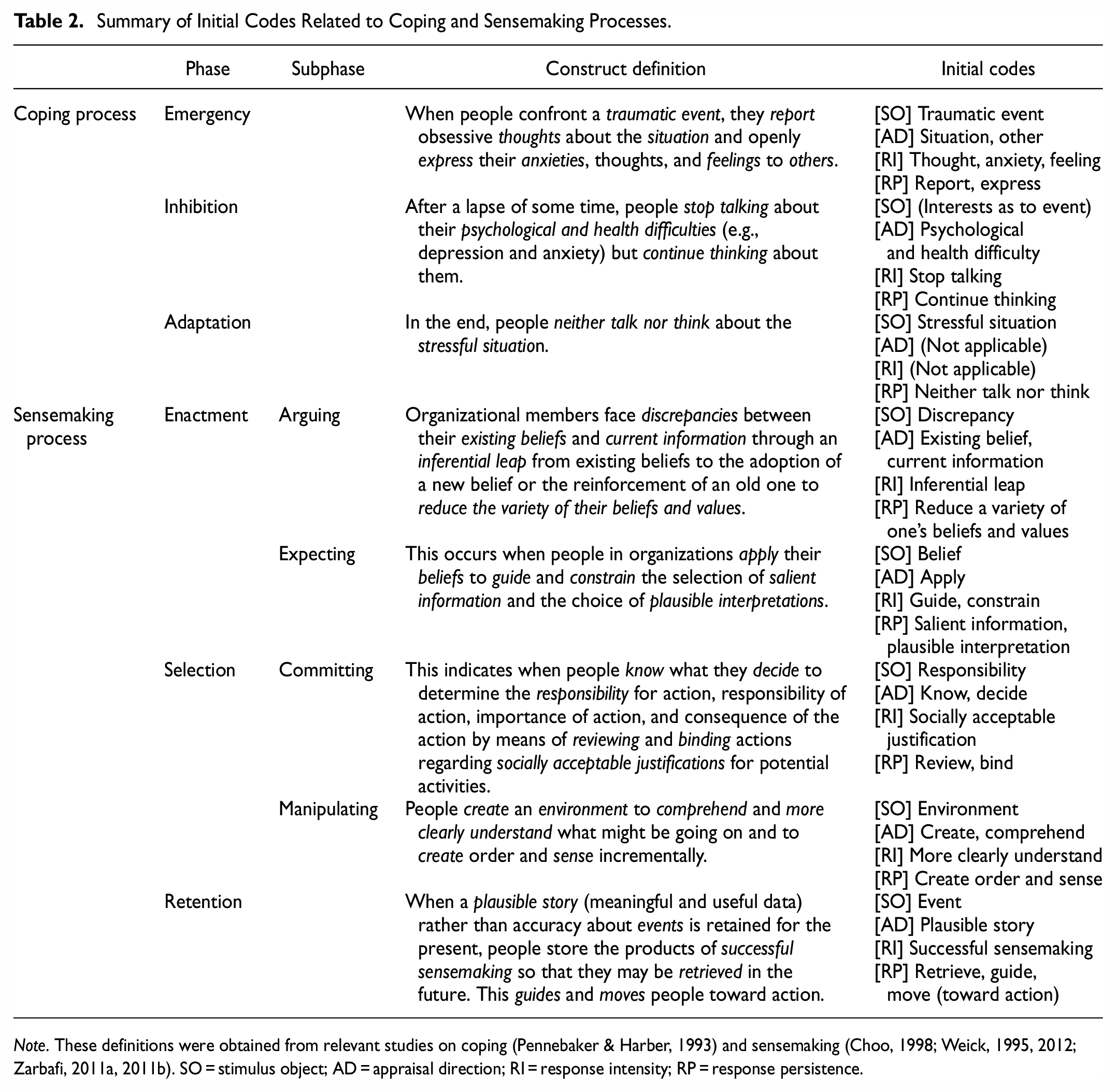
Note. These definitions were obtained from relevant studies on coping (Pennebaker & Harber, 1993) and sensemaking (Choo, 1998; Weick, 1995, 2012; Zarbafi, 2011a, 2011b). SO = stimulus object; AD = appraisal direction; RI = response intensity; RP = response persistence.
In the inhibition and enactment phase with construct definition, individuals pursue their interest (stimulus object) in a confused state of mind and recognize discrepancy (stimulus object) in the current information about new events from existing beliefs (appraisal direction). Furthermore, they perceive psychological and health difficulty (appraisal direction) that arouses noxious stimuli (Rogers, 1975) during traumatic events. Moreover, they tend to abstract the inferential leap (response intensity) from risk probabilities to the known situation. However, because they feel personal vulnerability as a risk factor for psychological disorders, they are willing to stop talking (response intensity) in a defensive response to intrusive thoughts because “any thought that implies nonvolitional entry into awareness, requires suppressive efforts or is hard to dispel, occurs or is experienced as something to be avoided” (Horowitz, 1975, p. 1458). On the other hand, although people continue thinking (response persistence), they also reduce the variety of their beliefs and values (response persistence) until they achieve awareness based on prior experience or knowledge.
Searching and Defining Themes
We searched for themes that referred to a probabilistic distribution of words to represent a shared level of patterned response or meaning among several topics related to the Sewol ferry accident from Twitter data. In particular, a topic in one time period may influence or stimulate another topic in a subsequent time period (Mei & Zhai, 2005); thus, the theme can evolve with time. For this reason, we first performed a daily topic analysis in a data-driven approach using SAS Text Miner 15.1 and SAS 9.4 (SAS Institute Inc.) (e.g., Chakraborty et al., 2014; Osakwe et al., 2020), which allows the analysis of text data from the web, comment fields, books, and other text sources. The following timeline-based theme structures were discovered in the text by semantically connecting initial codes (as noted in the previous step) to the findings of representative topic keywords.
Concretely, we conducted preprocessing on the raw text, which can improve the available text data before analysis by removing nonstandard language. For example, we deleted the special characters of emoticons like ⊤⊤ expressing sad emotion in Korean within tweet sentences. The process included tokenization, which splits sentences into terms or morphemes. In this study with existing analytic framework (Kim & Lee, 2020), part-of-speech (POS) tagging classified tokenized terms (i.e., nouns, verbs, adjectives) (Manning et al., 2008), and was applied to the tweet data. The terms were converted to normalized weighted terms through vector space modeling (VSM), which presents terms and documents as vectors (Salton et al., 1975) and expresses terms in document space by producing dictionaries or thesauri. The terms and documents form a matrix, Xt,d, where m terms and n documents appear in the rows and columns, respectively.
VSM classifies the raw frequency distribution of terms as they appear in large volumes of documents on multiple scales and uses tf-idf (term frequencies-inverse document frequencies) transformation (Salton & Buckley, 1988). In a given matrix, Xt,d, the normalized value of a weighted term across documents is given as follows:

where wid is the weighted term value for each term-document combination. After weighting the terms, a latent semantic analysis (LSA), which creates maps of documents and terms in the latent semantic space (Hofmann, 2001), was conducted to extract the main topics. The generalized model for text content can be expressed as follows:

where X is the corpus of documents,
The core LSA procedure requires the implementation of singular value decomposition (SVD) and dimensionality reduction (Deerwester et al., 1990). Mathematically, SVD decomposes the matrix, Xt,d, into the product of three matrices: Ut,k, ∑k,k, and Vk,d. The Ut,k matrix is a term-by-factor matrix containing the eigenvectors of a XXT matrix, which is a term-by-term covariance matrix revealing the latent semantic factors of terms. The term loadings represent the factors revealing the topics (latent meanings) such as Kim and Lee’s (2020) a previous approach. Vk,d is a factor-by-document matrix showing the eigenvectors of XTX, which is a document-by-document covariance matrix showing the loading of each document for each factor. The document loadings indicate the degree of document relevance to the identified topics. The ∑k,k matrix is a diagonal matrix of singular values ranked in decreasing order. Therefore, SVD is expressed as follows:

where U and V represent the term eigenvectors and the document eigenvectors, respectively. ∑ is the diagonal matrix of singular values containing the square roots of eigenvalues, and the superscript T denotes transposition. At this point, LSA employs truncated singular value decomposition (TSVD), which modifies term frequencies and includes only terms of great importance. The TSVD model follows the rationale of dimensionality reduction of Xt,d, recognizing that in a large corpus of textual data, topics are structured in low-dimensionality space (Cliff, 1988). The threshold of the eigenvalues is typically set to 1 or higher (Guttman, 1954). TSVD can be expressed as follows:

where
Finally, in the property of orthonormality, UTU = I and VTV = I, where I is an k × k identity matrix, I, is used to obtain the term loadings,

where
In the current study based on Kim and Lee’s (2020) analytical procedure, there were
In sequence, we linked key topic words and phrases, which derived from the topic analysis via both generated initial codes in the first step and the time span related to the two adaptive response processes (coping and sensemaking). According to the assumption that aggregated topics, as collective responses, are obtained by pooling each individual topic on the theoretical considerations of adaptive response processes, semantically related topic words within a specific time span can be connected with themes indicating the changing features. In so doing, we labeled potential common themes. For example, for April 16th, during the emergency phase of the coping process, with respect to the inconsistency between what is expected and what is experienced when reacting to changes due to a crisis (Norris et al., 2008), we arranged “accident, distress (derived from topic analysis)” into “discrepancy (stimulus object; generated in the first step).” In this way, it was deduced as the potential theme in the emergency phase (see Table 3).
Summary of Potential Themes, Including Key Topic Words Related to Initial Codes.

Note. These tables summarize representative potential themes in accordance with the coping and sensemaking processes.
Synthesizing Themes
We depict the flow of a variety of common theme tweets represented individuals’ thoughts, emotional expressions, or opinions following time estimation (Figure 1) based on a theory-driven approach. The potential derived in the second step (Table 3) is reassigned by chronological order from the occurrence of the Sewol ferry disaster to the attainment of the common goal (the enactment of the Special Law). In the pivot of the time estimation, we propose the dynamic interactions that occur in a particular stress event. When a disaster occurs, an S-R (stimulus-response) relationship will be initially activated and will serve as cues for the observer (Berger & Lambert, 1968). Individuals evaluate the level of severity of the disaster or potential threats because a disaster can be attributed to failures in human decisions that are preventable or at least amenable to minimization (Heath, 1998). They act toward an event based on the meaning that they construct in determining the social response (i.e., social impact) to the onset of a traumatic event and finding the circumstances to make sense of their own life (Mirowsky & Ross, 1989). For instance, people may assess whether the contingency plans of their organization are appropriate in case of an emergency through social media (Reeder et al., 2014) as secondary communication channels (e.g., sharing information or leaving a message; Karami et al., 2020).
Nevertheless, individuals’ negative intrusive thoughts are likely to continue when their demands, needs or goals are not met sufficiently to resolve their crisis situation; thus, it can function as a backward loop for reducing discrepancy (Carver & Scheier, 2000) with their past appraisals about current concerns (Klinger & Cox, 2011). In this sense, people can be frustrated for months or even years because of delays in understanding the significant event sequences and in the redevelopment planning process (Chamlee-Wright, 2010) with respect to the probability of the event’s recurrence based on the existing framework (e.g., institutional constraints, organizational expectations, acceptable justifications).
Results
When individuals manage disaster stress, they engage in adaptive responses to stressful situations. Collective adaptation processes (coping and sensemaking) develop in online communities through tweeting activities. To further explore this emerging phenomenon, our study presented a summary of potential themes in each phase (emergency, inhibition, adaptation, present-perfect) using a new theoretical foundation that integrates coping (Pennebaker & Harber, 1993) with sensemaking (Weick et al., 2005) processes. Guided by the new framework that emerged from the collective coping and sensemaking processes (Figure 3), we delineate why and how individuals become motivated to (a) develop a shared perspective on their environment through tweets expressing their beliefs and opinions during early disaster response and (b) make explicit efforts to reduce perceived stress and seek the main causes of the disaster until they achieve their aims through goal-oriented tweeting behaviors that persistently call for collective action beyond individual thoughts and perceptions.

Unifying the theoretical model. Solid-line arrows represent forward processes. Dotted-line arrows represent recurrent backward processes. The dotted rectangle represents an unreached status due to unresolved matters.
Emergency and Enactment Phase
With the outbreak of unexpected events, first responders (Cremers et al., 2015) begin to seek the main causes of an accident by extracting and interpreting cues from their environment to construct a plausible account of the disaster (Weick, 1995). They interact with other sympathetic people (e.g., citizens and parents) to foster shared beliefs and a sense of belonging in a society against conflictual issues regarding fact-finding about actual causes and to obtain community support (Capielo Rosario et al., 2020). Especially when individuals are unable to obtain clear and plausible information to reduce their stress in an unexpected situation, debate arises among individuals over the discrepancy between their existing beliefs and the current information or status. They express their expectations by effectively identifying and organizing valuable patterns from large and continuous streams of data (Calvard, 2016) related to the accident. For instance, one expected belief is that the initial (problem) situation was not handled well and that many casualties were caused by human misconduct (see Apr. 24th in Table 3).
Inhibition and Selection Phase
Individuals link their beliefs with actions to organize new meaning structures to provide cause-effect explanations of what is happening in an attempt to make sense of equivocal situations (Weick, 1995). They sought to understand the meaning of the events related to the Sewol ferry disaster and were therefore highly interested in clarifying responsibility to provide socially acceptable justifications for disaster-related activities. One user stated, “All the ministers and officials in the government exhibited irresponsible behavior……” (see Apr. 30th in Table 3). However, when many people confront continuing collective challenges regarding whether to accept the outcomes of social change, given that these outcomes shape their own identities and destinies (e.g., “The truth should be exposed……”), they consistently strive to assert their own understanding of and solutions for the present situation (e.g., “To ask for a face-to-face talk with the President……,” see May 11th in Manipulating at the Inhibition Phase, Table 3).
Inhibition Through Selection and Enactment Into the Retention Phase
Individuals try to gain further understanding of remaining ambiguities. In so doing, they interpret the accident progression sequence as “If they had made their best efforts to rescue people……,” see May 15th in Retention). Despite these efforts, people still had not reached a meaningful and useful explanation for interpreting and responding to future actions or events (Hobfoll et al., 2007). In association with the retention with inhibition phase, the following tweet shows that gaps remained between the government’s role in crisis planning and management and the reality of the current event, although at this point, they had been trying to understand the sudden crisis for almost 1 month.
“Express the will of the public in anger, cherishing the memory with a deeply sorrowful heart … That is right, it is an absolutely unforgettable disaster. (We) should share the sorrow and focus on expulsion of the illegal regime with anger.” (May 24th in Retention) “For the Sewol-ho disaster, a pan-national candlelight rally. Urge thorough fact-finding.” (May 25th in Arguing, in relation to collective action on conflictual issues; Diani, 1992).
Their tweeting activities (e.g., “We should reveal our suspicions …,” May 25th in Arguing, Table 3) became recursive to reduce information mismatch concerning the Sewol ferry disaster. Consequently, tweets moved back and forth between potential themes during the collective coping and sensemaking processes and until people’s adaptive actions were acceptable to comprehend this disaster.
Adaptation and Retention Phase
By the retention phase, people face limited or no opportunities to redeem losses in the trauma context. Cognitive coping strategies, which consider benefit-finding, radical acceptance, or self-enhancing appraisal of events, may restore their destabilizing feelings of demoralization and frustration (e.g., J. Wang & Wei, 2020).
“To collect signatures for enacting a Special Law, we should join at Gangnam Station. It’s all of our duty.” (July 6th, Manipulation)
Present Perfect and Selection Into the Recurrent Retention Phase
Individuals still fail to relieve stress and lower the possibility of experiencing stressors in the future. The disruption of cognitive processes (e.g., unclear understanding) activates a repetitive feedback loop of information seeking to bring more clarity to ambiguous environments (Parrish Csc et al., 2020). People prefer to express their actions outside the institutional sphere and the routine procedures of social life (Diani, 1992). They again attempt to explore other cues for varying levels of equivocality and return to the previous phase (e.g., enactment and selection). For example, for public demonstrations requesting the enactment of a “Special Law on the ferry disaster,” the “yellow ribbon campaign” not only played a central role as a symbol commemorating the victims in the tragic sinking of the ferry but also affected other formal activities. Unfortunately, at the eighth anniversary of the Korean Sewol-ho tragedy, the controversy with the South Korean government over the true causes of the event, the accident sequence, and ways to strengthen the social safety system continued.
As evidence, since the adaptation phase in the coping process, collective stress adaptive responses converged on committing (decision for determining the responsibility for action) or manipulating (action for creating a new environment to more clearly understand current events) instead of retention in the present-perfect phase. Ultimately, online communities will serve as an important channel in which people continuously share, receive, and exchange information about their own stress prompted by unexpected events, although that stress persists for a long time.
“We will never forget. Be active. Please gather in Seoul Square. Let’s come together with the cry of the bereaved families. Both the president and National Assembly should enact a Special Law related to Sewol-ho for the bereaved families and national people” (July 21st, in relation to shared beliefs, solidarity, and action, primarily occurring outside the institutional sphere; Diani, 1992).
As mentioned above, the present study has shown the emergency of adaptive response mechanism through individuals’ tweeting activities as appraisal of man-made disaster regarding the case of Sewol ferry in South Korea in an online community. However, there are also several methodological and generalizable limitations that obscure the purpose of the research. First, the results of this study reflected only the sample of Twitter users rather than the general population. Age groups with relatively difficulty in using social media (e.g., Jungsu et al., 2021) or people who do not actually use Twitter may be excluded. For future studies, it needs to consider another source such as Facebook and in-depth research focusing on Twitter of users within the area nearby where the disaster occurred. Second, this study has limitations on the validity of the model stemming from the proposed conceptual and integrative model approach with existing theoretical categories taken from the literature. For this reason, future research should therefore verify the model considering other disaster situations such as the Halloween disaster in Seoul (Dostal, 2023), school shooting in Florida (Armstrong & Carlson, 2019). Third, another limitation is that the current research analyzed only text data. However, to share more trustworthy and vivid information people delivered also geotagged live images and video clips during disaster (Bashir et al., 2021). Therefore, future study could focus on identifying multimedia contents with text messages in order to provide further understanding of changeable aspects of individuals’ responses when confronted with disaster.
Discussion
Collective responses to a man-made crisis may occur in individuals’ reaction both to their thoughts and feelings and to sharing them to achieve the goal of effectively responding to, recovering from, or finding the real causes of a disaster by tweeting, among other ways. These responses may vary by the affected individuals’ appraisals of whether the current government has taken the appropriate action at the level of social responsibility. As people share and express their feelings about traumatic events via tweeting, collective responses in the community context can illustrate normative beliefs about the government or what they should do (e.g., Boyd & Martin, 2022). Based on unifying the theoretical relationship between coping and sensemaking theory and analyzing users’ tweets as individual responses for relieving stress during a stressful crisis, the present study proposes an emergent model of collective adaptive response and contributes to the literature in at least two ways.
First, we refine the existing coping and sensemaking literature with theoretical processes on the time estimation basis during a disaster. New emergent phenomena may result from making sense of the cause of a disaster and from the continuity of collective activities to attain shared goals beyond individual goals to reduce stress. In the face of an unknowable or unpredictable situation or extreme upheaval, people first react with dazed bewilderment, disbelief, and even denial of the facts of the event (Shader & Schwartz, 1966) to control the impact of high fear arousal and to adjust to the stressful situation of health-threatening warnings using protection motivations (e.g., defensive avoidance) (Beck & Frankel, 1981; Carver & Scheier, 2000). People’s responses to stress can vary depending on their appraisal of whether they will resolve or understand the present risk of a life-threatening environment over time. The dynamic and meaningful connections between individuals’ responses and the shared collective response to stress not only offer a better lens for viewing the adaptive mechanism evolving from the Twitter-based community in terms of social phenomena but also provide a useful theoretical framework that, as Katz and Gonzalez (2016) have noted, allows us to identify and explain the types of community change, including members as change agents who belong to a community. Therefore, this study provides an additional understanding of tweet activity as an adaptive motivation for immediately coping with stress and making sense of an ongoing state of perceived crisis.
Second, our study expands prior research on stress by applying textual content reflecting individuals’ adaptive activities in a Twitter-based community to traumatic events, such as man-made disasters. Given the increasing importance of social interactions via social media in public responses to crises, more theoretical development is necessary to examine the transient social context, which may affect the cognition, effect, and behavior of individuals within organizations (McFarland & Ployhart, 2015). In particular, raising the issue of research on person-focused theories using social media would lead to the neglect of different contexts that influence the meanings people ascribe to events or to themselves (Johns, 2006). Importantly, our study focused more specifically on delineating the temporal context in the before-during-after disaster stream. This helps us broadly understand the characteristics of amorphous phenomena and interpret how patterns of activities and events over a limited period are related to a specific order or logic (i.e., the temporal response process to a situation) within the time continuum in terms of time-sensitive processes (Sonnentag, 2012). We can understand the role of Twitter as a mediation process for potential stress-adaptive solutions through collective activities in individuals’ evolving responses to a disaster (e.g., demanding the establishment of a fact-finding investigation into the Sewol ferry disaster to resolve unanswered questions).
When people face an emergency environment that they cannot handle with existing resources and cannot avoid threats to their well-being (Lazarus & Launier, 1978), they appraise the personal relevance of the impending stressors (e.g., well-being, potential loss, threat) (Lazarus & Folkman, 1984). However, when people are unable to shape shared acceptance of event-related problems or to develop communal coping to confront adversity by pooling resources and efforts (Zajdel & Helgeson, 2020), disaster-affected individuals put effort into developing shared beliefs and spreading them in social life, which involves dynamic streams of action through social interactions (Pescosolido, 1992). In conclusion, the present study may provide further evidence of a dynamic phenomenon in which individuals perceive the level of severity of a man-made disaster depending on their interpretation (Labib & Harris, 2015) based on the appraised possibility of controlling and coping with it.
Footnotes
Data Availability
Data will be made available on request.
Declaration of Conflicting Interests
The author(s) declared no potential conflicts of interest with respect to the research, authorship, and/or publication of this article.
Funding
The author(s) disclosed receipt of the following financial support for the research, authorship, and/or publication of this article: This work was supported by the Ministry of Education of the Republic of Korea and the National Research Foundation of Korea (NRF-2020S1A5B8101323).
