




Abstract
The Athletic Religious Faith Scale (ARFS) is an instrument measuring religious faith in a sporting context. This study validated the ARFS using exploratory factor analysis (EFA) and confirmatory factor analysis (CFA) to reach a final version of the scale. Using the EFA, seven domains were classified: religious coping (9 items), religious psychological effects (5 items), dependence on faith (5 items), religious mental healing (6 items), flow (4 items), athletic identity (4 items), and religious dietary practices (7 items). Using CFA, all construct factor loadings were over 0.5. Composite reliability and Cronbach’s alpha values indicated adequate reliability (0.81–0.94) for all ARFS domains. The convergent validity and discriminant validity of all constructs were also established. Overall, the ARFS is a reliable and valid assessment tool for measuring religious faith in athletes. The ARFS could potentially be used with athletes of various religious affiliations in different countries, cultures, and sporting contexts.
Some athletes (e.g., tennis player Serena Williams, golfer Bubba Watson, quarterback Tim Tebow and boxer Muhammad Ali) generally express their religious faith in public. When divers David Boudia and Steele Johnson took the silver medal in the men’s synchronized platform diving at the Rio Olympics, they mentioned how:
We both know our identity is in Christ … Going into this event knowing that my identity is rooted in Christ and not the result of this competition just gave me peace. And it let me enjoy the contest. God’s given us a cool opportunity, and I’m glad I could come away with an Olympic silver medal. (Winston, 2016, para. 2).
A Jewish track athlete recited to himself softly before the competition, “God, give me the courage to do the best I can do” (Winston, 2016, A mental anchor, para. 5). Kulsoom Abdullah, who was the first woman to compete in weightlifting wearing a hijab in international competition, said that “religion helped me with mental benefits” (Winston, 2016, A strong believer, para. 6). As seen in the examples above, it is often to watch some athletes, at all levels, perform religious activities, such as making the sign of the cross before stepping onto the field or after scoring a touchdown.
Over the past two decades, the importance of religion and spirituality in sport has entered the academic agenda. Although it is challenging to establish a clear distinction between spirituality and religion, these concepts are not synonymous. Spirituality refers to beliefs that embrace personal philosophy and an appreciation for the meaning and purpose of life, whereas religion refers to belief in a God or gods, organized rituals, and particular dogma (Mauk, 2010). Religion is often viewed as worshiping within a formally structured religious institution that exists to organize the practices of religious faith (e.g., churches, synagogues, mosques, temples, and other places of service). In this research, religion is defined as the “beliefs, actions and institutions which assume the existence of supernatural entities with powers of action, or impersonal powers or processes possessed of moral purpose” (Bruce, 2011, p. 112).
Studies have shown that religion and spirituality are positively related to stress and anxiety, confidence, coping strategies, mental health and healing, and athlete well-being in sport (Czech & Bullet, 2007; Czech et al., 2004; Hoven, 2019; Hoven & Kuchera, 2016; Howe & Parker, 2014; Maranise, 2013; McKnight, 2009; McKnight & Juillerat, 2011; Noh & Shahdan, 2020; Park, 2000; Roe & Parker, 2016; Roychowdhury, 2019; Udermann et al., 2008; Watson & Czech, 2005; Wiese-Bjornstal, 2000). Most research has been conducted to examine the role of religion and spirituality in sport using qualitative research methods (Czech et al., 2004; Egli et al., 2014; Gamble et al., 2013; Howe & Parker, 2014; Jules et al., 2018; Kretschmann & Benz, 2012; Mosley et al., 2015; Park, 2000; Roe & Parker, 2016; Ronkainen et al., 2015, 2020; Schroeder & Paredes Scribner, 2006; Seitz et al., 2014; Wiggins et al., 2005). Crust (2006) argued that the research on spirituality in sport depended heavily on qualitative research approaches to gain knowledge, even though they were needed to establish conceptualizations and knowledge development in the early stages. Crust emphasized that systematic and scientific manner should be employed to unravel the knowledge concerning spirituality in sport and integrate it into current practice.
Due to the lack of instruments to measure the role of religion and spirituality in sport, many researchers have utilized assessment tools for the general population (e.g., Amrhein et al., 2016; Jackson & Wood, 2018; McKnight & Juillerat, 2011; Najah et al., 2017; Proios, 2017; Storch et al., 2001). For instance, researchers have examined two items from the Brief COPE to assess the influence of religious beliefs and practices on the mental health of athletes with anterior cruciate ligament injuries (Najah et al., 2017). Moreover, researchers have assessed the strength of belief in a higher power using the Character Strength Inventory-Spirit (CSI-Spirit; Isaacowitz et al., 2003), a seven-item scale to examine the impact of religious belief on psychological factors (e.g., cognitive appraisal, anxiety, self-efficacy, life satisfaction, and achievement goals) in elite athletes (Jackson & Wood, 2018). Storch et al. (2001) evaluated the religiosity of elite collegiate athletes using the five-item Duke Religion Index (DRI; Koenig et al., 1997).
In sport, two measurement tools are used to access religiosity in athletes: the Religious Behavior Survey (RBS; Czech & Bullet, 2007) and the Spirituality in Sport Test (SIST; Dillon & Tait, 2000; Spittle & Dillon, 2014). However, the RBS lacks validation and the SIST, a unidimensional measurement consisting of 10 items, insufficiently tests psychometric evaluation and lacks information on item generation and content validity (Dillon & Tait, 2000; Noh et al., 2022). To gain a deeper understanding of the role of religion in sport, it is necessary to develop a reliable and valid sport-specific measurement for gauging athletes’ religious faith.
Recently, Noh and Shahdan (2022) have suggested a religion and sport performance (RSP) model. Based on the RSP model, sport performance is influenced by six factors: mental health and healing, psychological effects, coping strategy, performance outcomes, religious support, and religious dietary practices. A recent systematic review of the literature also identified six psychological factors that influence athletes’ performance: well-being and healing, confidence, anxiety and depression, flow or being in the zone, identity, and coping with adversity (Noh & Shahdan, 2020). Previous studies have shown that these religious-psychological elements have an effect on each other and may aid religious athletes in enhancing their athletic performance (Noh & Shahdan, 2020, 2022). Thus, to gain a greater appreciation of the importance of religion in sport, a multidimensional approach can be used to help capture the various facets of the role of religion in this context, which the unidimensional approach often does not discover.
To develop a new scale, it is important to follow the systematic approach of scale construction (e.g., providing evidence regarding the content relevance of domains and individual items, content validity, pilot study, reducing the number of items, and construct reliability and validity). Noh et al. (2022) completed the process of item generation and provided evidence for the content validity of the Athletic Religious Faith Scale (ARFS). Based on the RSP model and a systematic review, Noh et al. (2022) identified eight relevant domains and the initial version of ARFS consisted of 55 items. After assessing the content validity of the ARFS, the second version was designed to comprise 51 items across eight domains (i.e., coping strategies, religious support, psychological effects, performance outcomes, religious dietary practices, mental health and healing, identity, and flow). The aim of this research is to evaluate the dimensionality of the ARFS by checking its reliability (i.e., Cronbach’s alpha and composite reliability) and validity (i.e., convergent validity and discriminant validity) using EFA and CFA to reach a final version of the scale.
Methods
Participants
The selection criteria for the participants included: (1) athletes who were currently competing in sport events (either individual or team sports, or both); (2) athletes who were training in sports to increase their athletic potential to perform at a high athletic level; (3) athletes who were formally registered in local, regional, or national sport federations; (4) athletes who were over 12 years old; and (5) athletes who had a particular religion. The exclusion criteria were individuals who did not respond to a survey completely. This assessment tool was created for use with adolescents (ages 12−18) and adults. Based on the conceptual and empirical knowledge of questionnaire research, standardized measurement tools used with adults can be used in research with adolescents due to the latter’s well-developed cognitive ability and comprehension of logical operators and negations (De Leeuw, 2011).
The minimum sample size for the variance-based partial least squares structural equation modeling (PLS-SEM) was 177 (minimum sample size to detect effect) and 264 (recommended minimum sample size). This was based on power analysis using A-priori Sample Size Calculator for Structural Equation Models (Soper, 2021), with eight latent variables and 51 observed variables, a medium effect size (ƒ2) of 0.3, an α of .05, and a power of 0.80, which is most commonly used for social sciences research (Hair et al., 2017).
In total, the authors recruited 675 athletes. However, the authors excluded some participants (n = 10) who did not have any particular religion and some participants (n = 53) who did not answer the questionnaire completely. In total, 63 responses were excluded from the study. The participants consisted of 612 athletes (310 males, 302 females), aged 12 to 70 years (mean age = 25.33; SD = 8.99), all of whom were competitors in either team or individual sports, or both, and who were involved in different types of sports and at different levels. Participants’ demographic information is displayed in Table 1.
Demographic Characteristics of Participants (N = 612).

Participants completed the measures in English. The language known as Bahasa Melayu or Malay has been the national or official language in Malaysia since 1968. In 2003, the policy was changed to teach the subjects of mathematics and science in English in schools at all levels (Foo & Richards, 2004). Furthermore, English is the medium of instruction in all private higher educational institutions (Foo & Richards, 2004). Currently, English is used widely in daily conversation and is encouraged at all levels of education (from primary to tertiary).
Procedure
Ethics approval for the research was obtained from the University of Malaya Research Ethics Committee (UM.TNC2/UMREC-1025). The authors contacted the executives of the sports council and sports federation from each state (e.g., Selangor, Johor, Kedah, Kelantan, Terenggangu, Pahang, Perak, Sarawak, Sabah, and Kuala Lumpur), elite sports clubs (e.g., archery, badminton, hockey, diving, and squash), each state club (e.g., football, badminton, netball, martial arts, softball, and cycling) and from sports associations (e.g., Lawn Tennis Association of Malaysia, Motor Sport Association of Malaysia, Football Association of Malaysia, Malaysia Rugby Association, and Malaysia Squash Organization). Moreover, the authors invited around 50 head coaches from local sports via email or telephone and got permission from coaches/directors/staff before the data collection began. The authors obtained a written consent form from athletes who were volunteers and provided them with an information sheet regarding the purpose and procedure of the research including the confidentiality of their individual information prior to data collection. Due to the COVID-19 pandemic, the survey was conducted through an online survey platform (e.g., Google Form).
Measure
Athletic Religious Faith Scale (ARFS)
Religious faith in the sporting context was measured using the ARFS. This scale had 51 items developed from the previous study (Noh et al., 2022) and was used to measure eight different domains. The ARFS included coping strategies (6 items: e.g., dealing with sport-related pressure, emotions and anxiety through religious faith before or during competitions), religious support (8 items: e.g., perceiving emotional support through religious faith when facing hard times), psychological effects (6 items: e.g., motivation and confidence to achieve goals through religious faith), performance outcomes (7 items: e.g., how athletes accept their performance outcomes according to their religious faith), religious dietary practices (7 items: e.g., items related to religious food restrictions before, during and after competitions), mental health and healing (7 items: e.g., depression and injury), identity (6 items: e.g., finding the meaning in and purpose of athletes’ lives through religious faith) and flow (4 items: e.g., the flow state or being in the zone during competitions). The participants responded to the items on a scale ranging from 1 (strongly disagree) to 5 (strongly agree). After considering the age and information processing limitations of the targeted respondents, a 5-point scale was developed to offer the ideal number of anchors for answering questions. A 5-point scale requires less cognitive effort from respondents and maximizes the transfer of information within the scale compared to 4-, 6-, 7-, 8-, and 9-point scales (Chen et al., 2015). Furthermore, it is preferable to include a midpoint to reduce potential acquiescence bias, non-response bias, and extreme response bias (Chen et al., 2015; Chyung et al., 2017). From the pilot study, the ARFS showed that the internal consistency reliability (Cronbach’s alpha) of all the domains ranged from 0.88 to 0.96 (Noh et al., 2022).
Data Analysis
The participants were randomly split into two groups using SPSS (version 27) for separate analyses. EFA was administered to Group 1 (n = 400) and CFA was tested on Group 2 (n = 212). The recommended sample size is at least 300 cases for EFA (Worthington & Whittaker, 2006) and the minimum sample sizes should be between 100 and 200 cases for CFA (Kline, 2016). Prior to performing the EFA, the Kaiser–Meyer–Olkin (KMO) Test and Bartlett’s Test of Sphericity (BTS) were done to check the suitability of the data for structure detection in the dataset from 400 participants using SPSS software (version 27). The KMO value should be more than 0.60 and BTS ought to be significant at α < .05 to proceed to the factor analysis (Hair et al., 2009).
Some researchers run CFA without taking into account the merits of EFA. EFA is helpful for achieving a parsimonious conceptual understanding of the latent variables or factors underlying a measure by determining the number and character of common factors required to explain the pattern of correlations among the observed variables (Fabrigar et al., 1999; Morgado et al., 2017). Determining the number of factors is one of the most important decisions in EFA. EFA attempts to identify latent structures that can parsimoniously explain the covariation underlying a set of measured variables (Watkins, 2018).
In this study, the number of components was identified using maximum likelihood estimation. Maximum likelihood estimation is utilized to estimate more robust population parameters by sampling the observed correlation matrix (Yong & Pearce, 2013). To obtain a better interpretation, promax rotation was followed. Promax rotation starts with an orthogonal rotation, which assumes the factors are orthogonal, and then relaxes the rotation with an oblique rotation, and the factors can then be correlated to improve the fit to a simple structure (Fabrigar et al., 1999; Russell, 2002). Promax rotation is generally appropriate in the social sciences, because almost everything assessed is correlated to some extent (Watkins, 2018). The recommended minimum factor loading cut-off point is 0.30 (Hair et al., 2009).
Next, factors extracted from EFA, CFA was performed on another dataset including 212 participants using SmartPLS (version 4), which is specially used for structural equation modeling (SEM), CFA, and path analysis. The internal consistency of the ARFS domains was measured using Cronbach’s alpha and composite reliability (CR). Cronbach’s alpha is equivalent to the mean of all split-half estimates (Cronbach, 1951), which is another measure of reliability when there is only one test administered and it is the most frequently used to compute internal consistency reliability (DeVon et al., 2007). The CR is a reliability coefficient that is similar to Cronbach’s alpha. When comparing Cronbach’s alpha and CR, the CR provides more accurate estimates of scale reliability than Cronbach’s alpha does because it does not assume essential tau-equivalent that alpha underestimates the reliability of the test (Hayes & Coutts, 2020; Tavakol & Dennick, 2011). As some researchers are reluctant to adopt an alternative measure of reliability that is less familiar, the authors cross-checked the reliability with both methods to obtain accurate and reliable results. Like Cronbach’s alpha, threshold values above .70 indicate acceptable internal consistency reliability (Lance et al., 2006).
Finally, the convergent validity (based on factor loadings and the average variance extracted [AVE]) and discriminant validity were tested. To assess the validity and reliability of a measurement model in SEM, it is suggested that the factor loading at the early stages of scale development is acceptable at 0.50 or 0.60 when CR and AVE are in the acceptable range (Chin, 1998). Cronbach’s alpha should be >.70, the convergent validity (AVE) should be >.50 for each construct measure, and the discriminant validity (HTMT) should be <.85 or .90 (Hair et al., 2019).
Results
Exploratory Factor Analysis
In order to explore the underlying factor structure of the ARFS, EFA was applied to determine the factor structure with 51 items. The KMO measure for the sampling adequacy was 0.961, where a desirable value is 0.80 or higher, and BTS was significant (χ2(1,275) = 15,324.16, p < .001). The maximum likelihood with promax rotations extracted eight factors that accounted for 67% of the total variance (Table 2).
Total Variance Explained by Extracted Components (51 Items).

Note. Extraction method: Maximum likelihood with promax rotation.
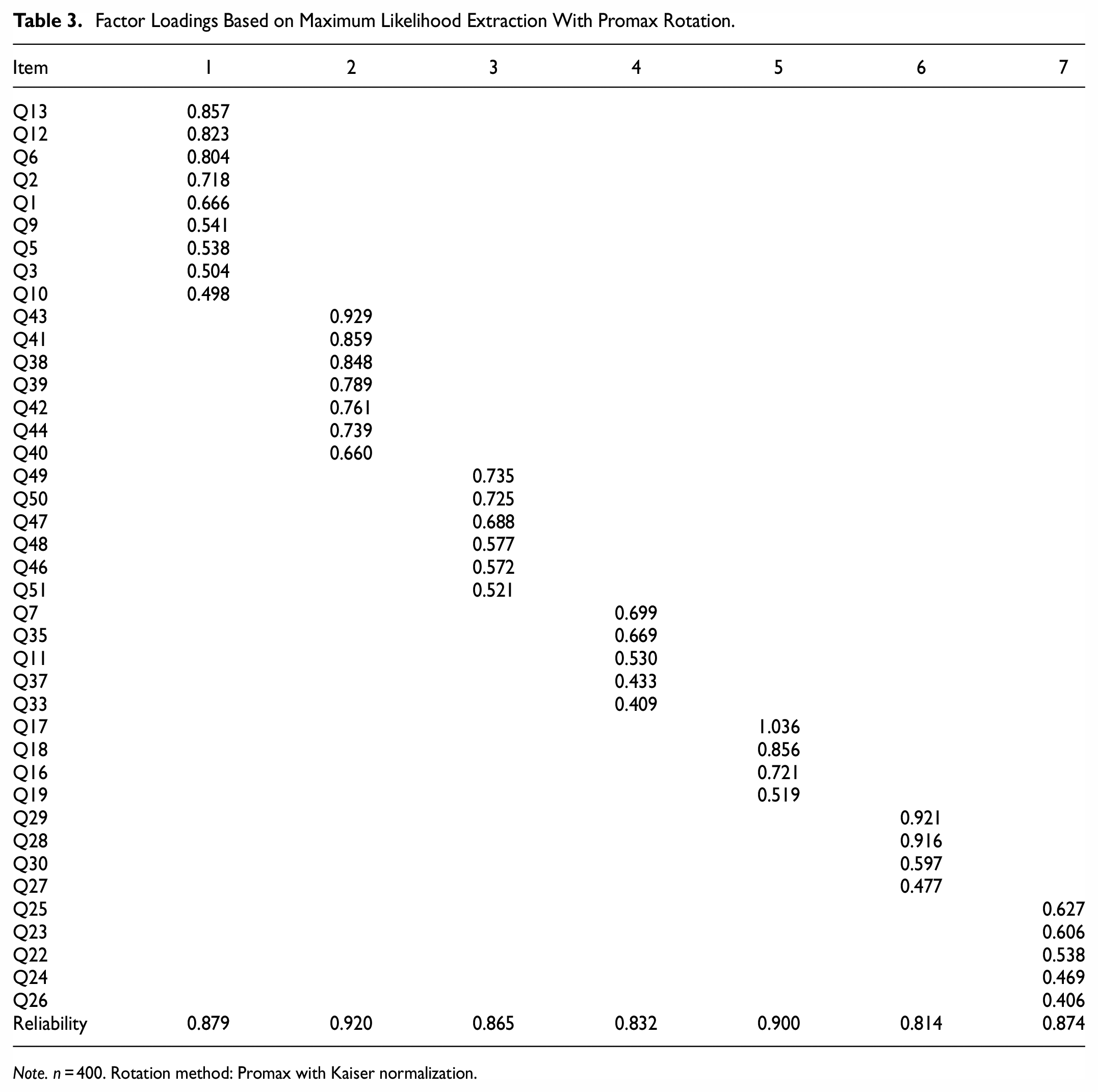
The components factor loadings explained by the eight factors are shown in Table 3.
Factor Loadings Based on Maximum Likelihood Extraction With Promax Rotation.
Note. n = 400. Rotation method: Promax with Kaiser normalization.
The threshold for factor loading was fixed at 0.40 and 11 items were eliminated due to cross-loading variables or low factor loadings. As a result, 40 items were retained with seven factors when rotating. The seven factors were religious coping (9 items), religious dietary practices (7 items), religious mental healing (6 items), dependence on faith (5 items), religious psychological effects (5 items), athletic identity (4 items), and flow (4 items).
Confirmatory Factor Analysis (Measurement Model)
The ARFS was evaluated based on the measurement model of evaluation. The assessment of the ARFS began with an evaluation of the factor loadings, followed by a determination of construct reliability and validity.
Construct Reliability and Convergent Validity of the ARFS
According to the results of the measurement model, all factor loadings of the construct were over 0.50, which was still an acceptable value (Chin, 1998). Thus, no items were further eliminated. The CR statistics ranged from 0.877 to 0.937, whereas Cronbach’s alpha values were between .814 and .921, indicating adequate reliability for all ARFS domains. The AVE values were over 0.50, which showed that the convergent validity of all constructs was established. Factor loadings, Cronbach’s alpha, CR, and AVE are presented in Table 4.
Convergent Validity and Reliability of the ARFS Measurement Model (n = 212).

Note. CR = composite reliability; AVE = average variance extracted.
Discriminant Validity of the ARFS
To establish the discriminant validity, the hetrotrait–monotrait ratio of criterion (HTMT) values were determined, which was part of measurement model evaluation in variance-based SEM. Table 5 shows the HTMT ratio of all the constructs was less than the required threshold of 0.90, which indicated that there was sufficient discriminant validity for the domains. Moreover, the cross-loading for each construct was very low, which indicated that there was a weak correlation between items of a different construct.
Correlation of Latent Constructs and Discriminant Validity (HTMT Criterion).
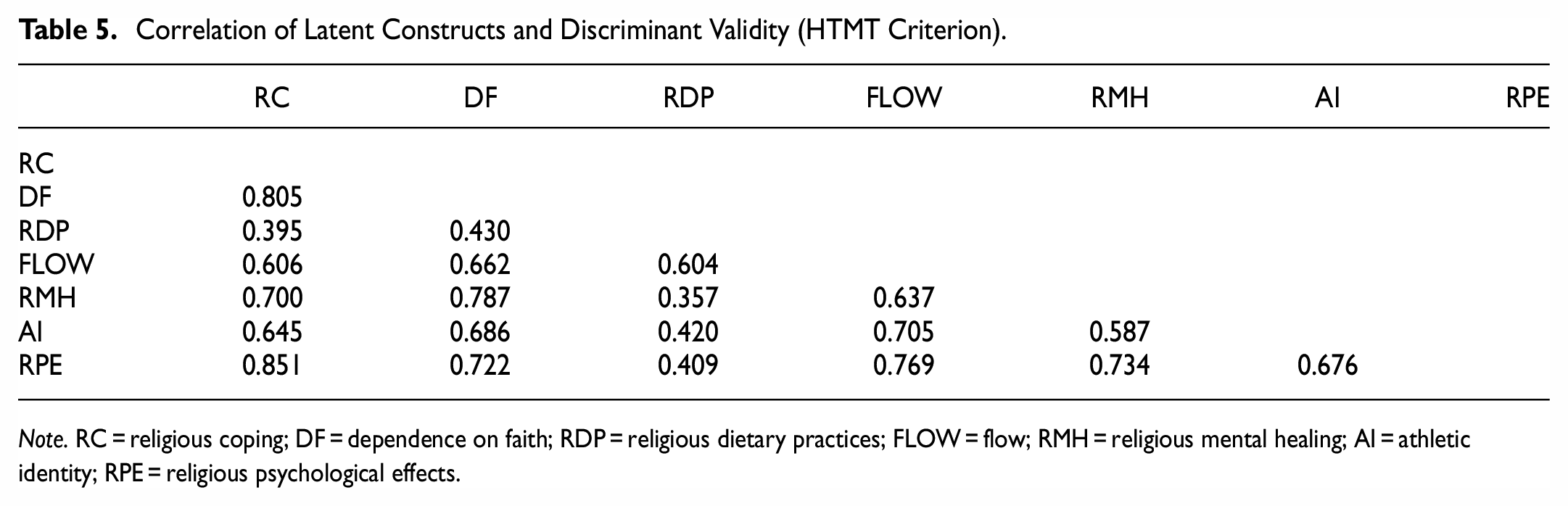
Note. RC = religious coping; DF = dependence on faith; RDP = religious dietary practices; FLOW = flow; RMH = religious mental healing; AI = athletic identity; RPE = religious psychological effects.
Validating Higher-Order Construct of the ARFS
The higher-order construct was validated as part of the assessment of the measurement model. Sarstedt et al. (2019) have advised that each of these constructs is needed to evaluate reliability, convergent validity, and discriminant validity with other lower-order constructs. The reliability and convergent validity of all other constructs were demonstrated, as the reliability value was greater than 0.70 and the AVE was greater than 0.50, which indicated that both reliability and validity were established. Additionally, the discriminant validity of the higher-order and lower-order constructs was evaluated. HTMT findings were also less than 0.90 (Table 6).
Higher-Order Construct of Reliability and Validity.

Note. RC = religious coping; DF = dependence on faith; RDP = religious dietary practices; FLOW = flow; RMH = religious mental healing; AI = athletic identity; RPE = religious psychological effects.
Since the overall ARFS was the second-order latent variable that included seven sub-domains, it was investigated to evaluate the significant contribution of all lower-order latent variables using the bootstrap approach. The results showed that all of the following seven sub-domains statistically and significantly contributed to the ARFS (Table 7): religious coping, RC (λ = .860, p < .001); dependence on faith, DF (λ = .825, p < .001); religious dietary practices, RDP (λ = .594, p < .001); flow, FLOW (λ = .785, p < .001); religious mental healing, RMH (λ = .800, p < .001); athletic identity, AI (λ = .768, p < .001); and religious psychological effects, RPE (λ = .856, p < .001). The results indicated that in the higher-order latent variables, the standardized path coefficient (outer loadings) was above .50 and significant. The highest contribution belonged to religious coping, and the lowest contribution was observed for the religious dietary practices sub-domain. Figure 1 shows the lower-order construct measurement model of the ARFS, and Figure 2 shows the higher-order construct measurement model of the ARFS.
Test of Second-Order Models Using Bootstrapping.
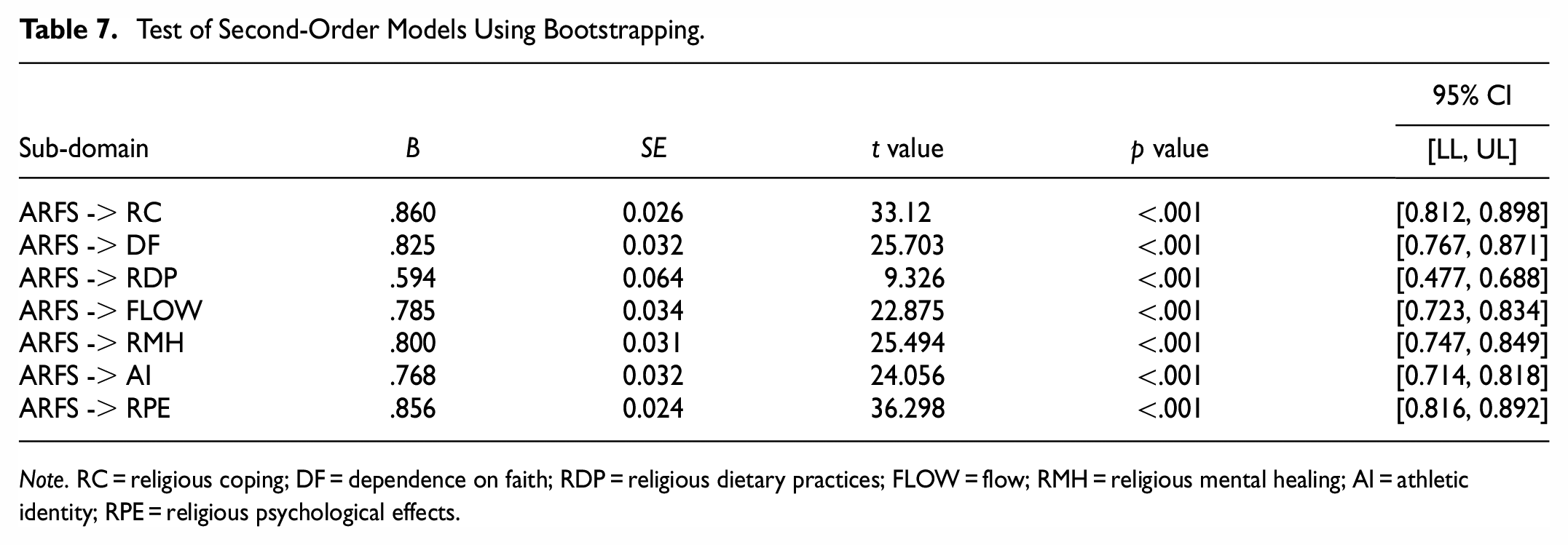
Note. RC = religious coping; DF = dependence on faith; RDP = religious dietary practices; FLOW = flow; RMH = religious mental healing; AI = athletic identity; RPE = religious psychological effects.

Lower-order constructs measurement model (CFA) for the ARFS.

Higher-order constructs measurement model (CFA) for the ARFS.
In CFA, the model fit describes the extent to which a proposed model explains the correlations between variables in the dataset. Several statistical tests (e.g., the root mean square error of approximation [RMSEA], the comparative fit index [CFI], and the standardized root mean square residual [SRMR]) can be employed to evaluate a hypothesized model’s fit with the data. However, a good model fit between the proposed model and the data does not necessarily indicate that the model is correct and consistent with reality (Schermelleh-Engel et al., 2003); rather, it indicates that the model is tenable (Schermelleh-Engel et al., 2003). In PLS-SEM, researchers should report on and use the model fit with extreme caution (Hair et al., 2017). Although some researchers require that new model fit indices be reported for PLS-SEM, there is a reason why the proposed criteria should not be applied and reported in the assessment of PLS-SEM results: the proposed criteria are in the initial stage of research, which means the critical threshold values are not fully understood (Ringle et al., 2022). For example, some model fit indices presuppose a common factor model, which necessitates outer residuals that are uncorrelated. However, it is not necessary for the outer residuals of composite models to be uncorrelated in PLS-SEM (Lohmöller, 1989). Thus, the criteria should not be applicable to PLS-SEM (Ringle et al., 2022).
Discussion
Religion plays a crucial role in enhancing athletic performance and promoting athletes’ psychological/mental health. However, there are no valid and reliable sport-specific instruments for measuring religious faith in sport. The purpose of the present research was to develop and provide evidence of the validity and reliability of a new scale (the ARFS) to measure religious faith among athletes. When assessing the results of the ARFS in this study, based on the total variance, eight factors were extracted. However, 11 items were eliminated due to cross-loading variables or low factor loadings, and seven factors were retained when rotating factors. When analyzing the CFA with information criteria, no items were eliminated. Thus, the ARFS was finalized with 40 items, with seven factors contributing most greatly to the ARFS: religious coping (9 items), religious psychological effects (5 items), dependence on faith (5 items), religious mental healing (6 items), flow (4 items), athletic identity (4 items), and religious dietary practices (7 items).
The first domain, religious coping (9 items), can be described as when athletes who are feeling insecure or handling uncertain circumstances gain comfort from emotional support and encouragement through their religious faith. This domain explains most of the contributions of the ARFS, indicating that it is a key domain of the ARFS. Frequently, two or more factors collapse into a single factor, making it challenging to find a single unifying theme among the measured variables (Fabrigar & Wegener, 2012). This domain combined coping strategies and religious support from eight relevant domains. In fact, social support is a crucial coping strategy that helps individuals manage stress and make positive contributions to mental health (Aflakseir, 2010). Religious athletes employ religious faith to enhance their coping skills to handle their stress and anxiety before, during, and after competitions (Czech & Bullet, 2007; Noh & Shahdan, 2022; Watson & Czech, 2005). Specifically, religious athletes frequently pray to relieve anxiety and tension, control their emotions, and maintain calm under pressure before and during competitions (Noh & Shahdan, 2020, 2022). According to the RSP model, religious athletes manage their emotions through prayer, especially during critical moments in competitions (Noh & Shahdan, 2022). These results suggest that researchers or coaches might need to consider how to provide emotional support or sources for support (e.g., team players) to reduce sport-related stress or anxiety through religious faith. Religious faith provides a sense of structure and offers a sense of connection to athletes with similar beliefs. When developing programs to support religious athletes, religious struggles where the athletes feel punished or abandoned by God are critical considerations. Religious struggles are relatively common human experiences leading to negative psychosocial and physical health outcomes, such as lower levels of self-esteem (Wilt et al., 2016). Those who are struggling are expected to adapt their negative religious coping style when dealing with critical circumstances (Exline et al., 2011). To the best of our knowledge, however, no research has been conducted regarding religious struggles among athletes. Future research could therefore explore how to handle religious struggles when athletes are facing hard times.
The second domain, religious psychological effects (5 items), can be defined as the positive effects produced by a person’s psychological aspects through religious faith. This domain is the second main contribution of the ARFS. Some researchers have found that adolescent players gain both comfort and confidence through prayer when confronting anxiety (Hoven & Kuchera, 2016). Furthermore, it is believed that religious faith promotes self-confidence, motivation, and a sense of security (Shahdan et al., 2022). According to the RSP model, religious athletes rely on their religious faith to improve their motivation so that they can accomplish the goals they have set for themselves (Noh & Shahdan, 2022). Previous research has shown that religious faith is considered to positively affect such as alleviating anxiety levels, enhancing motivation to achieve goals, and increasing self-confidence to focus on competition (Noh & Shahdan, 2020).
The third domain, dependence on faith (5 items), can be described as attitudes about accepting competition outcomes that are wholly dependent on a higher power. A higher power can be viewed as ultimate reality, a supreme being, or a God/gods that is greater than the individual who worships that power through their faith (e.g., Buddhism, Hinduism, Christianity, or Islam). Based on the RSP model, religious athletes accept performance outcomes as God’s plan regardless of success or failure (Noh & Shahdan, 2022). In fact, poor athletic performance tends to coincide with a greater risk for depression (Hammond et al., 2013; Wolanin et al., 2015). However, religious athletes accept the performance outcomes with hope and optimism when losing games and prepare for their next competition (Noh & Shahdan, 2022).
The fourth domain, religious mental healing (6 items), can be described as the process of alleviating emotional distress through the power of religious faith. Athletes face multiple stressors, including injuries, competitive stress, overtraining, and poor performance outcomes during training and competitions. In particular, sport-related injuries lead to depression and long-lasting emotional impacts (Wolanin et al., 2015). Injured players have higher levels of depression and life stress scores than uninjured players do (Brewer & Petrie, 1995). According to the RSP model, religious athletes maintain a positive mindset and try to eliminate negative or depressed thoughts through religious faith (Noh & Shahdan, 2022). It is necessary to take into account incorporating religious faith into sport psychology consultancy for athletes with different values and beliefs. Sarkar et al. (2014) have also suggested that sport psychology practitioners need to consider athletes with various religious and spiritual perspectives and cultures when working with them.
The fifth domain, flow (4 items), can be described as a mental state in which an athlete is entirely concentrated on their performance, generating momentum effortlessly, and beyond the point of distraction. The mental states experienced by religious athletes, such as being in the zone or having a spiritual connection, are remarkably comparable to flow (Spittle & Dillon, 2014). Because religious athletes gain strength and comfort through their religious faith, they may tend to experience flow. However, there is little research exploring the relationship between religion and flow, except for two studies (Dillon & Tait, 2000; Spittle & Dillon, 2014). This correlation research can be helpful in exploring the effects of flow as well as designing interventions to enhance sport performance.
The sixth domain, athletic identity (4 items), can be described as how athletes perceive their existence in relation to the athletic role and talent bestowed upon them by their religious faith. An individual with high athletic identity, in particular, elite athletes, commit to developing their skills and achieving their goals by overcoming obstacles through psychological and physical challenges. Although two elite Christian athletes segregated their religion from their athletic identity (Ronkainen et al., 2020), many religious athletes seek to find their athletic identity and meaning in their lives through their religious faith (Hoven & Kuchera, 2016; Shafranske, 1996).
The seventh domain, religious dietary practices (7 items), can be described as religious beliefs that affect an individual’s dietary patterns and food selection. Many religions have dietary restrictions that may or may not be rigorously adhered to. For example, Hindus generally avoid foods (e.g., garlic and onion) that they feel inhibit spiritual growth (McCaffree, 2002) and certain foods are forbidden during fasting. Seventh-Day Adventists adhere to a stringent lacto-ovo vegetarian diet that excludes poultry, meat, fish, tobacco, alcohol, and caffeine (McCaffree, 2002). The Jewish religion permits the eating of meat that has been prepared according to Jewish rituals. Buddhist’s dietary practices are varied. While many Buddhists are vegetarians, some Buddhists in Tibet and Japan make individual choices (McCaffree, 2002). Fasting is observed in various religions, such as the Tenth of Tevet in Judaism, Fast of Esther, Christian Lent, Tisha B’av, Yom Kippur, the Seventeenth of Tamuz, Tzom Gedalia, and Ramadan fasting. There is an issue about religious nutritional practice in sport, particularly regarding Ramadan fasting. Some studies found that Ramadan fasting could negatively affect athletes due to dehydration, accumulated sleep deficit and fatigue, while other studies reported no or minimal effects of fasting on athletes’ performances (Chamari et al., 2019). Unfortunately, there is very little research on the relationship between psychological factors and sport performance during Ramadan fasting.
Practical Implications
Most research on religion and sport has been conducted via qualitative research (Crust, 2006; Noh & Shahdan, 2020, 2022). Naturally, qualitative research is needed to generate knowledge and gain a deep understanding of a specific theory in the early stages. However, researchers need to expand our knowledge and develop a wider understanding of further phenomena regarding religion in sport based on scientific methods. One promising approach to understanding these phenomena is through validated tools, which involve quantitative measurements. This new scale, the ARFS, can mainly be used for two purposes. First, the scale will allow researchers and/or sport psychologists to quantitatively assess research hypotheses. Scales of measurement are important instruments for assigning numerical values to events that cannot be measured directly. They are collections of elements that reflect levels of theoretical variables that are otherwise directly unobservable. Researchers could compare and quantify relationships between two or more variables by observing different groups or conditions or they could look at cause-and-effect relationships to predict phenomena in natural or designed experiments and generalize their findings for an athletic population.
Second, the scale will help researchers/sport psychologists to design intervention programs to enhance sport performance by using validated measures. Sport psychologists/coaches endeavor to help athletes to realize their potential or increase their performance around a skill or task through psychological skills training (e.g., goal setting, motivation, imagery, relaxation, and concentration). As proven from the literature, religious faith plays a significant role in achieving better performance among religious athletes (Noh & Shahdan, 2020, 2022). When predicting a religious–psychological factor’s impact on sport performance, it helps to design effective interventions to enhance sport performance for religious athletes. For example, if religious coping is the main predictor that influences sport performance, then it can be applied by employing two methods (relaxation techniques and prayer) to reduce sport-related anxiety and increase a positive mindset in religious athletes. When increasing the effectiveness of prayer, context-specific determinants may need to be considered, such as culture and the degree of belief.
Study Limitations
Even though this study has conducted following a systematic approach to developing the questionnaire, there are several limitations to be considered. First, the majority of participants were Muslims (76%). Malaysia is a multi-ethnic and multi-religious country whose official religion is Islam. To check content validity, four different religious workers (i.e., one imam, one Thai monk, one pastor, and one pujari) from the previous study (Noh et al., 2022) identified each construct and measurement item and provided evidence of good content validity. However, the results in the current study do not represent the considerable diversity within various religions. Therefore, a balanced number of participants from diverse religious faiths should be included in future research.
Second, a self-report questionnaire was tested for its validity and reliability to develop a final questionnaire. Hence, response bias may have arisen in this study. The participants were required to recall a particular situation, such as a competition, when answering the questionnaire. Some participants might lack retrospective ability even though they were attempting to be truthful and accurate. Biased responses can be deliberate or accidental, but such responses make results less informative and valuable.
Lastly, we recruited 612 participants in this study and divided them into two groups for separate EFA and CFA. Although the respondent sample size met the minimum requirements of the analysis statistically, it is necessary to employ larger sample sizes with sample diversification to increase the credibility and generalization of the results. The ARFS is designed to be used with athletes of diverse religious faiths in various countries and cultures. Thus, future studies with sufficiently large samples from varied cultures and religious faiths are needed to examine the psychometric properties of the ARFS.
Conclusion
This study involved the development and validation of the ARFS using factor analysis to reach a final version of the scale. The ARFS is a reliable and valid assessment tool for measuring religious faith in athletes. The ARFS could be potentially utilized with athletes of various religious affiliations in different countries, cultures, and sporting contexts. Researchers can also use the scale to test the relationship between the role of religious faith and sporting performance. Furthermore, researchers and sport psychologists can design intervention programs to enhance sport performance by gathering statistical information using ARFS. The ARFS is a multidimensional questionnaire that can measure which factor is the most significant in influencing sport performance. In addition, the ARFS can be a useful tool to expand the knowledge of religious faith in sport literature. It is expected to stimulate further research on religion and sport performance.
Supplemental Material
sj-docx-1-sgo-10.1177_21582440231204682 – Supplemental material for The Athletic Religious Faith Scale: Part II—Development and Initial Validation
Supplemental material, sj-docx-1-sgo-10.1177_21582440231204682 for The Athletic Religious Faith Scale: Part II—Development and Initial Validation by Young-Eun Noh, Fariz Zaki, Eng Wah Teo and Mahmoud Danaee in SAGE Open
Footnotes
Acknowledgements
The authors would like to thank all the athletes for their participation.
Declaration of Conflicting Interests
The author(s) declared no potential conflicts of interest with respect to the research, authorship, and/or publication of this article.
Funding
The author(s) disclosed receipt of the following financial support for the research, authorship, and/or publication of this article: This work is supported financially by the Ministry of Higher Education Malaysia via Fundamental Research Grant Scheme (FRGS/1/2020/SS0/UM/02/2).
Ethical Approval
Approval for the research was obtained from the University of Malaya Research Ethics Committee (UM.TNC2/UMREC-1025).

Supplemental Material
Supplemental material for this article is available online.
Data Availability Statement
The data that support the findings of this study are available from the corresponding author, [Y N], upon reasonable request.
References
Supplementary Material
Please find the following supplemental material available below.
For Open Access articles published under a Creative Commons License, all supplemental material carries the same license as the article it is associated with.
For non-Open Access articles published, all supplemental material carries a non-exclusive license, and permission requests for re-use of supplemental material or any part of supplemental material shall be sent directly to the copyright owner as specified in the copyright notice associated with the article.
