




Abstract
Assessments are regularly used among clinicians within psychology, yet many are deemed too time-consuming and expensive. The Personality Inventory for—Diagnostic and Statistical Manual of Mental Disorders (5th ed.; DSM-5)—Brief Form (PID-5-BF) was developed to measure maladaptive personality traits (negative affect, detachment, antagonism, disinhibition, and psychoticism), based on the “hybrid model” for personality disorders included in DSM-5 Section III. Literature indicates that reliability and validity for the PID-5-BF has been established in other countries. We explored these psychometric properties within a South African population using the NEO Personality Inventory Revised and Mini International Neuropsychiatric Interview’s (MINI) Subscale K: psychotic disorders and mood disorder with psychotic features, as measures for comparison. Our results indicated support for the PID-5-BF with sufficient reliability, convergent, and discriminant validity. More research is needed on the PID-5-BF, especially in South Africa, but our findings indicate it to be a promising assessment tool that could greatly benefit clinicians in the mental health sector.
Keywords
Introduction
One of the cruxes of psychologists is formulating diagnoses to enable the application of effective treatment. South African clinicians generally refer to the Diagnostic and Statistical Manual of Mental Disorders (5th ed.; DSM-5; American Psychiatric Association [APA], 2013a) in this regard. As opposed to the belief that the DSM-5 is the main tool for psychiatric diagnosis, the World Health Organization (WHO) International Classification of Diseases, Tenth Revision (ICD-10; ICD-11 currently in revision), is officially used worldwide for classifying diseases, which includes personality disorders and other mental health disorders (Bach et al., 2017; Reed, 2010; Reed et al., 2019). Hence, as a WHO member of state, South Africa also adheres to ICD-10 regulations as mandatory to obtain and report health statistics (Bach et al., 2017; Keeley et al., 2016). Much like the DSM-5, the ICD-10 provides health care professionals with a framework regarding the organization and decision-making of health care services, as well as an administrative structure for reimbursement and claims for billing, tracking, and outcome assessment (Bach & First, 2018; Keeley et al., 2016; Reed, 2010).
Psychometric assessments are important tools as a further aid in making correct diagnoses. These assessments need to be of high quality and standardized within a South African context to yield valid and reliable results (Foxcroft et al., 2004; Foxcroft & Roodt, 2009).
A survey regarding psychometric tests in South Africa expressed urgency for tests to specifically diagnose personality disorders and pathology. This survey also indicated concern that tests are too time-consuming and expensive (Foxcroft et al., 2004). Considering the rushed manner of modern-day life, and the decline of South Africa’s economic growth (Statistics South Africa, 2016), psychopathology is a problem not currently dissipating (Fearon et al., 2017; Kliewer et al., 2017; Shulman & Scharf, 2018), and it can surely be assumed that the findings of Foxcroft and colleagues (2004) are still valid. Therefore, assessments that are quick to administer are greatly sought after.
Personality, within the field of psychology, is a central and indispensable concept, as it contributes to the clinical presentations and general functioning of clients or patients (McWilliams, 2011; Montag & Panksepp, 2017; Roberts & Davis, 2016). Research has indicated that most personality traits may be understood from the five-factor model (FFM) of personality, composed of five basic dimensions, namely extraversion, neuroticism, openness, conscientiousness, and agreeableness (e.g., Kandler et al., 2014).
As psychologists, we mostly focus on personality when it has become disordered in some way, that is, through impairments and malfunctions of the brain (Clarkin et al., 2015; Pharo et al., 2011; Romer, 2010), and trauma and psychosocial factors, including emotion-dysregulation, negative self-beliefs, and rigidity of interpersonal behaviors and styles (Clarkin et al., 2015; Hopwood et al., 2013; Krueger, 2013). Personality disorders may therefore be described as enduring, pervasive, inflexible, and stable patterns of thinking, feeling, and behaving in ways different from that of the norm, which causes distress and affects negatively, or impairs two or more domains of functioning, usually occupational and interpersonal, sometimes to a debilitating degree (APA, 2013a; Clarkin et al., 2015; Stewart et al., 2002). Research has also indicated that personality disorders may be understood as extreme or maladaptive variants of the big five personality traits (Samuel & Widiger, 2008; Widiger & Trull, 2007).
Up to date, the DSM-5 categorical model of personality disorders (Section II) and assessments based thereon (e.g., Personality Diagnostic Questionnaire-4 [PDQ-4]; Hyler, 1994) and the Millon Clinical Multiaxial Inventory III (MCMI-III; Millon et al., 1994) has been used to diagnose personality disorders. However, in response to various limitations presented by this model (i.e., poor validity of assessments, lack of clinical utility, and high comorbidity between personality disorders), a more dimensional and empirically based approach, the “hybrid model,” was developed and included in the DSM-5 Section III (APA, 2013a; Clarkin et al., 2015; Krueger et al., 2014). The hybrid model (Section III) defines personality disorders similarly to the categorical model (Section II), but places more focus on the impairment of personality functioning (Criterion A), as well as pathological personality traits (Criterion B; APA, 2013a; Miller et al., 2015; Suzuki et al., 2015).
In the operationalisation of the hybrid model, Krueger and colleagues (2012) developed an instrument (Personality Inventory for DSM-5 [PID-5]) for the measurement of Criterion B, that is, maladaptive personality traits. In addition, a brief form was developed focusing on five trait domains, namely negative affectivity, detachment, antagonism, disinhibition, and psychoticism (APA, 2013c). The easy accessibility of the Personality Inventory for DSM-5 Brief Form (PID-5-BF) and routine utility thereof could potentially allow for earlier detection of personality pathology. It should, however, be noted that the PID-5-BF is not designed to diagnose personality disorders or measure impairment in Criterion A core functions, but rather aims to recognize elevation of the maladaptive trait dimensions to indicate whether there is a need for further assessment (Fossati et al., 2017).
Literature surrounding the DSM-5 hybrid model and PID-5/PID-5-BF has expanded substantially since its development and has indicated reliability and validity, as well as internal consistency (Al-Dajani et al., 2016; Anderson et al., 2018; Bach et al., 2016; Fossati et al., 2017).
Fossati and colleagues (2017) examined the reliability and construct validity of the PID-5-BF (APA, 2013c) in an Italian adolescent sample (N = 877) having used the Measure of Disordered Personality Functioning (MDPF; Parker et al., 2004). Their results suggested that, at least in the Italian-translated version, the PID-5-BF could be proficient in capturing personality psychopathology. They detected adequate internal consistency for all the five PID-5-BF scales as measured by the mean interim correlation (MIC: α = .59–.83; Clark & Watson, 1995). Convergent validity was examined by evaluating the size of the factor loadings in relation to the purported latent constructs. Findings indicated significant, mostly of moderate size, factor loadings with median rit = 0.3 and SD = 0.10. Model fit was assessed through the chi-square test, root mean square error of approximation (RMSEA; significant at 0.05–0.08; Browne & Cudeck, 1993; van de Schoot et al., 2012), Tucker–Lewis Index (TLI; Tucker & Lewis, 1973), and Comparative Fit Index (CFI; Bentler, 1990) with significant values at >0.95 (Hu & Bentler, 1999). Results indicated adequate fit with RMSEA = 0.41, TLI = 0.92, and CFI = 0.95 (Fossati et al., 2017).
However, having used an adolescent sample, generalizability to adult populations is questionable. Bach and colleagues (2016) also evaluated the PID-5-BF’s psychometric properties, as well as the PID-5 and PID-5 Short Form (PID-5-SF, 100 items) in a large Danish sample made up of both psychiatric and community respondents. Their results, in line with Fossati and colleagues’ (2017) findings, also indicated acceptable reliability, internal consistency (α = .74–.81), convergent validity between the three assessments (Pearson correlations = .83–.92; significant at <.50; Cohen, 1992), and evidence for the PID-5-BF’s factor structure (RMSEA = 0.041; CFI = 0.984). Their results furthermore indicated that the PID-5-BF is able to differentiate between psychiatric and community participants and showed evidence for the measure’s utility in assessing the categorical (Section II) personality disorders (Bach et al., 2016). Although these studies indicated support for the clinical use of the PID-5 measures, these studies did not use the official English version of the measure.
Hence, in 2018, Anderson and colleagues set out to evaluate the psychometric properties of the PID-5-BF using the original English version. They used three samples, which included 347 undergraduate university students; archival data from 285 undergraduate university students; and an archival community sample focused on participants who reported potentially psychopathological traits. To assess the associations between external criterion measures and the PID-5-BF domains, the following measures were used: Personality Psychopathology-Five (PSY-5; Harkness & McNulty, 1994; included in the Minnesota Multiphasic Personality Inventory-2 Restructured Form [MMPI-2-RF]; Ben-Porath & Tellegen, 2008), PDQ-4 (Hyler, 1994), the Inventory for Depression and Anxiety Symptoms-2 (IDAS-2; Watson et al., 2007), and the Externalizing Spectrum Inventory (ESI; Krueger et al., 2007).
As expected, their results indicated support for the utility of the PID-5-BF as a brief screening measure for maladaptive personality traits, as well as a brief measure of dimensional personality psychopathology (Anderson et al., 2018). In line with previous research (Bach et al., 2016; Fossati et al., 2017; Krueger et al., 2012; Wright et al., 2012), their findings indicated acceptable internal consistency for the scales within each sample (α = .69–.78), and showed support for model fit (via confirmatory factor analysis [CFA]; RMSEA = 0.06, CFI = 0.94, TLI = 0.93, for the community sample, and RMSEA = 0.06, CFI = 0.93, TLI = 0.92, for the combined undergraduate sample). Some research on personality inventories have used exploratory factor analysis (EFA) that is a less stringent form of analysis (Asparouhov & Muthén, 2009; Hopwood & Donnellan, 2010; Marsh et al., 2014), and some findings have indicated that using CFA for personality inventories might result in poor model fit (Hopwood & Donnellan, 2010). Anderson and colleagues (2018) therefore propose that their findings, having used CFA, suggest strong support for the PID-5-BF’s factor structure as it indicated acceptable model fit.
Furthermore, their results stipulated support for the associations between measures of Section II personality disorders and the PID-5-BF, PSY-5 scales, PID-5, and PID-5-SF, and measures of broad externalizing and internalizing psychopathology, consistent with previous findings (Finn et al., 2014; Sellbom et al., 2014). In addition, their results showed that externalizing PID-5-BF domains predicted ESI scores and internalizing PID-5-BF domains predicted IDAS scores. Finally, analyses indicated PID-5-BF associations with external measures to be consistent with correlation patterns found when using the PID-5 and PID-5-SF, as also found by Bach and colleagues (2016) and Fossati et al. (2017).
Research furthermore indicates support for the DSM-5 hybrid model in comparison with other evidence-based systems of personality and pathology, and that it aligns in a theoretically acceptable manner (Gore & Widiger, 2013; Thomas et al., 2013). Thus, although research has not yet been done in South Africa, it is assumed that the PID-5-BF could greatly benefit South Africa’s mental health sector in providing a measure that is not only cost-free, but quick to administer and in line with contemporary views of personality pathology as described by the DSM-5 hybrid model.
Sample
Henceforth, the aim of this study was to explore the psychometric properties of the PID-5-BF within a South African context. For this study, a sample of university students were used. When assessing a study, regardless of what the nature of the participants may be, it is important to do so in light of the goal that is set out to reach, the larger research agenda to which the specific study wishes to contribute to (Druckman & Kam, 2009). The aim of this study was not to generalize findings to the wider South African population, but to obtain an indication of whether the PID-5-BF yields similar results in terms of validity, than that obtained in other countries and settings. In most of these studies, the nature of the participants is not of great relevance, especially when efforts are put in place to ensure that the preference or motivation for using a particular population sample is in line with what is set out in theory (Druckman & Kam, 2009). Consequently, a student sample, representing a subsection of the South African population, may qualify as research participants for fundamental research as well as theory testing (Bello et al., 2009; Pernice et al., 2008).
Furthermore, university students may be seen as appropriate research samples in certain situations, especially if they are representative of a certain population of interest (Peterson & Merunka, 2014). Because the DSM-5 (APA, 2013a) states that the onset age of personality disorders is generally in late adolescence to early adulthood (Blonigen et al., 2008; Caspi et al., 2005; Roberts et al., 2006; Roberts & Mroczek, 2008), in line with research indicating that the key period for personality change is during late adolescence and early adulthood (Jackson et al., 2012; Josefsson et al., 2013; Kanacri et al., 2014; Roberts & Davis, 2016; Roberts & Mroczek, 2008), university students, irrespective of race, language, or gender, in this study can be seen as adequate research participants. In addition, student populations, or participants in early adulthood, irrespective of possible personality pathology or disorders, are frequently used in validation studies, like the Community Assessment of Psychic Experience (CAPE; for example, Mossaheb et al., 2012); MMPI-2 (e.g., Svanum et al., 1994); NEO Personality Inventory (NEO-PI; for example, McCrae et al., 1996); and PID-5 (e.g., De Fruyt et al., 2013) to name but a few. One would likely not suspect to see elevations on pathology scales, given the sample (i.e., an assumingly intelligent group), but as the aim is to explore correlations between the assessments to establish validity for the constructs, characteristics of personality pathology are not pivotal in this regard (Anderson et al., 2018; Druckman & Kam, 2009; Krueger et al., 2012).
Arguments have been made that the use of university students is appropriate in research studies where emphasis is placed on psychological processes and the theory tested is related to human behavior, thus being independent of sample characteristics (APA, 2013a; Blonigen et al., 2008; Caspi et al., 2005; Druckman & Kam, 2009; Lucas, 2003; Peterson, 2001; Roberts et al., 2006; Roberts & Mroczek, 2008).
Objectives
The objectives of this study were to examine the construct validity, as well as convergent and discriminant validity of the measuring instrument compared with similar constructs of the NEO Personality Inventory Revised (NEO-PI-R) and the Mini International Neuropsychiatric Interview’s (MINI) Subscale K: Psychotic disorders and mood disorder with psychotic features. The aim of this study was not to generalize findings to the wider South African population.
The NEO-PI-R is seen as an assessment tool more often used for general, as opposed to psychopathological, personality structure. However, some other studies have also used these tests (NEO versions and PID-5 versions) in a comparative manner to explore convergent and discriminant validity.
In 2013, De Fruyt and colleagues examined the replicability of the DSM-5 personality trait model. They used a Dutch version of the PID-5 (checked via independent back translation) and furthermore explored the common structure of the PID-5 and the NEO-PI-3 (De Fruyt et al., 2013). The findings presented support for the validity of hierarchical conceptualization of personality traits, with both general and maladaptive traits being organized under an umbrella of higher order domains (Anderson et al., 2013; Thomas et al., 2013). More specifically, it would seem as though negative affect (DSM-5) relates to neuroticism (FFM); detachment (DSM-5) is akin to low extraversion (FFM); antagonism (DSM-5) to low agreeableness (FFM); and disinhibition (DSM-5) to low conscientiousness (FFM). A link between DSM-5 Psychoticism and FFM Openness could however not be clearly established. This study did however provide support for construct validity of the DSM-5 trait model and underscored the psychometric properties of the PID-5. Finally, it suggested that the NEO measures can be used to supplement the PID-5 when both general and maladaptive traits want to be assessed (De Fruyt et al., 2013).
Griffin and Samuel (2014) administered a joint EFA of the 30 NEO-PI-R trait scales and the 25 PID-5 trait scales having used a sample of 388 undergraduate psychology students. Their results indicated a five-factor structure similar to the FFM, as supported by previous research having indicated the same (Anderson et al., 2013; De Fruyt et al., 2013; Griffin and Samuel, 2014; Krueger et al., 2012; Thomas et al., 2013; Wright et al., 2012). Their results furthermore indicated that the five joint factors obtained represent the same five factors materialized by normal-range personality measures. Their findings also extended to the domain of openness. In line with previous research (De Fruyt et al., 2013; Gore & Widiger, 2013; Thomas et al., 2013), they found NEO-PI-R openness facets (ideas, fantasy, and aesthetics) loaded primarily onto the PID-5 psychoticism factor (unusual beliefs/experiences, perceptual dysregulation, and eccentricity; Griffin and Samuel, 2014).
We hypothesized that construct validity and reliability for the PID-5-BF will be present in a South African sample when compared with conceptually similar measures and coefficients found in other studies. We further hypothesized that, based on research, negative affect would correlate positively with neuroticism; detachment negatively with extraversion; antagonism negatively with agreeableness; and disinhibition negatively with conscientiousness (Gore & Widiger, 2013; Krueger et al., 2011; Thomas et al., 2013). Seeing as research (e.g., Al-Dajani et al., 2016; De Fruyt et al., 2013; Gore & Widiger, 2013; Griffin & Samuel, 2014; Thomas et al., 2013) has yielded inconsistencies for the correlation between psychoticism (unusual beliefs and experiences, eccentricity, perceptual dysregulation; APA, 2013c) and openness (fantasy, aesthetics, feelings, actions, ideas, values; Costa & McCrae, 1992), we hypothesized that these two scales, albeit perhaps small in significance, will correlate to some degree. To strengthen the investigation, we also utilized the MINI Subscale K as an alternative measure of psychoticism to be correlated with the PID-5-BF Psychoticism scale. As of yet, there has not been a study that specifically compared the PID-5-BF Psychoticism scale with the MINI Subscale K, which specifically measures psychotic components.
Method
Participants
The sample population consisted of 874 undergraduate university students, specifically from the North-West University (NWU) Potchefstroom campus. According to the Students Statistics of the NWU in 2018, the number of enrolled students totalled at 68,260, of which 54,725 were undergraduates. The undergraduate population is made up of 66.6% female students and 33.4% male students. The undergraduate population further consists of 67.2% African students, 27.2% White students, 4.7% Colored students, and a combined 0.8% of Indian and Asian students.
The age range was between 18 and 22 years, and all participants had an adequate understanding of the English language, mostly as the second language, given the linguistic diversity in South Africa. Furthermore, the sample group was made up of both female and male participants, and there was no restriction or preference according to race or culture. Because recruitment was done via advertisements (pamphlets and posters) and participation was completely voluntary, the sample did not necessarily represent a true reflection of the distribution of individuals in South Africa or even in the university. Henceforth, the sample will be referred to as a “subsection of the South African population.”
Procedure
Sampling method
Convenience sampling was used to recruit students through advertisements, that is, posters on notice boards and pamphlets handed out in classrooms.
Data collection
Data were collected through the administration of paper-based self-report questionnaires supervised by an independent person. This was done to maintain anonymity. The questionnaire included the PID-5-BF, composed of 25 questions (referred to as Section A in questionnaire), MINI (Version 6.0; Subscale K), composed of 15 questions (Section B), and NEO-PI-R, composed of 240 questions (Section C), compiled in that order. Participants were however not required to answer in said order, and were free to answer in any order (e.g., Section B, Section A, Section C). Although the MINI is a clinical interview, for the purposes of this study, it was converted into a self-report format. The 15 questions were answered through indicating “yes” or “no,” and in this sense, follow-up questions asking for more detail (which one would explore in the interview) were not included. This was seen as appropriate as the detail surrounding specific psychotic experiences was not necessary in assessing validity.
PID-5-BF
The PID-5 BF is measured on a 4-point Likert-type scale, with the following responses: very false/often false, sometimes/somewhat false, sometimes/somewhat true/very true/often true. Internal consistency and construct validity for the PID-5-BF has been established. Fossati and colleagues (2017) found coefficients ranging from 0.59 to 0.83, in line with other studies indicating reliability and validity for the PID-5-BF.
NEO-PI-R
The NEO-PI-R focuses on the measurement of personality constructs as theorized by the big five personality structure, or FFM. Questions are rated on a 5-point Likert-type scale: strongly disagree, disagree, neutral, agree, and strongly disagree. Internal consistency for the five factors has been indicated to be approximately 0.90, and ranges between 0.50 and 0.70 for the facets (Costa & McCrae, 1992; Soto & John, 2009). High correlations between the NEO-PI-R facets and other personality scales indicate sufficient convergent and discriminant validity (Gaughan et al., 2012; Maples et al., 2014).
MINI Subscale K
The MINI can be used to diagnose a variety of disorders, including Criterion A psychotic symptoms of schizophrenia. Subscale K: psychotic disorders and mood disorder with psychotic features specifically focuses on symptoms of a psychotic nature. The MINI has been proved valid and reliable, with excellent test–retest and interrater reliability values (.88–1.0) and good convergent validity values (.69–.82; Lecrubier et al., 1997; Sheehan et al., 1988).
Ethical considerations
In any research study using questionnaires, truthful responses are relied upon for accurate and meaningful conclusions. In this study, general ethical considerations included voluntariness of participation, informed consent, anonymity, and the use of standardized assessments, to name but a few. One has to consider, though, that there are still some obstacles that might hinder truthful answering, that is, response biases. This can be defined as various personal biases or conditions, intentional or accidental, which may influence the way in which a participant responds (Johnson, 2019; King & Bruner, 2000; Nunnally, 1994; Sauro & Lewis, 2011; van de Mortel, 2008). In this study, unfortunately there was no direct assessment of response bias, which might have affected the validity of results.
Furthermore, as participants were exposed to reflections regarding their personalities with the risk of inducing psychological distress, debriefing services were made available to any participant who required it after survey completion. No participants made use of this opportunity.
Data Analysis
Even though there is some debate around whether CFA or EFA is more applicable (Asparouhov & Muthén, 2009; Brown, 2015; Brown & Moore, 2012; Browne, 2001; Hopwood & Donnellan, 2010; Izquierdo Alfaro et al., 2014; Li, 2016; Schmitt, 2011), this study involved CFA. CFA enables the investigation of relationships between variables. The CFA may be used to test the reliability of the observed variables, as well as examine the covariations between constructs. Furthermore, it allows for testing relationships between constructs and the directionality thereof (Brown, 2015; Brown & Moore, 2012; Izquierdo Alfaro et al., 2014; Li, 2016; Schmitt, 2011; Schreiber et al., 2006). It has also been indicated that a notable difference between CFA and EFA is that EFA is frequently used during the earlier processes of developing a scale and validating its constructs. CFA was considered a viable method in this study, given aforementioned uses of CFA, and it is used more commonly during later stages of research when prior theoretical and empirical foundations have been established (Brown, 2015; Brown & Moore, 2012).
Statistical analyses were implemented in Mplus 8.1 (Muthén & Muthén, 2018), which allows for the implementation of latent variable modeling in a structural equation modeling (SEM) framework. A series of models were tested with the NEO-PI-R components and the PID-5-BF components. Specifically, CFA was used to establish measurement models, that is, to create the latent factor structures based on the items in the case of the PID-5 BF, and the personality factors were based on the total score for their subdimensions as the items. Latent variables are more desirable to normal total or mean scores as it considers measurement error (Brown, 2015). In terms of parameter estimation, the mean- and variance-adjusted weighted least squares (WLSMV) implementation was used, and this implementation has been found to work well in samples that exceed 200 participants (Li, 2016), outperforming maximum likelihood estimation.
With regard to the fit of the factor structure to the data, the following indices were considered: CFI, TLI, and RMSEA. For the CFI and TLI, the rule of thumb of 0.90 would be used and for the RMSEA, 0.08 and below (van de Schoot et al., 2012). The CFA analysis also generated a correlation matrix that examined the relationships between the variables, specifically aspects of convergent and discriminant validity. Effect sizes for correlational relationships were considered medium for values of r = .30 to .49 and large for correlations from r = .50 to .84. Correlations of .85 and above were used as the cutoff point to consider discriminant validity issues (Brown, 2015). Furthermore, a test for discriminant validity was implemented by constraining the correlation between two variables of interest to unity (1.00), and then having compared it with a model where the correlation remained unconstrained by means of a chi-square difference test.
Results
Please see sections below for fit of the models. For each NEO-PI-R factor, for example, Neuroticism, it was estimated as a single factor with the PID-5-BF represented by its individual components. Investigation also included the subcomponents of the NEO-PI-R facets in the correlation matrixes. Therefore, a series of models were tested.
Please note that full result tables are available upon request.
PID-5-BF Factor Structure: Five-Factor Versus Higher Order Six-Factor Model
In the consideration of model fit to the data of the PID-5-BF instrument, two models were considered. The first model was an FFM consisting of the individual components of the PID-5-BF, and the second was a six-factor (second order/higher order) model that contained an additional factor for the score as a higher order latent variable consisting of the five components of the first model. For the initial FFM, all items were assigned to their respective factors (χ2 = 556.89; df = 242; CFI = 0.94; TLI = 0.94; RMSEA = 0.07). However, in this initial FFM, Item Q13 (“I steer clear of romantic relationships”) had a low loading (0.27) in context of the other items and was removed to retest the FFM. The revised first (five-factor) model indicated best fit to the data as it had the lowest chi-square and RMSEA values and higher CFI and TLI values. Further data analyses were therefore based upon the FFM.
Furthermore, comparison between the scales also yielded good correlations for most relationships. The highest correlations found were between detachment and negative affect (r = .71; large effect) and detachment and psychoticism (r = .72; large effect). All other relationships between scales (e.g., disinhibition and psychoticism) had values of between .54 and .69 (large effects). However, antagonism had the weakest correlation coefficient values in correlation to the other scales. It correlated most significantly with disinhibition (r = .55; large effect) and psychoticism (r = .54; large effect). Furthermore, correlational values for its relationship to detachment showed a medium effect (r = .38), as well as for the correlation to negative affect (r = .35).
In general, as can be seen, the PID-5-BF showed adequate validity, as all coefficients represented medium to large effects, and none were above .85. Internal consistency was also established with sufficient Cronbach’s alpha coefficients (α = .69–.84). Although the traditional cutoff for Cronbach’s alpha is .70, the difference of .01 for detachment was considered insignificant, and did not warrant its exclusion.
The best-fitting FFM’s items loaded onto their constructs in a significant manner (cutoff value ≥0.50). It should be noted that Q8 (0.49) and Q10 (0.46) just did not meet the cutoff loading on to negative affect. The same was found for Q14 (0.48) and Q18 (0.46) for detachment, and Q20 (0.48) for antagonism. However, given the proximity to 0.50 in terms of rounding, it was decided to keep these items for further analysis.
Scale Correlations
Relationship Between NEO-PI-R Neuroticism PID-5-BF
The Cronbach’s alpha coefficient was found to be adequate (α = .79) for neuroticism. The model containing the PID-5-BF components and NEO-PI-R Neuroticism scale indicated adequate data fit (χ2 = 724.31; df = 390; CFI = 0.90; TLI = 0.89; RMSEA = 0.06).
Negative affect and neuroticism (relationship primarily investigated) showed a significant positive relationship (r = .78; large effect). Furthermore, all subscales of neuroticism showed medium effect correlations, apart from depression which showed a small effect size (r = .24). Neuroticism also showed correlations of large effect with detachment (r = .58) and psychoticism (r = .51).
Relationship Between NEO-PI-R Extraversion and PID-5-BF
Extraversion showed an adequate Cronbach’s alpha of .78. The model for the PID-5-BF components with the NEO-PI-R extraversion fits the data adequately (χ2 = 975.12; df = 388; CFI = 0.91; TLI = 0.90; RMSEA = 0.07).
The PID-5-BF scale of Detachment correlated negatively with the NEO-PI-R Extraversion scale (r = −.51; large effect). Half of the subscales showed medium effect sizes, although assertiveness, activity, and excitement-seeking indicated coefficients of small effects (i.e., <.29), in a negative direction.
Relationship Between NEO-PI-R Openness and PID-5-BF
The Cronbach’s alpha for Openness was .66. In general, for reliability to be adequate, Cronbach’s alpha should be ≥.70, although for the openness factor, other studies have also found the coefficient to be below .70 (e.g., α = .68; Sherry et al., 2007), indicating lower internal consistency for this factor. Once again due to rounding, it was decided to keep this factor for further analysis. The model indicated adequate fit to data (χ2 = 927.36; df = 390; CFI = 0.91; TLI = 0.90; RMSEA = 0.07).
In terms of correlational relationships, no large correlation between psychoticism and openness was found (r = .31; medium effect). All subscales of openness correlated with the PID-5-BF Psychoticism scale to a small effect, and actions were found to have a statistically nonsignificant correlation (r = .03; p > .05).
Relationship Between NEO-PI-R Agreeableness and PID-5-BF
Agreeableness yielded an adequate Cronbach’s alpha coefficient of .70. Again, as with previous models, data fit the model adequately (χ2 = 1,013.72; df = 387; CFI = 0.91; TLI = 0.90; RMSEA = 0.08).
Antagonism was strongly negatively correlated with agreeableness (r = −.76; large effect), and antagonism strongly correlated with two agreeableness subscales, namely straightforwardness (r = −.59) and tendermindedness (r = −.52).
Relationship Between NEO-PI-R Conscientiousness and PID-5-BF
The Cronbach’s alpha coefficient indicated good internal consistency for conscientiousness (α = .88). Furthermore, the model containing the PID-5-BF and NEO-PI-R conscientiousness components indicated good fit to data (χ2 = 849.52; df = 390; CFI = 0.94; TLI = 0.94; RMSEA = 0.07).
Disinhibition and conscientiousness showed a significant negative correlation (r = −.70; large effect). PID-5-BF disinhibition additionally correlated negatively with all conscientiousness subscales. All correlated in a significantly negative manner with large effect size, that is, order = −.52; dutifulness = −.55; achievement-striving = −.52; self-discipline = −.61; and deliberation = −.55, except for competence which showed a medium effect size (r = −.48).
MINI Subscale K and PID-5-BF
As mentioned previously, all correlations were below the 0.85 guideline set by Brown (2015) for discriminant validity issues in CFA analysis. However, an additional discriminant validity test was conducted. For this test, the MINI Subscale K and PID-5-BF Psychoticism scale were both best operationalised comprising factors based on items of each construct, as indicators of the respective latent factors (χ2 = 1,015.89; df = 684; CFI = 0.92; TLI = 0.91; RMSEA = 0.04).
The test for discriminant validity was conducted with the DIFFTEST option in Mplus, comparing two correlated models: (a) where the correlation between the MINI Subscale K and PID-5-BF Psychoticism scale remained unconstrained and (b) where the correlation between the two variables was constrained to unity (1.00). The result of the chi-square difference test was significant (p < .001), indicating that the model in which the MINI Subscale K and PID-5-BF was constrained to unity was not a better model. However, it should still be noted that a large positive correlation existed between the constructs (r = .66; large effect), still indicating a significant overlap between the two concepts (R2 = 43.56%; large effect).
Discussion
Literature has consistently indicated validity for the FFM’s general personality traits and its relationship to Diagnostic and Statistical Manual of Mental Disorders (4th ed.; DSM-IV; American Psychiatric Association, 1994) personality disorders and has therefore increasingly been considered in the formulation of alternative models with the view that personality disorders could be considered maladaptive variants of these general personality traits (Bach et al., 2015; Clarkin et al., 2015; Gore & Widiger, 2013; Thomas et al., 2013). In line with research having indicated convergence between the FFM and pathological personality traits, the structure of maladaptive traits as proposed by the hybrid model clearly resembles the structure of normal personality, and therefore, that personality functioning and traits are represented in various degrees, and not, as the categorical model suggests, either present or absent (APA, 2013a; Bach et al., 2015). Specifically, the DSM-5 trait of negative affect seems to be akin to the FFM trait of neuroticism; DSM-5 trait of detachment to low FFM extraversion; antagonism akin to low FFM agreeableness; disinhibition to low conscientiousness; and the DSM-5 trait of psychoticism to the FFM trait openness (Gore & Widiger, 2013; Krueger et al., 2011; Thomas et al., 2013).
The results yielded from this study proved to be in line with these findings. Reliability for the PID-5-BF was found to be adequate with Cronbach’s alphas ranging between .69 and .84. Although the cutoff for Cronbach’s alpha is .70, we considered the difference of .01 for detachment (α = .69) negligible, and thus viewed it as an adequate representation of reliability.
As hypothesized, the predicted correlational relationships between the constructs of the PID-5-BF (hybrid model) and NEO-PI-R (FFM) were found, as well as between the PID-5-BF and MINI Subscale K. In general, adequate validity coefficients were found (r = .35; medium effect, to .72; large effect), and no correlations were above .85. Factorial validity was found for most questions as they loaded strongly onto the expected factor. Some were however below the expected cutoff level of >0.5 (0.46–0.49), which included two questions under negative affect (“I worry about almost everything” and “I fear being alone in life more than anything else”); two questions under detachment (“I’m not interested in making friends” and “I rarely get enthusiastic about anything”); and Q20 (“I often have to deal with people who are less important than me”) under antagonism. The reason for this might be a presence of social desirability bias responses. The questions are asked in a very unipolar fashion which possibly urged participants to respond in an overly positive way so as to downplay negative or extreme characteristics that would in general be perceived as falling outside of the norm.
Question 13 (“I steer clear of romantic relationships”) had a significantly low loading (0.27) onto detachment in context to other items. Perhaps, an avoidance of romantic relationships would better load on to negative affect as it includes aspects of anxiousness, separation insecurity, and emotional lability, with the suggestion then that avoiding romantic relationships is more based on social anxiousness than emotional withdrawal/detachment. These are mere speculations and warrant further investigation.
Pursuant to literature (Gore & Widiger, 2013; Krueger et al., 2011; Thomas et al., 2013), our results indicated a strong positive relationship between PID-5-BF negative affect and NEO-PI-R neuroticism (r = .78). This finding is not only significant in that it shows good construct validity for the negative affect component but also that it supports existing theory. Literature on personality pathology has indicated that premorbid personality traits, especially neuroticism (anxiety, angry hostility, depression, self-consciousness, impulsiveness, vulnerability; Costa & McCrae, 1992), akin to negative affect (emotional lability, anxiousness, separation anxiety; APA, 2013a), can predispose individuals to be more vulnerable to stress (Hopwood et al., 2013; Kotov et al., 2010; Leichsenring et al., 2011). For example, individuals high in neuroticism are more likely to respond to stressful situations with significant levels of distress and anxiety. In turn, the individual’s response to stress might lead to poor decision-making or elicit negative reactions from others which therefore might increase and reinforce the original distress experienced, creating a cycle of poor and rigid emotional dysregulation. This is not only relevant to the trait negative affect. As indicated by our results, neuroticism correlated with detachment (r = .58), as well as with psychoticism (r = .51), showing support for the influence neuroticism/negative affect may have on one’s functioning and personality related to other domains.
The PID-5-BF scale of Detachment correlated negatively with the NEO-PI-R Extraversion scale (r = .51), indicating validity. This inverse relationship has been established by various research studies (Gore & Widiger, 2013; Krueger et al., 2011; Thomas et al., 2013). Detachment, which includes characteristics such as withdrawal, anhedonia and intimacy avoidance, and interpersonal inhibition (APA, 2013a; Petterson et al., 2014), may therefore be seen as the opposite of extraversion. Extraversion is characterized by Costa and McCrae (1992), as including traits of warmth, gregariousness, assertiveness, excitement-seeking, activity, and positive emotions. In line with this description, others have indicated that being outgoing, talkative, and having the need for external and social stimulation further describes the construct extraversion (Acton, 2003). McCabe and Fleeson (2012) investigated the purpose of extraversion and stipulated as being a facilitator for having fun and entertaining people, and connecting to others, which indicates a stark contrast to the construct detachment, as shown through the inverse correlational relationship found between the two constructs.
The correlation found between psychoticism and openness was positive, yet medium in effect (r = .31). Seeing as research has yielded inconsistencies for the correlation between psychoticism (unusual beliefs and experiences, eccentricity, perceptual dysregulation; APA, 2013c) and openness (fantasy, aesthetics, feelings, actions, ideas, values; Costa & McCrae, 1992), it is not a correlation hypothesized, but one still being explored (Al-Dajani et al., 2016; Gore & Widiger, 2013; Griffin & Samuel, 2014; Thomas et al., 2013). In response, we utilized the MINI Subscale K as an alternative measure of psychoticism to be correlated with the PID-5-BF Psychoticism scale. As of yet, there has not been a study that specifically compared the PID-5-BF Psychoticism scale with the MINI Subscale K, which specifically measures psychotic components. Because validity and reliability for the MINI (Lecrubier et al., 1997) has been established, it is safe to assume its relevance as sufficient for comparison purposes. The correlation found between psychoticism and MINI Subscale K was sufficient (r = .66; R2 = 43.56%). In that regard, the PID-5-BF Psychoticism scale may be seen as adequately assessing the probability of psychotic symptoms. It should be noted though that whereas the MINI Subscale K focuses on more severe psychosis (e.g., hallucinations/delusions present with schizophrenia), the PID-5-BF scale of Psychoticism focuses on psychotic symptoms related to personality pathology, such as dissociation. We recommend that the Psychoticism scale therefore be compared with other, more similar, scales in future research.
The construct agreeableness comprises empathy, compassion, trust, compliance and cooperation, altruism, modesty, and tendermindedness (Costa & McCrae, 1992; John & Srivastava, 1999; Laursen et al., 2002). It has been mentioned that agreeableness plays a key role in psychological well-being, as positive affect and healthy, friendly interpersonal relationships help to anchor resilience, in turn facilitating efficacy and success (Laursen et al., 2002). However, antagonism, which may be described as manipulativeness, deceitfulness, grandiosity (APA, 2013c); being exploitative, violent, and volatile (Petterson et al., 2014); uncontrolled, hostile, and impulsive (Laursen et al., 2002), predisposes one to maladaptive or antisocial behavior. This, together with existing literature, therefore suggests that agreeableness and antagonism are each other’s inverses. Our study indicated that antagonism was strongly correlated with agreeableness in the negative (r = −.76), supporting theory, indicating very good construct validity, and also convergent and divergent validity. Furthermore, antagonism negatively correlated with two agreeableness subscales, namely straightforwardness (r = −.59; large effect) and tendermindedness (r = −.52; large effect).
Conscientiousness may be described as the propensity to stay within social norms, as in controlling one’s impulses, delaying gratification and to be goal-directed (John & Srivastava, 1999). Costa and McCrae (1992) emphasizes conscientiousness as entailing traits of dutifulness, self-discipline, deliberation, achievement-striving, order, and competence. In contrast, disinhibition refers to irresponsibility, impulsivity, and distractibility (APA, 2013c). Disinhibition and conscientiousness showed a significant negative correlation (r = −.70). PID-5-BF Disinhibition additionally correlated negatively with all conscientiousness subscales. Our results, in line with research, indicate an overlap between disinhibition and a lack of conscientiousness, which may be reflective of the trait domain’s temperamental core (Bogg & Roberts, 2004). This trait may have significant implications for not only psychological well-being but physical health as well. Individuals who are more disinhibited and therefore less conscientious are more likely to engage in reckless and risky behavior, such as alcohol or drug use (Acton, 2003; Bogg & Roberts, 2004; Vaidya et al., 2010).
The results of our study indicate adequate construct validity for the PID-5-BF in a subsection of the South African population, as all constructs indicated to sufficiently measure the trait domain it was set out to measure, in a convergent and discriminant way in relation to similar assessments. The results also support existing literature on the PID-5-BF and FFM, further indicating support for the hybrid model of personality disorders as well. As this study is the first of its kind in a South African context, and because the hybrid model is still a new concept within the clinical and psychological field, more extensive research is needed. However, the results, as it correlated with research done in other countries and circumstances, might give some preliminary information on both the hybrid model and PID-5-BF as introduction to clinicians who might want to utilize it in future. The use thereof in clinical settings as a possible tool for personality disorder assessment is therefore regarded as an avenue to explore. Research using a South African clinical sample, especially focused on patients with diagnosed personality disorders, will however be needed in this regard. The PID-5-BF is not proposed as a fine-grained measure set out to assess the DSM-5 personality traits, but rather intends to screen for possible personality pathology, as specific hypotheses on categorical diagnoses cannot be made using only the PID-5-BF. However, the PID-5-BF can broadly describe areas of dysfunction to inform the need for additional assessments. It may also potentially allow for earlier detection of personality pathology, possibly preceding the development of more severe psychopathology, such as externalizing problems (e.g., substance abuse, self-harming behavior, or aggressive behavior), and internalizing disorders (e.g., depression or anxiety; Fossati et al., 2017), as these are commonly found to be comorbid with personality disorders.
Limitations
Some limitations regarding this study are noted. As only the internal consistency of the PID-5-BF was assessed in this study, it is recommended that future studies include evaluating test–retest reliability to strengthen results and further aid in the validation of this scale. In conjunction, it would be helpful in future to assess the psychometric properties using the 36-item PID-5-BF+ modified (PID-5-BF-M; Bach et al., 2020) in the consideration of resolving possible shortcomings of the PID-5-BF.
Another limitation was possible common method variance as only one manner of data gathering was used. In future, it could be beneficial to use surveys, as was done in this study, in conjunction with other methods, for example, interviews, to increase objectivity and lessen method bias. Furthermore, when using CFA, correlations might be artificially inflated and exploratory structural equation modeling (ESEM) should also be considered to ascertain the potential cross-loadings of items and thereby removing the assumption that cross-loadings are zero, as is the case with CFA (Garrido et al., 2018; Hsu et al., 2014). This concern may be addressed through ESEM in future research.
This study entailed a sample of 283 participants, a larger sample could yield more statistically significant results. The sample was furthermore made up of a very specific demographic group (i.e., a certain university’s students, 18–22 years), and future research could focus on extending the sample size and demography to represent a larger and more demographically correct sample of the population. Furthermore, studies that investigate the cultural invariance of the PID-5-BF is necessary, and sufficiently large samples should be collected to make accurate comparisons between groups for this purpose. Therefore configural, metric, and scalar invariance is necessary to make accurate conclusions when comparing the mean levels of these factors.
Valuable information could also be obtained by assessing the psychometric properties within the South African mental health sector, as this is where the PID-5-BF would predominantly be used. A sample made up of mental health care users diagnosed with personality disorders could aid in this regard.
Future studies should also investigate criterion validity of the scale, that is, the predictive ability of the scale with regard to certain applicable outcomes. This should be done with cross-sectional data, but ideally with longitudinal data if possible to ascertain causality. For example, one might look at whether high scores on the Detachment scale of the PID-5-BF would lead to a higher likelihood for suicidal ideation or self-harm.
Conclusion
In conclusion, our study found the psychometric properties of the PID-5-BF to be in line with what has been indicated in literature. The PID-5-BF showed adequate reliability and validity when measured within a South African sample and correlated as expected in comparison with measurements of similar constructs. Our findings suggest that, although more research needs to be done, the PID-5-BF could be a promising tool to use in South African mental health facilities where time and economy are limited.
Sample Distribution (n = 283).

PID-5-BF Model Fit Statistics.

Note. df = degrees of freedom; CFI = comparative fit index; TLI = Tucker–Lewis index; RMSEA = root mean square error of approximation; PID-5-BF = Personality Inventory for DSM-5 Brief Form.
p < .001.
Correlations Between PID-5-BF Constructs.

Note. PID-5-BF = Personality Inventory for DSM-5 Brief Form.
Factor Loadings (Five-Factor Model).

Correlations Between Neuroticism and PID-5-BF.
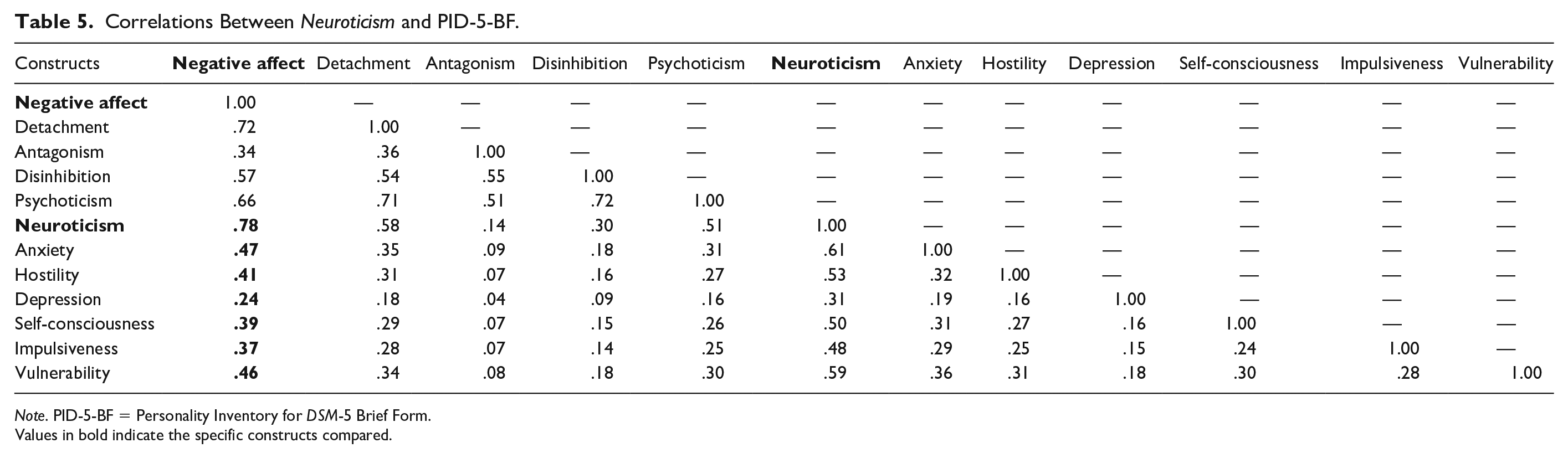
Note. PID-5-BF = Personality Inventory for DSM-5 Brief Form.
Values in bold indicate the specific constructs compared.
Correlations Between Extraversion and PID-5-BF.

Note. PID-5-BF = Personality Inventory for DSM-5 Brief Form.
Values in bold indicate the specific constructs compared.
Correlations Between Openness and PID-5-BF.

Note. PID-5-BF = Personality Inventory for DSM-5 Brief Form.
Values in bold indicate the specific constructs compared.
Correlations Between Agreeableness and PID-5-BF.
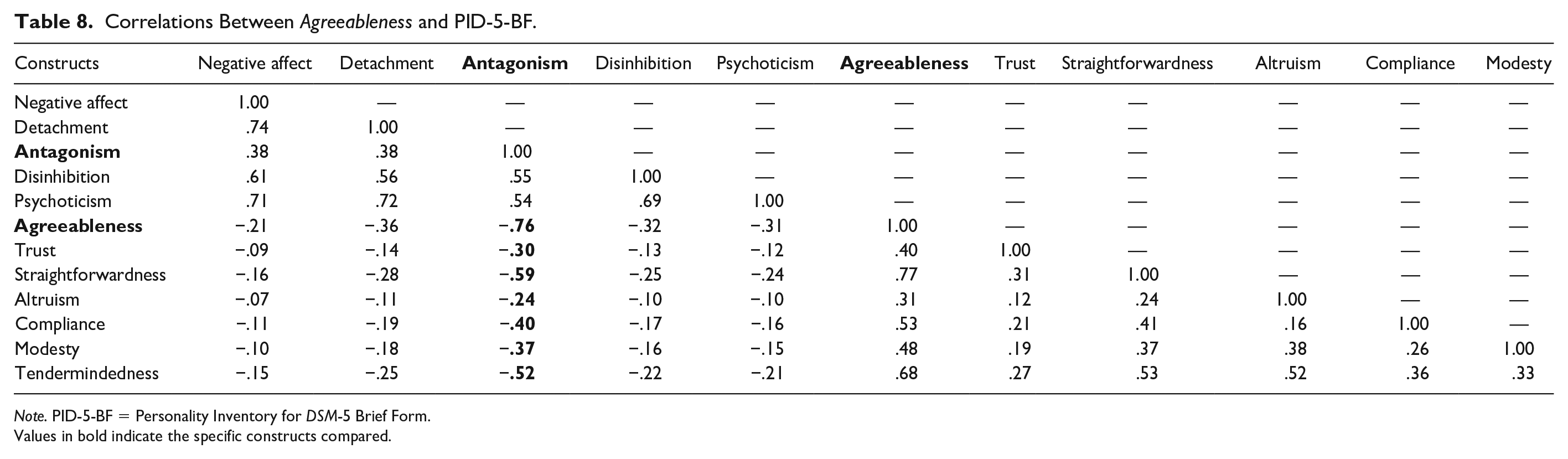
Note. PID-5-BF = Personality Inventory for DSM-5 Brief Form.
Values in bold indicate the specific constructs compared.
Correlations Between Conscientiousness and PID-5-BF.

Note. PID-5-BF = Personality Inventory for DSM-5 Brief Form.
Values in bold indicate the specific constructs compared.
Correlations Between MINI Subscale K and PID-5-BF.

Note. PID-5-BF = Personality Inventory for DSM-5 Brief Form; MINI = Mini International Neuropsychiatric Interview.
Values in bold indicate the specific constructs compared.
Footnotes
Declaration of Conflicting Interests
The author(s) declared no potential conflicts of interest with respect to the research, authorship, and/or publication of this article.
Funding
The author(s) received no financial support for the research, authorship, and/or publication of this article.
