




Abstract
Given the accelerated pace of traditional Chinese medicine (TCM) translation studies and their increasing popularity in China, it is necessary to make a comprehensive review. This study explores the recent development and hotspots on TCM translation studies, based on research articles published between 1992 and 2020 in key journals in China National Knowledge Infrastructure database, and it employs bibliometric methods to analyze the status quo, hotspots, and future trends of TCM translation studies. The study identifies the main researchers, their affiliations, and frequently cited papers and examined them from the perspective of keywords and burst terms. We find that TCM translation studies are rapidly increasing, topics and fields are increasingly covered, and cultural elements and their significance are increasingly considered. More perspectives and topics should remain to be considered. Thus, the TCM-related corpus should be expanded to enable in-depth studies. Further, more studies should be conducted on the training of TCM translators and interpreters.
Introduction
Widely considered the treasure of Chinese civilization, traditional Chinese medicine (TCM) is an important part of China’s impressive national culture and cultural diffusion. TCM translation has achieved remarkable feats, such as the publication of four classic works—“Inner Canon of the Yellow Emperor,”“Nan Jing,”“Sheng Nong’s Herbal Classic,” and “Shang Han Za Bing Lun”—and the issue of the first English translation of TCM keywords in Shanghai in 2018. TCM translation studies have been conducted in succession, from which many influential results have emerged. From a research perspective, extensive research has been devoted to exploring the translation of TCM terms, such as the principles and strategies of the English translation of terms to standardize the translation more (Dou et al., 2020; X. Li, 2019; X. Wang & Fang, 2019; Q. Wang et al., 2019; Ye, 2019). At the same time, numerous papers have explored the translation of TCM classics while mainly focusing on the application of a particular theory to the translation of TCM classics at a macro level (Y. Wang & He, 2020), such as cultural schemata (e.g., Jiang, 2010) and communicative translation (e.g., Qu, 2019). Furthermore, they have conducted a more of a microscopic exploration of the translation of words, phrases and sentences in TCM classics. (Y. Wang & He, 2020), such as the study of Inner Canon of the Yellow Emperor (L. Wang, 2016; X. Zhang & Shi, 2008; Y. Zhang et al., 2016).
However, these studies have garnered little attention from the TCM and translation circles, and the achievements of TCM translation studies remain underappreciated in academic circles. Traditional Chinese medicine is the essence of Chinese culture, the key to unlocking the treasures of Chinese civilization, and the foundation and prerequisite for globalization. Although the academic circle has actively studied TCM translation, this is, not commensurate with the importance of Chinese medicine. Further, these studies mostly focus on the investigation and analysis of specific problems and fail to summarize the research progress and shortcomings. While some scholars have attempted to address the situation in the first 9 years of this century, the investigation period is inadequate to reflect the initial stages and latest progress in this field.
With the increasingly frequent cultural exchanges among countries and the continuous improvement of China’s international influence, spreading the Chinese native culture abroad has become a general trend. Under the background of the “going out” of TCM culture, TCM translation activities have caused increasing research problems. Few professors or scholars abroad have analyzed the translation of TCM, however, they wrote books and compiled dictionaries (Shen, 2020). Nigel Wiseman developed A Practical Dictionary of Chinese Medicine (Nigel & Feng, 2003). Zi (2021) mentioned 11 papers written by authors from overseas institutions such as those in the United States, Singapore and Australia on the overseas dissemination and translation of TCM overseas between 2009 and 2018. Although the international community has not paid much attention to the translation and research of TCM, medicine is a common demand from mankind, and TCM is more easily accepted by people in different cultural environments because of its unique practical and scientific value (Yu, 2018). Consequently, it is necessary for the international dissemination and exploration of TCM translation research.
Therefore, a more comprehensive review of TCM translation studies in China is necessary, given the accelerated pace of such studies and their increasing popularity. This study selects the TCM translation studies in the China National Knowledge Infrastructure (CNKI) database; summarizes those conducted in China since the 1990s; analyzes their achievements and status quo; and explores their hotspots, major issues, and trends to provide empirical data support for foreign counterparts to study TCM translation.
Literature Review
Understanding the existing literature and identifying the prospective areas for future research on a specific research topic is of prime importance to researchers (Naikl & Reddy, 2021). In China, some scholars have already conducted systematic research on TCM translation. W. Zhu et al. (2020) reviewed research papers on TCM translation in six core journals. They reviewed 326 TCM translation research papers and concluded that the research object of TCM translation needed to be expanded. However, this paper only analyzed the research results of TCM translation by combining the publishing units, publishing journals, research contents and research objects of the six core journals, and the scope of the core journals was limited. Fang et al. (2020) explored the development and research hotspots in the field of TCM English translation in China from 2014 to 2018, and concluded that the theoretical framework of TCM English translation should be further improved. In this paper, 649 research papers on TCM English translation were collected, including more papers published in non-core journals with different publication levels and a short collection time range. Gu (2020) visually analyzed nearly 349 papers published in the CNKI database from 1999 to 2018, showing the current status, characteristics and tortuous development of TCM translation research in recent years. Meanwhile, he pointed out that multi-directional cooperation between researchers and research institutions should be vigorously promoted. The statistical papers reviewed in research included those in both general journals and core journals. The number of journal publications, author cooperation, research institutions and keywords were analyzed, however, the future research trend was not analyzed in combination with mutation terms. Using the bibliometrics method and CNKI as the data source, Yan and Li (2016) searched all the papers published from 2004 to 2013 on the English translation of TCM, analyzed the number of papers, years, authors, and topic of the literature; and concluded that the English translation of TCM has gradually become a popular topic for publication in academic journals. However, the topic needs to be deepened and expanded further, and the analysis of relevant elements of the papers is limited by using bibliometric methods only.
The above-mentioned studies have conducted statistical analyses of TCM translation research papers from different periods, statistical sources and statistical methods. However, very few studies have simultaneously used bibliometrics and CiteSpace visual analysis software for statistical analysis of TCM translation research papers published in core journals in the past 30 years. In addition, this study conducts statistical analysis on the publication trend, published journals, high-yield authors, major scientific research institutions and highly cited papers. Simultaneously, it uses CiteSpace visualization knowledge map to combine qualitative and quantitative research methods and analyze popular topics, main issues and trends of TCM translation research more clearly and visually from different perspectives. It presents a comprehensive understanding of TCM translation studies and presents empirical data support supporting TCM translation research to provide a reference for improving the quality of TCM translation studies.
Methodology
Data Sources
“Using correct retrieval methods and strategies to obtain relatively comprehensive and accurate basic data is the first step of scientific analysis” (Q. Wang, 2018). This study conducted a comprehensive search to ascertain the streams of TCM translation studies and development in China. It employed key journal databases, including CNKI, the Chinese Social Sciences Citation Index (CSSCI), and the Chinese Science Citation Database (CSCD). To ensure the richness of all data, the advanced search subject word is “TCM” combined with “Translation” and “TCM” + “English Translation” separately. In total, 671 papers dating up to August 2020 were obtained, the earliest being from 1992. To ensure the scholarly nature of the research results, 198 duplications, meeting notices, and journal introductions were eliminated by manual screening. Thus, 473 effective papers were obtained. This literature review addressed the following research questions:
Research Question 1: Which analytical research methods and tools are used?
Research Question 2: What are the current situation and problems of TCM translation studies in China from January, 1992, to August, 2020?
Research Question 3: What are the hotspots and trends in TCM translation studies?
Research Question 4: How is the dilemma of TCM translation studies solved?
Analytical Method and Tool
The mapping knowledge domain concretely presents abstract information such as the overall distribution, laws and evolution of scientific research in the form of a visual map, thus providing a clearer understanding of the development trends and cutting-edge popular issues in the research field (Zhao, 2020). The research methodology has been applied to a variety of fields such as management (Tang et al., 2021), education (M. Pan, 2021), and biomedicine (Qin et al., 2020).
CiteSpace is a data operation and processing system based on the Java language development environment. Through Pathfinder and other functions, CiteSpace “explores the critical path and knowledge inflection point of the evolution of the subject domain, and analyzes the potential dynamic mechanism of the evolution of the subject and the exploration of the subject development frontier through a series of visualization maps” (Chen et al., 2015). In this study, the parameters in the CiteSpace setting interface are set as follows: The Timespan is 1992 to 2020, and Years per Slice are set to 1 year; that is, every year is a time partition. Term Source is title, keywords and abstract. Term type selects noun phrases and burst terms. Node types include author, institution, and keyword, among others, according to the need to generate the knowledge graph. Top N selects the Top 5 or 10, that is, the top 5 or 10 nodes with high frequency in each time zone. Visualization chooses the Cluster View-Static view.
This study mapped high-frequency keywords and burst terms via the CiteSpace visualization analysis software to explore the status, development line, focus, and tendency of these studies through quantitative and qualitative analyses. The study also employs the bibliometric method, which is a critical tool for conducting longitudinal reviews of given research fields. The bibliometric method is the quantitative analysis and identification of the characteristics of research literature output as reflected in the literature dataset through different metrics (number of papers, chronological distribution, and highly cited papers) to review the current state of research field development objectively, Thus, it enhances the scientific validity and accuracy of the research results and broaden the researcher’s perspective. The bibliometric method is used to map the variation diagram of published TCM translation studies, published journals, and statistical charts of highly cited papers via Excel to provide a reference for later research in the field.
Statistical Results and Analysis of Data
Publication Trend of TCM Translation Research Papers
The statistics of the sampled papers published in China from 1992 to 2020 (Figure 1) demonstrates a rising trend. Figure 1 shows a small peak in 2002 (19 papers) and subsequent alternations of falls and rises. Furthermore, 82% of these TCM translation papers were published after 2002, especially within the 2012 to 2020 period. The number of published papers accounts for nearly 55% of the total number in 29 years, which is 1.21 times the number of papers each year compared to the first 20 years. Thus, TCM translation studies are being conducted extensively. With the deepening of globalization and strengthening of cultural confidence, TCM is striding into the international arena. Hence, TCM translation studies are bound to set off a new burst of academic activities.
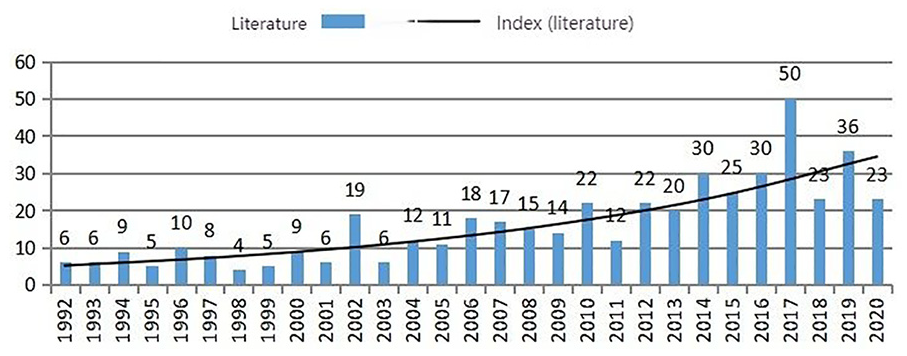
The quantity trend chart of published research papers on TCM translation in China.
Journals of TCM Translation Studies
Analyzing academic journals is conducive to grasping the focus of the journals and the dynamics of the subject’s development. Using bibliometrics, this study finds that 61 key journals in the CNKI database have published TCM translation papers. Table 1 presents the journals with more than four published articles on TCM translation.
Journals With More Than Four Published TCM Translation Papers in China.

Table 1 shows that TCM translation studies are mainly published in key medical, foreign language, and university TCM journals. Among the 473 papers, the Chinese Journal of Integrated Traditional Chinese and Western Medicine published 156 (32.98%) and the Chinese Journal of Basic Medicine in Traditional Chinese Medicine published 77 (16.28%). However, TCM translation papers in the Chinese Science and Technology Translators Journal, Chinese Translators Journal, and Shanghai Journal of Translators are only 24, 21, and 11, respectively, indicating that Chinese medicine translation studies are far less popular than mainstream translation studies. Moreover, compared to traditional translation studies, Chinese medicine translation studies still need further development (W. Zhu et al., 2020). As studies on Chinese culture and on foreign translations of Chinese literature and TCM classics are increasingly popular, it is slightly surprising that the study of TCM translations has not received much attention in foreign language and translation circles. Foreign languages and translation circles should strengthen TCM translation studies and employ relevant knowledge, theories, and new perspectives to help TCM reach a global audience and enrich the translation content of the Chinese cultural system.
Prolific Authors of TCM Translation Studies
The development and evolution of the discipline cannot be separated from the researchers in the field. Statistical analysis of the main publishers in a field can help identify the core scholars in the field, assess their research hotspots, and predict the research direction of the field (H. Li & Chen, 2018). Table 2 presents the authors (the first author) who published more than four TCM translation papers via Excel software.
Published Papers of Prolific TCM Translation Scholars in China.

Table 2 shows that Li Yongan, Li Zhaoguo, and Lan Fengli are the top three authors in the field of TCM translation in China. Li Yongan has elaborated on some topics of TCM translation studies, such as the translation of TCM names, terms, translation theories, and translation strategies. Before the Journal of Integrative Medicine was accepted by CSCD, Li Zhaoguo has published 62 articles in this Journal; he analyzed the terminology of TCM and discussed translation standards, which greatly promoted the development of the field. Since 2000, the most influential TCM translation author is Lan Fengli, who focuses on culture and TCM translation. His descriptive study on the English translation of “Inner Canon of the Yellow Emperor” has attracted extensive attention from scholars in the field of TCM translation. Li Zhaoguo and Lan Fengli are both scholars of foreign languages and TCM; however, their work focuses on foreign languages. Their papers were mainly published in Chinese medical journals, indicating that a small number of scholars in foreign language and translation circles are active and have contributed significantly to TCM translation. However, the acceptance of TCM translation studies in foreign language journals should be boosted, and foreign language and translation circles still pay little attention to TCM translation studies.
Major Research Institutes for TCM Translation
To some extent, the more studies a research institution produces in a certain field, the stronger its scientific prowess in that field (Qiu & Fang, 2014). Scientific research institutions are among the drivers of scientific research activities. Moreover, the analysis of highly influential scientific research institutions is conducive to grasping the theoretical dynamics and development trends of the discipline (M. Li & Nong, 2016 ). Table 3 shows the institutions leading in TCM research in China.
Institutions Leading TCM Translation Research in China.

TCM universities are the core institutions of TCM translation studies. Five notable TCM universities (Nanjing University of Chinese Medicine, Henan University of Chinese Medicine, Shaanxi University of Chinese Medicine, Shanghai University of Traditional Chinese Medicine, and Beijing University of Chinese Medicine) all published more than 20 papers, approximately 37.21%, of which the Nanjing University of Chinese Medicine is the most active. It studied the “Inner Canon of the Yellow Emperor,” TCM metaphors, TCM classics, TCM symptoms, and acupuncture terms to contribute significantly to the spread of TCM. Again, even though foreign language experts from TCM-related institutions remain the main driver of TCM translation research, TCM translation has received little attention.
Highly Cited TCM Translation Studies
Highly cited studies are those cited more frequently than others in a certain statistical period, because citation frequency “reflects the contribution and impact of a paper to the development of a discipline. The research of highly cited authors also reflects and forms the core of research in a discipline” (Shan et al., 2017) and represents the research progress in the discipline (Q. Zhu & Leng, 2014). Table 4 presents the papers with a high citation frequency ranking among the top 9 in TCM translation studies. To an extent, Table 4 also shows the hotspots of TCM translation studies.
Highly Cited TCM Translation Studies in China.

Notably, these highly cited studies mainly address the English translation of TCM terms, “Inner Canon of the Yellow Emperor,” TCM classics, and translation strategies and principles. Among such papers, “On the Concept, Principle and Method of International Standardization of TCM Terminology Translation” has been cited the most (119 times), indicating that TCM translation researchers pay more attention to TCM terminology. According to the publication time and citation frequency, the translation of TCM classics, especially the English translation of “Inner Canon of the Yellow Emperor,” has gradually become a new hotspot in TCM translation.
Hotspots and Trends in TCM Translation Studies
Research Hotspots Mining
Keywords represent the essence of an article. High-frequency keywords repeatedly appear in studies in a certain field. High-frequency keywords are analyzed to explore research hotspots and capture development trends (F. Wang & Chen, 2017). Via the automatic cluster analysis function of CiteSpace, this study clusters the keywords of TCM translation studies (Figure 2).

Knowledge graph of keywords in TCM translation studies in China.
Figure 2 has 462 nodes and 718 lines. The nodes represent keywords: the larger the nodes, the higher the frequency. The lines represent the co-occurrence relationships among keywords—the thicker the lines, the more likely they co-exist in a document (J. Zhang, 2016). The nodes of “English translation,”“translation,”“TCM,”“TCM terminology,”“TCM English translation,”“terminology,”“translation strategies,” and TCM classics are relatively large, especially the “English translation” node. To an extent, these high-frequency keywords represent the hotspots in the field of TCM translation from 1992 to 2020.
Apart from common words such as “English translation,”“translation,” and “TCM,” high-frequency keywords with the same meaning in TCM translation studies can be divided into three categories: terminology of Chinese medicine, terms, and TCM terms; translation strategy, translation method, and Chinese Pinyin; and TCM classics, “Inner Canon of the Yellow Emperor,” and culture-loaded words.
Terminology of Chinese Medicine, Terms, and TCM Terms
Terminology of Chinese Medicine, terms, and TCM terms should belong to the same category; however, the research emphasis is different. Terminology of Chinese Medicine focuses on TCM theory, and standardized TCM terminology translation is conducive to further developing TCM internationalization (Z. Li, 2008). According to the literature, translation studies under “Terminology of Chinese Medicine, terms, and TCM terms” have been increasing. Many scholars, such as Li Zhaoguo, Zhang Dengfeng, Liu Fagong, Lan Fengli, and Zhang Qingrong, have conducted in-depth discussions. Terminology translation plays an important role and is a hotspot in TCM translation.
Translation Strategy, Translation Method, and Pinyin
Chinese classical philosophy is the theoretical basis for the extensive and profound TCM culture. As TCM papers comprise simple and classical words, a concise style, good use of classical Chinese, and connected meaning and implicit logic relations, few understand them without further explanation. Thus, translations should focus more on the cultural differences between the source language and the target language and the difference in language characteristics and text structure. Many TCM translation studies have examined TCM translation strategies and translation methods. According to the cultural schemata, Jiang (2010) proposes the strategy of “foreignization oriented and domestication complemented” for TCM translation (Jiang, 2010). Regarding international communication, Ge Xiaoqin noted that TCM translation should adhere to the “prototype translation method,” centered on the original text, and the “marginal translation method,” based on the target language and its culture, to promote the dissemination and output of TCM culture and reach new audiences(Ge, 2009).
TCM Classics, “Inner Canon of the Yellow Emperor,” and Culture-Loaded Words
Classic books and records of TCM contain many theoretical works. “Inner Canon of the Yellow Emperor,” as the first classic work of TCM, is vital in the field. Language reflects national history and culture, and certain elements and concepts are culture-loaded words. They are also important as well as difficult points in TCM translation works. TCM translation studies show that translation principles and strategies of TCM are expounded in many studies on TCM classics, “Inner Canon of the Yellow Emperor,” and culture-loaded words.
Research Trend Analysis
Abrupt terms suddenly appear or are used more frequently in a certain period and their dynamic change characteristics accurately reflects the research frontier of a certain discipline (H. Li, 2014). Given the research frontier, researchers can explore and analyze the development trend of the field and predict its development direction. Based on the mutation detection function of CiteSpace, this study generates the schematic diagram of the mutation of keywords in TCM translation studies (Figure 3). The red block is the burst node; thus, many studies are related to the corresponding topic in this stage. The closer to the current day start time of the keyword burst, the greater its novelty.
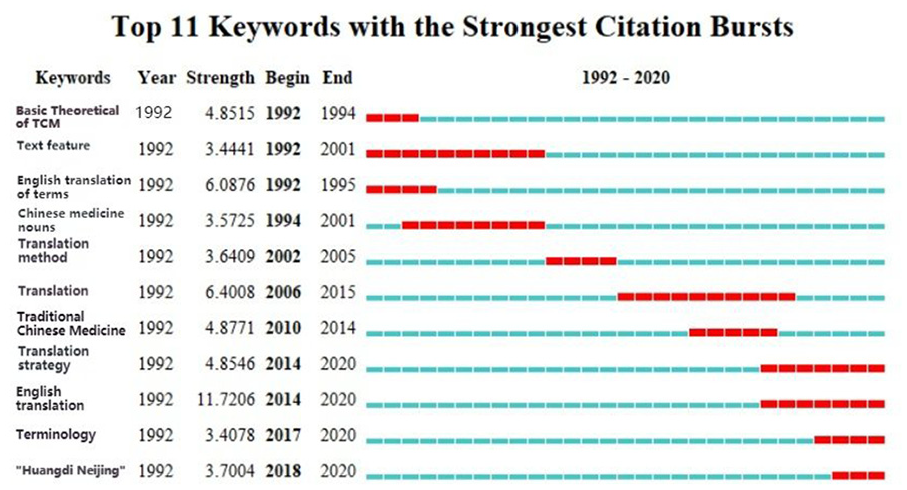
Knowledge domain of mutants in TCM translation studies in China.
Figure 3 shows the chronological order and span of the emergence of the 11 strongest words. From 1992 to 2020, the frontiers of TCM translation studies were constantly changing. In 2006, the mutation value of “noun term” was 6.4008. From 2014 to 2020, “translation strategies” and “English translation” were in a constant state of mutation, with a mutation value of 11.7206 for “English translation.” In 2018, the “Inner Canon of the Yellow Emperor” mutated, and many studies on “TCM classics” and “Inner Canon of the Yellow Emperor” were published.
English Translation of TCM: Chinese medicine classics have been mutating since 2014. In the literature searchable on the CNKI database, 61 studies on Chinese medicine classics have been published from 2010 to the end of August 2020, becoming a hotspot in Chinese medicine research. The studies involve the disease names, book titles, culture-loaded words and nomenclature in Chinese medical texts, and analyses the rhetoric, translations, metaphors and cultural factors of Chinese medical texts in the light of theories such as ecological translation science, acceptance theory, adaptive selection theory and functional reciprocity, etc. The translation strategies, translation principles and translation methods of Chinese medical texts are also discussed.
“Inner Canon of the Yellow Emperor”: As the foundation work of TCM theory (H. Pan et al., 2022) and the must-read classic book of TCM science, “Inner Canon of the Yellow Emperor” is crucial in TCM development. From 2018 to August 2020, 30 papers were published, with nearly 10 papers published every year, and the Inner Canon of the Yellow Emperor has become a popular research topic at present. Moreover, related translation studies offer novel perspectives with more detailed content and studied paratexts; corpus; translator-centeredness; and figures of speech including metaphors, couplets, and intertextuality among others (Cheng & Wang, 2020). They apply interpretative translations of cultural words, such as “green,”“red,” and “five gods” in “Inner Canon of the Yellow Emperor,” to strengthen the content and expand the scope of TCM translation studies.
Research Summary
TCM translation studies have made good achievements, given the obvious development trend. First, owing to the wider research field and increasing research depth, increasing attention has been paid to TCM translation studies. The field has gradually expanded from research on translation methods and techniques of terms and the analysis of translation errors of characters, words, and sentences to the deep analysis of the connotation of TCM classics. Researchers mainly comprise English teachers from TCM colleges and universities, supplemented by their counterparts from other colleges and universities. Research institutions mainly comprise TCM colleges and universities and other colleges and universities that actively integrate TCM. The research perspectives are becoming increasingly novel and diverse (Y. Zhou & Wang, 2013). TCM research has gradually developed into the study of TCM material translation via translation theories and strategies.
Second, the study of TCM terminology translation has shifted from emphasizing translation methods to cultural connotations. TCM has a long development history and it is deeply influenced by ethnic medicine, western medicine, and humanistic philosophy. The language of traditional Chinese medicine is characterized by history, humanity, philosophy, literariness, and fuzziness. Most terms are in ancient Chinese, and the connotations of some terms are different from those in modern medicine (J. Zhu, 2006). Xie Zhufan conducted an in-depth study on the guiding principles of the standardization of TCM terminology translation, transliteration, Pinyin, and the creation of new words. He notes that Chinese scholars have the best say on interpreting TCM terminologies and on whether the translation captures the original TCM meaning (Xie, 2000). British translator Nigel Wiseman opined that TCM translation should be prioritized over cultural translation and it should adhere to the linguistics of national conditions because, as the treasure of Chinese culture, it should not be separated from the TCM culture and it should retain its characteristics. Given the imitation of Western medicine translation, TCM culture is easily ignored and fails to spread the Chinese culture abroad (Wiseman & Xu, 2004).
Third, the translation of TCM classics has gradually become a research hotspot. In recent years, translation researchers have been devoted to the translation of TCM classics. Numerous research papers on TCM classics are published every year, covering a wide range of research perspectives. In addition to traditional research fields such as terminology, culture-loaded words and translation strategies, the translation of TCM classics into English is also studied from the perspectives of linguistics, corpus and machine translation. Since 2002, nearly 84 articles have been published in key journals of in the CNKI database on the translation study of “Inner Canon of the Yellow Emperor.”
Discussion and Conclusion
Along with recognizing the achievements, we should also address the problems in TCM translation research, such as the lack of attention by foreign language and translation circles. Most studies on the English translation of TCM terms are limited to the analysis and discussion of specific translation examples, and innovative and relevant theoretical studies are lacking (E. Zhou & Su, 2022). Thus, future studies should consider the following aspects to improve the research in this field further.
First, future studies must broaden the perspective and field of TCM translation studies. Research on linguistics theory should be strengthened, especially studies that employ pragmatics theory. Given the rich cultural connotations of TCM language, it is impossible to convey the connotation of the language itself by merely expressing the static meaning of its components and symbol units. However, the actual TCM context must be considered. Further, regarding translation services communication, TCM translation should focus more on pragmatic implications and pragmatic cross-cultural differences. Currently, however, the key journals in the CNKI database only include two research papers on TCM translation from the perspective of pragmatics: “On TCM Translation from the Perspective of ‘Formal Pragmatics’” by Deng Haijing and Luo Haiyan and “A Pragmatic Study of Equivalent Translation of Chinese Medicine in English” by Guo Xianying. Additionally, the research scope of TCM classics should be expanded. “Inner Canon of the Yellow Emperor” is worthy of attention, but too many scholars have flocked to study it, which is not conducive to the translation and dissemination of other TCM classics. Currently, it is necessary to strengthen the English translation of such TCM classics as “Shang Han Za Bing Lun,”“Shennong’s Herbal,”“Synopsis of the Golden Chamber,” and “Prescription Worth a Thousand Pieces of Gold.”
Second, TCM translation corpus construction and research must be strengthened. Given the rapid development of information technology, the integration of translation and technology is increasingly becoming interdependent, and corpus research, which is closely related to the rapid development of computers, has progressed significantly. Corpus translation research is among the research frontiers capturing the attention of international translation scholars (H. Li, 2014). However, only some scholars in China have applied the corpus for TCM translation studies. For instance, He Nana published “Corpus-based study on the translation of disease terms of the brain system in Huangdi Neijing,” and Zhu Jianfei published “Corpus-based translation studies on Yellow Emperor’s Canon of Medicine.” Nevertheless, the corpus applied in TCM translation should be further improved. Despite a strong philosophical overtone, the TCM literature remains largely scientific in nature and has an obvious stylistic style, which makes it ideal for corpus analysis. As corpus research in foreign language and translation circles is more in-depth than that in Chinese medicine circles, it can serve as a breakthrough point for foreign language and translation experts to study the TCM translation.
Third, further studies are needed to strengthen the research on the training of TCM translation talents. With the deepening of the Belt and Road Initiative, TCM international exchanges are getting increasingly closer. Currently, TCM translation talents are limited. However, this problem has not attracted the attention of TCM translation scholars. Among the TCM translation papers reviewed in this study, only five discussed the cultivation of talents, mainly focusing on the professional competence of talents and the training mode of medical translators. Other aspects of TCM translation talent cultivation are barely discussed. Thus, future studies should actively explore mature TCM translation talents and discuss the characteristics and requirements of their training in curriculum setting, teaching content, and textbook compilation.
Although bibliometrics research seems to have been prevalent in recent years, it remains necessary to make such a compendium of TCM translation research. Despite achieving encouraging results, research in this field has received far less attention than it deserves. It is necessary for TCM and foreign language and translation circles to understand existing TCM translation studies comprehensively and thus improve the quality of TCM translation, globalize the TCM culture, or improve the translation research system. The superficial attempt in this study at least illustrates the entire picture of TCM translation studies via periodical papers.
Footnotes
Author Contributions
JXC designed/performed most of the research and data analysis. FW contributed to interpretation and analyses of the data and wrote the manuscript. All authors have read and approved the manuscript.
Declaration of Conflicting Interests
The author(s) declared no potential conflicts of interest with respect to the research, authorship, and/or publication of this article.
Funding
The author(s) disclosed receipt of the following financial support for the research, authorship, and/or publication of this article: This work was funded by the Anhui Vocational Adult Education Association (Azcj050),(azcg197); Key Project of Humanities and Social Sciences Research of Anhui Department of Education (SK2020A0779); and School-level Internal Construction Key Project (2020bzjyxm02).
