




Abstract
Can we measure child labor? It may sound simple and a classic question to ask, but scholarly discourse continues to raise doubts about how best to measure it accurately, at what level of measurement, and how to differentiate between child labor and a range of almost similar terms such as children assisting parents and working children. In this article, as part of our long-term research project in oil palm production in Sabah (Malaysia), we attempt to measure child labor focusing on four domains, (i) children’s involvement in oil palm activities; (ii) time spent in performing such activities; (iii) types of activities; and (iv) time spent on the learning and undertaking recreational activities. To better understand their involvement in oil palm activities, further analysis is undertaken from four social lenses: gender, age, identity, and education. Our overall findings indicate that while there is a clear conceptual difference and practice between children assisting parents and working children, it is challenging to distinguish between working children and child labor. Instead, most of our child respondents categorized as working children fall within the broader definition of child labor. Given the complex interplay between local contexts and root causes that create conditions of child labor, this article highlights the urgency to refresh scholarly discourse and the way we understand and measure child labor.
Introduction
In 2020, the International Labour Organization, together with the United Nations Children’s Fund (ILO-UNICEF, 2020) estimated that about 160 million children globally were engaged in child labor. One in every three of them was found in Asia and the Pacific region, and nearly 70% of them were working in the agricultural sector, including in large oil palm plantations and smallholder farmers in the region. Child labor is defined as work that deprives children of their childhood, their potential and dignity, and that is harmful to physical and mental development (International Labour Organization [ILO], n.d.-a). Children in child labor are often ignored, invisible, and exposed to a range of other forms of labor exploitation (Pare & Chong, 2017; Pasaribu & Vanclay, 2021). Child labor constitutes a severe violation of children’s rights which can result in extreme bodily and mental harm, and even death (United Nations Children’s Fund [UNICEF], n.d.). In some extreme situations, children are enslaved, separated from their families, and exposed to serious hazards and illness—all of which constitute the worst forms of child labor (ILO, n.d.-b).
Globally, poverty remains a critical driver for child labor, but also connected with a range of other factors such as the lack of decent work opportunities, conflicts, and displacement (ECLT Foundation, n.d.). In countries such as Ghana and Cambodia, studies found that child labor was higher in rural and remote places that experienced agricultural-related shocks, crop failure and floods (Guarcello, et al., 2010), highlighting that child labor also intersects with environmental disasters and climate change.
The lack of access to adequate and quality education is another critical driver and consequence of child labor. ILO and UNICEF (2020) highlighted that nearly half of the children in child labor were reported not enrolling in any form of education. Evidence shows that in many poorest countries such as Lao PDR and Pakistan, where access to education is possible, schools in remote or rural locations are often under-resourced, eventually leading to a high dropout rate among students (Hashim & Thorsen, 2011). In other countries such as Malaysia, while primary education has been made compulsory, it excludes non-citizen children, including children of migrant workers and refugee children (Loganathan et al., 2021). Where non-citizens children are unable to access education, they are at risk of working at a young age, while others are vulnerable to syndicate-organized begging activities (U.S. Department of State, 2021).
Evidently, drivers of child labor are complex and multifaceted. Not only that child labor often occurs covertly, but it also intersects with other forms of exploitation, slavery, and human trafficking. This necessitates a robust method to identify, estimate and subsequently undertake necessary measures to address it. Realizing the complexity to identify and address child labor, in 2019, the ILO published a standard methodology to estimate child labor (ILO, 2019). While this methodology, which relies heavily on macro-level and administrative data can help produce child labor estimates, they vary and fluctuate considerably across countries (see Berlan, 2013; Lerche, 2007; Wahab & Dollah, 2022). Additionally, there are persistent conceptual and practical challenges to distinguish child labor from a range of almost similar concepts such as “working children,”“children assisting parents,” and “children performing household chores” (Berlan, 2013; Wahab & Dollah, 2022; White, 1996).
Against this backdrop, the primary research inquiry raised in this study is: can we measure child labor? This is followed by the secondary inquiry: if we can measure child labor, how best we can measure it? Here, we assert that while measuring child labor is important, it must reflect the broader contexts that create conditions of child labor. This cannot be achieved without having appropriate domains and the need to measure it at the individual level. Relying on macro-level data such as population census and other national administrative data (e.g., labor force survey) is likely to disregard local contexts, norms, and demographic characteristics associated with children’s involvement in economic activities.
Following the two research inquiries and initial observations discussed above, we attempt to measure child labor at the individual level from four domains. These four domains are formulated based on a review of existing literature, which is presented in the next section on “Existing Literature on Child Labour.” Briefly, we first identify the children’s involvement in oil palm activities. Second, we measure the time spent performing such activities. Third, we assess the different types of activities they undertake. And finally, we measure the time spent by children in learning and recreational activities. To better reflect the social lenses of their involvement in oil pam activities, we consider a range of demographic characteristics such as gender, age, identity, and access to education.
Empirical data used in this study derives from the exploratory application of the time-use-survey, involving 43 child respondents, and semi-structured interviews with 12 of them, conducted from 21 January 2019 to 23 January 2020, in several villages of Lahad Datu, Sabah (Malaysia). For the record, some of these data, particularly the qualitative transcripts from the interviews were previously used in our recently published article (see Wahab & Dollah, 2022). In our recent article published in 2022, we focused on explaining the conceptual interplay between child labor and unfree labor, by highlighting children’s perceptions and voices about the risks and hazards they faced, and the risk of child labor for working children who were in employment transition from oil palm production to the fishing sector. In the present article, we focus on highlighting the time-use-survey data with the aim to measure the incidence of child labor, as discussed above. To further delve into the local contexts and conditions the children face, this present article also leverages some qualitative transcripts from the semi-structured interviews.
Why Children in Oil Palm, and Why Sabah (Malaysia)?
One may ask why focusing on children in oil palm production in Sabah, Malaysia. Generally, oil palm is an important agricultural product, contributing to Malaysia’s annual export revenue between RM60 billion (US$15 billion) and RM70 billion (US$17.5 billion) (Szulczyk, 2013; Wahab, 2019). Malaysia is the second largest producer of oil palm (after Indonesia), and a global major exporter (May, 2012; Wahab, 2019). Given the nature of oil palm activities and limited technological advancement, the palm oil sector in Malaysia has remained labor-intensive, hiring a half million workers—the majority of which are migrant workers (Azman, 2013; Ramli et al., 2011; Wahab, 2019).
Sabah is the second-largest palm oil-producing state in Malaysia (Wahab & Dollah, 2022). Existing studies indicate tens of thousands of Indonesian, Filipino and stateless children working informally and/or assisting their parents in undertaking oil palm-related activities (Abdul Aziz & Iskandar, 2017; Earthworm Foundation, 2019; Wahab, 2019). Though there is no official estimate produced by the state, the Government of Indonesia estimates that at least 60,000 Indonesian children are living around plantation areas across Sabah (Earthworm Foundation, 2019; UNICEF, 2015). However, there is no available reference to estimate the number of Filipino children.
Unlike Peninsular Malaysia (or West Malaysia), Sabah is unique given the fact that international migrant workers, mostly Indonesian and Filipino workers, are legally allowed to bring their family members under a special permit for dependents, including spouse and children, and to live together with them (Puder, 2019). However, ineffective implementation of the regulatory framework (e.g., complicated administrative procedure and involvement of third parties for special permit renewal), coupled with common irregular migration from Indonesia and the Philippines into Sabah—causes some migrant workers and their children to become “irregular workers and dependents.” Besides, the long and complex migration history of many Indonesians and Filipinos into Sabah (Puder, 2019; Wahab, 2020) contributes to children lacking identity documents and the risk of becoming stateless children.
Generally, Malaysia has ratified several ILO conventions which are of particular relevance in combating child labor. These include Malaysia’s ratification of the ILO Minimum Age Convention (C.138), Worst Forms of Child Labour Convention (C.182), and Forced Labour Convention (C.29). In addition to that, Malaysia is also a state party to the Convention on the Rights of the Child (CRC) since 1995, which among others, further strengthens Malaysia’s commitment to protecting children from any forms of economic exploitation and activities that are likely to be hazardous or interfere with the child’s education and health. Despite this commitment, the national regulations, including the state legislation (i.e., Sabah Labour Ordinance) allow the employment of children according to their age groups, with certain conditions related to the type of occupation, number of working days, and hours of work they can be engaged. Though this flexibility is reasonably acceptable and standard practice in many developing countries, none of these regulations recognizes the term child labor. This contributes to a lack of awareness and confusion on the actual meaning of child labor.
What Is Known Thus Far?
There are existing academic research and public reports exposing children’s participation in various economic activities and sectors in Malaysia (see Abdul Aziz & Iskandar, 2017; Dzurizah & Jalihah, 2014; Earthworm Foundation, 2019; Fair Labor Association, 2018; Janzen, 2018; Puder, 2019; Rainforest Action Network [RAN], 2010; Solidar, 2019; Wahab, 2022). Early research by scholars such as Jomo (1992) argued that the employment of children had already existed in the 1990s, occurring in both urban and rural areas, affecting various economic sectors including agriculture.
In Sabah specifically, there has been a growing literature studying the employment of children and/or child labor. In Sabah specifically, these studies explained the intersection between child labor, household poverty and geographical remoteness (see Abdul Aziz & Iskandar, 2017; Dzurizah & Jalihah, 2014; Pye et al., 2012; World Vision, 2012); children working in long hours, less pay and barriers to education (see Ibrahim & Shah, 2014); and children affected by cross-border migration, irregularity, and lack of documentation (see Earthworm Foundation, 2019; Ibrahim & Shah, 2014; Ismail, 2008; Puder, 2019; Wahab & Dollah, 2022).
A study conducted by Abdul Aziz and Iskandar (2017), for instance, found that immigrant children from poor families in Sabah are commonly employed in various agricultural farms, including in palm oil estates. Another piece of literature written by Ibrahim and Shah (2014) found that it is common for many children of the local population and immigrant children to assist their parents in agriculture and fishing, while other children are involved in informal economies such as selling plastic bags, fish and vegetables, porter and selling cigarettes mainly in urban and peri-urban settings.
Apart from academic literature, there has also been an increasing number of public reports released by non-governmental organizations (NGOs), indicating child labor situations in Sabah. For example, in 2012, the World Vision (2012) reported the involvement of immigrant children in oil palm activities, hired by palm oil companies for very little pay. Another report published by the RAN (2010) revealed that children in oil palm estates were not given appropriate protective masks while working, and hence heavily exposed to toxic chemicals.
While the involvement of children in oil palm production is a concern, the existing academic research and public reports do not provide a comprehensive account of their involvement, including the exact nature of children’s involvement in oil palm production. There has also been an inconsistent use of different terms (e.g., working children, children undertaking hazardous work, children assisting parents, etc.) and potential confusion between different segments of children that exist in Sabah (e.g., stateless children, undocumented local and undocumented migrant children).
Existing Literature on Child Labor
Debating child labor is challenging as it involves a range of historical, social, economic, development, human rights, cultural, and parenting aspects (Adonteng-Kissi, 2021; Berlan 2013; Hamenoo et al., 2018; Kifle et al., 2005). While the existing international standards make a clear distinction between different categories of children involved in employment, directly and indirectly, as well as in formal and informal economies (see Adonteng-Kissi, 2020; Bourdillon & Myers, 2014; Carter & Roelen, 2017), the real practices and conditions of child labor are far more intricate.
This section reviews the main themes in the existing literature and international standards on child labor, with the aim to draw a potential framework to be used in this study. Based on the review of the literature and international standards, we found four main themes associated with child labor (see Figure 1). Additionally, across these literature and international standards, we found the importance of linking such themes with several demographic characteristics of children. Here we include four demographic characteristics, referred to as social lenses, namely, gender, age, identity (meaning, status of nationality), and education.
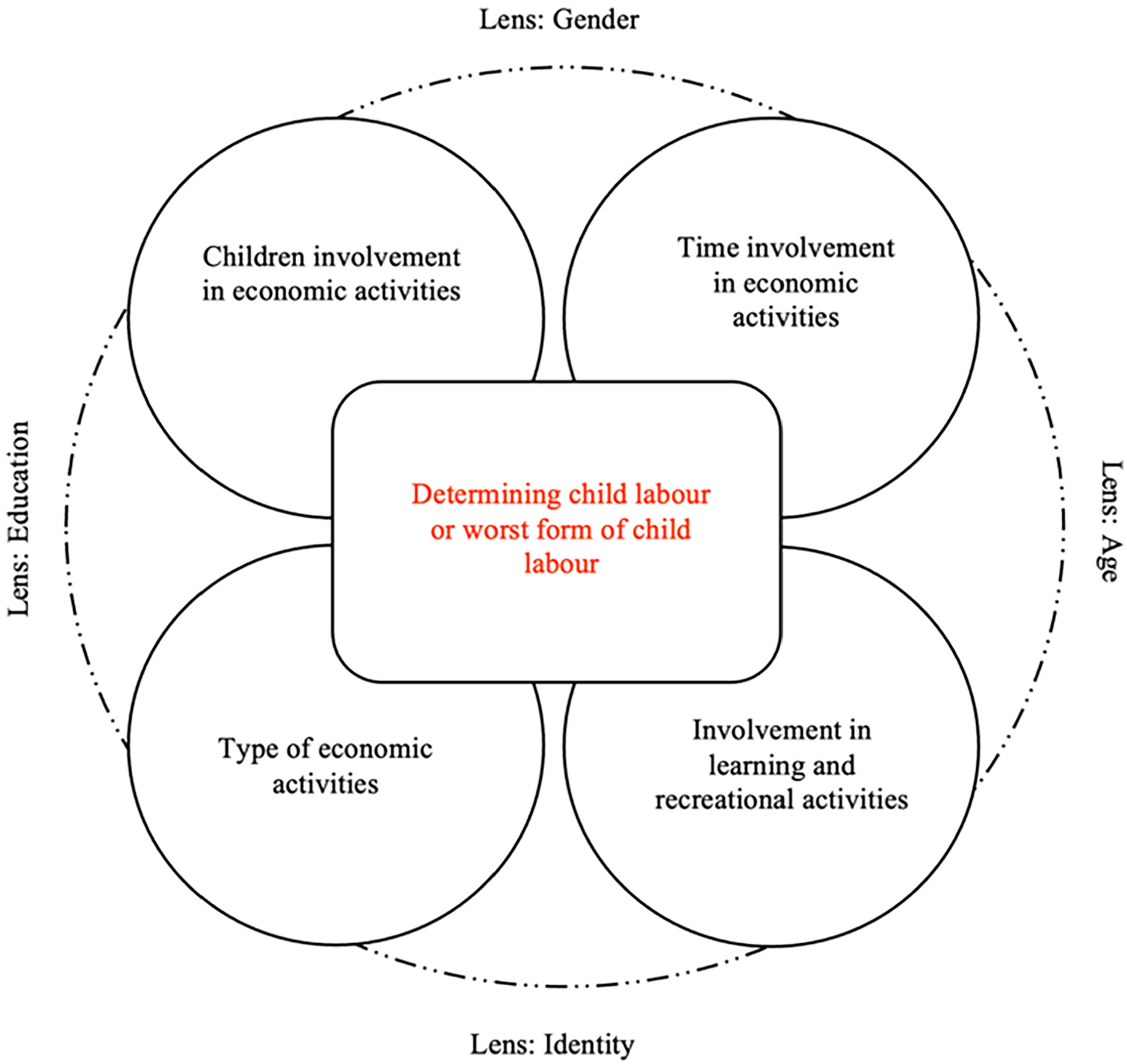
Four domains and social lenses determining child labor.
Related to the first domain (i.e., children’s involvement in economic activities), the existing literature stresses the importance of identifying, differentiating, and utilizing a range of working terms, which have direct implications for interpreting and estimating the incidence of child labor. These include working terms such as “light work,”“working children,” and “children in hazardous activities.” First, the ILO (2018) refers to light work as work that is not harmful to children, and at the same time, does not interfere with a child’s education, or her ability to benefit from education (ILO, 2018). Second, though there is no universally accepted term to refer to “working children,” in the context of the palm oil sector in Malaysia, it is referred to as children below 18 years of age, engaging in activity to produce goods or to provide services for use by others or own use. This definition includes volunteer work by children, comprising non-compulsory work performed for others without pay (Ministry of Plantation Industries and Commodities, 2018). Third, the ILO (n.d.-c) considers children in hazardous activities as children’s involvement in work which exposes children to physical, psychological, or sexual abuse; work with dangerous machinery, equipment, and tools, or which involves the manual handling or transport of heavy loads.
To identify the involvement of children in economic activities and the risk of child labor, one must be able to recognize and consider these working terms. It must be noted, however, that while these working terms are conceptually clear and useful, the reality on the ground is far more complex and multifaceted (Fors, 2008; Wahab & Dollah, 2022).
Concerning the second domain (i.e., time involvement in economic activities), child labor, especially in high-risk sectors such as manufacturing, coal and mining, construction, fishery, and agriculture—has been associated with excessive hours of work, which are harmful to children’s health and wellbeing. In these sectors, children as young as 12 years began to work long hours, up to 10 hours/day, with very little pay (Kifle et al., 2005; Ramos, 2018). The lack of access to formal education also causes children to engage in informal work, including committing to long hours of work and hazardous activities (Wahab, 2019). A study conducted in Bangladesh found that children performing long hours of work are likely to suffer from tiredness, exhaustion, backaches, and other health problems such as infection, burns, and lung diseases (Ahmed & Ray, 2014).
Related to the third domain (i.e., type of economic activities), most of the existing literature explains the close relationship between the type of occupation the children perform and the risks they face at the workplace. Kifle et al. (2005) and Ramos (2018), for instance, children performing agricultural activities are often not provided with protective equipment at work (e.g., safety boots). Children are also exposed to risks such as snake and insect bites, thorns, extreme weather conditions, lacerations, and chemicals, as well as demanding tasks such as heavy lifting and climbing. Ramos (2018) also found that children who work in tobacco farms in the United States of America, Kazakhstan and Malawi face serious health implications such as green tobacco sickness, dizziness, continuous headaches, nausea, vomiting, dehydration, anorexia, and insomnia. Children involved in informal economies (e.g., selling products on the roadside) are at risk of road accidents, skin rashes, coughs, and joint aches (Hamenoo et al., 2018).
Pertaining to the fourth domain (i.e., involvement in learning and recreational activities), existing literature stresses the interplay between the employment of children and the lack of access to education. Some children dropped out of school, and eventually get employed in various economic sectors (Emerson & Souza, 2007; Fors, 2008; Kurosaki et al., 2006; Strauss & Thomas, 1995; Tang et al., 2018). In some cases, children attend school but also work at the same time. The work hours and energy needed by their work outside the classroom can interfere with their ability to fully benefit from the learning in schools, eventually compromising their school attendance and educational performance (Emerson et al., 2017). In countries such as Pakistan, the high cost of schooling fees and long travel distances to schools serve as barriers to accessing formal learning, leading them to work at a young age (Hazarika & Bedi, 2003).
Finally, with regards to demographic characteristics of children in child labor conditions, the existing literature highlights that gender aspect plays an important role in determining which sectors of the economy and type of occupation where child labor is likely to occur. Bessell (2011), for instance, found that girls tend to work in manufacturing factories. They work to fund themselves (i.e., buying what they wish for), and eventually provides a sense of greater control over their life decision. In countries such as Pakistan, parents are reluctant to send their children, especially daughters, to schools due to concerns about girls’ mobility in public spaces, and further exacerbated by a taboo on education for girls (Hazarika & Bedi, 2003). This raises alarming risks for girls to perform both economic and non-economic activities at home or the workplace.
Migration and displacement continue to expose children to a range of economic exploitation, including child labor. By the end of 2020, about 11.8 million child refugees and 1.3 million asylum-seeking children lived outside their country of origin and were exposed to child labor (UNICEF, 2021). Other studies, for instance, Flamm (2010) highlight that unaccompanied migrant children are more likely to be involved in child labor in destination countries compared to accompanied migrant children. In India, a study conducted by Goyal (2011) found that most internal migrant child laborers in the country came from landless households from socially oppressed classes, and a large proportion originated from drought-prone areas.
Methodology
This study employed a combination of a time-use-survey and a semi-structured interview. In essence, the time-use-survey is a 24-hour diary survey approach that allows researchers to assess the time-use pattern and changes in respondents’ daily activities (Bauman et al., 2019; Wahab & Dollah, 2022). The survey approach has been widely acknowledged as among the best methods to measure unpaid work activities (e.g., informal economy) (Fleming & Spellerberg, 1999). While the use of time-use-survey has evolved exponentially in measuring informal economy and unpaid activities, no significant research was undertaken to use it in measuring child labor (Wahab & Dollah, 2022).
In this survey, we used a 24-hour diary system (or a template), with a 15-minute time block approach as the main unit of measurement. This diary system allowed children to indicate their daily activities, and the places (or locations) and time they spent performing such activities. Prior to filling up the diary template, which was done by the researchers on behalf of the children, demographic profiles of the child respondents were first gathered. Researchers took, on average, between 60 minutes and 90 minutes to complete one survey.
The survey, which was conducted from 21 January 2019 to 23 January 2020, covered a total of 43 child respondents, comprising children of temporary settlers and children of Indonesian workers. These children aged between 12 and 17 years living in several villages in Lahad Datu, Sabah. Before the survey was conducted, a few discussion sessions were held with local community groups. These discussions helped the researchers to identify the prospective child respondents.
Semi-structured interview sessions were conducted simultaneously with the survey, involving 12 children who were also respondents to the survey. The interview sessions aimed at understanding and reflecting on children’s experiences and perceptions of their involvement in oil palm activities. There was a total of 14 semi-structured questions included in the interview instrument, divided into four sections: migration history and identity, livelihood, perceptions of risks and hazards, as well as future aspirations. Each interview session took place between 45 and 60 minutes, on average.
Malaysian language (or Malay language) is the common language spoken by most children, including non-citizen children in Sabah. Given the ability of these children to understand and speak the language, all survey and interview sessions were conducted in the Malay language. To ensure that the child respondents were able to participate in the sessions freely and openly, both surveys and interviews were mostly conducted in public places such as playing fields, mosques, and nearby learning centers, without the presence of their parents and guardians. All child respondents were first informed about the purpose of the study before consenting to participate in the sessions. Child respondents were also informed that they can withdraw their participation, at any time, before and during the sessions. During the briefing, child respondents were also informed that their personal particulars, except information about their gender, age, and nationality, will not appear in any form of publication and format.
Given the exploratory utility of the time-use-survey, data gathered from this survey technic was processed using a simple Microsoft Excel template and analyzed descriptively. Two types of descriptive analysis were performed: a descriptive analysis for each individual variable, and a descriptive analysis for a combination of variables. These analyses aimed to describe the individual domains of child labor (see Figure 1), and to identify associations between such domains and social lenses (e.g., age, gender, identity, and education). As for the semi-structured interviews, we used a deductive thematic analysis technique to determine and interpret patterns of shared meaning and use them to complement descriptive data from the time-use-survey. Given the small sample size, we do not generalize the findings and analyses in this study to the larger context of children’s situations and conditions in the oil palm production in Sabah.
Findings
Children’s Involvement in Oil Palm Activities
As shown in Table 1, child respondents are grouped into three categories: (i) children who are not involved in any oil palm activities; (ii) children assisting parents; and (iii) working children. Of the total 43 respondents surveyed in this study, 13 of them are found not involved in any type of oil palm activities. About 15 other respondents are categorized as children assisting parents, and another 15 respondents (35%) are grouped as working children. In this study, we used a single measure to identify and distinguish between children assisting parents and working children—that is the average time spent by children in undertaking oil palm activities. Children that have spent less than 4 hours a day are categorized as children assisting parents, and children that have spent a minimum of 4 hours a day, are classified as working children.
Children’s Involvement in Oil Palm Activities by Social Lenses, Number of Children (Per Cent).

Source. Fieldwork in Lahad Datu, Sabah, from 21 January 2019 to 23 January 2020.
The involvement of children in oil palm activities varies according to four social lenses. From the gender lens, it is found that female children are less likely to be involved in oil palm activities as compared to male children. In contrast, more than two-thirds of the total 30 male respondents are found involved in assisting parents on-site and as working children. This finding mirrors the global overview of the gender aspect, where male children (or boys) outnumber female children (girls) in most economic sectors, including in the agricultural sector (Carter & Roelen, 2017; Wahab & Dollah, 2022). When female children are involved in agricultural activities, the type of work they do often differs from male children. For example, male children tend to use sharp tools and undertake chemical spraying (see Carter & Roelen, 2017), while female children usually undertake more lighter works such as collecting loose fruits (Dzurizah & Jalihah, 2014), and bringing meals and water to their parents (Carter & Roelen, 2017). Semi-structured interviews with several female respondents found that while some female children are expected to help parents undertake oil palm activities, they are also responsible for helping parents take care of their younger siblings at home and performing everyday household chores.
From the age perspective, the survey found that children aged 12 to 14 years are less likely to be involved in oil palm activities as compared to those aged between 15 and 17 years. In contrast, child respondents aged 15 to 17 years are largely found in the category of working children (12 out of 20 respondents), followed by children assisting parents (6 out of 20 respondents), and only two out of 20 respondents who are not involved in any oil palm activities. Other existing studies found that children tend to begin working, primarily in the agricultural sector at the age of 15 years (see Carter & Roelen, 2017; Food and Agriculture Organization & United Nations Children’s Fund, 2019; Gamlin & Hesketh, 2007; ILO-IPEC, 2008).
From the lens of identity, this study found that children of non-citizens are more likely to be involved in oil palm activities as compared to local children. This is aligned with several existing studies indicating the involvement of non-citizen children, including those without proper travel documents in oil palm activities (Earthworm Foundation, 2019; RAN, 2010; World Vision, 2012). In contrast, of the total 13 children of Malaysian citizens sampled in this study, 4 of them are found assisting parents and only 1 is categorized as a working child. The remaining eight child respondents are found not participating in any type of oil palm activities.
From the lens of education, this study found that though children enrolling in formal education are less likely to become working children, they may still assist parents in performing various oil palm activities. In this study, formal education is referred to both government schools and alternative learning centers. In contrast, more than half of the child respondents who are not enrolling in formal education are categorized as working children. Further interviews with several child respondents found that they mostly dropped out of school after completing their primary education. One child respondent (aged 13) claimed that while there is a formal education (alternative learning center) accessible for non-citizen children in primary education, there is no similar school at the secondary level. As a non-citizen, he added that he is not allowed to enroll in government secondary school.
Time Commitment in Performing Oil Palm Activities
This study found that children assisting parents on site spent less than 2 hours/day (on average), while working children typically spent between 7 and 8 hours/day (further see Table 2). If counted on a weekly basis, according to international standards: children assisting parents spent nearly 13 hours a week (on average), which indicates compliance with the expected international standards (i.e., 14 hours a week), while working children spent more than 50 hours a week, which raises a strong indicator of child labor.
Time Spent by Children Assisting Parents and Working Children.
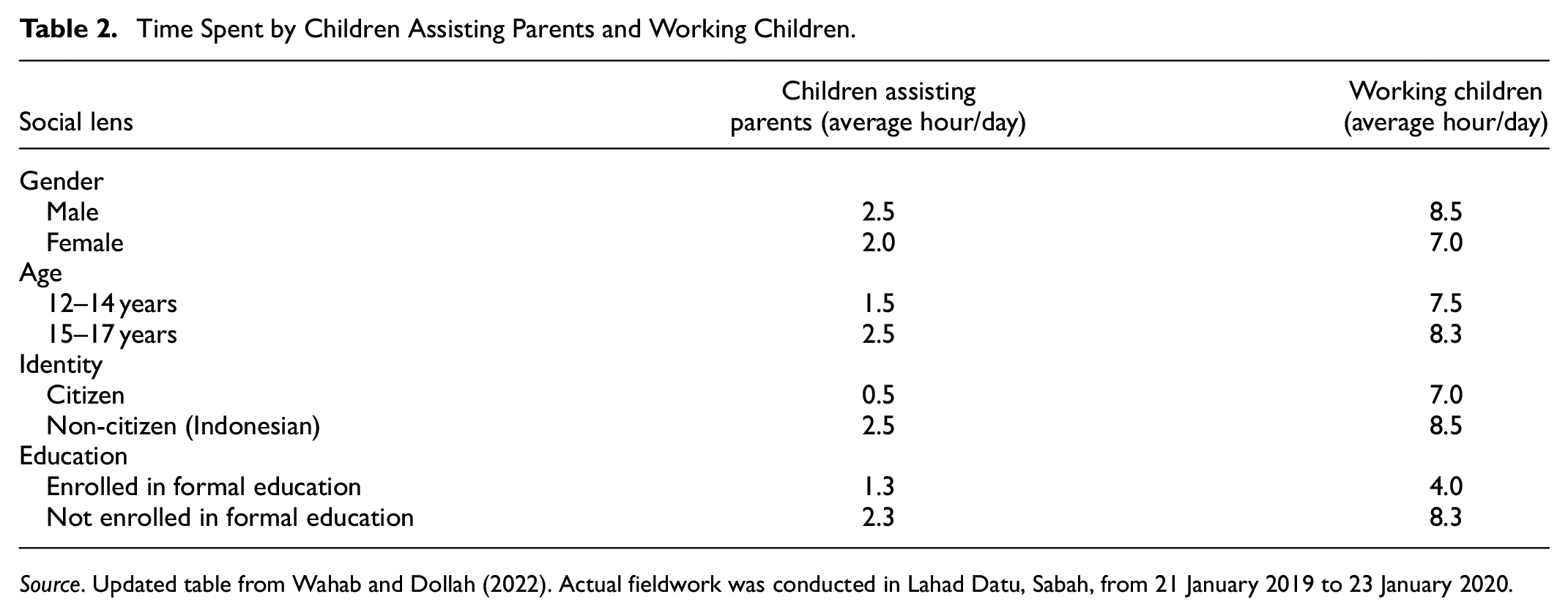
Source. Updated table from Wahab and Dollah (2022). Actual fieldwork was conducted in Lahad Datu, Sabah, from 21 January 2019 to 23 January 2020.
When analyzed from the gender lens, it is found that male children spent more time assisting parents on-site as compared to female children. A similar trend was found for male and female working children. From the age perspective, child respondents aged between 15 and 17 years are found to spend more time assisting parents on-site as compared to children in the age range of 12 to 14 years.
When analyzed based on identity, it is found that children of non-citizens spent far more hours assisting parents on-site and as working children (see Table 2). In contrast, local children assisting parents on site only spent less than an hour per day, and for local working children, they spent about 7 hours a day. Similarly, when analyzed from the educational lens, children who are not enrolling in formal education spent more time assisting parents and working on-site, compared to children who enrolled in formal education.
Semi-structured interviews with child respondents further justify the survey results above. First, female children spent more time helping parents undertaking household chores at home, hence time commitment of assisting parents on-site or as working children (outside their house) is less expected. A local female child respondent (aged 15) mentioned that she is expected to be a full-time “housewife” in the future (i.e., when she becomes an adult), and that is the reason why she is not expected to work outside the house. This partly explains the gender differences in time commitment between male and female children.
Second, identity and education are two social lenses that are different in scope but interconnected to each other. For children who are non-citizens, while it is still possible for them (with valid travel documents) to enroll in the government education system, expensive school fees imposed on non-citizens often hinder them from entering government schools. In Sabah, there is a range of alternative learning centers at primary and secondary level education that is made available to both Indonesian and Filipino children. However, learning centers at the secondary level of education are limited (Earthworm Foundation, 2019). After completing their primary education, most non-citizen children are unable or not interested to pursue their education.
Oil Palm Activities Performed by Children on Site
Among children assisting parents, it was found that these respondents tend to undertake easy tasks with fewer safety risks as compared to other children who are classified as working children. These activities include collecting loose fruits and manuring (see further in Table 3). For male respondents, in addition to collecting loose fruits, they also performed other activities such as slashing, especially those aged between 15 and 17 years. Slashing is considered hazardous activity as it involves the use of sharp tools. In contrast, while female children are synonymous with the tasks such as collecting loose fruits, they also performed additional activities such as bringing and serving food to their working parents and taking care of their younger siblings while their parents are on duty.
Oil Palm-Related Activities Performed by Children Assisting Parents and Working Children.
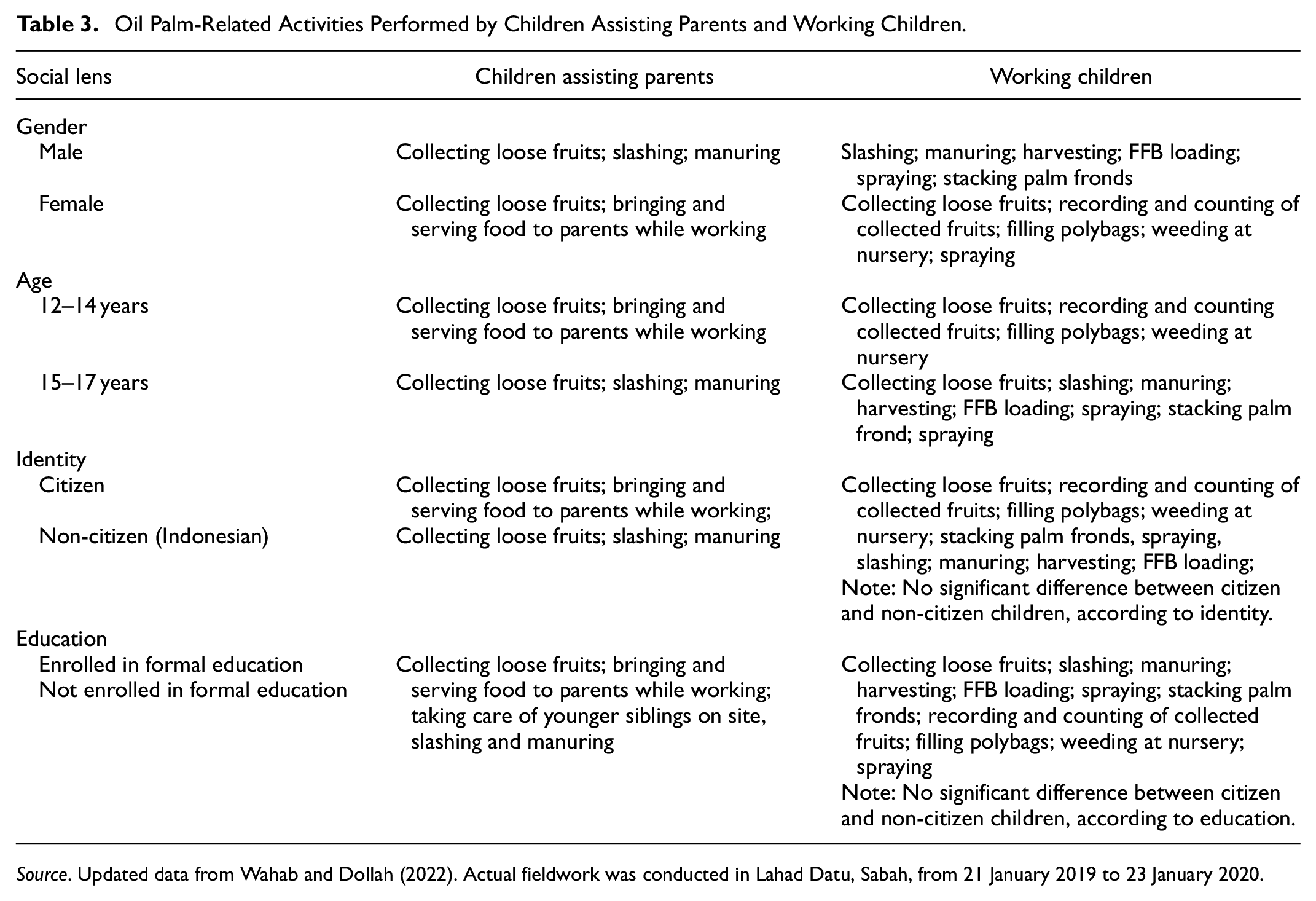
Source. Updated data from Wahab and Dollah (2022). Actual fieldwork was conducted in Lahad Datu, Sabah, from 21 January 2019 to 23 January 2020.
Unlike children assisting parents, working children performed heavier, risky, and hazardous activities (see Wahab & Dollah, 2022). From the survey, it was found that male respondents aged between 15 and 17 years typically performed activities such as harvesting, loading, and stacking palm fronds (see Table 3). Important to note that these activities are among the typical tasks performed by adult workers. From the gender perspective, it was found that female children (working children) performed activities such as filling polybags and weeding at the nursery.
Time Spent in Learning and Recreational Activities
This subsection presents the average time spent by child respondents in three aspects namely, (i) formal learning; (ii) informal learning; (iii) recreational and sports activities. Broadly, child respondents spent about 5.2 hours/day (on average) attending formal education (or formal learning), about 0.7 hours/day participating in informal learning, and about 2.3 hours/day in recreational and sports activities.
In this study, we consider formal learning as children’s enrolment in formal education—be it in government school systems or alternative learning centers. Informal learning refers to any form of learning activities the children do outside the formal education system. These include, for instance, undertaking school homework at home, drawing, painting and counting, book reading, enrolling in private tuition, and attending religious classes (e.g., Quran recitation). Child respondents informed that recreational and sports activities include playing football and other sports activities in the playground, fishing and children’s involvement in common youth or community activities such as pencak silat (the art of self-defense).
From the gender perspective, it was found that male child respondents spent more time in learning (both formal and informal learning) and recreational and sports activities as compared to female children (see Table 4). Based on the lifecycle perspective, children from 15 to 17 years spent more time in learning and recreational activities as opposed to children aged 12 to 14 years. From the identity perspective, children of non-citizens spent more time in learning and recreational activities as compared to their peers among local children who spent only about 7.9 hours/day on the same activities.
Average Time Spent in Learning and Recreational Activities (Average Hour Per Day), Number of Children (Per Cent).

Source. Fieldwork in Lahad Datu, Sabah, from 21 January 2019 to 23 January 2020.
From the educational lens, it was found that children who are able to enroll in formal education tend to spend more time in learning and recreational activities at the same time. In contrast, children who are left behind in accessing formal education only spent about 3.4 hours (on average) per day. The survey data also indicates that the vast majority of child respondents (89%) under this category are non-citizen children. This indicates two social lenses, namely identity and education (i.e., enrolment in formal education), are two important risk factors that can be linked to children’s involvement in oil palm activities. In other words, lesser time spent in learning and recreational activities leads to more chances of children spending time undertaking other activities, including involvement in oil palm activities.
Discussion and Reflection
Conceptual Contribution
As discussed early, child labor is a complex and multifaceted phenomenon. Where official statistics are unavailable and/or inadequate to reflect the gravity of child labor incidence, child advocates and institutions rely on anecdotal and piecemeal publications. Besides, very little effort to measure child labor at the individual level, especially in economic activities. The findings in this study contribute to the existing scholarly discussion on child labor from three perspectives.
First, conceptually, there is almost a clear distinction between the terms “children assisting parents,”“working children,” and “child labor.” During fieldwork, we did not use or refer to the term child labor, and hence no pre-determination of the incidence without further examining the nature and extent of their involvement in oil palm activities (Wahab & Dollah, 2022). In this study, we found that while there is a clear distinction between children assisting parents and working children (also see in Wahab & Dollah, 2022), it is difficult to distinguish between working children and child labor. However, after considering the four domains used in this study, we found that all children classified as working children fall within the broader definition of child labor.
Second, as we claimed earlier, it is important to consider the local contexts and conditions of children that are likely to position them in child labor. In this study, we are able to explain the involvement of our child respondents in oil palm production that may lead to child labor incidence through the analysis of four social lenses (i.e., age of children, gender, identity, and education). In this study, we also found that being children of non-citizens (identity) and the inability to enroll in the formal education system influence the active participation of children in economic activities—in this case, oil palm activities. This brings us to argue that any efforts to measure child labor should consider children’s identity and the barriers underpinning their right to education.
Third, the involvement of children in oil palm production in Sabah contributes to existing scholarly discussions that link child labor to a range of other concepts such as compulsion and voluntariness (see Barrientos et al., 2013; Berlan, 2013) and social norms (Kurosaki et al., 2006; Strauss & Thomas, 1995). In the context of children in oil palm production in Sabah, our field findings indicate that the chronic conditions of needs, primarily associated with poverty, lack of identity and enrolment in the formal education system—have collectively influenced the involvement of children in oil palm activities. In this context, children are incapable of consenting to their participation in oil palm activities, hence the notion of compulsion may apply (see Wahab & Dollah, 2022).
Additionally, we also found that social norms, responsibility, and expectations encourage the active participation of children in oil palm production, especially in Sabah. For example, male children are likely to be actively involved in oil palm activities as they are expected to be the head of the household when they become adults. In contrast, girls or female children tend to perform household chores because they are expected to be a housewife in the future. Though, in principle, we do not agree with the gendered approach of work distribution, any efforts to measure child labor should consider social norms and expectations, along with the socio-economic conditions that compel children to enter into the labor market (formally or informally).
Empirical Lessons
Here we present some important lessons on the exploratory utility of the time-use-survey, complemented by a semi-structured interview. Generally, the time-use-survey has been able to explore and explain the involvement of our child respondents in oil palm activities in Sabah. Nevertheless, during the data collection and data analysis stages, we found several gaps worth highlighting for future consideration.
First, the design of our time-use-survey template did not segregate between school or working days (e.g., Monday to Friday) and public holidays (e.g., Saturday, Sunday, or during school breaks). The absence of this feature hindered data analysis to explore the differences (e.g., time spent) between children’s participation in oil palm activities during regular days and public holidays.
Second, our time-use-survey template did not have a feature that can distinguish children’s activities on site between low and peak seasons. From the semi-structured interviews, children tend to spend more time assisting parents and working in oil palm production during peak seasons. Peak season usually falls twice in a given year: the first peak season is between January and April, and the second peak season falls between June and October. The absence of a feature that distinguishes children’s participation in these two seasons hinders further analysis in our time-use-survey.
Third, as mentioned early, our time-use-survey used a 15-minute time as a technique to identify and measure children’s activities in oil palm production. Though this time block (i.e., 15 minutes) has been able to explore the types of activities and the time spent by children performing oil palm activities, it has the potential of excluding simple activities the children do such as going to the toilet, eating, and typical household chores such as washing and hanging clothes and cooking. Though these activities do not generally consume much time, cumulatively they may influence the overall time spent by children on a daily basis.
Finally, during fieldwork, we found that some children were unable to remember and express their daily activities accurately. Every child respondent was given reasonable time (i.e., between 60 and 90 minutes) to indicate the type of activities and the time spent performing such activities. However, not all of them were able to remember such information, leaving some time block columns (i.e., every 15 minutes) unfilled by the researchers. This has implications for the overall findings of our time-use-survey.
Conclusion
The overall aim of this study has been to measure child labor at the individual level from four domains, (i) involvement of child respondents in oil palm activities; (ii) time spent in performing oil palm activities; (iii) type of activities in oil palm estates or farms undertaken by child respondents; and (iv) time spent by child respondents in learning and recreational activities. To better reflect the local contexts and practices, we further analyzed child labor from four social lenses, namely, gender, age, identity, and access to education.
In this study we found that of the total 43 respondents, more than half of them (30 respondents) are found involved in oil palm activities: 15 children are classified as children assisting parents, and 15 others are classified as working children. For those that are categorized as children assisting parents, they spent nearly 2 hours, on average, per day performing various oil palm activities on site, while working children spent more than 3 times higher. While children assisting parents tend to perform lighter work (e.g., collecting loose fruits), working children perform more heavier and hazardous activities such as slashing, loading, and harvesting.
This study also found that child respondents only spent about 5.2 hours/day (on average) attending formal education, about 0.7 hours/day participating informal learning, and about 2.3 hours/day participating in recreational and sports activities. This indicates that lesser time spent in learning and recreational activities leads to more chances of children spending time undertaking oil palm activities, eventually increasing the likelihood of child labor.
The section on discussion and reflection further highlights the importance of positioning child labor discourse that reflects the everyday reality of their involvement in economic activities on the one hand (see Wahab & Dollah, 2022), and the complex dynamics of local contexts and societal expectations, on the other hand. Besides, given the complex interplay between the local contexts, family’s expectations of their children as part of a larger society, and the root causes (e.g., lack of identity) that create conditions of child labor, this article highlights the urgency to refresh the way we understand and measure child labor.
Finally, while we focused on child labor in oil palm production, and as part of our long-term research project in Sabah (Malaysia), findings derived from this study also offer conceptual and empirical lessons that are applicable to better understand pockets of children, in almost similar contexts in the region. This is especially important since agricultural activities such as oil palm, rubber, seed, cocoa, and timber production remain the backbone of many Asian countries.
Footnotes
Acknowledgements
This article is a revised version of a working paper presented at the First Online Conference on Combating Child Labour in ASEAN/Southeast Asia, organized jointly by the International Labour organization (ILO), Viet Nam, Law School of the Vietnam National University, and Southeast Asian Human Rights and Peace Studies Network (SEAHRN) & the Strengthening Human Rights and Peace Research and Education in ASEAN/Southeast Asia Programme (SHAPE-SEA) on 3 to 4 June 2021. I would like to thank the Director and other Associate Researchers at the UUM Research Institute for Indonesia, Thailand and Singapore (UUM-ITS) for their technical support and critical commentaries throughout the peer-review process between 2022 and 2023.
Declaration of Conflicting Interests
The author(s) declared no potential conflicts of interest with respect to the research, authorship, and/or publication of this article.
Funding
The author(s) disclosed receipt of the following financial support for the research, authorship, and/or publication of this article: This work was supported by the Fundamental Research Grant Scheme (FRGS) [Ref: FRGS/1/2021/SS0/UKM/02/4].
Consent
Informed consent was obtained from all individuals, including child respondents and their parents and guardians included in the study. Given the sensitive nature of the subject matter (i.e., child labor) and the irregular migration legal status among child respondents, no actual information, including name and affiliation (except age and nationality, if applicable) has been reported throughout the study.
