Abstract
This article is based on ethnographic data and presents and expands on the symbolic functions of buwas kuning (yellow rice) being prepared and offered by the Sama-Bajau communities in their ritual performances in Semporna, Sabah, Malaysia. The findings show that the practice of offering buwas kuning (as an integral part of the main rituals, such as pag-omboh) has symbolic latent (unintended and unrecognized) psychological and social consequences on the Sama-Bajau villagers. The community knows that among the functions of buwas kuning are that it spreads fear and risk; creates a link between the physical and spiritual worlds; protects families from curses (sickness, disasters, spirit possessions); maintains the ritual’s authenticity and originality (which satisfies the ancestors and related spirits); causes participation of the community members, especially women; and engenders community support. The latent (yet to some extent known to some community members) functions of the offering of buwas kuning enable the community to check families’ material wealth and integrate the community with its identity. It teaches members to go (or live) through a process of patience (indispensable in rough sea life; also in the dangerous geographic region) and the material gains, as well as the social status enjoyed by the mediums. However, many villagers have some understanding of the latent functions of buwas kuning’s latent consequences. Although many people know about these functions, it is the degree of knowledge about these latent functions that is of interest, as this knowing is meaningful for the survival of ritual practices such as buwas kuning.
Introduction
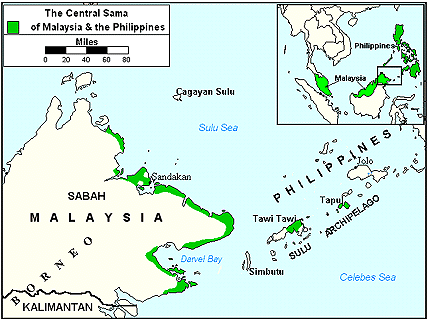
This article focuses on a little known but important part of the rituals that are practiced among the Sama-Bajau nomadic groups living in eastern Indonesia; the eastern part of Sabah (Borneo in Malaysia) to the southern Philippines (see Figures 1 and 2). The elements (or part) include buwas (rice) kuning (yellow) prepared for regular and annual rituals (i.e., mag—omboh or magpaii-bahau—the annual harvest ritual and mag—paigal jinn—removing the spirit from the human body) to offer ancestral spirits and jinn (they are mediums). The preparation of buwas kuning takes place in a ritualistic manner in the form of an offering. In Malaysia, the Philippines, and Indonesia, rice is cooked yellow (Pugh-Kitingan, Hussin, & Baptist, 2005; Sillander, 2006). Rice offerings are common to many Austronesian communities but in different ways (Baldick, 2013; Headley, 2004). Among the Sama-Bajau, buwas kuning is yellow rice because turmeric (dulaw) powder is added. It has religious and social significance and is considered central to the ritual’s performance. Among the Sama-Bajau, the preparation and offering of buwas kuning is a single element (besides other food offerings) within the annual ritual mag-omboh.
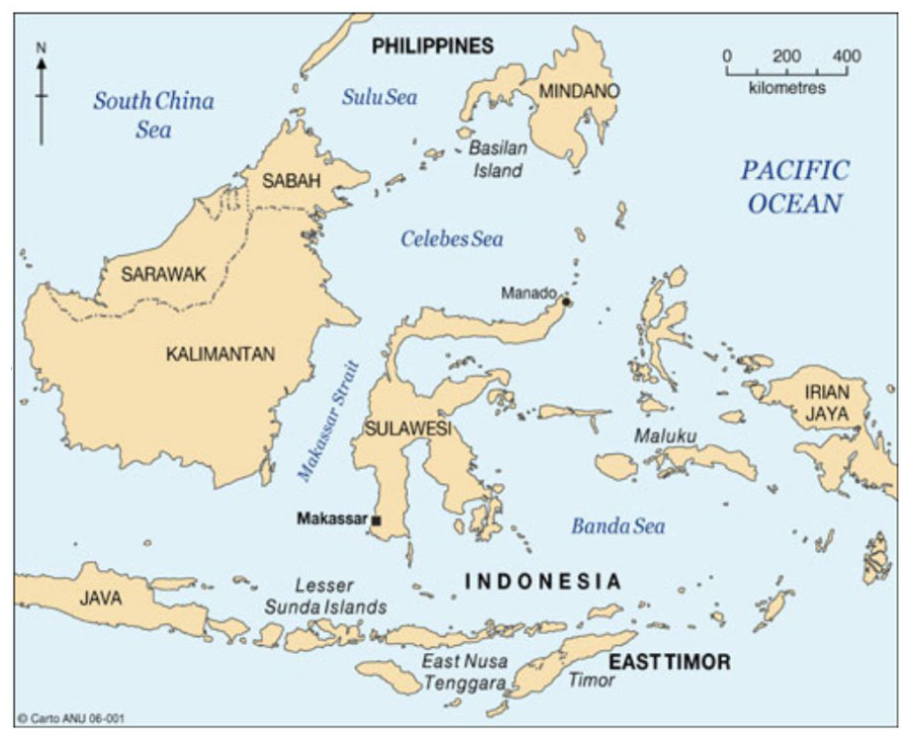
Map of Sama-Bajau speakers found in Southeast Asia (Stacey, 2007).
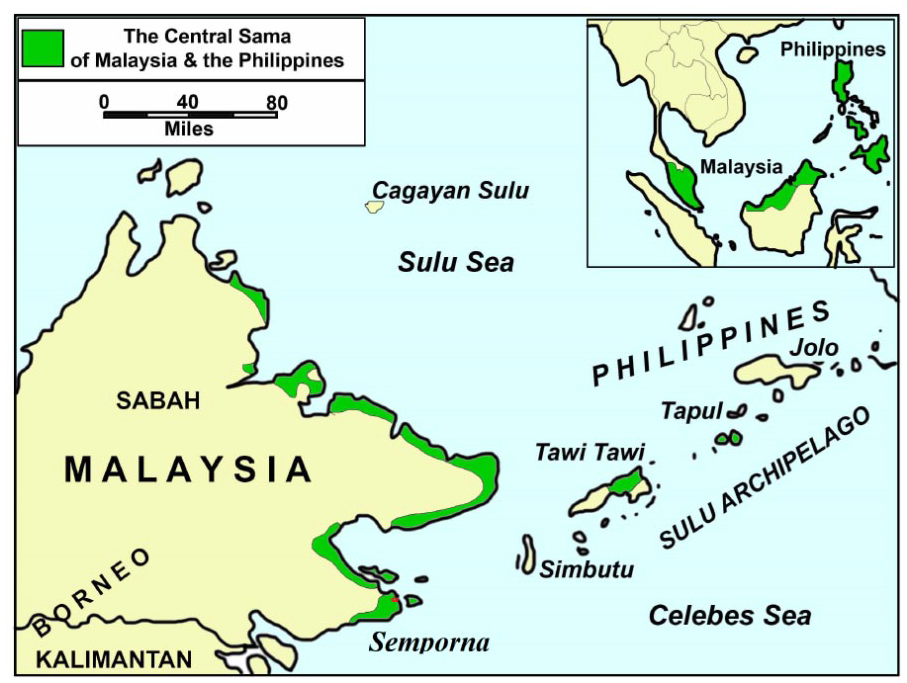
The location of Sama-Bajau of Malaysia and the Philippines highlighted in green (“Unreached Peoples Prayer Profiles,” n.d.).
Although there are no historical accounts to suggest that buwas kuning only belonged to the Sama-Bajau communities in the Malay Archipelago, the community members claim that buwas kuning has been used in their ritual performances for many generations. Also, the term buwas kuning does not appear elsewhere in the literature. Various scholars, including Nimmo (2001), Bottignolo (1995), and Abels (2012), who worked among the Sama-Bajau communities (in Malaysia and Indonesia), have mentioned that the communities offer different kinds of rice or food made of rice in rituals, but, they did not term it as buwas kuning or independently highlight the symbolic functions of it in the ritual performances. Moreover, although Waterson (1995) did mention the offering of rice besides other types of food offered in rituals among the Torajans, she did not mention yellow rice. This article, therefore, fills a small gap in the increasing literature on Sama-Bajau rituals and their belief system. In 2004, the author had his first chance to discover the term buwas kuning being used and also its different dimensions and functional aspects among the Sama-Bajau communities in two villages (Kampung Kabimbangan and Kampung Bangau-Bangau) in Semporna, Sabah, Malaysia.
My interests in buwas kuning also derive inspiration from some of the writings on the rituals, plays, and their symbolic functions (or roles); these include Turner (1982) and Waterson (1995). Buwas kuning is an important food item of the rituals and has many functions and themes that may match with many other ingredients in the ritual performances from an ethnographic point of view in different parts of the world. The diversity, variety, and complexity of the ritual performances have led writers like Hubert and Mauss (1964), Bloch (1992), and Waterson (1995) to concur that it is fruitless to support one explanation by criticizing the others. However, the writers have stressed the degree and the exact explanation of the functions and themes that differ in their specific ritual contexts (or analysis). Waterson (1995) contends that the competition between Hubert and Mauss’ (1964) communication of rituals and Smith’s (1889) communion of rituals are no longer needed in the recent studies of rituals, but both are given importance in their particular contexts.
For Turner (1957), a ritual is a social drama that entails four dimensions—breach, crisis, redressive actions, and reintegration. Together, the participating community in the ritual achieves a common goal known as communitas, which gives a sense of integration. In Turner’s (1982) analysis of the ritual, work and play are presented together to entertain.
I also take great inspiration from Merton’s (2012) concept of latent and manifest functions (he introduced it in 1968), which I have used as a framework to understand the symbolic functions. However, I have used it to understand the different contexts and functions, especially the latent functions, because the manifest contexts (dimensions) of buwas kuning’s preparation and offering in the rituals are not sufficient to reach the explanation of the practices. Merton argued that manifest functions are intended and that the consequences of such functions are known to individuals and social groups, which aim to make adjustment in the society or social groups; latent functions also work to adjust behaviors and practices in a society or among groups; however, these consequences are not intended by the group, but work invisibly or unknowingly (Elwell, 2009). These rituals and their mandatory practices (i.e., play and sacrifice) may have “the latent functions of reinforcing the group identity by providing a periodic occasion on which the scattered members of a group assemble to engage in a common activity” (Merton, 2012, p. 70). Thus, Merton stresses interpreting the non-purposed or latent functions of ritual ceremonies; in other words, go beyond the visible actions and find the underlying consequences. Merton’s concept is logical and appealing because it helps to identify irrational (collateral) behaviors of social activity and to determine whether a social practice interferes in the maintenance of the social system (Elwell, 2009). The concept of latent functions provides an alternative interpretation of ceremonials and institutions that may not be performing the avowed purposes, but still thrive among the communities; primarily, because these perform latent (unintended) and unrecognized functions that may occur because of their survival (Birnbaum, 1989).
In this article, I pay attention to buwas kuning’s independent importance and symbolic functions among the Sama-Bajau communities. In search of latent functions, the researcher examines why and how the preparation and offering of buwas kuning in ritual performances among the Sama-Bajau has manifest (intended) and latent (unintended) symbolic functions (consequences). It will also explore whether these functions (and outcomes of these functions) were intended by the villagers who use buwas kuning in the ceremonials, and, if these were not intended, why? Finally, I would like to examine whether buwas kuning played a role in integrating the Sama-Bajau communities. With these themes, descriptions, and questions in my mind, I start with the methods and materials and then provide a brief description of the Sama-Bajau communities in Malaysia (see the location of the Sama-Bajau communities in Figures 1 and 2). Afterwards, I analyze the latent and symbolic contexts in which buwas kuning is prepared and offered in the ritual ceremony.
Methods and Materials
This article is based on the researcher’s long-term affiliation with the Sama-Bajau groups living in Kampung Kabimbangan and Kampung Bangau-Bangau villages in Semporna. In 2004, for the first time, the researcher conducted ethnographic fieldwork in the villages to study their ritual arts, dances, and performances. The researcher has revisited the communities’ scores of times to discover different dimensions of their lives, especially those concerning their rituals and performances, and the different food and non-food elements that are indispensable in the ritual practices. Simultaneously, the researcher has produced papers and presented many findings on various aspects of Sama-Bajau villagers at different academic forums. Thus, this article is significantly based on the detailed informal interviews with villagers, personal observations, field notes, and the secondary monographs that the researcher produced over time, both individually and along with other researchers. The researcher also conducted a detailed interview with Puan Intan Sulga, the Bajau Laut cultural practitioner. As a result of the author’s continuous efforts, she was declared a national living legend or the master of Sama-Bajau traditional and ritualistic dance by the Malaysian Department of National Heritage.
Sama-Bajau in Southeast Asia
Sopher (1965) divided the nomadic or sea people living throughout the mainland and islands in Southeast Asia into three groups: Bajau, the Orang Laut, and the Moken. This division is based on three broad linguistic and cultural characteristics. It is not clear who was the first to use the compound term Sama-Bajau, but it is linked with Pallesen (1977). Sather (1997) noticed that each group was culturally, linguistically, and geographically different from each other. In 1997, Sather estimated that around 900,000 Sama-Bajau lived both on the boats (on sea water) and also on the shores in Southeast Asia. They had centered their lives around the maritime ecosystems and environments of Southeast Asia. Sather (1997) writes that they lived in the maritime region scattered over 3.25 million square kilometers stretching from eastern Palawan, Samar, and coastal Mindanao in the north, through the Sulu Archipelago of the Philippines, to the northern and eastern coasts of Borneo, southward through the Straits of Makassar to Sulawesi, and from there over widely dispersed areas of eastern Indonesia. (p. 2)
According to Pallesen (1977), within the Western Malayo-Polynesian language family, Sama-Bajau languages are a distinct subdivision of Austronesian languages. Pallesen found 10 Sama-Bajau languages and many dialects. Sather (1997, pp. 9-10) said that the Sama language in Indonesia has close links to the Southern Sama language spoken by Sama-Bajau on the eastern coast of Sabah, on its islands, and in the Sulu Archipelago in the Philippines. The English observers used the generic term Sama for Sama-Bajau speakers. Sama-Bajau communities are connected through bonds of language, marriage, and kinship (Sather, 1997).
Sama-Bajau in Semporna, Sabah
In Sabah (Malaysia), the Sama-Bajau live with cultural complexes in two different locations—west coast Bajau (Kota Belud and Putatan area) and east coast Bajau (Semporna area). Although the two are dependent on the sea resources for their livelihoods, somehow, they differ in terms of their culture and from a historical point of view (Hussin, 2016). The Sama-Bajau who live along the east coast are considered to be the largest Sama-Bajau group in Semporna. Among the Sama-Bajau are the Bajau Kubang, who genealogically are believed to be the original inhabitants of Semporna; they settled in different Islands and, finally, came to the mainland and settled on the shore in search of food, trade and other livelihoods, and resources. Once settled on the shore, they formed villages and lived in small hamlets, where they have become famous for their expertise as wood artisans, mat-makers, boat-builders, ironsmiths, and producers of tortoiseshell pendants and combs. The Sama-Bajau’s prime source of livelihood is fishing and other related activities; however, they also depend on seaweed cultivation in the sea and the cultivation of rice on the land (Sather, 1997). Many Sama-Bajau families abandoned traditional fishing activities and joined government services and became businesspersons. One of the Sama-Bajau groups is called Sama-Dilaut, which is largely dependent on fishing and other sea-related activities include seaweed farming (Hussin, 2010; Hussin & Khoso, 2017).
A Sama-Bajau family live in a household, which has a couple of rooms, a jetty at the front and a kitchen at the back. The household includes other relatives such as grandparents. Elders are respected in the family and the wider community for their wisdom and knowledge and also for their spiritual powers. In 2004, the informants shared that Kampung Bangau-Bangau village had an estimated 4,000 people, but, by 2016, it was reported that there were more than 6,000. Most of them were settled on the land. The population in Kampung Kabimbangan village was estimated to be around 2,500, which had grown to around 4,000 in 2016; many of them were still living on boats.
Belief System and Rituals of Sama-Bajau
In Sama-Bajau’s mythology, the supreme deities are Umboh Tuhan (also known as Umboh Dilaut, the “Lord of the Sea”) and his consort, Dayang Mangilai (the lady of the forest; Hussin & Santamaria, 2008). The Sama-Bajau of the past and present divided the world into the physical and spiritual realms which exist side by side. For Sama-Bajau villagers in Kampung Kabimbangan and Kampung Bangau-Bangau (who called themselves Muslims), Umboh Tuhan (or simply Tuhan or Tuan) was usually equated with Allah. This shows that the villagers’ worldview is still pre-Islamic. Meaning, besides recognizing Allah as a Supreme Being, the villagers recognized and refer to various other powerful beings, such as Omboh or Arwah, spirits of the sky or Ruwata; malevolent spirits such as jinn (represented by smoke); and Shaitan (devil) and other spirits of non-human origins. Therefore, various religious ritual practices are a combination of pre-Islamic and Islamic beliefs and ceremonies (Hussin & Santamaria, 2008).
The pag-omboh is the annual mandatory ritual celebration performed by all Sama-Bajau groups in Indonesia, Malaysia, and the Philippines. The mag-omboh comes from the word omboh, which means ancestors or the parents are not alive. Thus, it pleases the ancestors, who are not alive. A Sama-Bajau explained, “It is a contract of the living with the dead to perform the ritual.” It is not a solar ritual as understood by Bottignolo (1995), the confusion stems from the fact that since it ends at midday, scholars mistakenly relate it to the sun; however, pag-omboh follows the lunar calendar and is performed over 3 days including nights. This ancestral worship is not allowed in mainstream Islam, but it is Sama-Bajau’s belief system that comes from their religious practices before converting to Islam in the 14th century (Jubilado, 2010). However, this ritual is also performed to address different issues, such as the illness of family members. In either case, the ritual is performed to please the ancestors.
In addition, a healing ritual (mag-kalamat) is performed to heal the sick at any time. In it, the presence of a close family member is viewed as mandatory. Then, the pag-labut is performed to attract the ancestral spirits (omboh) to partake in the ritual. The harmful spirits are also invited to this offering (Hussin, 2010; Nor & Hussin, 2012). The mag-paigal jinn ritual is performed on the full moon once a month by a spirit bearer (jinn) male (jinn Lella) or female (jinn denda), family members, and village communities.
The mag-omboh is the annual rice ritual or also called as magpaii-bahau, which was first performed at Sitangkai Island in the Philippines and then followed by the head jinn in Kampung Bangau-Bangau and Kampung Kabimbangan villages (Hussin, 2008). In the ritual, seven bowls of buwas kuning offerings were presented. The ritual is divided into three rites: the preparation of the ritual offerings (mag-patanak), rites of mag-omboh (amangan pai bahau), and ritual music and dance (mag-tagunggu’ and mag-igal). The preparation starts with unhusking and drying the new rice (paay bahaw) for buwas kuning. After the unhusking, drying takes place at night. The rice is placed in a spacious room and left for one or two nights to sleep. In this given time, the rice is called sleeping rice. The villagers informed that the ancestors and spirits join the sleeping rice. They added that, as they often met with their ancestors in their dreams who bless them, and, later on, in return, they visit at the time of ritual and eat the rice offered in the form of buwas kuning. On the next day, the “sleeping” rice is divided into three piles, of which two piles are for buwas kuning. The third pile of rice is soaked in water, pounded, and cooked to make kuih panyam (sweet meals) and durul (sweet cakes). However, buwas kuning is central to the ritual, which Bajau Kubang and Bajau-Laut of Semporna called pito botangan (seven ceramic plates of offerings; Hussin, 2010). Buwas kuning enjoys high importance, and it can neither be absent from the ritual ceremony nor replaced with other food items. It is mandatory to perform the Buwas kuning preparation process in traditional style from the beginning until the offering of buwas kuning to ancestors and spirits (Hussin, 2010).
On the final day, the ritual performances reach their climax, and the buwas kuning is surrounded by the family members, guests, and visitors who recite the Islamic hymns and dua (recitation of prayers) together. The dua consists of several surahs (chapters or verses) from the Quran such as Al-Fatihah, Al-Ikhlas, An-Nass, and Al-Baqarah led by the ritual specialist, mediums, and spirit bearers (Nor & Hussin, 2012). The symbolic action takes place at the end of the recitative session. The eldest female member of the family pours some of the newly produced coconut oil onto the first pile of buwas kuning before it is offered to be consumed by the guests or by the sick members of the family. This is a crucial and an important part of the ritual. It is a marker of unification with the ancestors, and it is a time when the ancestors accept the offering of buwas kuning. Following this rite, another final recitative session dua arwah (prayers for the dead ancestors’ souls) takes place. It begins with the ritual specialist drinking some water from the water container made out of a coconut shell (baung). The recitation of the Quranic verses follows this rite of drinking.
This recitation is further followed by Jikir (Islamic Zikir), which is chanting and supplicating God’s name. At the end of this session, the members of the family and guests are invited to eat buwas kuning and other food items. The ritual consumption of offerings made from the newly harvested rice or amangan paii bahau (eating new rice) completes the rites of mag-paii bahau (Hussin, 2010, 2019). Intan Sulga (a passionate female expert in ritual and dance of Sama-Bajau who is able to link the seen and the unseen worlds) informed that in both villages in the daily lives of the Sama-Bajau, the performance of the ritual pag-omboh and pag-akanduli is extremely important. As a special food, buwas kuning has great social and religious weight in the ritual performances and has various symbolic social contexts and functions. The number of unintended purposes or consequences of offering buwas kuning is more than the intended symbolic contexts (intended outcomes). In the following, I have attempted to discuss and analyze the manifest symbolic contexts and functions of buwas kuning in the ritual performances.
Food Identity and Food for the Dead
Buwas kuning is a ritualistic food like many other ritualistic foods analyzed in different parts of the world and a variety of settings (Brandes, 1997; Feeley-Hamik, 1995; Murcott, 1996; Waterson, 1995; Weismantel, 1991). In September each year, the villagers prepare buwas kuning in the traditional manner, which is an attempt to maintain the authenticity and originality of the ritual, because buwas kuning is the identity of the ritual. The communities know that the offering of buwas kuning maintains the originality of the ritual, and that, without it, the ritual could not bring the anticipated or intended consequences.
It is interesting to note that the Sama-Bajau do not cultivate rice but buy husked rice from the market. However, its preparation and offering to the ancestors symbolizes or marks the end of the year (or season) in which they earned or harvested enough fish, which could go until the next offering in the pag-omboh ritual. Buwas kuning is meant to be shared with the dead and has been widely practiced across the world since time immemorial (Hornedo, 1994; Lauwerier, 1983). The villagers informed that ordinary people could not afford buwas kuning to feed their ancestors because they did not grow rice but purchased by them and unhusked in the process. However, it became special on a certain occasion. Sama-Bajau used buwas kuning to perform ceremonial roles similar to how ordinary people in the Andean civilization (in 3,200 BCE) used to offer food to their ancestors (Hastorf, 2003) or dead. The share of the dead indirectly or latently creates fear among the villagers to continue to provide the share and stay connected with the ancestors for their own physical and mental wellbeing.
Buwas kuning is a manifest identity of the ritual that is observable and recognizable by the community members, and the ritual is a manifest practice and identity of the community as a whole. The villagers informed that the avowed purpose of giving a yellow color to the rice is to show their ancestors that they hope for prosperity, security and protection, and their happiness. One of the informants believed that they did not know since when they had been using turmeric powder in buwas kuning. However, it gave a yellowish identity and prominence to the ritual ceremony. Other villagers believed that the new yellow color is not only for decoration, but that it is a symbol of good fortune to them. The color links and binds them with their ancestors whose good legacy they followed. Like Sama-Bajau, for Bali people in Indonesia, rice is used as a prime source of wealth and life, and an integral part of ceremonial and ritual activities.
Moreover, the yellow color is one of the holiest colors, which they use to make nasi kuning (yellow rice; Kruger, 2014). This shows that, among the Balinese and Sama-Bajau, the color also retains the holiest status and is not just a tool of decoration. Turmeric is a spice that gives flavor to food. It is also used as a preservative. It has been widely used in South Asia for the last 2,500 years (Mishra & Palanivelu, 2008). The Sama-Bajau villagers did not know when yellow was first used in the rice to make it part of the ritual. Food color and its decoration are the manifest expressions of latent fears in the minds of the villagers; if they did not prepare food offerings appropriately, they might suffer from bad reactions from their ancestors through spirit mediums. Bottignolo (1995) also discusses the importance of the yellow color among the Bajau, which has religious meanings, but he connects it with the color of the sun, which is not the context of the yellow color in buwas kuning. Douglas (1996) also highlights the importance of colors among the people of Zambia; besides many other functions, they had an abstract level of interpretation.
Participation, Gender, and Community Support
The community members knew that the female family and community members only unhusk and cook the buwas kuning when the rice is newly harvested. Otherwise, if buwas kuning is prepared for the ceremony of healing a sick person, women are not required to unhusk the rice and the rice is not placed for sleeping during the night. Although the females knew that the preparation of buwas kuning is a great source of meeting with many female community members in the living world, they believed that they gathered for a religious purpose to meet with their nonliving ancestors who also include female ancestors.
Together they call them omboh; whereas, the preparation of buwas kuning means the engagement of women community members, which provides an opportunity for women to meet and share their life stories. Intan Sulga informed that the preparation of buwas kuning by women is as important as buwas kuning itself because the preparation by women means the offerings have come from the family, not from individuals. Intan believed that for the ancestors, the family is extremely important and that without the participation of women, the family is incomplete. Usually, the community members do not offer help, but, on the occasion of the preparation of buwas kuning and offerings to the ancestral spirits, the support of the community members is believed to be indispensable. They consider that without their support in prayers, preparing buwas kuning and eating buwas kuning, the healing of the sick is difficult because they believe that collective prayers work more effectively than those of an individual. The preparation of buwas kuning is also a major source of community integration.
In the division of labor, the hard work is done by the Sama-Bajau women, which requires the unhusking (Figure 3) and cooking of buwas kuning and other food offerings for a large gathering (Figure 4). An old female member said that she has been busy in preparing buwas kuning since the first day of the ritual. She took part in unhusking the paddy, which is a lengthy and hectic process primarily performed by females under the guidance of old female family members. For many hours, women pound paddy and separate the rice from the husk (its cover). After the unhusking and drying (sleeping of rice in the night), comes the turn of cooking buwas kuning, which also needs the support of other community female members. The ritualization of buwas kuning by female members is not just a passive display of ritual values, but that these practices are the outcome of “ritualized agents,” which behave or perform the same roles in the communities (Bell, 1992). These practices are a source to create social realities and routine gendered roles in society.

Unhusking rice at Sama-Bajau, Bajau Kubang of Kampung Kabimbangan Semporna, Sabah. The unhusked rice is dried, gathered, and pounded by the female family members. It shows support for female family members so that the food used for the ritual brings fruit for the families. This event shows that females are ready to unite with the ancestors and other spirits; and, symbolically, it is a harmonious situation to celebrate the grand event together with families.

The preparation of buwas kuning of Sama-Dilaut, Bajau-Laut, Kampung Bangau-Bangau, Semporna-Sabah. It shows that the female family members take charge of mixing turmeric powder with coconut milk, the main ingredient of buwas kuning.
Similarly, the preparation of buwas kuning constructs gendered roles and the division of labor among the Sama-Bajau communities. It also creates economic niches and meets certain economic ends. I also noted that the Sama-Bajau have fixed certain traditional roles that only women perform as keepers of the ritual traditions and practices, which are important to the communities. These roles in maintaining social order in the community ensure that the unique identity of the community can be maintained.
Fears and Risks, Transgressions, and Protection From Curses
Intan Sulga claimed that the community knows that the offering of buwas kuning is a mandatory offering in the ritual and that ignoring the offering of buwas kuning could invite the anger of the ancestral spirits and jinn (spirit bearers), which could bring further loss, misery, and misfortune for the family and community members. These fears and risks are instilled in their minds by the continuous spreading of messages by mediums and ritual specialists. Ignoring the offering of buwas kuning could lead to a disconnect between the real and unseen world and would create an imbalance in the social life of the families and groups.
The offering is the only opportunity to share newly harvested rice with the ancestors and please them and, as a result, seek protection against all kinds of curses and the negative impacts of jinn on the community members. The informant shared that they could not proceed with the performance of the ritual without buwas kuning. They claimed that the performance provided a sense of protection and security and that it brought balance between the two worlds (i.e., the seen world and the unseen world; Hussin, 2018a).
The imbalance in social order or illnesses among Sama-Bajau is the result of the transgression of boundaries, which are seen and fixed by the mediums and ritual specialists. Waterson (1995) also observed the concepts of transgressions and boundaries of social order among Torajans, but she did not spell out who framed (fixed) the boundaries of societal balance and the parameters that showed that the boundaries are transgressed. The respondents in Sama-Bajau feel that they live within social boundaries and that crossing those would be a transgression and, ultimately, invite the anger and curses of the ancestors. These boundaries are the creation of mediums and ritual specialists who are wrapped with the communities’ fears and risks—under the “rebounded violence” (Bloch, 1992) process. They work through the communities’ risks and fears and take advantage of these.
For Sama-Bajau, buwas kuning has a mesmerizing effect on continuing the relationship with the ancestors and is a source of continuous blessings from them. It is used to please the jinn (the foreigners) who do not belong to the physical (seen) world. They enter human bodies and possess them, especially those who either disturbed jinn by going to their places or have lived an impure and unclean life. Jinn are offered buwas kuning and asked to leave the human body. Otherwise, they are deprived of the ritual food and punished with verses of the Holy Quran, which the jinn do not like. The concept of purity and cleanliness greatly determines the Sama-Bajau’s life. These are the boundaries the community members clearly understand and avoid transgressing. Intan Sulga believes that unclean and impure living could invite foreign intervenors to possess their bodies and hurt them. Such an impure status also indicates weak social boundaries, which could allow the jinn to enter into human bodies. Thus, the community gives special consideration to cleanliness and purity of body and soul. The purity of body is attained through washing body parts, while the purity of soul is attained by following a religious way of life that is guided by mediums, spirit bearers, and other ritual specialists.
Buwas kuning works as a conduit that converts the resentment of spirits into contentment, illness into good health, and fears and risks into a peaceful life. According to the villagers, even when the community has no problems, buwas kuning assists in averting illness, sickness, and curses and provides opportunities for the community’s wellbeing, health, and happy life. The community understands that the offering of buwas kuning plays its role in protecting them and restoring or re-ordering ruptured systems. The neglect of the ritual performance along with buwas kuning is considered an open invitation to an ancestral curse (kabusongan) for the family. Intan Sulga informed that individual family members rarely refused to perform the ritual or to offer buwas kuning to the ancestors because they know that refusal might cause a curse in the form of illness or loss of wealth to the household members. This shows the manifest importance of protecting the family or lineage (katurunan). Among the Sama-Bajau, through family lineage, such manifest important virtues of the ritual as well as of the food are transmitted through socialization. Once, Intan informed the researcher that without transmitting the virtues to lineage members and the future generations, it is not possible to retain the importance of ancestral practices and that once the importance is lost, it means the loss of the ritual practices or some part of the ritual practices.
Generally, mediums and spirit bearers perform the ritual and indirectly spread fear among the communities. All the community members seek consultation with the mediums and ritual specialists in cases of bad luck in terms of the fish catch and the sickness of family members. These consultations always result in ritual ceremonies and the offering of buwas kuning. I could sense the role of the mediums and spirit bearers who exploited the concept of the ancestral curse and the anger of other spirits, which were always considered to be in the forefront of their minds. These situations could be avoided by pleasing them (ancestral spirits and spirits through mediums and spirit bearers) with the offering of homage, buwas kuning, and other special food offerings and materials. Jumala (2013) also found the same practice among the Sama-Bajau in the Philippines, in which mediums (jinn) go into a trance and mutter words that are not understood by the audience. At the end of the ritual, the mediums convene the message of the blessing of ancestors on the condition of the continued performance of the ritual and offering of buwas kuning. Intan Sulga shared that, besides buwas kuning, the presence of other ceremonial foods and materials is very much liked among the participants, especially by mediums, who are later served with the same offerings. Female members also cooked kuih panyam (flat, crescent moon-shaped cakes) and kuih sahalibulan (flat, round-shaped cakes) from the same newly harvested rice. The sweet scent of greenish cologne (perfume) is sprinkled everywhere inside the house, which, according to the informants, is done so that the spirits join the ritual. However, Intan Sulga believes that buwas kuning could not be skipped and, in her life, she never saw the absence of buwas kuning in any of the rituals, especially the pag-omboh ritual.
Integration and Identity
Like every other community, Sama-Bajau needed a source that could integrate them and with which they could identify themselves. The yellow color is the identity of the buwas kuning offering. Buwas kuning is the identity of pag-omboh. Pag-omboh is the identity of Sama-Bajau. However, without the offering of buwas kuning, the performance of the pag-omboh ritual is not possible. During the 3 days of preparation and the offering of buwas kuning, the community gathers. It not only reintegrates the living community members but also results in the reunion of living with nonliving ancestors to whom the living community members do not see but feel and realize when the mediums and the spirit bearers leave the home happily. For the Sama-Bajau, it is a psychological experience that is verified by the mediums and spirit bearers. It is a latent function of the buwas kuning offering (as social and religious) activity performed by the community members. However, many senior villagers said that buwas kuning is an important source of bringing the community members together, particularly for those who they do not otherwise see for the whole year.
The reunion of families is an intended and anticipated purpose of the ritual and they understand that the preparation and performance of buwas kuning play the role of bringing them together as the ritual brings them together with their ancestors. The villagers understand that without buwas kuning, the rituals are not performed and that without the ritual, the family and community members and ancestors are not coming, and if the ancestral spirits are not coming, it means that blessings are not given, curses are not prevented, and misery is not averted. Buwas kuning is not merely a source of linking the seen and unseen powerful world, but at the unintentional level, its preparation and offering brings the family and community members together. Generally, the community members believe that the ritual of preparing and offering buwas kuning is a religious activity. However, they have little (yet they had) realization that the activity of the preparation of buwas kuning is a social and cultural gathering that provides an opportunity for all members to participate irrespective of whether or not they believe in the ancestors and their curse. The ritual draws an invisible line and boundary between the sacred and routine days’ food. The boundary is understood by the villagers with specially prepared and served buwas kuning and other foods made from rice (Figure 5). The symbolic purpose of the food used in the ritual is also a family union, which is also performed in different parts of the world. For instance, for the Nyakyusa people in Africa, the sacrificial food used in the ritual signifies the union of husband and wife: “Indeed the rituals of death and abnormal birth, as well as the ritual of puberty and marriage, may be interpreted as a celebration of the union of husband and wife” (Wilson, 1954, p. 235).

Photograph of buwas kuning among the Bajau-Sama-Dilaut of Kampung Bangau-Bangau. It includes rice cake on top of buwas kuning called kuih panyam (an oval shape) and Kuih sahalibulan (crown-like shape) made from the rice flour mixed with sugar. It is an ancestral heritage for many generations and treated as a special gift to the ancestors and other spirits in the spiritual world and human beings in the physical world.
Process and Patience
The preparation and then serving of buwas kuning indicate a process (lasting 3 days) in which a raw harvested material (believed to be useless unless it is not) passes through a process in which the community members and ancestral spirits participate. The 3-day process, as highlighted by Bottignolo (1995), has a beginning and ends at midday on the third day. The process of preparing buwas kuning teaches patience to the community members. Continuous participation for 3 days in the annual ritual involves the participants in the process, and the process enables them to wait and continue to go along with the ritual until the ritual performance is finalized on the third day (Figures 6 and 7). For the Sama-Bajau, waiting for 3 days is important. It is a process that constructs social realities in their minds. The process of preparing and offering creates a quality of patience among them, which is indispensable for living a rough and stressful nomadic sea life. It is unintended learning for the community members, which enables the community members to avoid reaching any place (conclusion) without going through a process. It indirectly teaches the individuals that patience is required, not only in the preparation of buwas kuning and its offering in the ritual but also in daily life, in which one has to pass through processes with patience. The process of the preparation is ritualized to signify the continuous link between the living and the dead (ancestral spirits, jinn, and other evil spirits) inhabiting the spiritual world.

Photograph of the mag-paii-bahau ritual of Sama-Dilaut of Kampung Bangau-Bangau, Semporna, Sabah. The Imam (the ritual specialist) is reciting verses and prayers from the Quran in front of buwas kuning and the other offerings.

Photograph of the mag-paii-bahau-Magduwata ritual in Sama-Bajau, Bajau Kubang of Semporna, Sabah. Two zikir take place: first zikir (prayer), called ancestral zikir (zikir nenek moyang), and second, zikir and prayer for the dead (Dua Arwah). After the completion of the first zikir, the sick person, who is the heir of the langkapan is fed with buwas kuning, kuih panyam, durul, and poloh-poloh, which is symbolically fed to the ancestors.
During the rite of the sleeping of the rice, the ancestral spirits accompany the rice, but they are not satisfied with the unhusked and uncooked sleeping rice unless they are served in the form of buwas kuning. The sleeping of the rice symbolizes the unseen context in which the ancestors join the newly harvested rice and approve the cooking of these for their favorite dish—buwas kuning. The serving and offering of the newly harvested rice is only accepted if the offspring presents new rice in the form of buwas kuning. This implies that raw materials in the real world of the Sama-Bajau do not please human souls, whether alive or dead, unless they are prepared and decorated through a participative process. Buwas kuning is also prepared from old rice for ritual ceremonies that take place every month or when needed. Thus, it is significant whether the rice is newly harvested or old. However, buwas kuning has to pass through a process, and it is served to please the unseen ancestors. The process of the preparation of buwas kuning is only possible when the family and community members and ancestral spirits take part in all the designated activities over the 3 days. This shows the collectiveness of the groups and strengthens the ties of the individuals within the group.
Material Gains and Social Status
Mediums and other ritual specialists are nobilities among Sama-Bajau. The villagers believe that this special class of persons could establish, maintain, and recreate the balance of the society within days of a crisis. Mediums are treated as a special class of person because they perform a job, which not everyone could do. From the ritual practices, these members of the noble class become the wealthiest within the community. Mediums have powers to grow grains and cure illness and their intervention in each marriage is considered important. The sacrificial food is extremely important, and buwas kuning is not only a feast for the common Sama-Bajau but also the mediums.
Mediums construct a social environment of fear and risk (as described earlier). They rebounded violence (as Bloch [1992] envisaged) to scare the communities so that if they stop offering buwas kuning and other materials to jinn and their ancestors, their lives could become imbalanced. The ritual process over the 3 days and offerings is also a means for the community members to realize who they are, who their ancestors were, and what they have to carry on with. In the ritual process, they also realize that they are part of the clan and the permanent life beyond their material world.
The ritual specialists finally take the offering of buwas kuning and other material. They are also served with money and care and given an important place in their gatherings. However, the villagers do not recognize or understand the material gains and social status enjoyed by the people who inject the fear and risk in their communities. However, one villager informed that “the spirit bearers take food, money and other material at the end of the performance. It is given because of their services, which a common person cannot perform.”
The material gains and social status of the spirit bearers is believed to be the legitimate (as Merton says, morally approved functions) rights of the people who play the role of the conduit between the seen and unseen world. These conduits greatly determine the material interests and political powers. This way, Sama-Bajau’s communities fulfill these latent functions to serve the real world’s spirit bearers and mediums in the name of unseen spirits and ancestors. However, the community members do not know that the ritual performances around buwas kuning provide additional social status to the ritual specialists among them. Even if the villagers know that the mediums and spirit bearers have gained from them, they have to close their eyes. This is because they live an insecure and unstable life in a volatile geographic area, which is greatly characterized by illegal practices of piracy, smuggling, and international trafficking of undocumented workers.
However, the presence of the government is nearly absent, which could handle insurgents and bandits. Wars, foreign occupation, and political turmoil are not solely recent issues or those of a colonial past, but, for many centuries (in the pre-colonial times), the Southeast Asian region has remained a battleground for various wars (Charney, 2014). The geographic character of the region in which the Sama-Bajau live has created an insecure and unstable life for the Sama-Bajau groups. These fears and insecurities have also been considered to be a major reason for the creation of the rituals and offerings to the ancestors, spirits, and other potent unseen beings to seek help (Hussin, 2010). In such a state of political and social affairs, the offering of harvested rice (buwas kuning) brings the scattered families to one place and with some peace that is shared with their ancestral spirits.
Discussion
Various researchers (Abels, 2012; Bottignolo, 1995; Hussin, 2018a, 2018b, 2019; Hussin, Baptist, & Pugh-Kitingan, 2018; Jubilado, 2010; Jumala, 2013; Nimmo, 2001; Sather, 1997; to mention a few) on the Sama-Bajau have attempted to discover symbolically recognizable, familiar, planned, and manifest practices and consequences of ritual performances. However, they did not bring a distinctive contribution to the knowledge (as Merton, 2012 envisaged) related to the latent and symbolic functions of the offering of buwas kuning. Thus, this inquiry has looked into the deliberately instituted practice of the preparation and offering of buwas kuning as a ritual food that has its manifest objectives and then extended the inquiry to the unrecognizable purposes of the offering of buwas kuning, about which the community has little realization or is unfamiliar in terms of the symbolic dimensions (as Waterson, 1995 noticed among Torajans).
For the Sama-Bajau, buwas kuning is not simply rice or a staple food, but it signifies a clear meaning in the annual ritual mag-omboh, and it is a vital and visible source of physical joy and performance. The ritual for the celebration of the newly harvested rice is meaningless if performed without buwas kuning. The Sama-Bajau villagers regard the buwas kuning offering in the symbolic context in which the ancestral spirits metaphorically eat the food, and, in return, they feel pleased with the community and protect them from curses and illnesses. These are the avowed purposes. The continuous offering of buwas kuning reveals that it exists because it serves unknown purposes. However, it cannot be determined how long buwas kuning will survive in the fluid and changing scapes of every dimension of life in the fast-changing world where cultural, ceremonial, and traditional foods are disappearing (Kwon, 2017).
The offering of buwas kuning should not be attributed to its ostensible purposes or be labeled as superstitious practice (as Merton, 2012 suggests), as it plays an actual role in guiding the behavior of the Sama-Bajau villagers. The list of conscious motivations for offering buwas kuning is not only long among the Sama-Bajau, but the objective consequences of offering buwas kuning are also not easily recognizable by the community; in general, they do not know the objective or latent consequences of offering buwas kuning in ritual performance. The motive for the offering of buwas kuning is identifiable by the villagers, but its latent functions within the ritual and practical life of the community vary according to the individual and also to the level or degree; to what extent or degree the individuals comprehend the latent functions remains a question mark. Since the latent functions of the preparation and offering of buwas kuning among the Sama-Bajau are not commonly known and understood by the common folk of the villages, even ritual specialists are not fully aware of the conspicuous consequences of the preparation and offering of buwas kuning.
However, at one level, Merton’s concept of latent functions could contend that it is the degree to which the villagers have information and knowledge of different latent functions. There is the likelihood that some villagers have some understanding of the latent functions (implying the concept of Merton that knowledge is not common, which means there is a possibility that some individuals in the communities have some degree of knowledge) of the latent consequences of buwas kuning. These degrees or levels of understanding of the latent functions are aspects that social scientists have to extend inquiries into. On another front, in the search and analysis of the functions of buwas kuning, it becomes extremely difficult to gauge which functions play the major role in supporting (positively contributing) the systems and structures of the community. The latent functions are more in number, but yet, the villagers have some realization of such functions, which weakens the statement that latent functions or consequences are unknown and that believing that the performers are not aware of the functions may not be the objective result because outcomes of social behaviors may be unconsciously recognized. Social practices may not necessarily survive because of the latent functions; even communities could abandon social practices if these did not perform manifest functions and do not know latent functions. The Sama-Bajau traditionally practiced animistic rituals, but, after the acceptance of Islam, many ritual practices were abandoned because of changes in their worldview that demanded them to change their social practices. They did not quit animistic ritual practices because those practices had lost their functions to integrate their communities, it largely happened because the worldview, motivations, and preferences of individuals changed, and the new social practices still served their manifest purposes.
In addition, the preparation and offerings (performance) of buwas kuning—an integral part or mini ceremony located within a much bigger ceremony or ritual frame (mag-omboh)—entailed unintended consequences. However, although it remains unexplained to what extent the performance of buwas kuning interfered (Elwell, 2009) with the Sama-Bajau’s life and restored, reordered, and maintained their ruptured systems, it did. Another missing dimension in the concept of latent function is that while describing the key concept of latent and manifest functions, Merton confined his concept to a whole ceremony. However, this inquiry explained the latent functions of buwas kuning as part of the mag-omboh ritual ceremony, not the total ceremony. The “doing” (mag-hinang) buwas kuning is apparently as important as the ritual effect itself.
The communal activities involved in the preparation and offering of buwas kuning also had latent social functions, not only the religious context that brought family members together, but also reintegrating the local Sama-Bajau communities in the event. Integration of not only the community but integration of the community with departed souls and spirits of their ancestors, which, as Fernandez (1984) said, are ‘transcendently humanized’; where spirits reach to the same worldly level like other humans, who share and enjoy new harvested and cooked food (buwas kuning). The sharing and enjoyment of the descendants’ food signify that the spirits are still happy and part of the family and community. It unifies the communities at the macro level. The preparation and offering are marked as nonreligious gatherings turned into cultural events that enable family and community members to take part as both social and secular agents to enjoy the dance and food and to reaffirm their identity and reintegrate into the communities. The Sama-Bajau’s offerings match Turner’s (1969) explanation of the rituals that had meaning and efficacy about other symbols, and the field context, that is, cultural and social, in the settings in which the symbols appear.
Conclusion
In this analysis of symbolic functions of the preparation and offering of buwas kuning in the pag-omboh ritual ceremony, the research finds many latent and manifest functions. The villagers know that the function of buwas kuning is to spread fear and risk; create a link between the physical and the spiritual worlds; protect families from curses (sickness, calamities, and spirit possessions); maintain the ritual’s authenticity and originality (which satisfies the ancestors and related spirits); engender participation of the community members, especially women; and encourage community support. The latent functions of the offering of buwas kuning enable the community to check the material wealth of the families, integrate the community with its identity, teach members to go through a process with patience (indispensable in rough sea life), and the material gains and social status enjoyed by the ritual specialists (mediums and spirit bearers).
Although Merton’s concept has great potential to help a researcher to ferret out the functions of social behavior in a specific community, it leaves various areas and concerns unaddressed. It lacks clarity concerning whether the survival of social practice is because of the latent functions or for other reasons, but, among the Sama-Bajau, abandoning the various animistic ritual practices was an inference of change in their apparent (manifest) worldview, motivations, and preferences. It was not because the rituals became redundant to serve the latent functions.
In either case, whether the community performed rituals before accepting Islam or after it, the buwas kuning serves the purpose of integrating the community (as Merton, 2012 conceived), which signifies that the latent functions do not make a difference if individuals’ manifest purposes, motivations, and preferences are changed. Resultantly, the findings of the latent functions undoubtedly represent an insignificant addition in social sciences knowledge and slightly disapprove Merton’s claim that the discovery of such functions brings a distinctive contribution to social sciences. The role buwas kuning plays in the broader ritual frame, in socializing and inculcating the values, is the most important for the present Sama-Bajau communities who still follow the pre-Islamic worldview. From Turner’s (1969) point of view, the preparation and offering of buwas kuning in the ritual take place within the social process, which is the outcome of the Sama-Bajau’s needs, and those needs are fulfilled through humanly meaningful practices. Gibson (1986) claimed that the shared meal is meant to constitute and reconstitute communities where the buwas kuning as food is important for the daily life and culture of the Sama-Bajau because food is a cultural product and has its significant soft power (Hussin, 2018b). However, Waterson (1995, p. 97) believed that rituals and sacrificial materials, especially food, enabled the communities to gather even temporarily, which, in everyday life, divided them. This article also shows the importance of food, especially the nutritional (besides its decoration and appearance as yellow) dimensions, which is consumed and enjoyed by all community members, including those who may not be able to afford to eat it on other occasions.
Footnotes
Declaration of Conflicting Interests
The author(s) declared no potential conflicts of interest with respect to the research, authorship, and/or publication of this article.
Funding
The author(s) disclosed receipt of the following financial support for the research, authorship, and/or publication of this article: The study received funding from the University of Malaya, grants GC002C-15SBS, RU009F-2018 & BKS096-2017.