



Abstract
The present study aims to investigate the relationship between sustainable leadership styles and frugal innovation in SMEs in the Chinese context. We also investigate the role of knowledge sharing as a mediator in the relationship between SL-FI. Furthermore, this study introduces the situational variable organizational innovation climate to explore its moderating role between KS-FI. The data were collected from corporate employees of SMEs in China’s manufacturing and service industries, with a 67.7% response rate on the questionnaire. The hypotheses were tested in this study using SmartPLS 4.0.8.7, and the empirical findings of this study revealed that sustainable leadership positively affects frugal innovation, with the knowledge-sharing process serving as a partial mediating effect. In addition, the results revealed that a higher level of organizational innovation climate will result in a higher effect of knowledge sharing on frugal innovation. The results of the current study provide insights and empirical evidence on the importance of frugal innovation in emerging markets and the ability to improve firms’ frugal innovation through leadership practices and knowledge resources. The current study provides a new contribution as it links sustainable leadership, knowledge sharing, and frugal innovation in the context of China as an emerging country. The research findings contribute to expanding the literature in the area of leadership styles and innovation, and provide practical insights for policymakers, entrepreneurs, and others in developing countries and emerging market SMEs.
Introduction
In a rapidly changing business world, innovation is a central pillar of business (Du Plessis, 2007) and plays a dominant role in the process of survival and gaining competitive advantage (Atalay et al., 2013; Cho & Pucik, 2005; B. Hu & Zhao, 2016; Liao et al., 2017) and serves as a key driver of economic growth (Colino et al., 2014; Lei et al., 2019, 2021). Innovation can refer to brand-new goods, services, or technologies (Harkema, 2003). According to Harkema (2003), innovation is a process that aims to create new knowledge and develop workable solutions. Currently, scholars and entrepreneurs are focusing more on corporate innovation and trying to explore effective methods for improving firms’ innovation capabilities (N. Anderson et al., 2014; Khalili, 2016; Le & Lei, 2019; Waite, 2014).
The complex business environment has led companies to rethink their innovation strategies (Santos et al., 2020), and one of the issues the companies face is how to retain profitability in a resource-constrained, unstable environment (Rao, 2013). Among them, the concept of “frugal innovation” has received a lot of attention from managers and business scholars (Dost et al, 2019; Hossain, 2020; Pisoni et al., 2018; M. B. Zeschky et al., 2014). Frugal innovation differs from traditional innovation conducted in developed countries, is a new innovative paradigm that generally arises in emerging or low-income market situations (Hossain, 2016; Rosca et al., 2017), but is also gradually attracting the interest of researchers and practitioners in developed economies (Mazieri et al., 2017). Emerging markets have gradually become the center of gravity for technology due to their large size, high demand, and abundant human resources (Agarwal & Brem, 2012). Currently, there is a growing demand for frugal innovation products/services in emerging markets, which cannot be separated from the characteristics and advantages of frugal innovation. For instance, frugal innovation redesigns business models with products, services, and processes that prioritize resource conservation and minimize harmful environmental effects (Iqbal, Ahmad, & Li, 2021). Frugal innovation focuses on integrating low-income consumers and producers into the innovation value chain, which creates benefits for the wider BoP community, resulting in more inclusive development outcomes (Bhatti, 2012; Knorringa et al., 2016). Considering these, a discussion in the context of emerging economies is justified. Currently, the antecedents regarding frugal innovation are largely unclear (Dost et al., 2019). Therefore, it is essential to explore the key antecedents of frugal innovation.
Among different factors, previous scholars have highlighted the critical role and specific impact of leadership style on corporate innovation (Jung et al., 2003; Khalili, 2016; Lei et al., 2019; Li et al., 2018; Sattayaraksa & Boon-itt, 2018). Adopting a sustainable leadership style is essential since innovation is critical to a company’s sustainability (Javed et al., 2021). Researchers have argued that introducing the concept of sustainability within organizations may facilitate organizational innovation and gain competitive advantage (Ali et al., 2021). Effective leadership that supports sustainable practices at the organizational and societal levels while also making money for the organization is known as sustainability leadership (Iqbal et al., 2020). Frugal innovation is the type of strategy that sustainability leaders in developing country firms consider viable (Iqbal, Ahmad, & Halim, 2021), and its development of solutions specifically for resource-constrained environments creates a new value proposition that could be an opportunity for resource-constrained, underserved markets (Santos et al., 2020). Studies have already indicated the existence of a significant positive impact of sustainable leadership on frugal innovation (Iqbal et al., 2022), but there is a lack of pertinent research on the mechanisms at play in between. Therefore, the main purpose of this paper is to advance leadership theory by investigating the mechanisms underlying the role of sustainable leadership styles on frugal corporate innovation. This also leads to the first research question.
Q1: Is there a direct and significant relationship between sustainable leadership and frugal innovation in firms?
Moreover, knowledge, as a key organizational resource, is inseparable from organizational innovation and is one of the important sources of competitive advantage for organizations (Foss & Pedersen, 2002; Van den Hooff & De Ridder, 2004; S. Wang & Noe, 2010). Knowledge sharing is an activity through which an organization can make full use of its knowledge resources, and the organization’s employees create and apply knowledge through knowledge sharing, which in turn promotes organizational innovation and improves organizational performance (Cabrera & Cabrera, 2005; L. Hu & Randel, 2014; Z. Wang & Wang, 2012). Top management support significantly affects the organizational knowledge-sharing process (Bavik et al., 2018; Singh, 2008; Singh et al., 2021; Srivastava et al., 2006). By expressing their vision, listening to their employees’ ideas, and creating a culture of open communication, sustainable leadership positively impacts the organization’s process of knowledge creation and sharing (Iqbal et al., 2022). Employees in the organization interact in knowledge sharing to generate new ideas, which also motivates the organization to innovate (Flinchbaugh et al., 2016; H. Yang et al., 2020). The interaction between frugal innovation and leadership style and knowledge sharing (KS) mediating functions has been considered in the past literature (Lei et al., 2021), but there is a lack of studies analyzing the impact of sustainable leadership on frugal innovation through KS mediating status. This leads to the second question of this study.
Q2: Does knowledge-sharing process mediate the impact of SL on FI?
Although employees gain new skills and knowledge through organizational knowledge sharing, they may not recognize the importance of innovation through experimenting with new ideas and approaches for organizational development, which requires a certain organizational innovation climate to guide employees in their innovative activities. Organizational innovation climate is the individual members’ perception of organizational innovation orientation (F. Liu et al., 2019). Many previous studies have shown the positive impact of organizational innovation climate on individual innovation behavior (Hsu & Fan, 2010; Hunter et al., 2007; Scott & Bruce, 1994). Additionally, leaders and organizations value and support knowledge sharing and dissemination as a beneficial behavior for the organization when the organizational innovation climate is strong (Bock et al., 2005; F. Liu et al., 2019). In an organizational innovation climate, employees feel safe and supported and are free to try new ideas and actively participate in innovation activities (F. Liu et al., 2019). Based on this, the third research question of this paper is posed.
Q3: Does the organizational innovation climate play a moderating role in the relationship between KS and FI?
Therefore, the purpose of this study is to examine the intrinsic mechanisms of action of sustainable leadership styles on frugal innovation in Chinese SMEs. This paper attempts to make the following contributions to the existing literature: First, although previous studies have investigated the relationship between specific leadership styles and frugal innovation, few have examined the impact of sustainable leadership styles on frugal innovation and its intrinsic mechanisms of action. This study links sustainable leadership, knowledge sharing, and frugal innovation in the context of China as an emerging country, which helps to fill the research gap in the existing literature. Second, this study examines the role of knowledge sharing and organizational innovation climate in the relationship between SL and FI, providing empirical evidence for understanding the enhancement of a firm’s FI capability through knowledge resources and contextual factors, and further extending the literature in the area of leadership theory, knowledge and innovation. Finally, this study chooses SMEs as the study population, which have insufficient advantages in terms of organizational structure and resources compared to large firms, and frugal innovation is an important solution for firms to cope with resource constraints, which provides products with greater cost advantages (M. Zeschky et al., 2011). This study helps SMEs to gain competitive power through frugal innovation in resource-constrained markets and also provides valuable insights for policymakers, practitioners, and stakeholders in developing countries and emerging markets.
Background and Hypotheses Development
According to the upper echelon theory, the top management of a firm is the key factor that influences the strategic decision making and development of the firm (Hambrick & Mason, 1984). Based on upper echelon theory, top managers’ demographic characteristics, and experiences can influence their perceptions, which in turn affect the process of strategic decision-making and ultimately can affect the performance or outcome of the firm. Research on executive characteristics on organizational outcomes has focused on three components, executive observable characteristics (He et al., 2021; G. Wang et al., 2016; Wiresema & Bentel, 1992), executive psychological characteristics (Hiller & Hambrick, 2005; D. Liu et al., 2018; H. Yang et al., 2021), and executive leadership style (Burawat, 2019; Dost et al., 2019; Waldman et al., 2004) on organizational outcomes. Innovation is widely recognized as an important means of bringing solid success to firms, and prior research has investigated the relationship between specific leadership styles and firm innovation (Lei et al., 2019; Sattayaraksa & Boon-itt, 2018), finding that leadership styles can have specific effects on firm innovation (Jung et al., 2003; Khalili, 2016; Li et al., 2018). Therefore, this study wants to investigate the influence mechanism between sustainable leadership style and frugal innovation in firms based on the upper echelon theory.
Sustainable Leadership
Leadership, according to Metcalf and Benn (2013), is essential to attaining sustainability. The term “sustainable leadership” is derived from the early term “Rheinman management” (G. Avery, 2005). Sustainable leadership is a better and more sustainable management approach aimed at promoting systemic innovation, avoiding turnover, and delivering better products, services, and solutions (G. C. Avery & Bergsteiner, 2011). Sustainability and sustainable leadership are the focus of the decision-making process on how organizations can be healthy, stable, and survive in the long term (McCann & Holt, 2010). Bendell et al. (2017) argue that sustainable leadership is an ethical behavior that helps groups solve common dilemmas like social, economic, and cultural issues that affect people. Hallinger and Suriyankietkaew (2018), after synthesizing the concept of sustainable leadership, revealed several common characteristics: emphasis on leadership, long-term vision, long-term goals, ethical behavior, social responsibility, ability to innovate, systemic change, connected stakeholders, and building shareholder capacity. In contrast to shareholder override practices, G. C. Avery and Bergsteiner (2011) argue that sustainable leadership is more advantageous and leads to better performance for the company. Dynamic, creative, and sustainable leadership can bring a competitive advantage to the organization and contribute to the creation of core values (McCann & Holt, 2010).
From a long-term perspective, sustainable leadership seeks to create permanent social and economic value for all stakeholders (even for future generations) and to achieve mutual benefits by bringing together various stakeholders (G. C. Avery & Bergsteiner, 2011). Sustainable leadership is proposed based on values that aim to promote sustainability, such as knowledge, experience, value beliefs, quality, and innovation, which also help leaders to realize their vision (Hallinger & Suriyankietkaew, 2018). Sustainable leadership tends to produce ethical behavior, which enhances organizational sustainability, such as taking an ethical approach to business can enhance the organizational reputation and boost stakeholder confidence (G. Avery, 2005; Kantabutra & Avery, 2013). Moreover, organizations that want to achieve sustainability cannot ignore social justice issues (McCann & Holt, 2010), and Hargreaves and Fink (2004) proposed that the seven principles model of sustainable leadership includes the principle of justice. Thus, sustainable leadership facilitates organizations to achieve sustainability.
In addition, sustainable leadership values employees and believes that businesses can contribute to social well-being, reinforcing weak leadership systems from within (G. C. Avery & Bergsteiner, 2011). Sustainable leadership prioritizes long-term goals above short-term ones, (Hargreaves & Fink, 2004), and existing leadership models stress striking a balance between short-term and long-term organizational goals (Lambert, 2011). Sustainable leadership places profit goals behind sustainable efforts and contributes to a sustainable, ethical organization through sustainable leadership practices (McCann & Holt, 2010). In addition, organizations that implement a sustainable leadership philosophy are better off with the people involved (Lambert, 2011).
Frugal Innovation
The Economist (2010) introduced the first definition, “Frugal innovation is not simply the redesign of a product but also involves rethinking the entire process and business model.” The concept of frugal innovation is similar to the concepts of “Gandhian innovation,”“bottom-of-the-pyramid innovation,”“cost innovation,”“disruptive innovation,” and “reverse innovation,” and is frequently used interchangeably by researchers. Weyrauch and Herstatt (2017) argue from three criteria that innovations that meet significant cost reduction, focus on core functionality, and optimize product performance can be characterized as frugal innovation. Bhatti (2012) argued that frugal innovation is more concerned with creating value for underserved markets than cost.
Frugal innovation is a new type of innovation proposed in response to resource-constrained environments, offering products that are more cost-competitive than existing solutions (M. Zeschky et al., 2011). Frugal innovation offers new perspectives and ideas for a slowing world (Bhatti, 2012). Frugal innovation is more applicable to emerging markets, built on a sufficiently good innovation base, and requires more complex organizational capabilities (M. B. Zeschky et al., 2014). Cai et al. (2019) considers frugal innovation in terms of both cost and value dimensions and suggests that institutional leverage capabilities, resource patchwork capabilities, and perceived dysfunctional competition can facilitate frugal innovation. In addition, enhanced human resource capacity, management support, focus on local needs, efficient R&D, collaboration with key players, and frugal culture are key contributors to frugal innovation (Niroumand et al., 2021).
The development of frugal innovation capabilities implies a particular type of competitiveness that can provide a competitive advantage to firms. Frugality leads to the exploration of new features, which meet the new requirements that arise along with economic growth and fuel the investment drive of developing economies, contributing to their sustainable development (Fukuda & Watanabe, 2011). Frugal innovation has a significant positive impact on the performance of firms in emerging markets by enabling low-cost requirements on the one hand and enhancing user value on the other and providing opportunities for new business models (Cai et al., 2019). Bhatti (2012) argues that frugal innovation can create more inclusive markets because it changes product design, modifies business models, reconfigures the value chain, and satisfies users with limited affordability in a more sustainable way. Frugal innovation provides products and services that have a positive impact on sustainability and improve people’s lives by providing affordable products and services (Dost et al., 2019; Rosca et al., 2017).
Sustainable Leadership and Frugal Innovation
Sustainability goals need to be pursued at the organizational and societal levels, leading leaders to provide a vision, set direction, and motivate followers to take the proper action. Previous research has demonstrated that leadership characteristics have a significant positive impact on the ability to innovate, and McCann and Holt (2010) argue that current or prospective corporate leaders must be able to use sustainable leadership as a tool to foster organizational innovation. Sustainable leadership focuses on sustainability, values economic, human development, and environmental issues, shares a long-term vision within the organization and promotes the implementation of green management policies (Armani et al., 2020; G. C. Avery & Bergsteiner, 2011). Sustainable leadership practices promote open and progressive innovation, create organizational culture, and fulfill environmental and social responsibility (Kantabutra & Avery, 2013). Frugal innovation is made possible in organizations by gathering knowledge from internal and external sources (Dost et al., 2019), and sustainable leadership connects all stakeholders and offers the resources and learning opportunities required for frugal innovation (G. C. Avery & Bergsteiner, 2011).
In addition, leadership style influences employees’ optimism in a favorable way, and a positive psychological state enhances employees’ innovation (Lei et al., 2021). According to Javed et al., (2021), sustainable leadership increases employees’ workplace productivity and enhances their innovative behavior by promoting their innovative self-efficacy. Management support is an important factor in promoting frugal innovation in resource-constrained environments, and strong leadership behaviors and supportive culture can motivate employees to contribute positively to innovation. Leadership can promote frugal innovation by giving empowering and creative power, using local entrepreneurial capabilities, and so on (Niroumand et al., 2020). Sustainable leadership behaviors gain employee trust, share ideas and offer solutions to resource constraints, and create low-cost, high-value products and services (Iqbal et al., 2022). According to Albert (2019), who employed qualitative study, frugal innovation is inherently sustainable in both economic and social aspects. Thus, frugal innovation is frequently adopted by sustainable leaders to promote corporate sustainability. Therefore, the following hypothesis is proposed based on the previous literature.
H1: Sustainable leaders have a positive impact on frugal innovation.
Sustainable Leadership and Knowledge Sharing
Knowledge management is a key source for organizations to gain a competitive advantage (Le & Lei, 2017). How to integrate the knowledge generated by individuals into the organizational knowledge base is a problem that leaders need to consider, and knowledge sharing is an integral part of this process. Knowledge sharing is the process by which individuals within an organization exchange knowledge with each other and produce new knowledge (Van den Hooff & De Ridder, 2004). J. N. Lee (2001) defines knowledge sharing as the activity of knowledge transfer or dissemination within different individuals, groups, and organizations. Knowledge sharing is the act of sharing knowledge that exists within an individual with others, either through exchanges or knowledge bases (Bock et al., 2005).
The knowledge generation and diffusion process in an organization cannot be separated from the role of leadership. Leaders value knowledge and foster knowledge management practices through cultivating a culture, rewarding employees, offering training, and inspiring members (Nam Nguyen & Mohamed, 2011). By delegating authority and serving as role models during the information-sharing process, leaders assist the transfer of knowledge throughout the organization. An essential element of Kantabutra and Avery’s (2011) pyramid model is employee retention, where sustainable leaders prefer to develop employees within the firm to avoid employee turnover as opposed to bringing in external talent. In the long term, employees who stick around develop loyalty to the organization and continue to exchange ideas and skills within the organization. Sustainable leaders foster a strong, widely shared organizational culture, which is often managed through a vision, values, or statement expressing core beliefs (Kantabutra & Avery, 2013).
Sustainable leaders also encourage the generation of new ideas and establish psychologically secure working environments that empower employees to freely express their thoughts and share knowledge (Iqbal et al., 2020). The trust, commitment, and training of sustainable leaders give employees the willingness to share knowledge on a continuous basis (Hashim & Tan, 2015). The sustainable leadership model incorporates the concept of fairness (Hargreaves & Fink, 2004), and employees’ perceptions of receiving fair treatment influence their attitudes and behaviors toward knowledge sharing, and procedural fairness and distributive fairness significantly affect the organizational knowledge sharing process (Ibragimova, 2006; Le & Lei, 2017). Sustainable leaders promote knowledge-sharing behavior by sharing ideas and visions with employees and gaining followers in the management process (Park & Kim, 2018). Iqbal, Ahmad, and Halim (2021) considered sustainable leadership as a resource and verified that there is a significant positive impact on organizational learning, and the organizational learning process promotes knowledge generation and transfer. In addition, sustainable leadership further facilitates knowledge sharing through open communication and the creation of a sustainable knowledge base (Iqbal & Ahmad, 2021; Park & Kim, 2018). Therefore, the following hypothesis is proposed based on the previous literature.
H2: Sustainable leaders have a positive impact on knowledge sharing.
Knowledge Sharing and Frugal Innovation
Knowledge and innovation are inextricably linked and are key to organizational innovation. Though few articles have studied the effect of knowledge sharing on frugal innovation, there have been many studies demonstrating the positive impact of knowledge sharing on organizational innovation (B. Hu & Zhao, 2016; J. Lee et al., 2014; Liao et al., 2007; Lin, 2007; Sáenz et al., 2012). According to Lin (2007), corporate innovation entails a knowledge-sharing process, and employees’ willingness to share knowledge is strongly correlated to organizational innovation capability. Liao et al. (2017) argue that team members can improve their capacity for information absorption through knowledge sharing, and knowledge that is absorbed and converted affects a company’s potential for innovation. Firms create knowledge-sharing mechanisms, such as knowledge transfer through training and the creation of teams responsible for generating new plans, aimed at improving innovation capabilities. Sáenz et al. (2012) suggested that the thinking process of innovation is positively influenced by the interaction between employees and the incorporation of knowledge sharing into the organizational management process. A study by J. Lee et al. (2014) et al. concluded that the organizational knowledge-sharing process enhances to improve team members’ skills as well as the level of effort, which in turn improves the team’s performance. B. Hu and Zhao (2016) argued that employees can promote innovation by continuously gathering and integrating new knowledge and that employees with high innovation self-efficacy are more inclined to generate new ideas and share their knowledge, which further stimulates organizational innovation. As a result, this research makes the case that knowledge sharing and frugal innovation may be significantly correlated.
Knowledge sharing can foster a favorable atmosphere within an organization, inducing reciprocity and interaction among employees to generate new ideas (Flinchbaugh et al., 2016). Z. Yang et al. (2018) argued that through knowledge sharing, employees learn new knowledge and reintegrate it, which is more conducive to coming up with new solutions to resource constraints and facilitating the organizational frugal innovation process. Internal and external knowledge sharing improves employees’ creative problem-solving skills (Carmeli et al., 2013) and makes it easier to handle the complexities of the frugal innovation process. Frugal innovation requires knowledge from inside and outside the organization, both of which can complement each other to improve the products, services, and procedures of frugal innovation (AlMulhim, 2021; Dost et al., 2019). In addition, frugal innovation requires the use of existing technologies to develop new products for markets with insufficient demand and sharing new and diverse knowledge within the organization can help facilitate new product development and improve new product performance (Dost et al., 2019; MacCurtain et al., 2010). A study by Lei et al. (2021) showed that internal knowledge sharing has a significant impact on inherent forms of innovation, such as frugal functions and frugal costs, positively and significantly, and that external knowledge sharing should be used to enhance frugal innovation systems and balance the firm’s innovation activities. Therefore, based on previous literature, the following hypothesis is proposed.
H3: Knowledge sharing has a positive effect on frugal innovation.
The Mediating Role of Knowledge Sharing
Park and Kim (2018) suggested that sustainable leadership contributes to the development of favorable conditions for the organizational knowledge sharing process. Management support for knowledge sharing enhances employees’ eagerness to communicate and share knowledge (S. Wang & Noe, 2010). Zapata-Cantu (2020) showed that top management support for innovation is essential for developing a knowledge system within the organization. According to Iqbal et al. (2020), sustainable leadership creates a psychologically safe environment within an organization, which fosters communication among employees and trust in leadership and facilitates the construction of positive trust-knowledge sharing relationships (S. Wang & Noe, 2010), which in turn makes a significant contribution to the exploration and development of knowledge resources for organizational innovation capacity and performance (Dost et al., 2019; Z. Yang et al., 2018).
Mura et al. (2013) found that knowledge sharing positively influences the innovative behavior of organizational employees and that sharing best practices and error experiences are two key drivers of employee innovativeness. Additionally, in line with frugal innovation, sustainable leadership actively enhances communities as well as protects the environment and plays an important role in shared value creation using corporate policies and practices to gain competitive advantage (Fatoki, 2021). Sustainable leadership contributes to a greater extent to the role of frugal innovation for sustainable development. Sustainable leadership stimulates the creation and sharing of knowledge within the organization, in which employees are willing to innovate to find solutions and drive frugal innovation in the organization (Iqbal et al., 2022). Although the mediating role of KS in the relationship between leadership style and corporate innovation has been validated, empirical studies on how KS mediates the relationship between SL on frugal innovation are still lacking. Therefore, this study hypothesized that sustainable leadership could have an impact on frugal innovation through knowledge sharing. We proposed the following hypothesis.
H4: Knowledge sharing mediates the impact of sustainable leadership on frugal innovation.
The Moderating Role of Organizational Innovation Climate
Organizational climate is the perception of the organizational environment in which an organization’s employees work (James & Jones, 1974). Organizational innovation climate is developed from the concept of organizational climate, which emphasizes the aspects of organizational climate related to employees’ innovative activities. Amabile et al. (1996) defined organizational innovation climate as the extent to which employees perceive the work environment to be supportive of creativity and innovation, emphasizing the role of individual perceptions. Organizational innovation climate has been a hot topic of research in the field of organizational behavior (Sarros et al., 2008). As a specific type of organizational climate, OIC has been previously identified in the literature as a core prerequisite for innovative performance, and this climate can convey a message to employees that the strategic priority of the organization is to contribute creatively to the organization’s mission/goals using the organization’s internal resources (Charbonnier-Voirin et al., 2010).
The effect of knowledge sharing on frugal innovation may be enhanced by the organizational innovation climate. Previous studies have shown that the work environment (climate) has a positive effect on employee creativity and innovative behavior (De Jong & Den Hartog, 2007; F. Liu et al., 2019). De Jong and Den Hartog (2007), using knowledge-intensive firms, found that an organizational climate that supports innovation promotes employee creativity and innovative behaviors. F. Liu et al. (2019) argued that employees are more willing to take risks, exchange ideas more proactively, and try out new ideas more freely in a workplace that supports innovation. Previous studies have shown that when firms have values that are open to and supportive of innovation, employees in organizations want to share more ideas and knowledge, which in turn motivates them to innovate more and respond more easily and quickly to changes in the external environment and new opportunities in the market (Donate & Guadamillas, 2010).
Edú-Valsania et al. (2016), by examining employees in different firms in Spain, found that an organizational climate with innovative characteristics has a positive impact on organizational knowledge sharing. When innovation is highly recognized and encouraged in the organization, the act of sharing and disseminating knowledge is often highly valued and recognized by leaders (F. Liu et al., 2019), which is advocated as a way of behavior that benefits the organization as a whole (Bock et al., 2005). Proactive employees can collect knowledge and information more readily when the organization supports and cooperates with innovation (Hirst et al., 2009), which facilitates better knowledge acquisition and interchange during the knowledge-sharing process and further promotes individual innovation behavior (Vessey et al., 2014).
In addition, a strong organizational innovation climate motivates employees to actively imagine and openly exchange ideas during the knowledge-sharing process (Bock et al., 2005), which enables them to bravely try out new ideas in the subsequent process, and this process helps them to transform their ideas into frugal innovation. Based on the above, this paper argues that when the level of organizational innovation climate is high, employees who generate new ideas and solutions through the knowledge-sharing process are more inclined to engage in innovative activities, providing the necessary prerequisites for organizations to engage in frugal innovation. Based on the above analysis, the following hypotheses are proposed.
H5: Organizational innovation climate positively moderates the relationship between knowledge sharing and frugal innovation.
Methodology
Conceptual Framework
The conceptual framework of this study includes sustainable leadership as the independent variable and frugal innovation as the dependent variable. Additionally, knowledge sharing is treated as a mediating variable and organizational innovation climate is treated as a moderating variable. Figure 1 provides the research model.

Research model.
Sample Design and Data Collection
This study used a self-assessment questionnaire to collect research data. We selected employees of small and medium-sized enterprises from manufacturing, service, and environmental protection industries in mainland China as the data source. To ensure the validity and reliability of the study, the variables were measured using items developed and used in previous studies. Then, this study used the backward translation method to verify the consistency of the English questionnaire and Chinese questionnaire. To confirm the validity of the questionnaire before formal data collection, we asked experts in the field of strategic management and organizational behavior to evaluate and embellish this paper’s questionnaire and revise the items with ambiguous word meanings, which led to the final questionnaire. Before the actual research, we explained the purpose of this paper to the respondents and promised that the questionnaire would be anonymous and the results would be used for academic research only, and we asked the respondents to answer honestly. In the formal data collection, 620 questionnaires were distributed to the participants and 484 responses were received. Valid questionnaires were selected after cleaning the survey data by identifying and deleting invalid responses. Ultimately, the number of valid questionnaires recovered was 420, corresponding to a valid return rate of 67.7%. Table 1 presents the sample and sampling adequacy.
Sample and Sample Adequacy.

Research Instrument
All constructs in this study were measured using multiple items, and all items were measured via a 5-point Likert scale ranging from “1” (strongly disagree) to “5” (strongly agree). The questionnaire contains 40 items which also include the respondents’ gender, age, education, size, and operating years of the firms they work for. And the firm size is estimated by the number of employees. SL measuring instruments had 15 items adopted from Mccan and Holt (2010) to assess employees’ perceptions of their direct supervisors’ SL style. Measures for knowledge sharing are adopted from Lu et al. (2006) which has 8 items. The FI scale had 9 items adopted from Rossetto et al. (2017). Furthermore, 4-measurement item scale of organizational innovation climate was adopted from Oke et al. (2013).
To measure the adequacy of sampling, this study conducted a Kaiser–Meyer–Olkin (KMO) test on the sample data. The results showed a KMO value of 0.963, greater than the criterion value (0.50), indicating the validity of the data collected by the questionnaire and the proportion of variance of the variables used. Furthermore, Bartlett’s test results showed a degree of freedom of 10,122.828, which was significant at the 1% level (p < .01), indicating the suitability of the questionnaire data for factor analysis.
Common Method Bias
To eliminate the potential effects of common method bias (CMB) in self-reported variables, this study used Harman’s one-way test to check for possible CMB problems (Podsakoff & Organ, 1986). Therefore, exploratory factor analysis and principal components factor analysis were used in this study to extract all questionnaire items for the four constructs with eigenvalues greater than 1. The results showed a cumulative variance ratio of 63.84% and a maximum characteristic root factor variance contribution of 38.91% (less than 50%) for the unrotated extraction. Therefore, the common method bias problem in this paper is not serious.
Data Analysis Method
The analysis for this study is conducted by adopting a quantitative research approach. We used a Partial least squares—Structural Model Equation technique (PLS-SEM) to estimate the theoretical model of the research. The PLS-SEM technique is a variance-based approach, which helps to produce accurate results in exploratory studies (Hair et al., 2019). A PLS-SEM assessment usually consists of a two-steps process—measurement model and structural model assessment (J. C. Anderson & Gerbing, 1988).
Empirical Results
Respondents Demographic
Our study sample came from employees of Chinese SMEs, and Table 2 shows the demographic characteristics of the respondents. The results show that 52.9% of the survey respondents were male and 47.1% were female. Respondents were aged 20 to 64 years or older, with the largest number of respondents aged 31 to 41 years, accounting for 53.5%. Overall, 245 respondents had a bachelor’s degree education (58.3%), 135 had less than 13 years of education (32.1%), and 40 had a master’s degree or higher education (9.5%). In terms of firm size, 10.7% of the firms had 1 to 50 employees, 51.7% had 50 to 100 employees, and 37.6% had 100 to 250 employees. Regarding the years of operation of the firms in which the respondents work, 5.2% have been in business for less than 1 year, 53.6% for 1 to 5 years, 27.4% for 6 to 10 years, 10.0% for 10 to 15 years, and 3.8% for more than 15 years.
The Profiles of Respondents.

Measurement Model
The quality of the measurement model is analyzed based on its convergent and discriminant validity. The results of convergent validity tests are shown in Table 3, which includes “descriptive statistics, factor loadings, Cronbach’s alpha (Cα), Composite Reliability (CR), and Average Variance Extracted (AVE).” The results of Cronbach’s alpha coefficient (Cα) range from .907 to .945, which exceeds the accepted value (.70) recommended by Nunnally and Bernstein (1994) (see also Figure 2, for more reliable results). The composite reliability values range from .934 to .951 all higher than the accepted value (.70). These results indicated the reliability of our measures was acceptable. The values of the indicators’ factor loadings vary between .699 and .905, which exceeded the recommended threshold of .60 (Chin, 1998). Similarly, the average Variance Extracted (AVE) of each construct ranges from .567 to .781, which exceeds the accepted value (.50) recommended by (Chin, 1998; Fornell & Larcker, 1981). The above results indicate that the model of this study meets the convergent validity criteria.
Validity and Reliability for Constructs.

Note: SL = sustainable leadership; KS = knowledge sharing; FI = frugal innovation; OIC = organizational innovation climate; Cα = Cronbach’s alpha; CR = composite reliability; AVE = average variance extracted.
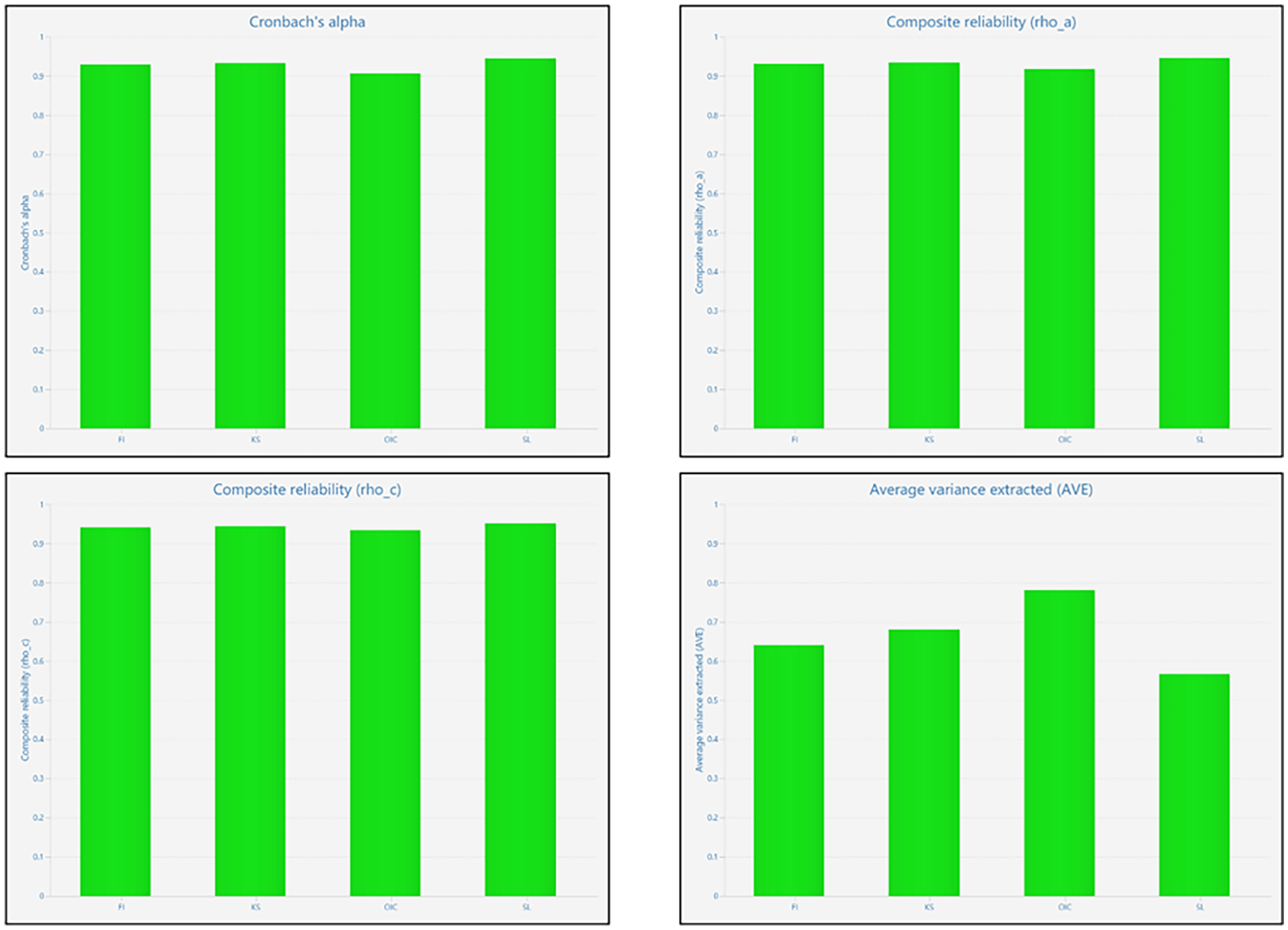
Cronbach’s alpha, rho_A, average variance extracted, composite reliability.
To assess discriminant validity, the square root of the AVE for each construct should be greater than the correlation between constructs, using the criterion of Fornell and Larcker (1981). Table 4 presents discriminant validity values. The results show that all AVE square root values are greater than the correlations between constructs, which indicates that the measures are not a reflection of other variables. Hence, the discriminant validity criterion is satisfied.
Discriminant Validity.

Structural Model
To test the proposed hypotheses and analyze the structural path of the research model, we used SmartPls 4.0.8.7 software and followed Hair et al. (2019) by looking at the structural path coefficients, defined with bootstrap with 5,000 samples. Table 5 shows the results of structural equation modeling estimates. Figure 3 also presents the hypothesized structural model of the study. The results reveal that sustainable leadership has a positive and significant direct effect on frugal innovation (β = .451; p < .001), which supported H1.
Direct Effect Analysis.


Structural model.
Mediating Analysis
The results of the mediating effects of knowledge sharing are shown in Table 6. Further Figure 4 presents the structural equation modeling of mediating effects of KS. The empirical results reveal the positive effects of sustainable leadership on knowledge sharing (β = .451; p < .001) so hypothesis H2 is supported. And knowledge sharing has a positive significant effect on frugal innovation (β = .451; p < .001), thereby supporting H3. H4 proposes that knowledge sharing plays a mediating role between SL and FI. Our results reveal the significant indirect effect of sustainable leadership on frugal innovation through knowledge sharing (β = .451; p < .001). Hence, H4 is supported.
Mediating Effect of Knowledge Sharing.


Structural equation modeling of the mediating effect of KS.
Moderating Analysis
Table 7 shows the results of the moderating effects of organizational innovation climate. Further Figure 5 presents the structural equation modeling of mediating effects of KS. The results show that the interaction of KS*OIC significantly affects FI (β = .207; p < .001). Therefore, hypothesis 5 is supported, and it reveals that the OIC positively moderates the effect of KS on FI.
Moderating Effect of Organizational Innovation Climate.


Structural equation modeling of the moderating effect of OIC.
Discussion
FI is becoming the mainstream of recent innovation research due to the growth potential and business opportunities in emerging countries. Frugal innovation is considered to be the future of innovation management and will become a new business model or strategy that cannot be ignored in emerging or developing countries in the coming years (Khan, 2016). This study attempts to examine the impact of corporate sustainable leadership style on frugal innovation in the context of the emerging country of China, while testing the impact of knowledge sharing and organizational innovation climate in the relationship between SL-FI. Data for the study were collected through an online questionnaire, and the respondent group was employees of Chinese SMEs in the manufacturing and service industries. This study used SmartPLS 4.0.8.7 software to analyze the data empirically. The findings show that sustainable leadership style promotes frugal innovation and knowledge sharing mediates the positive impact of SL on FI. In addition, organizational innovation climate positively moderated the relationship between knowledge sharing and frugal innovation.
The data show that sustainable leadership style has a positive impact on FI, a finding that supports and advances previous research (e.g., Iqbal & Ahmad, 2021; Lei et al., 2019). The possible explanation of this finding could be that sustainable leadership is a key factor in improving the ability of firms to develop specific products/services in environments with limited resources. The positive impact of sustainable leadership helps employees to develop innovation capabilities within the organization, integrate information and share knowledge, come up with new ideas to develop frugal innovation solutions, and ensure the quality of innovation under constraint pressure while addressing needs for resource-scarce markets and customers.
The findings also show that knowledge sharing plays a partially mediating role between SL-FI, that is, sustainable leadership practices can directly or indirectly promote frugal innovation in firms by facilitating employees’ knowledge-sharing behaviors. This finding also suggests that employees are more conducive to generating new solutions to resource constraints by continuously collecting and integrating new knowledge, facilitating the organizational frugal innovation process. Knowledge sharing helps to better handle the challenges of the frugal innovation process by creating a favorable climate in the organization where employees learn new knowledge and reintegrate it, improving creative problem-solving skills (Carmeli et al., 2013).
In testing the moderating effect of organizational climate on the relationship between knowledge-sharing process and frugal innovation, the data showed that organizational innovation climate positively influences the effectiveness of knowledge dissemination for innovation. This suggests that if leaders can create a climate within the organization that values and supports innovation, it can facilitate innovation and further boost the competitiveness of the company. This also implies that organizations that want to achieve the goal of FI can stimulate innovative interactions among employees by creating an innovative climate and enhancing KS activities. The findings respond to the call of previous studies (Donate & Guadamillas, 2010; Le, 2021; Lei et al., 2019) by examining the mechanism of the role of organizational contextual factors in the relationship between knowledge and innovation activities.
Implications
Overall, the empirical results obtained in this study support all direct and indirect hypotheses and have several theoretical and practical implications for the fields of leadership, knowledge management, and innovation management. The theoretical implications of this study are several: First, our study developed and tested a theoretical model to examine the impact of sustainable leadership styles on frugal innovation in companies. The results of the study showed a positive impact. The findings are consistent with previous results that have examined the important role of leadership on corporate innovation (Hughes et al., 2018; Iqbal et al., 2022; Khalili, 2016; Lei et al., 2019). Previous literature has rarely linked sustainable leadership to frugal innovation and examined the intrinsic mechanisms of influence. Therefore, this paper makes a significant contribution to filling such a gap in the literature by integrating sustainable leadership and frugal innovation. By examining the SL-FI relationship, this paper makes a significant contribution to a deeper understanding of the antecedents of FI and reveals that organizations need to accelerate their FI capabilities by developing the SL style of their managers or directors.
Second, this study examined the mediating role of knowledge sharing in the relationship between SL and FI, and the findings showed that SL can promote frugal innovation directly or indirectly through knowledge sharing. Previous studies have identified knowledge sharing as an important mediator between critical leadership and key organizational outcomes (Lei et al., 2019; Uddin et al., 2016; Zheng et al., 2017). However, previous studies have rarely investigated the mechanisms underlying the influence of sustainable leadership on frugal innovation or explored the mediating role that knowledge sharing plays in the relationship between SL-FI. Based on this, this paper contributes to advancing innovation theory by constructing a model integrating SL, KS, and FL, which contribute to the advancement of literature in the field of knowledge and innovation.
Third, this study examined whether organizational innovation climate plays a moderating role between KS-FI. The empirical results indicate that knowledge sharing has a stronger effect on frugal innovation when the degree of organizational innovation climate is higher. This implies that effectively promoting employee knowledge sharing within the organization and building FI capabilities requires a certain external environment to support it. By introducing OIC as a situational variable that interacts with knowledge sharing to foster frugal innovation, a gap in the existing field is filled, and our understanding of knowledge in the field of innovation is deepened.
Finally, this study chooses to study SMEs in the emerging country of China and emphasizes the importance that firms should enhance frugal innovation. Resource constraint is a serious difficulty faced by SMEs in the external market competition, and frugal innovation is an important solution to deal with the problem of resource constraint. The main idea of this innovation is to provide a product or service that meets a specific need or is cost-effective in emerging markets, making it available to resource-constrained consumers who do not have access to such products/services (Weyrauch & Herstatt, 2017). The findings provide a new context for empirical research on frugal innovation in emerging countries and valuable insights into how firms in emerging or developing countries can effectively engage in frugal innovation, with sustainable leadership practices and knowledge-sharing activities as important drivers.
Third implications for managerial practice can be derived. First, the empirical results of this study can motivate executives, managers, and entrepreneurs, among others, to innovate frugally use new solutions for economic growth in resource-constrained environments and provide products or services that are easy to use and have core functionality for consumers in emerging markets. Companies developing frugal innovations can achieve efficient use of resources and provide frugal products and services that can create more inclusive markets and can contribute to the sustainable development of society (Dost et al., 2019).
Second, our findings suggest that SL may be an important way for firms to develop FI capabilities within the organization by promoting employees’ knowledge-sharing activities and thus (Iqbal et al., 2022). Sustainable leadership fosters employees’ willingness to share knowledge and encourages them to identify and exchange knowledge beyond their personal interests, which in turn enhances corporate frugal innovation and improves sustainable practices (Iqbal et al., 2020, 2022). Therefore, companies can develop managers’ sustainable leadership styles through appropriate training programs and provide favorable conditions for them to apply SL practices in their organizations. Specifically, managers can practice the SL leadership style by (1) developing and sharing a long-term corporate vision and setting a direction for growth; (2) creating a supportive organizational culture that actively inspires employees; (3) gaining employees’ trust and encouraging them to freely express their ideas; (4) maintaining open communication with employees to better understand their needs, ideas, and so on. These will greatly facilitate the KS process to achieve frugal innovation.
Finally, the empirical results of this paper suggest that organizational innovation climate is an important factor that can improve the effectiveness of KS process on the role of FI. Therefore, executives/managers need to foster a work climate within the organization that is open to communication and encourages innovation, and employees’ KS activities and innovation activities need some external support to be more effective (Le, 2021). Corporate executives/managers can create an atmosphere that encourages and supports innovation in the workplace by (1) arranging for employees to work in groups with diverse knowledge skills and encouraging open group communication; (2) recognizing and rewarding innovative ideas and behaviors among employees; (3) providing resources for employees to propose innovative ideas or solutions, and so on.
Limitations and Directions for Future Research
There are some limitations of this paper as well. First, this paper uses a cross-sectional design to study the correlation between constructs. This may result in changes in causality over time. Future longitudinal studies can be used to overcome this limitation and consolidate the findings. Second, this study is limited to a sample frame of Chinese SMEs, and the study can be further extended and consolidated by investigating large firms in the future or by continuing to test the study in other country contexts. Finally, this study examined the mechanisms underlying the influence between leadership style and FI from a knowledge perspective only. Therefore, this study strongly calls for future research to explore new antecedents and appropriate conditions for firms to pursue FI. In addition, future research could examine the mechanisms by which different leadership styles affect FI and use other mediating or moderating variables to further explore the boundary conditions of the role of leadership styles on FI.
Research Data
sj-xlsx-1-sgo-10.1177_21582440231200946 – for Sustainable Leadership, Knowledge Sharing, and Frugal Innovation: The Moderating Role of Organizational Innovation Climate
sj-xlsx-1-sgo-10.1177_21582440231200946 for Sustainable Leadership, Knowledge Sharing, and Frugal Innovation: The Moderating Role of Organizational Innovation Climate by Hong Tian and Ao Wang in SAGE Open
Footnotes
Declaration of Conflicting Interests
The author(s) declared no potential conflicts of interest with respect to the research, authorship, and/or publication of this article.
Funding
The author(s) disclosed receipt of the following financial support for the research, authorship, and/or publication of this article: This work was supported by research on the formation mechanism and influence effect of pro-environmental behavior in Chinese organizational context" (20FGLB039), a late-stage project funded by the National Social Science Foundation of China.

References
Supplementary Material
Please find the following supplemental material available below.
For Open Access articles published under a Creative Commons License, all supplemental material carries the same license as the article it is associated with.
For non-Open Access articles published, all supplemental material carries a non-exclusive license, and permission requests for re-use of supplemental material or any part of supplemental material shall be sent directly to the copyright owner as specified in the copyright notice associated with the article.
