




Abstract
The positive effects of multimodal instruction have been widely assumed, but few studies have looked into the impact of multimodal tutorials within the context of an Intensive English Program (IEP). Hence, to address the research gap, the aim of this study was to investigate the impact of multimodality and tutoring assistance within an IEP on the language proficiency of EFL learners. The IEP program consisted of two phases, featuring three forms of tutoring: non-tutoring, multimodality tutoring, and multimodality mentor-tutoring. The research questions were answered using both experimental and survey methods. The quasi-experimental study was conducted (N = 467) with two fixed factors, that is, Type of Tutoring and Phase. A questionnaire was further distributed to measure students’ perceptions of learning, including learning effort (LE), perception of TA scaffolding (TASCAF), and willingness to continue learning (WTL). The results of two-way ANCOVA indicated a significant effect of Type of Tutoring (p < .001), and interaction between Type of Tutoring and Phase (p < .05). Structural equation modeling testing the model fitness (i.e., LE contributes significantly both directly and indirectly through TASCAF) indicated an acceptable goodness of fit (CFI = 0.952, SRMR = 0.036, and RMSEA = 0.80), supporting the significant contribution of Type of Tutoring to students’ English learning. In summary, the multimodal tutorial environment reinforced the contemporary tenet that language learning is fundamentally socially mediated. This aspect underscores the creation of a multimodal learning context with an optimal interplay among mentors, tutors, instructors, and students.
Introduction
Multimodality in language teaching and learning has been considered beneficial to student learning (Choi & Yi, 2016; Jewitt, 2013; Lim et al., 2022; cf. New London Group, 2000). In particular, it is the use of the multimodal online resources and electronic tools exposing students to the target language through interactive meaning-making activities in English courses that enhances the effect of learning (Grabe & Grabe, 2007; Macknish, 2019). More recently, Khan and Mallette (2019) pointed out specific advantages of such teaching, including intensifying learners’ engagement with language texts, making school learning pertinent to students’ off-campus interests, offering a voice to marginalized or lower achievers, and encouraging greater interaction between teachers and students, and between students and teaching assistants (Chadha, 2013; Plakans, 1997).
Furthermore, effective language programs such as Intensive English Programs (IEP) usually entail the cooperation of instructors, learners, and administrators, who work together to discover any possible new efficiencies in the approaches to improve learners’ language abilities (Mclaughlin, 1996; Yi & Angay-Crowder, 2016). The IEP is one such example conducted with the collaboration of instructors, TAs, and learners. Many factors are presumed responsible for the facilitating effects of IEPs (Mukundan et al., 2012). For example, many lower achievement students need more support in terms of multimodal pedagogies and scaffolds where learning occurs in a social context (Vygotsky, 1978). However, few studies have explored the effects of different types of IEP in a multimodal society where people use language, images, gestures, actions, sounds and other resources to communicate (Lim Fei et al., 2015). Since no studies have focused on the effect of multimodality instruction with tutoring support in short-term programs, the current study aimed to explore this effect on an IEP.
IEPs: Aims, Features, Collaboration, and Administrative Support
It is commonly recognized that IEPs are conducted for international students in U.S. universities in order for them to advance in their careers (e.g., Juffs, 2021; Reese & Hekms, 2018; cf. CSUN, 2021); these IEPS come with some specific features such as:
providing “non-native English-speaking international students with instruction in grammar, reading, writing, and speaking.”
“focusing on English for high-level daily communication and academic study, and serving students with varying levels of English proficiency.”
entailing a minimum of 18 hr of coursework per week.
offering courses based on one-on-one tutoring sessions.
preparing international students for English examinations (e.g., TOEFL and IELTS).
Moreover, support from administrators, coordinators, and faculty is significant for the development of IEP programs, as examples at the University of Arizona, Georgia State University, Georgetown University, Indiana University, University of Missouri, and UCLA. This support involves a range of administrative structures, including curriculum design (e.g., Brevetti & Ford, 2017). IEPs are also possibly conducted via collaboration with proprietary providers in terms of courses offered and curriculum governed or sponsored by a company through a range of administrative structures.
In particular, Table 1 summarizes some IEP features from selected programs conducted in the US and/or elsewhere. For example, IEPs need the collaboration of instructors, TAs, and administrators, who work together to enhance learners’ English proficiency. However, it has also been revealed that some programs were hindered by a low number of TAs, mentors, and lack of IEP documents (e.g., Juffs, 2021; A. S. Thompson, 2013).
Selected IEP Studies and Research Papers During the Past Two Decades.

Framework of the Study
This research began by describing multimodality, the multimodal IEP, the multimodal tools, and social scaffolding interaction. It has been reported that mentorship positively affects academic and learning outcomes in higher education (Lorenzetti et al., 2019). According to Hutson et al. (2022) and Terry and Ghosh (2015), successful mentorships result in improved success rates and retention rates in learning for students from different social areas. Figure 1 illustrates our proposed socially interactive framework for implementing a multimodal IEP with mentor-tutoring, as a solution to students’ limited exposure to English due to the limited hours of lectures (cf. Fernández-Fontecha et al., 2020; Harwood, 2023; Herring, 2015; see also Tables 1–3).

The multimodal IEP framework of this study.
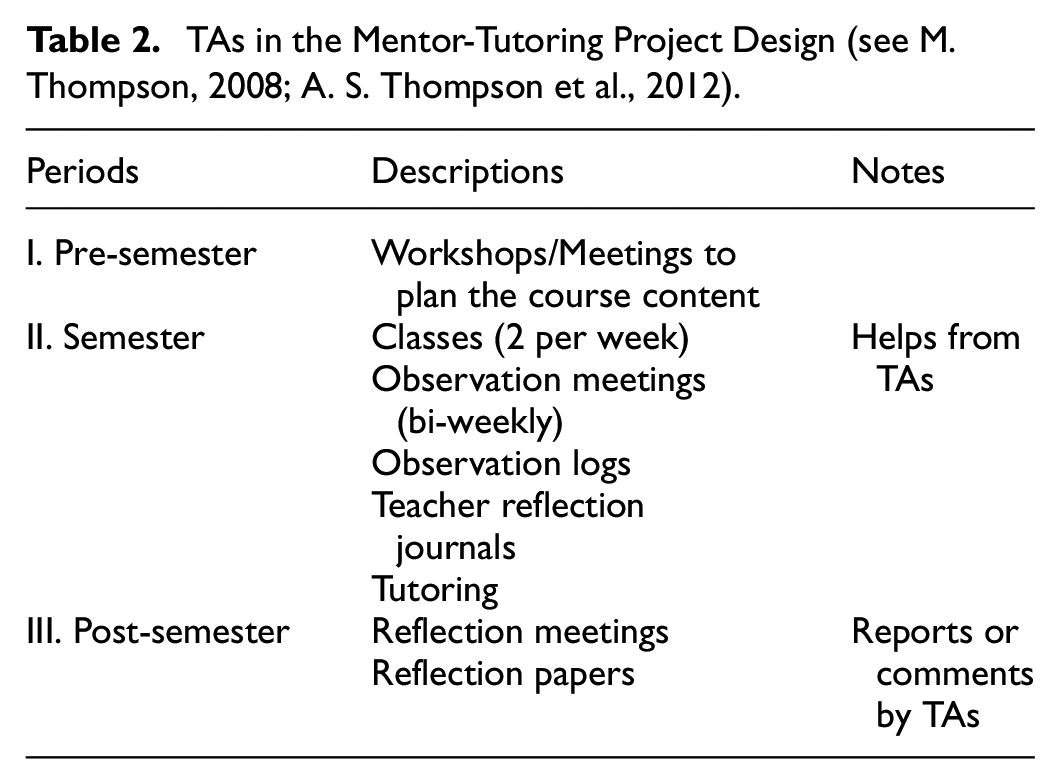
TAs in the Mentor-Tutoring Project Design (see M. Thompson, 2008; A. S. Thompson et al., 2012).
Multimodal Theoretical Framework.

This mentor-tutoring framework with intensive, interactive and collaborative features has been implemented through the IEP administration, coordination/mentoring, instruction and tutoring for grouping, which are based on four aspects, namely relevant theories, curriculum design, instruction methods, and assessment (A. S. Thompson et al., 2012; S. -p. Wang & Chen, 2018).
To reinforce the language learning of the four skills, Campoy-Cubillo and Querol-Julián (2021) argued how to assess multimodal listening, and provided a model for the practice of multimodal listening. Furthermore, Oyama-Mercer (2019) explored some positive outcomes of multimodal reading of literary texts. According to Selander (2021), a new learning landscape has been proposed to explore how text meaning in language learning has been expanded over time, especially how three dominant understandings of text are related to social and technological conditions, and how they interact with one another: (1) texts as written and printed/verbal text, (2) text as multimodal text, and (3) text as interactive text. For example, text is defined as written letters and words, whereas reading and writing are understood as the ability to read or write letters, words, and sentences.
Research Aim and Research Questions
The present study aimed to examine the effects of three different types of tutoring in the IEP on the participants’ learning achievement in two phases (see Table 1), namely (1) simple IEP (no tutoring), (2) IEP with tutoring and multimodality (Cabezas et al., 2011; Khan & Mallette, 2019), and (3) multimodal IEP with mentor-tutoring (Griffee, 2012; Macknish, 2019). Accordingly, the following research questions (RQs) were formulated:
RQ1: To what extent was the type of tutoring effective in making a difference to students’ English ability?
RQ2: To what extent was the factor of phase effective in making a difference to students’ English ability?
RQ3: To what extent was the interaction of type of tutoring and phase effective in enhancing students’ English ability?
RQ4: How did students’ perceptions of tutoring contribute to their willingness to continue to learn English?
RQ5: How did the multimodal approaches, adopted in the Presentation and Interview courses, along with mentor-tutoring sessions, influence the students’ language learning?
Literature Review
This section begins with a general theoretical framework of second language acquisition (SLA) inspired by Vygotsky’s socio-cultural theory (Vygotsky, 1978) in which interaction plays the central role of learning. Based on the framework, the concept of multimodality in education was reviewed to emphasize the functions of multiple modes in learning. Then, more reviews demonstrated how IEP can be designed in multimodal learning contexts with practical support of team-teaching and tutoring. The last two parts are more details of how technologies and corpora are integrated into the design of multimodal instruction contexts.
SLA for the Scaffolding and Sociocultural Interaction
Vygotsky’s (1978) sociocultural theory (p. 87) claims that learning occurs in a social context so that students learn from their role models (i.e., instructors or TAs) who facilitate in the zone of proximal development (ZPD), the optimal teaching space where a teacher structures the environment to promote cognitive development. Learners make improvement through scaffolding interactions with instructors and/or TAs, especially during the process of language learning (Tyler, 2012).
As Vygotsky (1978) put it, learning is considered a mediated and internalized process of social interactions (Vygotsky, 1978), yet Ngo (2018) claimed that learning involves an intensely personal process. In fact, the learning process involves an alteration of the external sociocultural level into the internal psychological level in terms of mediational mechanisms. In other words, learning involves both independent-functioning level (i.e., being able to learn independently without guidance), and instructional level (i.e., requiring instructional scaffolding, guidance, or TA’s help) (Ellis, 2008). This is achieved with the help of scaffolding. That is, language learning may happen in a social context where a learner can perform better with the support of others (Lantolf & Thorne, 2007; Tyler, 2012, p. 16).
Moreover, in the area of SLA, interaction has been confirmed as playing a crucial role in the process of learning (Ellis, 2008). During the past decades, many studies have demonstrated how classroom interactions play important roles in collaborative conversations (Swain, 2018; Swain & Lapkin, 1998), negotiation (Polio & Gass, 1998), corrective feedback (Lightbown & Spada, 1994) and effectiveness in language learning (e.g., C. Wang et al., 2020).
However, the poor English performance of technological university students in Asia has long been a concern (see ETS, 2020). Such concerns in some Asian countries (e.g., Japan and Korea) have been prompting governments or universities to provide stronger support for English programs, such as more interactive multimodal instruction (e.g., O’Halloran et al., 2016; Unsworth & Cléirigh, 2014) to enhance the overall efficacy of English teaching.
Multimodal IEP
Multimodality research refers to understanding how to make meaning through a diversity of communicative modes (Lamy, 2012); it is used to explore how people communicate and interact with each other through many modes (Kress, 2010) such as reading (Oyama-Mercer, 2019; Unsworth & Cléirigh, 2014; S. -p. Wang & Chen, 2018), writing (DePalma & Alexander, 2018; Gebhard et al., 2008), listening and speaking (Clancy & Murray, 2016; Macknish, 2019), presentation (Morell, 2015), gesture, gaze, and audio-visual forms with the use of technological instruments (Farr & Murray, 2016; see Appendix 1).
As for the course design, the multimodal curriculum is a significant design for developing students’ language ability, which receives “increasing attention as a contributing factor to learners’ academic success” (Hong-Nam & Leavell, 2006, p. 401). Some multimodality studies have indicated the function of technologies in EFL to help learners develop “multimodal communicative competence” (Prior, 2013; Royce, 2002, 2007) such as conference presentations along with multiple modes (e.g., digital media, slides, journal papers, and many other technical genres). Moreover, multimodality can be put into practice in students’ assignments and their development of learning artifacts; such practice would effectively facilitate students’ learning (Plastina, 2013).
In multimodal service-learning, reflections have been applied to strengthen the multimodal learning of ESL learners. As Macknish (2019) put it, seniors serving as mentors in the meaningful context enabled individuals to contribute to the community. Khan and Mallette (2019) indicated how students expressed their willingness to learn from the International TAs (ITAs) in the multimodal learning context.
While fruitful results have indicated the positive influence of using multimodality on English learning, little is known regarding the effect within a short period, such as IEP. In other words, studies on multimodality for English learning abound, but few have attempted to explore its effectiveness in IEPs which are preferred by technological universities in Asia (Ladika, 2018).
The Inclusion of Tutors in IEP
Team-Teaching Mentoring Design
An IEP usually involves a team-teaching design, which requires the participation of both mentors and TAs, as proposed by A. S. Thompson et al. (2012), pp. 137–168). Such design shows a three-stage process of successful TA development (i.e., “senior-learner,”“colleague-in-training,” and “junior colleague”). The behavioral principles for TAs and mentors are: (I) collaboration between TAs and mentors, (II) TAs as the decision-makers, and (III) abundant opportunities for conversation between TAs and mentors to bridge the gap between teachers and students. As the foregoing review unfolds, there are inevitable challenges faced by teachers, students and administrators implementing IEPs, but these challenges are likely to be overcome through several methods, one of which is the inclusion of tutorial sessions (see Table 2).
The Role of Tutors
The success of an IEP is related to the intensity of tutoring, including socialized and individualized arrangements (Wasik, 1998). It is also important to enhance the work of TAs for intensive programs in higher education (Chadha, 2013). As an interactive and socialized role, TAs motivate collaborative teaching and learning in a socialized environment. As Reinhardt and Zander (2011) proposed, L2 socialization perspectives and research frameworks are applied to social-networking sites (SNS) in IEP contexts. They also “develop awareness of SNS literacy practices as a means for learner socialization and community practice” (p. 327) by using classroom research methods, involving teaching and learning logs, audio recordings of classroom interactions and observations.
Moreover, some relevant tutoring studies have long been explored. First, as Shaw et al. (2008) explained, a successful tutorial session is based on collaboration between the tutors and tutees within the classroom setting. Their interactions become meaningful when tutors encourage students to observe their own learning and to share their ideas in lectures, readings, and discussions. Second, Cabezas et al. (2011) argued that tutoring played a prominent role in a short-term language program since it effectively increased students’ scores. Specifically, they found that more tutoring sessions per week resulted in greater academic achievement. According to Allen and Chavkin (2004), it is more likely that students who receive more tutoring pass examinations and receive higher scores. Furthermore, Jarvis and Creasey (2012) reinforce the merits of applying tutoring in language teaching. For example, the more students trust the instructors/TAs, the more their relationship has been enhanced.
However, few studies have explored the role of TAs in a multimodal IEP, aiming at improving students’ language abilities. Our current IEP clarified how instructors and tutors enhanced students’ vocabulary proficiency, reading comprehension, and listening ability (Kanzaki, 2020) by reinforcing theories and applications of multimodality (e.g., Oyama-Mercer, 2019).
Multimodal Technologies in IEP
Multimodal approaches help students in language learning beyond verbal language to realize and produce text more effectively (O’Halloran et al., 2016). Peláez Galán (2016) postulated that using multimodal approaches and technologies would increase learners’ motivation and collaboration. Especially, technologies may play a dual role (tools and tutors) in the multimodal environment. A tutor and his/her tutees used the multimodality of the learning environment to promote their interaction in which the tutors repeatedly reinforced what had been expressed in their talk, and the tutees asked for language help from the tutor.
Furthermore, multimodal instruction creates spaces for language and content teachers (Fernández-Fontecha et al., 2020; M. Thompson, 2008), involving many SLA theories (e.g., Royce, 2002, 2007), and L2 learning and pedagogical approaches (Lotherington & Jenson, 2011; Walker & White, 2013). Based on the SLA-relevant theories, multimodality integrated various ideas, principles, or theories into a more solid IEP to reinforce its effectiveness and to shorten the length of the program.
Table 3 summarizes the SLA-relevant theories (see also Appendix 1) to integrate computer-assisted language learning (CALL) into technology-enhanced language learning (TELL), thus outlining how an integrated multimodal framework has been applied to the current study (adapted from Walker & White, 2013, p. 10; see also Gajek, 2019, pp. 191–213; Saville-Troike, 2012, pp. 25–30; Hauck & Youngs, 2008).
Therefore, TAs in the tutorial sessions, with their role in creating face-to-face communication, make the best use of the multimodal functions, increase the accessibility of the electronic devices, and expose learners to more English. Since few studies have explored the interaction in an IEP as the relations between “instructors and learners” or “tutors and tutees” in a cognitive, socialized environment (Barton & Lee, 2013), this study explored how an IEP was conducted by integrating the multimodal design (see Figure 1 and Table 3) into CALL and TELL to increase students’ exposure to English (Guichon & Cohen, 2016).
Multimodal Corpus-Based Wordlists and Teaching Materials
As Lessard-Clouston (2021) noted, vocabulary is central to English language teaching. Yet college students today tend to have a limited vocabulary. To tackle this problem, Mayer (2005) suggested that a multimodal approach integrating pictures and words can be more useful for students to learn languages. Moreover, Bonsignori (2018) explored the pedagogic potential of a multimodal corpus in teaching and learning, especially when the corpus was composed of video clips generated from films and TV series touching on specific discourse domains, such as Business and Tourism. With such a corpus, multimodality could play an important role in students’ meaning-making processes. What is more, Fuchs and Akbar (2013) also suggested that authentic materials or online texts can be integrated into multimodal IEPs.
Therefore, developing multimodal corpora with multimodal analysis is a potential solution to the problem of language learning. As suggested by Abraham (2008) and Fuchs and Akbar (2013), a corpus-based wordlist (see Appendix 2) was strongly proposed before the program, and/or during the tutorial time to reinforce students’ listening and reading abilities (Kanzaki, 2020). Wordlists are also important in language teaching and learning (Juffs, 2021; Lessard-Clouston, 2021) because some words occur more frequently than others in certain genres which should be learned first (Lessard-Clouston, 2021; Nation, 2008). Useful corpus-based resources (Szudarski, 2018, pp. 102–103), websites (B. Murphy & Riordan, 2016, pp. 401–403), and corpus-based vocabulary teaching materials are conveniently available (M. Jones & Durrant, 2010, pp. 387–400) for instructional purposes.
Summary of Literature Review
In summary, to maximize students’ exposure to English and to create dialogic spaces (Bakhtin, 1981; Wong, 2006) for passive students, a language program can be designed including the elements: (1) integrating tutorial sessions into the IEP and emphasizing collaboration between tutors and tutees (see Figures 1 and 3; Shaw et al., 2008), (2) applying authentic materials (e.g., the wordlists in Appendix 2) into the multimodal design (Fuchs & Akbar, 2013), and (3) combining more easily created multimodal texts with digital materials and video clips (see Figures 1 and 3; Barton & Lee, 2013). Additionally, TAs and mentors should collaborate to bridge the gap between teachers and students. Mentors also play a role as a consultant to advise or to help TAs to solve instructional or non-instructional issues. In other words, multimodality can be an effective instructional scaffold to boost learners’ communication and language ability with the help of technology and a mentor-tutoring design (A. S. Thompson et al., 2012).
Methods
This was a quasi-experimental study with pretests and posttests which measured students’ English ability. A survey questionnaire was also adopted to measure students’ perceptions of English learning. A pre-course workshop to train both teachers and TAs was conducted to improve the mutual agreement and tripartite understanding (i.e., mentor, instructors, and TAs), including collaboration and opportunities for the tripartite dialog.
Participants
The study consisted of 467 students from 38 technological universities assigned in 14 classes, from 38 technological universities. They were involved in two phases of IEPs, ranging from 30 to 36 in each class. For our research purpose, the 14 classes were assigned into six groups with two dimensions: Tutoring type and Phase of program (see Table 4). There were three levels of tutoring type: Non-tutoring (T1), Tutoring + Multimodality (T2), and Tutoring + Multimodality + Mentor support (T3), and two phases of IEP, Phase 1 and Phase 2, launched during two consecutive Summers. In Phase 1, the students of Group 1 (n = 30) and Group 2 (n = 30) from the same university (U1) participated in a similar IEP but received no tutorial sessions. Group 3 (n = 30) and Group 4 (n = 30) students were from eight technological universities (U2–U9), with Group 3 receiving tutoring plus multimodality support while Group 4 received tutoring, multimodality and mentor support. During Phase 2, students in Group 5 (n = 175) had no tutoring, while Group 6 received tutoring, multimodality and mentor support. The two-dimensional dissemination of the classes is shown in Table 4.
Three Types of Tutoring.

Thirteen instructors took turns teaching each group. The mentor as a coordinator called for a meeting of the instructors who attended the pre-teaching workshop, and supervised TAs to ensure the tutorial quality. Each class with tutoring support was assigned three TAs with native-like accents and TOEIC scores of over 900 points. All TAs were equipped with the skills of counseling, language teaching, technology communication, presentations, and keeping daily teaching logs (see Appendix 3).
Course Design
For all groups of students in the program, there were 13 short courses (see the left column in Table 5) with corresponding language activities, comprising 120 teaching hours. Students in Type 1 (see Table 4 above) received traditional language teaching emphasizing the four skills of listening, speaking, reading, and writing. These students without tutoring support spent about 60 to 80 hr in total after class on self-study.
Multimodal Pedagogical IEP Curriculum (MPIC).

Students in Type 2 (tutoring with multimodality) and Type 3 (Mentor-tutoring with multimodality), on the other hand, had about 60 to 80 tutorial hours. The tutorial activities increased the exposure time to English vocabulary, reading, and communication with the TAs, and the interactions within the learner group. The TAs also kept their daily teaching logs, describing tutees’ learning behaviors mainly based on (1) linguistic factors, for example, pronunciation, accuracy, fluency, grammatical errors, and presentation skills, and (2) non-linguistic factors such as tutees’ psychological mindset and learning attitude. All TAs were requested to participate in the TA training meetings, while the teachers attended the pre-teaching workshop to come to a general agreement on the program.
The tutoring sessions were based on the integrated multimodal design, following the Multimodal Pedagogical IEP Curriculum (MPIC), involving various multimodal features in teaching, tutoring, and testing aspects, through multimodal approaches, for example, video clips, YouTube, Ted Talks, online materials, etc. (Schmitt & Hamp-Lyons, 2015). Since a multimodal assessment contributes to understanding the complicated phenomena of short- and long-term courses (Olson, 2014; Sahakyan & Ryan, 2018; Stieglitz, 2003), the current multimodal program also comprised digital learning and testing to help students improve their English ability, interview skills, and presentation skills. Most instructors applied technical skills and online resources to integrate content and language into their syllabi. Both teachers and tutors used interactive, communicative and multimodal instruments to enhance students’ language learning through various types of assessment tools such as the wordlist quizzes, the pre- and post-tests, the final presentation contest, and English interviews (see Table 5).
For students in the mentor-tutoring type (Type 3), a mentor was also involved actively throughout the program, acting as a counselor and coordinator among the students, the TAs, the teachers and administrators. As suggested by Brevetti and Ford (2017), the involvement of a mentor in the program offers supports from a range of administrative structures, including coordination and curriculum design. The support may also involve collaboration with proprietary providers in terms of courses offered and curriculum governed or sponsored by an institute.
As for language proficiency measures, all students were pretested at the beginning of the IEP, including TOEIC listening and reading tests (Kanzaki, 2020), followed by the implementation of courses, and then posttests. This process was conducted for 4 weeks during the summer.
Instruments, Measurements, and Questionnaires
This study used TOEIC (Test of English for International Communication) as the measure for students’ English proficiency; it is a standardized test across the world designed by ETS to assess non-English speakers’ general communication skills (https://www.ef.com/wwen/english-tests/toeic/). According to Kanzaki (2020), the combination of TOEIC listening and reading scores is strongly correlated to the overall scores, suggesting that both the listening and reading scores are a good representative for overall scores of the test. Thus, to test the effectiveness of this program, the pre- and post-tests of the listening and reading sections using TOEIC (495 points total each for listening and reading) were conducted. All participating students took TOEIC at least once within a month before the summer English program they joined and another one within a month after the completion of the summer program.
Furthermore, the assessments of two courses in the program, that is, the Presentation Course with Contest and the Interview Course, were included as examples of how the multimodal mentor-tutoring design is effectively integrated into the IEP. Each subject was carefully considered, such as the wordlist, listening, speaking, reading, writing, and many other pedagogical courses (see Appendices).
The Interview course with assessments was conducted through the classroom instruction and tutorial sessions. The course included the major topics: (1) conducting a pre-program interview, self-introduction, and answering the most commonly asked interview questions, (2) preparing for an interview with the art of interviewing, and (3) arriving for an interview with a post-program interview. The video clips, for example, “Interview Dos and Don’ts” were an essential part of the materials in class (see https://youtu.be/S1ucmfPOBV8). Finally, all TAs recorded students’ learning behavior by weekly logs, learned to use multimodal instruments, and acted as the rater to rehearse with and evaluate each student, mainly based on their language fluency, accuracy, and content.
As for the final presentation contest, all of the participants from Group 6 were divided into small subgroups (4–6 students per subgroup). Three instructors acted as the raters based on each team’s four criteria: presentation content (40%) based on clarity, relevancy, creativity, conciseness, etc; presentation skills (40%) based on language fluency & accuracy, body language, goal alignment, and teamwork spirit; powerpoint skills (15%) based on layout and format; time management (5%) (for detail presentation evaluation sheet see Appendix 4).
To further investigate the role of multimodality instruction, a questionnaire (see Appendix 5) was adapted from Teacher & Class Evaluation Questionnaires (n.d) (see http://iteslj.org/Handouts/Evaluation.html), the general teachers’ evaluation questionnaire used by one university involved in the IEP; this was to measure students in the mentoring-tutor plus multimodality group (Group 6). Seven items related to teaching were adopted (see Appendix 5), among them one sample item is: The instructors explained the syllabus clearly. Furthermore, a 6-point Likert-type scale questionnaire, measuring Learning Effort (LE), Perception of TA Scaffolding (TASCAF), and Willingness to Continue Learning (WTL) was designed also based on the Teacher & Class Evaluation Questionnaires (n.d) from the Internet TESL Journal. It consists of four items of LE, four items of TASCAF and four items of WTL. One item in the WTL category did not converge well with the other three items in a preliminary factor analysis and was therefore removed. As a result, there were three items remained in WTL. The indices of internal reliability, indicating the acceptable consistency of the measure of each category, are 0.78 for LE, α = .90 for TASCAF and α = .79 for WTL, respectively. The respective sample items for each category are: I attend my English class following the scheduled time; My TAs understand the students’ learning needs; I am willing to persist in learning English.
Procedure and Data Analysis
First, ANCOVA (i.e., Analysis of Covariance), using the pretest as the covariate and the posttest as the dependent variable, was applied to test any difference after the treatment, excluding the effect due to the pretest. Two-way ANCOVA was implemented, with Phase and Type of Tutoring as two major fixed factors.
Rather than testing relationships using regression analyses three times (for LE—TASCAF; TASCAF—WTL; LE—WTL), structural equation modeling (SEM) is capable of integrating the interrelationship of multiple variables. As such, SEM was conducted to test the proposed causal relationships among LE, TASCAF, and WTL:LE was hypothesized to influence WTL directly and indirectly through the mediation of TASCAF (Figure 2). Before conducting SEM, reliability and validity measures and the measurement model using AMOS were implemented to test the fitness of each subscale. Then, SEM using AMOS for analysis was also conducted to test a hypothesized model. The results indicated that the three subscales have reached acceptable reliability (CR > 0.7) and validity (AVE > 0.5); they also reached the level of good fit (χ2/df < 2; p > .05; CFI > 0.90; RMSEA < 0.05). The fitness indices, composite reliabilities (CR) and average variance extracted (AVE) are shown in Table 6.

Hypothesized model of variable relationships.
Reliability and Validity and Fitness Indices for the Scales.

Note. Acceptable threshold: CR > 0.6; AVE > 0.5 (Fornell & Larcker, 1981); χ2/df < 2 ((Ullman, 2001 ) or <5 (Schumacker & Lomax, 2004 ); p > .05; CFI > 0.90 (Bentler, 1995); RMSEA < 0.05.
Finally, a multimodal analysis was applied to investigate how other tools and modes (e.g., gaze, gesture, and proxemics) are integrated with discourse (R. H. Jones, 2012; Kress & van Leeuwen, 2001; S. -p. Wang & Chen, 2018). One key principle of multimodal analysis is to explore how language “works together” with other multiple communication modes.
Results
The Effects of Type of Tutoring, Phase and the Interaction of the Two Factors
To answer research questions 1 to 3, two-way ANCOVA was conducted to test the effects of Type of Tutoring, Phase, and the interaction between the two. Before ANCOVA was executed, Levene’s test should be first conducted to check whether the error variances of English proficiency scores in the groups are significantly different. A result of statistical insignificance (where p > .05) makes it legitimate to conduct ANCOVA. In this case, Levene’s test results indicated that the error variances of the dependent variables are not significantly different (F(4,462) = 0.168, p = .650), thus meeting the assumption of homogeneity for the test of ANCOVA.
RQ1: To What Extent Was the Type of Tutoring Effective in Making a Difference in the Students’ English Ability?
To answer RQ1, descriptive statistics (see Table 7) and the results of ANCOVA (see Table 8) with pretests as covariates indicated a significant effect of Type of Tutoring, with F = 42.258, p < .01, and η2 = 0.155 (η2 > 0.14 indicates large effect). To further provide evidence for the effect of Type of tutoring, the effect size for mean difference groups with unequal sample size with a pre-post control design was implemented (Lenhard & Lenhard, 2016). The result shows a very strong effect size of d = 0.864 based on Morris (2008).
Descriptive Statistics.

The Results of Two-Way ANCOVA (Dependent Variable: Posttest).
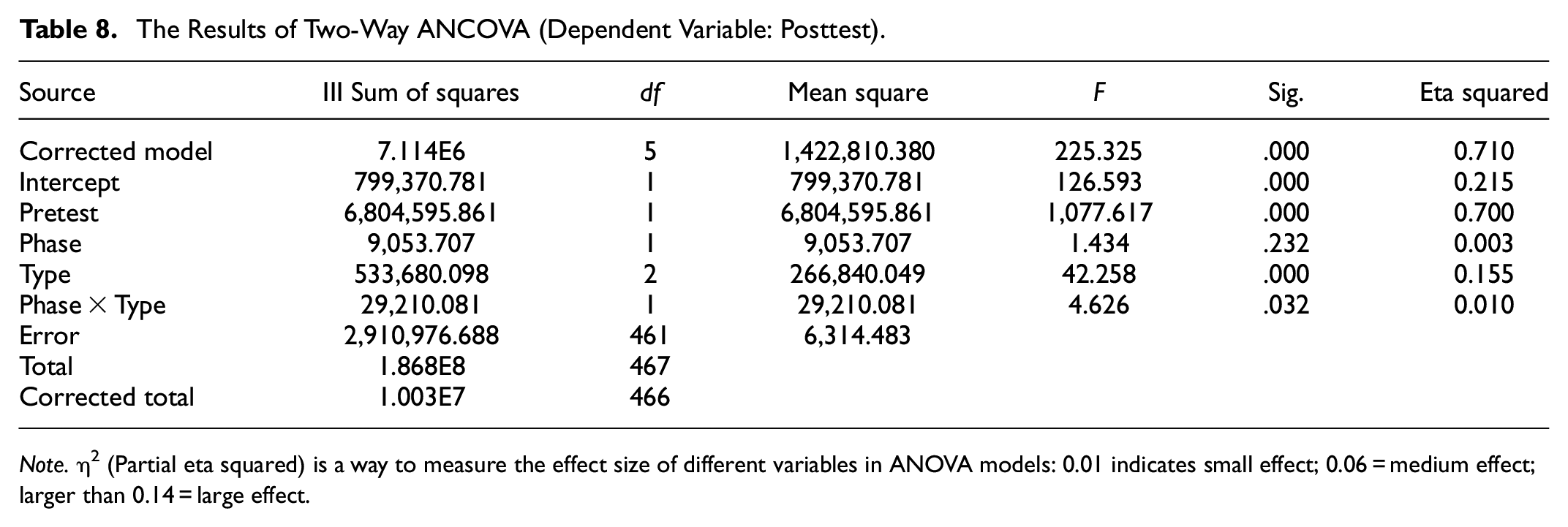
Note. η 2 (Partial eta squared) is a way to measure the effect size of different variables in ANOVA models: 0.01 indicates small effect; 0.06 = medium effect; larger than 0.14 = large effect.
With the differences in pretest scores factored out, the improvement of scores in each Type and Phase indicated that mentor-tutoring with multimodality significantly enhanced students’ English scores (see Table 9). The results of RQ1 also confirmed previous studies which found that using the multimodal framework improved students’ English ability to a significant extent (e.g., Oyama-Mercer, 2019; Selander, 2021).
Improvement of English Scores From Pretests to Posttests.

To further demonstrate how the three Types of Tutoring differ from each other, further ANCOVA paired Type 1 and Type 2, Type 2 and Type 3, and Type 1 and Type 3 were implemented. Results showed that Type 1 and Type 3 were significantly different in terms of students’ English performance (with F = 9.645, p = .003 < .05, η2 = 0.100), while other pairs were not. In other words, multimodality with mentor-tutoring significantly enhanced the students’ English performance.
RQ2: To What Extent Was the Factor of Phase Effective in Making a Difference in the Students’ English Ability?
In response to RQ2, Table 7 (see above) demonstrates that ANCOVA results in non-significant effect of Phase, with F = 1.434, p = .232 > .05, and η2 = 0.003 < 0.01.
RQ3: To What Extent Was the Interaction of Type of Tutoring and Phase Effective in Enhancing Students’ English Ability?
The answer for RQ3 is that there is a significant interaction effect of Type of Tutoring and Phase, with F = 4.126, p < .05, and η2 = 0.010. This indicates that, while both Type 1 and Type 3 Tutoring were implemented, students’ English scores in Type 3 showed a relatively much higher increase (see Table 9) in the pre-/post-test differences from 94.7 (652.2–557.5) in Phase 1 to 139.42 (628.69–489.27) in Phase 2 than those in Type 1 from 13.59 (628–614.41) to 6.92 (605.69–589.77). Likewise, RQ3 confirmed what Campoy-Cubillo and Querol-Julián (2021) and many others proposed regarding multimodal English teaching and learning, indicating an accumulative benefit in the practice of Type 3 tutoring (Mentor-tutoring).
To graphically demonstrate the trajectory of students’ English scores from pretests to posttests in different Types of Tutoring in each Phase, Figures 3 and 4 illustrate that among students in Phase 1, T2 (Tutoring with modality; a difference of 71) and T3 (Mentor-tutoring with multimodality; a difference of 94.7) improved much more than those in T1 (Non-tutoring; a difference of only 13.59) in their TOEIC scores. Furthermore, for Phase 2 (Multimodal IEP), students in T3 (a difference of 139.42) improved much more than those in T1 (a difference of only 6.92).

Score changes in Phase 1.

Score changes in Phase 2.
Supporting Evidence of the Effect of Tutoring
To answer RQ4 (How did students’ perceptions of tutoring contribute to their willingness to continue to learn English?), Structural Equation Modeling (SEM) was implemented to test the hypothesized model which suggests that Learning Effort (LE) contributes to Willingness to Continue Learning (WTL) directly and indirectly through Perception of TA Scaffolding (TASCAF). Among the many indices for model fitness, significant indicators for SEM may include: Chi-square/df < 3 (Kline, 2005); CFI > 0.95 (Hu & Bentler, 1998); RMSEA < 0.08 (McDonald & Ho, 2002); and SRMR < 0.05 (Jöreskog & Sörbom, 1989). The results of SEM indicated acceptable fit between the data and the model, with Chi-square/ df = 2.064; CFI = 0.952; RMSEA = 0.080; and SRMR = 0.036. Figure 5 shows the results which demonstrate that LE significantly contributed directly to WTL (β = .24, p < .001; β indicates the percentage of contribution to the dependent variable, in this case WTL) but also indirectly through TASCAF (β = .58, p < .001) to WTL (β = .30, p < .001). A summary of standardized weights is illustrated in Table 10. This indirect contribution which is greater than the direct contribution of LE (β = .30 > .24) to WTL further suggests the significant contribution of TASCAF to WTL. Although WTL is not the outcome of English learning, the willingness to continue to learn may then potentially result in learning outcome.

Results of SEM analysis.
Standardized Regression Weights.

Supporting Evidence of the Effect of Multimodality Instruction
The weekly questionnaire evaluating students’ perceptions of teaching was conducted in Group 6 (Phase 2 Mentor-tutoring with multimodality) to supplement the important role of multimodality in instruction (as revealed in 4.1.1). Using a 5-point Likert scale, the average of the results was 4.6 (α = .94), as shown in Table 11. The means for all questions, 4.6, was much higher than the average of scores evaluated for English courses (mean = 4.4–4.7) at the university. Moreover, the students especially appreciated the systematic content (mean of q4 = 4.7) and supplementary materials (mean of q5 = 4.7). It is evident that most students were satisfied with this multimodal IEP.
The Means of the Weekly Questionnaire Questions.

Combining the Presentation Course and the Contest to Support the Effect of Mentor-Tutoring
To answer RQ5, the Presentation course intended to improve students’ English ability with the help of instructors and TAs. For example, each class in Group 6 (Phase 2 Mentor-tutoring with multimodality) formed six sub-groups for the final competition in their presentations. Figure 6 illustrates how students were trained to prepare for the presentation contest. They received relevant training through a 4-week course by using computer software or by learning how to locate online resources under the instruction of lecturers and with the help of the TAs. Each TA also assisted his/her team in brainstorming a topic, a plot, and a draft of the PowerPoint slides, and revised the draft through continual discussions and rehearsals. As can be seen in Figure 6, there are many instances of eye gaze, indicated by the dotted arrows, among the teachers, TAs, peers, teaching materials, PowerPoint slides, and worksheets during lectures, tutorial sessions, rehearsals, and presentations. These instances are shown to be one of the important semiotics that has facilitated students’ meaning-making process across their learning trajectory (Lin, 2019).

A typical training process for the final presentation contest: (a) locating online resources at a computer lab, (b) learning to surf websites and use digital tools, (c) brainstorming the draft with the TA (left), (d) sharpening presentation skills: teaching and learning, (e) rehearsing in class, and (f) delivering a presentation during the contest.
Finally, a presentation with PowerPoint slides was delivered in a highly competitive contest. With the slides, students were required to speak on behalf of an actual company about their current marketing situations, and promote the products (e.g., mobile phones) to be sold. All the students were requested to be well dressed in business attire for this competition. In general, most students appreciated this contest and curriculum design. As Student 4 pointed out, “It is really exhausting, but I enjoy this sense of achievement. I have never focused on a subject for such a long time in one day.” Another example is a small group of students ranking second in the final presentation contest (see Appendix 4) who improved drastically in their TOEIC scores from 572.5 to 693.8.
We also perceive that the Presentation course was highly esteemed from the following comments: “Interesting!,”“Excellent!,”“I love the instructor!,” and “Very clear and practical,” indicating that all of the students greatly appreciated this course, the instructors and the TAs. A common statement found in the feedback was “I learned a lot of presentation skills.” More comments on the instructors included “The instructor introduced the SWOT analysis very professionally. She managed the classroom very well. All of us are highly motivated in her class.”
As for students’ comments on TAs, the typical feedback included such praise as these comments from Student 2 to the TAs: “I want to thank the TAs because they are really hard-working,”“The TAs are very enthusiastic, helpful and professional,” and “We interact with the TAs very well.”
The Interview Course and the Assessment Supporting the Positive Effect of Mentor-Tutoring
Just as in the Presentation course, students gained much support from the instructors and TAs. The complete course began with a pre-interview and ended with a formal and mock interview as an assessment. In between the pre- and mock interview, the instructors and TAs took advantage of different types of multimodal resources, such as gestures, facial expressions, whole-body interaction, sounds and visuals to engage students, and to enhance their understanding in different activities. Students, therefore, could come up with multiple drafts of interview scripts through rich discussion and sufficient revision.
Figure 7 illustrates the various forms of activities: Pre-interviewing with TAs (Figure 7a), Introduction to Interviews by the instructor and creating the first interview script in class (Figure 7b), the instructor’s guidance and comments on the interview scripts and practice in-class (Figure 7c), discussion and revision of the first scripts to form script (2) (Figure 7d), watching video clips of interviews (Figure 7e), revising script (2) and confirming the final and the third script (3) (Figure 7f), and interviewing rehearsal with TAs (Figure 7g) with a mock interview conducted by the TAs (Figure 7h). A remarkable change can be observed from the facial expression and posture of a trainee, slightly embarrassed and awkward at the beginning of this program (Figure 7a), but showing confidence in the mock interview (Figure 7h).

A multimodal interview course: (a) pre-interview: practice with the TA (smiling, right), (b) creation of scripts (1) in class, (c) in-class practice with the instructor, (d) discussion on and revision of scripts → scripts (2), (e) video clips: gazing and shaking hands, (f) revision of scripts (2) → scripts (3), (g) interview rehearsal again with TA (left), and (h) interview test in a formal dress suit with a TA (right).
Sample for Discourse Analytics
Some interview data are included below to demonstrate the impact of this mentor-tutoring type of multimodal instruction. For example, the students’ attitudes positively changed over the duration of the course: “Interview English is not as difficult as its name sounds. I can do it.” “I’ve learned it is not only about me. It is also about the company. It helps me to understand why companies would or would not want to hire me and for what reason I can be their best choice.” “It makes me realize that it is not only about English skills but about the interview per se.” “I thought it was all about English skills, for which I didn’t think I could prepare. After taking this course, I’ve learned that interview English can actually be prepared and should be well prepared to do it well.”
On the other hand, the TAs’ observation and evaluation of the students’ performance recorded in the TAs’ teaching logs also provided important implications. For example, TA-1 observed Student 2 and commented: “Johnny (pseudonym) sometimes falls asleep in class. However, he often answers the teachers’ questions and expresses his ideas in class. Sometimes he would make some grammatical errors; hopefully, he could improve on English grammar gradually.” Likewise, TA-2 described how Student 4 performed in class, “David’s (pseudonym) pronunciation is good, but he should be more confident when speaking English.” These comments are significant in improving the quality of teaching and learning.
Discussion and Conclusion
The Role of Multimodality in IEPs
In this study, we have presented (1) the Multimodal IEP Framework with technological language learning and teaching (see Figure 1 and Table 2), and (2) TA in Team-teaching and Mentoring Design (Table 1). The IEP has been conducted with the collaboration of instructors, TAs, and learners, as shown in a mentoring project design where TAs played a dual role, that is, tutor and bridge.
Our multimodal IEP with a mentor-tutoring design was based on CALL/TELL theories and a pedagogical multimodal IEP curriculum. This program integrating a multimodal approach with tutor-mentoring in IEP effectively enhanced students’ English ability, as demonstrated in the results of ANCOVA in 4.1. As suggested by prior studies, materials provided beyond verbal form (O’Halloran et al., 2016) and technologies (Peláez Galán, 2016) were integrated with technical tools, skills and online teaching and learning resources; this multimodal IEP has also developed into a landmark in Taiwan’s EFL teaching across different universities due to its efficiency and effectiveness. Specifically, echoing the potential effect of the short-term intensive program, the outcomes obtained within as short as 4 weeks by the student participants in this IEP were remarkably higher than the local average scores achieved through traditional teaching methods. Other than the multimodal curriculum, additional observed factors such as the tutorial time, online teaching and learning of each course have contributed to the improvement in students’ English vocabulary, reading, and listening proficiency (Li & Kirby, 2015). In addition, a multimodal corpus wordlist for vocabulary and reading practices was also implemented to enhance the students’ vocabulary, reading and listening comprehensions (see Appendices 2-1 and 2-2). The main findings are summarized below.
The Influence of Different Types of Tutoring
Additionally, the multimodal mentor-tutoring program has influenced students’ English learning to a great extent through (1) the multimodality and (2) the administrative support (see Table 12). It is apparent that the multimodal factor influenced G3 moderately, G4 moderately highly and G6 highly (based on test score improvement from pretest to posttest shown in Tables 4 and 9). As for G1, G2, and G5, they received no benefit from tutoring, mentor-tutoring and multimodal influence. As is known, a successful IEP is also supported by the administration of an institution (see Reese & Hekms, 2018). According to the results of students’ performance in our current research, the administrative support has had a high impact on the multimodal tutoring (MT), especially the multimodal mentor-tutoring (MMT). As for the non-tutoring IEP (without multimodality), traditionally, the students’ performance has long been unsatisfactory.
The Influence of Different Supports on the Three Types of Tutoring Based on Score Improvement.

An alternative way to interpret the score improvement can be attributed to the influence of administrative, communicative, collaborative and interactive support. Based on the TOEIC scores (990 points in total), Table 12 demonstrates how these different types of support affected score improvement in the three types of IEP (note: “Low” refers to improving 1–50 points, “Mid,” improving 51–75 points; “Mid-High,” improving 76–99; “High,” improving 100+).
The Role of TAs and Their Relationship With the Mentor
The present study identified the important role of tutoring in implementing an IEP. With the TAs’ tutoring, students’ exposure to and interaction with English was expanded beyond the 120 hr of lectures (M. Thompson, 2008; A. S. Thompson et al., 2012). In particular, this can be shown in the score improvement of Group 4 and Group 6 with the high Cohen’s (2013) effect size of d = 0.88 and 1.07, respectively, echoing prior studies which found that tutoring support contributed to greater academic achievement (Allen & Chavkin, 2004; Cabezas et al., 2011; A. S. Thompson, 2013). In addition to increasing students’ exposure to English, TAs also provided tailor-made support to meet various student needs. Students were found to be relatively more comfortable with raising questions and negotiating meaning during tutorial sessions than they were during class. This result echoes that of Crowe et al. (2014), who found that having an undergraduate TA in a research method course allows students to receive essential support, thereby acknowledging a TA as “an intermediary between the student and professor” (p. 772). Such positive results can be attributed to the interaction provided between the tutor and the tutee, as indicated by Cabezas et al. (2011). It is also further evidence supporting Vygotsky’s (1978) key proposal of the role of interaction in learning.
Multimodal mentor-tutoring has been applied as the framework for instructors, tutors, and tutees (see Figure 1 earlier). Tutors may encounter the challenges of the multimodality as tutees reluctantly communicate with the “cool machines.” Both a mentor and tutors may create a sociable environment, acting as a mentor or a counselor to encourage tutees and to repair any inadequacies that may be found. In sum, with the help of mentor-tutoring (Jarvis & Creasey, 2012), mutual trust and closer relationships between tutors and students could lead to successful learning outcomes. In addition, more collaborations and interactions through asking questions and seeking help result in better performance. The role of a TA, therefore, goes beyond merely providing additional hours of teaching; by meaningfully deploying multimodality, the role further encompasses the exchanges of dialog between TA and tutees and the clarification of students’ unsolved questions in class.
Additionally, TAs’ teaching logs showed how the tutees’ learning behaviors were observed, corrected, and improved through the tutorial sessions (cf. Appendix 3). This improvement demonstrates that more interactions along with technical and interactive tasks in collaborative learning are critical in IEP course design (Swain, 2018; Swain & Lapkin, 1998). Such interactions with the language and significant others may play an important role in the multimodal design of IEP programs for technological universities. The impact of other course components such as the presentation contest and the videotaping interviews in this IEP warrant further exploration as they may provide instructors, tutors, and students with a better understanding of many aspects of language education (cf. Campoy-Cubillo & Querol-Julián, 2021).
The interaction effect of Type of tutoring and Phase suggested that accumulative practice of such multimodal IEP can be an additive agent to the enhancement of students’ English scores. Although the practice of IEP in Phase 1 and Phase 2 is basically the same (as shown with no significant difference: F = 1.434, p < .232, η2 = 0.003), the interaction effect (F = 4.126, p < .05, η2 = 0.010) suggested that with accumulative experience implementing the program, the practice in Phase 2 made further contribution to students’ English scores.
The Implications of Multimodal Instruction and Mentor-Tutoring for IEP
Multimodal instruction and mentor-tutoring are two powerful and complementary approaches (Hutson et al., 2022) that can be used to unlock language learning in an intensive English program. By combining the two approaches, students can receive personalized instruction, gain a deeper understanding of language, and have a more effective language learning experience. On the one hand, multimodal instruction involves the use of multiple modes of engaging material, such as visual, auditory, and tactile activities; it calls for the use of different types of media, including video, audio, and text (cf Appendix 1). Mentor-tutoring, on the other hand, is a form of one-on-one instruction in which a mentor or tutor works with a student to help them master the material more effectively and successfully (Lorenzetti et al., 2019).
The combination of multimodal instruction and mentor-tutoring offers many benefits for language learning. First, by providing multiple modalities of engagement, the material can be more interesting and engaging for students. Additionally, by using different types of media, students can gain a deeper understanding of the material. Second, the use of a mentor or tutor allows for personalized instruction. This allows the mentor or tutor to provide feedback on the student’s progress, address areas of difficulty, and provide guidance and support. Finally, the combination of multimodal instruction and mentor-tutoring can create a more immersive learning experience, which can help students to acquire language skills more quickly. To echo Juffs (2021), A. S. Thompson (2013), and McCrostie (2010), this multimodal IEP with the mentor-tutoring design also provides an alternative approach to lifelong language learning (cf. Jacques-Bilodeau, 2010) for lower achievers for the improvement of their English proficiency (cf. Sahakyan & Ryan, 2018).
In practice, to successfully implement multimodal instruction and mentor-tutoring in an intensive English program, there are several tips to keep in mind (Fernández-Fontecha et al., 2020; Gajek, 2019; M. Thompson, 2008; Walker & White, 2013). First, it is important to find the right materials and resources to use. This may include video and audio materials (Campoy-Cubillo & Querol-Julián, 2021), as well as texts and other written materials. Additionally, it is important to find an experienced mentor or tutor who can provide personalized instruction. Furthermore, it is important to ensure that students have access to the necessary technology and that instructors are comfortable using it. Finally, it is important to create a supportive learning environment in which students feel comfortable asking questions and engaging in discussion.
The Implications for Learning and Multimodal Instruction
As shown in the current study, multimodal instruction and mentor-tutoring can have positive effects on language learning (Terry & Ghosh, 2015). On the one hand, multimodal instruction involves the use of multiple modes of representation (e.g., visual, auditory, and kinesthetic) to convey information, which can enhance student engagement and comprehension (e.g., Jewitt, 2013). On the other hand, mentor-tutoring, where students receive personalized guidance from experienced teachers, can help students progress at their own pace and address individual needs and learning styles (e.g., Allen & Chavkin, 2004; Cabezas et al., 2011). These teaching methods align with the principles of multimodal learning theory, which suggests that learning is most effective when multiple modes of representation are used and learners have personalized support (Jewitt, 2017). Further, the current research findings contribute to the development of multimodal learning theory by demonstrating the importance of incorporating multiple modes of representation in language education, that is, using multiple modes of communication with individualized support has great potentials in facilitating language learning. In other words, multimodal teaching and mentor-tutoring can be used to unlock language learning in an intensive English program. By combining the two approaches, students can receive personalized instruction, gain a deeper understanding of language, and have a more effective language learning experience. With the right materials and resources, as well as the right mentor or tutor, language learning can be made more engaging and immersive.
Critically, the creation of a multimodal learning environment reinforced the current tenet that language learning is fundamentally mediated by social relationships among people (Lantolf & Thorne, 2007). In specific, learners need to be provided with opportunities for meaningful interaction and collaboration in the language learning process. This can include activities such as group discussions, role-plays, and collaborative tasks that allow students to engage with one another in a social context and develop their language skills in a supportive and engaging multimodal setting (Barton & Lee, 2013). This understanding of language learning as a socially mediated process has important implications (Grapin, 2019) for language teachers and language pedagogy. Rather than solely relying on traditional teaching methods, such as lectures or grammar exercises, teachers can incorporate more collaborative and communicative activities into their lessons. These activities can help students to internalize language structures and develop their communicative abilities in a more meaningful and engaging way. Furthermore, the use of technology in the multimodal tutorial environment can also provide new and innovative ways for students to interact with one another and engage in language learning (Clancy & Murray, 2016; S. -p. Wang & Chen, 2018). Through the fusion of multimodal instruction and mentor-tutoring, language learning becomes not just an individual activity, but a shared and socially-driven experience that is more likely to lead to long-term language development and success (Jacques-Bilodeau, 2010; Olson, 2014; Sahakyan & Ryan, 2018).
Conclusion
In conclusion, the novel application of multimodal instruction and mentor-tutoring to language learning is an important development in the field of education. The multimodal approach enables learners to engage using language in a variety of ways to make connections between different modes of communication and helps learners to better understand and use the language, as well as to build more effective communication skills. Further, the mentor-tutoring approach scaffolds learners to gain a deeper understanding of the language and encourages learners to take ownership of their learning, as they are able to receive guidance that is tailored to their individual needs and goals. In practice, the combination of multimodal instruction and mentor-tutoring provides an innovative and effective way of teaching English. To elaborate, learning the language through a fusion of the two instructional approaches allows learners to practice various forms of communication using the language with supportive and personalized guidance and feedback. Previous empirical studies rarely reached this goal due to the lack of integrated mentor-tutoring sessions, which are shown to have an important role in effectively delivering such intensive English lessons. In the end, the novelty of applying multimodal instruction and mentor-tutoring to learning English appears to be empirically supportive. The outcome of the study showcases that the integration of multimodal instruction and mentor-tutoring helps create a positive learning environment that is conducive to language learning.
Footnotes
Appendices
Weekly Questionnaire Questions.
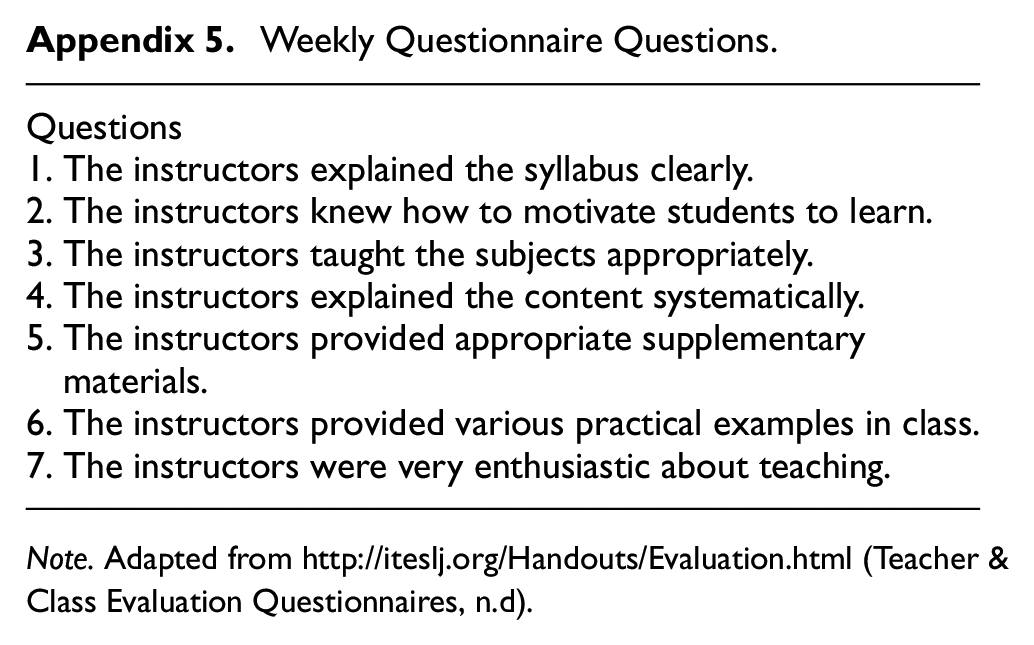
| Questions |
| 1. The instructors explained the syllabus clearly. |
| 2. The instructors knew how to motivate students to learn. |
| 3. The instructors taught the subjects appropriately. |
| 4. The instructors explained the content systematically. |
| 5. The instructors provided appropriate supplementary materials. |
| 6. The instructors provided various practical examples in class. |
| 7. The instructors were very enthusiastic about teaching. |
Note. Adapted from http://iteslj.org/Handouts/Evaluation.html (Teacher & Class Evaluation Questionnaires, n.d).
Acknowledgements
The author(s) wish to thank the teachers and the teaching assistants involved in the study for their time and untiring effort in the IEPs.
Declaration of Conflicting Interests
The author(s) declared no potential conflicts of interest with respect to the research, authorship, and/or publication of this article.
Funding
The author(s) received no financial support for the research, authorship, and/or publication of this article.
Ethics Statement
Not applicable in this study since this study was not interventional in nature.
