



Abstract
Ellipsis pervades the Qur’anic discourse. One pervasive form of it is al-iẖtibāk (“interchangeable ellipsis”). In terms of the interface between Qur’anic exegesis and Arabic rhetoric, the phenomenon of al-iẖtibāk is far more than a rhetorically heuristic technique for surface-structure analysis. It is a fruitful tool for pragmasemantic inferences of discursive implicatures defined as a fundamental mode of text construction and a logical hermeneutic of text consumption. The veracity of al-iẖtibāk has received little attention in non-Arabic research. Consequently, this article revisits the typology of al-iẖtibāk through the lens of Osborne’s dependency grammar to argue for its relevance to Qur’anic epistemology and axiology. Using a dependency grammar approach to al-iẖtibāk, the article conducts a qualitative content analysis of representative Qur’anic verses to highlight the symbiotic relationship between Qur’anic exegesis and Arabic rhetoric. Al-iẖtibāk is found to be related to givenness and newness of information structure which impact its interpretation and resolution—a finding in line with Winkler’s argument. Al-iẖtibāk proves to be a central discourse marker of interaction between the Qur’an and its recipients who take part in filling the elliptical slots co(n)textually.
Keywords
Introduction
The periphrasis, or circumlocution, is the peculiar talent of country farmers; … the ellipsis, or speech by half-words, of ministers and politicians.
Wansbrough (1968) states that rhetorical terms, al-ẖadhf (“ellipsis”) as a typical case in point, have evolved in adaptation to exigencies of scriptural interpretation and in response to scholiastic preoccupations with the Qur’an. One ostensive aspect of al-ẖadhf (“ellipsis”) is al-ījāz bi-l-ẖadhf (“brevity or economy by ellipsis”) for rhetorical purposes as succinctness, conciseness, and preciseness in avoidance of pleonasm, tautology, and redundancy (cf. Al-Asᶜad, 2004, 2013; Maduro & Carvalho, 2002; Ramaḏān & Asᶜad, 2006). Al-ẖadhf (“ellipsis”) is defined as leaving an entity unmentioned but co(n)textually understood, nevertheless (cf. Al-Jurjānī, 1992; Halliday & Hasan, 1976). On the mileage of ellipsis in Arabic, Al-Jurjānī (1992, p. 146) states that ellipsis is an eccentrically magical technique that renders the omission of an entity more eloquent than its mention. Admittedly, Ibn Jinnī (1952 [P2], p. 362) considers ellipsis, among others, one basic facet of the bravery of Arabic. On the mileage of ellipsis in English, Brandon (2018, p. 103) states that it is a dark horse in the philosophical stable which is variously used in different contexts but is not thoroughly examined by scholars. Merchant (2018, p. 1) points out that ellipsis is still fascinating because its analysis is at the heart of syntax and is still centrally interesting to linguists as it constitutes meaning without form. The Qur’anic syntax is no exception and abounds in elliptical expressions, the meanings of which, being recovered through dependencies upon preceding or following entities, are left unexpressed. The disparity between what is explicitly stated (explicatures) and what is implicitly intended (implicatures) raises some challenges for form-meaning correspondences.
Most recently, different types of ellipsis have been proposed and examined at several different linguistic levels: phonological, morphological, structural, and semantical. Elliptical constructions are manifold “depending on what elements are omitted” (Huddleston, 1984, p. 284). The co(n)text of utterance (and situation) is so central a clue to the recoverability of what is left unmentioned or unsaid (cf. Al-Asᶜad, 2013; Al-Qurashī, 2009; Brandon, 2018; Thomas, 1979, among others). The recoverability of ellipses hinges upon whether the inferences are endophorically, exophorically, cotextually, or contextually made. Quirk et al. (1985, p. 862) divide recoverability into (a) textual recoverability (the ellipsis can be recovered from a neighboring, preceding, or following (co)text), (b) situational recoverability (the ellipsis can be recovered from an extralinguistic situation, and (c) structural recoverability (the ellipsis can be recovered from certain syntactic clues in the sentence). Al-ẖadhf (“ellipsis”), which I mark in writing with strikethroughs (cf. Osborne, 2019b) or Ø (Thomas, 1979), pervades the Qur’anic discourse and manifests itself in different guises. One understudied guise is a particular form of ellipsis in Arabic technically termed al-iẖtibāk, whose target equivalents include “reciprocal ellipsis” (cf. Abdulrahman, 2012) and “both side ellipsis” (cf. Ramaḏān & Asᶜad, 2006). However, I tend to propose “interchangeable ellipsis” as a more appropriate equivalent, being evocative of mutual exclusivity, reciprocity, and elicitability of elided units.
Al-iẖtibāk (henceforth, “interchangeable ellipsis”) is of a polyonymous nature, being known by a plurality of names in Arabic rhetoric and grammar, including but are not limited to al-ẖadhf al-taqābulī (Al-Sijilmāsī, 1980), al-ījāz (“brevity,”Sībawayh, 1988 [P1], p. 212), al-ẖadhf al-muqābalī (Al-Zarkashī in Ramaḏān & Asᶜad, 2006, p. 45), and ẖadhf al-taqābul (AbūHayyān al-Gharnātī, 2010). The last three names amount to “oppositional ellipsis.” In spite of such polyonyms, the currently well-established term is al-iẖtibāk (cf. Al-Asᶜad, 2013; Al-Qurashī, 2009). Al-iẖtibāk is terminologically defined by Al-Sijilmāsī as a rhetorical and grammatical phenomenon composed of a couple of lexical pairs in which one item in either pair is deleted because it can easily be elicited by its remnant counterpart (cf. Al-Qurashī, 2009, p. 21). It is said to include a sporadic typology in classical sources whose types have been pieced together therefrom to comprise al-iẖtibāk al-ḏiddī (i.e., interchangeable ellipsis of opposites), al-iẖtibāk al-mutashābih (i.e., interchangeable ellipsis of duplicate or same items), al-iẖtibāk al-mutanādhir (i.e., interchangeable ellipsis of analogous counterparts), al-iẖtibāk al-manfī al-muthbat (i.e., interchangeable ellipsis of negated and non-negated items), and al-iẖtibāk al-mushtarak (i.e., interchangeable ellipsis across any preceding category). For example, al-iẖtibāk al-ḏiddī which is based on opposition is typified by the Qur’anic verse “Therein (i.e., in heaven) they see neither the sun nor the cold” (Q. 76:13), whereby the items “moon” and “heat” are ellipted because of their recoverability and evocability by the remnant items “sun” and “cold,” respectively. With al-iẖtibāk al-ḏiddī, the verse would read as “Therein they see neither the sun nor the moon nor the cold nor the heat” (cf. Al-Zamakhsharī, 1998 [P6], p. 279). The felicity of this type of ellipsis depends upon a coherent symbiotic relation between the antecedents and the ellipses (cf. Kehler, 1993).
Al-iẖtibāk is a rhetorical trope relatively handled in Arabic but scantly tackled in English. In Arabic, a handful of studies approached it from different perspectives. Al-Hudhud (1999) investigated its origins, forms, and sites in the Qur’an. Al-Asᶜad (2004, 2013) pieced its jigsaw types together into a five-tiered typology gathered from sundry sources. Al-Qurashī (2009) examined it in a diachronic historical context. Al-Thawbih (2014) established a common link between structural ellipsis (al-iẖtibāk) and zero-morpheme (al-mabnā alc-adamī) with co(n)textual retrievability clues. ᶜAbdulẖafīz (2015) examined it from a stylistic perspective whereas ᶜIlwānī (2019) tackled it in two parts (juz’yan) of the Qur’an. What all these studies share is the review of the definitions and classifications of al-iẖtibāk from a purely rhetorical viewpoint. In English, previous research on al-iẖtibāk is rather lamentable and there is an extreme dearth of non-Arabic literature. Only one single translational inquiry was conducted on al-iẖtibāk by Abdulrahman (2012) who worked only on three types of al-iẖtibāk, namely oppositional, similar, and negative versus affirmative, but neglected analogous and cross-categorial ones (cf. Al-Asᶜad, 2013, pp. 24–31; Al-Qurashī, 2009, p. 8; ᶜAbdulhafīz, 2015, p. 246; Ramaḏān & Asᶜad, 2006, pp. 53–75).
The bespoken paucity of western literature on al-iẖtibāk shapes the rationale and motivation for undertaking the present inquiry. No single English study has so far worked directly on al-iẖtibāk using a dependency grammar (DG) approach. Specifically, the objectives are (a) to identify and exemplify the interplay between al-iẖtibāk and lexical-semantic relations as al-taḏād (“opposition”), al-tashābuh (“similarity”), al-tanāẕur (“analogy”), and al-tanāquḏ (“contradiction”), (b) to specify and typify the sites and resolutions of al-iẖtibāk within a representative dataset of Qur’anic verses, and (c) to clarify and qualify the relation of al-iẖtibāk to givenness and newness of information structure and dependency grammar. The current inquiry raises the following questions: (1) How are al-iẖtibāk and lexical-semantic relations interfaced? (2) How can the gaps of al-iẖtibāk be inferentially resolved and filled? (3) What is the relevance of al-iẖtibāk to given-new information structure and to dependency grammar? Alongside these specific objectives and questions, it is assumed that al-iẖtibāk plays an epistemologically and axiologically pivotal role in how its verses are exegetically interpreted. To achieve its objectives and answer its inquiries, the present study structures its framework as follows. Section One presents a survey of the phenomenon of al-iẖtibāk regarding its etymology, terminology, etiology, and typology through dependency grammar. Section Two sets the methodological pathway through the dataset and the methodical approach. Section Three presents the analysis and its corresponding discussion. Section Four rounds up the treatise compendiously.
Preliminary Overview of al-iẖtibāk
قُلْتُ وَمِنْهُ الاحْتِبَاكُ يُخْتَصَرْ مِنْ شِقَّيِ الجُمْلَةِ ضِدَّ مَا ذُكِرْ وَهْوُ لَطِيفٌ رَاقٍ لِلْمُقْتَبِسِ بَيَّنَهُ ابْنُ يُوسُفَ الأَنْدَلُسِي I said: A form of it is interchangeable ellipsis, abridging from two sentence parts the opposite of what is existing; for the quoter it is delicate and elevated; by Ibn Yūsuf al-Andalusī it was elucidated. (Al-Suyūtī, n.d., p. 133, my translation)
The phenomenon of al-iẖtibāk is a basic form of ellipsis in Arabic rhetoric and is taxonomically debatable among rhetoricians, some of whom classify it as a rhetorical trope (i.e., a notion in ᶜilm al-badīᶜ “tropology”) while others categorize it as a semantic concept (i.e., a notion in ᶜilm al-maᶜānī“semantics”). Tropological or semantical, it is a pervasive aspect of coherent and cohesive texture motivated by rhetorical and semantic brevity (less form, more meaning). In tackling rhetorical notions, Arab(ic) rhetoricians support their scholarly views with relative examples from Classical Arabic poetry but with much more extensive instances from the Qur’an. This practice seems to have been the norm since antiquity to date due to their dogmatic faith in the inimitable rhetoricity of Qur’anic Arabic. In his study of al-iltifāt (“deictic shift”), Abdel Haleem (1992, p. 408) seems to support this point when he expounds that the language of the Qur’an employs this feature (i.e., al-iltifāt) “far more extensively and in more variations than does Arabic poetry.” The phenomenon of al-iẖtibāk is certainly no exception, I would claim. This can be evidenced by the doctoral and postdoctoral theses quantifying the occurrences of al-iẖtibāk in the Qur’an as shown in Figure 1.
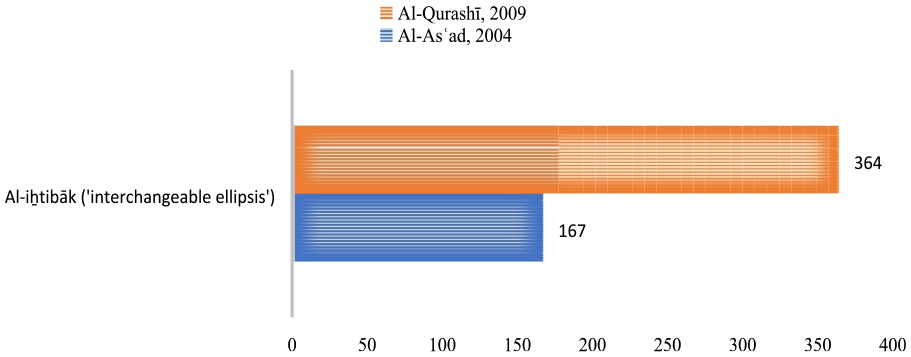
Frequencies of al-iẖtibāk in the Qur’an.
As Figure 1 depicts, there is no consensus on the frequencies of interchangeable ellipses in Qur’anic Arabic, which is caused by (ac)counting cases as being interchangeably elliptical while they are, indeed, just pseudo-cases (cf. Al-Asᶜad, 2004; Al-Qurashī, 2009).
Definitions of al-Iẖtibāk: Etymology
There are two symbiotically related definitions of al-iẖtibāk in Arabic studies. Lexically, it is defined as a cognate noun derived from the triliteral root عَلَى كُلِّ مَحْبُوكِ السَّراةِ | عُقابٌ هَوَتْ مِنْ مَرْقَبٍ وتَعَلَّتِ On every tightly fastened horseback as if it were | an eagle rushing down from a lookout and then up. (Al-Asᶜad, 2013, p. 15), my translation
The adjectival past participle maẖbūk (“tightly fastened”) brings such a lexical meaning home to us—the meaning of tightening an apron, a band, or a belt around the waist to start hard work. Another shade of this lexical meaning is further Qur’anized in verse (51:7) which reads wa-l-samā’ dhāt al-ẖubuk (“By the beautifully routed heaven”)—a meaning reflecting the esthetic of structure. On this Qur’anic meaning, the line of verse composed by al-Nābigha al-Shaybānī says: تُغَيِّرُها الرِياحُ وَكُلُّ غَيثٍ | لهُ حُبُكٌ رِواءٌ بَعدَ حُبْكِ Changed by the winds and everyrain | has beautiful routes after routes. (Al-Asᶜad, 2004, p. 15), my translation
The italicized item ẖubuk (“routes”) describes the rain as it beautifully threads its course through the land—another shade of meaning complementary to the preceding lexical one.
Technically, Al-Qurashī (2009, p. 21) considers the best rhetorical definition of al-iẖtibāk to be the one given by Al-Sijilmāsī (d. 704/1304): “A statement compounded of four symmetrically proportionate parts, wherein the proportional relation between odd parts (1:3) is the same as the proportional relation between even parts (2:4), or otherwise, and whereby either of the two odd or even parts is deleted because it can be elicited by the undeleted other.”Al-Asᶜad (2013, p. 17) synergizes scholarly insights into al-iẖtibāk to form the following operational and holistic definition: “Putting two pairs of opposites, clones or duplicates, analogs or counterparts, contradictories, or a conflation of two of these together into one text, wherein either of them, being elicited by the other, is elided for reasons of brevity.” The relation is so binary and evocable that the remnant entity easily elicits the elided one without affectation or equivocation, as Figure 2 sketches it:
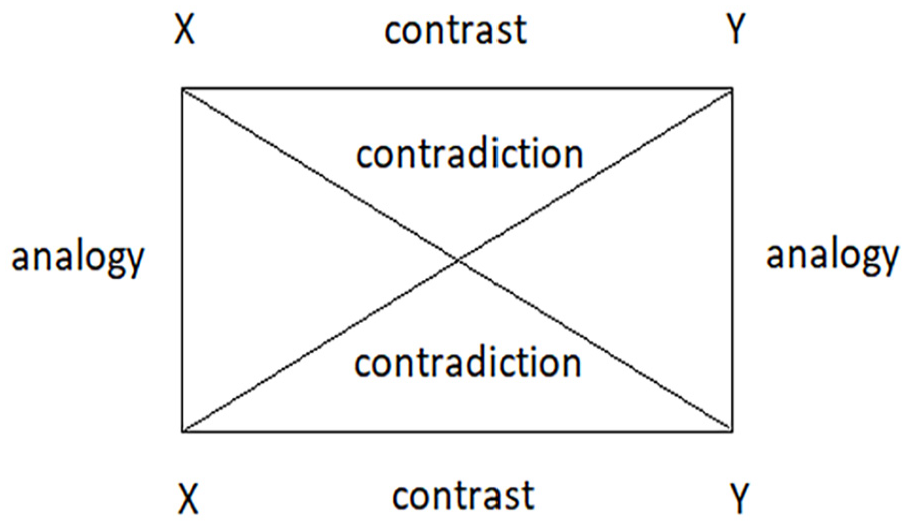
Lexical-semantic relations between interchangeable ellipses induced by al-iẖtibāk.
Rightly put, when there are two oppositional (opposite/non-opposite) pairs, designated as XX/YY, either X or Y in either pair is interchangeably elided because it is recoverable and inferable by its remnant counterpart, as Figure 3 illustrates it:

A numerical progression of al-iẖtibāk (“interchangeable ellipsis”).
In Figure 3, the presence of a numerical element, be it odd or even, is a prerequisite for the absence or omission of the other. The ellipsis of either element is conditioned by elicitability and inferability induced by the other. Al-Suyūtī (2008, p. 543) accounts for the symbiotic relation between the lexical and technical meanings by likening leaving and filling gaps in the fabric of a garment to leaving and filling gaps in the fabric of a text, the purpose of which is to produce a beautifully fibered texture. The technical definition originates from the lexical definition in a beautifully and meaningfully threaded manner.
Denominations of al-Iẖtibāk: Polyonymy
As usual, the phenomenon of al-iẖtibāk, just like other rhetorical phenomena, such as al-ṯibāq, has onomastically been designated by other less technical and less common terms. Let us first trace the phenomenon through the prism of Arabic grammarians. The first reference to it is made by Sībawayh (d. 180/796, 1988 [P1], p. 212) in his distinction between al-ittisāᶜ (“expansion”) and al-ijāz (“brevity”). So similar indirect references to the term are made by other grammarians, including Al-Na
Grammarians’ indirect references have had the advantage of attracting exegetes’ attention to the phenomenon. The first classicist exegetes who have referred to al-iẖtibāk in their interpretations of a bundle of Qur’anic verses but have not named it so are Al-Kirmānī (d. 505/1111, 1988, p. 191), Al-Zamakhsharī (d. 538/1144, 1998 [P3], p. 88), Ibn ᶜAṯiyya (d. 546/1152, 1975 [P7], p. 180), Al-Bayḏāwī (d. 719/1319, n.d. [P5], p. 253), and Abū H̲ayyān al-Gharnāṯī (d. 745/1344, 2010 [P3], p. 45). Unlike his predecessors who hint at this issue, AbūHayyān al-Gharnātī (2010) elaborates on it, and the first name, ẖadhf al-taqābul (“oppositional ellipsis”), given to it dates back to him. Ramaḏān & Asᶜad (2006, p. 45) cite al-Zarkashī (d. 794/1392) as the first to have explicitly given this form of ellipsis a name, that is, al-ẖadhf al-muqābalī (“oppositional ellipsis”), with a variety of Qur’anic examples. Al-Sharīf Al-Jurjānī (d. 816/1413, 2004, p. 13) inserts the term al-iẖtibāk as a lexical entry into his dictionary, in which it is not terminologically translated but entered as a rhetorical term meaning “to join two equivalent phrases in one sentence and delete one word in one phrase because its equivalent in the other phrase suffices to elicit the meaning, e.g., ‘I fed it hay and cold water’ instead of saying ‘I fed it hay and watered [gave] it cold (water)’” (cf. El-Amin, 2005, pp. 54–55). Al-Biqāᶜī (d. 885/1480, 1984 [P4], p. 263) is regarded as the father of al-iẖtibāk phenomenon, who has extensively identified and typified it within the Qur’an and whose insights have been retrieved by his followers, notably Al-Suyū
Polyonymy figures not only through the lens of grammarians and exegetes but through the lens of rhetoricians, as well. Al-Sakkākī (d. 626/1229, 1987) has identified this ellipsis with its deleted and remnant constituents but has not named it al-iẖtibāk. Al-Sijilmāsī (1980) introduces this form of ellipsis under the label al-ẖadhf al-taqābulī and notates it within a numerical progression (1-2-3-4), in which two pairs (1-3/2-4) are opposed and two members thereof are interchangeably elided but cotextually elicited and contextually recovered. Al-Suyūtī (2005) follows his predecessors, mentioning al-iẖtibāk in a variety of his books, intertwining its lexicological and terminological definitions, and showing a striking similitude between an interlaced garment and an interwoven text. Of all these polyonyms, al-iẖtibāk is the commonest term (cf. Al-Asᶜad, 2013; Al-Qurashī, 2009). Regardless of its polyonymic nature, Arab(ic) scholars consider it the most exotic and eccentric form of ellipsis in (Qur’anic) Arabic.
Standardizations of al-Iẖtibāk: Conditions
For the phenomenon of al-iẖtibāk to hold and apply, there are a number of conditions which must first be achieved. Oppositional ellipsis holds if the following conditions are met. The first condition is that there must be a rhetorical reason that renders ellipsis more compendiously eloquent than mention. The second condition is that ellipsis must be evoked by a cotext or recovered from a context. The third condition is that there must be two spoken or written oppositions, either of which is interchangeably elided but elicited by the other. Such conditions are partly mirrored in Quirk et al. (1985) who posit the following criteria for ellipsis in general:
(1) the elided words are precisely recoverable;
(2) the elliptical construction is grammatically defective;
(3) insertion of the missing words results in a grammatical sentence, with the same meaning as the original;
(4) the missing words are recoverable from the neighboring text; and
(5) the missing words are an exact copy of the antecedent.
The conditions set above are relatively reflected in Arabic literature, wherein conditions for the occurrence of al-iẖtibāk include the presence of two oppositional pairs and evidential clues to the ellipses (cf. ᶜIlwānī, 2019, pp. 8–26). Al-Qurashī (2009, p. 23) reports similar conditions which can be summed up as (a) relationality (a relation must exist between elided and remnant entities), (b) evidentiality (remnant entities must be of evidentiary value to elided ones), (c) oppositionality (a quartet of entities must be opposed in pairs), and (d) rhetoricality (ellipsis must have a rhetorical purpose). These conditions place constraints on the range of ellipsis because “if the term ‘ellipsis’ is allowed to range so widely in its application, it ceases to be of interest or use” (Thomas, 1979, p. 43). ᶜAbdulhafīz (2015) and Abdul-Raof (2019) expound similar conditions.
Classifications of al-Iẖtibāk: Typology
Like the case of other phenomena in Arabic rhetoric as al-ṯibāq (“antonymy”), no replicable typology of al-iẖtibāk can be retrieved from one Classical Arabic source. Instead, jigsaw types of it exist in separate books—types which, if pieced together, constitute an absolute typology of it. This is exactly what contemporary scholars (e.g., Al-Asᶜad, 2004, 2013; Al-Qurashī, 2009) have done in their (post)doctoral works. The piecing together of these types have developed a five-tiered typology, including al-iẖtibāk al-ḏiddī (“ellipsis of opposites”), al-iẖtibāk al-mutashābih (“ellipsis of duplicates”), al-iẖtibāk al-mutanādhir (“ellipsis of analogs”), al-iẖtibāk al-manfī al-muthbat (“ellipsis of negatives/affirmatives”), and al-iẖtibāk al-mushtarak (“ellipsis across categories”). A comparative diachronic survey of accessible sources on al-iẖtibāk has been conducted to deem it a coherent and comprehensive typology viable to the Qur’anic text. Each category of al-iẖtibāk in the typology is self-contained and singled out without any overlap. Even the fifth category is peculiar because it conflates two elliptical pairs across categories. The logical criterion for the classification is its being based upon lexicosemantic relations enshrined between the items of the ellipted and remnant pairs. Consider, for example, al-iẖtibāk al-mutashābih which is based on sameness and similarity of meaning; al-iẖtibāk al-ḏiddī which is built on opposition and oppositeness of meaning, and so forth. This is not an innovated but a motivated typology analogous to other typologies of Arabic linguistic phenomena. Further evidence for authenticity of the selected examples is based on a consensus opinion among the prominent theorist Al-Biqāᶜī (1984) and his followers, Al-Asᶜad (2004), and Al-Qurashī (2009). Being the analytical toolkit for my dataset in this study in combination with dependency grammar theory, this typology is rigorously elaborated in the Methodology section.
Dependency Grammar of al-Iẖtibāk: Catenae
Text linguistics studies intrasentential and intersentential text and information structures and their constituents, as cohesion and (un)marked information, and focuses on processes of textual cohesion as cohesive ties (Abdul-Raof, 2019, pp. 9–10). One cohesive device is ellipsis (Halliday & Hasan, 1976, pp. 141–182), a grammatical form left unrealized in the structure for reasons of economy but is recovered from the context (Crystal, 2008, p. 166); a tool for achieving textual compactness and terseness and repudiating the content which the receptors might expect (De Beaugrande, 1980, p. 66), and for achieving phoricity, something present in the (non)verbal context (Halliday & Matthiessen, 2004, p. 89). Semantically, ellipsis is defined as “A semantic change in which a word occurring in a phrase takes on the meaning of the whole phrase” (Fasold & Connor-Linton, 2014, p. 296). A number of ellipsis types have been identified and verified, including nominal ellipsis, verbal ellipsis, and clausal ellipsis (cf. Abdul-Raof, 2019; Halliday & Hasan, 1976).
Osborne (2019b, pp. 349–406) states that ellipsis takes place when something has been elided from an expression or a part of it for a number of reasons, as in the desire to reduce redundancy, to communicate with less effort, and to emphasize parts of an expression. According to Osborne (2019a), the elided part is the ellipsis (catena); the part surviving the ellipsis is the remnant (residue). Osborne (2019b, p. 73) argues that the tests (such as coordination) employed for constituency of syntactic structure support dependency over phrase structure. On the mechanisms of ellipsis, of which al-iẖtibāk is a special form in Arabic, Osborne (2019b), adapting from De Beaugrande (1980), has developed mechanisms for elliptical sites in text, as outlined in Table 1.
Ellipsis Mechanisms in Dependency Grammar (Osborne, 2019b, p. 350).

According to the dependency grammar of the tabulated ellipsis mechanisms, the elided parts form catenae, words or combinations of words combined together by directed dependencies between a head word and its dependents, as in “cute puppies” in which the noun “puppies” controls the adjective “cute” (Osborne, 2019b, p. 36).
Methodology
This section introduces a representative dataset retrieved from the Qur’an and a systematic and consistent pathway for a rigorous and replicable analysis.
Dataset
The raw material of this study is the Qur’an (Q.), the most canonical source of Islamic religion and highest variety of Classical Arabic (CA) henceforward referred to as QA. A sporadically representative, albeit selective, sample of Qur’anic verses constitutes the dataset of analysis. Since it is argued that the number of interchangeably elliptical verses identified by Arabic classicist scholars, like Al-Biqāᶜī, is relatively exaggerated and hence controversial, I am then obliged to focus on those verses which are common and almost unanimous among them and which are unquestionably typical cases of al-iẖtibāk. Culling from the theoretical framework of the present study, I find it more scientific and sager to use as reference points Qur’an exegeses that are linguistically oriented towards the phenomenon in focus: al-Kashshāf (Al-Zamakhsharī, 1998), Naẕm al-Durar (Al-Biqāᶜī, 1984), and al-Taẖrīr wa-l-Tanwīr (Ibn ᶜĀshūr, 1984).
Method
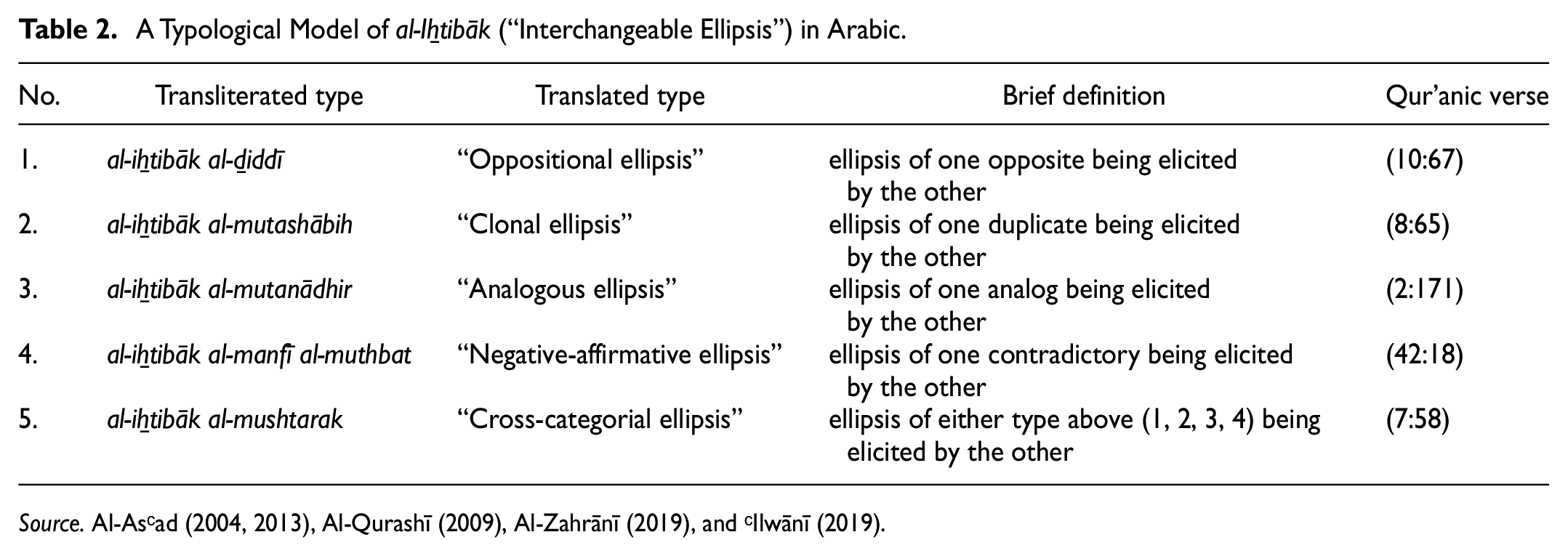
This study takes as its method an analytical model whose constituent categories are pieced together from sundry Classical Arabic sources, gathered by Al-Asᶜad (2004, 2013) and replicated by Al-Qurashī (2009), in combination with Osborne’s (2019a, 2019b) dependency grammar theory. Table 2 outlines the categories with brief definitions and typical instances.
A Typological Model of al-Iẖtibāk (“Interchangeable Ellipsis”) in Arabic.
Source.Al-Asᶜad (2004, 2013), Al-Qurashī (2009), Al-Zahrānī (2019), and ᶜIlwānī (2019).
As Table 2 shows, al-iẖtibāk al-ḏiddī holds between pairs of opposites, technically antonyms, whereby an elliptic catena in one pair (henceforth, E) is evoked by a remnant residue in the other (henceforth, R), or vice versa. The interchangeable presence or absence of antonyms produces a variety of structural patterns on the syntagmatic axis. The typical structural pattern of (Q. 10:67), for example, is RER × RRE, that is, X1Ø2Z3 versus X4Y5Ø6. In this pattern, Ø2 is an elliptic Y2 evoked by Y5 and Ø6 is an elliptic Z6 evoked by Z3. Al-iẖtibāk al-mutashābih obtains between clones/duplicates whereby either one is interchangeably deleted, being elicited by the other, as in the structural pattern of (Q. 8:65) figuring as RRE × RER, that is, X1Y2Ø3 versus X4Ø5Z6, in which Ø3 is an elliptic Z3 in the first part evoked by Z6 in the second and Ø5 is an elliptic Y5 in the second part elicited by Y2 in the first part. Al-iẖtibāk al-mutanādhir occurs between analogs whereby either analog is interchangeably elided but elicited by the other, as in the structural pattern of (Q. 2:171) featuring as ER × RE, that is, Ø1Y2 versus X3Ø4, in which Ø1 is an elliptic X1 evoked by X3 and Ø4 is an elliptic Y4 evoked by Y2. Al-iẖtibāk al-manfī al-muthbat holds between contradictories (one is negative and the other affirmative) whereby either is interchangeably elided, being called forth by the other, as in (Q. 42:18) whose structural pattern is RRE × ERR, that is, X1Y2Ø3 versus Ø4Y5Z6 wherein Ø3 in the first part is an elliptic Z3 evoked by Z6 and Ø4 in the second part is an elliptic X4 evoked by X1. Al-iẖtibāk al-mushtarak conflates the preceding categories, whereby either opposed entity, be it an antonym, a clone/duplicate, or a contradictory, is interchangeably elided, being elicited by the other, as in (Q. 7:58), whose structural pattern is RRE × RER, that is, X1Y2Ø3 versus X4Ø5Z6, wherein Ø3 in the first part is an elliptic Z3 evoked by its opposite Z6 and Ø5 in the second part is an elliptic Y5 evoked by its duplicate Y2.
This study tends to revisit and reexamine the phenomenon of al-iẖtibāk through the lens of dependency grammar (DG) theory. It considers how dependency grammar views this particular form of ellipsis in Classical Arabic since a propensity for the existence of null nodes is posited to accommodate elliptical aspects with particular relevance to a catena unit, a combination of words combined together through dependencies (Osborne, 2019a). It plans to do so by testing ellipsis mechanisms in dependency grammar against the static and absolute typology of al-iẖtibāk. Through the catena unit, it is possible to adopt a more economical approach to al-iẖtibāk. The Analysis section below tests this dynamic model against a representative sample of interchangeable ellipsis to explore its impact on the interpretation and rendition of the Qur’an.
The respective question is Why Dependency Grammar (DG)? Compared with other grammars like Generative Grammar (GG) or Constituency Grammar (CG), DG is more theoretically and analytically compatible with the Arabic typology of al-iẖtibāk that is based on lexicosemantic relations between items like identity of meaning (duplicates), analogy of meaning (analogs), oppositeness of meaning (opposites), and contradiction of meaning (contradictories). Next, al-iẖtibāk features dependency relations between catenae (ellipses) and residues (remnants) for which DG is more appropriate, being concerned with all (in)direct links between heads and their dependents. Moreover, DG is simply more well-suited for the analysis of languages with free word order like Arabic. Also, dependencies, the locus of DG, are syntactically and semantically motivated by grammatical functions like SVO where a bivalent verb like “hate” requires a head (V) and two dependents (S/O). All in all, DG is said to have certain advantages for languages with a higher word-order variation than English.
Analysis
Since the quantification of al-iẖtibāk is debatable and there is no consensus on the identified numbers, this study undertakes, in this section, a qualitative analysis of a representative sample of database verses considered by a majority, if not by consensus, to be typical of interchangeable ellipsis. Hummadi et al. (2020, p. 5) cite Elo et al. (2014, p. 1) as pointing out that the qualitative content analysis “represents a systematic and objective means of describing . . . phenomena.” Due to word and space limits, only one example which is typically representative of many others is extensively and rigorously analyzed under each category. Each representative example features in (a) its original language (Arabic) followed by (b) a transliteration (phonetic transcription), (c) interlinear word-by-word glosses (Leipzig Glossing Rule 1), (d) formal glosses (https://corpus.quran.com) which serve the DG-analytic scope of the study, and (e) reader-friendly translations that may suffice the targeted readership.
Al-iẖtibāk al-ḏiddī: Interchangeable Ellipsis of Antonyms or Opposites
(1) (Q. 10:67)
a. هُوَ الَّذِي جَعَلَ لَكُمُ اللَّيْلَ لِتَسْكُنُوا فِيهِ وَالنَّهَارَ مُبْصِرًا.
b. huwa al-ladhī jaᶜala la-kum al-layla li-taskun-ū fīhi wa-l-nahāra mubs̲iran.
c. He who made for-you the-night to-repose-you in-it and the-day light.
d. PRON.REL.V.P-PRON.DET-N.PRP-V-PRON.P-PRON.CONJ.DET-N.N
e. “It is He who made for you the night to repose in it and the day light.”
Example 1a (Q. 10:67) features a prototypical case of al-iẖtibāk al-ḏiddī, ellipsis of antonyms or opposites on an interchangeable basis (cf. Al-Biqāᶜī, 1984 [P9], p. 158). One ellipsis occurs in the first part of two coordinated clauses and targets an adjective, muẕliman (“dark”), post-modifying the noun al-layl (“night”), in contradistinction to a remnant adjective, mubs̲iran (“light”), post-modifying the noun al-nahār (“day”). Gapping causes an adjective-phrase ellipsis (AdjP-Ø) which is easy to elicit from a cotext, a remnant AdjP, and to retrieve from a postcedent. Another gapping is a right-edge ellipsis in the second clause created by eliding an infinitive adverb phrase (AdvP-Ø), li-tantashirū fīhi (“to spread out in it”), being elicitable by a remnant antecedent, the AdvP li-taskunū fīhi (“to repose in it”). Based on this interchangeable oppositional ellipsis, the construction of example 1a (Q. 10:67) reads RER × RRE (XØZ vs. XYØ), as outlined in Figure 4:

Dependency grammar of al-iẖtibāk al-ḏiddī in (Q. 10:67) with catenae (in strikethroughs) and residues.
As Figure 4 diagrams, example 1a posits the existence of two null materials: in the first coordinated clause is the adjectival modifier “dark” being elicited by its remnant postcedent “light” in the second and in the second clause is the causal adverbial phrase that complements the compound structure but whose meaning is easy to recover thanks to the presence of its remnant antecedent “to repose in it.” Cotextually elicited and contextually recovered, example 1a which fills its elliptical sites from the linguistic co(n)text of the verse reads as follows: [who made the night dark to repose in it and the day light to spread out in it]. The null materials in the catenae are easily retrievable from the remnants surviving the interchangeable ellipsis. In such a guise, al-iẖtibāk al-ḏiddī massively challenges Jones’s (2002) category of ancillary antonymy which is based on a canonical opposition between two pairs: an A-pair whose antonymous members serve to signal a more important contrast between members of a B-pair which are canonically, semicanonically, or noncanonically opposed. It also defies the categories of al-ṯibāq al-maᶜanawī (“semantic antonymy”) and al-ṯibāq al-khafī (“pseudo-antonymy”), wherein oppositeness holds between the senses of lexemes rather than the lexemes themselves (cf. Hassanein, 2020a).
Al-iẖtibāk al-mutashābih: Interchangeable Ellipsis of Clones or Duplicates
(2) (Q. 2:135)
a. وَقالُوا كُونُوا هُوداً أَوْ نَصارى تَهْتَدُوا.
b. wa-qāl-ū kūn-ū hūdan aw nas̲ārā tahtad-ū.
c. and-said-they be-you Jews or Christians guide-you.
d. REM.V-PRON.V-PRON.PN.CONJ.PN.V.PRON
e. “And they said, ‘Be Jews or Christians, you shall be guided’.”
A majority of Arabic rhetoricians agree that example 2a (Q. 2:135) is a typical case of al-iẖtibāk al-mutashābih (“clonal ellipsis” here, “similar ellipsis” in Abdulrahman, 2012, p. 4), in which lexical duplicates or clones, that is, morphologically related derivatives, are interchangeably elided in either part of the verse (cf. AbūHayyān al-Gharnātī, 2010; Al-Ālūsī, 1994; Al-Khafājī, 1866; Rashīd Ridā, 1910). One verb-phrase ellipsis (VP-Ø), tahtad-ū (“shall be guided”), is said to occur immediately before the coordinator aw (“or”) and another verb-phrase ellipsis (VP-Ø), kūn-ū (“be”), occurs immediately after the coordinator aw. For the Qur’an recipients, it is easy to retrieve the former apodotic VP-Ø from a remnant postcedent in the second conjunct and the latter protatic VP-Ø from a remnant antecedent in the first conjunct. According to ellipsis sites, verse (Q. 2:135) has the structural pattern RRE × ERR (XYØ vs. ØYZ), wherein the elided Z in the first part can be elicited by the remnant Z in the second and the elided X in the second part can be evoked by the remnant X in the first. Figure 5 schematizes the pattern in a dependency-grammar relationship, as follows:
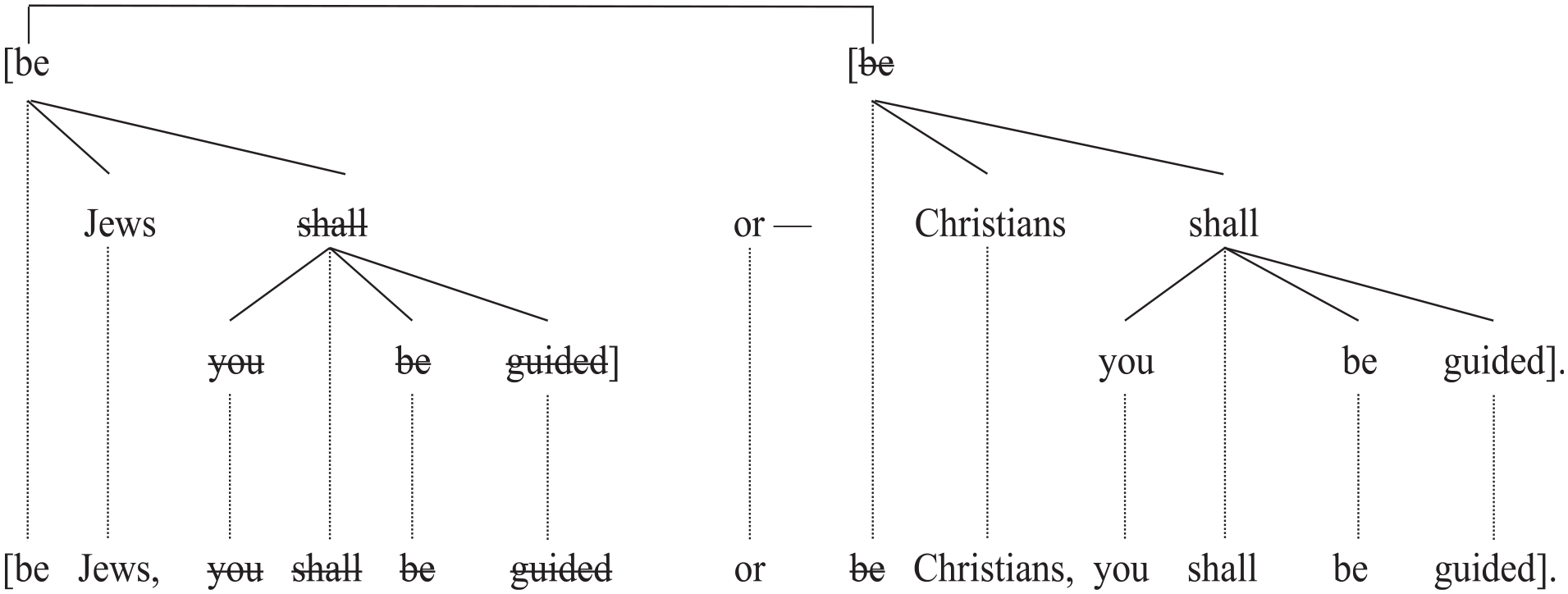
Dependency grammar of al-iẖtibāk al-mutashābih in (Q. 2:135) with catenae (in strikethroughs) and residues.
By means of the remnant cotexts, the meaning of (Q. 2:135) can be reconstructed without tedious efforts on part of the recipients, as follows: “Be Jews, you shall be guided or be Christians, you shall be guided.” The disjunctive coordinator aw“or” is exegetically said to not signify inclusive choice whereby conversion to Judaism or Christianity shall lead the converter to guidance (cf. Ibn ᶜĀshūr, 1984 [P1], p. 736) but rather exclusive choice whereby conversion to Judaism shall lead to guidance or conversion to Christianity shall lead to it—not both of them together, of course, as either of them belies and rejects the other (cf. Al-Tabarī, 2000 [P3], p. 101).
Al-iẖtibāk al-mutanādhir: Interchangeable Ellipsis of Analogs or Counterparts
(3) (Q. 36:22)
a. وَمَا لِيَ لَا أَعْبُدُ الَّذِي فَطَرَنِي وَإِلَيْهِ تُرْجَعُونَ.
b. wa-mā liya lā a-ᶜbudu al-ladhī faṯar-anī wa-ilayhi turjaᶜ-ūna.
c. And-what for-me not I-worship who created-me and to-him return-you.
d. CONJ.INTG.P-PRON.NEG.PRON-V.REL.V-PRON.CONJ.P-PRON.V-PRON
e. “And why would I not worship who originated me and to whom you shall be returned.”
It is quite agreed that example 3a (Q. 36:22) is a typical instance of al-iẖtibāk al-mutanādhir (“interchangeably analogous ellipsis”), in which either of the four analogs is elided in either part of the verse, being recoverable from its counterpart. Al-iẖtibāk al-mutanādhir differs from al-iẖtibāk al-mutashābih in that the analogs of the former are similar and distinct in some aspects (similarity) whereas the duplicates of the latter have all aspects in common (identity)—that is the reason why they are called as such. In verse (Q. 36:22), a declarative-sentence (statement) ellipsis (DS-Ø), wa ilay-hi u-rjaᶜ (“to Him I shall be returned”), transpires in the first hemistich of the verse, and an interrogative-sentence (question) ellipsis (IS-Ø), wa mā la-kum lā taᶜbud-ūna al-ladhī faṯar-akum (“Why would you not worship who originated you?”), happens in its second hemistich (cf. Al-Ālūsī, 1994, Al-Asᶜad, 2004, 2013; Al-Biqāᶜī, 1984; Al-Khafājī, 1866; Al-Qurashī, 2009). The surface semantic structure of the verse is RE × ER (XØ vs. ØY), whose deep semantic structure, if the ellipsis sites are filled with the evocable fillers, would read as Figure 6 illustrates:
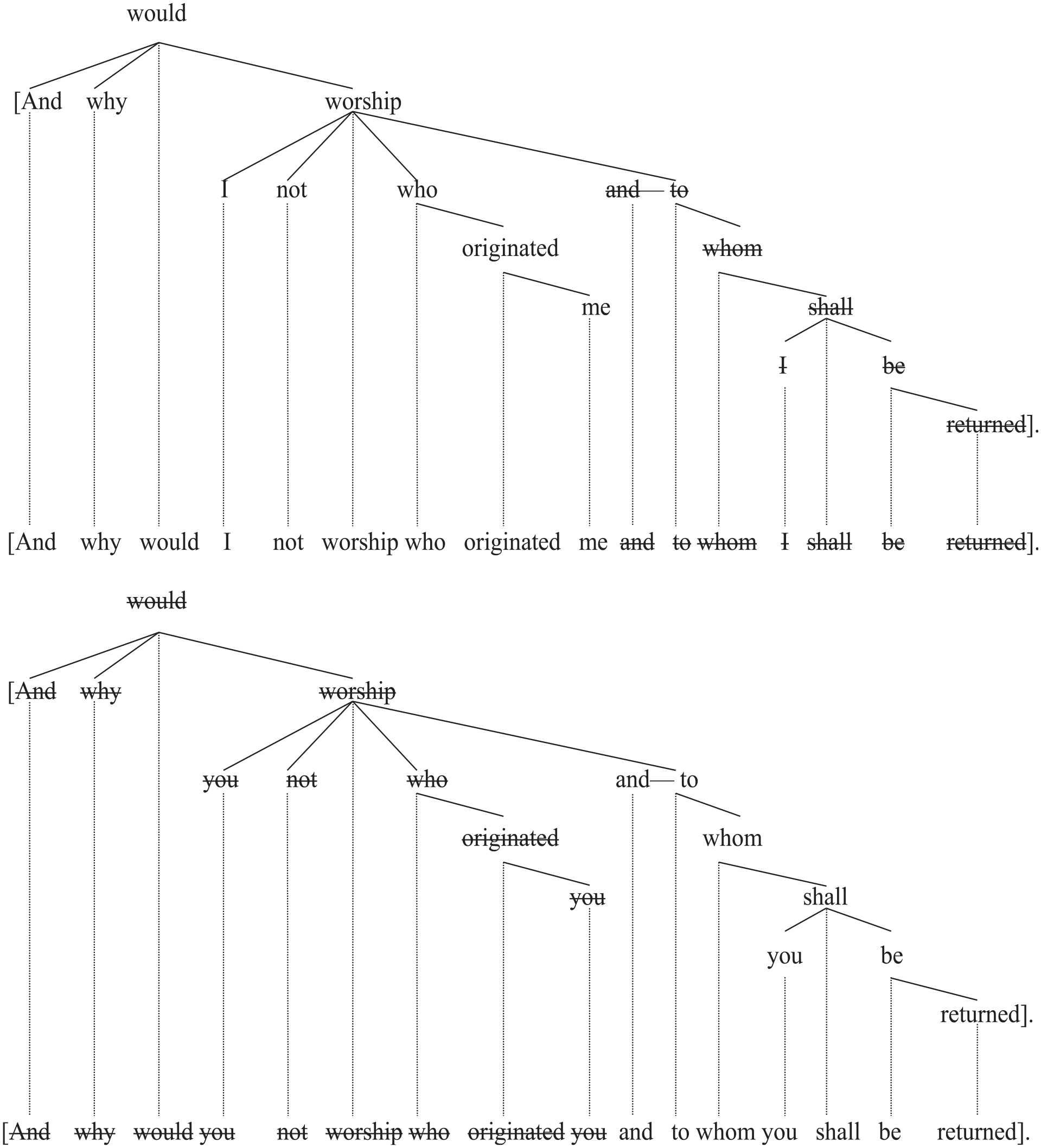
Dependency grammar of al-iẖtibāk al-mutanādhir in (Q. 36:22) with catenae (in strikethroughs) and residues.
The former ellipsis in the first hemistich is resolved by its counterpart in the second and the latter ellipsis in the second hemistich is solved by its counterpart in the first. The original voice in this verse is exegetically said to belong to H̲abīb ibn Isrā’īl al-Najjār who disapprovingly wonders why not to worship the One who created him and created the people he debates and to whom they shall all be returned (cf. Al-Zamakhsharī, 1998 [P5], p. 171-172; Ibn ᶜĀshūr, 1984 [P22], p. 368). He disapprovingly starts his argumentation with self-mention and self-interrogation for reasons of politeness and indirectly maintains a common ground with his people for comminatory and exhortatory purposes (cf. Al-Asᶜad, 2013, p. 123). He does so by eloquently intermeshing the phenomenon of al-iẖtibāk with that of al-iltifāt (“deictic or grammatical shift,”Abdel Haleem, 1992), that is, turning from first-person singular to second-person plural and from past tense to future tense. Both phenomena work in tandem rather than in isolation.
Al-iẖtibāk al-manfī al-muthbat: Interchangeable Ellipsis of Negatives or Affirmatives
(4) (Q. 38:73-74)
a. فَسَجَدَ الْمَلآئِكَةُ كُلّهُمْ أَجْمَعُونَ إِلَّا إِبْلِيسَ اسْتَكْبَرَ.
b. fa-sajada al-malā’ikatu kullu-hum ajmaᶜūna illā Iblīsa istakbara.
c. Then-prostrated the-angels all-them all-together except Iblīs disdained.
d. REM-V.DET-N.N-PRON.N.RES.PN.V.
e. “Then all angels prostrated together except Iblīs who disdained.”
Example 4a (Q. 38:73-74) is claimed by Al-Biqāᶜī (1984), Al-Asᶜad (2004), and Al-Qurashī (2009) to typify al-iẖtibāk al-manfī al-muthbat (“interchangeably negative-affirmative ellipsis”)—an ellipsis in which a negative or affirmative item is elided since it can be evoked by its contradictory. There is a quadrilateral relation between two pairs of contradictory elements, whereby one affirmative in the first conjunct is contrasted with its negative in the second and a negative in the first conjunct is contrasted with its affirmative in the second, or vice versa, using negative particles as mā, lam, lan, and ghayr (“not”). Either of these four elements is omissible, being recoverable from its contradictory. In the verse, the negative form, lam yasjud (“did not prostrate”), is deleted from the second part because it is inferred from its affirmative contradictory, sajada (“prostrated”), in the first, and the negative form, lam yastakbir-ū (“did not disdain”) is omitted from the first part because it is recovered from its affirmative contradictory, istakbara (“disdained”), in the second. Based on these verb-phrase ellipses (VP-Ø), the structural pattern of the verse is RE × RE (XØ vs. XØ), in which the elided Y in the first part is inferred from the remnant X in the second and the elided Y in the second part is inferred from the remnant X in the first. If the ellipsis sites are accordingly inferred, the verse will read as diagrammed in Figure 7:

Dependency grammar of al-iẖtibāk al-manfī al-muthbat in (Q. 38:73-74) with catenae (in strikethroughs) and residues.
Reading like “Then all angels prostrated all together and did not disdain except Iblīs; he disdained and did not prostrate,” example 4a (Q. 38:73-74) is explicit about the first heinous sin, rebellion, committed by Satan’s hubris, against the divine commandment to fall prostrate before Adam, the proto-father of humanity in both Biblical and Qur’anic narratives. Interrogated about what stopped him from prostrating himself before Adam (Q. 38:75), Satan answers: “I am better than he; You made me from fire but made him from clay” (Q. 38:76). Pride and obstinacy brought him downfall and curse (cf. Al-Zamakhsharī, 1998 [P5], p. 281–282; Ibn ᶜĀshūr, 1984 [P23], p. 300–305). As Salama (2021, p. 93) puts it, “The Qurʼan uses the two terms Iblīs and Satan (Shayṯān) to denote the same entity that stands as the symbol of disobedience to Allah.”
Al-iẖtibāk al-mushtarak: Ellipsis of Units across Former Categories
(5) (Q. 27:12)
a. وَأَدْخِلْ يَدَكَ فِي جَيْبِكَ تَخْرُجْ بَيْضَاءَ مِنْ غَيْرِ سُوءٍ.
b. wa-adkhil yada-ka fī jaybi-ka takhruj bayḏā’a min ghayri sū’in.
c. And-enter hand-your in bosom-your exit white with no disorder.
d. CONJ.V.N-PRON.P.N-PRON.V.N.P.N.N
e. “Enter your hand into your bosom, then it comes out white without disorder.”
A constellation of rhetors and exegetes are almost unanimous that example 5a typifies al-iẖtibāk al-mushtarak (“interchangeably cross-categorial ellipsis”) that interlocks two or more categories in one verse (cf. Al-Marrākushī (d. 721/1322), 1985; Al-Sijilmāsī, 1980; Al-Andalusī (d. 780/1378, 1928); al-Zarkashī (n.d.), Al-Suyūtī, 2008; Al-Qurashī, 2009). In verse (Q. 27:12), as a case in point, there is an iẖtibāk ḏiddī (“interchangeably oppositional ellipsis”), which figures in the elided bi-sū’ (“with disorder”) in opposition to the remnant min ghayri sū’ (“without disorder”). The former unit is omitted because it can be elicited by the latter. Another iẖtibāk ḏiddī relates to the elided wa-akhrijhā (“take it out”) and its remnant antonymy wa-adkhil (“put in”) as well as to the elided tadkhul (“go in”) and its remnant antonym takhruj (“come out”). The elided units are easy for the recipients to elicit through the lexical-semantic relation of al-ṯibāq, that is, through their remnant antonyms (cf. Al-Qurashī, 2009, p. 90). Given the numerical symbols 1, 2, 3, and 4 which stand respectively for adkhil, tadkhul, akhrijhā, and takhruj, antonymy figures in 1/3 (adkhil/akhrijhā) and in 2/4 (tadkhul/takhruj). There is also an iẖtibāk mutanādhir (“interchangeably analogous ellipsis”) in 1/2 and 3/4 featuring morpholexically related and cliticized analogs (imperative/indicative and transitive/intransitive). Figure 8 sketches these lexical-semantic relations between the catenae and residues:

Lexical-semantic relations between the catenae and residues.
Verse (Q. 27:12) features its interchangeably cross-categorial ellipses in the structural pattern REE × ERR (XØØ vs. ØYZ) wherein the elided X (VP-Ø) in the second apodotic clause is elicited by the remnant X (VP) in the protatic clause, the elided Y (AdjP-Ø) and Z (PP-Ø) in the former are evoked by the remnant Y (AdjP) and Z (PP) in the latter, as graphically represented in Figure 9:

Dependency grammar of al-iẖtibāk al-mushtarak in (Q. 27:12) with catenae (in strikethroughs) and residues.
With its graphical representation “Enter your hand into your bosom, it goes in nonwhite with disorder and take it out, it comes out white without disorder,” Verse (Q. 27:12) connects intertextually to two other syntagmatically identical but paradigmatically similar, or synonymous, verses (Q. 20:22, 28:32). On the paradigmatic axes, lexical choices are semantically nuanced and distinct as shown in Figure 10:

Bottom-up syntagmatic-paradigmatic comparisons between the three verses (Q. 27:12, 20:22, 28:32).
Syntagmatically, the combinational chain of lexical choices generates the same structural pattern of al-iẖtibāk al-mushtarak in the three verses in comparison.
Conclusion
This article has sought to adopt and apply a dependency-grammar approach to a scantly understudied rhetorical phenomenon in non-Arabic studies: al-iẖtibāk (“interchangeable ellipsis”), a sparsely attended phenomenon whose purpose is to invest the minimum number of words in the production of maximum meanings—the fewest words for the fullest meanings in the tersest and most succinct style. Qur’anic rhetoric on which Arabic rhetoric is often modeled employs this phenomenon in a considerable, albeit controversial, number of what I am prone to call “economy verses” that omit, for economical reasons, lexical items or units that can be cotextually elicited and contextually recovered. Co(n)textual recoverability accords with Osborne’s (2019a) argument that the ellipsis sites get their meanings from overt materials in the linguistic contexts wherein the elided materials often stand in an identity relation with an antecedent or postcedent. These verses communicate the most compendious meaning with the shortest means in the best reader-friendly way, whereby their readers are not passive text recipients but active participants in filling out the elliptical slots and making cotext- and context-clued inferences. On ellipsis, Halliday and Hasan (1976, p. 142) state that it is “something left unsaid … but understood, nevertheless … SOMETHING UNDERSTOOD … in the special sense of going without saying.”
As it may be found, al-iẖtibāk together with its five-tiered typology is interrelated to the information structure of the verse under interpretation or rendition. New-information material is mentioned whereas given-information material is elided as its mention would be textually redundant but paratextually important as epitexts. This finding is in line with Winkler’s (2016) finding that the information structure affects the form, function, and interpretation of ellipsis. In this respect, it is further shown that al-iẖtibāk (“interchangeable ellipsis”) divides the information structure into ellipses (catenae) and remnants (residues), both of which hold in between a lexical-semantic relation, including antonymy (oppositions), contradiction (affirmatives vs. negatives), analogy (similar counterparts), and (re)duplication (same clones), or a blend of these (across categories). It is also revealed that al-iẖtibāk transpires either forwardly or backwardly in a bipartite structure based on a reverse relation to the antecedent or postcedent (either of the remnants), a result also in compliance with Winkler’s (2016). A further conclusion is that al-iẖtibāk does not work in isolation but rather in tandem with other rhetorical phenomena as al-ṯibāq (a relation of canonical opposition between the catenae and their relevant residues) and al-iẖtirās (a relation of semantic complementarity guarding against sceptical misinterpretation on part of the Qur’anic text recipients). Al-muwāzana (“parallelism”) is a bedfellow of al-iẖtibāk which obtains between structurally and lexically parallel forms of the ellipses and their remnants, a conclusion in agreement to Winkler’s (2016) argument that contrastive ellipsis omits nonconstituents in parallel syntactic structures and Merchant’s (2018) argument that a parallel syntactic antecedent (or postcedent) must be used when it is available.
Al-iẖtibāk in praesentia forms an elliptical construction on the paradigmatic axis on which either constituent is interchangeably deleted but related to a surface-structure semantic representation while al-iẖtibāk in absentia constitutes a deep-structure semantic representation by reconstructing the syntactic structure of elided and remnant materials. This procedure coincides with what Maduro & Carvalho (2002) call “ellipsis resolution” mediated by cotextual and contextual clues as elicitability, inferability, and recoverability (cf. ᶜIlwānī, 2019). Al-iẖtibāk, along with other common rhetorical phenomena, has been developed and is dated back to the studious scholarship of genius Arab(ic) classicists who are found to possess all the erudition that their generations have hoarded up over the ages. The analysis of such a handful of verses is hoped to be rigorous enough to reflect the implications of al-iẖtibāk phenomenon for Qur’an interpretation and rendition. Ellipsis, of which al-iẖtibāk is clearly a special form, is motivated by a miscellany of (sub)conscious motivations: to elide what is cognitively easy to retrieve, to reduce redundancy, to communicate maximum effect with minimum effort, and to give prominence to the remnant over the elliptical (cf. Osborne, 2019b).
In conclusion, the relevant question regards what advantageous implications a DG model of analysis has for interpreting and rendering elliptical structures and expressions from Qur’anic Arabic into English. DG is a more viable model than Constituency Grammar (CG) (also, Phrase Structure Grammar, PSG) and Generative Grammar (GG) on the grounds that ellipsis interconnects the meanings of remnants (antecedents/postcedents) and catenae (elliptical constructions) and make both of them interdependent in the Qur’an interpretation and rendition. The notion of dependency is a sound argument for the election of DG as it evinces tree relations between a governor (Osborne’s “colocant”) and a set of dependents in appendage to the colocant. To orthodoxly interpret and render the Qur’an, dependency relations between the governor and its dependents must be retrieved and transposed to discern form-function correspondences for reasons of structural and semantic uniformities. This conclusion might be supported by the corpus-based syntactic treebanks and dependency graphs on https://corpus.quran.com.
Footnotes
Appendix
Conventional Abbreviations of Qur’anic Arabic Glosses.

| Abbreviation | Full form | Abbreviation | Full form |
|---|---|---|---|
| PRON | Pronoun | REL | Relative |
| V | Verb | P | Preposition |
| N | Noun | PRP | Particle of purpose |
| CONJ | Conjunction | DET | Determiner |
| REM | Resumptive particle | PN | Proper noun |
| INTG NEG |
Interrogative particle Negative |
RES PP |
Restrictive particle Prepositional phrase |
Source. Retrieved and adapted from https://corpus.quran.com/wordbyword.jsp?
Declaration of Conflicting Interests
The author(s) declared no potential conflicts of interest with respect to the research, authorship, and/or publication of this article.
Funding
The author(s) disclosed receipt of the following financial support for the research, authorship, and/or publication of this article: This study is supported via funding from Prince Sattam bin Abdulaziz University project number (PSAU/2023/R/1445). I am grateful to PSAU and Mansoura University (MU) for their support and motivation. I am also grateful to SO’s article editor and reviewers for having added much rigor and quality to my article.
