




Abstract
The unprecedented Coronavirus disease 2019 (COVID-19) pandemic affected adolescents’ routines, experiences, and physical and mental health but not everybody reacted in the same way. The present longitudinal mixed-method study based in Luxembourg explores adolescents’ emotional responses to the pandemic as well as resilience factors that helped them cope with the challenges. It combines data from a survey completed in 2021 by 332 adolescents and from interviews carried out with 19 adolescents in 2020 and 2021. Overall, the results document the importance of support through family and peer relationships in order to withstand adversity. The findings may help parents, educators, and policymakers develop a supportive environment that minimizes the consequences of future negative events on adolescents.
Introduction
The COVID-19 pandemic was and still is an unprecedented life-altering situation for adults and children alike. According to Walsh (2015), people are likely to suffer from negative outcomes of an event if it is untimely and unexpected, severe or persistent, or if multiple stressors occur simultaneously. The COVID-19 pandemic meets all of these conditions and affected children’s and adolescents’ well-being and mental health in various ways (Huber et al., 2020). Some children and adolescents had positive outcomes. For instance, Yucatan Maya mothers reported their children’s increased responsibility toward their schoolwork and help with family work (Alcalá et al., 2021). In Turkey, some mothers reported their children’s self-care as well as closer relationships with them (Işik et al., 2022). The increased family time resulted in a perception of added family support irrespective of the degree of agreement or disagreement (Bousselin, 2022; Rogers et al., 2021). Other children, however, experienced negative outcomes such as distress (Alcalá et al., 2021) and anxiety or depression (Creswell et al., 2021; Sikorska et al., 2021). In general, it was found that adolescent girls were more prone to experience negative psychological outcomes than adolescent boys (Grazzani et al., 2022; Kirsch et al., 2020, 2022; Shum et al., 2021) and that children who had pre-existing mental health disorders or faced challenges such as mistreatment were more likely to suffer negative outcomes (Fegert et al., 2020; Panchal et al., 2020).
To find ways to mitigate the negative effects of the pandemic on children’s and adolescents’ well-being and mental health, it is important to understand their resilience, and therefore, children’s negative feelings, the changes in affect over time and the support that contributes to a positive outcome. (In this paper, affect is used as a collective term for describing subjective feeling states that range from unpleasant to pleasant (Watson et al., 1988).) For the past five decades resilience has been investigated in a plethora of scientific fields encompassing human, social, natural and computer sciences, and even public policy (Catau Veres, 2020). Researchers agree that adversity or a disturbance is necessary for resilience to emerge and that exposure to uncommon stressors can be beneficial as it prepares a person for bigger adversity in the form of “stress inoculation training” (Masten & Barnes, 2018, p. 7). Resilience can result in greater life satisfaction and lower negative emotions such as anxiety or stress levels (D’Ambrosio et al., 2021). Several protective resilience factors have been identified including personal skills, family relations, schools, and communities (Masten, 2001; Masten & Barnes, 2018).
The present paper continues from the previous work on children’s well-being and social experiences in 2020 and 2021 in Luxembourg (Kirsch et al., 2022; Kirsch & Vaiouli, 2023). Our interdisciplinary team analyzed adolescents’ emotional responses to the Coronavirus pandemic as well as their coping strategies based on a sociocentric model of resilience which draws on Bronfenbrenner’s ecological framework (Bronfenbrenner, 1979). Combining data from the 2021 survey completed by 332 adolescents and from interviews carried out with (the same) 19 adolescents in 2020 and 2021, we analyzed the adolescents’ reported feelings and changes of affect as well as possible factors that influence and predict their feelings such as family routines, peer interactions and some demographic variables. We hypothesized that the adolescents’ perceived changes in affect along with the reported levels of peer and family interactions during the pandemic are related to their positive and negative feelings. The findings of this exploratory study add to literature on the effects of high-stress situations on adolescents’ well-being by offering insights into factors that may help adolescents cope during other high-stress times (ranging from divorce to natural catastrophes) and by assisting parents, educators, and policymakers in developing supportive environments that minimize the consequences of such negative events.
Context
Luxembourg, a small country in Western Europe bordering France, Belgium, and Germany, saw its first case of COVID-19 in March 2020. The government called for a lockdown. All aspects of children’s and adolescents’ lives changed, and they were unable to see many family members and friends. Schools closed from 16th March 2020 and students worked from home until May 2020 after which they gradually returned to school and faced strict social and physical prevention measures. The need for masks, sanitization, aeration of rooms, and regulated movement, remained in place until after the summer holidays. From September 2020 to July 2021, all children and adolescents were able to attend school apart from 2 weeks of school closures owing to a second lockdown declared in Winter 2020. The students’ schooling depended largely on the infection rates within the school and the school could decide whether students or classes were quarantined (which still allowed them to attend school) or whether the entire school should close. Teachers offered distance education for those unable to attend. The government progressively lifted the social and physical distancing measures from January 2021 which also meant that the adolescents could resume many of their leisure activities if they wished to.
Resilience and Coping Strategies
The following section reviews relevant studies on children’s changes of emotional responses during the pandemic as well as the resilience factors that help children withstand adversities and limit or avoid negative consequences for their well-being and mental health.
Children’s Changes of Emotional Responses During the Pandemic
The pandemic resulted in changes to children’s routines, experiences, and emotional responses. Hawes et al. (2021) found that negative mental health outcomes (e.g., depression, anxiety) amongst young people (aged 12–22) were most significant at the beginning of the pandemic peaking mid-spring. The symptoms then decreased throughout the summer of 2020. The longitudinal survey study COVID-19 and Psychological Health (COPSY) from Germany showed that children’s emotional, mental, and psychosomatic problems increased drastically from before the pandemic with an additional increase in the second wave of the survey which took place during the second lockdown (December 2020/January 2021) (Ravens-Sieberer et al., 2023). Data from the longitudinal study Supporting Parents, Adolescents and Children during Epidemics (Co-SPACE) in England confirm the effect of the lockdowns on mental health. According to the participating parents/carers, the children’s or adolescents’ attentional, behavioral, and emotional problems increased during the lockdown periods and decreased when the lockdowns eased (Creswell et al., 2021; Shum et al., 2021). Not all children and adolescents reacted in the same way and, therefore, it is important to understand how they withstood adversity with minimal or no negative mental health outcomes.
Resilience Factors
Resilience factors comprise individual strategies and systems like family and the wider community (Van Eickels et al., 2022). As a child’s resilience depends on the family’s, and the family’s resilience depends on the systems that support it, the following section presents three levels of resilience; the family, the wider community, and the individual (Masten, 2016; Walsh, 2015).
Family members have been identified as a resilience factor in a range of studies as parental support can predict children’s mental well-being (Fuhrmann et al., 2022). Masten and Narayan (2012) reported that the quality of the family relationship protected children during disaster situations such as war, terrorism, and natural disasters. During the Coronavirus pandemic, quantitative studies from Germany, Austria, and Switzerland confirmed that parents protected children from negative mental health outcomes (Ravens-Sieberer et al., 2023; Van Eickels et al., 2022). The following resilience factors have been identified as relevant: caring and nurturing family members, a sense of belonging, safety, and protection, as well as family routines. By contrast, Rogers et al. (2021) confirmed in their mixed-method study that family conflict can also be a predictor of good mental health in adolescents. Finally, several studies have found that the relationship between siblings can counteract adversities from psychologically distressed parents or conflict at home (Davies et al., 2019; Prime et al. 2020). Siblings are thus also an important protective factor.
Parents’ and children’s emotional well-being are closely related (Creswell et al., 2021). For example, when parents suffer from stress, the parent-child relationships may suffer. This, in turn, can affect children’s behavior, health, and development. This phenomenon is called “social referencing” as children mimic the parents’ fears and concerns and may become terrified themselves (Masten & Narayan, 2012, p. 239). During the pandemic, some parents suffered from fatigue, stress, and burnout as a result of their new roles and tasks (D’Ambrosio et al., 2021; Wößmann et al. 2021). Many needed to work from home, carry out more household tasks, help children with homework or organize their leisure time (Işik et al., 2022). Some of these parents and children continued to report high levels of stress and seemed to show less resilience even after the major restrictions were lifted (Creswell et al., 2021). One could assume by the same principle that if the parent is resilient, the child should be too. However, a quantitative study from Italy showed that parent resilience is not transferable and does not predict the child’s resilience (Wigley et al., 2021). The child’s resilience is, rather, supported by good parenting as the parents serve as “models of resilience” (Wigley et al., 2021, p. 7).
Resilience factors relating to the level of the wider community include a well-functioning school and community (neighbors, peers, teachers, positive adult role models, church), which can support both the children and the families during high-stress situations (Burns & Gottschalk, 2019; Folostina et al., 2015; Masten, 2001, 2016; Masten & Barnes, 2018; Masten & Narayan, 2012). Caring adult role models such as teachers who believe in the child and act as advocates can help children withstand adversity (Burns & Gottschalk, 2019; Walsh, 2015). Peers, who are often the most important social group of adolescents, have also been found to help children face adversities (Höltge et al., 2021; Rogers et al., 2021; Sikorska et al., 2021). Grazzani et al. (2022) found this to be true, especially for girls. Both the quality of friendship (Fuhrmann et al., 2022; Rogers et al., 2021) and conflict with friends (Rogers et al., 2021) can contribute to children and adolescents’ mental health.
Finally, on an individual level, a range of resilience factors have been identified including the following: skills (e.g., communication; self-regulation, problem-solving, capacity to plan and adapt); agency (e.g., independence, autonomy); optimism (e.g., hope, faith, humor); personality traits (e.g., self-esteem, self-efficacy, self-regulation, empathy, flexibility, creativity) (Burns & Gottschalk, 2019; Daniel & Wassell, 2002; Folostina et al., 2015; Masten & Barnes, 2018; Masten & Narayan, 2012; Sikorska et al., 2021). In Luxembourg, adolescents and young adults were found to mostly use cognitive strategies (repression, distraction, re-interpretation) and problem-oriented strategies (use of ICT for communication) to cope during the COVID-19 pandemic (Residori et al., 2021). Flemish adolescents reported distractive strategies as the most useful in coping with the lockdown (Cauberghe et al., 2022). Compiling five studies that analyzed resilience during the SARS outbreak, Carmassi et al. (2020) found that the use of humor, acceptance of risks, religious beliefs, learning a new skill, and the ability to talk to others were associated with lower rates of post-traumatic stress disorder amongst adults. Family, friends, colleagues, and work supervisors all mitigated the negative mental health outcomes of the crisis. As such, the three levels (individual, family, community) are interlinked (Carmassi et al., 2020).
Based on this literature review, it has been shown that not all children and adolescents were affected in the same way in the COVID-19 pandemic and that few studies analyzed changes in affect in relation to their coping strategies (resilience). Furthermore, even fewer studies examined predictors of positive and negative affect in children and those that did, identified socioeconomic status, disadvantaged backgrounds, personal skills, family support, and friendship quality (Coifman et al., 2007; Fuhrmann et al., 2022; Rogers et al., 2021; Sagone et al., 2017). We hypothesize, firstly, that adolescents in Luxembourg experienced a range of positive and negative feelings during the pandemic and changed feelings due to resilience, and, secondly, that their perceived changes in affect along with the reported levels of peer and family interactions may predict their levels of positive and negative feelings.
Methodology
The mixed method projects COVID-Kids I and II examined the children’s and adolescents’ well-being, relationships, everyday activities, and school experiences during the ongoing Coronavirus pandemic in 2020 and 2021 from the perspective of 6- to 16-year-olds in Luxembourg. The mixed methods approach provided an opportunity for all data types to be collected, analyzed, triangulated, and reported within a single study (Creswell & Clark, 2017). As visualized in Figure 1, the longitudinal study was implemented in two sequential stages within a period of approximately 1 year: interviews and a survey in, firstly, May 2020 and, secondly, June 2021. (The findings on children’s well-being from the 2020 survey are published in Engel de Abreu et al., 2021.)

The two sequential stages of the mixed-methods approach.
At the time of the interviews in 2020, the secondary school students had been back at school for 1 or 2 weeks. In 2021, they also attended schools, depending on the infection rates. The study was approved by the University of Luxembourg Ethics Review Panel (ERP 20-033A-C COVID-KIDS, ERP 21-023-C COVID-Kids II) and complied with the European Union’s General Data Protection Regulation.
In this paper, we present the survey data from 2021 together with the interviews carried out with the adolescents in 2020 and 2021. Combining these two data sets allows for a deeper understanding and a fuller picture of the adolescents’ reported social experiences and feelings and the factors that influence and predict them.
Participants
In 2019/2010, approximately 23,000 students aged 12-16 attended secondary schools in Luxembourg (MENJE, 2021a). Our survey was completed by 365 adolescents between June and July 2021. While the survey was advertised on social media, we also approached private schools and 36 students of two private schools completed the pen-and-paper questionnaires at home. Of the participants, 83% attended private schools and 17% state schools. Participants were excluded if they did not fit the inclusion criterion (e.g., age), missed more than 50% of the answers in the entire questionnaire and spent less than 8 min on the online questionnaire. (The average time to complete the online survey was 30 min.) The remaining sample included 332 adolescents (Mage = 14.44, SD = 1.41, 70% females). There were no significant differences in the International Standard Classification of Occupations ISCO 08 and the International Socio-Economic Index of Occupational Status (ISEI-08, Ganzeboom, 2010) scores (used to identify the parents’ occupational status) between the adolescents attending private and public schools and no significant differences in the outcome variables of participants completing the online and the pen-and-paper questionnaires. It was therefore decided to retain these adolescents, independently of the type of school or the type of questionnaire. Demographic and background characteristics can be found in Table 1.
Demographic and Background Characteristics of the Study Sample (N = 332).

Note. Higher occupational status is calculated based on the ISCO 08 classification.
Two researchers interviewed 22 adolescents in May 2020 amidst the first lockdown (COVID-Kids I) of which 19 (12 boys, 7 girls) agreed to be interviewed a second time in June 2021 (COVID-Kids II). (Three moved to a different country.) Given the lockdown in 2020, Kirsch, the principal investigator, invited children to participate via social media. She also contacted acquaintances who had children and adolescents aged 10 to 15 and asked them to contact friends. The selection criteria included age, language, and school. We wished to recruit adolescents from more or less the same age but from different linguistic, cultural, and socio-economic backgrounds who attended different schools. In 2020, 14 boys and 8 girls were selected for the interviews and most attended the final year of primary school. In 2021, 12 of the boys and seven of the girls aged between 11 and 16 were interviewed a second time. The average ages of the boys and girls were 14 and 12, respectively. By now, all interviewees went to secondary schools, attending five different state schools. Fourteen of the participants had siblings and three lived in their mother’s household because their parents were divorced.
Standardized Questionnaire, Measures, and Interview Guide
The standardized questionnaire used in COVID-Kids II comprised 64 questions (Kirsch et al., 2022). The items gather information about the participants’ sociodemographic characteristics and ask the adolescents about their subjective well-being, leisure time activities, and experiences when learning at home and at school. The data presented in this article stem from the following set of items:
Family routines during COVID-19: Adolescents were asked to answer a series of questions about their family routines with the prompt: How often do you engage with your family in the following: playing games with parents, dining, and talking about problems? Responses were measured on a four-point Likert scales (1 = almost never to 4 = very often). One composite (sum score) describes the family routines of the participants during COVID-19.
Peer interactions: Participants answered a series of questions on the survey that explored the frequency of interactions with their peers. A composite score (sum score) was computed and used in the analyses.
Perceived changes of affect: Two single-item questions explored levels of perceived changes in positive and negative affect of adolescents during COVID-19. Specifically, participants were asked to reflect on the time before COVID-19 and then respond to three-point scale on how worried or happy they felt during the pandemic (1 = I am more worried/less happy to 3 = I am less worried/happier than before).
Outcome variable: Participants were asked to rate the frequency with which they experienced negative feelings (sad, bored, lonely, and anxious) during the pandemic. A score was computed by summing the items.
The interviews were based on an adapted version of an interview guide developed for the project “Children’s Understandings of well-being—global and local Contexts” (http://www.cuwb.org/). The questions focused on a typical day during the pandemic, the adolescents’ schooling experiences, their feelings related to the pandemic, the people and institutions they missed as well as things that they wished to stay the same after the pandemic. The interview guide of 2021 was a slightly adapted version of the 2020 guide and concentrated on changes since 2021 and the reasons for the changes.
Procedures
The project COVID-Kids II was advertised on social media platforms (e.g., Facebook, Instagram, WhatsApp) and explained in emails to the head teachers of 14 private secondary schools. Seven head teachers agreed to ask students to complete the online questionnaires at home and two distributed the pen-and-paper questionnaires to students. The data was collected between 7th June and 15th July 2021. Participants could complete the survey in Luxembourgish, German, French, English, or Portuguese, once they and their parents had given informed consent.
The first round of interviews took place in May 2020, the second one in June 2021. In 2020, Kirsch conducted the interviews in English or Luxembourgish on the online platform Zoom and the online video conferencing tool Cisco Webex. In 2021, Bebić-Crestany carried out the interviews with the 19 adolescents interviewed previously, using the same languages and working on Cisco Webex. The interviews, to which all parents and adolescents had given their informed consent, lasted on average 43 min.
Plan and Methods of the Analysis
The quantitative data was analysed using SPSS 27 IBM (IBM Corp., 2020). Pearson’s r correlations examined the associations among key variables of the study to identify descriptive patterns among key concepts (Table 2). Hierarchical multiple regression was conducted to examine whether perceived changes in relationships (interactions with family and peers) and negative feelings during COVID-19 were associated with perceived changes in positive and negative affect. We conducted separate hierarchical linear regressions models for positive and negative affect. In step 1, demographic controls were entered (age and gender). In step 2, family routines and peer interactions were entered as predictors and in step 3 we introduced the perceived changes in positive and negative affect. Thus, the model tested the concurrent associations between perceived COVID-19-related social emotional changes while controlling for status before the pandemic.
Descriptive Statistics for Predictors and Outcome Variables in the Study.

The interviews, once transcribed, were analyzed in the original language to avoid any loss or change of meaning through interpretation. Our analysis drew on thematic analysis (Braun & Clarke, 2006) and was guided by Masten and Barnes’ (2018) three resilience research questions: what are the challenges, how is the person doing, and what processes support success? (pp. 3–4). To identify, firstly, the adolescents’ positive and negative feelings as well as changes thereof, and, secondly, coping strategies, we coded the data in relation to the adolescents’ reported life challenges (e.g., arguing with family members, missing friends, distance education), negative feelings (e.g., boredom, anxiety, sadness, loneliness), positive feelings (e.g., happiness, being unafraid) and, finally, coping strategies (e.g., spending time with family members and friends). To identify changes of feelings and of resilience strategies over time, we pursued two strategies: comparing the codes of the interviews conducted in 2020 to those in 2021 and comparing the same adolescent across the 2 years. Only the latter method was productive as it allowed us to explore changes in affect as well as the number of adolescents who mentioned any change over time. Interactions with family members and peers, online and in person, played a key-role, corroborating and extending the survey data.
Results
The following sections outline the interviewees’ feelings as well as changes thereof over time and present the predictors of negative feelings as well as the adolescents’ coping strategies by drawing on the survey and on the interviews.
Adolescents’ Reported Feelings in the Interviews
Before giving some insights into the interviews, it is important to present some relevant findings of the standardized surveys of the project COVID-Kids I and II (Kirsch et al., 2020, 2022). In the surveys, the adolescents frequently expressed negative feelings and worries during the ongoing pandemic; for instance, a third of them expressed being often or very often worried that a family member or themselves would fall ill because of the Coronavirus (Kirsch et al., 2020, 2022). Other frequently mentioned negative feelings were boredom as a result of being stuck at home or being annoyed with family members. The positive feelings voiced were satisfaction with the comfort the lockdown had brought such as sleeping in, eating at home, learning at home, and feeling more independent. In the interviews, the 19 adolescents voiced similar positive and negative feelings related to family members and peers, as seen in the following representative quotes.
It’s nice to spend quality time with my family. (Binita, 13, 2020) The people I miss the most are the classmates (…), I can only meet them online and it’s kinda, it’s unfortunate. And what I miss the most is probably going out with them, like going to the cinema or, yeah going outside with them. (Dado, 16, 2020) You couldn’t predict what would happen next. It felt like a little uneasy, cause, like you don’t know if the lockdown continues or not and like and how much work you are gonna get and like there was just so much like so much stuff to worry about. (Kayden, 11, 2021) I was going crazy because I was, there was no human interaction except with the people I live with which could get a bit annoying. I remember I’d always, I never actually get to see my friends, so that was really sad, but I called them a lot, we do our work together, but it wasn’t the same as actually seeing them in person. (Carolina, 11, 2021)
Not all interviewees missed family members and friends or felt lonely. Some enjoyed their increased family time while others mentioned tensions with family members owing to the intensity of the time spent together.
Every day in the evening our family gets together and we watch a few series, some episodes from a series, so entertainment. (Shai, 12, 2021) It’s bad because my brother annoys me more, much more. Really much more. But it’s good because we’re playing more together. (Alex, 12, 2020) During the lockdown, [the arguing] got worse because I was stuck with her [sister] but after the lockdown it got a bit better just because we didn’t have to spend every single moment together all the time. Spending time together is nice, but not if you’re forced to all the time. (Carolina, 11, 2021)
As a consequence of not seeing relatives as frequently as before the pandemic, two boys and four girls reported being frustrated by their weakened skills in their home language.
To establish how the adolescents coped with the challenges they were facing, we examined the changes in the adolescents’ reported feelings. The findings showed that the vast majority felt worse in 2020 than in 2021. In 2020, 11 of the 19 adolescents (7 boys, 4 girls) reported experiencing more negative than positive feelings, while 1 girl reported feeling better than before the pandemic. At the same time, seven adolescents (five boys, two girls) reported experiencing as many negative as positive feelings. The adolescents’ emotional states had changed by June 2021 and 14 adolescents shared more positive than negative feelings.
Figure 2 illustrates the ways in which the adolescents’ feelings (predominantly negative, balanced, predominantly positive) changed over time. Firstly, of the 11 adolescents who were initially rather negative, only a 15-year-old boy and a 12-year-old girl continued to voice negative feelings. The boy was scared of the vaccine and annoyed by the masks. The girl was afraid of the virus, sad she could not see her relatives, and stressed owing to the social distancing measures. At the same time, she shared that she was glad to be able to go outside again. Secondly, the 11-year-old girl who reported more positive than negative feelings in May 2020 mentioned predominantly negative ones in June 2021. She mentioned loneliness owing to the impossibility of meeting people, stress owing to the constant idea of the pandemic, boredom with the repetitive daily routines, the anxiety of falling behind in school if testing positive and being quarantined, and irritation because some people referred to the past as normal. Finally, of the seven adolescents who had reported as many negative as positive feelings in May 2020 (visualized as “balanced” in Figure 2), only two boys continued to report more negative feelings in June 2021, in this case anxiety related to the virus. One of these boys even feared his parents may die of COVID-19. The other five adolescents voiced more positive feelings in 2021. Although some of them continued to be concerned that vulnerable people may fall ill, most of them explicitly stated not being afraid of the virus itself. The reasons mentioned were, for instance, the parents’ positive attitude, the fact that many people were vaccinated, as well as the (erroneous) beliefs that falling ill conferred immunity to a recurrence and that the virus was not dangerous to adolescents. Masks played an important role as well. While several adolescents reported being annoyed by masks, they also indicated that social and distancing measures gave them a sense of safety. Furthermore, several mentioned a sense of responsibility that arose from following the measures. Having established that 14 adolescents (9 boys, 5 girls) felt better in June 2021 than they did in May 2020, it is important to find out what helped (or hindered) them from feeling better (or worse). For this purpose, we present relevant survey findings before returning to the interviews.

Changes of the adolescents’ feelings from 2020 to 2021.
Predictors of the Adolescents’ Feelings
The following section turns to the quantitative results of the survey, presenting, firstly, the correlations between the adolescents’ negative feelings, the changes in their positive and negative affect, the family routines and peer interactions as well as demographic variables, and, secondly, the predictors of the adolescents’ feelings.
Perceived Changes in Affect, and Associations With Negative Feelings
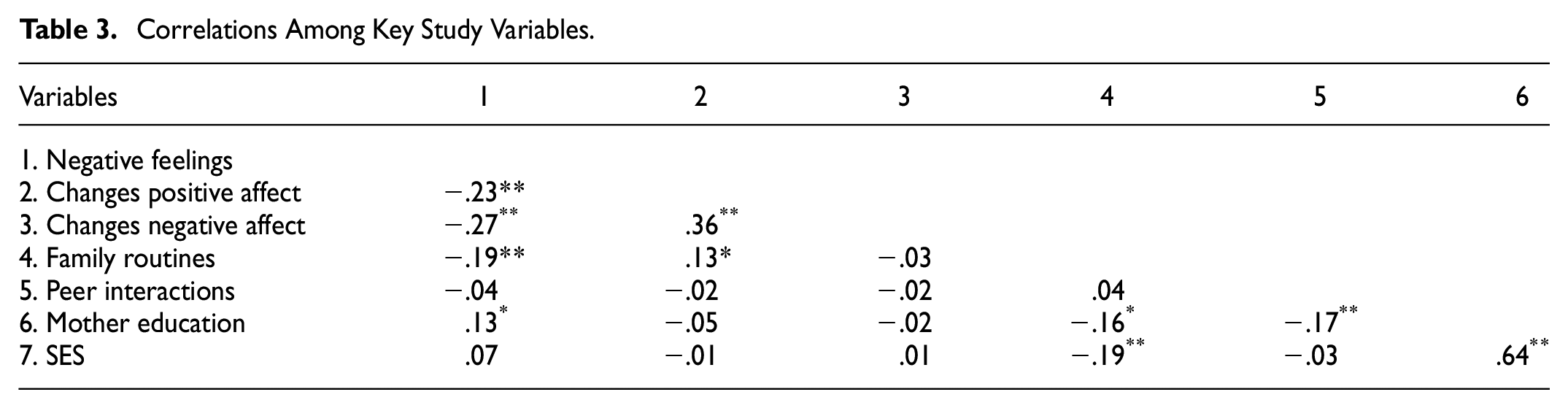
Pearson’s r correlations (Table 3) examined associations among all variables in the study and showed negative associations among reported negative feelings and perceived changes in affect, and peer and family interactions. Adolescents who reported experiencing more often negative feelings (sad, bored, lonely, anxious) during the pandemic also reported feeling less happy when they were asked to report their experiences in comparison to their situation before the pandemic. That is, reported negative feelings correlated negatively with perceived changes in positive affect (r = −.23, p < .01). More time with the family (such as engaging in dinner, playing games, and talking) was associated with less negative affect and more positive affect. Specifically, there were significant negative associations between family routines and reported negative feelings (r = −.19, p < .01) and positive associations between family routines and perceived changes in positive affect (r = .13, p < .01). Neither peer interactions nor economic status yielded statistically significant correlations with reported negative feelings. Finally, maternal level of education correlated positively and significantly with reported levels of negative feelings (r = .13, p < .05) and negatively with reported family routines (r = −.16, p < .01). These findings suggest that adolescents whose mothers had higher education degrees reported experiencing more negative feelings and having less time with their family during the day. Overall, the results indicate weak (probably because of the variability in the adolescents’ responses and the sample size of the study) but statistically significant associations among most variables of interest in this study. These associations are further explored in the regression models that follow as well as in the qualitative analysis of the study. The findings will be discussed in more detail in the following sections and the discussion.
Correlations Among Key Study Variables.
Predictors of Reported Negative Feelings
We examined whether the reported levels of negative feelings experienced during the pandemic were associated with background characteristics (e.g., gender, the education level of the mother), reported relationships with family members and friends, and perceived changes in positive and negative affect. A three-stage hierarchical linear regression model was conducted with perceived negative feelings as the dependent variable. Background demographic characteristics were entered at step 1 of the regression model to control for gender and maternal education (as an indicator of socio-economic status). Family routines and social peer interactions were entered at stage 2, and perceived changes in positive and negative affect at stage 3. The independent variables were entered in this order as they fit the theoretical framework on factors that may promote well-being in children and adolescents during COVID-19 (Masten, 2016; Walsh, 2003). Full results of these models are presented in Table 4.
Results of Hierarchical Multiple Regression Models Predicting Reported Negative Emotions From Family Routines, Peer Interactions, and Perceived Changes in Positive and Negative Affect.

The hierarchical multiple regression at step 1 revealed that demographic characteristics contributed significantly to the model and accounted for 5% of the variance (F(2, 229) = 6.38, p < .05, R2 = .05, R2 adjusted = .04). Introducing the variables related to perceived family routines and peer interactions explained 9% (additional 5%) of variation in the reported levels of negative feelings. It also contributed significantly to the model (F(4, 227) = 5.78, p < .01, R2 = . 09, R2 adjusted = .07). Finally, the addition of the variables of changes in positive and negative affect explained 19.4% of the variance in reported negative feelings (that is an additional 10%) and this change in R2 was also significant (F(6, 227) = 9.08, p < .001, R2 = .19, R2 adjusted = .17).
Furthermore, several significant relations emerged when looking at the predictor variables (Table 4). Of interest to our study, gender but not the level of the mother’s education was a significant contributor to the results. Further, family routines were negatively associated with reported negative feelings, but peer interactions were not a statistically significant contributor to the model. Adolescents spent more time with family and less with friends during the pandemic and this may explain why family routines were identified as significant in the model. Finally, perceived changes in affect were associated with reported negative feelings.
Differences Based on the Gender of the Participants and Family Status
An independent samples T-test indicated statistically significant differences for female (M = 2.34, SD = 0.76) and male (M = 1.93, SD = 0.62) participants of the study on the reported negative feelings: t(314) = 4.60, p < .01.
Reported Family and Peer Interactions in the Interviews
The interview findings complement those of the survey and provide a fuller picture of the interactions with family members as well as also those with peers. In particular, the results point to differences in the ways in which the two groups of adolescents, those who felt better and those who felt worse after 1 year, spent time with their family members or peers. In May 2020, all adolescents reported spending time with their parents and doing various activities together such as having dinner together, talking, doing sports, cooking, or watching movies. The adolescents who felt better in 2021 than in 2020 reported engaging in a lot of activities with family members in both years although the activities were less diverse in 2021. By contrast, the adolescents who felt worse after 1 year engaged in fewer and less diverse activities in both years compared to the first group. The quality time spent with parents seemed to help the adolescents cope better with the pandemic and its challenges.
The 14 adolescents who had siblings also reported spending more time together and, at times arguing, with them during the lockdown in 2020. In both groups, almost none of the adolescents reported still spending time or arguing with their siblings in June 2021. This may be because they were back at school and attended their clubs during their free time. Nevertheless, as with the parents, the adolescents who coped better in June 2021 had engaged in more diverse activities with their siblings in May 2020 than the participants who did not cope as well.
Finally, the biggest difference between the two groups related to peer interactions outside of school. All adolescents reported spending time with their peers online during the lockdown in 2020 and a few indicated rare exceptions where they met peers outside. The group of adolescents who felt better in June 2021 regularly played with their friends and spent time together in sports club, music courses, or the scout’s troop. Only one 13-year-old boy continued to only spend time online with his friends, playing videogames with them. By contrast, of the five adolescents who still reported negative feelings in June 2021, only one 12-year-old boy reported seeing his friends regularly in person in his sports club. The remainder only communicated with their friends online and seemed isolated. While they went for walks or cycled alone or with family members, they did not attend any clubs and had no opportunities to meet people other than their families. There was a pattern: face-to-face peer interactions in social activities outside of school influenced adolescents’ well-being. In conclusion, we argue that the opportunities to engage in a range of activities with family members and peers helped the adolescents cope with their challenging lives in 2020 and 2021. Given that there were more boys than girls in the small sample, no conclusions can be drawn in relation to gender.
Discussion
This mixed method study aimed to explore adolescents’ emotional responses to the pandemic and the protective factors that may have helped them cope with the pandemic-related challenges. Results from the survey and the interviews are synthesized in the following section.
Overall, the results of the survey and the interviews pinpoint to the importance of protective factors which include both individual strategies (acknowledging having positive feelings prior to and during the pandemic) as well as social support. Correlations among the variables showed weak but significant associations in the frequency of having negative feelings during the pandemic (i.e., sadness or loneliness) and reports of feeling equally or more worried during the pandemic and less happy compared to their pre-pandemic feelings/emotional state. Further survey results showed that girls reported more negative feelings than boys. Family routines were identified as a protective factor while peer interactions did not bear statistical significance in our findings. It is important to note that weak associations are acceptable in educational studies because of the variability in the participants’ responses, the sample sizes, and the pragmatic reasons behind the selection of sample size and characteristics. Equally important and contrary to the theory-based assumption that adolescents whose mothers have higher education degrees, report fewer negative feelings, our results suggest that the relationship between the adolescents’ reported negative feelings and maternal education is inverse: adolescents whose mothers had higher education degrees were more likely to report experiencing more negative feelings and spending less time with their family during the day. This finding aligns with studies on the effects of socioeconomic status and child well-being during the pandemic. For example, Scrimin et al (2022) indicated that parents with higher household incomes were more distressed by the changes in the routines and the need to help their children, which, in turn, contributed to children’s emotional difficulties in coping with the pandemic.
The interviews confirm the findings on the importance of family routines. Specifically, adolescents who had more positive feelings in 2021 all reported spending more quality time with their parents and regularly spending time with peers. This is in line with studies demonstrating the influence of family on adolescents’ coping (Masten & Narayan, 2012; Wigley et al., 2021). A report on adolescents in Luxembourg found that the time spent with family can promote the emergence of resilience in adolescents (MENJE, 2021b). Walsh (2003) even argued for the existence of family resilience, understanding family “as a functional unit” (p. 3). Facing adversities together as a family helps each individual evolve and the family grow together and become more resourceful when meeting future challenges (Walsh, 2003). Some of the interviewed adolescents reported having closer relationships with their parents. This may explain why the adolescents who spent more quality time with their parents felt better in 2021 than the ones who did not. The fact that those adolescents whose mothers had a degree in higher education reported having more negative feelings might pinpoint to the working conditions of these mothers. Because our survey did not include the collection of more information or information from parents themselves, we cannot make secure inferences on that matter.
The interviews also offered insights into the role of siblings as most adolescents spent more time with them due to the lockdown in 2020. The adolescents who reported more positive than negative feelings tended to carry out more varied activities with their siblings. The difference between the two groups was small but given that the relationship with a sibling can have a protective effect, the finding is relevant (Davies et al., 2019). The interviews also showed the adolescents who engaged with peers in a range of activities, for instance in clubs, were coping better with the on-going pandemic in 2021 than the ones who were more isolated. It is not possible to disentangle the effects of peers (or siblings) from the social activities they engage in together. Playing with others and doing sports during the COVID-19 pandemic has proven to enhance children’s well-being (Lades et al., 2020). Similarly, studies confirm the role of peers to help adolescents withstand adversity (Grazzani et al. 2022; Höltge et al., 2021; Rogers et al., 2021; Sikorska et al., 2021). These interview findings contrast with those of our survey where peer interactions did not show a statistical significance. The changes in the adolescents’ experiences during the pandemic help explain this phenomenon. The results of the COVID-Kids I survey carried out in 2020 (Kirsch et al., 2020) showed that children missed their friends and their family most during the school closures and the confinement. From September 2020 onwards, the adolescents went back to school and had, once again, some opportunities to meet their peers outside of school. While the two surveys did not recruit the same participants, the interviews did and, therefore, we could ask the adolescents more detailed questions about their peer interactions. Furthermore, the survey did not include items that specifically addressed the frequency of peer interactions and their activities, which might explain the differences in the responses.
The findings of our study also confirm previous findings on the importance of face-to-face interactions compared to online interactions. For instance, a longitudinal mixed-method study from the United States with 407 adolescents found that 76% of the participants perceived their inability to interact in-person with others outside of their household as very challenging (Rogers et al., 2021). Adolescents in several studies agreed that online communication tools lacked true emotional connection and closeness and were often not enough to fill the void of social peer interaction (Cockerham et al. 2021; Rogers et al., 2021). Fitzgerald et al. (2021) held that the loss of intimate peer relationships was especially dramatic for vulnerable children with pre-existing mental health issues.
Conclusion
The COVID-19 pandemic has severely affected people’s physical and mental health since 2020. Since then, other challenges such as wars and climate change continue to trouble our world. It is therefore important to not only understand the negative outcomes of the COVID-19 pandemic, but also know some of the resilience factors that can help protect people in future adverse situations. While resilience is understood as a connection of “mutually dependent, interacting resources from different systems such as psychological, social, institutional, cultural, and environmental” (Höltge et al., 2021, p. 581), the present study mainly offered insights into the relevance of activities with family members and peers and was less informative on individual strategies and demographic factors owing to the small size of this convenience sample which had an unequal distribution of gender and sociodemographic status. Furthermore, the survey and interviews were intended to get insights into adolescents’ social experiences and emotional responses rather than their resilience for which we would have needed to use a standardized resilience questionnaire. Future studies could target a more representative sample although it is not easy to find willing participants during a pandemic. Nevertheless, this longitudinal study of adolescents in Luxembourg has shown that adolescents changed their negative and positive emotions during the pandemic, and highlighted the relevance of interactions with family members and peers as protective factors. It is hoped that parents, educators, and policymakers understand their crucial role and are better prepared to develop environments that help children and adolescents navigate challenges in uncertain times.
Footnotes
Acknowledgements
We would like to acknowledge the contribution of Ms Anne-Sophie Genevois (Luxembourg Institute of Socio-Economic Research) for cleaning the data and providing us with the demographics of the sample.
Declaration of Conflicting Interests
The author(s) declared no potential conflicts of interest with respect to the research, authorship, and/or publication of this article.
Funding
The author(s) disclosed receipt of the following financial support for the research, authorship, and/or publication of this article: This research was supported by the Œuvre Nationale de Secours Grande-Duchesse Charlotte [2020COV012 and 2021JEU004].
