




Abstract
Despite the growing importance of self-care in the retention of social workers, its practice has been rarely studied. This study investigated the self-care strategies utilized by social workers to enhance retention in China. This study comprised individual in-depth interviews with 49 experienced social workers and three focus group discussions. Findings showed that five categories of personal self-care strategies and six categories of professional self-care strategies were identified. Emphases on self-care practice differed at three distinct career stages, frontline social workers, project officers or managers, and organizational managers. Self-care practice was revealed as indispensable for social workers’ retention in China, identifying distinct Chinese characteristics and highlighting the global nature of the ecological perspective of self-care. The study discusses the implications for social workers, educators, social services organizations, government, and the public.
Introduction
The licensure of social workers came into effect in mainland China (hereafter “China”) in 2008. Social work was then regarded as an emerging profession (Yan et al., 2013). Following the government’s social governance initiatives and purchase of social work services after 2013, the number of social work service organizations (SWSOs), one type of non-profit organization (NPO), and the primary workplaces for Chinese social workers, increased to nearly 10,000 in 2020. By the end of 2021, 737,000 national social worker licenses had been issued (Ministry of Civil Affairs of China, 2022). Licenses are issued to people who have passed the national licensure examinations, regardless of whether they possess a social work or other diploma, but who have social work-related work experience (although specific statistics for neither are available). Policies related to social work have developed incrementally and impact Chinese social workers’ intentions to remain in the profession. Increasingly, some choose social work as a long-term profession. However, the challenges arising from daily practice, such as burnout and confused roles (Li et al., 2022; Tang & Li, 2021), high workload, deficient capacity, and low wages and social status (An & Chapman, 2014; Jiang et al., 2019), contribute to high turnover, which remains at around 20% (Jiang et al., 2019; E. Wang et al., 2019). As a result, many Chinese social workers leave the profession after a few years, especially those holding a social work diploma and working in SWSOs. In D. W. Xu’s (2017) study undertaken in Shenzhen, 38.1% of social workers intended to obtain another social work job, but 49.4% planned to move into a different profession.
Despite challenges, some Chinese social workers maintain a long-term commitment to the profession. Researchers have identified the association between a wide range of factors affecting social work turnover and retention, such as professional identity (Wang et al., 2019), and income and future (Zeng et al., 2016); some of these are explained and are highly relevant to self-care (Lee & Miller, 2013; Miller et al., 2017, 2019; Y. Wang et al., 2019a; Y. Wang, Jiang, et al., 2021). Furthermore, social workers engage in self-care on a limited basis (Bloomquist et al., 2016). Despite the growing importance of self-care, little research has investigated self-care activities among Chinese social workers and their effect on retention throughout different career stages. As Miller et al. (2017) asserted, social workers’“self-care must be learned, practiced, and honed throughout a career” (p. 880). Understanding how social workers remain in the profession offers a more valuable and practical alternative to studying the factors related to social workers’ intention to leave and actually quitting the profession.
The study is one element of a large national project, whose main research questions are: What challenges do Chinese social workers encounter, and what coping strategies do they apply to achieve retention? This study reported in this article aimed to address the research gap by asking the primary research questions: How do Chinese social workers apply self-care strategies to achieve retention? Are differential self-care strategies utilized at different career stages? The study focused on self-care strategies social workers used to cope with challenges, regarding self-care as a means to achieve retention. The study enhances knowledge of self-care and retention in social work. A parallel study discusses related structural barriers and coping strategies separately (Author, 2022). The present study also analyzes self-care strategies related to coping with structural barriers.
Literature Review
Self-Care Defined
Self-care refers to care of the self. For social workers, it is increasingly regarded as an empowering tool and engagement in behaviors that holistically support and promote health and well-being (Bettney, 2017; Lee & Miller, 2013). The National Association of Social Workers (NASW, 2018) defined self-care as “a choice and commitment to become actively involved in maintaining one’s effectiveness as a social worker” (p. 246). Self-care includes personal and professional self-care (Lee & Miller, 2013) and is “holistic attention to multiple domains associated with overall well-being” (Miller et al., 2019, p. 56). Personal self-care is defined as “a process of purposeful engagement in practices that promote holistic health and well-being of the self” (Lee & Miller, 2013, p. 98). Professional self-care is defined as “the process of purposeful engagement in practices that promote effective and appropriate use of the self in the professional role within the context of sustaining holistic health and well-being” (Lee & Miller, 2013, p. 98). Miller et al. (2017) even highlighted a holistic and participatory perspective of self-care, and asserted that practitioners, organizations, and society are engaged in self-care activities. Based on the social work context of collaborative worker-client relationships, Bressi and Vaden (2017) critically suggested a reconsidered definition of self-care reflecting intersubjectivity and relational models to render the self visible.
A Myriad of Challenges and Unwanted Outcomes: Arduous Retention
Globally, social workers face a myriad of challenges and unwanted outcomes. These include personal and organizational challenges and structural barriers, such as increasing paperwork and caseloads, stress and burnout (Ravalier et al., 2021; Y. Xu et al., 2019), high turnover intentions and job mobility (Geisler et al., 2019), role or identity ambiguity (Van Robaeys et al., 2018), self-care barriers (Y. Xu et al., 2019), secondary traumatic stress and compassion fatigue (McGarrigle & Walsh, 2011; Newell & Nelson-Gardell, 2014), client-engaged violence and abuse (Shier et al., 2021), job dissatisfaction, poor pay, growing bureaucratization, repetitive administrative duties, insufficient supervision and management support, and incongruence between practitioner, programming mandates, and the social welfare system (Hombrados-Mendieta & Cosano-Rivas, 2013; Shier & Graham, 2015; Ravalier et al., 2021). Research suggests that social workers’ stress levels are increasing (Ravalier et al., 2021). Some challenges, such as compassion fatigue, secondary traumatic stress, incompetence, and low well-being level, correlate with a lack of self-care (Lee & Miller, 2013). With such multidimensional challenges, scholars and practitioners have drawn increasing attention to workforce retention in the social work profession.
In the emerging context of social work in China, social workers also encounter various challenges. Structural barriers have been identified as constraining structural contexts and immature professionalization (Author, 2022). Other challenges include burnout and role stress, depression, a fragile professional identity, confused roles (Li et al., 2022; Tang & Li, 2021; Y. Wang et al., 2019a), deficient skills and capacity, a lack of supervision, high workload, a shortage of staff and high turnover (Jiang et al., 2019; E. Wang et al., 2019), low wages and social status (An & Chapman, 2014; Yan et al., 2013), organizational bureaucracy and managerialism, vague collective psychological ownership of organizations (Su & Ng, 2019), and low social recognition, and even the public’s misconception of social workers as volunteers (D. W. Xu, 2017; Y. Wang, Jiang, et al., 2021). Some of these challenges mirror those reported internationally. Inevitably, these challenges impact the quality of services provided to clients. Thus, retention is a serious issue for the profession in China and merits further investigation.
Self-Care: A Solution to Professional Challenges
Among strategies utilized to cope with career challenges, self-care is considered a solution to enhance social workers’ retention, competence, and well-being, and its importance is increasingly acknowledged. This indicates that social workers’ self-care is deficient compared with the growing organizational and structural strategies; consequently, further attention to social workers’ self-care is imperative (Lee and Miller, 2013; Miller et al., 2017).
The International Federation of Social Workers’Global social work statement of ethical principles considers self-care a vital element of professional integrity and that social workers should undertake self-care activities “professionally and personally in the workplace, in their private lives and in society” (International Federation of Social Workers, 2018, #9.6). NASW’s Code of ethics also addresses the importance of social workers’ professional self-care and regards it as a paramount element for competent and ethical practice (NASW, 2021).
Although research on self-care among social workers is still in its infancy, studies have increasingly disputed its benefits (Acker, 2018; Miller et al., 2017). Empirical studies suggest that self-care not only mitigates social workers’ job-related stress, burnout, secondary traumatic stress, and turnover intentions, but could also enhance well-being and retention, resilience, professional quality of life, and job satisfaction (Acker, 2018; Bloomquist et al., 2016; Lee & Miller, 2013; McGarrigle & Walsh, 2011; Miller et al., 2019; Mo, 2023; Pandya, 2021; Y. Wang et al., 2019a; Y. Xu et al., 2019), and even play a vital role in influencing the development of social work (NASW, 2021; Y. Wang, Jiang, et al., 2021). Lee and Miller (2013) summarized that self-care could empower social workers “to negotiate and offset some of the profound structural, organizational, and interpersonal challenges” (p. 101). Other studies have also identified the importance of self-care in assuaging challenges related to social work practice (Miller et al., 2017, 2019), distress emerging in social services organizations (Y. Wang et al., 2019b) and in improving service quality and client outcomes (Miller et al., 2019). However, social workers’ engagement in self-care practices is limited, so it warrants more attention (Miller et al., 2019).
Few empirical studies have investigated self-care among Chinese social workers (Mo, 2023; Y. Wang et al., 2019a). Mo (2023) identified several characteristics of positive organizational measures related to social workers’ self-care in Guangdong province, including supportive work relationships and team culture, work–life balance and a healthy work environment, and sensitivity and an accepting attitude of supervisors and managers. Y. Wang et al. (2019b) found self-care to be a critical moderator of the effect of supervisor behavior on novice practitioners’ organizational citizenship behaviors, a primary criterion of job performance reflecting leadership and the relationship between organization and employees, and that increased self-care training for social work students resulted in improved performance following graduation. In addition, securing support from the family and government is regarded as self-care activity enhancing professional retention (Sun & Liu, 2017). Although researchers have begun to investigate self-care strategies primarily from the organizational perspective, little research has investigated self-care practice in relation to the political and socio-cultural environment (Sun & Liu, 2017). However, the research gap concerning the exact content of self-care activities and how individual Chinese social workers utilize them from a holistic perspective to maintain retention through different career stages remains.
Self-Care Applications
In terms of personal self-care, studies have identified daily physical, emotional, mental, social, and spiritual activities (McGarrigle & Walsh, 2011; Miller et al., 2017, 2019; Mo, 2023). Lee and Miller (2013) and Bloomquist et al. (2016) have specified personal self-care from five primary structures of support: (1) physical support, such as a healthy diet, exercise, regular sleep, and medical care when needed; (2) psychological and emotional support, such as undertaking therapy, approaching family or friends for emotional support, journaling, reading, spending time with a loved one, laughing and using humor, and self-praise; (3) social support, such as engaging in a local supervision group, and building social networks; (4) leisure support, such as enjoying a short holiday, playing with children; and (5) spiritual support, such as attending religious events, praying, meditating or engaging in mindfulness practice. Empirical studies have analyzed the effectiveness of different personal self-care actives in promoting well-being, such as using humor, to reduce stress and expressing camaraderie (Westbrook et al., 2006), mindfulness practice and meditation to mitigate stress and improve professional life quality and competencies (McGarrigle & Walsh, 2011; Pandya, 2021), and pursuing personal value congruence as a means of sustaining practitioners’ self-care in non-profit organizations (Kanter & Sherman, 2016; Miller et al., 2017).
In terms of professional self-care, scholars have acknowledged various aspects. For example, Cox and Steiner (2013) and Miller et al. (2019) described three elements of professional development activities, supervision and attention to financial well-being. Miller et al. (2017) and Mo (2023) stated that professional self-care activities embody intrapersonal work among colleagues, professional development and support. Lee and Miller (2013) outlined six support structures contributing to professional self-care: workload and time management, attention to the professional role, attention to reactions to work, professional social support and self-advocacy, professional development, and revitalization and energy generation (p. 100).
The literature suggests professional self-care comprises four elements: (1) professional development (such as participating in professional training, workload and time management, identifying professional role, and setting boundaries with clients and stakeholders); (2) intrapersonal work among colleagues (such as case discussion, teamwork or participating in a peer support group); (3) professional support (such as regular supervision, and self-advocacy); and (4) attention to financial well-being and energy revitalization (such as a salary increase with/or promotion, taking breaks during the work day, and making the workplace pleasant) (Bloomquist et al., 2016; Miller et al., 2017, 2019; Mo, 2023).
The literature also acknowledges the importance of professional self-care activities and the effectiveness of its sub-strategies on social workers’ overall well-being. For instance, on-the-job-training and skill training programs are recognized as advancing social workers’ professional competence, retention, and quality of supervision received (Malmberg-Heimonen et al., 2016; Westbrook et al., 2006). Moving positions or jobs to find the appropriate fit and self-advocacy for structural changes within the organization are regarded as important coping strategies for ensuring survival in the profession (Lee & Miller, 2013; Westbrook et al., 2006). Organizational support (including supervision, mentorship and peer support, provision of resources, a rewarding role, a balanced work–life organizational culture, and relationships and interactions) and use of support is vital for professional self-care activities to strengthen practitioners’ work performance, job satisfaction, and well-being (Mo, 2023; Radey et al., 2017; Ravalier et al., 2021). In addition, social workers are aware of the barriers to undertaking self-care activities, such as heavy workloads, overtime work, family and community obligations, social life, and poor teamwork or organizational environment (Bloomquist et al., 2016; Mo, 2023; Y. Xu et al., 2019).
Furthermore, the literature reveals the positive and dynamic correlation and interconnection between personal and professional self-care (Lee & Miller, 2013; Miller et al., 2017). “In order to engage in productive personal self-care, one benefits from engagement in productive professional self-care, and vice versa” (Lee & Miller, 2013,p. 99). However, differences in self-care activities exist between various groups. Licensed social workers, supervisors, and those working in micro contexts engage in more self-care practices than others (Miller et al., 2019). Miller et al. (2017) identified significant differences in professional self-care practices between social workers with licensure statuses, although the effect on personal self-care practices was the same. Those with longer work experience developed more self-care strategies. “Experience … is related to self-care practice and overall professional quality of life” (Bloomquist et al., 2016, p. 305). Furthermore, Bressi & Vaden (2017) identified “a disruption in the equilibrium between the personal self and professional self” (p. 35), “[social] workers hav[ing] multiple selves that are co-constructed in relationship with each client” (p. 36), and highlighted the importance of engagement in the social work relationship when social workers using self to enhance client growth.
Overall, the literature has distinct implications. Chinese social workers encounter multidimensional challenges and associated problematic outcomes that negatively influence the quality of services to clients. Self-care may alleviate such challenges and outcomes, even though literature cautions that self-care might be an insufficient response to worker burnout because safe work environments matter and “an over-reliance on self care to resist work-related distress is aligned with a problematic yet prevailing discourse about the amelioration of stress and its negative outcomes” (Bressi & Vaden, 2017, p. 37). However, the minimal attention to self-care in the emerging Chinese social work context suggests the necessity to investigate further social workers’ narratives of self-care practices during their careers.
The current study, a follow-up to Author (2022), aimed to explore the specific personal and professional self-care activities identified by Chinese social workers and how they were utilized to maintain retention throughout different career stages.
Research Methods
Methods and Participants
The study used in-depth interviews supplemented by focus group discussions to address the research question. Participants were required to be: (1) licensed social workers who had completed university-level social work education and held a social work diploma; (2) working in an SWSO or other NPO for more than 1 year; and (3) employed in the social work profession for more than 5 years and intending to remain in the profession long-term. Social workers licensed as a result of passing the national qualification examination without a social work diploma or who worked in government or community neighborhood committees were excluded because of differences in their career development and roles in the latter organizations that were essentially administrative.
Study participants came from three cities, Shanghai, Shenzhen, and Xiamen. These locations were chosen because of access to sufficient eligible participants, convenience, and the viability of data collection. In 2003, Shanghai piloted professional social work using licensed social workers in judicial services, pre-dating the national licensure of social workers in 2008. Shenzhen adjoins Hong Kong and has had extensive cooperation and partnership with social work service organizations and universities in Hong Kong for many years enabling it to develop the most advanced social work programs in China. Xiamen is the closest mainland city to Taiwan, where social work is also well-developed, with which it has engaged in ongoing contact.
Data Collection Process
Phase 1 of the study comprised in-depth interviews with social workers. In addition to the author’s professional networks, snowballing was applied to recruit participants to access eligible participants purposefully. Four participants were invited to serve as gatekeepers in Shenzhen and Shanghai to introduce eligible colleagues and friends based on their own networks, following which the author then invited and interviewed these recommended participants in person. The author determined that data saturation had been achieved after interviewing 49 participants. The interviews elicited participants’ demographic information, experiences of challenges and self-care activities developed throughout their careers since starting work in social work. Actually, participants talked about stories covering their entire career experience since tertiary education, although 10 initial questions guided each interview in this study, such as, What challenges do you face in your daily work, and what issues resulted from these challenges? In terms of personal practice and coping strategies you utilized, how do you understand self-care, and what self-care strategies do you utilize on a daily basis and throughout different career stages? And influenced your remaining in social work? Forty-three participants were interviewed once, and six twice because further meaningful stories emerged after the first interview. Each interview lasted around 2 hours. All interviews were audio-recorded and transcribed; transcripts were coded using thematic analysis.
Following the generation of preliminary findings in Phase 1, participants were invited to contribute to focus group discussions conducted in each of the three cities in Phase 2 to report and obtain feedback on findings and identify new ideas or themes. The major focus group questions were: How far do you agree/disagree with the preliminary findings? What new themes do you want to raise? Focus group discussions were recorded, transcribed and coded using thematic analysis. Transcripts of the interviews and focus groups, the preliminary findings and analysis of themes were sent to participants seeking correction and feedback to ensure triangulation and validation of the data and the trustworthiness of the analytic process. The author also invited colleagues and research assistants to review data coding and analysis to aid credibility.
Coding Strategy
Thematic analysis was applied to two over-arching themes, “challenges and barriers” and “self-care strategies.” Given the volume of the verbatim interviews and focus group transcripts (more than 1.5 million words), NVivo 12 Plus software was used to help manage preliminary and secondary coding and generate themes. The phases of thematic analysis comprised the following steps (Braun and Clarke, 2006): (1) importing transcripts into NVivo and ensuring familiarization with the data; (2) using bottom-up data analysis for manual coding and generating preliminary nodes in NVivo; (3) adjusting nodes and generating initial themes related to challenges and self-care strategies; and (4) amending themes and categories based on participants’ feedback, and defining and naming four main themes related to personal challenges (“excessive workload,”“economic pressure,”“inadequate competence,” and “values and ethical dilemmas”), and two categories (“personal self-care” and “professional self-care”) and 11 sub-categories of self-care strategies. Two main themes related to structural barriers (“constraining social structures” and “immature professionalization”) were borrowed from the parallel study (Author, 2022). The author’s reflexivity was brought into the process of data coding, analysis, and interpretation. Finally, a thematic map was generated to expand each theme and strategy (see Appendices A and B).
Ethical Considerations and Approval
This study was approved by the human subjects ethics committee of the author’s affiliated university and adhered to four ethical principles: informed consent, autonomy or self-determination, privacy and confidentiality, and no harm. All participants provided advance informed consent to participate in both phases of the study. The author personally conducted all interviews and focus group discussions and undertook data analysis. Individual interviews were conducted in locations participants considered safe and comfortable. All digital material was stored on a password-protected computer, and all hard copy documents were kept in a locked space. Participants’ names were concealed in coding, analysis, and the findings. All participants were assured of their right to withdraw from the study at any time.
Participants’ Demographic Information
Fifteen participants were from Shanghai (coded SH01 to SH15), 16 from Shenzhen (coded SZ01 to SZ16), and 18 from Xiamen (coded XM01 to XM18). Eight were male and 41 female; 31 were married, and 18 were single. The average age and years spent working as a social worker were 32.7 and 8.6, respectively. Twenty-two participants were categorized as organizational managers (OM) (6 from Shanghai, 6 from Shenzhen, and 10 from Xiamen), including a director and deputy director. All OMs had experience as frontline social workers (FSW) and project officers or managers (PM). Twenty-five participants were PMs (nine from Shanghai, nine from Shenzhen, and seven from Xiamen), as supervisor, project or departmental director, regional manager, or service center director. All PMs had previous FSW experience. Two participants were FSWs from Shenzhen and Xiamen. Thus, the study comprised 49 accounts relating to the FSW stage, 47 to the PM stage, and 22 to the OM stage.
Findings
A Snapshot of Challenges and Barriers
Participants identified four main categories of personal challenges: (1) excessive workload, (2) economic pressure, (3) inadequate competence, and (4) values and ethical dilemmas. They also indicated two categories of structural barriers identified in the parallel study (Author, 2022): (1) constraining structural contexts; and (2) immature professionalization within social work and NPOs (see Appendix A: Table A1 and Appendix B: Table B1). Each category of challenge or barrier displayed various characteristics at the three career stages. These challenges and barriers negatively impacted participants’ retention and served as the basis of discussion on implementing self-care strategies. The research purpose and space constraints limit elaboration of participants’ narratives of these challenges and barriers. Meanwhile, the parallel study (Author, 2022) also discussed strategies applied to cope with structural barriers to achieve participants’ retention in the profession, therefore this study mainly analyzed self-care strategies jointly applied to cope with structural barriers and personal challenges, of which self-care was one coping strategy.
Tables A1 and B1 reveal participants’ apparent under-application of self-care, since part self-care strategies were mentioned and utilized by few participants; however, different personal and professional self-care strategies impacting participants’ continuance in social work could be extracted from their narratives.
Personal Self-Care Strategies
As Table A1 shows, five categories of personal self-care activities were identified: (1) enjoying physical and leisure time; (2) seeking informal psychological and emotional support; (3) maintaining a work-life balance; (4) pursuing personal value congruence with the social work mission; (5) engaging with a local social network.
Enjoying Physical and Leisure Time
Participants said that they commonly relaxed through participating in exercise such as hiking and running, regular medical care, taking a short holiday or weekend break, playing with children, keeping a regular sleep pattern and a healthy diet, ikebana, taking part in tea ceremonies, cooking, gardening, watching movies, and hanging out with friends.
When I felt frustrated by the excessive workload as an FSW, I took a break and tried to release pressure through sports, eating, and traveling … Now, we [three founders] often do that and discuss appropriate solutions together. (XM01: 32-year-old male OM in Xiamen)
Seeking Informal Psychological and Emotional Support
Participants disclosed different ways of obtaining psychological and emotional support, mostly specifying reading, journaling, and spending time with friends and families. Some mentioned burning incense and worshipping at a local temple as a spiritual self-care activity. Therapy or psychological counseling were absent from participants’ narratives.
Unlike my colleagues, I don’t like to get emotional support from my supervisor or friends. Instead, reading, journaling, and spending time alone in a Buddhist temple give me support. (SZ05: 33-year-old female PM in Shenzhen)
Maintaining a Work-Life Balance
In the face of excessive workloads, some participants referred to the importance of developing a work-life balance, such as enjoying a coffee break with colleagues during the workday, not engaging in work or online work-related conversations like WeChat groups after 7:00 pm on workdays or at weekends, and seeking enjoyment in life beyond work.
I feel I have learned to separate work from life better than before. I am highly involved in work when I am at work, and also enjoy life as much as possible after work, such as at nights and weekends. (SH06: 31-year-old female OM in Shanghai)
Pursuing Personal Value Congruence With the Social Work Mission
Almost all participants highlighted economic pressure. They tried to pursue personal value congruence with the social work mission and the non-profit ethos of SWSOs through several means, for instance, focusing on helping others and social commitment as sources of satisfaction, and fulfilling personal life career goals and professional development, instead of only on achieving a high income.
Even though the salary is much lower than in other professions, when I see great changes in clients and communities, I understand the meaning of my work as a social worker. That’s the essential source of satisfaction and commitment to social work. (SH09: 34-year-old female OM in Shanghai)
Engaging With a Local Social Network
Participants expressed high motivation to engage with local groups, including the local social work supervisor trainees group, alumni association, and townspeople association. They also tried to develop social networks with local government, business, and third sector organizations to generate multi-dimensional social support.
Besides joining my friends, classmates, and the local supervisor trainees groups, I have been particularly concerned with exploring the social network with government officials and getting to know local entrepreneurs. (XM08: 30-year-old female OM in Xiamen)
Professional Self-Care Strategies
As Table B1 shows, participants highlighted six categories of high-frequency professional self-care activities: (1) attention to professional development; (2) using peer support and teamwork; (3) seeking professional support and integrating external resources; (4) attention to financial well-being; (5) attention to organizational governance and a pleasant workplace; and (6) attention to enhancing social status.
Attention to Professional Development
Inadequate competence was a common challenge faced by participants. They had paid moderate attention to professional development. Three sub-categories could be summarized: (1) improving competence and capacity in daily practice, such as designing group work and organizing large community activities; (2) identifying a professional role and clarifying their career; and (3) participating in professional training and education, including continuing education programs to obtain a higher academic degree, and the local social work supervisor training scheme.
I participated in the supervisor training scheme … to gain qualification as a supervisor and to broaden my social network … I really learned a lot. This allowed me to survive the period of confusion … I also began my part-time Master of Social Work studies last September. (SH09: 34-year-old female OM in Shanghai)
Using Peer Support and Teamwork
Participants said they usually approached colleagues, especially team members in the same program, for peer support to alleviate excessive workloads and stress and enhance their competence and skills. This included group discussion, peer supervision when needed, monthly program workshops or reunions, and collaboration in large community activities.
When I was quite busy and distressed as an FSW, I sought support from my colleagues Lisha and Ayong. They kindly shared the work and gave me necessary peer supervision. This was quite useful, and I have applied this to my current work. (SZ13: 34-year-old female OM in Shenzhen)
Seeking Professional Support and Integrating External Resources
Participating in regular supervision was the most popular means of seeking professional support, most commonly weekly or twice monthly with an external supervisor or from inside the organization. Participants also frequently mentioned integrating resources from multiple external stakeholders to satisfy organizational development, service delivery needs, and implement activities, such as local community voluntary organizations, the corporate social responsibility sector, and the government sector.
After I was promoted to PM … I was able to approach supervisors from Hong Kong more frequently than before. They always gave me direct guidance about ethical dilemmas and program management. (SZ02: 30-year-old female PM in Shenzhen)
Attention to Financial Well-Being
Participants adopted two vital professional self-care solutions to secure their financial well-being: (1) gaining promotion and the accompanying increased higher salary; and (2) utilizing their professional ability to increase their income. Some participants in senior positions reported earning extra money based on their professional field and “expert identity,” such as children and youth counseling and education, social work supervision, and practical expertise for social work evaluation.
Many social workers use different ways to earn more money … When I was a PM, I began to invest in a friend’s company that is highly related to my current work. Offering part-time social work training, supervision, and evaluation also brings extra income after I was entitled to be a practical expert. (SZ08: 35-year-old male OM in Shenzhen)
Attention to Organizational Governance and a Pleasant Workplace
Based on their organizational level, participants highlighted two frequently-used professional self-care strategies: (1) promoting organizational governance. Senior participants identified the specific activities as clarifying the organizational mission and vision, improving strategy and the business model, creating brand projects and standards, strengthening authorization and participation rights, re-organizing departments, and allocating human resources to promote inter-departmental collaboration; and (2) creating a pleasant workplace and a participatory culture and atmosphere in which participants felt free, open, equal, and could take breaks during the workday to gain revitalization of energy.
I am a Buddhist and wanted to create a Buddha-like learning-style organization and expand this culture to colleagues, in which everyone can feel uncritical, and equally participate in organizational governance and decision-making. I believe in working together, making great progress. (XM18: 39-year-old female OM in Xiamen)
Attention to Enhancing Social Status
Participants stressed two significant professional self-care activities to enhance the social status of social workers in China: (1) moving positions or jobs and self-advocacy within the organization to achieve the appropriate fit and to make structural changes for a better survival in the organization; and (2) engaging in self-advocacy in the broad social work context, including self-endorsement through demonstrating good service performance and program effectiveness, collective voicing, and policy advocacy.
As the director of the organization and a senior social worker, I totally understand the difficulties we face, so I always catch every opportunity to voice and carry out policy advocacy to government officials and make social work values and performance evident to enhance social workers’ social status. (SH06: 31-year-old female OM in Shanghai)
Self-Care Strategies Utilized and Retention at Three Career Stages
Tables A1 and B1 illustrate the different characteristics of the challenges at each career stage. While the self-care strategies utilized by FSWs, PMs, and OMs varied, this section relates self-care strategies to the narratives regarding participant retention from FSWs to PMs and OMs.
The FSW Stage
FSWs stated they faced: (1) a large caseload leading to burnout, stress, and frequent turnover intentions; (2) a low starting salary; (3) a shortage of personal service skills; (4) direct service dilemmas; (5) challenges resulting from inadequate social work education; (6) a confused professional identity and low social status; and (7) inadequate organizational support (see Tables A1 and B1).
Participants mentioned all five categories of personal self-care strategies at the FSW stage, although three issues are worth exploring. First, participants frequently highlighted the necessity of seeking informal psychological and emotional support from families and friends, which provided vital support and social recognition, and ensured their retention in the social work profession when they faced challenges early in their careers (see Table A1, #1.2).
In the first few years of my social work career, my parents and girlfriend (now wife) gave me countless empathy and material and emotional support, without which I might have left the profession. (SH01: 32-year-old male OM in Shanghai)
Second, participants indicated that pursuing personal value congruence with the social work mission was extraordinarily important at the FSW stage (see Table A1, #1.4). This reduced turnover intentions and motivated them to continue in the social work profession despite poor remuneration and inadequate competence, as indicated by participant SH09 above.
Third, all participants agreed on the importance of engaging in the local social network from the beginning of their careers (see Table A1, #1.5). Participant XM16 added:
The local social work network brought me and organization volunteers, financial aid, and intelligent support. Its benefits were not only apparent when I was an FSW, but have lasted throughout my entire career. (XM16: 29-year-old female PM in Xiamen)
Meanwhile, participants tended to utilize three categories of professional self-care strategies at the FSW stage. First, attention to professional development, including three sub-categories of strategies, they not only emphasized improving competence and identifying their professional role through learning-by-doing but also actively participated in many kinds of professional training and education (see Table B1, #2.1).
Honestly, besides in-service training, I particularly paid attention to accumulating direct service experience. This mostly benefited my professional competence when I was an FSW. (XM03:28-year-old female PM in Xiamen)
Second was using peer support and teamwork, especially with colleagues working in the same project or community, which helped relieve excessive workloads, improve service skills and competence, and access necessary and timely support (see Table B1, #2.2). The comments of participant SZ13 reported above were typical of participants’ narratives.
Third was seeking professional support and integrating external resources, primarily through organizational supervision and resources in the local community they served (see Table B1 #2.3). Participants also expected to gain promotion that would alleviate any turnover intention, generate a higher salary, and further identify their professional roles for remaining longer in the profession (see Table B1, #2.4a). Participant XM16, who previously mentioned the importance of engaging with the local social network of friends, social work professionals, and government officials, added:
I also valued organizational supervision, which assisted me in improving my direct service skills when I was an FSW … I also hoped to be sufficiently competent to become a PM soon. (XM16: 29-year-old female PM in Xiamen)
The PM Stage
Most PMs said they had experienced swift promotion from FSW positions and were expected to be all-round professionals, managing projects, building a cooperative team, handling external relationships, and supervising new social workers. They encountered: (1) project administrative work overload; (2) comparatively low income and the temptation to move to higher-paid jobs; (3) role transition pressure and inadequate project management capacity; (4) confusion about personal career plans; (5) conflicts between universal and professional values and ethics; (6) vague boundaries; and (7) a shortage of human resources and team instability (see Tables A1 and B1).
Similar to FSWs, PM participants reported using all five sub-categories of personal self-care strategies at the PM stage. Nevertheless, they frequently highlighted the importance of engaging in the local social network that not only supported them at the PM stage to clarify their personal career plans and handle conflicts between universal and professional values and ethics, but also helped them set clearer boundaries with other stakeholders, and supplement the diversity of human resources (see Table A1, #1.5).
When I was a PM, I guess the most important progress I made was to take care of myself and my relationships with other stakeholders to think about who I am and who I should be. Gradually, I could better understand my professional and personal roles, and deal with different relationships appropriately. (SH10: 35-year-old female OM in Shanghai)
Similar to the FSW stage, participants used three categories of professional self-care strategies at the PM stage. The first was attention to professional development (see Table B1, #2.1). Participants had more opportunities to undertake training and supervision; such as undertaking the social work supervisor training scheme, similar to what participant SH09 talked about previously. The second was using peer support and teamwork (see Table B1, #2.2). Participants appraised that PMs could guide or seek peer support and teamwork in their own projects or inter-projects. The third was seeking professional support and integrating external resources (see Table B1, #2.3). PMs recognized that they were more likely to be supervised by external supervisors from Hong Kong or Taiwan than FSWs. Participants in Shenzhen, such as SZ02, preferred Hong Kong supervisors.
Meanwhile, PMs improved their financial well-being by securing promotion or utilizing their professional ability to generate additional income related to their social work competence, thus making long-term retention in the social work profession possible (see Table B1, #2.4). Previous quotes from participants SZ13 and XM16 demonstrated this point well.
Moreover, some PMs reported beginning to participate in organizational governance or decision-making processes and making a pleasant workplace or project team (see Table B1, #2.5). Through these they could better manage project administrative work and advocate for a reasonable salary structure and re-organizing departments within the organization. Participant SZ10 echoed the sentiments of participant XM18.
During those years of being a PM, I consciously built up a warm and mutual project team. This really equipped me and my colleagues with sustainable motivations and confidence. I could finally participate in organizational strategy planning. Thus, I am firmly convinced about choosing social work as a life-long profession. (SZ10: 36-year-old female OM in Shenzhen)
The OM Stage
Most OMs said they were responsible for handling three sets of pressure at this stage: ensuring organizational development, pursuing a better personal life and income, and contributing to the development of social work. They highlighted several challenges: (1) organizational administrative work overload; (2) economic pressure; (3) organizational governance and development pressure, frustrated role transition, and high capacity and responsibility challenges; (4) values and ethical dilemmas; (5) a stressful relationship with a dominant government and the imposition of hierarchical power; (6) low operationalization of policies, regulations, and standards; and (7) the pressure of organizational governance and development (see Tables A1 and B1). OMs shared some of the same challenges as PMs.
OMs revealed that they used the same five categories of personal self-care strategies as PMs to release challenges and maintain retention. Nevertheless, OMs paid more attention to caring for organizational development and constructing the social work community. They were highly engaged in local informal social networks to get appropriate social support to reduce organizational administrative workload and pressure of organizational governance and promote social recognition of social work. They were also highly involved in the local network with government officials to get to know them and even have the opportunity to raise questions about policy application and advocacy (see Table A1, #1.5). Participant XM08 previously gave a typical narrative, and added:
We cannot emphasize too much the importance of establishing a friendly relationship with external stakeholders, especially government officials and entrepreneurs, not only for myself and my organization, but also for the whole social work community, because we need their recognition and resources. (XM08: 30-year-old female OM in Xiamen)
OMs utilized all professional self-care strategies used in the earlier FSW and PM stages, although they focused on two in particular, attention to organization governance and a pleasant workplace and attention to enhancing the social status of social work (see Table B1 #2.5 and 2.6).
Through attention to organizational governance and a pleasant workplace, OMs arranged appropriate workloads, reduced the pressure of organizational governance, improved management competence to achieve role transition, and secured decent salaries for themselves and their colleagues. They also directly participated in policy practice by demonstrating service effectiveness and organization management performance. In addition to participant SZ10’s account of building up a warm and friendly team and organizational strategy planning, participant SH07’s experience expanded new interpretation:
Several years ago, I founded my organization to establish services for older people in JM District … At that time, the government did not purchase social work services for older people; thus, our financial resource was unsustainable. However, my organization kept providing services and tried to make them visible until the District government recognized their effectiveness and initiated the purchasing policy … Consequently, social work services for older people expanded to every community, I guess this might have partially resulted from our success in policy practice. (XM09: 35-year-old female OM in Xiamen)
OMs reported several ways in which they enhanced the social status of social work, including becoming a representative of the Communist Party of China, a member of the Committee of the Chinese People’s Political Consultative Conference, and a deputy of the People’s Congress at national, municipal or district levels, such as participants were entitled, such as SH06, SH09, SH15, XM05, and SZ10. These political appointments represented the realization of their aspirations and generated previously unachievable opportunities to participate directly in the policy-making process or submit proposals to improve the social status of social work. Performing these roles secured their personal career path and long-term retention in social work and contributed to the development of social work in China.
Discussion and Conclusion
Self-Care Practice in the Context of Social Work in China
Literature suggests Chinese social workers encounter constraining structural contexts and immature professionalization: including a political system “characterized by centralism, hierarchy, bureaucracy and top-down management” (Author, 2022, p. 373); constraints faced by NPOs extend to social workers, such as inequality and distrust from the government, and the lack of professional management and competitive capacity among NPOs; the low threshold for the licensure of social workers because of the shortage of social workers and “the macro plan to create a large cadre of social workers in a short time” (Author, 2022, p. 374); and low autonomy for professionalism. Consequently, Chinese government officials often regarded social work “as a means of maintaining social stability or an instrument to assist periodic social governance projects” (Author, 2022, p. 374).
Engaged in the constraining contexts, participants applied various self-care strategies and presented similarities, differences, and interconnectedness in the three different career stages. All five categories of personal self-care strategies were commonly utilized at the three different career stages to assist participants in coping with challenges. Furthermore, participants paid essential attention to professional self-care strategies, such as professional development, peer support and teamwork, professional support and external resources, and financial well-being.
The differences in applications of self-care strategies to retention varied at the three stages, reflecting each stage’s unique challenges and professional requirements. FSWs were eager to alleviate stress, pursue value congruence with social work’s mission and generate motivation. PMs were more likely to identify boundaries and professional roles, gain a clearer professional role and career plan, and focus on inadequate competence related to project management and comparative economic pressure. OMs’ major responsibilities were organizational governance and development, and building a better social work community. Thus, as discussed previously, participants utilized distinct self-care strategies to assist coping with the challenges to retention.
Moreover, at each career stage, participants utilized personal and professional self-care strategies interconnectedly to cope with the main challenges and sustain a long-term career in social work. For instance, FSWs needed to pursue personal value congruence with the social work mission; this personal self-care strategy usually motivated their professional self-care strategies, such as identifying professional roles and participating in professional training, and vice versa. These self-care strategies combined to contribute to staff retention. Another example was personal self-care of engaging in local social networks, and professional self-care of integrating external resources, which OM participants admitted to regarding as virtually the same. The study’s interpretation of the interconnectedness of personal and professional self-care strategies echoed Lee and Miller’s (2013) argument “considering personal and professional self-care as two separate but implicitly and inextricably linked processes” (p. 99).
Progressing From Care for Social Work’s Mission to Care for Self?
Early in their careers, participants were committed to the social work mission and chose personal value congruence with it. Care for the mission of social work combined with self-care was regarded as the vital motivation ensuring participants continued their social work careers and generated their “professional hope” (Koenig & Spano, 2007, p. 48) to pursue a better world and belief that “the spring of social work” in China would come 1 day (Yan et al., 2013). These findings add empirical evidence to existing research (Schwartz et al., 2007), and reinforce Barth’s (2003) phrase “mission trumps money” (p. 17) to explain why participants remained in the profession.
However, as participants became more deeply embedded in service delivery or management positions, they encountered novel challenges that consumed their passions and care for the social work mission did not always effectively empower retention, having faded in the light of complex external constraining context and internal inexperience. This echoed other scholars’ perceptions that commitment to the social work mission may not motivate social workers to remain in the profession (An & Chapman, 2014; Healy, 2008). Consequently, the motivation to remain in the profession had to be sought from personal and professional self-care. Care for self generated participants’“realistic hope” (Collins, 2015, p. 209) or “personal hope” (Koenig & Spano, 2007, p. 48), such as the personal pursuit of professional development, promotion opportunities, achievement of a decent income, and increasing social status. The satisfaction of personal and professional self-care and well-being impelled participants’ retention as “committed survivors” (Westbrook et al., 2006, p. 57).
Progressing from care for the social work mission to care for self, participants tried to regard the profession as “an ordinary job,” that is, a job providing a fair income and predictable career, rather than being inextricably wedded ethically or morally to care for the social work mission. This finding supports M. S. Luo and Chui’s (2020) argument that social workers’ self-care regarding benefits and pay was positively associated with their remaining in the profession. It also expands Barth’s (2003) contention that social workers’ earnings are “unresponsive” to the labor market; because a stereotype of “taste” for social work prefers remaining in the profession, even if doing so risks lower pay, and likely results in ignorance of their self-care and well-being. Participants presented a strong desire for “money” and personal well-being to support retention, and demonstrated an interesting explanation of “taste” to balance care for the social work mission and care for self. Rapid promotion from FSW to PM or even OM, and the consequent improving expertise, remuneration or opportunities to obtain part-time income, and social status encouraged participants to remain in the profession. Thus, the “taste” in social work deserves diverse solutions, paying particular attention to social workers’ self-care.
Self-Care From an Ecological Perspective
Retention in social work in the emerging Chinese context is not only an individual issue but a structural, organizational, and chronological one (E. Wang, Zheng, & Si, 2021). Thus, self-care strategies from an ecological perspective deserve attention; international literature also highlights the global nature of the ecological perspective on self-care, through which social workers may identify more opportunities and resources to undertake self-care to promote retention in the profession and enhance clients’ growth (Bressi & Vaden, 2017; Cox & Steiner, 2013; Lee & Miller, 2013; Miller et al., 2019). The findings denote that participants demonstrated their self-care attempts from the five systems of ecological systems theory (Bronfenbrenner, 1979) to achieve positive daily practice, create a better organization for social workers, and enhance their social status.
At the microsystem level, participants approached their immediate environment, for instance, families, friends, and supervisors, to seek emotional and professional support. This expanded the argument that microsystem strategies might be helpless to impact constraining and changing contexts (An & Chapman, 2014; Mo, 2023). At the mesosystem level, participants emphasized interconnections between their microsystems, for example, alumni association, the local social work trainees groups, the relationship between local government and the organization, and collaboration between SWSOs, to share leisure time, engage in the local social network, and integrate external resources. At the exosystem level, when involved in challenging the indirect environment, such as local government leaders’ turnover and the pressure of community workers’ performance appraisal, participants paid great attention to pursuing stable funding and necessary professional autonomy. At the macrosystem level, when encountering structural barriers, participants demonstrated their self-care activities from both personal and professional perspectives. OMs, in particular, undertook the main responsibilities of utilizing more professional self-care strategies than FSWs and PMs to respond to structural barriers, such as identifying boundaries and developing a working relationship with government sectors and improving social workers’ social status and the construction of the social work community through collective voicing and policy advocacy. These findings echo and supplement the strategies to cope with structural barriers participants identified (Author, 2022). At the chronosystem level, following rapid policy changes and professionalization in the Chinese social work contexts over the past two decades, participants demonstrated that they paid more attention to and applied better self-care activities to daily practice. Moreover, when experience increased from junior to senior level, as discussed previously, OMs mastered and applied more multiple self-care strategies than PMs, and PMs more than FSWs.
Moreover, different stakeholders in the ecological systems, such as supervisors, employers, government, and family members play vital roles in enhancing self-care practice along with social workers (E. Wang, Zheng, & Si, 2021), as underlined by Y. Xu et al. (2019): “In addition to social workers’ individual-level self-care activities … employers, supervisors, family members, and community members can play an important role in helping to promote a manageable work-life balance for social workers, allowing them to better care for themselves …” (p. 20). In addition, SWSOs and educational institutions are also responsible for social workers’ self-care. SWSOs “can do more to build a healthy workplace culture to enhance self-care practices” (Y. Wang et al., 2019b, p. 52). Educators should “integrate self-care into social work education and create self-care continuing education courses to increase social workers’ awareness, self-care is also a core competency in helping others” (Y. Xu et al., 2019, p. 21).
The Chinese Characteristics of Self-Care
Regarding traditional culture and social structure, several Chinese self-care characteristics social workers use are worth discussing. First, literature reveals that social workers are moderately engaged in self-care practices globally (Acker, 2018; Miller et al., 2019). This study reinforced the conservative nature of participants’ utilization of self-care. Participants’ choosing to enter the social work profession more likely indicated their collectivism (E. Wang, Zheng, & Si, 2021), such as patriotism, dedication, friendship, and commitment to social work mission, impelling individuals to contribute to their work and employers, interact with others and wider society as much as they can. When participants intended a long-term retention in the profession, the progressing from care for social work’s mission to care for self, as discussed previously, gradually presented their individualism or satisfying their own interests and self-care needs. This point resonates with the traditional debate on collectivism versus individualism in Chinese culture; despite literature suggesting a tendency to transition from collectivism to individualism (Cao, 2009; Koch & Koch, 2007), other scholars reckon interpreting it as collectivism or individualism is too simplistic (J. D. Luo & Yeh, 2012). Cultural claims combined with a commitment to the social work mission apparently further squeezed space for their self-care. Therefore, there is an urgent need for Chinese social workers to be aware of the importance of satisfying their own needs (Dominelli, 2020).
Second, the application of self-care strategies demonstrated the Chinese traditional culture’s indigenization of social work practice. Participants highlighted Chinese tea ceremonies, painting, gardening, cooking, ikebana, and worshipping Buddha at the personal self-care level. At the professional level, it consisted of undertaking additional part-time work to improve their income, building a positive relationship with the dominant government, improving service skills and competence, and enhancing the social status of social work. However, it was noticeable that participants did not mention several effective self-care activities identified in the literature, such as meditation, and mindfulness (Lee & Miller, 2013; McGarrigle & Walsh, 2011; Pandya, 2021).
Third, self-care strategies recognized by participants indicate congruence with China’s political system, characterized by centralism, hierarchy, bureaucracy, and top-down management (Author, 2022). The dominant Chinese government epitomizes the typical characteristics of this political system and has co-existing advantages and disadvantages to participants’ self-care practice. On the one hand, “the incumbent [government] is the most important source of power, authority, and resources influencing the social work and NPOs fields” and “could continue promoting the soaring development of social work by issuing policies and regulations” (Author, 2022, p. 17), these facts chronologically allowed participants to pay more attention to and utilize self-care activities on a daily based. On the other hand, social work’s major role in this political system is considered an instrumental one to promote a harmonious society (Niu & Haugen, 2019). Consequently, participants were heavily engaged with the local government sectors and had to apply various professional self-care strategies during their daily practice, such as engaging in local social networks and building a good relationship with government officials, integrating external resources from government sectors, and participating in the social work policy-making process and policy advocacy.
Conclusion
This study demonstrates that Chinese social workers utilized different personal and professional self-care strategies to promote social work retention. Good self-care practice helps achieve retention in the profession. Five categories of personal and six categories of professional self-care strategies were identified. All participants used similar self-care strategies, although the emphasis on applications was distinct at the three career stages since the challenges and responsibilities at each stage varied. Participants presented a clear “taste” for balancing care for the social work mission and self-care to actualize long-term retention. The global nature of the ecological perspective on self-care should be highlighted. The self-care strategies identified by participants also indicated specific Chinese characteristics related to traditional culture, the political system, and localized applications.
Implications
The study findings have vital implications for levels of self-care practice. First, for social workers in China and other developing countries where social work is emerging, this study implies that social workers “should no longer just pay lip service to the value of self-care, but instead embrace self-care as a legitimate tool to support professional quality of life” and enhance their retention in the profession (Bloomquist et al., 2016, p. 307). Engaged in the Chinese political and cultural context, it is essential for social workers to understand the political environment of self-care and care for China’s political system and the dominant government; Chinese social workers should pay more attention to individualism and balance between care for the social work mission and care for self and regard the profession as “an ordinary job” to satisfy their own personal hope and seek decent income and social status. Specifically, social workers at different career stages could choose appropriate self-care strategies discussed in the study to cope with professional challenges and structural barriers.
Second, when the unit costs of qualifying a social worker will increase (Curtis et al., 2012), agencies such as SWSOs and NPOs should recognize the value of self-care in addition to organizational management and development in promoting social workers’ retention. Especially, when facing constraining structural contexts and organizational bureaucracy and managerialism, OMs and PMs should undertake more responsibilities and actions necessary to reduce social workers’ job pressure and burnout and improve their self-care and social status. These could include creating a work-life balance and healthy workplace, providing professional training and supervision, and improving remuneration for social workers at the organizational level; and becoming involved in the local network with government officials, building a better social work community, and participating directly in the policy-making process at the messo and macro perspectives.
Third, regarding national or local government and the public, developing social work professionalism is a long process, especially in emerging professional contexts such as in China. Thus, social workers should be offered more space and policies related to self-care, allowing them to explore better well-being and self-care. Moreover, the Chinese public’s misconception that social workers are volunteers must be rectified and that they are professionals who deserve remuneration commensurate with commercial and government sectors. In addition, social work programs should provide more self-care training to students to improve their performance following graduation (Y. Wang et al., 2019b).
Limitations
This study has several limitations. First, reliance on participants from three cities only limited the diversity of participants’ self-care narratives. Social workers in other locations in China where social work is less developed might provide different perspectives. Second, licensed social workers who did not have a social work diploma or worked outside SWSOs were excluded from the study. Third, participants came from different social work fields rather than one specific area; this may have limited the in-depth description of one specific area. Fourth, participants recalled events occurring several years previously, so the passage of time might have limited recall of past experiences. Fifth, the study relied exclusively on qualitative data; a mixed-methods approach could further improve the knowledge of the correlation between self-care and retention. Finally, space constraints limit elaboration of the challenges and barriers facing participants.
Footnotes
Appendix A
Personal Self-Care Strategies and Challenges.

| Self-care strategies (N = 49) | ||||||||
|---|---|---|---|---|---|---|---|---|
| Personal challenges and structural barriers (N = 49) | 1. Personal self-care (n = 49) | |||||||
| Themes | Characteristics in three stages | No. of participants (n) | 1.1. Enjoying physical and leisure time. (n = 47) | 1.2. Seeking informal psychological and emotional support. (n = 46) | 1.3. Maintaining work-life balance. (n = 27) | 1.4. Pursuing personal value congruence with the social work mission. (n = 42) | 1.5. Engaging in local social network. (n = 47) | |
| Excessive workload | FSW | 1. A large caseload, burnout and stress | 19 | √ | √ | √ | √ | |
| 2. Frequent personal turnover intentions | 20 | √ | √ | √ | √ | |||
| PM | 3. Project administrative work overload | 22 | √ | √ | √ | √ | ||
| OM | 4. Organizational administrative work overload | 10 | √ | √ | √ | √ | ||
| Economic pressure | FSW | 1. Low starting salary | 19 | √ | √ | |||
| PM/OM | 2. A comparatively low income | 25 | √ | √ | ||||
| 3. The temptation of higher salaried jobs | 15 | √ | √ | |||||
| Inadequate competence | FSW | 1. Shortage of direct service skills | 29 | |||||
| PM | 2. Role transition pressure | 24 | ||||||
| 3. Inadequate project management capacity | 11 | |||||||
| OM | 4. Frustrated role transition, high capacity and responsibility challenges | 16 | ||||||
| Values and ethical dilemmas | FSW | 1. Direct service dilemmas | 12 | √ | √ | |||
| PM/OM | 2. Confusion about personal career plans | 20 | √ | √ | √ | |||
| 3. Conflicts between universal and professional values and ethics | 5 | √ | √ | √ | ||||
| Constraining social contexts | FSW | 1. Challenges resulting from inadequate social work education | 13 | |||||
| PM | 2. Facing a vague boundary | 27 | √ | |||||
| OM | 3. A stressful relationship with a dominant government and the imposition of hierarchical power | 21 | √ | |||||
| 4. Low operationalization of policies, regulations, and standards | 15 | √ | ||||||
| Immature professionalization | FSW | 1. A confused professional identity and low social status | 36 | √ | √ | |||
| 2. Inadequate organizational support | 30 | √ | ||||||
| PM | 3. A shortage of human resources and team instability | 45 | √ | |||||
| OM | 4. The pressure of organizational governance and development | 19 | √ | |||||
Appendix B
Professional Self-Care Strategies and Challenges.
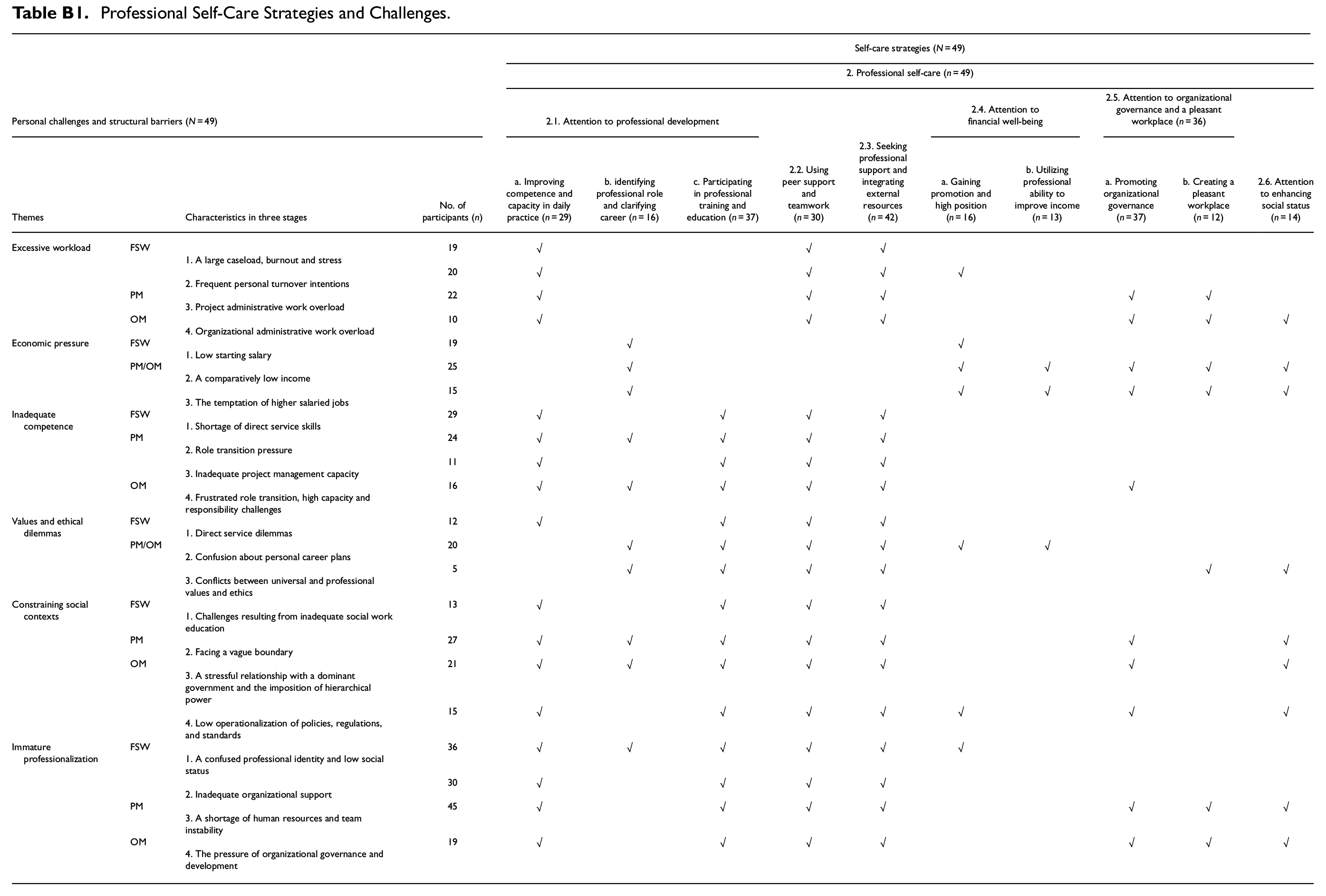
| Self-care strategies (N = 49) | |||||||||||||
|---|---|---|---|---|---|---|---|---|---|---|---|---|---|
| 2. Professional self-care (n = 49) | |||||||||||||
| Personal challenges and structural barriers (N = 49) | 2.1. Attention to professional development | 2.4. Attention to financial well-being | 2.5. Attention to organizational governance and a pleasant workplace (n = 36) | ||||||||||
| Themes | Characteristics in three stages | No. of participants (n) | a. Improving competence and capacity in daily practice (n = 29) | b. identifying professional role and clarifying career (n = 16) | c. Participating in professional training and education (n = 37) | 2.2. Using peer support and teamwork (n = 30) | 2.3. Seeking professional support and integrating external resources (n = 42) | a. Gaining promotion and high position (n = 16) | b. Utilizing professional ability to improve income (n = 13) | a. Promoting organizational governance (n = 37) | b. Creating a pleasant workplace (n = 12) | 2.6. Attention to enhancing social status (n = 14) | |
| Excessive workload | FSW | 1. A large caseload, burnout and stress | 19 | √ | √ | √ | |||||||
| 2. Frequent personal turnover intentions | 20 | √ | √ | √ | √ | ||||||||
| PM | 3. Project administrative work overload | 22 | √ | √ | √ | √ | √ | ||||||
| OM | 4. Organizational administrative work overload | 10 | √ | √ | √ | √ | √ | √ | |||||
| Economic pressure | FSW | 1. Low starting salary | 19 | √ | √ | ||||||||
| PM/OM | 2. A comparatively low income | 25 | √ | √ | √ | √ | √ | √ | |||||
| 3. The temptation of higher salaried jobs | 15 | √ | √ | √ | √ | √ | √ | ||||||
| Inadequate competence | FSW | 1. Shortage of direct service skills | 29 | √ | √ | √ | √ | ||||||
| PM | 2. Role transition pressure | 24 | √ | √ | √ | √ | √ | ||||||
| 3. Inadequate project management capacity | 11 | √ | √ | √ | √ | ||||||||
| OM | 4. Frustrated role transition, high capacity and responsibility challenges | 16 | √ | √ | √ | √ | √ | √ | |||||
| Values and ethical dilemmas | FSW | 1. Direct service dilemmas | 12 | √ | √ | √ | √ | ||||||
| PM/OM | 2. Confusion about personal career plans | 20 | √ | √ | √ | √ | √ | √ | |||||
| 3. Conflicts between universal and professional values and ethics | 5 | √ | √ | √ | √ | √ | √ | ||||||
| Constraining social contexts | FSW | 1. Challenges resulting from inadequate social work education | 13 | √ | √ | √ | √ | ||||||
| PM | 2. Facing a vague boundary | 27 | √ | √ | √ | √ | √ | √ | √ | ||||
| OM | 3. A stressful relationship with a dominant government and the imposition of hierarchical power | 21 | √ | √ | √ | √ | √ | √ | √ | ||||
| 4. Low operationalization of policies, regulations, and standards | 15 | √ | √ | √ | √ | √ | √ | √ | |||||
| Immature professionalization | FSW | 1. A confused professional identity and low social status | 36 | √ | √ | √ | √ | √ | √ | ||||
| 2. Inadequate organizational support | 30 | √ | √ | √ | √ | ||||||||
| PM | 3. A shortage of human resources and team instability | 45 | √ | √ | √ | √ | √ | √ | √ | ||||
| OM | 4. The pressure of organizational governance and development | 19 | √ | √ | √ | √ | √ | √ | √ | ||||
Declaration of Conflicting Interests
The author(s) declared no potential conflicts of interest with respect to the research, authorship, and/or publication of this article.
Funding
The author(s) disclosed receipt of the following financial support for the research, authorship, and/or publication of this article: This study was funded by The National Social Science Fund of China (Grant No.: 20BSH124).
Ethics Statement
This study was approved by the human subjects ethics committee of Xiamen University (Approval No.: 0310-K18B0001).
