




Abstract
This research discusses the underapplication opacity, namely counterbleeding, of non-local compensatory lengthening in Modern Colloquial Persian, a style of informal speech in Iran (mostly in Tehran) motivated by moraic glottal consonants in the postconsonantal position in the coda. It concludes that building a moraic structure occurs before segmental changes, such as glottal deletion, Flop, and Spread (i.e., double flop), through weight-by-position. After building the moraic structure of coda consonants, a postconsonantal glottal is prone to deletion, resulting in a floating mora that precedes coda consonant flops while delinked from its mora. In this environment, stem vowels can spread to the neighboring mora and lengthen. Stratal OT is capable of accounting for counterbleeding through strata with different sets of OT constraints established on the basis of Persian morphology. The first stratum ensures the construction of the moraic structure before any segmental change, while the second stratum is where the counterbleeding order is covered.
The current study demonstrates the underapplication opacity known as “counterbleeding” in non-local compensatory lengthening (CL) in Modern Colloquial Persian, the Persian vernacular spoken mostly in Tehran. Non-CL targets moraic glottal consonants in the postconsonantal position in the coda. CL alludes to the process of vowel lengthening resulting from the affiliation of moras of deleted consonants as weight-bearing segments (Ahmadi Varmazani & Fattahi, 2019; Alqahtani, 2020, 2023; Hayes, 1989; Kavitskaya, 2017; Samko, 2011; Shaw, 2007). The CL approach is problematic in phonological analysis, especially Optimality Theory (OT), because a sequence of processes is impossible in two-level OT; that is, OT comprising an input and a surface (Shaw, 2007). In other words, CL requires intermediate levels between the input and the surface, which in turn makes opacity a major problem in OT analysis (Topintzi, 2012). Kiparsky (1973, p. 79) deduced that phonological opacity stems from counterfeeding and counterbleeding interactions as follows.
(1) Definition of “opacity” (Kiparsky, 1973, p. 79)
A phonological Rule P of the form A→B/ C______D is opaque if there are surface structures with any of the following characteristics: instances of A in the environment C________D, instances of B derived by P that occurs in the environments other than C_____D.
Based on the definition of opacity in (1), statement (1. a) refers to counterfeeding, also known as underapplication opacity, while statement (1. b) creates an illusion of counterbleeding, termed overapplication opacity. According to Bakovic (2011), counterfeeding and counterbleeding are inverses of feeding and bleeding as transparent rule interactions; counterfeeding becomes feeding and counterbleeding becomes bleeding when rules B and A were the opposite order.
The crossing of association lines that violate well-formedness in Universal Grammar (UG) (Archangeli 1984; Goldsmith, 1976; Nespor & Vogel, 1986; Pulleyblank, 1983; Sagey, 1986; Williams, 1976) is considered a challenge of non-local CL in Modern Colloquial Persian (Ahmadi Varmazani & Fattahi, 2019; Alqahtani, 2023; Darzi, 1991; Samko, 2011; Sumner, 1999), as shown in the following representation.
(2) /tobˀ /→[to:b] “nature”

Darzi (1991) suggested a method based on splitting a CV tier from a moraic tier to avoid crossing the association line caused by the deletion of non-adjacent glottal consonants in the coda with reference to Colloquial Tehrani Farsi. As a result, vowels can spread freely to floating moras, as shown in the following representation.
(3)

On the other hand, the above process is limited to glottal consonants in cases where the deletion of non-glottal coda consonants do not trigger vowel lengthening; that is, they do not benefit from the Weight-by-Position (WBP) rule. This statement was supported by Sumner (1999) and Kavitskaya (2002). Specifically, these scholars suggest that Darzi’s (1991) above proposal is problematic based on the following. Sumner (1999) notes that the above proposal relies on the moracity of glottal consonants in a coda compared to other consonants in the same position, which would cause a problem particular to the sonority of glottals versus other consonants. In addition, the same proposal would violate the WBP because a glottal member is moraic while a non-glottal member is non-moraic in a coda when dealing with CVGC or CVCG, where G stands for a “glottal.” In step with Sumner (1999), Kavitskaya (2002) exposes hard phonetic evidence that supports the claim that vocalic glottal elements trigger CL; specifically, her evidence originates from a recording of two speakers producing glottal stops in the word-final position. She observes that the phonetic data gained from those speakers assert that glottals in Farsi undergo vocalization word-finally and are phonetically realized as approximants, even with careful pronunciation. Kavitskaya (2002, p. 84) shows a modern Tehrani Farsi speaker’s pronunciation of the word [ro?b] “terror” in formal speech in the following waveform and spectrogram (Figure 1).
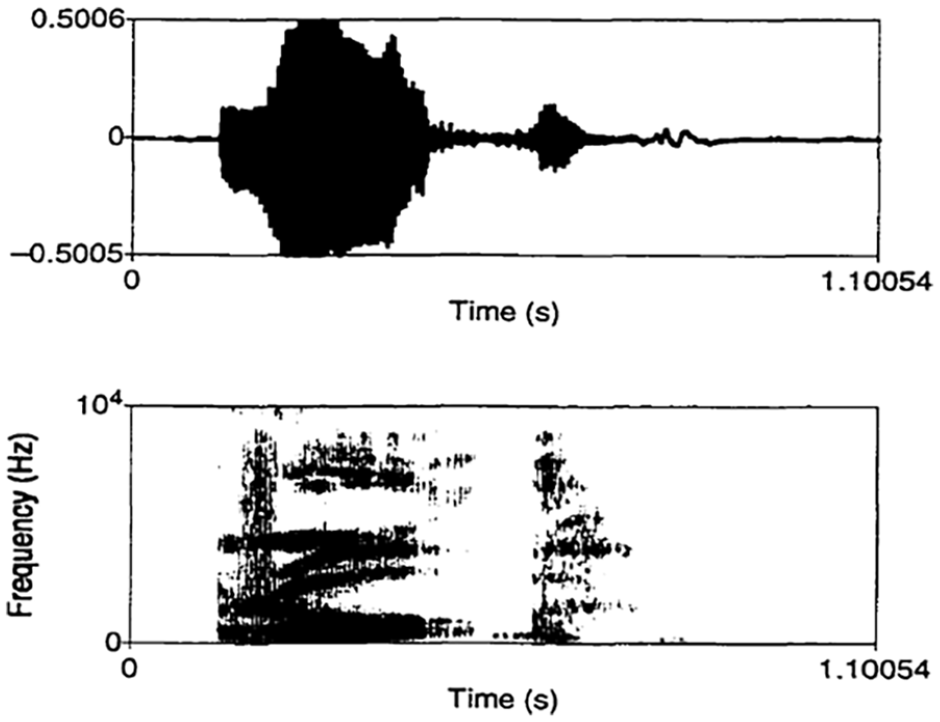
Tehrani Farsi: [roˀb] “terror” (formal speech) (Kavitskaya, 2002, p. 84).
Based on the above waveform and spectrum, the shape of the vocal tract in a glottal approximant, as observed by Kavitskaya (2002), is that of a preceding vowel but with laryngealization, which is parallel to the glottal fricative h in the word-final position.
Kavitskaya (2002) noted that lengthening of the vowel in the following syllable could occur because there are no association lines to prevent mora from spreading across syllables. She also reported that the concept of syllables shown in the proposal above would violate the standard insights of various works on syllable-related phenomena and syllable typology.
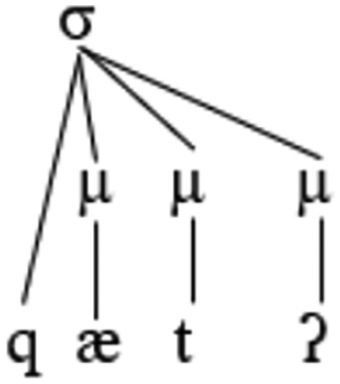
Samko (2011), who works on CL in light of Harmonic Serialism, as an OT model, addresses the crossing of association lines caused by non-local CL in Tehrani Farsi. Her proposal to avoid such a problem is to have both a word-final glottal consonant and the preceding consonant in a coda position dominated by one mora in order to prepare an environment for mora sharing with the preceding vowel without crossing the association line. Even though vowel lengthening can be achieved without crossing the association line, an output, such as [ro:µµb], can have a non-moraic coda that violates the WBP. However, Samko’s (2011) analysis suggests the absence of a trimoraic syllable in Modern Colloquial Persian, which is not true. Hayes (1989) argues that the existence of trimoraic syllables in different languages, including Persian, can be established by CL patterns. Alqahtani (2023) extends Hayes’ (1989) argument by considering the avoidance of association line crossing in light of OT, with reference to non-local CL in Modern Colloquial Persian. Unlike Samko’s (2011) ad hoc solution to avoid association line crossing, Alqahtani (2023) infers that trimoracity is restricted to syllables with glottal codas since the moracity of consonants is a language-specific phenomenon, especially when dealing with syllables of the forms CVGC and CVCG. Given the fact that non-local CL is not vulnerable to association line crossing through the two processes of Flop and Spread (i.e., double flop), after a glottal consonant deletion in a coda. Coping with syllables of the form CVCG, the first member of a complex coda, as a non-glottal consonant, flops to the floating mora of the deleted glottal, while its mora is deleted to facilitate the spread of the stem vowel to the adjacent mora where vowel lengthening occurs, as shown in the following representation.
(4)

Ahmadi Varmazani and Fattahi (2019) who refer to the moraic analysis of compensatory lengthening in Kermanshahi Persian shed light on the non-local CL in the aforementioned dialect yielded by the deletion of the postconsonantal /d/ and /t/, e.g. /dozd/ ‘thief’→ [do:z]. Hence, they state that the purpose of non-local CL is to maintain the weight of the syllable. However, Alqahtani (2023) mentions that the three mora slots are highly restricted to glottal coda consonants in Persian, while the non-glottal codas as post-consonantal codas are linked to the preceding moras, and their deletion has no impact on syllable weights. This statement is discussed in detail in the following section.
With respect to the scholars discussed above, the underapplication opacity of non-local CL in Modern Colloquial Persian has yet to be investigated in terms of a stratal OT approach. Therefore, the aim of this research is to clarify how Stratal OT, as a framework, is more advantageous than other analyses when accounting for the underapplication opacity behind non-local CL in Modern Colloquial Persian. To do so, two questions must be addressed. First, how does underapplication opacity become a phonological derivation behind non-local CL in Modern Colloquial Persian? Second, how can the underapplication opacity of non-local CL in Modern Colloquial Persian be accounted for using the Stratal OT? The next section provides background knowledge on the phonology of Modern Colloquial Persian.
The Phonology of Modern Colloquial Persian
Consonant and Vowel Inventory of Modern Colloquial Persian
Table 1 shows 23 consonants in Modern Colloquial Persian, which are set on the basis of place and manner of articulation (Alqahtani, 2020; Hosseini, 2014; Mahootian, 1997; Windfuhr, 1987). Vowels in Modern Colloquial Persian are divided into three short vowels, /e, æ, o/, of the [–long] feature, and three long counterparts, /i, u, ɑ/, of the [+long] feature, as shown in Table 2 (Aronow et al., 2017; Kambuziya et al., 2017; Miller, 2013).
Manners and Places of Articulation of the Consonants of Modern Colloquial Persian (Alqahtani, 2020; Hosseini, 2014; Mahootian, 1997; Windfuhr, 1987).

Vowel Chart of Modern Colloquial Persian (Aronow et al., 2017; Kambuziya et al., 2017; Miller, 2013).

Since the moracity of segments is concerned, the next subsection is devoted to demonstrating the syllable types in Modern Colloquial Persian, along with their weights and restrictions.
Syllable Structure and Weight in Modern Colloquial Persian
The syllable types in Modern Colloquia Persian have been taken into consideration by scholars, such as Elwell-Sutton (1976), Hayes (1979), Windfuhr (1979), Darzi (1991), Amini (1997), Bijankhan (2000), Hall (2007), Rahbar (2012), and Heidarizadi (2014), Kambuziya et al. (2017), Rahmani (2019), and Alqahtani (2019, 2020). Table 3 presents the syllable types in Modern Colloquial Persian, such as CV, CVV, CVC, CVVC, and CVCC.
Syllable Types in Modern Colloquial Persian.

Syllable weight and restriction are crucial when accounting for syllable types in Modern Colloquial Persian. CV is the only light syllable since the onset in Modern Colloquial Persian is non-moraic (i.e., weightless), according to Elwell-Sutton (1976), Hayes (1979), Windfuhr (1979), Darzi (1991), Amini (1997), Bijankhan (2000), Hall (2007), Rahbar (2012), Heidarizadi (2014), Kambuziya et al. (2017), Rahmani (2019), and Alqahtani (2019, 2020). Consider the following representation of [be] “to,”
(5)

The CVV syllable in Modern Colloquial Persian is considered heavy since a nucleus is linked to two moras (i.e., bimoraic), as shown in the following representation of [tɑ] “till.”
(6) The representation of [tɑ] “till” (Alqahtani, 2023)

The same heavy syllable—CVV—can be derived from CVC owing to local CL. Consider the representation in [mæ:. ni] “meaning.”
(7) /mæˀ.ni/→ [mæ:.ni] “meaning”

Likewise, the CVC syllable is heavy because it is bimoraic, as shown in the representation of [bæd] “bad.”
(8)

CVC can be derived from vowel shortening of the CVVC syllable. The following section discusses this phenomenon in detail.
Hayes (1989) discussed the existence of trimoraic syllables in a number of different languages, including Old English, Farsi, German, Danish dialects, Finnish, and Estonian. He argues that trimoraic syllables in the languages mentioned above can be indirectly established by patterns of CL and quantitative metrics and can be directly established by the existence of three-way or ternary long contrasts. Following Hayes’s (1989) argument, the existence of trimoraic syllables in Persian can be established by CL and quantitative metrics, as proposed below.
In this system, the light syllables correspond to a short metric position (/ ͝ /) and heavy syllables to either a long metrical position (/__ /) or two shorts (/ ͝ ͝ /). Superheavy syllables (CVVC and CVCC) are scanned as (/__ ͝ /). If we make the usual assumptions for quantitative (/__/ corresponds to two moras, / ͝ / to one), then the superheavy syllables must count as trimoraic. (Hayes, 1989, p. 292)
Hayes (1979, pp. 196–197) reports that the above generalizations of quantitative metrics are established by the following Persian correspondence rules:
Ignore all syllable-initial consonants.
Every breve (/ ͝ /) in the pattern must correspond to a single phonological segment of the line.
Every macron (/__/) of the pattern must correspond to the syllable of the first two segments of the syllable of the line (not counting initial consonants).
The above Persian rules are depicted in the following representations.
(9)

However, the three moraic slots in Persian are more highly restricted to syllables that contain glottals in the coda position (Darzi, 1991); that is, moracity of the consonants is a language-specific phenomenon. This is observed through the CL in Colloquial Tehrani Farsi, as shown below.
(10) /toµbµˀµ/→ [to:µµbµ] “nature”

On the other hand, the three moraic slots do not exist in syllables with non-glottal coda consonants, because vowel lengthening is not triggered by the deletion of non-glottal consonants in the coda position (Alqahtani, 2023; Darzi, 1991). Consider the following examples.
(11) Non-CL cases in Modern Colloquial Persian (Alqahtani, 2023) /loµχµt/→ [loµχµ]/ *[lo:µµχµ] “naked” /qæµnµd/→ [qæµnµ]/ *[qæ:µµnµ] “sugar” /dæµsµt/→ [dæµsµ]/ *[dæ:µµsµ] “hand” /koµnµd/→ [koµnµ]/ *[ko:µµnµ] “slow” /feµkµr/→ [feµkµ]/ *[fe:µµkµ] “thought”
According to Darzi’s (1991) hypothesis, the word-final consonants in (11) are not assigned as extrasyllabic because they are linked to the preceding mora, as shown in the representation below.
(12)

The word-final consonant in the CVVC is also linked to the preceding mora, which is why the final CVVC is heavy. Consider the following representation of [ɡɑz] “gas” below.
(13)

In contrast, Kambuziya et al. (2017) and Alqahtani (2023) agree that the long vowel shortening of CVVC yields CVC through certain rules: the long vowel of non-final CVVC is liable to vowel shortening when it is followed by liquids/l,r/. Consider the following presentations of [sor.me] “kohl.”
(14) /surme/→ [sor.me] “kohl” (Alqahtani, 2023)
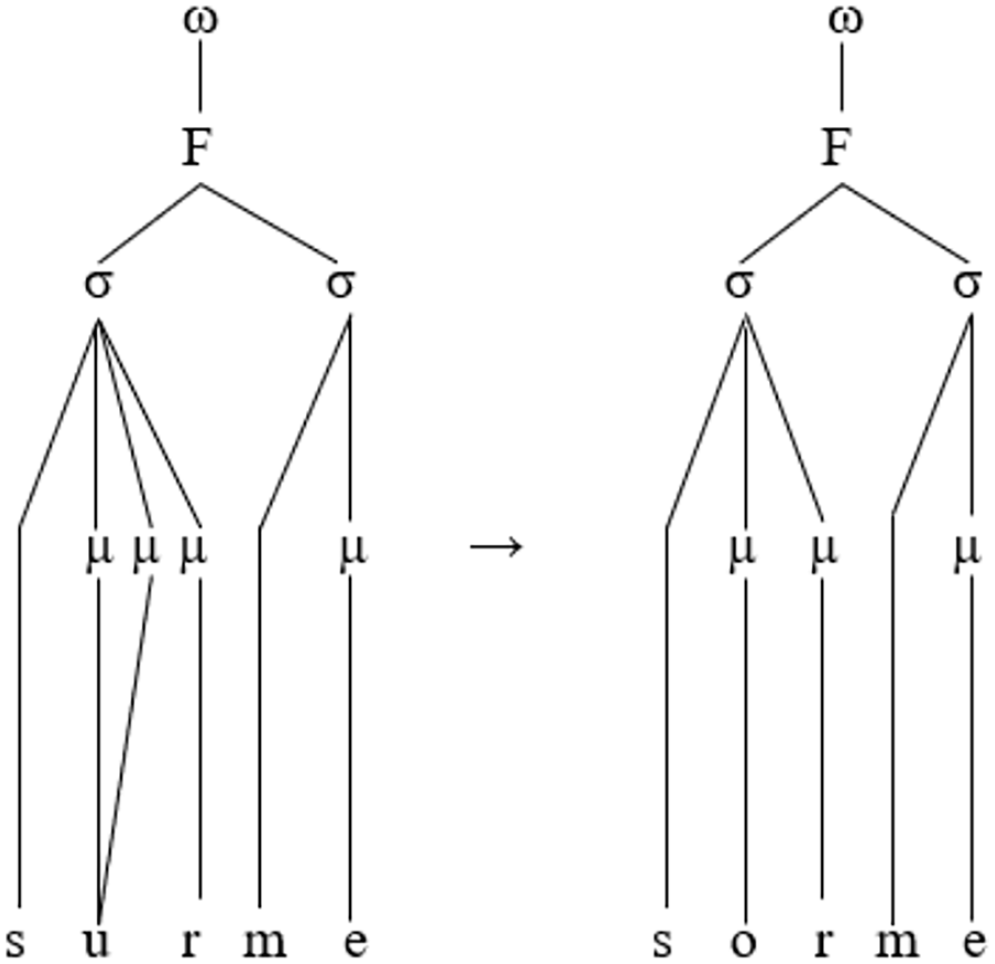
Furthermore, according to Kambuziya et al. (2017) and Alqahtani (2023), a long vowel in CVVC is subject to shortening when a coda consonant is nasal, as shown in the representation of [pe.hen] “dung” below:
(15) /pehin/ → [pe.hen] “dung” (Alqahtani, 2023)

The exceptional case of CVCC, as reported by Kambuziya et al. (2017) and Alqahtani (2023), is in a non-final position as the reduction of CVVCC syllables due to vowel shortening. For example, a long vowel in /j
(16) /j

To recap, syllables in Modern Colloquial Persian are classified as light, heavy, and superheavy, depending on the number of moras in every syllable type. CV, being monomraic, is the only light syllable in Modern Colloquial Persian; meanwhile, CVV and CVC are heavy syllables and biomoraic. CVV can be derived from CVC syllables due to CL, while CVC can be derived from a long vowel shortening of the CVVC syllable, resulting in the reduction of moras. Syllables with three moraic slots in Modern Colloquial Persian are highly restricted because consonant moracity is a language-specific phenomenon. The long vowel in the CVVC syllable is targeted by vowel shortening when a coda is one of the /l,r,n,m/ consonants, while CVVC syllables with word-final consonants are heavy (bimoraic) because word-final consonants are linked to the preceding mora. Similarly, the word-final consonant in CVCC is linked to the preceding mora, which is why CVCC in this case is heavy. The CVCC syllable may also be derived from CVVCC, which is attached to a consonant-initial suffix through vowel shortening due to a word-final consonant being one of the /l,r,n,m/ consonants. The next section elucidates the study’s data.
Modern Colloquial Persian Data
The data of this study were extracted from the existing literature, particularly from Persian vernaculars, including books, articles, and theses. Data harvested from the literature were verified through consultation with four native speakers (two males and two females) of Persian from Tehran.
The glottal consonants /h, ˀ/ in the postconsonantal position in the coda are subject to CL when the stem vowel is short. In other words, CL in this variety of Persian is limited to glottal consonants that follow short vowels, while the same process never applies to the same consonants in the postconsonantal position in coda that follow long vowels. Consider the following examples.
(17) Examples of non-local CL in modern colloquial Persian (Alqahtani, 2023).
a. /tæµrµhµ/ [tæ:µµrµ] “project”
b. /soµbµhµ/ [so:µµbµ] “morning”
c. /roµbµˀµ/ [ro:µµbµ] “quarter”
d. /mæµnµˀµ/ [mæµµ:nµ] “prevention”
e. /ʃæµrµhµ/ [ʃæ:µµrµ] “explanation”
f. /sæµrµˀµ/ [sæ:µµrµ] “epilepsy”
g. /qæµtµˀµ/ [qæ:µµtµ] “rescission”
h. /ʃæµmµˀµ/ [ʃæ:µµmµ] “candle”
i. /væµzµˀµ/ [væ:µµzµ] “situation”
j. /soµlµhµ/ [so:µµhµ] “peace”
k. /ʃeµjµˀµ/ [ʃe:µµjµ] “object”
l. /ʃæµrµˀµ/ [ʃæ:µµrµ] “religious law”
m. /qæµlµˀµ/ [qæ:µµlµ] “tin”
n. /næµfµˀµ/ [næ: µµfµ] “benefit”
o. /fæµrµˀµ/ [fæ:µµrµ] “branch”
p. /toµbµˀµ/ [to:µµbµ] “nature”
Considering the examples in (17), as discussed in Section 2, syllables of the form CVCC, of which a final consonant cluster with a glottal member is considered to be trimoaic because the moracity of consonants is considered to be a language-specific phenomenon (Darzi, 1991; Hayes, 1989). Following Hayes’s (1989) argument of the existence of trimoraic syllables discussed in Section 2, syllables with the three moraic slots in Modern Colloquial Persian can be established by CL patterns, which supports the claim that CVCC with glottal members of word-final clusters is trimoraic since CL is restrained to postvocalic or post-consonantal glottals in the coda position preceded by short stem vowels. The syllable weight in the above examples is maintained even after the occurrence of a non-local CL. The next section illustrates non-locals in Modern Colloquial Persian by autosegmental analysis.
The Autosegmental Approach to Non-Local CL in Modern Colloquial Persian
According to Hayes (1989), the autosegmental approach to non-local CL is derivational; that is, it involves glottal deletion, flop, and spread. The first step is to delete a glottal consonant in the postconsonantal position in the coda. The second step involves flopping the preceding coda consonant, which is delinked from its mora, to the floating mora of the deleted glottal. This would facilitate the spreading of the stem vowel to the adjacent mora as the final step, yielding vowel lengthening, as schematized below.
(18)

However, ill-formed syllables are formed by the spreading of the stem vowel to the floating mora of the deleted glottal stop, resulting in association line crossing, as shown below.
(19)

Turning to the non-local CL in Modern Colloquial Persian, the three steps discussed above are autosegmentally illustrated by the following representations of the outputs of /qæµtµˀµ/ “rescission” and /soµlµhµ/ “peace.”
(20)
a. /qæµtµˀµ/→ [qæ:µµtµ] “rescission”

b. /soµlµhµ/→ [so:µµhµ] “peace”
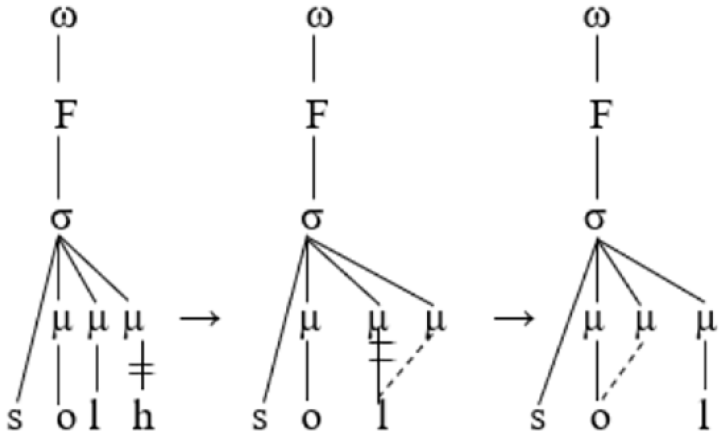
An opaque rule interaction is found in non-CL in Modern Colloquial Persian because the non-local CL occurs after the implementation of WBP. Simply put, the opacity of non-CL in Modern Colloquial Persian involves the application of WBP prior to the deletion of the post-consonantal glottal in coda, and the fact that vowels are underlyingly moraic does not dispute the Richness of the Base hypothesis (Prince & Smolensky, 1993/2004) based on the universal moracity of vowels. According to Sprouse (1997), the mora that triggers vowel lengthening cannot be a part of the input. This type of underapplication opacity is termed “counterbleeding,” in which the deletion of the post-consonantal glottal in the coda counterbleeds WBP, as shown below.
(21) Counterbleeding order

To account for the above phonological opacity, counterbleeding, and OT, it is crucial to first shed light on OT models and which model is capable of accounting for such opacity. Therefore, the next section illuminates the derivational versions of OT.
The OT Models
The phonological opacity in the previous section, that is, counterbleeding, as well as counterfeeding, is not easily handled by parallel OT (Idsardi, 1997, 2000; Kager, 1999; Kiparsky, 2000, 2003; McCarthy, 1999). McCarthy (1999, p. 2) states the following: As OT is currently understood, though, constraint ranking and violation cannot explain all instances of opacity. Unless further refinements are introduced, OT cannot contend successfully with any non-surface-apparent generalizations or with a residue of non-surface-true generalizations.
The output-output faithfulness model, known as correspondence theory, has been criticized by McCarthy (1999) and Kiparsky (2000, 2003) when dealing with counterbleeding. According to McCarthy (1999), this model is incapable of accounting for counterbleeding in Tiberian Hebrew because it fails to provide a complete solution to counterbleeding as an opacity problem.
Sympathy theory, an OT model, was introduced by McCarthy (1999) as an ad hoc solution to the opacity problem. This model has been liable to criticism by Idsardi (1997, 2000), Kiparsky (2000), and Ito and Mester (2003). For instance, this model cannot account for the opaque interaction of stress and vowel epenthesis in Palestinian Arabic (Kiparsky, 2000); hence, a different sympathy constraint is demanded in every opaque process, referring to the same Selector, which would give rise to chaos in the Palestinian Arabic system.
The introduction of Harmonic Serialism by McCarthy (2007b) is considered another attempt to solve the problem of opacity; this model is inherently a derivational variant of classic OT. McCarthy (2007b) and Samko (2011) agree that this model is about the input making multiple passes through the same constraint ranking; hence, the winner candidate of each pass is employed as the input in the following stage until the faithful candidate wins along with the coverage of the derivation. However, McCarthy (2007b, p. 37) criticized this model, stating, “Wherever classic OT has a problem with counterbleeding opacity, harmonic serialism will too, since harmonic serialism is just classic OT, iterated.” Unlike McCarthy’s (2007b) criticism of Harmonic Serialism, Samko (2011) reports that counterbleeding, as an opaque rule interaction, can possibly be accounted for using Harmonic Serialism together accompanied by the concept of the Fully Faith Candidate (FFC) plus Candidate Chains (OT-CC).
However, the capability of accounting for phonological opacity using Harmonic Serialism is restricted to counterbleeding, while the capability of accounting for counterfeeding is never mentioned in Samko (2011). Simply put, it is crucial not to refer to an OT model in which the ability to account for opaque processes is limited. My argument is supported by McCarthy (2007b) and Elfner (2016), who state that Harmonic Serialism cannot account for counterfeeding opacity.
Stratal OT, as an OT model, was used in the current study because it can account for both counterbleeding and counterfeeding, compared to Harmonic Serialism, according to Kiparsky (1997a, 1997b, 2000, 2003), Bermúdez-Otero (1999, 2008), McCarthy (1999), and Staroverov (2014). In other words, the problems originating from opaque rules can be easily solved using stratal OT rather than any other model. According to Kager (1999), the input in the stratal OT is directly mapped onto the output, where different sets of OT constraints are found in the stages between the input and output; that is, the set of OT constraints is not unified. The representation below shows how stratal OT works.
(22) Stratal OT (Kager, 1999, p. 283)
Input
↓
↓
↓
Output
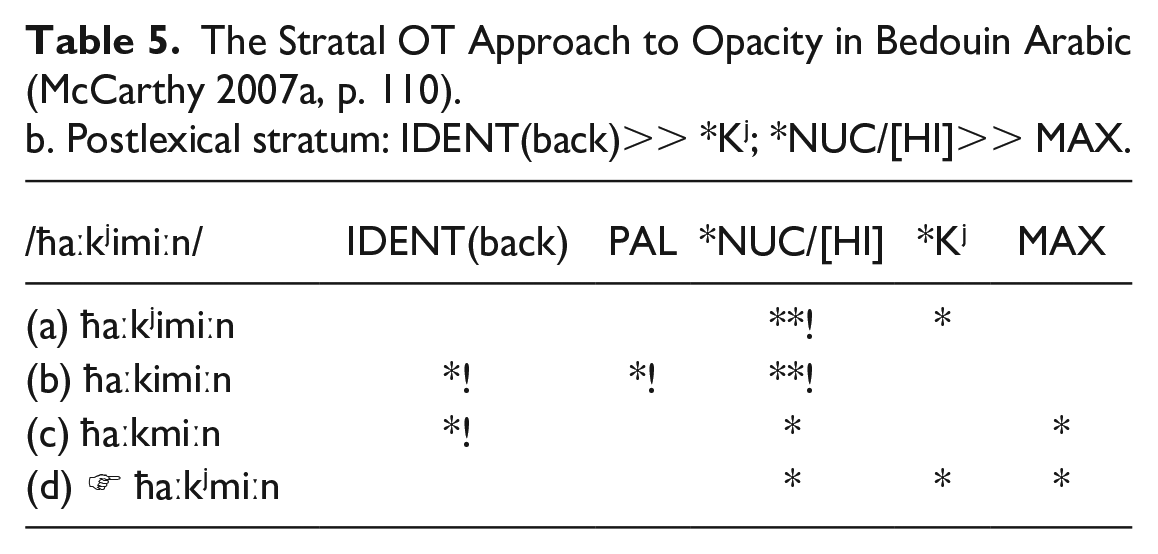
In the representation of the stratal OT above, the output of Stratum 1 serves as the input for the following stratum. McCarthy (2007a) presented the stratal OT approach for opacity (i.e., counterbleeding) in Bedouin Arabic to show how this model can account for opacity, as follows (Tables 4 and 5).
The Stratal OT Approach to Opacity in Bedouin Arabic (McCarthy 2007a, p. 110).
a. Word stratum: PAL, MAX>>*Kj>>IDENT(back); MAX>>*NUC/[HI].

The Stratal OT Approach to Opacity in Bedouin Arabic (McCarthy 2007a, p. 110).
b. Postlexical stratum: IDENT(back)>> *Kj; *NUC/[HI]>> MAX.
The next section demonstrates how stratal OT accounts for counterbleeding stemming from non-local CL in Modern Colloquial Persian.
Stratal OT Analysis of Non-Local CL in Modern Colloquial Persian
The previous section illustrated the basic background knowledge of stratal OT. This section demonstrates how this model can account for counterbleeding with reference to CL in Modern Colloquial Persian. A moraic structure is built prior to segmental changes. To do so, the stem level (Stratum 1) constructs a moraic structure before consonant deletion. The optimal output in this step is employed as the input of the following step in Stratum 2, where the derivation is covered; hence, these strata are established on the basis of Persian morphology. Before considering this process, we consider the relevant OT constraints on the derivation below.
(23) OT constraints
a. WFC (b) (Byrd & Sandell, 2015)
Association lines do not cross. Assign one violation for each crossed association line.
b. WBP (Hayes, 1989)
Assign a violation for each coda consonant that is not moraic.
c. *float (Samko, 2011, p. 29)
Assign a violation for each mora in the output that is not associated with a segment.
d. *glottal (Sumner, 1999)
No glottal consonants should be present in the output.
f. *shared (Samko, 2011)
Assign a violation to each mora that dominates more than one segment of the output.
g. MAX (McCarthy & Prince, 1995)
Assign a violation for each segment in the input that is not present in the output.
h. DEP [µ] (McCarthy, 1997)
Assign a violation fo11r each mora in the output that is not present in the input.
i. DEP (McCarthy & Prince, 1995)
Every segment of S2 has a correspondent in S1 (S2 is “dependent on” S1).
j. *Cµµ
Assign one violation for each consonant dominated by more than one mora.
Given these constraints, the next tableaux accounts for the counterbleeding order with reference to the input /qæµtˀ / “rescission” (Table 6):
Stratum (1) (Stem Level).
WBP>>WFC(b)>>DEP>>MAX>> *FLOAT>>*SHARED>>*Cµµ>> *GLOTTAL>>DEP[µ].


Stratum (1) above shows the fatal violation of the WBP constraint candidates (a), which is initially eliminated. The same constraint, on the other hand, is satisfied by the other candidates. Candidate (c), for instance, avoids the violation of WBP and *GLOTTAL because it has a moraic coda consonant and permits the deletion of the post-consonantal glottal consonant in the coda. However, this candidate fails to be optimal because of the violation of the MAX. The epenthetic vowel in Candidate (e) incurs a violation of the DEP, which is why Candidate (e) is eliminated. Candidate (b), as the most challenging output, satisfies WBP, MAX, and DEP; however, it is not determined as optimal owing to the violation of *SHARED. As a result, Candidate (d), the desired output, is distinguished as optimal and serves as the input in Table (7) (i.e., Stratum (2)).
Stratum (2) (Word level).
WBP>>WFC(b)>>*Cµµ>>*GLOTTAL>>*FLOAT>>*SHARED>>MAX>>DEP>> DEP [µ].

Stratum (2), where phonological derivation is covered, shows Candidate (e) with a lengthened vowel because it does not violate the WFC (b),*GLOTTAL, *Cµµ, and *FLOAT constraints. Candidate (b), however, fatally violates WFC (b) and is eliminated. *Cµµ is subject to fatal violation by Candidate (d), which is not optimal. Candidate (a), which is the most faithful output to the input above, is not optimal because of the violation of *GLOTTAL. The floating mora in candidate (c) violates the *FLOAT.
In a nutshell, stratal OT is shown in this section as a framework superior to other analyses, dealing with counterbleeding as the underapplied opacity behind non-local CL in Modern Colloquial Persian. The strata in this model were established with reference to Persian morphology. Building the moraic structure prior to CL is achieved in Stratum 1, while phonological derivation, in which vowel lengthening is accomplished, is over in Stratum 2.
Conclusion
This research investigated the underapplication opacity (i.e., counterbleeding), of non-local CL in Modern Colloquial Persian, which targets moraic glottal consonants in the postconsonantal position in the coda. The moraic structure is built before segmental changes, such as glottal deletion, Flop, and Spread, through WBP. Subsequently, a postconsonantal glottal is prone to deletion, resulting in a floating mora. The preceding non-glottal coda consonant, delinked from its mora, flops to the floating mora of the deleted glottal stop. The final stage is vowel lengthening, which is achieved by spreading the short stem vowel to the adjacent mora. This study established that stratal OT is a superior framework to other analyses for examining the underapplication opacity found in non-local CL in Modern Colloquial Persian. Hence, this framework is capable of accounting for underapplication opacity through strata with different sets of OT constraints established with reference to Persian morphology. Building a moraic structure prior to any segmental change was accomplished in the first stratum. The counterbleeding order is covered in the second stratum, where the short stem vowel is lengthened.
Footnotes
Acknowledgements
The researcher is very grateful to Research Centre in the Faculty of Language Sciences and the Deanship of Scientific Research at King Saud University for funding this research.
Declaration of Conflicting Interests
The author(s) declared no potential conflicts of interest with respect to the research, authorship, and/or publication of this article.
Funding
The author(s) received no financial support for the research, authorship, and/or publication of this article.
