




Abstract
The article analyses the determinants of acquisition of flamenco albums. Flamenco is a musical genre recognized by UNESCO as intangible heritage of humanity. A methodology divided into three phases has been used for this purpose: firstly, interviews with experts from the Spanish music industry where new variables are identified that can affect flamenco consumption habits; then 586 surveys of flamenco spectators who valued these variables and, finally, the application of econometric models to obtain the coefficients of the variables. The results show how the valuation of the composition, the performer and its virtuosity, of the existing trends, and the sociodemographic characteristics of the spectators directly affect the acquisition of flamenco-recorded music. The article contributes to the scarce empirical literature that relates the determinants of recorded music acquisition with traditional popular genres, by adding never studied before variables, focusing on the case of flamenco.
Introduction
According to the latest 2021 report from the IFPI, an organization that represents the recorded music industry worldwide, the global recorded music market has grown by 7.4%, for the sixth consecutive year. This growth is mainly due to the promotion of streaming (technology that allows listening to music through platforms without the need for prior download), especially through paid subscriptions, which increased by 18.5% and has let to revenues of $13.4 billion (62.1% of total recorded music revenues worldwide). This fact has offset the decrease in physical revenues (music on physical media), which fell by 4.7%. The latter can be perceived in the following Figure 1, where the gradual decline in physical music sales in recent years is observed.
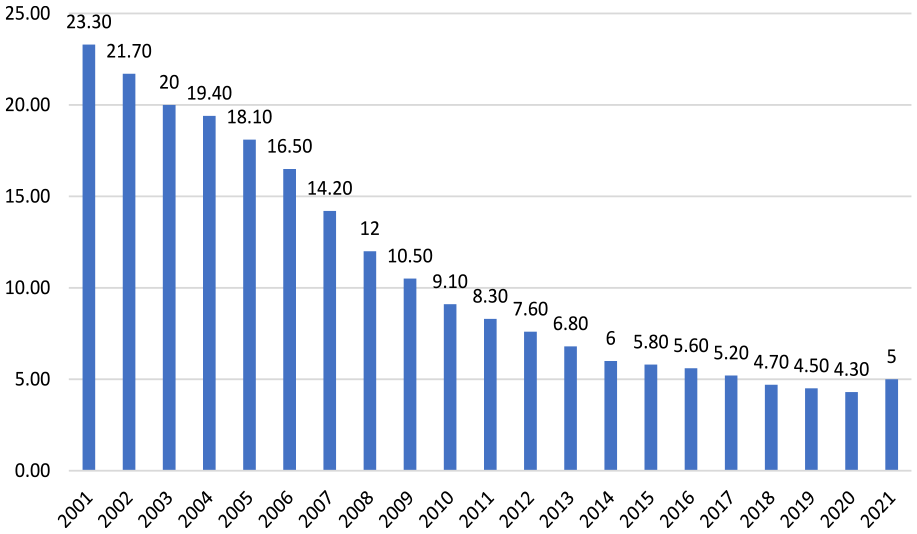
Worldwide physical music sales (2001–2021) in million dollars.
In the case of Spain, Figure 2 shows how in recent years the decrease in physical music sales has been as opposed to the increase in digital music sales (Promusicae, 2021). And Figure 3 shows the annual variation rate of the volume of physical music sales in Spain in 2021, by types. While singles and videos have experienced a decrease in sales, the vinyl has maintained the growing trend of the latter years. In fact, in 2021, approximately 38% more units were sold than the previous year. On the other hand, around a 6% more CDs were sold than in 2020 (https://es.statista.com/estadisticas/474727/musica-fisica-espanola-variacion-de-volumen-de-ventas-espana-por-tipo/).

Sales of recorded and physical music in Spain (2001–2021) in millions of euros.

Annual variation rate of the volume of physical music sales in Spain in 2021.
Some authors have called this phenomenon as the perspective of utilitarian substitution and have identified that certain factors such as educational level, age, socio-professional situation of the life cycle associated with fatherhood or motherhood have influenced the music consumption (Herrera-Usagre, 2012).
On the other hand, and referring to the different musical genres that have been affected by the aforementioned fact, it can be seen that flamenco, a genre that has been declared an intangible heritage of humanity by the UNESCO since 2010 (Palma et al., 2017) has aroused special interest for the streaming music platform Spotify (Ramos et al., 2019), one of the main regarding revenue levels in this sector. Precisely last November 16th, the International Flamenco Day, this platform wanted to celebrate it with the launch of a “Flamenco hub,” a kind of house in the genre within it, giving shelter to a total of 11 playlists that they range from the most classic flamenco to its most modern side. It is interesting to know that flamenco is the third most listened local musical genre on Spotify in Spain, a total of 24% of users show an affinity for this genre, and even worldwide, whose level of listeners has increased by 300% in the last 2 years (https://www.abc.es/cultura/musica/abci-spotify-pone-jondo-internacional-flamenco-202011161433_noticia.html).
It seems crucial, therefore, to understand the consumer based on its habits or preferences (Heredia-Carroza et al., 2020) because in this way strategies can be designed at the cultural promotion level (offer), as well as being able to influence the stimulation of demand (De Sancha-Navarro et al., 2021). In fact, as several authors believe, cultural consumption plays an important role in the study of consumption (Ateca-Amestoy & Villarroya, 2017; Katz-Gerro, 2004; Navarrete & Borowiecki, 2016; Zallo, 2007).
In this sense, Darias (2021) describes in his report that the Spanish consumer especially likes to consume music in his language, regardless of the nationality of the artist. However, within these preferences, there is an enormous variety in terms of favourite genres. As it can be seen in Figure 4 below, the most popular genres are Pop and Rock. Flamenco would occupy a little 2% out of the total.
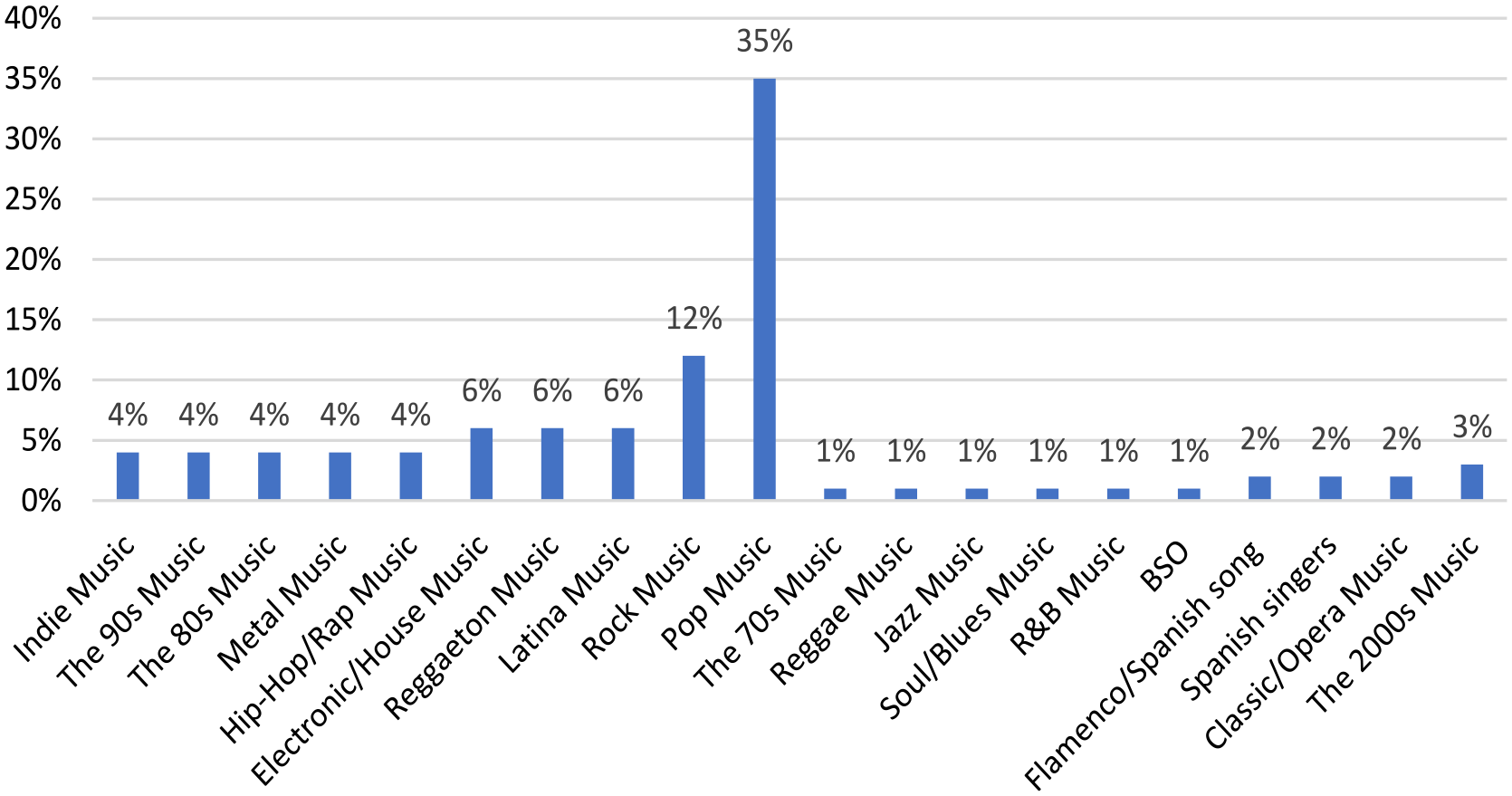
Preferences for musical genres in Spain (2020).
This work aims precisely to deepen into the reasons or factors that affect the recorded music consumption or purchase, focusing on the case of flamenco. For this purpose, and after identifying relevant variables by conducting interviews with experts from flamenco and the Spanish music industry, a survey has been developed that has been applied to flamenco spectators, subsequently using a methodology consisting of the application of econometric models that show which factors affecting the flamenco recorded music consumption are.
Among the main findings of this research is that the valuation of the composition, of the performer and his virtuosity, of the existing trends, and the sociodemographic characteristics of the respondents directly affect the acquisition of flamenco-recorded music.
Literature Review
Over the last few years, various authors have analysed the factors that affect music consumption. Among them, they are those that put some emphasis on features such as gender, age, and socioeconomic status. For example, Favaro and Frateschi (2007) make experimental research of the “patterns of cultural choice” regarding music consumption in Italy, trying to corroborate if tastes in music are diverse, and founded on the theoretical demand model for cultural goods suggested by Levy-Garboua and Montmarquette (1996), discovered that age, gender, and education are necessary indicators of an omnivorous taste in music. On the other hand, Prieto and Fernández (2000) analyze the dissimilitude between the classical and popular music consumption, observing that the taste for both of them is inherited. In the case of popular music, this innate quality diminishes when ageing, except for the range between 30 and 45 years, and, furthermore, the educational level of the parents is advantageous to listening to classical music. However, it has not the same effect on popular one.
Herrera-Usagre (2012) endeavors to study in an empirical way the connections between downloading and buying, and downloading and attending live performances in people’s conduct through the Survey of Cultural Practices Habits (Encuesta de hábitos de prácticas culturales) (SGAE, 2007). It concludes that if individuals exchange more records, they will buy more of them in physical format, and, consequently, they are more willing to attend live performances. Additionally, it identifies a number of factors that have an impact on both behaviors, including age, socioeconomic status, educational level, and the life cycle associated with fatherhood or motherhood. Also, Herrera-Usagre (2011) attempts to restrict the social attributes that have the largest effect of cultural consumption habits, using stratification hypothesis. It demonstrates that practices considered to be of “high culture” are linked to the social strata that are in the best positions, and that cultural consumption continues to exhibit characteristics of social stratification in contemporary Spanish society.
Instead, other researchers aim more attention at cultural capital. Indeed, Ateca-Amestoy (2009) discusses the significance of human capital in determining how cultural consumption differences can be explained. She calculates the differences in attendance at cultural events that result from the availability of this personal resource. For this reason, it involves information from the 2002 Study of Public Cooperation in Human expressions from the United States and presumes that those individuals who have got some sort of formal or explicit training in the arts are more willing to go to a live performance. Ateca-Amestoy and Villarroya (2017) provide a general overview of the primary sources of statistical information on cultural participation as well as some research conducted over the past two decades, highlighting the significance of Spanish research on cultural participation issues.
In fact, Gray (1998) proposes to explore whether and to what extent participation in the arts is influenced by early exposure. It discovers that the lessons increase participation and control other influences, but it is not clear if schools are the best place for such lessons because they might not be equipped to provide the necessary breadth and depth.
Falk and Katz-Gerro (2016) investigate how much cultural consumption decisions are influenced by demographic and socioeconomic factors. They come to the conclusion that the effects of age and gender are both weaker and less consistent across countries, whereas acquired characteristics (education and income) have remarkably similar positive effects on cultural participation across countries in that sample.
Prieto et al. (2018), analyse cultural consumption based on taste or price. They come to the conclusion that education is the aspect that most affects cultural consumption. Being the deficiency of interest, the primary argument for non-attendance because of the significance of a good early education. On the other hand, and alluding again to the importance of cultural and financial capital, Váradi (2020) identifies that higher education, the musical capital of parents and a good financial status increase the possibilities of cultural consumption.
It is also worth highlighting another recent work by Bansal et al. (2021) where the personality is related to music consumption and the conclusion is reached that more extrovert and friendly people are inclined to be predisposed to consume a greater figure of musical genres. Also, Grebosz-Haring and Weichbold (2020) try to find out what factors influences the consumption of contemporary music, and highlight the high level of education of the participants as well as their musical capital. Finally, Carrillo Barbosa and Guzmán Rincón (2022) link together musical consumption and group identities.
As it has been stated, music consumption currently seems to be dominated by the ever-increasing rise of streaming platforms; its business model based on monthly subscriptions with unlimited access to musical products such as singles and albums has drastically devalued their unit value, leaving musicians with only one substantial channel of income, live music (Pinto, 2021).
According to Harris (2013), the determinants of the future consumer behavior toward any service or products are perceived value, quality, and satisfaction, which can be subjective and specific to each individual, and are interrelated in a complex way. In relation to the consumption or acquisition of albums through online platforms, Tapia (2015) identifies the variables ease, convenience, and trust as determinants when using this type of platform to acquire recorded music.
Hsu et al. (2021) analyzed the stimulus-organism-response theory on how the consumer perceives the attributes of music streaming and its impact on emotion, satisfaction, and purchase intention. This work demonstrates that all product attributes have a positive effect on emotion (especially design), resulting in consumer satisfaction and purchase intent.
Lastly, it is also worth noting the growing consumption of vinyl musical support, whose consumption has not only not disappeared, but is clearly on the rise worldwide. Among the determinants of this (mainly youth) consumption, the tangible experience with the format stands out, a differentiated listening, and even being able to feel the nostalgia of the past, different from digital listening (Roig, 2021).
Method
Data and Variables
To conduct this research, an exhaustive review of the literature on music consumption in general is carried out (Herrera-Usagre, 2012; Hsu et al., 2021; Levinson, 2015). But due to the features of traditional popular music and, specifically, of flamenco, this study endeavors to go one step further in identifying variables that can impact the consumption of recorded music. Therefore, a first part of qualitative research was proposed through interviews with 15 personalities related to flamenco and the Spanish music industry (Arboleda & Gonzalez, 2016; Heredia-Carroza, Palma Martos, et al., 2021; Hernando & Campo, 2017). To design subsequently a survey instrument that was answered by Flemish consumers in order to obtain quantitative information that allows the implementation of econometric techniques in the study.
Firstly, using as a base the own bibliography on cultural economics (Heredia-Carroza, Saraiva, et al., 2021; O’Hagan & Zieba, 2010; Throsby, 1990; Towse, 2008; Werck & Heyndels, 2007; Withers, 1980), the interviews were structured in three parts; firstly, the structure of the musical work, the elements that reflect its cultural value and the elements that affect its success (2010) are inquired; secondly, a section is dedicated to copyright and, eventually, a general section dedicated to future studies. For this article, the information obtained in the first section of the interviews has been used. The intention is providing the study with an innovative nature in the choice of variables that have an effect on the purchase decision of flamenco album consumers, such as: the creative agents that shape flamenco (authors, performers), creative variables (composition of the authors and virtuosity of the artists), and even emotional variables of the spectators (the feelings they have when listening to a song). In addition to the effect of trends on the consumption of flamenco or variables related to the social environment of flamenco artists who live under difficult economic situations in many cases.
These experts interviewed are authors, who are also interpreters of the three manifestations of flamenco—singing, dancing, and playing—; politicians responsible for the area of culture—Former Minister of Culture of Andalusia—; representatives of the two most important intellectual property rights management entities in Spain—General Society of Authors and Publishers (Sociedad General de Autores y Editores, SGAE) and the Association of Artists, Performers and Interpreters (Asociación de Artistas, Intérpretes y Ejecutantes, AIE); or cultural managers of the festivals “Bienal de Flamenco de Sevilla” and the “Festival de Jerez de la Frontera” (they lasted between 60 and 90 min and were carried out in the period between January and May 2017. The criteria for selecting the interviewees were their relevance, taking into account the prizes obtained in the case of the artists; the festivals they run for cultural managers; or the level of responsibility in issues related to culture).
Finally, combining the variable identified in the bibliography and those provided by the interviews, three groups of variables were identified that could affect the frequency of live flamenco shows attendance:
Sociodemographic: Age, educational level, or gender of the individual. These variables help to control heterogeneity between individuals by reducing the importance of potentially significantly relevant omitted variables (Andrade, 2016; Bermúdez Triviño et al., 2016).
Variables referring to the individual’s flamenco cultural capital (Ateca-Amestoy, 2009): number of albums purchased (the dependent variable), live performances of other genres attendance, and what flamenco work components the individual values most (Klamer, 2003; Levinson, 2015): its structural elements (palo) (Rosón, 2010; Heredia-Carroza et al., 2019), the agents involved in its creation (author, performer), awards obtained, fashion or ticket sales, among others (Heredia-Carroza, Palma Martos, et al., 2021).
Creative variables: A confirmatory factor analysis (CFA) was made (Heredia-Carroza, Palma Martos, et al., 2021), which revealed that commitment: feelings, virtuosity, and composition elements are proper elements to explain flamenco work creation.
Once the different groups of variables were identified, an online survey instrument (attached as Supplemental Appendix I are the full survey instruments) available in Flama. La guía del flamenco (the largest portal for information, ticket sales, schedule of shows and news about flamenco. It has been operating in Spain and France on a monthly basis since January 2006.) was designed, which also featured the disclosure of the Centro Andaluz de Documentación del Flamenco and the Promocionmusical.es website, the survey was divided into four sections. In the first one, the flamenco consumption habits of the spectators were investigated. In the second, valuation questions were asked about the Flamenco work. In the third, issues of cultural policy are addressed, posing questions about if flamenco should be supported with public funds. In the fourth, the sociodemographic profile of the respondent was required. Finally, 586 surveys were obtained from people who call themselves flamenco spectators, with which an ad hoc database has been built. Table 1 presents the variables used in the subsequent econometric analysis.
Descriptive Statistics.

Source. Own elaboration.
Once the variables and data obtained have been presented, the econometric strategy used is shown in the next section (Di Tella et al., 2001; Ferrer-i-Carbonell & Frijters, 2004).
Econometric Strategy
With the availability of the data obtained thanks to the surveys (Chan & Au, 2017; Choi et al., 2007), this research aims to contrast which the variables that determine the number of flamenco albums that a person acquires are.
The dependent variable of the model is the number of flamenco albums that the respondent acquired throughout the prior year of the survey. That variable is expressed on a scale of 4 possible categories (the first category corresponds to 0 albums, the second with 1 to 4 albums, the third with 5 to 9, and the last with more than 10 albums) where the individual chooses a course of action within a finite set of options, thus configuring a variable whose qualitative nature corresponds to the use of discrete choice models, such as the ordered logit. However, there is relevant empirical evidence (Ferrer-i-Carbonell & Frijters, 2004; Marcos & García, 2012) that an ordinary least squares model, under the assumption of cardinality, yields significantly equivalent results.
For this reason, the regression will be carried out with both models to corroborate this hypothesis, to be able to access results whose coefficients have a more intuitive interpretation, and thus facilitating the interpretation of the coefficients of the results, and demonstrating the robustness of the estimates proposed by not significantly varying the results by including a methodological change in the model. Additionally, a binomial logit model will be calculated after transforming the dependent variable into a dichotomous variable where it is only considered whether the spectator purchased flamenco albums or not, this step having been carried out to provide more perspective to the analysis.
Thus, the model will be considered as follows:

Where:
The dependent variable Yi represents the number of albums purchased by individual i.
α is the constant.
X1 is the vector of the sociodemographic characteristics of the individual (such as the gender, age, and educational level).
X2 is the vector of the variables of the flamenco cultural capital of the individual (such as its valuation about flamenco elements as the author or interpreter).
X3 is the vector of the factorial variables.
ε i is the random disturbance.
Results
The obtained results from the proposed triple methodological perspective (Ordered logit, Robust linear regression, and Binomial logit) are shown in Table 2.
Triple Optic Results.

Note. Standard errors in parenthesis.
p < .01. **p < .05. *p < .1.
Firstly, from a methodological perspective, it should be pointed out that the coefficients and their significance support the hypothesis proposed by Ferrer-i-Carbonell & Frijters (2004) of equivalence between linear and discrete choice models, as well as the robustness of the results. The linear model was calculated as robust, showing heteroscedasticity according to the White and Breusch-Pagan tests, as well as according to the squared residual plot. The variables used in the model have been selected, not only following the criteria of adaptation to the purpose of the analysis, but also the criterion of non-multicollinearity, having discarded the variables that affect the appearance of said multicollinearity (adequacy regarding this aspect was made by applying the variance inflation factor).
Regarding the groups of variables, the sociodemographic variables deserve special attention. Gender is significant, with men being more likely to acquire more flamenco albums, while educational level and age also show significant coefficients. On the other hand, the older the age is, the greater the consumption of flamenco albums, and with respect to educational level, it seems to be a negative correlation between a higher educational level and obtaining flamenco albums, with this relationship significantly existing after high school.
The fact that men consume more flamenco albums than women may be due to several factors, such as the fact that flamenco music has historically been associated with masculinity. Regarding more educated people and their lower consumption of flamenco albums, it may be due to the fact that, as in the case of younger people, there is a lack of exposure to flamenco in academic and youth culture. The Flamenco is considered a shared practice with an eminently oral nature, so if it is not transmitted in this way in these circles, it will be very difficult for flamenco to generate fans among people with more academic training and youngsters.
As for the variables related to the cultural capital of flamenco, the valuation of the performer stands out, which shows a positive and significant coefficient, revealing itself as the most important component of the flamenco work. In fact, those who consider this component of the work to remain in difficult conditions are also more likely to obtain a great number of albums. This may be due to the central role that performers have in creating flamenco through interpretation. Flamenco is a genre that has a strong oral tradition and great importance in the popular culture of Spain. In fact, flamenco artists can be considered as carriers and transmitters of that tradition and culture, which give them a special status and appeal to consumers of flamenco music. Through their concerts, festival appearances, interviews in the media and social networks, artists can reach a wide audience and contribute to spreading flamenco.
A social variable related to the above that draws attention within the study is the fact that flamenco consumers know about the bad economic situation that different flamenco artists are going through. It has a positive effect on the acquisition of flamenco albums. And this fact may be due to different reasons such as solidarity with the artists upon learning of their precarious economic situation, the commitment to the cultural sustainability of flamenco, or the appreciation of flamenco music through the support to its artists.
Another of the creative variables that has a positive effect on the sale of flamenco records is the author’s composition. Specifically, this may be due to its musical and artistic quality, which will generate greater demand from the public. Its originality and innovation can be key elements through the introduction of new elements: rhythms, melodies, lyrics, or arrangements, which can catch the attention of a broader audience.
It is also observed how the fact that a certain flamenco work is in fashion generates a negative effect on the acquisition of flamenco albums. This may be due to the fact that the overexposure of a flamenco work can mean that consumers do not value it as much, diminishing their interest in it. This may be due to the fact that the flamenco consumer values the diversity and richness of the genre more than the specific fashions of each moment.
Attending live performances of other genres also has a significant positive effect on the dependent variable, and curiously, those who value flamenco being fashionable are the ones who are significantly less likely to obtain a greater number of flamenco albums. This can be related to the concept of cultural omnivore, which are those people who show a high interest and consumption in different forms of art and culture. Studies suggest that cultural omnivores tend to be more open to exploring and discovering different musical genres and styles.
Conclusions
This article analyses the determinants for the consumption of recorded flamenco music. The study’s empirical approach is its primary contribution through the existing literature about traditional popular music genres consumption habits; secondly, with interviews to professionals in the flamenco and Spanish music industries, and, eventually, through 586 surveys to individuals who regard themselves as “consumers of flamenco,” it builds a unique ad hoc database.
On the one hand, from a methodological standpoint, it is crucial to emphasize that the coefficients and their significance support the robustness of the findings as well as the notion of the equivalence between linear models and discrete choice models suggested by Ferrer-i-Carbonell and Frijters (2004). Besides, the estimation of the econometric model has enabled the identification of a significant relationship between gender, age, and educational level, which are sociodemographic variables. The individual’s flamenco cultural capital has a symbolic and positive impact, and the virtuosity of the performer and the composition elements have a meaningful and positive impact on the consumers’ habits.
According to the finds, where the figure of the performer and the importance of the composition are key, some of the implications for management could be oriented toward the development and support of new talents that develop both compositions and their subsequent interpretations. Regarding the research developed by Heredia-Carroza (2019), it is evident that the performer’s figure is crucial in flamenco. Another of the implications when fashions have an adverse effect would be the diversification of the offer in order to attract different audiences.
This is closely linked to attracting young people to flamenco, which could be done through the organization of events and festivals in places where they feel comfortable and where they usually spend their time, helping flamenco to reach new audiences and more diversity. Another measure could be the encouragement of musical training and education about flamenco through schools and cultural centers. In this way, knowledge and appreciation of flamenco music are promoted, not only among young people, but also among people with a higher academic level.
Finally, trying to bring flamenco closer to women, measures could be carried out such as the organization of events and shows, always taking into account the gender perspective; encouraging the participation of women artists both on stage and in the production and management of events, which could help to promote role models and to encourage women’s identification with flamenco; and, on the other hand, flamenco could be promoted as a form of female empowerment and expression, highlighting the fundamental role of women in the transmission, history and evolution of flamenco.
New Research Directions and Limitations
A future extension of this work may consider other measures for flamenco albums consumption since artistic measures such as its virtuosity or the work that would be performed. It could compare the findings with different kinds of music recognized by UNESCO, such as doina (Romania), fado (Portugal), or vallenato (Colombia), among others. Furthermore, this study of consumption is limited to analysing only flamenco usual consumers since it does not have information on how people who are not usual consumers, such as tourists, base their consumption decisions. Another of the possible lines of research that this article introduces is the need to observe the reasons why young people and those with more academic education tend to consume less flamenco. All this oriented to the formulation of potential public policies aimed at the creation of new audiences.
Supplemental Material
sj-docx-1-sgo-10.1177_21582440231195202 – Supplemental material for Consumption Habits of Recorded Music: Determinants of Flamenco Albums Acquisition
Supplemental material, sj-docx-1-sgo-10.1177_21582440231195202 for Consumption Habits of Recorded Music: Determinants of Flamenco Albums Acquisition by Jesús Heredia-Carroza, Luis Palma, Jesús de Sancha-Navarro and Carlos Chavarría-Ortiz in SAGE Open
Footnotes
Acknowledgements
The authors are grateful to MSc. Alejandro Marín and MSc. Laura Díaz for many helpful discussions and comments, as well as to all the interviewed experts, the organizations, which disclosed the survey: Flama. La guía del Flamenco, Centro Andaluz de Documentación del Flamenco and the website Promocionmusical.com, and finally to the people who took the survey.
Declaration of Conflicting Interests
The author(s) declared no potential conflicts of interest with respect to the research, authorship, and/or publication of this article.
Funding
The authors disclosed receipt of the following financial support for the research, authorship, and/or publication of this article: The first author (JHC) discloses receipt of financial support for the research, authorship, and/or publication of this article. The author fist author (JHC) receipt financial support from Ayudas para la Recualificación del Sistema Universitario Español en su Modalidad Margarita Salas granted by the Spanish Ministry of Universities through the Resolución de 29 de noviembre de 2021 de Universidad de Sevilla, financed by the European Union-NextGenerationEU.
Ethical Statement
This article meets the requirements of compliance with Ethical Standards. The authors reported no potential conflict of interest. All the interviewed experts have signed an informed consent.

Supplemental Material
Supplemental material for this article is available online.
References
Supplementary Material
Please find the following supplemental material available below.
For Open Access articles published under a Creative Commons License, all supplemental material carries the same license as the article it is associated with.
For non-Open Access articles published, all supplemental material carries a non-exclusive license, and permission requests for re-use of supplemental material or any part of supplemental material shall be sent directly to the copyright owner as specified in the copyright notice associated with the article.
