



Abstract
Whereas the use of metaphors in populist political communication has been widely studied, few works have considered the way in which the concept of populism is constructed through metaphors in the public sphere and in the media. By applying Critical Metaphor Analysis (CMA) to a sample of newspaper articles published in Spain and Italy, we detect the main metaphorical frameworks used for discursively constructing populism in countries characterized by a polarized pluralist media system. Results show that populism is metaphorized in less than half of the analyzed items and that there are three common source domains for conceptualizing the term:
Plain language summary
The use of metaphors in populist political communication has been widely studied, but few works have approached the way in which the concept of populism is constructed through metaphors in the media. In this research we apply the Critical Metaphor Analysis method to newspaper articles published in Spain and Italy for identifying the main metaphorical frameworks used for discursively constructing populism. These countries belong to what is known as the polarized pluralist media system, in which little research on this topic has been conducted. Results show that populism is metaphorized in less than half of the analyzed items and that there are three common domains of knowledge for conceptualizing the term: PATH/TRAVEL/MOVEMENT, CONFLICT/WAR/CRIME and PERSONIFICATION. While similar narratives can be drawn from the use of these source domains, different perspectives appear when looking at newspapers’ political leaning.
Introduction
Populism has increasingly been gaining attention in academia and in society more generally in recent decades, along with the rise of populist political parties in European and other countries all over the globe. This has resulted in a populist “hype,” which, according to Brown and Mondon (2021), can entail serious implications for how we understand the meaning of populism. For instance, the label “populism” has been used so far to refer to a wide spectrum of circumstances, political actions, ideologies, actors, movements, and parties in diverse geographical and temporal contexts with little or nothing in common (Hunger & Paxton, 2022). Thus, the concept of populism has become distorted to the extent that everything can be populist and, consequently, nothing is. And so, it is difficult to encounter an explicative model covering the different manifestations of populism across various countries and periods, and in relation to opposing ideologies (Pano, 2017).
Populism has been understood either as a thick ideology (Canovan, 1999), a thin ideology (Mudde, 2004), as a political signifier (Laclau, 2005) or a political communication style (Engesser et al., 2017; Jagers & Walgrave, 2007), and its definition differs according to the paradigm adopted. According to Tarchi (2003), it is a versatile concept that gathers elements of political style, discursive strategy, and political content.
Scholars agree that populism divides society into two groups, the people and the elites, which are homogeneously composed and opposed to each other. Morally speaking, the people are defined as necessarily pure, whereas the elites are necessarily corrupt (Mudde, 2004). Populist actors identify themselves with the people, on whom they construct their political project. These ideas are referred to by de Vreese et al. (2018) as “core components of populism ideology,” while Aslanidis (2015) and Cassell (2021) use the concept of a “populist frame.” Populism’s components are rendered visible through various linguistic tools that are as central as the political ideas they frame (de Vreese et al., 2018) and that, when concretized in terms of norms, routines, and processes, create populist communication (Engesser et al., 2017, p. 1280).
Nevertheless, there is no academic consensus when it comes to defining any other element that can bring together different kinds of populism. Whereas populism is defined by the dichotomy between the people and the elite, populist parties build this opposition very differently to one another, depending on their specific ideology (Mudde & Rovira Kaltwasser, 2013). Thus, this is actively interpreted and articulated together with the particular social, economic, and cultural aspects of a certain situation. All these conceptions of populism are disputable, so any temporary stability of these constructions needs to be comprehended as the product of a discursive fight (De Cleen et al., 2018).
The lack of a concrete definition makes it difficult to set frontiers that delimit what can be considered populism and what not (Bale et al., 2011). In this sense, Gaspar (2020) states that the description of “populism” has poorly defined referential limits, and Olivas Osuna (2021, pp. 377–378) affirms that the term has suffered what Sartori (1970) posits as “conceptual stretching” and is associated with more social and political realities than would ordinarily be semantically attributed to a single term. Following the work of other authors, Dean and Maiguashca (2020, p. 24) propose “to shift our attention from populism-as-concept to populism-as-signifier, paving the way for a critical analysis of discourses about populism, and their relation to broader ideological formations,” as the open character of the concept allows for it to be concretized in diverse manners, and also in the social field.
This has brought different authors (Brown & Mondon, 2021; Dean & Maiguashca, 2020; De Cleen et al., 2018) to claim the need to specify the meaning of populism both in academia and in common language, as populism as a signifier acts on our contemporary political thinking. They argue that the concept of populism has been widely studied in the academic field, but not in the social one, and so there is a need for more studies that focus on the daily use of the term. Because research on discursive patterns linked to the signifier populism “is just as important and interesting as is the effort to establish an analytically productive concept of populism” (De Cleen et al., 2018, p. 651), it is paramount to investigate how populism is socially constructed. Our study aims to contribute to the knowledge on how populism is defined by the media through metaphors. In doing so, we look at Italy and Spain, since these are countries belonging to the polarized pluralist (or Mediterranean) media system, which, as we argue in the theoretical framework section, has been little investigated in relation to the social definition of populism. Moreover, these two countries also have the distinctive feature of having other populist movements beyond right-wing ones—Podemos (left-wing) in Spain, and the Five Star Movement, which lacks a well-defined political orientation, in Italy—and this allows us to investigate how newspapers with different editorial leanings metaphorically frame the concept of populism. Considering that the term is “under dispute” in the public sphere (Hatakka & Herkman, 2022, p. 1524), we believe that metaphor is an adequate tool to understand how the meaning of populism is shaped by common language. Unlike some studies that have considered the use of the term by the news media (Bale et al., 2011; Berti et al., 2025; Brookes, 2018; Hatakka & Herkman, 2022; Herkman, 2016), we go beyond content analysis and propose an approach to the social definition of populism that has been little explored in literature.
Theoretical Framework
Media play a fundamental role in the construction of social representations (McNair, 2007) and, as indicated by Pano (2017), we may think about them as key actors in the process through which a term is relexicalized and frames are created. Among the first studies that analyzed the mediatized use of the concept of “populism” is Bale et al. (2011). In their analysis of British newspapers, they conclude that the terms “populism” and “populist” are rarely central to the articles’ content as well as scarcely defined. Their use is not sound, and they are employed to describe a wide spectrum of politicians, parties, and policies—both left and right—in diverse countries and, when referring to British politics, populism is frequently used in a pejorative manner. Brown and Mondon (2021) used the British newspaper The Guardian as a case study to examine how the concept of populism has been used and abused: they find that the term trivializes racist, nativist, or far-right politics when used as their synonym, since it is less stigmatizing and, thus, contributes to blur their meaning. The authors claim a need for a critical and careful use of the concept in public discourse.
Mediatization of the concept of populism has also been investigated in other contexts, such as the Nordic press (Herkman, 2016); the Australian and US press (Brookes, 2018); the Spanish press (Marín Lladó et al., 2022); and in a comparison between the US, the UK, the Netherlands, Finland, Sweden, and Turkey’s press (Hatakka & Herkman, 2022). Herkman (2016) finds that populism is framed negatively in most of the analyzed newspapers and that it appears linked to right-wing, nationalist political forces. Nevertheless, he insists that the meanings given to populism in different countries and newspapers can only be fully understood in their specific political, cultural, and journalistic contexts. Brookes (2018) analyzes the media coverage of the 2016 general elections in Australia and the US and concludes that the concept of populism was used pejoratively to dismiss and delegitimize a range of political actors, from Donald Trump to smaller political parties. In her analysis, she underlines three key constructions of this term, which is used to (a) describe a trend or phenomenon in domestic politics; (b) link local political actors to wider global movements to make sense of them; and (c) frame the people as fueling populist movements. More recently, Marín Lladó et al. (2022) studied the presence of the concept of “populism” in two major Spanish newspapers between 2019 and 2020: they found that populism is mostly used in the news on national and international politics and does not appear much in opinion articles and headlines. Moreover, they state the analyzed newspapers talk about populism in a generic way, without referring to parties or political leaders and that, whereas there are negative appeals, they are not the majority. Lastly, Hatakka and Herkman (2022) study how the press in six different countries (Finland, Sweden, US, UK, Netherlands, and Turkey) use the term and show how media use has shifted from populism’s stylistic elements toward its ideological ones. Their work shows that there is a global understanding of populism referring to the far right, which is seen as a growing ideology detrimental to democracy.
These authors stress the need to approach this issue qualitatively in media systems other than the liberal and democratic corporatist (Hallin & Mancini, 2004), as well as in countries where left-wing populism is a relevant force. To the best of our knowledge, few studies have tried to shed light on these questions, mainly in the field of linguistics. An example is the work of De Santiago Guervós (2015) who argues the use of the concept of populism by the Spanish press underwent a relexicalization process coinciding with the appearance of the left-wing populist party Podemos. By 2014 the word “populism started to accumulate negative connotations related to political interests, and its meaning as a way of doing politics became subsidiary to the social meaning of the term as portrayed by the media. Pano (2017), who analyzed newspaper headlines between 2014 and 2017, similarly concludes that the press uses the term ‘populism’” in a derogatory manner, which is malleable to relexicalization by political actors confronting other organizations. This way, the concept is put at the service of the editorial leaning of each newspaper, confirming what some of the studies cited above point out. Gaspar (2020) adds that, according to the results shown by the analysis of three major Spanish newspapers in 2018, populism is no longer to be considered as a category of analysis but as an insult. He states that the term has become a signifier without a reference, useful for pejoratively qualifying any situation or anyone, by grouping under the same lexical field very different references.
Another example is the work of Thornborrow et al. (2021), who explore populism as a discursive label in editorials and opinion-based articles in France, Greece, Sweden, and the UK. In doing so, they take a discourse-analytic approach and examine the patterns and variations in the range of salient semantic fields, and metaphorically evaluative language, identified across the corpus to conclude that there is a shared meta-language in relation to the conceptualization of populism. In their research, they use metaphorical language to identify representations of populism in the press. While our primary aim is not detecting common frames of reference in different languages and socio-political contexts, we believe metaphor analysis is a useful method for identifying discourse positions (Bickes et al., 2014) and approaching how meaning is negotiated in the public sphere (Capdevila & Moragas-Fernández, 2019).
As stated by Demata et al. (2020, p. 10), metaphors “play a key role in orienting the public perception of populism based on shared modes of understanding social and political life.” Their power lies in their ability to shape our perception of political issues and influence “how we view or understand political issues by eliminating alternative points of view” (Charteris-Black, 2011, p. 32). The metaphor, beyond being considered a frame detection mechanism (Gamson & Modigliani, 1989), plays a dual cognitive and persuasive role and sometimes itself gives rise to a frame (Burgers et al., 2016). In its cognitive role, metaphor is a figurative way of understanding the world (Lakoff & Johnson, 1980). Analogy, in particular, is fundamental to the linguistic construction of social and political reality because it shapes a new reality, the target domain (TD), from a known reality, the source domain (SD; Mio, 1997; Musolff, 2004). In its persuasive role, metaphor shifts attention to specific aspects of reality (Eco, 1993; Semino, 2008) to the detriment of other aspects. Because of that, abstract target domain concepts can be presented in terms of usually more familiar and concrete source domains. Metaphors have the capacity to create a story about a certain political event as “they […] ‘set the scene,’: what is an issue, what is the issue about and what is it not about, how does it link to other issues and why must we or must we not therefore take this or that political action” (Stenvoll, 2008, p. 2). And this is especially relevant when the definition of the issue that is being discussed is under negotiation due to its conflictual character or its non-consensual meaning, such as is the case with the term “populism.”
Whereas there are several studies on how populist political actors use metaphors in their political communication (Arcimavičienė, 2020; Capdevila et al., 2022a, 2022b; Demata, 2017; Freistein et al., 2020; Keating, 2021; Keating & Soria, 2019; Llamas-Saíz & Breeze, 2020; Stulík, 2019; Valdivia, 2020), few works have considered the way in which the concept of populism is constructed through metaphors in the public sphere and, in particular, in the media. Among them we find the work of Pano (2017), Demata et al. (2020), and Thornborrow et al. (2021). Pano identifies the presence of metaphors of a meteorological nature that warn of natural disasters, conflicts and, on one occasion, of populism being portrayed as a virus; moreover, she detects (Pano, 2017, pp. 75–76) a framing based on personification where populism acts without control and can carry out numerous offensive actions. In all cases, populism is framed in a negative way, as a threat that must be slowed down or stopped. Demata et al. (2020) analyze the construction of the concepts of populism and anti-populism and their metaphorical realizations in British news discourse in 2016. They point out the prevalence of the metaphor POPULISM IS (UPWARD) MOVEMENT, both for populists and anti-populists, but with diverging evaluations depending on the editorial policy of the analyzed newspaper. Lastly, Thornborrow et al. (2021) find four conceptual metaphors referring to populism that are shared between different countries in a variety of media systems: personalized populism, populism as battle/war, populism as a force of nature, and populism as a disease. All of them give a negative vision of the phenomenon since the metaphors are based on negative semantic fields, but with slightly different narratives depending on the country’s political context.
In this study, we intend to expand the research on the news media’s conceptualization of populism by critically analyzing metaphors. Through an analysis of newspaper articles in Spain and Italy, we aim to accomplish the following objectives:
(1) To detect the metaphors that conceptualize populism in the Spanish and the Italian press
(2) To identify the source domains referred to by the concept of “populism”
(3) To establish the narratives derived from the most relevant metaphors in the analyzed news outlets according to their political leaning.
Methodology
The sample consists of 455 news and opinion articles (253 from Spain, and 202 from Italy) mentioning the root “populis*” in all its possible variations (in the original languages), and it was collected using the database Factiva. Because the root “populis*” could be mentioned more than once in an article, and not all articles were specifically focused on populism, we used single sentences as units of analysis. The total number of units of analysis was therefore 588 (345 from Spain, and 243 from Italy).
The analyzed items were published a month before two recent national elections (10 November 2019 in Spain and 25 September 2022 in Italy) and 1 week after. They were gathered from a selection of newspapers printed in Spain and Italy considering their different political leanings and their circulation. For Spain, we chose El País (liberal and center-left), elDiario.es (left-wing, progressive), and La Razón (right-wing, conservative). And, for Italy, we selected Corriere della Sera (liberal, center), Il Fatto Quotidiano (considered close to the ideas of the Five Star Movement), and Il Giornale (right-wing, conservative). An overview of the sample is presented in Table 1:
Research Sample (Articles and Units of Analysis).

The analysis of the 588 sentences that mentioned the word “populis*” revealed that 234 of them contained metaphors referring to this concept. So, in total, the corpus of analysis consists of 234 metaphorical expressions (142 from Spain and 92 from Italy).
The sample was codified manually by three researchers (fluent/native in Spanish and Italian) according to the categories detailed in Table 2. Inter-coder reliability for the variable Metaphor (Yes/No) was calculated by undertaking an inter-rater agreement test of a subsample of 60 units with the software ReCal3 (Freelon, 2010). This resulted in a Cohen’s Kappa value of 0.615, which is considered adequate for an explorative study. Subsequently, we coded the full sample and, if doubts emerged, they were discussed by the coders and agreement reached.
Coding Variables With an Example.

By adopting a Critical Metaphor Analysis (CMA) methodology, we can identify, interpret, and explain metaphorical expressions (Charteris-Black, 2011). Different from other well-known methods for analyzing metaphors, such as the MIP (Pragglejaz Group, 2007) or the MIPVU (Steen et al., 2010), CMA is framed under the tradition of Critical Discourse Studies, which considers the pragmatic dimension of discourses. Hence, it focuses on the conceptual dimension of metaphors as well as on the context in which they are used. By employing CMA, we aimed to reflect on what the implications are of metaphorically framing the concept of populism under certain domains of knowledge. We thus identified expressions referring to a semantic field that diverged from the remaining content—generating what Charteris-Black (2004) calls “semantic tension”—and grouped those expressions in terms of broader conceptual units (SDs, see Table 1). Once a word or a set of words had been identified as potentially metaphorical, researchers checked their original meaning in the Real Academia Española’s dictionary (for Spanish) or in the Vocabolario Treccani (for Italian) to confirm that these words were being used in a different way from the one that was intended in their most basic meaning. Interpretation and explanation were based on relating salient items from the identified SDs with TDs considering the context, which then illuminated which narrative, or definition of a situation, arose from the use of the metaphor in question.
To address the second and third phases of CMA, correspondences were identified between the source and target domains, that is, conceptual maps were created that highlighted the common points between the two domains and the transfers of meaning between them. Conceptual maps articulate different possible narratives or perspectives of a source domain and thus guide the interpretation of the conceptualized issue. To determine the narrative that underpinned the use of a metaphor, the different expressions categorized in a source domain were grouped and studied in depth in terms of their context. The first two phases of the CMA were completed by the third phase, a detailed analysis of the identified metaphors based on the pragmatic aspects of the texts in which they were included. As an example, in declaring that “Populism is the enemy of pluralism,” the writer and El País’ collaborator Daniel Gascón is using the SD of
In the next section, we present the results using qualitative extracts from the articles when necessary to further elaborate on ideas and concepts. Translations are by the authors (see Supplemental Appendix for the originals).
Results
To Detect the Metaphors That Conceptualize Populism in the Spanish and the Italian Press
Metaphors that conceptualize populism were detected in 234 out of the 588 units of analysis in which the terms “populism” and “populist” were mentioned, this being 39.76% of the sample. Table 3 shows the distribution of metaphors in the different news outlets. In all of them, the number of units of analysis that do not contain metaphors referring to populism is greater than those that do. As can be seen, Il Giornale shows a higher percentage of metaphors (45.33%) compared to the other Italian newspapers (which are around 34%). At the other extreme, La Razón shows a lower percentage of metaphors (38.32%) if we compare it to the other newspapers in the Spanish sample (which are around 42%).
Presence of Metaphors in the Newspapers Analyzed.

To Identify the Source Domains Referred to by the Concept of“Populism”
In relation to the SDs referred to by “populism” and “populist,”Table 4 shows the distribution of metaphors between the two analyzed TDs. Most of the metaphors (83.7% in Italy and 73.24% in Spain) refer to the term “populism,” whereas only 14.13% in Italy and 21.13% in Spain refer to “populist.” A marginal percentage of metaphors (2.17% in Italy and 5.63% in Spain) conceptualizes other aspects related to populism in a collateral or imprecise way [i.e., the Chilean constitution
Target Domain for Newspapers and Countries.

Because we consider that the concept of populism is mainly constructed by the TDs “populism” and “populist,”Table 5 gathers together the SDs used for conceptualizing both terms, with the most prominent ones highlighted in bold. Apparently, there is no SD that clearly predominates over the others, but
Source Domains for the Concept of “Populism.”
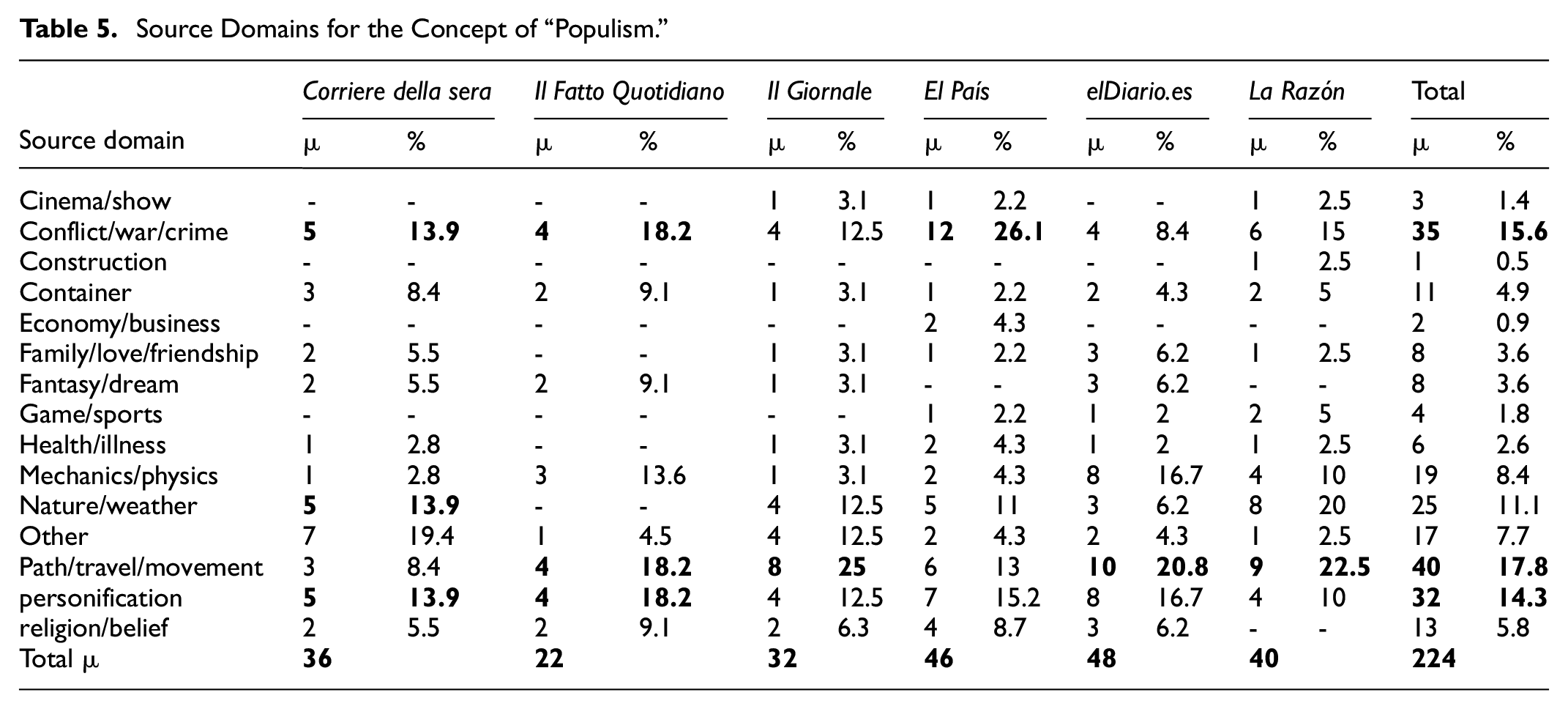
As can be observed, the SD with the highest percentage is that of
Secondly, the newspapers defined populism with
The third most recurrent metaphorical SD is that of
Overall, both in Spain and in Italy
To Establish the Narratives Derived From the Most Relevant Metaphors in the Analyzed News Outlets According to Their Political Leaning
The identified SDs associated with the terms “populism” and “populist” generate diverse narratives that may lead to a certain vision of the concept. The results of this section are presented according to the criteria of shared SD, but also according to the political leaning of the analyzed media. Considering this, three main narratives have been established: (i) Populism is on the rise and moving forward and needs to be stopped; (ii) Populism must be fought because it poses a threat to democracy; and (iii) Populism is a schemer that divides society and does not help people. Whereas these metaphorical frames are common to the analyzed news outlets, they are constructed differently depending on the newspapers’ editorial slant.
Populism Is on the Rise and Moving Forward and Needs to be Stopped
In the analyzed corpus,
[…] But what worries observers is this […] Italians are good Europeans, they know their place. I don’t think they will Populist leadership […] The inconvenience of dealing with Even Jean-Luc Mélenchon’s
Both Il Fatto Quotidiano and elDiario.es (progressive) construct negative-oriented narratives regarding
[Social Democrats] are concerned about In one way or another, the only certain thing is […] those who have shown themselves in favor of the We need […] a youth that […] although there is
Unlike the newspapers cited above, Il Giornale (conservative) holds the EU elites and the left responsible for the spread of populism, while still referring to the “populist path.” The newspaper also points to the populist drift that the Democratic Party is considering after the election results. Likewise, La Razón (conservative) blames the Socialist Party for the populist drift of the Spanish Government and for its will to hand over Spain’s governability to secessionists through a golden bridge built by left-wing populism. In doing so, the newspaper also conceptualizes populism as something that is rising, ascending, and moving forward, which entails that it is favorably progressing toward gaining power in the institutions.
When asked about the responsibilities of the European elite and the left for At stake is the fate of the leader Enrico Letta, of course: […] there is a rift between supporters of The crisis of traditional parties and […] sectors of the Spanish left, including the Socialist party itself, who observe with concern The Socialist Party is so desperate for the governability of Spain not to be handed over to Oriol Junqueras’ independentists and Arnaldo Otegi’s philo-terrorists
Populism Needs to be Fought Because It Poses a Threat to Democracy
The use of
[…] In two years we will see if we were right in trusting in Brussels and
A similar narrative is developed by Il Fatto Quotidiano and elDiario.es. These news outlets also report on populism as a perceived threat to liberal values, which is something made clear by many linguistic choices that specify and amplify this menace. For instance, they point at populism as a tragedy for countries, which are incapable of doing anything but fighting against other populists.
Falling asleep thinking that “ People have to assume that their responsibility is with democracy and that […] a rising
Finally, Il Giornale and La Razón propose a narrative in which populism, in addition to being considered a threat that could end in catastrophe or disaster, plays a more active or belligerent role. Here populism is not only threatening but is also capable of developing fighting methods, conquering and blackmailing parties and countries, and acquiring offensive capacity. In this case, these dynamics are attributed to both right-wing and left-wing populism.
[…] the Marxists, and socialist-revolutionaries who took up themes and I’m sorry for the Democratic Party, Nationalism and Let’s see what [Pedro Sánchez] does now, with the majority of the Senate lost, the PP on his heels, the old PP with 52 seats, and
Populism Is a Schemer That Divides Society and Does Not Help People
To attribute certain human qualities to populism entails a neutral, slightly negative or positive perception of the phenomenon, depending on which values these features entail. In the case of Corriere della Sera and El País, they opt for negatively evaluating populism when personifying it. The former claims that populism has a destiny, which is not that of helping people but of using them, and is attributed the traits of anger and stubbornness. The latter argues that populism is attractive, robust, and strong. But, far from being positive features, these are depicted as necessary abilities to create fragmentation and to question liberal democracies.
What will the choice of Italians indicate about In an Italy where absolute poverty has tripled in the last 15 years […] it is a slap in the face to the dignity of people and confirms a fact: We can already imagine the attempt of a scaled-down but In his opinion, these [Vox] seems to have become a party somewhat more comparable to those of the
Il Fatto Quotidiano denounces the attempts to make populism look reasonable and argues that it feeds on contextual factors, such as the continuation of some deputies in the Italian parliament after many terms in office, blaming both the ones acclaiming it and the ones responsible for society’s dissatisfaction with those that have traditionally exercised power. As for elDiario.es, populism is accused of jeopardizing people’s futures and generating tyrannies or dictatorial regimes, but the newspaper also recognizes the movement’s ability to gain support from many citizens. Be that as it may, both news outlets underline the manipulative nature of populism, whose aims are not clear.
According to Bannon, Trump’s victory strategist, “put In the face of the brazen obstinacy of too many long-standing PD parliamentarians who are refractory to the idea that a limit on mandates is necessary. A limit that a serious party should enforce […] As if abstentionism and […] mass
In the case of Il Giornale, journalistic indifference is said to be the presentable face of populism, putting the blame on some media—in this case Corriere della Sera’s journalist Massimo Gramellini—for whitening it. Populism is also conceptualized as being noisy and able to take over some political parties. It must be noted that, in this case, Il Giornale is referring to the Five Star Movement. Regarding La Razón, the newspaper states that populism—either right or left-oriented—has an instinct, which is that of destroying democratic institutions, as it does not value them and it worsens democracy’s real problems.
But But the closer the percentage of the Five Star Movement gets to that of the Democratic Party, the more likely it is that the pressure will restart within the party from those who can’t wait to mend relations with the former prime minister and follow But unless it becomes part of a broad coalition, […] this
Discussion and Conclusions
Our study on the discursive constructions of populism in the Spanish and Italian press through metaphors expands the current literature on how the term is defined by the news media by proposing a novel scope for approaching this topic, and doing so in the context of the polarized pluralist media system. In this section, after describing which metaphorical frames were used for conceptualizing populism, we argue for similarities with other investigations, while also identifying some specifics of our case study.
After detecting the metaphors and identifying the source domains referred to by populism, we have determined three main narratives through which the notion of populism is framed. As pointed out above, these conceptualizations are common to all the analyzed newspapers, but they originate different ways of understanding the phenomenon depending on their political leanings. For instance, while all the news outlets refer to populism in terms of moving upwards and forward—and stress the need to stop it –, liberal newspapers apply this to both right-wing and left-wing populism, but progressive and conservative media specifically refer to right or left respectively. As shown in the previous section, the other identified narratives show similar patterns. Whereas the scope of the study is different, this would differ from Hatakka and Herkman’s (2022) findings that point to an understanding of populism referring to the far right in the six countries they analyze, which can be true for liberal and democratic corporatist models of journalism, but not for polarized pluralist ones.
In any case, and in line with what previous studies have demonstrated, the term is mostly used in a negative manner “for criticizing and delegitimizing a range of political projects, from the radical right to the radical left” (De Cleen et al., 2018: 655). Again, populism is depicted as threatening the status quo as understood in liberal democratic terms (Brown & Mondon, 2021). And, in the present investigation, this menace is articulated through the interaction of three domains of knowledge that operate together to put forward this idea:
As stated by Demata et al. (2020, p. 29), “metaphorical constructs of populism are crucial in the way populism is codified and understood in discourse.” Nevertheless, while they can generate narratives through which it is possible to make sense of such a disputed concept, metaphors also contribute to its relexicalization due to their ability to create new meanings through analogy. Consequently, opting for lexical choices that build up a cognitive framework that promotes populism as undesirable for society implies that nobody wants to be labeled under such a negative concept (De Santiago Guervós, 2015). However, metaphors could also contribute to the opposite. This could be the case, for instance, in the use of the
Unlike in Thornborrow et al.’s (2021) work, populism as a force of nature and populism as a disease were not relevant metaphors in the analyzed news articles overall. Instead, populism as a movement or as a path predominated, as well as personalized populism and populism as battle/war, which the authors also identify in their study. In our analysis, the way in which these source domains were articulated did not just depend on contextual factors, but also on the media’s editorial slant. For instance, metaphors of
Finally, there were no relevant differences in the use of metaphors depending on the news outlet’s country of origin, quite the contrary. The identified metaphorical expressions tended to resemble one another, possibly because they did not just conceive of populism as a local phenomenon but rather as a European and global threat under which national populist movements were framed. As an example, expressions such as “rise,”“spread,”“gain ground,”“flee from” or “stop” coexist in the Italian and the Spanish samples and build up the broader narrative of populism as something that is “rising and moving forward and needs to be stopped.” As mentioned above, what differs in each country, and specifically in each newspaper, are the targeted political movements, which mostly depend on the news outlet’s ideological background.
Our findings may be affected by certain limitations. The first one is related to the period of analysis, which coincides with an electoral period in both countries. Further research could look at the way populism is constructed through metaphors in the newspapers analyzed outside election campaigns. Moreover, it should also be considered that the organizations that are framed as populist political forces at a national level in both countries are currently experiencing an institutionalization process; it could be interesting to see if the media perception of these political actors changes in the future. In methodological terms, it would also be interesting to employ mixed methods to explore other dimensions related to the definition of populism (i.e., content analysis considering variables such as ideology or political actors and movements linked to this concept), as well as considering reception studies for reflecting on how media practitioners understand populism, and how journalistic practices have been affected by populist political communication.
Supplemental Material
sj-docx-1-sgo-10.1177_21582440251327544 – Supplemental material for Marching Against a Rising and Manipulative Threat: Metaphorical Constructions of Populism in the Spanish and the Italian Press
Supplemental material, sj-docx-1-sgo-10.1177_21582440251327544 for Marching Against a Rising and Manipulative Threat: Metaphorical Constructions of Populism in the Spanish and the Italian Press by Carlota M. Moragas-Fernández, Arantxa Capdevila Gómez and Carlo Berti in SAGE Open
Footnotes

References
Supplementary Material
Please find the following supplemental material available below.
For Open Access articles published under a Creative Commons License, all supplemental material carries the same license as the article it is associated with.
For non-Open Access articles published, all supplemental material carries a non-exclusive license, and permission requests for re-use of supplemental material or any part of supplemental material shall be sent directly to the copyright owner as specified in the copyright notice associated with the article.
