




Abstract
More and more individuals are turning to the mass media in search of information related to health care. Moreover, health care accounts for an important percentage of modern economies and household expenses. Since the 1990s, this demand has been to a degree satisfied by free healthcare magazines that offer useful advice and information related to health services and wellness. As the article argues, Spain can be a representative case for analyzing the health care magazine phenomenon. Using a methodology based on quantitative and qualitative variables, the article synthesizes the results of a broader research project carried out between 2012 and 2015, focusing on the news content and advertising in three free health and wellness magazines aimed at the general public in Spain: El Periódico de la Farmacia (The Pharmacy Newspaper), Estar bien (Feeling Well), and Health 21 (Salud 21). The conclusions discuss the main features and dimensions of these publications from an educational and social viewpoint, considering their fight for survival in an environment conditioned by financial crisis, competition from online publications, and the decrease in advertising and marketing specializing in health.
Introduction
Issues related to health enjoy a high level of acceptance among the general public, which is logical when one recalls that health is one of the main interests of the citizenry (Shah, 2011). In Spain, concretely, the latest barometers of the Centre of Sociological Studies (CIS) show an increase in concern about the health services in general. According to the 2014 Health Barometer (CIS; January-December), health is the sixth area of interest to the citizenry, whereas the CIS Barometer of December 2015 reports that health is the sixth problem of greatest concern (11.9%), a figure that has risen considerably since 2007, when it stood at 5.8%, according to the same source. It should also be recalled that health is a regular topic of informal conversation among the population.
Naturally, for many years, the mass media have responded to the citizens’ interest in acquiring useful data and knowledge to improve their quality of life. In reality, the mass media have always offered content, suggestions, and guidelines that readers can apply at a given moment, which is directly related to the so-called “social responsibility” of the press (Scott, 1987, p. 3). Furthermore, over the last decades, there has been an increase in health content in all media and media formats, in addition to the appearance of new journals on health and wellness (Salmon & Atkin, 2003). This expansion has been attributed to different circumstances, such as the boom in consumption, the aging of the population or the trend of body worship, and the consumption of information and products on beauty, nutrition, and aesthetics (Peñafiel, Camacho, Aiestaran, Ronco, & Echegaray, 2014, p. 137).
The usefulness, or service, provided by such media content on health and wellness appears to be closely linked to their preventive and educational function (Scott, 1987). It is a question of placing emphasis on the need to act before diseases occur, laying the foundations so that society incorporates healthy habits into its lifestyle, insofar as “preventive measures contribute necessary advice to avoid contracting particular diseases” (Pena de Oliviera, 2006, p. 143). This is possible thanks to the use of an easily understandable language with the aim of informing, interpreting, and explaining the facts clearly and impartially.
This article analyzes the information and advertising on health and wellness in non–daily free magazines, aimed at the general public and published in Spain, with a clearly educational and preventive intention. These are magazines that readers request free of charge, typically distributed in bulk to hospitals, pharmacies, nursing homes, sports centers, and other public locations linked to health and wellness.
Previously published research on health journalism differs from our main objective, as it examines the coverage of health issues either from the viewpoint of specialized professional publications or from the perspective of periodical publications aimed at the general public that are not free of charge (Costa, 2008; Dentzer, 2009; González, 2004; Kline, 2006; Molyneux & Holton, 2015; Peñafiel et al., 2014; Revuelta, 2006; Salmon & Atkin, 2003; Schwitzer, 2010; Seale, 2003). Although it is true that there have been numerous studies on free-distribution publications aimed at the general public (Núñez, 2013; Santos, 2008), to date no studies have analyzed media content on free health publications, at least not with a direct approach to the question (Martínez, Reig, & Marín, 2013; Schutz, 2009; Wofford, Pinson, Folmar, & Moran, 1995).
That is why this research aims to contribute to filling a vacuum and to deepening understanding of this phenomenon on health media content. With this purpose, the study considered the following specific research questions:
This study is of interest due to the current need to understand the keys to the communicative phenomenon of free magazines with health content. Not only in the media context of the web, where there has been a proliferation of content on health in recent years, but most especially in the traditional field of the printed press, an area conditioned by a business model in crisis that is acquiring particular features in the case of the free press.
Specifically, this research on the process of elaborating information on health and wellness has taken account of the need of determining the role played by the publications analyzed as an instrument that channels the interest of citizens in health questions.
The main hypothesis of the research suggests that the free distribution of these publications determines a distinctive educational and preventive approach closely related to an advertising and marketing aim and, in general, to the sales objectives of those companies related to health from a general point of view (pharmaceutical, health tourism, services for the third age, etc.). In this sense, their content offers information on general aspects, but in a proportion that makes it possible to fill the existing vacuum in health coverage in the general press. The study, thus, considers other premises, such as the importance of specialized advertising for the survival of printed publications in times of crisis, in contrast to the sustained and growing consumption of websites carrying information on health.
Study Case Description and Context
In the light of the objectives and hypothesis described above, the study consisted in analyzing three free health care magazines with less than a decade of existence—El Periódico de la Farmacia (The Pharmacy Newspaper; 2005), Estar Bien (Feeling Well; 2007), and Salud 21 de la Región de Murcia (Health 21 of the Region of Murcia; 2008), all of them audited by the PGD (Publicaciones Gratuitas Ejemplares Distribuibles), the Spanish Office of Free Publications and Distributable Copies 1 (Table 1). In this respect, similar publications that were not audited by the PGD were omitted, such as Farmaex (2002), a publication distributed in the region of Extremadura.
Study Cases Description.

Source. Elaborated by the authors using information from the Data from the PGD Office (Publicaciones Gratuitas Ejemplares Distribuibles), the Spanish Office of Free Publications and Distributable Copies.
In December 2005, the Publishing Group Sanidad Ediciones, S.L. (Saned) and the distributor Cofares launched El Periódico de la Farmacia. This publication is distributed in some 13,000 pharmacies, although its content is also available in an online edition. When this magazine first came out it had an average of 48 pages per month, although between 2009 and 2011, its number of pages fell to 32. In 2012, it carried out another adjustment and began to publish only 16 pages per month. El Periódico de la Farmacia came out with a print run of 299,571, which fell to 239,102 copies per month in 2012, as certified by the PGD.
This publication has six main sections—disorders, healthy mind, better to prevent, learn to, women’s health, and exercise. The greater part of its informative content covers everything related to women’s health, especially from the point of view of the most common diseases and the most innovative diagnostic techniques. In fact, in its readers’ profile, there is a predominance of women (66%) in comparison with men (33%), with an age group of readers between 35 and 54 years. It is also relevant that 63% of its readers take the journal home, which raises the audience figure to 4.29 readers per copy. Besides being monitored by the PGD, this publication belongs to the Asociación Española de la Prensa Gratuita (AEPG; Spanish Free Press Association). In the year 2015, El Periódico de la Farmacia began to be distributed monthly, and finally closed in December. As stated by its editor, Alicia Martínez, this magazine was the leader in the sector in 2011 according to the OJD (Oficina de Justificación de la Difusión, Circulation Audit Bureau). As the interviewed pointed out, this magazine aims to offer a service to those communities in which it is distributed, maintaining a good relationship with different agents, such as nonprofit organizations. The journal Estar Bien, published by Contenidos e Información de Salud, S.L. until April 2014 and by Wecare-U from this date onward, was first published on January 26, 2007. Even if Estar Bien had traditionally a very wide network of distribution points, in the last years this magazine reduced these to pharmacies and centers where sporting activities were practiced. Its print run in 2012 was reduced by half in 2014, falling from 300,000 copies to 150,000. From 2012 onward, it began a process of change and its number of pages per month fell to 32, until its closure.
According to data obtained from the in-depth interview with its editor, Lucía Barrera, Estar Bien can be considered as the “first health newspaper” with “information inviting you to improve the quality of life and enjoyment of leisure.” The aim of this magazine is to reach the entire public through strategic points. In fact, as the interviewee pointed out, its launch sought “a new form of understanding information on health,”’, as it was “a newspaper that tackled wellness in its widest sense, from the prevention of disease to care and the promotion of healthy habits. These were our principles.” Estar Bien came out with a weekly periodicity and a national distribution (Table 1). Its print run 2 initially reached 300,000 copies that were distributed in hospitals, hotels, health resorts, pharmacies, and much-frequented places, like means of transport. From 2012 onward, the publishing company decided to concentrate the publication at strategic points like fitness and wellness centers, and pharmacies. In fact, in January 2012, the publication defined itself as a “free magazine on lifestyle.” In the words of Barrera, the change at this stage went further than what can be seen at first sight. From this time onward, the publication gave increasing importance to strategies of transversal collaboration with other media like the Intereconomía television channel, as well as to strategies on social networks, especially on Twitter and Facebook.
In its pages, Estar Bien includes the following sections: communication, looking after yourself well, menus, drinks, sport, feeling well, prevention, living well, and travel. With respect to the profile of its readers, the majority of its public is formed of women (67%) aged between 25 and 54 years, with higher education. This reader type is concerned about bodily well-being, regularly practices some type of sport, travels, and consumes beauty products. She or he dedicates approximately 28 min to reading Estar Bien, and 60% decide to take the copy home.
The third publication analyzed, Salud 21 de la Región de Murcia, was launched in March 2008, with a fortnightly periodicity and a print run of 26,000 copies, on the initiative of the company Ediciones Vitalidad y Progreso, S.L. According to its editor, Alfonso Celestino, this magazine has managed to maintain its print run at 29,000 copies. In 2014, its number of pages increased and from then on it has published between 64 and 80 pages. This magazine carries out most of its distribution at the entrances of the big hospitals in Murcia with the aim of reaching health personnel and patients. The promoter interviewed defined this magazine as a health newspaper, whereas its front page currently describes it as “The newspaper of wellness.” As in the case of Estar Bien, an evolution can be seen in the concept and aims pursued by this publication, distributed in health-related centers—public and private hospitals, health insurers, old people’s homes, hotels, health resorts, and pharmacies in urban areas of Murcia. Starting in May 2010, Salud 21 diversified its business toward sectors related to the trade in medical, orthopedic, optical equipment and instruments, cosmetics, hygiene, and herbal remedies. Like the other publications of this type, Salud 21 also has a web edition that is updated weekly.
Several criteria were followed in the process of testing the representativeness of the publications examined. First, the study considers all the free health care magazines published in Spain with quality control auditing (PGD).
Specifically, the media studied are classified as periodical printed publications of thematic interest (health and wellness), whose aims are focused on the general public (customers of pharmacies, hospital patients, and residents of old people’s homes), made available to the public at regular intervals of time, with the same title, in a continuous series, with the date and correlative numbering. This characterization makes it possible to differentiate the publications examined from others that are apparently similar in their subject and aims, but very different due to their classification. Such is the case of publications that are classified differently as “pharmacy periodicals,” which is the case with Consejos de tu Farmacéutico (Advice From Your Chemist), published by the Grupo Difusiones Tecnológicas de Mercado (DTM). In addition, the publications selected are differentiated from others with a greater degree of specialization, as they are publications aimed at an expert and professional public.
Besides their large print run and their diffusion being audited by the PGD, the publications were considered according to the following indicators:
Characteristics of their promoters: These are consolidated companies with a wide presence and experience in the publishing sector on health, with specialized publications both for qualified health personnel and, in the case of the publications analyzed in this article, for the general public. 3
They represent different geographical settings, that is, national and regional coverage.
Easy access by the public, given that they are free and distributed through pharmacies and other centers related to health.
It is important to call attention to the fact that the magazines analyzed were launched between 2005 and 2008, when the economic crisis was already a reality at the world level and was causing a clear fall in advertising investment, which placed publishing companies in a difficult situation. Even so, while the free general information newspapers were obliged by market contingencies to close delegations, sack personnel, reduce the number of their pages, and print run, the publications examined have managed to survive and remain on the market by taking certain measures—concentration of distribution points in strategic zones of cities, cutting costs, lengthening the periodicity of distribution, and reduction in the number of fixed pages.
Sampling and Method
This study considers a sample of issues published in different phases, between the months of August 2012 and August 2014, and the months of June and December 2015. This sample procedure aimed to analyze representative issues from two relevant phases: The first phase refers to a moment of ordinary development and circulation, whereas the second one refers to the opening of a period of crisis, due to several factors considered in the study and explained below. In total, the study considered a sample of 94 issues (2,602 pages), divided as follows: El Periódico de la Farmacia (22 issues, 352 pages), Estar Bien (19 issues, 626 pages), and Salud 21 de la Región de Murcia (53 issues, 1,624 pages). These three publications represent free press models that have been able to adapt to market circumstances, constantly seeking more adequate solutions to subsist. Some of them have also shown a thematic and functional evolution, such as Estar Bien, which has progressed from being considered a health magazine to one focused on “lifestyle.”
Methodologically, the study adopted the qualitative and descriptive technique of content analysis (Hsieh & Shannon, 2005; Krippendorff, 1990), due to its utility for examining published texts in a systematic and objective way, as well as for quantifying the materials of the research To apply this qualitative procedure, we opted for the case study, with the understanding that this analytical form is more suitable for obtaining an in-depth understanding of what is subjected to research, and also due to its validity for establishing general theoretical propositions (Yin, 2002).
With the purpose of completing the main results of the study, other qualitative techniques were applied, such as semistructured interviews with those in charge of these publications. Interviews were carried out with the editors of the free-distribution publications analyzed. Questions were related to the characteristics of these publications, such as their aims, objectives, and financing, as well as to other questions, such as their relationship with advertisers and their general viewpoint on the sector of free-distribution publications and health.
The analysis was also completed by consulting different sources like the AEPG and the PGD)of the OJD, as well as different documents such as health reports, reports by official bodies, and other sources related to the question.
The information or media content was codified according to 13 representative thematic categories related to health and wellness: general health, specialized women’s health, specialized men’s health, specialized children’s health, specialized third age health, agenda, current affairs on news, nutrition, beauty and wellness, psychiatry/psychology, leisure, sports, and others (Table 2). Following the same line, advertising was analyzed on the basis of the following categories: medicines, nutrition, beauty, reforms, clinics, sales, institutional, vehicles, banks, telephony, funerary, old people’s homes, lawyers, leisure, clairvoyance, orthopedic, and self-advertising.
Front Page Main Topics (%).

Source. Elaborated by the authors.
Results
Although all the front pages of the publications analyzed deal with health content, their approaches vary significantly (Table 2). Thus, in El Periódico de la Farmacia, questions related to alimentation and beauty stand out in equal proportion, although questions dedicated to women’s health are the priority. Estar Bien also prioritizes alimentation, as well as questions of psychiatry and psychology, with a greater proportion than the other publications. In Salud 21, current affairs in health account for the greatest percentage of content.
To achieve the publication’s educational aim, and so that its message on health reaches a nonspecialized general public with clarity and without creating confusion or false expectations, it is important for there to be qualified personnel in the newsroom. This is the only way to ensure that the information is rigorous and focuses on basic questions, excluding irrelevant data that might lead to sensationalism or create false expectations in the audience. In this context, the journalist’s role must be focused on “reporting with the peculiarities of health language, characterized by the technical terms of the scientific area,” but making it into a language that is understandable to the public in general.
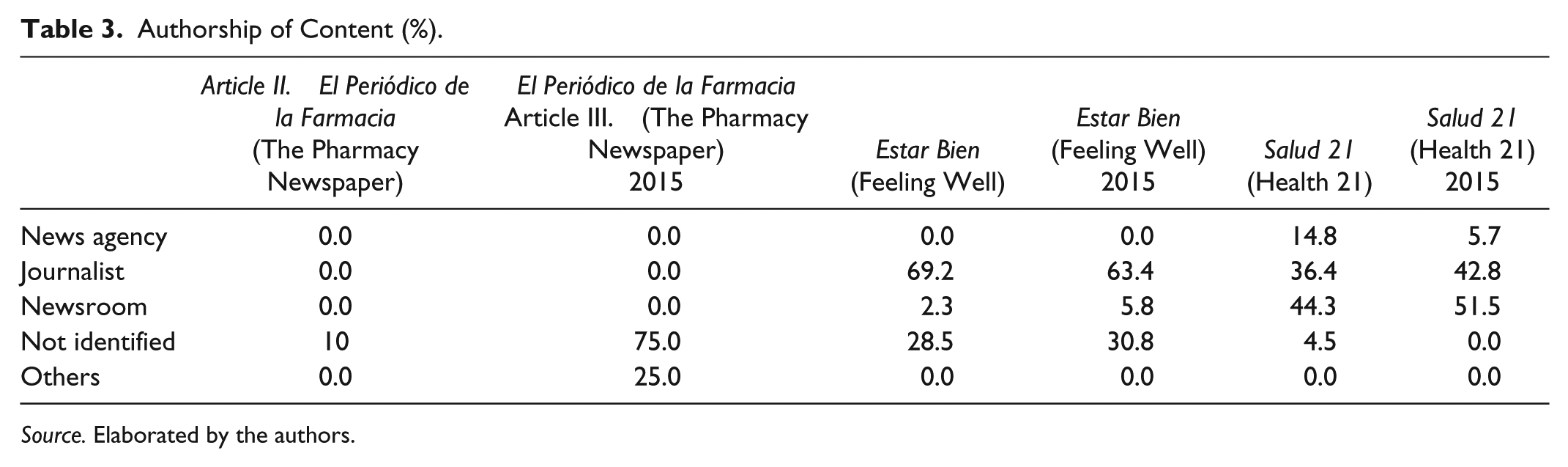
With respect to the authorship of the news reports (Table 3), only in El Periódico de la Farmacia is the authorship of the information not given in any cases, in spite of the fact that the group that publishes it, Saned, has over 50 professionals and 400 external collaborators, including specialists in communication, “medical writers,” experts in marketing, health managers, designers, and programmers. News agencies only have a significant presence in Salud 21.
Authorship of Content (%).
Source. Elaborated by the authors.
As Table 4 shows, the magazines examined provide healthy guidelines and habits with suggestions aimed at improving frequent health problems and diseases like osteoporosis, rheumatism, osteoarthritis or lower back pain, sleeping problems, obesity and how to deal with it through balanced diets, exercise, and, as a last resort, surgical intervention. Regardless of the ailment they are dealing with, they describe the disease, risk factors, symptoms, prevention, and recommendations.
Contents.

Source. Elaborated by the authors.
Women’s health is considered by dealing with the different stages of their lives. Particular attention is given to gynecological specialties (assisted reproduction, pregnancy, menopause, etc.). Salud 21 dedicated a special 11-page monograph to such content. The specific ailments of men are also covered, although to a lesser degree. Specific guidelines and information are included for elderly people dealing with the characteristic ailments of that age, such as dementia, dental health problems, infectious processes, cardiovascular alterations, osteoarthritis, and pain—the most frequent reasons for medical consultations among the population over 65 years.
The content of Salud 21 is directed at older people, and it is thus not surprising that its pages deal with these frequent diseases with instructions on how to prevent them or improve their condition. Nor is the childhood stage ignored, with advice and suggestions for preventing diseases.
The diary of events and organizations is also a service worth highlighting in this type of publications. Salud 21 provides a complete guide to associations of people with ailments, like Adirmu (diabetes), On-Off Association (Parkinson’s disease), Asociación de Ayuda al Enfermo Renal (ADAER) (renal patients), Asociación Murciana Virus Inmunodeficiencia Humana (AMUVIH) (HIV patients), Multiple Sclerosis, among others. In addition, it provides numerous addresses of health centers and hospitals in the province.
In the texts analyzed, all aspects of nutrition and alimentation are dealt with; advice on a balanced diet is provided, but the need for support from a health professional is taken into consideration. This content shows the health benefits contributed by fruits and vegetables, among other foodstuffs. Also included are recommendations from experts for reducing arterial inflammation. This content is completed with cookery recipes, which include the ingredients needed to feed four people, the steps to follow throughout the process, and necessary observations for elaborating the dishes.
In addition, all the publications show an interest in current health innovation, such as new techniques being applied in surgical operations and new treatments.
With respect to current health issues, content is adapted to the season in all the publications analyzed, which show disorders and diseases related to the time of year concerned. They provide detailed explanations of their pathology, accompanied by guidelines and recommendations with the causes, symptoms, and ways of preventing disorders, such as spring asthenia, for example. In summer, advice is given on how to combat heat and thirst with a compendium of recommendations and suggestions for the season, such as natural remedies for reducing the amount of body sweat, refreshing oneself to satisfy thirst when the sun is hottest, the importance of good hydration, and caring for the skin protecting it from the sun, thus avoiding melanomas and patches. In autumn, recommendations are given on the use of exfoliating creams and moisturizers to reduce the risk of suffering from different lesions. In winter, flu and cold are a recurrent topic. They include symptoms and the most used medicines, like analgesics, antipyretics, decongestants, and antihistamines. Relevant dates like New Year are also considered.
In the section on beauty, there is concern for the skin with natural active products and vitamins to mitigate stains and imperfections. Psychiatry and psychology also find a space in their pages. Guidelines are given that can help in overcoming difficult moments in life and raising morale. Attention is given to situations of stress and disorders like anxiety, depressions, obsessions, and other pathologies, which might be due to the current crisis and require specific therapies. The pages of the publications are completed with other issues of current interest in society, like ecology.
Analysis of the advertising in the publications of the sample provides dissimilar results, as can be seen in Table 5. While the majority of the advertising in El Periódico de la Farmacia is about medicines, in Estar Bien the greater number of advertisements is related to nutrition and aesthetics. With specific reference to advertisements on medicines, it should be recalled that the publisher of El Periódico de la Farmacia belongs to the pharmaceutical sector and distributes this publication in pharmacies. This type of advertising focuses on medicines for health problems that are well known to the public and are easy to obtain as they can be acquired without medical prescription. In this way, clear commercial links are established between the publisher, the pharmacy, and the consumer.
General Advertising (%).

Source. Elaborated by the authors.
In Estar Bien, the secondary advertising is dedicated to services like telephony and clairvoyance. In Salud 21, advertising for medicines, nutrition, and beauty accounts for a small minority, as opposed to advertisements for clinics, orthopedics, and reforms, which are nonexistent in the case of the other two publications. Also characteristic of Salud 21 is advertising that specializes in equipment and systems for assisting problems of reduced mobility that are characteristic of the third age (scooters, wheelchairs, lifts, articulated beds, etc.). Also outstanding in Salud 21 is advertising on old people’s homes, funeral, and juridical services, as well as advertising on product sales (digital tension meters, 20 language translators, television surveillance sets, steam cleaners, etc.). As Table 5 shows, in the three publications, the majority of the advertising specializing in medicine focuses on the common cold (head, lower back, joints, etc.) and sight (opticians, medicines, eye drops, etc.).
Advertising plays a decisive role in the publications in our study as a source of funding. Not for nothing is the Grupo Saned, the publisher of El Periódico de la Farmacia, a global services company, responsible for advising and training health professionals. For its part, Cofares, the distributor of El Periódico de la Farmacia, is a leader in pharmaceutical marketing in Spain, with over 4,500 pharmacies as clients and 9,654 pharmacists as cooperation partners, with a turnover in 2012 of over 2,523 million Euros. Contenidos e Informaciones de Salud, S.L., the publisher of Estar Bien, is a novel business model, which works in research and in the creation, consultancy, design, and publishing of information related to the sciences of health, medicine, bioscience, pharmacy, veterinary science, and other related professions. Starting in May 2010, the company Ediciones Vitalidad y Progreso, S.L., responsible for Salud 21 de la Región de Murcia, diversified its business toward sectors related to the retail marketing of medical, orthopedic, optical, photographic instruments and cosmetic products (Table 6).
Advertising Specializing in Medicines (%).

Source. Elaborated by the authors.
Discussion and Final Remarks
Following the main hypothesis of the study, the results obtained make it possible to conclude that the free-distribution publications on health and wellness aimed at the general public to fulfill a priority aim: to support the activities of their parent companies in fields outside publishing, directly through advertising (medicines, products for the third age, etc.) and indirectly by educating the public, and arousing its interesting in such questions that are directly related to “quality of life.”
Advertising in these publications provides important support for products related to a healthy life. As occurs in the case of the main content, we can also note differences among the publications in the case of advertising. Thus, El Periódico de la Farmacia mainly dedicates its advertising space to medicines, whereas Estar Bien gives priority to products related to nutrition, and Salud 21 to advertising on clinics and old people’s homes.
Within the general treatment that the publications analyzed give to questions related to health, it is possible to observe slight specializations that give a particular personality to each of these media. Although the publications examined dedicate their pages to questions related to health, it is difficult to find a topic that attains a similar index of presence in the three publications. Thus, differences can be noted with respect to the agenda of the main content, both on the front and inner pages. While El Periódico de la Farmacia pays special attention to nutrition and beauty, Estar Bien gives priority to nutrition and questions of psychiatry and psychology, and Salud 21 highlights current health issues. The content they include is clearly useful, as they provide healthy guidelines and habits, with suggestions and standards aimed at making life better. This usefulness is also shown in content aimed at performing a preventive function. With respect to the thematic preferences of these publications, there is also a noticeable tendency in El Periódico de la Farmacia and Estar Bien to increasingly equate health with wellness or quality of life.
The publications analyzed emerged in the midst of the economic recession and, with the exception of Salud 21, they have not managed to subsist in the print market unlike other free-distribution publications, which is very interesting. The survival of Salud 21 has been possible through adaptations (print run, periodicity, etc.), although it is still too soon to know if these measures will continue to be effective in the long-term. In this respect, their online versions seem to be the solution. In their online versions, the three publications have continued to exist, and they have sufficient potential to develop a specific type of publication defined by greater dynamism, thematic breadth, and interactivity.
In line with what the editors noted, journalistic content on health aims to provide answers, offer guidelines, and provide orientation to the reader facing a problem that directly affects his or her life. Stated in other words, this is content that educates the population on health, with messages that are educational and useful. Thus, the general interest of the publications that form our object of study lies in their presenting content that is immediately useful to people, that serves to help in daily life, encompassed in what is known as “service journalism.” One decisive factor is that these publications deal with diseases and ailments that are suffered by a very significant part of the population and that receive special recognition through World Days. As a suggestion for future research, we propose widening this type of analysis to other media like the radio and television, which will also make it possible to carry out comparative studies.
One of the main keys to the emergence of the publications studied lies in their offering content related to health that closely concerns the reader, employing positive approaches that also have an educational aim, even if they entail a marketing or advertising aim. The increase in information on questions related to health in recent decades would thus be giving a new boost to periodical publications dealing with these issues, as well as to health-sector advertising.
Nevertheless, as a final summary, and in accordance with the main hypothesis, the study highlights the great influence of advertising and marketing in health journalism. This seems to be specially significant in the case of free-distribution publications that are committed to providing educational and service information on general and specialized health (women’s and men’s health, etc.), as, for such publications, the decrease in sales does not represent a sword of Damocles. In fact, in view of the study results, it is possible to conclude that the publications analyzed are presented to the public as being concerned with health education and service, while their purely marketing and advertising aims are concealed. Continuous changes in periodicity and number of pages clearly evidence this lack of commitment to service information and, in contrast, a considerable preference for doing business through advertising.
Footnotes
Declaration of Conflicting Interests
The author(s) declared no potential conflicts of interest with respect to the research, authorship, and/or publication of this article.
Funding
The author(s) disclosed receipt of the following financial support for the research, authorship, and/or publication of this article: Funding information for invoice University of the Basque Country (UPV/EHU) Department of Journalism II NIF: Q-4818001-B UPV/EHU Dpto. Periodismo II Facultad de Ciencias Sociales y de la Comunicación Bº Sarriena, S/N 48940-Leioa (Bizkaia), Spain.
