




Abstract
Lifestyle is formed by the daily habits of a personal, and depending on the behavior, health problems, or premature death are affected. Efforts and research to maintain and improve healthy lifestyles in public health continue. This study tried to develop a tool that can be quantitatively evaluated through the Activity, Interest, and Opinion (AIO) technique and to verify the validity of the tool to understand the lifestyle based on personal values at a microscopic point. Lifestyle evaluation tool was developed through Delphi surveys. The development items consisted of three categories (activity, interest, opinion) that can understand contextual factors such as individual values, opinions, and interests, and items with 24 concepts. The Delphi survey consisted of a panel of 17 experts in the field of health-care for the elderly, and convergence and consensus were confirmed in two rounds. The average content validity ratio of the final Delphi survey was 0.89, stability 0.16, convergence 0.42, and consensus 0.76, which were high. The developed tool is expected to be used in empirical research to identify the lifestyle reflecting the values of the elderly and to promote health.
Introduction
Lifestyle was defined as the distinctive mode of living of members of a social group or society as a whole with social background and was defined as a characteristic of an individual that distinguishes him from other members (Lazer, 1963). In a recent study reported in 2019, lifestyle was defined as a consistent mode of living formed by the interaction of environmental factors with the values, personalities, etc. of the performers as humans spend time and money (Park et al., 2019). Such lifestyle was defined as behaviors such as physical activity, drinking, smoking, and nutrition in public health care and reported as a representative factor determining health (Lalonde, 1974).
A personal lifestyle is formed by daily habits and has characteristics that distinguish it from others, and may have health problems due to an unhealthy lifestyle (Farhud, 2015). According to the World Health Organization (WHO), an unhealthy lifestyle increases the morbidity of non-communicable diseases, regardless of age and gender, and the mortality rate from this is 71% worldwide (World Health Organization [WHO], 2017). As such, public health interest in managing a lifestyle that affects the level of human health is increasing worldwide (WHO, 2021).
Human cells irreversible biological changes as they age, and changes in body structure and function appear (Organisation for Economic Cooperation and Development, 2021). Age and lifestyle behavior are correlated and can lead to increasingly unhealthy lifestyles (Zanjani et al., 2015). Health-related lifestyle behavior can be predicted and explained by the concept of the theory of planned behavior (TPB) (Godin & Kok, 1996), but more in-depth consideration becomes possible when considering everyday values that determine behavior (Ahmad et al., 2020). As such, values can be judged as an important factor necessary for decision-making on the lifestyle behavior of the elderly (Wu & Li, 2017).
As a quantitative assessment tool to understand an individual’s healthy lifestyle, the Fantastic Lifestyle Questionnaire, which measures family and friend relationships, activities, nutrition, smoking, etc., is used, but there are limitations to validity (D. M. Wilson et al., 1984). On the other hand, Health-Promoting Lifestyle Profile ãÀ, whose validity and reliability have been verified, consists of domains such as health responsibility, health responsibility, physical activity, and nutrition, and is being applied in many countries (Walker & Hill-Polerecky, 1996). Other than that, there is the Elderly Lifestyle Questionnaire, but it has limitations because it deals with a small number of risk factors because domains consist of exercise, preventive activities, stress management, and nutrition (Eshaghi et al., 2010). The recently developed Yonsei Lifestyle Profile measures the sub-domains of physical activity, activity participation, and nutrition, categorizes an individual’s multifaceted lifestyle, and presents the results (Park & Park, 2020). Although these healthy lifestyles evaluate health-related behaviors, no tool can measure the subjective aspects that individuals pursue health and make decisions.
Lifestyle is divided into personal activities, interests, needs, and values, and is materialized in various forms and behaviors in daily life (Wells, 1975). To analyze the lifestyle of individuals or small groups rather than society as a whole, it is necessary to identify and predict patterns of values, interests, and opinions pursued through micro-analysis methods. In this context, to understand a healthy lifestyle, the micro-analysis method of daily activities, interest in the surrounding environment, and social and personal problems suggested by Wells and Tigert (1971) have an important meaning. Consequently, it is essential to subdivide and understand the health-related behaviors and personalities of the elderly expressed in a changing society and culture.
Plummer’s (1974) AIO is used for lifestyle profiling from a microscopic point of view. The three-dimensional view of AIO is divided into Activities (how you spend their time), Interests (what they place importance), and Opinions (opinions of their view). In addition, each dimensional view is subdivided into the bottom nine essential concepts (A; work, hobbies, social activities, etc., I; family, home, occupation, etc., O; self, social problems, politics, etc.). It is possible to understand the lifestyle reflecting the extent and importance of the distribution of activities, interests, and opinions that consume time and money (Holtzhausen et al., 2021).
This study was intended to develop a lifestyle evaluation tool from a microscopic point of view that focuses on the behavior according to the choices that determine the health of specific groups rather than the overall healthy lifestyle of the group constituting society. Therefore, the purpose of this study is to develop an evaluation tool that can evaluate and understand the lifestyle revealed in the real life of the elderly from a microscopic point of view based on personal attitudes and values. Lifestyle evaluation tool development was to develop a standardization tool that can be quantitatively evaluated through an AIO approach proposed by Plummer (1974) and verify its validity.
Methods
Study Design
We conducted a modified Delphi survey, which is performed to gather an expert consensus by using a series of structural closed questions (Boulkedid et al., 2011; Hasson et al., 2000). Ethics approval was granted by a local university (YUWIRB-1041849-202207-SB-135-03).
Delphi Survey and Process
The Delphi survey is characterized by repeatedly examining the opinions of a panel of experts on a specific topic to draw a comprehensive conclusion (Dalkey, 1969). It is based on the principle of democratic decision-making based on objective quantitative principles and majority judgment by repeatedly collecting and synthesizing collective judgment opinions on a specific subject (Lee, 2001). Therefore, this study tried to develop an evaluation tool that can measure a healthy lifestyle from a microscopic point of view based on the collective judgment of experts using the Delphi technique.
In this study, the Delphi study was conducted through the stages of Expert panel selection, preparation questionnaire, Delphi survey, and Delphi data analysis (Figure 1).
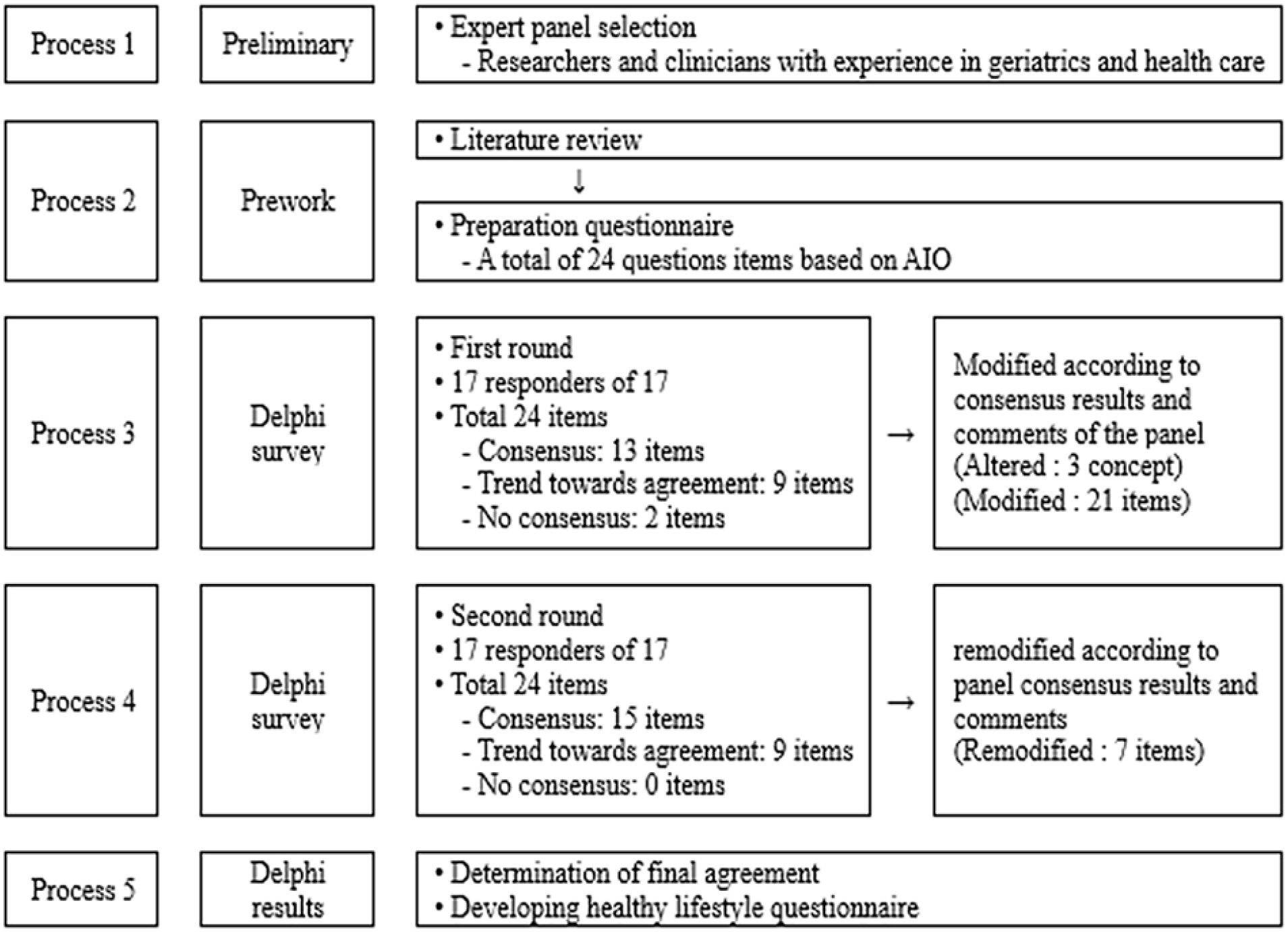
Flow chart of Delphi process.
Delphi Panel Selection
To gather multidisciplinary healthcare professionals in lifestyle research and health and quality of life of older adults, the researchers invited experts who had completed a graduate master’s degree or who had experience in relevant areas for over 5 years at least. Moreover, to enhance the diversity of the expert panel, we invited professionals with expertise in the fields of lifestyles and/or health of older adults within the scope of healthcare management including occupational therapy, physiotherapy, nutrition, social welfare, and preventive medicine. The eligibility criteria were to (a) participate in the second round of the current research, (b) be able to use a computer, and (c) have access to the Internet.
Potential panelists were determined based on peer review and literature reviews, which included clinical experts and researchers with professional performance experience in elderly and lifestyle majors, research, and therapy. The snowballing technique was also used. The panelists were required to answer the question regarding other relevant experts (Iqbal & Pipon-Young, 2009). According to the literature on the Delphi survey, traditionally 10 to 15 experts recommends as a panel (Green et al., 1999).
Identified the potential professionals were sent an invitation email which contained a letter explaining the current study and informed consent. Delphi survey and the survey period were specified and reminders were sent as needed to increase the survey response rate.
In the Delphi first round, the consensus of the question item developed by the researcher was evaluated on a four-point Likert-type scale (1: strongly disagree, 2: disagree, 3: agree, 4: strongly agree). In addition, other opinions were presented so that opinions such as modification, deletion, addition, etc. could be presented for each question item. In the Delphi survey collected afterward, the panel’s consensus or suggested revisions were reviewed by two authors and incorporated into each question item.
The second round was conducted with the same experts as the first panel. To reach a consensus on the question item, the content of each panel’s response and the distribution of opinions (mean, standard deviation, content validity ratio (CVR), stability, convergence, consensus) of the panel were provided, and the appropriateness of the item was reviewed on a four-point Likert-type scale. After analyzing the results of the second round, a lifestyle measurement tool that reflects values was finally determined.
Creation of the Questionnaire
A literature review was conducted to develop a questionnaire that can analyze healthy lifestyle. For data collection, online databases (CINAHL, PubMed, Google scholar) were searched from January 2010 to March 2022. The search terms were health, lifestyle, behavior, values, attitude, and assessment, and literature on the multifaceted scope and definition of lifestyle (Park & Park, 2020), factor (Anand et al., 2022), and evaluation (Ferreira et al., 2018) were reviewed.
The lifestyle measures applied the AIO approach that analyzes the multifaceted lifestyle from a microscopic point of view. The composition of the questionnaire consisted of appropriate questions based on the essential sub-concepts according to the three-dimensional view of AIO. Question item development was developed by researchers (Two PhDs in occupational therapy in the field of healthcare profession) by reviewing existing studies so that the concept of a healthy lifestyle can be reflected and expressed based on sub-concepts of AIO. Finally, questions reflecting a total of 24 sub-concepts according to the AIO-based three-dimensional view were developed, and the degree of extent and importance according to the concept was evaluated on a five-point Likert scale (1: strongly disagree, 2: disagree, 3: neither agree nor disagree, 4: agree, 5: strongly agree).
Delphi Survey—First Round
Twenty-four closed-ended questions into three themes were presented in the first round survey (Supplemental Material S1 Appendix). Questions for the first round were developed based on the previous literature review which was conducted by the authors. The expert panel received the first round of survey materials by e-mail and was required to rate and score the relevance of each proposed item using a four-point Likert-type scale (1: strongly disagree, 2: disagree, 3: agree, 4: strongly agree). The participants were required to provide their additional opinion freely on each proposed item.
Delphi Survey—Second Round
Based on the response of the second round survey, all items received a consensus as relevant and important items. In the second round, we asked the experts to rate the relevance and importance of each item on a four-point Likert scale (1: strongly disagree, 2: disagree, 3: agree, 4: strongly agree). The level of consensus was set to 75% of respondents indicating agreement (Diamond et al., 2014).
Data Analysis
Quantitative data will be analyzed by using IBM SPSS version 25.0. Data will be investigated by two different researchers independently. To analyze the response of rounds 1 and 2, we estimated CVR. The minimum CVR was rated by the number of professionals who participated in each round (Lawshe, 1975). Based on the criteria, the CVR value of all items was set to 0.49 for 17 experts in rounds 1 and 2. The CVR ranges from +1 to −1. A high positive value demonstrates that the survey experts agreed that a factor or item was necessary (F. R. Wilson et al., 2012). Also stability, convergence, and consensus will be analyzed in each round by conducting a combination of descriptive and inferential statistics. Consensus will be assessed by applying descriptive statistics of central tendency and dispersion. As the Likert scale is considered an ordinal scale, 60 median and IQR will be used (Hicks, 2009; von der Gracht, 2012). The stability of the responses between rounds 1 and 2 will be assessed by using the Wilcoxon rank-sum test. Statistical significances will be set at p < .05 (Trevelyan et al., 2015; von der Gracht, 2012).
Results
Demographic of the Panel Experts
We delivered about 20 invitation letters by email to potential experts. Of these, 17 experts provided their written consent to participate in the study. All of 17 participants in the current study finished all rounds. The demographic characteristics of the experts are described in Table 1.
Demographic Characteristics of the Panel Experts.

In rounds 1 and 2, 17 experts enrolled to be members of the expert panel, and 10 of them were male (58.82%) (10 males, 7 females). The mean age of the participants was 38.58 years (standard deviation: 7.75 years). Ten (58.82%) of the participants had over than 10 years of work experience, and 14 (82.35%) of the participants had a PhD as their highest level of education. In terms of occupation, 12 experts (70.59%) in occupational therapy participated in the survey.
Results of the First Round
The results of the first round Delphi survey are presented in Table 2. In the activity category, the CVR was higher than 0.49 except two items, and the content validity was verified for five items in this category. The CVR was highest in the “hobbies” and “sport” sub-items. In contrast, the CVR for “rest” and “community” was less than 0.49 (Table 2). In terms of interest category, the CVR was less than 0.49 for three items including “family,”“job,” and “fashion.” Lastly, in the opinion category, two items such as “work-life balance” and “economics” demonstrate low level of CVR. Therefore, the low items with low CVRs were checked and modified by authors before conducting round two Delphi survey.
Contents of the Lifestyle-Values in the Round 1 Survey.

Note. CVR = content validity ratio of all sub-items; Mean = average values of each sub-items; SD = standard deviation of each sub-items.
Results of Second Round
The items for round 2 are shown in detail in Table 3. The CVR for round 2 was 0.49 or higher, and the content validity was confirmed for all 24 items. According to the results of the second round survey, compared with the round one, the relevant of the items was relatively high, and the expert panel’s response demonstrated high convergence and agreement (Table 4).
Contents of the Lifestyle-Values in Elderly Profile in the Round 2 Survey.

Note. CVR = content validity ratio of all sub-items; Mean = average values of each sub-items; SD = standard deviation of each sub-items.
Expert Panel Agreement in the First and Second Delphi Surveys.

Note. Mean = average values of all sub-items; SD = standard deviation of all sub-items; CVR = content validity ratio of all sub-items.
Discussion
Efforts in related academic fields to evaluate and objectify lifestyles that affect the health of elderly people have important aspects (Lara et al., 2013). To evaluate a healthy lifestyle, it has been reported that in general, the presence, frequency, and time of daily behaviors and activities for risk factors are evaluated with objective scales (Lim & Park, 2022). This may raise the need for this study in that it is possible to understand the mode of living and methods of a healthy lifestyle that distinguishes it from others, but cannot interpret a lifestyle according to the values formed under the influence of a personal environment and social background. Plummer’s (1974) AIO approach applied mutatis mutandis in this study is thought to help explain and predict lifestyle behavior by placing importance on the values pursued by personal.
An academic approach that enables empirical research and analysis that can reflect the conceptual definition of lifestyle is needed. Although there is no consensus definition of a lifestyle, it is defined as a unique mode of living that reflects a personal social background. Although there is no consensus definition of a lifestyle, it is defined as a unique mode of living that reflects a personal social background (Lazer, 1963) and is embodied in various forms and behaviors divided into activities, interests, needs, and values in daily life (Wells, 1975). Empirical views on lifestyle are reported to be important factors influencing human health and successful aging (Franklin & Tate, 2009; WHO, 2021). To objectively evaluate the lifestyle formed by reflecting the values of the elderly, evaluation items should be composed in a way that can measure the multi-dimensional concept of lifestyle.
To evaluate a healthy lifestyle that reflects the values of the elderly, the AIO approach based on the psychographic values dealing with psychological, mental, and emotional factors was used to partially modify the concept to meet the purpose of this study and constituted development items. The development items consisted of a total of 24 items with categories and sub-concepts for Activity, Interest, and Opinion of the AIO approach. Existing health lifestyle measures focus on factors such as nutrition, physical activity, and leisure (Park & Park, 2020; Walker & Hill-Polerecky, 1996; D. M. Wilson et al., 1984). In this development tool, items of nutritional factors that can reflect the concept of shopping, food, products, and cultures, such as diet, food, and nutrients, are included in the sub-category. And the physical activity factor reflects sports events, mountaineering, jogging, etc. in the category with the concept of sports, and the leisure factor is composed of items including hobbies, leisure, and cultural life in the hobbies and recreation categories.
In addition, a healthy lifestyle should be considered as a total approach that can include the concepts of individual psychological, cognitive, and social functioning (Kendig et al., 2014; Visser et al., 2019). In this study, items with the concept of health-related social events, community, work, and rest were included in category activity based on the values of psychographics. Also included are items that can recognize the concepts of family, job, fashion, and media in category interest. In category opinion, items with the concepts of themselves, health issues, politics, work-life balance, economics, education, and future were included. As such, the development tool comprehensively includes factors affecting the healthy lifestyle from various aspects. Therefore, it will be possible to evaluate and understand quantitatively the degree of agreement with activities, interests, and opinions of individuals when they spend their time from a consumption point of view.
The Delphi panel of this study consisted of experts with experience in clinical, educational, and research in the field of health-related academic field for the elderly. The expert panel majored in medical, health, and welfare, with an average of 13 years of professional experience, which is considered a reliable group to extract and synthesize professional opinions and judgments on the subject of this research. The size of the expert panel was a total of 17 people, which satisfies the size of 10 to 15 people who can be recognized for useful results and reliability in Delphi research (Anderson & Peirce, 1995).
In the Delphi survey, content validity was verified through Lawshe’s (1975) CVR value (<0.49) based on 17 expert panelists. In the first Delphi survey, the fit was found to be in the range of CVR –0.05 to 0.88 which was lower than the standard value. After analyzing the responses of the panelists, the concept and items were revised based on the rating, skewness, positive number, and the opinions presented. Through this, in the second Delphi survey, it was judged that the content validity was significant in all question items with a CVR of 0.64 to 1.0 in all items except for the item with the concept of rest (CVR 0.29). The concept rest item showed a low level of validity at 0.29, but considering that rest is emphasized in a healthy lifestyle (Olds et al., 2018), it was revised by discussing with the co-authors and not excluding the item, but by accepting the panel opinion.
It is reported that in-depth understanding and improvement of lifestyle formed through daily habits from a preventive point of view is essential to lower the risk of health problems and premature death appearing in the aging process (Balwan & Kour, 2021). Considering that lifestyles that affect health are formed according to different social backgrounds, environments, and values for each person (Partridge et al., 2018), the development of an evaluation tool was required for empirical analysis that could reflect this. Therefore, this study developed objective evaluation items through the AIO approach to evaluate the lifestyles reflecting the values in different contexts of the elderly. The tool that secured content validity was named 'Yonsei Lifestyle Profile-Values' (YLP-V). It is thought that it is meaningful in terms of being able to understand and objectify lifestyle behaviors that are distinguished from others by expressing values according to the degree of consent in the tools that include various variables. Through this development tool, it will be possible to explain the healthy lifestyle reflecting individual values, identify the degree of change, and use it as a basis for health promotion programs, and it will be possible to approach empirical research by categorizing groups.
As a limitation of this study, only the content validity of the tools to be developed by experts dealing with the health-related being academic of the elderly was verified. In addition, it cannot be excluded that the 17 expert panel members were biased toward the field of public health, and the process and results were somewhat distorted or biased. In future research, it needs to be verified through usefulness, validity, and reliability studies as a lifestyle evaluation tool that can reflect individual values for the health promotion of the elderly.
Conclusion
This study tried to develop items that can evaluate the health lifestyle reflecting the values of the elderly by applying the AIO approach and the Delphi method. The expert panel included in the Delphi survey consisted of 17 people with professional knowledge and practitioners in the fields of medical, health, and welfare. In addition, convergence and agreement on development items were confirmed. In this study, the final 24 items were derived by presenting the consensus of measurement for contextual factors such as individual values, opinions, and interests through the AIO approach. This is considered to be meaningful from the perspective of being able to understand the lifestyle formed in the elderly based on individual values and to identify the characteristics that distinguish them from others. Therefore, based on the tool developed in this study, it is expected that the lifestyles reflecting the values of the elderly can be identified and used in empirical studies for health promotion.
Supplemental Material
sj-docx-1-sgo-10.1177_21582440231194802 – Supplemental material for Development of Lifestyle Evaluation Tools Based on the Values of the Elderly: A Delphi Study
Supplemental material, sj-docx-1-sgo-10.1177_21582440231194802 for Development of Lifestyle Evaluation Tools Based on the Values of the Elderly: A Delphi Study by Young-Myoung Lim, Kang-Hyun Park and Ji-Hyuk Park in SAGE Open
Footnotes
Declaration of Conflicting Interests
The author(s) declared no potential conflicts of interest with respect to the research, authorship, and/or publication of this article.
Funding
The author(s) disclosed receipt of the following financial support for the research, authorship, and/or publication of this article: This work was supported by the Ministry of Education of the Republic of Korea and the National Research Foundation of Korea (NRF-2021S1A3A2A02096338).

Supplemental Material
Supplemental material for this article is available online.
References
Supplementary Material
Please find the following supplemental material available below.
For Open Access articles published under a Creative Commons License, all supplemental material carries the same license as the article it is associated with.
For non-Open Access articles published, all supplemental material carries a non-exclusive license, and permission requests for re-use of supplemental material or any part of supplemental material shall be sent directly to the copyright owner as specified in the copyright notice associated with the article.
