




Abstract
This explorative study investigates how book readers engage on Instagram within the platform-based reviewer sphere as part of the Bookstagram community. The communicative patterns and practices of online book reviews align with the communicative infrastructure of social media. The aim is to define and describe the communicative patterns and practices of online book reviewing under the changing conditions in a social media environment. The article analyzes a sample of the German-language reviewer sphere on Instagram in order to investigate a local formation of a global community. Based on a content analysis of posts (N = 514) from three thematic hashtags—#rezension (“review”), #buch (“book”), and #bookstagramgermany—, I will discuss the types of reviewers and analyze their content by the categories of platform affordances, imagery, textual forms, and review approach. The article contributes to the research of online book reviewing within communication and media studies by providing insight into the communication and review approaches of a niche-structured Instagram community.
Introduction
Social media largely affect all aspects of life in “mediatized society” (Hepp & Krotz, 2014). The constant spread and dynamic transformation of particular social media platforms impact the relevance not only of social media content but of the cultural practices of creating, publishing, and consuming content on digital and social media platforms. The increasing platform-driven communication in digital media culture (Helmond, 2015) has also impacted the field of online book culture; for instance, digital self-publishing and collaborative reading and writing on social media platforms have given rise to “a new generation of authors [who] are building audiences, on social platforms, through direct engagement with readers even before publishing through platforms” (Ramdarshan Bold, 2018, p. 119). However, readers not only use digital and social media platforms to engage with authors interactively; they have also formed collaborative communities to develop and cultivate what Moody (2019) calls a “participatory culture of online book reviewing.” In this context, the practice of reviewing books is changing in the wake of a social media-driven culture as the communicative structures of discussing and evaluating books align with the patterns of media communication on popular social media platforms. The review of books on YouTube by readers—called BookTubing—creates a mediated community of book lovers who use the audiovisual patterns of vlog-style communication to recommend favorite books to a follower base (Perkins, 2017). Amazon’s platform Goodreads uses algorithms to process the self-catalogization of books, or the curation of reading lists, for a follower community that supports collaboratively filtered recommendations of books on the platform (Murray, 2021, pp. 8–9). And phenomena such as Bookstagram, where books are reviewed on the image-sharing platform Instagram, drive platform-bound discussion and evaluation that is affecting the review genre (Jaakkola, 2019, 2022, p. 152–170). In this context (with non-institutional and mostly amateur users dominating), the practice of reviewing is changing; it reflects the particular evaluation values of and within a social media community. In the context of “user-generated reviewing” (Jaakkola, 2018, p. 11) characteristics of everyday cultural opinion-making and community-driven negotiations of tastes that fit the environment of social media as well are becoming increasingly more important than the evaluation of books. Therefore, book reviewing is changing due to the particular logics of social media communication. Book reviewing on Instagram, called Bookstagram, has developed within a global community (Jaakkola, 2019; Thomas, 2021) and is influencing the phenomenon of online book reviews. This has changed the form of reviewing discourse by popularizing the ordinary as opposed to the institutionalized reviewer (Jaakkola, 2018, p. 13; Kristensen & From, 2017, p. 105).
Online review practices are hardly new: however, scholarly attention has recently focused on the community-driven and bottom-up practices of readers and writers, while traditional publishers are losing their cultural significance as gatekeepers—particularly among younger media users (Moody, 2019, p. 1067). The communicative patterns and discursive processes of book reviewing are changing due to the diverse structure of reviewers within communities on digital and social media platforms. Moreover, the practices of book reviewing cannot be isolated from the different platform-entrenched processes of creating, publishing, and consuming content. Reviewers on social media not only make use of the communicative infrastructure that certain platforms provide; they also need to follow their operational principles. Within the research field of online book culture to which this study aims to contribute, this article addresses the practices of book reviewing under the changing conditions of social media, focusing on Instagram in particular. The research subject of online book reviewing is located at the intersection of book and publishing studies within the research area of media and communication studies (Murray, 2006, p. 12) as well as cultural theory (Jaakkola, 2022, pp. 61–77; Kurschus, 2015, pp. 35–43). I will therefore discuss the platform-driven transformations of online book reviewing on Instagram, focusing on communication and media studies that follow an approach in media cultural theory (Hepp, 2008, 2010). In so doing, I will analyze a sample of the German-language reviewer sphere on Instagram by the following research questions: Q1: What aspects of reviewing are pursued by German-language social media book reviewers on Instagram? Q2: How do German-language social media book reviewers use communicative forms on the Instagram platform? This allows me to understand a local formation of a global community in terms of its communicative patterns and approach to book reviewing on a popular social media platform especially among younger media users (Beisch & Schäfer, 2020, p. 466). The paper contributes value to the research field of online book reviewing by adding an analysis of a local (language) formation of a global community to enrich the discours on transformations of online reviewing. This is particularly relevant to address and understand differentiations of certain online community structures with reference to particular cultural goods. Moreover, the paper contributes value to the field by adressing the recent dynamic of transformation that arises from increasing platform-driven forms of online communication which effects online book culture as well.
The theoretical framework is based on approaches to the changing conditions of online reviewing on digital and social media (e.g., Jaakkola, 2019, 2020; Kammer, 2015; Kristensen & From, 2017; Perkins, 2017; Steiner, 2008, 2010). Methodologically, the article relies on qualitative content analysis (Mayring, 2015) of posts (N = 514) from three thematic hashtags: #rezension (“review”), #buch (“book”), and #bookstagramgermany. This local formation within the global community of social media book reviewers is discussed in terms of the types of reviewers, while their content is analyzed in terms of the main categories of platform affordance, imagery, textual forms, and review approach.
My argument proceeds as follows: First, I discuss the theoretical foundation of the study by presenting a literature review of relevant theories on the transformation of online book reviewing on digital and social media, and the concept of “vernacular reviewing” in particular (Jaakkola, 2018, 2019, 2020, 2022). Second, I briefly describe the German-language reviewer sphere on Instagram. This is followed by an introduction to the methodological approach of qualitative content analysis (Mayring, 2015), a discussion of the sample data, and an analysis of the sample material. The qualitative content analysis is two-pronged and was conducted by manual coding. First, to discuss the types of reviewers, I will apply a contextual analysis based on the account information of the users that provides a taxonomy of user categories and follows an inductive approach (Mayring, 2015, p. 69). For an inductive approach, information will be derived from the sample material in order to identify themes and issues “bottom-up,” thus from a specific case study (e.g., concrete sample) to the general (e.g., certain conceptual) field. Second, based on the literature review, I follow a deductive approach that will lead to identification of the main categories for the analysis of the review content by thematic structuring (Mayring, 2015, p. 103). The deductive approach rather operates “top-down” as the categories for the analysis will be identified and defined strictly in line with classifications and discussions of a particular discourse and research field. Therefore, a deductive approach leads to specifications of categories based on theory while an inductive approach leads to descriptions of categories based on the sample material. Finally, I present a discussion of the study’s findings and the preliminary conclusions based on the explorative approach of the study.
Book Reviewing on Social Media
Criticism, as Orlik (2016, p. 78) puts it with reference to literary scholar and philosopher Eliseo Vivas, pursues various ambitions. It usually reveals “the aesthetic value of an object” and relates the object to “the structure that sustains it” and “the traditions to which it belongs,” while also defining and discussing “the intention of the artist.” In that sense, criticism provides a perspective for the audience that includes a contextual social and cultural analysis of the object; it mediates between the text, its creator, and the audience; and it suggests a horizon for understanding and interpretation while attracting the audience’s attention through entertainment (Orlik, 2016, pp. 27–34). Social media-driven forms of “post-industrial cultural criticism,” as Kammer (2015) has put it, now provide new opportunities for reading, writing, and publishing reviews on digital platforms. The review genre commonly refers to the dissemination of opinions on certain cultural products to an interested public. It provides a summary of the particular content and an evaluation that can help readers become more informed about certain cultural assets and evaluate preferred content (Jaakkola, 2019, p. 93; for a broader discussion, see Blank, 2007, pp. 1–23). It can be distinguished from professional or institutional and non-professional or amateur reviewing (Jaakkola, 2019, 2020; Kammer, 2015; Kristensen & From, 2017; Steiner, 2010). As the types are mutually aware of each other, their mesh of relations has been discussed, particularly in terms of the new challenges caused by digital platforms (Domsch, 2009; Gillespie, 2012). As Domsch (2009, p. 230) has put it, the genre is changing due to the transformation of online communication and increasing relocation from a concluded form of publication (like a published text in a trade magazine or newspaper) to an open process of “iterative re-dialogization” on the internet. Alterations of certain cultural practices (e.g., online reviewing) result from mutual changes between technological developments and their social and cultural appropriations in a cultural field (Hepp, 2010, pp. 69–76). In that sense, this paper follows a media cultural perspective in theory (Hepp, 2008, 2010) that mediates between technological and cultural dynamics of digital media transformations to specifically address modifications of online reviewing due to new, plattfom-driven developments.
The subjective opinion-based genre of the review often circumvents the binary logic of an impersonal observation by professional critics (due to their profession as cultural journalists or academics) versus judgment that is fan-related. This judgment is based on intensive consumption of cultural content that originates in “personal fascinations, preferences, and interests vested in the cultural products” (Kammer, 2015, p. 874; see also Kristensen & From, 2017, p. 94; McWhirter, 2017, pp. 138–140). The latter becomes particularly relevant in the context of digital and social media (technological dynamics) and the expansion of amateur reviewing (social and cultural appropriations in a cultural field): “Since it is ordinary people expressing their opinion and evaluations of cultural products, given the means to do so through digital media,” as Kammer (2015, p. 874) writes, “the everyday amateur expert is a cultural critic characterized by an absence of the institutional legitimacy and authority that comes from being affiliated with an established media organization.” Though the ordinary or non-professional reviewers’ expert knowledge is mainly based on cultural consumption and experience with a particular form or story world of popular cultural content, their status usually stems from a deep knowledge of a certain phenomenon and experience despite their lack of institutional affiliation or a related profession (Kammer, 2015, pp. 874–875). As Jenkins (2012) writes, critical engagement with cultural texts in an amateur realm occurs as “a semistructured space where competing interpretations and evaluations of common texts are proposed, debated, and negotiated and where readers speculate about the nature of the mass media and their own relationship to it” (p. 86). In that sense, “the intimate knowledge and cultural competency of the popular reader also promotes critical evaluation and interpretation, the exercise of a popular ‘expertise’” (p. 86). Therefore, the rise of ordinary or non-professional reviewers—characterized in terms ranging from “amateur reviewers” (Steiner, 2010) and “private critics” (Steiner, 2008) to “everyday amateur experts” (Kammer, 2015; Kristensen & From, 2017), “pro-am enthusiasts” (“professional amateurs;”Leadbeater & Miller, 2004), and “fan-critics” (Jenkins, 2012, pp. 86–119)—promote forms of interactive discussion instead of institutionalized methods including the professional critic’s tendency to soliloquize (Domsch, 2009). Moreover, due to the expansion of social media platforms, a variety of self-appointed book reviewers “up the ante” on the scene. Instead of using a particular online book forum or the review section of an e-commerce platform (e.g., Amazon), they spread and share reviews on multi-featured social media platforms such as YouTube (Perkins, 2017) and Instagram (Jaakkola, 2019). These social media book reviewers “are free to define the content of the genre and move from one storytelling mode to another to fulfill the reviewing function” (Jaakkola, 2020, p. 376).
Thus, the technological dynamics of social media platforms are giving rise to a generation of reviewers who are building a community on certain platforms through direct engagement with users (followers, readers, or other reviewers) by means of community-bound negotiations (social and cultural appropriations in a cultural field) on a certain cultural product: a book. They apply their standards of qualitative valuation while mainly referring to an everyday cultural discourse on books as a facet of popular culture and ordinary consumption (Jaakkola, 2020, p. 377). Such practices are linked to what Burgess (2006, p. 206) has called “vernacular creativity” as an approach to “describe and illuminate creative practices that emerge from highly particular and non-elite social contexts and communicative conventions.” Vernacular, in that sense, means a certain form of “speech, thought or expression, usually applied to the ‘native’ speech of a populace as against the official language […] but now used to distinguish ‘everyday’ language from institutional of official modes of expression” (Burgess, 2006, p. 206). In addition and due to the increasing relevance of social media in particular in everyday cultural communication, Gibbs et al. (2015, p. 257) have used the term “platform vernacular” to describe the practices of online communication as influenced by social media platforms:
“We argue that each social media platform comes to have its own unique combination of styles, grammars and logics, which can be considered as constituting a ‘platform vernacular’, or a popular (as in ‘of the people’) genre of communication. These genres of communication emerge from the affordances of particular social media platforms and the ways they are appropriated and performed in practice. The affordances that are built into the hardware and software of social media platforms delimit particular modes of expression or action […], and as a result prioritise particular forms of social participation.”
Thus, the platform vernacular affects media practices as bodily and materially founded operations of situational communication actions as they are executed in direct relation to media technologies and their particular platform affordances, which facilitate but also confine communication online (Pentzold, 2015, pp. 236–242). Consequently, in a social media environment, communication is always aligned with platform-bound forms—for example, content such as written tweets or posts, vertical or horizontal video material, audio content, reels, images, or slides. It is also aligned with application functions such as sharing, annotating, and liking, as well as with network-driven features such as tagging, listing, connecting subjects and people and events, etc., by means of a platform’s algorithm (Andersen, 2018, pp. 1135–1136; Schmidt & Taddicken, 2017, pp. 24–29). In line with the followed media cultural theory (Hepp, 2008, 2010) the transformations of certain social and cultural practices (e.g., “vernacular creativity;”Burgess, 2006) can be analyzed in terms of modifications due to mutual changes with technological developments (e.g., “the platform vernacular;”Gibbs et al., 2015). Applied to the cultural field of reviewing new approaches occur that address further dynamics and adjustments. In that sense, Jaakkola (2018, 2019, 2020, 2022) uses the approach of “vernacular reviewing” which is “constituted from bottom-up and is far more dispersed and less structured as a social phenomenon” (Jaakkola, 2019, p. 95). It is, as Jaakkola (2018, pp. 12–13) describes it, conducted “by users as ‘user-generated reviewing’ (UGR) to acknowledge the fact that ordinary users create and share review content.” Vernacular, in that sense, has two conceptual dimensions. First, it emphasizes the users’status as “lay persons, distinct from professionally produced institutionalised forms of reviewing, which operate in the discourses of high and popular culture” (Jaakkola, 2018, p. 13). Second, the vernacular designates a form of discourse that “emerge[s] ‘from discussions between self-identified smaller communities’ within larger communities” (Jaakkola, 2018, p. 13; see also Conti, 2013). This constitutes “an expression of alterity to the institutional power” because of its non-institutionalized and community-driven origin (Jaakkola, 2018, p. 13). From this perspective, vernacularity represents discursive possibilities for the development of a community-related normativity for reviewing that usually differs from “professional normativity of institutionalised reviewing” (p. 13). Different communities negotiate different rules and standards for reviewing (Jaakkola, 2018, p. 13). Community normativity is habitually related to the participants’ lifestyles and everyday cultural practices. The concept of vernacular reviewing relies on this since it “deals with ordinary consumption […], setting the focus beyond the artistic realm—to which the institutionalised forms of reviewing are attached—and on the aesthetics of everyday life” (Jaakkola, 2018, p. 15). Conceptually, it is linked to consumer product evaluations (Jaakkola, 2018, p. 15).
As self-appointed vernacular reviewers have no institutional affiliation but instead gain cultural legitimization within a community on social media, they must follow certain rules and logics of communication on platforms. Legitimization and appreciation are linked to the number of followers, viewers, and likes, and the feedback-driven communication on the platform (Jaakkola, 2018, p. 15). To return to the idea of “platform vernacular” by Gibbs et al. (2015) within the followed media theory of this paper, the review process and the distribution of reviews (social and cultural appropriations in a cultural field) must be in alignment with the multi-optional use of communication practices driven by the social media platform’s features and functions (technological dynamics). To provide a more comprehensive understanding, I will analyze the German-language social media reviewer sphere on Instagram in the following.
The German-Language Reviewer Sphere on Instagram
Instagram is the most popular photo and video sharing social network (Serafinelli, 2018). More than 1 billion people use Instagram worldwide, and more than 21 million people use Instagram in Germany. According to the representative poll of citizens (N = 3,003) conducted within the scope of a study by Beisch and Schäfer (2020, p. 462), 94.0% of the German population is online, while nearly 100% of the younger and middle age groups use the internet daily (97.0% in the age groups 14–18 years as well as 20–29). Thus, media users aged 14 to 29 years are more or less permanently online. Of specific social media platforms, in Germany Instagram leads the field of daily media usage in the age group 14 to 29 years (53.0%), followed by Snapchat (27.0%) and Facebook (24.0%). Even among media users aged thirty to forty-nine, Instagram (13.0%) is catching up with Facebook (19.0%; Beisch & Schäfer, 2020, p. 466). Instagram thus appears to be increasingly popular as a multi-feature communication platform (images, videos, audios, direct messaging, Instagram stories, and Instagram TV) that is used daily for a variety of purposes. One form of content and activity is review posts and their corresponding community-driven communication. The German-language reviewer sphere on Instagram is constantly growing; there are thousands of posts with hashtags such as #bookstagramgermany (more than 494,000 posts), and #rezension (“review;” over 197,000 posts) and more than a million posts with hashtags like #buch (“book;” over 1.66 million posts) and #bücher (“books;” over 1.63 million posts). The popular online press praises the Bookstagram community on Instagram as interesting or stimulating and publishes lists of well-known accounts and influencers (e.g., Mendgen, 2020). They also commend influencers’ strategies for creating personal brands, such as Romanian bookstagrammer James Trevino’s (@james_trevino) artistic arrangements of books. Some German social media or “micro-celebrities” (Jerslev, 2016) like Nils Küchmeister (@bunteschwarzweisswelt) and Jessica Sieb (@witcherybooks) have also achieved a certain amount of awareness (Grenier, 2019).
Method and Data
The objective of this explorative study is to define and describe the communicative forms and the review approach of the German-language social media book reviewer sphere on the Instagram platform. In doing so, the study aims to discuss the following research questions: Q1: What aspects of reviewing are pursued by German-language social media book reviewers on Instagram? Q2: How do German-language social media book reviewers use communicative forms on the Instagram platform? Methodologically, the article relies on qualitative content analysis (Mayring, 2015). As Mayring (2015, p. 11) puts it, content analysis aims to examine the content of communication—in other words, symbols (e.g., verbal, auditory, pictorial, and gestural) within a communicative process that is fixed in material forms (texts, videos, and pictures). The analysis follows an inductive and a deductive approach to reconstruct meaning from the material and to draw a conclusion in line with the conceptual design of the study. For the inductive procedure, information derived from the sample material can be analyzed through a contextual analysis that allows for elaboration of a content-resulted taxonomy (Mayring, 2015, p. 69). For the deductive procedure, thematic structuring allows for the identification of main categories for manual coding and evaluation in line with the literature review (Mayring, 2015, pp. 97–103).
The epistemological assumption of the study relies on a social-constructivist tradition (Berger & Luckmann, 1967) of an understanding of media dynamics in everyday culture, underpinned by the mediatization approach in communication and media studies (Couldry & Hepp, 2013; Hepp, 2008, 2010). Hence, meaning is constructed by social actors and their communicative engagement with the social and cultural reality. Yet this meaning is highly affected by media such as social media platforms and their influence on the processes of users’ construction of and engagement with the social world (Couldry & Hepp, 2013, p. 196; Hepp, 2010, p. 75). The following analysis attempts to understand the meaning of online user communication in the context of book reviewing on Instagram within the environment of the platform. It also investigates the influence of its affordances on online reviewing.
Data Collection and Sampling
The sample of posts (N = 514) for coding was collected from Instagram from August 21 to 27, 2020 and involves a collection of data from the local community of only German-language book reviewers on Instagram. To understand the local German-language formation within the global Bookstagram community, the Instagram platform was searched for posts marked with the hashtag #bookstagramgermany. In addition, the vernacular expression #rezension (“review”) was searched on the platform. This hashtag was preferred over hashtags like #buchrezension (“book review”) to circumvent a greater overlap of the same posts in the data collection with the hashtag #bookstagramgermany. Lastly, posts marked with the broader hashtag that relates to the cultural object #buch (“book”) were also searched. The guiding principle was to collect data via hashtags that are thematically related but not too identical, in order to achieve a diversity of content. Since Instagram marks posts as “top ranked,” the first 200 top-ranked contributions to each hashtag were subject to coding (N = 200 per hashtag). The sample material was collected manually by opening each photo and using the entire post as a unit of analysis. I gathered all posts in an Excel format (.xlsx) for manual processing in a spreadsheet, together with further information (the survey day, the account name, the number of posts, the number of followers, the link to the particular Instagram post with its numbers of likes and comments, the textual elements and the description of the visual information). I started the collection of posts with the hashtag #rezension (“review”) between August 21 and 23. Every post was pretested for its review-related characteristics by a simplified two-way-procedure to secure only important sample posts. Therefore, all posts were checked by the following test criteria: First, I checked all posts on used marks like review or book recommendation in the captions. Second, I briefly examined the textual elements on review-based characteristics like book summaries, opinions, scoring etc. of the user. The same procedure was conducted again with the posts collected from the hashtag #buch (“book”) between August 24 and 25, and with posts collected from the hashtag #bookstagramgermany between August 26 and 27. After examining the data, I found that 86 posts did not have any review-related content (e.g., posts that contain only paper art pictures, writer’s posts that inform on the status of a current chapter in the making, posts that contain advertising on cups, candels etc.). Thus, a total number of N = 514 posts were subject to manual coding: #rezension (N = 189), #bookstagramgermany (N = 171), #buch (N = 154).
For coding reliability, the study followed the process of intracoder reliability as it “refers to consistency in how the same person codes data at multiple time points” (O’Connor & Joffe, 2020, p. 2, see also Mayring, 2015, p. 124). The analysis occurred between August 2020 and March 2021 and thus during the COVID-19 pandemic and Germany’s second lockdown phase. As mobility was restricted and employees were instructed to work from home, one researcher conducted the study. To gain reliability, verification of the coding was performed three times in December 2020, January 2021, and March 2021, based on the taxonomy of user categories (cf. Table 1 in the following section) and the scheme of main categories and characteristics for coding (cf. Table 6 in the section “Applied Category Analysis”). Additionally, to strengthen the trustworthiness of the study I follow the discourse on criteria like credibility, transferability, dependability, and confirmability in qualitative research (Lincoln & Guba, 1985; Stahl & King, 2020; Tracy, 2010). To archive credibility the analysis provides a rich description by detailed informationen on how the data is structured and discussed (Tables 1–6) to explicate its “culturally situated meaning” and “complex specificity” within this study (Tracy, 2010, p. 843). For the discussion I also follow the logic of “theoretical triangulation” (Stahl & King, 2020, p. 27) as the interdisciplinary and explorative character of the paper calls for matching with similar research in the field to compare findings. Given that qualitative research “does not (cannot) aim for replicability” (Stahl & King, 2020, p. 27) the structuring, description, and analysis of the data has been executed in terms of the transferability of the research design. The rather comprehensive presentation of data together with the contextual as well as applied analysis and the discussion provide information that are rich enough to operate as guiding patterns for other research, thus to be transferable (Stahl & King, 2020, p. 27; Tracy, 2010, p. 845). As the COVID-19 pandemic and the second lockdown phase in Germany forced researchers to work in isolation multiple peer debriefing could not be performed during the research process. Therefore, the study conducted the procedure of intracoder reliability to verify the consistency of the research design. However, a journal’s peer review process can also further test and strengthen the dependability of a study. To manage the criterion of confirmability the analysis, discussion, and conclusion shows findings that are clearly derived from the presented data. The paper follows the ideal of accuracy in the presentation and interpretation of the sample material (Stahl & King, 2020, p. 28); it also compare findings with equivalent research initiatives to discuss the study’s outcome within the discursive field.
Taxonomy of User Categories.

The 20 Sample Accounts With the Most Followers.

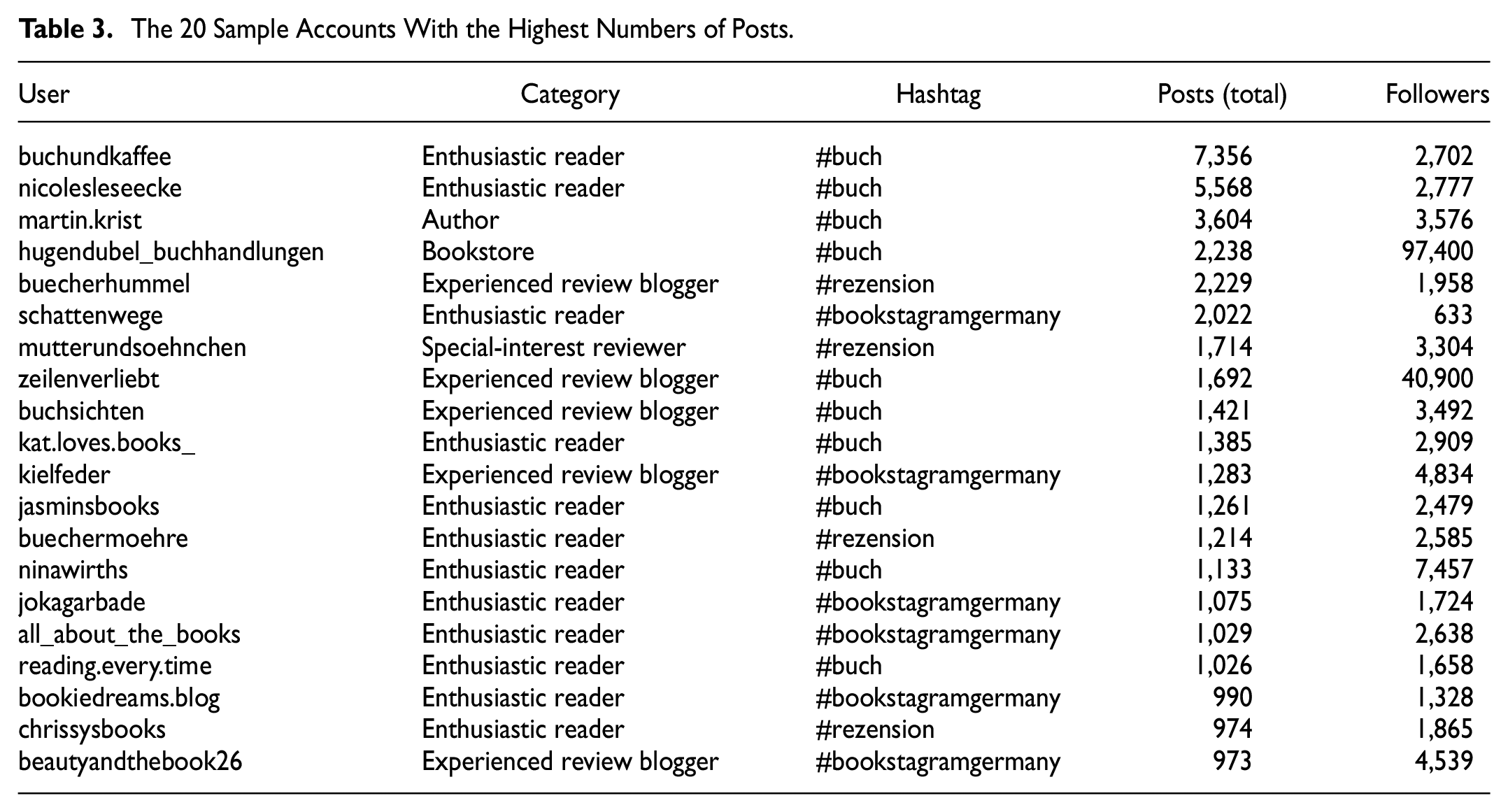
The 20 Sample Accounts With the Highest Numbers of Posts.
The 20 Accounts With the Highest Number of Likes of Sample Posts.

The 20 Accounts With the Highest Number of Comments on Sample Posts.

Main Categories and Characteristics for Coding.

Contextual Analysis
On the level of the contextual analysis, the category of users was discussed to define the types of ascribed “ordinary users.” This seems relevant as it distinguishes “user-generated reviewing” from “professionally produced institutionalised forms” of reviewing (Jaakkola, 2018, pp. 12–13). Information in the users’ Instagram accounts was analyzed to define the particular categories of users in terms of a taxonomy (Table 1). This taxonomy is comparable to the analysis of Bookstagram reviews by Jaakkola (2019, p. 98, 2022, p. 162); however, the terminology varies slightly in definition and meaning. The study did not collect any secondary data; therefore, the analysis executed a robustly anonymized procedure of not containing any personal data of the users’ followers who commented on the posts. The study uses only primary user data to define and discuss the following types and structure of users (Table 1–5).
The majority of users can be categorized as bloggers (92.61%), who are basically active readers that publicly discuss their reading habits on the Instagram platform and share their reviews with followers (see also Jaakkola, 2019, p. 98). Typically, these accounts are self-described as personal blogs or as being written by bloggers. However, posts in the sample material were also written by users who can be described as authors (5.64%). Users of these accounts describe themselves as authors, while their content mainly relates to aspects of the purported daily life of an author (or promotes new books, chapters, and ideas). Furthermore, the official accounts of bookstores or booksellers (1.17%) and others (book journals or journalists; 0.58%) were identified. Posts from these types were coded only if those particular accounts also frequently publish reviews. Within the category of bloggers, three different types of user profiles could be identified: experienced review bloggers (16.15%), special-interest reviewers (1.36%), and enthusiastic readers (75.1%). Experienced review bloggers use Instagram as part of their elaborate reviewing practices. They maintain different platforms (e.g., specific websites, YouTube channels) to not only address readers, but also to explicitly address publishers or other partners for cooperation. These accounts can be defined as “wide-reaching” due to a higher number of followers, from thousands to tens of thousands. Special-interest reviewers publish posts that are tied to certain areas of interest (such as guidebooks, children’s literature, or books on pets). Enthusiastic readers represent the majority of Instagram reviewers. They use Instagram to document the number of books they have read in a year and to demonstrate their enthusiasm and love of books. Usually these accounts have a lower number of only hundreds or a few thousand followers. A few mixed accounts (with a major focus on a topic other than books) are also part of the reviewer sphere on Instagram. To provide an overview of the structure of users, their number of posts, and their community-oriented engagement, the sample material was listed by the most followers (Table 2), the number of posts (Table 3), the number of likes of the sample posts (Table 4), and the number of comments on the sample posts (Table 5). The tables select 20 positions and contextualize the taxonomy of user categories. They show the difference between the accounts in their number of followers. They also show the disparities between the number of posts in relation to the number of followers, the number of likes to a post in relation to the number of followers, and the number of comments to a post in relation to the number of followers. These represent basic heuristic tools for the discussion.
The German-language reviewer sphere appears to be somewhat of a niche community. The wide-reaching accounts within the sample material are connected to a follower community with thousands or sometimes even tens of thousands of followers (Table 2). However, their number of followers does not necessary mean that these accounts are the most active users. The sample accounts with the highest number of posts differ in terms of their number of followers. Some of the wide-reaching accounts occur in the list of top 20 content-rate users; the majority of users fit the category of enthusiastic readers, with only a few followers (Table 3). On the other hand, the highest number of likes of sample posts can be attributed to a majority of wide-reaching accounts, from bookstores to experienced review bloggers; some are also listed multiple times due to their “like score” on different posts in the sample material (Table 4). A slightly different situation can be described for the list of accounts with the highest number of comments on the sample posts. Only a little more than half of the posts are linked to wide-reaching accounts, while the other half are linked to reader accounts with even fewer than a few thousand followers (Table 5). Therefore, community-related engagement based on the number of likes or comments in the sample material is not necessarily associated with the more professional accounts. Within the niche-structured community of German-language book reviewers, the “like rate” and comment-based communication vary equally between experienced review bloggers and enthusiastic readers. From this perspective, the distinction between influential and non-influential reviewers is considerably more difficult to determine. Even wide-reaching reviewer accounts attract a community on social media that cannot contend with popular German influencer accounts, which attract millions of followers. Moreover, reviewer accounts with fewer followers also have a high level of interaction with the community. Thus, if anything, German-language reviewer accounts on Instagram can be described as “micro influencers” since they accumulate a community of between 1,000 and 100,000 followers (Lammers, 2018, p. 111). This also means that, within such a niche-structured community on social media, certain content-related dimensions of platformized communication seem more likely to be of interest (Valsesia et al., 2020).
Applied Category Analysis
On the level of the applied category analysis, four main categories were characterized by thematic structuring in line with the literature review (Mayring, 2015, p. 103). They direct the coding to identify the main characteristics of the review content (Table 6). (1) Platform affordance: General platform-bound affordances will be discussed with a view to platformized communication practices. As an entire post is evaluated as a unit of analysis, the basic features of image-centered, text-related, and networked communication functions on Instagram will be discussed. This leads to the second and third main categories, to show their differences in the context of book reviews on the platform. (2) Imagery: Because Instagram is a visual medium and image-sharing platform that supports certain communicative forms, reviewers’ visual communication patterns will be identified. Images of the collected posts will be analyzed by means of visual information. (3) Textual forms: Characteristics of textual communication by German-language non-professional or amateur reviewers will be described. Here, the posts will be analyzed in terms of textual elements used to signify the users’ reviewing characteristics. (4) Review approach: Based on the community-driven notion of vernacular reviewing, the posts will be analyzed to describe the users’ strategies and intentions as well as their attempts to address the community on the platform.
Platform Affordance
Instagram favors the image as the key element of the platform’s logic of visual communication. Due to Instagram’s visual paradigm, corresponding communicative features are also implemented and enhanced. These include slideshows, video clips, the Instagram Story function (including the highlights section that can be placed at the top of the user account), live videos, Instagram TV (IGTV), and a filter selection that can be used to edit images and videos. On the other hand, textual forms are secondary. Especially since mobile media like the smartphone are the primary interface for communication practices on digital and social media platforms (e.g., Frees & Koch, 2018, p. 401), textual forms are less prominent than visual elements. A post’s text box allows for a description of up to 2,200 characters. However, a post in a user’s feed only shows the first two lines. To read the whole text, a user has to click “more” for the rest of the description. Links to external sources are not supported in the text box (but only in the account’s main description); thus users are urged to use links mainly within the Instagram platform (e.g., via hashtags or tags to others’ accounts). In that sense, textual elements must be arranged in a way that takes into account “the two-line preview,” which, if anything, must interest users so they click for “more.” Other textual elements (such as hashtags or tags) formally limit the communicative actions in a post based on the platform-aligned practices of communication. Options for communicative openings are promoted through the items used, though only within the networked structure of Instagram itself.
Imagery
Although Instagram is an image-centered social media platform, the visual dimensions of communication in the sample material from the German-language reviewer sphere appear rather limited. All sample posts contain only one image. No slideshows or videos were included in the sample material. Since the manual coding aimed to analyze material from the “top ranked” posts with the hashtags #rezension, #buch, and #bookstagramgermany additional material from the individual accounts (e.g., stories, story highlights, live videos, IGTV content) was not collected. The great majority of posts in the sample material represent the book’s cover (as a printed book or on a smartphone or tablet screen), a selection of books, or book spines, if the author is describing a series (82.1%). Posts also feature images of the user (holding the book beside their face and sitting in front of a bookshelf while holding a book) or arrange books along with other elements (a cup of coffee, a candle, or items associated with the book’s title). These posts demonstrate that users are trying to create a certain “reading ambiance” (sitting in an inspiring environment surrounded by books, drinking tea, or coffee while reading “a good book,” reading a book at the beach on vacation, and so forth). One user also tries to visually mediate emotions that are associated with the reviewer’s text (e.g., holding a tissue and pretending to cry because the book is so touching). One male user frequently poses in a rather eroticized way (e.g., by showing naked body parts such as legs or his upper body). The reviewer community on Instagram also uses image editing techniques to add filters and effects (e.g., magical lighting effects) or a certain coloring to establish a recognizable visual style for an account. However, the vast majority (82.1%) of German reviewers use a strong patterned form of visual communication, highlighting the book’s cover as their main post theme. In this respect, they are taking up and perpetuating a form of visual communication as it is related to the global reviewer community on Instagram (Jaakkola, 2019, p. 101–103).
Textual Forms
The reviewing practices on Instagram within the sample material seem to reframe the logic of communication on the platform as reviewers favor textual elements over visual communication. Reviewers express their evaluation by using the short form of textual communication. They provide a summary, use a scoring system such as a 5-star system or templates with ratings such as “highlight,”“I enjoyed it,”“book for in-between,”“it was not appealing.” Some reviewers describe their emotional situation as it relates to the book’s story and support it with emojis and hashtags. Others tag publishers or authors to thank them for providing them with a review copy. Textual posts may contain a synopsis of the story (e.g., basic storylines, struggles of the main character) as well as personal information (what someone did during the day or on the weekend and how books can help uplift feelings). They also constantly address the community (e.g., ask questions about their preferred endings or favorite character, or simply write “have a good day”). They also declare their interest in reading a book or series (e.g., by describing why they’re looking forward to reading a certain book). The community address in particular is a pattern of textual communication that aims to create a connection between reviewer and followers. Reviewers participate in “buddy reads” which emphasize the collaborative practice of reading. Moreover, the community address creates an atmosphere of belonging by posing recurring “do you also like” questions regarding genres or authors. While reviewers’ use of images adheres to a standard format, their use of textual elements represents a more diverse communicative environment than that of Instagram. Hence, the German reviewer sphere on Instagram can be characterized as a text-based community that uses the mode of visual communication on the social media platform but mainly by imitating global community patterns of representation. The written word, however, appears to be the main mode of communication (see also Jaakkola, 2019, p. 101).
Review Approach
Based on the mode of communication, the review policy of the German Instagram reviewer sphere must be discussed relative to the textual form. The basic approach is the community-driven notion of communication about book reading and reader-centered reflection on individual preferences. Assertions about books and authors are frequently connected to statements about the “reader self” (see also Jaakkola, 2019, p. 105). The practice of reviewing is thereby related to several aspects that can be categorized under the following modes of expression: First, book reviews are firmly rooted in taste. Most reviews express their liking of a book (and to a lesser extent, their disliking). Phrases such as “I love this book” or “this is magnificent” are frequently used (these usually tag the publisher or author). Second, reviews are linked to the individual reading experience (e.g., with phrases like “I couldn’t stop reading this”). Third, reviewing generally occurs as a recommendation based on the reviewer’s taste. In a sense, reviews by Instagram bloggers and bookstores, for example, are less distinctive since they both typically recommend that the user read a book (although bookstores also encourage users to buy it). Fourth, reviewing on Instagram appears to be rather superficial since it frequently seems to serve to boost the reviewer’s status rather than providing a contextualized critique. This stance is also linked to images of bookshelves (“look at how many books I have”), current reads, and the number of books the reviewer has read (“look at how much I can read in a week, a month or a year”). Thus the approach to social media reviewing is to engage in self-centered discussions on the practice of reading rather than reviewing in practice. Fifth, this self-centeredness is constantly taken up and molded within the niche-structured community on the platform. Reviewers consider themselves to be part of a reading community that circulates evaluations, judgments, and recommendations only within the community. Social media book reviewers mostly do not adopt a critical perspective outside their reader base to contextualize a book’s genre or storytelling techniques. Instead, they assume a common tone, sharing the experience of reading in an atmosphere of social connectedness between the “reader-reviewer” and the “reader-follower.” This promotes a way of media-cultural belonging to an Instagram community that offers a public platform for the assembly of reviewers as book-consuming community participants. This kind of approach to reviewing creates reviewers whom Jaakkola (2019, p. 105) calls “me-viewers” since they are “individualized experts of their own reading experience, mediating their intellectual, emotional, and esthetic ephemeral experience regarding the book product they happen to have received or stumbled upon.”
Discussion
Amateur book reviewing on digital media has been discussed in terms of an overlap between amateurs and professionals due to “their passion and capability to structure an argument targeted at a specific audience. […] They do so primarily by means of a layman’s authority, authenticity, and credibility, and by facilitating playful identification among peers” (Kristensen & From, 2017, p. 106). On platforms like blogs or online forums, reviewers have also been studied as semi-professionals due to their elaborate reviewing approaches which come in part from a “background or job relat[ion] to literature” and which become apparent in their use of “professional strategies, values, and language to reach their readership” (Steiner, 2010, p. 486). With the expansion of social media and its personalized form of communication, reviewer accounts may appear in a “self-preserving, documenting form;” however, many social media reviewers have a “strong desire […] to display themselves. Sharing yourself with others is an important part of being someone in today’s society,” as Steiner (2010, pp. 488–489) writes. Book reviewing on Instagram appears to be as much about the reader as a reviewer as about the book to be reviewed. In that sense, this form of engagement with a cultural text constitutes a difference to what Jenkins (2012, p. 86) calls “a semistructured space [of] competing interpretations and evaluations,” as users mostly share information about their relationship to the act of reading and write an evaluation for the community. Yet gaining recognition is considerably difficult, especially in a niche-structured community, which is why participation and the “relation between a blogger and the potential readers [are] very important, and many postings express a desire for a link to other people” (Steiner, 2010, p. 489). This community approach may still lead to an accumulation of “shared knowledges about books and their authors” (Moody, 2019, p. 1074). But even more, it leads to the evolution and transformation of reviewing within the community platform. This has intensified in view of the growing popularity of the Instagram environment, particularly among younger users.
The German-language reviewer sphere on Instagram can be described as a niche-structured community with a small number of experienced review bloggers (16.15%) whose accounts may be defined as “wide-reaching” in terms of their number of followers and a great majority of enthusiastic readers (75.1%). Their review practice is more concerned with reading and recommending books to read, which leads directly to research question Q1 (What aspects of reviewing are pursued by German-language social media book reviewers on Instagram?). Social media reviewers are deeply anchored in the consumer culture. They represent and perform as consumers of a large number of books and primarily read and evaluate books for the community. Rather than maintaining a detailed and contextualizing critical view, these Instagram reviewers primarily share their enthusiasm for books within the community, allowing for mutual opinions with others on the platform. These opinions express reviewer-related information rather than in-depth discussions of books. Book reviewing on Instagram represents a popular cultural expression of participatory book reading and discussion based on individual taste, emotional expression, and users’ representation of themselves as enthusiastic readers sharing their recommendations. The community-oriented communication on social media consolidates the meaning and value of the subjective opinion-based form of review as recommendation to read based on consumer-related judgment. Moreover, that judgment is driven by fascination, personal preferences, and an investment of time and resources to read in order to be part of and support the community environment on social media (Jaakkola, 2020; Kammer, 2015; Kristensen & From, 2017; McWhirter, 2017). In that sense, the user as everyday amateur reviewer on social media does not only circumvents the logic of an impersonal evaluation led by professional judgment (Kammer, 2015, p. 874). They rather gain meaning and value through the community’s bottom-up approach. That participatory bottom-up approach (Moody, 2019) also leads to a negotiation of cultural significance as gatekeepers that is ascribed to the community and its communicative practices. Therefore, the “semistructured space” (Jenkins, 2012, p. 86) of everyday amateur engagement with a cultural text on social media facilitates a communicative ambiance of discussion and exchange that amplifies a form of shared knowledge that does not only rely on the users’ experience with and relationship to the cultural text. It also relies on the users’ affiliation to the community. As social media book reviewers define their standards of evaluation and recommendation within the community (Jaakkola, 2018, p. 13) they also constantly add value to the function of the community as cultural gatekeeper. These findings are similar to that of other studies in the field (Jaakkola, 2019, 2022, pp. 152–170; Steiner, 2010, p. 489), and demonstrate the strong tendency of the transformational communication patterns that social media imprint on the review genre. As online communication supports the transformation of reviewing into an open process of “iterative re-dialogization” (Domsch, 2009, p. 230), social media book reviewing re-addresses this process, not only in the form of re-dialogization on a digital platform. I would argue that it also shifts the focus of the cultural phenomenon of social media reviewing toward an iterative re-dialogization, as a community negotiation and a central purpose for engaging with reviews.
To return to research question Q2: How do German-language social media book reviewers use communicative forms on the Instagram platform? While Instagram encourages and expedites visual communication, the German-language reviewing community favors the textual form over a plethora of image-based means of communication. While the platform logic of communication still forces users to communicate visually, the book reviewing community puts effort into the presentation of the book’s cover as the main theme of their posts (82.1%). In that sense, the cozy representation of the book cover in the private space (e.g., the bedroom or living room) or in connection with holidays (at the beach or in the country) aims to create a comfortable atmosphere that highlights both the practice of reading and the social and cultural environment of the reader. Certainly this demonstrates a certain obeisance “not only [to] literature, but [to] the book itself” (Steiner, 2010, p. 473) as well as to the act of reading a printed book. However, it also mainly follows the need for visual representation on the Instagram platform while saying nothing about the form of reviewing. As it does, the act of reading itself is portrayed as a popular or stylized practice of “casual coziness” (Grenier, 2019) that contributes to the bottom-up and community-based identity of the reviewer sphere and fits the everyday cultural and lifestyle approach of reviewing within the Instagram community (see also Jaakkola, 2018, p. 15).
The German-language community’s use of visual communication is also aligned with a global paradigm of book cover presentations as its primary theme. While Instagram drives the use of images, the reviewer community seems to prefer recognizable patterns of visual communication that serve to bond the community character through egalitarian representation rather than adopting a plurality of individual styles. Within the community reviewers choose the written word as their key mode of communication. Nevertheless, their textual forms are restricted due to the platform-driven processes of communication. Instagram’s platformized logic of arranging content, using or listing hashtags, tagging other accounts, and so forth (Andersen, 2018; Schmidt & Taddicken, 2017) supports linkage with review-related platform-bound communication practices such as using book scoring systems or templates for publishing reading recommendations. The platform-bound communication on Instagram drives the provision of content. This affects usage since communication is only permitted within the platform-bound infrastructure of the application. In this sense, it is only possible for the user to conform to the platform or to expand communicative actions in specific communities. Within the textual form, however, reviewers don’t only adopt schematic methods of evaluation such as scoring systems. They also use textual forms including hashtags and account tags to negotiate with others in the community about reading experiences and preferences (communications include recurring questions, greetings, and attendance of buddy reads). Thus, even though they’re using a visual platform, reviewers’ main mode of communication is text-based (see also Jaakkola, 2019, p. 101).
Conclusion
Everyday amateur experts, as Kristensen and Unni (2017, p. 105) have put it, have developed within an expanding realm of “non-institutionalized media platforms as forums for cultural debate” that constantly contest “the hierarchical and elitist logic of especially the printed cultural pages.” Social media platforms accelerate this process due to their increasing popularity among younger users in particular. Reviewing on Instagram is certainly not isolated from other platforms such as websites, blogs, YouTube, and Goodreads and their reviewing practices (Jaakkola, 2018; Kammer, 2015; Moody, 2019; Steiner, 2010). However, as Jaakkola (2018, p. 12) has put it, “user-generated reviewing” is changing due to its different media appearances and the media’s influence on specific reviewing activities. Reviewing on Instagram also promotes the layman instead of the institutionalized reviewer since an amateur (Kammer, 2015; Kristensen & From, 2017; Steiner, 2008, 2010) or “ordinary reader” (Jaakkola, 2019, p. 98) represents the majority. Enthusiastic readers (75.1%) form the majority of German-language reviewers on Instagram as well. However, the functions of reviewing are also changing. Instead of providing a contextualized analysis of the object or a perspective for interpretation and understanding (Orlik, 2016, pp. 27–34), reviewing on Instagram supports a form of engagement that operates as “iterative re-dialogization” (Domsch, 2009) in terms of community negotiation, which seems to be the main purpose for engaging in reviewing. Reviewing on Instagram is connected to the everyday cultural practices and lifestyles of the users within a community on the platform, which constitutes the forum for a particular community approach to reading and sharing recommendations (see also Jaakkola, 2018; Jaakkola, 2019).
The communicative forms reinforce this approach on Instagram with images that solidify a pattern of cozy book cover representations (82.1%) which also highlight the act of reading and the reader’s formalized atmospheric environment (Grenier, 2019). The textual form, in turn, represents the main mode of communication for the negotiation of reading experiences, preferences, emotional relations to the act of reading, etc. within the community (see also Jaakkola, 2019, p. 101).
Like all studies, this analysis needs to be interpreted in the context of its limitations. First, the sample material consists of 514 Instagram posts taken at a particular time from posts with the hashtags #bookstagramgermany, #rezension, and #buch. Further research might usefully analyze other hashtags that are related to book reviews as well. Second, content analysis is always limited by the researcher’s decisions regarding the particular characteristics to code and investigate. A number of other dimensions could have been subjected to coding for different findings (e.g., the literary genre, the intra-community structure of buddy reads, and the marketing orientation). Third, further methodological research might also apply structured interviews for data collection to investigate the community approach and its influence on the form of review on the platform. Finally, content analysis was applied only to Instagram. Additional user accounts within the sample material could have been analyzed to compare review approaches on different platforms. However, the guiding principle was to discuss user-generated reviewing on one particular platform in consideration of its specific media appearance (Jaakkola, 2018, p. 12).
Despite these limitations, this study has demonstrated how the German-language reviewer sphere operates on Instagram, in line with similar studies in the field. The explorative analysis also provides potential for further studies. Due to the effects that Instagram has on the review genre—the platform provides and supports transformational communication patterns that influence different local formations within a global community (Jaakkola, 2019, 2022; Thomas, 2021)—further research is needed to analyze additional local reviewer or Bookstagram communities for supplementary evaluation and comparison. Moreover, further work needs to be done on the everyday and consumer cultural logic (Jaakkola, 2018, p. 15; Kammer, 2015, p. 874; Kristensen & From, 2017, p. 102; McWhirter, 2017, p. 138; Steiner, 2010, p. 475) of reviewing on social media, and Instagram in particular. “The blogging culture has become an important and integrated part of the book trade,” as Steiner (2010, p. 472) writes, “and has influenced the publishing, marketing, and distribution of literature.” The lifestyle-embedded approach in the Bookstagram community seems to accelerate the cultural market relevance of book reviewing on Instagram. However, it makes review content increasingly difficult to distinguish from other user-generated content; this is especially true in the context of similar book-related content such as stylized photos of books used as home decor or the emphasis on consumer choice via book cover visualizations. Furthermore, the niche-structured community, with its few wide-reaching accounts but a majority of enthusiastic readers who engage in intense community negotiations (cf. Table 2–5), seems to be more susceptible to marketing (Steiner, 2010) and especially micro-influencer marketing (Lammers, 2018). The meaning and value of the community as gatekeeper is gaining in importance. Thus, analyses of niche-structured communities imply deeper approaches of community-oriented strategies that address micro-influencers and their community affiliation (Lammers, 2018). Further research should be expected to address these issues in more detail.
Footnotes
Declaration of Conflicting Interests
The author declared no potential conflicts of interest with respect to the research, authorship, and/or publication of this article.
Funding
The author disclosed receipt of the following financial support for the research, authorship, and/or publication of this article: Funded by the Open Access Publishing Fund of Leipzig University supported by the German Research Foundation within the program Open Access Publication Funding.
