




Abstract
Serious emergencies exacerbate the uncertainty, complexity, and ambiguity of the external environment, creating survival challenges for organizations and employees. During emergencies, it becomes more difficult for organizations to leverage organizational citizenship behaviors (OCBs) from their employees to survive existential crises. From the perspective of resource exchange and investment, we explore the ways that organizations can collaboratively overcome difficulties by motivating their employees to engage in OCBs. Our findings show that (1) a psychosocial safety climate (PSC) that is adopted by an organization can effectively stimulate employee OCBs, which are of greater help to organizations than to coworkers, (2) resilience may be a psychological resource that explains the stimulating effect of a PSC on OCBs, and (3) employee trait gratitude enhances the role of resilience in mediating the relationship between a PSC and helping behaviors (but not civic virtue behaviors). Our findings not only reveal the mechanisms by which organizations can stimulate employee OCBs when the two face survival challenges during serious emergencies but also provide a recommendation for managers to focus on employee mental health and resilience during crises.
Serious emergencies (e.g., COVID-19) exacerbate the uncertainty, complexity, and ambiguity of the external environment, which results in the need for organizations to simultaneously deal with competitive pressures from the marketplace and maintain operations in an uncertain environment (Wang et al., 2020). As an important endogenous source of power, employees are a magic weapon that enterprises can use to cope with external challenges (Carnevale & Hatak, 2020). Numerous studies have shown that the organizational citizenship behaviors (OCBs) of employees can help enterprises to overcome difficulties and challenges (Carnevale & Hatak, 2020; X. Li, 2020; Ocampo et al., 2018). However, a study of hiring relationships by a Chinese recruitment website (zhaopin.com) found that fewer than 20% of respondents were willing to cooperate with their organization when the organization and its employees faced challenges. 1 This drove us to focus on ways to avoid this phenomenon because stimulating employee OCBs and other pro-organizational behaviors is critical for organizations and employees to overcome external challenges together when they simultaneously face survival challenges.
Previous studies have shown that a key to maintaining OCBs is the material and emotional support for employees that is provided by organizations that can compensate for the energy that is lost by engaging in OCBs (Lemoine et al., 2015; N. P. Podsakoff et al., 2009), such as a comfortable workplace, supervisor support, and organizational climate (Eisenberger et al., 2022). However, these studies have ignored the impact of the COVID-19 pandemic on organizational support and employee OCBs. The COVID-19 pandemic has not only caused psychological distress to employees by threatening their health and safety but also created survival challenges for enterprises, making it difficult for enterprises to care about and to address the potential psychological issues of employees (Stankevičiūtė et al., 2021; Testa et al., 2020). When employees face psychological distress, they devote limited self-resources to relieving their own psychological stress, which reduces the ability and the willingness of employees to engage in OCBs and to remain with the organization through difficult times (Lin et al., 2021). Moreover, this often causes employees to act against the organization and exacerbates the challenge for employees and organizations to save themselves. Resilience is the psychological ability of employees to recover from difficulties, which can reduce employees’ psychological distress and depletion of psychological resources when facing challenges (Avey et al., 2010; Luthans et al., 2015). Therefore, paying attention to the psychological resilience of employees is the key to encouraging them to overcome difficulties together with the organization.
Using the perspectives of resource exchange and investment, this study explores the ways that a psychosocial safety climate (PSC) can stimulate employee OCBs by enhancing employees’ psychological abilities (resilience). During serious emergencies, 2 the PSC that is provided by an organization can support the physical and mental health of its employees (Dollard & Bailey, 2021; Siami et al., 2022), which not only alleviates their psychological distress but also enhances their psychological resilience to engaging in OCBs. Meanwhile, a PSC helps to create a positive organizational image, increase employees’ perceived job security and organizational trust, and stimulate employees’ resource-investment motivations for OCBs (Derbis & Jasinski, 2018; Mansour & Tremblay, 2018). In addition, the effectiveness of a PSC depends on the subjective perceptions of individuals, which affects its stimulating effect on employee OCBs (Wu et al., 2018). Previous studies have shown that employees that have positive traits are more likely to exhibit positive behavior in adversity (Fredrickson, 2012) so we also explore the bounding role of personal gratitude traits on PSC. Therefore, we developed a theoretical model that proposes that a PSC stimulates employee OCBs through enhancing resilience during serious emergencies and this effect is moderated by the trait gratitude of employees.
The aim of this study was to show the ways that organizations encourage employees to behave in a way with the organizations to overcome difficulties during serious emergencies. Our study has several potential contributions. First, using the conservation of resource (COR) theory, we constructed a mechanism for PSC to stimulate OCBs through resilience, which enriches the application scenarios of COR theory and the mechanism of PSC to stimulate employees’ positive behavior. Second, we found that a PSC is the key reason for motivating employee OCBs in serious emergencies, which not only enriches the factors that stimulate employee OCBs in serious emergencies but also reveals the importance of employees’ mental health in the stimulation of their positive work behavior in serious emergencies. Finally, we revealed the role of employee traits in resilience and OCBs, which helps to explain who is more likely to engage in OCBs during serious emergencies.
Theoretical Background and Hypothesis
Conservation of Resource Theory
COR theory holds that individuals have a tendency to preserve, protect, and access resources, which are defined as things that are valuable or helpful to the individual, including object resources, condition resources, personal characteristic resources, and energy resources (Hobfoll et al., 2018). The value of the resources depends on the subjective perception of individuals and not on whether it actually helps to achieve goals (J. R. B. Halbesleben et al., 2014). Therefore, the value of resources is affected by the situation and only when the resources match the needs of the individual in a special situation will it drive the individual to exchange and invest resources, protect existing resources from loss, and acquire new resources (J. R. Halbesleben & Bowler, 2007).
Previous studies have shown that COR theory is an important perspective to explain employee OCBs. Employees who engage in OCBs suffer resource depletion (Potipiroon & Faerman, 2020). Therefore, meeting the mutually beneficial needs of resource exchange among employees is the key to maintaining OCBs (Lemoine et al., 2015). During serious emergencies, the psychological distress that is caused by external threats and organizational pressures may prompt employees to avoid extra-role behaviors such as OCBs and focus their limited resources on alleviating psychological pressures (Lin et al., 2021). In such a scenario, organizations can support the physical and mental health of their employees through PSC, which can effectively compensate for the loss of energy resources that is caused by psychological distress and enhance the psychological resilience of employees (Dollard & Bailey, 2021). Meanwhile, to obtain more resources from the PSC, employees engage in more extra-role behaviors, such as OCBs, to exchange resources.
Although a PSC can provide employees with a safe and stable work environment, alleviate their fears, and enhance their resilience to crises (Bronkhorst, 2015), COR theory holds that the value of resources depends on the subjective perceptions of individuals (J. R. B. Halbesleben et al., 2014). Therefore, individuals’ different perceptions of a PSC affect the stimulating effect of the PSC on the OCBs. Employee traits are relatively stable and therefore are not easily affected by emergencies (McCullough et al., 2002), which is better for understanding the boundaries of PSC in the context of COVID-19. As a stable tendency, trait gratitude helps to alleviate the negative impact of serious emergencies on employees and pro-organizational behaviors, such as OCBs (H. W. Lee et al., 2019). Employees who exhibit high levels of trait gratitude tend to attribute an organization’s security policies and procedures to organizational support and help and they translate this support into working resources to invest in OCBs to give back to the organization (Fredrickson & Branigan, 2005). Therefore, exploring the boundary role of employees’ trait gratitude in serious emergencies is critical to understanding the role of PSC in employee resilience and OCBs.
Therefore, we constructed a theoretical model that used resource exchange and investment to reveal the ways that a PSC can stimulate employee OCBs during a serious emergency by mitigating psychological resource depletion and to discuss the boundary of this transformation from the perspective of trait gratitude (see Figure 1).

Theoretical model.
Psychosocial Safety Climate and Organizational Citizenship Behaviors
A PSC is considered a policy, practice, and procedure that is adopted by organizations to protect employees’ mental health and safety (Law et al., 2011). As an organizational policy and institution, a PSC can compensate for a lack of emotional support (Dollard & Bakker, 2010). A physical safety climate alone cannot protect employees’ mental health (Zadow et al., 2017) or reduce the negative impact of the external environment (Dollard & Bailey, 2014). In serious emergencies in particular, a PSC can become a special type of work resource, relieving employees’ psychological pressures and perceptions of external threats, guaranteeing job security, and providing a psychological resource to stimulate employees’ pro-organizational behaviors (Dollard & Bailey, 2021; Mirza et al., 2022).
OCBs are pro-organizational behaviors that are voluntarily performed by employees to promote the effective operation of the organization (Organ, 1988), potentially improving the resilience and the flexibility of the organization in emergencies (Testa et al., 2020) and creating favorable work conditions for the organization and one’s coworkers (Conchie, 2013). Previous studies have shown that employee OCBs can be categorized into those that benefit the organization and those that benefit one’s coworkers (Tan et al., 2019). OCBs that benefit the organization manifest mainly as civic virtue or responsible participation in organizational life (P. M. Podsakoff & MacKenzie, 1997). Those that benefit one’s colleagues manifest mainly as helping behaviors (Van Dyne & LePine, 1998). However, regardless of whether OCBs manifest as civic virtue or helping behaviors, they consume employees’ resources and energy (Bolino et al., 2015). Meanwhile, the additional work and the psychological pressure that is created by serious emergencies also deplete employees’ energy, which results in resource scarcity and citizen fatigue (Stankevičiūtė et al., 2021). This, in turn, leads to employees increasing the defensive expectations of resource retention, which reduces the amount of resources that is available to help the organization.
Organizational support and family-supportive supervisor behavior have been shown to alleviate resource constraints and to promote OCBs (N. P. Podsakoff et al., 2009). By providing psychological care and a safe work environment, a PSC may prevent the depletion of employees’ psychological resources that is caused by external threats and provide a stable environment for employees to build their psychological resources (Dollard et al., 2012; Mirza et al., 2022). In emergencies, this may alleviate the psychological pressures and the health threats that employees face, compensate for the loss of psychological resources, and create an environment in which employees can engage in pro-organizational behaviors (Nguyen et al., 2022). Given the interdependence between employees and organizations in emergencies, to maintain a stable work state and to obtain support from the organization, employees take the initiative to engage in pro-organizational behaviors for the purposes of resource exchange and investment. This reduces the impact of the emergency on the organization and their coworkers and helps the organization to return to normal operations as soon as possible (Potter et al., 2017). Thus, we propose the following hypotheses:
H1a: A PSC significantly and positively affects employees’ civic virtue behaviors.
H1b: A PSC significantly and positively affects employees’ helping behaviors.
Mediating Role of Resilience
Resilience as a core component of psychological capital (PsyCap) is employees’ psychological ability to recover from difficulties and to achieve self-growth (Avey et al., 2010; Luthans et al., 2015). Unlike the other three components of PsyCap, resilience focuses on the ways that employees respond to risk and recover from adversity or difficulty (Luthans, 2002) whereas efficacy, hope, and optimism are individuals’ proactive behaviors to focus more on confidence, positive attribution, and expectations for the future (Luthans et al., 2007). Obviously, when employees are troubled by serious emergencies, resilience is more important to recover from adversity and even beyond (resilience) to attain success. As a psychological resource to cope with adversity, resilience can reduce employees’ perceptions of external threats and work pressures (Sonnentag & Fritz, 2007) and decrease the negative emotions and the psychological distress that are caused by emergencies (Egozi Farkash et al., 2022; Mak et al., 2011). However, it can improve their ability and confidence to face adversity (H. H. Lee & Cranford, 2008), help them to actively adapt to changes in the external environment, and enhance their intrinsic motivation to actively respond to challenges (Rabenu & Tziner, 2016).
Although resilience is an important psychological resource to help employees to cope with external threats, it is not inexhaustible (Deng et al., 2018). The depletion of psychological resources by external threats reduces the resilience of employees and the resources that are invested by employees in OCBs (Bhatnagar & Aggarwal, 2020). Therefore, when continuously responding to external threats, employees require sufficient resources to compensate for the loss from having to show resilience (Dean et al., 2020). COR theory suggests that only resources that match employees’ needs can effectively compensate for the resource loss of employees (J. R. B. Halbesleben et al., 2014). During serious emergencies, employees’ concerns about physical and psychological health are the primary cause of loss of psychological resources (Egozi Farkash et al., 2022). This drove our focus on critical resources that can provide physical and psychological health to employees in serious emergencies. We believe that a PSC can help to maintain employee resilience by increasing revenue and reducing expenditure. First, by offering psychological care and job security and improving working conditions, it reduces the negative impact of external threats on employees’ work (Messmann, 2023). In addition, by providing a climate of safety and emotional support, it compensates for employees’ loss of resources, helping them to maintain resilience (Dollard & Bailey, 2014). Second, by alleviating employees’ perceptions of external threats, it can block negative emotions, such as anxiety and fear, and reduce the consumption of resources, which enables employees to remain resilient (Mirza et al., 2022).
Employee resilience is a key internal driver of positive behaviors to cope with adversity and crises (Sonnentag & Fritz, 2007) and can help employees to use their limited psychological resources to adapt to the changes and the challenges that are presented by the external environment and to create positive coping emotions and work behaviors ((Derbis and Jasinski, 2018); Salmela-Aro & Upadyaya, 2014). COR theory states that employees can acquire new resources through resource exchange and investment (Hobfoll et al., 2018). During emergencies, the increase in a PSC to employees’ resilience resources can motivate employees to obtain more resources through the implementation of pro-organizational behavior (Baker et al., 2021). Given the interdependence between employees and organizations, we believe that employees prioritize investing resources in OCBs to help organizations to recover. To return to their normal work and life as soon as possible, employees make suggestions about organizational recovery, accept additional work, and exhibit civic virtue behaviors to help the organization to overcome challenges. Moreover, to help the organization to overcome challenges and to construct stable social relationships, employees give their colleagues more support and strengthen the agglomeration effect of organizational internal resources (Southwick et al., 2016). Thus, a PSC can improve employee resilience and help employees to build their psychological resources, providing a space for employees to exhibit OCBs toward the organization and their coworkers. Thus, we posit the following hypotheses:
H2a: Resilience partially mediates the positive relationship between a PSC and employees’ civic virtue behaviors.
H2b: Resilience partially mediates the positive relationship between a PSC and employees’ helping behaviors.
Moderating Role of Trait Gratitude
Trait gratitude is a stable tendency that refers to a grateful cognitive and behavioral response of employees to favors from others that can make employees create positive psychology (McCullough et al., 2002). Some studies have shown that trait gratitude can stimulate prosocial behaviors, such as helping, cooperating, and donating to benefactors and other individuals (Bartlett & DeSteno, 2006; Fredrickson, 2012). However, individual differences in trait gratitude may lead to employees having different perceptions about help and support at work, leading to different effects on work behaviors (Wu et al., 2018). Employees that have high levels of trait gratitude are more sensitive to help in the workplace and more prone to pro-organizational behaviors (McCullough et al., 2002). In serious emergencies, employees that have high levels of trait gratitude tend to positively attribute perceived organizational support and psychological resources (Bernabe-Valero et al., 2021; Weiner, 1985). They believe that the organization’s attempt to improve their resilience is to help them to better cope with crises and challenges, thereby enhancing their emotional connection to the organization, and they are willing to return the psychological resources that are provided by the organization by engaging in pro-organizational behaviors, such as OCBs (Kumar, Liu, & Jin, 2022). Moreover, high levels of trait gratitude can offset the negative emotions that are caused by emergencies (Lambert et al., 2012) and increase employees’ willingness to help individuals other than benefactors, such as their coworkers (Bartlett & DeSteno, 2006). However, employees that have low levels of trait gratitude tend to self-attribute psychological resources, believing that enhancing employee resilience is an attempt by the organization to better cope with the threat, thereby reducing the willingness of employees to help the organization and their colleagues (Kumar, Liu, & Jin, 2022). Thus, we propose the following hypotheses:
H3a: Trait gratitude positively moderates the relationship between resilience and civic virtue behaviors. In other words, the higher the level of an employee’s trait gratitude, the stronger the effect of resilience on civic virtue, and vice versa.
H3b: Trait gratitude positively moderates the relationship between resilience and helping behaviors. In other words, the higher the level of an employee’s trait gratitude, the stronger the effect of resilience on helping behaviors, and vice versa.
Employees that have trait gratitude pay more attention to positive events in the workplace (Wu et al., 2018). In serious emergencies in particular, employees that have high levels of trait gratitude are more likely to perceive the satisfaction of a PSC meeting their psychological needs in the workplace (Bernabe-Valero et al., 2021). This helps to alleviate the resource conflict between maintaining resilience and implementing OCBs, accumulating sufficient psychological resources for employees’ civic virtue and helping behaviors, and further strengthening the effects of resilience (Kumar, Liu, Flinchbaugh, et al., 2022). In other words, high levels of trait gratitude enhance the indirect effect of resilience on the relationship between a PSC and civic virtue and helping behaviors. However, employees that have low levels of trait gratitude find it relatively challenging to have their psychological needs met. Thus, we propose the following hypotheses:
H4a: Trait gratitude moderates the mediating role of resilience on the relationship between a PSC and civic virtue behaviors. In other words, when employees exhibit high levels of trait gratitude, the mediating effect of resilience is enhanced.
H4b: Trait gratitude moderates the mediating effect of resilience on the relationship between a PSC and helping behaviors. In other words, when employees exhibit high levels of trait gratitude, the mediating effect of resilience is enhanced.
Research Design
Sample and Procedure
Participants were selected via Credamo, 3 an online research platform, in China. The survey was conducted in two stages to reduce common method bias. We matched the participants’ two responses through their IDs (unique), which were provided by Credamo. Eligible participants who completed the first and second stages of the survey were rewarded with three yuan (Gong et al., 2020). To improve the reliability of the survey, we created detection options in two stages to further test participants’ work experience and reverse questions were created to check participants’ answers. Answers to the detection options and the reverse questions that clearly differed were rejected. The reverse questions were coded using positive scoring.
Our study focuses on administration staff and office workers whose jobs have been affected by the COVID-19 pandemic but are still able to work from home or remotely, which helps us to study employee work behavior. We collected basic information from the participants from October 4 to 7, 2020, and measured our control variables, PSC, and resilience. A total of 376 samples was collected, 300 of which passed the quality test, giving us an effective recovery rate of 79.8%. Two weeks later, from October 24 to 28, 2020, 284 participants who had passed the first stage were surveyed to test their trait gratitude and OCBs. After excluding participants who failed the test questions, took too short a time to answer the questions (less than the time needed to read the questions), and did not answer carefully (answers to all the questions were the same), 257 valid samples were collected twice, giving us an effective rate of 68.4%. The basic sample characteristics are shown in Table 1.
Sample Composition.

Research Variables
To ensure the accurate and effective measurement of the sample, we selected a widely used scale that was relevant to the research question and the respondents. The scale was translated and back-translated by two doctoral and two master’s students who are majoring in business management. Business management scholars and employees were invited to review the survey to ensure its rationality and intelligibility. All the measures used a response scale of 1 (completely inconsistent) to 5 (completely consistent) unless otherwise noted.
PSC was measured using a 12-item scale that was developed by Hall et al. (2010). A sample item is, “In my work, managers will take action quickly to correct the problems/matters affecting the mental health of employees.” Cronbach’s alpha for this measure was .947.
Resilience (RE) was measured using a nine-item scale that was developed by Siu et al. (2009). A sample item is, “I have the confidence to overcome current or future difficulties and can solve difficulties or problems that may be faced.” Cronbach’s alpha for this measure was .891.
OCBs were measured using a 10-item scale that was developed by Bachrach et al. (2007). Helping behaviors (OCBh) included seven items, such as, “Help other employees out if someone falls behind in his/her work.” Cronbach’s alpha was .771. Civic virtue (OCBm) contained three items, including, “Provide constructive suggestions about how the unit can improve its effectiveness.” Cronbach’s alpha was .714.
Trait gratitude (GD) was measured using a six-item scale that was developed by McCullough et al. (2002). A sample item is, “I have so much in life to be thankful for.” Cronbach’s alpha for this measure was .721.
Control Variables
Prior studies have shown that individual cognitive differences lead to behavioral differences in employees in the same environment. Further, cognitive ability is affected by the work environment and the family status of employees (Gu & Wang, 2021). In addition, the number of people infected by COVID-19 influences an employee’s assessment of external threats. Therefore, to reduce the impact of these variables on the research results, factors such as gender, age, educational level (Edu), position, marital status, workplace, and the number of local people infected with COVID-19 (Infection) were controlled in this study. To measure the number of people infected with COVID-19, the daily COVID-19 information that was provided by the relevant provincial health commission was used and the cumulative number of people that had been diagnosed in each province as of October 28, 2020, was taken.
Moreover, family-supportive supervisor behavior has been shown to alleviate the psychological pressure and the support resource recovery of employees during serious emergencies (Sargent et al., 2022). Therefore, to test the effectiveness and the robustness of our framework, we also controlled family-supportive supervisor behavior, which was measured using a four-item scale that was developed by Hammer et al. (2013). A sample item is, “Your supervisor makes you feel comfortable talking to him/her about your conflicts between work and non-work.” Cronbach’s alpha for this measure was .858.
Data Analysis and Results
Confirmatory Factor Analysis, Common Method Bias, and Descriptive Statistics
To test the structural validity between the variables, Mplus 7.4 was used to conduct confirmatory factor analysis on PSC, resilience, helping behavior, civic virtue, and trait gratitude. The results show that the five-factor model was significantly superior to the single-factor and other models, indicating that the variables that were used in this study had good structural validity. Table 2 shows the specific comparative results. Common method bias, the means, the standard deviations, and the correlations among the demographic and five core research variables were estimated, using SPSS 21.0. The variance explained by the first factor was 36.18%, which is lower than 50%, indicating that there was no serious common method bias (CMB) in this study. Meanwhile, the CMV method was also used to test the CMB. The main fitting metrics of the model did not improve significantly after the adding of a method factor (χ2 = 968.561, df = 613, CFI = 0.929, TLI = 0.923, RMSEA = 0.048, SRMR = 0.058). The change in CFI and TLI was less than 0.1, and the change in RMSEA and SRMR was less than 0.05, which indicates that there was no serious CMB in the single-source data that was used in this study (P. M. Podsakoff et al., 2003).
Results of Confirmatory Factor Analysis.
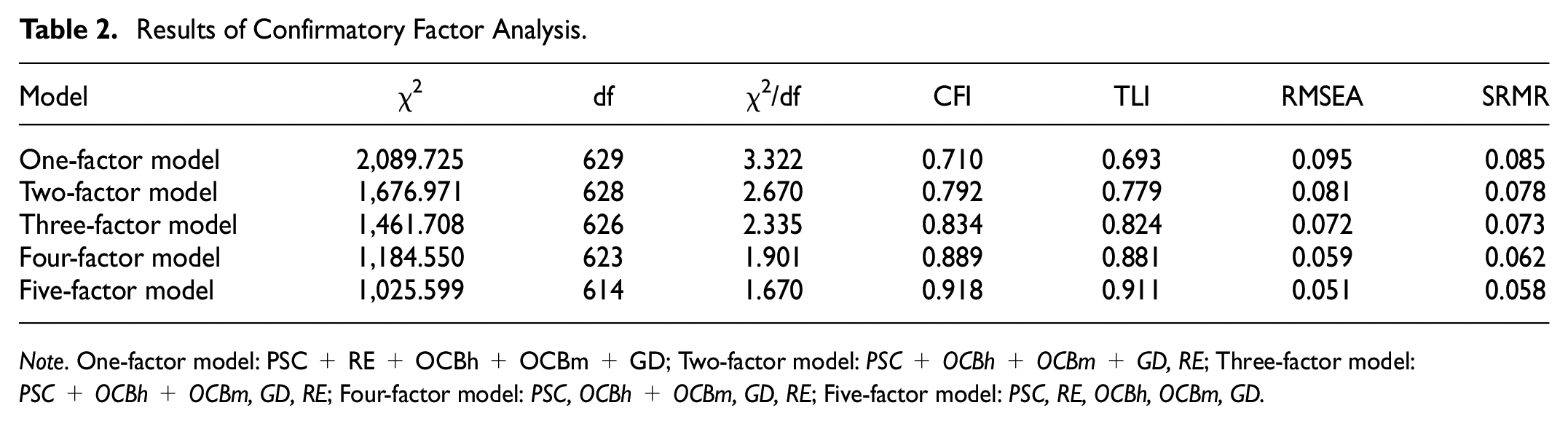
Note. One-factor model: PSC + RE + OCBh + OCBm + GD; Two-factor model: PSC + OCBh + OCBm + GD, RE; Three-factor model: PSC + OCBh + OCBm, GD, RE; Four-factor model: PSC, OCBh + OCBm, GD, RE; Five-factor model: PSC, RE, OCBh, OCBm, GD.
The results of the descriptive analysis of the core variables show (Table 3) that the means (standard deviations) of PSC, resilience, helping behavior, civic virtue, and trait gratitude were 3.99 (0.043), 3.85 (0.038), 4.28 (0.024), 4.01 (0.041), and 4.21 (0.034), respectively. PSC was significantly and positively correlated with resilience (r = .63, p < .01), helping behavior (r = .53, p < .01), civic virtue (r = .57, p < .01), and trait gratitude (r = .44, p < .01). Resilience was significantly and positively correlated with helping behavior (r = .48, p < .01), civic virtue (r = .59, p < .01), and trait gratitude (r = .28, p < .01). Helping behavior was positively related to civic virtue (r = .56, p < .01) and trait gratitude (r = .39, p < .01). There was a significant and positive correlation between civic virtue and trait gratitude (r = .33, p < .01), which provided a preliminary test for the research hypotheses.
Results of Variable Correlation.

p < .01. *p < .05.
Hypothesis Testing
To test our hypotheses, SPSS 21.0 was used to conduct hierarchical regression and bootstrapping (see results in Table 4). Models 0, 2, and 5 show the regression results of the control variables on resilience, helping behavior, and civic virtue, respectively. Model 1 shows the regression result of PSC on resilience. The results show that PSC played a significant role in promoting resilience (β = .592, p < .001). Models 3 and 6 show the regression results of PSC on helping behavior and civic virtue, respectively. PSC had a significant and positive effect on helping behavior (β = .504, p < .001) and civic virtue (β = .524, p < .001), supporting H1a and H1b. Model 4 shows the regression results of PSC and resilience on helping behavior. Combined with the results from Models 1, 3, and 4, this result indicates that PSC had a significant and positive effect on resilience and helping behavior, and PSC and resilience had a significant and positive effect on helping behavior at the same time. According to a method that was provided by Baron and Kenny (1986), it can be seen that resilience plays a partial mediating role in PSC and helping behavior (indirect effect = 0.073, 95% CI [0.030, 0.120]; Sobel test statistic = 2.875, p < .01), that is, a PSC can promote employees’ helping behavior by enhancing mental resilience. Thus, H2a was supported. Model 7 shows the regression result of PSC and resilience on civic virtue. Combined with the results from Models 1, 6, and 7, this result indicates that PSC had a significant and positive effect on resilience and civic virtue, and PSC and resilience had a significant and positive effect on civic virtue at the same time. According to a method that was provided by Baron and Kenny (1986), it can be seen that resilience played a partial mediating role in PSC and civic virtue (indirect effect = 0.191, CI [0.104, 0.296]; Sobel test statistic = 3.186, p < .001). Thus, H2b was supported.
Results of Regression Analysis.

p < .001. **p < .01. *p < .05.
To check for the robustness of our results, family-supportive supervisor behavior was additionally controlled (see Table 5). The effect of a PSC on employee OCBs in serious emergencies was still robust and significant, continuing to support our research hypotheses. Furthermore, we found that a PSC can significantly weaken the influence of family-supportive supervisor behavior on OCBs. After the incorporation of a PSC, family-supportive supervisor behavior did not affect the helping behavior of employees, indicating that the effect of a PSC on employee OCBs was superior to that of family-supportive supervisor behavior. This indicates that a PSC is the key to stimulating employee OCBs in serious emergencies.
Results of Robustness Test.

p < .001. **p < .01. *p < .05.
PROCESS 3.3 was used to analyze the interactive effect of resilience and trait gratitude. The interaction between resilience and trait gratitude had a significant and positive effect on helping behavior (β = .128, p = .043, 95% CI [0.004, 0.251]). When employees have a high level of trait gratitude, the positive effect of resilience on helping behavior is enhanced (β = .209, p < .001, CI [0.102, 0.315]). When employees have a low level of trait gratitude, the positive effect of resilience on helping behavior is not enhanced (β = .060, p = .296, CI [−0.053, 0.173]). Therefore, trait gratitude positively moderates the positive relationship between resilience and helping behavior, which supports H3a (see Figure 2). Moreover, the Johnson–Neyman technique was used to explore the boundary effect of resilience. It was found that high levels of trait gratitude strengthen the positive effect of resilience on helping behavior only when employee resilience is higher than 3.4 (see Figure 3). However, the interaction between resilience and trait gratitude had no significant effect on civic virtue (β = −.114, p = .236, CI [−0.311, 0.078]). In other words, trait gratitude does not moderate the enhancement of resilience and civic virtue, rejecting H3b.

Moderating effect of trait gratitude on relationship between resilience and helping behavior.

Moderating range of trait gratitude on resilience and helping behavior.
Our analysis of the conditional mediating effect shows that trait gratitude significantly influences the indirect effect of resilience on the relationship between PSC and helping behavior (β = .067, 95% CI [0.002, 0.141]). A high level of trait gratitude in employees strengthens the indirect effect of resilience on the relationship between PSC and helping behavior (β = .114, CI [0.048, 0.183]). However, a low level of trait gratitude has no influence on the indirect effect of resilience on the relationship between PSC and helping behavior (β = .035, CI [−0.029, 0.091]), supporting H4a. Trait gratitude has no significant effect on the indirect effect of resilience on the relationship between PSC and civic virtue (β = −.061, CI [−0.217, 0.105]), rejecting H4b.
The results indicate that a PSC can motivate employees to engage in OCBs, including helping their colleagues and the organization, and promote OCBs through employee resilience. Moreover, trait gratitude affects the role of employee resilience. High levels of employee trait gratitude strengthen the positive mediating effect of resilience on the relationship between PSC and helping behavior whereas low levels of trait gratitude have no effect. However, neither high nor low levels of employee trait gratitude influence the positive mediating effect of resilience on the relationship between PSC and civic virtue.
Discussion
Results Discussion
Using a COR theory perspective, we explored the relationship between a PSC and OCBs through resilience and trait gratitude. The findings show that a PSC has a positive effect on employee OCBs but its effects on civic virtue and helping behaviors differ. A PSC has a stronger effect on employees’ civic virtue behaviors toward the organization than on their helping behaviors toward coworkers. This finding is essentially consistent with previous studies, showing that resources that are provided by organizations can compensate for resource depletion that arises from employee OCBs and promote ongoing OCBs (Testa et al., 2020). The PSC that is provided by an organization can not only respond to and alleviate the negative psychological impact of emergencies but also meet the defensive psychological needs of employees in emergencies by implementing safety measures (Dollard & Bailey, 2021). Meanwhile, a PSC also motivates employees to exchange and to invest resources through OCBs, such as providing advice and assistance to the organization to further build a safe working environment. However, employees prioritize exchange and investment with entities when there is a high level of return (J. R. Halbesleben, 2010). Therefore, employees prioritize exhibiting beneficial behaviors toward the organization over helping their colleagues.
Further, the findings show that resilience is an important mediating mechanism in the effect of a PSC on employee OCBs. It has been widely proven that organizational support can influence employee behavior through psychological resources (Eisenberger et al., 2022) and shown that resilience is also an important mediator between organizational support and employee behavior (Egozi Farkash et al., 2022). A PSC that is provided by an organization in emergencies can help employees to build their psychological resources, first, by attending to their mental health and taking active measures to reduce their psychological burden (Dollard & Bailey, 2021) and, second, by reducing their perceptions of and sensitivity to external threats by providing safety measures and policies to reduce the consumption and the depletion of psychological resources (Dollard & Bailey, 2021). Moreover, the maintenance and the growth of resilience enables the ongoing accumulation of psychological resources for employees to engage in OCBs (Hobfoll et al., 2018). Therefore, a PSC can promote employee OCBs by increasing resilience and, then, they provide more help for the organization.
In addition, we found that trait gratitude is an important boundary condition that affects the role of resilience, which can strengthen the relationship between employee resilience and helping behaviors. Prior studies have shown that trait gratitude motivates employees to make specific attributions for gaining help from others and stimulates their feedback behaviors, such as prosocial behaviors (Eisenberger et al., 2022; Wu et al., 2018). Employees that have high levels of trait gratitude are more perceptive and sensitive to organizational support (Eisenberger et al., 2022) and thus tend to attribute their enhanced resilience to the PSC that is provided by the organization. Nevertheless, it is only when resilience is enhanced to a certain extent (>3.40) that employees are stimulated to invest their resources into helping behaviors. Moreover, the positive emotions that are induced by high levels of trait gratitude may alleviate the psychological pressure that are faced by employees (Kumar, Liu, Flinchbaugh, et al., 2022), enhance the building of psychological resources and resilience, and strengthen the indirect effect of resilience on helping behaviors. Therefore, trait gratitude is a key condition that affects resilience and helping behavior.
Theoretical Contributions
Our findings make several contributions to the literature. Our study expands the research on stimulating OCBs in serious emergencies from the perspective of employee mental health and reveals the role of a PSC in stimulating OCBs. Serious emergencies, such as the COVID-19 pandemic, have unpredictable and persistent effects on employees’ work and lifestyles (Wang et al., 2020). In response to serious emergencies, organizations often use their limited resources to deal with overt problems, such as physical safety and work recovery, but the mental health of employees is always overlooked (Venkatesh et al., 2021). Although studies have been conducted on the ways that organizations build a PSC that focuses on employee mental health (Dollard & Bailey, 2021), these studies have not explored the ways that a PSC affects employee behavior during serious emergencies, which is not conducive to managers’ understanding of the importance and the benefits of a PSC. From the perspective of COR theory, our study reveals that in serious emergencies, a PSC not only motivates employees to display civic virtue behaviors toward their organization but also stimulates them to help their colleagues. This finding not only complements the shortcomings of prior studies but also shows that paying attention to employees’ mental health in serious emergencies is an effective means of motivating them to increase their helping behaviors toward the organization.
Our study reveals the role of resilience in PSC and employee OCBs under the COR theory, constructed the mechanism of a PSC in stimulating employees’ OCBs in serious emergencies. Although prior studies have explained the mechanism of employee OCBs in terms of the aspects of meaningful work, psychological entitlement, and interpersonal relationships ((Eisenberger et al., 2022); Supanti & Butcher, 2019), these studies have ignored the impact of serious emergencies on OCBs, which is not conducive to prompting employees and organizations to overcome difficulties. Our study shows that during serious emergencies, the PSC that is provided by organizations can influence OCBs by enhancing resilience. When the PSC that is adopted by the organization helps employees to build their psychological resources, they exchange their resources via OCBs to obtain additional psychological resources and help the organization to overcome difficulties (Siami et al., 2022). This finding indicates that resilience is a key mechanism for explaining the ways that organizational resources affect employee OCBs during serious emergencies. Moreover, our study enriches the perspective of understanding the relationship between organizational support and employee behavior in serious emergencies through COR theory.
From the perspective of employee traits, our study reveals the boundary effect of trait gratitude on OCBs and resilience in serious emergencies. Although the effect of employee traits on OCBs has been studied (Bernabe-Valero et al., 2021; Wu et al., 2018), the boundary effect of employee traits on the relationship between resilience and OCBs in serious emergencies was unclear. Our study shows that during serious emergencies, employees that have higher levels of trait gratitude exhibit greater helping behaviors rather than civic virtue. However, employees that have lower levels of trait gratitude exhibit no significant change in helping behaviors or civic virtue. This shows that in serious emergencies, employee traits cannot affect the relationship between resilience and civic virtue but employees’ helping behaviors are a function of interpersonal relationships in the workplace and thus are readily affected by their personal traits. This study comprehensively reveals the boundary of the mechanism of COR theory in explaining the stimulating effect of a PSC on employee OCBs in serious emergencies.
Practical Implications
Organizations should pay attention to the potential psychological pressures on employees during serious emergencies and take timely measures to meet employees’ psychological needs. Our findings show that PSC that are adopted by organizations have a significant and positive effect on employee OCBs. The measures that an organization takes to alleviate the psychological pressure on employees and to meet their psychological needs enhance employees’ emotional connection to the organization and motivate employees to initiate pro-organizational behaviors and to help the organization overcome difficulties (Dollard & Bailey, 2021; Siami et al., 2022). Therefore, organizations should be aware of the benefits of a PSC in reducing employee psychological health risks and improve the organization’s PSC construction by strengthening the training of managers.
Organizations should pay attention to employees’ mental health in their daily work to improve their resilience. The findings of this study show that employee resilience not only plays a significant role in promoting OCBs but also enhances the transformation of a PSC into OCBs, which is critical for stimulating employees and the organization to work together to overcome difficulties. As an important psychological resource for employees to cope with challenges, resilience is not only the key to reducing the negative impact of external threats but also represents a psychological resource for employees to help organizations to overcome difficulties (Egozi Farkash et al., 2022). Therefore, organizations should regard employee resilience as an important resource to ensure their effective operation. It is important to improve employee resilience through organizational culture, team building, crisis planning and drills, and quality training activities and to enhance employees’ psychological ability to respond to emergencies.
In the process of dealing with crises, organizations need to pay attention to invisible resources in the form of employee traits and to strengthen them in everyday work. The findings of this study show that unlike organizational helping behaviors that use social exchange, helping behaviors toward coworkers are influenced by employee trait gratitude. Coworkers are key components of an organization and employees assisting their colleagues can increase the vitality of the organization and employees to deal with external challenges (van Gerwen et al., 2018). Therefore, in the face of emergencies, organizations should pay attention to the important role of employee traits. Organizations need to identify employee traits through personality testing and personnel evaluation. However, organizations need to shape employees’ trait gratitude through organizational culture, leadership role modeling, reasonable incentives, and organizational gratitude climate.
Limitations and Future Research
There are some shortcomings that may be addressed by future research. First, self-reporting data were mainly used to test the relationships between the variables because the participants worked from home. Although our results show that there was no serious CMB, our conclusions were still somewhat affected by a small CMB. Second, our study focused on office workers and ignored other occupational types, such as healthcare workers, doctors, and firefighters. This somewhat limits the application of the study’s conclusions. Third, data were collected during the COVID-19 pandemic, which reflected a real situation of employees in a serious emergency. However, a serious emergency was not deeply embedded in the study and this resulted in our under-disclosure of the impact of serious emergencies.
In the future, researchers could explore the dynamic impact of a PSC on OCBs combined with the stage of the impact and the measure variables from various sources to comprehensively understand the complex relationship between a PSC and OCBs in serious emergencies. In addition, they could combine the characteristics of serious emergencies to reveal the complex relationship between PSC and OCBs. Finally, the differences in the performance of occupational types between PSC and OCB should be given more attention. These would help us to better understand the relationship between a PSC and OCBs in serious emergencies.
Conclusion
Through our empirical research, a PSC was identified as a critical facilitator of employee OCBs during COVID-19. Moreover, our findings suggest that a PSC affects OCBs through resilience and these relationships are moderated by employee trait gratitude. Such a study has implications for promoting employee OCBs during the COVID-19 pandemic. Thus, the findings of our study lay the foundation for understanding the ways that employees are motivated to engage in OCBs during COVID-19.
Footnotes
Author Contributions
Y.Y., R.Y., YT.G., F.F., and Y.M took part in this study. Y.Y and Y.M mainly conceived the idea and basic model of this study, R.Y., YT.G., and F.F collected and analyzed data and wrote this paper. All authors have read and agreed to the published version of the manuscript.
Declaration of Conflicting Interests
The author(s) declared no potential conflicts of interest with respect to the research, authorship, and/or publication of this article.
Funding
The author(s) disclosed receipt of the following financial support for the research, authorship, and/or publication of this article: This research was funded by the National Natural Science Foundation of China, grant number 71972062; the National Natural Science Foundation of China, grant number 71872058; the Fundamental Research Funds for the Central Universities, grant number HIT.HSS.201842.
Data Availability Statement
The raw data supporting the conclusions of this article will be made available by the authors, without undue reservation.
Ethics Statement
The studies involving human participants were reviewed and approved by Ethics Review Committee of the School of Management, Harbin Institute of Technology. Written informed consent from the participants’ legal guardian/next of kin was not required to participate in this study in accordance with the national legislation and the institutional requirements. All the participants were asked to read and approve this ethical consent before taking part in the present study and follow it in the process of research.
