




Abstract
In India, the emphasis on disaster management primarily focuses on structural reconciliation. So, post-disaster reconstruction mostly becomes inadequate to be sustainable and to help the affected people revive to their desired states of recovery. The lack of state mechanisms raises major questions about the practices adopted for sustenance at the individual and community levels. In the context of the Kosi River flood in Bihar in the year 2008, the main aim of the study is to explore the reconciliatory practices and changes in the rural society of Bihar to cope with the post-flood impacts in the absence of adequate institutional support. The present study also tries to explore the resilience capacity of community members to revive from the post-flood period. A qualitative study was conducted using grounded theory approach. A total of 23 participants were interviewed through a semi-structured interview guide. Results depict that community members adopt different coping mechanisms to deal with the impact of disasters.
Introduction
Disasters provide ideal contexts to understand and explore various aspects that shape social change in human history (Becker & Reusser, 2016; Nakagawa & Shaw, 2004) and the further effects of such changes on human life (Elliott & Pais, 2006). So, post-disaster studies give an excellent scope to examine, how human societies have rearranged themselves in the context of available resources, capacities, and capital to overcome adversities (Becker & Reusser, 2016). As Merton (1969, p. xi) observed that such findings can add to various sociological theories on human behavior and social organization (Merton, 1969). But vast diversity in the statuses and practices regarding socio-cultural and economic aspects in different corners of the world gives an ideal set-up to each disaster to explain the diverse patterns of human responses as coping mechanisms to natural disasters in different environmental setups. The vulnerability assessment of the disaster-affected communities helps to understand the essential elements of the community in the first place which will help in the process of reconstruction, moreover, in higher sustainable forms along with being a reference in framing future community-oriented plans and policies in disaster management (Du et al., 2015). In India, emphasis on successful disaster management is a recent discourse. But it is important to mention that India’s disaster preparedness and management programs focus more on saving human life in the pre-disaster phase, and physical reconstruction (though neglected in many cases) in post-disaster situations. Social reconstruction which is a major emergency, facing serious long-term crises during and after the disaster is still a neglected fact in the national disaster preparedness and mitigation policy of India. Furthermore, it is crucial aspect to study how people with highly limited resources and institutional support evolve to manage the miseries of a disaster and how such strategies shape their society in the next period of time. India has a large section of its communities in need of various types of emergency support at any point in time; while they are put to sustain the sudden extreme effects of the disaster, the compass of the vulnerability points the most to the underprivileged sections like rural poor, tribal, scheduled caste-like groups. The Phailin in 2013 and the Fani in 2019 experiences show evidence of the fact that though the timely evacuations helped minimize the number of deaths (National Institute of Disaster Management (NIDM), 2015-16; 2020-21), post-disaster management practices seem to omit human dimensions. The observations in “conclusive remarks” and “lessons learned” have almost an absence of space for issues like community consultation and participation in the rebuilding process, social reconstruction, and approaches toward post-disaster psychosocial issues in case of occurrences of such calamities in the future. Furthermore, considering the homologous pattern of mitigation and reconstruction practices adopted for affected communities across regions (Elliott & Pais, 2006; Tariq et al., 2021), it is important to note that there are significant social and economic inequalities and cultural variations persisting at various sub-levels. For example, individuals in traditional and tribal societies in India depend more on social solidarity and social capital; in our previous study experiences in such closely knit traditional communities, the significant presence of lending, borrowing and batter practices among households and individual members was observed. Beyond material needs, other social, cultural, and psychological dependencies are also very high. Therefore they would need a different approach to post-disaster management and reconciliation.
Disaster risk is determined by the severity, complexity and consequences of the event. Community participation and responsibility in all phases of the disaster life cycle is an impartible component of community disaster resilience. United Nations International Strategy for Disaster Reduction (UNISDR) defines disaster resilience as “The ability of a system, community or society exposed to hazards to resist, absorb, accommodate to and recover from the effects of a hazard in a timely and efficient manner, including through the preservation and restoration of its essential basic structures and functions (UNISDR, 2009, p.24).” Community disaster resilience is a vital aspect that requires identifying the social and cultural context in which people live and respond to disasters.
The present study has evaluated the Kosi flood that occurred in 2008 in the Bihar state, which brought one of the worst and most damaging experiences to the affected people. The present paper in the context of the studied environmental hazard tried to elucidate how affected households or community members survived with the available limited resources and adopted various means available at their disposal to come out of the emergency. Being at the top list of poorest states of India along with the very limited post-disaster response and arrangement by governmental and institutional agencies, it is insightful to understand how the affected people in Bihar managed or are still managing to evolve from the post-effect of the calamity.
Objectives of the Study
The objective of the present study was to explore the post-disaster effect due to the flood on rural Indian society in various spheres of human life-both personal and public. The study also aimed to understand the pattern of changes and the coping mechanisms adopted by the inhabitants of the affected areas during the post-flood period in the last 10 years and to explore how the local mechanisms in the studied villages have evolved with alternative arrangements to overcome the damages and losses due to the flood.
Theoretical Framework
The present study employed a grounded theory approach as a primary research methodology, to describe and explore disaster-related resiliency, from the community members’ perspectives during the post-flood period. The study also adopted the theories around community disaster resilience (such as the “Bottom-up” Approach to Resilience and Socio-ecological resilience theories) to understand the consistent reproduction of capacity by rural communities to adapt to disasters (Long et al., 2011; Zhu, 2017). It focused on how a community survives and revives during the post-disaster period with regard to the prevailing traditional and new features that ascend from social and economic changes (Wilson et al., 2018; Zhu, 2017).
The Grounded Theory Approach
Grounded theory is a systematic approach to developing theories from concrete data. Glaser and Strauss, who introduced the approach, defined the grounded theory method as “the discovery of theory from data, systematically obtained and analysed in social research” (Glaser & Strauss, 1967). As a qualitative method, it looks for the building of relationships between the concepts and categories to generate broader perspectives. In exploring disaster survivors’ experiences and deriving elements of cultural and situational contexts, grounded theory will be an effective method. The main process of grounded theory is in three phases: open coding, axial coding, and selective coding. By employing this, the authors in the present study tried to explore the participant’s post-disaster experience, derive variables related to the nature of the experience and identify relationships between the concepts to bring in broader perspectives of the participant’s experience. The grounded theory has an “intuitive appeal” for novel investigators since it allows researchers to get “immersed” deeply within the data (Myers, 2009, p. 111).
The present study by applying the grounded theory approach as a research methodology describes and explores disaster-related resiliency from the community member’s perspective during the post-flood situations. This investigation provides the basis for the emergence of different concepts on community resilience patterns during the post-flood situation. People sharing common conditions (community members’ disaster experiences, behaviors, and coping mechanisms) are the essence of what grounded theory can bring out through analysis (Ahangama & Prasanna, 2021; McCann & Clark, 2003).
“Bottom-Up” Approach to Resilience
The community is a multifaceted adaptive structure built in different social, environmental, physical, and economic units. These units are closely related, and the operation of the structure is governed by the interplay between them. Any disturbance that happens in any unit of the structure, leads to serious disruption to the whole structure.
A resilient community is a community where the members of the community can cope with the adverse impacts of uncertainties (Adger, 2000; De Bruijn et al., 2017; FAO, 2010; Tariq et al., 2021). But in relation to societal resilience toward disaster, the ability to prevent, cope, and the capacity to implement recovery activities of society make society less vulnerable to disasters. Prevention and Mitigation, Preparedness, Response, Rehabilitation and Build Back Better are the four pillars of disaster resilience.
The move from a state-centered approach to a community-based approach whereby the community itself is actively involved in the process of its own mitigation and recovery is the bottom-up approach whereby the community members themselves raise their community resilience awareness and recognize their strengths and weaknesses, and areas of development. In this study, we particularly explain how individuals and communities take the responsibility of coping with the adverse disaster situation. It is a significant consideration because it determines the extent of community involvement in the estimation process, and influences the cost and spatial extent of the assessment (Resilient America Roundtable and National Research Council, 2015).
Social-Ecological Resilience Theory
Social-ecological resilience theory is an appropriate theory to discuss community resilience in the post-flood period in rural Bihar. Socio-ecological resilience is the community’s capability to adapt or change with respect to transformation in socio-ecological structures, particularly during emergency situations (Biggs et al., 2015; Chapin et al., 2010). Emery and Flora (2006) define community resilience as introduced from the social-ecological structure, including geography, socio-economic environment, and cultural and political aspects. Empirical studies show that those community aspects as resources are sturdily inclined by the social-ecological structure (Kelly et al., 2015). Resilience can be used as a basis for the amalgamation of the social and ecological values of natural disasters because it represents a shared kind of alteration, disruption, and adaptation and accompaniments to the communally subjugated discourse of risk and emergency management and practices (Heinkel et al., 2022). Social sources of resilience include social capital that is, social trust and collaboration and collective recollection which includes past experiences for change. These are vital to adjust and form the change (Folke, 2006). According to this perspective, resilience is related to how to persevere through incessant development in the aspect of transformation and how to adapt or adjust to the new form of arrangement. So community resilience measures how rural communities use resources, capacities, and capital within their system to acclimate to an emergency situation. In the present study, the status of community resilience is not only addressed but also how these types of community disaster resilience are dispersed as a purpose of socio-ecological impacts is explored.
Methodology
The present study is a qualitative study undertaken in multiple cross-sectional manner exploring coping strategies of flood-affected households and community members with their limited resources by reviving more resilient.
Study Area
While understanding the impacts of natural disasters, the demography and socioeconomic characteristics of the affected society carry significant importance as such aspects can explain the risk of loss and damage to a larger extent. Bihar is mostly an agrarian society with a largely rural economy. The state is situated in the eastern part of India. It is surrounded by Uttar Pradesh, West Bengal and Jharkhand in the west, east and south respectively with Nepal to the north. The state has a large plain land stretch that contributes to the bed of the River Ganges and its two major tributaries-Gandak and Kosi. The rural population of Bihar constitutes 88% of the total population of the state (Census of India, 2011b). Hindus are the majority among various communities in the state, though the state is also home to a large population of Muslim households (Census of India, 2011a). Caste is a major factor among Hindus, playing a significant role in social mobilization due to complex social stratification. On the other hand, the state is considered as one of the most backward states in India with a high degree of poverty, illiteracy along with lacking basic amenities like health facilities, transport, and communication, drinking water, etc. In the almost absent industrial scenario, the per capita income of the state stands at31,229 INR while it is 74,380 INR at the national level (Directorate of Economics & Statistics of Respective State Governments, and for All-India - Central Statistics Office, n.d.). Due to the lack of job opportunities, a high rate of interstate migration of Bihari people has been witnessed in the recent couple of decades, which has increased significantly in the last 5 to 8 years (Government of Bihar, 2017) (Figure 1).

Study area.
Kosi Flood, the focus of the present study took place on 18th August 2008 due to heavy monsoon rain in the upper catchment areas of the river leading the river to change its natural course by flooding a vast region of India and particularly in Bihar (Figure 2). The flood severely affected six districts in Bihar among which Supaul is one of the worst affected districts. The flood caused death to 1,800 people, with 2 million people displaced and 567,000 homes destroyed. A large portion of livestock was swept out as well as heavy damage to physical infrastructure, large areas of fertile agricultural land were heavily affected along with the loss of livelihood and breakdown of community and social infrastructure. The post-flood period brought heavy displacement, loos of livelihood various, various morbidities and other health issues as well as large-scale compulsory migration to the affected people.
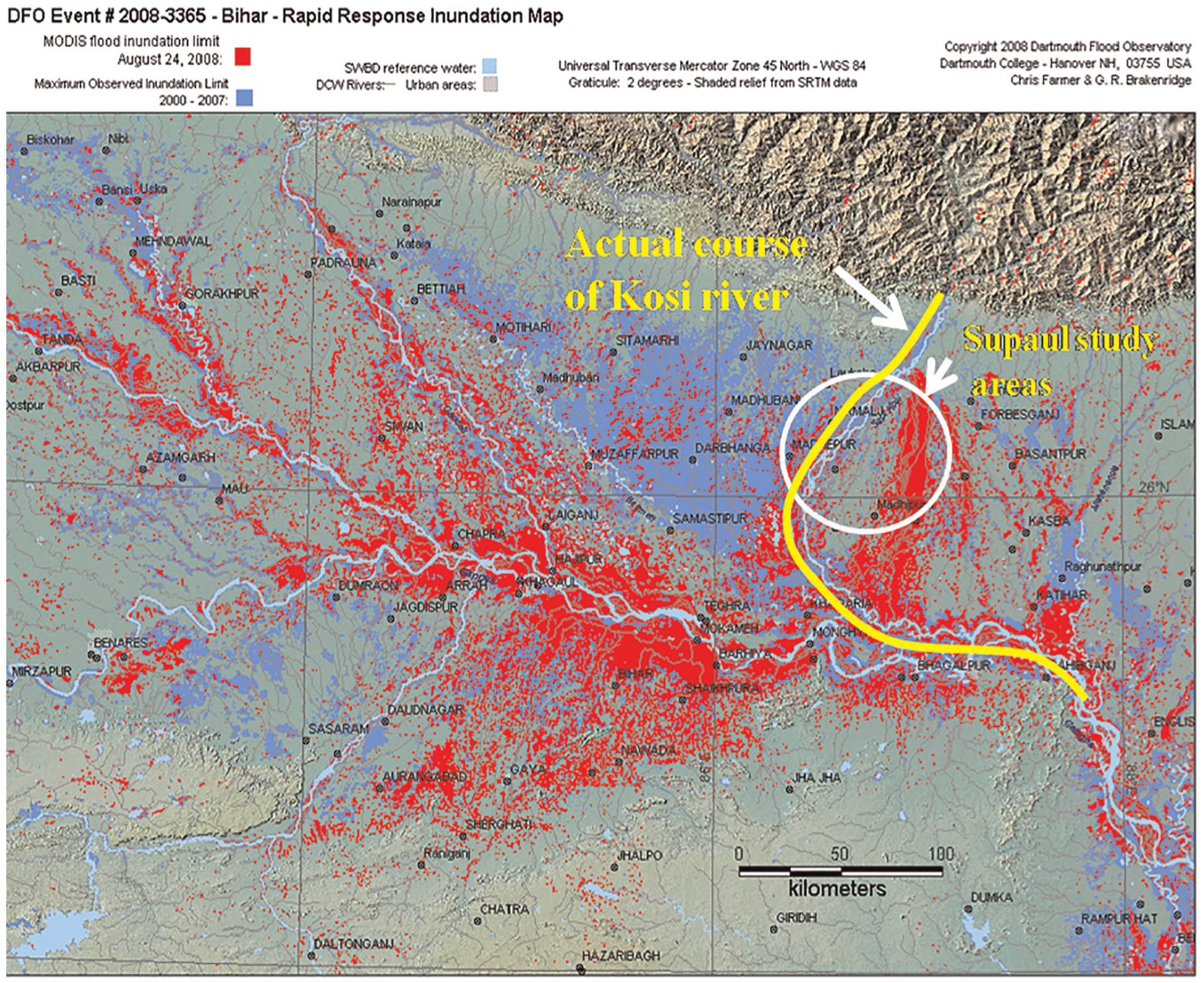
Flood in Kosi river in Supaul District.
Recruitment of Participants
We conducted multiple phases of data collection in 15 village panchayats across five blocks of Supaul district of Bihar during the months of October and December 2016 (First phase) and July to September (Second phase) in 2017, January to March (Third Phase), 2018 . The study selected its participants through a purposive convenience sampling method. Thirty respondents were identified initially, and 23 of them participated in the in-depth interview. The age distribution of the participants ranged from 35 to 65 years. All participants had a primary and above level of education. Both men and women were selected for the study purposes. We adopted a semi-structured interview guide focusing particularly on post-flood community resilience. Different probes were used to explore the in-depth information on various selected aspects from the key informants.
Data Collection
Qualitative research methods such as in-depth interviews and participatory observation of daily life were used for data collection. The semi-structured interview guide used for in-depth interviews consisted of closed and open-ended questions regarding their social, cultural, economic, family structure, health-seeking behavior, and migration pattern in relation to post-flood situations with the aim to understand their experiences. The broad questions guided the research highlighted the following aspects: the role of communities in disaster management during the post-flood period; the experiences and challenges encountered by the communities during the post-flood situation. The key questions guiding the interviews were as follows: How do the affected households perceive the effects of flooding? What is the impact of floods on the lives and livelihoods of communities? How do the communities respond and cope with floods in regard to their resilience? What is their experience in recovery and reconstruction during post-flood? To what extent, do people use indigenous coping strategies to adapt events of recurrent flood situations? How the socio-cultural life of the community changes over time during the post-flood period? Before the interviews, investigators explained the study procedures and asked for participants’ verbal consent. Participants also completed a short survey with questions about demographic details. The interviews were digitally recorded, and field notes were taken. All reported interviews were recorded with the permission of the participants and transcribed verbatim for analysis. The interviews lasted for 45 min to 1 hr.
Data Analysis
The analysis of the data was based on grounded theory (Figure 3). The interviews were transcribed in detail and coded to extract information. During the data analysis, open coding was used to identify different concepts and issues that emerged from each interview. The data were fragmented into different concepts. Then axial coding was used to find the relationship between the concepts that emerged from open coding and grouped them into broader categories. These broader categories were presented as the major adaptive capacities and socio-cultural changes related to post-flood community resilience (Figure 4).

The grounded theory approach.
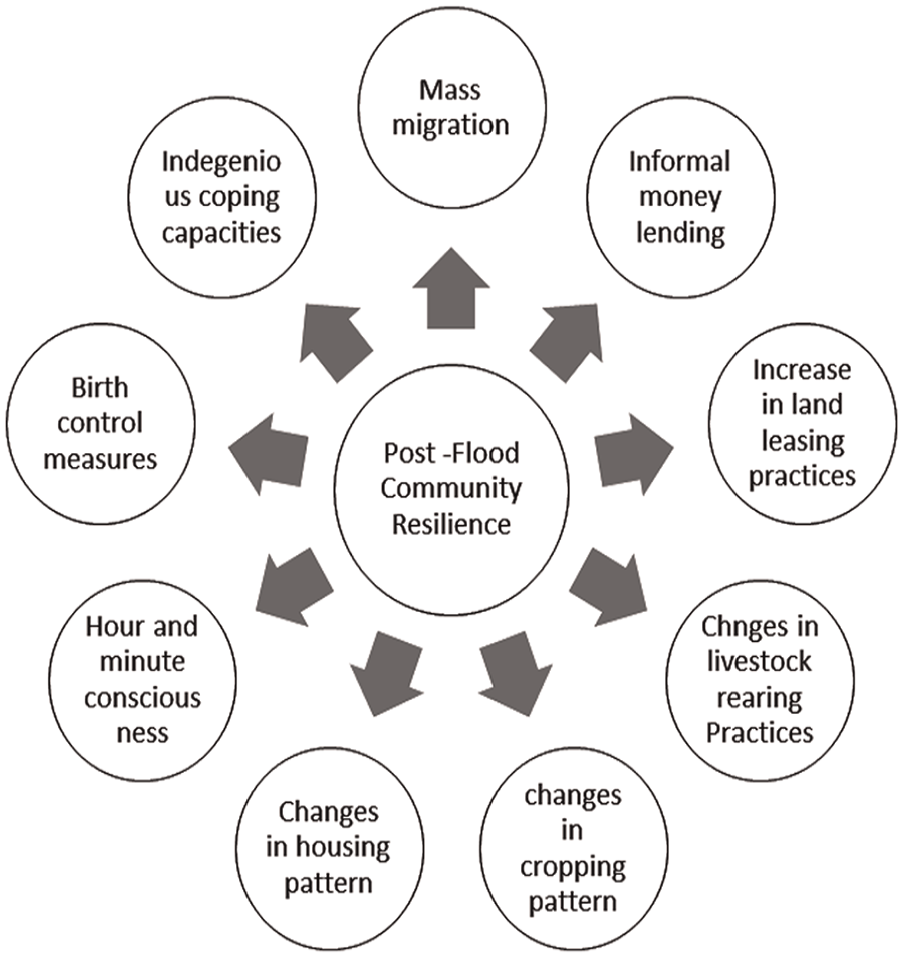
Post-flood community resilience thematic analysis.
Ethical Considerations
Obtaining verbal consent before conducting interviews, retaining anonymity, ensuring confidentiality of information, and observing the participants’ rights of withdrawing from the study or interview at any time were some of the ethical considerations in the present study.
Findings and Observations
The study has brought in various post-flood incidents and such consequences in different spheres of the affected people in the studied areas. Upon analyzing the narratives, nine substantial themes were generated and discussed as follows.
The Disaster of Mass Migration in the Post-Disaster Period
Migration at the mass level to cities in the post-disaster period is a disaster-induced major displacement incident and a common and immediate feature of post-disaster adversities (DeJong & Fawcett, 1981; Sijapati, 2015; Speare, 1974). Such patterns are more observed in poor and developing countries, particularly, in areas with ill-equipped basic amenities as well as with high dependency on the subsistent economy (Hugo, 1996). After the flood in Kosi in the year 2008, the major affected parts of studied Supaul district experienced a mass movement of rural people to different parts of the country as a significant event. It was elaborated by the interviewed people from the flood-affected areas that the mass migration started from the temporary shelters themselves rather than waiting until rehabilitation and restoration by the government. It was observed during the personal interviews with the locals that such a trend took place because these migrating people were rural poor and had already lost their houses entirely along with other valuables. It was observed during the field visit in the blocks like Supaul, Radhepur, Marauna, and Basantpura that a large-scale migration took place in the post-flood period during the year 2008–2009. As a continuance to the trend, a major proportion of the population was staying out of home for a significant period of a year as the migrant population. It further revealed that these people migrated to states like Punjab, Haryana, Jammu and Kashmir, Delhi, Himachal Pradesh, and Gujarat. The major sources of their income were agricultural and non-agricultural labor activities in migrant places spending 3 to 12 months in those workplaces. Investigations revealed that the rate of migration as well as the period of stay in migrating places in the post-flood period was observed to have increased at a very high rate among the lower castes particularly among the scheduled caste and Dalits (highly marginalized) and mahadalits (extremely marginalized) in comparison to the rate of migration among these communities during the period prior to flood. One respondent told that,
The unavailability of work and the loss of agricultural products pushed me for off-farm work in big cities. I have heavy debts due to continuous crop loss, so I planned to migrate for a short period, usually for 6 months, and again when the cropping season comes, I will return home. (Participant 1)
It was observed during the study in several villages that the majority of the adult males have left for cities leaving the women, children and elderly individuals in the families. The Muslim migrants were observed working in semi-skilled jobs in industries of clothes in Jammu and Kashmir along with agricultural and non-agricultural migrant labor activities in the above-stated states. Another credible section of the migrants was also found seasonally moving to mega-cities to participate in low-end jobs, mostly rickshaw pulling. The stay at migrant places takes place multi-episodically throughout the year. Those who go for agricultural labor migrate about thrice a year; during paddy transplantation activities in June; paddy harvesting activities during October-November; wheat harvesting activities during April; each migratory period occurring from 30 to 45 days. On average, they earn 7,000 to 9,000 rupees a session excluding their expenditure.
The investigation revealed that people with the heavy burden of loans from local money lenders preferred to stay in migratory places even after the end of one agricultural engagement session by getting involved in non-agricultural labor jobs still the next agricultural session. This helps them earn more money and to repay and reduce the burden of lending early. It was further observed that the interest rate for lending money in the Supoul district varied from 7 to 12 rupees for a 100 rupees per month. During the field visit to Barahara gram panchayat in Marauna block, a farmer named Jai Ram Yadav explained his experiences.
I borrowed about 60,000 rupees at 7% interest per month from a local moneylender who is a close and known neighbour of mine. I borrowed money four years back to build my house. I have been paying the interest to date in various amounts (as I remembered once 5000/-, second time 2000/-, and third time 12000/-) during the last two years. I made a major payment, particularly after every harvesting session. The moneylender never pressurized me to repay the total amount. (Participant 2)
Further inquiry found that he had not yet been able to repay or lessen the main amount he borrowed, as all the installments of his repayment went toward the interest payment only. On further inquiry regarding how he would repay the total money, he said,
This man (money lender) is good. After paying the interest for some years, he exempted the borrowing farmer from paying the main loan amount. He had promised me in the same line. (Participant 2)
On the other hand, our field experience explored that during the immediate months of the post-flood period, the natives were reduced to total “have-nots” when they were not even able to pay for the travel to migrant places. As they had lost all food grain, cattle, household articles, and all other materials that could fetch them some money, they mortgaged the gold and silver jewelry worn by family members in exchange for money to migrate to labor places that could never be recovered in many cases.
Informal Money Lenders as Decisive Factors in the Heavy Borrowing Environment
The post-flood period in the affected areas has given rise to a social situation of high borrowing activities by the local inhabitants, particularly from the informal money lenders (reported in nine different interviews including participant 2 as quoted above). It has various facets. Firstly, the high shortage of primary needs and associated non-affordability has driven many households to borrow money for various activities like building houses, getting their daughters married, buying food and household articles, etc. It was also observed that many people have taken money from local moneylenders during migration to other places in search of wages. As money-lending and paying back practices by the formal banking system is not easy or timely, people either prefer or are forced to borrow from the local money lenders. On the other hand, several households complained about corruption and bribery in the formal banking system. Thirdly, while bank officials after a particular period of time pressurize to pay back the loan and the interest, the local moneylender does not do so.
The agricultural households in most of the villages with the burden of loans make a big chunk of the payment of the total loan and interest amount after every paddy or wheat harvest. It was observed that such expenditure eats out a significant portion of their income from agriculture (reported in nine different interviews including participant 2 as quoted above).
However, as in a Mushahartola (ward) in the Basantpur block, women were observed actively getting involved in self-help groups (SHGs). This gave them a big return in terms of socio-economic security. They availed loans from these SHGs at just 1% to 2% interest per month against the 7% to 15% interest levied by local money lenders. The process was also transparent and there was no charge of undue payment. It was significant to report that most of the SHG members were loaners of these SHGs. It was observed that though SHGs’ activities are not regular in every village, women from the socio-economically backward sections of society are more taking interest in SHGs for getting access to easy loan facilities.
Landlessness, Increasing Family Size and Socio-Economic Burdens
Though ownership of agricultural land in rural areas is losing its relevance in certain parts of India, land ownership plays very significant roles in social, economic, and physical adjustment in the society in the studied part of Bihar. Land ownership in the visited part of rural Bihar was highly concentrated to a selected section of people in a village society while the rest inhabitants, a significantly large section of the society were landless or had a negligible amount of land ownership with few Kathas (local unit of land). Land ownership is conceived as a vital source of social security in the studied villages. It was observed that the lack of agricultural land ownership is a major cause of acute and prolonged poverty among rural inhabitants of this agriculture-dependent society. Landlessness was also observed to be an intense cause of increasing the burden and the severity of borrowing practices. On the other hand, families with large numbers of members mainly Muslim families are the acute sufferers of such a situation. In Muslim villages, it was observed that most families were with more than 7 to 8 children which further extend up to 13 to 14 numbers in certain cases. Though such families caused their large size as the result of Allah’s (god’s)wish, they could not be definite in answering the issues like homelessness or acute shortage of living rooms as a result of such family sizes. In the cases of most such families, multiple small, congested but separate houses were built on a small piece of land.
Post-Flood Period and Changes in Society
In the post-disaster period, as the society tries to accommodate its members with locally available resources, such a process pushes the total set up to scarcity and chaos-like situation due to the already damaged and scantily available resources. Such situations at the beginning give rise to various immediate and drastic fallouts, though are followed by reconciliation (that may take longer to a very long time). A similar situation was observed in the present context of the Kosi flood. In the post-flood period, people faced a drastic shortage of income sources due to almost absent jobs in the locality. As they elaborated, such a situation continued for a period of more than a year. The high joblessness-driven migration has led to a high dropout rate in education among both boys and girls. The economically backward sections have suffered the most out of these fallouts. Non-affordability has become an unavoidable and acute household challenge in most areas. Along with this, there has been an increasing burden of household expenditure faced by most. All such factors were observed to be the major causes for such a high dropout rate. Though the awareness among parents regarding children’s education has increased in recent years, the dropout rate still continued to remain high even after 7 to 8 years due to the issues like continued poverty, non-affordability, social burden, lack or very less utility value of formal education in income generation and immediate economic prosperity. Boys in most cases were witnessed going for livelihood support to their families after dropping out of school, mainly after attaining the secondary level of education while girls stay at home and helped in household work till getting married.
On the other hand, the dowry rate in the post-flood period has grown manifolds. Demand for a motorbike or money of an amount of up to 50,000/- during the marriage was observed to be a common practice among even poor households in recent times. While working in Balabhadrapurgram panchayat under Basantpur Block, we interacted with Imanat Seikh. Imanat had three girl children and a son. As he said,
My first girl child got married at the age of just 13 years within the next six months of flood resettlement. I took a loan of 25,000 rupees from the local branch of a nationalized bank for which I had to give 10,000 rupees to the manager to sanction the loan. I borrowed another 20, 000 rupees from other sources. My second daughter got married in the year 2014. This time I had nothing to borrow against or sell for. I sent my son who was in class 9
th
to a labor contractor for six months to work in his brick kiln against a loan of 30, 000 rupees. Somehow the marriage of the second daughter was solemnized. But the contractor kept the boy for an extra two months. Me and my son were still regretting the break in the education of my son. (Participant 5)
It was observed in cases of families in the condition of acute poverty that girl children have been given married at an age of below 18 years. Particularly, in Muslim families, the age of marriage was observed to be as low as 10 years. Further, a preference for getting a groom from states like Uttar Pradesh and Haryana along with the bordering country like Nepal was observed. It was understood that in such cases the family does not have to pay any money to the groom’s side; rather in certain cases, they get paid for giving their girl’s marriage. The frequency of such practices in marriage has got a stiff increase during the year 2008 to recent times. In the same Muslim village of Imanat, we met Sabina who had got married in Uttar Pradesh about 5 years ago. She was 16 years old at the time of our visit and was having three children. During our conversation with her, she told,
I was only in the 5th class while I got married. Still I am interested to continue her studies. “I am already married. Does education continue after marriage? (answered causally) Not.” We asked Sabina about her friends. She answered with a big laugh, “Sab ki Saddi ho chuki he” (Participant 12).
We visited three Muslim villages during our field visit and several similar cases were reported in these villages. Ealy marriage and school dropout were observed as two major adversities faced by the girl children in the post-flood period.
During our interaction and data collection, the son preference among both men and women was observed to be high. In many cases, the number of children had got extended up to 6 or 7 in general and even up to 11 to 12 in certain particular cases (in mostly Muslim families) in expectation of a single male child. On the other hand, our conversation with one household head revealed that,
There has been a boom in the increase in number of nuclear families in recent years than the previous ones. Along with this, sons are also getting separated from their parents in the early post-marriage years. (Participant 10)
This social change signifies that having a son is no way to ensure any social security for the parents. The further conversation with families highlighted that people understood that it was just a cultural perception that having a son could only continue the bloodline which would never happen with a girl child. In most cases, the general perception among both male and female parents is that having a son is a social status; a couple with all-girl children feels a perceived stigma in peer groups. Though, in very isolated cases, it was observed that the instances of girl child having acquired some job and income source in local bodies by subsequently taking care of the parents are pushing for a new narrative than the traditional ideas in the households regarding the dichotomy of girl/boy child preference.
As another fallout of the post-flood effect, a shrink in the community, as well as household ritual and worship activities with a cut in expenditure on such heads, was observed. A shift in focus on income generation and economic activities was observed to be the primary reason behind it. Similarly, leisure activities have also shrunk significantly, as people (as they said) got very little time for such purposes. As an old man explained, the calves are now getting less milk from their mother than in previous times as now people take most of the milk for selling. So, such changes in socio-cultural practices from the micro level to the macro level give highly significant input in explaining the changing society in the post-flood period. We believe there is much research needed in this context.
Birth Control Measures in the Post-Flood Period
Birth control is the first measure that helps a family or a country to accommodate the inadequate availability of resources in societies with a high scarcity of amenities. Different countries in different contexts in the process of human history have shifted to birth control in various ways to avoid scarcity. At the individual and household levels, people adopt this method for better lifestyle and living practices. However, in the present post-disaster context, such a practice was observed as an attempt to substitute the basic amenities, or in other words, to stay alive. Many households explained that they went for sterilization within the immediate couple of months of the receding of the flood. The heavy scarcity in every aspect of basic needs in the immediate years of the post-flood period brought many lessons to the affected people. They gave up many practices due to the heavy economic burden; they adopted many measures to lessen their misery. Similarly, people’s approach has changed significantly toward availing and adopting various government welfare measures in the last 8 years during the post-flood period. It was observed, that people’s perceptions and practices regarding family planning and sterilization have also positively changed and several women have started to adopt such methods. Particularly, an increased preference among households from Hindu societies toward child control measures was observed. The primary inspiration behind adopting family planning was to increase household affordability for improving living facilities. The practices in Muslim society were also observed to be expanding. During our field visit to a Muslim village in Motipur Panchayat, it was observed that Muslims particularly women are increasingly taking interest in family planning. As Sabina (41 years) said,
Most of the households in my village have adopted family planning. (Participant 21)
To our question that if local religious leaders play any role or the women took the local religious leaders into confidence as such practices are said to be prohibited in Koran, Sabina said,
Yes, the religious leaders say this. But this practice by women is being conducted personally or secretly without informing the Maulana or the religious leader. It is because if he knew about it, he would not come to the last rites of our family members. But who wants a large family at this time when everything is increasingly becoming expensive?” Remembering her experience from a neighboring village Sabina said, “In other villages, women use sui,(injection method of contraception) a temporary measure for family planning as their family heads do not allow permanent sterilization. (Participant 21)
On the other hand, while working in a Muslim village in Dinbandhi Panchayat under the Basantpur block, we observed a reverse trend in the post-flood period, the choice for more children and particularly sons increased. It is because they hope, that more sons mean an added source of income which will help them prosper. To our query regarding the practice of family planning, they responded in a strongly negative manner. The common response to having too many children and not adopting any birth control measure was,
It is all the wish of Allah (God) to have children. We are none to stop it and if we do so it would be against the wish of that almighty. (Participant 3)
Another young man who is working as a madrasah teacher in the same village told in this context that,
Our Muslim population is very less in the country for which we need to reproduce more. So a birth control measure would worsen the situation. (Participant 11)
When asked whether they have ever seen the benefits of birth control being discussed in TV, radio, etc. Sahid (28), the eldest son of an interviewed household said,
TV is not kept in a Muslim household. It is a Hindu household article. (Participant 7)
Overall, it was observed that during the post-flood period, a portion of the Muslim society in the studied area started to understand and brought changes in practice regarding birth control. On the other hand, in Hindu societies, health camps are regularly organized for male and female sterilization for birth control. But in most households, men were found to avoid sterilization by adopting the same for their wives as they believed that male sterilization would lead to loss of their vigor leading to failure for physical labor and resultant economic misery.
Increasing Religious Harmony and Falling Social Inequality in the Affected Area
The bad memory of flood and its deep traumatic and devastating effects during and in the post-flood period have brought significant changes in the inter-community relationship. Adopting new livelihood practices by one community has influenced the other groups with improved interaction for similar support. Similarly, the rising poverty helped in minimizing the community-level gap due to their increasing interdependency during post-flood years.
The post-flood period has brought significant changes in the socioeconomic status and behavior of the local inhabitants. During the pre-flood period, labor costs for males were very lower while females were being paid in kind. In the post-flood period, the cost of labor increased for men, while women in many cases are being paid in the form of few amounts of money along with food grains like paddy and wheat. But there is very high discrimination in wages of men and women, for example, while men get 150 to 200 rupees, women get just 40 to 60 rupees or food grains of this cost. Similarly, the increased activities by MGNRGA in the post-flood period have led to an increase in the cost of daily wage labor in the way of cash-based payment. Cash-based payment has led to availing comparatively better-living facilities for the laborers. Cash in hand led to building better houses also.
Similarly, another major outcome in the post-flood period is falling inequality in accessing healthcare facilities. People were mostly afraid of shifting to modern healthcare facilities due to the fear of heavy expenditure and their inability to afford such expenditure. So, this situation was leading to adopting and depending on the traditional or local medical system. But in the recent period, they have started to access modern medicine and health care system in most instances though it is still a long way to go. During the data collection, it was observed that the post-flood outward migration leading to a substantial increase in the information and income generation capability in the form of hard cash has enhanced their buying capacity with respect to health and healthcare.
Increase in Land Leasing Practices
Rural Bihar in Supaul district provided a typical landholding practice. It was seen that while very few people hold a large set of agricultural land ownership, a big section lives landless. The devastating effect of the flood has converted many village grounds into large water bodies. In many cases, small villages of landless households have been built on private land. These people living on private land have to oblige the landowners by doing different economic and labor activity support them on a priority basis. On the other hand, people having small to medium amounts of land which has partially or totally got affected by the flood, are burdened with increasing labor costs and lessened productivity. So, in this post-flood period, many such people preferred the practice of land leasing and migrating out. In this regard, one participant said,
On the other hand, the landless people, mainly from lower castes and earning their livelihood from agricultural labor activities are leasing these lands for agricultural production activities. A significant section of such folk is practicing cash crops and vegetables on these leased-in lands while going for seasonal migration after the finishing of the agricultural activities.
Increased Sterility of Agricultural Land
The flood has severely affected the farmlands in flood-affected areas across visited five blocks. While on the one hand, many new water bodies have got created on plains and agricultural lands due to heavy water flow during the flood, on the other hand, sand deposition has taken place on agricultural lands affecting agricultural productivity severely. Even a layer of about 10 inches of sand tightly filled in many agricultural fields can be witnessed. This has led to a total breakdown of normal cropping patterns to a substantial extent.
The farmers were highly dependent on the public irrigation system in the pre-flood period. Due to the high flow of water current during the flood, the canal system for irrigation has got almost ruined. The rebuild is yet to take place which is a very difficult task with the total restoration of the broken canal connections. This disrupted irrigation system is another major cause affecting the fertility of the agricultural land by leading to non-productivity. In many cases, farmers have started installing groundwater boring systems for irrigation purposes. Figure 5 shows the breaches in the major canal system in Supaul district until early September 2008. As the flood continued to affect the canal system till October, the devastation with respect to the irrigation system continued to happen at a much higher level during this later period of time. Further, the destroyed minor canal structures are not represented in the figure which is a huge issue at the local level for the farmers. So, overall this largely failed state of the public irrigation system has become a cause of non-productivity.

A map representing the breach in the canal system for irrigation due to flood (Water Resource Department Bihar Flood Management System, n.d.).
Changing Cropping Pattern
Sand-ridden agricultural fields have brought many changes directly as well as in indirect ways to the cropping pattern which was followed before. First of all, the sand-stricken field condition has led to a substantial alteration in the basic agricultural cycle in many affected areas. It has led to the replacement of wheat and paddy cultivation by mazes and vegetables, a new cropping pattern that needs less soil and water. On the other hand, jute, the only cash crop cultivation practice has also got affected due to a lack of proper field conditions and irrigation facilities. It has led to the falling cultivation of jute. It can further be noticed that people in rural and remote parts of Bihar produce a major fuel from cow dung, which is prepared by putting a jute stem into a pack of cow dung. But the observations found in recent times, this fuel is being prepared mainly from cow dung only due to the scarcity of jute stem.
Significant Fall and Changes in Livestock Rearing Practices
Like changing cropping patterns, the flood in 2008 in Kosi River almost washed out the cattle and livestock in the flood-affected areas. While people were busy in saving human lives, there was less effort to save livestock. In the post-flood situation, there was very less selective restoration of the property heads like cattle and livestock. During the present field visit, it was found that oxen were totally absent in most of the cattle sheds. It was understood that during the pre-flood time, despite the increasing tendency toward mechanization in agriculture by using tractors and power tillers in cultivation, there was also extensive use of oxen in agricultural activities. In the post-flood period, due to the high sand deposit in the fields, agricultural practices have been severely affected. It has reduced the farmlands to almost sterile or less productive terrain. On the other hand, people did not have enough money to take the risk by investing in such lands that had very fewer prospects of giving good returns. So, the practice of agriculture as the primary occupation has significantly fallen by being replaced with migrant labor activities in the agricultural as well as non-agricultural sectors which has become the primary source of income for the people in a very short period of time. So, oxen which were primarily kept for tilling activities became less relevant for households. On the other hand, those who continued with agriculture preferred to use tractors and power tillers for cultivation activities to release the burden of taking care of the animals throughout the year. It was less burdensome for a household to use mechanical instruments than keep animals for agricultural activities during a time when there was less hope and less harvest from agriculture and when it has been very hard to live even at the subsistence level. On the other hand, the high migration of adult members in search of income to other states and increased engagement of children in school led to a shortage of human resources to maintain and take care of less effective income-generative cattle like ox. At the same time, the increase in population and lack of housing land led to increasing public encroachment of open government land for housing purposes and other similar activities which further led to the shrinking of grazing land for cattle. So, people wanted to dispose of the least needful animal and oxen, at the first point, fall out of grace. Similarly, another trend was observed that local cows are being replaced by hybrid and more milk-producing cows. With the shortage of grass and grazing land, the traditionally reared cows are heading toward the same fate as an ox. The hybrid cows do not need to be taken to grazing land daily and can be reared in a smaller place with a handful of returns while traditional local cows do not fit such conditions. The other major cattle are buffalos dominantly reared by inhabitants of rural Bihar. Though buffalos also need grazing land and face the same issues as traditional cows, buffalos are much more productive, less burdensome, and economically beneficial than cows. It is, therefore, that though there is a significant fall in the number of buffalos, they are still indispensable at least for the present. Overall, it was observed that the inhabitants of the studied areas are heading toward a significant shift in income and occupation patterns led by wage-based labor practices (mainly through migration) from the previous one of dominant practices of cattle-rearing activities. The effect of flood and its subsequent events were observed to play a pivotal role in this head.
Housing Pattern and Structure in the Post-Flood Period
In most of natural calamities, a maximum number of deaths are caused as people get stuck under the collapsed house structures. Kosi flood has changed the perception and practices of people belonging to weaker sections toward house building. In the present field visit, it was observed that about 50% to 80% of the houses are kaccha houses with thin walls and thatched roofs. Having kaccha houses is an issue of affordability and it may not be true to say always that people adopted such a practice of building houses to accommodate changing disaster conditions; however, considering the conditions of those houses it was understood that there is heavy use of bamboo in house construction patterns. Particularly, the walls of the houses were built with bamboo with a further thin earthen layer to the inner side only, while the bamboo made skeleton of the wall is openly visible towards the outside. Though there has not been any major flood after 2008, every year, heavy rain inundates these areas bringing the memory of flood fear back. As the natives of the studied villages explained—it is not only nonviable to build a house with walls of thick layers of earth, it is more laborious; there is an increased risk of collapses leading to further risk of life loss. Similarly, the post-flood condition has brought a significant change in the thatching pattern. Previously, a local grass called “Kher” was abundantly used for thatching houses. It was durable and weather friendly. The effect of the flood has led to a heavy fall in its production leading to inadequate availability which has further led to the adoption of other housing materials like rice stems etc. as building rooftops of houses. On the other hand, people have also adopted a tin sheet for building a roof for durability.
Time Consciousness of “Hour and Minute”
The flood-driven devastation led to an unavoidable rebuilt process in various sectors. An interesting and very significant change was observed as an outcome of such acts of development particularly, in the road transport and communication sector in the post-flood period, which was historically a neglected aspect in the government agenda in Bihar. The construction of road, transport and communication facilities led to increased interest and aspiration among people residing in dehat (remote and interior villages) areas to come out and interact with urban and market setups; while such activities were not happening previously, even many people in remote villages confessing of living their whole lives without a visit to an urban center. So, due to the improved road communication in post-flood period and peoples’ interest in interacting with the urban world, transport vehicle services started through the newly built major roads crossing the nearby villages. As there is a limited number of such vehicles like buses or taxis providing transport services, it has built pressure on the people living in these areas to get prepared in time and wait for the vehicles to visit urban centers. This has brought a significant change in peoples’ lives to be time conscious, in the sense of hour and minute, a typical character of an urban living pattern. The particular time schedule of communicating and transporting vehicle services has led to a change in lifestyle practices of the people, where they have started to maintain everyday activities on the hour and minute basis which was absent there previously, even in the recent past. This particular observation was more pronounced among middle or elderly people. Such time consciousness has also further got reflected in their other spheres of life like going to bed, having meals or getting ready to go for the agricultural activities and so on. People take it as a joy to wear a wristwatch as they are asked by others about the exact time.
Discussion
This study is meant to explore the reconciliatory practices, changes, and coping mechanisms adopted by the communities of the flood-affected areas of Bihar. The study used a grounded theory approach to examine the resilience practices and changes adopted by the communities during the post-flood period. Supaul District as mentioned in the study area section is more vulnerable to floods. The area has been affected by floods regularly that affect the area perennially. The study results showed that the process of transformation and adaptation of communities in the flood-prone areas of Bihar, especially the communities of Supaul district where it was very much determined on the basis of their social capital, historical experience, and different cultural adaptability. Different experiences of flood-affected areas create different responses and this affects their adaptive capacities too.
Continuous floods present arduous challenges in front of the communities to manage the adverse impacts of disasters which ultimately affects human capital development and poverty alleviation. Community members respond to these conditions by changing several characteristics of their activities. Considering these changes as coping mechanisms consisting of their own resources, networks, and knowledge; these mechanisms signify ex-post approaches to natural disasters (Daramola et al., 2016).
The present study also explores the experience of the community people around the severe effects of the flood and the strategies they used to cope with normalizing their daily lives. The results of the in-depth interviews showed that the community members adopted different coping mechanisms as resilience strategies to overcome the adversities of the flood. In this context, this study explored how migration as a coping strategy played a vital role in relation to exposure to natural hazards. Particularly farming households experienced high exposure to continuous floods, increasing their chances to migrate during the post-disaster period. As farming households are the most vulnerable population to natural extremes, this suggests that these severe extremes provide enticements for migration (Berlemann & Steinhardt, 2017). The findings also point out that those households who cannot rely on alternative certain sources of income tend to choose migration as an adaptive mechanism. However, the decision to migrate is also related to household capital like land and jewelry. For long-run recovery, remittances seem to have been considered helpful. There has been greater support of remittances to preserve household resources which eventually decrease the chances of getting into poverty.
In this study, communities’ access to social and economic capital especially borrowing from formal and informal institutions like money lenders, and neighbors influence the adaptive capacity of the affected population. In this context, financial capital like income generation activities like farming are very much affected by recurrent phenomena. Individuals need loans and other assets or services for their sustenance which cannot be afforded by their income beyond their regular income. In the form of borrowings, they strengthen their financial expenditure and others too. Saving and borrowing from formal and informal sources are the coping strategies adopted by the households after and before the disaster occurrence.
Another important coping strategy found in the study pertains to reducing children’s schooling and the prevalence of early marriage. The study found that the effect of the Kosi floods was more pronounced among Muslim households, where dowry is predominant, and among landless families, who would have been the most affected. To get rid of economic vulnerability, households with young sons may marry their sons early to receive dowry and sustenance through tough times. The results suggest that child marriage could be a critical coping mechanism in response to economic losses associated with natural disasters. Because of this high dowry prevalence, son preference is also high in the studied area. People have the wish to have more sons than daughters because sons are considered as the breadwinners of the family and they will take care of their family. There was a belief among the households that they will have sons if God wishes which clearly indicates the influence of religion in the decision-making capacity of reproductive health of women.
Change and uncertainty are inherent to socio-ecological settings, these are not different. The capability of educating themselves to live with change and uncertainty is very much influenced by the tendency that the community may live with this phenomenon (Weis et al., 2021). Large parts of Bihar are regularly affected by floods, which not only disturb the livelihood of the people but have a deep psychological impact on them as well. Most of Government initiatives are relief oriented not for long-term solutions. So community people have developed their own ways and means to deal with these floods. To mitigate the effects of the regular risk that floods constitute, establishing social, economic, and material relations with friends, relatives, neighbors, and also with local money lenders are crucial. These socio-economic networks help them to cope with disasters. This gives them the opportunities to tap the resources in terms of economic and social support aftermath of a flood disaster. From the present study, it is found that the variations in the agricultural pattern have affected the income generation activities of the community, particularly for the paddy and wheat cultivators, alongside they have switched to multiple crop cultivation. Similarly, the disastrous floods and heavy siltation have destroyed their traditional house-making material, a local grass called “Kher,” they have started to use rice stems and tin sheets for the construction of houses. Berkes et al. (2000) described the socio-ecological system that makes it possible to explore environmental problems as a direct interaction or interplay between nature and society. This approach emphasizes that humans must be seen as a part of, not apart from, nature. Traditional knowledge of natural resources, ecosystem dynamics, and associated management practices exists among the communities, and it benefits the ecosystem as well as the livelihood of local people (Berkes et al., 2000, p. 265). According to this perspective, resilience is overall an associated event, which needs to be understood with all its adversities through the eyes of the domain of traditional knowledge.
Conclusion
The observations of the present study bring various perspectives to the explanation of disaster studies in the societal context. Beyond physical reconstruction, social reconstruction by revamping the damaged social infrastructure in the areas of the capacity of the community, religious harmony, and social cooperation will have long-term dividends for the members of the communities. New and innovative practices toward improving individual/community living status, facilitating income generations within the community frameworks, protecting against the economic atrocities by local money lenders, etc., will give a solid boost to the local communities to rapidly regain the lost confidence. Similarly, consistent community counseling in the immediate post-disaster period by facilitating and involving the members themselves will bring positive results toward rapid social recovery. Looking at the episodes discussed, poverty and backwardness at the individual level and lack of public welfare services and basic facilities, in general, were observed to be the primary factors causing suffering—though culture has a unique place in this regard. So, addressing such socioeconomic problems that are the root of many other issues will help to improve the disaster management policy bringing positive results in post and pre-disaster management. This will also help to adopt certain perspectives for long-term planning in disaster mitigation. The observations in the present study have important explanations for the scope of society’s recovery on its own. For example, if a society in its post-disaster reconstruction period is facilitated to develop its own mechanisms or is made equipped with mechanisms, fitting to its desires, the reconstruction process becomes sustainable. Understanding the community or societal perception is the first and foremost step in ensuring development. It was observed among the farmers and households that in spite of the availability of expanded banking facilities people preferred local money lenders in the post-flood rebuild process due to the various hurdles and corrupt practices in the banking system. Similarly, in the case of many displacement and rehabilitation practices in India, the programs have been observed to increase desperation than bring relief. Additionally, the preparedness of the community or individuals toward successful adoption should be considered and properly measured before starting any reconstruction program.
A system of community or society-related databases recording the reconciling procedure adopted by different societies during various natural and man-made disasters or disruptions, both small and large will help address any such issues next time. Similarly, peoples’ responses to the government’s roles in both direct and indirect rebuild processes need to be evaluated. A standard structure in the above regard can be developed with scope to accommodate contextual inputs and specific scope for interventions.
Sustainability is a major issue in rehabilitation and reconstruction in post-disaster society. While various remarkable steps are undertaken by the government as well as non-governmental organizations to ensure public welfare, many a time these efforts do not bring successful results and even lead to undesirable reparations for the people. For example, in an agriculture-dominant society like Bihar, the introduction, and promotion of total cash crops in the post-flood period will lead to serious nutritional insecurity. In its efforts to improve the skills for self-employment and earning in post-disaster periods, the government needs to frame separate, focused and affordable skill development programs so that individuals can utilize their skills locally as well as in alternatively available contexts. So, it is necessary to identify the promising opportunities available to rebuild and replace the losses; the most important aspect of this process is that there remains very little time in most cases to undertake such planning and execution. So, the constant pursuit of innovation in disaster reconciliation needs to be prioritized.
Significance of the Study
The present study contributes in several significant ways to disaster studies. Primarily, the study strengthens the perspectives of resilience in vulnerable populations. In the absence of systematic disaster mitigation facilities by public sector agencies, the study highlights the diverse pattern of approaches that helped evolve from the calamity. This study adds to the research on community resilience from the perspective of a “social–ecological system,” which expands the participants and alters the development mode of the actors’ interaction accordingly. The study will contribute to developing a holistic community disaster resilience framework by bridging the gap between decision-makers and key stakeholders like disaster management authority staff, local government officers, and community members to achieve a more equitable form of resilience assessment.
Studies on disaster, its effects, the process of reconciliation, public engagement in rebuilding, estimation of losses, etc. aspects that carry immense multidisciplinary importance for academics. Particularly in the socio-behavioral context, disaster-induced social changes generate ample knowledge about the potential of humans toward progression and their adaptability to varied environmental effects. Similarly, post-disaster changes in society, institutions, practices, beliefs, rituals, and other socio-cultural structures and functions give valuable information about human civilization, which can also be highly useful in various other implementation research. Similarly, the human decision-making process in adversities and the patterns of prioritizations, particularly at individual and group levels—both separately and combined, is a complex process and can be well explained by proper planning of the studies on disaster-affected societies. Additionally, social scientists can utilize disaster contexts to examine, how unaffected individuals of the society respond to the needs and support of their affected members. Disaster studies give the governing agencies opportunities to test their preparedness and shortcomings in handling emergencies and moreover, in a coordinated manner as disasters are not one-time events. Therefore, management responses need the involvement of multiple agencies’ efforts. So, in a broader sense, disaster gives a natural social laboratory-like condition to examine all such aspects regarding humans.
Limitations of the Study
The present study was conducted on the basis of the experiences and opinions of individuals or community members on coping strategies they have adopted during the post-flood period. The role of other stakeholders like members of local panchayat leaders, Non-government Organizations (NGOs) and policymakers who are directly or indirectly involved in community resilience in the context of disaster management during and post-flood situations was either limited or not explored. Another limitation is that the experiences and adaptative strategies reported in the study reflect community resilience in the particular studied community. Proper care needs to be taken when compared with other societies.
Footnotes
Acknowledgements
We sincerely acknowledge the support from Institute for Human Development (IHD), New Delhi. No financial support was made for this study. We express our sincere gratitude to the field informants for sharing their experiences.
Declaration of Conflicting Interests
The author(s) declared no potential conflicts of interest with respect to the research, authorship, and/or publication of this article.
Funding
The author(s) received no financial support for the research, authorship, and/or publication of this article.
Ethics Approval and Consent to Participate
Obtaining verbal consent before conducting interviews, retaining anonymity, ensuring the confidentiality of information, and observing the participants’ rights to withdraw from the study or interview at any time were some of the ethical considerations in the present study.

Availability of Data and Material
All data generated or analyzed during this study are included in this published article.