



Abstract
This study sought to ascertain how Senior High School mathematics teachers perceived Continuous Assessment (CA) and used CA scores. It also explored relationships between teachers’ perceptions of CA and their use of CA scores as well as the difficulties mathematics teachers faced administering CA. One hundred sixty (160) Senior High School mathematics teachers from two districts in the Central Region of Ghana participated in the study. Questionnaires were administered to the research participants in 16 Senior High Schools (SHSs) across the two districts. The data collected was analyzed, using both descriptive and inferential statistics. The results from the study revealed that the participants perceived CA primarily as a means of generating grades and providing feedback. The majority of the participants used their students’ CA scores for the purpose of generating end-of-term grades. Teachers’ teaching experience and professional status were found to have effect on their perception of CA and the use of CA scores. A strong positive correlation was found to exist between teachers’ perception and their use of CA as well as their teaching experience and the use of CA scores. The implications of the findings for policy and continuous professional development of mathematics teachers have been provided.
Keywords
Introduction
Assessment in education refers to a variety of tools and methods educators use to measure, document, and evaluate learning needs, learning progress, learning outcomes, instructional activities, curriculum, and attainment of the overall goal of education (Brown, 2022; The Glossary of Education Reform, 2015). Assessment, therefore, plays a key role in the delivery of quality education at all levels (Brown, 2022). The literature suggests that classroom assessment could be either summative or formative, depending on the objective and use of the assessment. Summative assessment is for ensuring accountability while continuous/formative assessment is for improving teaching and learning. The summative assessment aims at assessment of learning while formative/continuous assessment aims at the use of assessment to improve learning (i.e., assessment as learning and assessment of learning; Monteiro et al., 2021). Continuous/formative assessment is a continuous method of testing students’ performance at a given time during a period of study (Stacey, 2016). The marks earned from home works/assignments, examinations, drills, and terminal analysis are all part of continuous assessment. It is carried out continuously during teaching, whereas marks obtained from a final examination or at the end of a course represent the summative assessment. However, students’ final evaluation scores are based on both Continuous Assessment and Summative Assessment. The aims and use of formative assessment and its role in the delivery of quality education justify the basis for the focus of this study on continuous assessment.
Continuous Assessment (CA) is presented in the literature as an evaluation method that focuses primarily on the collection of continuous learning data on learner performance (Wiliam, 2011a, 2011b). The goal is to make the assessment more rigorous and systematic. This is to ensure that assessment is integrated into the teaching and learning process. It entails the continuous gathering and analyzing of information about teaching and learning in order to obtain holistic learning knowledge about students (Brookhart, 2019; Marynowski, 2015). Xu and Brown (2016) position Continuous Assessment as an appraisal technique in which the final grading of a student in any subject systematically considers the progress of the student’s internal learning. Continuous Assessment has also been identified in the literature as being cumulative, detailed, systematic, diagnostic, formative, and guidance-oriented (Garrison & Ehringhaus, 2011). It takes a holistic view of the students’ overall performance over a given period of schooling. It also aims to obtain the most accurate picture of each student’s skill, while assisting the student to improve his or her abilities to the greatest extent possible (Löfgren & Löfgren, 2017). It provides an avenue for mathematics teachers to gather evidence on both students’ learning and their own teaching practices continually to improve students’ learning outcomes in mathematics. It, therefore, forms the basis for the evaluation of teachers’ teaching and students’ learning for improvement (Brookhart, 2019; Monteiro et al., 2021). For the purpose of this study, we conceptualize Continuous Assessment as a means of observing and gathering data continually to examine students’ learning outcomes with the aim to improve it.
Assessment has the following continuous characteristics: systematic, by recording student learning progress; thorough, by using multiple assessment tools; and cumulative, by considering all records to compute students’ final grades (Wiliam, 2015). These characteristics enable teachers to internally evaluate learners throughout the year of their course of study (Black & Wiliam, 2009; Hattie & Yates, 2013) and, therefore, gain direct feedback on the success or otherwise of their teaching (Brown, 2008).
Assessment practices in classrooms and, for that matter, mathematics classrooms, could be either traditional or alternative. Assessment practices in a typical traditional system consist of the normal practices of teachers giving class exercises, tests, and homework. Alternative forms of assessment that teachers give in the classroom include oral presentations, discussions, interviews, group work, project work, observation and participation (Dagdag & Dagdag, 2020). The literature suggests that the procedures and techniques developed to assess students’ acquisition and learning progress should be designed in such a way that learners can receive immediate feedback. Assessment methods that encourage students’ self-assessment and ongoing assessment, improve tracking progress, and make effective use of feedback to optimize learning for students, can be used to stimulate learning (National Council of Teachers of Mathematics [NCTM], 2014). We argue that when both alternative and traditional assessment practices are used in mathematics classrooms teachers are able to assess high quality learning outcomes such as critical and creative thinking skills as well as personal and social skills.
Modern educational systems are expected to adopt continuous assessment practices that will assist teachers in tracking and analyzing every aspect of their practices in the classroom. Teachers’ evaluation in the classroom does not only promote learning but also coordinates academic activities that allow students to develop knowledge, skills, and abilities. If Continuous Assessment is valued as a process, beginning with continuous monitoring of the teachers’ teaching and the knowledge acquired by the students, it is immediately possible to implement the changes required to optimize the process of teaching and improve learning. It is critical to determine the abilities to be attained as well as the educational goals proposed in a curriculum; when doing so, CA should aim at improving students’ learning outcomes (Almuntasheri, 2016; Karim, 2015).
Despite the importance of CA in promoting quality learning, the literature suggests that teachers’ use of CA scores may range from “excellent” to “weak” (Brown, 2008, 2011). According to Brown (2011), the excellent use of CA scores include using CA scores to make decisions about teaching and learning; good use of CA scores includes using CA scores to identify the strengths and weaknesses of students’ learning in class; and weak use of CA scores includes using CA scores to give feedback to students or to motivate students. Studies show that only few teachers have high uses of CA (Brown, 2008).
Teachers’ conceptions of CA have attracted the attention of researchers in recent times. The literature suggests that conception comprises “what individuals understand, know, believe, think or feel about a thing at any one time” (Mirian & Zulnaidi, 2020, p. 2). Therefore, the conception of teachers serves as the mirror through which they see their practices in the classroom. Again, Brown (2004) argues, “all pedagogical acts, including teachers’ perceptions and evaluations of student behavior and performance, are affected by the perceptions of teachers in many educational artifacts, such as teaching, learning, assessment, curriculum, and teacher efficacy.” (p. 303). This suggests that assessment practices of teachers, including continuous assessment practices, could be influenced by their perceptions. Takele and Melese (2022) argue that teachers’ conception of assessment influences their classroom practices, either positively or negatively, and observed in their study that teachers’ conceptions of CA account for more than a quarter of the disparity in their classroom practices. Teachers’ conceptions of assessment form the basis for their assessment practices in the classroom (Dagdag & Dagdag, 2020; Monteiro et al., 2021; Rural, 2021).
Drawing on the work of Brown (2004, 2006), Takele and Melese (2022) have identified four types of conceptions of assessment: (1) assessment as improvement of teaching and learning (improvement), (2) assessment as making schools and teachers accountable for their effectiveness (school accountability), (3) assessment as making students accountable for their learning (accountability), and (4) assessment as irrelevant to the life and work of teachers and students (irrelevant).
The literature suggests that teachers’ perceptions of CA may also range from “excellent” to “weak” (Brown, 2008, 2011). According to Brown (2008), Excellent Perceptions of CA practices include those that position CA as being helpful in making decisions about teaching and learning; Good Perception includes perceiving CA as a means of gathering information about teaching and learning; Weak Perceptions include perceiving CA as a means of giving feedbacks to students using grades, internally generated assessment tasks by the teacher in a school, among others; and Very Weak Perceptions include perceiving CA as a means of giving information about learners to parents, schools and other stakeholders. This study used Brown’s (2008) conceptualization of the range of teachers’ perceptions of CA as its main frame since others such as Takele and Melese (2022) also drew from Brown’s study.
Teachers with productive beliefs about classroom assessment provide a better use of classroom assessment than those with unproductive beliefs (Dayal, 2021). It is against the background of the relationship between conceptions and classroom assessment practices that this study explored the relationship between teachers’ perceptions and their continuous assessment practices.
Experience gained over a period of time on the job is reported in the literature as influencing knowledge, skills, and output of work (Rice, 2010). Literature points to the fact that the number of years on the job is not always a good predictor of teacher effectiveness, which is defined as a teacher’s ability to increase learners learning as measured by the gains the learner makes on achievement tests (Ladd, 2008; Rice, 2010). However, it is evident that generally teaching experience is a key factor in teacher effectiveness and students’ learning outcomes (Podolsky et al., 2019). Teacher experience is linked to mathematics achievement (Rice, 2010). While the relationship between teaching experience and teacher effectiveness has attracted the attention of many researchers (Ladd, 2008; Podolsky et al., 2019; Rice, 2010), there appears to be a dearth of research on the relationship between teaching experience and teachers’ assessment practices despite the key role assessment plays in the whole teaching and learning process.
The literature suggests that teachers face a number of challenges in administering Continuous Assessment in schools. These include: time constraints, lack of resources for evaluation, large class size, the effect of teaching students to pass examinations, and difficulty using different assessments techniques, and mark interpretation, particularly in group work (Stacey, 2016; Wiliam, 2015). Mok (2011) highlights several significant factors that are likely to influence the Continuous Assessment of teachers: the concerns of teachers about students and their progress (not only in learning but also in their social and emotional development); the subjects being taught and the ages of the students taking them; the reporting policies and practices that are in place; and finally, the power of external assessment.
As this study was carried out in Ghana, the authors provide a brief highlight of Ghana’s education system. Currently, Ghana’s education system is going through major reforms from objective-based curriculum system to a standard-based system. Ghana’s education system is officially divided into 2 years of kindergarten, 6 years of Primary Education, 3 years of Junior High Education (also known as Basic Education) lasting 11 years, followed by 3 years of Senior High School education, and 4 years of University/Tertiary education (National Council for Curriculum and Assessment [NaCCA], 2019). According to the Ghanaian educational policy statements, there will eventually be no formal assessment at the end of the first 6 years of primary education. Certificates will be issued based on school-based assessment. The Basic School Education Certificate will be based on a combination of continuous assessment in schools and a final examination administered by the West African Examinations Council or the respective state examining bodies at the end of Junior High School. The school-based assessment will account for half of the final grade. The school-based assessment and a final standardized test administered by the West African Examinations Council will be used to determine the certificate of Senior High School education. This policy direction strengthens the role of continuous assessment as an important part of the Ghanaian educational system and calls for research into the existing continuous assessment practices to inform the implementation of the new educational reforms and enhance students’ learning outcomes, especially in mathematics, which has often been identified as being difficult for Ghanaian students to learn and teachers to teach (Davis et al., 2020).
As part of the reforms in education in Ghana, a certificate in teacher training has become a requirement for teaching in Ghanaian schools. However, there are still large numbers of non-professional teachers in the school system who have taught over the years. These non-professional teachers teach and assess students but no study, as far as we are aware, has explored their perceptions and the use of continuous assessment scores to ascertain how it compares with the professional teachers and its implication for policy. Meanwhile, the literature suggests that teachers’ qualifications in mathematics and the quality of scores they obtain in licensure examinations relate to high school students’ achievement in mathematics (Ladd, 2008).
Purpose of the Study
Studies on CA practices, especially in mathematics, are not new. Some studies have carried out simple comparisons of continuous and summative assessments (Black & Wiliam, 2009; Stacey, 2016). Others have considered the relative impacts of internal assessment on the outcomes of students’ Summative Assessment (Löfgren & Löfgren, 2017; Mok, 2011; Sach, 2012). Although the importance of the relationship between teachers’ perceptions/conceptions and assessment practices has been highlighted in the literature (Brown, 2009), no study in Ghana, as far as we know, has examined this relationship to contribute to the international literature on the subject.
This study, therefore, sought to investigate how Senior High School mathematics teachers perceived and used Continuous Assessment (CA). It also aimed to explore the correlation between the perception and use of continuous assessment as well as the effect of teachers’ teaching experience and professional status on their perceptions and use of CA scores. Again, the study investigated some of the major challenges the mathematics teachers faced in administering continuous assessment.
Research Questions
The following research questions were formulated to guide the study:
How do Senior High School (SHS) mathematics teachers perceive continuous assessment (CA)?
What do SHS mathematics teachers use continuous assessment (CA) scores for?
What major challenges do SHS mathematics teachers face in conducting continuous assessment (CA)?
Research Hypotheses
The following research hypotheses were formulated to guide the study:
H01: There is no statistically significant correlation between SHS mathematics teachers’ perception and their use of CA scores.
H02: There is no statistically significant correlation between SHS mathematics teachers’ teaching experience, and professional status and their use of CA scores.
H03: There is no statistically significant correlation between SHS mathematics teachers’ teaching experience, and professional status and their perceptions of CA.
H04: There is no statistically significant effect of teachers’ teaching experience (novice and experienced) on their perceptions and use of CA scores.
H05: There is no statistically significant effect of teachers’ professional status (professional and non-professional) on their perceptions and use of CA scores.
Research Methods
Research Design and Participants
The descriptive survey design was used in this study since it was interested in describing a particular phenomenon; that is, mathematics teachers’ perceptions and their use of CA scores (Cohen et al., 2011). This design was used because the literature suggests that it provides descriptive research aims to accurately and systematically describe a population, situation or phenomenon, which is what this study sought to do. The population for the study was all Senior High School mathematics teachers from all the 20 districts in the Central Region of Ghana. Central Region was purposely selected because it is the educational hub of Ghana, with many high schools and the two main education universities in the country. Two districts were selected, using the simple random sampling technique. All the Senior High School mathematics teachers from the two districts were sampled, using census method to participate in the study (Cohen et al., 2011).
Data Collection Instrument
The main instrument that was used in collecting the data for this study was a questionnaire. The questionnaire comprised four parts. Part 1 elicited the respondents’ biographical information, while Part 2, Part 3, and Part 4 had items that sought to measure teachers’ perception of CA, use of CA scores, and problems teachers face in administering CA respectively. The items in parts two to four were mainly the open-ended type. This gave the respondents the opportunity to express their views. The instrument was developed by the researchers. The items were crafted by the researchers based on the literature review (Brown, 2006, 2008, 2011; Stacey, 2016; Wiliam, 2015) and subjected to validity and reliability tests. Both researchers examined the instruments to ensure that it met both face and content validity. The instrument was also presented at a departmental seminar to elicit feedback from experts in the area, as part of the validation process. One school each from two districts, other than those the main study was carried out in, was used for pre-testing the instrument. Using a pseudo-random number generator, EDSH and MFG Senior High Schools were randomly selected from the two districts. EDSH and MFG Senior High Schools had similar characteristics; however, the teachers from these schools were not part of the two districts that participated in the main study. A total of 30 mathematics teachers made up of 12 from District 1 and 18 from District 2, respectively, participated in the pre-testing of the instrument. Response rates of 80% and 88% for the questionnaire were achieved in the pre-test districts 1 and 2 respectively. A few of the items that were not clear to the respondents were modified to elicit valid responses. The internal consistency of the questionnaire was calculated, using the Cronbach coefficient alpha. The alpha coefficient obtained for the questionnaire was.88, suggesting a high reliability coefficient for the instrument (Pallant, 2005).
Data Collection and Analysis Procedures
Ethical clearance was sought from the University of Cape Coast, Institutional Review Board (IRB). Permission was also sought from the headteachers of the schools and the district Education Office in each of the selected districts to allow their mathematics teachers to participate in the study. The teachers in each of the schools were invited to participate in the study after the project was explained to them. All teachers in the participating schools voluntarily participated. Participants were assured that the data will be kept confidential and used for research purposes only.
The questionnaire was administered to 160 Senior High School mathematics teachers in the main study, with 100 teachers from District 1 and 60 from District 2. These teachers were drawn from 16 Senior High Schools from the two districts. The questionnaires were administered personally by the second author. The data collected was coded and analyzed, using frequency counts, descriptive and inferential statistics; that is, Pearson Product Moment correlation, ANOVA, and MANOVA. Frequency counts (percentages) were used to address research questions 1 to 3. Descriptive statistics, MANOVA, and ANOVA were used to address hypotheses 4 and 5, while descriptive statistics, Pearson Product Moment Correlation and ANOVA were used to address hypotheses 1 to 3. The inferential analysis was conducted between 0.05 and 0.01 error margins, depending on the test, as will be seen in the presentation of the results. The narrative data from the open-ended items were analyzed qualitatively and presented as narrative description with some illustrative examples.
Results
The results of the study have been presented in this section in the order of the research questions and the hypotheses that were formulated to guide the study. As the exploration of the relationship between teachers’ experience and their perceptions and assessment practices formed an important part of this study, this section begins with the results on the teaching experience of the respondents (Table 1).
Frequency Distribution of Teaching the Experience of the Research Participants.

As can be found in Table 1, the majority (76.3%) of the teachers indicated that they had taught for 5 to 15 years. Less than a quarter (23.8%) of the teachers indicated that they had taught for less than 5 years, while none indicated teaching experience of more than 15 years. This is an indication that the majority of the teachers were experienced. The results also show that mathematics teachers in the two districts appear not to stay in teaching for long since none had taught for more than 15 years.
Findings in Relation to Research Question 1: “How Do SHS Mathematics Teachers Perceived Continuous Assessment?”
This research question sought to explore the Senior High School mathematics teachers’ perceptions of Continuous Assessment practices in mathematics teaching and learning. The results are presented in Table 2.
Frequency Distribution of Quality of the Teachers’ Perceptions on CA With Examples.
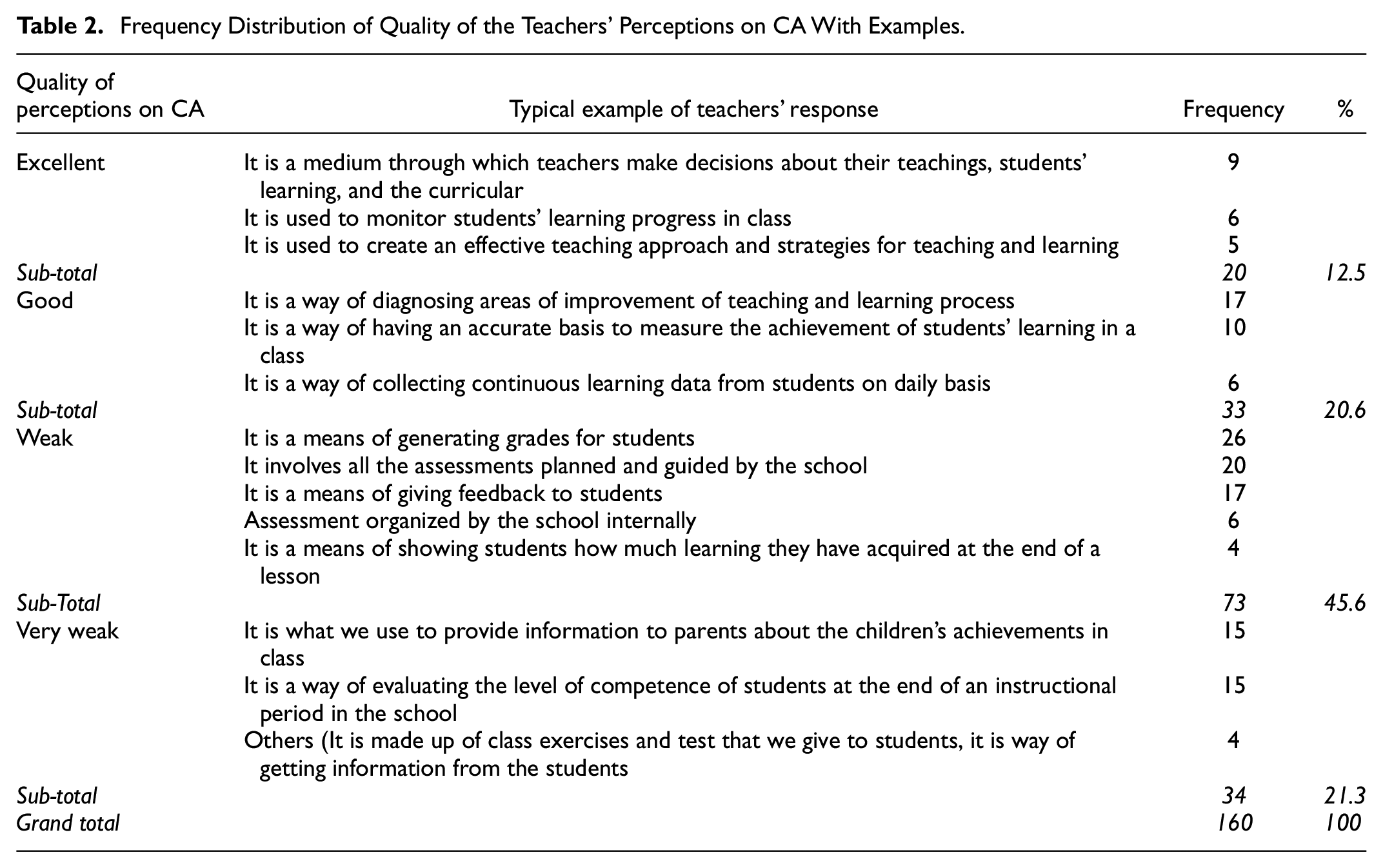
Brown’s (2008) four categories of teachers’ perceptions of CA namely Excellent, Good, Weak and Very Weak were used to analyze the results of the SHS mathematics teachers’ perceptions. Table 2 presents the summary of results. The results in Table 2 show that the majority (66.9%) of the SHS mathematics teachers’ perceptions of CA were in either weak or very weak categories. Only about a third (33.1%) had perceptions of CA which were in either excellent or good categories.
Findings in Relation to Research Question Two: “What Do Senior High School Mathematics Teachers Use Continuous Assessment Scores for?”
This question sought to explore the use to which mathematics teachers put CA scores. Table 3 summarizes the results on the uses of CA scores, as reported by the teachers. The results in Table 3 show that the use to which the majority (62.5%) of the SHS mathematics teachers put students’ CA scores could be described as either very weak or weak. Only a few (37.5%) had their use of students’ CA scores in the excellent or good categories.
Frequency Distribution of the Quality of Teachers’ Use of CA With Examples.

Findings in Relation to Research Question Three: “What Challenges Do Senior High School Mathematics Teachers Face in Conducting Continuous Assessment?”
This research question explored the challenges that SHS mathematics teachers said they faced when administering CA. The results are presented in Table 4.
Frequency Distribution of the Challenges Teachers Said They Faced in Administering CA With Examples.

The results in Table 4 show that the challenges identified by the teachers could be grouped into four: “Constraints in marking assessment tasks/activities” (37.5%), “Constraints in constructing assessment task/activities” (33.1%), “Time constraints” (23.8%), and “Others” (5.7%). The challenges relating to constraints in marking assessment task and activities, and constraint related to designing and carrying out assessment activities were frequently mentioned by the teachers. These accounted for the majority (63.8%) of the challenges identified by the teachers.
In the following section of the paper, we present the outcome of the hypothesis tested. Presented in Table 5 are the results of Pearson Correlation between SHS mathematics teachers’ perceptions and their use of CA scores.
Results of Pearson Correlation Between SHS Teachers’ Perceptions and Their Uses of CA.

Correlation is significant at the .01 level (two-tailed).
The results in Table 5 reveal a very strong positive correlation between teachers’ perception and their use of CA scores (r = .985, n = 160, p = .0, p < .01, two-tailed). These results suggest that higher levels of teachers’ perceptions of CA are associated with the quality of use of CA scores.
The results of Pearson Multiple Correlation between teachers’ teaching experience, professional status, and their use of CA scores are presented in Table 6.
Results of Multiple Correlations Between Teachers’ use of CA Scores and Their Professional Status and Teaching Experience.

The results in Table 6 show a very strong positive correlation between teachers’ teaching experience and their use of CA scores (r = .644, n = 160, p = .0, p < .01, two-tailed). This suggests that the higher the teachers’ teaching experience, the better the uses to which students’ CA scores are put in the teaching and learning of mathematics. However, a weak correlation was found to exist between teachers’ professional status and their uses of CA scores. These results suggest that teachers with the requisite professional qualifications’ use of CA scores did not reflect high quality use of CA scores in the teaching and learning of mathematics.
To determine the combined effect of teachers’ teaching experience and professional status on their uses of CA scores, model summary and ANOVA parameters were computed. The results of the model summary and ANOVA parameters for the effect of teachers’ use of CA scores based on their professional status and teaching experience are presented in Table 7.
ANOVA Results on the Effect of the Teachers’ Use of CA Scores and Their Professional Status and Teaching Experience.

Dependent variable: teachers’ use of CA scores.
Predictors: (constant), Teachers’ professional status and teaching experience.
A standard multiple linear regression was computed to predict SHS mathematics teachers’ use of CA based on their professional status and their teaching experience. The results show a positive correlation between the independent variables (i.e., teaching experience and professional status) and dependent variable (i.e., teachers’ use of CA) with adjusted R square = .44, p = .0. These variables were statistically significant predictors of teachers’ use of CA scores (F (2,157) = 62.256, p < .05, R 2 = .44, p = .0, p < .05). Participants’ predicted use of CA is equal to 1.115 + 0.358(professional status) +0.089(teaching experience), where independent variable1 was coded teaching experience and independent variable2 was coded professional status.
The results in Table 8 show the Pearson Multiple Correlations between teachers’ professional status, teaching experience, and their perceptions of CA.
Pearson Multiple Correlations Between Teachers’ Perceptions of CA and Their Professional Status and Teaching Experience.

The analysis of the results in Table 8 reveals a very strong positive correlation between teachers’ teaching experience and their perceptions of CA (r = .649, n = 160, p = .0, p < .01, two-tailed). The results suggest that higher levels of teachers’ teaching experience are associated with strong positive perceptions of CA. This means that the higher the teachers’ teaching experience, the better their perceptions of CA. However, a weak correlation was found to exist between teachers’ professional status and their perceptions of CA. This result appears to show that being a professional teacher does not generally guarantee positive perceptions of CA.
To determine the combined effect of teachers’ teaching experience and professional status on their perceptions of CA, a model summary and ANOVA parameters were computed. The results in Table 9 show the model summary and ANOVA parameters for the effect of the teachers’ professional status and teaching experience on their perceptions of CA.
Results of ANOVA on Effect of the Teachers’ Professional Status and Teaching Experience on Their Perception of CA.

Dependent variable: teachers’ perception of CA scores.
Predictors: (constant), Teachers’ professional status and teaching experience.
A standard multiple linear regression was computed to predict SHS mathematics teachers’ perceptions of CA based on their professional status and their teaching experience. The result shows a positive correlation between the independent variables (i.e., teaching experience and professional status) and dependent variable (i.e., teachers’ perceptions of CA) with adjusted R square = .44, p = .0. These variables were statistically significant predictors of teachers’ perceptions of CA, F (2,157) = 62.631, p < .05, R 2 = .44, p = .0, p < .05. Participants’ predicted perception of CA is equal to 1.056 + 0.324 (professional status) +0.816(teaching experience), where independent variable1 was coded teaching experience and independent variable2 was coded professional status.
To determine the effect of SHS mathematics teachers’ teaching experience on their perceptions and use of CA, the test of between-subject effects was computed, using MANOVA. A one-way between-groups multivariate analysis of variance was performed to investigate the effect of SHS mathematics teachers’ teaching experience on perceptions and use of CA scores. Two dependent variables were used: SHS mathematics teachers’ perception of CA, and use of CA scores. The independent variable was SHS mathematics teachers’ teaching experience. Preliminary assumption testing was conducted to check for normality, linearity, univariate and multivariate outliers, homogeneity of variance-covariance matrices, and multicollinearity with only violation of equal variances assumed. This was considered a minor violation, as asserted by Tabachnick and Fidell (2013). Table 10 shows the results of the test of between-subject effects for the dependent variables (SHS mathematics teachers’ perception and use of CA scores) and the independent variable (SHS mathematics teachers’ teaching experience).
Tests of Between-Subjects Effects of Teachers’ Perceptions and Use of CA Scores and Their Teaching Experience.

squared = .119(Adjusted R Squared = .114).
R squared = .118(Adjusted R Squared = .112).
The results in Table 10 show a statistically significant effect of SHS mathematics teachers’ teaching experience on both their perception of CA (F [1,158] = 21.439; Wilks’ Lambda = 10.674; p = .0, p < .05; partial n 2 = .12) and use of CA scores (F [1,158] = 21.088; p = .0, p < .05; partial n 2 = .12).
The univariate effect was explored, using ANOVA, with pairwise comparisons of SHS mathematics teachers’ perception and use of CA scores between experienced and novice teachers. The pairwise comparison for teachers’ perception and use of CA scores between experienced and novice teachers are presented in Table 11.
Pairwise Comparisons.

Note. Based on estimated marginal means.
Adjustment for multiple comparisons: Bonferroni.
The mean difference is significant at .025 level.
The results in Table 11 show that the mean scores of the experienced teachers’ perception of CA were significantly higher than that of the novice teachers (Mean Score = 2.43, SD = 0.94 for the experienced teachers and Mean Score = 1.68, SD = 0.57 for the novice teachers, p < .025). Again, the mean score of the experienced teachers’ use of CA was also significantly higher than that of the novice teachers (Mean Score = 2.43 and SD = 0.95 for experienced teachers and Mean Score = 1.68, SD = 0.57 for the novice teachers, p < .025).
To determine the effect of SHS mathematics teachers’ professional status on their perceptions and use of CA, the test of between-subject effects was computed, using MANOVA. A one-way between-groups multivariate analysis of variance was performed to investigate the effect of professional status (professionals, N = 114 and non-professionals, N = 46) on teachers’ perception and use of CA scores. Two dependent variables were used: SHS mathematics teachers’ perception of CA, and their use of CA scores. The independent variable was mathematics teachers’ professional status. Preliminary assumption testing was conducted to check for normality, linearity, univariate and multivariate outliers, homogeneity of variance-covariance matrices, and multicollinearity, with only violation of equal variances assumed. This was considered a minor violation (Tabachnick & Fidell, 2013); hence, we set a new alpha value of .025, as suggested by Tabachnick and Fidell (2013).
Table 12 shows the tests of between-subject effects for the dependent variables (SHS mathematics teachers’ perception and use of CA) and the independent variable (SHS mathematics teachers’ professional status).
Tests of Between-Subjects Effects of Teachers’ Perceptions and Use of CA Scores and Their Teaching Experience.
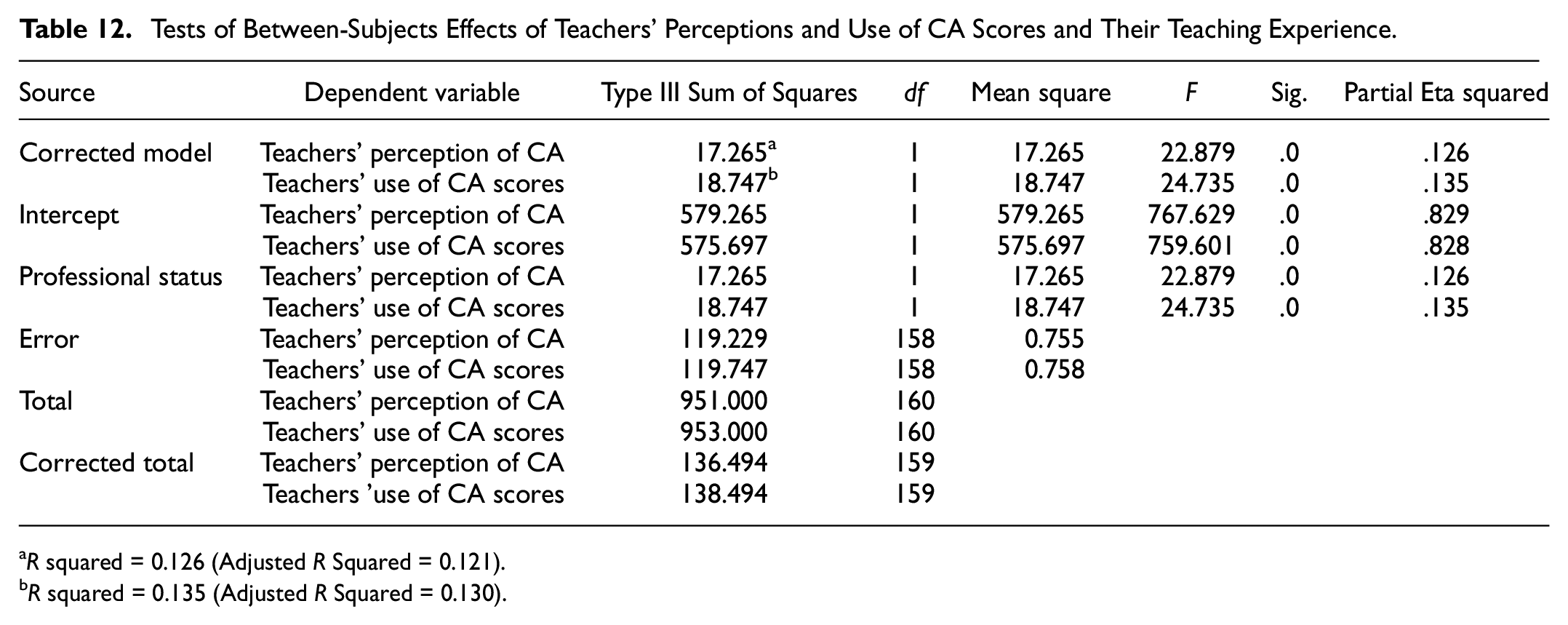
R squared = 0.126 (Adjusted R Squared = 0.121).
R squared = 0.135 (Adjusted R Squared = 0.130).
The results in Table 12 show a statistically significant multivariate effect of professional status on both teachers’ perception of CA (F (1,158) = 22.879; Wilks’ Lambda = 12.464; p = .00, p < .025; partial n 2 = .130 and teachers’ use of CA scores (F (1, 158) = 24.735; p = .00, p < .025 partial n 2 = .14.
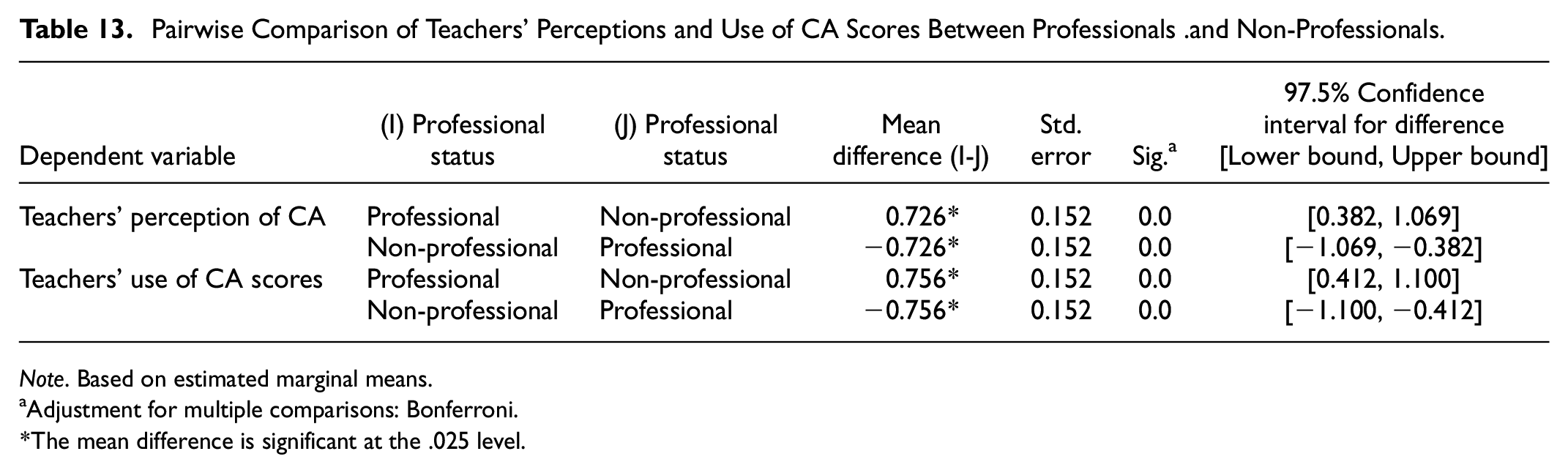
The univariate effect was explored, using ANOVA, with pairwise comparisons of SHS mathematics teachers’ perception and the use of CA scores between professionals and non-professionals. The pairwise comparison for teachers’ perception of CA between professionals and non-professionals is presented in Table 13.
Pairwise Comparison of Teachers’ Perceptions and Use of CA Scores Between Professionals .and Non-Professionals.
Note. Based on estimated marginal means.
Adjustment for multiple comparisons: Bonferroni.
The mean difference is significant at the .025 level.
The results in Table 13 show that the mean scores for professional teachers’ perception of CA were significantly higher than the non-professionals (Mean Score = 2.46 and SD = 0.98 for professional teachers and Mean Score = 1.74 and SD = 0.49 for non-professional teachers, p < .025). Again, the mean score on the professional teachers’ use of CA scores was also significantly higher than the non-professionals (Mean Score = 2.47 and SD = 0.98 for professional teachers and Mean Score = 1.72 and SD = 0.49 for non-professional teachers, p < .025). In other words, professional and non-professional SHS mathematics teachers differed in their perception and use of CA scores.
Discussion
The majority of the SHS mathematics teachers’ perceptions of CA was weak; only a few of them had strong perception of continuous assessment. Majority of the teachers’ view of continuous assessment was limited to a means of generating grades for students and to also inform parents about their children’s academic achievements in school. As with teachers’ perception of CA, the findings on the use to which CA scores are put also revealed weak use of CA scores by the mathematics teachers. The majority (62.5%) of the SHS mathematics teachers’ use of the CA scores was low. Their use of CA scores mainly reflected generation of scores for the purpose of grading (Table 3). Brown and Hirschfeld (2007) made a similar observation in their study involving secondary school students and their teachers in New Zealand, which revealed that the majority of secondary school mathematics teachers and their students had a low perception of CA. Other researchers have also reported that only a few teachers use CA scores extensively in secondary schools to promote quality learning (Karim, 2015; Sach, 2012). Brown (2008), for example, observed from his study on the uses of CA scores by teachers that the majority of high school teachers have low uses of CA scores. The findings from this study, therefore, add to the international literature on teachers’ low perceptions of CA and use of CA scores.
The SHS mathematics teachers’ low perceptions of CA and use of CA scores could be attributed to the lack of, or very limited training opportunities for teachers to be conscious of the purpose of CA. Traditionally, professional development sessions focus on building teachers’ skills, either in teaching, setting questions or helping them to understand contents that are often reported as being difficult for students to learn or teachers to teach. The examination driven nature of the Ghanaian school system is also likely to influence the world view of teachers to see continuous assessment as just a means of generating scores to grade students at the end of their program since continuous assessment form 30% of the entire assessment of students at the SHS level at the end of their program.
The literature suggests that there is a link between teachers’ perceptions and their use of continuous assessment (Dayal, 2021). This implies that the low perceptions of the majority of the Ghanaian SHS mathematics teachers indicate that they are not likely to use CA as the basis to collect data on students’ learning to improve teaching and learning in mathematics classroom. The view of CA as a means to generate students’ scores and to give feedback to students, for example, attests to the fact that the assessment for learning and assessment as learning are not practiced among the majority of the teachers but only assessment of learning. This has the tendency to adversely affect the quality of teaching and learning because opportunities to identify learning difficulties through CA is lost because of overemphasis on generating scores for the purposes of grading and reporting. The function of CA as a tool for feedback to students and decision making about students’ learning will, therefore, be lost in the classroom of many of the teachers who participated in this study (Cerasoli et al., 2014; Garrison & Ehringhaus, 2011 ).
Challenges related to the constraints in marking assessment tasks/activities and constructing assessment task/activities constituted the difficulty the majority (63.8%) of the teachers mentioned. These challenges appear to persist because previous studies in Ghana and elsewhere have highlighted similar challenges (Asare, 2020; Dayal, 2021; Karim, 2015). Some of the challenges could be attributed to the context of schooling. For example, many high schools in Ghana currently have very large class sizes and teachers have to teach several classes as a result of the introduction of Ghana Government’s Free Senior High School policy in 2017. This policy has made it possible for all students who would not have had the opportunity to enroll in secondary education for financial reason to do so. While students’ enrollment at the Senior High School level has increased exponentially, the same cannot be said about the number of teachers employed to teach mathematics and classrooms to accommodate the large numbers of students. Teachers do not also have teaching assistants to assist them with marking. This situation will naturally make marking and tracking of students’ performance with the aim of helping them to improve on their learning outcomes very difficult. Some teachers mentioned difficulty in constructing assessment tasks in mathematics.
The challenge associated with setting of questions could also be related to teachers’ level of control over the subject matter. The literature suggests that posing cognitively engaging assessment task in mathematics requires fluency, flexibility, and originality with mathematical knowledge (Singer et al., 2015). It could also be due to the lack of training opportunities since the current Continuous Development program run by the Ghana National Teaching Council does not seem to have a module specific for assessment in mathematics (National Teaching Council [NTC], 2021).
The results of the study revealed a strong positive correlation between teachers’ perceptions of CA and the use to which they put CA scores (.985). This suggests that teachers who have positive perceptions or views about CA are more likely to use CA scores to promote learning in their mathematics classroom than those who have negative perceptions. This finding confirms and, therefore, adds to the existing literature in the area (Dayal, 2021).
The multivariate analysis of the results on the effect of teaching experience on teachers’ perceptions and the use of CA scores in mathematics revealed that the teaching experience of mathematics teachers was found to have a significant effect on their perceptions of CA and the use to which they put CA scores. The univariate analysis showed that experienced teachers’ perceptions of CA and use of CA scores were significantly higher than those of the novice teachers. The correlation between teaching experience, perceptions on CA and use of CA was also strong. This finding is not surprising because the experienced teachers have gained experience on the job through practice and professional learning opportunities that might have been available to them. The finding also supports the literature on the relationship between teaching experience and teacher effectiveness, which suggests that generally more experienced teachers are more effective than new teachers (Podolsky et al., 2019; Rice, 2010). Thus, experienced teachers are more likely to be effective in their continuous assessment practices than less experienced teachers.
The multivariate analysis of the results on the effect of professional status on teachers’ perceptions and use of CA scores in mathematics revealed that the professional status of the mathematics teachers had a significant effect on their perceptions of CA and the use to which they put CA scores. The univariate analysis showed that the professional mathematics teachers’ perceptions of CA and use of CA scores were significantly higher than those of the non-professional mathematics teachers. The correlation between professional status, perceptions on CA, and use of CA was, however, weak. This finding suggests that while the professional teachers seem to be ahead of the non-professional teachers, their perceptions and use of CA scores still need to be improved. Their perception of CA did not generally reflect the excellent perceptions that support best practices, while the use to which they put the CA scores did not also reflect high levels of use that support the use of assessment as learning and assessment for learning (Mok, 2011; Western and Northern Canadian Protocol for Collaboration in Education, 2006).
Conclusion and Implication
Based on the results of the study, we conclude that majority of the mathematics teachers who participated in the study had weak perceptions of CA and low use of CA scores. Their perception generally positions CA as means of generating scores and their use of CA scores was mainly for grading and communicating same to parents. Their world-view of assessment was limited to assessment of learning but not assessment for learning or assessment as learning (Mok, 2011; Western and Northern Canadian Protocol for Collaboration in Education, 2006). The implication of this finding is that many of these teachers are not likely to use assessment as a means for collecting data on students’ mathematics learning to improve learning outcomes in mathematics classrooms.
The difficulty in marking assessment and setting assessment tasks were the challenges the majority of the mathematics teachers highlighted. This implies that the majority of the teachers either struggle to score mathematical tasks assigned to students or struggle to set tasks for the students. This could lead to the situation where teachers might exaggerate continuous assessment scores because of the challenges associated with generation of the scores. There may be the need for the Ghana Education Service (GES) to consider appointing teaching assistants for mathematics teachers in the research locale and other districts that may be experiencing similar problems.
The mathematics teachers’ perceptions and use of continuous assessment scores were found to be strongly correlated. This implies that teachers’ world view of continuous assessment appears to have a direct relationship with the quality of use to which continuous assessment scores are put. There is the need for school heads, heads of mathematics department, the District and Regional Education offices and NTC to support mathematics teachers to develop more positive/high perceptions of continuous assessment through regular continuous professional development sessions. This may help improve the use to which they put continuous assessment scores.
Teaching experience and professional status of teachers had significant effect on mathematics teachers’ perceptions of CA and use of CA scores. However, the correlation between professional status, perception of CA and use of CA score appears to be weak. This implies that a good number of the professionally trained mathematics teachers also generally had weak perception and low use of CA scores. This finding also has implication for continuous professional development. It suggests that continuous professional development in continuous assessment should pay attention on both professional and non-professional teachers, but more on the non-professional teachers since the professional teachers’ perceptions of CA and use of CA scores were found to be higher than the non-professional teachers.
Footnotes
Declaration of Conflicting Interests
The author(s) declared no potential conflicts of interest with respect to the research, authorship, and/or publication of this article.
Funding
The author(s) received no financial support for the research, authorship, and/or publication of this article.
