




Abstract
This study analyzed the mediating influence of social capital and the moderated mediating effects of social capital and intensive reflection vis-à-vis near transfer (NT) and far transfer (FT). The results obtained from data pertaining to 401 elementary school teachers in Korea revealed the following: (1) NT positively influences FT; (2) there is a direct relationship between NT and social capital; and (3) social capital does not directly impact FT on its own but affects FT when combined with intensive reflection. The results offer crucial theoretical and policy implications for teacher education and professional development programs worldwide.
Keywords
Introduction
As participants in continued professional education, teachers are required to apply and adapt their knowledge and skills for various social situations inside and outside school settings to cope with the needs of students, parents, and caregivers (H. J. Kim, 2016; Nafukho et al., 2017). Some researchers acknowledge that it is often difficult for teachers to participate in and integrate knowledge from professional education programs due to the limited time and resources available for such courses (Hyun, 2004; H. J. Kim & Hyun, 2018; Prenger et al., 2019).
The educational sector must adapt to help teachers resolve the needs of stakeholders (Holton & Baldwin, 2003). As a result, professional education programs must adapt to train teachers in the application of the knowledge and skills that are needed in the modern workplace (Blume et al., 2010; Cheng & Ho, 2001; Fauth & González-Martínez, 2022; Holton & Baldwin, 2003). This need to apply learning to the development of appropriate practices has caused numerous researchers to explore the theme of learning transfer (Foley & Kaiser, 2013; Penner-Williams et al., 2017).
Learning transfer is defined as the activity where information learned in one situation is applied to another case. Regarding adult learners, learning transfer refers to the application of knowledge and skills learned in training to their jobs (Dreer et al., 2017; Fauth & González-Martínez, 2022; Holton & Baldwin, 2003; Roumell, 2019). Even though there are a variety of taxonomies of learning transfer, it is generally classified as near and far transfer (Hyun, 2004; Sala et al., 2019). Near transfer (NT) requires learners to directly apply knowledge and skills absorbed in the learning program to contextually similar workplace tasks (Laker, 1990). Far transfer (FT) requires learners to adapt their learned knowledge and skills to contextually distant situations that may be either pertinent or unrelated to their performed tasks (Salomon & Perkins, 1989).
FT is more difficult to discern in the workplace than NT (Hyun, 2004; H. J. Kim, 2016). Some researchers (Choi, 2020; Enos et al., 2003; J. H. Kim & Callahan, 2013; Sala et al., 2019) assert that NT learning experiences can generate important elements that encourage FT. Holton and Baldwin (2003) proposed a linear relationship labeled the transfer distance model (TDM) to show that NT can predispose FT. Given the close association between NT and FT in the TDM, clarifying the elements related to NT that can effectively generate FT is crucial.
Many unanswered questions remain regarding the TDM, including, notably, the factors that mediate or moderate the relationship between NT and FT. The traditional TDM suggested that repeating and maintaining a training application represents an important connection between NT and FT (Han & Na, 2015; Holton & Baldwin, 2003). Some researchers have reported results that do not support a linear relationship between NT and FT; elements such as reflective thinking, support from others, social capital, and NT have been suggested as correlated in generating FT (Dreer et al., 2017; Enos et al., 2003; Prenger et al., 2019). The concept of social capital has gained support from other researchers (Ado et al., 2017; Portes, 2000; Putnam, 1995); hence, reflective thinking and social capital may be closely linked to the generation of FT without the involvement of NT.
Many researchers have defined social capital as the resources generated through human relationships institutionalized in societies (Enai, 2014; Modipane & Themane, 2014). Social capital combines with other information, knowledge, and skills to expand its scope (Dika & Singh, 2002; Liu, 2018; Portes, 2000). For example, learners absorb knowledge and skills in an education program and, through NT, apply this information in job-related situations. At the next stage of NT, learners can form social capital by establishing relationships with others and applying transformed knowledge in new situations (Salomon & Perkins, 1989; Shin & Hyun, 2021), achieving FT. Thus, social capital can mediate the relationship between NTs and FTs.
Enos et al. (2003) define reflective thinking as a problem-solving process that helps individuals pinpoint problems they face, analyze, and evaluate them, and internalize their views to resolve the difficulties. Such internalizing is closely associated with FT—it encourages individuals to revise their learning strategies and transform learned knowledge and skills or create new channels to absorb information (Macaulay & Cree, 1999). This process forces learners to apply and adapt their learning and skills to new circumstances that are related or unrelated to their workplace functions (Chi et al., 1989; Prenger et al., 2019). Assuming that reflective thinking is hierarchical, the degree of reflective thinking can moderate the effect of FT with social capital as a mediator (H. J. Kim, 2016; H. J. Kim & Hyun, 2018; Nafukho et al., 2017; Peltier et al., 2005).
Therefore, social capital can mediate the relationship between NT and FT and the degree of reflective thinking can moderate the association between these two types of knowledge transfer when combined with social capital. It is important to illuminate the mediating influence of social capital and the moderated mediating effects of social capital and reflective thinking between NT and FT. Mediation and moderation analyses are thus integrated to simultaneously ascertain the mediation and moderation effects of social capital and reflective thinking (Hayes, 2013). In other words, intensive reflection, the highest degree of reflective thinking, can expedite moving from NT to FT based on connections and interactions (H. J. Kim, 2016), covering the moderated mediation effect of intensive reflection between social capital and FT (Dreer et al., 2017; Roumell, 2019). Therefore, intensive reflection moderates the mediating effect of social capital on FT.
This study adopts the following objectives: First, to explore whether social capital can mediate the relationship between NT and FT and second, if so, to integrate mediation and moderation factors to examine whether intensive reflection moderates the effects of social capital as a mediator of FT. This study is significant for several reasons. First, it clarifies the role of social capital in association with intensive reflection to reinforce FT within the teaching community and in teacher education programs. Second, the study results can help curriculum developers and policymakers draft and develop appropriate educational programs and policies for teachers. Third, globally, teacher quality, and teacher education are important topics in the field of education policy; this study can contribute to the improvement of teacher professional development models by empirically testing recent theories and frameworks (e.g., Brandt et al., 2019; Gibbons et al., 2021; Pak et al., 2020; Sancar et al., 2021) that emphasize collective collaboration and learning, establishment of positive culture, and relationship building, teacher reflection, and individual teacher learning.
Literature Review
Definition of Learning Transfers and Their Types
A learning transfer is the intended short- or long-term outcome of individual educational activities (Dreer et al., 2017; Shin & Hyun, 2021; Xiao, 1996). Some researchers have defined the term as the extent to which a learner effectively applies knowledge, skills, and attitudes absorbed during education and training in the workplace (Holton, 1996; Roumell, 2019; Sala et al., 2019). Noe (1986) expanded the conceptual scope of the term to incorporate the learner’s continuous and effective application of appropriate cognitive strategies along with the embedded knowledge, skills, and attitudes from training. Russ-Eft and Preskill (2001) and Roumell (2019) explain the concept as the extent to which a learner applies the knowledge, skills, and attitudes learned during a lesson or training. This definition is closely associated with the concept of the generalization of absorbed knowledge for application to work-related tasks (Dreer et al., 2017; H. J. Kim, 2016; Sala et al., 2019).
According to Baldwin and Ford (1988), maintenance is defined as the way in which learners continuously apply their knowledge and skills in their jobs and how they continually adapt their behaviors in response to changes. Generalization denotes the extent to which learners apply the absorbed knowledge to performing work-related tasks, while maintenance concerns the extent to which learners utilize applied skills and change their behaviors (Cvercko, 1994; Fauth & González-Martínez, 2022). Therefore, learning transfer is defined as the extent to which learners apply knowledge, skills, and attitudes absorbed from education and training to tasks in the workplace and cause changes in their behavior.
Learning transfers are classified into several types; however, they are generally categorized in terms of NT and FT (H. J. Kim, 2016; Sala et al., 2019). Laker (1990) emphasized the core question—“Where should someone apply the knowledge, skills, and attitude absorbed in the education and training?”—to categorize learning transfers, classifying them as NT and FT. The identical elements theory explains NT and FT, describing them as the degree to which the knowledge, skills, and attitudes learned from one situation can be transmitted to another situation; the type of transfer depends on the similarities between the two situations (Woodworth & Thorndike, 1901). NT implies a transfer to application contexts that are almost identical to the topics of training (Hyun, 2004; J. Kim et al., 2020). Thus, a person can solve problems in the application context if they are confronted with a problem or task almost identical to the training context (H. J. Kim, 2016; Roumell, 2019).
Absorbed knowledge, skills, and attitudes can be transmitted when two situations are heterogeneous. FT signifies the transfer of trained elements when the training context differs from the application context (H. J. Kim & Hyun, 2018; Yamnill & McLean, 2001) and demonstrates a person’s ability to solve problems in the application context when confronted with tasks different from the training context (Sala et al., 2019; Spitzer, 1984). Consequently, the difference between NT and FT concerns the learner’s ability to apply training-related knowledge, skills, and attitudes to contexts that differ from the training context in varying degrees.
Social Capital Defined
Social capital encompasses various perspective-related attributes (Beugelsdijk & Van Schaik, 2005; Van Der Gaag & Snijders, 2005; Woolcock & Narayan, 2000). According to Bourdieu and Wacquant (1992), social capital is “the sum of the resources, actual or virtual that accrue to an individual or a group by virtue of possessing a durable network of more or less institutionalized relationships of mutual acquaintance and recognition” (p. 119). This conceptualization of social capital emphasizes its power to induce people to acquire resources through networks (Organization for Economic Cooperation and Development, 2000) that simultaneously act as resources and serve as the impetus to acquire the required means (Marsden & Hurlbert, 1988).
Coleman (1988) defined social capital as “a variety of different entities, with two elements in common: they all consist of some aspect of social structure, and they facilitate certain actions of actors—whether persons or corporate actors—within the structure” (p. 98). This description is functionally associated with something that expedites individual or collective action initiated by networks and is closely linked with relationships, reciprocity, trust, and social norms (Portes, 2000).
The conceptualization of social capital has evolved incrementally but discriminately based on the abovementioned definitions. Putnam (1995, 2000) explained social capital as a public good, the sum of participatory potentiality, civic orientation, and trust in others in cities, states, or nations, performing a collective function at the aggregate level. This explanation demonstrates the aggregating but judicious variance between his viewpoint and those of Bourdieu and Wacquant (1992) and Coleman (1988). In Putnam’s (1995) view, social capital involves “features of social organizations, such as networks, norms and trust that facilitate action and cooperation for mutual benefit” (p. 35). Thus, social capital can essentially be considered a quality that is closely linked to the function of an animator of interpersonal cooperation (Putnam, 2000).
As mentioned above, the network forms the core of social capital and functions in the social organization to produce mutual benefits (Almager, 2015). It is additionally emphasized that institutions (Chattopadhay, 2013; Modipane & Themane, 2014), societies and individuals (Almager, 2015), and individuals and others (Belfi et al., 2015; Brimhall, 2014; Enai, 2014; Koebley, 2013; Minckler, 2014) can designate the elemental reasons for which the networks are facilitated. Consequently, social capital denotes the added value formed by networks between an individual and others or institutions.
In summary, social capital should consider its structural, cognitive, and relational dimensions, which are closely linked to one another (Coppe et al., 2022; Farooq, 2020; Nahapiet & Ghoshal, 1998). More specifically, the structural dimension is deeply associated with the configuration and stability of the network (Ado et al., 2017; Inkpen & Tsang, 2005). The cognitive dimension is closely linked to goals, cultures, or codes, language, and narratives shared among people (Nahapiet & Ghoshal, 1998; Prenger et al., 2021). The relational dimension is described from the viewpoint of trust, norms, and obligations (Inkpen & Tsang, 2005; Nahapiet & Ghoshal, 1998). Thus, social capital can be extended to these dimensions in a manner closely linked to abstract and practical values. As a result, social capital can be associated with individuals’ learning or higher-order thinking, such as reflective thinking, and problem solving (Aslam et al., 2021; Coppe et al., 2022; Farooq, 2020; Prenger et al., 2021).
Definition and Levels of Reflective Thinking
Explaining reflective thinking is problematic because of differences in researchers’ conceptualization of the term. Many scholars have considered reflective thinking to involve a stepwise process (Johnsson & Svensson, 2005; Merriam et al., 2007; Mintzberg & Gosling, 2002; Payne, 1998; Peltier et al., 2005; Roessger, 2014), demonstrating the necessity of visualizing every stage of reflective thinking to accurately define the concept.
Experience is a prerequisite of the expression of reflective thinking (Kolb, 1984; Korthagen, 2017; Peltier et al., 2005; Van Manen, 1991). Experience connotes a personal usage or practical sensing of the knowledge acquired through this process. It further can serve as the impetus to resolve a problem or situation through personal perspectives (H. J. Kim & Hyun, 2018; Merriam et al., 2007). Thus, individuals can exhibit habitual behaviors or introspection based on an experience; however, reflective thinking must be pushed past introspection to reorganize problems or situations and explore alternatives (Aslam et al., 2021; Korthagen, 2017; Mezirow, 1981).
Reflective thinking involves a stepwise process. The first stage of reflective thinking requires an individual to discover the problem(s) based on an experience (Johnsson & Svensson, 2005; Mintzberg & Gosling, 2002). The individual formulates a personal opinion of the world based on their experiences and discovers valuable or meaningful elements related to a variety of problems (Boyd & Fales, 1983; Merriam et al., 2007). The problems may be complex, unstructured, and even unsolvable (Johnsson & Svensson, 2005; Roessger, 2014).
The second step of reflective thinking is an individual’s critical analysis of the problem(s) based on previously attained information and knowledge (Johnsson & Svensson, 2005; Merriam et al., 2007; Mintzberg & Gosling, 2002; Peltier et al., 2005). The individual analyzes the problem(s) based on previous information and knowledge and further clarifies the fundamental principles and rationality of the structured problem(s) (Fauth & González-Martínez, 2022; Peltier et al., 2005). This process causes the individual to explore alternatives to resolve the problem(s) and simultaneously prepare to judge between the alternatives (Boyd & Fales, 1983; Johnsson & Svensson, 2005).
The third step of reflective thinking requires an individual to internalize their personal perspective to solve the problem(s) (H. J. Kim & Hyun, 2018; Korthagen, 2017). The individual can improve their intelligence and cognition by internalizing their personal perspective of the problem (Boud et al., 1985). Reflective thinking thus involves three processes that occur in distinct stages: the discovery of the problem(s) based on experience, critical analysis and evaluation of the problem(s) based on previously attained information and knowledge, and the internalization of the personal perspective to resolve the problem(s).
Numerous scholars have established the hierarchy of reflective thinking using their own criteria (Korthagen, 2017; Mezirow, 1981; Ross, 1989; van Manen, 1977; Zeichner & Liston, 1985). Peltier et al. (2005) structured reflective thinking on the basis of previous research—habitual actions, understanding, reflection, and intensive reflection. The basic level of reflective thinking concerns habitual actions, which are the automatic or unconscious acts committed through routine informal learning (Kember, 1999). The next level of reflective thinking involves the acceptance of new situations or experiences and their interpretation within the framework of previously understood knowledge (Buzdar & Ali, 2013). Next, reflective thinking pertains to the discovery of the problem(s) in a specific situation and using critical analysis and processes to resolve the discovered problem(s) (Kember, 1999).
Intensive reflection forms the highest degree of reflective thinking and encompasses the comprehension of the reasons for recognition, thinking, feeling, and behaviors (Aslam et al., 2021; Kember, 1999). In this stage, the individual examines core issues, clarifies their meaning within a personal framework, and finally formulates their viewpoint or a recognition framework (Boyd & Fales, 1983; Korthagen, 2017; Pak et al., 2020). In summary, intensive reflection helps the learner resolve problems occurring during the learning process using a unique, personal viewpoint, or recognition framework. Intensive reflection can represent an effective element that intricately connects learning-related NT and FT (H. J. Kim & Hyun, 2018; see also Haug & Mork, 2021; Penner-Williams et al., 2017; Ping et al., 2018).
Relationships Between Near and Far Transfer, Social Capital, and Intensive Reflection
Examining the links between the components of NT and FT, social capital, and intensive reflection within the hierarchy of reflective thinking is recommended to accurately grasp the relationships between these phenomena. The link between NT and FT must be clarified before considering the positioning of social capital vis-à-vis NT and FT. Subsequently, the placement of intensive reflection between NT and FT and social capital can be understood.
The Link Between Near and Far Transfer
Several studies have been conducted on the associations between NT and FT (Carlson et al., 2015; Ganier et al., 2014; H. J. Kim & Hyun, 2018; J. H. Kim & Callahan, 2013). Initially, the studies assumed that exclusive and distinct characteristics differed between these types of learning transmission, asserting an unchangeable, independent association between them (Cvercko, 1994). Holton and Baldwin (2003) disagreed with these assumptions and postulated the TDM to explain the association between NT and FT. They defined transfer distance as the interval between every learning and transfer circumstance during which learning and transfer occur.
Figure 1 demonstrates the six stages of the TDM. The learning process occurs from steps one to three and the transfer process between steps four and six. The former develops the individual’s capability of absorbing and executing knowledge and skills; the latter sustains these developed abilities (Chung, 2011; H. J. Kim & Hyun, 2018). The first step involves the acquisition of cognitive knowledge and is labeled “know that.” The second step concerns the accrual of knowledge and is called “know how.” The third step facilitates the construction of performance capabilities through practice (Hyun, 2004). The fourth step applies job-specific proficiency; the fifth step repeats and maintains these applications (Han & Na, 2015; H. J. Kim & Hyun, 2018). NT cannot be sustained or connected to FT without these repetitions (Holton & Baldwin, 2003; Sala et al., 2019). The sixth step generalizes the duplicated and sustained practices and is closely linked to FT. The TDM demonstrates the necessity for repetition and maintenance but is limited by its failure to adequately explain the element(s) related to the prerequisite repetitions and maintenance of applications between NT and FT.

Transfer distance model (Holton & Baldwin, 2003).
Positioning Social Capital as a Mediator Between Near and Far Transfer
The repetition and maintenance of applications represent link elements between NT and FT in the TDM; however, they do not indicate strong mediators or moderators between the two processes. Understanding that repetition and maintenance merely denote crucial elements that propel the outcomes of learning behaviors without mediation and moderation is necessary (H. J. Kim & Hyun, 2018). Thus, repetition and maintenance are not mediators or moderators but rather critical factors that act as links between the processes of learning and transfer. This limitation leads to the necessity of clarifying elements that influence repetition and maintenance.
Social capital is different from the applications that repeat and maintain the link between NT and FT and can thus mediate between the two types of learning transmission. Continuous networking exchanges can create sources with knowledge variants applicable to varied fields as long as meaningful information exchanges occur through networking (Dahiyat et al., 2023; Dika & Singh, 2002; Portes, 2000; Prenger et al., 2019, 2021). Such exchanges concern NT and FT; content learned in a training context can be mediated by social capital and become applicable to tasks that differ from the training context (Ado et al., 2017; Brion, 2022; Fiore, 2007). Hence, it can be assumed that social capital mediates between NT and FT.
Some researchers (Han & Na, 2015; Hyun, 2010) have emphasized the mediation effect of social capital between NT and FT. Those in the process of NT can attain FT by focusing on repeating and maintaining the absorbed knowledge, skills, and attitudes without mediating, or moderating any factors. The mediation factors, such as social capital, can promote the progression from NT to FT. An individual can benefit from external knowledge, skills, and attitudes absorbed by connections and interactions from the others to advance their competitiveness (Dreer et al., 2017; Tzokas et al., 2015). This benefit involves a pathway closely linked to continuous scanning to obtain new external knowledge, skills, and attitudes (Altinay et al., 2015; Dahiyat et al., 2023). The connections and interactions with other parties strengthens dyadic relationships; encourage a comfortable environment to obtain external knowledge, skills, and attitudes; and promote the scope of the acquired knowledge, skills, and attitudes, such as mediating between NT and FT (Liu, 2018; Roumell, 2019).
Positioning Iintensive Reflection as a Moderated Mediator Between NT and FT and Social Capital as a Mediator
The role of reflective thinking in the linear association between NT and FT with social capital as the mediator must be determined to identify where reflective thinking occurs within this process. The generating process of reflective thinking can deduce its position between NT and FT as follows.
Learners analyze acquired knowledge and skills in exchanges with others in their networks to the extent to which their experience allows (Aslam et al., 2021; Macaulay & Cree, 1999). During this process of analysis, they evaluate the inputs, processes, and outputs of their learning; this procedure, labeled reflective analysis (Ping et al., 2018; Scanlan & Chernomas, 1997), causes learners to review their learning strategies, transform what they have learned into new knowledge and skills, and create other means to absorb this knowledge (Altinay et al., 2015; Brown et al., 1981; H. J. Kim & Hyun, 2018; Scardamalia & Bereiter, 1985).
Thus, reflective thinking changes and renews what has been learned in the training context such that it can be employed in the application context and can be utilized for workplace tasks that differ from the learning environment (Bransford & Nitsch, 1978; Chi et al., 1989; Ping et al., 2018). The process of reflective analysis is closely linked to intensive reflection in the hierarchy of reflective thinking (Aslam et al., 2021; Boyd & Fales, 1983); the intensive reflection stage of reflective thinking hence moderates the relationship between NT and FT (Fauth & González-Martínez, 2022; H. J. Kim, 2016).
Some researchers (Choi, 2020; Jung et al., 2017) established the moderation effect of intensive reflection as the highest degree of reflective thinking between the learning-related elements. Additional discussion shows the moderated mediation effect of intensive reflection on these elements (H. J. Kim & Hyun, 2018). Those who attain NT are likely to share intangible values such as goals, ambition, and vision in connections, and interactions with others (Pak et al., 2020; Roumell, 2019; Tzokas et al., 2015). This sharing of connections and interactions encourages mutual trust and norms that are closely linked to problem-solving capabilities to seek new knowledge, skills, and attitudes (Campopiano et al., 2016; Dahiyat et al., 2023).
The scope of intensive reflection is extended to external knowledge, skills, and attitudes to expand its horizons (Altinay et al., 2015; Fauth & González-Martínez, 2022) in that problem-solving capabilities are deeply associated with intensive reflection (H. J. Kim, 2016). This means that the extent of intensive reflection can expedite moving from NT to FT based on connections and interactions, which covers the moderated mediation effect of intensive reflection between social capital and FT.
Depending on the teacher’s quality in the education and training program, teachers who attain NT may share intangible values while connecting and interacting with others to bolster intensive reflection (Dreer et al., 2017; Roumell, 2019). The teachers’ extent of intensive reflection can expedite reaching the FT stage. Therefore, it is crucial to explore learning strategies to strengthen teachers’ intensive reflection on their interactions with others after enrolling in the learning program (Brandt et al., 2019; H. J. Kim, 2016; Prenger et al., 2019, 2021). This is a powerful method to bolster FT and NT.
Research Model and Hypotheses
The conceptual research model is shown in Figure 2. The propositions mentioned above, the positioning of social capital between NT and FT and the placement of reflective thinking between NT, FT, and social capital, allow for the postulation of the following hypotheses:
Hypothesis 1: Social capital mediates the effects of NT on FT.
Hypothesis 2: Intensive reflection moderates the effects of social capital as a mediator of FT.

Conceptual research model.
Methods
Data Collection
This study aims to analyze the mediating influence of social capital and investigate the moderated mediating effects of social capital and intensive reflection between NT and FT, primarily focusing on teachers enrolled in a teacher education program. The participants were elementary school teachers enrolled in an in-service training program in Seoul, South Korea. The Seoul Metropolitan Office of Education in South Korea approved the participation of teachers from the district for this study. In 2015, there were 29,627 elementary school teachers affiliated with the Seoul Metropolitan Office of Education in South Korea. This study analyzed the respondents’ reactions to the questionnaires from a sample of 382 elementary school teachers enrolled in an in-service training program (CL = 0.95, SE = ±0.05) (see Kwon & Hyun, 2004). The responses were collected from participating elementary school teachers after a year that the questionnaires were shared with them.
Table 1 presents the number of elementary school teachers at the 11 District Offices of Education in the Seoul Metropolitan Office of Education. The sample of 382 elementary school teachers was selected according to the ratio of elementary school teachers at each of the 11 District Offices of Education, and questionnaires were distributed and collected as per the abovementioned ratio. The respondents and their organizations approved the data collection and analysis for this study. The respondents reported their participation for the collection and analysis to their organization, which accepted their reports. According to Woo and Yoon (2008), listwise deletion is preferred over imputation or FIML if the gap in the number of collected and evaluated questionnaires is not large. Ultimately, 511 questionnaires were distributed, 445 were collected, and 401 that did not have any missing values were evaluated. All participants in the sample were Korean.
Minimum Sample Size and Questionnaires Distributed Via Stratified Sampling.

Note. The data mentioned above were retrieved from the Statistical Yearbook of Education: 2015 compiled by the The Korean Educational Development Institute (2015).
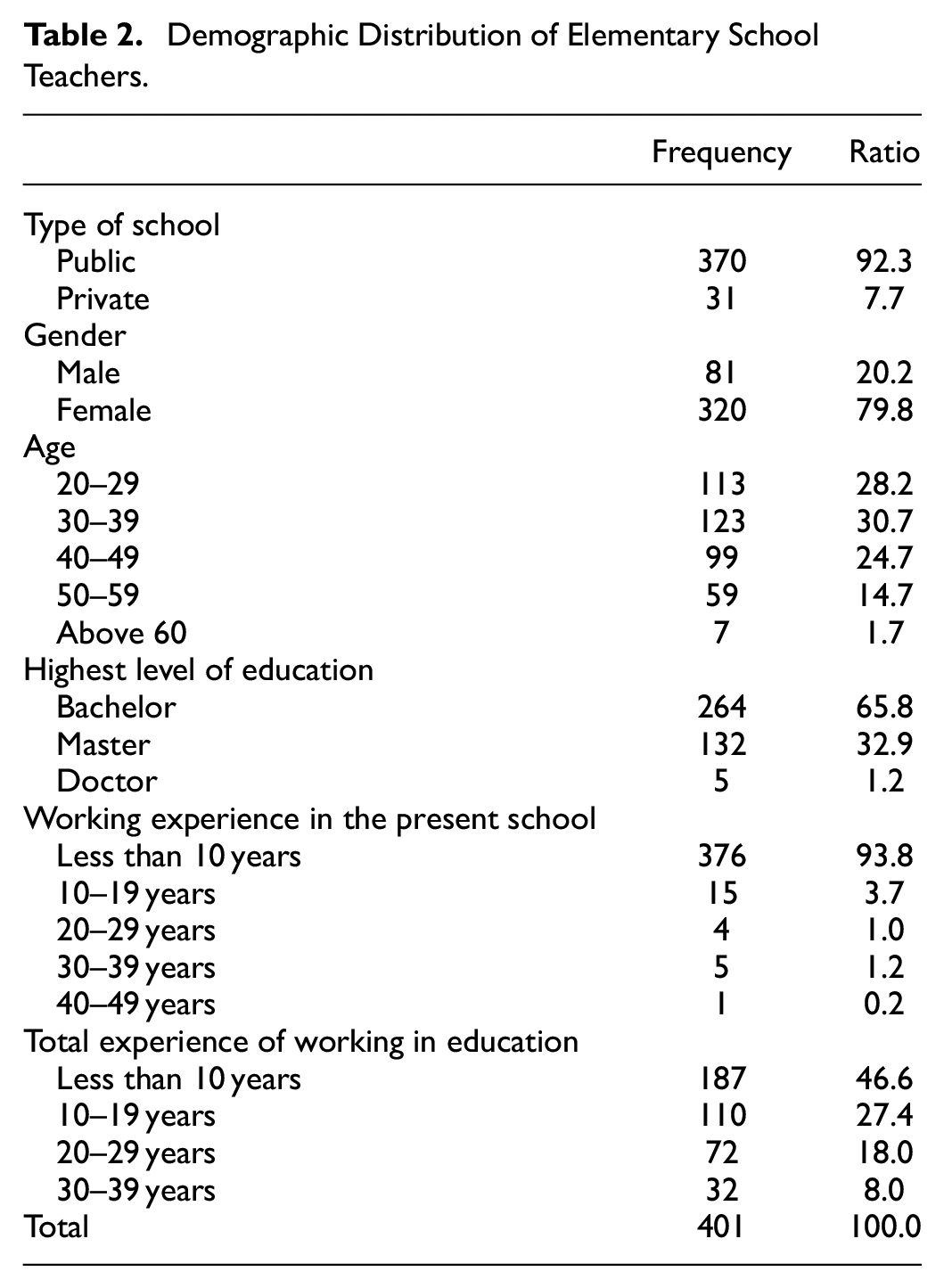
Table 2 presents the demographic information of the participants and displays that most respondents were employed in public elementary schools (92.3%) and a small number of respondents worked in private elementary schools (7.7%). The male to female ratio was approximately one (20.2%) to four (79.8%). Most respondents were aged in their twenties (28.2%), thirties (30.7%), and forties (24.7%), but a few were in their fifties (14.7%) and sixties or over (1.7%). More than 90% of respondents had a bachelor’s degree or higher. Most respondents had worked in their present school for less than 10 years (93.8%); 46.6% of respondents had accrued less than 10 years of work experience in their current school or elsewhere, 27.4% of respondents had worked for more than 10 and less than 20 years, 18.0% of respondents had worked for more than 20 and less than 30 years, and 8.0% of respondents had worked for almost 40 years.
Demographic Distribution of Elementary School Teachers.
Measures
The previous section outlined the four principal elements of this study: NT and FT, social capital, and intensive reflection as the highest level of reflective thinking. The four elements were queried based on a five-point Likert-like scale that is detailed below. The mean of social capital and intensive reflection were centered before calculating the interaction term.
First, this study measured NT and FT through an instrument developed by Rouiller and Goldstein (1993) and revised by Lee (1995). Rouiller and Goldstein (1993) developed an English-based measurement instrument classifying NT and FT as two branches of learning transmission. Lee (1995) translated the original into a Korean-based measurement instrument. The reliability of this instrument was computed in previous studies to range from a low of 0.61 to a high of 0.71. The results with the reliability of confirmatory factor analysis (CFA) revealed that five questionnaire items pertaining to NT (e.g., “I applied/will apply the learned knowledge and skills into the practical jobs in the workplace”) and three items regarding FT (e.g., “I applied/will apply the learned principles into various situations in the workplace”) were preferentially confirmed (factor loading >0.5).
However, the result with model fit indices (MFI) revealed that the results with the reliability of CFA were insufficient. The additional elimination (e.g., “I tried/will try to apply the learned knowledge and skills into practical jobs in the workplace”) of two NT questionnaire items on the modification indices (MI) established that three questionnaire items each for NT and FT could be applied to verify the hypotheses posited in this study (Cronbach Alpha = 0.876, 0.823, respectively). The MFI suggested that the results of CFA with MI were significantly acceptable (Chi-Square = 25.230 [p < .01, df = 8], RMR = 0.016, GFI = 0.979, TLI = 0.974, CFI = 0.986, RMSEA = 0.073).
Second, this study utilized Williams (2006) instrument on social capital, whose reliability had been verified in previous studies to range from 0.84 to 0.90. The results with the reliability of CFA revealed that 10 questionnaire items on social capital were preferentially confirmed (factor loading >0.5). However, the result with MFI revealed that the results with the reliability of CFA were insufficient. Upon the additional elimination (e.g., “I always contact new persons”) of two questionnaire items on the MI, eight questionnaire items on social capital (e.g., “I have many persons to talk to when I feel lonely”) were applied to verify the hypotheses postulated for this study (Cronbach Alpha = 0.901). The MFI demonstrated significantly acceptable results of CFA with MI (Chi-Square = 70.592 [p < .01, df = 19], RMR = 0.040, GFI = 0.957, TLI = 0.953, CFI = 0.968, RMSEA = 0.082).
Third, this study evaluated reflective thinking using the instrument developed by Peltier et al. (2005), whose reliability was verified in previous studies to range from 0.75 to 0.87. The results with the reliability of CFA demonstrated the preferential confirmation of four questionnaire items probing intensive reflection (factor loading >0.5). However, the result with MFI revealed that the results with the reliability of CFA were insufficient. MI results revealed that the initial four questionnaire items on intensive reflection (e.g., “I should think continuously knowledge and skills that I will learn”) could be applied to verify the hypotheses proposed in this study (Cronbach Alpha = 0.758). The MFI exhibited significantly acceptable results of CFA with MI (Chi-Square = 167.3342 [p < .01, df = 62], RMR = 0.037, GFI = 0.938, TLI = 0.912, CFI = 0.930, RMSEA = 0.065).
Data Analysis
The data analysis encompassed three procedures using the SPSS and SPSS PROCESS statistical packages. First, a descriptive statistical assessment was performed to calculate the mean, standard deviation, skewness, and kurtosis to judge the normality of each questionnaire item response. Second, a zero-order correlation and multicollinearity analysis were conducted to examine the relationship between the independent and dependent variables. Third, two conditional process analyses were applied to verify the mediation effects of social capital between NT and FT (Hypothesis 1) and confirm the moderated mediation effects of intensive reflection between NT and FT as independent and dependent variables with social capital as their mediator (Hypothesis 2).
Results
Descriptive Statistical Analysis
Table 3 shows that most respondents perceived the degrees of their NT and FT via participation in the in-service teacher education program; social capital, and intensive reflection were moderately important. The highest mean calculated was for intensive reflection (M = 3.97, SD = 0.66), and the lowest mean was for social capital (M = 3.47, SD = 0.69). The skewness and kurtosis of variables were below two and seven, respectively (West et al., 1995); therefore, these parameters were deemed to display normality for each questionnaire item response.
Descriptive Statistical Analysis for Variables.

Note. NT = Near Transfer, FT = Far Transfer, SC = Social Capital, IR = Intensive Reflection.
Zero-Order Correlation With Multicollinearity Analysis
Table 4 presents the zero-order correlation among the variables. NT was significantly related to FT, social capital, and intensive reflection (respectively, r = .610, 0.298, 0.326; p < .01). FT was significantly related to social capital and intensive reflection (r = .274, 0.321; p < .01), and social capital was significantly related to intensive reflection (r = .409; p < .01). Multicollinearity was scarcely noted among the four variables (r < .90, Tolerance <0.1, 1 < VIF < 10; Kline, 2016).
Zero-Order Correlation Matrix for Variables.

Note. NT = Near Transfer, FT = Far Transfer, SC = Social Capital, IR = Intensive Reflection;
p < .01. *p < .05.
Mediating Effects of Social Capital
Table 5 shows the outcomes of two regression analyses to determine the associations of all independent variables with each dependent variable with respect to social capital and FT. Table 5 includes coefficients, standard errors, and 95% confidential intervals, and reports the results of the regression analyses as follows.
Testing the Mediating Effects of Social Capital on Far Transfers.

Note. Analyses conducted using PROCESS model 4, N = 353, NT = Near Transfer, FT = Far Transfer, SC = Social Capital, Total effect = 0.64***, Direct effect = 0.62***, Indirect effect = 0.02, ***p < .001, **p < .01, *p < .05.
First, the regression analysis conducted with OLS and PROCESS model 4 demonstrated that NT as an independent variable explained 12% of the social capital as a dependent variable (R2 = .12). The coefficient NT was consistently positive and highly significant (B = 0.93, p < .001, SE = 0.13, 95% CI = [0.67, 1.20]). The results reveal that the respondents positively associated NT with their social capital.
Second, the regression analysis found that NT and social capital as independent variables explained 38% of the FT as a dependent variable (R2 = 0.38). The coefficient NT was consistently positive and highly significant (B = 0.62, p < .001, SE = 0.05, 95% CI = [0.53, 0.71]), and the coefficient social capital was consistently positive but not statistically significant (B = 0.03, SE = 0.02, 95% CI = [−0.09, 0.06]). The results indicate that the respondents positively associated NT with FT but rarely associated their social capital with their FT.
Overall, these findings suggest that the social capital of elementary school teachers does not statistically mediate the relationships between their NT and FT. The results do not support Hypothesis 1 because NTs positively influenced the social capital and FT of elementary school teachers but their social capital did not statistically influence FT. It is necessary to modify input variable(s) and to change models to precisely examine the role of social capital on FT.
Moderated Mediation Effects
Table 6 illuminates the results of two regression analyses conducted to ascertain the associations of all independent variables with each dependent variable with respect to social capital and FT. The table includes coefficients, standard errors, and 95% confidential intervals and indicates the following outcomes.
Testing the Moderated Mediation Effects of Intensive Reflection on Far Transfer.

Note. Analyses conducted using PROCESS model 14, N = 353, NT = Near Transfer, FT = Far Transfer, SC = Social Capital, IR = Intensive Reflection, Total effect = 0.71***, Direct effect = 0.59***, Indirect effect = 0.12, ***p < .001, **p < .01, *p < .05.
First, the results of the regression analysis using OLS and PROCESS model 14 display that NT as an independent variable explained 12% of the social capital as a dependent variable (R2 = 0.12). The coefficient NT was consistently positive and highly significant (B = 0.93, p < .001, SE = 0.13, 95% CI = [0.67, 1.20]). The results confirm that the respondents positively associated NT with their social capital.
Second, the regression analysis demonstrated that independent variables such as NT, social capital, intensive reflection, and the intersection between social capital and intensive reflection explained 39% of FT as a dependent variable (R2 = .39). The coefficient NT was consistently positive and highly significant (B = 0.59, p < .001, SE = 0.05, 95% CI = [0.49, 0.68]), and the coefficient social capital was consistently positive but not statistically significant (B = 0.01, SE = 0.02, 95% CI = [−0.03, 0.04]). The results illustrate that the respondents positively associated NT with FT but rarely related their social capital to FT. The coefficient intensive reflection was consistently positive and highly significant (B = 0.11, p < .01, SE = 0.04, 95% CI = [0.03, 0.19]), and the coefficient intensive reflection moderated the effects of social capital on the FT (B = 0.01, p < .05, SE = 0.01, 95% CI = [0.01, 0.03]). This outcome indicates the effects of the interaction between social capital and intensive reflection. Figure 3 shows the statistical effects of all independent and dependent variables on the conceptual research model displayed in Figure 2.
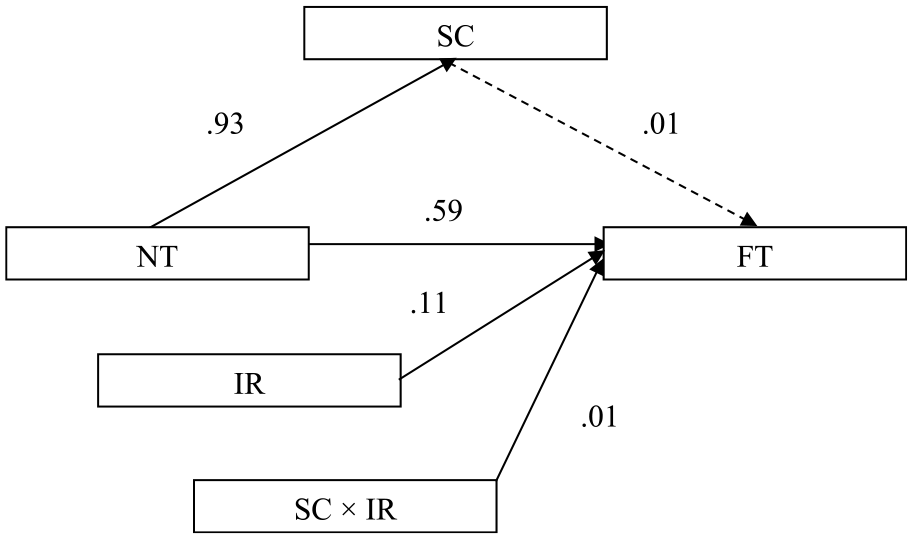
Statistical research model.
Figure 4 shows how the three levels of intensive reflection (i.e., −1 SD, average, and +1 SD) are moderated with social capital and FT, respectively. In the three levels of intensive reflection, social capital is positively associated with FT. Along with the low level of intensive reflection (−1 SD), the effect of social capital was not statistically significant with FT (p = .166). The other cases (i.e., Average and +1 SD) showed that the effect of social capital was consistently positive and highly significant with FT (p < .01).

Moderating effect of intensive reflection.
Overall, the study findings suggest that the social capital of elementary school teachers does not statistically mediate the relationship between their NT and FT, taking into consideration that intensive reflection moderated the effects of social capital on FT. Ultimately, this study discovered that the intensive reflection of elementary school teachers influenced their FT and moderated the effects of social capital on FT. These outcomes support Hypothesis 2. It was difficult to determine whether the NT of elementary school teachers influenced their FT via social capital attained by networking with others. Conversely, intensive reflection by elementary school teachers independently influenced FT and affected FT when combined with social capital.
Intensive reflection was thus significant to the FT of elementary school teachers, both independent of and dependent on social capital. This finding reveals that NT through social capital does not statistically influence the FT of elementary school teachers, but NT through social capital via the moderated function of intensive reflection influenced FT. Intensive reflection hence performs a core role in strengthening the effects of social capital as a moderator between NT and FT regardless of the coefficient. This interpretation supports the idea that statistical significance with the coefficient is important for conditional process analysis (J. Kim et al., 2020). Rather than aiming to strengthen social capital, the teachers’ professional development program should focus on strengthening teachers’ intensive reflection individually while collaborating with others.
Discussion and Implications
This study tested the mediating effects of social capital in the relationship between NT and FT and the moderated mediating effect of intensive reflection in the relationships between social capital and FT. These aspects of learning transfer were evaluated in Korean elementary school teachers. The results did not support Hypothesis 1, but Hypothesis 2 was accepted. Specifically, the results indicate the existence of a direct association between NT and social capital and between NT and FT, but no mediating effect of social capital in the association between NT and FT. The results further suggest that social capital does not directly affect FT but can impact FT when combined with intensive reflection as a moderator. The results of this analysis offer theoretical and policy-related implications for the professional development of teachers worldwide.
The results of this study confirm the need to modify and supplement the TDM (Holton & Baldwin, 2003), which highlights learned knowledge and technical attitudes as applied in workplace tasks, and FT may be achieved through continuously repeated and sustained application of this knowledge. The results of this study support TDM because NT is found to exert a statistically significant and positive effect on FT. However, various factors have been proposed by researchers as influencing learning transfers (e.g., Blume et al., 2010; Fauth & González-Martínez, 2022; H. J. Kim & Hyun, 2018). The findings of previous studies and the moderated mediating effects observed in this study suggest that learning transfers do not occur as a linear process.
Notably, social capital is found to exert a nonsignificant influence on FT, and intensive reflection shows a direct and moderated effect on FT when combined with social capital. These results indicate the need to emphasize social capital and opportunities for intensive reflection in learners to increase the possibilities of the occurrence and reinforcement of FT. In turn, the linear TDM must be transfigured into a multidimensional archetype.
Intensive reflection is important in moderating the relationship between NT and FT, which underlines the need to apply the cognitive load theory to the development of a multidimensional TDM (Paas, 1992). The cognitive load theory can supplement the limitations of the linear, stepwise TDM because it emphasizes the choices and strategies adopted by learners in the assimilation of information (Leppink, 2017; see also Prenger et al., 2021). In this context, researchers must determine the precise stage of the extant six-step TDM in which intensive reflection and cognitive load theory may be contemplated for the evolution of a multidimensional TDM.
A clue may be found in the meaning and hierarchy of reflective thinking that is discussed in this text. Specifically, reflective thinking presupposes experience or knowledge and comprises the four stages of habitual action, understanding, reflection, and intensive reflection (Aslam et al., 2021; Korthagen, 2017; Peltier et al., 2005); these ideas can be applied to develop a TDM where cognitive load appears during the entire NT phase. Considering the importance of intensive reflection between social capital and FT as shown in the results of this study, intensive reflection may emerge in stages 5 and 6 of the TDM when combined with social capital (see H. J. Kim & Hyun, 2018; Penner-Williams et al., 2017; Sala et al., 2019).
Notably, the TDM revision mentioned above represents an important idea for the development of a learning theory and professional development model for existing teachers. Generally, external factors are emphasized in teacher education, such as the organizational culture, and structure of the school, the leadership of the principal, educational policies, and support from administrative authorities (Haug & Mork, 2021; Joo, 2021; Postholm, 2012). However, as Desimone (2009) has suggested, the enhancement of the knowledge and skills of teachers and their behavioral transformations and belief modifications depend greatly on the curriculum of teacher education, the active learning of teachers, the activities undertaken, and the collective interactions between teachers.
Such efforts toward the enhancement of teacher education programs must consider individual factors along with offering supportive organizational environments and policies. The results of this study validate Desimone’s (2009) argument, proving the need to strengthen learning transfers that can apply the knowledge, skills, and attitudes acquired through teacher education to various situations and develop and enforce professional policies that address the psychological, emotional, and cognitive characteristics of teachers (Baldwin et al., 2017; Korthagen, 2017; Pak et al., 2020; Roumell, 2019).
Korean education policies have rarely incorporated programing to cultivate skilled teachers. For example, the Korean government does not present a clear teacher education model even though Korean teacher-related policies tend to be government-centered. The absence of a teacher education model has resulted in the lack of superior quality training programs and instability in schools. Additionally, the needs of Korean teachers and related factors are not reflected in teacher education programs, and the accountability policies of mandatory teacher participation are unclear (Hur et al., 2018). Therefore, teacher training methodologies must be improved to strengthen NT and FT in participants and therefore enhance overall teacher quality (Fauth & González-Martínez, 2022; Nafukho et al., 2017).
More specifically, Nafukho et al. (2017) argue the necessity of designing practical problem-solving training programs to encourage effective learning transfer. Active-participation modules should address issues that emerge in the workplace such that teacher–learners can actively participate in practicing learning transfers. Thus, professional development models and policies for teachers should emphasize building social capital to expand collective interaction and encourage intensive reflection to induce active learning and proactive participation (Kirsten, 2020; Pak et al., 2020; Prenger et al., 2019, 2021).
The finding that NT, through social capital via the moderated mediation effects of intensive reflection, reinforces FT underscores the need for social networks; in teacher workplaces, this requires forming, and activating professional learning communities (PLCs) at the school level (Penner-Williams et al., 2017; Prenger et al., 2019, 2021). The emphasis on accountability in education policy since the 2000s has highlighted the role of PLCs in facilitating sharing, close cooperation, feedback, and engagement in reflective discourse necessary to improve schools and develop professionalism in teachers (Joo, 2020, 2021).
Routine professional development activities undertaken by school-based PLCs can offer realistic pathways for strengthening NT and FT through professional learning (Prenger et al., 2019; Vangrieken et al., 2017); a school-based system avoids issues with teacher education programs imparted by agencies administrating educational initiatives. However, educational policymakers and practitioners should not standardize PLCs despite the positive effects of school-level PLCs. Standardizing government-developed PLC systems could deprive teachers of opportunities for intensive reflection by enforcing compulsory PLC operations and participation (Joo, 2021; Vangrieken et al., 2017). Countries planning to standardize government-led PLCs need to note that teachers in Korean schools are beginning to express their dissatisfaction with compulsory PLC participation.
Another result of the study pertinent to forming and activating PLCs is that above average intensive reflection affects FT when combined with social capital, as shown in Figure 4. Despite the findings that social capital alone does not affect FT, the results of this study support the findings of previous studies (e.g., Aslam et al., 2021; Coppe et al., 2022; Farooq, 2020; Pak et al., 2020) that emphasized the importance of social capital in learning transfer. As this study focuses on personal relationships rather than work-related social networks, an increase in effect size between social capital and NT and FT can be expected when the scope of social capital is expanded to work relationships.
This study’s findings suggest that school-based PLCs rooted in teacher autonomy can be a key mechanism to promote learning transfer by expanding teachers’ opportunities for intensive reflection and social capital. Policymakers and practitioners around the world need to note that PLCs can improve closed organizational culture and bureaucratic school organizations as well as practical functions to support and activate teachers’ professional learning in a rapidly changing educational environment (Brandt et al., 2019; Roumell, 2019; Sancar et al., 2021).
Figure 5 illustrates a mechanism for learning transfer that reflects the main findings and implications of this study. As an advanced form of TDM, this model shows how an association of social capital and intensive reflection within PLCs facilitates FT in the relationship between NT and FT. This model can be used for pre-service teacher training in higher education institutions and for the professional development of in-service teachers.

Mechanism for learning transfer.
Study Limitations and Directions for Further Research
This study acknowledges certain limitations. First, common method bias is possible: the measured correlation may be overestimated vis-à-vis the real because the two variables were evaluated using the same method (Billings & Wroten, 1978). The socially desirable inclination manifested by the respondents could be a reason for such a bias (Ganster et al., 1983). The consistency motif demonstrated by the respondents or their tendency to respond in the same manner to similar questions may be cited as another reason (Johns, 1994; Podsakoff & Organ, 1986; Salancik & Pfeffer, 1977; Schmitt, 1994). Respondents positively expressing the extent of their NT can assert the degree of their FT in terms of socially desirable inclinations or consistency motifs. Future research initiatives should focus on experimental design, study the time lag between variables, and solicit third-party responses from people such as peers or superiors of the respondents to resolve the issue of common method bias.
Second, selection bias may be a problem. The in-service education participation of school teachers in South Korea is likely to be mandated because in-service education programs are linked to the evaluation and promotion of school teachers. School teachers would probably internalize a sense of low autonomy and show low motivation or positivity when they are forced to acquire knowledge and skills from such learning programs. Prospective research projects should attend to the psychological conditions of school teachers, probing characteristics such as motivation and positivity.
Third, this study did not address learning activities other than in-service education, especially for middle or high school teachers. Graduate school or extracurricular learning activities are more intricately connected to the teacher’s autonomy than in-service education. Investigations of learning acquired by school teachers in graduate school or through extracurricular activities could thus present different results for NT and FT, social capital, and intensive reflection. As there are clear differences in the contents of in-service education for elementary, middle, and high school teachers, the results of the four variables may be different for each cohort. Therefore, future investigations should focus on learning activities and cohorts other than in-service education and elementary school teachers.
Fourth, this study did not address the motivation and learning environments of school teachers. Motivation is a core element in enhancing NT and FT (see Baldwin et al., 2017; Brion, 2022; Korthagen, 2017; Roumell, 2019). The learning environment, including support from peers and superiors, is an essential factor for the cultivation of NT and FT. Some studies on NT and FT have probed motivational and environmental factors (H. J. Kim, 2016), proving the necessity of conducting stringent and precise investigations that consider motivational and environmental elements. Therefore, further research should focus on the motivation and learning environments of schools.
Finally, this study focuses more on respondents’ social capital as a whole than their work-related social capital. This can bolster the small effect size for the relationship between social capital and learning transfers. The measurement of the impact of social capital on work-related network connections can improve the validity of the measurements. Therefore, further research should focus on measuring social capital on work-related network connections for validity.
Conclusion
Teachers are the most important determinants of the quality of education. Hence, the processes and problems of in-service teacher education programs must be examined to improve the quality of education imparted in the rapidly changing educational environment. In particular, the ongoing COVID-19 pandemic has exposed some problems and limitations of the public education system, with teacher education being no exception. Rapid changes in the socioeconomic environment require teacher education to be reconceptualized. The results of this study statistically verify the learning transfer process, which is fundamental to the construction of professional development models for teachers. The results indicate factors that should be considered during the teacher education process. Countries worldwide emphasize the development of creative students to prepare future leaders who can undertake national development and direct future societies. The education of creative students begins with teachers who can perform intensive reflection and learn within social networks. Educational policymakers, practitioners, and scholars should use the lens of the newly developed learning transfer theory to examine in detail the conditions and problems pertaining to teacher education.
Footnotes
Author’s Note
This work is based on Hyeon-Jin Kim’s doctoral dissertation.
Declaration of Conflicting Interests
The author(s) declared no potential conflicts of interest with respect to the research, authorship, and/or publication of this article.
Funding
The author(s) received no financial support for the research, authorship, and/or publication of this article.
