



Abstract
The purpose of this study was to delve into the underlying mechanism and contextual boundary condition of the U-shaped relationship between job control and voice at the episode level within the framework of conservation of resources theory. Adopting a two-wave experience sampling method, this study collected 265 matched cases nested in 53 Chinese employees for 5 consecutive days. By hierarchical linear regression, the U-shaped effect of job control on voice at the episode level was replicated. Furthermore, the mediating role of emotional resistance (ER) to change and to the moderating role of supervisor developmental feedback (SDF) was examined. Job control has a U-shaped effect on day-level voice and an inverted U-shaped effect on trait ER, which mediates the curvilinear relationship between job control and day-level voice. Daily SDF moderates the curvilinear relationship between job control and day-level voice such that daily SDF buffers the negative relationship between low job control and day-level voice, as well as amplifies the positive relationship between high job control and day-level voice. The current study unveils the mediating states and contextual boundary conditions of the curvilinear relationship between job control and day-level voice by testing the mediating role of ER and moderating role of SDF at the episode level, thereby further contributing to the literature on voice.
Introduction
Faced with fierce market competition, employee voice is currently regarded as a necessary ingredient for the effectiveness, and even, survival of organizations (Glauser, 1984; Janssen & Gao, 2015). Voice is referred to as the discretionary communication of ideas, suggestions, or concerns intended to benefit an organization (Morrison, 2011). Studies have revealed that employee voice not only improves organizational learning but also promotes the superior detections of errors (Kremer et al., 2019). Both results manifest the importance of employee voice.
Given the critical role of employee voice, there is a growing stream of research focusing on its antecedents, identifying the personal causes (e.g., job control, core self-evaluation, and proactive personality) (Aryee et al., 2014; Tangirala & Ramanujam, 2008; Wijaya, 2019) and contextual inducements (e.g., supervisor managerial behavior, leadership, and culture) (Emelifeonwu & Valk, 2019; Tangirala & Ramanujam, 2012; Venkataramani et al., 2016). Previous research has shown that voice could only be performed strategically because voice means to challenge current relationships and change the status quo in organizations (Ng & Feldman, 2012), resulting in employees’ personal consumption of resources (Detert & Burris, 2007). Therefore, only with sufficient or the instant replenishment of resources could employees manifest voice behavior (Xu et al., 2015).
Job control is regarded as one of the most crucial resources in the workplace (Wood et al., 2020). Wood (2008) has examined the positive influence of job control on voice. Furthermore, Tangirala and Ramanujam (2008) have unveiled the U-shaped effect of job control on voice and the moderation effect of organizational identification, which contributes to a better understanding of how job control affects voice. They asserted that there are two distinct but complementary theoretical resources-based perspectives on the relationship between job control and voice. First, employees with low job control are motivated to acquire personal resources through voicing. Second, employees with high job control are reluctant to voice to conserve personal resources. However, Tangirala and Ramanujam’s research was conducted at the between-person level, omitting the possible fluctuations of voice (Liu et al., 2017; Morrison, 2014). Also, their study neglected the underlying mechanism of the curvilinear effects of job control on voice.
There is research that has explored the moderating effect of employees’ organizational identification while ignoring the potential contextual factors that may act as boundary conditions for the association between job control and voice (Qin et al., 2018). Consequently, we still know little about how and when job control influences employees’ upward voice at the episode level. Therefore, this study adopts a multilevel framework to investigate the underlying mechanism and contextual boundary condition of the curvilinear effect of job control on voice. We developed our conceptual model within the conservation of resources (COR) theory framework. As resources ebb and flow from time to time, COR theory is dynamic in nature and contributes to explaining the variances of voice at the within-person level (Halbesleben et al., 2014; Hobföll, 1989; Qin et al., 2018).
We introduce emotional resistance (ER) to change as the mediator linking job control to employee voice. ER denotes an individual’s emotional reactions to imposed changes (Oreg, 2003). Two theoretical considerations are relevant. First, Morrison (2014) suggests that voice is a nonconscious process through which emotion plays a vital role in shaping employees’ voice. Second, ER has been examined as a barrier to an individual’s changing behavior (Hon et al., 2014; Laumer et al., 2015). Meanwhile, voice is change oriented (Kremer et al., 2019). Thus, current research explores the potential mediating role of ER in the curvilinear relationship between job control and voice.
We also adopt supervisor developmental feedback (SDF) as a moderator. SDF refers to a supervisor’s downward influential strategy, which is aimed at providing employees with valuable information and fostering them to learn and make improvements to their jobs (Zhou, 2003). It is relevant to consider SDF because it contributes resolutions to the concerns about “read the wind.” Employees are always inquiring to discern whether a situation is suitable to voice with their leaders (Milliken et al., 2003). According to COR theory, SDF serves as qualified resources for creating comfortable atmospheres free from the pressure and fear of making mistakes. Such atmospheres minimize the psychological costs to voice (Liang et al., 2012). Thus, the curvilinear relationship is moderated by daily SDF, as the latter offers extra resources to employees instantly and may affect how employees use voice as a response to different levels of job control (Joo et al., 2015; Zhou, 2003).
To test our research model concerning the underlying mechanism and contextual boundary conditions of the curvilinear relationship between job control and employee voice (Figure 1), we conducted a multiwave diary study. By doing so, this study provides three potential contributions to the extant literature on voice. First, we responded to a call to investigate the mediating mechanism of the U-shaped relationship between job control and voice. Current research identifies ER change as a mediator in this nonlinear relationship and elaborates on the mediating states of the curvilinear effect of job control on voice (Tangirala & Ramanujam, 2008). Second, by examining the moderating role of SDF, we offer a contextual boundary condition under which job control is more or less beneficial to employees. Offering a more comprehensive understanding of the U-shaped effect of job control on employee voice, our research highlights the importance of taking contextual factors, especially the managerial behavior of leaders, when considering how job control affects work behavior. Finally, by adopting the experience sampling method, our research examines the effects of job control on employee voice at the episode level. Tangirala and Ramanujam (2008) addressed the importance of examining how employees respond over time to different levels of job control. By adopting a within-individual approach, our research sheds light on the potential fluctuations of employee voice used as a response to job control.
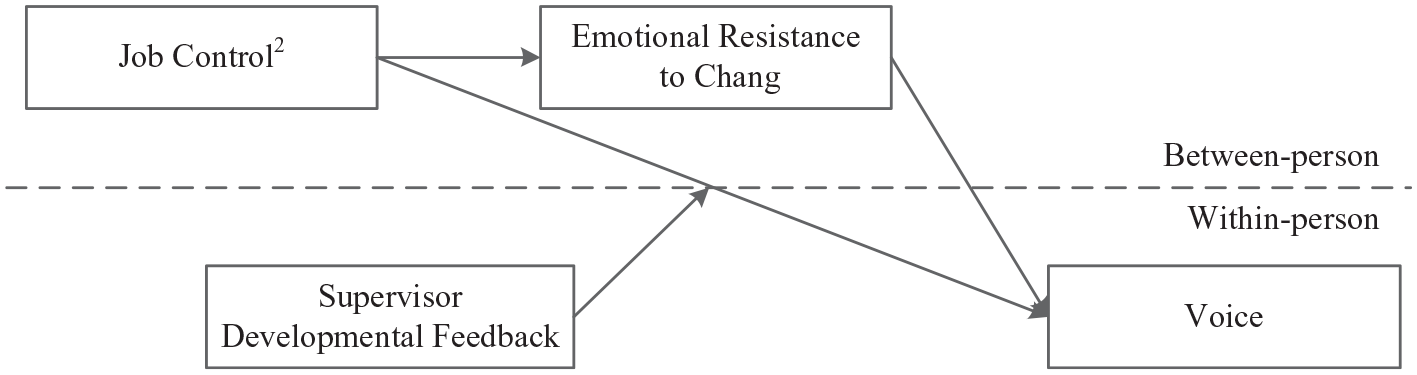
Conceptual model.
Hypotheses Development
Job Control and Voice
Tangirala and Ramanujam (2008) developed and tested the U-shaped relationship between job control and voice according to dissatisfaction-based and expectancy-based perspectives. According to their arguments, we retheorize this curvilinear relationship within the COR theory framework, which assumes that individuals are stimulated to protect, maintain, and acquire valuable resources in organizations (Halbesleben et al., 2014; Ng & Feldman, 2012). This principle suggests that employees in organizations are struggling to avoid loss of resources and seeking opportunities to gain extra resources (Halbesleben et al., 2014).
Job control is defined as the perceived capability to exert influence on one’s work environment to make it less threatening and more rewarding (Ganster & Fusilier, 1989). Job control is considered as a predictor of an individual’s beliefs about the causes of important work outcomes, the number of impacts that the individual has over work-related events, and the resources that the individual has available to achieve their goals in the workplace (C. Lee et al., 1990). Integrating the definition of job control and COR theory, we infer that there are two complementary perspectives, to which we refer as the resource-acquisition and resource-conservation perspectives, affecting the process of how job control exerts influences on employee voice.
The resource-acquisition perspective suggests that employees have a fundamental need or aspiration for control over their jobs to obtain valuable resources in organizations (J. R. Halbesleben et al., 2014; Hobfoll, 2001), that is, employees are struggling to make higher impacts and gain more autonomy in organizations rather than simply occupy passive positions responding to organizational dictates (Tangirala & Ramanujam, 2008). The literature on voice has examined the positive impacts of voice on perceived control and leaders’ high appraisals of performance (Kaufman, 2014). Thus, when job control is perceived to be low, employees are inclined to engage in voice to improve their impacts and autonomy at work, thereby reaching resource acquisition (Maynes & Podsakoff, 2014; Tangirala & Ramanujam, 2008).
The resource-conservation perspective assumes that employees are motivated to conserve personal resources and avoid experiencing loss of resources (Halbesleben et al., 2013, 2014). When job control is from low to modest, the motivation to voice decreases. The intention to voice reaches its nadir especially when job control is modest and employees have appropriate impacts on their current work without too many responsibilities for engaging in multiple and complex decision-making activities (Kubicek et al., 2014; Preston, 2013). Therefore, being motivated to conserve valuable resources, individuals are reluctant to involve changing their behaviors to challenge the status quo (Preston, 2013). With job control is from modest to high, the negative effect of job control emerges. High job control is usually followed by increased levels of responsibility (Kubicek et al., 2014). Employees with high job control are inclined to attribute the allocation of resources and outcomes to personal judgments (Weiner, 1974), and so, engage in complex and multiple decision-making processes (Kubicek et al., 2014). Such behavior leads to the loss of resources, especially the exhaustion of mental and emotional capabilities (Preston, 2013). Employees who have high job control are capable of decreasing the risks and uncertainties brought about by change-oriented behavior (Tangirala & Ramanujam, 2008). Voice is positively related to job satisfaction and beneficial to acquiring a higher status in the workplace (Kim et al., 2015; McClean et al., 2018). With increasing job control, employees prefer to accept and engage in voice to avoid the loss of resources and achieve resource conservation. Thus, we hypothesize the following:
Mediating Effect of ER to Change
Job control and ER
Whether employees resist changes emotionally depends on their judgments about their current states (Folger & Skarlicki, 1999). With regards to the relationship between job control and ER, we can also apply resource-acquisition and resource-conservation perspectives to offer an explanation.
When job control is low, employees occupy unfavorable positions in organizations and have low job autonomy and impact over their jobs (Wendsche et al., 2016). In accordance with COR theory, employees are motivated to invest in resources to avoid the loss of resources and recover any lost resources (Hobfoll, 2001). Motivated by resource acquisition, employees are eager to engage in change-oriented behavior because such behavior favors the implementations of new and useful strategies that would enhance their abilities to meet the demands of their organizations (Battistelli et al., 2013), thereby fostering a sense of control over and responsibility for their jobs. Thus, in conditions of low job control, ER is low.
When job control is modest, employees have a certain amount of control and impact over their jobs. Due to their preference for the familiarity and security of the status quo, employees usually do not expect changes in the conditions of modest job control (Folger & Skarlicki, 1999). Motivated by the resource-conservation perspective, employees are reluctant to become involved in change-oriented behavior because of its association with risks due to the challenging of the status quo and the threat of losing control (Ng & Feldman, 2012). ER will be strongest when job control is modest.
When job control is high, the negative side of job control will emerge because of its correlation with increased requirements for planning and responsibility for making multiple and complex decisions (Kubicek et al., 2014), which lead to the threat of loss of resources (S. Lee et al., 2017). Motivated to conserve personal resources, employees are eager to engage in change-oriented behavior to challenge the status quo. Moreover, high job control provides employees not only with the ability to be in charge of any changes but also insights into the connections between changes and organizational outcomes (Battistelli et al., 2013). Thus, under conditions of high job control, ER is low.
Taken together, the resource-acquisition and resource-conservation perspectives argue that individual ER is driven by different resource-related motivations with both low and high job control, respectively. When job control is low, employees who are motivated by resource acquisition are eager to become involved in change-oriented behaviors, resulting in low-level ER. When job control is from modest to high, employees who are motivated to conserve valuable resources have increased their willingness to participate in change-oriented behaviors, leading to a decrease in ER. Hence, we hypothesize that:
ER to change and voice
COR theory suggests that loss of resources leads to strain and psychologically stronger than do the acquisition of resources. Loss aversion and the consequent motive to conserve valuable resources are two inducements that shape employees’ work behaviors in daily organizations (Halbesleben et al., 2014).
Rather than exhibit active and adaptive responses to change-oriented events, high ER employees prefer to engage in passive and maladaptive reactions (Battistelli et al., 2013; Oreg, 2003). Meanwhile, the underlying aim of voice is to bring about a constructive change to organizations to correct existing mistakes and enhance organizational effectiveness (Barry & Wikinson, 2016). ER to change arises if a high-ER employee chooses to voice. Emotional dissonance refers to the discrepancy between emotions as they are felt and emotions as they are expected to be expressed in the work environment (O’Brien & Linehan, 2019). Research has indicated that extra resources are consumed when individuals adopt counter-attitudinal behaviors (Baumeister et al., 2018). ER drives employees to engage in familiar behavior rather than to initiate change-oriented behavior. Employees who have dispositional emotional tendencies toward stressing out may be reluctant to involve in employee voice at daily work, avoiding ER and conserving valuable personal resources. Hence, we can hypothesize as follows:
According to COR theory, there are two complementary perspectives that account for employees’ voice behaviors. When job control is low, the resource-acquisition perspective dominates employees’ motivation. To obtain higher impacts and autonomy in organizations, low job control employees have low-level ER and are eager to become involved in change-oriented voice. From modest to high levels of job control, employees’ attitudes toward change and behavior are induced by the resource-conservation perspective. When job control is modest, employees with the strongest ER exhibit the lowest level of voice because they have proper control over their current tasks without too many responsibilities. When job control is high, planning requirements and responsibilities consume large amounts of valuable personal resources. To conserve resources, employees with a low level of ER tend to voice to avoid loss of resources.
Moderating Effect of SDF
The literature on the conservation of resources theory posits that contextual factors play a vital role in shaping employees’ conservation and generation processes (Halbesleben et al., 2014; Qin et al., 2018). Morrison (2014) suggests that only when motivators are stronger than inhibitors can employees engage in voice. Motivators denote factors increasing the expected probability of enhancing the effectiveness or decreasing the negative repercussions of voice (Morrison, 2014). This study chose SDF as a moderator because of its potential motivating effects on employees’ expected utility calculus on whether to voice.
SDF is relevant to consideration because it contributes a resolution to the concern of “read the wind,” differs from performance feedback followed by requirements toward specific tasks (Joo et al., 2015), provides information focusing on employees’ learning and career growth (Zhou, 2003), and is more suitable for creating an organizational atmosphere free from pressure and the fear of making mistakes (Zhou, 2003).
As we argued earlier, when job control is low, day-level voice is the outcome of resource-acquisition motivation. SDF serves as qualified resources for employees (Zheng et al., 2016). With a high level of daily SDF, the employees’ resource pool is updated instantly. Daily SDF acts as a guide for low job control employees to behave and grow in organizations (Y. Zhang et al., 2014). Compared with taking risks and tolerating the uncertainty of engaging in voice, SDF can also help employees to obtain extra valuable resources without their undertaking of risks. Therefore, high-level SDF is inferred to buffer employees’ resource-acquisition motivation to engage in voice. Compared with low-level SDF, the negative relationship between job control and voice is weaker in the condition of high SDF.
When job control is from modest to high, voice is motivated by the resource-conservation perspective, which may also vary according to the level of daily SDF. Strong SDF provides employees with clear guides about how to behave and achieve career growth in organizations (N. Li et al., 2011), and thereby strengthen their control over their current tasks. Furthermore, a relaxed atmosphere free from pressure and the fear of making mistakes enhances the opportunities to practice voicing (Liang et al., 2012). Employees are inclined to voice to avoid the potential loss of resources resulting from too many responsibilities and planning requirements (Kubicek et al., 2014). Under such conditions, the positive relationship between job control and voice is more intense than under the condition of high perceived job control, that is, the U-shaped relationship between job control and voice is moderated by the contextual factor-SDF because of its impacted underlying motivation. Hence, we hypothesize the following:
Method
Participants and Procedure
We examined the curvilinear relationship between job control and voice at the episode level. Therefore, we adopted the experience sampling method to collect dynamic data from day to day. We contacted our alumni, who updated their contact information within 2 years through email, telephone, and mobile social apps, to inquire about their willingness to participate in our survey. We explained the purpose, process, and requirements of our research. Finally, 69 participants confirmed their participation.
Following prior studies, we formed a research group on WeChat, the most prevalent social app in China (Du et al., 2018; Qin et al., 2018). Two research assistants were assigned to monitor the data collection. First, all the participants were required to complete a questionnaire, which included demographic information (gender, education, and work experience), about their job control and ER. Then, from Monday to Friday, they received a hyperlink at 10:00 a.m. (SDF) and 17:00 p.m. (voice), respectively. The participants used their mobile phones to complete the questionnaires within 30 minutes. In sum, 265 matched surveys from 53 valid questionnaires were returned for analysis. The effective response rate was 76.8%.
Our samples came from a variety of industries, such as the internet, financial services, and manufacturing, in mainland China, ensuring the representativeness of the samples, of which 52.8% were female and 90.6% held a bachelor’s degree or above. The mean of the job experience was 8.972 (SD = 7.762).
Measures
To decrease the respondents’ response fatigue, short validated scales were used in this study (Du et al., 2020). All items were measured by a five-point Likert-type scale with “1 = strongly disagree” and “5 = totally agree.” Following the rules of double translation, all items were translated into Chinese (Brislin, 1970) to ensure the accuracy of the translation.
Job control was assessed by three items based on C. Lee et al. (1990). A sample item is “I have enough power in this organization to control events that may affect my job.” The Cronbach’s α of this scale was 0.729.
ER to change was evaluated by 4 items through the scale developed by Oreg (2003). A sample item is “When I am informed of a change of plans, I tense up a bit.” The Cronbach’s α of this scale was 0.808.
SDF was adapted from the scale developed by Zhou (2003). A sample item is “Today, while giving me feedback, my supervisor focused on helping me to learn and improve.” This scale yielded an internal reliability of α = 0.942.
Voice was measured by 4 items adapted from the scale developed by Lebel (2016). A sample item was “Today, I spoke up with ideas for new work-related policies and procedures.” The reliability of this scale was α=0.838. In the current study, voice was measured by a self-rated questionnaire, of which the primary advantages are the best positions and greatest awareness of their own voice being possessed by the employees themselves (Carpenter et al., 2014). Considering our experience sampling method, it is hard for supervisors to differentiate their subordinates’ voice from day to day. Thus, to reveal the potential fluctuations of voice, we adopted self-reported voice.
Control Variables
This study adopted gender, education, and job experience as control variables (Akhtar et al., 2016; Ward et al., 2016). Gender was coded as 0 for male and 1 for female. We coded education as 1 for college or below, 2 for a bachelor’s degree, and 3 for a master’s degree or above. Job experience was measured in years.
Results
Before testing the hypotheses, we adopted a multilevel CFA to test the construct validity of the studied variables. The results indicated that the expected 4-factor model (job control, ER, SDF, and voice) possessed the best fit for the data,
The descriptive statistics, intra-correlations, and correlations among all the variables are provided in Table 1. Job control was negatively correlated with ER (r = −0.638, p < .01), whereas SDF was positively correlated with voice (r = 0.275, p < .01).
Mean, Standard Deviation, and Correlations.

p < .05. **p < .01.
Prior to testing our theoretical model, we investigated whether systematic within- and between-person variances existed in our episodic variables. The ICC(1) values of SDF and voice were 0.72 and 0.71, respectively, justifying the appropriateness of the mixed model.
The data were examined by multilevel mediation and moderation analyses using HLM software (version 6.08). Before we conducted a hierarchical linear regression to test our hypotheses, within-person variables (SDF and voice) were group-mean centered and between-person variables (job experience, job control, and ER) were grand-mean centered.
According to Table 2, Model 2 showed that both job and squared job control were negatively related to ER (γ = −0.769, p < .01; γ = −0.392, p < .01), whereas Model 4 showed that both were positively related to voice (γ = −0.464, p < .01; γ = −0.336, p < .01). The regression analysis tested the curvilinear effect of job control on ER and voice. Further, we drew Figure 2 to directly reveal the inverted U-shaped relationship between job control and ER, as well as the U-shaped relationship between job control and voice. Hypothesis 1 and Hypothesis 2 were then tested.
Result of Hierarchical Linear Regression.

p < .05. **p< .01.

Curvilinear effects of job control on voice and emotional resistance to change.
Afterward, we added job control, squared job control, and ER together in Model 5. Unraveling the mediating effects of ER, the results showed that job control and squared job control were not significant anymore, but ER was still significant (γ = −0.319, p < .01). Hypotheses 3 and 4 were tested. We conducted the instantaneous indirect effects following the guidance of Hayes and Preacher (2010) by R to verify the indirect effects of squared job control on voice. The results in Table 3 shows that from low to high job control, the indirect effects ranging from 1.394 to 1.836 were all significant.
Result of Instantaneous Indirect Effect.

For Model 6, we tested the moderating role of SDF. The interactive item of squared job control with SDF was significant (γ = 0.115, p < .05). Then, we drew Figure 3, which was developed by Aiken and West (1991), to indicates that, for employees with high-level SDF and low levels of job control, the negative relationship between job control and voice was weaker, whereas, at high levels of job control, the positive relationship between job control and voice was stronger. Hence, Hypothesis 5 was supported.

Moderating effect of supervisor developmental feedback.
Discussion
Based on Tangirala and Ramanujam’s research, this study retheorized the curvilinear relationship between job control and voice within the COR theory framework. Drawn from the resource-acquisition and resource-conservation perspectives, we developed and tested the indirect U-shaped effect of job control on voice through ER. Furthermore, we examined the moderating role of SDF. When job control is low, SDF buffers the negative effect of job control on voice. When job control is high, SDF amplifies the positive effect of job control on voice. We adopted the experience sampling method to collect daily data to test our hypotheses at the episode level. By having done this, the current study adds three theoretical implications to the previous literature on voice.
Theoretical Implications
First, this study unraveled the underlying mechanism of the U-shaped relationship between job control and voice by examining the mediating role of ER. Tangirala and Ramanujam (2008) pointed out a future direction for research about the U-shaped relationship between job control and voice to investigate the mediating states in the curvilinear relationship between job control and voice. Morrison (2014) suggested that voice arose from an automatic process influenced by emotions and was a nonconscious process. Emotions are instant reactions to job resources changes (Ferreira et al., 2019). As well, the emotional path is one of the the most important mechanisms to explain how job resources predict employee voice (Qin et al., 2014). Integrating these two suggestions, we introduced ER, a kind of trait emotion, as a mediator. An employee’s ER is determined by their judgment about current states (Folger & Skarlicki, 1999). When apparent states threaten their resources, employees’ resistance to change decreases and they are motivated toward change-oriented behavior (Ng & Feldman, 2012). We tested the inverted U-shaped effect of job control on ER and the mediating effect of ER, offering a potential mediator to account for the covariance between job control and voice.
Second, our study further contributes to the curvilinear effect of job control on voice by revealing the contextual boundary condition under which job control is more or less beneficial to employees. COR theory assumes the importance of contextual factors in shaping the resource conservation and generation processes of employees (Halbesleben et al., 2014; Qin et al., 2018). Leaders’ feedback, especially developmental feedback, has been regarded as guide and resources for employee voice within resource-based theoretical framework (Gong et al., 2020; Z. Zhang et al., 2020). However, previous research has neglected to differentiate its influences on voice when employees have different levels of resources. Current research offers direct evidence of the different effects of SDF in the curvilinear relationship between job control and voice. The combination of a high level of SDF and a low level of job control reduced voice. This finding is inconsistent with supervisor support-based propositions stating that support from supervisors could substitute for employees’ personal endeavors (Schaubroeck & Fink, 1998), especially when job control is low. Furthermore, in our study, we also found that, in accordance with the arguments of COR theory, the interaction of strong SDF and high job control increased voice, suggesting that valuable resources helped employees to achieve anticipated goals and minimized related psychological costs (Bal et al., 2017).
Third, this study tested the dynamic effects of job control on day-level voice at the episode level by adopting the experience sampling method. Research in work and organizational psychology has examined voice trajectories over longer times (Aryee et al., 2014; Y. Li & Sun, 2015), whereas short-term tends have not been addressed (Morrison, 2011). Liu et al. (2017) provide evidence of substantial within-person variances in voice while demonstrating the importance and benefits of examining voice at the episode level. As well, Z. Zhang et al. (2019) found daily fluctuations in voice. In consistent with these studies, the present study finds 29% variance of voice at the episode level, which further provide evidence for the necessity to do research about employee voice at the within-person level. As well, our research follows Tangirala and Ramanujam’s logic and further replicates the U-shaped effect of job control on day-level voice, offering a more comprehensive understanding of this curvilinear relationship.
Practical Implications
Our study has significant implications for managerial practices. First, although our study reveals that both low and high job control promote voice, we still recommend leaders to render high job control to employees because low job control is usually coupled with anxiety, dissatisfaction, and burnout (Hu et al., 2017). Therefore, organizations should consider both the benefits and costs if they wish to garner voices from their low job control. Furthermore, our study provides another avenue for organizations to induce employees’ voice by offering high job control, which would help employees achieve a resource gain spiral (Halbesleben & Wheeler, 2015) and finally realize a “win-win” outcome for both organizations and employees. To achieve this goal, job autonomy should be offered to employees (Chung-Yan, 2010). As well, job crafting interventions can be considered, which have been examined as effective tools to enhance employees’ job control (Gordon et al., 2018).
Second, supervisors should provide developmental feedback based on the conditions of the employees’ job control. SDF is not always beneficial for employees in organizations (Z. Zhang et al., 2020). To ensure the management effectiveness, supervisors should differentiate their strategies to guide employees. For high job control employees, supervisors could provide them with high-level developmental feedback without worries. However, when combined with low job control, high-level SDF may decrease employees’ endeavors to achieve resource acquisition in organizations. Thus, besides offering direct SDF to low job control employees, supervisors should provide other necessary interventions that trigger the work-related intrinsic motivation of the employees (Ohana, 2016) or adopt self-efficacy (Choi et al., 2015) to ensure their involvement in voice.
Limitations and Directions for Future Research
There is no doubt that some limitations are coupled with the current study. First, we cannot firmly infer causality. Although we adopted the experience sampling method for our study to explore the effects of job control on sequential day-level voice, we still could not establish a firm causal relationship between job control and voice. Adopting a field experimental design may help overcome this limitation (Fast et al., 2014).
Second, all the data are collected through self-reported questionnaires, which cannot rule out common method variance (CMV). Although we provide reasons why we chose self-reported questionnaires as our instruments, we still require multisource data to overcome methodological legitimation and provide extra evidence for the robustness of our results (Podsakoff et al., 2015).
Third, voice is divided into two dimensions: promotive and prohibitive (Liang et al., 2012). Previous research has indicated that both the inducements and outcomes of these two kinds of voice are different (Kakkar et al., 2016; A. N. Li et al., 2017). However, our study examined only the effects of job control on promotive or constructive voice. For future research, the relationship between job control and prohibitive voice should also be taken into consideration.
Footnotes
Declaration of Conflicting Interests
The author(s) declared no potential conflicts of interest with respect to the research, authorship, and/or publication of this article.
Funding
The author(s) disclosed receipt of the following financial support for the research, authorship, and/or publication of this article: Our research is supported by the Academic Innovation Program Supported by China Youth University of Political Studies (grant no. 189110109). The Special Project of China Education Logistics Association (grant no. ZXYBKT202050).

Ethics Approval Statement
I would like to declare on behalf of my co-authors that the work described was original research that has not been published previously, and not under consideration for publication elsewhere, in whole or in part. All the authors listed have approved the manuscript that is enclosed.