




Abstract
This study examines the impact of teaching learning strategies on learners’ beliefs about language learning and reading comprehension ability. Participants were 78 university freshmen studying English language teaching, translation, and literature. They were divided into two groups. The experimental group received a number of learning strategies adopted and adapted by the researchers, including concept-mapping, vocabulary notebook, passage restatement, dictionary use, summary writing, and guessing. The treatment was carried out 4 hr a week for 15 consecutive weeks. The Language Learners’ Beliefs Scale, developed and validated by Birjandi and Mohammadi, and the reading comprehension section of Cambridge Preliminary English Test (PET) were administered before and after the treatment to identify the students’ shifts in beliefs about language learning and to measure reading comprehension ability, respectively. The results of independent t test indicated that the instruction of learning strategies changed the university students’ beliefs about language learning. Furthermore, learning strategy instruction could boost their reading comprehension ability.
Keywords
Introduction
The ultimate goal of educational systems is to instill in their learners the basic skills to achieve success, to culture the learners’ mind, to develop active, critical, cognitive skills, and to make the learners who strive for excellence for themselves and others. In fact, in these systems, the sole purpose of a teacher, as Kreis (2004) asserted, is not to impart knowledge to his or her students, but to shape their beliefs so that they are regarded as the extension of themselves. However, how can a teacher shape and reshape the learners’ mentality? Students attend the class with a wide range of knowledge, socio-cultural background, educational experiences, and personal attitudes toward English language learning. This signifies the importance of studying learners’ belief about language learning and the ways to enrich it.
Since the 1970s, when cognitive approach to language learning became prevalent, learners were seen more actively involved in the process of language learning. A line of research dealt with good language learners pioneered by Rubin (1975) and Naiman, Frohlich, Stern, and Todesco (1996/1978). They identified a set of strategies that facilitate their learning. The results of these studies and many others were underlining the learners’ personal beliefs they held as their experience in the process of language learning. Omaggio (1978) summarized these studies indicating that good language learners have “insight into the nature of the task [of learning]” (p. 2). Hosenfeld (1978) also referred to “mini-theories” of second language learning that forms the way learners learn language. These theories are the beliefs learners hold and can be regarded as a variable, because they can vary from learner to learner. Much of the research since then has been concerned with providing new classification for the learners’ beliefs.
Administering Beliefs About Language Learning Inventory (BALLI), Horwitz (1987) suggested five general areas of beliefs: (a) the difficulty of language learning, (b) aptitude for language learning, (c) the nature of language learning, (d) learning and communication strategies, and (e) motivation and expectations. Wenden (1986, 1987) also identified a classification of beliefs with three categories: (a) use of language, (b) beliefs relating to learning about the language, and (c) the importance of personal factors.
Benson and Lor (1999) also distinguished two different categories: higher order conceptions and lower order beliefs. They defined conceptions as “concerned with what the learner thinks the objects and processes of learning are,” whereas beliefs are “what the learner holds to be true about these objects and processes” (p. 464).
Ellis (2004) divided the construct into two general levels: higher order conceptions (epistemology) and lower order beliefs. A number of studies, including Benson and Lor (1999) and Tanaka (2004), have proposed that learners have certain conceptions regarding what language is and how it is learned. It contains three categories: quantitative/analytic, qualitative/experiential, and self-efficacy/confidence. Despite all these classifications, a point to consider is that belief is culture-based in nature, and learners in any context can have their own type of beliefs being shaped or reshaped by means of a variety of sources. Learning strategy training can be a case in point.
Learning Strategy Training
In the past 40 years or so, the literature on language learning strategy research has witnessed a diversity of issues on its path to reach the present status. Chamot (2004) introduced eight such issues extracted from the literature of leaning strategy in the literature. The first issue to discuss here is the identification of language learning strategies. A substantial body of literature is devoted to defining what learning strategy is and identifying these unobservable mental learning strategies. In English as a foreign language (EFL) context, Richards and Schmidt (2010) simply defined learning strategies as “the ways in which learners attempt to work out the meanings and uses of words, grammatical rules, and other aspects of the language they are learning” (p. 331). In Stern’s (1983) view, strategy is “best reserved for general tendencies or overall characteristics of the approach employed by the language learner, leaving techniques as the term to refer to particular forms of observable learning behavior” (p. 236). At the same time, Rubin (1987) asserted that learning strategies are “strategies which contribute to the development of the language system which the learner constructs and affect learning directly” (p. 15). In her article, Oxford (1989) referred to language learning strategies as “behaviors or actions which learners use to make language learning more successful, self-directed and enjoyable” (p. 235). Anderson (2005) defined strategies as “the conscious actions that learners take to improve their language learning” (p. 757). According to Chamot (2005), learning strategies are “procedures that facilitate a learning task. Strategies are most often conscious and goal-driven, especially in the beginning stages of tackling an unfamiliar language task” (p. 112).
When the concept of learning strategy was investigated and defined, it was time to devise some classifications according to the conceptualization of the term learning strategy. There are almost dozens of second language learning strategy classifications. In Wenden’s (1983) classification, she identified three general categories of self-directing learning strategies: (a) knowing about language, (b) planning, and (c) self-evaluation. Rubin (1987) suggested that there are three kinds of strategies that contribute directly or indirectly to language learning: learning strategies, communication strategies, and social strategies. O’Malley and Chamot (1990) proposed a framework in which three major types of learning strategies are classified: metacognitive, cognitive, and social/affective. Metacognitive strategies are the ones that involve planning for learning, thinking about the learning process as it is taking place, monitoring of one’s production or comprehension, and evaluating learning after an activity is completed. Cognitive strategies, according to O’Malley and Chamot (1990), “are more directly related to individual learning tasks and entails direct manipulation or transformation of learning materials” (p. 8), strategies such as repetition, translation, grouping, deduction, contextualization, and transfer. Social/affective strategies concern interaction with other learners and native speakers and management of the affective demands made by language learning such as cooperation, question for clarification, and self-talks.
Oxford’s model of learning strategies is believed to be one of the most comprehensive classifications (Brown, 2007; Ellis, 1994). In Oxford’s (1990) taxonomy, she distinguished between direct and indirect strategies. The former consist of “strategies that directly involve the target language . . . [in a way that] require mental processing of the language” (p. 37). The latter, however, “provide indirect support for language learning through focusing, planning, evaluating seeking opportunities, controlling anxiety, increasing cooperation and empathy and other means” (p. 151). The strategies under the first category (direct), according to Oxford, are memory strategies, cognitive strategies, and compensation strategies. Memory strategies, also called mnemonics, “enables learners to store verbal material and then retrieve it when needed for communication” (Oxford, 1990, p. 39). Cognitive strategies vary a lot “ranging from repeating to analyzing expressions to summarizing” (p. 43). Oxford (1990) identified four sets of cognitive strategies: “1) Practicing, 2) Receiving and sending messages, 3) Analyzing and reasoning, and 4) Creating structure for input and output” (p. 17). Compensation strategies, according to Oxford (1990), “enable learners to use the new language for either comprehension or production despite limitations in knowledge” (p. 47). The second category (indirect) includes “actions which go beyond purely cognitive devices, and which provide a way for learners to coordinate their own learning process” (p. 136).
Stern (1992), furthermore, summarized and reclassified his classification of 10 strategies, offered in Stern (1983), into 5 main language learning strategies: (a) management and planning strategies, (b) cognitive strategies, (c) communicative–experiential strategies, (d) interpersonal strategies, and (e) affective strategies.
Another line of research in language learning strategy is the relationship between learning strategy and the learner variables such as gender and level of language proficiency. Several works were carried out to underline the role of gender (El-Dib, 2004; Kaylani, 1996; Oxford, Park-Oh, Ito, & Sumrall, 1993; Vandergrift, 1997; Wharton, 2000); however, as Chamot (2004) asserted, we cannot certainly confirm any role for gender in learning strategy use. As for proficiency level, the results tend to be convergent. The majority of the studies (Anderson, 2005; Bruen, 2001; Chamot & El-Dinary, 1999; Green & Oxford, 1995; Mohammadi, 2009; O’Malley & Chamot, 1990; Wharton, 2000) revealed that students with more command of English are skillful users of learning strategies.
The next line in the language learning strategy research is the fact that learning strategy use is culture- and context-specific. The results of some studies underlined that the adoption of strategies may vary among the learners in different learning contexts and with various cultural values (Keatley, Chamot, Spokane, & Greenstreet, 2004; Olivares-Cuhat, 2002; Wharton, 2000).
One more research area in the literature of language learning strategy is the explicit instruction of strategy within such frameworks as Strategy-Based Instruction or Learning Strategy Training. Many scholars unanimously agree on the usefulness of explicit instruction of strategy (Anderson, 2005; Butler, 1997; Chamot, Barnhardt, El-Dinary, & Robbins, 1999; Cohen, 1998; Goh & Taib, 2006; Lam, 2009; Nguyen & Gu, 2013; Nunan, 1997; O’Malley & Chamot, 1990; Oxford & Leaver, 1996; Rubin & McCoy, 2008; Shen, 2003). However, the integration or separation of strategy training from other learning tasks is a source of contention. Some argue for the integration of them (Chamot et al., 1999; Chamot & O’Malley, 1994; Cohen, 1998; Grenfell & Harris, 1999; Nunan, 1997; Oxford & Leaver, 1996), whereas others are for their separation (Gu, 1996; Vance, 1999; Weinstein & Mayer, 1986). Rubin, Chamot, Harris, and Anderson (2007) also introduced four core features of a strategy-based instruction model: (a) awareness raising, (b) presentation and modeling, (c) providing multiple practice opportunities, and (d) evaluating the effectiveness of strategies and transferring them to new tasks.
There are some other research lines in the literature of learning strategy such as the role of the language of instruction in teaching learning strategies and the transfer of strategies to new tasks or to the rest of their education, which are recently taken care of.
A closer look at the above discussions implies that learning strategies are not just an affective factor but a cognitive factor as well, which are affected by cultural, social, and situational contexts of use. This study aimed to investigate the answer to the following questions:
Method
Participants
The population of the study included all the students studying English language at the faculty of Persian literature and foreign languages in Islamic Azad University, Roudehen Branch in Tehran. Out of them, two intact classes with a total of 92 students were selected from among the freshman students who had been admitted to the faculty using cluster random sampling. The freshman students were selected because their beliefs about language learning were all shaped in their school period, and the change could be more significant. They were both male (n = 23) and female (n = 55). To homogenize the students, a proficiency test (Test of English as a Foreign Language [TOEFL]) was administered to all of them. For the sake of practicality, only the reading comprehension and structure sections were administered. Based on the results, those at the extreme ends, standing at the point more than one standard deviation below and above the mean, were crossed out of the study. They were totally 78 students majoring in English language teaching, English language translation, and English language literature ranging between 19 and 31 years old with the mean index of 21.
Instrument
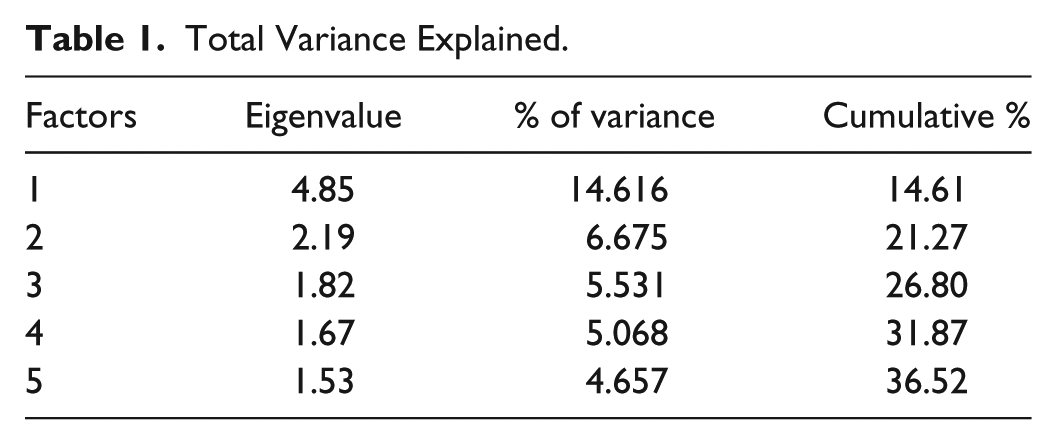
The research instrument in this study was Language Learners’ Beliefs Scale (LLBS; see the appendix) designed by Birjandi and Mohammadi (2014), which has 32 items. To estimate the reliability of the measure, as reported by Birjandi and Mohammadi, the Cronbach’s alpha coefficient was calculated among a group of 328 university students, which came to be .78. To investigate the construct validity, they subjected the 32-item LLBS to principal components analysis (PCA) using SPSS Version 16. The Kaiser–Meyer–Oklin (KMO) measure of sampling adequacy was 0.74, and Bartlett’s test of sphericity had reached statistical significance supporting the factorability of the correlation matrix. The results of five-factor solution (Table 1) revealed a total of 36.52% of the variance, with Components 1, 2, 3, 4, and 5 contributing 14.61%, 6.67%, 5.53%, 5.06%, and 4.65%, respectively.
Total Variance Explained.
The underlying constructs that were considered in the scale were Mediatory beliefs (seven items), Self-beliefs (eight items), Attributive beliefs (six items), Traditional beliefs (six items), and Epistemological beliefs (five items). Self-beliefs referred to the beliefs about self-worth, self-concept, and self-efficacy, whereas epistemological beliefs were designated to the beliefs about the nature of knowledge of language and learning. Attributive beliefs are beliefs about the causes of language learning, and mediatory beliefs are composed of beliefs about the role of mediators in language learning. Traditional beliefs also refer to all the learning beliefs that are deeply rooted in the traditional English language learning/teaching methodology. The answer to the items of the LLBS was supposed to be done on a 4-point Likert-type scale with 4 options for the responses as strongly disagree, disagree, agree, or strongly agree. For the ease of computation, the responses were numerically coded 1 to 4, respectively.
The reading comprehension section of Cambridge Preliminary English Test (PET) was also used as a pretest and posttest to measure participants’ reading comprehension ability. It included 35 items in five different parts administered in Sessions 1 and 16.
Procedure
Having homogenized the students and deselected those at both extremes in the proficiency test, the researcher had two classes of control (n = 38) and experimental (n = 40) groups. LLBS and reading comprehension test, as pretests, were administered to both classes to identify their beliefs about language learning and their reading comprehension ability prior to the treatment. Both of the classes were taught by one of the researchers so that the impact of the teacher’s cognition, bias, teaching methods, and styles was nullified. The university syllabus for the course required the course book called Active Skills for Reading Book 3 (Anderson, 2008, 2nd ed.). It should be mentioned here that although verifying strategy is one of the six basic assumptions of the book, the researchers decided to choose the course book for two reasons: One is that what is claimed by the study is the explicit instruction of learning strategies while it is not directly claimed by the series’ author. Second, the researchers’ years of experience revealed that the explicit teaching of learning strategies is not a common practice of the teachers in the classes of this type. In the experimental class, in addition to their classroom syllabus, the students were presented a set of strategies. Because the classes were both “Reading Comprehension,” most of the learning strategies presented in the experimental class were in one way or another related to it and the related skills and subskills. The researchers adopted and adapted a number of learning strategies for the experimental class, including concept-mapping, vocabulary notebook, passage restatement, dictionary use, summary writing, and guessing.
In concept-mapping strategy, students were required to identify important concepts in their passages and relate those concepts to each other. Students were also asked to prepare a vocabulary notebook for any new words they encountered in lessons along with their synonyms and antonyms, collocations, roots, and derivations. In passage restatement strategy, they were supposed to restate the reading passage or the stories assigned to them for their classmates. This strategy had two different versions: one by restating the story from different points of view or from the character’s point of view and the other by restricting them to use limited number of vocabulary to restate the text. It also contained the story reproduction using certain given keywords. The students were also taught the proper use of monolingual dictionary and kept practicing it in class. In summary writing strategy, to enhance their memory of the main ideas, students were asked to write the summary of their reading passages (at most one to three paragraphs) and their story readings at home (more than five paragraphs). In guessing strategy, they worked on the meaning of the keywords in the passage and were encouraged to do the postreading activities guessing the other words through context, word roots, prefixes, and suffixes. This way, their tolerance of ambiguity could be fostered. At the end of the semester (with a 15-week interval), the LLBS and reading comprehension test were administered again to check the probable changes in learners’ beliefs about language learning and reading comprehension abilities.
Data Analysis and Discussion
To answer the research questions, the data from the administrations of LLBS to both experimental and control groups were collected as the pretest and posttest. Independent-samples t tests were run to compare the experimental and control groups’ means on the pretest and posttest of beliefs. Before discussing the results, it should be mentioned that the assumption of normality—a prerequisite to independent-samples t test—was met (Table 2). The ratios of skewness and kurtosis over their respective standard errors were “within the ranges of ± 1.96” (Field, 2009).
Normality Assumption for Pretest and Posttest of Beliefs.
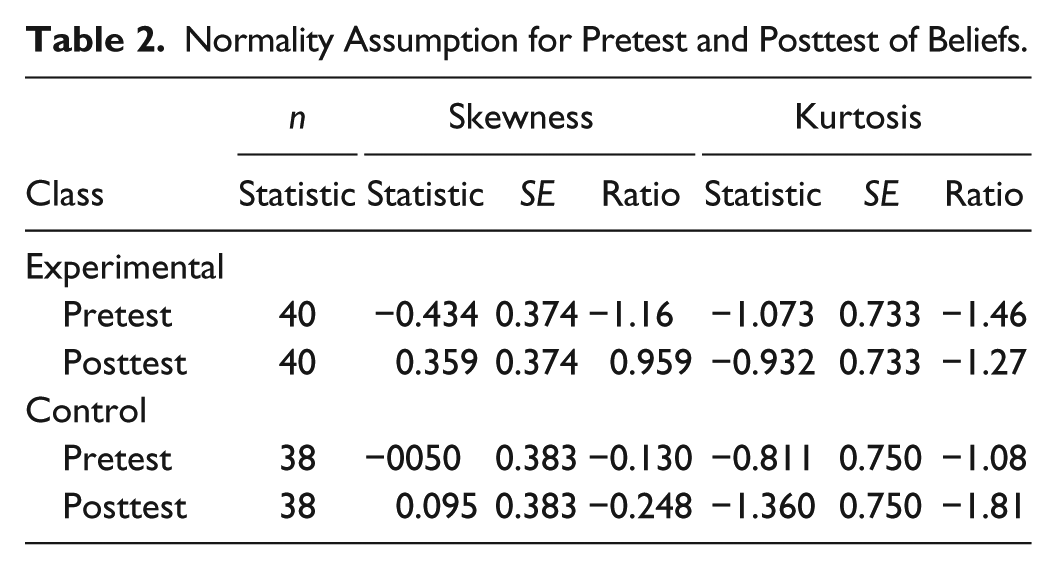
The assumption of homogeneity of variance will be discussed when reporting the results of the independent-samples t test.
The data on pretests were, then, analyzed. Independent t test was run to compare the experimental and control groups’ mean scores on pretest of beliefs to prove that the two groups held the same beliefs prior to the main study. As displayed in Table 3, the mean scores for experimental and control groups on pretest of beliefs were 13.90 and 13.94, respectively.
Descriptive Statistics for Pretest of Beliefs by Groups.

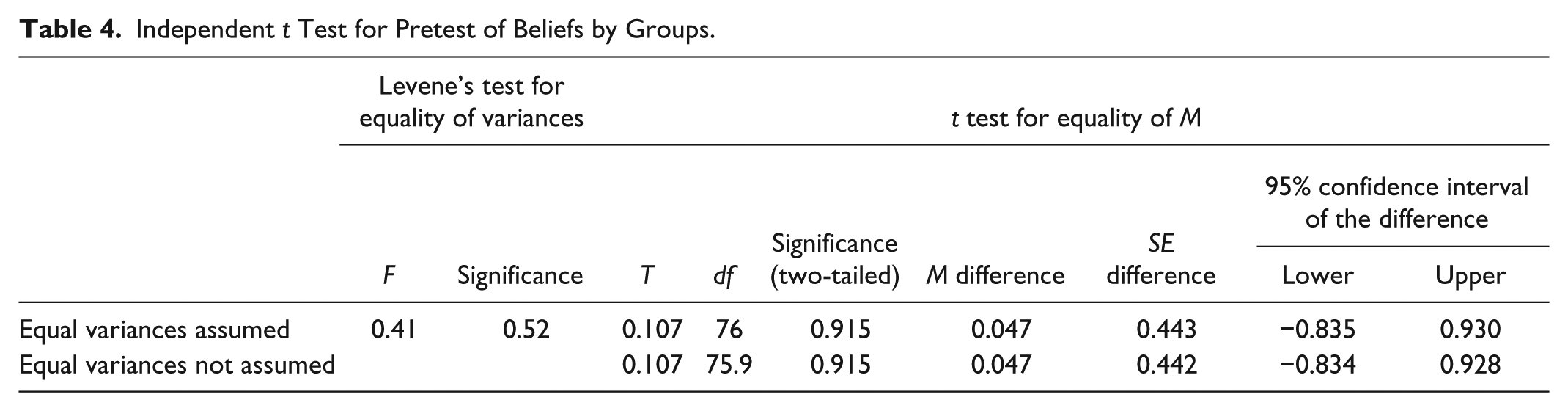
The results of the independent t test, t(76) = 0.107, p > .05, and the effect size, r = .012, representing a weak effect size according to Field (2009), indicated that there was no significant difference between experimental and control groups’ mean scores on the pretest of beliefs. Thus, it can be concluded that the two groups enjoyed the same level of beliefs prior to the main study.
It should be noted that the assumption of homogeneity of variances was met (Levene’s F = .413, p = .522 > .05). That is why the first row of Table 4, that is, “Equal variances assumed,” was reported. Figure 1 represents the homogeneity of pretest for both groups.
Independent t Test for Pretest of Beliefs by Groups.

Pretest of beliefs by groups.
Next, the posttests were analyzed. An independent t test was run to compare the experimental and control groups’ mean scores on posttest of beliefs to probe the effect of teaching learning strategies on the shifts in their beliefs about language learning. As displayed in Table 5, the mean scores for experimental and control groups on posttest of beliefs were 15.80 and 14.54, respectively.
Descriptive Statistics for Posttest of Beliefs by Groups.
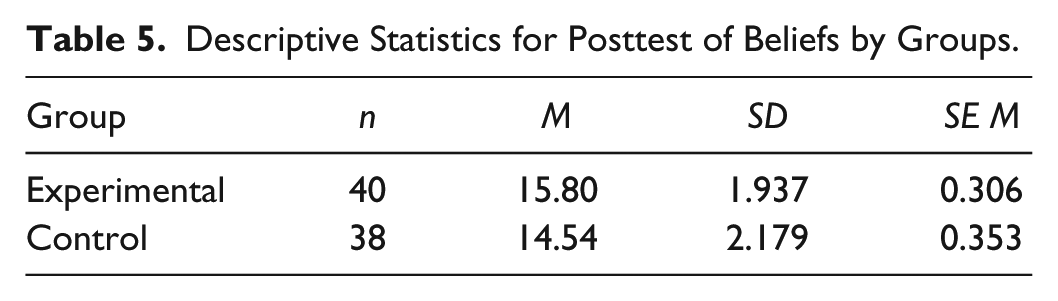
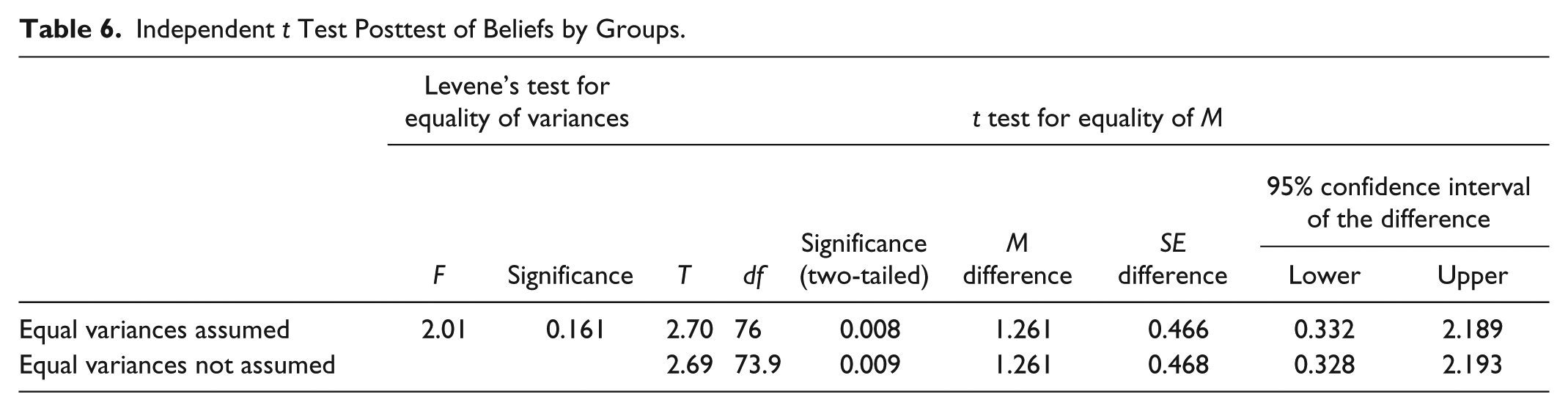
The results of the independent t test, t(76) = 2.73, p < .05, and the effect size, r = .29, representing an almost moderate effect size according to Field (2009), indicate that there was a significant but moderate difference between experimental and control groups’ mean scores on the posttest. Thus, it can be concluded the null hypothesis as teaching language learning strategies does not have any significant effect on the beliefs Iranian EFL learners possess is rejected although the results should be interpreted cautiously due to the moderate effect size value of the t statistic.
It should be noted that the assumption of homogeneity of variances was met (Levene’s F = 2, p = .161 > .05). That is why the first row of Table 6, that is, “Equal variances assumed” was reported. Figure 2 represents the heterogeneity of posttest for both groups.
Independent t Test Posttest of Beliefs by Groups.

Posttest of beliefs by groups.
To answer the second research question, the data on reading comprehension pretests were analyzed. Independent t test was run to compare the experimental and control groups’ mean scores on pretest of reading comprehension to prove that the two groups held the same ability prior to the main study. As displayed in Table 7, the mean scores for experimental and control groups on pretest of reading comprehension were 13.71 and 13.94, respectively.
Descriptive Statistics for Pretest of Reading Comprehension by Groups.

An independent-samples t test was conducted to compare the scores of reading comprehension pretests for control and experimental classes. The results showed that there was no significant difference in reading comprehension scores for control group (M = 13.94, SD = 1.89) and experimental group (M = 13.71, SD = 2.23), t(78) = −0.5, p = .62, two-tailed (Table 8). The magnitude of the differences in the means, according to Cohen (1988), was very small (η2 = .003).
Independent t Test for Pretest of Reading Comprehension by Groups.

The data on reading comprehension posttests were also analyzed. Independent t test was run to compare the experimental and control groups’ mean scores on posttest of reading comprehension to investigate the effect of teaching language learning strategies on the students’ reading comprehension ability. As displayed in Table 9, the mean scores for experimental and control groups on pretest of reading comprehension were 15.8 and 14.35, respectively.
Descriptive Statistics for Posttest of Reading Comprehension by Groups.

An independent-samples t test was conducted to compare the scores of reading comprehension posttests for control and experimental classes. The results showed that there was a significant difference in reading comprehension scores for control group (M = 14.3, SD = 2.34) and experimental group (M = 15.8, SD = 1.93), t(78) = 2.97, p = .004, two-tailed (Table 10). The magnitude of the differences in the means, according to Cohen (1988), was very large (η2 = 0.1).
Independent t Test for Posttest of Reading Comprehension by Groups.

The results of the present study, first and foremost, support the usefulness of explicit instruction of strategy as already proposed by some scholars (Anderson, 2005; Butler, 1997; Chamot et al., 1999; Cohen, 1998; De Silva, 2014; Goh & Taib, 2006; Gu, 2007; Nguyen & Gu, 2013; Nunan, 1997; O’Malley & Chamot, 1990; Oxford & Leaver, 1996; Rubin & McCoy, 2008; Shen, 2003). Change in the learners’ beliefs about language learning as a result of teaching language learning strategies could lead to familiarizing the learners with what the nature of language is and how it is learned. The instruction of learning strategies was integrated with the linguistic content classroom tasks, and the results were in line with those proposed by some scholars who argue for their integration (Chamot et al., 1999; Chamot & O’Malley, 1994; Cohen, 1998; Grenfell & Harris, 1999; Nunan, 1997; Oxford & Leaver, 1996). The findings also proved a shift in the learners’ beliefs about language learning and endorsed the results of the study by Yang (1992) who indicated that learning “strategies can cause beliefs as well” (p. 148).
Conclusion and Implications
This study was an attempt to examine the effect of teaching learning strategies on learners’ beliefs about language learning and their reading comprehension ability. The findings of the study can be categorized into two parts: the effects of learning strategies on both changes in learners’ beliefs and their dynamicity and their reading comprehension ability.
The results of this study indicated that strategy-rich classrooms can enrich the students’ beliefs and develop their cognition about language learning. There are two groups of studies in the literature adopting language learning beliefs and language learning strategies as the major variable. The first group examined the effects of learning beliefs on students’ language learning strategies (Abraham & Vann, 1987; Elbaum, Berg, & Dodd, 1993; Riley, 1997; Yang, 1992) and unanimously agreed that language learning beliefs can influence learning strategy use. The second group has examined the relationship between beliefs about language learning and learning strategy use (Abedini, Rahimi, & Zare-ee, 2011; Chang & Shen, 2010; Li, 2010; Su, 1995; Yang, 1999; Yu, 2007; Zare-ee, 2010). It means that this study can be a pioneer work because, as mentioned above, there has been no such study in the literature as far as the researchers could access.
The results of this study are also significant when the learners’ beliefs have changed during a short term. The literature has witnessed two groups of studies in this respect: One is related to those which claim that belief is stable, inflexible, and resistant to change that was once favorably prevalent in many scientific studies (e.g., Almarza, 1996; Freeman, 1992; Guillaume & Rudney, 1993; Horwitz, 1987, 1988; Johnson, 1996; Kennedy, 1991; Nettle, 1998; Su, 1995; Tumposky, 1991; Yang, 1992). For them, education is believed to be ineffective in changing or influencing the beliefs. The second group is related to those which concluded that beliefs at micro-level (short time) are not changing and are very stable at the group level (e.g., Kern, 1995). The results of this study have no commonalities with those in both of the above groups. However, it is in line with the results of a few studies that ended up with significant changes in learners’ beliefs at 1-year intervals or shorter (Amuzie & Winke, 2009; Lim, Pagram, & Nastiti, 2009; Oh, 1996; Sugiyama, 2003; Tanaka & Ellis, 2003).
This study was conducted among university students with more or less established beliefs about language learning. It can be carried out among language learners of different proficiency levels. Also, belief changes here were investigated from an emic rather than etic perspective, which can be a suggestion for further studies. Furthermore, the future studies can be on the investigation of macro-dynamicity of beliefs about language learning rather than micro-dynamicity, which was adopted by this study.
The results of this study enjoy certain implications for the stakeholders in language education. Teachers are suggested to equip students with the strategies for better learning along with the course content. This is helpful for the students not only to be a “good language learner” but also to improve their autonomy and self-efficacy. The message for the teachers is that students’ beliefs can be shaped or reshaped if there are meditational tools such as strategies for language learning. Syllabus designers are also recommended to include learning strategies within the syllabus. If these strategies are reinforced by the course books all through the syllabus, students’ beliefs are formed and reformed more systematically. Only this can revive the hope that an educational system is stepping toward its ultimate goal, which is educating students for the future.
Footnotes
Appendix
Declaration of Conflicting Interests
The author(s) declared no potential conflicts of interest with respect to the research, authorship, and/or publication of this article.
Funding
The author(s) received no financial support for the research and/or authorship of this article.