




Abstract
Chile currently has a relatively robust tobacco control policy approach. Nonetheless, it has one of the highest tobacco consumption prevalence rates among adults worldwide. Better knowledge regarding changes in tobacco control policy over time may provide a comprehensive understanding of the observed changes in the prevalence of tobacco consumption. We aimed to carry out a scoping review to explore the evolution of Chile’s tobacco control consumption policies. We searched legal instruments, including laws and decrees, in the Chilean National Library of Congress from inception to December 2018. One author screened potential legal instruments; two authors independently systematized research records found. We included any legal instrument issued by the President of the Republic or the Chilean National Congress. We used the MPOWER strategy as a guideline to classify interventions. The institutional change theory proposed by van der Heijden and Kuhlmann was applied to interpret policy changes. We identified 499 legal instruments related to tobacco. Of these, three laws and ten decrees were included for analysis. We observed an uneven implementation of measures recommended by the WHO over time. The dimensions Protect, Warn, and Enforce showed consistent progress, measures in the Monitor and Raise dimensions were unsustained, and no measures for the dimension Offer were found. In Chile, measures to tackle tobacco consumption over the last three decades have focused predominantly on regulating individual choices rather than on the tobacco industry. Future research assessing the effects of Chile’s tobacco control consumption policies should account for their multifaceted and heterogeneous implementation.
Introduction
Tobacco use has adverse health and economic consequences (Goodchild et al., 2018). Tobacco use is among the four major risk factors for death and disability globally, in high-income countries and the Region of the Americas across all ages (Institute for Health Metrics and Evaluation, 2019). The cost of smoking-attributable diseases to the healthcare system has been estimated at 5.7% of global health expenditure. The total economic cost is equivalent to 1.8% of the global annual gross domestic product (GDP) (Goodchild et al., 2018). The extent of health losses caused by tobacco use has been recognized worldwide epidemic(Goodchild et al., 2018). To tackle this burden, the World Health Organization (WHO) (World Health Organization, 2017, 2021c), along with multiple scientific and professional organizations such as the American Cancer Society Cancer Action Network (The American Cancer Society Cancer Action Network, 2022), Action on Smoking & Health (Action on Smoking & Health, 2012), the Centers for Disease Control and Prevention (Center for Disease Control and Prevention, 2022), and the World Bank (World bank, 2009) have spurred the promotion of comprehensive and cost-effective responses across the world.
In 2008, the WHO Framework Convention on Tobacco Control (FCTC) and its parties committed themselves to assisting the country-level implementation of effective measures to reduce the offer and demand for tobacco through a set of six tobacco control policies domains (World Health Organization, 2009), known as the MPOWER strategy (see Figure 1). MPOWER is the acronym for these measures: 1) monitor tobacco use and prevention policies; 2) protect people from tobacco smoke; 3) offer help to quit smoking; 4) warn about the dangers of tobacco; 5) enforce bans on tobacco advertising, promotion, and sponsorship; and 6) raise taxes on tobacco (World Health Organization, 2009).

MPOWER World Health Organization strategy (2017).
The overall implementation of these country-level tobacco control measures has been steady (World Health Organization, 2021c). Currently, three-quarters of all countries are covered by at least one of these measures (World Health Organization, 2021c). Notably, it has been estimated that around 37 million lives have been saved by adopting the MPOWER strategy (World Health Organization, 2021c). However, more information is needed about how countries have progressed in implementing the measures associated with this strategy over time. Moreover, the extent to which a combination of international and national forces can influence the configuration of these measures has yet to be studied.
Reviews of national tobacco policies using the MPOWER strategy have been performed at global, regional, and national levels (Abascal & Lorenzo, 2017; Ahluwalia et al., 2019; Calikoglu & Koycegiz, 2019; Glahn et al., 2018; Guindon et al., 2019; Husain et al., 2016; Kaur et al., 2021; Martins et al., 2021; Sandoval et al., 2021; Sanna et al., 2020; Saxena et al., 2020; Suárez-Lugo et al., 2018). Previous studies, however, have only provided a partial account by focusing on existing policies rather than observing when measures have been implemented and under what conditions. Even further, very few studies have included countries in the Region of the Americas (Abascal & Lorenzo, 2017; Guindon et al., 2019; Martins et al., 2021; Sandoval et al., 2021; Suárez-Lugo et al., 2018), region with one of the highest per capita tobacco consumption worldwide (World Population Review, 2022).
This article focuses on Chile, a high-income Latin American country according to the MPOWER standards one of the world’s most robust tobacco control policies (World Health Organization, 2021a, 2021c). However, Chile has the highest tobacco consumption prevalence rate among the adult population (38.7%) in the Region of the Americas (Instituto de políticas públicas en Salud, 2022). In addition, Chile’s health system spends approximately 1.15 trillion pesos annually (approximately USD$1.8 billion) on treating illnesses caused by smoking tobacco, (this is equivalent to 0.6% of its GDP in 2017) (Castillo-Riquelme et al., 2020).
To the best of our knowledge, this study presents the first overview of the historical changes in Chile’s national tobacco strategy, which is further complemented by considering the implementation of the MPOWER strategy measures. The status of the tobacco control policy, its degree of adherence to the MPOWER strategy, and the extent to which its different domains have been unfolding will allow future inquiries into the effectiveness of each component in tobacco control in Chile. Our study aims to carry out a scoping review to explore the evolution of Chile’s tobacco control consumption policies displayed in Chile its legal instruments.
Review Question
What is the evolution of Chile’s tobacco control consumption policies displayed in its legal instruments?
Sub-questions
What is the evolution of Chile’s tobacco control consumption policies over time, considering de MPOWER strategy?
What is the historical-political evolution of Chile’s tobacco control consumption policies?
Methods
The proposed scoping review was conducted following the JBI methodology for scoping reviews (Peters et al., 2020, p.406–451; Tricco et al., 2018).
Eligibility Criteria
We deemed legal documents (i.e., laws and decrees) issued by the President of the Republic or the Chilean National Congress, that is, enacted by the central government, as eligible if (i) they were targeted at the general Chilean population or specific groups of the population or public or private organizations based in Chile; and (ii) they referred to tobacco control measures as per the six domains of the MPOWER strategy (Figure 1). The analyzed documents are in Spanish. The laws and decrees will be those available in the Chilean National Library of Congress (Biblioteca del Congreso Nacional de Chile, 2014) (https://www.bcn.cl/portal/) from the database inception to March 2023. In this manner, this scoping review will consider gray literature as a focus.
Additional details regarding the definitions of the different legal documents (Biblioteca del Congreso Nacional de Chile, n.d.) considered for inclusion are provided in the Supplemental Table S1.
Information Sources
We searched for eligible legal documents using the Chilean National Library of Congress (Biblioteca del Congreso Nacional de Chile, 2014; Peña et al., 2021) (https://www.bcn.cl/portal/). This database allows tracing the origin of each Law and decree and their subsequent modifications since 1818 and contains more than 260,000 regulations from inception to the present. We searched the database from inception to March 30, 2023.
Search Strategy
We used an all-encompassing search strategy based on free-text words in the basic search engine available in the Chilean National Library of Congress (BCN). For the development of the search strategy, we considered two elements: 1) the definition of tobacco products declared on the legal documents that regulate tobacco consumption in Chile (Biblioteca del congreso Nacional, 1995); and 2) the current approach of the main instruments to monitor tobacco consumption (Ministerio de Salud, 2023; Servicio Nacional para la Prevención y Rehabilitación del Consumo de Drogas y Alcohol, 2023). In the first case, tobacco products are “any product containing or prepared wholly or in part using tobacco leaves as a raw material.” The regulatory framework, therefore, considers all types of tobacco-derived products within its indications. On the other hand, the principal instruments to monitor tobacco consumption are focused on cigarette use since this is the country’s main format of tobacco consumption. According to the last National Health Survey, only 1.5% of the population reported tobacco consumption through e-cigarettes (Ministerio de Salud, 2023); on the other hand, e-cigarettes were not integrated into the questionnaires of the biannual National Survey of Drug Consumption for the general population which is carried out since 1994 (Servicio Nacional para la Prevención y Rehabilitación del Consumo de Drogas y Alcohol, 2023). In order to achieve an exhaustive search, we use all possible terms associated with the specific consumption of cigarettes since this, unlike other alternative tobacco products, can be identified by different names in the Country.
Thus, in the basic engine of BCN, we used the terms in Spanish “tabaco” (tobacco), “cigarro” (cigar), “cigarros” (cigars), “cigarrillo” (cigarette), and “cigarrillos” (cigarettes) in an independent manner. The search allowed us to identify legal documents containing these keywords in the title or full text. In the database, we applied the filter “legislación” (legislation), discarding other sources of information (detailed search strategy in Supplemental Table S2).
To further improve the applied search strategy, we performed an advanced search focused on laws and decrees (detailed search strategy in Supplemental Table S3).
Selection of Sources of Evidence
One author (KADC) identified and uploaded all the legal documents in a spreadsheet to facilitate a full review. After the manual removal of duplicates, the titles of each record were screened to judge their inclusion or exclusion. When the title was not providing enough information to identify the main theme regulated by the legal document, one author revised the entire document to perform content analysis. The documents that passed the screening phase were retrieved and read in full to assess their eligibility. When a decree that directly regulates the production, sales, and consumption of tobacco products was modified by a law, we followed up the modification of the decree by performing a manual search in the database of the previous version for the same document. Regulations associated with general dispositions on taxation, customs, national funding or subventions, transportation, and environmental protection, among others (Figure 2), were excluded (see Supplemental Tables S2, S3, and S4 for more details). We limited the eligible document to those enacted between 1960 (legal documents enacted before this date are discontinued) and 2018.

Categories for incremental institutional change adopted from van der Heijden and Kuhlmann (2017)
Data Charting Process
Two authors (KADC and PM) extracted the name of the Law or decree, the date of enactment, and key messages included in the legal documents that regulated tobacco production, sales, and consumption according to the recommended measures of the MPOWER strategy (Monitor, Protection, Offer, Warn, and Raise) in an independent manner. The charting process was performed iteratively, with discussions about the content as a main calibration method. The information was organized in two spreadsheets, one for laws and another for decrees, and presented chronologically. A third author (JINM) resolved disagreements between the two authors in a joint meeting by consensus.
Data Items
Data items were extracted with attention to the following elements: Law or decree identification number or name if it existed; date of enactment; date of modification; tobacco policies interventions. It is noteworthy that legal documents contain information that went further the focus of the study. As such, the authors performed a thematic analysis of the content of legal documents with the MPOWER strategy as a framework to identify the tobacco policies interventions. No other variables were considered.
Synthesis of Results
We initially performed a content analysis to identify the main themes of each screened document and a thematic analysis of the legal documents considering the MPOWER strategy domains as a guideline to identify the tobacco control interventions. This approach was applied to ensure convergence and exhaustion of the topics to be classified.
Next, we organized the information in chronological order to trace changes over time in each dimension. The evolution of tobacco control policies is analyzed and described in a narrative way considering three periods: March 1990 to February 2000, March 2000 to February 2010, and March 2010 to February 2018. The previous periods were selected given their historical-political implications for developing policies in the country (Table 1). From a historical-political point of view, we tagged the three periods as: “Return to democracy,”“Center-left governments,” and “Intermittent center-right-wing and center-left-wing governments.”
Historical-Political Periods for Analysis.
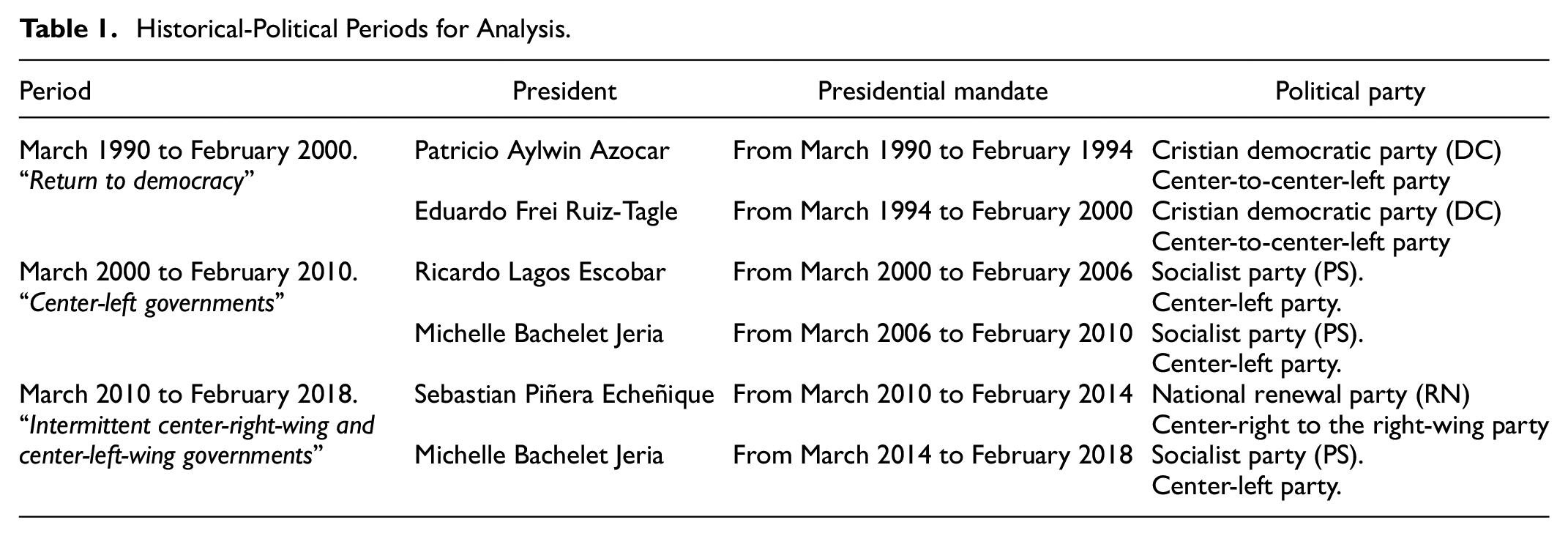
Subsequently, we classify the observed changes using four values: (−) absent, in which no reference was found to identify measures in a given dimension; (+) incipient, in which evidence of existent measures is partially associated with the WHO’s recommendations; (++) developed, in which measures are partially associated with the WHO’s recommendation, however, improves an incipient past related set of measures; and (+++) consolidated, in which a group of measures strongly aligns with the WHO’s recommendations. The values used to evaluate compliance with the recommendations consider the progressive contribution represented by each legal instrument analyzed. To facilitate the lecture on results, we added a figure with circles representing the contribution of each document (low, medium, and high) to the final classification per analyzed period.
Additionally, we applied the incremental institutional change framework proposed by van der Heijden and Kuhlmann (van der Heijden & Kuhlmann, 2017) (Figure 2) to better understand the evolution of laws and decrees of tobacco policies. The framework considers the categories: layering, conversion, drift and displacement. We added two categories to the framework (un-sustained and absent) to contrast layering and displacement. Un-sustained refers to the absence of changes required after introducing an initial change. For example, an initial shift in tobacco taxes is not followed by more progressive increases over time. Absent refers to the total absence of a policy in any realm of interest—for example, the absence of tobacco taxes.
Results
Selection of Sources of Evidence
With the basic engine of BCN, we found 499 documents (including 41 laws and 70 decrees). After removing duplicates and excluding bulletins, resolutions, and instructions or news, we proceeded to screen 45 documents. Thirty-two documents were deemed eligible, and from this selection, three laws and nine decrees were selected for synthesis (Figure 3) (Supplemental Table S2). To supplement this first search, we then applied an “advance search” method. With this alternative we identified 58 laws and 287 decrees. After removing duplicates and excluding documents not related to tobacco, the same previous three laws and eight decrees were re-identified. The “advanced search” method helped us to identify one more decree which was associated with a regulation that re-organized the health system in Chile in 1979 (Law 2 763).

Flow diagram of the literature search for enacted laws and decrees.
Characteristics of Sources of Evidence
Considering the recommendations included in the MPOWER strategy, we charted both the name of the Law or decree, from enactment, and what the policy was about.
Results of Individual Sources of Evidence
The results of each legal document included in the revision are presented in Table 2. We provide a graphical representation of each enacted Law (Biblioteca del congreso Nacional, 1995, 2006, 2013) or decree(Biblioteca del congreso Nacional, 1974, 1975a, 1975b, 1977, 1986, 1994, 1997, 1998, 2003, 2005, 2010, 2014, 2016a, 2016b) in chronological order, from 1990 to 2018 (Figure 4). We added all identified sources to observe a longer historical account in the Supplemental Figure S1.
Data Extracted from Tobacco Control Policies in Chile Considering the MPOWER Strategy.


graphical representation of the evolution of tobacco control policies in Chile considering the MPOWER strategy.
Synthesis of Results
To synthesize results, we present the evolution of each dimension of the MPOWER strategy in three historical-political periods of the country, consolidating the findings by applying the incremental theory of change. This process allows us to answer our two sub-questions.
March 1990 to February 2000: “Return to Democracy.”
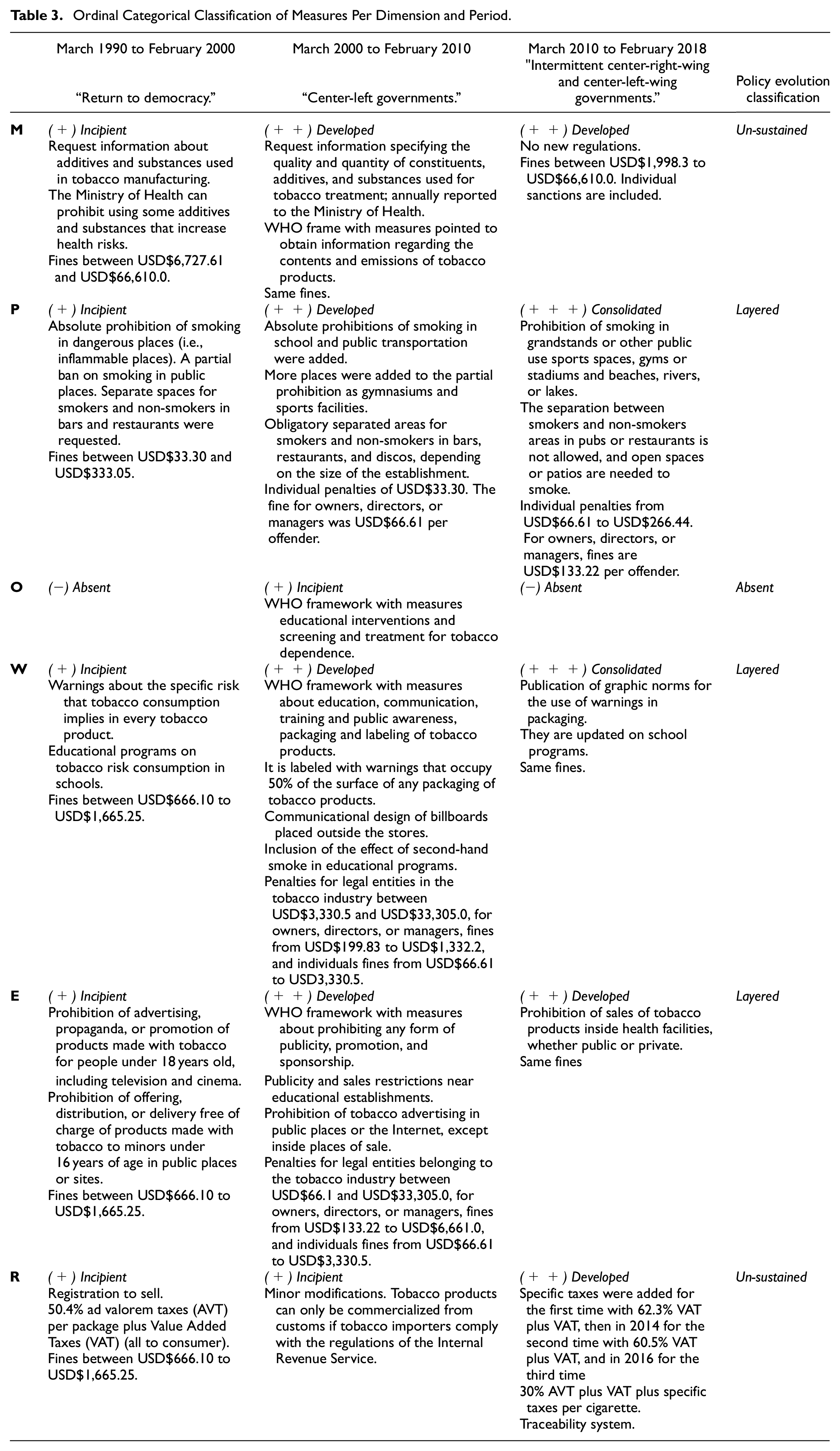
One Law and two decrees set the foundation for tobacco control policies (Law 19 419 and decrees 18 and 828). We observed an incipient development of five of the six dimensions analyzed and the only dimension classified as “absent” was Offer (Table 3).
Ordinal Categorical Classification of Measures Per Dimension and Period.
Monitor
The legal documents established information flows regarding the composition of tobacco products to be monitored. The Ministry of Health is responsible for this activity to date. Non-compliance with regulations of this dimension was penalized with fines (Supplemental Table S5).
Protect
Smoking was prohibited in high-risk locations. In addition, partial measures for places such as bars and restaurants were enacted. Individuals who did not comply with the regulations were penalized with fines (Supplemental Table S5).
Offer
We did not find legal documents for this dimension in this period.
Warn
Warnings about the risks related to tobacco consumption in every package of product made with tobacco were implemented. Educational programs were included in both primary and secondary education curricula. Non-compliance with regulations by legal entities in the tobacco industry was penalized with fines (Supplemental Table S5).
Enforce
The measures were focused on the prevention of exposure to advertising, propaganda, or promotion of products made with tobacco in minors. In addition, offering, distributing, or free delivery in public places of products made with tobacco to individuals under 16 years old was prohibited. Non-compliance with the abovementioned regulations was penalized with fines (Supplemental Table S5).
Raise
Since tobacco products correspond to a consumer good, Chile enacted tobacco trade and taxation regulations before the analyzed decade, laying the foundations for regulating their purchase and sale. Between 1990 and 2000, adjustments were made to the taxes associated with the goods, especially those presented as a pack of cigarettes. At the end of this decade, cigarettes had to pay a tax of 50.4% on their sale price to the consumer for each pack, box, or wrapper. Non-compliance with regulations of this dimension was penalized with fines (Supplemental Table S5).
March 2000 to February 2010: “Center-left Governments.”
One decree and one Law were crucial to initiate an important change in tobacco control policies (decree 143 and law 20 105). We observed a developed status in four dimensions (Monitor, Protect, Warn and Enforce) with an incipient development other two (Offer and Raise) (Table 3).
Monitor
Advances related to the monitorization of the composition of tobacco products were observed, specifically in the quality and quantity of constituents, additives, and substances used for tobacco treatment. In addition, the FCTC introduced measures in research and scientific, technical, and legal cooperation. Non-compliance with these regulations was penalized with fines higher than those observed in the previous period (Supplemental Table S6).
Protect
Measures were implemented to protect against tobacco smoke exposure, particularly in indoor workplaces, public transport, and other public places. Prohibitions on smoking in higher education institutions, gymnasiums, sports facilities, and others were established. During this decade, regulation of tobacco consumption in recreational spaces such as bars and restaurants begin. Non-compliance with these regulations was penalized with fines higher than those observed in the previous period (Supplemental Table S6).
Offer
This is the only decade that shows an advance in this dimension, with the recommendations in the context of enacting the FCTC.
Warn
The regulation of the labeling of tobacco products is strengthened following the recommendations of the FCTC. These interventions were accompanied by changes in advertising tobacco products at stores and some modifications in measures related to educational programs. Non-compliance with regulations of this dimension was penalized with fines higher than those observed in the previous period (Supplemental Table S6).
Enforce
Broad prohibitions toward publicity on tobacco products were established. Publicity and sales restrictions near educational establishments were in place. Non-compliance with regulations of this dimension was penalized with fines higher than those observed in the previous period (Supplemental Table S6).
Raise
During this period, minor modifications to the current legal documents were established. However, no changes in taxation were identified.
March 2010 to February 2018: “Intermittent Center-Right-Wing and Center-Left-Wing Governments.”
In the last analyzed period, one decree and one Law represented significant advances in tobacco control policies (decree 825 and law 20 660). We observed a developed status in three dimensions (Monitor, Enforce and Raise) and a consolidation of two (Protect and Warn) (Table 3).
Monitor
On this dimension, we observed an increase in the fines than those observed in the previous period (see Supplemental Table S7) without changes in the measures.
Protect
During this period, the protective measures were strengthened by extending the bans to various public places, including the absolute prohibition of smoking in enclosed areas of bars and restaurants, public sports spaces, gyms, stadiums, beaches, rivers, or lakes. Not complying with these prohibitions was penalized with fines higher than those observed in the previous period (Supplemental Table S7).
Offer
We did not find legal documents for this dimension in this period.
Warn
Several warning designs are established. Educational measures with a national education plan are reinforced. Fines remained unchanged compared to the previous period.
Enforce
As a new measure, we identified the prohibition of sales of tobacco products inside health facilities. The cost of fines remained unchanged compared to the previous period.
Raise
The specific taxation for cigarette packages, boxes, or wrappers is introduced. This measure suffers three changes between 2010 and 2018. In addition, a traceability system was approved to protect the fiscal interest determined by the Internal Revenue Service on goods subject to the specific tobacco tax.
Progress of enacted laws and decrees of national tobacco policies in Chile
Table 3 presents a comprehensive analysis of the evolution of Chile’s tobacco control consumption policies displayed in its legal instruments considering the recommendations of the MPOWER strategy.
In general, we observed uneven progress in the adoption of anti-smoking measures over time, with three dimensions that experienced changes considered layered (protect, warn, and enforce), two unsustained (monitor and raise), and one absent (offer). Adopting measures recommended by the MPOWER strategy has been heterogeneous, with a marked progression since the FCTC enactment. This progression continued in the third period in the case of the dimensions protect and raise. Free smoke environments and the increase of specific taxes with a decrease of ad valorem taxation are the most robust measures adopted by Chile.
Discussion
We conducted a scoping review to explore the evolution of Chile’s tobacco control consumption policies with attention to the FCTC. The observed policy changes were analyzed using theoretical concepts proposed by van der Heijden and Kuhlmann (2017).
In general terms, Chile has enacted regulations related to tobacco trade and taxation since 1814(Biblioteca del Congreso Nacional de Chile, 2014). However, it was not until the mid-1990s that regulations included in legal documents—with the exception of the dimension Offer, only incorporated in 2005—that Chile begins a considerable but uneven effort to enact FCTC measures. More specifically, the dimensions Protect, Warn and Enforce were classified as layered, whereas Monitor and Raise, and Offer were considered as unsustained and absent respectively.
A turning point in tobacco policy development can be associated with the enactment of the FCTC in 2005. More specifically, a sustained progression is observed for Protect and Warn dimensions, where many measures were enacted between 2006 and 2018. Relatedly, measures associated with the Raise dimension are only developed more clearly in the last analysis period. Interestingly a government that one could have expected to have less aggressive measures towards the tobacco industry was the one which increased their taxes in 2016. In sum, we observe a relatively progressive construction of tobacco policy with a predominance of measures focusing on individual behavior/choices rather than targeting per se the tobacco industry.
While our findings confirm the evaluation made by the WHO in its global tobacco epidemic report (World Health Organization, 2021b), there are various nuances that deserve a lengthier discussion. First, interventions in the Monitor dimension are not necessarily defined by Laws. As such, measures reported depend on how governments respond to the questionnaires sent by WHO when writing these types of reports. In the case of Chile, the global report considered surveys and ad-hoc studies, which are not necessarily part of a tobacco monitoring strategy formally institutionalized by the country. Regarding the absent dimension Offer, this observation is consistent with other authors (Acuña, 2017; Bambs et al., 2020; Castillo-Riquelme et al., 2020; Feigl et al., 2015). The WHO report indicates pharmacological treatment is available; however, it must be clarified that the public health system does not cover this. With regards to the toll-free telephone quit line, this is a generic number that is used to respond to any health inquiry (“Salud responde”)(Ministerio de Salud, 2021). In addition to the above, the report indicates that smoking cessation programs are unavailable. The latter is interesting, considering that in 2003 a guideline on Tobacco Cessation for Primary Health Care professionals (Ministerio de Salud, 2003), developed with the collaboration of the Pan American Health Organization, was available. However, these interventions focused on counseling, a small part of cessation treatment. This guideline was discontinued later, and the interventions were moved to the Preventive Medical Examen for Adults (Ministerio de Salud, 2015).
Strengths and Limitations
Our scoping review has been reported following the PRISMA-ScR statement, contributing to its findings’ reliability and replicability. Likewise, the WHO MPOWER strategy is a standard reference for judging progress in cost-effective tobacco control measures. Complementarily, one of our study’s main strengths is bringing together the analytical framework provided by the WHO with a historical-political view to account for how local and global processes may intertwine to shape tobacco control measures over time at the national level.
Complementarily, our review is limited to tobacco policies endorsed in Chilean legislation, which is relevant in two directions. On the one hand, we only have data on law enforcement capacities within the specific legal provisions and penalties associated with their transgression. Thus, we cannot reject the possibility that we are in the presence of a “dead letter.” On the other, we have yet to consider tobacco control strategies not supported by legal documents. That is, the range of strategies and the extent of progress in tobacco control in Chile may be greater than that we have reported. Moreover, because we focused on documents enacted by the central government, local regulations issued by the municipalities (Chile has 345 municipalities to date) were left unexplored. In summary, a more comprehensive view of the progress of tobacco policies in Chile requires further research that contrasts various sources and the inclusion of legal documents issued by local governments.
Although the official legal documents in Chile are stored in a centralized database, making them easily accessible, our interpretation of tobacco-related legislation should consider the involvement of legal professionals to increase the precision of our results.
Future research on this topic could include other policy documents to complement the current evidence presented in this study and consider interviews with stakeholders internationally and locally involved in the evolution of this Chile’s frame, strategies that can provide more information about the use of alternative tobacco products such as the e-cigarettes.
Our revision highlights a series of policy changes that can be used to understand tobacco prevalence changes from a population-level perspective comprehensively. In addition, better research designs can be advanced since Chile’s tobacco policies have been multifaceted and heterogeneous.
Supplemental Material
sj-docx-1-sgo-10.1177_21582440231181392 – Supplemental material for Chile’s Tobacco Strategy: A Scoping Review of Tobacco Measures Over Time
Supplemental material, sj-docx-1-sgo-10.1177_21582440231181392 for Chile’s Tobacco Strategy: A Scoping Review of Tobacco Measures Over Time by Karen A. Domínguez-Cancino, Pablo Martínez and Josí Ignacio Nazif-Munoz in SAGE Open
Footnotes
Declaration of Conflicting Interests
The author(s) declared no potential conflicts of interest with respect to the research, authorship, and/or publication of this article.
Funding
The author(s) disclosed receipt of the following financial support for the research, authorship, and/or publication of this article: Fonds de recherche Santé, grant # 269540.

Supplemental Material
Supplemental material for this article is available online.
References
Supplementary Material
Please find the following supplemental material available below.
For Open Access articles published under a Creative Commons License, all supplemental material carries the same license as the article it is associated with.
For non-Open Access articles published, all supplemental material carries a non-exclusive license, and permission requests for re-use of supplemental material or any part of supplemental material shall be sent directly to the copyright owner as specified in the copyright notice associated with the article.
