




Abstract
In order to achieve educational changes, professional development initiatives are needed. Recently more emphasis is placed on methods in which teachers are engaged in collaborative discourse. One potential strategy for this is the use of Teacher redesign Teams (TrDT), in which the support of an academic developer is imperative for its effectiveness. Previous studies show diversified findings on role categorization and role uptake of academic developers. This study attempts to apply the existing frameworks and provides a better understanding of the varying role of a TrDT facilitator in a university setting. During two focus groups, data was collected from the university facilitators (n = 10) who had been supporting TrDTs for 1 year. In addition, audio recordings were gathered of TrDT conversations. A thematic analysis of the collected qualitative data results in an alternative extended framework specifically altered to the roles of an academic developer in a university setting. According to our study, the facilitator can take on eight different roles, ranging from coordinating and organizing meetings and building bridges with stakeholders to being a representative, located at different levels, going from meso to micro level. In addition, the ADDIE-model for instructional design can be used to structure the implementation of innovative learning approaches.
Introduction
In response to the prevailing consumerist approach in higher education, a contrasting movement has gained momentum in educational theory and practice; one that seeks to place greater value on more student-centered approaches and in which active learning is promoted to improve learning outcomes (Biggs & Tang, 2011; Bonwell & Eison, 1991). This approach emphasizes that both students and teachers need to actively contribute to the educational process that takes place (McCulloch, 2009). In higher education, academic developers play a key role in the implementation of such educational approaches (Bonwell & Eison, 1991). One of the key findings in current research is that considerable efforts are linked to sustaining and spreading such approaches over time (Stoll et al., 2006). In order to achieve educational changes, professional development initiatives are needed (Desimone, 2009).
Understanding Professional Learning Communities
Professional development initiatives can vary from formally organized lectures or workshops to informal dialogue with colleagues (Desimone, 2009). However, recently more emphasis is placed on models in which teachers are engaged in collaborative discourse, such as professional learning communities (PLCs), as dialogue is essential for work and learning processes (Binkhorst et al., 2015; Desimone, 2009; Lefstein et al., 2020). In line with this, Vangrieken et al. (2017) state that teacher communities are conducive for sustainable improvements in teaching practices and can have an (indirect) positive impact on teachers’ professional development and student achievement (Hord, 2004; Lomos et al., 2011; Stoll et al., 2006). Furthermore, Compen and Schelfhout (2020) state that the enhanced ownership emerging from commitment in collaborative discourse is suggested to positively impact teachers’ enthusiasm to implement the curricular changes.
Due to the fragmented character of the research field (Lefstein et al., 2020), professional learning communities exist in different shapes and sizes, although there is a general consensus that it is a community “with the capacity to promote and sustain the learning of all professionals in the school with the collective purpose of enhancing student learning” (Stoll et al., 2006, p. 145). Furthermore, PLCs are characterized by some typical features (Hord, 2004; Stoll et al., 2006):
Shared values and vision: The individual goals of the different PLC members must be transformed into a collective purpose (Binkhorst et al., 2015; Stoll et al., 2006). This goal alignment is crucial for an effective PLC and will guide the team when making decisions about the teaching and learning of students (Hord, 2004).
Collective responsibility: The members of the PLC are committed in creating optimal learning experiences for their students. This shared feeling of responsibility helps maintaining commitment towards the shared goal and contributes to the effectiveness of the group (Stoll et al., 2006).
Reflective professional inquiry: The work of the PLC is grounded in reflective dialogue. By discussing educational issues and recurring problems, the participants apply new knowledge and try to create solutions for effective learning and school improvement (Biggs & Tang, 2011; Stoll et al., 2006).
Group and individual learning: In a PLC the cognitive abilities of the participants are combined and used in order to improve their teaching practices. This learning is driven by the continuous reflective dialogue of the participants (Stoll et al., 2006).
One type of PLC that emerges more and more and has aforementioned characteristics is a Teacher reDesign Team (TrDT). A TrDT is described as a group of two or more teachers/teaching assistant(s) who collaboratively (re-)design curriculum materials (Handelzalts, 2009). Based on the descriptive framework of Binkhorst et al. (2017) the targeted outcome of TrDTs is twofold: it has the potential to (1) lead to practically implementable educational materials and (2) support professional development. Currently, most research on Teacher reDesign Teams is carried out in compulsory education and less is known about working in teams in a university setting (Gast, 2018).
The Facilitator of TrDTs
According to the existing literature (Becuwe et al., 2016; Binkhorst et al., 2015; Huizinga et al., 2019; Margalef & Pareja Roblin, 2016; Stoll et al., 2006) support from an expert or facilitator during the TrDT process is critical and enhances the effectiveness of the TrDT. This expert has to possess pedagogical content knowledge or content knowledge to guarantee optimal guidance (Compen & Schelfhout, 2020; Parker et al., 2012). In higher education academic developers have the responsibility to coach teaching staff, for this reason they are well-suited to support TrDTs. However, integrating academic developers in higher education institutions’ daily policy and practice has proven to be challenging (Kensington-Miller et al., 2015).
Central or Faculty-Based Academic Developer?
The role of an academic developer is not an obvious one, as they often are underappreciated and unacknowledged. This limited institutional legitimacy ensures that it is a constant struggle for them to make clear “who they are” to their colleagues, but also to themselves. In addition, their work is often not regarded as a priority resulting in a lack of funding, as well as unclear career track designations (Kensington-Miller et al., 2015).
Consequently, there is a restraint on the number of staff who engages in academic guidance and professionalization (Sharif et al., 2019). Due to these challenges, Sharif et al. (2019) propose a new position which embeds an academic developer in faculty-based entities and can help to connect professional and academic domains. These academic developers all have a different blend of competencies, knowledge, and experience (Sharif et al., 2019). This allows a higher education institution to choose between three different models for academic support: (1) only central academic support, (2) only faculty-based support, or (3) combining central and faculty-based support. These different positions lead to diverse knowledge profiles. A central academic developer is mostly screened and appointed on the basis of pedagogical knowledge (Wright & Miller, 2000) which is defined by Koehler and Mishra (2009) as “deep knowledge about the processes and practices or methods of teaching and learning” (p.64). This means they are selected based on whether or not they received a pedagogical training. In contrast, a faculty-based academic developer is largely selected based on their content knowledge which is “knowledge about the subject matter to be learned or taught” (Koehler & Mishra, 2009, p. 63). In addition, some of these facilitators have expertise of the pedagogy that is applicable to educating specific content, also known as pedagogical content knowledge (Koehler & Mishra, 2009). This results in a third position, that of an academic developer combining central and faculty-based support.
Roles of the Academic Developer
According to existing research, the facilitator of a TrDT can take on a multitude of roles (Margalef & Pareja Roblin, 2016). For instance, Becuwe et al. (2016) formulate three different roles (see Figure 1), namely, (1) providing logistic support, in which the facilitator manages the practicalities necessary for the teams functioning. In addition, (2) the scaffolder who provides structure by offering a specific framework to facilitate the design process or by asking questions and summarizing. Lastly, as (3) monitor of the design process the facilitator makes sure the whole process of collaboration runs smoothly (Becuwe et al., 2016).

Roles of a TDT facilitator depending on several factors (Becuwe et al., 2016).
In line with this, Margalef and Pareja Roblin (2016) also describe three roles (see Figure 2): (1) the coordination of the TrDT activities, which refers to the practicalities related to working in a TrDT, such as planning the gatherings and other routine tasks. This is identical to the role of “providing logistic support” and is important especially in the starting phase of the TrDT (Becuwe et al., 2016; Margalef & Pareja Roblin, 2016). As (2) supporter of community building the facilitator is concerned with tasks such as formulating a common goal and shared vision and establishing a climate of trust. These tasks all are important to foster teacher learning (Margalef & Pareja Roblin, 2016). The third role, but not the least important one, is about (3) supporting teacher learning. For this, the facilitator must provide learning resources, such as articles and other evidence-based insights, and develop a challenging learning climate that encourages critical reflection and inquiry. As such, facilitators should ask critical questions and problematize participants’ instructional practices (Avgitidou, 2009; Margalef & Pareja Roblin, 2016). This is in line with the role of scaffolding mentioned by Becuwe et al. (2016).

Facilitators’ roles and tasks.
Sharif et al. (2019) use yet another division of roles which a facilitator can take on. They make a distinction between five roles, namely (1) thinker and explorer, in which the facilitator seeks for innovative ideas and good practices that can be a solution for the learning needs of students and shares them with faculty. This is in line with the role of supporter of teacher learning that Margalef and Pareja Roblin (2016) propose. To gain access to information and certain good practices, it is possible that the facilitator needs to take on the role of (2) relationship builder and connector, which is mainly to connect faculty with the right resources and significant others. Of course, a facilitator needs to establish what the support needs and expectations are of the involved faculty, for this the facilitator takes on the third role of (3) planner, designer, and builder. After determining the needs, support can be tailored and, if necessary, workshops can be developed. This whole process needs to be (4) evaluated, which is the fourth role Sharif et al. (2019) define. Lastly, the newly adopted innovations need to be shared to inform others (in- and outside the walls of the institution). This role of (5) researcher and presenter can be apparent when the facilitator conducts research and presents findings and good practices at conferences (Sharif et al., 2019).
Hence, it becomes clear that there are already different models or divisions in which some similarities can be found (see Figure 3). It is evident that the uptake of these roles is highly dependent on the broader teaching and learning context (Sharif et al., 2019). For instance, Becuwe et al. (2016) indicate that the instructional design phase plays an important role. To give an example, activities where the TrDT is still being established, such as planning and developing a shared goal, appear to occur more at the beginning of the instructional design process. Yet, when a common goal is established, the facilitator tends to focus more on the learning aspect (Becuwe et al., 2016; Margalef & Pareja Roblin, 2016). Finally, existing studies also mention that there should be research to help examine how background characteristics of academic developers, such as experience and expertise, can influence the roles adopted by facilitators (Margalef & Pareja Roblin, 2016; van der Want & Meirink, 2020).

Similarities between the different models or divisions.
Purpose of the Study
Due the current diversified and limited findings on role categorization and role uptake of facilitators in TrDTs in higher education, this study explores this issue further. More specifically, it focuses on the differences in role uptake during TrDTs between central and decentral academic developers in a university-wide project on active learning approaches (Margalef & Pareja Roblin, 2016; Sharif et al., 2019). The purpose of this study is to develop an extended descriptive framework that provides insight in role uptake during the sequential phases of TrDT implementation in a university setting. Therefore, the current study was set out to answer following research questions:
RQ1: How do facilitators perceive their position and which roles do they take on during a university-wide innovation project on active learning approaches? (research question 1)
RQ2a: What are differences between the role enactment of a central academic developer and a faculty-based academic developer during TrDT conversations? (research question 2a)
RQ2b: Does the role uptake differ according to the different instructional design phases? (research question 2b)
Methodology
Context
The current study took place within the context of a university-wide project on active learning approaches at a public university in Belgium since 2008. The goal is to implement evidence-based active learning techniques tailored to the study program through the formation of new teacher redesign teams.
The newly composed teacher redesign teams, consisting of two to six members, focus on one subject and are supported by an academic developer, also known as the facilitator. At Ghent University, a facilitator can be (1) an expert in the pedagogical field or (2) an expert in the subject matter of the involved faculty. This way we have two possible types of facilitators. First, a central academic developer who has a pedagogical background and is employed at the educational support service of the university. Secondly, a faculty-based academic developer who is employed within a specific faculty and has a background in that type of subject-matter.
During the TrDTs we opt to work with a systematic and iterative approach based on the ADDIE-model for instructional design, which stands for Analyze, Design, Develop, Implement, and Evaluate (Branch, 2009; see Figure 4).

ADDIE-model.
In a first phase, the analysis of the course, there is a targeted conversation with the TrDT to get to know each other and the course (i.e., instructional materials and course components). Furthermore, the individual teaching needs become clear, which is important information for the facilitator (Binkhorst et al., 2017). At the end of the analysis phase, it is vital to have a shared vision or goal (Handelzalts, 2009). In a following phase, the design starts. In these meetings, the team firstly elaborates on the structure of the course, after which the design process really kicks off. Through targeted questions, the facilitator assists the members of the TrDT in their critical thinking (Margalef & Pareja Roblin, 2016). In order to provide inspiration, the facilitator offers on-topic scientific articles about educational activities and assessment methods (Huizinga et al., 2019). When there is a conceptual idea about the (re)design of the course, we move into the development phase. Generally, the TrDT takes full responsibility for this, with on-demand support from the facilitator. This also is the case for the implementation of the redesign, although, it can happen that a team asks the facilitator to observe the implementation. As for the last phase, the evaluation, the facilitator organizes feedback meetings with the team to reflect about the process. The team is also encouraged to carry out formative evaluations during the implementation to help inform and improve the redesign (Huizinga et al., 2019). After a first implementation and evaluation, the process can start again.
Participants and Data Collection
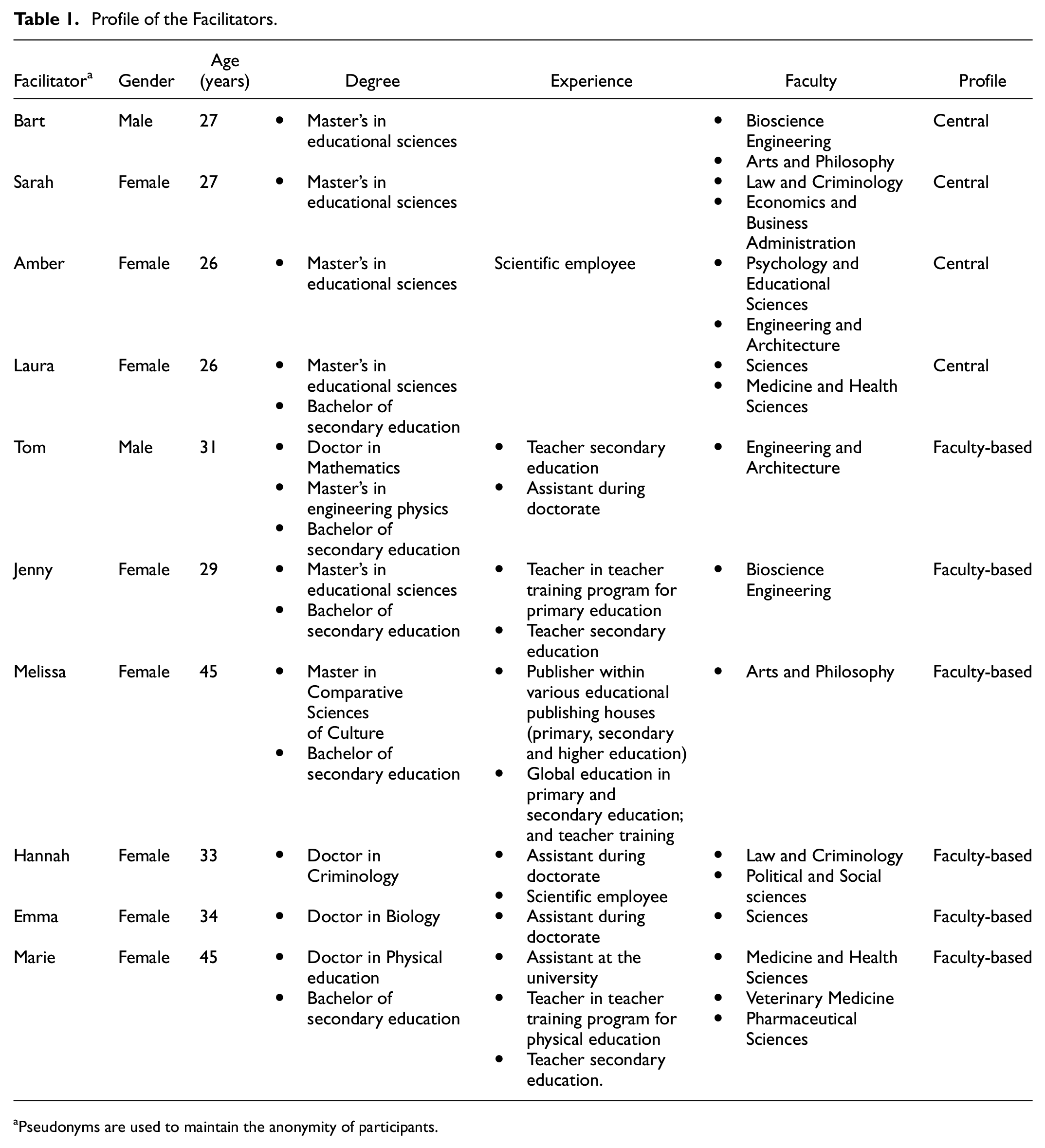
To answer the research questions, data was collected through two qualitative focus groups with all the TrDT facilitators appointed at our University. The first focus group was organized in June 2019 with central academic developers. The second focus group was set up in May 2020 with six faculty-based facilitators. All facilitators were included in the study. There was no selection process. Backgrounds can be found in Table 1. Due to COVID-19 the second focus group took place online through Microsoft Teams.
Profile of the Facilitators.
Pseudonyms are used to maintain the anonymity of participants.
For every focus group, a meeting of 3 hours was planned in order to investigate the participants perceptions after being an academic developer for 1 year. In addition to the focus groups, audio recordings were gathered of TrDT conversations. For this, both a central academic facilitator and a faculty-based academic developer were selected by the stratified sampling method and followed. During the data collection the researchers took a neutral role and acted as the moderators of the conversation in order to minimize the researcher effect (Miles & Huberman, 1994).
Data Analysis
All focus group interviews and TrDT conversations were audiotaped and transcribed. Following this, the transcripts were inserted into NVivo, a qualitative data analysis computer software package. The data was analyzed through thematic analysis which consist of six recursive steps (see Figure 5). A deductive approach was applied which used existing theoretical frameworks to identify themes based on the research questions. Subsequently, the existing coding scheme was supplemented with the inductive approach, meaning extra themes were derived from the data (see Table 2). In addition, every respondent was categorized as a personal case (Kiger & Varpio, 2020).

Thematic analysis.
Codebook.

Within-case and cross-case analyses were conducted based on matrix coding queries with percentages. This implies that an individual case, which reflects the experience of one facilitator, was analyzed to gain insight in the different roles he or she experienced. In addition, cases were compared to one another to find commonalities and unique features (Miles & Huberman, 1994).
The data was coded through the collaboration of author 1 and 2 of this manuscript. Any uncertainties or inconsistencies were discussed and resolved. As the analysis was done collaboratively, no inter-rater reliabilities were calculated.
Results
Research Question 1: General Role Enactment
From the data it is possible to give an idea about how the different facilitators experience their own position after 1 year of being an academic developer, also called the perceived role enactment. “During the focus group the faculty-based facilitators indicate that they often feel that it is hard to find a balance between the different tasks and needs, which can be linked with the role as ‘relationship builder and connector’: I am like a circus artist, in need of constant balancing or juggling.” (Hannah)
In addition, some mention that they are the glue necessary to establish a link between people, for instance those of a specific faculty and the central educational support service: “We are just that link or puzzle piece that further completes the circle or connection, allowing it to flow and sprout.” (Jenny)
The central academic facilitators also experience this role of the “relationship builder and connector”: “I feel like some kind of an octopus in which all the arms refer to the different things we were doing and also the different parties we had to keep happy.” (Sarah)
In addition, Laura and Bart, both central academic facilitators, add feeling like a method developer, which is in line with the role of the “planner, designer and builder”: “The goal for me was to create an elaborated method at training and professional level, to try it out, fine-tune it and finally “transfer” it to colleagues.” (Laura)
Next to the perceived role enactment, we can get an overview of which actual roles the facilitators take up by analyzing the statements from the focus groups and the TrDT conversations (see Table 3).
Actual Role Enactment in General.

Firstly, we can see that the role of “facilitator of professional development,” in which they provide learning resources and seek for innovative ideas and good practices, is most taken on. From the statements it becomes clear that this is also a role that is deeply experienced: “I do experience that teachers also see me as someone with expertise, or they test it anyway. Because I often get questions like: ‘and how should we do that?’” (Laura)
This role is followed by that of the “relationship builder and connector.” Jenny points out that “… when I look at my agenda, at all the meetings, then I think that consultation and bringing people together sometimes becomes more dominant.” In addition, Marie mentions the following “… I think that the common thing with everyone is that the amount of people we should work with is countless.”
Being a “community builder” only appears in 14% of their statements. When looking for possible explanations we can see that most facilitators indicate that it is difficult to know whether they engage in community building, which can be derived from the following citation of Marie: “I find that a difficult one, but I don’t know to what extent I do it. The workshops have always gone very well, but I don’t know. Community builder, that’s how you are.”
Lastly, the role of “coordinator and organizer” is only found in 12% of the comments. An example of the latter can be found in following statement of Marie in which she says that “… where I spend a lot of time on is to find a meeting date that suits everyone. That is a difficult one. Especially because you also must ensure that you take the time to plan and prepare those appointments.”
This is in contrast with following comment where Sarah mentions that she feels that “… the role as a ‘facilitator of professional development’ is suffering from the time constraint. Next week I have a workshop for production policy, and I don’t know when I will prepare it.” So it becomes apparent that the facilitators indicate that this role as a “coordinator and organizer” takes up the most of their available time, which influences the other roles, and endangers especially the uptake of the role of “facilitator of professional development.”
The role as “representative,” also labeled as salesmen or preacher was specified by the facilitators themselves and derived from following quote: It’s a project that absorbs a lot of budget, that everyone is looking at and you must sell it on the one hand, but you also have to deliver. I find the role of motivating and selling a difficult one. (Sarah)
In general, the overview of the role enactment of the ten facilitators shows very low uptake of the following roles: “planner, designer and builder”; “evaluator”; “researcher and presenter”; and “representative.”
Research Question 2a: Central or Faculty-Based Academic Developer?
To answer the first part of the second research question, we focused on the different profiles of the facilitators. As indicated, a facilitator can be (1) an expert in the pedagogical field or (2) an expert in the subject matter of the involved faculty. For this we took a closer look at statements of both one central academic developer (Laura) and one faculty-based academic developer (Tom) during TrDTs.
In the focus group we asked the facilitators which role they most experience. Laura reacted with following answer: “According to others, I am very strong in motivational interviewing and encouraging reflection.” These actions are in line with community building and facilitation of professional development.
In contrast, Tom answered with this statement: I think I spend the least time, conscious time, on community building. And coordination and organization take up the most time. But there still is a good balance with the time available for professional development. So maybe the focus is on coordination and professional development.
The analysis of the actual role enactment shows differences in the perceived role enactment and the actual role enactment. Furthermore, the differences in the actual role enactment of the two profiles of the facilitators are small (Table 4).
Overview of Results Per Facilitator RQ2a.

Research Question 2b: Instructional Design Phase
When we focus on the ADDIE-model for instructional design and the role uptake of the two profiles, we get following distribution (see Figure 6).

Role uptake per ADDIE phases.
When we take a closer look at which roles both facilitators take on the most during a TrDT linked to the ADDIE-model, we see that the role as “facilitator of professional development” still prevails during all phases (see Figure 7). We do see a slight difference between both profiles in the analysis phase for the roles of “the community builder” and the “coordinator and organizer.” Compared to the central academic developer, the faculty-based academic developer seems to take on more often the role as “coordinator and organizer” than the role as “community builder.”

Role uptake of a central and faculty-based academic developer linked to ADDIE.
Discussion
The main goal of this paper was to develop an extended descriptive framework that provides insight in role uptake during the sequential phases of TrDT implementation in a university setting. In order to gain these insights, ten facilitators were questioned regarding their experience after being an academic developer for 1 year. In addition, one central academic facilitator and one faculty-based academic developer were selected through stratified sampling and followed during TrDT conversations. Based on our results, we propose an alternative framework specifically altered to the roles of a facilitator which can guide the implementation of innovative practices in a university setting.
Facilitators’ Roles
The results indicate the existence of a variety of roles, shifting from coordination to facilitator of professional development. This confirms the results of earlier research (e.g., Becuwe et al., 2016; Margalef & Pareja Roblin, 2016; Sharif et al., 2019). In addition, it became apparent that the roles can be located at different levels, going from meso to micro level (see Figure 8). The meso level refers to a community or an organization, whereas the micro level is linked to an individual or a small group of individuals (Jepperson & Meyer, 2011). Linked to the micro level we find the roles of “community builder,”“coordinator and organizer,” and “facilitator of professional development,” which are taken up when the facilitator supports a TrDT. For instance, the facilitator as “community builder” needs to enhance the relationship between the different individuals in the TrDT by supporting them, whereas a “facilitator of professional development” provides professionalization when the group needs it and the facilitator as “coordinator and organizer” plans and structures the different TrDT-meetings. In contrast, the roles of “relationship builder and connector,”“planner, designer and builder,”“evaluator,”“researcher and presenter,” and “representative” are linked to the meso level and occur when the facilitator is not guiding a TrDT. For instance, the role of “relationships builder and connecter” appears to be important when the TrDT needs further help or resources (eg. supportive educational technology, infrastructure, and online resources) from other services in the university. Another example is the role of “researcher and presenter” when participating in conferences or workshops inside and outside the university.

Facilitators’ roles located at different levels of a university setting.
First of all, we can see a difference between “what they think they are doing” and “what they are actually doing,” also known as the perceived role enactment and the actual role enactment. The facilitators indicated that they often feel that it is hard to find a balance between the different tasks and needs of the involved parties and other projects at the university. This feeling does not match with the actual role enactment showing us that the role of “facilitator of professional development” prevails. This finding can be considered as positive, because the core task of an academic developer is to foster professional development. This is also the only role that can be found in all existing research (Becuwe et al., 2016; Margalef & Pareja Roblin, 2016; Sharif et al., 2019). The second role most occurring, that of “relationship builder and connector,” can also be seen reasonable because to start the process it is necessary to build connections. In addition, it became clear that other projects and university policies also want to link to our project on active learning approaches. Lastly, the role of “representative” was added because the facilitators made clear during the focus groups that they also needed to sell the project before the process could be started. In general, the overview of the role enactment shows very low uptake of the following roles: “planner, designer and builder”; “evaluator”; “researcher and presenter”; and “representative.” A possible explanation for the absence of these roles may be that the project was still in the starting phase. For instance, for the role of “researcher and presenter” this means that activities such as presenting at conferences and conducting research are not yet applicable. In addition, due to COVID-19 it was not possible to observe a whole cycle of the ADDIE-model for instructional design. This may have prevented certain roles from being observed.
When we focus on the micro level, the data shows that the uptake of the role of “community builder” is limited. According to existing research, this role should be more prominent, especially at the starting phase, as formulating a common goal and shared vision and developing a shared language are of great importance for the effectiveness of the team and is necessary to foster teacher learning (Binkhorst et al., 2015; Margalef & Pareja Roblin, 2016; Stoll et al., 2006). In addition, the role of “coordinator and organizer” also appears to be less visible. However, according to the academic developers this role is time consuming, which endangers the role uptake of “facilitator of professional development” wherein facilitators act as a critical friend and offer evidence-based practices. More research is needed to gain insight into the reason why these roles are less apparent, especially because existing research mentions that these roles are important in the starting phase of a TrDT (Becuwe et al., 2016; Margalef & Pareja Roblin, 2016).
When looking for differences between the central academic developer and the faculty-based academic developer, we noted no substantial discrepancies in the actual role enactment of the two profiles. This demonstrates that both types of facilitators managed to fulfill their job of guaranteeing optimal guidance as a facilitator of professional development (Compen & Schelfhout, 2020; Parker et al., 2012). It also exposes that faculty-based academic developers attained enough pedagogical content knowledge to offer efficient support. Further research is needed to expose whether the existence of the two profiles has consequences for the outcomes of a TrDT.
ADDIE-Model for Instructional Design
If we look at the appearance of roles linked to the ADDIE-model of instructional design, we notice that the role of “facilitator of professional development” is important in almost all phases. This emphasizes that the help of a facilitator is essential when working with TrDTs, which is in line with existing research (Becuwe et al., 2016; Binkhorst et al., 2015; Huizinga et al., 2019; Margalef & Pareja Roblin, 2016; Stoll et al., 2006). The absence of role uptake in the development, implementation, and evaluation phase can be explained by two reasons. First, for the central academic developer the lack of roles during development and implementation can be explained by the fact that lecturers at universities have the autonomy to design and arrange the curricula to their needs and wishes. This autonomy often is seen mainly as a positive aspect, but this can also be the cause of the emergence of a fragmented educational program (Christensen, 2011). In the future it will be necessary to look for how we can optimize our systematic approach to increase the involvement of the facilitator in the development and implementation phase. Secondly, due to COVID-19 some phases were largely skipped or it was not possible to observe a whole cycle of the ADDIE-model for instructional design because conversations could not be captured. It will be important to look back on this as this hugely affects the outcomes and the quality of the design (Handelzalts, 2009; Huizinga et al., 2019).
Limitations and Future Studies
A few limitations should be expressed after completing this study. First, due to COVID-19, it was not possible to check the opinions of the members of the TrDT, such as the university lecturers or teaching assistants, on the roles of the facilitator. It would be recommended to cross-check these findings in additional research which focuses on the perspective of TrDT members, so there would not be singularly focused on the viewpoint of the facilitators. Furthermore, it was also not possible to observe a whole cycle of the ADDIE-model for instructional design. For this, the study should be repeated to gain insight in the changing role of the facilitator during a full design cycle. In addition, this study happened after the facilitators had been employed for about 1 year. It would be wise to do longitudinal research which investigates the evolution of the roles. Future studies should also do an in-depth and rigorous analysis of our framework. Furthermore, additional research is needed that examines why certain roles are more common than others. For instance, this can be linked to data about good and bad TrDT cases. Lastly, the framework should be explored in other higher educational institutions to check its generalizability.
Conclusion
The current study investigated the role enactment of central and faculty-based academic developers. Our findings reveal that the models as proposed by Becuwe et al. (2016), Margalef and Pareja Roblin (2016), and Sharif et al. (2019) have some limitations. From the results it becomes apparent that the roles they mention don’t suffice to describe all the tasks that are being taken on by the facilitators. That is why we propose an alternative extended framework specifically altered to the roles of an academic developer which can guide the implementation of innovative practices in a university setting. According to our study, the facilitator can take on eight different roles, ranging from coordinating and organizing meetings and building bridges with stakeholders to being a representative. These roles can be located at different levels, going from meso to micro level. In addition, the ADDIE-model for instructional design can be used to structure the implementation of innovative learning approaches.
Footnotes
Acknowledgements
We thank the participants for their insights and participation. We thank the different central and faculty-based academic developers for their cooperation.
Declaration of Conflicting Interests
The author(s) declared no potential conflicts of interest with respect to the research, authorship, and/or publication of this article.
Funding
The author(s) received no financial support for the research, authorship, and/or publication of this article.
Ethical Approval
No ethical approval was necessary for this research.
