



Abstract
Existing studies have revealed that prior educational experience plays an important role in student learning, and many international students are encountering challenges while undertaking academic studies at Anglophone universities. However, few studies have examined how the pre-university preparation international students experience assists them in transitioning to university. This study explores, through the perceptions of students, the effectiveness of different university preparation pathways of a cohort of international students in a leading Australian university. Using a mixed-method research design, a questionnaire and focus group interviews were conducted to collect data about overseas student perceptions of the pathway program they undertook. The results show that international students who undertook different pathway programs had different perspectives about the extent to which they felt prepared for university in terms of important aspects of their education, such as subject content knowledge and English language proficiency. Based on the students’ perceptions, the findings of this exploratory study contribute new insights to help improve education practices at universities through a deeper understanding of the diverse preparation international students receive. Overall, the article highlights the heterogeneous nature of international students’ academic preparedness for university transition, and offers some practical implications for university educators, administrators, and curriculum designers.
Introduction
Studying in and graduating from an internationally reputable university is usually considered by international students as a way to cultivate and enhance their “cultural capital,” including better understanding of diverse languages and cultures, valuable international skills, and employment prospects (Bourdieu, 1979; Marangell et al., 2018; Organisation for Economic Co-operation and Development [OECD], 2020; Ragusa & Steinke, 2012). As a result, there has been an increasing number of international students, who “have crossed borders for the purpose of study” or “are not residents of their country of study” (OECD, 2013), pursuing tertiary education abroad, contributing to the dramatic expansion of tertiary education in Anglophone countries in the past 50 years (de Wit & Altbach, 2021).
Transitioning from school to university is a critical and challenging process (Briggs et al., 2012; Kyndt et al., 2017), and the existing research suggested that good preparation prior to university can enhance students’ transition to university and positively influence their academic achievement (Hultberg et al., 2008). In addition, international students need to cross not only educational, but also national (Bhandari et al., 2018; Hanassab, 2006; J. J. Lee, 2014; Matthews, 2002; Meadows, 2011; Ong, 2009; Skyrme, 2007) and linguistic boundaries (Hennebry et al., 2012; Morton et al., 2015) to adapt to a new learning and social environment when they are studying abroad. Therefore, many studies have been conducted to investigate international students’ perceptions of studying at overseas universities. Although such studies have identified and addressed a relatively comprehensive list of challenges that may impede international students’ transition to universities in countries other than their own, this is still an important topic for research (Noyens et al., 2017). Moreover, most of the existing studies in higher education research have explored factors that are influential in students’ transition experience at university, such as motivation and self-efficacy (Ashwin & Trigwell, 2012; Christie et al., 2008), while failing to consider how well students have been prepared for university study prior to entry (Lamberton & Ashton-Hay, 2015; Money et al., 2020). As part of a larger study, this paper focuses on how well international students perceive pathway programs have prepared them for university, enabling a deeper understanding of international students’ perceptions of the preparation they received and how it affects their learning experience at university.
In Australia, pathway programs vary by type, length, and content (McKay et al., 2018). The most common pathway into university is to complete a senior secondary qualification such as the Higher School Certificate (HSC) and achieve a high Australian Tertiary Admission Rank (ATAR) score. In addition, an increasingly popular pathway to degree programs at Australian universities is to complete a Foundation Studies program, which is equivalent to an Australian senior secondary school qualification and can prepare eligible students such as international students to enter the first year of a degree. Similar pathways exist in other Anglophone countries, such as the Advanced Placement (AP) pathway program in the USA. Courses in this program cover seven subjects, which aim to enable “willing and academically prepared students to pursue college-level studies while still in high school” (College Board, 2021). However, unlike the HSC, AP is not compulsory for secondary students, and it allows successful graduates to earn college credit and/or skip introductory courses in college.
We reviewed a number of university pathway programs in Australia, and we found that most are focused on academic excellence and sociocultural competence. For example, the Foundation Studies Program at the University of New South Wales (UNSW) is designed to suit international students’ academic and English skills, support them with personalized learning, provide opportunities for students to engage in social activities and build lasting friendships with their international peers “in a diverse global community” (UNSW Global, 2022a, 2022b). Similarly, Foundation Studies at Trinity College prepares international students for the transition into their course of choice at the University of Melbourne. This pathway program not only aims to help international students improve their overall English proficiency, but also provides students with “an introduction to the academic skills required to succeed in Foundation Studies and bachelor programs” (Trinity College, 2022a). International students at Trinity College (2022b) also have opportunities to connect with their peers and find a social group that suits them from sports activities, religious groups and social clubs.
As most university pathway programs devote significant effort to the development of academic competence and sociocultural competence, we focused this study on these two competences. Moreover, since there is a limited research into international student perceptions of pathway programs, focusing on the academic and sociocultural aspects of student experiences in preparation programs enables a better understanding of these factors, contributing the most to higher education research and practice (Rybo-LoPresti & Rhein, 2021).
In terms of research, we adopted a two stage explanatory sequential design over a 6 months period (Creswell & Plano Clark, 2011). In the first stage, an online questionnaire about international students’ perceptions of preparatory programs was used to engage students and collect mainly quantitative data which gave us a general picture of the students’ perceived experience. In the second stage, focus group discussions were employed to help elaborate on the quantitative results so that we could obtain a deeper understanding of the issues (Creswell & Zhang, 2009).
Academic Competence
According to Gettinger and Seibert (2002), academic competence “is associated with the knowledge and application of effective study skills” (p. 350). Knowledge refers to content knowledge possessed by students and what they understand about the discipline they are studying. Study skills is defined as student’s knowledge of “appropriate study strategies and methods and the ability to manage time and other resources to meet the demands of the academic tasks” (Credé & Kuncel, 2008, p. 427). In this study, we conceptualized knowledge as the subject content knowledge of international students, and study skills as both international students’ English language skills and general academic skills such as critical thinking.
Previous research has shown that many international students who are studying in Anglophone universities struggle with their learning because of the language barrier, despite most being required to meet specific benchmarks on English language proficiency tests such as the International English Language Testing System (IELTS), Pearson Test of English (PTE), and Test of English as a Foreign Language (TOFEL) before they commence their studies at overseas universities (Liu et al., 2014; Park & Son, 2011). However, a majority of the studies about the linguistic barriers for such students have concentrated on addressing and evaluating challenges speakers of English as an additional language (EAL) have encountered in reading, listening, and more importantly in writing and speaking. Fewer studies have attempted to engage students about their preparedness for and transition experiences in moving across language boundaries in Anglophone institutional environments (Hennebry et al., 2012; Morton et al., 2015; Skyrme, 2007).
In New South Wales (NSW), Australia’s most populous state, a diverse range of pathway programs are offered to students, including international students, to smooth their transition process and prepare them for success within tertiary education. For example, programs such as Foundation Studies aim to provide international students with a preparation that is aligned with the demands of university. Most English courses in such programs focus on preparing students with academic English language skills to help students reach minimum academic requirements and succeed at university (Arkoudis & Starfield, 2007, August). However, secondary certification programs such as the NSW 2-year Higher School Certificate (HSC) offer international EAL students an alternative pathway to Australian universities. In terms of the courses of study, secondary school students must complete “at least 12 units of preliminary courses and 10 units of HSC courses, including English” successfully to be eligible to sit in HSC (NSW Education Standards Authority, 2021). International EAL students can not only acquire English language proficiency but also learn to “ become competent members of the classroom and community culture” in subject English in the HSC (Davison, 2007, p. 540). Hence, it is crucial to explore how international students feel regarding their English language proficiency and the preparation they received for university in this aspect.
In addition to English language proficiency, research has shown subject content knowledge is essential for students to interact with lecturers, fellow students, and academic texts in their chosen discipline in higher education (Swanson et al., 2019). However, international students who have just commenced their university education may not have enough background knowledge of their subject, and therefore may face challenges in achieving academic excellence (Thompson & Zamboanga, 2004). Moreover, international students’ content learning may be negatively impacted by language barriers (Lin & Lei, 2021), especially given the often sharp increase in complexity of subject content in the first year of study (K. F. Lee et al., 2019). A better academic preparation prior to university may have a positive impact on international students’ transition to tertiary education and their experience overall in their courses (Ang et al., 2019). Understanding how the international students are prepared academically during pathway programs is therefore important to support them through this process.
In addition, more general academic skills such as critical thinking and the ability to synthesize and evaluate arguments are crucial for tertiary students (Barak & Shakhman, 2008; Davies, 2013; Thomas, 2011), and how students perceive the skills preparation they have received from pathway programs is related to their transition experience. Studies have found that appropriate academic skills preparation has a positive impact on students’ academic outcomes and satisfaction with their degree choice at university (Jansen & Suhre, 2010; Sakız et al., 2021). Particularly important is the ability of students to understand the nature and purpose of university assessment tasks (Blair, 2017; Nixon et al, 2017). Nixon et al. (2017) found that a large number of students tended to perceive themselves as recipients of feedback instead of active learners in it, and therefore, they were less proactive in taking the initiative in utilizing the feedback they received for further improvements. Such studies highlight the need for teachers and institutions to “provide more training to students to enhance their assessment and feedback literacy in order for students to appreciate the value of assessment and feedback activities” (Sun et al., 2022; Zhou et al., 2020). It is thought that pathway programs can help international students develop their academic skills, build their confidence, understand cultures different to their own, and gain more information about going to university (Crawford, 2014). Ang et al. (2019) also suggest that the academic skills students gain from the final years of secondary school can help them better integrate into university study and culture. Therefore, it is vital to assess the assumptions underlying such claims and to understand the existing knowledge and skills of international students transitioning to university to further assist to them adjust to a new academic environment.
Sociocultural Competence
While settling into a new social context and commencing their studies in a foreign country, international students are also crossing cultural boundaries (Redfern, 2016; Wu et al., 2015). According to Safina (2014, p. 81), sociocultural competence refers to the ability to apply skills and knowledge of national, language, and cultural peculiarities, and the possession of tolerance toward people of other nationalities “in the process of intercultural communication in the specific conditions of life.” Sociocultural competence has been shown to make international students’ transition to a new learning environment in Anglophone communities much smoother (Marangell et al., 2018). Challenges international students face in adapting to new academic and cultural environments are well known (Rivera Munoz et al., 2020), and international students with different cultural experiences to those of their Australian peers may experience significant culture shock in their social interactions (Wu et al., 2015).
Research shows that positive teacher-student interactions can bring a range of benefits to students, such as a stronger sense of belonging that may facilitate social integration (Rivera Munoz et al., 2020). However, many international students may be used to “accepting the professor as the authority,” thus are less prepared to volunteer answers or ask questions in lectures or tutorials (Hennebry et al., 2012). Teo and Arkoudis (2019) suggest that pathway programs such as Foundation Studies can be regarded as a “stepping stone” to enter into the affiliated university, with many international students finding this program facilitates social interaction while helping them build positive relationships with their peers. In contrast, students from the same class in secondary schools may choose to move across the state or even across the country to pursue tertiary education. Thus, they need to adapt to the new learning environment and search for new friends to form a study group. Studies have shown that friendship plays an important role in shaping adolescents’ behavior and participation during secondary schooling, and it has a positive impact on students’ adjustment process at university (Bezzina, 2004; Buote et al., 2007). Therefore, such relationships are critical for and may be highly valued by international students. However, in universities, most students rush to class, making it relatively tough to make friends with others (Teo & Arkoudis, 2019). Despite such constraints, Xu (2012) found international research students moving to Australia exerting significant learner agency to overcome challenges to their confidence due to the unfamiliar variety of English and the disruption to their familiar sociocultural context. Research has shown that learner agency plays an important role in the language learning process and language learners can exercise their agency during learning to shape their learning experiences and outcomes (Bown, 2009; Chi & Hamid, 2015; Xiao, 2014). From this perspective, understanding international students’ readiness from a sociocultural aspect is vital to support their transition to university.
Methods
Study Design
This exploratory study adopted a mixed-methods sequential explanatory design, which involved collecting and analyzing both quantitative and qualitative data across the stages of this study. Quantitative data generated via questionnaire captured how well international undergraduates thought their pathway program prepared them for university. The questionnaire yielded data relating to different aspects of their preparation program. The analysis of this data allowed us to describe any patterns in student responses and identify key factors that are influential to students’ perceptions. In the qualitative stage of this study, focus group interviews were used so that we could use one participant’s contribution to help others elaborate on their responses (Lederman, 1990). Participants explained why they think different components of the preparation program helped them transition into university and what kind of support could have been provided to better prepare them. In this way, we were able to gain a richer understanding of different students’ perceptions about the university preparation program they attended through group interactions than those obtained from one-to-one interviews (Rabiee, 2004).
Participants
The participants in the first stage of this study were EAL students (n = 81) from a business school at a NSW university that attracts international students from more than 40 countries for tertiary educations The researchers asked lecturers or course convenors to send out an invitation to international students who were in their first year of their degree. This cohort of students was chosen for two main reasons. Firstly, as revealed by Engstrom and Tinto (2008), the dropout rate of first-year international students remains relatively high, so we wanted to focus on the impact of pathway programs on students’ learning in their first year. Secondly, more than 40% of international students enrolling at Australian universities were pursuing their studies in commerce and management in 2019 (Australian Government Department of Education, Skills and Employment, 2019). Therefore, given the significance of this student population, we decided to target international students who were undertaking a commerce degree at a leading Australian university in this project.
Of the 81 responses received, 56 were returned as completed and valid. The sample size was relatively smaller than expected due to the disruption caused by COVID-19. The international students (39 females and 17 males) consisted of students from different countries of origin (e.g., China and Indonesia) and who had undertaken different pathway programs before starting their degrees at university. The basic demographic characteristics of the questionnaire participants are summarized in Table 1.
Demographics of the Questionnaire Participants.
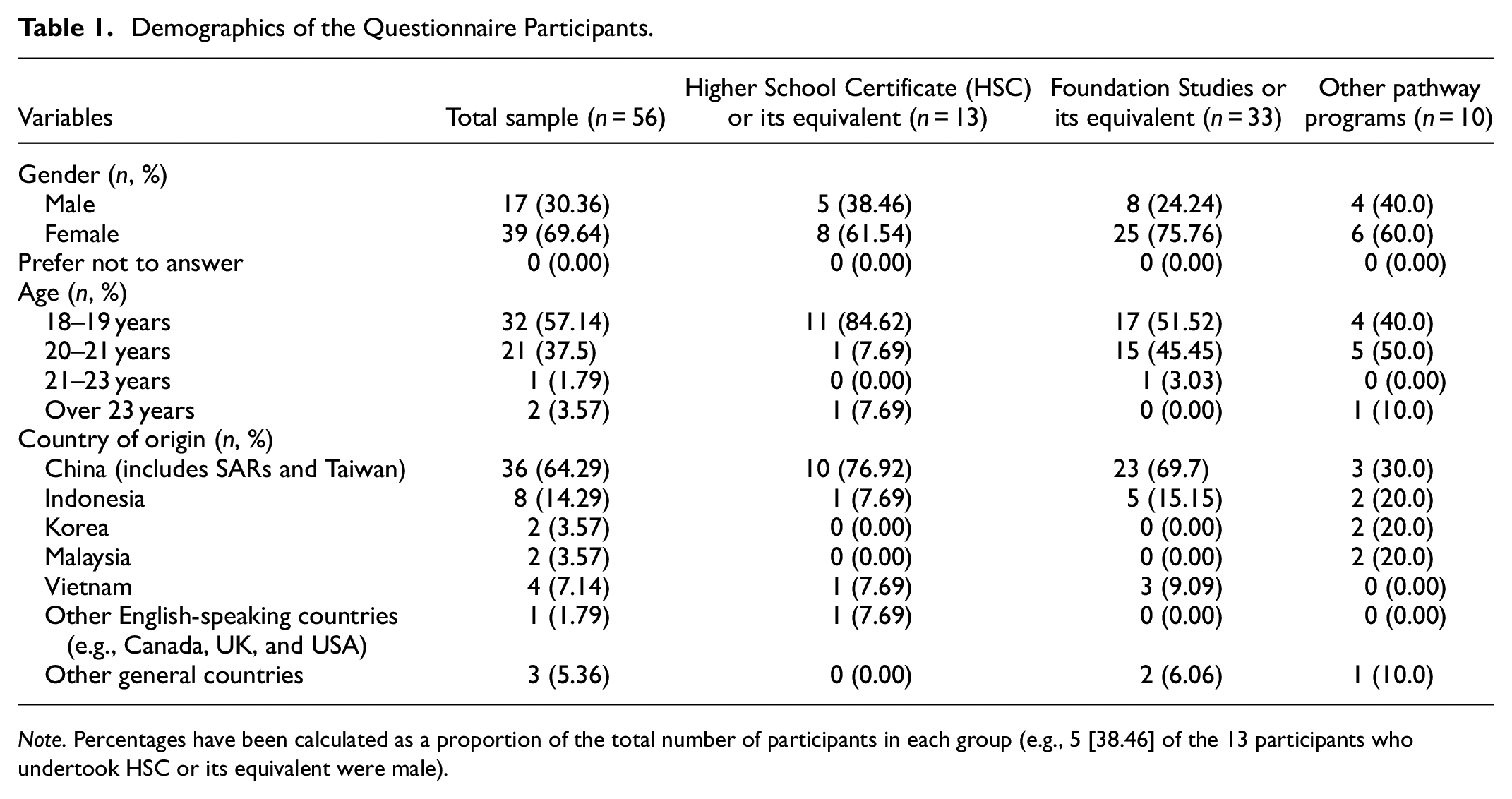
Note. Percentages have been calculated as a proportion of the total number of participants in each group (e.g., 5 [38.46] of the 13 participants who undertook HSC or its equivalent were male).
In the second stage of data collection, a purposive sample of international students (n = 4) who responded to the questionnaire and who had expressed their willingness to continue participating in the study was recruited to engage in in-depth focus-group discussion. We employed this sampling method as it enabled us to identify and select groups of individuals who were knowledgeable about the different preparatory programs they undertook. The four participants, aged around 20 years old were all originally from China, belonging to a school in which around 40% of participants are international students. An overview of key participants of the focus group participants is outlined in Table 2.
Overview of Key Participants.

Note: all names are pseudonyms chose by participants.
Ethics
The university where the study was conducted granted ethical approval for the research. The students who participated in this study did not know the authors personally. All participants received a participant information sheet and consent form and were briefed about the project prior to their participation. The electronic data collected in this study has been stored securely.
Data Collection
Data collection took place over a period of 4 months between June and September 2020. In the first stage of the project, the questionnaire was piloted with approximately 20 penultimate or final year undergraduate students. After pilot testing was completed and defects were fixed, eligible students voluntarily responded to the questionnaire through Qualtrics. The questionnaire was designed by the authors, which consisted of three sections: demographic information, international students’ experience in the preparation program, and international student experience at first-year university. It started with screener questions to make sure it captures the right audience. Participants were asked to respond to approximately 40 items, most of which were closed-ended questions, such as Rating Scale Questions with a 5-point Likert scale. Two open-ended questions were included at the end of the question, which supplemented the participants’ close-ended responses and enabled us to formulate the focus group interviews while using students’ responses as a reference (Creswell, 2009). Upon completion, participants indicated whether they were interested in participating further in the focus group interview by providing their contact email.
The main approach for eliciting student perception of their experience of preparation programs in the second stage of the data collection procedure was through semi-structured focus group discussions (n = 4). The interviews targeted similar objectives as the questionnaire but obtained additional qualitative information to support the data analysis (Morgan, 1997). Two focus group discussions, with two students per group, were carried out by the first author online, ranging from 60 to 70 minutes in duration. To maintain this timeframe, six open-ended questions were prepared, and subsequent questions were formulated from interviewees’ answers to these questions to encourage participants to elaborate on their experiences and perceptions of the pathway program they undertook. Students explained why they think different components of the preparation program helped them transition into university and what kind of support could have been provided to better prepare them. Both discussions were audio-recorded and transcribed verbatim with permission from participants.
Data Analysis
Given that the questionnaire was designed to provide us with a general picture of the research problem, the data collected via questionnaire was analyzed using the Statistical Package for Social Sciences (SPSS) without the use of complex statistics.
The data collected through focus group discussions were hand-coded by the first author and data analysis was conducted based on Saldaña’s (2021) thematic analysis approach. Firstly, the first author transcribed the focus group discussions and went through the transcription to make herself familiar with the data. In addition, focus group discussions recordings were played three times to assure the accuracy of transcription and the credibility of the data. Then, the data was re-read, and interesting features, repeating ideas, or important information were highlighted and coded into different categories, with each category containing relevant codes across the entire data set. Annotations were used during the data analysis process. For example, codes like “interact with teaching staff,” “communicate with classmates in group work,’ and “speak English after school” were aggregated into the category of oral English, whereas “write an essay or report,” “referencing,” and “paraphrasing” were aggregated into the category of writing skills. Once the initial categories had been generated, they were condensed to high-level categories where appropriate. For instance, “writing skills” and “oral English” were gathered into the high-level category of English language proficiency. The codes and categories were then presented to the second and third authors, who are experts in qualitative studies, for cross-checking. Consensus on the main themes was reached after discussing and addressing all disagreements.
Since the authors were also data collectors and data analysts, our personal beliefs and interests create potential bias during the research process (Mason, 2002; Miles & Huberman, 1994). Therefore, member checking was carried out to enhance the trustworthiness of the data collected (Doyle, 2007). A copy of the transcription was sent to focus group participants, making sure that transcription errors were minimized, and participants were not misrepresented (Birt et al., 2016). All four participants returned the documents without additional comment.
Findings
In this project the quantitative data yielded mainly descriptive statistics, with the qualitative data produced by focus group interviews providing more insights about international students’ perceptions with respect to the preparation program they attended. The findings are presented in two sections, with the first part focused on the quantitative results from the questionnaire and the second part focused on the qualitative findings.
Quantitative
Table 3 shows the correlation between international students’ overall perceptions of the pathway programs they undertook and how the students felt they were prepared in different aspects of their programs. On the one hand, moderately positive correlations were found between students’ overall perception and preparedness in subject content knowledge (r = .56, p = .000), and between overall perception and preparedness in academic skills (r = .581, p = .000). These correlations were statically significant, meaning that there was a linear relationship between students’ overall perceptions and their preparedness in these two aspects respectively in the population at .05 level. On the other hand, only weakly positive correlations were found between overall perceptions and preparedness in English language proficiency (r = .16), as well as between overall perceptions and preparedness in peer interactions (r = .24). These two correlations were not statically significant at .05 level. The results showed that the more international students think they have been equipped with subject content knowledge and academic skills by their choice of pathway programs, the more they tend to perceive themselves as prepared for university.
Correlation of International Students’ Overall Perceptions and Perceptions of Specific Aspects of the Preparation They Received During Pathway Programs.

Note. N = 56.
p < .1. **p < .01.
Table 4 reflected international students’ perceptions of different aspects of preparation they received in pathway programs by the level of importance. Participants were asked to rank five aspects of preparation in pathway programs according to their perceived level of importance. By calculating the average ranking for each answer choice, it showed that international commerce students perceived preparation in subject content knowledge (4.02), academic skills (3.82), and English language proficiency (3.00) as more important than building relationships with peers (2.55) and teachers (1.43) for their tertiary education. It is worth noting that more than half the participants (51.79%) perceived subject content knowledge as the most important area that they needed to be prepared in for their university study. In contrast, most of the participants (67.86%) in the study thought the relationships they established with teachers from their pathway programs were less important for their future studies compared to other aspects. This result could imply that international students had a smoother transition to university if they were well prepared with subject content knowledge in their field of study.
International Students’ Perceptions of Different Aspects of Preparation They Received in Pathway Programs by Level of Importance.

Note. Percentages have been calculated as a proportion of the total number of participants (n = 56) in this study.
Table 5 presented how international students who have undertaken different pathway programs perceived their preparation experiences. On the one hand, more international students who completed a foundation studies program of an affiliated university than those who undertook HSC or its equivalent strongly agreed that they had been prepared with subject content knowledge (15.15% and 7.69%), academic skills (12.12% and 0.00%), and peer interactions (9.09% and 7.69%) in the pathway program. On the other hand, the proportion of international commerce students who strongly agreed that they were prepared with English language proficiency by HSC or its equivalent (23.08%) is significantly higher than that by Foundation Studies or its equivalent (12.12%). This indicated that international students tended to gain more background knowledge for their degree, obtain more academic skills that are essential at university, and establish more connections with peers in university-affiliated foundation programs. In contrast, the English environment in local secondary schools equipped international students with more language skills and provided them with more opportunities to interact with teachers.
The Percentage of “Strongly Agree” Responses to the Question “The Pathway Program I Undertook Prepared Me With the Following Aspects.”

Note. Percentages have been calculated as a proportion of the total number of participants in each group (e.g., 5 [15.15] of the 33 participants who undertook Foundation Studies or its equivalent strongly agreed that the program prepared them with subject content knowledge).
Qualitative
The results of this stage can be summarized by two themes encapsulating the main ideas raised by focus group participants about their perceptions of the preparation they received from pathway programs for tertiary education. The first theme is Academic Competence (T1), which contains three high-level categories, which include English language proficiency, subject content knowledge, and academic skills. The second theme that emerged in this study is Sociocultural Competence (T2), containing two high-level categories of interactions with peers, and interactions with elders. An illustration of themes, high-level categories, and categories obtained during focus group discussions in this study were detailed in Figure 1 above.

Themes and categories from focus group discussions with international commerce students based on Saldaña’s thematic analysis approach.
Academic Competence
The participants reported three high-level categories of academic competence concerning their perceived level of preparation via pathway programs: English language proficiency, subject content knowledge, and academic skills. In particular, English language proficiency referred to their writing, oral English, and reading skills; subject content knowledge consisted of international students’subject choices and course content; academic skills were made up of general skills and abilities to cope with assessment and feedback.
Most participants (3/4) indicated that their writing skills improved significantly during pathway programs. For example, Khloe, who undertook the HSC in a public school in Sydney, expressed her positive perceptions of the preparation she received concerning writing skills during the pathway program: “We studied a course called EAL/D, which was for international students, and it was quite helpful for my English skills. Because we studied about writing and writing essays in high school, my writing skills are much better than before.” Lucy and Isaac, who undertook a Foundation Studies program of an affiliated university, gave more details about how they were prepared with writing skills by the pathway program concerning English language proficiency respectively. Lucy explained that she “learned a lot about how to write an essay and how to paraphrase,” which helped her a lot in marketing assignment. In addition, Isaac elaborated that he “learned a lot about structuring the sentences, like using passive voice or normalization,” which are useful writing skills from his perspective.
Lucy’s opinion revealed that international students valued the writing skills such as paraphrasing which they learnt during their pathway program, and which they felt enhanced their English language proficiency and could be utilized when they were attempting university assignments.
In contrast to writing skills, Lucy reported that her oral English was less well prepared throughout the pathway program due to the lack of an English-speaking environment: “… most of my classmates were Chinese, they don’t like to speak English after school, so we don’t have much time to improve … I feel like my verbal English is not really good.” However, Isaac and Angela suggested that oral English can be developed outside school. For instance, Isaac commented that “[oral] English is not that important to practice at school. We can join more societies and other events or activities to practice [speaking English].” Participants’ diverse perspectives indicated that they perceived oral English as a less important aspect influencing their preparedness for university, which affirmed the questionnaire results presented in Table 3.
Other results from the questionnaire regarding subject content knowledge were also affirmed and expanded by the focus group participants. In contrast to English language proficiency, all participating international students (4/4) felt that the subject content knowledge obtained from their pathway program was an essential factor influencing their preparedness for tertiary education. Participants found the course content at university was more challenging than that in the pathway program, therefore, participants who gained basic background knowledge from the pathway program reported a smoother transition to university than their counterparts and a better performance. For example, Lucy emphasized that she was able to adapt to a new learning environment at university as what she had studied in her pathway program was connected to the first-year course content: “In foundation studies we learned a lot of basic knowledge about some courses such as economics, accounting, and business law. It helped me a lot because the course content is related to the first-year courses.” Likewise, Angela who took AP economics in social science also indicated she had learnt a lot of the material needed at university beforehand so that mastering first-year content knowledge was not a big problem for her.
On the contrary, half of the participants [2/4] thought they were less well prepared for higher education since they had little background knowledge of the course. Khloe talked about how the limitations in subject choice in pathway programs affected her transition experience:
… We only had very few selections [in HSC]. I did economics for HSC, but for other Commerce courses like Accounting and Finance, we didn’t study a lot in high school … It is a little bit difficult to master the course content at university because it is from zero for me. (Khloe)
Additionally, Isaac, who was undertaking a dual degree at university, pointed out that it was less likely for international students who undertook a Foundation Studies program from an affiliated university to be well prepared with subject content knowledge in both of their disciplines at university, which can make students’ adaptation process more challenging:
… If we choose double degree, that means there must be one degree that we did not study before. I did physical science [in Foundation Studies], but one of my degrees at university is Commerce. I did not have any knowledge about accounting or economics, so I didn’t do well in a first-year course, which is the accounting. (Isaac)
Furthermore, consistent with the questionnaire results, international students’ academic skills preparation was also found to be important among focus group participants. For instance, Khloe noted: “We not only gained the academic knowledge, but we also gained the teamwork, communication, and leadership, a lot of different kind of skills.” Khole then gave more details about how the communication skills she obtained during her pathway program helped her transition to university study better:
… At first, I was quite afraid that whether my opinion was right or wrong, and I was afraid if others could understand what I was saying. But I found most people were quite friendly. If they can’t understand you, they will ask you. So, I feel more confident to express my opinion after HSC. (Khloe)
In the same vein, for Isaac, his communication skills were further improved through the pathway program, and he was able to communicate with his group members confidently at university: “I think the pathway program did help a lot to build confidence in group work because we practiced a lot in the Foundation [program] about writing essays together, shooting film together and doing reports together.” Thus, some of the essential skills international students developed in pathway programs, which are critical for them to succeed at university, led to a more positive perception of pathway programs regarding preparedness for tertiary education.
In addition to these general skills, assessment, and feedback literacy was another valuable academic skill that participants improved via pathway programs. Participating students reported that with guidance and feedback from teachers, they were able to better understand marking rubrics to improve academic performance. For example, Lucy noted: “The teacher will talk a lot of details about how they mark us, we have an opportunity to get high marks based on the criteria.” Moreover, most of the participants (3/4) indicated that they regarded assessment tasks as an opportunity to “review what we have learned,” and they “were learning by doing them, and felt more confident after finishing the program.” How the assessment literacy developed helped participating international students transition to university was elaborated by Khloe:
… I think assessment structures at our high school are quite similar to university. We had assessments through the term, and we had midterm, final and many quizzes. So, you had to put your work in the several weeks, and not do them in a rush in the final exam. And also, you had to do preparation before classes, because the class was quite short, and you had to be prepared for it. I think it [HSC] transited me very smoothly, because both the structure of assessment and the style of teaching are similar [to those at university]. (Khloe)
Overall, the data analysis indicated that participants were unanimous about the academic skills that helped the most, including general skills and assessment and feedback literacy they were prepared by pathway programs for tertiary study. However, the academic competencies international students obtained from different pathway programs diverged in other aspects. On the one hand, participants who undertook a Foundation Studies program (2/4) noted that they were able to study more subjects which were all related to their first-year courses so that they perceived the program prepared them well in subject content knowledge and it was easier for them to transition to university and achieve better performance. On the other hand, participating students who undertook an HSC or its equivalent (2/4) had a chance to practice their language skills in a more English-dominant environment but had limited subjects which were related to their prospective university degree to study. The academic competencies international students obtained from pathway programs were influential in their levels of preparedness and their transition experience to a new academic environment.
Sociocultural Competence
The above analysis identified that international students who undertook different pathway programs had different perceptions of how well they were prepared by the programs for university study. In addition to this academic competence, another theme that emerged from the focus group discussions was sociocultural competence. In particular, it was found that international students perceived the ability to interact with peers such as classmates or senior students, and to interact with elders such as teachers and community members also vital for university life.
When talking about how relationships with peers during pathway programs helped them transition to tertiary education, participants who undertook different pathway programs had very diverse perceptions. Both Lucy and Isaac, who undertook a Foundation Studies program, regarded building networks with peers as one of the advantages of undertaking this pathway program. In addition, Isaac reported that “an important purpose of the Foundation Studies is to build our network. I think the contents are basically high school [HSC] content, but my friends, we met in Foundation course, they are my good friends.” Moreover, Lucy provided more details about how the network built during Foundation Studies program assisted them to integrate into university:
Most of information about class registration and choosing a major was gained from my friend. Because she got into university earlier than me, she provided lots of information to me. If I didn’t make friends [in Foundation Studies], I would definitely get into trouble. (Lucy)
To Angela and Khloe who undertook an HSC or its equivalent, the interactions with peers at university were not perceived as dependent on the connections built during pathway programs. Both of them noted that none of their friends came to the same university with them, however, they agreed with each other that student “can still like make friends at university if they are friendly, easy-going, and talkative.” Khloe then shared her experience, affirming that it was not difficult for her to expand her network with peers at university:
It was a little bit hard to make friends with Chinese students because they have already had their friends from Foundation Studies. But it was not hard to make friends as there were other students, not only Chinese students – it depends on you. (Khloe)
Furthermore, focus group participants who undertook a HSC or its equivalent raised a unique insight that experiencing cultural differences was a vital part of studying overseas, and being able to understand the cultural differences influenced their transition to university. Angela noted: “I would more prefer to adapt to a new culture and to get involved in the local community more.” Moreover, Khloe reported that the pathway program they undertook assisted them better adapting to the Australian culture compared to other programs such as Foundation Studies:
I think it [HSC] helped me quite a lot to integrate into the Australian society, because my classmates and my friends were all local students from Australia. And if I could choose again, I would still choose to do the HSC because it helped me to integrate better than Foundation Studies. (Khloe)
In contrast to the connections established with the local community that were valued by Angela and Khloe, Lucy and Isaac emphasized that interacting with professionals, including teachers and advisers from the pathway program prepared them better for university life. For instance, Lucy claimed that consultations in the Foundation Studies program contributed to her transition to tertiary education, as she was able to ask for and obtain information about university study: “I made many friends in consultations and I received a lot of information about university during consultations, it helped me a lot.” Isaac affirmed and elaborated based on Lucy’s comment:
I really love the student centre, because I had a lot of questions. I went to student centre almost every week, and I asked lots of questions about degree choosing, about doing a double degree and about university courses. It helped me a lot. (Isaac)
In contrast, it seemed that other participating students, including Khloe, who undertook HSC or its equivalent did not have access to the relevant information in their pathway programs, and therefore perceived themselves as less prepared for university. Khloe even gave some suggestions about aspects that pathway programs can improve to better prepare international students for tertiary education overseas:
I think there were no connections between high school and university. They only had the university open week when you could visit the university that you wanted to come, that’s all. Maybe they could have a presentation about some information about the university and build an international student community. We only knew this from the internet as we didn’t have any connection or activities like that. (Khloe)
The analysis above reveals that international students who undertook different pathway programs seemed to have different perceptions of how they were prepared for diverse aspects of sociocultural competence. Pathway programs provided by local high schools provided ample opportunities for international students to immerse themselves in the local culture and integrate into the overseas society. However, these pathway programs did not connect their graduates with prospective universities, which hindered the smooth adjustment of international students to university life. This shortcoming of undertaking a HSC or its equivalent at local high schools was seen by participants as an advantage of attending Foundation Studies programs of affiliated universities, where they could obtain not only course advice but information about university life from teachers and advisers to be better prepared for tertiary education.
Discussion
Overall, the findings presented above demonstrate the participating students’ diverse perceptions of how pathway programs equipped them with academic and sociocultural competence, and how these competencies prepared them for tertiary education. Beyond indicating the different aspects of preparation international students can receive via pathway programs, the exploratory study highlighted that the different transition experiences of international students who may have undertaken different pathway programs, thus they are not a homogenous group. At the same time, the varied competencies international students developed during pathway programs seemed to help them overcome different barriers to integrate into university study.
In terms of the participants’ preparation in academic competence, this research demonstrated that pathway programs tended to prepare international students with English language proficiency, subject content knowledge, and academic skills. Specifically, for English language proficiency, pathway programs provided by affiliated universities were found to prepare international students well with writing skills such as paraphrasing and structuring sentences. This result echoes the findings of Arkoudis and Starfield (2007), which found that English courses in preparation programs aimed to provide international students with essential academic English skills, enabling them to satisfy language requirements and succeed at university.
In addition, similar to existing literature reporting that oral English abilities had a limited effect on adjustment to university (Poyrazli et al., 2001), participants in this project did not regard the lack of preparation in oral English as an obstacle to adapt to university study. They believed international students who were determined to improve their English-speaking skills could get involved in student societies and activities outside school to achieve their goals. This reported finding echoes the experience of second-language (L2) learners in Xu (2012) with international research students moving to Australia exerting strong learner agency by seeking different channels to enhance their English, smoothing their transition from one academic and social culture to another. Thus, our findings highlighted the important role of learner agency (Bown, 2009; Chi & Hamid, 2015; Xiao, 2014) in international students’ transition experience, and the relations between experiences and agency that were indicated in this study may be applicable to all L2 learners across the country.
Furthermore, this study reported that international students perceived the preparation in subject content knowledge as one of the most important parts of pathway programs, and those who perceived themselves as well prepared in subject knowledge also tended to have a positive perception toward pathway programs. It is also found that international students who had obtained basic subject content knowledge during pathway programs were able to transition to university study smoothly, whereas those who perceived themselves as less prepared with background knowledge were more likely to find it difficult to master the course content at university. This result is in line with Thompson and Zamboanga’s (2004) research which found that international students who were not familiar with the background knowledge of the subject could face more challenges in achieving academic excellence. Like Thompson and Zamboanga (2004), this study revealed that international students undertaking a dual degree tended to have limited prior knowledge in at least one undergraduate degree area due to a lack of subject choices in pathway programs, and therefore might underperform at university. In this regard, the research highlights the heterogeneous nature of international students’ academic preparedness for university transition (Heng, 2019).
In addition, better preparation in general skills such as communication was also found to be associated with a smoother adjustment to university study. Participants in this research reported that they were able to build up confidence in communicating with group members while undertaking pathway programs and they felt more comfortable expressing their opinions during group work at university. To some extent, this confirms trends in the current literature, which suggested that students who have gained appropriate academic skills prior to university tend to integrate into university study easier and achieve better academic outcomes (Ang et al., 2019; Jansen & Suhre, 2010; Sakız et al., 2021). Therefore, it is vital for teachers and practitioners in the higher education sector to understand what skills international students bring with them to university to further assist them to adjust to a new academic environment.
Moreover, the participating students in focus group discussions claimed that assessment structures in pathway programs and universities were similar so that the assessment and feedback literacy developed during the pathway programs enabled them to integrate into tertiary education more smoothly. This finding is contradictory to existing literature reporting that in general, students were not able to understand the nature and purpose of a university assessment task and that assessment and feedback was the single biggest area of concern during students’ transition to higher education (Blair, 2017).
However, it is important to note that participants in this research were all international undergraduate students who undertook pathway programs in Anglophone countries such as Australia and the United States, where the alignment in assessment and feedback practices meant students had the opportunity to develop their assessment and feedback literacy before entering into university. However, other international students who come from a country with a different assessment and feedback culture and who do not undertake a pathway program may find it challenging to utilize unfamiliar assessment tasks and feedback to improve their learning. Therefore, having a better understanding of students’ prior knowledge in this aspect may assist teachers and practitioners at university to provide individualized assessment and feedback to support students transitioning to higher education (Dart & Spratt, 2020; Trowler, 2010).
Regarding sociocultural competence, this research indicated that international students might be able to establish connections with peers such as classmates or senior students and elders such as teachers and community members during pathway programs, leading to better cultural integration and a smoother transition to higher education (Marangell et al., 2018). However, it was found in this research that questionnaire participants perceived the connection they built during pathway programs as a less important factor in assisting them to transition to university, and only half of the participating students in focus group discussions suggested that the network built during pathway programs help them integrate into university better. This evidence confirmed the findings of the existing literature (Bezzina, 2004; Buote et al., 2007; Teo & Arkoudis, 2019), which concluded that relationships established with peers had a positive impact on students’ adjustment process at university. However, some participating students in this study claimed that it was not difficult for them to interact with peers at university if they were friendly and easy-going, and students could participate in activities or events organized by student societies if they would like to make more friends. This finding contradicted that of Teo and Arkoudis (2019), who found students were not spending much time on campus due to work commitments, hence making it relatively tough to make friends with others at university. Therefore, this evidence implies that opportunities for social interactions do not appear automatically, and international students need to put in a concerted effort to proactively expand their network and adapt to a complex social environment at university (Meier & Daniels, 2013).
In the case of interaction with professionals and communities, it was found that different pathway programs prepared international students differently. On the one hand, participating students who undertook a Foundation Studies program of an affiliated university claimed that while interacting and communicating with teachers and advisers from the pathway program, they were able to obtain valuable information which enabled them to get to know university life better. This result is in line with Rivera Munoz et al. (2020), who indicated positive teacher-student interactions could benefit students and facilitate social integration. On the other hand, this research revealed that participants who undertook a HSC or its equivalent at local high schools were able to connect with the local community and adapt to the local culture during the pathway program. These international students with varied cultural backgrounds felt that they had learnt to understand cultural differences before commencing higher education, so it was less likely for them to experience culture shock (Wu et al. (2015) in their social interactions and thus, they could adapt more quickly to a new academic and social environment at university.
Conclusion
This study examined how well a cohort of international students perceived their pathway program had prepared them for university. Academic and sociocultural competence were found to be the two areas of preparation international students perceived essential to their transition experience at university, but this investigation has also highlighted the heterogeneous nature of international students’ academic preparedness for university transition, which offers some practical implications for university educators, administrators, and curriculum designers.
The quantitative phase was cohort-based given the exploratory nature of this study. The small sample size limited the generalizability of the findings, which are therefore indicative. An even larger number of participants in the study may have revealed greater variations in international students’ perceptions of the pathway programs they undertook before university. Thus, future research could include more participants to compare perspectives on the subject matter and replicate the analysis to improve the generalizability of the findings from this research.
We involved only four participants in the qualitative stage of this study, as many international students deferred or discontinued their study due to the disruption caused by COVID-19. This resulted in another limitation that all focus group participants were from China, and a more diversified cohort of students could lead to varied results. Thus, future studies could focus on students from diverse backgrounds and explore their experiences and perceptions of pathway programs using qualitative methods, so that voices of international students of diverse backgrounds can be heard in higher education context.
Furthermore, although this research only targeted first-year international Commerce students at a leading university in Australia, this does not mean that pathway programs have little impact on international students’ learning after the first year. Future research could involve international students across different years in their undergraduate degrees to examine the potentially far-reaching impacts of the pathway programs on them.
Such research, like this study, will be of interest to those working both in and outside Australia, given the continued growth in participation by international students in the Anglophone higher education landscape in recent years, and major changes in university student population globally (Skyrme, 2007).
Footnotes
Acknowledgements
We would like to thank the participants in this research study, who can only be recognized by pseudonyms, but who contributed to the project by sharing their perspectives and experiences and made this research possible.
Author Note
Shuting (Alice) Sun and Chris Davison are affiliated to University of New South Wales, Kensington, NSW, Australia.
Author Contributions
Shuting (Alice) Sun is a PhD candidate at the School of Education, University of New South Wales (UNSW), Australia. Her research focuses on assessment and feedback practices, higher education, and international students’ educational experiences. She teaches commerce and accounting at UNSW and UNSW College. Chris Davison is an Emeritus Professor of Language and Literacy Education at the School of Education, University of New South Wales. She is a specialist in language education and school-based assessment.
Declaration of Conflicting Interests
The author(s) declared no potential conflicts of interest with respect to the research, authorship, and/or publication of this article.
Funding
The author(s) disclosed receipt of the following financial support for the research, authorship, and/or publication of this article: This study was funded by the University of New South Wales (project number: RG213499).
Ethical Approval
The University of New South Wales where the study was conducted granted ethical approval for the research (HC reference number: HC200342). The students who participated in this study did not know the authors personally.
Informed Consent
All participants received a participant information sheet and consent form and were briefed about the project prior to their participation.

Availability Data Material
The electronic data collected in this study has been stored securely.