




Abstract
The intersectionality framework allows for the combination of formerly additive individual characteristics into intersectional profiles of employees in order to prioritize and direct further education investments. A k-medoid technique creates these profiles from the large-scale sample of the German National Educational Panel Study. A specific heuristic links high percentile-training recipients to evolution in job satisfaction over a 5-year period. Women receive relatively high amounts of further education and training and seldom resign. With university degrees, they profit most from frequent training while it has the most negative influence on women with upper secondary education. Men with academic as well as vocational education range between those groups. The results indicate direct training for university-educated women, adaptation of the training and opportunities offer to women with secondary education as well as retention programs for frequent learners among university-educated men to improve job satisfaction and thus productivity in the workplace.
Keywords
Introduction
In general, stakeholders including employees and employers expect value from educational investments (Leuven et al., 2005; Seyda, 2020). This value manifests in economic progress, personal development and social inclusiveness (Aspin, 2012). Further education and training are relevant in all three of those areas. In 2019, German companies invested an estimate of 1,236 euros per year in their average employee’s further education and training (Seyda, 2020). These investments sum up to 41.3 Billion Euros for the whole economy on a rising trend (Seyda, 2020). This does not surprise, as part of corporate value creation (cf. Messersmith et al., 2011) unfolds through the enhancement of skills and opportunities for employees (Messersmith et al., 2011). Within this background, wherever organizational learning processes create or maintain inequalities (Acker, 2011), skills and opportunities do not match and therefore human potential cannot develop at its best. From this observation linked to intersectionality theory the following research contribution obtains its theoretical relevance. From a practitioners point of view, it is the role of strategic human resource management within organizations to work on attitudes, skills and behaviors (Zhu et al., 2018), so that more equality leads to better outcomes.
To be able to evaluate the expected returns of further education and training in relationship to its risk measured through its variance (Henderson et al., 2017; Palacios-Huerta, 2003), and in order to develop adequate interventions, the present study extends the existing knowledge base. We address with our study the problem to identify relevant groups of learners and their needs (Schmidt, 2007, cf. also Henderson et al., 2017, for disability). Common approaches tend to “limit[ing] inquiry to the experiences of otherwise-privileged members” (Crenshaw, 1989) of those groups, for example, white women. Decisions are then “grounded in experiences that actually represent only a subset of a much more complex phenomenon” (Crenshaw, 1989). In contrast, our methodology aims at a higher visibility to decision makers of “individuals’ and groups’ multiple positionality at […] individual and […] sociostructural levels” (Atewologun, 2018) and therefore supports the solving of inequity problems (Acker, 2011). To this end, Cole (2009) defines intersectionality as “analytic approaches that consider the meaning and consequences of multiple categories of social group membership.” The organizational context is key to questions of inequality, where looking at one social dimension at a time is insufficient (Acker, 2011) to make decisions about employees’ learning processes. We add a novel point of view to the discussion by arguing that intersectional inequality is not only a matter of privilege and discrimination (Cole, 2009), but also of human resource efficiency in organizations. Thereby we also propose an alternative to this discrimination perspective: An investment-portfolio approach that provides information about who can progress the most (e.g., in productivity or other contributions) compared to their individual status quo, no matter how high or low it is. On that basis, the present study occupies the point where business interests, relief to intersectional inequality and pedagogical aspirations converge. It provides and employs a novel tool to class individuals based on their potential advancement in job satisfaction depending on the further education and training they incur using non-parametric data.
The methodological innovation of this study builds on the shift from single-variable or “single-axis” (Crenshaw, 1989) and additive relationships (cf. Coelli & Tabasso, 2019; Ehlert, 2017; Hansson, 2008; Messersmith et al., 2011; Palacios-Huerta, 2003; Reichel et al., 2022; Xiao & Tsang, 2004) to quantitative intersectional approaches (Woodhams et al., 2015; Bauer et al., 2021; Else-Quest & Hyde, 2016). Furthermore, we use risk-adjusted potential measures (Henderson et al., 2017; Palacios-Huerta, 2003), which has not yet been applied to further education and training in the German context. In doing so we aim to close the above describe methodological gap and the one left concerning the application of the intersectionality framework to the German labor market realm. To close these two gaps the presented study seeks for insights to answer the question how training and development investments relate to intersectional employee profiles in terms of job satisfaction considering aspects of inequality; where job satisfaction is defined as the answer on an 11-point scale to the question “How satisfied are you with your work?” ranging from “completely dissatisfied” to “completely satisfied.” We subdivide this global aim into the following set of research questions:
− Research question 1 asks “Does the labor market allocate further education resources to those groups defined by multiple social characteristics that would profit the most of them in terms of job satisfaction” and relies on algorithmically determined intersectional clusters. Each of those shows a characteristic combination of further education hours and evolution in job satisfaction.
− To answer research question 2—“How do different combinations of social categories identified by the literature as having a significant relationship with returns to further education intersect with each other to reveal differences in those returns?”—we take a closer look at the composition of the aforementioned clusters.
− Finally, research question 3 leads to a ranking of the clusters, in order to investigate “Which of the resulting intersectional employee profiles benefits more than others from further education in order to improve their job satisfaction and which profiles need further assistance to develop their potential?”
The structure of the study follows the deconstruction of intersectionality questions into components of “inequality regimes” by Acker (2011). In section 2 we define the bases of inequality in the realm of further education based on a review of the theory and the existing evidence. The “Research methodology” in section 3 develops adequate methods to algorithmically combine those bases of inequality and to provide a ranking of the combinations. In section 4 we present and analyze the resulting intersectional combinations (clusters) of these bases. By profiling the resulting intersectional groups, we augment their visibility. This allows us in the discussion (5) and conclusion (6) section to state “interests in changing or maintaining the inequalities” (cf. Acker, 2011) and suggest systematic prioritization of investments in further education and training on the individual, organizational and the labor market levels.
Theoretical Framework to Analyze Further Education Intersectionality
In the following section, we develop the theoretical and empirical basis for our analysis and further corroborate the importance of the specific methodological approach used in our study. Then we use an overview of the variables that link further education and training to job satisfaction—as discussed and investigated in the literature so far—to select relevant individual characteristics that are building blocks of multiple positionality related to job satisfaction and therefore important for our analysis. We provide former research findings to legitimate the use of job satisfaction as a proxy for education-generated value.
Evidence for Intersectional Further Education and Training Differences
The Australian findings of Coelli and Tabasso (2019) depict the function of further education and training for employees to counter currently declining job outcomes. In this context, significant effects are only observable when explicitly accounting for the negative trends before the training spell (Coelli & Tabasso, 2019). Structural inequalities at the root of these declining outcomes may be one of the causes that intersectionality as a theoretical framework helps to uncover in order to shed light on marginalized groups in the context of management and organizations (Acker, 2011; Atewologun, 2018). The case of disability made by Henderson et al. (2017) shows that discrimination sensitive group membership has significant effects in the workplace, but this and similar single-variable approaches cannot account for intersectional effects. In general, the necessity to use methods that attenuate the influence of unobserved interference, like fixed-effects with instruments by Coelli and Tabasso (2019), suggests a certain variable complexity or structure of interdependencies when it comes to educational returns that more homogeneous clusters may help to unearth and resolve (cf. Vogel & Gardill, 2010). Consequently, this study relies on clustering techniques to construct more homogeneous subgroups (cf. the critique of Crenshaw (1989) of heterogeneous groups defined by only one characteristic). These groups form the basis for the estimation of individual further education and training potential.
Gender Intersections’ Influence on Selection for Further Education
Employers seem to rely on how they perceive the ability level of employees in order to select individuals for training (Hansson, 2008) even if—as we argue—very competent or privileged persons may not need as much investment in their training. Actually, the same amount invested in learning support could yield more value for less able individuals as they have more upward potential left. Hansson (2008) argues that the presumed mobility of the workforce, the complexity of jobs and the educational level of the trainees might also influence the propensity of employers to support training of individuals. These cases of reticence appear to be linked by the argument that the more likely an employee is to leave the corporation after training the riskier it is to select that person for training.
On the self-selection side of further education and training interventions, Hansson (2008) elaborates that an individual’s choice for training depends on gender. Xiao and Tsang (2004) see women more likely to participate in further education and training; above all, when the offer is external to the corporation, while Ryu and Moon (2019) find no significant correlation between gender and workplace learning. The question thus arises whether gender has to be regarded in intersectional clusters combined with other variables relevant to further education and training to further clarify that picture. In that sense, it will be of interest whether the potential evolution of job satisfaction in each cluster corresponds to the selection likelihood for further education and training. In any case, selection effects probably occur and therefore we cluster individuals before that point, so that possible selection biases are not incorporated in the process.
Age, Disability, Education, and Gender as Bases of Potential Inequality
By discussing the salient single-axis characteristics linked to educational returns, the following literature review establishes the necessary focus on categories and identities (Atewologun, 2018) between which intersectional effects are likely to take place when it comes to further education and training. In intersectionality, those bases of inequality usually include class, gender, ethnicity and sexuality, but also age, religion and disability (Acker, 2011). However, their influence and composition likely vary by context. Therefore, we concentrate on those variables that have proven significant in the context of further education and training. Furthermore, to support its profiling objective, this study focuses on variables that occur before the decision to participate in further education and training and before the learning intervention begins, which is the point of the related educational investment decisions. To facilitate the direct identification of the clusters in practical use, as well as for methodological considerations (see below), the variables are limited to those directly measurable on individuals.
These reflections lead to the exclusion of the following factors. In order to provide the full context, we briefly present these factors . They include mobility, training quality, satisfaction, length of the training, learning method and type as well as motives and preferences for learning. There is also a strong correlation between job training satisfaction and job satisfaction (Schmidt, 2007), sometimes even yielding negative effects for intrinsically motivated participants (Ryu & Moon, 2019). This phenomenon possibly builds on their higher expectations concerning the quality of the learning program (Ryu & Moon, 2019). Moreover, a worker with a pronounced intrinsic motive will accord more value to job satisfaction and less to extrinsic stimuli like career opportunities. Post further education and training job mobility (cf. Coelli & Tabasso, 2019) can also be linked to the previous educational measures and therefore potentially also to its outcomes. Job training satisfaction, training length, type and method as well as training type preferences of individuals (Hansson, 2008; Schmidt, 2007) occur after the decision and appear to have limited effects on outcomes like for example, job satisfaction (Schmidt, 2007) due to the complexity of the training situation. Consequently, this study relies on the assumption that course quality and quantity will be nearly randomly distributed across individuals thanks to the large sample size of the National Educational Panel Study (NEPS) on which the present study relies.
As the first of the eligible variables, the type of prior education can be directly observed and is not influenced by external factors at the time of the further education and training decision. Which educational base level yields more returns through additional workplace training than another is inconclusive though (Hansson, 2008), suggesting the relationship could become clearer through the clustering with other variables. Notwithstanding the doubt regarding the possibility to rank educational levels, Coelli and Tabasso (2019) look at the influence of so-called up-skilling on multiple returns to education. However, the financial impact they find could also be linked to the token function of certified degrees. Consequently, the same study does not discover a consistent link between up-skilling and job satisfaction (Coelli & Tabasso, 2019). An interaction seems to appear between up-skilling and gender (Coelli & Tabasso, 2019). The prior education of an individual also closely links to class as an important base of inequality in organizational contexts (Acker, 2011). Workers have virtually no class power (Acker, 2011) and no higher education, whilst access to management positions often comes with university degrees. Hence, for its inequality potential, inconclusiveness and high level of interaction, prior education appears promising for the present study.
Depending on the target measurement, gender—as the primary characteristic in intersectionality theory—affects educational returns in opposite directions (Hansson, 2008). The same is true for the variable age which reveals significance when intersected for example, with gender (Coelli & Tabasso, 2019). Both, sex and age, therefore are to be included in the clustering process hereafter in order to unveil their possible significant intersectional combinations. Disability is another promising variable, due to the heterogeneity in returns it generates. For the United States of America, Henderson et al. (2017) find that individuals with disabilities have lower mean returns to education than people without. They also expose an important heterogeneity within the disability community that even uncovers situations where able-bodied and able-minded workers perceive lower returns (Henderson et al., 2017). Earlier onset appears to be linked to higher financial returns than later disability onset, which could be due to greater adaptation opportunities (Henderson et al., 2017). In general, financial returns to education vary more for disabled individuals (Henderson et al., 2017). Because of these considerations, disability appears to be a complex factor in itself. This could lead to it being of little use for the cluster distinction. The intersectional effects with other social attributes could explain the overlap and variance.
To conclude, the literature review exposes a set of variables that are highly variant in their input or produce highly heterogeneous outputs or stay inconclusive when used separately. This suggests that we have to look at the value out of further education and training through the lens of case-clusters conducive to revealing intersectional phenomena. Therefore, we can concretize research question 2: How do the categories gender, prior education, disability status and age intersect to influence returns to further education?
The aforementioned base categories find their mirror in the intersectional components of Woodhams et al. (2015), when looking at pay inequity, except for ethnicity included there and prior education included here. As components of Acker’s (2011) inequality regimes, they differ in their legitimacy. For instance, gender inequality has less legitimacy than class inequality (Acker, 2011). Prior education, ability and experience differences may justify inequality of status in the eyes of some, however, if seen in the framework of disability, and age, the latter two more difficult so. The evolution of an individual through further education and training—in contrast to its absolute educational level—does not qualify as a legitimate base of discrimination, that is, it should yield similar expected returns no matter the initial status. Thus, by devising a method that focuses on the relative evolution in further education and job satisfaction, we include all four categories into the analysis, without the caveat of possible legitimacy of differences. This means: an individual that seeks amelioration through education is entitled to reap the gains in terms of job satisfaction, even if other benefits are not accessible due to external factors.
Job Satisfaction as a Legitimate Proxy for Education-Generated Value
The legitimacy viewpoint also implies that the kind of return makes a difference. Inequality regimes more easily justify wage inequity on the mentioned bases—that is, more education is accepted to yield more revenue—, whereas all employees are entitled “to construct their work as meaningful and satisfying” (Acker, 2011), that is, increase their job satisfaction. Although commonly used as an indicator to productivity, wage changes actually seem to constitute a weak proxy for the value of continuous vocational training, due to their pronounced dependence on external and corporate factors (Ehlert, 2017; Hansson, 2008). In particular, in intersectionality contexts, wages are rather a mechanism of control and compliance (Acker, 2011) and therefore risk bias. Moreover, there is only sparse empirical evidence (Hansson, 2008) and even insignificance (Coelli & Tabasso, 2019) to be found in the relationship between wage and productivity gains out of training.
Job satisfaction, in contrast, shows less labor market specific sensitivity (Hansson, 2008). Together with turnover, it constitutes the most important dimensions in human resource management (Nemteanu & Dabija, 2020). The link between job satisfaction, on the one hand, and effective further education and training opportunities, on the other hand, appears to be well-established (Ryu & Moon, 2019; Schmidt, 2007; Nemţeanu et al., 2022). The same is true for the correlation between job satisfaction and productivity (Ryu & Moon, 2019; Nemţeanu et al., 2022).
Coelli and Tabasso (2019) even identify job satisfaction as the main return to further education and training, as significant influence on other effects cannot consistently be found, at least in the Australian context. In Korea, Ryu and Moon (2019) prove further education and training to influence job satisfaction positively when tested in a model alongside sex, educational level, job position and part-time status, thus establishing a general tendency with regard to the variables of the present study. In the context of intersectionality, Acker (2011) considers workers’ efforts toward job satisfaction also as an internalized control mechanism. Consequently, Nemteanu and Dabija (2020) find a strong influence of work engagement on job satisfaction. In that sense, further education and training are used as a remedy rather than an opportunity in the Australian study of Coelli and Tabasso (2019), where downward trends in outcomes such as revenue and job satisfaction are observed prior to the educational spell. Job satisfaction is observed to decline before the further education and training intervention and to rise again with its start Coelli and Tabasso (2019) . To conclude, this study retains employee job satisfaction as a proxy for value created out of further education and training. This variable likely encompasses other measures of educational returns without sharing their caveats and it is less subject to legitimacy concerns.
Research Methodology
In general, quantitative intersectional studies help to understand and interpret the combined effects of various categories in a given context (Atewologun, 2018; Bauer et al., 2021). The research design used in this study is geared to be applied to different contexts and levels, down to single organizations, to shed light on further education and training potential. Thus, we follow a prudent approach concerning variable scale levels in order to prepare an application to contexts where ordinal and categorical scale levels are often the common denominator. Replications of this study can also capture differences in cluster formation and cluster significance across time and labor markets.
Importance of Large Scale Panel Data for Sub-groups
The dataset used originates from the National Educational Panel Study (NEPS)—Starting Cohort Adults (NEPS Network, 2022). From 2008 to 2013, this data was collected as part of the Framework Program for the Promotion of Empirical Educational Research funded by the German Federal Ministry of Education and Research (BMBF). As of 2014, NEPS has been carried out by the Leibniz Institute for Educational Trajectories (LIfBi) in cooperation with a nationwide research network (Blossfeld et al., 2011). The NEPS data enable conclusions at the scale of the German population, thanks to its large-scale design and sampling (Aßmann et al., 2011). It therefore allows for great depth in education related profiling, including a retroactive view into past profiles and the respective pathways afterward. The initial wave of this panel study covered the birth years 1944 to 1986, and is constantly updated with 300 individuals sampled per year on the basis of a two-stage cluster sampling strategy with the 12,429 German municipalities as elementary sampling units. The result is a pool of approximately 13,000 cases (Aßmann et al., 2011). The size is important for intersectional quantitative studies to avoid too small subgroups (Woodhams et al., 2015). To collect the data, trained interviewers conduct by default computer assisted personal interviews (CAPI) at the homes of the respondents and in some cases computer-assisted telephone interview (CATI) (Allmendinger et al., 2019). Both modes are also proposed as a choice when this helps to minimize nonresponse bias and panel attrition (Allmendinger et al., 2019). The computer use supports data quality by automatically personalizing the interview to each participant, performing consistency checks, avoiding to ask unrelated questions and prompting for targeted control questions (Allmendinger et al., 2019). The interview duration varies between 30 and 60 min (Allmendinger et al., 2019).
Increased investments by companies in further education and training are observed during periods of economic downturn when the opportunity cost for training is low (Hansson, 2008) and the relationship between educational returns and disability is linked to recession (Henderson et al., 2017) like during the 2008 financial crisis. Moreover, Nemteanu et al. (2021) point out the correlations of job satisfaction with external influences reducing job security and perceived job stability. Such influences could possibility overlay the aims of the present study. Consequently, this study situates itself in a period between those two socio-economic events.
K-Medoid Cluster Partitioning Algorithm Supporting Intersectional Profiling
Thanks to k-medoid cluster analysis, the present study describes estimates of intersections and differences across them within the field of further education of employees (Bauer et al., 2021). Combined with silhouette scores it breaks down the sample into distinct groups of cases with similar characteristics (Aghaee et al., 2016). This approach stands in contrast to k-means clustering, which minimizes average squared distances instead (Kaufman & Rousseeuw, 1990). The resulting centroids of k-means would be a set of average measures across cluster members and hence do not necessarily exist as real world individuals in that particular combination, whereas the medoids are actual observations (Aghaee et al., 2016) useful for data reduction and characterization (Kaufman & Rousseeuw, 1990, p. 41). This is an important aspect to illustrate the intersectional perspective, as mean profiles could again dissimulate individual combinations of social categories. Partitioning algorithms, like our k-medoid approach, have the advantage over hierarchical clustering that they self-correct to a certain degree, allowing for an improved attribution of an individual later in the process (Kaufman & Rousseeuw, 1990). This is an important feature to avoid errors of attribution within the subsets of each cluster when analyzing potential and avoids not replicable data splits (Bauer et al., 2021). The present study therefore opts for the Partitioning Around Medoids (PAM) procedure developed by Kaufman and Rousseeuw (1990).
In the course of the study, we have to decide on a target number of clusters. Therefore, we establish the following criteria of usefulness (Vogel & Gardill, 2010): Clusters 1. Are greater in number than two to form a decision-making basis for a set of profiles 2. Are fewer than 11, for otherwise based on an 11-level job satisfaction scale the ranking based on sums would risk spurious precision 3. Offer a large number of individuals at the same similarity level within the clusters indicated graphically by broad silhouette widths (Rousseeuw, 1987) 4. Correspond to a local optimum reflected in a higher overall average silhouette width than the neighboring numbers of clusters (Rousseeuw, 1987) 5. Converge between the two equivalent sets of variables one completely categorized and one of mixed scales (Table 1) to control for the possible adverse effects of a scale-level mix (DiStefano & Mindrila, 2013). This last condition is meant to cross verify the categorization process and can be ignored in subsequent applications of the method.
Categorized Cluster Variables With Their Continuous Counterpart.

The choice of cluster variables should be directly measurable and not latent, not only to facilitate the identification of profiles in application contexts, but also to cater to the requirements of the method (DiStefano & Mindrila, 2013). The variables used are:
− Sex
− Age (cf. the classification of Hanushek et al. 2015)
− Accumulated formal education according to the International Standard Classification of Education (ISCED) of 1997
− Disability onset and disability grade where the partitioning between early and late is at age 16
Assured by the preliminary literature review, the variable levels convey “sense” to the clusters in that they reflect relevant social categories. For instance, the categories established for the variable disability frame the importance of the moment of disability onset (Henderson et al., 2017). When it comes to the social category sex, no gender identities on a larger scale are provided by the panel data. Even if that implies a possible loss of precision on the one side, on the other side those two categories are also most easily observable and grounded in past literature. The age levels represent typical career stages with their specific opportunities and pitfalls (Hanushek et al., 2015; similar considerations but less in depth by Woodhams et al., 2015). Thus, the algorithm recognizes more clearly, which fold lines are most relevant to social dissimilarity. To calculate those dissimilarities as a necessary basis to clustering, we use the methodology developed by Kaufman and Rousseeuw (1990) and integrated by the authors in a program named DAISY using R as statistical software. For the all-categorical variant, this equals transforming each possible expression of all the nominal variables into binary scores and relying on percentages of matches between them Kaufman and Rousseeuw (1990). For the mixed-scale approach, sex is still treated as a binary variable. Age and disability grade qualify as ratio-scaled for they possess an absolute zero. The International Standard Classification of Education (ISCED) classes are interpreted on an ordinal scale. Following Gower (1971) and Kaufman and Rousseeuw (1990), all those variables are converted to fit the range between 0 and 1. For the interval, ratio and ordinal level variables this is achieved through the formula
The resulting dissimilarity matrix is put into the Partitioning Around Medoids (PAM) or k-medoid algorithm of Kaufman and Rousseeuw (1990) (see also Aghaee et al., 2016). It essentially repeats the following steps:
Find k representative observations = centrotypes= “medoids”,
Assign each observation to the nearest medoid,
Minimize the sum of dissimilarities of observations to their medoid by possibly attributing the medoid role from one observation to another.
Once the clusters formed this way, we need to construct a process to measure the relative evolution of job satisfaction that is complementary with the ordinal nature of the corresponding scale, while capturing the heterogeneity within social categories (Cole, 2009).
Potential Determination Heuristic for an Ordinal Scaled Target Variable
To obtain this relative measure, we compare individuals within the cluster that received close to no further education and training si,l with their most educated peers sj,h in the same class. The idea to compare a baseline evolution to an educational investment, builds on the use of the ex ante Sharpe ratio (Sharpe, 1994)
First, we define thresholds for high and low amounts of further education and training and assure comparability across clusters. Therefore, those two points are established representative for the population on the basis of the whole panel data. Median education spell times can be used to focus on the particular effects of an intervention while avoiding external influences (Coelli & Tabasso, 2019). Analog to this thought, for the purpose of this study, the percentiles P20% and P80% (cf. Henderson et al., 2017) of educational spell times are more useful to find the observations s that define the thresholds of low education
In that way, the cluster potential scores become comparable to each other. The original Sharpe-formula additionally puts the variance of returns in the denominator to account for the notion of risk of the investment (Sharpe, 1994). That an educational spell can constitute even a downward risk for job satisfaction has already been indicated in the section “Job satisfaction as a legitimate proxy for education-generated value.” Thus, we amend our potential measure by computing the interquartile distance of the subsample
Results
First, we present our findings about the quality of the four-cluster structure and its particularities concerning the within group heterogeneity of women. Then we describe the differences between the obtained clusters. The following subsection presents the results of the analysis of the division among women by academic qualification and its consequences on an individual and a collective level. In the final section, we expose the clear target profiles that emerge around sex and prior education as bases of inequality.
Coherence of a Four-Cluster Structure for Age, Gender, Education and Disability
The variables age, gender, education and disability build the most useful classes at a cluster number of k = 4 as illustrated in Figure 1, where overall average silhouette scores are based on sex, disability onset (or continuous disability grade), age group (or continuous age), prior education group (or ISCED stage). Furthermore, the obtained profiles across the two scaling options present similar silhouette shapes in Figure 2 and the obtained profiles are comparable (Tables 4 and 5) with regard to sex, age, prior education and amount of further education and training. This picture supports the claim that the categorized version of the variables is sufficient while carrying more significance. The silhouettes in the categorical version depict a set of individuals in clusters 1 and 4 that distinguish themselves by a leap down from scores around 0.4 to silhouette values lower than 0.1 (Figure 2), thus contributing to the relative narrowness of those clusters. Isolated, those cases are all female and situate themselves uniquely within the two education categories not covered by the medoids, notably foundational education and upper secondary non-tertiary. When integrating these reflections by omitting the educational differences of those women from silhouette score considerations as a form of outliers that do not exist in the male classes, all clusters present similar silhouette shapes and are therefore of comparable representativeness.
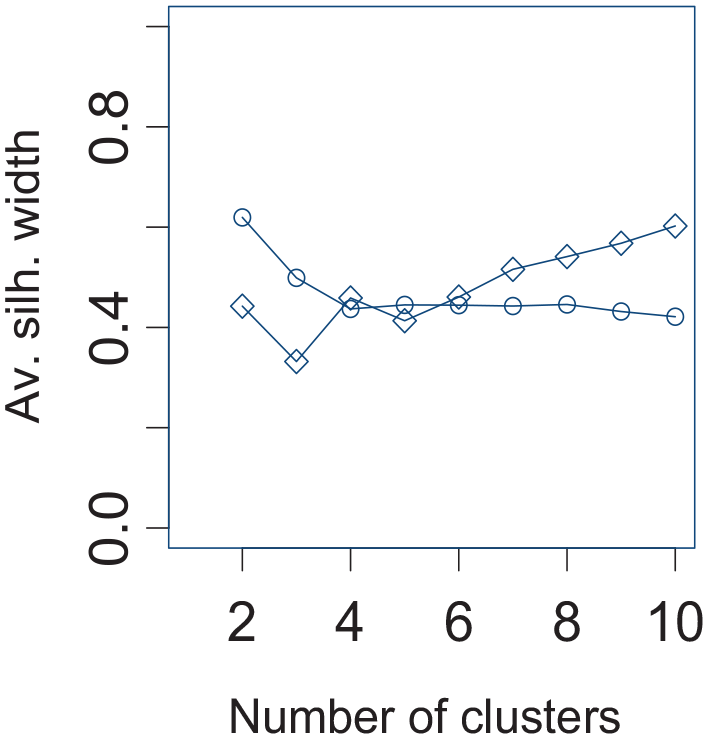
Comparison of average silhouette scores between categorized variables (squares) and their mixed scale equivalent (circles).

Silhouette diagrams illustrating the results of the Partitioning Around Medoids (PAM) process.
Differences in Selection, Satisfaction and Amount of Further Education in the Clusters
To provide a general understanding of the clusters, we provide a brief description for each of them from the categorized-variables-only partitioning, as the clusters based on the mixed-scales are very similar. In the version with categorized variables, cluster 1 consists of only women that mostly hold qualifications at the upper secondary level. With a mean of 47 further education hours they rank at the before last position when it comes to selection (Table 5). The members of cluster 1 experience a negative effect of training on their job satisfaction and rank lowest in that regard. About one-third of them situate themselves above the 80th percentile of the population when it comes to the amount of further education received and therefore qualify as frequent learners. Another third of cluster 1 are infrequent learners, for they fall below the 20th percentile as calibrated on the whole sample (Table 2). The members of cluster 1 are also the least likely to resign their jobs (Table 4).
Cluster Potential With Categorized Variables.

Cluster 4 is completely male and finished education mostly at the upper secondary level. The mean of further education hours is the lowest of all four at 32 (Table 5). The individuals in that group also experience a negative evolution of job-satisfaction when trained. About 38% qualify as infrequent learners while 29% are frequent learners (Table 2). People who resign their jobs are most likely part of this group (Table 4).
Cluster 2 is also completely male. The educational level of those men is tertiary. The mean of further education hours is 51 (Table 5). The job satisfaction of the members of cluster 2 increases with training, but less than in cluster 3. About 22% of them are infrequent and 46% frequent learners (Table 2). This group has the second highest share of job resignations (Table 4).
All of cluster 3 are higher-educated women (Table 5). They receive an average of 76 hr of further education (Table 5) and profit the most of it in terms of job-satisfaction (Table 2). About 13% qualify as infrequent learners while 52% are frequent learners (Table 2). Only the women in cluster 1 resign less often their job (Table 4).
Division of Women by Academic Qualification
The ranking of the clusters helps to identify current high and low potential individuals as well as profiles that need more support to raise their potential. In Table 2, risk does not differ between clusters and therefore does not influence the ranking. Thus, it is the individual-centered measure of “satisfaction differences” that defines the ranking detailing the sum of—positive and negative—evolution of job satisfaction during the observation period by respectively 200 individuals in each cluster (for details see the methods section). All the subsequent tables also order the clusters by rank for illustration purposes.
Overall, men and women with university degrees rank higher than their upper secondary educated counterparts do when it comes to job satisfaction benefits from further education and training. Women with university and with upper secondary education occupy the extreme positions of the ranking, while men of the two educational levels gather in the middle of the spectrum in Table 2. Table 3 further supports the particular situation of women with university degrees at the top. There, based on the mixed scale variables, only they achieve positive potential scores. In addition to the individual perspective, those individuals who can potentially raise their job satisfaction through further education and training also have a collective dimension. Therefore, we include in Tables 2 and 3 the shares of high—above the 80th percentile of the population—and low—below the 20th percentile—learners within the clusters as well as the proportion of the population a cluster covers—that is, its weight within the labor market. To the latter, all clusters represent roughly equal shares of the employed population with a slightly higher share of the cluster at the bottom of the ranking.
Cluster Potential With Mixed Scale Levels.

The clusters differ, however, in their within distribution of learners: Approximately 50% of the individuals in the cluster with the highest positive satisfaction differences but also 30% of those with the lowest and even negative potential evolution of job satisfaction receive high amounts of further education and training in Tables 2 and 3. High-potentials receive low numbers of hours at a rate of 15%, low-potentials at a rate of around 30%. This means that the lowest ranked cluster attributes further education and training insensitive to its relative impact on job satisfaction compared to the other clusters. In contrast, the proportions of the clusters in between reflect their relative places in the ranking when clustered with categorized variables (Table 2). To take a different perspective on the above findings, Table 4 shows the distribution of clusters among those resigning on their own initiative during an interval ranging from 1 year before to 1 year after the observation period ends. It confirms the ranking, for all clusters reflect their further education and training potential for job satisfaction in their propensity to quit their jobs, except for the secondary educated women.
Proportions Among Those Who Resign Their Jobs 2 Years Around the End of the Observation Period (N = 151).

Clear Target Profiles Around Sex and Prior Education
The profiles are established based on the characteristics of the medoid, that is, the individual around which all members of a cluster group. In order to give those profiles more depth, we add—across all cluster members—proportions for the characteristics put forth by each medoid as well as means for age and further education and training hours and medians for the International Standard Classification of Education (ISCED) stages. In Tables 5 and 6 those elements are called the shadow of each medoid. The medoids appear in the ranking order of their respective clusters.
Profiles With Categorized Variables.

Profiles With Mixed Scale Level Variables.
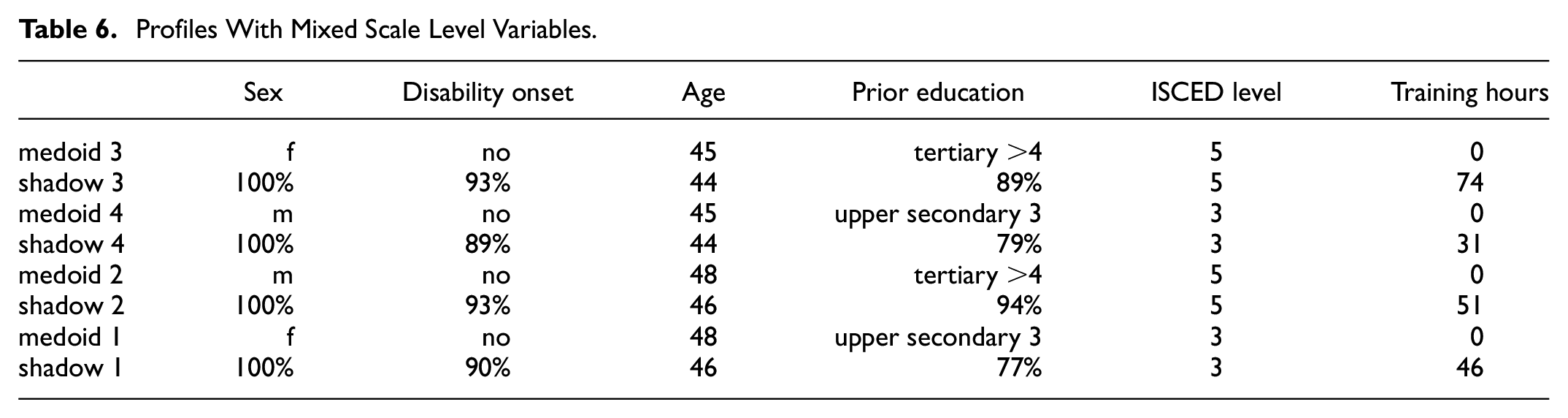
The shadows show for instance that university-educated individuals are rather postgraduates than undergraduates. They also expose minor differences concerning the proportion of disability in each cluster. The most interesting observation, however, is that the cluster with the lowest potential receives not the least mean amount of further education and training hours, while the rest are in diminishing order according to their ranks in the “shadows” in Table 5. The clusters based on the mixed variables in Table 6 also attribute the highest mean hours to the first ranked cluster and not the lowest to the last.
Sex and prior education clearly differ between the identified profiles, as illustrated by the medoids and their shadows in Tables 5 and 6. Age does not seem to contribute as much to the clustering process, as mean age differences in the shadows are not pronounced and do not belong to different age categories. The fact that standardized measures of job satisfaction evolution for clusters 1 and 4 are negative in Table 2 indicates that the representatives of those clusters tend to show diminished job satisfaction over the observation period when they receive high amounts of further education and training.
Discussion
The four-cluster structure resulting from the analysis of this study finds its mirror in the research of Berg et al. (2017) and corroborates their results. High against low wages in their study take the place of differences in prior education in our approach. In their study, the self-chosen time of retirement is the equivalent of higher job satisfaction in ours, only for the specific group of older employees. Their combination of wages with the categories female and male shows structurally equal relationships to training (Berg et al., 2017) compared to our study. The present studies fold line between positive and negative evolution of job satisfaction finds its echo in Palacios-Huerta’s (2003) relative negative financial consequences of education for secondary educated individuals in contrast to the gains for the college educated (Palacios-Huerta, 2003). Reflecting this previous research in the light of our results suggests that the former inconclusiveness of the variable gender pointed to in the literature review springs from over-homogenization of social groups (Woodhams et al., 2015) in additive approaches that lead to taking only one of the two subcategories found here to be representative for women (Cole, 2009).
Possibly, the significantly higher participation of women in the study of Xiao and Tsang (2004) as compared to male participants relates to intersectional theory, in that the subgroup of university-educated women becomes representative there. Even more clearly, the respondents of the recent study of Nemţeanu et al. (2022) are 67% female and have a bachelor or master’s degree in 73% of the cases. For this represents the group to profit most likely from further education according to our research, Nemţeanu et al. (2022) consequently find a positive influence of knowledge and skills capitalization on job satisfaction. On the contrary, the insignificant influence of sex on selection in Ryu and Moon (2019) may arise from the leveling out of within group differences among women. Similarly, Reichel et al. (2022) find to their own surprise that childcare availability is negatively related to the provision of further education. With university educated women at 51% into the sample, the particular situation of women with different educational backgrounds may have become submerged. Here, our study suggests in Tables 2 and 6 that employers look foremost at the propensity to stay and not the relative effect on the indicator job satisfaction when distributing educational investments among employees and therefore favor women with secondary education. Even under this hypothesis, the decision seems gendered, as secondary educated men—who also have negative job satisfaction scores—should then receive less often high amounts of training than women with secondary education should. The present study also discovered a parallel anomaly within the otherwise negative relationship (De Gieter et al., 2011; Egan et al., 2004; James, 2020; Nemteanu & Dabija, 2020) between job satisfaction and turnover. Secondary educated women do not fit, as they show the most dissatisfaction (Table 2) but the least turnover (Table 4).
Two results of our study surprise in the context of former research on intersectionality. First, university educated men did not show up at the top of the ranking, a place intersectionality theory would predict for this multiply privileged group in other contexts (Woodhams et al., 2015). Second, the fact that prior education puts two groups of women at opposite sides of the spectrum is surprising. Intersectionality would normally expect the double negative influence of those two bases of inequality to interact also to the disadvantage of university-educated women (Woodhams et al., 2015). The key to that particularity might be the level to which educational offers cater to the needs of the respective groups. In that sense, high-earning women profit systematically more from individualized training—as opposed to standardized offers—than those to the bottom of the spectrum in the study of Berg et al. (2017), which is even clearer in our case due to the different learning history of the equivalent group with university education.
Through this mechanism of female split-up, a more legitimate (see theoretical foundations above) base of inequality—prior education—thereby hides illegitimate gender inequality in further education and training. Moreover, the negative change in job satisfaction of women with upper secondary education is consistent with the observation and conclusion of Ryu and Moon (2019), in that the presumed expectations of secondary educated individuals toward skill improvement are not met by standardized training offers. This is true especially whenever the sought-for remedy to prior declining job satisfaction (Coelli & Tabasso, 2019) of that group does not materialize.
Intertwined with this experience, the assumption of the implicit class—with its links to education—and gender model (Acker, 2011) of German organizations may lead to outcome differences (cf. Schnabel & Schnabel, 2002 for wages) across intersectional clusters. If training links to opportunities of promotion (Consiglio & Sologon, 2019; Ehlert, 2017) differently for those groups, they also experience unequal frustrations (Acevedo et al., 2017). In that sense, university educated male decision makers more easily perceive the inequity of women with a similar educational background (Acker, 2011) and devise education-promotion packages as a remedy. The reality of secondary educated women is less visible to them, which could lead to a lack of adapted opportunities and therefore lower job satisfaction. If the latter affects productivity of women with secondary education, the class and gender model even receives a deceiving feedback that diminishes further the prospect of job improvements. Processes like this would explain the apparent sidelining of secondary educated women found by the present study. A way out resides in tailor-made education for this group. Actually, Berg et al. (2017) found evidence that the available “general” training in organizations is geared toward men, whereas training supports women with low wages when it is individualized.
Conclusion
In the following, we will elaborate the theoretical implications and the managerial contributions of our study. Furthermore, we will reflect on the occurring limitations and future research perspectives. Enhancing intersectionality theory, the above results show that the effect of prior education on further education and training is gendered. In the context of further education and training, gender and prior education qualify as main “bases of inequality” concerning job satisfaction and participation in training. Without considering the intersection between them, the real differences in job satisfaction of men and women risk staying hidden. Vice versa, observers also risk underestimating the influence of prior education when unaware of gender. Therefore, human resources professionals need to tailor their interventions to the groups at those intersections. In analogy to the race-gender analysis of Crenshaw (1989) we uncover that further education and training practices have particularly harsh consequences for secondary educated women.
Consequently, on the individual level, further education and training propositions have to adapt more to the needs of women with upper secondary education. This is highly relevant for organizations, as those women also more often remain in their unsatisfying job situation compared to men (Table 4). New technologies of remote and virtual work and learning like cognitive analytics, algorithmic tracking may not only improve work performance (Hawkins, 2022) but also help to enquire into the micro-processes that lead into the above mentioned inequality and therefore uncover concrete activities of adaptation. Digital avatars (Kral et al., 2022) carry the advantage, that they allow for non-gendered direct interactions in further education and the workplace. The above findings also firmly suggest for digital twins (Kral et al., 2022) of employees and workplaces to reflect intersectional phenomena, so that they will only aggravate justified educational inequality intentionally.On the organizational level, the first choice for unmediated standard further education and training investments are currently mid-career women with university degrees when the objective is to improve job satisfaction. Not frequently resigning (Table 4), they keep educational investment within the company. However, already 52% of this group receive a high amount of further education and training. Men with higher education as the second in line have more training potential left unused. However, they will, unlike the women, need additional investment in retention measures, as frequent learners are also frequent leavers (Table 4). A prospective framework to address those problems is internal marketing with its proven links to job satisfaction (Nemteanu & Dabija, 2021). The derived clusters then become internal market segments in which the organization systematically studies customer needs in order to achieve higher satisfaction through its educational services.
A managerial implication of our study is that the two clusters at the bottom of the list do not recommend themselves for unmediated investment in further education and training, because their scores of further education and training potential are negative. Spending should therefore first focus on initiatives to improve the fit of the educational offer before increasing their participation rates. The findings of Berg et al. (2017) support this approach, as they discover that targeted training affects positively the continuing work motivation of women with lower salaries. In contrast, low-earning men appear to profit more from standardized training than low-earning women (Berg et al., 2017), which further supports the ideas that the further education and training in organizations is structurally gendered and that secondary educated women need an adapted offer. Moreover, related investments are likely to pay out, as secondary educated women are more likely to stay with the organization compared to their male counterparts (Table 4). Following the intersectionality sensitive recommendations, ultimately all identified groups can become part of an educational investment portfolio in adequate shares.
On the labor market level, selection and self-selection processes generally reflect the differences in potential job satisfaction as Tables 2 and 4 show through the distribution of training hours in line with the job satisfaction ranks. This study showed that there is some further education and training capacity left unused in the higher ranks and a possible overinvestment at the bottom. A preference of women of all educational backgrounds for their lower job mobility (Hansson, 2008; Table 4) regardless of their respective potential job satisfaction—and thus productivity—would explain the unbalanced share of training investment in women with secondary education. Another incentive to over-invest in the group with the most negative job satisfaction outcome could reside in targeted funding to counter a lack of education accessibility or to avert negative externalities like the threat of unemployment (Seyda, 2020). If this is the case, respective programs are likely to cause adverse effects with regard to job satisfaction in secondary educated women. Funding should be rather linked to the capacity of initiatives to generate job satisfaction than only to labor market vulnerabilities or it should be replaced by direct job insertion investments. Overall, the group of secondary educated women appears to be most relevant in terms of changes to investments into further education and training with the aim to raise job satisfaction.
The present study unfolds its full explanatory power only in non-exceptional economic and labor market periods. To determine whether their significance changes under conditions of extraordinary economic growth or recession would enlarge the cases for their use. Another limitation that may influence the above results in the future is the growing virtualization of work through immersive technology (Kral et al., 2022), where gender differences may become less salient. The attribution of educational resources might also become less subjective thanks to algorithmic data analytics instruments, which begin to amplify their entry into the workplace (Hawkins, 2022). Moreover, the presence of disability as a characteristic was rather small in the sample, which could have yielded suboptimal representation of intersections with disability. In future studies, oversampling of disabled individuals can help to test the importance of this attribute (Bauer et al., 2021). In parallel, a deepening of the results would be achieved if similar or different clusters and profiles could be discovered within professional domains or even single firms. Further research should also investigate the underlying reasons for the ranking after having identified the clusters in the particular context. A central question is what the specific needs of those individuals are, who do not realize their potential for job satisfaction and why they do not participate in further education. Besides, further research is needed to clarify why in some clusters there is a narrower job satisfaction span than in others as well as which interventions can help the individuals in low-potential or even negative-potential clusters to increase their capacity. In this context, it is unclear if they are already at their highest possible job satisfaction without further training. The convergence between the variant based solely on categorized variables and the mixed-scales alternative suggests that the categorized approach is sufficient, which helps to apply the method of the study to other datasets, labor markets and countries. Finally, subsequent applications of the research design will suggest the relative stability of the findings through time and contexts and uncover social change.
Footnotes
Acknowledgements
None.
Declaration of Conflicting Interests
The author(s) declared no potential conflicts of interest with respect to the research, authorship, and/or publication of this article.
Funding
The author(s) received no financial support for the research, authorship, and/or publication of this article.
Ethics Statement
Not applicable.
