




Abstract
Active learning strategies are purported to be effective in enhancing students’ understanding of concepts that would otherwise be difficult to master through other strategies of mediating learning. This study forms part of a bigger study where pre-service teachers’ errors and misconceptions in transformation geometry were identified, analyzed and then addressed. The focus of this current study is on exploring the implementation of a van Hiele phase-based instruction to address the students’ misconceptions through the facilitation of active learning. The instructional program was implemented with 82 pre-service teachers (student teachers) and field notes, observations and informal conversations with students were used to collect data during the implementation. A test was then given at the end of the intervention to determine the effect of the intervention on student performance. Findings suggest active learning can be promoted, through the use of van Hiele phase-based intervention program, to address effectively students’ misconceptions.
Introduction
Students unavoidably misconceive ideas as they navigate through the world in order to develop their own understanding (Hansen, 2017). Misconceptions are more pronounced in the learning of geometry, throughout all schooling levels, as well as in Higher Education, with transformation geometry being one of the areas where students experience challenges (Alex & Mammen, 2016; Guven, 2012; Luneta, 2015).
This paper reports on part of a bigger study in which pre-service teachers’ errors and misconceptions were investigated, analyzed and then an intervention program was designed to address the misconceptions. In this present study, an instructional intervention was implemented, based on van Hiele phases of learning, targeting students’ challenges in transformation geometry. It involved a range of strategies that are pertinent to Van Hiele’s phase-based learning, such as the processes students have to go through as they are guided in doing activities during the Guided Orientation phase (Armah et al., 2017; Meng & Sam, 2013). The intervention focused on the teachers’ instructional practices and classroom management strategies, emphasizing the teacher’s need and intention to engage students in active learning methods. These included opportunities for students to participate in learner-centered approaches such as cooperative learning, inquiry-based learning, experiential and interactive learning (Alemu, 2010; Duarte, 2015) that motivate students to “engage their thinking processes” (Slavin & Lake, 2008, p. 430).
Teachers play an important role in facilitating students’ active learning. They need to put effort in guiding instructional activities and expectations so that students get motivated and remain focused. It is therefore imperative that teachers should have sufficient content as well as pedagogical knowledge of the topic being taught, so as to mediate learning confidently to a wide range of students (Ball & Forzani, 2011). The concern for teacher deficient knowledge in geometry teaching, including transformation geometry, has been raised in many studies, in South Africa and abroad, where teacher training seems to provide inadequate teaching skills to pre-service teachers (Harper, 2003; Ndlovu, 2012; Taşdan & Koyunkaya, 2017). An active learning approach reduces the tendency for students to rely totally on the teacher for receiving information passively. Instead, students are led toward developing their own independent thinking and sense making (Graven et al., 2013).
This study provides some insights into strategies that can be used to facilitate students’ active learning so as to address their misconceptions in transformation geometry. These being pre-service teachers, the study emphasizes the strengthening of teacher training efforts, which, when implemented in a timely fashion during their training, can improve their competence in teaching geometry in the future, and thus contribute to the quality of the education system.
Student Teachers’ Knowledge of and Reasoning in Transformation Geometry
Students sometimes lack conceptual understanding of the mathematics they need when they enter college or university (Lee & Boyadzhiev, 2020). Research evidence shows that geometry is difficult to teach as well as to learn, especially given the demand for many types of knowledge required in geometry reasoning, such as procedural, conceptual, strategic and declarative knowledge (Luneta, 2015). Within the broader context of geometry, students experience problems with the learning of transformation geometry (Bansilal & Naidoo, 2012; Evbuomwan, 2013). For example, even though students seem to know the algebraic meaning of translation and rotation, they sometimes fail to understand the geometric meaning of these concepts (Ada & Kurtuluş, 2010).
This study involved student teachers or sometimes referred to as pre-service teachers. This was a cohort of undergraduate students that were enrolled in a Bachelor of Education degree in order to qualify as teachers after 4 years. In a similar study Acquah (2011) discovered that these student teachers could not successfully operate reflections involving orientations other than familiar lines such as the axes. Students’ grappling with the description of transformations was also detected in a study by Kaplan and Öztürk (2014), where students confused reflection and translation. Kambilombilo and Sakala’s (2015) study involving Zambian in-service teachers revealed that many of them couldn’t use mathematics instruments properly and struggled working with reflections that involved images of objects reflected in slant lines (Kambilombilo & Sakala, 2015). Many studies that investigated students’ reasoning in transformation geometry (Evbuomwan, 2013; Luneta, 2015), discovered that the majority of students operated at levels of thinking in transformation geometry that were lower than what is expected at their stage of learning.
The results of a study by Laslan (2013), conducted in Turkey, revealed that most students tried to memorize the rules for some of the transformation types such as rotation. For example, the students applied rules of transformation using ordered pairs even in cases where the physical transformation of the shape, using visual means, could have been simpler. Yet this approach created problems when students sometimes forgot the rules involved. Hence the use of transformation using visualization is recommended where students would otherwise carry out a superficial analysis of the properties of the shapes involved (Bansilal & Naidoo, 2012). In contrast, most students in Evbuomwan’s (2013) study in Lesotho, were able to use visualization correctly, by doing actual motion to identify transformations as well as to transform figures; the few who had difficulties with such transformations could not differentiate between rotated and translated figures.
The Relevance of Active Learning in Promoting Understanding
The principle of active learning involves the use of various strategies that allow the student to actively perform some action, whether mentally or physically, in order to construct an understanding of the concept being taught. For example, students can participate actively in problem solving, inquiry or conduct an investigation (Alemu, 2010). The teacher facilitates learning by designing and implementing carefully structured learning activities. Such learning should promote students’ critical thinking while encouraging their active involvement in classroom activities (Tedesco-Schneck, 2013). An important aspect of active learning is the discussion that takes place between students. Garrett (2020) asserts that discussion-based learning is an effective pedagogical tool or constructivist method for promoting student engagement, where they talk back-and-forth, sharing opinions and experiences, which results in the development of higher-order thinking skills. Such skills are likely to promote better understanding of the concept students are engaged with, which, in cases of misconceptions, students are likely to interrogate their incorrect reasoning and align themselves with correct version of the concept being discussed. Ismail and Allaq (2019) concur by recognizing cooperative learning as a valuable instructional procedure for promoting learners’ engagement and classroom social interaction.
In the present study, the use of active learning was aligned to the following four modes of student cognitive engagement with the learning material (Chi & Wylie, 2014):
Interactive: students work together to reach consensus about the material they are working on.
Constructive: students construct meaning and deeper understanding that goes beyond the learning material presented to them generate work that goes beyond what has been presented in instructional materials.
Active: students are involved in working with physical manipulations without adding any new knowledge (such as moving shape pieces around on the chalkboard)
Passive: Students receive information (e.g., when they listen to facilitator’s instructions)
The active mode of promoting student engagement in the present study also included the use of technology where a laptop was used for demonstrations in the form of diagrams being projected on a screen while discussing transformation of shapes. According to Deveci et al., 2018), using laptops can shift the teacher’s role from the holder of knowledge to the facilitator of learning. This promotes student engagement and creates active learners.
Concerns about student resistance to active learning have been raised (Finelli et al., 2018). In this study the student teachers’ resistance included their unwillingness to work in groups, lack of participation in working on their errors and the identified misconceptions and lack of participation in remedial and enrichments session. However, given their misconceptions as a starting point for the design of the implemented intervention in this present study, it was hoped that they would be encouraged toward embracing strategies that sought to help them address such misconceptions.
Van Hiele Phase-Based Learning
The design and implementation of the intervention program that addressed students’ errors and misconceptions in the current study was based on the Van Hiele theory of geometric reasoning (Van Hiele, 1986). This theory proposes five phases of learning that students should be engaged in so as to advance their reasoning from one level to the next, higher level (Armah & Kissi, 2019). These phases are information phase, guided orientation phase, explicitation phase, free orientation, and integration:
Phase 1: Information Phase
In this phase, the teacher identifies, through discussion, what students already know about a topic and in this way the student becomes acquainted with the topic of interest. Observations are made (e.g., the teacher might display a picture or diagram to students), questions are raised, and level-specific vocabulary is introduced (Armah et al., 2017). This makes it possible for the teacher to identify what the students already know about the topic or concept being explored. Therefore, the purpose of activities performed during the information phase is to give teachers an indication of students’ prior knowledge about the topic, as well as to give students an idea of the direction of further study (Atebe, 2008).
Phase 2: Guided Orientation Phase
Students work on teacher-specified, carefully structured tasks and the teacher guides them so that they can make the necessary discoveries or notice possible relationships (Abdullah & Zakaria, 2013). The teacher presents the tasks as a learning unit to guide students so they can advance from one level of reasoning to the next, higher level.
Phase 3: Explicitation
In the explicitation phase, students share their views and explain their understanding about the concept and relationships already learned (Abdullah & Zakaria, 2013), building on their previous learning experiences. In this way, the teacher can assess students’ understanding of the topic taught earlier, so as to monitor their progress and improve their learning. The teacher also introduces technical terms or standard vocabulary and correct mathematical language appropriate for the particular context, in order to promote accurate communication among the students (Atebe, 2008).
Phase 4: Free Orientation
In the free orientation phase, students are given more challenging tasks and are required to do investigations on their own, so as to discover certain relationships (Pusey, 2003). Open-ended tasks with multi-path solutions are provided to students, in order to encourage them to find their own solutions. They are required to justify their answers, using appropriate vocabulary as developed during the explicitation phase.
Phase 5: Integration
In this phase, students review, integrate and summarize what they have learned in order to develop a new overall view (Abdullah & Zakaria, 2013; Atebe, 2008). The teacher might assist, if necessary, by providing brief references to what the student has learnt. It is anticipated that when the integration phase is completed, the student will have now attained the next level of reasoning in the Van Hiele model (Pusey, 2003).
In the present study, van Hiele phase-based program of instruction was implemented to address students’ errors and misconceptions with transformation geometry. The research questions for the study were:
To what extent can van Hiele phase-based instruction program promote students’ active learning during an intervention program involving transformation geometry?
Is there an improvement in student understanding of and performance in transformation geometry tasks following an implementation of the intervention program?
Method
This was a mixed method research (Timans et al., 2019) where qualitative participatory action research approach (Kemmis & McTaggart, 2000) was used to answer the first research question and quantitative analysis and interpretation of data occurred to answer the second question. The implementation of the intervention program required the facilitator, one of the researchers, to be part of the classroom presentations and interactions over a period of 3 months.
Sample
The students who participated in the current research were enrolled for BEd in Foundation Phase program in a newly established rural university in South Africa. The 4-year program prepares students for teaching in the undergraduate Foundation Phase level of schooling. A total of 82 students participated in the bigger study of which this present study forms part. During the presentation of the implementation program, the number of participants varied between 80 and 82 during the different periods of intervention lessons.
Data Collection
Data were collected by one of the authors as she was the lecturer for the participants involved in the study. Prior to intervention, the Transformation Geometry Achievement Test (TGAT) and the Learning Levels of Transformation Geometry Test (LLTGT), incorporating the general frameworks for investigating learners’ van Hiele levels of geometric development (Burger & Shaughnessy, 1986; Guven, 2012; Mayberry, 1981; Soon, 1989; Usiskin, 1982), were administered to determine students’ errors and misconceptions with transformation geometry. Therefore, the tests were valid and reliable since they were based on frameworks and tests that have been tested and validated before. The tests were piloted with a group of third-year students who were not going to take part in the research study, thus increasing their credibility.
Following the diagnosis and identification of students’ errors and probable misconceptions that caused these errors, from the tests in the main study, the researcher then planned and developed a series of activities, in the form of lesson presentations, that were based on the three types of transformation, namely, translation, rotation and reflection. These activities were arranged in such a way that they facilitated van Hiele phase-based instruction, as described in an earlier section. Students were then given a test, by the lecturer, similar to the one given during the main study, before the intervention.
During the implementation of the intervention program, data were collected through participant observation, informal conversations with students, document analysis of students’ work and the facilitator’s field notes. Video recordings, with permission from students, were taken during various occasions when necessary. These data collection methods were used together by the lecturer-researcher, almost simultaneously, to supplement each other, throughout the implementation of the intervention program.
Analysis
Thematic analysis, which is compatible with constructionist paradigms (Braun & Clarke, 2006), was the main method used to analyze data for the present study. Both researchers analyzed that data by firstly reading and re-reading notes and information (both descriptive and reflective, as mentioned earlier on) from the facilitator’s notebook and from students’ written work (Phase 1 of thematic analysis). In addition, the researchers analyzed relevant images from video clips taken during lesson presentations by, for example, organizing such images under relevant themes or codes. Analysis of data from lessons presented during the intervention program was done to answer mainly the first research question. Analysis of data from lesson presentations also occurred through coding, searching for, reviewing, defining and naming themes (Phases 2, 3, 4 and 5 of thematic analysis) obtained from the data sources used during lesson presentations.
Analysis of the test involved a comparison of student performance in the test they wrote before intervention and the one they wrote after intervention. This comparison was done according to each of the levels of geometric reason, for each type of transformation geometry.
To answer the second research question, descriptive statistics in the form of average percentages were used to compare and analyze results of the pre-test and the post-test. This comparison was done according to each of the levels of van Hiele geometric reason, for each type of transformation geometry.
Validity Issues
The lecturer-researcher had a prolonged engagement with participants (students), during the intervention, with the aim of building trust with them (Korstjens & Moser, 2018). This resulted in students communicating freely (on encouragement by the researcher) their explanations that accompanied their answers, for both the tests and during the intervention program. This enabled her to gain a deeper and enriched understanding of the phenomenon being studied, from their rich and thick descriptions, thus reducing the possibility of researcher bias resulting from her own opinions.
Ethical Considerations
Permission to conduct research was sought and obtained from the university where the participants were enrolled. Written consent was obtained from all participants in the study, before the commencement of the research activities. They were informed of the purpose of the study, the procedures to be followed during the period of participation, such as video recording if they gave consent, as well as the freedom to withdraw from participating in the study any time if they chose to. Participants were informed of confidentiality regarding sharing information that they might divulge during the research, such as their names, their identities, and so on.
Results
Errors and Misconceptions Identified
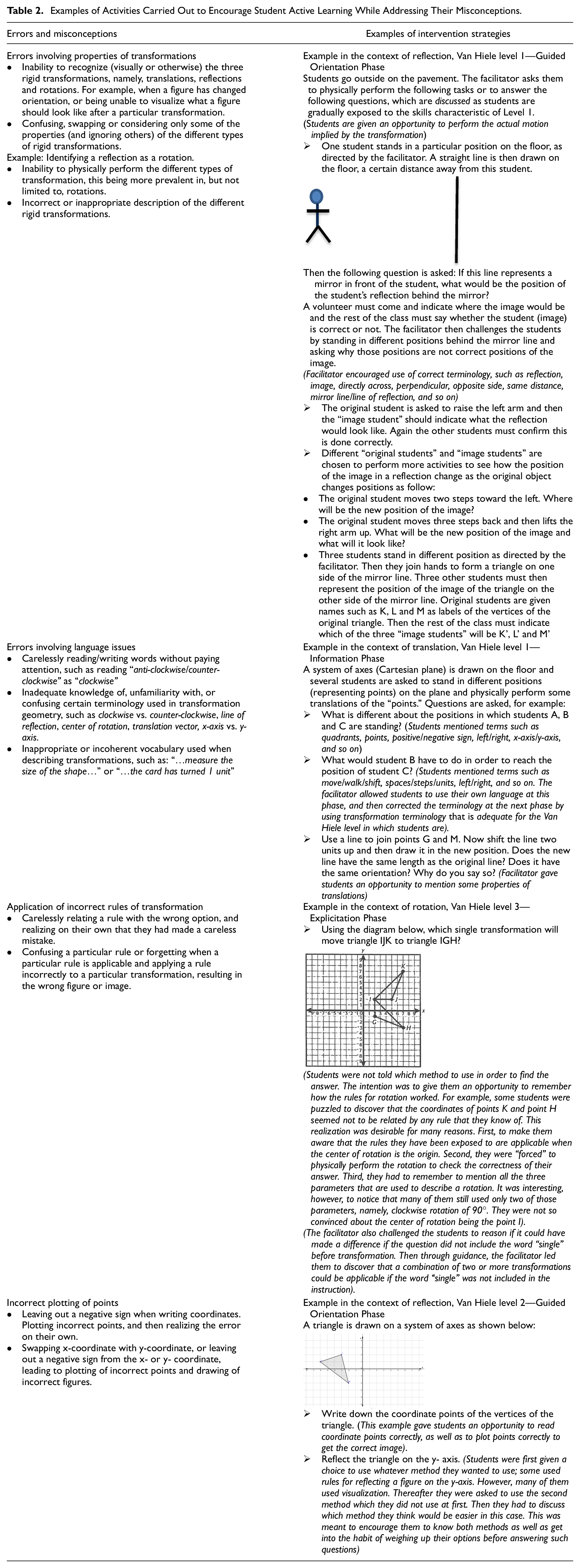
For the purpose of the present study, the errors identified from students’ written work on the tests were incorporated into the development of the intervention program. These appear in the first column of Table 2 below, where errors and misconceptions identified are used to develop corresponding intervention strategies.
The Implementation of the Intervention Program
The lessons presented during the intervention program included instances in which students were working individually, in pairs, in small groups or as a whole class. There was active engagement of students with each other and in cooperative groups, physically moving around while performing transformations, on book, on the chalkboard as well as on the floor. Sense making was also enhanced through the use of visual manipulatives such as cut out pieces of cardboard in triangular shapes, used for carrying out the transformation of shapes (Figure 1 and Figure 2). The facilitator’s role as participant-observer, while students worked on the transformation geometry activities, meant that there was no formal observation schedule. Instead, the facilitator noted “cases of interest, excitement or disquiet” (Mnqwazi, 2015), observed with students regarding certain discussions during lesson presentation and student interactions. These cases were relevant in helping to answer the research questions. One example of such cases (Figure 1) involves a question during the Free Orientation Phase under the subtopic of translations, by which students were required to investigate whether one of the figures below can be a translation of the other:

Diagram used for investigating whether one figure is a translation of the other.
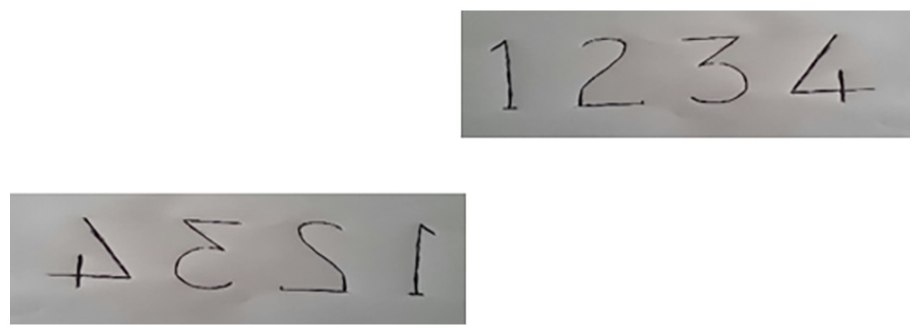
Reflection of digits in a mirror.
This question (Figure 3) became a case of interest because of the unique and unexpected answers given by some students, as well as the variety of methods that students used to do the investigation. Written answers ranging from “no, because they are not in the same line” to “yes, they are translation of each other because they look the same” were provided. Furthermore, through observation, the facilitator saw students tracing the figures onto blank paper and then super-imposing them onto each other to see if they are congruent. These were the kind of data that the facilitator obtained through written documents, observation and further probing through informal conversations, allowing her to identify, understand and address the misconceptions students had.
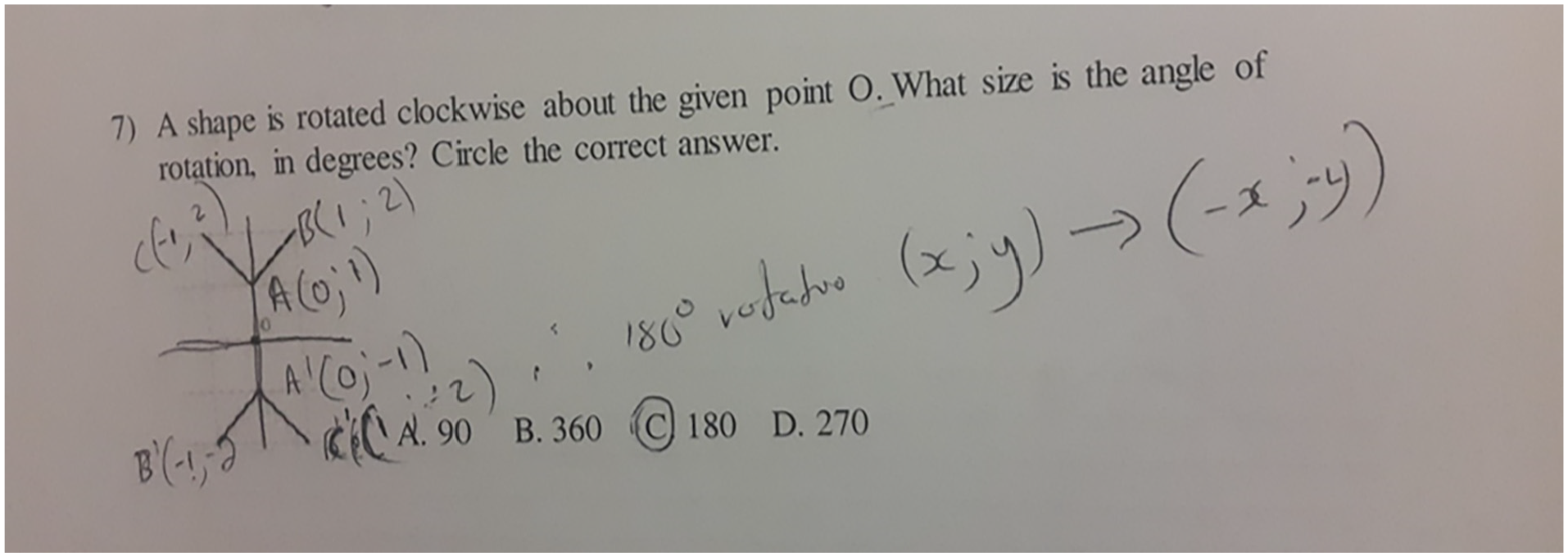
A snippet showing the scribbling of S21 in answering MC Question 7 of the post-test.
The facilitator’s role during the intervention program also involved guiding students with the effective use of time, during both practical activities and written exercises. She kept students engaged with tasks and motivated them to think creatively and critically. In order to enhance the success of the overall intervention program, the facilitator used formative assessments throughout the lesson presentations, as part of Van Hiele phase-based instruction. For example, for each lesson on the different types of transformation, the students had to test their understanding by working through the Integration phase, whereby they had to apply the knowledge they gained from the preceding phases. Tomlison (2014, p. 12) supported the idea of formative assessment during the lesson, and claimed that the teacher “should sample student understanding in relation to the material so the teacher has a reasonable approximation of who may experience difficulty, who may show early mastery, and who may bring misunderstandings to the unit of study.” Formative assessment during the intervention program therefore became one way of answering the second research question, which sought to address misconceptions.
The student in the study struggled to, among other things, describe transformations, write the equation of the line of reflection, as well as to state the center of rotation. Additional data emerged from the intervention program, giving the facilitator an opportunity to identify additional errors that were not picked up from the tests given before. These “emergent” errors were addressed as and when they occurred. For example, during one of the lessons, students were asked to look at and draw the image when the number “1234” is reflected in the mirror. Without paying attention to the instruction, and assuming that they understood reflection as a case where the image is virtually inverted (left-to-right), most students carelessly wrote the reflection as “4321.” That is, they ignored the left-to-right inversion of each symbol, as shown in the image below:
As mentioned in an earlier paragraph, the facilitator used field notes to capture some of the data that emerged from the lessons presented as part of the intervention program. She would spend some time observing a particular activity and then record the details as field notes immediately after the observation, to avoid discrepancies between observed and recorded data. Therefore, the field notes were recorded on the research site, with information captured, as much as possible, as it was spoken or observed (Mertler, 2017). In this context, the field notes provided some descriptive information, which is a record of factual data (Schwandt, 2015).
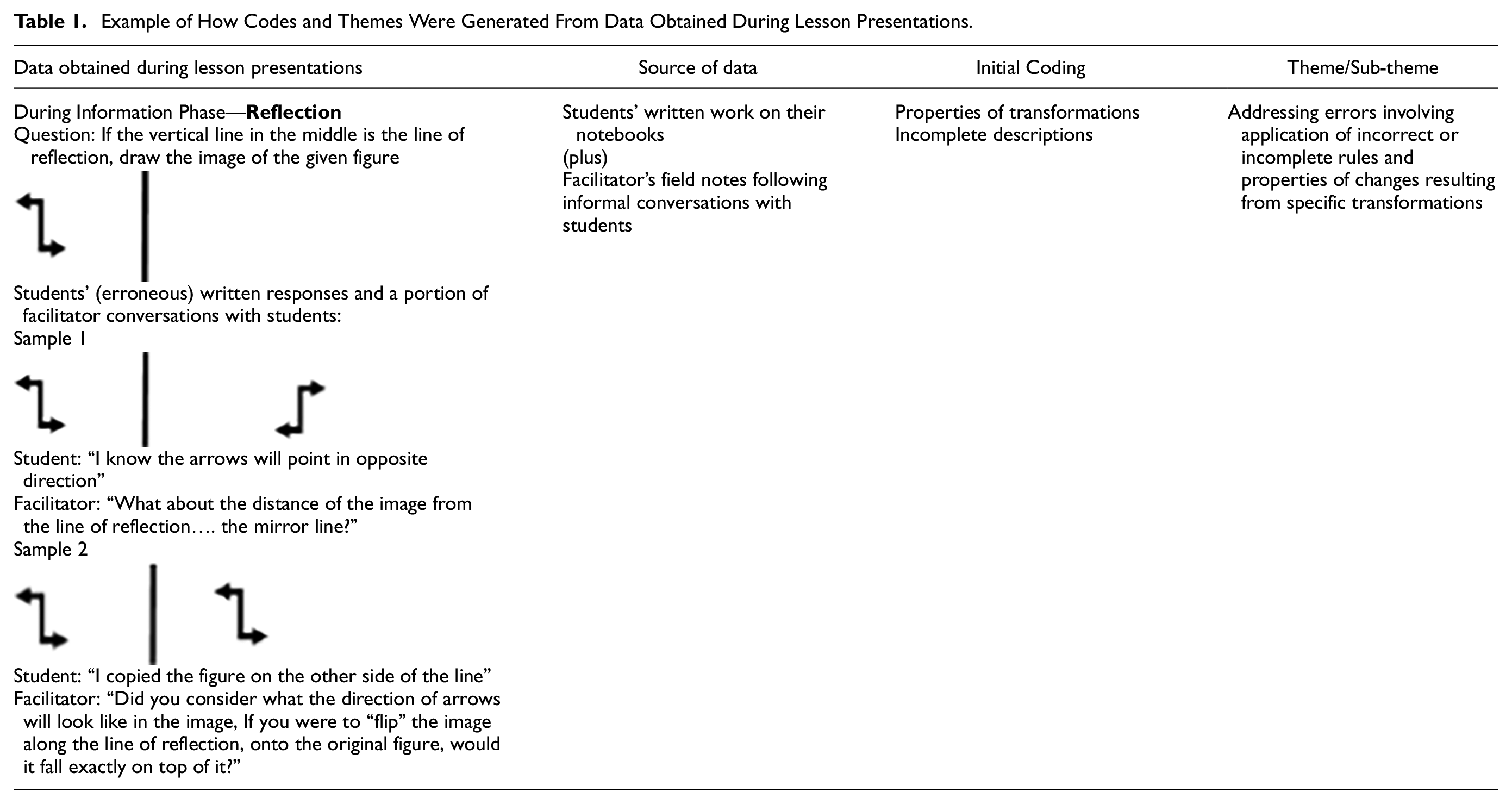
Examples of coding and theme generation during lesson presentations as part of the intervention program appear in the Table 1 below.
Example of How Codes and Themes Were Generated From Data Obtained During Lesson Presentations.
The next Table 2 gives examples of data that show actions taken toward addressing some errors and misconceptions during lesson presentations. Some of the actions/strategies used were cutting across different skills and therefore addressed different errors and misconceptions at the same time. Details and descriptions are merged within the table as part of the results.
Examples of Activities Carried Out to Encourage Student Active Learning While Addressing Their Misconceptions.
Results From the Test
The results of the test showed a definite improvement in terms of students getting more correct answers than before. For example, out of the 82 students, 6 of them got all the questions in the multiple choice (MC) portion of the test correct while only one student obtained a mark of less than 8. That is, only one student performed at less than 50% in terms of correct answers in the multiple-choice portion of the post-test. However, this being a qualitative study, the researchers had to determine if students were able to address their misconceptions, resulting in improvements in their understanding of transformation geometry. They were encouraged to notice how some students improved in terms of their reasoning and how they expressed it in writing, compared to how they did in the MC pre-test. For example, the following snippet shows how student
It is interesting to note how
Students’ responses in the discussion section of the test showed that they still struggled with some questions, especially those that were set at higher Van Hiele levels. Furthermore, most questions in which performance was lower in the pre-test still had lower performance in the post-test, compared to those in which performance was higher and vice versa. Table 3 below shows the comparison of performance in the test before and after intervention. A feature that stands out in the table, is that students’ performance in the questions of higher Van Hiele levels did not show much improvement. Moreover, it seemed as if an improvement was not realized much with rotation questions, where, for example, Questions 11.2 and 14.3, both set at Van Hiele level 2, showed no improvement at all. Table 3 provides the analysis of the students’ work and their Soon’s (1989) levels of operation. Soon (1989) used Van Hiele levels (1–5) but were specific to transformation geometry.
Comparison of Student Overall Performance Per Question in the Discussion Section of the Test.

Discussion
Based on the findings of this study, pre-service teachers, who grapple with the learning of the topic of transformation geometry and display a range of misconceptions, can improve their understanding of the topic through an engagement in an active learning intervention program. The gains obtained from interactive and constructive modes of active learning (Chi & Wylie, 2014), through the lecturer implementation of a van Hiele phase-based learning program, gave both student teachers and the BED mathematics course lecturer an opportunity to drive learning toward the desired outcome. Student performance in transformation geometry tasks, on the whole, improved because of the intervention.
Students’ use of hands-on activities (Medoff, 2013) and engagement in cooperative learning benefited students who were struggling with certain concepts in transformation geometry. Cooperative learning as part of “social construction of mathematical knowledge” (Font et al., 2013, p. 122), while the facilitator used scaffolding techniques, were facilitated so as to help them make sense of, and improve their learning (Sundling, 2012). The sense making was also enhanced through the use of visual manipulatives such as cut out pieces of cardboard in triangular shapes, used for carrying out the transformation of shapes.
The effect of active learning toward developing students critical thinking was confirmed in this study, thus supporting findings by other studies such as that of Duarte (2015). Contrary to Finelli et al. (2018), student resistance toward participating in active learning was not an issue with the current study. Students were, most of the time, intrigued, if not pleasantly surprised, to realize their errors and that they could then explain them as well as address them. This might benefit pre-service teachers in that they will emerge more confident and competent in their teacher training and become better teachers. Furthermore, it is also envisaged that when student teachers address their errors and misconceptions in a meaningful way it will provide them with error analysis skills that will aid in address their own students’ errors and misconceptions in the future.
The performance of students in the test confirmed earlier studies that showed that most students struggle solving problems that are set at higher van Hiele levels of geometric reasoning (Alex & Mammen, 2016; Luneta, 2015). This was evident as, despite improvement in performance in questions set at these higher levels, this improvement was lower, compared to that associated with lower-level questions. For instance, in Table 3, there was a minimal shift of 3% and 1% respectively in students’ performance in the pre and post-tests in a question such as “Draw image of given figure according to given coordinate rule” and “Motivate why a rotated figure and its image are congruent” that were at level 4.
The aspect of language of mathematics and particularly on communicative aspects (Abdullah & Zakaria, 2013; Alex & Mammen, 2016), was prominent, especially where students misinterpreted or misread instructions. However, the prolonged engagement with the facilitator and constant reminders and guidance, encouraged students to remember to focus on such instructions and therefore reduced occurrences of errors as the intervention continued.
Conclusion
Student engagement in activities that allow them to participate actively in their learning has a potential to enable them to develop better understanding of the concepts they are learning. Teachers should therefore create learning environments where students can engage physically, mentally and cooperatively with the learning material. To improve practice, we recommend that technology could also be utilized to explore its potential in increasing student active engagement with the learning of mathematics. For example, Interactive Whiteboard technology could be integrated into students’ learning if teachers developed a dynamic understanding of it and learned to interact fluidly with the concepts during instruction (Young et al., 2017). It is even better when teachers use students’ misconceptions as the starting point, so that they direct their activities to specific deficiencies that students have.
Footnotes
Acknowledgements
The participation of the students from the university where the research was conducted, is appreciated.
Declaration of Conflicting Interests
The author(s) declared no potential conflicts of interest with respect to the research, authorship, and/or publication of this article.
Funding
The author(s) received no financial support for the research, authorship, and/or publication of this article.
Ethical Approval
An ethics statement (including the committee approval number) for animal and human studies. If this is not applicable, please state this instead.
Not applicable
