



Abstract
The uncertainty behind a warming climate produces significant risk for communities that rely on tourism, but vulnerability assessment can help inform planning for adaptation and mitigation efforts. Since coastal regions have significant tourism economies, and rely on the tourism sector for socio-economic stability, we seek to understand how assessments of vulnerability have been applied in coastal communities by systemically assessing literature that describes the concepts of adaptation, resilience, and vulnerability. We conducted a systematic search across three peer-reviewed journal databases (Web of Science, Scopus, and PubMed) to compare the types of methods and models used to determine coastal adaptation and vulnerability in various geographical and demographic settings. The systematic process found 205 unique articles; 143 were deemed relevant as they focused on adaptation, resilience, or vulnerability assessment. A qualitative analysis of the key themes of relevant studies, identified using thematic coding, found that vulnerability and adaptation research in tourism-based coastal communities is predominantly done through qualitative methods, researched more frequently in higher-populated areas of Europe and North America, have a focus on water as a driver of vulnerability, focus on socio-economic impacts of vulnerability, and emphasize locally-based knowledge in understanding adaptive capacity. Bibliometric analysis of citations and mentions in social-media reveal a larger number of papers with a higher citation rate focused on coastal-based systems (salt-water) with an emphasis on regional studies rather than those with a specific urban or rural focus. We found few studies aimed at coastal communities using tourism operators as informants, but rural coastal communities had higher social-media metrics indicating their comparative public importance. Thus, we highlight the need for locally-informed case studies in vulnerability and adaptation assessment for small coastal communities.
Keywords
Introduction
Uncertainty behind a warmer and variable climate manifests as both a vulnerability as well as an opportunity for coastal communities. Coastal and marine environments are inextricably linked to climate; the ocean is an important distributor of the planet’s heat and this distribution is strongly influenced by changes in global climate. The same process allows for coastal communities to be tourism destinations; warmer and sunny conditions with a breeze attract tourists to coastal destinations globally. However, recent environmental change has been linked to increased storm events, stronger winds, and subsequent increased storm-surge related flooding (Dellink et al., 2019; Edmonds & Noy, 2018). Sea-level rise and storm-surge related flooding will likely become one of the most prevalent hazards for coastal communities in an increasingly variable climate future (Withey et al., 2019). Further straining coastal ecosystems globally are increasing coastal populations due to urban and industrial growth in larger port cities, as well as tourism and retirement in smaller coastal communities (Neumann et al., 2015). As such, understanding the vulnerability and resilience of the economy of coastal communities is paramount to understanding their growth and sustainability in an increasingly variable climate future. Vulnerability of coastal ecosystems associated with environmental change translates equally to pre-existing vulnerabilities inherent in the socio-economic reality of many smaller and rural coastal communities (Dolan & Walker, 2006). Coastal populations in isolated or outlying areas, including islands, are at higher levels of socio-economic vulnerability, due to their distance from basic goods and emergency services (Edmonds & Noy, 2018). Demographics can exacerbate the severity of climate-risk, where existing at-risk and marginalized populations have an inherently higher vulnerability, especially in rural areas where access to services is lower (Akerlof et al., 2015).
The disproportionally large influence of environmental change on coastal communities has already been at the forefront of Island Nations in the South Pacific (Dogru et al., 2019). Damage to infrastructure from higher storm surge, as well as long-term risks to buildings, is higher in close proximity to the water (Withey et al., 2019). The dominant form of risk is often related to infrastructure, which can depend on location (Niang et al., 2010). For example, the Senegalese coast of the island nation of Cape Verde has a large population living in zones exposed to sea-level rise, which exposes a large portion of the country’s housing to damage associated with climate change (Niang et al., 2010). For crop-lands of the Saloum estuary of Senegal, agricultural production is similarly at risk (Niang et al., 2010). Thus, socio-economic factors can intensify pre-existing vulnerability associated with the proximity to the coast, which is magnified during storm-events. The indirect impacts of disasters, though less easily quantified, are just as harmful as they can result in a loss of goods and services production, from the hazard itself, or by pulling away resources from usual production levels in response to the hazard. This can cascade across economies of scale by shifting resources and priorities from other regions for disaster relief (Edmonds & Noy, 2018).
Activities and industries that rely on coastal ecosystem services, such as marine transportation of goods, energy generation, resource extraction, fish and aquaculture cultivation, recreation, and tourism are recognized as “climate-sensitive” (Amelung et al., 2007; Dolan & Walker, 2006). Tourism, in particular, as a place-based industry that relies on predictable seasonality, natural environments, and pleasant climates, is facing a large amount of uncertainty and risk due to the effects of climate change (Amelung et al., 2007). Vulnerability associated with loss of recreational value (e.g., loss of beaches due to erosion), variable weather, and unpleasant environments, can strongly impact socio-economic sustainability and specifically tourism industries in coastal zones (Sinay & Carter, 2020). Globally, expenditures on tourism are shown to be decreasing and the average quality of tourism environments is declining due to climate change impacts (Dellink et al., 2019). The tourism sector is also affected by global crises; the recent COVID-19 pandemic significantly contributed to a decline in global tourism expenditures due to national travel restrictions and international border closures (Nicola et al., 2020).
While evidence of the susceptibility of the tourism industry to climate change continues to mount, there has not been commensurate attention devoted to assessing tourism destinations’ ability to respond and adapt to climate change. The perception of climate risk is also inherently a significant challenge (Weber & Stern, 2011). The adopted definition of community resilience can affect the perception of system vulnerability, leading to critical implications for coastal governance in the context of the human-nature relationship (Jozaei et al., 2022). Local communities, and even local tourism operators, may be aware of the global effects of environmental change, but may not perceive an associated local risk to their own industry or livelihoods. Even if aware, there may not be knowledge or realized capacity to deal with identified potential impacts (Zhang & Bakar, 2017). As such, locally-informed research and adaptation plans to address perceived impacts from environmental change are emphasized as being crucial to increasing the resilience of coastal communities (Zhang & Bakar, 2017). Data generated on a national basis is useful for elucidating overarching trends, but implementing adaptation measures is often both a regional issue and a local challenge (Dolan & Walker, 2006).
Despite the importance of local participation in adaptation and mitigation planning, many models used in assessments of vulnerability deploy multi-regional applications, such as Computable General Equilibrium (CGE) models in economic assessments (Dellink et al., 2019); and as such, much of the data on changes in tourism may be different at a regional or local scale. Indeed, a key finding of adaptation research done on a community-level scale, regardless of location, suggests that local knowledge is a key component of our understanding of the implications of climate change and should be incorporated into design and implementation of adaptation efforts (Dolan & Walker, 2006; Zhang & Bakar, 2017). Community-based, locally informed, adaptation measures are identified as being crucial to tackling climate vulnerability (Dolan & Walker, 2006; Rey-Valette et al., 2015; Rulleau & Rey-Valette, 2017). Berman et al. (2020) found that communities with self-organized local institutions appear to be better able to adapt to climate change. Thus, management of the risks and vulnerability associated with environmental change requires well thought out and inclusive adaptation planning to be included in policies, action, and response strategies targeted at reducing the vulnerability of populations, assets, and operations (Van Proosdij et al., 2016).
Here, we systematically review literature that has used the concepts of vulnerability, adaptation, and resilience; either in isolation, or in combination, to identify how assessments of vulnerability for coastal communities have been undertaken. As our interest lies in how adaptation and risk may be perceived in the tourism industry of coastal communities from that of other tourist-focused destinations, we extract and compare methods and approaches in the literature in non-coastal and coastal environments. A bibliometric analysis of results is used to compare the focus, location, and relative importance (as determined by number of citations and social-media mention) of literature focused on vulnerability and assessment of the tourism sector in response to climate change broadly. However, the concepts of vulnerability, adaptation, and resilience often overlap and are sometimes used interchangeably, often without explicit definitions.
Tessema and Simane (2021) defines vulnerability as a condition where a predisposition for susceptibility can cause harm and a lack of capacity to adapt. In this context, vulnerability then relates to the ability of a system to be resilient or responsive to harm (Ng et al., 2019). Resilience is a term often applied to ecology but is also related to processes in socio-economic and ecological systems. We define resilience as the ability for an ecosystem or organization to adapt, transform, or recover from the effects of disturbance (Edmonds & Noy, 2018). The interchangeability of resilience and vulnerability can often make it difficult to understand the exact message and purpose of their use. This is especially true in a risk-assessment, or the context of knowledge mobilization of risk. Thus, our systematic review focuses on the relationship between climate adaptation capacity and socio-economic vulnerability by specifically outlining the similarities and differences between methods used to determine the vulnerability of the tourism industry, and perceived coastal adaptation strategies due to climate change in various geographical and demographic settings including rural and urban coastal communities. We aim to assess the existing knowledge and approaches of how small coastal communities’ adaptive capacity, in the context of climate change, has been perceived by tourism-dependent stakeholders. The thematic relationships have been used to summarize a risk and resilience framework for rural, urban, and regional coastal locations grappling with the effects of climate change.
Methods
To understand the extent to which the existing literature has explored the process of determining vulnerability of the tourism industry in coastal areas, a systematic approach (Haddaway et al., 2017) was used to identify peer-reviewed published literature that contains keywords relating to the areas of interest. Bibliometrics were extracted and a qualitative analysis of results was conducted to identify trends in the extent and range of literature focused on tourism-specific adaptation and approaches used to understand vulnerability. The systematic review process included three steps: (1) identifying the broad research realms of coastal vulnerability, climate change adaptation, economics and tourism through a Boolean keyword search, (2) systematically identifying and selecting key research articles that captured the themes identified, and (3) extracting bibliometrics and analyzing each relevant study identified using thematic analysis to summarize their key focus and compare and contrast the approaches and methodologies used in coastal versus non-coastal environments. We aimed to include as many relevant articles as possible in our initial keyword search to be able to gather a broad scope of studies related to the desired topics, especially considering the overlap of key terms related to vulnerability, resilience, and adaptation.
Search Strategy
Our search strategy focused on vulnerability, tourism, and climate change. We included adaptation (adapt*) and assessment as keywords for three of the four search criteria deployed, and an additional string for perception and risk (Table 1). Unique articles were sought from three databases; Web of Science, PubMed, and Scopus conducted on 12/02/2022 and reviewed again on 21/06/2022. Each search was designed to capture as many articles on the core themes as possible; all results from the associated search criteria are outlined in the supplemental information following the ROSES (RepOrting standards for Systematic Evidence Syntheses) format for systematic reviews (Haddaway et al., 2018). Duplicate results between the search strings and databases were removed. For verification purposes, we also conducted an independent search using Google Scholar on 15/06/2022 with the following search terms; climate, vulnerability, tourism, and survey, which produced an additional six relevant articles.
Boolean Search Criteria of Peer-Reviewed Literature Focused on the Themes of Risk Perception (Search 1), Economics (Search 2), Ecosystems (Search 3), and Resilience (Search 4).

Note. The systematic search was conducted using three repositories; PubMed, Web of Science, and Scopus.
Inclusion Criteria and Article Selection Process
For all four search criteria, articles were considered relevant if they contained studies with a focus on adaptation or vulnerability assessment. Articles found in searches that did not include a direct focus on tourism but contained a useful method of assessment in any of the topics of risk perception, economics, ecosystems, or resilience, were included. Articles without a direct focus on climate change were excluded, but the related terms of “global warming,” and “sustainability,” were considered applicable as these are often used in similar contexts. Articles that simply mentioned adaptation or vulnerability but did not include any methodology or approach that used or defined them were not included. Only articles published in English or French were included.
To select relevant articles, the titles and abstracts of each article were screened by two reviewers for key words and overall inclusion of main themes of the project, and the main themes of the four Boolean searches. If the inclusion of the themes or their context was not clear from the title, keywords, or abstract, then the full article was screened for key terms of interest to determine the context. Articles that were found to fit the inclusion criteria and contained content relevant to the themes were consistency checked at the full text level by an additional reviewer and included for reference (Supplemental ROSES Review Protocol Table S1). A list of excluded articles at full text with reasons for exclusion is also provided (Supplemental ROSES Review Protocol Table S2).
Analysis
Articles included in the selection process were analyzed based on extracted bibliometrics as well as a qualitative analysis of their prominent themes, focus, methods, and key results. Extracted information included the year and location of publication, citations of the article by other peer-reviewed publications (both google scholar citations as well as cross-ref citations), mentions of the article in social media (twitter, facebook, blog posts as captured by the publisher of the study). Thematic analysis of each relevant paper was conducted using Nvivo software to identify the focus of the paper, the type of methodology used, if articles concerned with tourism focused on specific stakeholders, and whether or not the article had a substantial focus on saltwater related themes (sea-level rise, flooding, precipitation, snow, etc.). In addition to determining the methodology type, the sample size of informants in each study was also noted for qualitative studies using surveys or interviews as the primary data collection methodology. Not all sample sizes were consistent, therefore, sample sizes were considered an effect modifier and coded as a sub theme using Nvivo software within the article’s respective thematic category. We then analyzed key commonalities and/or differences between themes based on the selection criteria of coastal versus non-coastal locations with a specific focus on methodologies used to qualify (or quantify) vulnerability.
The results of the systematic review are presented as a combination of narrative and qualitative synthesis. In order to outline and review the common themes extracted from the systematic mapping results, NVivo was used to generate a word frequency query on selected articles. The query included the 50 most frequent words in the publications identified from each string, filtered to include stemmed words (active; activity; activities), as well as synonyms (activity; participation; dynamic; trigger). Words were omitted from each search to avoid redundancy with the search terms themselves: climate change, vulnerability, adaptation, and environment, as well as conjunction words and years. We also omitted common words included in each search independently: Search 1; risk and perception, Search 2; resilience, Search 3; economy, Search 4; ecosystems. The top 10 most-used words from all of the included articles were then compared to key themes identified. Words used less than seven times were not found to be consistently relevant, and repetitive of themes already illustrated by higher-frequency words.
Results
The four search criteria identified 345 articles from the three databases (Table 1), from which 140 duplicates were removed, leaving 205 unique articles. We excluded 40 articles based on title and abstract screening, resulting in 165 articles that were screened by a full text review, of which 137 were deemed relevant based on our inclusion criteria. An additional six articles found through an additional search of Google scholar for relevant articles that were not captured in the Boolean search process were screened and included, which resulted in a total of 143 articles.
Bibliometrics
Of the 143 articles included in this study, the majority were geographically focused in Europe followed by North America (Figure 1a). The articles spanned the period from 2003 to 2022 with the largest number of papers published in 2021, and the majority of papers published since 2019 (Figure 1b). There was a wide variety of journals that focused on the topic, with papers published from over 80 journals; the Journal of Sustainable Tourism, Current Issues in Tourism, and Sustainability contained the largest number of papers. However, papers published in the Journal of Sustainable Tourism and Tourism Management were the highest cited (Supplemental Table S2).
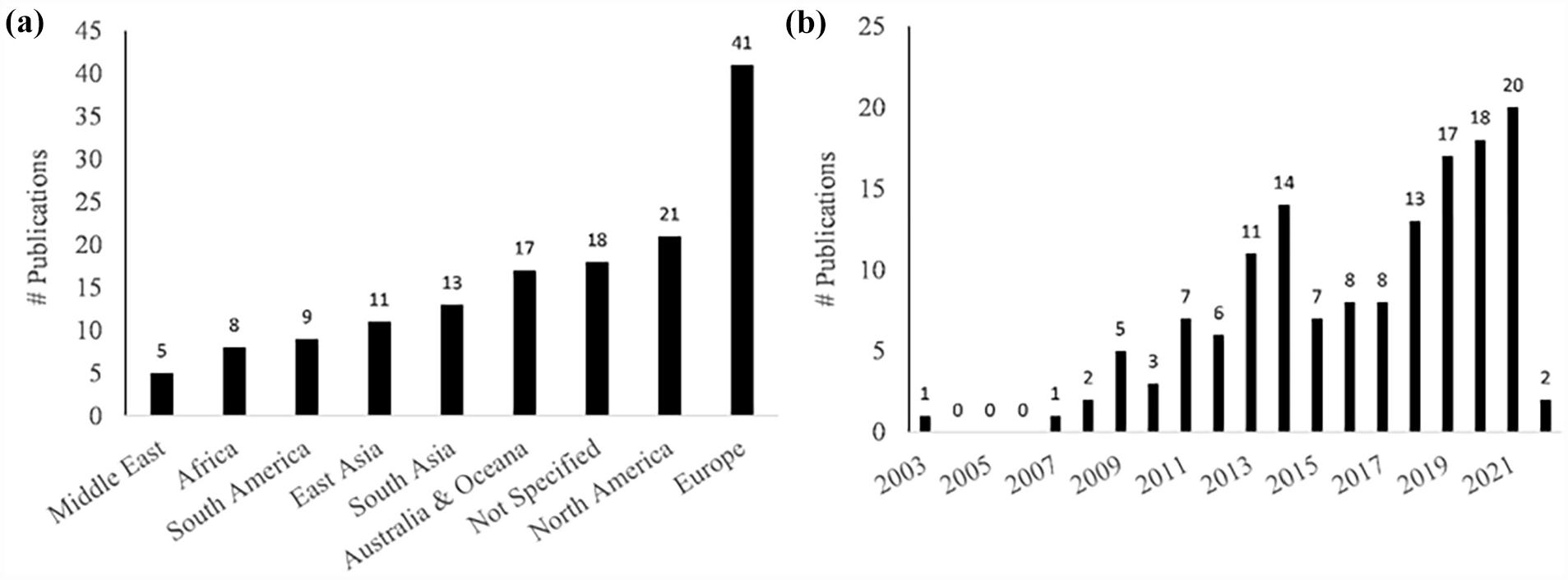
Published literature identified from the systematic search process categorized by: (a) most common regions of publication and (b) the number of publications in each year.
To compare and contrast the techniques and models used to assess vulnerability in various geographical and demographic settings, the reviewed articles were organized based on a search for key words corresponding with the topics indicated by the mind map (Figure 2). The number of citations for each mind map category was extracted from Google Scholar and Crossref, and the total number of social media mentions (public Twitter, Facebook, and blogposts) based on information collected by the publisher (Table 2). The largest number of papers were based on studies focused on water (85) versus terrestrial systems (25); those focused on water primarily represented salt-water (coastal) areas that had a regional focus (Table 2). While not all journals captured information on social media mentions, of the publishers that did a disproportionate number of social media mentions were focused on papers that had a coastal focus in a rural area.

Identified categories of the systematic review coded with NVivo. Each bubble represents a node that was manually coded for corresponding articles based on key word frequency searches. Blue colored bubbles represent articles related to coastal areas.
Citation Bibliometrics of Relevant Studies Based on Google Scholar and Crossref, as Well as the Total Number of Citations Divided by the Total Number of Papers in Each Category.

Note. The number of social media mentions as indicated by the journal for each paper (which includes public mentions in Twitter, Facebook, and blogposts). Papers are categorized as in Figure 2.
When we categorized the 143 articles by the methods used in each study, we found that 66 articles deployed qualitative methods, 41 contained specific mention of measured quantitative data, 19 were semi-quantitative (or a mixed-methods approach), and 17 were reviews (literature or analysis) (Table 3). The most commonly used methodological approaches for articles identified with a coastal focus include descriptive statistics, thematic coding, and Geographic Information Systems (GIS). Articles that focused on non-coastal systems had a similar approach to identify vulnerability, which included basic descriptive statistics, thematic coding, and GIS (Supplemental ROSES Review Protocol Table S3). The majority of articles (86 out of 143) used a mixture of stakeholder interviews and surveys as a method to collect data in order to assess the vulnerability of a defined population or area. We coded articles as using a stakeholder approach if they emphasized terms that included community members, tourists, or tourism operators. While the majority of articles used “stakeholder input” in some format to include in their study, others were “stakeholder-focused,” which outlined direct influence of, or effect on, specific stakeholder groups.
The Methods and Themes Identified Through NVivo Thematic Coding of Relevant Articles Found in the Systematic Process.

Note. “Review” articles analyzed literature without the purpose of creating new primary data. “Qualitative” articles included data that was social in nature (which included scenario generation). Quantitative articles described numerical or otherwise quantifiable data sources, including spatial analysis. Articles classified as “Semi-quantitative” (mixed-method) were self-described as being semi-quantitative or using a qualitative method like surveys, to generate measurable data.
We thematically coded each category identified in the mind map (Figure 2) as a node in the NVivo software and extracted the highest frequency words found. The 10 highest frequency words of all relevant articles identified were beach, coastal, environmental, island, data, sea, social, area, analysis, and variables based on weighted percentage (Figure 3). From this word frequency analysis, it is possible to discern that “beach” was used in 59 out of 85 articles and represents one of the most common locations studied within the reviewed articles at the water related articles node. Additional themes identified based on word frequency were sea-level rise, ocean warming/acidification, sediment erosion, and case studies with an emphasis on community & local adaptation and stakeholder perceptions. Articles that contained frequent uses of “beach” and “coastal” corresponded to the themes of sea-level rise and sediment erosion, most often on their ecological or economic impacts, or vulnerability assessments using coastal case studies.

Word-frequency as identified in NVivo that includes the 50 most frequently found words in all articles from the Boolean search. The largest font size words correspond with the most frequently occurring words in the literature based on weighted percentage. Omitted were connective words, any numerical values including years, and words less than three letters in length.
Articles were published from across the globe, with the majority of them measuring, to some degree, human responses in order to model the effects of climate change. This was often through interviews that focused on tourists and policy makers, or modeling how different socio-economic stakeholders would interact in adaptation efforts. Tourism was often associated as a socio-economic sector, where an individuals’ experience was highlighted based on interviews that generated in-depth individual perspectives and emphasized local knowledge. Despite the varying locations of the results (or perhaps because of), many articles emphasized that adaptation efforts in the context of tourism vulnerability should be community based or locally-municipally directed.
In contrast to articles that focused on coastal systems, those that were aligned to the terrestrial or freshwater environment focused on the themes of disaster risk mitigation, winter ski tourism, governance structure, climate change adaptation, and quantifying climate change vulnerability. Articles also had a high frequency of the word “increase,” which reflected vulnerability in terms of increased risk, increased temperature, increased drought, and increased risk associated with disasters in terrestrial systems. A localized focus on ski tourism in mountain regions was predominant. Local knowledge and perceptions were still a prominent theme, although appearing in the context of economic and social effects of storms and climate damages. Most studies focused on regional a outlook, with emphasis on disasters and risks from climate change and the related economic consequences. This contrasted with articles that were focused on coastal regions, which tended to emphasize the individual or stakeholder experiences to assess climate change and vulnerability.
To further understand the similarities and differences between the methods used to measure vulnerability in coastal and non-coastal areas, articles were organized into thematic nodes based on their topic of research and visualized in a diagram representing the relationships between geographical areas (Figure 4). The three themes that we found present in all three demographic nodes were “water and sea-level rise,”“socio-economic impacts,” and “the use of local, municipal, or regional knowledge.” The primary theme that overlapped between rural and urban specified articles was climate mitigation and adaptation strategies. Studies with an urban focus had stronger emphasis on regulations for new development, whereas articles with a rural focus had an emphasis on encouraging stakeholder engagement and building capacity to mitigate the effects of climate change. The overlapping theme between urban and regional related articles is risk and response. Articles identified with an urban focus had a larger emphasis on responding to risk through adaptation measures, in contrast to the emphasis on risk reduction and disaster management at a regional level. The overlapping theme between regional and rural incorporated the pre-existing management strategies at a regional level into rural policies that could be adapted to rural communities.

Core themes of each node based on demographic specification that emerged from the systemic review using NVivo thematic analysis of articles with a coastal (saltwater) focus. Within the triangle are common themes present in all research articles related to the coastal environment. Boxes represent key ideas and themes prominent in each demographic classification of articles. Arrows and description describe the connecting themes or processes between nodes.
Discussion
Since research on the influence of environmental change on coastal adaptation can be extremely context specific, and encompass a wide array of disciplines, a broad scope was used in the systematic review process. From our results, we note that articles with a coastal focus had similar approaches to those with a terrestrial and/or freshwater focus but differed in their overall context and objective associated with understanding vulnerability. The methods and models in the literature broadly utilized quantitative assessment and/or qualitative approaches for understanding vulnerability in the context of three demographic areas: regional, rural, and urban systems. We reviewed the significance of vulnerability research within the tourism sector by discussing (1) demographic context and location of research, (2) the tourism economy, (3) vulnerability and water, and (4) community-based approaches.
Centralization and Importance of Locally-Based Case-Studies
While we found that the literature reflected research from a diversity of global locations, the majority of studies were conducted in Europe. While this is not surprising given the popularity of Europe a tourist destination, it is likely not an accurate representation of where climate change may affect tourism the most. Small Island Developing States (SIDS), such as those in South Asia and along the African coastlines, were not prominent study areas, but are predicted to be at greater risk from climate change and assessed to have lower adaptive capacity (Scott et al., 2012). The focus on Europe highlights a potential research gap, where rural, remote, and small coastal communities in nations that have emerging tourism markets and high coastal vulnerability have not received adequate attention in the literature. Studies that focused on rural coastal communities only represented 6 out of 143 papers, but were publicly mentioned in social-media more than in other urban and regionally focused studies (Table 2). This underscores the importance of small rural communities while at the same time suggests that research efforts have been directed elsewhere.
Several studies suggest coastal areas need increased adaptation efforts to be resilient against climate change (Scott et al., 2012; Student et al., 2020; Tapsuwan & Rongrongmuang, 2015), and emphasize the importance of using local, regional-based case studies to do so (Scott et al., 2012). Research also suggests context matters, and that local conditions need to be understood before assessing the vulnerability and resilience of a specific tourist destination (Dogru et al., 2019). Local stakeholders were defined in the literature using various terms, which included: community members (Altschuler & Brownlee, 2016; Bennett et al., 2014; Westoby et al., 2020), tourists (Hein et al., 2009; Marshall et al., 2011; Ruan et al., 2020), tourism operators (Becken et al., 2014; Calgaro & Lloyd, 2008; Nalau et al., 2018), “vulnerable populations” (Bitsura-Meszaros et al., 2019; Marín-Monroy et al., 2021), and cities (Nicholls & Kebede, 2012), states, countries, or islands (Goujon & Hoarau, 2020; Huebner, 2012; Siegel et al., 2019; Sovacool, 2012). Regional vulnerabilities that were identified are especially noteworthy, as tourism markets and climate effects vary based on location (Scott et al., 2012). Most of the reviewed literature focused on regional adaptation efforts for assessing vulnerability, with over half of all reviewed and coastal focused articles referencing regional stakeholders and/or locations of study. We defined “regional” to include studies encompassing multiple demographic areas (both rural and urban) in one study or region.
Although we are primarily focused on coastal related articles it is important to note that studies conducted in terrestrial locations mostly dealt with winter-related tourism topics (Scott et al., 2003). Winter-related tourism was predominantly in mountain regions, and related studies note the varying climate of higher latitudes as one reason for the importance of having regional distinction in research. Articles with a stakeholder focus, as found in many of the reviewed coastal articles specifically with a rural focus, describe the perspectives of individuals from a community and their local knowledge as being crucial to adaptation efforts, selecting datasets, and understanding perceptions of risk or vulnerability (Bhattachan et al., 2019; Larsen et al., 2011).
Tourism-dependent municipalities were noted to have adaptation targeted at the regional governance level. Iglesias et al. (2017) described adaptation options as being framed around local environmental and socio-political contexts, therefore efforts reflect this context whether that be in a rural, urban, or a regional setting. Albasri and Sammut (2021) furthered this by noting that adaptive capacities and priorities can change and be unequal at the household level and between different livelihood groups, which makes an even stronger case for community-based knowledge and adaptation, as national or even regional governance would be unable to address these distinctions. Goujon and Hoarau (2020) also describe how social vulnerability of individuals within rural coastal communities and SIDS, can influence a region’s overall socio-economic and environmental vulnerability. Therefore, balancing the predominant attention on populated urban coastlines with more locally-based research and an emphasis on community knowledge would be more beneficial than additional studies of the urban context.
The Tourism Economy
The economic impact of climate change on the tourism sector was a common theme identified in the literature. Regardless of the tourism market in question, be it coastal or inland, urban, or rural, winter or summer based, financial risks are known to be components of climate vulnerability (Dellink et al., 2019). Increased physical and economic vulnerability is often associated with an economy that is heavily reliant on tourism, which highlights economic susceptibility (Dellink et al., 2019). The impact of tourism on an economy varies greatly. For example, in SIDS tourism represents one of the most important sectors both economically and socially (Loehr, 2020). Location can be an indicator of specific climate-related risk; regions with the highest climate related risk are predominately rural locations and inherently locations with limited access to resources and shorter tourist seasons.
One of the risks associated with climate vulnerability is a decrease in the number of optimal weather days (Hao et al., 2020). However, the risk is manifested in very different ways. Hein et al. (2009) noted that the skiing industry projects an 18% loss in visitors due to rising temperatures. While island or coastal locations face more economic vulnerability from flood, storm, or sea-level related damages to infrastructure (Bagdanavičiūtė et al., 2019; Hsu et al., 2017). Pacific islands located within the cyclone belt have the highest disaster risk globally, exposed to damage from high velocity winds, heavy rains and associated tidal surges, which will only increase with climate change (Edmonds & Noy, 2018). When combined with the rural nature of communities of island countries, the potential economic and material damages for these locations can have a lasting a negative impact beyond the context of tourism (Clissold et al., 2020).
Vulnerability and Water
One of the most complex effects of climate change, with direct and indirect effects on a location’s economy, are pressures on water resources. Water is a key indicator of overall vulnerability associated in the tourism sector as it is both an essential resource as well as a recreational, esthetic, and cultural component of many tourism destinations. As many tourism destinations and economies are centered on, or make use of, the available water resources, a higher variability in climate can directly translate to a higher vulnerability of destinations that are reliant on water resources (Dogru et al., 2019; Folgado-Fernández et al., 2018). A majority of the literature reviewed identified water as a primary focus, with sea-level rise, flooding, and storms, to be some of the largest concerns. Of the 143 articles that met our inclusion criteria, 85 focused on water and 25 focused on land-based systems (Table 2). Even in research conducted on land-based systems, several were concerned with the effects of precipitation, flooding on agriculture, water scarcity, and the vulnerability of wetlands (Aggarwal et al., 2022; Al-Zubari et al., 2018; Deléglise et al., 2019; Sugiarto et al., 2017). Winter tourism that is land-based also has a connection to water, in terms of how a lack of snow, and increased snow-making, affect the activities and related businesses (Scott et al., 2006, 2008).
Community-Based Methods
Community-based methods are often emphasized in the literature as they allow the local context of vulnerability to be understood. The use of surveys, interviews, and scenario generation/analysis were the most prevalent methods described within the empirical articles (Table 3). Studies that included data generated from community stakeholders (Altschuler & Brownlee, 2016; Bennett et al., 2014; Clissold et al., 2020) show that it is crucial to the implementation of adaptation efforts. Particularly important are efforts to understand public perception(s), as these are critical components of a region’s socio-political context, within which policy makers are responsible for adaptation operations (Fatorić & Morén-Alegret, 2013). While the majority of articles used “stakeholder input” in some format to include in their study, others were “stakeholder-focused,” which outlined direct influence of, or effect on, specific stakeholder groups. For example, Shakeela and Becken (2015) were able to assess how the effects of climate change are perceived and mitigated by individual stakeholder groups using the social amplification of risk framework in the low-lying areas of the Maldives. Adler et al. (2013) utilized a “stakeholder consultation process” to identify and compare the perception of glacial retreat risk pertaining to relevant local land-owners and the tourism industry in the isolated mountain region of western Nepal.
Community-based methods can also inform how a place might respond to potential adaptation initiatives. Bhattachan et al. (2019) notes that the context of vulnerability is often larger than that of adaptation, and that disaster management can be improved by using bottom-up, resident-centric approaches within the context of research and implementation processes. Bottom-up approaches are based on the idea that adaptation funneled down through national governments, and methods based on nationally generated data, is not likely to reach the most vulnerable people, nor be representative of them (Sabates-Wheeler et al., 2009). While the effects of climate change may often be directly quantifiable, such as sea-level rise or economic loss due to a shorter tourism season, socio-economic factors that influence perception of risk are less readily quantified. As such, most of the studies reviewed perceived vulnerability to climate change and adaptation efforts as described by respondents in interviews and surveys. For example, Marshall et al. (2011) used a non-parametric test of target groups via questionnaire, where specific questions were directed to recreational diving businesses about their opinions on climate change and how they believe it will affect them. We found that studies contained several similar surveys and questionnaires that were frequently used, regardless of which stakeholders the research was concerned with (e.g., Marshall et al., 2011; Ruan et al., 2020; Welling & Abegg, 2021). Tourists were typically the stakeholder that informed the perception of climate change described in each study; however, we found that few studies contained the local context (resident perspective) of their community’s vulnerability to climate change.
Qualitative surveys from respondents is considered the most direct way to develop a community-based, people-centric approach to climate vulnerability research, and considers socio-political factors within the assessment of adaptive capacity (Dogru et al., 2019). However, inter-disciplinary approaches that combine both quantitative and qualitative models might further support a community-based understanding, given there is no universally applicable approach to understanding vulnerability. Connected to the importance of community-based methods, it worth noting that perspectives from Indigenous peoples are largely absent from the reviewed literature. Of the 143 reviewed articles reviewed in this study, only five contained specific mention or discussion of Indigenous concerns or knowledge. Nalau et al. (2018) note that a lack of traditional knowledge in climate adaptation planning and practice is a barrier to adaptive capacity. Kieslinger et al. (2019) note that Indigenous Knowledge is particularly valuable to climate change adaptation and response planning. Indigenous peoples have had centuries of in-depth, empirical understanding and observation of coastal ecosystems, and a sustainable and reciprocal relationship with the environment (Abreu et al., 2017). However, the scientific community rarely includes Indigenous perspectives, with only recent recognition as a crucial information source for building adaptive capacity (Granderson, 2017). Given the historical relationship between western academia and Indigenous communities (Mullen, 2020), being able to build a relationship of trust in order to carry out inclusive research is a daunting task, but it is necessary to aid in the understanding of local contexts and in applying community-based coastal management.
Conclusion
We systematically reviewed literature using the climate change concepts of vulnerability, adaptation, and resilience in relation to tourism. The largest number of papers published on climate change vulnerability in the tourism sector were those that described coastal environments. The majority had a regional focus and were often about European contexts. We found that rural coastal communities were underrepresented in the literature, especially in countries with developing tourism markets. In contrast rural coastal communities were mentioned to a higher degree in social media than other urban or regional studies. We also identified the extent research contained gaps or limitations based on the approaches used. Tourism operators were an underrepresented group of stakeholders, especially in research that focused on risk perception and adaptation response. Much of the literature has assessed adaptation and vulnerability through qualitative, semi-quantitative, and quantitative methods in both coastal and non-coastal environments. Scenario building and simulations were used in all types of methods, as was modeling. Studies focused on socio-economic impacts commonly deploy qualitative methods to measure perceptions of climate change.
We found that a larger proportion of tourism-focused research was performed in developed and wealthy regions. Yet, there is a general recognition that small coastal or island communities, and developing countries, are deemed to have lower adaptive capacity and can be highly vulnerable to climate change. Much of the research that informs this review comes from larger case studies in well-documented areas such as Spain, Maldives, or even from non-coastal locations with well-developed tourism economies. The overlapping themes of water and sea-level rise, as well as local knowledge (regional and municipal) further suggest that smaller coastal areas are important. Adaptation is also shown to be more effective at the local level, especially when it takes into account the knowledge and perceptions of local stakeholders. This is particularly true of tourism, as the product is essentially an experience based on the authentic presentation of natural and sociocultural resources available at the location. Therefore, this paper emphasizes the importance of using locally-informed case studies in order to understand, as best as possible, the vulnerability to climate change and adaptive capacity that characterize small tourism-based coastal communities.
Supplemental Material
sj-pptx-2-sgo-10.1177_21582440231179215 – Supplemental material for Coastal Adaptation and Vulnerability Assessment in a Warming Future: A Systematic Review of the Tourism Sector
Supplemental material, sj-pptx-2-sgo-10.1177_21582440231179215 for Coastal Adaptation and Vulnerability Assessment in a Warming Future: A Systematic Review of the Tourism Sector by Alexandria Soontiens-Olsen, Laurel Genge, Andrew Scott Medeiros, Georgia Klein, Shannon Lin and Lorn Sheehan in SAGE Open
Supplemental Material
sj-xlsx-1-sgo-10.1177_21582440231179215 – Supplemental material for Coastal Adaptation and Vulnerability Assessment in a Warming Future: A Systematic Review of the Tourism Sector
Supplemental material, sj-xlsx-1-sgo-10.1177_21582440231179215 for Coastal Adaptation and Vulnerability Assessment in a Warming Future: A Systematic Review of the Tourism Sector by Alexandria Soontiens-Olsen, Laurel Genge, Andrew Scott Medeiros, Georgia Klein, Shannon Lin and Lorn Sheehan in SAGE Open
Footnotes
Acknowledgements
We would like to thank Victoria Watson and Kristin Levy for assistance throughout this research, and Coastal Action for providing context and support. We would like to extend gratitude to editors and reviewers of this manuscript for consideration for publication.
Declaration of Conflicting Interests
The author(s) declared no potential conflicts of interest with respect to the research, authorship, and/or publication of this article.
Funding
The author(s) disclosed receipt of the following financial support for the research, authorship, and/or publication of this article: Funding was provided by the Social-Sciences and Humanities Research Council (SSHRC) of Canada as well as Dalhousie University.

Supplemental Material
Supplemental material for this article is available online.
References
Supplementary Material
Please find the following supplemental material available below.
For Open Access articles published under a Creative Commons License, all supplemental material carries the same license as the article it is associated with.
For non-Open Access articles published, all supplemental material carries a non-exclusive license, and permission requests for re-use of supplemental material or any part of supplemental material shall be sent directly to the copyright owner as specified in the copyright notice associated with the article.
