




Abstract
Older adults show a progressive cognitive decline, and although language processing appears to resist advancing age, studies in word retrieval report that elders show important difficulties. Previous research reports that such failures increase from age 70 years, which suggests that during the fourth age word retrieval would exhibit even stronger constraints. At the same time, extant evidence suggests that only retrieval of a specific word might decline in advanced aging, and not the recovery of multiple pieces associated with a given semantic category. However, those studies did not explicitly assess these phenomena in a group of older adults in their fourth age, and thus cannot be considered conclusive with regards to this particular group. In the present study, we examined word retrieval in three distinctive advanced age groups (60–69, 70–79, and 80+ years) in two production tasks: a picture naming task, and a lexical availability task. We compared the fourth-age group against the other two third-age group in their reaction time (RT) and accuracy as well as, on the lexical availability index (LAI) and total words retrieved in a lexical availability task. Fourth-age group exhibited longer RT in the picture naming task, yet a high level of accuracy. They also showed a reduced number of retrieved words, as well as, a reduced LAI, relative to the control groups. We discuss our results in the context of the decline of fluid intelligence, and the information transmission deficits hypothesis.
Introduction
Aging is characterized by functional and structural changes (Baltes & Smith, 2003; Fletcher et al., 2018) that affect several cognitive processes (Duncan et al., 2017; Margrett et al., 2016; Mitchell et al., 2013). Thus, the changes during old age shape different evolutionary stages, such that today there seem to be two very marked groups: third age (60–79 years old) and fourth age (>80 years; Baltes & Smith, 2003; Höpflinger, 2017). In this last phase, cognitive decline is accentuated, compromising the cognitive performance of elderly people (Margrett et al., 2016; Mitchell et al., 2013).
Although language processing appears to resist advancing age, there is evidence that attrition may appear around age 60 years, and it is dominated by a deterioration in production versus relative maintenance of comprehension (Abrams & Farrell, 2011; James & Goring, 2018; Pelle, 2019). At the lexical-semantic level, older people show an early and progressive word retrieval deficit (Abrams & Davis, 2016; Farrell & Abrams, 2011; Gordon et al., 2018; Paesen & Leijten, 2019; Vogel-Eyny et al., 2016), accompanied by a moderate deficit in word recognition that is accentuated only after age 80 (Ratcliff et al., 2004; Rojas et al., 2022).
Studies in word naming report that older people show significant difficulties in accessing proper names, labeling a delivered definition, naming visually presented objects, and consecutively naming words within a given semantic category (Ferré et al., 2020; Gertel et al., 2020; Goral et al., 2007; Macoir et al., 2018; Vogel-Eyny et al., 2016). These failures appear most frequently from age 50 years and they increase in the middle stages of old age (70 years about; Goral et al., 2007; Huijbers et al., 2017; Verhaegen & Poncelet, 2013). Consequently, word retrieval deficits are a main and progressive linguistic difficulty in old age (Davis, 2020; James & Goring, 2018; Schmank & James, 2020).
Difficulties on word retrieval in old age is explained—mainly—by the systematic weakening of connections between lexical and phonological nodes, responsible for cortical activation not being robust enough to achieve information transfer, according to the transmission deficit hypothesis (TDH; MacKay & Burke, 1990). Thus, the progressive nature of this lower activation, coupled with the multiple levels of processing involved in retrieving a specific word (i.e., lexical, semantic, and phonological; Abrams & Farrell, 2011), allow us to assume that in very advanced stages of aging word naming tasks would evidence strong access constraints, reflected in a significant increase in response times (RT), higher number of phonological blocks, and a reduction of the available lexicon. However, our knowledge on word retrieval in people over 80 years old is still scarce; we do not know how severe this deficit could be and what kind of tasks would generate greater difficulties.
Assessing Word Production in Older Adults
Several studies using tasks that assess the retrieval of specific lexical items (i.e., picture naming) have shown a systematic increase in response times after age 60 years and beyond compared to younger adults (Ferré et al., 2020; Gertel et al., 2020; Macoir et al., 2018; Paesen & Leijten, 2019). This effect may be predictable, a product of the decline in fluid intelligence and operating skills described in the older people population (Cooley, 2020; Mitchell et al., 2013). However, this slowing is usually compensated by a good level of accuracy (Hoyau et al., 2017; Riffo et al., 2020; Rojas et al., 2022). Such RT-accuracy dissociation suggests that in the early stages of aging there is compensatory mechanisms that allow a correct recovery and act independently of the decline of fluid intelligence (Ferré et al., 2020), and the increase of cognitive reserve (Cooley, 2020; Wulff et al., 2016, 2019). It remains unclear, however, whether this RT-accuracy dissociation remains stable across the different stages of old age, and whether word retrieval accuracy retains its good performance after the age of 80 years.
In turn, studies using tasks that assess the retrieval of multiple words associated with a given semantic category or domain (lexical availability task) show that after age 60 years the available lexicon decreases, not because of a lack of vocabulary, but due to difficulties in retrieving the lemmas associated with the semantic category evaluated (Goral et al., 2007; Vogel-Eyny et al., 2016). The reduction of the available lexicon and the stabilization of a varied vocabulary (Horton et al., 2010) described in early old age appear, at first glance, contradictory. However, poor performance in lexical availability tasks is largely due to the slower speed of lexical retrieval, as well as on the reduction of compensatory strategies (i.e., fluid intelligence and information operation skills) that support lexicalization and phonological encoding processes. These abilities decline rapidly from the intermediate phase of aging onwards (Gordon et al., 2018) and we predict that they should decline further in individuals over 80 years old, as a consequence of generalized cognitive decline (Baltes & Smith, 2003; Margrett et al., 2016; Mitchell et al., 2013).
Goral et al. (2007) examined the effects of aging on word production in a longitudinal study of 238 participants, ranging in age 30 to 94 years (mean age 61.7, without differentiating between third and fourth age) using both, picture naming and multiple retrieval task. The authors predicted that if lemma selection happens before lexeme activation (serial model; Schriefers et al., 1990) retrieval deficits would be reflected in both tasks, as words would require to be selected and subsequently encoded, one at a time, causing constant blocking. By contrast, if lemma selection is simultaneous with lexeme activation (cascade model; Peterson & Savoy, 1998), poor performance should be observed in the picture naming retrieval task (Verhaegen & Poncelet, 2013), but not in the multiple retrieval task. As a result, the picture naming task exhibited a marked reduction in lexical retrieval from intermediate stages of old age. The multiple retrieval methods, on the other hand, exhibited a gradual decline throughout aging, with no evidence of a marked acceleration in the late stage. The authors conclude that the deficit in lexical retrieval of specific words could be explained by the TDH (MacKay & Burke, 1990). Performance in the multiple retrieval task could be explained by the cascade model (Peterson & Savoy, 1998) since the simultaneous activation between lemma and lexeme would allow access to all available and pre-activated concepts for a given semantic category (Goral et al., 2007).
The Present Study
According to the systematic weakening of connections between lexical and phonological nodes, which would be responsible for cortical activation not being robust enough to achieve information transfer (TDH; MacKay & Burke, 1990) and the decline of fluid intelligence in the advanced aging (Margrett et al., 2016; Rojas et al., 2022), the differences between a picture naming and a lexical availability task in older adults after 80 years old should be minimal. However, evidence of Goral et al. (2007) showed a significant reduction in specific lexical retrieval and a gradual decline throughout aging using multiple retrieval methods. But Goral et al. (2007) did not separate the sample into groups of third and fourth age or reported the sample size of participants beyond 80 years of age (i.e., fourth age). Thus, the relatively good performance in the multiple retrieval task in an underspecified sample of older adults could have obscured potential differences in performance in the advanced age stage, relative to younger participants. Therefore, it is relevant to assess how word retrieval progresses throughout aging (particularly in advanced stages) using both methods, to determine the effect of TDH during advanced aging, and whether the cascade model continues to favor lexical retrieval in the lexical availability task.
In addition, there are lexical variables that allow easier retrieval of certain words over others (i.e., high-frequency words, lower syllable length, high imagery, among others), whose effects have been extensively reported in young people and early and middle stages of old age, but not among the oldest old people. For example, picture naming tasks show that high lexical frequency words are retrieved in lower RT and obtain higher accuracy (Paesen & Leijten, 2019; Brysbaert et al., 2014). A similar case occurs with words of shorter syllable length. Cuetos et al. (2015) propose that these are processed faster, since their phonological coding corresponds to the linear relationship between their length and the time needed to process them (Haberlandt & Graesser, 1985), and they are also more common, which facilitates their retrieval (Abrams & Davis, 2016; Abrams & Farrell, 2011; Farrell & Abrams, 2011). On the other hand, data on lexical availability show that semantic categories more familiar to the individual (i.e., animals, clothes) increase the lexical availability index (LAI) and total words retrieval since they represent words of higher frequency, typicality, and early acquisition (Hernández & Izura, 2010). In this context, it is also interesting to explore whether the effects of these factors (lexical frequency, syllabic length, and semantic category type) remain stable later 80 years of age, a stage in which cognitive decline marks the evolution of this group.
In this study, we evaluated the effect of advanced aging on two tasks: A picture naming task (from which we obtain RTs and accuracy) and a lexical availability test (from this we counted the LAI and the total retrieved words). Also, we explore whether advanced aging maintains a stable effect on lexical frequency, syllable length, and semantic category type. We predict that the progressive nature of the transmission deficit between lexical and phonological nodes (TDH) and the decline of fluid intelligence will further affect words retrieval after the age of 80, which will negatively impact RT (picture naming task), the LAI, and total words retrieval (lexical availability task). On the contrary, the maintenance of semantic skills will allow an adequate conceptual performance. Thus, we expect no differences in accuracy (picture naming) between early, intermediate and advanced stages of aging.
Methods
Participants
A sample of 90 older adults participated voluntarily in this study. It was divided into three groups of 30 individuals according to the age of the participants. Group 1: 60 to 69 years (average age = 65.7 years, SD = 2.99; average years of education = 13, SD = 1.23); group 2: 70 to 79 years (average age = 74.0 years, SD = 2.89; average years of education = 13.1, SD = 1.81); and group 3: 80 to 92 (average age = 82.5 years, SD = 3.10; average years of education = 13.03, SD = 1.71). Groups 1 and 2 represented the third age and group 3, the fourth age.
All older adults belonged to three local senior clubs associated with the university. The following inclusion criteria were established: 60 years of age or more, have completed at least 8 years of schooling, self-report as actively aging (mental, physical and social), have normal (or corrected) hearing and vision, have urban residence, and complete the experiments in a maximum period of 2 months. We also established the following exclusion criteria: have a history of cerebrovascular disease, have a diagnosis of neurodegenerative disease, have depression or a psychiatric illness, and finally, presenting risk scores on any of the following tests applied: Montreal Cognitive Assessment (MoCA score of <21 points), Yesavage Yesavage score of >11 points), or Boston Reading Comprehension subtest score of <4 points. Approximately 140 older individuals were invited to participate. We established a sample size that could reach at least 2,000 data per experiment. Of those interested in participating, older adults who did not meet the inclusion and/or exclusion criteria were excluded.
To participate in this study, all the older individuals read and signed an informed consent, approved by the Ethics Committee of the sponsoring University. The objectives and details of the study were presented to the authorities of each club. Then, older adults interested in participating were assessed for cognitive (MoCA), emotional (Yesavage), and basic reading comprehension (Boston) performance. Finally, the selected older individuals were invited to the University’s Specialty Laboratory to perform the picture naming and lexical access task.
Materials and Design
Picture Naming Task
This task was implemented as a 2 × 3 design, including images that combined the lexical frequency of use (lexical frequency) of the target word (high/low) and its syllabic length (bi/tri/tetrasyllabic). Lexical frequency was checked through Spanish Lexical Database ( www.bcbl.eu/databases/espal/ ) and all selected words had an early acquisition. Images were extracted from Shutterstock virtual library ( https://www.shutterstock.com ). Only real digital images were included, which were edited at a size of 20 × 20 cm. To corroborate that the images faithfully represented the target words, a normative study was conducted with 20 older people (other than those selected for the experiments). In this normative, the older adults only had to write the name that best represented the observed image. All images with an average of more than 70% agreement with the expected response were chosen for the final selection. The experiment contained of 150 stimuli (Supplemental Appendix A). Specifically, 60 images representing high-frequency words and 60 images representing low lexical-frequency words were presented, subdivided into 20 bisyllables, 20 trisyllables, and 20 tetrasyllables, respectively. Finally, 30 filler trials and 3 training trials were included.
Lexical Availability Task
We selected seven semantic categories derived from the Panhispanic available lexicon project (López & Stramburger, 1991), which, according to Urzúa (2018), are weakened as people ages. These categories were clothes, furniture, objects placed on the table at mealtimes, kitchen and its tools, the school, means of transportation, and animals.
Procedure
The tasks were performed in an individual room, with adequate lighting and soundproofing. In the picture naming task, participants had to name each of the images as quickly as possible and without making mistakes. Stimuli were randomly presented on a 15.6″ computer screen using E-Prime 3.0 program. Each trial started with an asterisk in the middle of the screen for 1000 ms, followed by the visual stimuli. Three practice trials were given, before the actual materials were presented. The oral response of the participants and the time at which it occurred was registered, but if they did not respond after 10 seconds or more, the experimenter started the next trial. The task consisted of three blocks, separated by a short pause. The entire experiment lasted approximately 30 minutes.
For the lexical availability task, the older adults were instructed to name all the concepts that were associated with the proposed semantic category. The task was administered in one block. We started with the instructions and the training semantic category (colors), then each semantic category was randomly presented. Each stimulus presented a structure starting with a warning asterisk in the middle of the display for 2000 ms, immediately this instruction: “Name all the words you know related to…”, was displayed for 4000 ms. The semantic category was then displayed for 2 minutes, while the spoken responses were recorded. An alarm indicated that the time had expired, accompanied by a 1000 ms “response recorded” feedback. Subsequently, the next trial began. We recorded all the answers given. The whole task took 16 to 18 minutes, approximately.
Data Analysis
Picture Naming Task Data
For the picture naming task, the total of correct/incorrect stimuli was counted according to participants’ audio recordings. Although if the response to the trial was a product of involuntary activation of the vocal key, this was considered invalid (5.23% of the task). Regarding the RT of each stimulus, the criterion of Ratcliff et al. (2004) was used, which consisted of excluding responses outside the interval between 200 and 6,000 ms. To perform the inferential analysis, the TR data were log-transformed to approximate a normal distribution. Mixed-effects regression models (RT data) and generalized regression models (accuracy data) were used for statistical analysis using R software (R Core Team, 2020). Both regressions evaluate the effects of three variables on the RT and accuracy: age group (60–69/70–79/80 and older), lexical frequency (high/low), and syllable length (bi/tri/tetrasyllabic). The regressions incorporated interactions between fixed effects, random intercepts by participants and by items, and random slopes justified by the design. Considering that this study focuses on people aged 80 years and older, we used this group as the reference category (the intercept). Thus, we assessed the effect of each predictor in this group (i.e., lexical frequency and syllable length) and compared it directly with the third age groups.
Lexical Availability Task Data
For the lexical availability task, we unified and homogenized participants’ responses using the following criteria: (1) repeated words in the same semantic category were eliminated at the participant levels; (2) plural noun or adjective words were edited to their singular form, and (3) any mispronounced words due to sociocultural variants were corrected to their correct form. Data were processed using the Dispogen 1.6 software (Echeverría et al., 2005), allowing us to calculate the LAI for each word and the number of words produced per participant. The LAI corresponds to the value given to an evoked lexia, which ranges from 0 (no availability) to 1 (high availability) after weighting its absolute frequency by the order of occurrence (Urzúa, 2018). We selected only those words that were present in all age groups (excluding non-repeated words), so that the word pairings homogenized the comparison between groups and semantic category.
Inferential analysis of the LAI data was carried out using a linear mixed effects “beta” regression model (see Brooks et al., 2017) suitable for proportion with boundaries 0 > and <1 (Ospina & Ferrari, 2012). The data of total words retrieved were fitted using a Poisson regression model, since they correspond to count data. The beta regression had age group and semantic category as predictors, establishing the levels fourth age, and the semantic category “kitchen and its utensils” as the intercept. The latter, since we obtained the lowest LAI frequency in that semantic category. This allowed us to contrast that semantic category with the others, and the participants in the 80+ years of age group the other two groups of 60 to 69 and 70 to 79 years. In addition, these models also included random intercepts by participant and item. The regression for the total number of words retrieved incorporated the variables age group and semantic category as predictors, establishing the overall average of the advanced aging group (80+ years) and the semantic category “animals” as the intercept, given the higher frequency of words in this semantic category.
Results
In the picture naming task, the mixed linear regression model (see Table 1) exhibited a main effect of the age factor on RT. In particular, people in the fourth age group obtained significantly higher RT than did group 1 (60–69 years; β = −.270, SE = 0.051, t = −5.271, p < .00) and group 2 (70–79 years; β = −.122, SE = 0.050, t = −2.429, p = .016). Also, the fourth age group showed main effects on syllable length, which demonstrate facilitation for short-length words compared to long-length words (syllable length: β = .072, SE = 0.024, t = 3.050, p = .003), result of the high phonological encoding cost generated by long words. As for lexical frequency, no significant effects were observed for the third and fourth ages, probably because during the process of lexical retrieval the differences in RT among high and low-frequency words were not so accentuated (see Figure 1).
Linear Mixed Model RT Results for Picture Naming Task.

p < .05. **p < .01. ***p < .001.
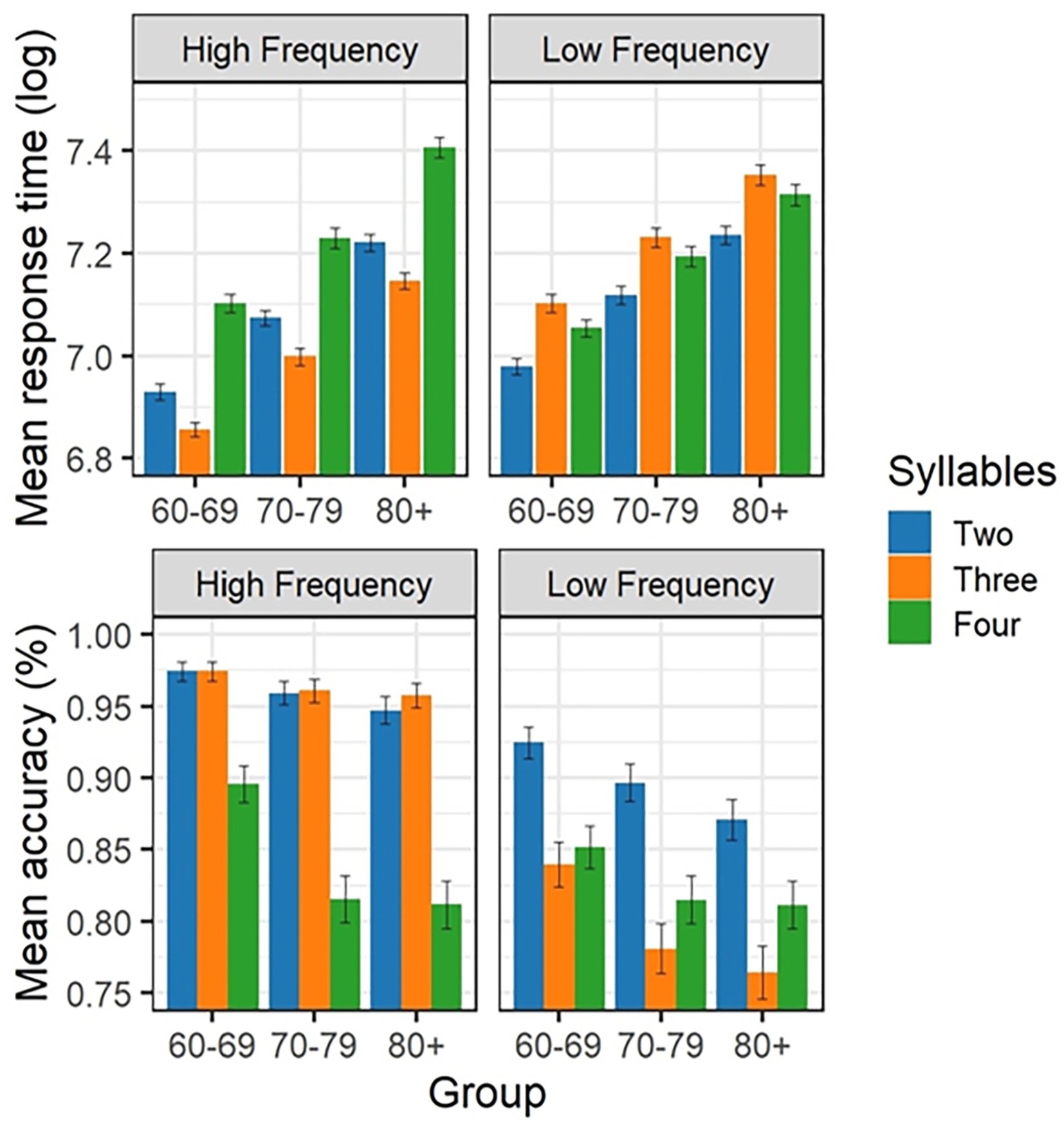
Mean log-transformed response time and accuracy (upper panel/lower panel) as a function of Age Group (80+, vs. 60–69 and 70–79), Lexical Frequency (High vs. Low), and Syllable Length (bisyllabic vs. threesyllabic vs. tetrasyllabic). The error bars represent within-subject adjusted standard error of the mean.
In addition, the generalized linear regression model (see Table 2) exhibited that the level of accuracy of the responses remains stable during aging, specifically, no significant differences are observed between the accuracy rates for initial (third-age) and advanced (fourth-age) aging groups. However, in the fourth-age group we visualize a main effect of lexical frequency (β = 1.515, SE = 0.598, z = 2.534, p = .011) and syllable length (β = −.684, SE = 0.191, z = −3.584, p < .00), which confirms that the error rate grows significantly when processing low-frequency and long-length words (see Figure 1).
Generalized Linear Mixed Model Accuracy Results for Picture Naming Task.

p < .05. **p < .01. ***p < .001.
As for the results in the lexical availability task, linear mixed-effects (Table 3) exhibit a main effect of aging on LAI. Specifically, fourth-age adults present a significantly lower LAI compared to both third-age groups (group 60–69: β = .283, SE = 0.032, z = 8.754, p < .000; group 70–79: β = .103, SE = 0.033, z = 3.135, p = .002). Also, the advanced aging group exhibits main effects for the semantic categories: animals (β = .836, SE = 0.151, z = 5.527, p < .000), clothes (β = .757, SE = 0.170, z = 4.452, p < .000), furniture (β = 1.090, SE = 0.127, z = 8.577, p < .000), and objects placed on the table at mealtimes (β = 1.066, SE = 0.078, z = 13.739, p < .000); which showed a significantly higher LAI compared to the semantic category kitchen and its utensils (comparison intercept), which exhibited lower lexical availability in advanced aging (see Figure 2).
Beta Regression Mixed-Effects Regression on LAI Results for Lexical Availability Task.
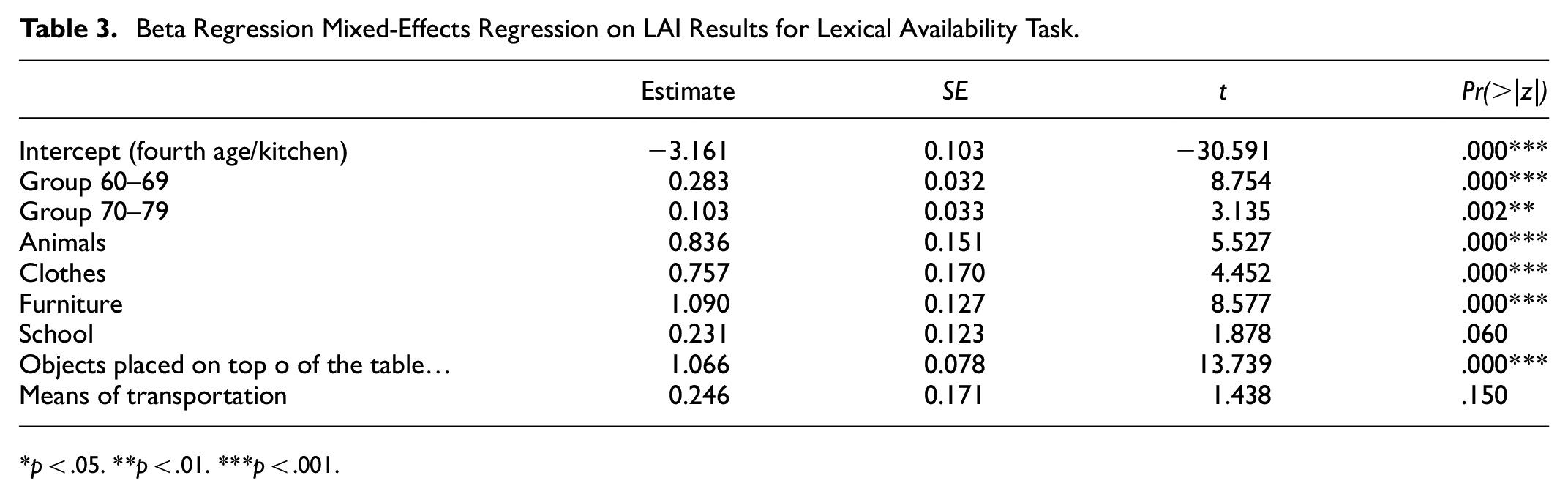
p < .05. **p < .01. ***p < .001.
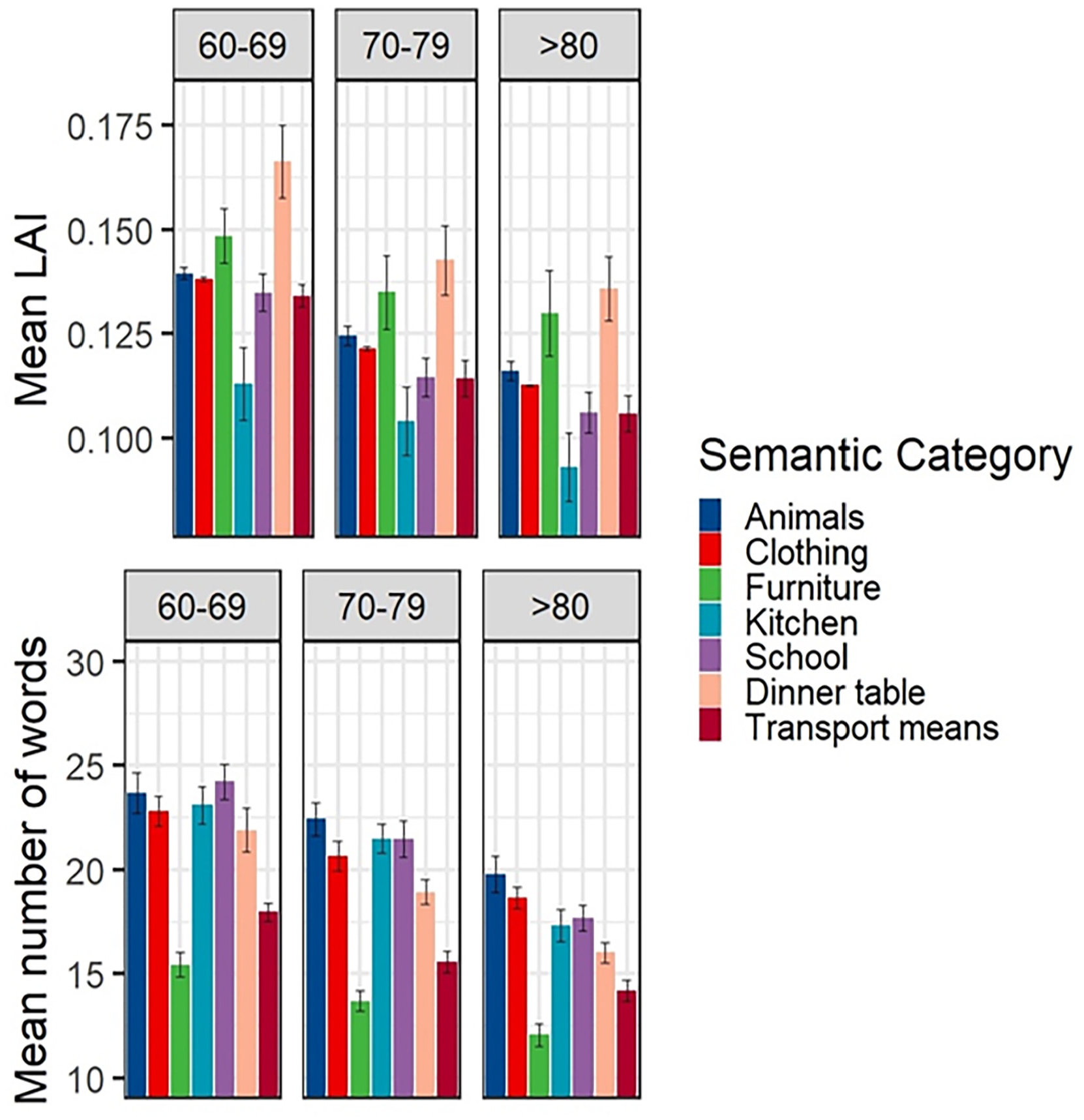
Mean LAI and the total number of words (upper panel/lower panel) as a function of Age Group (80+, vs. 60–69 and 70–79) and Semantic Category. The error bars represent within-subject adjusted standard error of the mean.
Furthermore, the generalized linear mixed-effects regression (see Table 4) exhibited a main effect between aging and the total number of words retrieved, specifically, the elders of fourth age retrieved significantly fewer words compared to the older group 60 to 69 years old (β = .183, SE = 0.071, z = 2.586, p = .010). However, the same did not happen with the 70 to 79 years age group, with which no significant differences were observed (see Figure 2). Also, the advanced aging group shows main effects for the semantic categories kitchen and its utensils (β = −.131, SE = 0.060, z = −2.189, p = .029), objects placed on the table at mealtimes (β = −.209, SE = 0.061, z = −3.416, p = .001), furniture (β = −.494, SE = .067, z = −7.409, p < .000), and means of transportation (β = −.331, SE = 0.063, z = −5.214, p < .000); which reflects that significantly fewer words are retrieved in these semantic categories compared to the semantic category animals (comparison intercept), which, in turn, facilitate word retrieval during the fourth age.
Generalized Linear Mixed Model Total Words Results for Lexical Availability Task

p < .05. **p < .01. ***p < .001.
Discussion
The purpose of this research was to verify how word retrieval is affected in individuals aged 80 years and over in a picture naming and lexical availability associated with a given semantic category tasks. A significant increase in the RT was observed to retrieve specific words and a marked reduction in LAI when multiple words were retrieved in the advanced aging group (fourth-age group) compared to both third-age groups separately. In addition, the advanced aging group retrieved fewer words than the third age groups, although the difference was significant only with the initial aging group (60–69 years). On the other side, there was no difference in accuracy in retrieving specific words between the initial and advanced aging groups.
The results obtained in this study might be associated with the known accentuated deficit in fluid intelligence in the fourth age, which causes a generalized slowing of cognitive tasks (Margrett et al., 2016), including in lexical access, and particularly in word retrieval. Such slow-down, though, is compensated by an adequate precision of the process, thanks to crystallized intelligence. Although no specific fluid intelligence and crystallized intelligence tests were taken in the study sample, the asymmetric decline of these two types of intelligence is well established in this population (Ferré et al., 2020, see also Ratcliff et al., 2004). In general, a “normal asymmetry” is described when crystallized intelligence tends to compensate for fluid intelligence deficits.
Specifically, the age effect in the strong increase in RT in this class of tasks would be justified because fourth-age individuals ostensibly decrease their information processing speed (Baltes & Smith, 2003; Mitchell et al., 2013), continue to reduce their fluid intelligence skills (Margrett et al., 2016; Rojas et al., 2022) and mainly because they exhibit a significant weakening of neural connections between lexical and phonological nodes, which would be largely responsible for cortical activation not being robust enough to achieve information transfer (MacKay & Burke, 1990). Thus, the systematic nature of these deficits during old age could explain why people aged 80 years and older are slower in selecting specific words from the mental lexicon and encoding them phonologically, compared to early and intermediate aging individuals.
Our data suggest that under healthy cognitive conditions, people aged 80 years and older can present a good conceptual performance retrieving words with a high level of precision (Wulff et al., 2016). We assume that this adequate performance is related to the maintenance of semantic skills along aging (Cooley, 2020; Riffo et al., 2020; Wulff et al., 2016, 2019), skills that would function independently of the speed at which the lexicon is accessed. Thus, the results obtained confirm that, independently of the cognitive variations inherent in advanced aging, responsible for the marked difference between the decline of specific abilities and the maintenance of others (Tucker et al., 2019), the vocabulary and lexical knowledge (crystallized intelligence, Cooley, 2020; Wulff et al., 2016, 2019) remain stable. This validates the idea that the difficulties of retrieval of specific words would lie in the selection and/or phonological encoding of lexical items (Verhaegen & Poncelet, 2013) and not in the knowledge of them, which allows us to ensure that the RT-accuracy dissociation (Ferré et al., 2020) remains stable until very advanced stages of the aging process.
On the other hand, the results from the lexical availability task show that people aged 80 years and older, not only present significant difficulties when they must retrieve a specific word, but also when they must retrieve multiple words associated with a given semantic category, which is consistent with the progressive decline in lexical access and word retrieval that have been described in early and middle stages of old age (Abrams & Davis, 2016; Gertel et al., 2020; Ouyang et al., 2020; Vogel-Eyny et al., 2016). Our findings indicate that the lexical access deficits that increase during fourth age affect word retrieval indistinctly, independent of the method applied for its evaluation. We infer that the generalized decline in cognitive processing during advanced aging, the progressive slowing and the accentuated deficit in fluid intelligence (Baltes & Smith, 2003; Mitchell et al., 2013) could justify, in part, the strong difficulty in retrieving multiple words associated with a given semantic category in people of the fourth age.
Goral et al.’s (2007) research showed that word retrieval deficits during advanced aging increase mainly when specific lexical items are retrieved and not when multiple words are retrieved. In contrast, our evidence shows that these difficulties are independent of the task applied. Everything seems to indicate that deficits in fluid intelligence, information processing speed and especially the TDH (MacKay & Burke, 1990), increase strongly after the age of 80, which further impairs lexical selection and phonological encoding skills. This also allows us to assume that regardless of the semantic activation model that explains the word retrieval deficit in old age (serial of Schriefers et al., 1990; or cascade of Peterson & Savoy, 1998), during the fourth age there would be a generalized restriction to access a certain word or to access all the concepts that the person knows for the semantic category evaluated, which directly impacts on the increase of the RT and the decrease of the lexical available indexes. Nevertheless, words retrieval deficits in advanced aging were accompanied by an excellent accuracy of the process, which allows us to suggest that after the age of 80 years certain compensatory or adaptive mechanisms continue to operate that allow correct retrieval and act independently of cognitive decline (Ferré et al., 2020), such as the maintenance of semantic abilities and the increase of cognitive reserve (Cooley, 2020; Wulff et al., 2016).
Conclusion
The present research contributes to a better understanding of lexical access behavior and specifically word retrieval during the more advanced stage of aging. The applied tasks exhibited that people aged 80 years and over exhibit a marked deterioration in the ability to retrieve a specific word or multiple words associated with a given semantic category. Specifically, the RT increases significantly when specific lexical items are retrieved, and in addition the LAI and total words retrieved are also reduced when multiple words are retrieved. Although, in parallel, a high level of response accuracy was observed in the specific retrieval task, similar to what was observed in both elders’ groups. Our findings are consistent with the data supporting that during aging the deterioration of fluid intelligence, information processing speed and the reduction of neural connections and transmission between lexical and phonological nodes, decreases the skill to retrieve words from the mental lexicon, deficits that according to our results become more acute after the age of 80 years, impacting equally the lexical retrieval of specific and multiple words. On the contrary, the preservation of the crystallized intelligence improves the accuracy of lexical access, which could be responsible for maintaining to some extent linguistic functionality during advanced aging. Our findings should be considered basic evidence on word retrieval in oldest old people. Future studies should delve deeper into the physiological aspects of lexical access described in this research, thus increasing the knowledge of how people aged 80 years and older manifest their cognitive-linguistic changes.
Supplemental Material
sj-docx-1-sgo-10.1177_21582440231178796 – Supplemental material for Word Retrieval After the 80s: Evidence From Specific and Multiple Words Naming Tasks
Supplemental material, sj-docx-1-sgo-10.1177_21582440231178796 for Word Retrieval After the 80s: Evidence From Specific and Multiple Words Naming Tasks by Carlos Rojas, Bernardo Riffo and Ernesto Guerra in SAGE Open
Footnotes
Author Contributions
CR: conceptualization, methodology, data curation, data analysis, original draft preparation, and writing—reviewing and editing. BR: methodology, data analysis, original draft preparation, and writing—reviewing and editing. EG: software, data curation, data analysis, visualization, original draft preparation, and writing—reviewing and editing.
Declaration of Conflicting Interests
The author(s) declared no potential conflicts of interest with respect to the research, authorship, and/or publication of this article.
Funding
The author(s) disclosed receipt of the following financial support for the research, authorship, and/or publication of this article: This work was supported by the National Research and Development Agency (ANID) Fondecyt Iniciación 11230984 (CR); Fondecyt Regular 1211754 (BR); and by the Vice Rectory Office for Research and Development, Universidad de Chile, through the PROA001/19 research grant (EG). Funding from ANID/PIA/Basal Funds for Centers of Excellence Project FB0003 was also gratefully acknowledged (EG).
Consent to Participate
The share study was approved by the University’s Ethics, Bioethics and Biosafety Committee. All participants provided written informed consent.

Data Availability
The raw data supporting the conclusions of this article will be made available by the authors, without undue reservation.
Supplemental Material
Supplemental material for this article is available online.
References
Supplementary Material
Please find the following supplemental material available below.
For Open Access articles published under a Creative Commons License, all supplemental material carries the same license as the article it is associated with.
For non-Open Access articles published, all supplemental material carries a non-exclusive license, and permission requests for re-use of supplemental material or any part of supplemental material shall be sent directly to the copyright owner as specified in the copyright notice associated with the article.
