




Abstract
New student residence halls are being built to meet students’ demands and needs, creating complex living units that prioritize private spaces over social group spaces despite potential negative impacts on student success and well-being. This study examines all university residences located in a large urban center in Northern America, quantifying students’ different levels of privacy in living units classified by the Housing Unit Classification (HUC). Using the Hierarchy of Isolation and Privacy in Architecture Tool (HIPAT), this study measures the level of privacy in residence units typologies and analyzes the possible effects on the experiences of students, crowding and isolation, academic performance detriment, or success in various residence units. Increased private space in units is typically in apartments or suites. Increases in privacy levels of residences’ living units reflect possible lowering of students’ socialization in the built space, with probable negative consequences on grade point average (GPA), program completion, feelings of isolation, and overall well-being.
Introduction
Balanced privacy and the control of passive encounters (Case, 1981) in college and university student housing is fundamental to student well-being, community involvement, social relationship skills, academic performance, personal development, and self-worth (Oseguera & Rhee, 2009; Pascarella & Terenzini, 1991; Titus, 2006). Increasingly privatized units are being built across North American university campuses, with private bedrooms, washrooms, lounges, and kitchens (La Roche et al., 2010), amplifying the variety of levels of privacy and socialization in on-campus university residences. This variety, combined with the new esthetics and amenities of residences, may have the effect of improving residential satisfaction (Moore et al., 2019) without considering the potential consequences on student socialization and community involvement, and thus academic performance and well-being. This paradox presents a major administrative and design challenge. Increasing privacy in student residence units is associated with feelings of isolation as well as effects on student academic success (Brown et al., 2019). As researchers are beginning to understand the consequences of privatized or “isolating” forms of architecture on student well-being, there is an increasing need for administrators, architects, designers, and planners to understand the social composition of student housing units, and prioritize units with balanced privacy for positive effects on student success and well-being.
The residence hall that a student selects to live in is not simply to provide that student with shelter, it is part of their education and has a critical impact on their development and involvement in university life and thus may be one of the largest determinants of their success in university (Bronkema & Bowman, 2017; Brown et al., 2019; McCartney & Rosenvasser, 2022a; Terenzini & Pascarella, 1984). This paper discusses how university student housing has changed in types of units offered through an examination of privacy levels in university student housing utilizing a quantitative methodological privacy analysis with the Hierarchy of Isolation and Privacy in Architecture Tool (HIPAT) (McCartney & Rosenvasser, 2022a). It examines the shift from secondary to primary territories in student living units and the impacts of balanced and imbalanced privacy on student development and well-being. This examination provides information to university administrators, developers, and designers to design and build university student housing that can achieve balanced privacy with the goal of increasing student performance and well-being, mitigating feelings of isolation and crowding.
Universities across Northern America (Canada and the United States of America) have consistently responded to changes in student needs and preferences, which is reflected in the ever-changing university housing offering, from the institution adopting a parental role (loco parentis), and the integration of veterans in the workforce (Lemieux & Card, 2001), to a democratization and overall demand from the middle class and women to access a college or university education (Axelrod, 1990). This evolution led to, in later years, international students gaining access as well (Smith, 2016). In recent decades, the design and building of new college and university student residences have substantially increased, especially given their perception as a new recession-proof investment asset class for investors (Hunt & Wissink, 2019), with increasing demand for living units for students coupled with a lack of affordable housing surrounding major universities (Hunt & Wissink, 2019; Laidley, 2014).
As Habraken and Teicher (1998) suggest, “the built environment is observed as a territorial organization, as space under the control of agents. We will find a distinct hierarchical structure related to the hierarchy of form” (p. 126). In student residences, students are agents and the level of privacy experienced in a territory by each student is hierarchical. Spatial territories are classified into three groups: primary, secondary, and public spaces that reflect the levels of control by each agent over the built space, that is, who controls the space, and how much of it (Altman, 1975). In each type of territory, students are provided with various levels of engagement and control. Agents—students—living in primary territories have a high level of control over the built environment, as it encompasses spaces where an individual, a pair or a small group can exert control over the lived environment by modifying it. In secondary territories, students can exert some control over the lived environment for brief periods of time, and the set of users will vary over time (e.g., group areas for use by those living on a residence floor). Public territories are open to all; the users are constantly in flux and agents have little ability to modify the space.
Students today are provided with a more diverse landscape of choices of university living units, all with varying levels of agent control and, thus, privacy. Choices range from traditional rooms (bedroom only with all shared hygiene and cooking/dining facilities located outside of the unit) to suites and apartments (bedroom with all hygiene and cooking/dining facilities located inside of the unit). According to Brown et al. (2019), “given that many colleges and universities have strategically expanded on-campus student housing facilities that employ more isolating forms of architecture than socializing forms of architecture, it may be possible that the on-campus living experience has become more varied than previously understood (Bronkema & Bowman, 2017; Graham et al., 2018; Schudde, 2011)” (p. 267–268). This diversity of student units creates a variety of social interaction possibilities, conditions for feelings of isolation and crowding, and overall well-being concerns with possible consequences on students’ development and success. Recent surges of new design and construction of university residences across Northern America (Brown et al., 2019; Haider & Moranis, 2018) and the participants in the design and construction of these residences are products of new partnerships between universities and investors from private and publicly traded companies (Macintyre, 2003).
Where a student chooses to live largely influences a student’s university experience in terms of academic success and well-being. Given the immense impact of the built environment on students’ development, this paper asks: how have student living unit typologies in university residences built in the last 70 years provided different levels of privacy experience for students and what are possible consequences for students’ well-being and academic performance? We examined 22 university-affiliated and on-campus residences in a large urban center in Northern America, sampling from all universities with student residences in that city. University-affiliated residences are not bound to on-campus regulation and are located a short walking distance from campus amenities and classrooms. Although building unit design reflects the culture of the time when they were built, this paper makes contributions to understand the use of these buildings through a quantitative methodology, examining the shift of secondary to primary spatial territories in student residence living units.
Problem
In the last decades, a number of new university student residences have been designed and built prioritizing students’ privacy. Students of this generation prefer more individual privacy, unaware of the loss of sociability (Bronkema & Bowman, 2017; Devlin et al., 2008; McCartney & Rosenvasser, 2022a) and its positive effects on student well-being and success. It is important for balanced privacy to be achieved in each residence hall because it has value for the individual’s development: ability to regulate privacy creates feelings of personal autonomy, emotional release, self-worth, self-independence, self-identity, and self-evaluation (Altman, 1975), as who they are is shaped by how they interact with others.
Increased focus on individual rather than balanced privacy across many HIPAT levels in living units has the potential to result in negative consequences on grade point average (GPA), program completion, feelings of isolation, feelings of belonging and inclusion in the university community, and overall well-being. This phenomenon should be examined more closely because housing is an important part of the education that universities deliver. Increased individual privacy in the design of student residences over the past 20 years is resulting in architecture that encourages isolation, which is contrary to balanced privacy and community building historically associated with the benefits of on-campus student housing. The possible negative effects of increased privacy on university students calls for a multi-level quantitative analysis comparing the different levels of agent control in the current student living units of residences as well as an examination of the use—that is, design—of space (Bronkema & Bowman, 2017). Using the Hierarchy of Isolation and Privacy in Architecture Tool (HIPAT), this quantitative study answers this call by measuring the level of privacy in various residence unit typologies built over the last 70 years and analyzing the possible effects on the expectations and experiences of students, crowding and isolation, and academic performance.
Hypotheses
Given that earlier research on university residences has not examined the distinctions of primary and secondary territories in an empirical manner, we explored the following research question with a multi-year sample: “How have the primary and secondary territories of living unit space in the design of residence hall architecture changed over the past 70 years?” Three hypotheses were developed to determine the shift of influential primary and secondary territories in living unit design of residence halls using a robust qualitative method.
H1: University student housing design has changed to reflect the times in which the units were built. There is an increased diversity of residence hall unit types available, many times within the same building, and this has an impact on student success and well-being.
H2: The number of secondary territories per unit has been reduced over time in favor of primary territories, and this reduction has impacts on student socialization. In recent times, the secondary territories of residence hall floor groupings (e.g., bathrooms and lounges) that dominated “our parents’ traditional dorm rooms,” and the socialization and student development that accompanies these, have diminished considerably.
H3: Social facilities within the living unit types in residence halls have changed and this has negatively impacted students by creating student housing that does not foster socialization.
Literature Review
Student wellness and mental health, as well as the consequences on student performance, are key components of student life and are partially determined by student residence and living unit choice due to the level of socialization and privacy of the built environment. Space shapes the way we interact with each other, and architectural design can either facilitate or deter socialization, and even encourage isolation. Achieving balanced privacy is an essential component of the successful design of students’ living units.
Balanced Privacy
Hierarchy models of privacy regulation such as McCartney and Rosenvasser’s (2022a) Hierarchy of Isolation and Privacy in Architecture Tool (HIPAT) address unit complexity and create frameworks to compare the different designs of student residences and their possible consequences for student performance. Privacy regulation is essential to personal development, as it fosters self-esteem, self-development, and social relationships. Well-balanced privacy produces self-sufficiency, and permits emotional outlet, evaluation of the self and secure, and limited communication. Effective or non-effective privacy can shape one’s personality, self-discovery, self-esteem, and the relationship with oneself and others (Altman, 1975).
Several studies have focused on the link between the design of university student housing units and feelings of isolation in students (Devlin et al., 2008; Heilweil, 1973; Schroeder & Jackson, 1987; Vinsel et al., 1980); and its repercussions on student development, well-being, and GPA (Bronkema & Bowman, 2017; Brown et al., 2019; Pascarella & Terenzini, 1991; Schroeder & Belmonte, 1979).
Socialization in Student Housing
Living on-campus has historically been associated with positive benefits to students, and socializing architecture in student university residences has been accredited to increasing student retention, GPA, and sense of community (Bronkema & Bowman, 2017; Brown et al., 2019; Terenzini & Pascarella, 1984; Vinsel et al., 1980).
Architecture shapes human interaction, but physical barriers of different sizes and types can discourage social interaction (Altman & Chemers, 1980); as such, increasing physical barriers can encourage the creation of private spaces and inhibit socialization. Appropriate spatial design is crucial for university students’ socialization and the avoidance of isolation; or, simply put, students’ involvement rather than alienation, especially during their college or university years (Gieryn, 2000, 2002). Activities can foster new relationships through human interactions taking place in secondary territories of common rooms; for example, “Common dining does provide an informal and shared activity, in which new friends may be made, or old friendships continued” (Heilweil, 1973, p. 383). In using common hygiene and cooking/dining facilities, students will encounter other students in their path to access and use these facilities (Case, 1981), but these required paths are diminished in units where the paths to access and the facilities themselves exist in primary rather than secondary territories, and will be further diminished if the primary territories have higher levels of privacy. The increasing number of privatized spaces, in turn, minimizes the number of passive encounters each student has, and its consequent effects on socialization and friendship (Case, 1981). Socialization through passive encounters takes time and entails the same individuals encountering each other often as a variable in group formation (Case, 1981). Thus, the addition of facilities in primary territories of the unit can decrease functional distance and the number of passive encounters, and hence deter the possibility of socialization and friendships from occurring, potentially creating feelings of isolation at the expense of student well-being and academic success.
Architectural design plays a fundamental role in the amount and type of interactions students will have. Within the study of traditional residences, a number of studies have emphasized the proximity of rooms to each other, as well as the keeping of unit doors open toward a common hallway to increase interaction between students, enabling students to socialize and make friends. (Buote et al., 2007; Chambliss & Takacs, 2014). Studies have also focused on the relationship of the architectural layout of the unit to student success and well-being, particularly a sense of belonging (Devlin et al., 2008), privacy, and issues of crowding (Baum et al., 1975; Bronkema & Bowman, 2017; Devlin et al., 2008).
The interaction of students between the spaces of the housing unit and the broader residence through secondary territories reflects the social connections of the students that live in the residence: “interaction emphasizes the notion that community cannot be built in a vacuum, that students must interface with one another to develop a sense of shared identity and experience” (Erb et al., 2015, para. 24). Architectural depth presents the distance measured in the number of individual rooms or spaces that a person must go through to get from one point to the other (Evans et al., 1996). These buffer areas, or spaces or zones between two destinations, can help mitigate feelings of crowding and eventual “social withdrawal.” The balance between socialization and withdrawal is important to address potential feelings of isolation that can negatively affect student well-being and performance. Examples of good designs for socialization of architectural depth include door placement with the ability to retain sight lines (Case, 1981), and light and windows in group spaces (to draw people to stay in those spaces).
Residential Satisfaction
Residential satisfaction has been used as an indicator of resident well-being and happiness with their built environment (Moore et al., 2019). Indicators of satisfaction include residents’ neighborhoods, proximity to commerce as well as their living unit. The majority of studies that focus on residential satisfaction are focused on management and social attributes rather than satisfaction’s correlation with the design of physical spaces (Amole, 2009). However, a body of research has attempted to explore residential satisfaction through a focus on the characteristics of facilities—bedrooms, bathrooms, spatial conditions, and privacy—and amenities provided in on- and off-campus residences (Moore et al., 2019; Thomsen & Eikemo, 2010). Many authors have reflected on the gap between the actual needs of residents and their aspirations (Amole, 2009; Galster, 1987), but little has been completed that considers the negative effects of such aspirations (Brown et al., 2019).
Evolution of Student Housing Typologies
Examination of university student housing typologies through the lens of privacy and agent control is necessary to understand socialization in primary and secondary spaces of student residences, as these spaces have significant impact on socialization and, by extension, student well-being and academic success (Bronkema & Bowman, 2017; Brown et al., 2019; Terenzini & Pascarella, 1984). This paper divides the literature on the evolution of residence design in this study across Northern America into three time frame partitions: residences built after WWII until before 1990 will be referred to as traditional residences; residences built between 1990 until before 2010 will be referred to as heterogeneous residences; and residences built from 2010 to 2021 will be referred to as privacy-oriented residences.
Traditional Residences
After WWII, traditional residences were quickly built by universities and included an economy of space that responded to the major influx of a new student population of veterans (Lemieux & Card, 2001). The student population almost doubled in 1945 and climaxed in 1949, creating a huge surge of demand for living and other facilities on post-secondary campuses (Bland & Schoenauer, 1966; Lemieux & Card, 2001). To accommodate this surge of new students, residences had to be built quickly, and for large populations with a different life experience. The typology used was similar to an army barracks; some even started using old barracks, modernist, and undecorated, where the layout was a line of rooms one next to the other, with common hygiene and dining facilities (Bland & Schoenauer, 1966). Most barracks-style buildings were considered simply a means to provide shelter to students.
The design intention of this typology of residences focused on economy of construction and paid little to no attention to student interaction and even less to student-faculty interaction; there was one entry point, easier for control and access to the bedrooms (Zeller & Angelini, 2003), and minimal common areas, and this configuration, paradoxically, helped develop a greater sense of community, belonging, and group formation (Baum et al., 1975; Devlin et al., 2008; Rodger & Johnson, 2005) than subsequent university student housing construction. It was due to this sense of community and affordability of construction that traditional socializing corridor-style residence halls (Brown et al., 2019) remained the dominant type for such a long period of time.
Heterogeneous Residences
From the 1990s and for 20 subsequent years, demand for greater levels of privacy along with student expectations encouraged many campuses to make different design choices for new buildings, a process that followed calls for reform of undergraduate education in the mid-1980s (Zeller & Angelini, 2003). New residence buildings were heterogeneous residences, maintaining some traditional residences mixed with newer unit types. Multiple apartments and suites started to be available for students, and the renovation of living units, which included transformation of traditional rooms into units with their own bathroom, termed modified traditional rooms, was common, indicating a move toward the construction of more privatized student living units on university campuses.
Privacy-Oriented Residences
In the last decade, privacy experiences and expectations of incoming undergraduate students and their parents—coupled with rapid changes in demographics of the student body, due to the increase in international students (Jacob et al., 2018), and new systems of financialization—have taken a leading role in student residence design with privacy-oriented residences.
University housing is no longer only being built by universities themselves, as diverse systems of financialization and partnerships between universities and profit-based companies are now typical arrangements in the construction of new university student housing. Residence halls were designed as part of multi-million-dollar expansions of student housing funded through financial partnerships with the private sector. Universities have an interest in shifting reputational and financial risk away from themselves to specialist companies that will profitably manage their university residences (Hunt & Wissink, 2019; U.S. Department of Housing and Urban Development, 2015).
Alongside the new experiences and expectations of undergraduate students and the surge of international students, most students when entering university, when given the choice, would prefer private bedrooms, private bathrooms, and private lounge spaces (La Roche et al., 2010), unaware of the potential detriment of these new units to socialization and their tendency to increase feelings of isolation. While the new apartment-style design offered to students has increased privacy, technology, and amenities (McClure et al., 2017), “students who live in the more socializing [traditional] corridor residence halls have higher academic outcomes than those who live in the more isolating apartment residence halls” (Brown et al., 2019, p. 277). Preferences of students when entering university have brought about a number of new and complex designs, moving away from shared activities that take place among the students that live on a single residence floor toward group, small group, and even completely private living units.
Privacy Measuring Tools
Hierarchy of Isolation and Privacy in Architecture Tool (HIPAT)
The design of the units, the architectural depth of those units, the arrangement of the rooms, and agent control over the rooms and spaces can have different impacts on students. Control over rooms and spaces impacts students in various ways, including social interaction, feelings of crowdedness or isolation, academic performance, and community belonging (Baum & Aiello, 1979; Devlin et al., 2008; Pascarella & Terenzini, 1991; Rodger & Johnson, 2005; Vinsel et al., 1980; ). Hierarchies of privacy can be used to understand agent control over built space (McCartney & Rosenvasser, 2022a) and to address privacy in living spaces of residences and their different qualities of learning, performance, and sociability. HIPAT is a visual and measurement tool that defines agent control by usage (i.e., density, number of agents) and governance (i.e., territoriality, control by agents) represented in: Level 1, primary territories, (a) private (individual); Level 2, primary territories, (b) semi-private (two students); Level 3, primary territories (c) small group; Level 4, secondary territories, (a) floor/residence group; Level 5, secondary territories, (b) building/entire residence; and Level 6, public territories.
Primary territories are “owned and used exclusively by individuals or groups” (Altman & Chemers, 1980, p. 129), although there are differences in privacy and socialization when an individual, pair, or group controls these spaces. HIPAT further classifies primary territories into Levels 1 to 3: Level 1, where an individual has control over the space; Level 2, when a pair engages in negotiation as they both have control over the space; and Level 3, when a small group larger than two people has control of the space and must negotiate. Secondary territories are those which are used by groups, such as students that live in a floor/residence group, or the entire building, although some spaces are designated to the group of the floor and some are for the much larger group of the entire building. Students receive official or unofficial admittance, and the primary users of these spaces vary during the day or over long periods of time. Levels 4 and 5 refer to secondary territories: Level 4 is where members of a floor/residence group have control over the space, and Level 5 is where residents of the entire building control and negotiate the use of the space. Level 6 is a public territory (Figure 1). This paper examines the shift from secondary to primary territories in university student housing living units, which involves primary territories (Levels 1–3) and their relationship with Level 4 (floor/residence group) secondary territories.

Privacy levels in the hierarchy of isolation and privacy in architecture tool (HIPAT).
Housing Unit Classification (HUC)
The Housing Unit Classification (HUC) is a housing unit taxonomy developed by McCartney and Rosenvasser (2022b) that focuses on agent control, privacy control hierarchy, and provision of facilities for each unit in an empirical methodology (Table 1). Focusing on the typical necessities of student residences—sleeping, eating, studying, cooking, socializing, bathroom use, and personal cleaning—the living unit is defined (1) spatially, by inclusion of spaces for sleep, study, hygiene, eating (cooking and dining), and lounging within the unit; and (2) via agent control and density, by utilizing the HIPAT to determine the hierarchy and level of privacy for each of the spaces (McCartney & Rosenvasser, 2022a). Classification of territory and agent control is in direct relationship with the living unit, as primary and secondary territories are considered as part of the elementary unit; in this study, secondary territories will be limited to residential floor or residential groupings.
Housing Unit Classification (HUC).

Source. McCartney and Rosenvasser (2022b).
Methodology
This study employs a design that determines how university student housing has changed in Northern America, up to 2021, through an examination of privacy levels of the living units. Urban area-wide information from 41 affiliated student residences is used to describe the change in total capacity of students living in each HUC unit type. A further sample of 22 residences is used to examine changes in the amounts of primary and secondary territories in student residences across this urban area. The sample was selected based upon two factors: the residences were built across all of the universities in the urban center, and across all time frame partitions—traditional residences, heterogeneous residences, and privacy-oriented residences.
The residences across this urban area span three post-secondary institutions that provide residences for their students; each university has recently expanded its campus housing facilities. Both student residences owned by the university alongside university-affiliated private residences were used in the sample. Private student residences without an official university affiliation were not used in the sample. The selected residences characterize each of the time frame partitions identified in the literature across each of the three universities: (1) traditional residences (7 of 22); (2) heterogeneous residences (9 of 22); and (3) privacy-oriented residences (6 of 22).
Using pre-COVID-19 non-socially distanced capacity, we selected the student bed capacity of each living unit for residences built by 2021 to best represent the student experience of housing in 2021, as opposed to the intended use at the time of a building’s design; for example, a room that was designed for two students to sleep in and now only accommodates one student would be designated as single; or, during COVID-19, when all bedrooms were single capacity due to the requirement to socially distance. This is also reflected in the selection of how counts are represented, as we count the number of students experiencing that living arrangement, not the number of units. The quantitative privacy analysis for this investigation uses the HIPAT method to measure privacy levels to identify primary and secondary territories in student residence living units (McCartney & Rosenvasser, 2022a) by area. The HUC range of typologies compares the variances of privacy levels across student experiences (McCartney & Rosenvasser, 2022b). Analysis of the data followed the methodology of ordinary least squares regression. This analysis measures the overall trend of the data (regression line). The slope of the line of best fit indicates whether the trend is negative (decreasing) or positive (increasing). The p-value indicates whether the trend is statistically significant, where a p-value of less than .05 is significant. Significance in this context refers to whether the regression model shows evidence of a trend between the two variables, such as between primary space in residences and the year of construction of such residences.
Data Collection
Architectural plans for the 22 sample student residences were the primary source of data for this study, as they allowed for the consideration of variables that might be related to design evolution and privacy levels, with attention on the living experience of each student from a privacy-design perspective. In addition, lists of HUC unit types and total number of students living in each unit were used to determine both the total capacity of each university residence and percentage capacity of each HUC unit type within the residence. Architectural plans, HUC unit types, and total number of students living in each residence were provided by each of the university administrations for all of the affiliated student residences in the urban area.
Using the HIPAT method on 22 sample architectural plans, the areas of the primary and secondary territories in the student residences were first analyzed to determine the HIPAT level of the space being considered. Second, a spatial measure of the area in square feet (sq. ft.) was made for each of the spaces in the architectural floor plans for each level of the student residences in the sample. This method produced HIPAT analytical diagrams of each floor level of the residence and data related to the area in square feet of space of each privacy level of each student residence included in this study.
This paper focuses on student access per HUC living unit type, and data were collected for primary and secondary territories in everyday living units of students (HIPAT Levels 1–4). Data were not collected for hallways, utility rooms, elevators, dons’ rooms (residence assistants that are upper-year or graduate student leaders that live alongside university students in residence), teachers’ rooms, or guest rooms. The analysis measured (1) areas within the living units according to the amount of students living in those units, and compared to the building total; and (2) spaces within each unit and the component parts of the living area—kitchen, washroom, bedroom, and social lounging spaces. To identify trends in the analysis of HUC unit types, those that represented less than 5% of the student population investigated in residence buildings are excluded from HUC unit type comparison.
Social amenities located in HIPAT Level 5 (secondary territories) and Level 6 (public territories) were excluded as this paper is focused on changes in privacy of the student living unit typologies that encompass HIPAT Levels 1 to 4.
Results and Discussion
Evolving Design of Primary and Secondary Territories of University Student Housing
We hypothesized that the design of university student housing has changed to reflect the times that they were built (H1), there is an increased diversity of HUC unit types available and that many students are living in these new types of residences, and that this can have an impact on student success and well-being. Additionally, residence halls are no longer constructed using only one HUC unit type as in the traditional time period of residence hall construction, and that can indicate a removal of the importance of egalitarian university life. We examined four factors relative to this rationale: building construction date or date of renovation into a student residence, HUC unit type, percentage of students living in each HUC unit type per residence, and the privacy level of each unit facility per HUC unit type.
We found that as university student residences in Northern America have evolved in the last 70 years, students’ expectations and desire for privacy have pushed the types of living units from those that accessed secondary territories toward greater amounts of primary territories within the unit. The evolution of the units was classified according to three time frames in the literature review for this article: traditional, heterogeneous, and privacy-oriented residences. Using this framework, we observed that the diversity of HUC unit types within a single residence has increased over time. The building of traditional and modified traditional rooms has virtually disappeared from new construction after 2004 (Figure 2).

University student housing—HUC typologies available to students in select residences 1964 to 2021.
Before the 1960s, the units built for students were traditional, representing 11.2% of the total units available in 2021 (Table 2). From the 1960s until the 1990s, many traditional residences were constructed that had virtually no other types of rooms other than HUC single and double traditional units, representing capacity for 25.7% of the students. These units encompass bedroom units as primary territories (HIPAT Level 1 for singles, Level 2 for doubles, and Level 3 for multiples); the other facilities located on the residence floor, such as hygiene, dining and living spaces, were communal secondary territories, or HIPAT Level 4. HIPAT Level 4 encompassed common egalitarian spaces where all students with living units on that floor met and socialized. In the 1990s, with the paradigm change in education (Zeller & Angelini, 2003) and the push to increase privacy to meet students’ and parents’ expectations (La Roche et al., 2010), universities included a variety of HUC unit options to tackle the new demands, building a heterogeneous array of HUC residence units with predominantly 5M Multiple Apartments, representing capacity for 14.9% of the students in 2021. Some residence buildings would accommodate a variety of HUC unit types and other residences would contain a single, yet completely new HUC typology on campus, creating HUC unit diversity within the university’s residences as a whole. Buildings of this time period, 1990 to 2010, expanded the diversity of HUC units for students in terms of unit privacy as defined by the expansion of the size of the primary territories, and introduction of HIPAT Levels 2 and Level 3 in hygiene, lounging, and kitchen areas, where previously these facilities were common HIPAT Level 4 spaces in traditional residences. Finally, privacy-oriented residences built after 2010 embodied a shift toward increased privacy in primary territories. Between 2010 and 2021, no HUC traditional and only a few HUC modified traditional units were built. In the privacy-oriented residences, HIPAT Level 4 washrooms no longer exist; hygiene facilities have been moved into the private living units and range between HIPAT Level 1 and Level 3. HUC units that consist of predominantly HIPAT Level 1 spaces, such as 4S Single Super Suites (0.8%) and 5S Single Apartments (2.1%), start to appear, and 5D Double (4.6%) and 5M Multiple Apartments (7.8%) are a strong presence in this period.
University Student Housing—Percentage of Student Capacity in HUC Unit Types Across the Urban Area in 2021 by Construction Time Frame Partitions (Pre-COVID-19 Capacity).

Source: Authors.
In 2021 (Table 2 and Figure 3), the largest majority of students live in Traditional Rooms (42.7%) and the second-largest majority live in Apartments (33.3%). These typologies have an impact on the usage of secondary spaces, with the largest majority of students relying on them for everyday activities, although there is a growing trend of privatized units shrinking the need to access secondary spaces for everyday activities, challenging previous notions and advantages of on-campus university experience.

University Student housing—student capacity in HUC unit types across urban areas in 2021 by construction time frame partitions (pre-COVID-19 capacity).
Reduction in Everyday Use of Secondary Territories
Students in 2021 have a broad range of living units available to them within the same campus and even within the same residence. We hypothesized that the area of secondary territories per unit has been reduced over time in favor of primary territories, and that this has impacts on student socialization (H2), as the HIPAT Level 4 privacy that dominated our parents’ traditional dorm rooms has in recent times been almost completely removed from privacy-oriented post-secondary student housing. Reduction of use of secondary territories in student living units can reduce chances of friendship and socialization in the residence living space (Case, 1981), as students would not be utilizing common facilities of secondary territories if those same facilities were available in their unit. We examined four factors relative to this rationale: building construction date or date of renovation into a student residence, HUC unit type, territoriality, and the square footage of each HIPAT Level in each unit per student.
The amount of space allocated to students has shifted from traditional to privacy-oriented residence units, and toward more primary living space available per student. Traditional residences would offer students Level 1 and Level 2 living facilities supported by Level 4 facilities for students’ everyday life, and several studies identified issues of crowding and the need for privacy for student development (Baum et al., 1975; Valins & Baum, 1973). Universities and designers considered these criticisms in heterogeneous residences, providing units that would reduce Level 4 facilities and move them within units (private washrooms and group lounges). In privacy-oriented residences, the trend continues to increase, with nearly all everyday living facilities designated as primary territories within the unit. A linear model of growth indicates that primary space allocated for students in buildings has grown from 83% of total space in 1964 to 92% of total space in buildings designed for 2021 construction (see Figure 4).
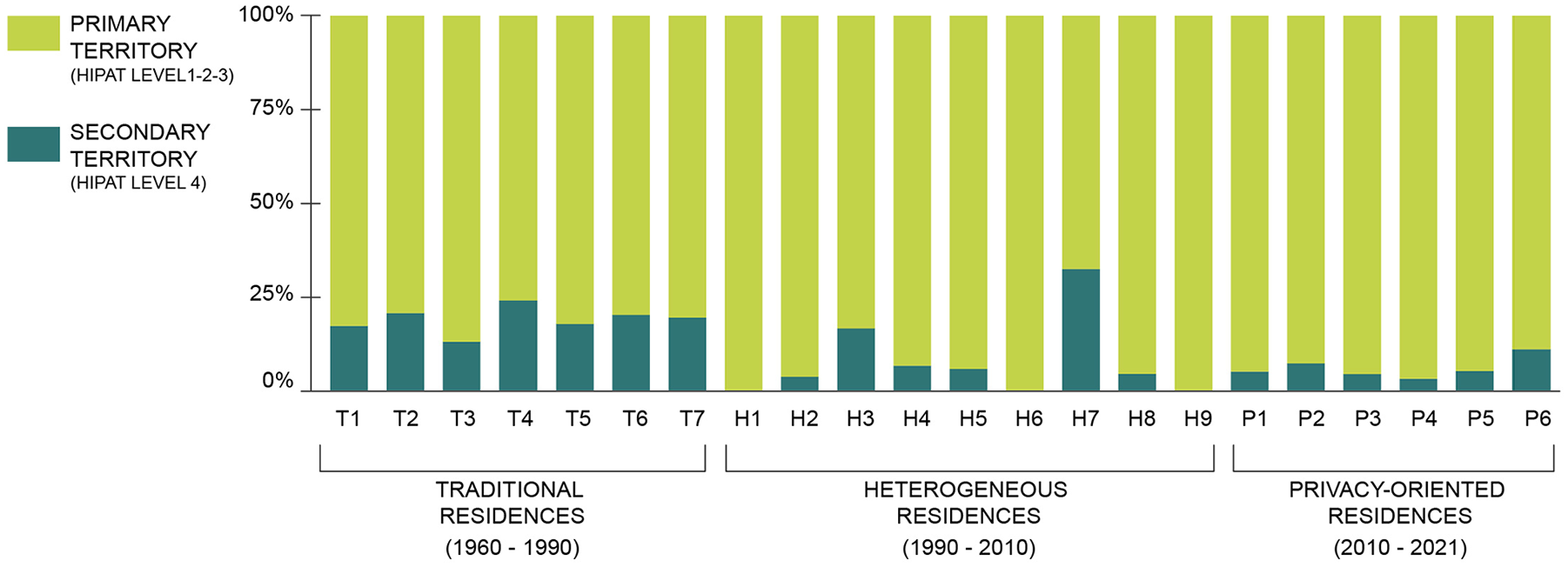
University student housing—primary and secondary spaces ratios (sq. ft.) per building constructed or repurposed in select residences 1964 to 2021. Each column refers to a unique residence organized from oldest to newest.
The total development of primary space (per student, in selected university residence buildings) has been increasing significantly over time, according to linear regression analysis (R2 = .16, p = .0065). A linear model of this growth indicates increasing square footage/student/year, with approximately 107 square feet/student on average in 1964 and 204 square feet/student on average in 2021. The total development of secondary space per student in residences has, thus, decreased between 1964 and 2021, and is statistically significant (R2 = .52, p = 2.5616E-08). Everyday facilities have moved from being common secondary spaces to being within the primary territories of units (see Figure 5). Both of these results are statistically significant, although the increasing rate of change to the primary spaces is far greater than the decreasing rate of change to secondary spaces.

University student housing—total primary and secondary space (sq. ft.) change by typology per year in select residences 1964 to 2021. Space per student is averaged across students living in the same HUC room typologies per typology per residence.
This study has identified that some institutions use strategies to adjust previously designed space to meet their goals for student living units, including strategies to increase privacy and strategies to increase affordability. Strategies to increase privacy and conform to incoming students’ increased privacy expectations include allowing single students to rent a room designed for two, increasing the amount of private (HIPAT Level 1) space and reducing semi-private (HIPAT Level 2) spaces; and HUC traditional rooms have been reformed to include washrooms, turning them into HUC modified traditional rooms, expanding the amount of primary territories (HIPAT Levels 1 and 2) for students in traditional residences and reducing secondary territories (HIPAT Level 4), despite the impact on socialization and its connection to student success and well-being. Strategies used to adjust previously designed space to increase affordability to address students seeking affordable housing (Hunt & Wissink, 2019) have started to affect offerings by urban university-affiliated residences. To meet this need, universities are employing a strategy that is counter to the strategies used to meet privacy expectations; that is, offering large single rooms to two students, shifting the privacy between private (HIPAT Level 1) to semi-private (HIPAT Level 2), thereby expanding their residence capacity. In new privacy-oriented residences, single rooms are represented in most of the student options, but a few double rooms are starting to be incorporated in the design options, addressing, on the one hand, the affordability of the units, and on the other, accommodating cultural preferences (Khozaei et al., 2014), especially with the large influx of international students (Smith, 2016). Residence living has been promoted as beneficial for student success and well-being; however, the shift from more opportunities to interact in secondary territories to a now-predominant focus on primary territories limits opportunities for interaction and could foster social withdrawal, producing a different university experience than the one advertised. Access to balanced HIPAT levels is an important factor in student success.
Change in Privacy Levels per Unit Type
Design of post-secondary housing units has changed over the years, with heterogeneous and privacy-oriented residences offering students more living space per student within the living unit, thus creating variances in not only amounts but types of interpersonal exchanges. We hypothesized that social facilities within the living unit types in residence halls have changed and that this has negatively impacted students by creating student housing that does not foster socialization (H3).
Most studies on agent control and socialization of university student housing units have focused on the dichotomy between traditional units and apartment living units. Discussions about traditional units center on crowding and the possible levels of privacy of the bedroom in juxtaposition to the sociability of the residence floor due to passive encounters and friendships that evolve in the HIPAT Level 4 spaces that are available in university student housing for these types of living units. Studies that involve multiple apartments usually consider those with private bedrooms (HIPAT Level 1) and group shared lounges, kitchens, and washrooms (HIPAT Level 3) within the living unit (Baum et al., 1975; Devlin et al., 2008; Rodger & Johnson, 2005). As discussed, three significant time frame partitions characterize the different types of living units for students, and there is a significantly greater variety of units beyond traditional and apartment types. Primary territories were once reserved for only the individual units (HIPAT Level 1) or semi-private units (HIPAT Level 2), where only the bedroom was a primary territory and other everyday living facilities, such as cooking, dining, social, and hygiene facilities, were secondary territories (HIPAT Level 4). There has been a gradual shift in these everyday living facilities toward varying levels of privacy, ranging from individual to semi-private to small groups (Level 1–Level 3), depending on the facilities and the number of people living within the unit. This shift from secondary territory facilities into spaces with primary territory privacy levels creates different layers of negotiation and thus levels of socialization for the students living in each of the units.
The trend to have more primary territory HIPAT Level 1 to 3 spaces per student within the living unit has increased significantly over time in the selected residences. Accordingly, amounts of Level 1, Level 2, and Level 3 spaces have shifted over time with the variety of student residence types. In the selected residences, semi-private space (Level 2) per student has varied over time but with no significant trend (R2 = .00, p = .785), while private (Level 1) space and group space (Level 3) per student increased significantly from 1964 to 2021 (private: R2 = .06, p = .0825; Level 3: R2 = .16, p = .0063). However, due to a high level of variation over time, there is low correlation for both trends in private and group space (see Figure 6).

University student housing—primary territory by HIPAT level (sq. ft.) change by typology per year in select residences 1964 to 2021. Space per student is averaged across students living in the same HUC room typologies per typology per residence.
HUC traditional residence units would present Level 1 and Level 2 privacy levels in the bedroom; primary territory shared spaces will occur either in the bedroom (Level 2) or in secondary territories (Level 4). An exception to this would be inviting people to their room, a common practice between students and an indicator of sociability and university engagement (Vinsel et al., 1980). The lack of architectural depth provides a favorable interaction between students, but can also create feelings of crowding, especially in shared rooms (Evans et al., 1996).
In units where the primary territories are shared with a few other agents, such as multiple apartments, there are more layers of increased interaction and negotiation between students than within apartment units for individuals, but the social interactions within the multiple-apartment living units are confined to a small group (HIPAT Level 3) and do not extend to the larger group interactions typical of secondary territories. In privacy-oriented residences, HIPAT Level 3, group shared spaces have disappeared in some units (HUC 5S Single Apartments and 4S Single Super Suites), lowering the levels of negotiation between a group to just one person or no interaction at all. Within individual, semi-private and group spaces (HIPAT Level 1, Level 2, and Level 3), a diversity of interactions, privacy levels, and negotiations occur between the different agents in the students’ day-to-day activities. Although these activities contribute to using a variety of behavioral mechanisms to control engagement or withdraw from social encounters, they do not equate to the types of mechanisms that would be employed within secondary territories. Studies on multiple apartments and traditional units have shown that the variety of behavioral mechanisms that students implement in residences correlates with students continuing into their second year of study (Vinsel et al., 1980). If apartments are necessary to accommodate students, then increasing the number of students sharing a living unit is recommended in order to provide a variety of levels of privacy to students within the unit, forcing them to use behavioral mechanisms within their daily routine, thus decreasing the possibilities of attrition and increasing satisfaction with the university (Vinsel et al., 1980).
Typologies such as traditional, modified traditional, and suites push students out of their units and into group spaces or floor/residence group spaces, as long as those spaces have been designed to gather and hang out in. On the other hand, apartments retain students in their units, since most hygiene and dining facilities are within the unit and have increased in terms of the floor area per student, thus reducing the need for students to use common floor facilities and interact with others outside the unit. This is problematic in 5S Single Apartments where students would not be required to interact or negotiate with other students for the control and everyday use of the facilities, possibly leading to isolation. Even if the correlation between primary and secondary territories is similar to a 1S Traditional room, in 5S and 5D Apartments (solely HIPAT Level 1 or Level 2 spaces) that are on residence floors with HIPAT Level 4 secondary spaces, the day-to-day interactions of the students reduce social encounters and the possibility of friendship occurring with others on their residence floor. The trend is toward increasing primary territories and reducing residence floor secondary territory facilities, exchanging the housing experience of our parents’ dorm rooms for one that is less community-based. Leaving this trend unchecked can reduce student well-being and academic achievement.
Area for Further Study
Equity on Campus Relates to Privacy Levels in Living Units
Differentiated housing experiences, due to changes to primary and secondary territories, alter university experience. Historically, students would share the same unit type across any social divide, which made on-campus student housing in traditional rooms an equalizing experience. Brown et al. (2019) caution, “While the option of self-selecting one’s residence hall location may emphasize greater levels of ‘customer service’ by reinforcing the notion of choice, not all choices may be uniformly beneficial for students (Blimling, 2014; Li et al., 2005)” (p. 278). In 2021, with private apartments and suites, and the perception that privacy is an upgrade to the university experience, a student’s access to financial resources possibly influences the unit that they can select. Shared bedroom spaces and shared apartments or suites are a more economic option than single apartments.
As student housing has long been considered a means to reduce student isolation and a tool to promote student success (Edwards & McKelfresh, 2002; Schudde, 2011; Simpson & Burnett, 2019), the introduction of new student university housing unit types that create differentiated housing experiences should be understood as creating a layer of inequality, as housing broadly bifurcates experiences of education. Greater inequity on post-secondary campuses may accompany this “rise of private luxury dorms”: “Moving into high-cost PBSAs is understood as some students’ intentional attempts to separate themselves from others less privileged or racialized students (Hubbard, 2008; Nakazawa, 2017)” (Sotomayor et al., 2022, p. 3). Changes to secondary territories can have an impact on equity as student passive encounters change. Further study should examine the connection of unit type and shifts in primary and secondary territories to equity and social structure on campus and the fracturing of socialization groups.
Conclusion
A goal of this study was to illustrate an answer to our initial primary research question—“How have the primary and secondary territories of living unit space in the design of residence hall architecture changed over the past 70 years?”—using an empirical methodology, indicating connections between territorial aspects of unit design, agent control of the facilities and impact on student socialization, and thus student success and well-being. We explored the following three hypotheses using a multi-year sample in a Northern America urban center: the design of university student housing has changed to reflect the times that they were built (H1); the amount of secondary territory areas per unit has been reduced over time in favor of primary territories, and this has impacts on student socialization (H2); and social facilities within the living unit types in residence halls have changed, and this has negatively impacted students by creating student housing that does not foster socialization (H3).
Unit design has changed over time according to students’ preferences and demands. This study explored the territoriality of the building units and the modification of agent control over unit design, establishing three time frame partitions (H1): traditional residences, or residences built after WWII until before 1990; heterogeneous residences, or residences built between 1990 until before 2010; and privacy-oriented residences, or residences built from 2010 to 2021.
Areas of primary territories have grown substantially per student over time as everyday facilities such as hygiene and dining facilities have been relocated into the living units. The area per student of secondary territories on the residence floor (HIPAT Level 4) has slightly decreased over the same period, although with a substantial increase in primary territories from 82% of total area to 92% (H2). We found this reduction in the area per student of secondary territories to be substantially less than anticipated. However, having facilities in secondary territories (HIPAT Level 4) that are not necessary for everyday life reduces the required paths that create passive encounters, diminishing possibilities of socialization and friendship that once dominated “our parents’ traditional dorm rooms” and altering the expected university experience.
Social facilities have changed both outside of the unit and within the unit types of residence halls, greatly reducing group socialization (H3). Group socialization, in multiple apartments and suites, has been presented as an advantage in the literature in comparison to traditional rooms, especially in addressing issues of crowding and socialization for introverted personality types. In the last 20 years, the typologies of multiple apartments and suites have been displaced in favor of single and double apartments and suites, reducing the amount of interaction between students as they access essential facilities. This increases architectural depth and reduces interaction and negotiation, and potential connections with a diverse group of students, thus possibly creating isolating unit types.
Student residences built in Northern America over the past 20 years prioritize privacy, and risk isolation, to accommodate perceived student preferences, to the detriment of students’ social spaces, and this trend should be questioned. The new design and construction of individual single apartments, although currently small in number, is a growing trend that represents a large shift toward isolating units. Historically, student housing has been a place that encourages students to build community networks, and increasingly privatized living units can create feelings of isolation that can negatively affect grade point average and deter social connection, possible friendship and overall well-being. Students’ social interaction should consider students’ desire to be alone and the need to socialize and create social relationships that will accompany them through their university years.
To address the need for a multi-level quantitative analysis of levels of privacy and socialization in the student living units, this paper proposes a method to examine the built environment using HIPAT and HUC together to measure changes in privacy in student residences. Implementation of McCartney and Rosenvasser’s (2022a, 2022b) HIPAT and HUC tools provides designers, researchers, and administrators with an overview of the sociability and privacy conditions of specific residences, such as architectural depth, quantifying the areas of each privacy level, and the prominent HUC types in a specific building. Administrators and social scientists would benefit from a research mechanism that presents the variety of living unit types offered, and, if combined with other sources—such as income and rent—encourages policies to address access to affordable and social oriented residences.
This method provides information to university administrators, developers, and designers to better understand the possible academic and well-being implications of the trend of increased privacy and to design and build university student housing that encourages socialization and, thus, supports students. Housing is an important part of the education that universities deliver. Universities should not continue to move away from the business of student housing; rather, they should focus on building housing that fosters socialization and community building, historically associated with the benefits of living on campus: student retention, well-being, and academic success.
Footnotes
Acknowledgements
The authors gratefully acknowledge research assistance by Andrew H. Lee, John Homsy, and Ross Edwards. Acknowledge the provision of information on the residences at their respective universities by Valerie Bruce, Jay Martin, and Kaye Kim from Toronto Metropolitan University, Johanna Classon and Anthony Barbisan from York University and, Michal Kuzniar, Logan Blair, and Stephen Baik from University of Toronto. The authors also wish to thank the greater StudentDwellTO (SDTO) team comprised of the Steering Committee, Advisory Committee and especially the core team members of Amy Campbell, Victoria McCrum, Dr. Luisa Sotomayor, Dr. Marcelo Vieta, Mauricio Quiros, and Jeremy Bowles for their commitment to the SDTO project, and to the three anonymous reviewers who helped us to improve the manuscript with excellent comments and suggestions.
Declaration of Conflicting Interests
The author(s) declared no potential conflicts of interest with respect to the research, authorship, and/or publication of this article.
Funding
The author(s) disclosed receipt of the following financial support for the research, authorship, and/or publication of this article: This work was supported by the University President’s of Toronto Metropolitan University (formerly Ryerson University), University of Toronto, OCAD University, and York University; Office of the Dean, Faculty of Community Services at Toronto Metropolitan University; and Office of the Dean, Faculty of Engineering and Architectural Science at Toronto Metropolitan University.
