




Abstract
Students’ privacy expectations in university housing have increased, a change that has been reflected in universities shifting from traditional units to increasing numbers of apartments and suites. This study examines privacy and territories in student university housing architecture, using architectural plans of 76 residences, relating the socialization of university students to their academic success by bringing together various literatures—student development, student development practice, and architecture of student housing—to address positivesocializing forms of architecture and effects of crowding and isolation in residence design. The proposed Hierarchy of Isolation and Privacy in Architecture Tool (HIPAT) is a tool for measuring and analyzing levels of privacy and the impact that control mechanisms in the built environment of student university housing have on them. The HIPAT addresses the need to analyze student interactions in residences from an architectural lens that applies a robust privacy literature as well as visualizing primary, secondary, and public territories in student university housing.
Introduction
In the last two decades, a shift in on-campus student housing design in Northern America has led to the creation of ever-larger amounts of privatized space in university student residences, largely through an increase in apartment-style residences (Brown et al., 2019; La Roche et al., 2010; U.S. Department of Housing and Urban Development 2015). For many, more privacy is perceived as a desired upgrade, but the recent shift from the communally focused corridor style of units toward apartment-style residence halls has contributed to greater feelings of isolation in university students now missing the former’s focus on socializing architecture (Heilweil, 1973)—a form of architectural design positively correlated with higher grade point average (GPA) and numerous other benefits for university students (Bronkema & Bowman, 2017; Brown et al., 2019; Schroeder & Belmonte, 1979). This establishes a privacy-isolation contradiction: Students want increased privacy, but more privatized units create isolation, to the detriment of those same students’ well-being and academic performance. The ever-increasing demand for more student housing compels us to ask: Do university administrators have adequate tools to measure the levels of human interaction and socialization in architecture when considering residence hall design? Understanding and employing socializing architecture would enable universities to create higher levels of interaction and socialization in student university housing, providing increased engagement, retention, and degree attainment—which have been credited to positive aspects of on-campus living (Brandon et al., 2008; Oseguera & Rhee, 2009; Pascarella & Terenzini, 1991; Titus, 2006).
As the demand for student housing continues to escalate globally—from Latin America (Business Wire, 2020) to Asia (Khozaei, 2014) to Africa (Amole, 2008) to North America (Brown et al., 2019) and Europe (Cascone, 2018; Verhetsel, 2017)—more new residences are projected to be constructed in the coming years. This means it is critical to create tools now to address and evaluate the implications of new student housing designs in terms of interaction and socialization, so that all of the benefits that have historically been achieved due to on-campus living can be preserved, if not improved upon.
The aim of this paper is to propose a visual tool that not only identifies the different levels of privacy in a built environment and how they change when environmental mechanisms of control are applied, but also provides a new way to collect data for analyzing these elements in student university housing. Systematized analysis and visualization of the primary, secondary, and public territories in student university housing can enable those who build, renovate, and maintain student university housing to measure levels of human interaction and socialization in architecture. This data will help shape residence hall design into more positive-socializing forms of architecture for students, instead of isolating ones.
Literature Review
In their review, Pascarella and Terenzini (1991) determined that living on campus is the most important positive university experience, as it contributes to a large array of learning, cognitive, attitudinal, psychosocial, and educational attainment outcomes. Not all campus residences are created equal, however; studies document the influence of architectural design features on the students who live in them (see Figure 1). In architecture, typologies are the taxonomic classifications of characteristics, typically physical, commonly found in buildings and urban places.

Dorm life in Washburn Hall, San Jose State College, Early 1970s.
Studies typically focus on two typologies of units: traditional and apartment (Aiello & Baum, 1979; Baum et al., 1975; Bronkema & Bowman, 2017; Devlin et al., 2008; Rodger & Johnson, 2005). Traditional residences are densely populated buildings with single or shared bedrooms that lead to a central long corridor, where the residents of a given floor would share the washroom, lounge, and study rooms (see Figure 2). Students would also often meet in large communal lounges or dining halls, usually located on the first or ground floor of the building. Apartment units have self-contained kitchen, dining, lounging, and hygiene facilities, providing more private space for the students than traditional units. Apartments can be for a single person or shared among many, with typically no more than 8 to 10 students. However, comparisons between traditional and apartment units do not contemplate the complexities and nuances of governance in design from an architectural perspective and have not yet been addressed in the literature. As the trend toward the privatization of spaces is growing—primarily through the construction of apartment-style units, and with a variety of new typologies being developed—it is necessary to create tools to broaden the view of university student housing design through the lens of socialization and privacy, given that human interaction increases the chance that a university student will complete university (Titus, 2006) and obtain a higher university GPA (Pascarella & Terenzini, 1991).

Floor plans of traditional (single and double) and apartment unit typologies.
Socialization and Isolation in Architecture
Architectural design doesn’t just impact how people experience spaces; it also impacts the social interactions that occur within them, through the communication of symbolic or cultural meanings and the preservation of a group’s values and paradigms (Shah & Kesan, 2007; Smith & Bugni, 2006). In this way, buildings—and the landscapes they are situated in—shape who we meet and how we interact with them. Architectural design alone does not guarantee that friendship and socialization will occur; rather, it provides opportunities for social interaction through types and sizes of physical barriers (Altman & Chemers, 1993); the more barriers introduced, the more private the spaces that are created. This has significant impacts on social interactions: More enclosed spaces are designed to strengthen in-group formation, whereas open spaces are designed to encourage association and socializing (Al-Homoud & Abu-Obeid, 2003). However, as space, and the design thereof, can encourage interactions between people, it can also encourage estrangement (Gieryn, 2000, 2002) and the significant impact of both on academic outcomes (Pascarella & Terenzini, 1991). The selection of a residence may be one of the greatest determinants of positive psychosocial development and academic success during a student’s university career.
The Need for Privacy: Individual Level
Self-discovery, growth, and social connection are intrinsic parts of student life, especially to those who are living away from home for the first time. Balanced privacy has value for the individual’s development: Regulation of privacy creates a feeling of personal autonomy, emotional release, and self-evaluation, as well as limited and protected communication (Altman, 1975). Further, privacy can help people define themselves, their self-worth, self-independence, and self-identity: Who they are is shaped by how they interact with others. High levels of privacy in a built space permit individuals to be alone with one person or a group, to share in a protected and selected manner. In addition, increased privacy allows for emotional release, relaxation from social roles, and doing “personal things that are typically avoided in public” (Altman, 1975, p. 19). High levels of privacy also allow individuals to enter a process of self-evaluation that permits putting together lived experiences and plans for the future. Altman (1975, p. 50) describes it this way: “the peripheral functions towardwhich control is directed—regulation of interpersonal interaction and self/other interface processes—ultimately serve the goal of self-identity.” Thus, privacy plays an important role in the development of an individual’s identity and well-being.
Privacy regulation is also one of the adjustments students face when entering university life (Vinsel et al., 1980). Students control the built environments that they live in using various behavioral mechanisms—defined by Altman (1975) to include verbal and paraverbal behavior, nonverbal behavior, environmentally oriented behaviors of personal space and territoriality, and culture-specific norms and rules that help regulate social interaction—to make themselves more or less accessible to one another (Vinsel et al., 1980). Although our study is focused on environmental and agent control mechanisms—as well as architectural spatial design—in university residences, it is vital to understand that university students employ various direct behavioral means to avoid others, such as shutting the doors to their rooms, going for a walk alone, or finding a quiet place to relax. Students also employ contact mechanisms to directly engage with specific people; for example, calling them on the telephone, looking for them in their rooms, or inviting them back to their own room. These mechanisms should be considered necessary for human interaction and socialization; students using a variety of behavioral mechanisms have a greater chance of continuing their university studies past their second year (Vinsel et al., 1980). The most effective behavioral mechanisms vary from person to person, although the creation of more privacy-regulated built environments deters the use and learning of additional behavioral mechanisms necessary to build resilient and healthy human interaction. Rather, when students have control over their environment—using a variety of mechanisms to choose when they engage in socialization or prevent contact with others—they adjust better and report higher levels of satisfaction toward the university (Vinsel et al., 1980).
Desire to engage in or avoid contact with their peers varies from student to student and from day to day; as such, students should be able to control these levels of privacy in their living environment. For example, a student may seek out seclusion during intense study sessions but may want to engage with their classmates during recreational time or light study. On the other hand, willingness to open the door to a common space, such as a hallway, from a private space, such as a bedroom or unit, indicates trust and reflects a willingness to engage with others. This willingness to keep doors open (Chambliss & Takacs, 2014)—the open-door phenomenon—is particularly important in private bedrooms that are organized along a more public corridor, as opposed to suite-style units: “the design is related to fostering a greater sense of community than was true for students in a residential design based on clusters of rooms” (Devlin et al., 2008, p. 514)
It’s important to achieve balance, however. Units that heavily focus on providing individual privacy with excessive control over the built environment—rather than providing a variety of mechanisms that encourage engagement—deter students from new encounters and socialization, while units where students lack control over the environment can create excessive contact, generate feelings of crowding, and interfere in student satisfaction and development (Altman, 1975; Schroeder & Jackson, 1987; Valins & Baum, 1973). Actively designing units that enable students to attain a variety of levels of privacy through various mechanisms allows them to feel in control of their environment, leading to an improved sense of well-being.
The Need for Privacy: Community
The connection between privacy and community is influenced by the design of the built environment. Feeling comfortable in one’s individual and broader shared surroundings—coupled with the relationships built with others in these shared spaces—plays a major role in students’ ability to relate to their academic activities, and privacy regulation in residences directly impacts a student’s sense of belonging to the greater university environment (Vinsel et al., 1980). For instance, multiple studies have shown that students in traditional residences leaving their bedroom doors open to the hallway helps develop a greater sense of community, belonging, and group formation (Devlin et al., 2008; Rodger & Johnson, 2005), and is an indicator of their involvement with the floor group formation. However, typologies where this is not a convenient option, such as suites and apartments, can deter the open-door phenomenon and promote personal or group isolation (Devlin et al., 2008; Heilweil, 1973; Vinsel et al., 1980).
Living together with people from diverse demographic, socioeconomic, racial, religious, cultural, and geographic backgrounds is one of the unique aspects of student life (Sotomayor et al., 2022), but each student will have different expectations when it comes to privacy. Typically, a student’s sense of belonging in university residences will vary based on whether they have a more introverted or extroverted personality type (Rodger & Johnson, 2005). Significantly introverted students develop a greater sense of belonging in apartment-style residences than traditional student residences; while double-room, dorm-style residence halls foster a high sense of belonging for extroverted students (Rodger & Johnson, 2005). However, once comfortable in their environment, having obtained adequate levels of control (and, therefore, privacy), students of various personality types are able to engage in a positive way with those around them. This is demonstrated by increases in student activity levels as student interaction increased in both traditional and apartment-style residences (Rodger & Johnson, 2005). Unfortunately, apartment-style grouping can lead to spatial segregation, and to a decreased sense of community in student university residences as a whole, suggesting students are less willing to interact with students from another grouping (Devlin et al., 2008).
Balanced Privacy: Crowding
Student success and well-being depend on social interactions, although too much social stimulation can result in feelings of crowdedness. In considering the dimensions and causes of residential crowding, the university student housing literature examines crowding by counting the number of interactions a student has in a day (Baum et al., 1975; Evans et al., 1996). Crowding can become a concern if residents have too many people to interact with. The negative impacts of feeling crowded include increases in stress and social withdrawal (Valins & Baum, 1973). Feelings of crowding should be mitigated; increasing privacy should not result in isolation. Many students report that they consider traditional residences to be crowded (Valins & Baum, 1973). Students can achieve the amount of privacy that they desire by going into different spaces—allowing them to balance feelings of isolation (due to excessive privacy) and feeling crowded (due to insufficient privacy; Altman, 1975).
Student university housing that is designed to have positive-socializing forms of architecture can increase students’ well-being and academic performance—for example, by fostering new relationships through interactions during informal and common shared activities in secondary territories. Architectural design can provide instances for social interaction to occur passively through different types of physical barriers (Altman & Chemers, 1993), although it cannot guarantee that friendship and socialization will occur. Rather, architecture divides spaces into those with either more or less privacy. Open spaces are designed to encourage association and socializing, whereas enclosed spaces are designed to strengthen in-group formation (Al-Homoud & Abu-Obeid, 2003). In a college or university context, architectural design can influence many valuable determinants of social life, and either encourage socialization or isolation, engagement or estrangement, in students (Gieryn, 2000, 2002).
Traditional and apartment-style residences are the focus in the literature on crowding, forming a dichotomy that positions them as opposite ends of the privacy spectrum. This kind of analysis negates the nuances of crowding, isolation, and socialization in unit types that are near the center of the privacy spectrum. This results in discussions in the literature that present the building of apartments as a solution to the issue of crowding in traditional residences (Baum et al., 1975; Evans et al., 1996). However, not all apartments have the same level of socialization, as the number of occupants in each apartment and in each bedroom differs. The literature is not specific in discussing the different amounts of occupancy in apartment types and instead focuses on multiple occupancy apartments with shared hygiene and cooking and dining facilities, neglecting to acknowledge that single occupancy apartments and multiple occupancy apartments provide very different opportunities for socialization and feelings of crowding. Unfortunately, the classification of units by type in the literature is insufficient to measure how usage and governance impacts crowding and socialization in the university residence context, resulting in a gap when considering these concerns in relation to fostering student well-being and design of university housing.
Connecting Student Development and Practice to the Literature of Student Housing Architecture
Valuable attempts have been made to study the relationship between design and control due to the important implications on students. While the research has focused primarily on crowding, it has also referred to group formation and its relationship to limited student housing unit typologies, as well as room size. Most studies on privacy, socialization, and friendship in this context replicate the binary between the traditional double-corridor setup and apartment arrangements or suites (Aiello & Baum, 1979; Baum et al., 1975; Bronkema & Bowman, 2017; Devlin et al., 2008) rather than focusing on the levels of governance within those typologies and how they can be altered by architectural mechanisms of control. This gap has been identified in the literature by Bronkema and Bowman (2017), who note that “although more research is needed, residence hall attributes appear to have important and complex relationships with student outcomes” (p. 629). The creation of tools that can unravel the complexity of the built environment from an architectural perspective is vital to analyzing the governance of spaces. In order to frame the conversation on student privacy within the architectural student housing literature, such tools are needed to measure and compare privacy in the built environment, which would expand the discussion in the literature to include student development and student development practice.
Studies on crowding typically analyze the architecture of a given space solely on the number of interactions between a certain number of students in comparison to other groupings (Baum et al., 1975). This is useful in terms of understanding how differences in the built environment can affect students, but the analysis does not provide a tool for replicating the findings and making comparisons to different residences, groupings, and designs. Terenzini and Pascarella (1984), in their study on student retention limitations, identify the importance of the nuances of architecture on human interaction: “It is reasonable to expect students’ intra-residential interactions with other students and the ambiance of their living situation to have some influence on their behavior” (p. 121). Their study concludes calling for further research on the built environment as it defines student interactions, and student housing, success, and psychosocial development.
In short, there is no one-size-fits-all approach to residence design; one residence unit design cannot meet the needs of every student. This suggests a need for diversification in the types of units, and also a need for research tools that can be used to design and evaluate each unit type to better accommodate a variety of student preferences. As such, tools that quantitatively measure privacy levels best suited to a range of student needs—including potential differences between demographic, socioeconomic, racial, religious, and cultural groups—will help universities create living environments better tailored to student psychosocial development and success.
Territories: Hierarchy of Space
Residence design articulates how agents control the built environment; therefore, understanding the hierarchy of agents’ control of the built environment allows for a definition of the different levels of privacy therein. Habraken and Teicher (1998) note that people acting on the physical environment reflect the social hierarchies within it: “the built environment is observed as a territorial organization, as space under the control of agents. We will find a distinct hierarchical structure related to the hierarchy of form” (p. 126). When Habraken and Teicher’s (1998) structure of social hierarchies is applied to student university housing, unit designs establish a hierarchical structure of control in each building—one that includes individuals’ control of each private and semi-private space, small group spaces used by the floor/residence group, larger group spaces used by the entire building, and public areas controlled by the university as a whole.
To understand the different levels of privacy in the environment, it is necessary to understand which agents regulate the spatial environment with regard to privacy. Altman’s (1975) approach to privacy is “a central regulatory process by which a person (or group) makes himself more or less accessible and open to others” (p. 3). Therefore, “the very act of inhibition of occupying a space and selecting what comes in and what stays out is fundamentally territorial” (Habraken & Teicher, 1998, p. 126). This is a “dialectic process” (Altman, 1975, p. 11) that involves both the restriction from and the pursuit of human interaction in spatial environments. Desired privacy, then, is the balance between feeling isolated due to an overabundance of privacy and feeling crowded due to inadequate levels of it—these can be regulated by behavioral and environmental mechanisms.
Altman (1975) identifies three levels of territory—primary, secondary, and public—and classifies them by the level of control an agent has in each. Van Dorst’s (2006) research on privacy zoning applies territory classification to the urban built environment in order to group together the control and significance of the space. While both Altman’s (1975) and Van Dorst’s (2006) approaches contributed significantly to the literature and are based on classifications of agent control, they do not address notions of social complexity when it comes to the individual or group controlling the territory, nor how these relate to the nuances of students’ lived experiences in residence.
According to Altman (1975), “primary territories are owned and used exclusively by individuals or groups” (p. 112) on a reasonably permanent basis, are part of their daily activities, and their ownership can be perceived by others. However, in the examination of usage of a built space, a distinction of density between an individual, a pair of people and a group must be made, since the ability to exert control varies between these categories. Personal, individual control over the space allows for an absence of negotiation—giving more freedom and allowing for individual augmentations to be made to the space. When a pair of people has control over the space, they can enter one-on-one negotiations with regard to decisions about it, an extremely direct way of solving a potential conflict (Brett & Thompson, 2016). This social complexity is particularly apparent in shared bedrooms in residences, where the literature indicates that students lack needed privacy and preferences not to share that space (Heilweil, 1973; La Roche et al., 2010; Schroeder & Jackson, 1987). Furthermore, in a group situation, negotiation with more than one person is necessary, thereby causing a variety of types of social interactions.
Secondary territories, for their part, are “places over which an individual or a group has some control, ownership and regulatory power but not to the same degree as over a primary territory” (Altman, 1975, p. 117). Others often access these spaces, and the predominant users vary over time (Altman, 1975).
Public territories, as defined by Altman (1975), are open to everyone; however, individuals can have short-term control over a space, provided they follow certain regulations.
Problem
Pushed by the demand for large, individual rooms that provide privacy—with the perception that this will improve the university experience for students—developers, real estate investment trusts, and universities have been designing and constructing new and diverse types of student housing units that differ significantly from the traditional style of communal and shared residences and group shared apartments (La Roche et al., 2010). This change impacts more than room size: Variations in privacy levels within these new units create ways of interacting and socializing that are different from their traditional predecessors—an evolution that has yet to be analyzed through the lens of space design in architecture.
Several privacy-focused studies have analyzed students’ performance and overall well-being; however, traditional residences have earned criticism for their lack of privacy and the consequences this has for social interaction (Aiello & Baum, 1979; Schroeder & Jackson, 1987), criticism which coincides with the development of housing that meets students’ expectations and perceived upgrading when it comes to private space (Cross et al., 2009). Although certain levels of student privacy are beneficial, an excess thereof can create feelings of isolation (Altman, 1975; Heilweil, 1973), which are detrimental to student academic performance and overall growth (Brown et al., 2019). But though these studies have described the space of the building, the architecture itself has not been analyzed in a spatial context. Rather, these studies have focused on the social aspects of the built environment, since there is a lack of systematized tools for analyzing and measuring privacy within the residential space.
Methodology
This study develops a graphic tool for interdisciplinary researchers to perform architectural spatial analysis that measures privacy, crowding, and socialization in university student housing. In order to create this tool, a literature review across the disciplines of student development and practice and student housing architecture, and a review of architectural plans, was completed. A map or an architectural plan records the opportunities for human interaction in space and how these humans influence each other, such as how agent control and human interactions can be modified by different control mechanisms. Architectural plans were the primary source of data for this study, as they allowed for the consideration of variables that might be related to design evolution and privacy levels with attention on the living experience of each student from a privacy-design perspective. The sample of 76 architectural plans of student residences were obtained from the literature or from the university administration at each respective university and selected based upon four factors: (1) geographically located across western, central and eastern states or provinces in the USA and Canada, representing 10 cities; (2) built evenly across 10-year time frame partitions from 1900 to 2020; (3) included both residences owned by a university or affiliated with a university and private student residences; and (4) represented across different unit and residence unit type classifications from the ACUHO-I Survey (Balogh et al., 2005). The unit classification framework of student housing units established by the Association of College and University Housing Officers—International (ACUHO-I) includes the following typologies: Traditional Rooms, Modified Traditional Rooms, Adjoining Suites, Super Suites, and, later on, Apartments (Balogh et al., 2005). The framework was designed to collect construction and renovation data by documenting the facilities constructed in each unit and the associated costs.
The student development literature contains a gap in the ability to complete spatial analysis as it pertains to student privacy and socialization. Thus, we sought to develop a tool to aid researchers in the collection of quantitative data from spatial analysis to enable discussions of levels of agent control in spaces. Our synthesis of the multi-disciplinary literature revealed that specific measures of usage and governance of student housing spaces would be useful to reflect the student lived experience, as well as relative levels of privacy and socialization. We identified the governance in the residence facilities—kitchen, washroom, bedroom, social lounging spaces, dining hall, amenities—within each of the floor plans, applying Altman’s (1975) three territories: primary, secondary, and public territories. Using computer-aided design to identify these spaces, we applied colors to the area of each of these territory types on the architectural plans. In each of these facilities we then identified the different levels of usage—defined by the number of people having indirect or direct control over the space and governance—classified by territory.
Our analysis included: (1) spatially identifying unit living facilities in each residence floor; (2) the number of students—agents—using each space; (3) a comparison of different living unit taxonomies to each other; and (4) a measurement of areas within each facility according to the number of students living in those units. To identify trends of agent control over the residences, administrative, and utility areas were excluded from the analysis.
After the tool was initially created, investigations followed that included an additional 30 residences across 10 cities in 7 states or provinces geographically located across Northern America to test the comprehensiveness of the tool for student residences constructed to date.
Hierarchy of Isolation and Privacy in Architecture Tool (HIPAT)
The Hierarchy of Isolation and Privacy in Architecture Tool (HIPAT) is a visual tool that defines agent control by levels of usage (i.e., density, number of agents) and governance (i.e., territoriality, control by agents; Figure 3) and can be applied to the various spaces—facilities—of student residence halls: kitchen, washroom, bedroom, social lounging spaces, dining hall, and amenities. Each individual is impacted differently by the number of agents controlling each space, which affects their amount of social interaction, and potentially their student experience. The HIPAT defines primary territories as private (controlled by 1 person), semi-private (controlled by 2 people), and group spaces (controlled by 3–8 people); and secondary territories as spaces controlled by a floor or residence group (typically 20–40 students) or the entire residence building (150–400 students). The HIPAT defines public territories as ones open to the whole university population or the broader public.

Privacy levels in the hierarchy of isolation and privacy in architecture tool (HIPAT).
Building on Altman’s (1975) three-part classification of territories to encompass the nuances between the various quantities of agents—students—in each space, the HIPAT takes into account the number of agents present and having governance over primary, secondary, and public territories, and further stratifies them into hierarchical levels, as it is the interactions between these agents that are positively linked to student performance and well-being. Agents can exert control over the space from any category. Agents are either by themselves or having to negotiate directly in primary territories over the long term with either one person, or small or large groups, resulting in social interactions between the agents developing differently depending on the number of people. In secondary territories, there are short-term negotiations between groups living on the same floor, or even shorter negotiations between larger groups contained in the building. Public territories necessitate negotiations with the public in a university environment for brief periods of time. The HIPAT defines space by usage and governance as follows: Level 1, Primary Territories (a) private (individual); Level 2, Primary Territories (b) semi-private (two students); Level 3, Primary Territories (c) group; Level 4, Secondary Territories (a) floor/residence group; Level 5, Secondary Territories (b) building/entire residence; and Level 6, Public Territories. Each level has a grayscale gradient (see Figure 3) associated with the stratification inherent in each level.
The HIPAT is graphically applied to the architectural floor plan of student housing to create a visual medium to analyze the amount of control each student has and the differences between the spaces of negotiation, with the transition between each one visible. The HIPAT can be used to both gather quantitative data on spatial distribution and visualize social configurations of the entirety of, or portions of, a residential building (i.e., specific facilities or living units). The living unit HIPAT diagram (Figure 4) visualizes the agent control elements of governance and usage by identifying facilities typical to everyday living, in living unit type.
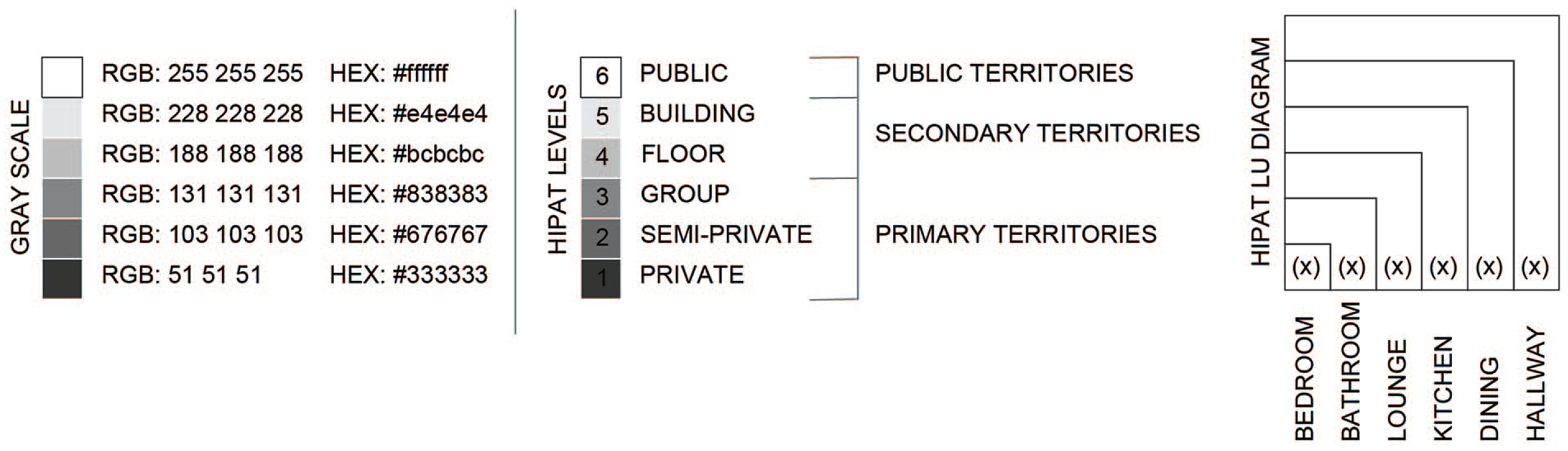
Hierarchy of isolation and privacy in architecture tool (HIPAT) graphic tool.
Understanding of the link between social encounters and the built environment can be furthered through spatial analysis. The HIPAT is applied to student housing in this paper, but it could be applied to many other co-living built environments such as hospitals, hostels, hotels, senior living, rooming houses, emergency housing, or group homes.
This tool enables quantitative spatial analysis of human interaction across various buildings with the same or different student university housing unit types. From complete control to spaces where control is limited by the administration, the HIPAT defines territories and creates a bridge for precise conversations between social science researchers and architects in studies relating the role of privacy and agent control in spaces to student success and well-being. This tool not only identifies but also enables data collection in order to analyze different levels of agent control and how they’re altered when various control mechanisms are applied to the built environment. The HIPAT internalizes student development and architecture literature to bring greater understanding of spatial analysis to the built environments of co-living and shared housing by documenting agent control so that universities can support student success and well-being in the design, construction, and management of student housing.
Expanding Existing Classifications of Territories to Create the Hierarchy of Isolation and Privacy in Architecture Tool (HIPAT)
The HIPAT builds upon and furthers the existing literature on isolation and crowding (Altman, 1975; Devlin et al., 2008; Heilweil, 1973; Schroeder & Jackson, 1987; Valins & Baum, 1973; Vinsel et al., 1980), as well as allowing for an analysis that broadens the understanding of control and agency in student university housing spaces, enabling a deeper discussion of the interactions that may occur within them and the design mechanisms that divide them. Design literature now has a visual tool for moving beyond the apartment-traditional room dichotomy toward a broad spectrum of design perspectives that expand the discussion to include juxtapositions of governance, usage, and hierarchy. The HIPAT enables variables of agent control within multiple dimensions of interest, including usage (i.e., density), and governance (i.e., territoriality), to be applied to spaces—facilities—of student residence halls.
The HIPAT integrates Altman’s (1975) three levels of territory—primary, secondary, and public—and his classification of them by the level of control an agent has in each, and also merges Van Dorst’s (2006) research on privacy zoning, to address notions of social complexity when it comes to the individual or group controlling the territory. The HIPAT applies territory classification to the built environments of residence facilities while relating to current classification standards. The dominant method of categorizing living units is organized by facilities within the unit (Balogh et al., 2005), but not by the number of users that have access to the facilities. We have created a tool that is compatible with existing taxonomies and that also addresses governance and usage.
Using the ACUHO-I categorization (Balogh et al., 2005) and Altman’s (1975) territoriality to classify the buildings, we observed that despite being considered the same ACUHO-I unit typology, many facilities located in primary territories had very different privacy zoning (Van Dorst, 2006). Initial differences observed in agent control and negotiation included: Residences may have the same facilities within them but different amount of users, for example, those that occur between two students or within a small group; whether individual privacy was possible; length of time of control over each of the facilities by agents, and amount of them; placement of doors to allow for agent connection between spaces—open-door phenomenon; and the ability to close or open the door due to amount of negotiation needed between agents, for example, between two students or within a small group.
Analysis of secondary territories revealed differences in the amount and type of negotiation between students in these common spaces. Certain residences had everyday facilities that were for common use and others had them within the unit; that is, bathrooms in traditional units are usually placed in secondary territories for common use, but in apartments, suites, and modified traditional units the bathroom is located in primary territories. Differences in facilities of secondary territories outlined the potential for very different group sizes and thus the number of passive encounters and negotiation that could occur while accessing facilities of daily life; for example, those that occur within a floor residence group of, typically, 20 to 40 students (e.g., in a common kitchen) and those that occur between members of the entire residence building of 150 to 400 students (e.g., in a dining hall).
A closer analysis of the living units of the traditional-apartment dichotomy in the literature reveals that the levels of agent control and negotiation complexity changed. The literature does not consider how many people are living in each of the units. According to Altman (1975), “primary territories are owned and used exclusively by individuals or groups” (p. 112) on a reasonably permanent basis, are part of their daily activities, and their ownership can be perceived by others. In the examination of agent control over a built space, a distinction between an individual, a pair of people, and a group must be made, however, since the ability to exert control varies between these categories. The student lived experience of required paths and instances of passive encounters when accessing facilities required for everyday life should also be considered. We introduced a variable of agent control of usage of each facility to the analysis and considered how this would impact socialization.
Socialization is positively associated with student success and well-being (Pascarella & Terenzini, 1991), so it was important to keep the connection of Altman’s primary and secondary territories and socialization to other disciplinary literatures that use territories to explain human interactions and could use HIPAT as a tool in analysis of spaces. Personal, individual control over the space allows for an absence of negotiation—giving more freedom and allowing for individual augmentations to be made to the space. Design of spaces can foster social interactions between people but also can encourage isolation (Altman, 1975; Heilweil, 1973), and negatively impact student success and well-being (Brown et al., 2019). Being able to identify the levels of negotiation, or lack thereof, on the living environment is one of the primary uses of the HIPAT. The literature examines crowding by quantifying the number of interactions a student has in a day (Baum et al., 1975; Evans et al., 1996); we took a similarly student-centered approach and observed when students did have opportunities for interaction but also with how many agents the negotiation could have occurred. We introduced categories of governance of each facility to the development of the HIPAT and considered how this related to isolation, need for privacy, and privacy regulation.
While isolation can be a concern, so is crowding, and thus we wanted to make sure that we could show when people had the ability to be alone. Our analysis of the literature showed that it would be important to identify private individual spaces, and the ability to be alone (Altman, 1975), within primary territories in the HIPAT. As privacy regulation varies room by room, we wanted to make sure that our tool captures each individual facility space and the hierarchy of agent control in each facility space.
Seeking to encompass community sense of belonging, diversity of experiences but also balancing that too much socialization can potentially result in crowding, we sought to categorize interactions of a pair of students as separate from a small group and as separate from even larger groups. Brett and Thompson (2016) insist that negotiating one on one is a very different social interaction experience due to the direct way of solving a potential conflict rather than negotiating between three or more people. Students spoke of privacy needs and their preference not to share space with two or more people (Heilweil, 1973; La Roche et al., 2010; Schroeder & Jackson, 1987). We decided that our divisions should follow typical usage in living units and complexities of governance beyond one-on-one negotiation. We are subcategorizing Altman’s primary territories model into three groups—Level 1, Primary Territories (a) private (individual); Level 2, Primary Territories (b) semi-private (two students); and Level 3, Primary Territories (c) group—to reflect social interactions and allow potential for isolation and crowding to be quantified.
Community and diversity within groups dominated the literature in the consideration of secondary territories but made distinctions between interactions that occurred with the social group of the residence floor and those of the entire building as shared facilities and passive encounters shifted between the two types. We subcategorized Altman’s secondary territories into two levels: Level 4, floor/residence group; and Level 5, building/entire residence. This enables us to address the differences in size when it comes to group formation—and therefore, socialization—in these spaces. Where everyday encounters (e.g., going to the bathroom, using the kitchen, or lounging on the sofa) would usually occur in floor/residence group spaces, the spaces of the building/entire residence encourage a different type of encounter with a much larger group of people, many of whom students may have not met before (e.g., in dining halls in traditional residences, or in large study halls in modern ones). Importantly, students may opt out of activities and socialization in secondary territory social spaces, thus diminishing opportunities for new and unplanned encounters to occur. It is more likely, though, that students will not opt out of social development encounters in required spaces that students have to use to prepare food and perform personal hygiene activities. Altman’s public territories were retained as Level 6, Public Territories.
The HIPAT internalizes a gradient hierarchy of socialization in facility spaces and gives each space a level that represents the agent control within it. Each level was given a grayscale gradient color to represent this gradient hierarchy. The HIPAT creates a tool that retains Altman’s (1975) primary, secondary, and public territories and Van Dorst’s (2006) approach to privacy zoning but creates subcategories to address the different levels of negotiation, usage, and governance in each facility.
It was important to make a tool that could support quantitative data analysis, rather than only qualitative analysis, so that the data could be tracked and compared in a systematic way, allowing a clear understanding of how much control and privacy each student would receive upon living in a particular unit on a particular residence floor, in a particular residence building. Analysis can occur across different residences and the actual amount of space dedicated to each student can be quantified. Final data figures should include the quantity of area per level per student in each living unit type in the residence, and not the residence total area. By quantifying the amounts per student, the student lived experience is centered and comparison across buildings of various sizes is enabled. HIPAT data from a building can be tracked in relation to the ACUHO-I living unit type and costs.
Additionally, it was important to encompass the gradient nature of the HIPAT in a graphic tool, enabling quick communication between designers on the topic of privacy and in communicating spatial analysis in the literature. We applied a grayscale gradient (see Figure 4) to the above list of hierarchies, with the most private being black, as the most private grouping of space does not allow for others to exert their control over the space. When applied to the architectural drawings of each residence floor or of each living unit in a residence building, the HIPAT provides a clear view of the potential relationships in a unit, as well as a spatial visualization of the levels of privacy within the residence floor or building. The HIPAT also allows for the recording and comparison of the area and proportion of different spaces, as well as their relationships and privacy areas.
In examining the privacy of each unit type we observed the different levels of usage of everyday facilities within the same ACUHO-I type, so we thought that it would be useful to have a diagram that could be used to easily communicate privacy levels of living unit types. We developed the HIPAT Living Unit diagram by dividing the living spaces (bedroom, kitchen, dining area, study room, and bathroom) to create a visual frame of the relationships within the unit typology, as well as the levels of governance and usage in different spaces (see Figure 4). The level of control is visualized in a gradient emulating the movement from most private on the left (bedroom) to most public on the right (hallway). The order of the facilities from left to right follows the ordering of spaces that gradually become more private in the ACUHO-I living unit typology. The HIPAT square diagram allows users to quickly visualize and compare the living unit typology as defined by privacy, and to broaden typological analysis of student residences as defined by agent control. The resulting HIPAT diagram for each residence researched visually demonstrates the many different social configurations of living units within each ACUHO-I classification type.
Classifying Space by HIPAT Level
A requirement of the HIPAT is that each facility within every living unit and residence as a whole be classified by territory, usage, and governance. A decision will need to be made as to whether the HIPAT Levels are to reflect occupancy of each space: (1) at the time of the building design; or (2) during a particular year of investigation.
When identifying whether a space is classified as primary, secondary, or public territory, the design of, and methods of access to, the building must be considered. The building needs to be assessed starting from the building entrance, with markers delineating which individuals have access to which spaces and how many people access them as part of their day-to-day activities. There may not be specific key or card locks that divide each residential floor or sub-areas of each floor, but the architectural design of the building provides control markers to determine this, such as: a door without a lock; a narrow hallway leading off a main residence space; an elevator; or specific furniture that suggests possible use of the space, such as light dividing screens or table arrangements.
Visualizing HIPAT as a Graphic Tool
In order to apply the HIPAT hierarchy, document the findings and then analyze the architecture of student university housing, building a graphic tool that can give a clear visualization of the spatial relationships of control is necessary.
After classifying the areas by HIPAT Level, apply the gradient grayscale to each of the areas identified. In student residences, spaces where students are not allowed are excluded from the analysis; for example, utility areas are left blank due to the lack of potential student interaction within them.
The resulting graphic produces a clear illustration of the level of control over the environment each individual has. The graphic demonstrates where an individual can control the space (Level 1 primary territory—private (individual) space), where the control has to be negotiated (Levels 2 and 3 primary territories—semi-private and group space, respectively), and where the university is the controlling agent (Levels 4 and 5 secondary territories—the floor/residence group and building/entire residence, respectively). Particular attention can be paid to the location of transition between HIPAT Levels; examination should include architectural depth and visual connection.
Parallel to this, complete the HIPAT Living Unit Diagram to document the HIPAT Level of the living spaces (bedroom, kitchen, dining area, study room, and bathroom). The diagram frames and visualizes the relationships within each living unit typology as defined by privacy, enabling visual comparisons between the levels of governance and usage in different facilities of the living units. To complete the HIPAT diagrams for each living unit, each unit is divided spatially into a set of activities typical to students’ everyday lives: sleeping, studying, hygiene, eating (cooking and dining), and lounge categories. The usage of each area is then determined and the corresponding HIPAT Level grayscale color and number are inserted into the diagram for that diagram space. The area is calculated for each level per student. The HIPAT square diagram allows users to broaden typological analysis of student residences as defined by agent control.
Quantitative Spatial Analysis of Privacy
Data can be gathered to compare lived experiences: (1) within the same building by students living in different types of units; or (2) between unit typologies of different buildings. When gathering data, it is important to identify the unit typologies (Balogh et al., 2005) within the residence being studied. This will provide the levels of privacy and negotiation that each agent has access to.
For each type of analysis, develop a database of the HIPAT Levels in each typology and residence, divided by facility. List the area of each facility and its corresponding HIPAT Level.
Area can be calculated using floor plans from buildings using computer-aided design programs or manual area calculations. Data should be reported on an area-per-student basis to center the lived experience of students in discussions of privacy. Longitudinal analysis can be completed by following a methodology of ordinary least squares regression and overall trends. The data from this can be used to compare the variations in privacy levels across student experiences. Additionally, within a single residence both pre- and post-renovation states can be measured. Data can also be used to analyze the designs of student residences from different time frames and geographies.
Application of the Hierarchyo Isolation and Privacy in Architecture Tool (HIPAT) in Student Housing
To illustrate an example of how the HIPAT can be used in analysis and evaluation of student housing, we have applied it to two typical architectural plans: one of the residential floors respectively of a University of Buffalo Ellicott Complex student housing building and of University of California, Santa Barbara (UCSB) San Joaquin Student Housing (see Figure 5 and Table 1). The Ellicott Complex (UB) was built in 1974 and is home to 3,200 students living in six towers on the campus, and San Joaquin Student Housing has 60 residential units and houses around 1,000 students. These buildings were selected because combined they feature traditional units and apartments with varying levels of agent control, creating an ideal case study for agent control analysis. When applied to the Ellicott Complex, the HIPAT allows student spaces with differing levels of privacy to be distinguished from each other. Within a single residential floor plan, the HIPAT makes visible the hierarchy of privacy designed into each of the individual units, and how the units are situated around the circulation spaces and amongst the common amenities.

HIPAT visualization of typical residence floors and living units of a traditional units floor and an apartment unit floor.
Area of HIPAT Privacy Level Per Student for a Traditional Unit Residence Floor and an Apartment Unit Floor.

Source. Authors.
Note. Primary territories n = number of students in living unit type per floor, secondary territories n = number of students per floor or building.
As defined by Balogh et al. (2005), there are two unit typologies present in these examples of student university housing: traditional and apartment. Traditional units, in this example, accommodate either one, two, or three to four students (i.e., Levels 1, 2, and 3). These bedrooms are attached through a shared living space and bathroom that are secondary territories, and are Level 4 (floor shared spaces), as is the bathroom. In the apartments, there are six students who each have a shared bedroom, which is a Level 2, semi-private primary territory space. These are attached to a group shared space, with a kitchen, two bathrooms, and a living-dining room, which are also primary territories—although they constitute a Level 3 group space within the suite.
In the traditional rooms, outside of the primary territories of the units, there are hallways, laundry facilities, as well as a lounge, which are all for common use. These spaces are all Levels 4 and 5 secondary territories of the floor/residence and building group, and they encourage passive encounters between students who live on the building and floor; there, students are presented with the opportunity to form relationships with each other, as the encounters can be centered around activities required for everyday life. Additionally, staircases—Level 5 secondary territories—connect each floor, linking them with the rest of the building’s inhabitants and facilitating further passive encounters (Case, 1981) between students.
The traditional typology in this example creates conditions for a particular kind of interaction amongst its residents. In shared traditional rooms, decor, watching TV, cleaning, and having friends over are negotiated successfully, or unsuccessfully, between individuals who occupy the shared space. However, other activities—such as cooking, dining, laundry, or group studying—take place in the common spaces of the floor. The design of the room’s shared space deters group formation, since people must be invited into the space, yet the size and layout of the suites do not allow for sizable groups to congregate. As such, the traditional room shared space is more of a transitional space between the bedrooms and the hallway that creates architectural depth (Evans et al., 1996) rather than a place for two or more people to gather and study together. (Given these limitations, gatherings would likely occur in the bedroom or in the floor common space.)
While it may appear that opportunities for socialization—as well as control over privacy—are higher in the apartment typology than in the traditional one, this is not the case. Students living in apartment-style units only have Levels 2 and 3 primary territories. The bedroom in the apartment typology offers semi-private space, whereas the remainder of the spaces—although an apartment offers more amenities than a traditional room—are primary territories with Level 3 privacy. This means that most daily activities must be performed in a space that is shared and negotiated with a group—or negotiated with another person in the bedroom. As such, passive encounters are diminished, as they will likely only occur in the common floor kitchen and lounge—which would probably be used less, since the same facilities, apart from laundry ones, exist within each apartment. As presented by Vinsel et al. (1980), this control over the space can lead to group segregation and isolation, as the design of the control mechanisms protects the private groups’ privacy, but also deters passive encounters. An increased level of control over these spaces, however, can help introverted students become more comfortable with their space and position within the university setting, ultimately leading to a better sense of belonging within the residence and the university (Rodger & Johnson, 2005; Vinsel et al., 1980).
Further analysis of the transition between primary and secondary territories includes the open-door phenomenon. In traditional residences, the phenomenon is a visual connection between the units and their inhabitants and the hallway. This merging of primary spaces with secondary ones speaks to the trust and the level of community involvement of the students on the floor (Vinsel et al., 1980). The decision to open the door connecting Levels 2 and 4 spaces within the traditional rooms is one that can be negotiated between the two individuals or a group of students; in the apartments, this negotiation would be done by a group. Since all the students in control of the apartment group space have to agree to open the door from the apartment to the corridor—or between the Levels 3 and 4 spaces—the amount of negotiation needed would probably deter the open-door phenomenon. In addition, the position of the door within the architecture can have an impact on the level of passive encounters that would occur between the two spaces, even if the door is left open. In Ellicott Complex, the door between the traditional rooms and the corridor is located such that, when standing in the doorway, the view is directly into a wall, thereby impeding direct visual connection between the hallway and the bedroom unit. In this design, where there is no direct visual connection established, the door would most likely be left closed rather than open. On the other hand, the door between the apartment and the corridor is situated in a location where it is architecturally more likely to be left open, as this allows people inside the unit to see into the hallway. Despite this, the increased complexity of the negotiation required between an apartment’s six occupants would mean that the likelihood of a closed door is greater in the apartment than in the traditional units with fewer occupants.
These considerations are ones that the HIPAT would enable architects and administrators globally to engage in discussions around. Designs for university student housing that has a positive effect on student success, psychosocial development such as self-awareness, interpersonal skills, morality, and general health and well-being will not only identify levels of privacy but also facilitate a detailed discussion about the possibilities for interaction between the students within them.
Function of the HIPAT in Practice
Recognizing that a diverse student body has a range of needs, the HIPAT would enable universities to better tailor programing, spaces, and units to suit the needs and preferences of their students. A one-size-fits all model of university student housing is not adequate, but as a visual tool, the HIPAT can help identify which levels of privacy and control are either overrepresented or underrepresented in the current housing offerings, and allow for increased privacy to suit student demands without producing units that lead to feelings of isolation. Moreover, this tool can help identify programing and space activations that will alleviate either a lack of privacy or an overabundance of it without having to remodel current housing design.
Administrators can also use the HIPAT to analyze and compare existing university housing with proposed new builds to create housing that’s more likely to contribute to student well-being and success: “Colleges and universities should be able to reshape campus environments to make them more conducive to positive student experiences, thus contributing to persistence to degree” (Titus, 2006, p. 311). Understanding how proposed student university housing relates to privacy and its impact on comfort, senses of belonging and socialization will help to shape universities’ housing portfolios, and to convey how various housing spaces best support the needs of each student. This type of directed housing development should be the basis of future university housing investment. Utilizing the HIPAT also provides evidence and visualization for recruiting prospective students and matching them to housing situations that will best provide for their needs and allow them to thrive academically. Investing this effort into student housing will show that the university is committed to student psychosocial development, well-being and success, providing a competitive edge, and from a built-form perspective, ensuring the holistic health—mental, physical, and social well-being—of students.
Areas for Future Study
Recent studies on the subject of privacy and the built environment in student university housing fail to discuss the design complexities of the built environment. The HIPAT, however, contributes to the discussion of privacy by including the built environment, bringing an interdisciplinary lens for further studies seeking to better the living environments for students.
The HIPAT also sheds light on the fact that the typical existing student housing typologies identified in the literature (Balogh et al., 2005) are insufficient when it comes to addressing the role of privacy in student well-being and the multiple approaches social agents have toward the built environment. More discussion on the role of suite, apartment, and traditional typologies on group formation is needed to provide a deeper understanding of how crowding, privacy, and isolation occur for students—and to consider the role of a given agent’s intervention in the space. It is also necessary to define typologies based on student experience—including feelings of privacy, crowding, and well-being—and not only on the available amenities. Moving to a design-oriented discussion on the social implications of the built form will bring about a greater understanding of the student experience and the role universities can have in effecting change to increase student satisfaction and psychosocial development. This paper has shown that specific design decisions have various social repercussions and may affect a variety of students differently. Thus, there is no universal design that is best for student housing. Rather, more research is needed to analyze and document various ways that the built environment of student housing impacts student well-being.
Conclusion
As students increasingly demand diverse forms of student housing, more privacy-oriented residences are being designed and built on university campuses—although more privatized units can create isolation, at the expense of students’ academic performance and well-being. Quantitative-qualitative research on the design of the residences and student university housing units is necessary for understanding how these different types of housing are affecting student outcomes, well-being, and sense of belonging. The HIPAT is a necessary tool for merging discussions between the literatures of student development, student development practice and student housing architecture, as well as encouraging university administrators around the world to better address positive-socializing forms of architecture and the effects of both crowding and isolation in residence design.
The Hierarchy of Isolation and Privacy in Architecture Tool (HIPAT) classifies levels of privacy in built space through a visual matrix of agent control within multiple dimensions of interest, including usage (i.e., density) and governance (i.e., territoriality), and can be visually applied to plans of facilities of residence halls. The combination of all three elements presents researchers with a tool of spatial analysis to not only link qualitative and quantitative data of student housing to the architecture being built, but to systematically analyze and visualize socialization in university housing to better understand students’ well-being, optimizing built environment conditions that foster their academic success.
Quantitative research can be challenging within the privacy-isolation contradiction, but the study of privacy regulation and territoriality is a tool for understanding student interaction as a fundamental area of student well-being within the built environment. Creating a layering of privacy hierarchies in the built environment using the HIPAT addresses the complexity of the residences and living units, and creates a visualization of privacy levels that makes potential sites of crowding and isolation easily discernible. The HIPAT enables complex discussions to occur among those interested in student university housing, including social scientists, developers, architects, students, and university administrators.
Within the design process for new residences—or renovations to existing ones—university administrators now have the HIPAT, a tool to measure the levels of human interaction and socialization in architecture to be considered when designing residence halls. Architects and interior designers could use the HIPAT to identify the sizes of groups and types of social interactions that should be encouraged in each instance of a given type of space. The HIPAT visualizes when students must use mechanisms other than environmental ones to negotiate within a space—and therefore increase their social development. Use of a variety of mechanisms encourages positive student development and increased maturity of social interactions, which have a positive correlation with GPA and well-being.
Addressing the complexities of design through the lens of privacy and control extends beyond the traditional-apartment dichotomy and into the complexities of space control. As such, the HIPAT allows for the visualization and measurement of privacy and control in the built environment of residences. The HIPAT analysis would allow administrators to place students into a unit type based on their personality type—as defined by degree of extroversion or introversion—and the architectural depth most appropriate to their personality.
The HIPAT highlights that the living unit should not be defined by the amenities inside of the unit rather than by the number of students sharing the unit, as this kind of analysis is insufficient to describe student experiences living within them. Further HIPAT-based study of the application of the traditional and apartment typologies—and their proximity to common uses of the building—can enable discussions of privacy and control that could assist in the design of future residences, in addition to understanding physical limitations of existing ones, as well as options for possible modifications to existing buildings and/or policies to maximize social interactions among the students that would mimic social interactions they might otherwise miss out on due to the absence of certain territories from the built space.
Footnotes
Acknowledgements
The authors wish to acknowledge Thomas Gomez Ospina and Andrew Lee for their research assistance in summarizing articles and completing drawings for the development of the work. The authors wish to thank the greater StudentDwellTO (SDTO) team comprised of the Steering Committee, Advisory Committee and especially the core team members of Amy Campbell, Victoria McCrum, Dr. Luisa Sotomayor, Dr. Marcelo Vieta, Mauricio Quiros, and Jeremy Bowles for their commitment to the SDTO project.
Declaration of Conflicting Interests
The author(s) declared no potential conflicts of interest with respect to the research, authorship, and/or publication of this article.
Funding
The author(s) disclosed receipt of the following financial support for the research, authorship, and/or publication of this article: This work was supported by the University President’s of Ryerson University (renaming in progress), University of Toronto, OCAD University, and York University; Office of the Dean, Faculty of Community Services at Ryerson University (renaming in progress); and Office of the Dean, Faculty of Engineering and Architectural Science at Ryerson University (renaming in progress).
Ethical Approval
This study did not involve animals or humans. Ethics statement for involvement of animals and human subjects is not applicable.
