




Abstract
This study explores the image of China projected in the Chinese version of President Xi Jinping’s overseas signed articles (OSAs) and their English translations regarding the review and proposal sections. A parallel corpus of 56 OSAs in two languages is established for synchronic and diachronic analysis (2014–2021). Linguistic choices in the system of AGENCY in systemic functional linguistics are focused to investigate whether an event is construed as self-engendered happening or being caused by an external Agent. The study finds that through consistent linguistic choices of demonstrating events as either actions or happenings, the images of China construed discursively in the proposal section are generally active, responsible, competent and cooperative in both versions. However, in the review, a modest, equal and inclusive images in Chinese originals of OSAs published in developed countries shift into active, competent and exclusive in their English translations. Both linguistic and contextual factors are examined to explain such shifts in language and image.
Introduction
Xi Jinping’s administration has been promoting the political metadiscourse 1 (Zhang, 2010) after he was elected the President of China. Since 2014, he has published 56 overseas signed articles (OSAs) or bylined articles ahead of state visits as one of his creative efforts 2 to publicize China and Chinese government in the international sphere. As a sub-genre of political discourse, the OSA is a concentrated interpretation of president’s aim of a particular state visit to the general public of the country of visit. The generic structure of Xi’s OSAs usually falls into two sections though without explicit subtitles: the review and the proposal. The former usually demonstrates friendship and diplomatic ties between two countries and introduces what China has done in contributing to domestic and global development, as well as efforts done by the country of visit, whereas the latter routinely sets forth specific plans for cooperation. Xi’s OSAs are often published in foreign local language in their mainstream newspapers, simultaneously with their Chinese versions available for domestic publicity and English ones released for internationalization and mass-mediatization (if not published in English). These translated texts are of great significance in national image building both at home and abroad (Yang, 2015).
As an important issue in sociological theory (Dietz & Burns, 1992), Agency is the “starting place of doing” (Oakeshott & Fuller, 2001, p. 35), about cause, and who or what, if anything, causes the process to happen (Dreyfus, 2017), emphasizing on individual’s willingness, capability and effort to enforce their beliefs and actions (Bandura, 2001). The primary distinction between “what we do and what happens to us,” that is, actions and happenings, introduces different levels of responsibility and commitment of active subjects in the process (Quigley, 2000; Taylor, 1985). Hence, Agency functions as positioning the self in either a past, present or future act along a cline of responsibility (O’Connor, 2000), helping to mark the self-image construal. It is hypothesized that translators may manipulate various linguistic systems consciously or subconsciously through choices, resulting in changes in meaning which then alters characterization (i.e., images of characters) in the translation. Therefore, by introducing linguistic interpretation, this study mainly adopts AGENCY and other interactive linguistic systems in systemic functional linguistics (SFL) as its analytical framework to explore different images of China construed in Chinese OSAs and their English translations due to both linguistic and contextual accounts.
Though there have been a great number of studies on political discourse (Charteris-Black, 2005, 2014; Chilton, 2004; van Dijk, 1997; Wodak, 2009), few investigates on non-Western discourse, let alone Chinese (Shi-xu, 1997, 2005, 2013, 2014; S. Wang & Zhang, 2017) and Xi Jinping’s discourse (Huang, 2017; J. Wang, 2017a, 2017b). For Xi’s OSA, a relatively new genre, only very general and macro features are examined including its writing style (X. Wen, 2014), rhetorical strategies (Chen & Wu, 2017), thoughts of international communication (J. Wen, 2016) and Chinese-English translation strategies (Fan & Hu, 2017). Taking a quantitative approach, this study is a diachronic one (2014–2021) across languages. It examines a translation phenomenon different from other studies either as source-initiated translation (Yu & Wu, 2018) or facts of target culture (Toury, 1995), as the OSA is first drafted in Chinese (source language) for translation with diplomatic purpose, and then translated into other languages by in-house translators under strict governmental supervision to ensure its political and ideological correctness (Y. Wang, 2014). Thus, the OSA is target-initiated, but source-supervised.
This article attempts to find answers to the following research questions:
(i) Are there any shifts of Agency in the process of translating Chinese OSAs to English?
(ii) Is there any difference of China’s national image construed in Chinese OSAs and their English translations?
(iii) If any, why are the images differently construed in two versions?
AGENCY and Other Interactive Grammatical Systems in SFL
AGENCY and Cline of Responsibility
The analytical framework of this study is primarily the system of AGENCY in SFL, since it is particularly relevant to the “translation of ideology” (Hatim & Mason, 1997) and the attribution of responsibility (Dreyfus, 2017; L. Li, 2020). Other closely related grammatical systems are TRANSITIVITY, VOICE, and THEME. 3 SFL identifies three metafunctions of language, namely ideational metafunction (construing experience), interpersonal metafunction (negotiating social relations) and textual metafunction (information flow) (Martin & White, 2005, p. 7). Ideationally, two complimentary perspectives are applied to construe our world and experience (Halliday & Matthiessen, 2004, p. 281): the transitive model (the system of TRANSITIVITY) and the ergative model (the system of AGENCY). Transitivity is “modeled as a configuration of a process, participants involved in it, and attendant circumstances” (Martin et al., 2010, p. 98). It differentiates between process types, that is, doing and happening (material process), sensing (mental process), saying (verbal process) and being and having (relational process). And each assigns with different participants, for example, Actor/Goal in the material process, Senser/Phenomenon in the mental, Token/Value in the relational. However, ergativity generalizes across those different process types, establishing a central participant common to all process types, that is, the Medium, through which the process unfolds or gets actualized (Halliday & Matthiessen, 2004, p. 284).
The ergative model emphasizes on the causation of an action, presenting an event as being self-engendered with Medium only, or as being caused from outside with another participant functioning as Agent (the instigator of an action), explicit or implicit, as long as it has the feature of Agency. A clause without an Agent is regarded as “middle voice,” whereas one with a feature of Agency is considered “effective” in the system of VOICE. The effective voice can either be identified as operative (active voice, where the Theme is the Agent) or receptive (passive voice, where the Theme is the Medium, with or without Agent through “by”), where the implied Agent is usually recoverable from the context or co-text. THEME is a central system in the textual metafunction. Theme is defined as the point of departure of a message (Halliday & Matthiessen, 2004), gaining textual prominence as a starting point and then moving to the non-prominent rest called the Rheme.
The system of AGENCY is illustrated in Figure 1. To be more specific, there are four different representations of the same experience of, for example, the expansion of the economic cooperation, see clause analysis of (1)(2)(3)(4) in Figure 2.

The system of AGENCY with examples.

Cline of responsibility (adapted from Dreyfus, 2017, p. 379).
In the TRANSITIVITY, “economic cooperation” is Goal in clause (1)(2)(3), but Actor in clause (4). However, in the system of AGENCY, “economic cooperation” is Medium across all the four clauses. Clause (1)(2)(3) are effective, indicating that the expansion is caused by an external force (i.e., Agent) explicit as “our governments” in clause (1) and (2), but implicit in (3). Clause (4) is middle, presenting the expansion of the economic cooperation as an event happening by itself. Such distinction between effective and middle clauses exists in both Chinese and English.
Based on the intertwining analysis of AGENCY, TRANSITIVITY, VOICE, and THEME, a cline of responsibility (Dreyfus, 2017) was proposed, see Figure 2. It is argued that construing events in operative clause (active voice) attributes maximum responsibility to the do-er, because placing the do-er in the initial Theme position will foreground the agentive role with textual prominence (Dreyfus, 2017). Therefore, the receptive (with Agent) with do-er as the Rheme assigns less responsibility than the operative, whereas in an agentless receptive clause, the Agent which can only be inferred as the do-er is not shown. Further down the cline, the middle clause completely leaves out any responsibility as if it is self-engendered.
Investigating Image Through Agency
Grammar, in a systemic functional approach, is viewed as a theory of reality rather than simple rules, and the scope and intricacy of the grammatical systems of a language drives us to be selective (Lukin et al., 2004). The notion of
Agency analysis allows divergent participant types of an Agent to be identified and labeled in the ergative or transitive model, contributing to a better understanding of image construction of a character. According to Hasan (1988, p. 65), the perception of what a person is like (i.e., image) derives from what kind of participant roles are assigned to him/her, and the same goes to an institution or even a nation. By analyzing participant roles ascribed to a character, that is, what the character does in a particular discourse, linguistic evidence for the writer’s or translator’s construal of their image as active or passive, demanding or submissive etc. can be obtained (Yu & Wu, 2016). Therefore, persistent shifts in agentive roles may bring a significant change in image construed (L. Li, 2020).
Previous studies on Agency and characterization or image-building mainly focus on shifting blames or shirking responsibility (e.g., Dreyfus, 2017; Lukin et al., 2004) from the perspective of Critical Discourse Analysis. This study, however, will approach it through Positive Discourse Analysis, targeting at positive image construction by taking responsibility. More specifically, by concentrating on linguistic choices within the system of AGENCY, this study hopes to find evidence in grammatical structure and linguistic patterns in Xi’s OSAs for Chinese government’s positive self-positioning to different audiences through translation.
Data and Methodology
Corpus Data
The dataset of this study comprises a diachronic parallel corpus of 56 Xi Jinping’s OSAs in Chinese and their officially published English translations between 2014 and 2021. Both the Chinese and English OSAs were collected on Xinhua Net, 4 an internet portal run by China’s biggest state-run agency—Xinhua News Agency, responsible for publishing authoritative official government documents and People’s Daily Online, 5 distinguished for “party website” as it is owned by People’s Daily, the party newspaper of Central Committee of the Communist Party of China.
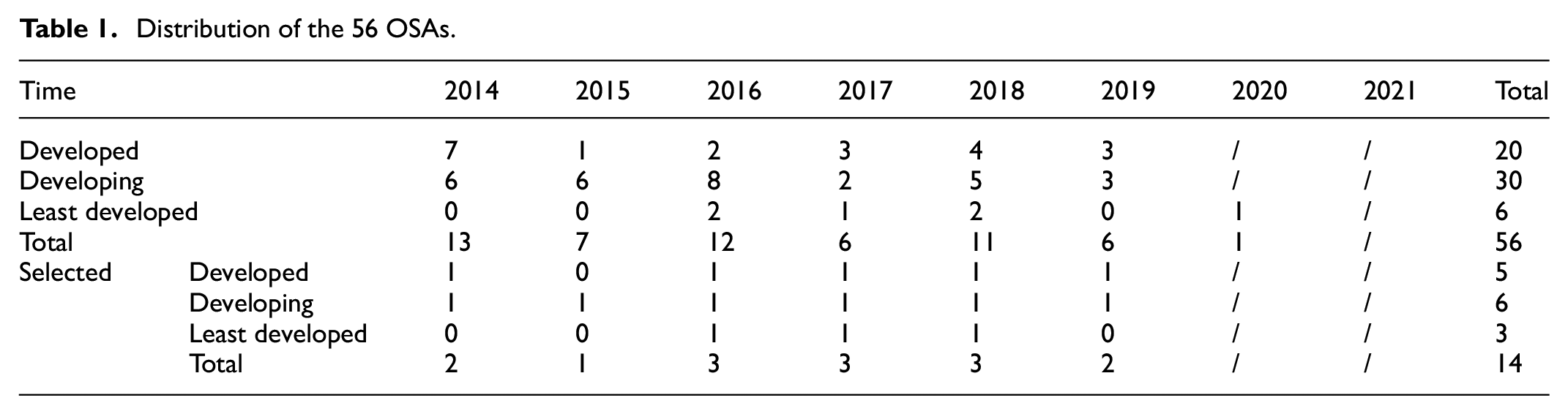
Table 1 shows the distribution of the 56 OSAs. Due to the COVID-19 pandemic since early 2020, offline cross-state visits are substituted by online meetings, therefore, no OSAs are published since then. Among the 56 OSAs, 14 were selected for detailed analysis given their distribution of publication date and country groupings (developed, developing and least developed countries according to the latest UN Human Development Report in 2010) to ensure the representativeness of the sample, see the “Selected” lines of Table 1. Table 2 displays the basic information of the 14 OSAs. All clauses in each OSA of two languages are analyzed, resulting in around 2,817 clauses (Chinese: 1,477; English: 1,340) in total.
Distribution of the 56 OSAs.
Data Overview of the 14 Selected OSAs.

Analytical Procedures
All the clauses of both Chinese and English OSAs in this corpus are annotated through UAM CorpusTool 3.3, a specialized analytical tool for SFL, and retrieved by AntConc 3.5.8, a concordance tool. The clausal analysis is manually done based on the description of the AGENCY system in Chinese (Halliday & McDonald, 2004; E. S. Li, 2007) and English (Halliday & Matthiessen, 1999, 2004). The coded elements include voice (middle/effective, operative/receptive) and Agent (China/the country of visit/both sides). The analysis of each clause was double checked by other two scholars familiar with both languages and SFL to ensure accuracy.
Results and Discussion
In this section, Chinese OSAs and their English translations are thoroughly analyzed in relation to the system of AGENCY and images thus construed. The reasons why differences emerge in both linguistic patterns and images projected across languages are explored from both linguistic and contextual perspectives.
A Quantitative Profile
Xi’s 14 OSAs in both Chinese and English were analyzed in UAM CorpusTool 3.3 regarding AGENCY. The results are automatically summarized, including the review and proposal sections of each OSA. Table 3 outlines the overall number and proportion of middle and effective clauses in both versions across two sections. For the ratio of middle and effective clauses, regarding different languages, English translations use more effective clauses (74%) than Chinese originals (64%). In terms of different sections, except the review section of Chinese OSAs where middle (46%) and effective (54%) are relatively balanced, the others are dominated by effective clauses. Furthermore, within all the effective clauses, receptive ones used in both Chinese and English OSAs, across both sections, are negligible compared with operative clauses (1%:63%; 8%:66%). Distributionally, the review section has far more receptive clauses than the proposal in both languages (14:1; 88:13). And interlingually, receptive clauses are more frequently used in English OSAs (n = 101) than in Chinese ones (n = 15). One of the reasons may be that passive voice can create a sense of emotional distance between the reader and the narrative, and fosters objectivity in English (Baratta, 2009), therefore in historical recounts in the review section, respective clauses are more frequently adopted in its English translations. However, in Chinese, receptive clauses are usually used to express undesirability and adversity (C. N. Li & Thompson, 1989), and thus uncommon to be seen in future prospect of such diplomatic discourse, but may appear in the description of difficulties and drawbacks experienced in the review.
Middle and Effective Clauses in Two Versions of OSAs Across Sections.

Figures 3 and 4 shows more detailed data of each OSA in time order. Generally, no particular raising or falling trends can be found diachronically, but there are interesting patterns across languages and sections. As presented in Figure 3, in the review section, the ratio of middle clause in Chinese OSAs generally outnumbers that of the English versions, and fluctuates more vigorously (between 20% and 70%) than their English translations (between 20% and 50%). Furthermore, Chinese OSAs published in Australia (61%), Czechia (53%), Germany (70%), Portugal (51%) and France (55%), which are all developed countries, are presented as peaks in the line, demonstrating that the proportion of their middle clauses exceed effective ones (middle > 50%). As for the other OSAs, the opposite is revealed. English translations of the review section take on a consistent feature where all the OSAs favor effective clauses (middle<50%). In the proposal section (see Figure 4), the trends of middle clauses in Chinese and English OSAs basically coincide, indicating that effective clauses in OSAs of both languages dominate, taking up more than 70% for each (middle <30%).
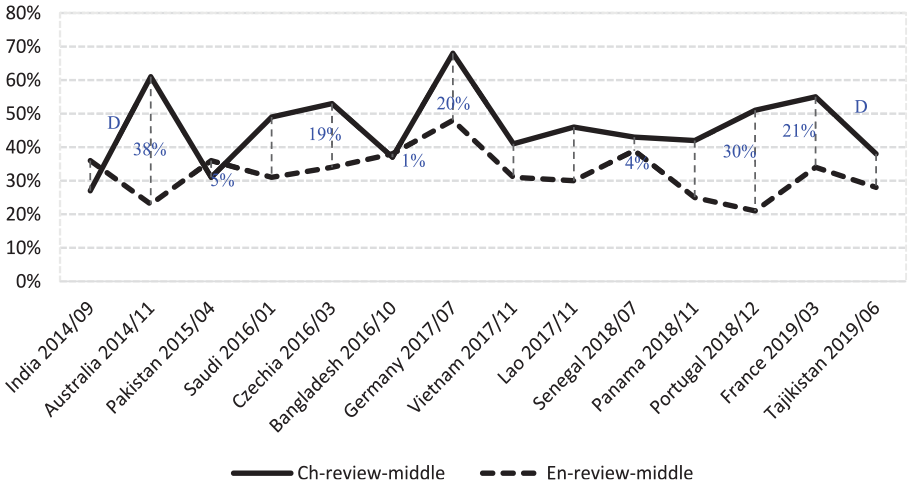
Middle and effective choices of AGENCY in the review section in Chinese and English OSAs.

Middle and effective choices of AGENCY in the proposal section in Chinese and English OSAs.
In terms of the Agent, China and the country of visit (CV)—either implicit or explicit—dominates in OSAs of both languages. China-related Agents (C), in a similar vein, generally surpass that of the country of visit (V) (see Figures 5 and 6), revealing a more active image of China and Chinese government compared with other nations, be it developing, least developed or developed countries.

Specific Agents in 14 Chinese OSAs across two sections.

Specific Agents in 14 English OSAs across two sections.
To conclude, except the review section of five Chinese OSAs published in developed countries, effective clauses greatly overcount the middle ones. Events are construed more as other-caused actions than self-engendered happenings, construing a general image of participants that is more active and responsible (Yu & Wu, 2018).
China’s Image Construed in Chinese and English OSAs
Review Section
Retrospecting Bilateral Ties
A detailed analysis of the data presents that when reviewing the historical relationship between China and the country of visit, more events are described as happening by themselves in Chinese version of OSAs published in developed countries, whereas more agentive roles are assigned to both sides in developing and least developed countries. However, events in English OSAs are construed more as caused by outside Agents constantly across all countries (see Figure 2). Excerpts (Ex. for emphasis) from OSAs of two languages are displayed, with an additional literal translation within quotation marks when the two are divergent in Agency. For sample selection, the Difference (D) between Chinese middle and English middle is considered (see dotted lines in Figure 2). As for OSAs published in developed countries, the top three is chosen, that is, Australia (D = 38%), Portugal (D = 30%) and France (D = 21%), because they represent the most frequent shifts in Agency (from Chinese middle to English effective). But for that in developing and least developed countries, the bottom three is adopted, that is, Bangladesh (D = 1%), Senegal (D = 4%) and Pakistan (D = 5%), since they indicate the least frequent shifts in Agency.
Australia
“China-Australia contacts at both the top and other levels are close, and the political mutual trust continues to deepen./China-Australia achievements in practical business co-operation are fruitful, and the converging interests continues to deepen./ China-Australia cultural exchanges is flourishing, and the friendship continues to deepen” “Australian premium dairy, meat and wine increasingly display on the dining tables of Chinese people.” Meanwhile, the premium dairy, meat and wine products of Australia are increasingly served at the dining tables of Chinese households.
Portugal
“…but the friendship between the two peoples dates back to ancient times and has grown stronger with the passing of time.” …our peoples have forged an enduring friendship dating back to antiquity. “China’s blue and white porcelain sailed across the ocean to Portugal, combined with the local porcelain-making technique, and established unique ‘Portugal blue.’” China’s blue and white porcelain, which was first shipped to Portugal centuries ago, inspired a fusion of Chinese and local techniques, producing a unique form of art Azulejo.
France
“The steps of two countries’ relationship get steadier./The cake of two countries’ common interest makes bigger and bigger./The foundation of two countries’ friendship continues to deepen.” “Such friendship comes from the long-standing friendly ties between China can France, and comes from the closeness between our peoples based on mutual respect and trust.” Such friendship is rooted in the long-standing friendly ties between our two countries, and reinforced by the closeness between our peoples with mutual respect and mutual trust.
Chinese OSAs published in developed countries in Ex. 1 to 6 are unfolded through agentless clauses: 政治互信/利益交融/友好情誼加深(political mutual trust/ converging interest/friendship deepens), 澳大利亞的產品擺上餐桌(Australian products display on the dining tables), 中國青花瓷漂洋過海(China’s blue and white porcelain sailed), 關係穩健(relationship gets steadier), 蛋糕越做越大(cake makes bigger). All the events are construed as self-engendered without external force.
As an alternative for highlighting the do-ers, the achievements made in the past between China and developed countries are emphasized by using middle clause in Chinese language, taking minimum responsibility. Construing events as happenings by themselves instead of two governments as external Agents pushing hard their relations, shows Chinese traditional virtue of modesty and claiming no credit for self after achievements done, making the relationship naturally connected rather than artificially established by an external force. In this way, an image of China that has relatively equal status with developed countries instead of an obsequious one is thus construed through linguistic choices.
In contrast, the English OSA do not follow the Chinese way of expression by using middle voice, but either add agentive roles like “China and Australia,” “our peoples” and “we” (Ex. 1, 3, 5), or transfer it into effective-receptive clause in need of an external Agent (Ex. 2, 4, 6). This shows a more active, responsible and competent image of both countries in building up diplomatic ties. It could also be a linguistic approach to construct solidarity and pull closer the emotional distance between China and the country of visit.
Bangladesh
More recently, having endured repeated wars and incessant poverty, our peoples fought tenaciously for national independence and liberation, strove for development and progress and forged unshakable trust and friendship in the process… Since the establishment of diplomatic ties 41 years ago, China has always regarded Bangladesh as its true friend and partner for development. China highly values its relations with Bangladesh. We firmly support each other on issues concerning each other’s core interests.
Senegal
China supports Senegal in choosing a development path in line with its national conditions and Senegal firmly supports China on issues concerning China’s core interest. The rural water supply project that includes 251 wells and 1800-kilometer pipelines funded by China will benefit one seventh of Senegal’s population.
Pakistan
Over a long period of time, China and Pakistan have conducted all-round, mutually beneficial and fruitful cooperation in various fields, bringing tangible benefits to the people of both countries. At present, the two sides are working together to steadily advance the China-Pakistan Economic Corridor. We have always respected, understood and supported each other on issues concerning our respective core interests.
For OSAs published in developing and least developed countries in their Chinese version in Ex. 7 to 12, Xi reconstrues the events as being caused by external Agents, that is, “中孟兩國人民(peoples of China and Bangladesh),” “中方(China)” and “塞方(Senegal),” “中巴兩國(China and Pakistan),” “兩國(two countries),” focusing on the friendship built through similar struggles for independence in the modern history, their mutual supports and aids, and their efforts made domestically and globally. The images of China here construed are active, responsible and competent by ascribing more agentive roles to both sides, emotionally seeking for common grounds.
Their English versions also choose effective voice with explicit Agents accurately translated as “our peoples,” “China,” “we,” “China and Pakistan,” “the two sides,” regardless of the operative or receptive (Ex. 10). But English versions use more explicit Agents, reinforcing the causes (like Ex. 8, Chinese original uses 1 Agent “中國” while English translation uses 3 “China,” “China” and “we”). Therefore, the active, responsible and competent images of China are more impressive in English versions.
For complement, the system of TRANSITIVITY is also examined concerning their process types. The data reveal that relational (being) process occurs more frequently in Chinese OSAs published in developed countries, whereas material (doing) process in developing and least developed countries. However, all of the English OSAs are dominated by material process. For instance, in Ex. 3 and 5, the clauses are relational in Chinese, but shifted into material in English with Theme-Agents “our people” and “we” textually prominent. The different choices of process types construe different experience, one (relational) through states of being, focusing on the results or achievements realized out of the relationship, and the other (material) in terms of material actions, highlighting the process or efforts made for building and enhancing the relationship. The “being” process creates a distanced depiction of events (Lukin et al., 2004). Such semiotic distance may enhance the impression of long history and rich culture of two countries (i.e., China and developed countries). The “doing” process, on the other hand, shifting the history which modern people never experienced into a more realistic scene, enhancing their historical engagement among audiences (i.e., China and developing and least developed countries).
Voicing China
In the review section, as a way of voicing and branding China, there will always be lines introducing what China has done, is doing or will do in contributing to domestic and global development, see Ex. 13 to 15.
Vietnam
“Last month, the Communist Party of China (CPC) successfully held its 19th National Congress. This congress drafted the overall guidelines and program of action for the future development of the party and the country…By 2020, will complete the building of a moderately prosperous society in all respects… from 2035 to the middle of this century, develop China into a great modern socialist country that is prosperous, strong, democratic, culturally advanced, harmonious, and beautiful.”
The Communist Party of China successfully held its 19th National Congress last month. Overall guidelines and program of action were set out for the future development of the party and the country…Our plan is to complete the building of a moderately prosperous society in all respects by 2020… and develop China into a great modern socialist country that is prosperous, strong, democratic, culturally advanced, harmonious, and beautiful by the middle of this century.
Czechia
People in China are now striving to complete the building of a moderately prosperous society in all respects, advance towards the “two centenary goals” of development (i.e. to double 2010 GDP and per capita income and finish the building of a moderately prosperous society in all respects by the time the CPC celebrates its centenary in 2021 and to turn the PRC into a modern socialist country that is prosperous, strong, democratic, culturally advanced and harmonious by the time it celebrates its centenary in 2049) and realize the Chinese dream of national rejuvenation.
Pakistan
The Chinese people are working toward the Chinese dream of great national rejuvenation. It is a dream about peace, development and win-win cooperation. What we pursue is not just the interests of the Chinese people, but also the common interests of the world people.
In these Chinese excerpts, almost all the clauses are effective-operative, with “CPC,” National “congress,” “the Chinese people” and other implicit China-related subjects as external Agents, actively holding, drafting, completing, building, developing, striving, advancing and realizing, thus creating an active and competent image of Chinese government. Though in Chinese, the Theme-Agent in declarative clause is often omitted as presenting the goals of different stages in Ex. 13, it is easy for Chinese audiences to distinguish from the co-text and context that it is the Chinese government as Agent to implement all the activities. The omitted Agent in these clauses can be “我們” (exclusive “we”) or “中國政府” (Chinese government), excluding the Chinese audience. Such a linguistic choice, that is, leaving the Agent implicit, can play a role in downsizing the distance between the author (Xi Jinping) as President and the reader as Chinese general public, and the distance between the Chinese government as governing body and the common people being governed (Yu & Wu, 2018). By removing the distance (Ex. 13) and explicitating the Agent “中國人民 (People in China)” (Ex. 14) through covert grammatical operation, the Chinese audience would feel involved in such a great course, supporting and contributing to the tasks enacted by the government. Meanwhile, a sense of confidence and inclusiveness arise spontaneously.
The English version is aiming at introducing China’s main work done and to be done in realizing “Chinese dream” and making China’s voice heard. Hence, a long explanation is added for “two centenary goals” in brackets in Ex. 14, clearly introducing Chinese government’s work to foreigners. In a similar vein, in Ex. 13, the middle clause (relational process) is adopted (“our plan” as Token) to give information instead of material action for command. In Ex. 15, when introducing what is Chinese dream, Xi’s words “我們追求中國人民的福祉,也追求各國人民共同的福祉 (we pursue not just the interests of the Chinese people, but also the common interests of the world people),” which is a material process with “we” the Chinese people as Agent, shifts into a relational process in the English translation (“What we pursue is…”). “We” and “our” here are exclusive, excluding the foreign addressee(s), meaning “I+ my group,” referring to Chinese government and Chinese people. The exclusive “we” represents a way of distancing, both from the hearer and from what the speaker is saying, and it is normally associated with power (Inigo-Mora, 2004). Therefore, the target reader of English OSAs, that is, foreigners with different cultural background, is viewed as outsiders, or the Other, who are unfamiliar with but interested in China out of curiosity, suspicion or even competition (Yu & Wu, 2018).
Proposal Section: Initiating Plans
As can be seen in Figure 3, effective clauses take dominion over the middle in both Chinese and English versions. In the proposal section, Xi presents future prospects, calls for collaborative efforts in varied facets, offers specific approaches and raises expectations. Excerpts from OSAs published in three countries representing different country groupings, that is, France (developed country), Pakistan (developing country) and Bangladesh (least developed country) are presented below, since there is no dramatic shifts of Agency from Chinese to English across countries.
Pakistan
—— —…We need to enhance strategic coordination, deepen practical cooperation and work together for common development. We will build the China-Pakistan community of common destiny and set a fine example for such efforts by China and its neighbouring countries. —China and Pakistan need to align economic and trade strategies more closely to deepen economic interdependence. The China-Pakistan Economic Corridor is located in where th
France
A strong sense of responsibility. What has happened in the past 55 years shows that China and France, working together, could make a difference. At a time when humanity stands at a critical juncture of development, major countries must rise to the challenge. China and France are both permanent members of the UN Security Council. China hopes to strengthen coordination with France to safeguard multilateralism and uphold the basic norms governing international relations as underpinned by the purposes and principles of the UN Charter. We need to join hands to tackle challenges, promote global prosperity and stability and build a community with a shared future for mankind.
Bangladesh
— We need to enhance South-South cooperation for common development. China stands ready to offer more assistance and support to Bangladesh to the best of its capability, enhance mutual assistance and cooperation with Bangladesh in areas such as disaster prevention and mitigation, vocational training, medical and health care services, climate change and women and children…
Generally, all clauses in the three excerpts, both Chinese and English, are effective-operative. Unified form of “我們要 (we need to)” appears in almost all the items in the proposal section. The plans are proposed by Xi Jinping, but with Theme-Agent inclusive “we” referring to both sides, assigning agentive roles to two countries and drawing closer the relationship. Taking a form of suggestion, it positions itself between an offer and command. Both versions in the proposal section reconstrue Chinese government as an active initiator, positively seeking cooperation with the country of visit for win-win results, contributing globally (Ex. 17 “promote global prosperity and stability”) rather than locally or regionally. The vision of major-country diplomacy with distinct Chinese features is clearly shown in the proposal, emphasizing political metadiscourse like the initiative of “Belt and Road” and the concept of “community with a shared future for mankind” (Ex. 16 and 17). The OSA, voicing through the head of state, promotes China’s discursive power and emphasizes the great influence of Chinese philosophy, Chinese vision and Chinese approach (Sun, 2018) in dealing with global issues.
Additionally, a responsible and humanistic image of China is also reconstrued. In Ex. 18, “中方 (China side),” an explicit Agent, acts as a generous helper, offering “assistance and support.” Actually, in OSAs published in least developed countries, such phenomenon frequently occurs through ascribing more agentive roles to Chinese government in helping them in a number of ways. Therefore, Xi attempts, in his OSAs, to build an image of China or Chinese government as the builder of world peace, contributor of global development and defender of international order (Xi, 2019).
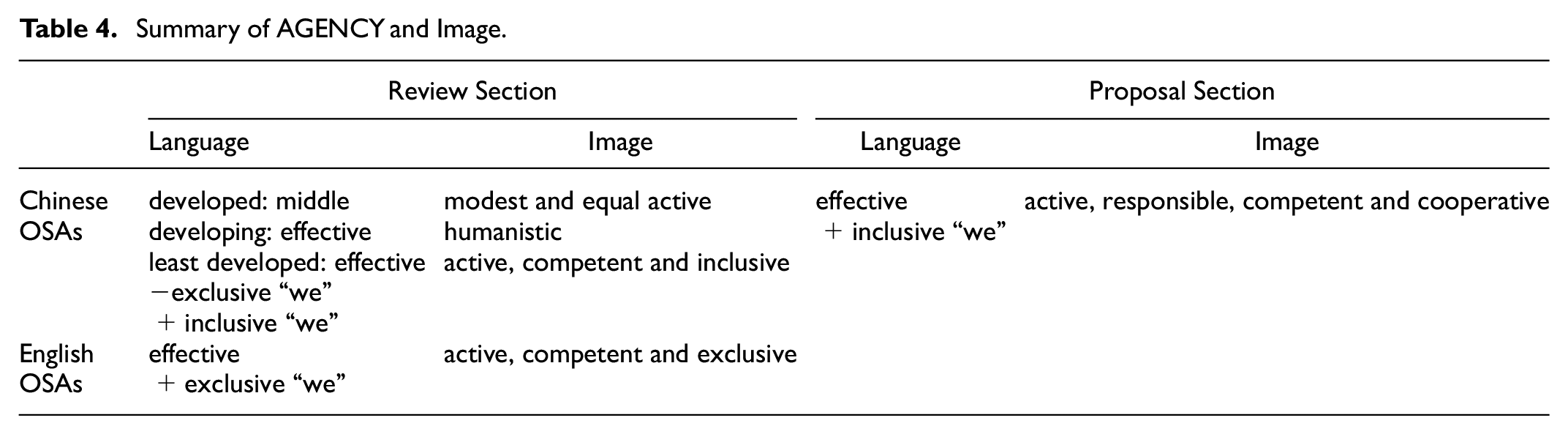
Table 4 summarizes the linguistic patterns and image shifts for both Chinese and English OSAs across two sections (+stand for addition; − stand for omission).
Summary of AGENCY and Image.
Reasons for Different Patterns and Images
The discussion above cannot be concluded that such particular grammatical structures (i.e., more effective clauses in English translations than in Chinese source texts) are deliberate choices of the translator. Whether the difference (i.e., the shift from Chinese middle to English effective in OSAs published in developed countries) lies in the internal linguistic restrains of two languages, or divergent cultural context needs to be further examined in this section.
Linguistic Restrains
To start with, linguistically, Chinese middle clauses can by and large be translated into English middle. For instance, in Ex.1, “根基不斷加深” can be faithfully translated as “The foundation continues to deepen,” in which no linguistic restrictions prohibit such use in English. And the addition of external Agent “we” is not obligatory. Actually, a great number of middle clauses in Chinese are translated as middle ones in English OSAs, for example in Table 5.
Examples of Chinese Middle Shifted Into English Middle.

Another factor influencing the shift from Chinese middle to English effective in translation might relate to stylistic features. Is there any possibility that the genre of OSAs by state leaders in English language favor effective clauses, especially in the review section? To uncover this mystery, a comparison of OSAs by native English language leaders and Xi’s OSAs shall be made. Barack Obama (2011), former president of the United States has published an OSA on Financial Times before a coming G20 summit, which is similar in terms of genre and register. The data are shown in Table 6.
Distribution of Middle Clauses in Review and Proposal Section in English OSAs.

As revealed in Table 6, Obama’s original English OSA employs extremely more middle clauses in the review section (90%) and relatively less in the proposal (29%). But as previously illustrated, Xi’s translated English OSAs use much more effective clauses in both two sections. Such difference justifies the consideration that the motivation behind the grammatical shifts relates more to context than to linguistic restrains and style. The next section will focus on contextual impacts.
Contextual Factors
From the above, we know that contextual factors play a larger role in explaining the difference. In SFL, three strata are contained in context: register, genre and ideology (Martin, 1992). Register includes three parameters, that is, field (the activity that the speaker or writer participate in), tenor (the relationship between participants) and mode (the medium of communication) (Halliday, 1978). In this study, field can be specified as the aim of publishing the OSA; tenor is the relationship between the author or translator and the intended audience of the OSA; mode is written language; genre is the OSA, and ideology is that within Chinese society and culture.
China’s relations with the rest of the world are undergoing profound and momentous changes. On the one hand, according to Xi, since 1949 China had experienced a historic rise from standing up, growing rich to getting strong (從站起來, 富起來到強起來的歷史性飛躍). The bright prospects for its great rejuvenation have opened up and China has unswervingly joined the ranks of major countries in the world. On the other hand, the report of the 19th National Congress clearly defines that China is still in the primary stage of socialism. Since the founding of New China, the CPC has been handling the three issues of “being beaten, being starved and being scolded” (挨打, 挨餓, 挨罵), the first two of which have already been solved bit by bit, while the third one is now the toughest to tackle in the somewhat hostile international atmosphere. Chinese government is striving to display a prosperous, strong, democratic, culturally advanced and harmonious national image of China both domestically and internationally.
As an initial step heading toward the ultimate goal of publication in foreign media, the Chinese OSA is composed for translation by members of the CPC and government officials, with President Xi Jinping finalizes and signs the articles, targeting at the general public in the country of visit, but with the actual receivers as Chinese citizens. Therefore, the Chinese OSA is mainly for domestic publicity. Since the Chinese government is putting more efforts on domestic ideological construction in these years, 6 the discourse producer of Chinese OSAs is seeking approval from the intended Chinese audience (Yu & Wu, 2018) and attempting to guide them unswervingly follow the path of socialism with Chinese characteristics. The discourse producers and the targeted audiences generally share the same history, tradition and cultural background. The inclusive “我們 (we)” (referring to China and the country of visit) in OSAs may leave the Chinese audience a sense of inclusiveness for its splendid and struggling history, developed and prosperous future, narrowing the distance between the author and audiences. For OSAs published in developing and least developed countries, in reviewing similar backward modern and contemporary history of both countries, Xi reconstrues China’s image as active and competent, arousing sympathy, patriotism and confidence among Chinese audiences. But for that in developed countries, a modest and equal image is construed because modesty is a good virtue deeply rooted in Chinese culture, and equality between China and developed countries can elicit the confidence of Chinese people in its chosen path, guiding theories, political system and culture 7 since Chinese people normally have the inferior self-image when compared with developed countries. Such expressions in the OSAs may help build a community of Chinese nation, working together for common prosperity and development.
The English OSA is translated by specific translation team, involving experts from the Ministry of Foreign Affairs and in-house translators, which imposes strict political and ideological requirements on translation, aiming at mass-medialization to voice China. Although there has been growing coverage of China in the international media, the image of China is generally unfavorable or even negative (Fang, 2018; Z. Peng, 2004; Xiang, 2013). Currently, a scholarly consensus is reached that the pursuit of positive international image is a significant part of Chinese foreign policy (Kopra, 2012). China’s concern for “favorable international image as a responsible major power is a critical variable determining the cost-benefit analysis behind international cooperation” (Johnston, 1998, p. 559). Since China’s 18th National Congress of CPC in 2012, President Xi has paid highly attention to the national image-building and China’s international discursive power construction, and has emphasized on the capacity building of international communication of Chinese discourse through telling China’s stories and spreading China’s voice on different occasions (Xi, 2013a, 2013b, 2014, 2016a). As Kopra (2012) demonstrates, the so-called Century of Humiliation (1839–1949) and the unfair dispossession of China’s status as the most sophisticated civilization in the world is considered central to Chinese national identity. Therefore, China is expecting to be recognized in the international stage as its desire to restore the state’s respectable status internationally (Yu & Wu, 2018). And that may explain well the reason why English OSAs are trying to reconstrue China’s national image as active, responsible and competent.
For another, President Xi proposed major-country diplomacy with distinctive Chinese features at the Central Conference on Work Relating to Foreign Affairs in 2014. That is why Xi’s OSAs started from that year, “the first year of China’s major-country diplomacy.” This policy underlines its important role in building a community with a shared future for mankind. China’s strategy for major-country diplomacy includes building new form of international relations with developed countries based on mutual respect, fairness, justice, and cooperation for mutual benefit, strengthening its relations with developing countries through “Belt and Road” initiative, and enhancing a neighborhood community with a shared future guided through the principle of “friendship, good faith, mutual benefit and inclusiveness.” This explains exactly the active role of China in English OSAs in initiating such innovative diplomatic ideas. China and Chinese government as the initiator possessing the most agentive roles in clauses in introducing China’s efforts and encouraging win-win situation and further cooperation is thus rationalized. Xi’s innovation in publishing OSAs can be one of the ways to display the real image of China, construing China as a civilized, active, competent and responsible socialist country standing in the East (J. Wen, 2016).
Conclusion
This study investigates China’s image construed in President Xi Jinping’s OSAs and their English translations through linguistic choices within the system of AGENCY and other interactive linguistic systems in SFL. By analyzing both Chinese and English OSAs in a self-established diachronic parallel corpus, a distinctive pattern of AGENCY in two languages are found. For English translations, effective clause prevails middle ones in both review and proposal section, whereas for Chinese texts, patterns of the two sections are not consistent. In the review, the middle outnumbers the effective in OSAs published in developed countries, but the situation is reversed in developing countries. In the proposal, effective clause dominates across all OSAs. As for the image of China construed through Agency, regarding the proposal, both the Chinese and English OSAs project an active, responsible, competent and cooperative image. However, in the review, a modest, equal and inclusive images in Chinese OSAs published in developed countries shift into active, competent and exclusive in their English translations. For Chinese OSAs published in non-developed countries, both versions show an active and competent image, but there is a shift from inclusiveness to exclusiveness when voicing China in the review. Instead of linguistic constrains, contextual considerations account more for the differences in grammatical patterns and images construed in OSAs of two languages. Specifically, Chinese government’s strong desire to voice China and restore its favorable image in the international stage drives the translation practice of OSAs to shift in such a distinctive way. This study, therefore, proves that national image can be purposefully constructed through translation in internationalized and mass-mediatized activities.
However, limitations still exist. For example, only 14 samples (Xi Jinping’s OSAs) are selected for analysis instead of the whole corpus, and due to limited resources collected, only one sample (Barack Obama’s OSA) is chosen for comparable data. A comparable corpus can be established to strengthen the argument. Moreover, investigations into the interpersonal and textual perspective of the same date can be further reached, for example, mood and modality, personal pronouns, cohesion and coherence, information pattern, etc. It should also be noted that the Xinhua Net and People Net has established several official databases related to President Xi Jinping’s political discourse in Chinese language, like the database of Xi’s keynote speeches, his published books and correspondences. The self-established corpus of Xi’s OSAs could contribute to the database and these are all resources for political discourse analysis. Correspondent English translations of Xi’s other types of discourse could be collected for similar studies to reveal the general linguistic style of President Xi Jinping.
Footnotes
Declaration of Conflicting Interests
The author declared the following potential conflicts of interest with respect to the research, authorship, and/or publication of this article: This is to acknowledge any financial interest or benefit that has arisen from the direct applications of your research.
Funding
The author disclosed receipt of the following financial support for the research, authorship, and/or publication of this article: Undergraduate Teaching Reform Research Project (22BYDSZ05) and Postgraduate Education Comprehensive Reform Research and Practice Project (22XWYJGA28).
