




Abstract
This study provides a bibliometric analysis of political discourse in translation studies based on the Web of Science (WoS) database from 1990 to 2020. It adopts a guiding procedure integrating the Preferred Reporting Items for Systematic reviews and Meta-analyses (PRISMA) guidelines into the bibliometric standard workflow and using VOSviewer as the visualization tool. With the help of the built-in WoS analysis tools, the annual publication trends and the most influential productive countries are examined. VOSviewer is used to explore the influential sources in the field, research themes, cited references and their intersections with other references, cited sources and their links to other sources, and most frequently cited authors. The co-occurrence analysis of keywords distinguishes eight research themes, namely, linguistic analysis, ideology and manipulation, power embodied in political communication, interpreting and critical discourse analysis (CDA), the recontextualization of political discourse in media discourse, diplomatic translation, the representation of political speeches in news translation, and conflict and politics. The co-citation analysis of the cited references focuses on discourse analysis models, research approaches, and theoretical frameworks. The co-citation of sources suggests that interdisciplinary features characterize political discourse translation studies, interacting with other disciplines through fields such as pragmatics, discourse analysis, and communication research.
Keywords
Introduction
The development of contemporary international relations and the varied demands of national interests have deepened the function of political discourse translation. The reception of political discourse in different cultures has complex socio-political, socio-cultural, and socio-ideological implications, essential for analyzing political discourse and translation studies (TS).
In the past two decades, a growing body of literature on the translation of political discourse has emerged from a linguistic point of view. An essentially text-centered perspective explores in what ways the source text (ST) and the target text (TT) are textually not equivalent (Baumgarten & Gagnon, 2005; Calzada-Pérez, 2003; Schäffner, 2003). The subsequent political need to relate to the communicative and pragmatic effects of the translated political discourse has inspired numerous CDA studies (Hatim & Mason, 1990, 1997; Schäffner, 1997, 2003, 2004a, 2004b; Valdeón, 2007). Other studies focus on the mediating role of translators and interpreters (Calzada Pérez, 2007; Gu, 2018, 2019a, 2019b; Guo, 2015, 2018; Gu & Tipton, 2020; Tang, 2007).
Hatim and Mason (1997) argue that insights provided by CDA studies contribute to understanding “the way ideology shapes discourse, and the way discourse practices help to maintain, reinforce or challenge ideologies” (p. 119). Schäffner contributes significantly to the study of political discourse analysis from the perspective of translation. Schäffner (2003) examines the English and German versions of the Blair/Schröder document published in June 1999. Applying CDA-related methods and descriptive and functionalist translation approaches, she attempts to link textual features to the social and ideological context of text production and reception. Linguistic choices of ideological words appear to be different in the ST and TT. She attributes these findings to the fact that translators’ decisions at the linguistic micro-level indicate their awareness of ideological implications in different cultures. Schäffner (2004b) further shows that analyzing political discourse from the perspective of translation can shed new light on understanding politics. Using examples, she argues it is hazardous to rely exclusively on the TT without comparing with the ST when discourse analysts comment on linguistic features or its discursive ramifications of translated political texts.
More recently, the corpus-based CDA approach is adopted to explore the intricated interrelation between political discourse translation and ideology. Farhan (2017) explores ideological manipulation in the five English translations of presidential speeches after the Arab Spring based on corpora and from a CDA point of view and proves that collocation, semantic prosody, discourse prosody, transitivity, modality, and lexical cohesion could serve as vehicles of ideological meanings. Gu (2019a) explores the interpreters’ institutional alignment and reconstruction of China’s political discourse and image building on a corpus-based CDA perspective. It is found that the interpreters’ agency and active mediation are proved through the discursive and linguistic means of their mediation through the corpus tools.
Despite the increasing interest in translation of political discourse in recent decades, there are hardly any comprehensive overviews of this field by applying the PRISMA guidelines and bibliometrics using VOSviewer software.
This study aims to collect the literature on the field of political discourse translation from the online WoS database and conduct a comprehensive overview of this field by translating the sparse literature into visual presentations. There are three motivations for precipitating the need to develop a bibliometric study of this field combining the PRISMA guidelines and VOSviewer visualizations. First, apart from collecting and compiling the literature on the topic, a comprehensive bibliometric analysis of the field offers an insightful outlook on future research by highlighting its key topics and research trends; second, the student researchers and novice researchers are confronted with the challenge of identifying influential research literature. VOSviewer is used as a visualization tool to examine research themes, cited references and co-occurrences of keywords. The network visualizations are helpful for researchers to recognize the research gaps in the large and growing body of previous literature; third, as with many systematic reviews, the PRISMA guidelines are particularly useful when examining a study that seeks to map the field. The PRISMA guidelines developed by Moher et al. 2009) provides guidelines that illustrate the existing evidence in a staged process and improve the transparency and clarity in literature reviews and meta-analyses.
To date, there have been many bibliometric research on social sciences or natural sciences that could underpin the design, method, and analysis of this study. In translation studies, bibliometric methods are of recent development, but they have increased rapidly in recent years. Bibliometrics offers a new perspective that can help promote the development of the field (Rovira-Esteva et al., 2015). Rovira-Esteva and Aixelá (2018, p. 119) regard the dedication of an entire issue of Perspectives in 2015 to bibliometrics as a turning point within TS. In this article, we have searched the literature related to bibliometric studies on TS between 2015 and 2020. Methods used in these studies include getting a historical overview of the discipline (Gile, 2015; Zanettin et al., 2015), focusing on specific topics, such as non-professional interpreting (Martínez-Gómez, 2015), translation criticism studies (Huang & Xin, 2020), identifying the merging trend between Discourse Studies and Translation Studies (Zhang et al., 2015), and examining the international visibility of TS scholars in China’s Mainland (Li, 2015).
These studies not only contribute to the reliability of bibliographic information as research data but show how researchers conduct their studies using bibliometric tools. However, these studies are mainly conducted through counting, such as calculating publication types, keywords, authors, and affiliations. Citation information remains underexplored, except for Li (2015). Bibliometric studies related to co-citation are rare, except for Dong and Chen (2015).
Research Design
Methodology
While the PRISMA guidelines are followed in most systematic literature review, recent studies have begun to integrate analysis software and visualization tools to synthesize the reviewed literature (Almasri et al., 2021; Kalibatiene & Miliauskaitė, 2021; Petersen et al., 2015; Zupic & Čater, 2015). Based on the PRISMA guides developed by (Moher et al., 2009), Almasri et al. (2021) develops a new guiding procedure integrating the PRISMA guidelines into the bibliometric standard workflow and using Biblioshiny, VOSviewer, and NVIVO software as tools. The developed procedure includes four stages (research design, data collection, data analysis, and visualization), as illustrated in Figure 1. This study continues with this line of analysis by combining the PRISMA guidelines and bibliometrics using VOSviewer software.
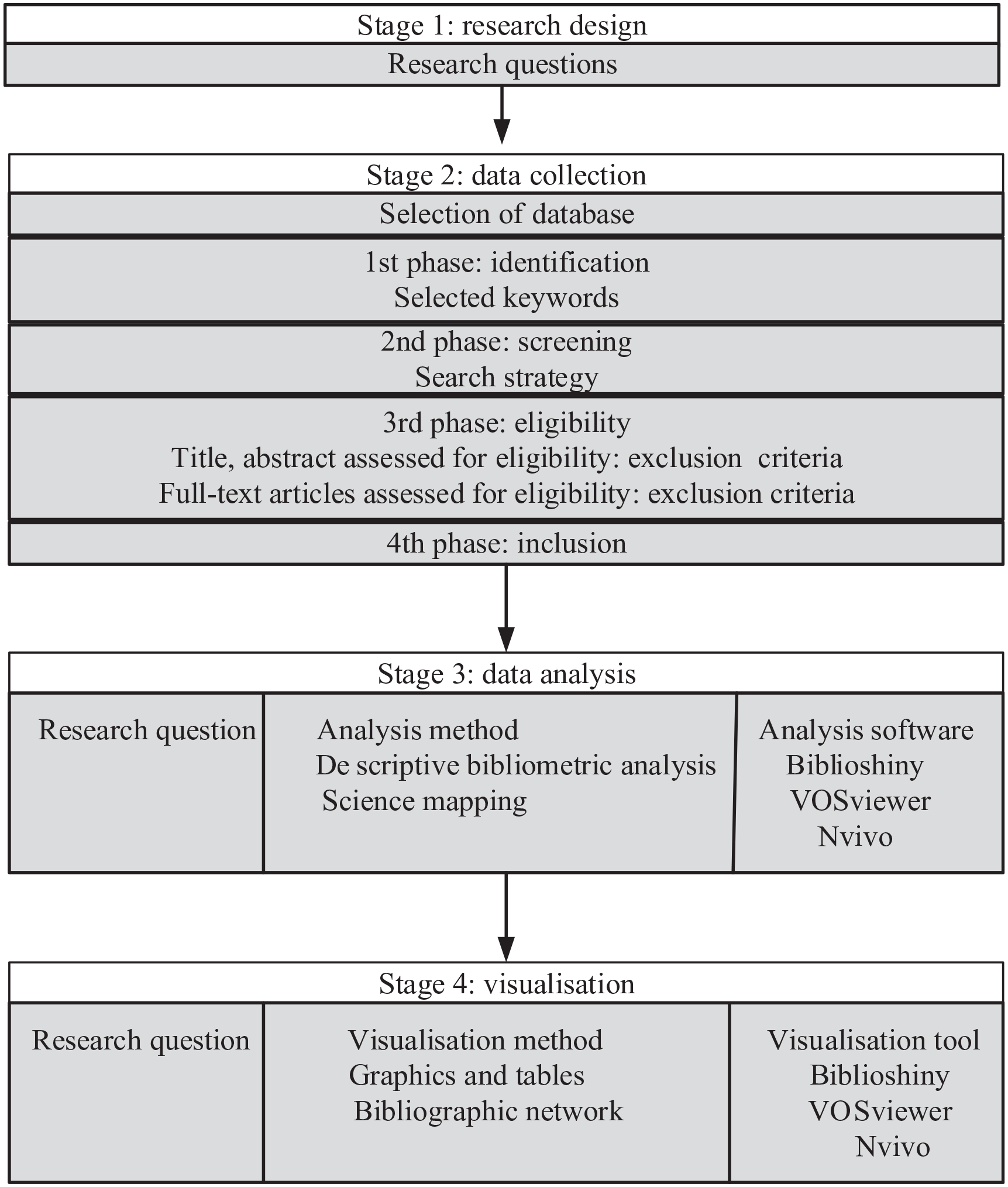
The developed procedure combining the PRISMA guides and analysis software and visualization tools.
Research Questions
The first step for designing this study is to formulate the research questions. Inspired by previous research, this article offers a comprehensive overview of the scientific landscape of political discourse translation based on a bibliometric analysis of data available in WoS. The following research questions (RQs) are addressed:
RQ1: Which countries contributed most to the field of political discourse translation between 1990 and 2020?
RQ2: What are the most influential sources?
RQ3: What are the research themes?
RQ4: What are the co-citation networks of this field?
Data Collection
The second stage is data collection. Figure 2 is the revised PRISMA flowchart that offers a detailed map of the records included for this study. In selecting the publication, the PRISMA guidelines are followed, including four phases: identification, screening, eligibility, and inclusion.

The revised PRISMA flowchart.
It is important to set the inclusion and exclusion criteria for choosing the most relevant articles before conducting data collection. According to the RQs, research design, and the definition of political discourse (Schäffner, 1997), the inclusion and exclusion criteria are specified. Schäffner (1997, p. 119) defines political discourse as “both inner-state and inter-state discourse” which takes different forms, such as “bilateral or multilateral treaties, speeches made during an electioneering campaign or at a congress of a political party, a contribution of a member of parliament to a parliamentary debate, editorials or commentaries in newspapers, a press conference with a politician, or a politician’s memoirs, scholarly article, conference paper, or conference proceeding.” The inclusion criteria are formulated as follows: (1) All journals indexed by the WoS Core Collection are included, (2) The keywords searched should include diverse forms of “political discourse,” such as “political text,” “political speech,” “political oration,” “political meeting,” “political interview,” “press conference,” “political communication,” “diplomatic discourse,” etc., (3) The publication must be a published scholarly article, (4) The publication period covered is from January 1, 1990 to May 8, 2020. The exclusion criteria are as follows: (1) The word “political discourse” and “translation” in the publication are used irrelevantly, (2) The articles have at least five pages, (3) The articles without political discourse translation as research objectives are excluded.
In the identification phase, all articles were collected from the online WoS Core Collection, namely, SCI-EXPANDED, SSCI, A&HCI, CPCI-S, CPCI-SSH, ESCI, CCR-EXPANDED, and IC. In terms of data collection, the keywords used for the record searches were “political discourse*” OR “political text*” OR “political speech*” OR “political oration*” OR “political meeting*” OR “political interview*” OR “press conference*” OR “political communication” OR “diplomatic” AND translation. A total of 176 data records are identified in the first phase.
In the screening phase, the results were refined choosing “article” as the document type by excluding book reviews, proceeding papers, meeting abstracts, conference reports, editorials, and other items. The results were also refined by choosing “English.” The publication period covered is from January 1, 1990 to May 8, 2020. A total of ten data records are excluded in the second phase.
In the eligibility phase, the remaining 166 data records were then assessed for eligibility by full-text reading. The rationale for full-text reading is that the searched keywords for data records happened to be included in the article or mentioned only in the research background. The articles without political discourse translation as research objectives are excluded. In the third phase, four data records were excluded with 155 records included in the final phase.
Bibliometric Information Analysis
After retrieving the data, we performed a general bibliometric analysis of political discourse translation in international journals through WoS’s built-in tool. Next, we loaded the data into VOSviewer (van Eck & Waltman, 2009) to perform citation and co-citation analysis. We first present the annual publication trends and the most influential countries using the automatic visualization of the WoS database. To answer the second research question, we present the citation analysis of sources using the citation function in VOSviewer. In citation analysis, the relatedness of items is determined based on the number of times authors cite each other. The citation analysis of documents is used to evaluate their academic impact on a certain field of study (Lv et al., 2011). The more citations a journal or article receives, the greater its academic influence.
To answer the third research question, we present the network analysis of the keywords co-occurrence downloaded from the WoS database. Many translation scholars have conducted keyword analysis to identify research foci, research areas, development trends, or what the leading edge in translation studies is (Dong & Chen, 2015; Huang & Liu, 2019; Li, 2015; Liang & Xu, 2016; Martínez-Gómez, 2015; Wang et al., 2019; Zanettin et al., 2015; Zhang et al., 2015). However, the co-occurrence of keywords remains understudied, with the exception of Dong and Chen (2015) and Wang et al. (2019). In this kind of analysis, the relatedness of items is determined by the number of keywords in which they occur together.
To answer the fourth research question, VOSviewer was used to conduct the following network and cluster analysis:
① Co-citation analysis to identify the most frequently cited references in this field and their intersections with other references;
② Co-citation analysis of the most cited sources and their intersections with other sources;
③ Co-citation analysis of the most cited authors.
Small (1973, p. 265) introduced co-citation analysis and defined co-citation as “the frequency with which two documents are cited together.” Two documents establish a co-citation relationship when they are cited in another document. Co-citation provides a tool for “monitoring the development of scientific fields, and for assessing the degree of interrelationship among specialties” (Small, 1973, p. 268). Co-citation analysis also provides a historical picture of the emergence of a topic (Suominen et al., 2019).
It is important to note that the relatedness of items is determined based on the number of times they are cited together in the co-citation analysis. According to the parameters in VOSviewer, there are two counting methods. For this study, a full account was chosen. Full counting means that each co-occurrence or each co-citation link has the same weight. Fractional counting means that the weight of a link is fractionalized. For instance, if an author co-authors a paper with ten other authors, each of the links has a weight of 1/10.
Results and Discussion
General Bibliometric Analysis
Figure 3 shows that the first paper on the translation of political discourse was published in 1994 in our data. From 1995 to 2013, articles were published sporadically, suggesting that scholars paid scant attention to the topic. In 2014, however, over ten papers were published. After that, papers on the translation of political discourse received increasing attention and reached a peak in 2018, with 30 published papers.

Annual research output.
Table 1 shows the ten most productive countries. Those contributing to the total collection of 155 papers are listed in the second column, followed by the number of papers in the third column, the percentage of published articles in the fourth column, and the citations received by the country in the fifth column. Authors from the People’s Republic of China and the United States contributed the most papers over the past three decades, each with 16.13% of the 155 papers respectively, followed by the United Kingdom, Canada, Australia, Iran, and Russia, with contributions of 13.55%, 6.45%, 5.16%, 4.52%, and 3.23% respectively. The authors from other countries contributed less than five papers. The People’s Republic of China ranks at the top, indicating that Chinese academics have high international productivity. A closer look at these papers reveals that twenty-three papers are from researchers from China’s Mainland and only two from Hong Kong. This finding does not support the Li’s views (2015), who finds that TS scholars from China’s Mainland have low international productivity based on thirteen examined SSCI- or A&HCI-indexed translation journals between 2005 and 2013.
Top Ten Productive Countries/Territories.
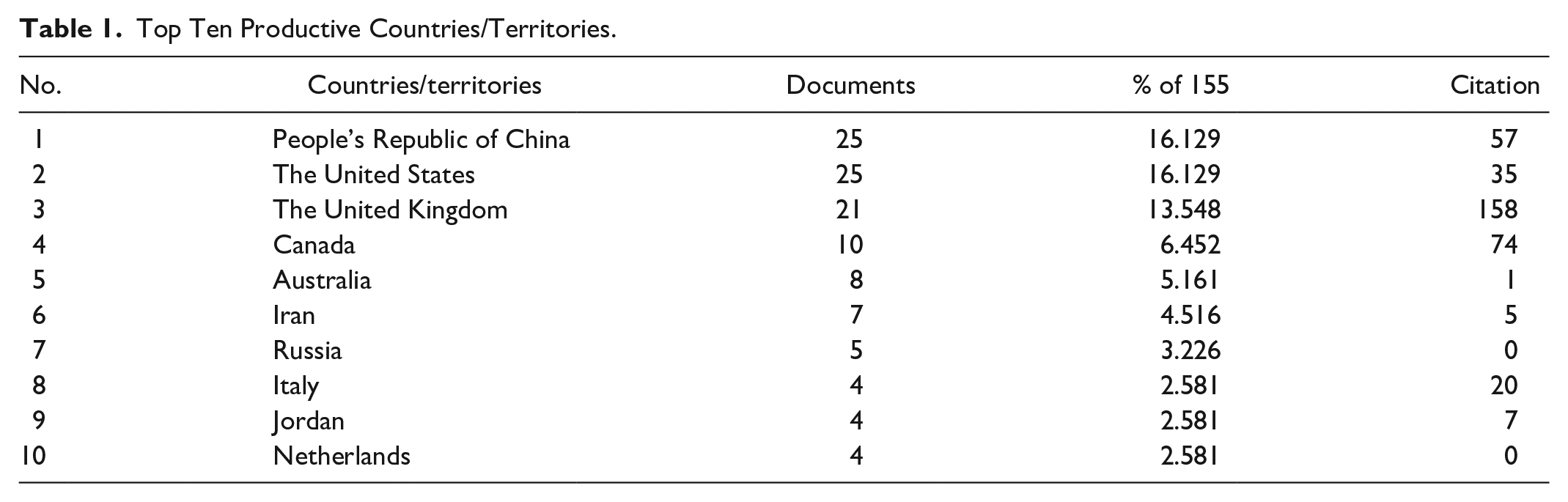
Judging by the origin of the citations, the United Kingdom stands out with 158 citations, followed by the People’s Republic of China, and the United States. Although the United Kingdom and Canada contribute less to this area, papers produced in these two countries are still cited more frequently.
For ease of analysis, it is important to merge the journals with different titles. For example, “Perspectives-Studies in Translation Theory and Practice” and “Perspectives-Studies in Translatology” were placed under the “Perspective” label. A total of 155 articles were published in 110 journals. The minimum number of documents of a source was set to two, and the minimum number of citations to four. Of the 110 journals, we presented the ten most cited journals in Table 2.
Top Ten Sources.

The number of articles and citations are listed in the second and third columns. Based on the number of articles, Perspectives, an internationally renowned TS journal from the UK, ranks first when it comes to cover topics related to political discourse. The higher the citation frequency of an article, the more influential this article is within this field. The filter function of VOSviewer is used to find the most cited article in Perspectives. It turns out that “A corpus-based study of stance-taking as seen from critical points in interpreted political discourse” by Wang and Feng’s (2018) has a total of seven citations.
Meta, the internationally renowned journal from Canada, is ranked second. Wang’s (2012) article “A descriptive study of norms in interpreting: Based on the Chinese-English consecutive interpreting corpus of Chinese Premier Press Conferences” has a total of sixteen citations.
Babel and the Journal of Language and Politics, both from the Netherlands are in third place, with five publications. The most cited article in Babel is Yang’s (2012) “The principles and tactics on diplomatic translation: A Chinese perspective” with eight citations. The most cited article in the Journal of Language and Politics is Al-Hejin’s (2012) “Linking critical discourse analysis with translation studies: An example from BBC News” with six citations.
To determine the influence of a journal, both citations and the number of articles need to be taken into account. According to the citations received, the Journal of Pragmatics, an interdisciplinary journal of language studies from the Netherlands, stands out. Schäffner’s (2004a) article “Metaphor and translation: Some implications of cognitive approach” has a total of seventy-nine citations. Perspectives is second. Target from the Netherlands is third. Schäffner’s (2012) article “Unknown agents in translated political discourse” is the most cited article with nineteen citations.
Co-occurrence Analysis of Keywords
The keyword searches were done in the keywords provided by the authors of the 155 papers. After having merged some keywords, we obtained 758 keywords from a total of 155 papers. For example, the American English “recontextualisation” and the British English “recontextualization” were placed under the “recontextualization” label. “Ideology”. and its plural form became “Ideology”. The minimum number of times of a keyword appears was set to two. We obtained forty-nine keywords from a total of 758, with a threshold value of two. The top fifteen keywords are listed in Table 3.
Top Fifteen Keyword List.

The keyword ideology has the highest frequency (nine), with the exception of the two keywords, translation and political discourse. The keyword ideology is followed by three relevant but different keywords (critical discourse analysis, discourse, and Chinese political discourse), with an occurrence of eight, six, and four respectively. This suggests that CDA issues are the most frequently explored topics in political discourse translation studies. It corroborates what Zhang et al. (2015) had already discovered in their research on the development of a merging area between Discourse Studies and Translation Studies.
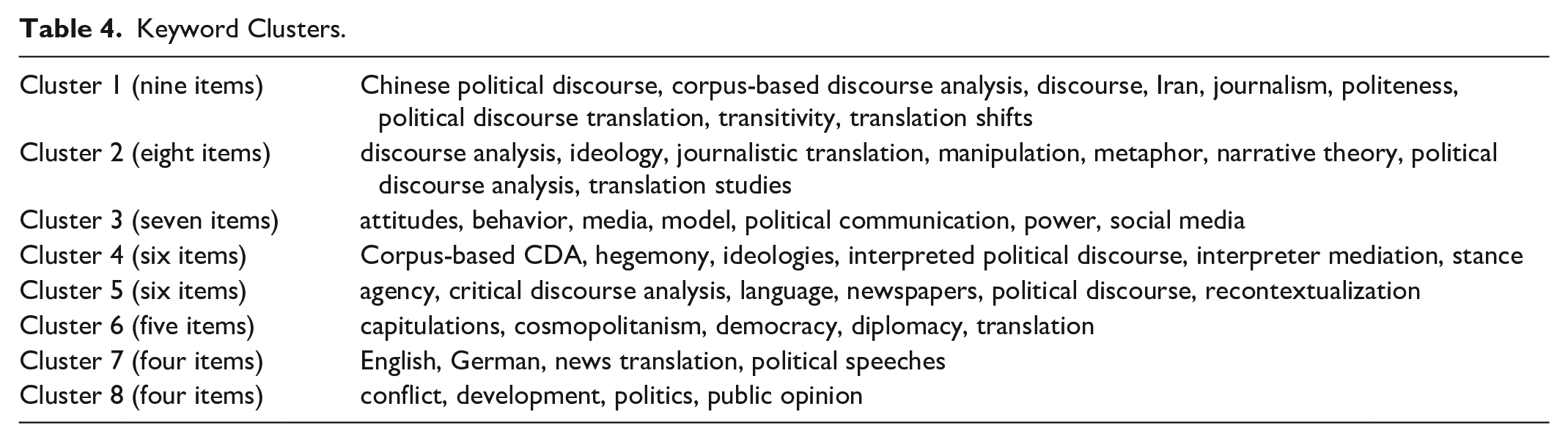
The clustering technique in VOSviewer was done according to “the citation relations between clusters” (van Eck & Waltman, 2017, p. 1063). VOSviewer automatically groups the forty-nine keywords into eight clusters of significant size. In this way, the field of political discourse translation is divided into eight research themes. It is important to note that Table 4, Figures 4 and 5 give the same representation of the keyword clusters while complementing each other. Table 4 presents a full list of eight clusters. In the network visualization of keywords (Figure 4), a node represents a keyword, and the size of the node indicates the frequency of the keyword. In the density visualization of keywords (Figure 5), different colors represent different keyword clusters. The next section focuses on the eight clusters in detail.
Keyword Clusters.
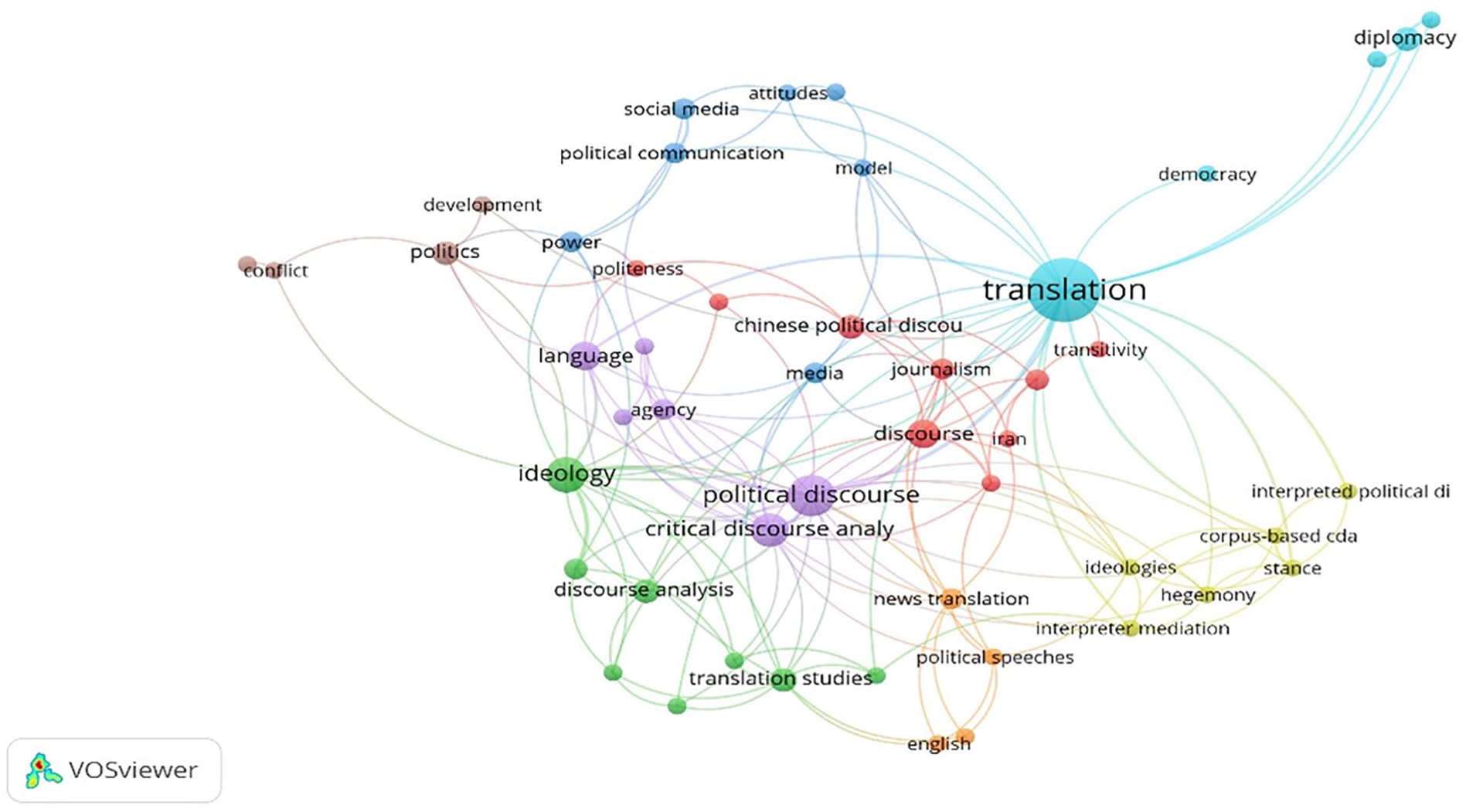
Network visualization of keywords.

Density visualization of keywords.
The red cluster (cluster 1) is strongly related to linguistic analysis, as indicated by the terms transitivity and translation shifts. The research method is both quantitative and qualitative, as suggested by the term corpus-based discourse analysis. The research material used in the analysis of political discourse is related to China and media discourse, as indicated by the terms Chinese political discourse and journalism. Li and Pan’s (2021) study is the latest one, which adopts the perspective of corpus-based discourse analysis to investigate how the image of China is reshaped in the English translation of Chinese political discourse. Based on the Appraisal System and the Ideological Square Model, they argue that the translation shifts detected in the English translation of the appraisal epithets serve China’s interests or its diplomatic principle.
The green cluster (cluster 2) is strongly linked with ideology and manipulation. The research method is primarily qualitative, as suggested by the term discourse analysis. The research theory can also be identified in this cluster, as illustrated by the term narrative theory. The emphasis is on exploring the linguistic realizations of ideology in translation (Puurtinen, 2003) and the extratextual and intratextual aspects of ideology as related to translation (Schäffner, 2003). Schäffner’s emphasis on ideology echoes Hatim and Mason’s (1997, p. 119) distinction between “the ideology of translating” and “the translation of ideology.” Baker’s (2006) Translation and Conflict: A Narrative Account and Calzada-Pérez’s (2003) Apropos of Ideology also touch upon ideology and translation.
It can be argued that the juxtaposition of the terms journalistic translation and political discourse analysis refers to Schäffner and Bassnett’s (2010) exploration of the implicit link between politics, media, and translation in their seminal work Political Discourse, Media and Translation. The juxtaposition of the three terms translation studies, manipulation, and ideology shows that the manipulative power and ideology behind the translation of political discourse has attracted scholarly attention.
The azure cluster (cluster 3) right above Figures 4 or 5 is strongly associated with power embodied in political communication, as suggested by the terms political communication, power, social media, and media. In recent years, the media has promoted political communication across languages, cultures, and boundaries. Its role cannot be neglected in the study of the translation of political discourse. Schäffner (2010, p. 255) believes that political discourse is transmitted in recontextualization processes and argues that “political communication is mediated by translation.”
The yellow cluster (cluster 4) is related to interpreting and CDA, as evidenced by corpus-based CDA, interpreted political discourse, and interpreter mediation. The research method used, in this cluster, is both quantitative and qualitative, as evidenced by the term corpus-based CDA. This synergistic approach highlights that discourse analyses are underpinned by empirical interpreting studies. Wang and Feng’s (2018) stance-taking in interpreting studies is a telling example. Drawing on evaluation theory, they conduct a corpus-based study of how the Chinese government’s stance is interpreted in English translation. Their findings show that the interpreters’ lexical choices reflect the Chinese government’s position on various political and social issues.
The purple cluster (cluster 5) is strongly related to the recontextualization of political discourse in media discourse across languages, cultures, and boundaries, as suggested by the terms newspapers, political discourse, and recontextualization. The research method is primarily qualitative, as shown by the term critical discourse analysis. The data used in the analysis of political discourse comes from the media, as indicated by the term newspaper. A telling example is a study by Kang (2007). To examine how North Korea is (re)constructed in translation, Kang (2007) takes a critical approach to news translations of stories about North Korea published in Newsweek and Newsweek Hankuk Pan (Korean edition) from the perspective of discourse analysis. She finds that the recontextualization of news discourse on North Korea involves “a reformulation of the source text in response to priorities and values relevant within the target context” (Kang, 2007, p. 240).
The acid blue cluster (cluster 6) in the upper right area of Figures 4 or 5 is related to diplomatic translation. This cluster suggests a strong connection between translation and diplomacy, showing that translation is involved in negotiating between states.
The orange cluster (cluster 7) is related to the representation of political speeches in news translation. A detailed reading reveals that the textual analyses are based on observations between English and German, as in Schäffner’s (2004b) study. A recent study calls for multilingual collaboration in news translation, which could deepen our understanding of global news translation (Matsushita & Schäffner, 2018). The brown cluster (cluster 8) in the upper left part of Figure 4 is related to conflict and politics. Small and marginalized as the two clusters, news translation, conflict, and politics, could be the potential topics of political discourse translation in future studies. News reports of conflicts between different nations are of interest to scholars. For example, Haj Omar (2019) conducts a narrative study on media coverage of the Arab-Israeli conflict from 2000 to 2010, and finds that competing narratives manifest themselves in the media.
Co-citation Analysis
Co-citation of cited references
The co-citation analysis of cited references aims to identify the most influential ones and their intersection using cited references as the unit of analysis. The importance of a cited reference is evaluated by “the number of co-citations it may possess” (Dong & Chen, 2015, p. 1117). The minimum number of citations of a cited reference was set to five. In other words, a cited reference must appear at least five times along with its co-cited reference. Of the 6, 526 cited references, thirty met this threshold. For each of these, the co-citation links with other cited references were calculated by VOSviewer. Table 5 shows thirty cited references, their citations, and co-citation links.
Top 30 Cited References.

Table 5 shows that, except for eight journal articles (in bold), most of the thirty cited references are books and book chapters dealing with translation theory, discourse analysis, and news translation widely known to researchers. For instance, Venuti’s (1995) book, cited ten times, is popular among translation scholars in Western and Chinese academia.
The thirty cited references are divided into four clusters by VOSviewer. In Figure 6, a node represents a reference and is labeled with its author and the year of publication. The larger the node is, the more frequently cited by scholars. Two nodes are connected by a line, indicating that they have been co-cited at least once. Different colors represent different clusters of co-cited references in the visualization of the density of the thirty co-cited references (Figure 7).
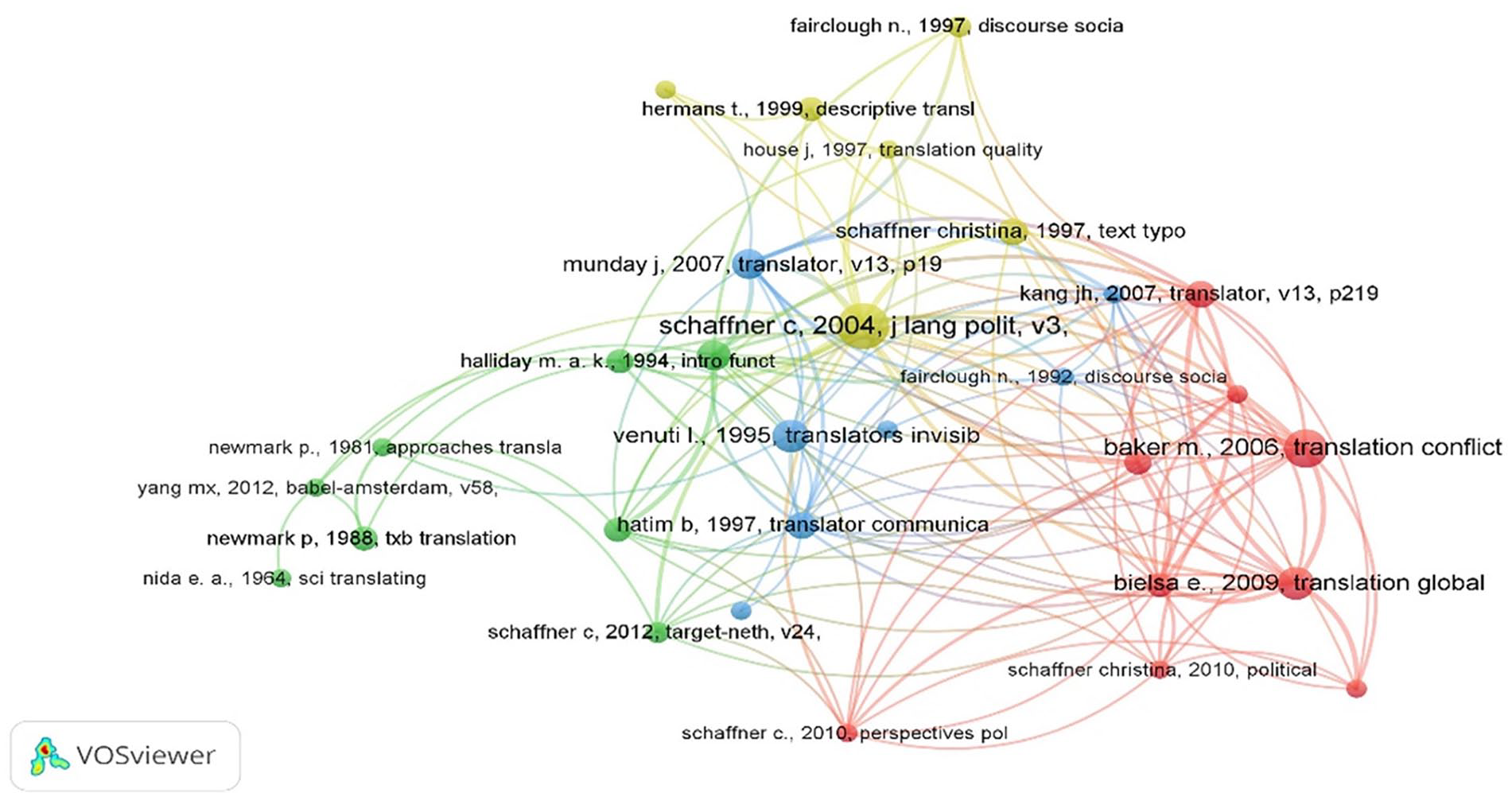
Network visualization of the co-citation of the selected thirty cited references.

Density visualization of the co-citation of the thirty cited references.
Cluster 1 (red cluster) is primarily concerned with the models of critical discourse analysis (Chilton, 2004; Fairclough, 1995) and narrative theory (Baker, 2006), as well as how critical discourse analysis can be applied to media discourse and translation, represented by Kuo and Nakamura (2005) and Kang (2007). It is important to note that the intertwined relationships between political discourse, media, and translation represented by Schäffner and Bassnett (2010) link critical discourse theory, media, news discourse, political discourse, and translation. Although neither Chilton (2004) nor Fairclough (1995) focus on translation, the influence of their discourse models is immense. Valdeón (2015, p. 647) argues that these discourse models have great potential to analyze translated texts and in particular news texts. These references are co-cited, as they are all related to discourse analysis models and theories of political discourse translation.
Cluster 2 (green cluster) focuses on the core point of the linguistic approach, as evidenced by Halliday’s (1994) Systemic Functional Linguistics (SFL), Newmark’s (1981, 1988) communicative and semantic translation, and dynamics of translation, equivalent effects in translation, text types and language functions, and Nida’s (1964) equivalence translation theory. Cluster 2 also deals with how linguistic theories can be applied to translation studies, such as how SFL can be used in discourse theory (Hatim & Mason, 1990) and how Nida’s equivalence translation theory can be applied in diplomatic translation studies (Yang, 2012). Notably, Yang’s (2012) study adopts a pioneering political equivalence theory based on Nida’s work. Cluster 2 also revolves around the role of translation and interpreting in media discourse (Schäffner, 2012) and the relationship between ideology and language (van Dijk, 1998). The co-citation of these references concerning linguistic theories suggests that the linguistic approach of TS is being applied in the field of political discourse translation.
Cluster 3 (blue cluster) represents the cultural approach to TS (the ideological functions in translation), represented by Lefevere’s (1992) Translation, Rewriting, and the Manipulation of Literary Fame and Venuti’s (1995) binary opposition of domestication and foreignization. This cluster also covers how ideology is conveyed and presented in political discourse translation (Munday, 2007), the study of ideological shifts (Hatim & Mason, 1997), and extratextual and intratextual aspects of ideology (Schäffner, 2003). Munday (2007) examines how ideology is conveyed textually in the translations of political speeches and interviews with Castro, Marcos, Chávez in Latin America by drawing on critical linguistics, the precursor of CDA. Schäffner (2003, p. 41) claims that ideology can be reflected in the text and attributes the subtle differences identified in the comparative analysis of the English and the German text of the Blair/Schröder document to ideological phenomena in the respective cultures. The fact that these references are co-cited suggests that cultural approaches to TS and “ideology of translating” and “the translation of ideology” (Hatim & Mason, 1997, p. 119) are active areas in the field of political discourse translation.
Cluster 4 (yellow cluster), consisting of six cited references, conceptualizes the translation of political discourse from different perspectives, such as Catford’s (1965) linguistic translation theory, Hermans’s (1999) systems theory, House’s (1997) translation quality assessment, Fairclough and Wodak’s (1997) discourse analysis, and Schäffner (1997, 2004a, 2004b) studies of political discourse. Schäffner (1997, p. 119) considers translation as a mediated cross-cultural type of communication and considers discourse analysis “a genuine social, political, or cultural analysis.” Schäffner (2004b) further argues that political discourse analysis (PDA) and postmodern translation theory link textual features to socio-political and socio-cultural contexts. In this regard, the translation of political discourse has been analyzed in a broader social, political, and cultural context.
The large yellow node in the middle in Figure 6 shows the strong link between the four clusters. This node is Schäffner’s (2004b) seminal paper “Political discourse analysis from the point of view of translation studies,” published in the Journal of Language and Politics. This article, with Schäffner’s powerful call for closer collaboration between TS and PDA, can be regarded as the standard reference for the field of political discourse translation studies. These pieces of research are often cited because they provide a theoretical framework for political discourse translation studies.
Co-citation of cited sources
The co-citation analysis of cited sources is designed to identify the most co-cited sources and their links, using cited sources as the unit of analysis to complement the co-citation analysis of cited references. The minimum number of citations for a source was set to fourteen. Of the 4, 857 sources, seventeen met the threshold. The seventeen sources in the database are listed in Table 6.
List of the Seventeen Cited Sources.
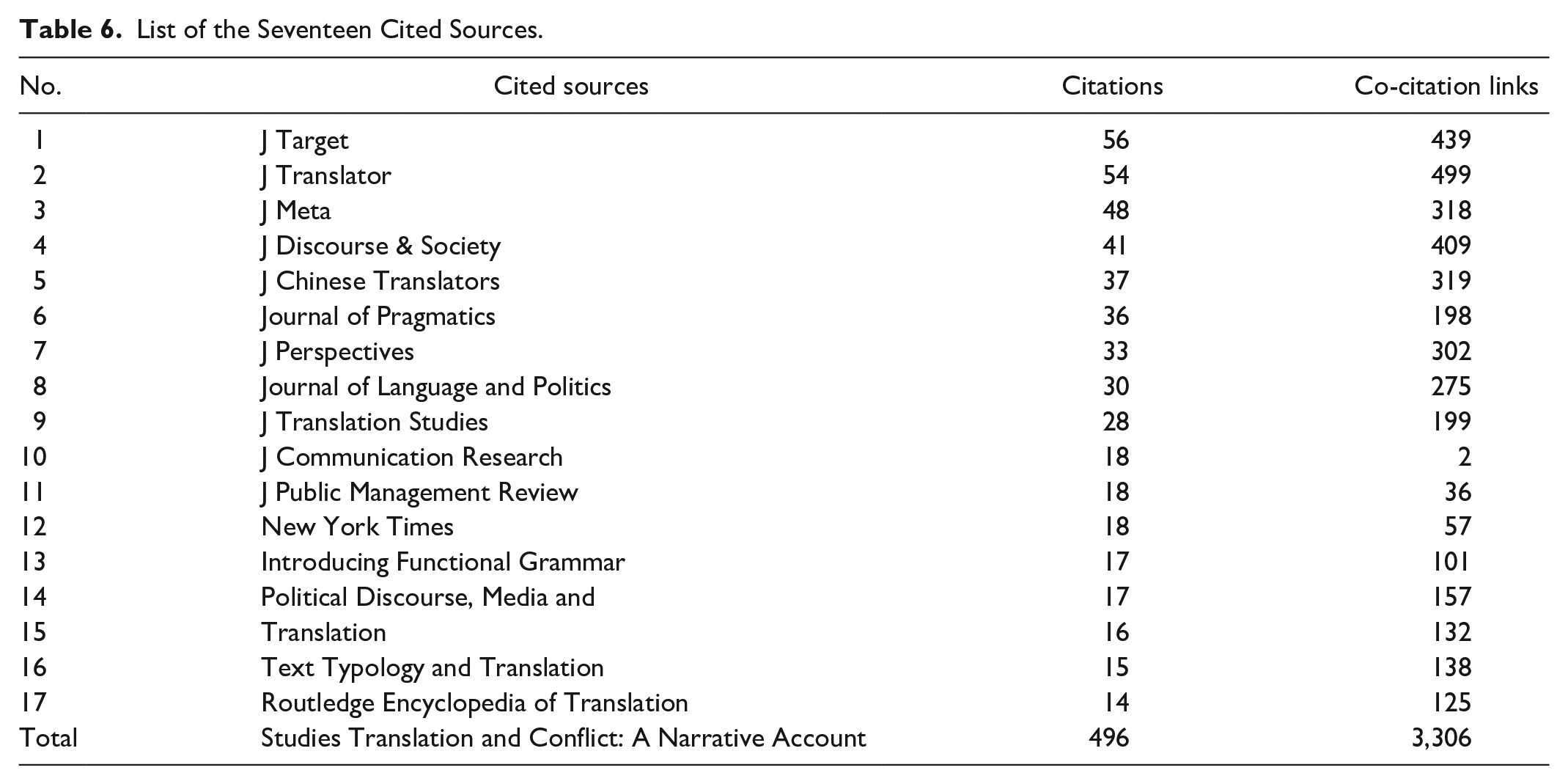
Table 6 shows that Target ranks first in terms of citations, while The Translator stands out in terms of co-citation links. This suggests that a journal with a high number of citations is not necessarily frequently co-cited. Communication Research ranks tenth in terms of citations, but seventeenth in terms of co-citation links.
Their co-citation relationships are further visualized. The network visualization of the seventeen cited sources is shown in Figure 8. The density visualization is shown in Figure 9. In Figure 8, a node represents a cited source, and each is labeled with the title of the cited source. The larger the node is, the more citations a source has received. The closer the nodes are to each other, the more closely related they are. In Figure 9, different colors represent different clusters of co-cited sources.
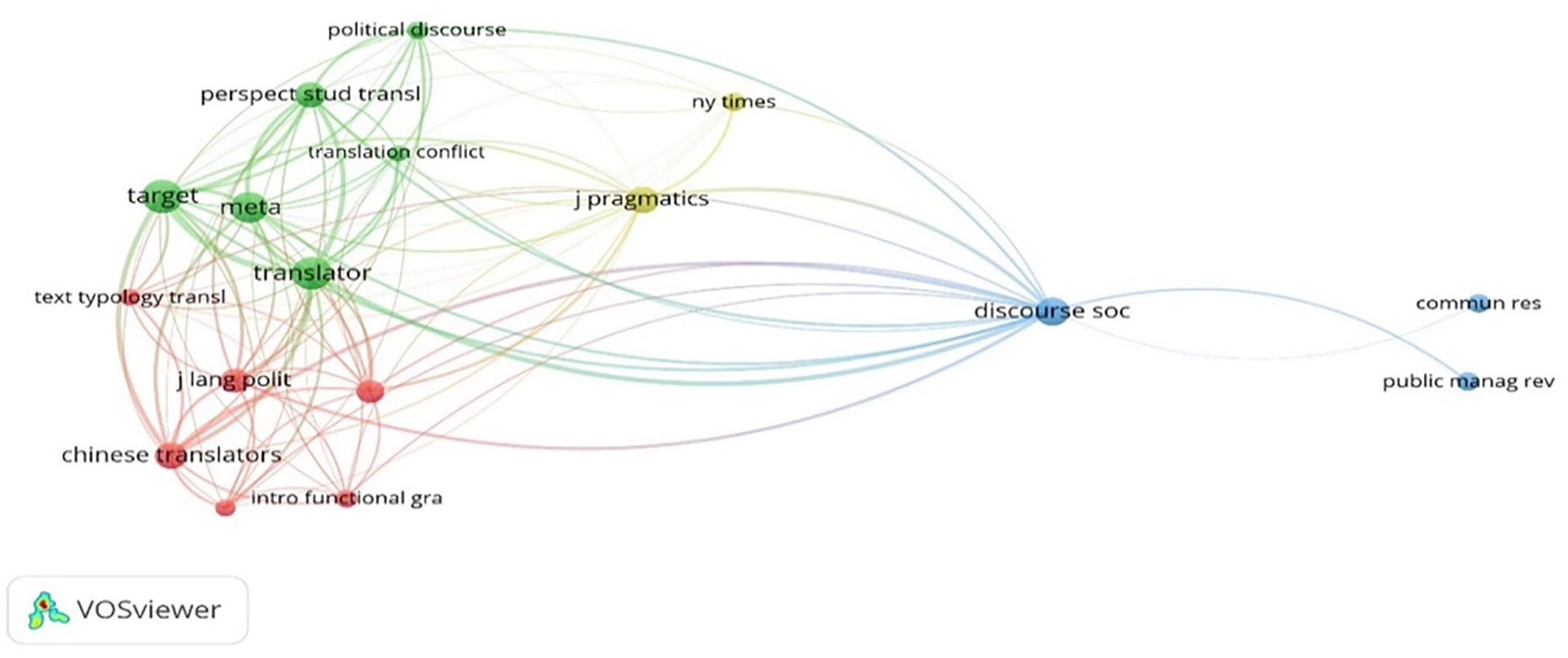
Co-citation network visualization of the seventeen cited sources.
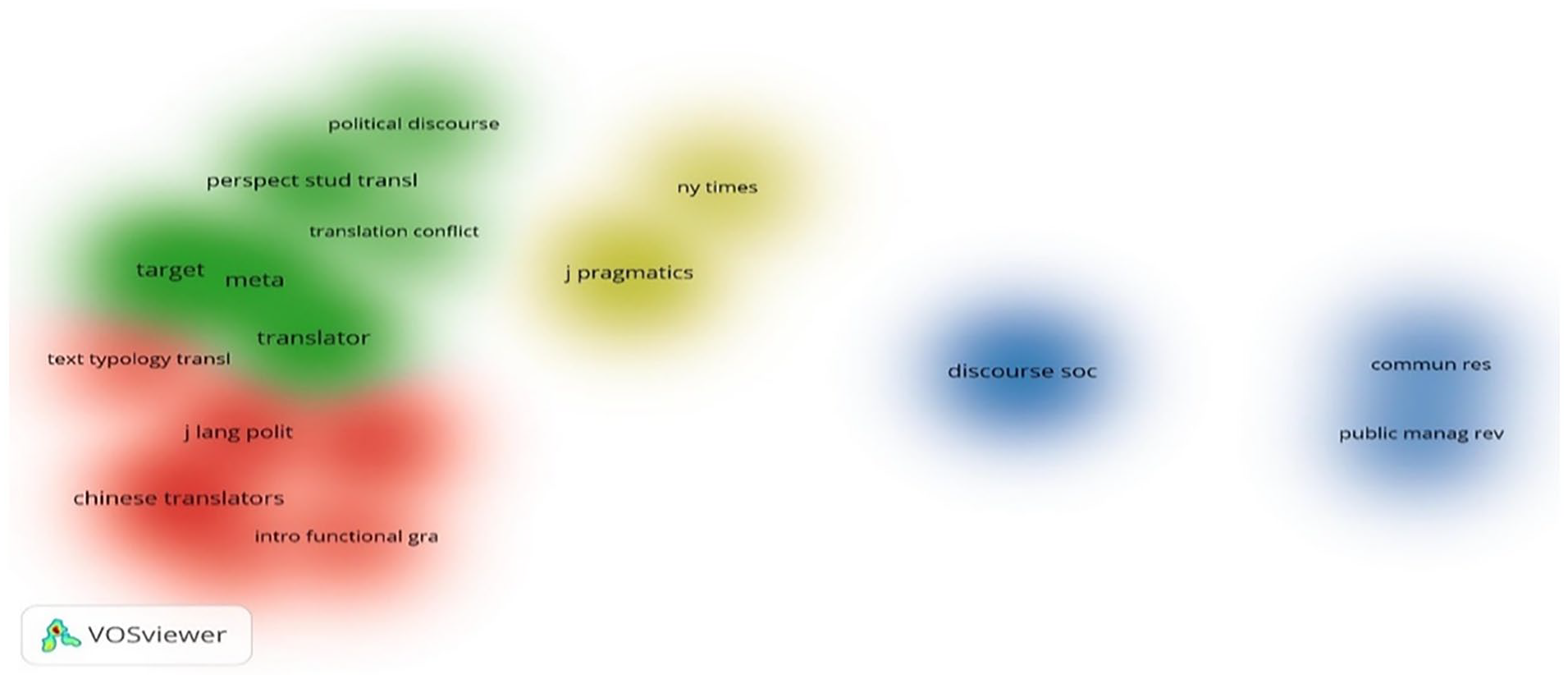
Co-citation density visualization of the seventeen cited sources.
Cluster 1 (red cluster) covers language and politics, text typology and translation, linguistic theories, and translation. These sources include three journals (Chinese Translators Journal, Journal of Language and Politics, and Translation Studies), an encyclopedia (Routledge Encyclopedia of Translation Studies), and two books (Introducing Functional Grammar and Text Typology and Translation). It is not surprising to find that Routledge Encyclopedia of Translation Studies is one of the most cited sources. Generalist publications receive many more citations than specialized ones. Probably it could also suggest that encyclopedias have more academic influence for research.
Cluster 2 (green cluster) focuses on political discourse and translation research. These sources include four journals (Meta, Perspectives, Target, and The Translator) and two books (Schäffner and Bassnett’s Political Discourse, Media and Translation and Baker’s Translation and Conflict: A Narrative Account).
Cluster 3 (blue cluster) covers discourse, society, and communication. These sources include three journals (Journal of Communication Research, Discourse & Society, and Public Management Review). Cluster 4 (yellow cluster) focuses on pragmatics and news discourse. These sources include one journal (The Journal of Pragmatics) and one American newspaper (The New York Times). Figure 8 shows that the yellow cluster serves as a linking cluster between the red, green, and blue clusters. In other words, research on the translation of political discourse connects with other disciplines through fields such as pragmatics, discourse analysis, and communication research.
Co-citation of cited authors
The co-citation analysis of cited authors is intended to complement the co-citation of cited references and cited sources. We set the threshold at ten, and eighteen authors met this threshold. The eighteen cited authors are listed in Table 7. It shows that Schäffner is the most cited author, with citations of eighty-four and co-citation ties of 726, followed by Baker and Fairclough, with citations of forty-five and thirty-nine, respectively, and with co-citation ties of 312 and 278.
The Eighteen Co-cited Authors.

Schäffner ranks the top in terms of political discourse translation, as Schäffner contributes greatly to political discourse studies, CDA studies, and Translation Studies. The second most cited author is Mona Baker who advances corpus linguistics and Translation Studies. Third, Fairclough proposes the three-dimensional CDA model to analyze different types of discourse.
The network visualization of the eighteen co-cited authors is shown in Figure 10. VOSviewer groups the eighteen authors into three clusters (Figure 11). In the network visualization (Figure 10), a node represents an author, and each one is labeled by the author’s name. The larger the node is, the more frequently the author is cited. A line is drawn when two authors are cited in one source. Figure 10 shows that the largest node is Schäffner’s (the green node), who acts as a link between the three clusters. In the density visualization (Figure 11), different colors represent different cited author clusters.

Network visualization of the eighteen cited authors.

Density visualization of the eighteen cited authors.
Cluster 1 (red cluster) relates to the linguistic and theoretical framework of political discourse translation and CDA, as suggested by the names of the authors: Halliday and Baker. It also focuses on discourse analysis models: Fairclough and Wodak; on news translation: Bielsa and Valdeón.
Cluster 2 (green cluster) concerns political discourse translation and ideology: Schäffner, van Dijk, Hatim, Munday, Banhegyi, and Chilton.
Cluster 3 (blue cluster) focuses on translation and interpreting studies: Chesterman, Newmark, Pym, and Hermans.
Conclusion
To identify the influential countries and sources, research themes, and the most co-cited references, sources, and authors, we used the automatic visualization tools provided by the WoS database, the network analysis of co-occurrence of keywords, and the co-citation analysis of cited references, sources, and authors. It has produced several significant findings.
First, it appears that the People’s Republic of China and the United States contribute the most to this field. The international journals of translation studies are paying more and more attention to Chinese political discourse translations. One possible explanation for this could be the growing awareness of Chinese scholars of the importance to disseminate Chinese political discourse research. It also appears that countries such as the United Kingdom and Canada can produce papers recognized in international academia with a smaller share of contribution. This necessarily help researchers understand that although the United Kingdom and Canada contribute less to this area, papers produced in these two countries are still cited more frequently. Thus, it is essential for researchers to locate these influential papers for future studies. Besides, countries such as the United Kingdom, Canada and the People’s Republic of China begin to account for a growing share of research output. This might be a general research trend corroborated in other fields, not only in linguistics in general (Lei & Liu, 2019), but also in other disciplines (Moiwo & Tao, 2013).
Second, the citation analysis of sources shows that the top three most influential sources in this area are the Journal of Pragmatics, Perspectives, and Target. Based on the number of articles, Perspectives, Meta, Babel, and the Journal of Language and Politics stand out. Although the Journal of Pragmatics contributes less to this field, it receives the most citations.
Third, the network analysis of co-occurrence of the top forty-nine keywords identifies eight major research themes: (1) linguistic analysis in political discourse translation studies, (2) ideology and manipulation within political discourse translation, (3) power embodied in political communication, (4) interpreting and CDA, (5) the recontextualization of political discourse in media discourse across languages, cultures and boundaries, (6) diplomatic translation, (7) the representation of political speeches in news translation, (8) news translation, conflict and politics. The synergic method of corpus linguistics and CDA is applied extensively in the field of political discourse translation. Corpus techniques, which help to locate linguistic patterns in translation studies, make this field much more persuasive and objective.
Fourth, it is evident that the co-citation analyses provide a historical picture of the emergence of the field of political discourse analysis. The co-citation analysis of cited references shows that these are divided into four major clusters: (1) discourse analysis models and theories of political discourse translation, (2) linguistic approaches to TS, (3) cultural approaches to TS, (4) theoretical frameworks for political discourse translation studies. The co-citation analysis of cited sources suggests that the study of political discourse translation draws extensively on linguistic translation theory, systems theory, discourse analysis, and others. The frequently cited authors can be divided into three clusters: authors who focus on the linguistic and theoretical framework and CDA, discourse analysis models; authors who concentrate on political discourse translation and ideology; authors who focus on translation and interpreting studies. Schäffner acts as a link between the three clusters.
Combining the PRISMA guidelines and VOSviewer visualizations, this study will shed new light on the current development of political discourse translation. First, the combined methodology for this study offers guidelines that show the previous literature in a staged process and improve the transparency and clarity of this bibliometric analysis; second, it helps student scholars and novice scholars identify the most productive countries, the most influential sources and documents, and the prospective authors in the field of political discourse studies; third, it helps scholars improve their awareness of the key topics and research trends in the field of political discourse translation. The key topics and research trends are essential for scholars to keep following the cutting-edge research; fourth, cited authors are clustered into linguistic theory, political discourse and translation studies. It might be good to know that researchers can also ground such classifications now in empirical research.
However, there are newer sources that are perhaps more appropriate given the change in the state of the art. For instance, the multimodal discourse analysis in political discourse translation is attracting increasing attention in recent years (Altahmazi, 2020; Wang & Munday, 2021). The multimodal discourse analysis in political discourse translation is not included in the co-citation networks of co-cited references, co-cited sources, and co-cited authors. One reason is that the articles concerning this topic are not indexed in the WoS when the data was collected for this study. Another possible explanation might be the age effect (Lei & Liu, 2019) in co-citation networks. The age effect on co-citation networks is strong, topping the list by earlier publications, as evidenced by Table 5. Only three of the top 30 cited references are published after 2012. The age effect might also suggest that the researchers should not only entrench their views of the field in canonical works but also stay tuned to the newer sources. Therefore, the bibliometric study should continue to be conducted for a panoramic view of a field.
Finally, a number of limitations should be mentioned. First, other databases such as Scopus, the Translation Studies Bibliography (TSB), or the Bibliography of Interpreting and Translation (BITRA) were not used, therefore this paints a very limited view of the field; second, the co-authorship analysis and H-index analysis were not performed; third, documents in languages other than English were not considered. Despite these limitations, it should be enlightening for researchers and students to be aware of this field’s research themes and origins. The frequently cited documents, widely co-cited references, sources, and authors guide novice researchers in political discourse translation studies.
Footnotes
Declaration of Conflicting Interests
The author(s) declared no potential conflicts of interest with respect to the research, authorship, and/or publication of this article.
Funding
The author(s) disclosed receipt of the following financial support for the research, authorship, and/or publication of this article: This work was supported by Anhui Department of Education, “A Corpus-based Study on the Communication and Reception of Chinese Political Discourse” [grant number SK2020ZD61], Anhui Department of Education [grant number SK2021A0865], and Key Project of Quality Engineering of Anhui Department of Education, “Shaping and Improving young Teachers’ Curriculum Resource Development Ability in Chinese Universities from the Perspective of Virtual Network Ecology” [grant number 2020jyxm1416].
