




Abstract
The study proposes a cost management model for recruitment, selection, employment, and integration (RSEI), for the human resources (HR) department in order to identify the possibilities of cost optimization. The proposed model consisted of applying the activity-based costing (ABC) method, as a novelty in the HR field, by developing an algorithm for calculating the cost per employee. To observe the evolution of the analyzed RSEI process costs, the Pareto Chart and the Markov chain model were used. To verify the viability of the model, it was applied within an industrial company. The research results indicated that: in the recruitment process, the most consuming resource is the use of recruitment agencies (89.50% of the recruitment cost); in the selection process, the protocol consumes 66.80%; in the employment and payment processes, salaries consume 52.20%, and insurance taxes 34.80%; in the integration processes, the most consuming resources are tutors with overtime pay (63.30%). After identifying and quantifying the high costs, a plan of measures is drawn up to minimize costs. The study contributes to the RSEI cost literature and has practical implications for human resources practices and organizational performance. The analysis is limited to a few processes of HR, but these are the most consuming resources and the most important in recruitment. The model could be implemented as a future direction for other improvements of the HR processes (performance evaluation, dysfunctional social analysis, motivation, reward and compensation), career management analysis, or other company’s processes.
Keywords
Introduction
The recent COVID-19 pandemic time brought challenges, changes and risks. Thus, the companies must find new solutions to survive and keep their main asset—human resources. Human resources around the world face real problems. HR managers must face the “unknown unknowns” and remain vigilant in detecting threats (Gomes & Semin, 2020). Thus, organizations must adjust to economic, societal and health problems without national borders (Carnevale & Hatak, 2020). Now, more than ever, it is critical that all companies attract, retain, and develop their employees in the new context of changes (Park & Park, 2021). At the same time, the pandemic of COVID-19 became the opportune moment for companies, managers and human resources to find new solutions and for specialists to coordinate efforts into operational strategies. Human resources management (HRM) is still underdeveloped from a theoretical and practical research point of view, especially in determining the value of human resources and the cost of recruitment, selection and employment. Also, human resource is the most significant and essential factor for business success and competitive advantage (Klepić, 2019; Lewis et al., 2019). Green recruitment and selection are recognized as an essential dimension of sustainable and green human resource management necessary for achieving sustainability (Malik et al., 2020; Pham & Paillé, 2019; Westerman et al., 2020; Yong et al., 2020). The main goal of recruitment is not to attract future employees but to attract qualified employees and unique individuals with different knowledge, experience and behaviors (Alvino et al., 2021; Campion et al., 2019; Del Giudice, 2020; Mina et al., 2019).
In the current context, it is evident that the pandemic conditions have affected not only local or regional areas but also global ones. Thus, it is analyzed the impact of this crisis on RSEI processes. Fields were affected by the pandemic period in 2020, such as (a) to (h) (Terrell, 2021): (a) in the leisure and hospitality field, many workers lost their jobs due to the temporary shutting down activity from restaurants, bars, or stadiums. In December 2020, there were 1.3 million fewer workers than in December 2019. To sustain that, the unemployment rate in this field was 5.0%, and in 2020 it was 11.7%.; (b) in 2020, many workers lost their jobs due to the temporary closing of mining, oil, and gas extraction businesses. In December 2020, there were 58.000 fewer workers than in the same period in 2019. The unemployment rate was in 2019 of 3.8%, and in 2020 it was 13.1%.; (c) due to the pandemic period, the travel and transportation jobs were reduced, especially in railroad (18.900 jobs lost) and airline businesses (with 116.500 fewer jobs). The unemployment rate was in 2019 of 2.6%, in 2020 of 8.4%; (d) Construction jobs for non-residential businesses were the field with the most jobs lost. In 2020 there were lost 441.000 jobs compared to 2019, and the unemployment rate was in 2019 of 5.0% compared to 9.6% in 2020; (e) Motion picture and music industry jobs were lost in this period. Only in Hollywood there were lost 110.000 jobs between 2019 and 2020. The unemployment rate was in 2019 of 1.9% and in 2020 of 6.4%; (f) Laundry, dry-cleaning and other personal service jobs were lost in this field since people used teleworking. In 2020 there were lost 228.000 jobs compared to 2019. The unemployment rate was in 2019 of 3.2% and in 2020 of 7.4%; (g) Self-employed workers offered freedom and flexibility. The unemployment rate was affected, recording a percentage of 6.7% in 2020 compared with 2.7% in 2019. (h) Jobs of manufacturing food, clothing and other goods were affected but in a slower rhythm. The unemployment rate in these domains was 3.1% in 2019 and grew to 5.5% in 2020. Recruitment and selection can be costly; thus, a budget must be made to help the specialists (Brown et al., 2019).
Considering that the more significant percentage of a company’s cost is formed by the HR costs and their employment and payment (almost 80% of the total costs) and that HR gives uniqueness and contributes to the long-term performance and success of a company, the authors considered this an opportunity for themselves, HR and IT specialists, and accountants to analyze just one HR process, which is essential and strategic for any company. Therefore, the study proposes a cost management model for recruitment, selection, employment, and integration (RSEI), for the human resources (HR) department in order to identify the possibilities of cost optimization. Starting from the problem of the statement, “Why is it necessary to implement a mathematical model for determining the costs of RSEI processes?,” the answer to this question can be given by the importance of these processes in the success of the company and the high costs of these processes compared to other administrative costs.
The novelty of this challenging task is that the cost management model uses ABC method to determine the entire cost of the RSEI process for the analyzed company, by developing an algorithm for calculating the cost per employee. To verify the viability of the model, it was applied within a Romanian industrial company. Pareto diagram and Markov chains model was used to observe the evolution of costs, in the next period, for all four analyzed processes (RSEI) and simulation of these processes using Excel program and QM for Windows.
The research has limitations in analyzing four out of all the HR processes. However, the highest administrative and HR costs deserve to be analyzed and constantly monitored. From this model, it is perceived necessary to determine the costs, especially for these essential but costly processes, so it is recommended for practitioners to determine RSEI costs and observe where possible errors could appear in the processes and what can be improved with time. The model could improve RSEI processes based on non-discrimination, equal chances, sustainability, and performance in future directions. Knowing with time the cost of such essential processes, the organizations will get those employees fitting within the organization, at the right time and place, at the correct value.
The study is structured into distinctive sections. The Introduction presents RSEI processes, the importance of these processes in organizations, and their evolution in challenging times, such as the COVID-19 period. In the Literature review, in the first part, each of the four analyzed HR processes were analyzed, their rules were presented to have efficiency for individuals and organizations and the impact of the Internet on these processes, and the second part analyzed the costs of RSEI processes. Methodology research presents the goal of the research, the objectives, and the methods used. ABC method, Pareto diagram and Markov chains, and the simulation programs such as Excel and QM for Windows were used in this study. The final part, the Discussion and Conclusions highlights the importance of the analyzed processes and the results from the research. Recommendations were also developed at the social, organizational, and individual levels.
Literature Review
Approaches of RSEI Processes
Recruitment
Now it is difficult to recruit a talented candidate (Holbeche, 2009), especially during the pandemic time of COVID-19, where attracting talented people became a significant challenge (Vaiman et al., 2021). Recruitment meaning is to search for suitable candidates (Sharma, 2016) and their stimulation to apply for a job vacancy (Breaugh & Starke, 2000). The recruiter has an important role, especially in transitioning the future employee from college to the workplace (Nogales et al., 2020). All organization’s processes are measured; thus, the recruitment process is not making an exception (Edgar & Geare, 2005). The recruitment process is deploying over a long period, and its cost is high (Sekiou et al., 2001), especially for advertising; so, to be efficient, the ads must offer details about the technical details of the job rather than the company (Dundon & Wilkinson, 2020). The main objectives of the recruitment process are to find the right candidate at the right or a minimum cost (Black & van Esch, 2020). An employer is a buyer of labor. Thus effective recruitment ensures attracting the most qualified applicants with adequate knowledge (transferring from those who have it to those who need it by using recruitment) (Butler et al., 2000; Van Beurden et al., 2021; Wilden et al., 2010). Recruitment efforts are expensive for any company; thus, its cost increases with knowledge, skills, and experience in the field (Ryan et al., 2005; Vincent, 2019). When there are issues with maintaining employees, the specialists will analyze only this process (N. Florea, 2013). Through recruitment, the company may attract new or old employees. By attracting old employees, called boomerang employees, the company gets external employees with internal job experience (Snyder et al., 2021, p. 295). By using ICT tools (social networking, mobile apps, websites, etc.) (Briàcariu, 2019; Vetráková et al., 2018), e-recruitment will ease the process for HR planners and will increase performance (Zhou et al., 2021), productivity (Popova, 2019), and will reduce costs (Crawshaw et al., 2020). ICT tools allow for receiving applications, facilitate the search for professionals, and can generate quick feedback in the new working conditions generated by the pandemic period (Brandão et al., 2019; Burgess & Connell, 2020).
Selection
Selection is a process for discovering candidates’ qualifications and characteristics to establish their fit for the vacancy (Pattanayak, 2003). There are many criteria used in selecting Mr./Mrs. Right (Kong et al., 2020), for example, the person-organization fit is essential, the goal being bringing benefits for both parties (Hu et al., 2021). During the pandemic, the fit was between person-environment, based on the principle that individuals are attracted to and selected by organizations whose work environments reflect the same values, cultures and work features (Carnevale & Hatak, 2020). Selection means “choose and be chosen” using trust, engagement or brand (Banerjee et al., 2020; N. V. Florea, 2011). It refers to choosing highly skilled persons for the job (Ahammad et al., 2020; Hough et al., 2001). If an employee does not have the right qualities for the job, the organization will not get performance (Peiró et al., 2020). The selection will make the difference between the success or failure of an organization. If the selection is based on finding the right competencies, skills and knowledge and not on a-priori principles, it will make a difference in achieving organizational performance (Chakraborty & Biswas, 2020).
Employment and Payment
In the context of the current economy, it is known that, according to laws and customs, the employer has the right and obligation to hire those people who will best perform the tasks or make the most significant contribution to the organization as the main purpose and to refuse those who do not fit the job (Nye et al., 2020). Hiring an essential resource is a critical issue for organizations due to instability, uncertainty and unpredictability in their tasks (Elix & Naikar, 2021). The hiring process concludes with the employment contract involving mutual expectations and obligations (Guillot-Soulez et al., 2019; Holt Larsen & Brewster, 2003). It became a formal contract even for SMEs due to work legislation (Li & Rees, 2021). The employment process implies creating a file for the new employee, which will be filled up with documents that may help the employee throughout their career in the organization. The work contract is a convention where an employer remunerates the employee who will undertake the work according to some standards (Soulez & Guillot-Soulez, 2011). This remuneration must be reasonable for a desirable standard of living (Godwin et al., 2017), with the security of income during work being significant for many countries from the EU, according to a study (Marchington et al., 2020). It is also crucial for the safety culture that one remains employed in the long run (Bisbey et al., 2021). By hiring effective employees, the company will have lower costs, and the employees will be more satisfied and less fatigued (Mensah, 2020). Employment now may be traditional or using new technologies (telework, working from home), which may be flexible or mobile (Whiting & Symon, 2020). Employment and payment must not depend on discrimination factors such as gender (Erlandsson, 2019; Kronberg, 2020), studies or age (Turek & Henkens, 2020), but to get the right people for the right job with the right skills knowledge and attitudes. The sociology of work depends on how different generations perceive this. Today, young employees are considered the “Millennials,” and the work society must know how to manage the new skills and attributes and repay them (Williams, 2020).
Integration and Training
Integration means familiarizing the new employee with the new regulations and policies, working time, breaks and social activities. Organizations will ensure that these processes are allocated sufficient resources (Martin & Jackson, 2008). Thus, the employee would adapt easier, faster and without errors to the new work environment (Weiss, 2005). The integration aims to facilitate the accommodation of the new employee, to create an atmosphere of safety and membership, trust, respect, better relationship and communication so that the new employee acquires confidence in his/her capacity to perform the tasks of the job. No matter how competent they are, the new employee will need guidance and instructions to approach their new position correctly, and they also need training programs to increase performance (Garavan et al., 2021). Investing in human and intellectual capital leads to significant performance (Alves et al., 2020; Collin & Weil, 2020), entrepreneurial success (Temouri et al., 2020) and HR development lead to organizational performance outcomes (Akdere & Egan, 2020). After employment, the integration process is coordinated by a tutor, who advises each new arrival during the adaptation period. The tutor will constantly check the new employee to have all the practical and general information necessary to carry out the tasks and familiarize themself as quickly as possible in his/her working environment.
Typology of Costs Used by RSEI
All stakeholders need the information to make decisions. Financial and accounting management offers information and serves different purposes. Cost is the cornerstone of most concepts and theories. Costs are usually defined as a resource consumed to achieve a specific objective. Costs are usually measured as the monetary amount that must be paid to acquire resources, goods and services. In our case, it is about acquiring an essential resource—the human resource. Cost is the resource foregone or sacrificed to accomplish a specified objective and is measured in terms of money (Al-Dhubaibi, 2021; Innes & Mitchell, 1995). Costs knowing represent essential information for managing a company and controlling its activities and processes. A cost accounting system is used to provide the management with information about the cost of products or services. It has great use to an organization, helping management monitor, control, diagnose and make decisions. There are various typologies of costs, but we have analyzed the costs of RSEI. Depending on the allocation method, the costs can be divided into (i) direct costs (advertising costs, travel expenses, fees for recruitment agencies, costs for renting rooms, medical costs) and (ii) indirect costs (costs of learning in order to fit with the new job, cost of integration for new employees, costs for developing a job description, costs for interviewers, the cost for verifying references, screening applicants, interviews, writing the work contracts) (Bonte & Bustos, 2004; Compton et al., 2014). Another criterion for classifying costs is that of recruitment, as follows: tangible costs (composed of advertising costs, interviewing, testing, training, and guiding) and intangible costs (which refer to lower efficiency for the new employee, cost of repairing errors, cost of supervision from a tutor, less productivity due to issues and period of overload and the lack of a high level of employees’ morale). Selection costs include choosing suitable candidates for the vacancy and using methods such as interviews, assessment centers, medical examinations or checking references (Le Louarn, 2008). Development costs are formed by the costs of evaluating training needs, developing programs specific to training and implementing the program. Observe the efficiency of each recruitment source determined percentages of each recruitment source, and the results are compared between them (Buhler, 2002).
Activity-Based Costing (ABC) is a method for developing cost estimates based on the activities used within the production process per cost object; the costs are determined especially for those activities linked to by-products (Leitner, 2007) or the operations specific to the production process per cost object (Jezig et al., 2021) in order to estimate the costs for the most important activities within the production cycle (Zeuner, 2012). This method was used in many studies, in services, but also in healthcare (Niñerola et al., 2021), planning environment management (Bagherpour et al., 2013), investments (Boonkhun et al., 2005), transportation (Stopka et al., 2021) or education (Tutcu, 2021).
The novelty of this study is that the costs are determined in our case for recruitment, selection, employment, integration and training. To develop a cost estimate, we need to identify the cost drivers (Quesado & Silva, 2021; W. H. Tsai et al., 2019). This method can be introduced as a tool for management decision-making (W.-H. Tsai, 1996). It is used to get insight into costs and gain control over cost allocation; it helps improve strategic and operational decisions in an organization (Gosselin, 1997; Hashim, 2019).
In order to implement ABC, a few stages are important (Capusneanu et al., 2021; Ionescu, 2018): (i) Identification of activities carried out by the economic entity: it is necessary to draw up a map of the activities; (ii) Identification of cost inductors related to each type of activity: it is necessary to identify at the level of activities the causal factors of resource consumption; (iii) Group tasks that have the same indicator in grouping center; (iv) Determination of unit cost per inductor: it is necessary to identify the expenditure related to each group center so that the specific expenditure is attributed to that center, using cost inductors; (v) Determination of the unit cost of the products: the activities carried out shall be determined for each product, and the cost inductors related to those activities shall be identified. The unit cost of the products shall consist of the total direct costs and the costs of the activities consumed by the concerned product.
Methodology of Research
As stated above, the cost is the cornerstone of most concepts, and RSEI processes are no exception. To improve these essential processes, the HR specialists must know the cost of each of the four analyzed processes to make significant future decisions. Moreover, because the ABC method is one of those clear and detailed analysis methods, the authors decided to use it to observe the effective costs of RSEI processes. The research statement is: “Why implement a mathematical model to determine the costs for RSEI processes?” because they are the most expensive processes from all the administrative costs and are of great importance.
The research started from the following principles existing in the Managerial costs and HRM field: (i) every resource is costing, but HR being unique and strategic in obtaining sustainable performance, the research is focusing on the HR department and its costs; (ii) the costs may be clearly determined if it is implemented an ABC analysis; (iii) the most cost consuming activities may be determined if it is implemented Pareto diagram and ABC analysis; (iv) knowing from the time the highest costs of the analyzed company may develop a set of objectives and measures necessary to reduce them from time; (v) simulation and modeling are vital for any company, their use can reduce risks and costs, based on forecasting—by knowing data from the past one can perceive a possible future and develop measures to prevent failure (lose valuable candidates, lose valuable customers, lose valuable employees or lose performance).
Analyzing these statements and facts, the following research hypothesis were developed:
H1—HR-RSEI costs may be determined by an implemented ABC method;
H2—using modeling we may determine the cost for RSEI analyzed process.
H3—using Pareto diagram it could determine the most consuming sub-processes from inventory (till 80% according to 20/80 rule).
H4—using modeling and simulation it could develop important measures necessary to improve RSEI processes.
H5—using simulation it could perceive a possible future for RSEI analyzed processes.
The research was done in a company from Dambovita county, Romania, and the company’s name is not offered from strategic issues. The analyzed company is acting in the industrial field (B2B sector) and made 30 hires from a total of 90 candidates in 2019 (2020 is exempt from the analysis due to the pandemic times when the recruitment process suffered, but the company maintained its employees’ number). The analyzed company used in-house recruitment and the services of a recruitment agency.
The research was quantitative using ABC analysis, Pareto diagram, and Markov chains (but also a qualitative one because the same methods could be used in order to develop specific measures to improve the most consuming RSEI processes resulting from the study), and QM for Windows—Inventory model, and Excel program were the tools for data collection and simulation.
Results
Using Activity-Based Costing (ABC) Method for Determination of HR-RSEI Costs
Using the ABC method, the organizations may ensure better knowledge of each deployed activity and know each cost involved. Thus, managerial accounting can ensure profitability in the long term by ensuring high-quality standards and competitive advantages. To analyze the information offered by the accounting method and the determination of costs, it was made a detailed analysis of RSEI processes. The ABC method’s vital role is to explain that activities are generating costs, and the services, in this case, are generating the demand for those activities.
Stage 1. Identifying the Specific Activities for the Analyzed Processes
To identify the direct and indirect costs associated with RSEI processes, each process and sub-process were described (Table 1).
RSEI Description.

Stage 2. Identifying the Cost Inductors and the KPIs for Each Type of Activity
At the end of the year 2019 there were employed 30 persons. The RSEI processes were established on each month (Table 3). To improve RSEI processes, it is important to determine each cost inductor and KPIs for each process to achieve effectiveness for analyzed process (Table 2).
Framework for RSEI Processes—Cost Inductors—KPIs.

Stage 3 Determine the Period of RSEI Processes
According to the next step of ABC method is important to determine the period necessary for each process included in RSEI processes (Table 3).
RSEI Costs in the Analyzed Organization.

According to the discussions had with the HR specialists and Table 3: (a) the recruitment process was taking place between M1-M2, M5-M6, and M9-M10 (6 months), (b) the selection process was taking place on M3, M7, and M11 (3 months), (c) employment and integration were taking place on M1-M12 (1 year). The explanation is that after the employment the integration begins, which takes a 6-month period after employment, until the employee is obtaining full performance. Thus, the payment and integration are made every month, because integration is taking place continuously, due to old employments whose integration processes is in process.
Stage 4 Determine the Costs Per Employee and Total RSEI Costs
From all the wages offered for the 30 employees, the average wage was chosen for 700 Eur. Of the 30 new employees, just three used the services of a recruitment agency (3 employees × 700 Eur × 12 months = 25,200 Eur × 10% fee = 2,520 Eur). Thus, the recruitment agency was paid 10% of the annual wage of one employee. For the rest, 27 new employees were recruited using in-house recruitment.
In the recruitment team were five specialists, the same for the selection process. For the integration process, there were six tutors. Integration was made individually at first and then in groups when employees had the same jobs. Eight old employees were working until new employees were hired. Supplementary hours were paid as, in average, 2 hr/day for 3 months. Thus, 700 Eur (20 working days) = 35 Eur/day/8 hr of working = 4.375 Eur 2 hr = 8.75 Eur day×20 days = 175 Eur. The rent for the selection process, the interviewing, testing, and evaluation were evaluated as approximately 150 Eur/month. Thus, for the evaluation of 30 employees, the cost/employee = is 150 Eur/30 = 50 Eur.
From the recruitment specialists, three were from the company, and two were outside the company. Thus, the cost of renting two hotel rooms was for one night of 80 Eur/night, and these specialists were called only for 6 days. The cost was 80 Eur day× 6 days × 2 specialists = 960 Eur/30 employees = 32 Eur. According to the legislation, the daily allowance was of 10 Eur/day. The daily allowance for the two specialists was 10 Eur day×2 days× 6 days=120 Eur/30 employees = 4 Eur. Two specialists were invited for selection, thus the same costs as for recruitment. For protocol, we were granted 40 Eur/day for each specialist involved in the RSEI process. Thus, 40 x 10 specialists x 30 days= 12,000 Eur/30 employees = 400 Eur. For transportation of the four specialists invited for the six meetings were granted: 30 Eur × 2 × 4 × 6 = 1,440 Eur/30 employees = 48 Eur. For the integration of new employees were allocated one training program to increase individual and organizational performance. Such a training program costs 180 Eur/30 employees = 6 Eur. As for the errors made by the new employees, they were allocated 500 Eur for: time lost in serving customers or signing a contract, the cost of losing customers, and staying over working hours. Thus, 500/30 employees = 16.70 Eur. The payment for the tutor’s payment in the integration process (time used over the working program): 700 Eur/20 days/8 hr/day = 4.375 Eur/day net, and there are paid 2 hr for 2 days in 3 months, resulting in a cost of 4.375 hr× 30 hr/month = 131.25 Eur. The recruitment cost for an online ad for 30 days was 200 Eur.
For the application of the ABC method, these expenses were determined for each activity, for one employee, for 30 employees per month, and then per year. The related costs for the other 60 candidates (who were registered just for recruitment) were comprised of “other direct costs” and “other costs” (Table 4).
The RSEI Costs for 1 and 30 Employees on Month and on Year.

It can be observed the cost from the analyzed processes made for one employee:
In the recruitment process, the most consuming resource is using recruitment agencies (consuming 89.50% of recruitment cost).
The most consuming resource in the selection process is protocol, with 66.80% of the selection cost.
In the employment and payment processes, the most consuming resource are the salaries (52.20%) and the insurance taxes for salaries (34.80%).
In the integration and training processes, the most consuming resource is overtime payment for tutors (63.30%).
From the calculation above, we could determine which sub-processes is the most consuming resource from each analyzed RSEI process. Thus, “H1- using the ABC method, could determine the cost per each employee”, is fulfilled.
According to a Hay Group statistic, the cost a company has for replacing a departing employee is equal to 12 to 18 salaries of that employee, whether it is the CEO or the cleaning lady, so resuming a recruitment process is a rather expensive one that no organization would want (Badea, 2016). Table 5 presents the percentage allocation of resources on each analyzed process/one employee. As we may observe (Table 4), the maximum number of analyzed activities for the four analyzed processes is eight (A1-A8). Thus, direct costs: for the recruitment process are analyzed into six activities; for selection, eight activities; for employment, three and integration and training, five activities; for indirect costs: three activities and general administrative costs are two activities (Table 5).
Percentage Allocation of Resources on Activities/one Employee.

From the calculations above, the research hypothesis “H2- using modeling, we may determine the cost for RSEI analyzed process” is totally fulfilled.
Using Pareto Diagram and ABC Analysis for HR Costs
The Pareto diagram is a powerful tool that may help an organization to detect the causes of problems and failure, distribute efforts to solve issues, determine the costliest processes, and improve quality and performance (Al-Zwainy & Mezher, 2018; Astanti et al., 2022; Du & Su, 2015; Statsenko et al., 2021). The 80/20 Pareto principle and its three zones: “A,”“B,” and “C,” consists of three steps: classification, differentiation and resource allocation (Grosfeld-Nir et al., 2007). In our study, we want to determine the 20% of the HR processes that bring 80% of the higher costs.
Pareto diagram deployment steps are as follows:
Collecting data on RSEI costs.
Preparing the data- ordering RSEI costs in descending order and calculating the cumulative relative frequencies for each type of cost.
Making the Pareto diagram (according to both ways).
Interpretation of the results.
Therefore, developing a plan of objectives and measures is necessary to decrease the RSEI costs.
Step (1) and (2) collect data on RSEI costs, sort in descending order, and calculate the relative frequencies (Table 6).
Cost Per Unit and Total Costs for RSEI Processes.

Step (3) consists of making the Pareto; we used QM for Windows, a valuable program for managing operations. It was introduced the data from the table above, those referring to the results for the multiplication of the number of employees, the number of months, and the cost. The program determined the total cost per item, the percent of each item in total value, and the cumulative cost per item and category value. The cost is introduced per the three zones: A, B, or C (Table 7).
Determining the Volume of Total Costs, Cumulative Volume and the ABC Analysis Using QM for Windows.

ABC analysis aims to identify the essential items that are kept in inventory. Importance is measured by dollar volume. In the example below, 20% of the items are in the A category (five items), and 30% are in the B category (eight items). The Pareto diagram is made in descending order of the absolute frequency and ascending order of the absolute cumulative frequency. According to the Pareto diagram, we could determine the most consuming sub-processes from RSEI processes, thus research hypothesis, “H3- using Pareto diagram, it could be determined the most consuming sub-processes from inventory (till 80% according to 20/80 rule)”, being totally fulfilled.
Step (4) implementing ABC analysis will help HR managers find out the problem’s causes in a process. The first five types of costs are the most important ones and need to be analyzed.
The table above shows that it would be more helpful to focus on the first five more considerable costs, which are found in zone A (80%), than in zone B: activities from 6 to 13 and in zone C, activities from 14 to 27.
Implementing a Plan of Measures to Reduce the Larger Costs of RSEI Processes From Pareto Diagram
To reduce customer complaints and increase customer satisfaction, the organization must implement a plan of measures made available to all employees on all hierarchical lines, which have aligned them with the CRM strategy (Table 8).
Plan of Measures Necessary to Minimize the Costs Found in the Zone A of ABC Analysis.
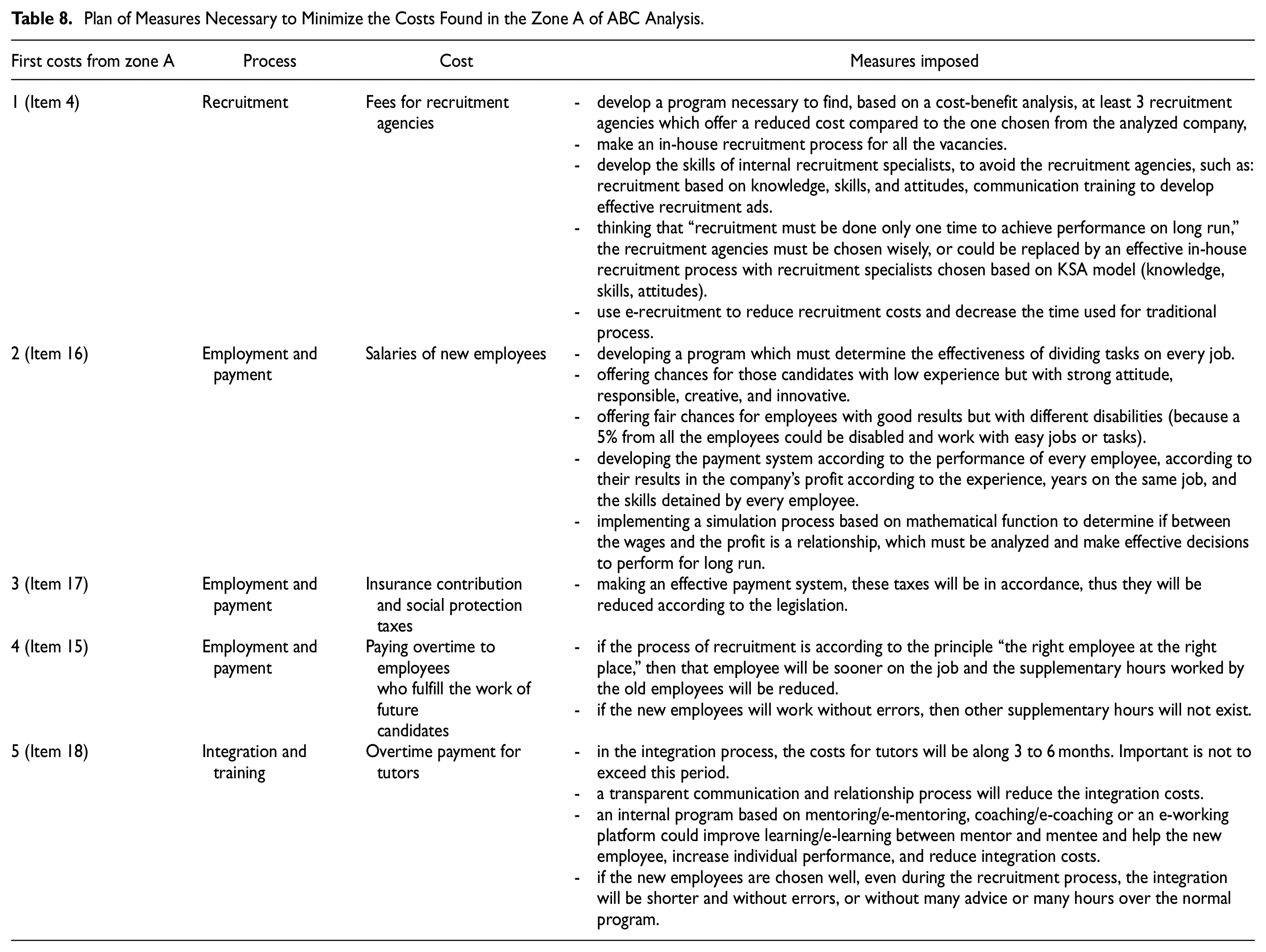
As can be observed, the five activities found in zone A (the costliest activities for RSEI processes) are the recruitment process (fees for recruitment agencies), employment (wages, taxes, and supplementary hours), and integration (supplementary worked hours for tutors). As the literature adds, the higher cost is payment (wages for employees and the afferent taxes and tutors) and the fees for recruitment agencies, so the company must implement the above objectives. So, the research hypothesis “H4- using modeling and simulation, we may develop essential measures necessary to improve RSEI processes” is fulfilled.
Forecasting RSEI Costs Per Employee in the Next 5 Years Using Markov Chains
Starting from the cost per employee presented in Table 4, the activities were divided just in four groups, due to the number of the analyzed processes- four processes: recruitment, selection, employment, and integration (Table 9).
Determining the Matrix for the Four Analyzed Processes.

It was obtained a squared matrix, formed by four columns and four lines. Each cost per group was divided to the total cost of the process with direct costs, obtaining the following values, comprised into the squared matrix.

The total of each analyzed process (2,822 for recruitment, 598.9 for selection, 1,341 for employment, and 207.25 for integration and training) is divided to the total of all the four analyzed processes (4969.95), obtaining the line vector: (0.57 0.12 0.27 0.04).
According to the steps specific for Markov chains, each value of the line vector is multiplied with each column and the values for the next forecasted years are obtained. Starting from the fact that the values of line vector are the values for 2020, the values for the four analyzed processes for the next 5 years are determined (Table 10).
Forecasted Values Between 2021 and 2025 Using Markov Chains.

Data above, representing the forecasted trend of RSEI processes over the next 5 years, shows an important change compared to 2020. So, the research hypothesis: H5- using simulation we may perceive a possible future for RSEI analyzed processes is totally fulfilled.
Discussion
Recruitment could be successful if it responds to challenges through flexibility, partnerships, experience, adequate time, innovation and, especially, knowing how to determine its costs because it is a costly process. Many studies were made to determine the costs of the recruitment process, but they were determined only those linked to the advertising recruitment costs (AlHeresh et al., 2021; Nkimbeng et al., 2020; Pinto & Dunsiger, 2021; Shet & Nair, 2022), not all the material costs and personnel costs and salaries which are the largest from the administrative HR costs, or it was analyzed the reduction of recruitment costs using online recruitment (Mazurenko et al., 2022; Sherman et al., 2022; Smith et al., 2022). Thus, such a study, where authors determine all the costs implied in having a successful recruitment, selection, employment and integration process, based on modeling and simulation, may indicate for professionals and experts a possible way to improve these processes, starting from the costs. Knowing with time, by modeling and simulation, the HR specialists may bring the right person to the right job with caution and based on activity-based costing.
As it is observed, we add that: (i) As for the Recruitment process—in 2020, when the cost per employee was at 0.57, in 2021 it decreased till it reached 0.08. This lower cost is explained through the prism of pandemic time and the other processes which are taking place according to the “snowball” principle—meaning that the organization, like many others, applied the decrease of the employee number, reducing the costs of recruitment, and applying the e-recruitment process when was necessary, not the services from recruitment agencies, who were determined as being the highest costs from recruitment costs. So, in 2022 the costs are supposed to increase a little, meaning that the organization is cautious with these higher costs. Only in 2023 will it be perceived as a possibility to increase recruitment costs due to the overall improvements at the national and international levels and because the organization was learning from the pandemic. It retained its valuable and talented employees, maintaining its recruitment costs at a lower level in 2024 and 2025 when it will make again new hiring based on its results and performances. The analyzed organization, if it follows this trend, will have performance based on the principle—bring the right employee at the right time and the right cost.; (ii) As for the Selection process—in 2020, the level of the costs was lower, in 2021, will know a vertiginous increasing, due to the in-house recruitment or rotation on jobs, but the selection costs are existing. But, the organization, due to the pandemic time, will learn again from the best practices and its own experience that are having the right employee at the right place and will keep only the employees it needs, according to the tasks, will not be obligated to have selection costs over time, so for 2022 to 2025 the selection costs will not be higher than in 2020 and will implement a policy based on its existing employees or rotation. (iii) As for Employment—in 2020, the costs were higher, but by maintaining the best employees and hiring from the internal pool, the organization will be able to keep its employment costs at a lower level between 2021 and 2025, only with a little increased cost in 2022 and 2024 due to inflation or to wages which will increase after COVID-19 time, when the economies will recover.; (iv) As for Integration- the costs were reduced in 2020, in 2022 will be an increase due to internal recruitment and selection, and in 2024 for the same reasons, but from 2023, as we may observe, the organization will be cautious and will implement a policy based on learning on the job, or implementing mentoring and coaching, or e-learning, which has reduced the costs with 60% in pandemic time.
Conclusions and Recommendations
The cost management model proposed for RSEI, allowed the detailed analysis of the costs of recruitment, selection, employment and integration processes. The results highlight the fact, that in the recruitment process, the most consuming resource is using recruitment agencies (89.50% of recruitment cost). In the selection process, the protocol consumes 66.80%. In the employment and payment processes, the salaries consume 52.20%, and the insurance taxes for salaries are 34.80%. In the integration and training processes, the most consuming resource is overtime payment for tutors (63.30%). For the most consuming activities, a plan with specific measures was proposed to reduce the costs from the A category. According to Buhler (Buhler, 2002), the average cost per hire was established at 5,600 USD/employee, and according to a few recent studies (SmartRecruiters, 2021), the average cost per hire in 2019 to 2020 was 4,500USD. According to the calculations made on the analyzed organization, the cost per hire is 5,323.35 Eur (or 6,320.42 USD). The result is above Buhler’s average cost per hire and recent studies from 2019 to 2020. Cost-per-hire is an important metric, and the analyzed organization must analyze and evaluate it to know the cost-effectiveness of its hiring process and efforts. Calculating this metric will help the company to track all its hiring costs in detail, to achieve essential insights, and discover what is functioning right or ineffective. It may optimize their future recruiting strategies, improve the recruitment team, advertising strategies, and budget planning, and make smarter, cost-effective, and data-driven decisions.
Markov chains method helped us determine a possible trend of RSEI costs between 2021 and 2025. It also could help to learn from errors, from the effects of the pandemic time, and improve RSEI processes, by resorting to better HR policies, such as recruiting from internal staff, maintaining and motivating the high performant and talented personnel, integrating new personnel using techniques based on new technologies: e-recruitment, e-selection, e-integration: e-coaching, e-mentoring or learning from the best employees. For the following period, due to complex conditions present all over the world, these techniques will help organizations and will keep the employees on a lasting period and will reduce RSEI costs. The Markov chains could help the organization find cost-effective solutions and obtain performance. So, all five research hypotheses were fulfilled because the ABC method could determine the cost of an employee and the most consuming RSEI processes. The Pareto diagram could determine the first more costly sub-processes according to the 20/80 rule. The modeling and simulation techniques used in the study determined that an RSEI trend could be perceived and that essential measures could be made in order to improve those sub-processes with the highest costs. The author’s contribution was of great importance, referring to enlarging the HR landscape analysis by developing an algorithm based on modeling and simulation necessary to determine the recruitment, selection, employment and integration costs and some critical measure to reduce value for most consuming processes. Also, the study results are likely to influence the efficiency of each RSEI process by knowing their costs with time and being able to make decisions based on forecasting. Knowing with time the possible future problems, the organizations may improve the analyzed processes and reduce those costs, which are the largest from the analyzed processes. The analysis may seem limited to just a few processes of HR, but these are the most consuming resources and the most important in recruitment. The recruitment and selection processes will depend on the organization’s future performance. The employment costs are the highest HR costs. Thus, this model could be implemented as a future direction for other improvements of the HR processes, such as performance evaluation, dysfunctional social analysis (conflicts, absenteeism, personnel fluctuation, and work accidents), motivation, reward and compensation, career management analysis or other company’s processes. At the social level, the implementation of the model could bring the following benefits: better recruitment based on non-discrimination, equal chances, responsible and sustainable process, ethical process and less costly process based on efficiency; at the organization level, good HR practices, the processes could know improvements by using key performance indicators, knowing with time the costs, the company is more interested in bringing the right candidate for the right job at the correct cost, the selection team will be more effective based on activity-based cost, the employment process will be more aware of its costs (being the largest from the HR administrative costs), based on the CEM principle (costs, evaluation of performance, motivation as the adequate triangle of HR employment efficiency), the integration process will be based on two principles as cost and time unified with experience of mentor and the desire to learn of the mentee. At the individual level, the candidate will be ensured of adequate marketing recruitment, a proper selection process based on real criteria not a-priori, an adequate payment process based on knowledge, skills and attitude, an adequate integration process, where information, change experience, sharing mutual knowledge, time and costs will be the real variables for efficiency and performance.
As research future perspective, this cost management model may also be implemented at local, regional or global levels according to the principle of analysis from local to global and for different areas of interest.
Footnotes
Declaration of Conflicting Interests
The author(s) declared no potential conflicts of interest with respect to the research, authorship, and/or publication of this article.
Funding
The author(s) received no financial support for the research, authorship, and/or publication of this article.
