




Abstract
The emergence of live-streaming commerce has fueled the phenomena of impulse buying. However, existing understanding of this phenomenon is relatively limited. In this study, we adopted the stimulus-organism-response (SOR) paradigm to create an influence mechanism of impulse buying behavior in live streaming shopping. We investigated the influence of social presence and sales promotion (stimuli) on impulse buying behavior (response) through flow experience (organism). In addition, we also examined time availability and money availability, two situational variables, as moderators of flow experience and impulse buying behavior. To explore the factors that contribute to consumers’ impulse buying behavior, an online survey (n = 375) was done in China. The empirical findings indicate that social presence and sales promotion positively affect flow experience, subsequently triggering consumers’ impulse buying behavior in live streaming. The results also indicated the positive moderation of money availability and time availability. Theoretically, the findings contribute to live- streaming commerce literature and impulse-buying literature. The findings also provide insightful managerial implications for live-streaming merchants to better understand impulse buying behavior to develop an effective marketing strategy.
Keywords
Introduction
Live streaming has been increasingly popular among consumers worldwide, providing consumers with a more engaging, informative, and immersive shopping experience (Lo et al., 2022). In addition to connecting sellers and consumers worldwide, live streaming has also arguably altered consumers’ shopping habits (Y. Ma, 2021), and become a niche option for exploiting consumers’“see-now-buy-now” impulse (Lo et al., 2022). Live streaming has emerged as a critical driver for economic and social development, and has further been expanded (Zhang, Cheng, et al., 2022), particularly in the Chinese market, as the social and economic depression caused by the COVID-19 epidemic (H. Gao et al., 2022; M. Li et al., 2022). According to eMarketer (2021), the revenue for live streaming is expected to be 479.46 billion US dollars in 2022. In addition, China Internet Network Information Center (CNNIC, 2022) also reports that the number of live streaming e-commerce users is 469 million, which is 5.33 million more than at the end of 2021. It indicates that Chinese consumers are becoming more enthusiastic about and interested in live-streaming purchasing experiences. Moreover, a survey from iimedia research in 2020 also reports that 49.5 of live-streaming users have admitted to making impulsive purchases in China (iimedia research, 2020). When consumers watched the products sold in live streaming, many of them could not resist purchasing (Lo et al., 2022). As China has the largest share of e-shopping worldwide (Gulfraz et al., 2022), it deserves more research attention to exploring consumers’ live-streaming impulse buying in the Chinese context.
Impulse buying behavior is such an emotional behavior that has been studied and examined from offline to online in marketing studies over the last few decades with the growth of digital payment, e-business, and social business (Abdelsalam et al., 2020). However, the applicability of those studies to live streaming is debatable due to its real-time and entertainment-based features (Lo et al., 2022). Extant research on live streaming highlights consumers’ characteristics and platform features in increasing consumers’ searching, watching, and subscribing intention (Ang et al., 2018; J. Chen & Liao, 2022), while few studies examine consumer’s impulse buying (Lo et al., 2022). Social presence inherent in live streaming directly affects consumers’ impulse buying (M. Li et al., 2022), while sales promotion is another boosted feature associated with consumers’ impulse purchase (H. Gao et al., 2022). Flow experience has also been identified as an essential factor that makes consumers more likely to purchase in social commerce (Hyun et al., 2022). Explicably, consumers will make a seamless decision when highly concentrated on activities (C. H. Lee & Wu, 2017). Although some latest research attempted to explain how live-streaming impulse buying is affected by social presence through pleasure and arousal (M. Li et al., 2022), or by live- streaming content features, interaction with anchors, and viewers’ cognation through cognitive-affective reactions (Lo et al., 2022), it is still unclear how social presence and sales promotion affect consumers’ impulse buying behavior through flow experience, as it is a primary driver impulse buying (Bao & Yang, 2022; Wu et al., 2016). Accordingly, this research aims to explore the influence mechanism of consumers’ impulse buying behavior in live streaming shopping. In addition, we also investigate the mediation role of flow experience and the moderation role of time availability and money availability within the SOR framework.
To achieve this goal and consistent with previous impulse buying research (Kang et al., 2021; Lin et al., 2022; D. Liu & Yu, 2022; Lo et al., 2022), the S-O-R model was adopted as the research framework in this study to examine how stimuli influence organism and response in live streaming shopping. Following the S-O-R framework, we empirically test the proposed hypotheses through an online survey (n = 375) in China. Specifically, social presence and sales promotion are identified as stimulus factors associated with live streaming that might affect consumers’ flow experience and impulse buying behavior. Flow experience is identified as organism-related factor that is argued to influence consumers’ impulse purchases. In addition, Chang et al. (2014) suggest situational characteristics might moderate the effects of positive emotional responses and consumers’ reactions. Accordingly, this study further facilitates the influence mechanism by integrating time availability and money availability as moderators in the O-R path and hypothesizes that those two situational factors can refine the association of consumers’ flow experience and impulse buying behavior. Social presence and sales promotion positively affect consumers’ flow experience, and flow experience positively facilitates impulse buying behavior. The mediation results confirm the mediation role of flow experience, and the moderation results show that time availability and money availability positively moderate the relationship between flow experience and impulse buying behavior.
This research makes the following contributions to the live-streaming commerce research. From the theoretical side, the findings provided a new standpoint that incorporates social presence and sales promotion in stimulating consumers’ impulse buying behavior, which is an underexplored area in the existing research. The research further extends the influence mechanism of impulse buying behavior by including flow experience as a mediator and time availability and money availability as moderators. In addition, it expands the understanding of social presence, sales promotion and flow experience to impulse buying in an integrated model, setting apart from previous research that explores those factors in relation to impulse buying separately. From the managerial side, valued suggestions for streamers, brands, and live-streaming managers for their future live streaming marketing strategies are provided by investigating the new integrated theoretical framework of S-O-R and situational characteristics.
Conceptual Backgrounds
We used the S-O-R model to depict the influence mechanism of live-streaming impulse buying behavior. The S-O-R model was used as a research basis for the following three reasons. First, the SOR model (Mehrabian & Russell, 1974) provides a thorough model for understanding how an external stimulus (S) might cause an organism (O) to involve in a psychological process to generate a behavioral response (R). Second, the S-O-R model was applied to investigate consumers’ live-streaming impulse buying, as its advantage in providing a holistic approach to integrating various external stimuli related to impulse buying (Chan et al., 2017; C. C. Chen & Yao, 2018; H. Gao et al., 2022; Lou et al., 2022). Third, the S-O-R model is suitable for investigating the mediation role of flow experience and the moderation role of situational variables. We used social presence and sales promotion as the environmental stimuli (S) that affect consumers’ flow experience (O), and in turn, consumers’ impulse buying behavior is influenced.
Social Presence and Sales Promotion as Stimuli
Consumers are attracted to watch and intend to purchase through the distinctive cues in live streaming shopping (H. Gao et al., 2022; Yang et al., 2021). In this study, social presence and sales promotion are assumed to be the exclusive stimuli incorporated in live streaming, which can affect consumers’ experience and ultimately alter their impulse buying behavior.
Social presence primarily conceptualizes as how people perceive themselves as independent and real individuals when communicating with others in media (Short et al., 1976). The primary argument for social presence is that a particular press or interaction environment can increase the closeness of people’s relationships and the degree of non-media interaction engagement (J. Chen & Liao, 2022). Studies have shown that as an intervening perception of the environment, social presence is one of the essential design factors of the interactive information system of social network media (Nadeem et al., 2020; Zhang et al., 2022), which can help users overcome the problem of lack of face-to-face interaction. However, online shopping often uses computers as the primary communication vehicle, which does not allow for other non-verbal interpersonal cues such as hearing and touching, thus creating a lower sense of social presence. Consumers will instinctively and consciously comprehend live-streaming product information through social presence. Therefore, it is important to explain how social presence as one of the stimuli affects consumers’ experience in live streaming, and its impact on consumers’ shopping behavior (Ang et al., 2018).
Sales promotion is another important cue of live streaming, offering consumers an incentive to purchase various products (H. Gao et al., 2022; Wongkitrungrueng et al., 2020). Past studies have drawn the same conclusion that sales promotion is an effective instrument that induces consumers’ purchase and re-purchase intention (Bandyopadhyay et al., 2021; Liao et al., 2010). In the traditional offline shopping mode, bonus packs are more likely to drive impulse buying, while price discounts can cause more impulse purchase intention in online shopping (Xu & Huang, 2014). In the e-commerce environment, price-associated promotions (price discounts) can better stimulate consumers’ purchase and repurchase intention (B. Zhu et al., 2019). Price discounts could also be one of the appealing advantages of live streaming (H. Gao et al., 2022). However, an impulse might not be satisfied directly through the sales promotion, as consumers’ phycological state might affect also (Sinha & Verma, 2020). As live streaming is more sales-oriented (Wongkitrungrueng et al., 2020), it is expected that sales promotion can be defined as a direct incentive in the S-O-R. Therefore, the relationships among sales promotion, an individual’s phycological state, and consumers’ impulse buying behavior, are worthy of investigation in the S-O-R framework in live streaming shopping.
Flow Experience as Organism
Flow experience is defined as an enjoyment state when a person is completely absorbed in an activity with a high level of concentration, energy, and focus (Csikszentmihalyi, 2008). Flow is also a kind of inner perception in which an individual responds to an environmental stimulus (Huang, 2016). In other words, when consumers interact with environmental stimuli, their flow experience could be generated in the activity they participated.
The psychological activity of flow experience has been investigated in previous research, for example, people’s perceptions, attitudes, satisfaction, trust, and loyalty (C. C. Chen & Lin, 2018; Hsu et al., 2012; Huang, 2016). Over the year, research has demonstrated that flow experience, an individual’s inner hedonism, loss of self-discipline, and self-reinforcement (Novak et al., 2000) can explain people’s continuous reactions and interactions, such as buying intention and re-purchase (Ng, 2013). Further research has shown that flow experience can be adapted to the study of online impulse buying (Bao & Yang, 2022; Wu et al., 2020). Accordingly, it is expected that flow experience can be treated as the organism to the stimuli and the antecedent of consumers’ impulse buying behavior in live streaming.
Impulse Buying Behavior as Response
Impulse buying is an unintended and unexpected buying instinctively when consumers are exposed to stimulating hints with a strong desire and a feeling of hedonism (Beatty & Elizabeth Ferrell, 1998). According to Rook (1987), impulse buying often occurs despite the consequences. As e-commerce becomes more predominant, online impulse buying is then conceptualized as a result of an individual’s internal loss of control (Shankar et al., 2011), with a followed sudden online purchase (Chan et al., 2017) under specific atmospheric cues (Floh & Madlberger, 2013). The fast growth of e-commerce has led to a flourishing academic research on various situations involving impulse purchases (H. Gao et al., 2022).
Research on consumers’ impulse buying in the online shopping context has been mainly investigated in two main areas. In the first stream, marketing stimuli (Chopdar & Balakrishnan, 2020; Dawson & Kim, 2010; L. Zhang et al., 2022), and customer assessment stimuli (Bandyopadhyay et al., 2021; Yang et al., 2021) are applied to the online shopping impulse buying. In the second stream, website quality (C. C. Chen & Yao, 2018; Kimiagari & Asadi Malafe, 2021; Zhu, Yan, et al., 2020) is identified to affect consumers’ impulse buying. Although the two lines of online impulse buying have enriched our understanding, as live streaming shopping flourishes during COVID-19, it is still necessary to investigate the influence mechanism of consumers’ impulse buying in live streaming. Accordingly, we adopt impulse buying as a response in our study.
Situational Characteristics as Moderators
Situational characteristics, such as time, place, and social interaction are important in shaping consumers’ assessment of buying and choice of purchase channel (Chocarro et al., 2013; Kim et al., 2017). Situational factors do not follow a person’s knowledge or stimulus attributes (Belk, 1975). Consumers’ attitudes, intentions, and ultimate behavior can be changed due to the situational variables (Simon & Usunier, 2007). For example, consumers who have much more money and time might show different shopping behavior than those who do not. According to Belk (1975), variables relating to physical surroundings, time, social environment, and tasks are all situational characteristics that can affect consumers’ product assessment and choice. In this study, we used time and money availability as moderators that are expected to shape the association of consumers’ flow experience and impulse buying behavior.
Research has shown that situational characteristics can moderate consumers’ perceptions and their intentional response and behaviors (Grewal et al., 1996). For example, the convenience of location and product involvement were used as moderators in Kim et al. (2017)’s research. In Chang et al. (2014)’s research, they found that task definition and the monetary situation can moderate female consumers’ emotional response and their impulse buying behavior in apparel retailing. However, few studies have given attention to the situational characteristics in live streaming and its impacts on the path of O-R in the S-O-R model. It is expected that situational factors can positively moderate the above relationship. Therefore, including situational factors through moderators is an important way to advance research.
Research Model and Hypotheses Development
Social Presence and Flow Experience
Live streaming allows consumers to see products in real-time through videos. They can talk to the streamers and ask questions about the product’s features, discounts, and shipping policies through live comments (J. Chen & Liao, 2022; M. Li et al., 2022; Wongkitrungrueng & Assarut, 2020). The signal of social presence reflects the degree to which interaction platforms raise other consumers’ awareness during digital communication. In live streaming, the degree to which the platform generates social presence is dependent on the extent to which it can provide real-world experiences by imitating the real-world environment. The diversity of communication modes can improve consumers’ sense of social presence, thus increasing their interest in marketing activities (Y. Ma, 2021).
Live streaming allows real-time interaction between streamers and viewers (Y. Li et al., 2021; Zheng et al., 2023). Consumers’ involvement in real face-to-face social interaction could be inspired (Chou et al., 2022). In Sun et al. (2019)’s research, they pointed out that live-streaming platforms can meet information transmission and create the environment for consumers’ interactive behaviors. The technological device allows consumers to connect with the streamer and others in real-time, creating a feeling of social presence (Y. Li et al., 2021). As social presence can ultimately change consumers’ perceptions and attitudes, consumers’ flow experience in live-streaming shopping might be enhanced. The following hypothesis is proposed:
Sales Promotion and Flow Experience
Consumers might have the irresistible desire to buy when facing sales promotion, but the liability to respond to the sales promotional stimuli varies (Iyer et al., 2020; Naeem, 2021). Discounts, coupons, and other forms of sales promotion provided to consumers can promote their consumption attention, though price-related deduction is still the most straightforward way (Kimiagari & Asadi Malafe, 2021). In this study, we considered sales promotion targeted at consumers as another important stimulus in accordance with the previous research (Bandyopadhyay et al., 2021; H. Gao et al., 2022).
In live streaming, where sales promotion is offered, new consumers and existing consumers will engage and get more information about the product. Consumers will spend time and effort sending messages through the bullet screen, and they will unconsciously be absorbed in the live streaming. Ko (2018) found that sales promotion can significantly increase consumers’ engagement and information sharing, where their hedonic value can be easily generated. Flow experience, as the creation of an absorbing experience, therefore, might be directly affected by the sales promotion provided by live streaming. Since a direct examination of how sales promotion toward consumers affects flow experience in the context of live streaming is still inefficient, therefore, we tend to propose the following hypothesis:
Flow Experience and Impulse Buying Behavior
Flow experience, generated from the online environment, is an important factor in revealing an individual’s online behavior (Hyun et al., 2022) . Sofi and Najar (2018) indicated that impulse purchase is a decision-making behavior generated by consumers who are strongly but irresistibly stimulated in the current shopping environment. Flow experience, an intense level of participation, can lead to a high level of psychological engagement for online consumers (Bao & Yang, 2022). The research of Wu et al. (2016) verified that consumers’ flow experience affects their online impulse buying intention and further confirmed the positive relationship between flow experience and online impulse purchase intention (Wu et al., 2020). Live streaming provides consumers with a feeling of freedom and engagement, in turn, can increase consumers’ willingness to make purchases (X. Liu et al., 2022). Accordingly, consumers with higher flow experience in live streaming are more prone to make an impulse purchase. The following hypothesis is proposed.
Moreover, as flow experience (O) can serve as a mediator in the S-O-R model, we aimed to reveal the mediation effect of flow experience when predicting the positive influence of social presence and sales promotion on consumers’ impulse buying in live streaming. Accordingly, we proposed the following hypotheses:
Impact of Proposed Moderating Variables
Consumers’ buying behavior is affected by their situation they encounter, which means their shopping decision could be changed or restrained by situational characteristics. Consumers might change their shopping channel preferences under time pressure (Kim et al., 2017). When consumers are immersed in shopping and have more time to browse the products, they are more likely to make an impulsive purchase, though the products were initially not on the shopping list (Goel et al., 2022). In this study, time availability was used as one of the described situational variables, which means the available time for a product involvement (Gehrt & Yan, 2004). It is argued that consumers might increase their flow to make an impulse purchase when they have higher time availability. Based on this, we propose the following moderation hypothesis:
Consumers feel better off when they have more money (Wood, 1998). Money availability, on the one hand, can induce consumers’ positive attitudes toward consumption, and, on the other hand, can encourage consumers’ purchasing power (Chang et al., 2014). For example, when consumers are immersed in shopping and have enough money to spend on the products, they are more likely to make an unplanned purchase. Research has shown that the availability of money is an essential motivator or an antecedent in facilitating consumers’ impulse buying (Beatty & Elizabeth Ferrell, 1998). However, little research incorporated it as a moderator in influencing consumers’ impulse buying. Merely, Chang et al. (2014) found money availability moderates the association between women consumers’ internal responses and impulse purchases. In this study, consumers’ money availability refers to the money that can be transferred from their bank card to the digital payment platform. We assume that consumers with more money available transferred to the digital payment platform might rise the impact of flow experience on impulse buying in live streaming. Therefore, the following moderation hypothesis is offered:
Conceptual Model
The SOR model is used to investigate the influence mechanism of impulse buying behavior in live streaming in this study. Figure 1 depicts the conceptual framework. Social presence and sales promotion are live streaming stimuli and impulse buying behavior is considered as behavioral response. The model suggests consumers’ internal state can be affected by the live-streaming environmental stimuli, and then consumers’ behavioral response can be generated. Some prior research has confirmed that flow experience can be applied as the organism and drive for consumers’ purchase intention (L. Gao & Bai, 2014; H. Liu et al., 2016). Thus, flow experience is considered as the organism that mediates consumers’ impulse buying behavior to live-streaming stimuli. Moreover, time and money availability are incorporated into the model that moderates the relationship between flow experience and impulse buying behavior.
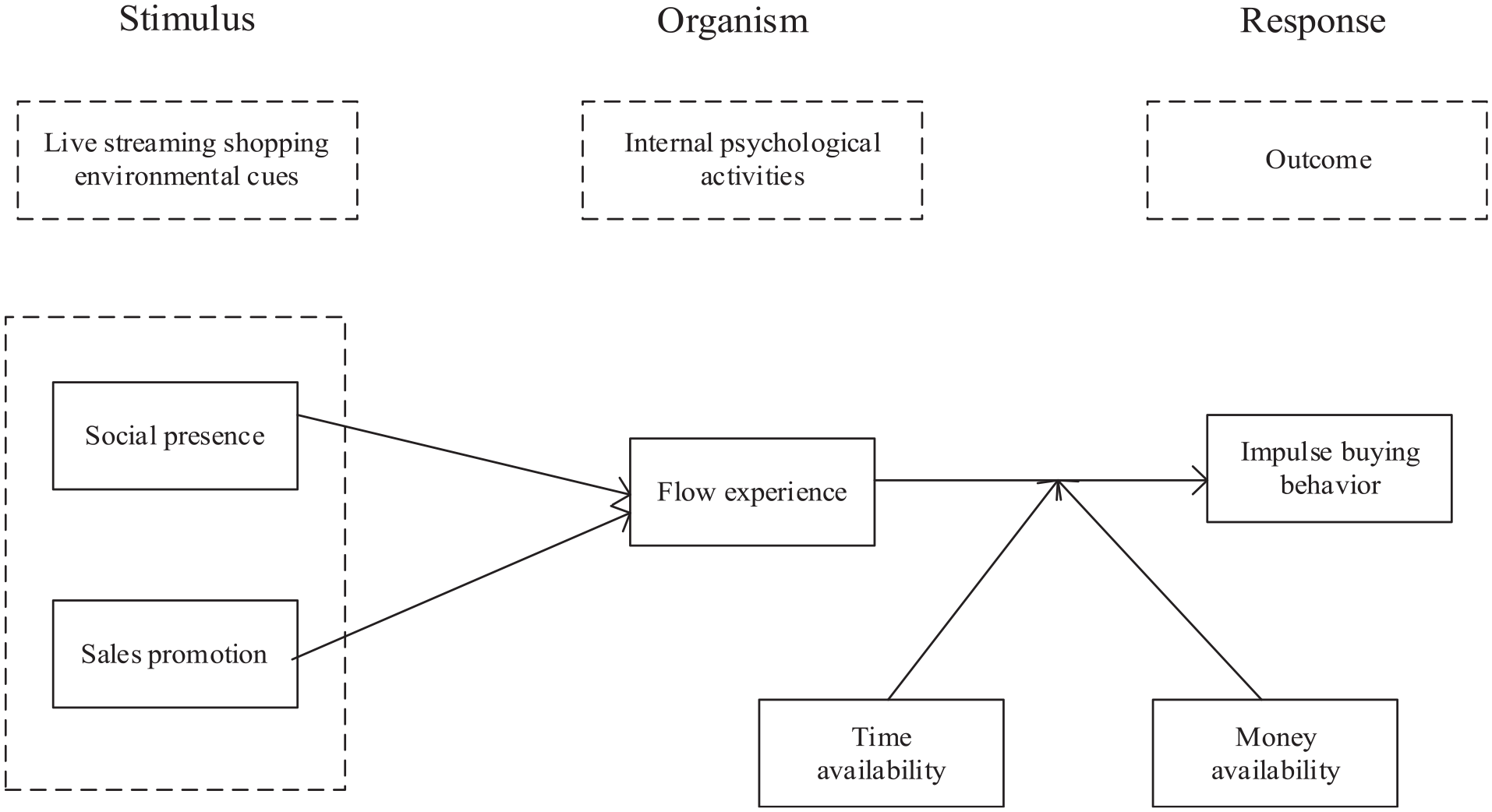
Conceptual framework and hypotheses of the base model.
Methodology
Measurements and Questions Design
The survey was initially written in English, and then it was translated into Chinese.
The translation process was thoroughly reviewed by three university professors in marketing management carefully to make sure that the meaning of the item did not change. The questionnaire included items adapted to the factors affecting consumers’ impulse buying combined with live-streaming shopping features. All constructs were measured and adapted from published or established valid items, using a 5-Likert scale. Social presence was measured with three items based on the study of E. J. Lee and Shin (2014) and used by Zhu et al. (2020), example items include I felt like I was having a conversation with the broadcast in live streaming shopping. Sales promotion was determined with four items based on Carlson et al. (2016)’s work and used by Sinha and Verma (2020), example items include I could get an exclusive discount from live streaming shopping. Flow experience was based on the research of Hsu et al. (2012), and also used by Wu et al. (2020) including four items. Live streaming impulse buying used three items adapted by Beatty and Elizabeth Ferrell (1998) and Rook and Fisher (1995), and have been used by Wu et al. (2016), Chang et al. (2014), Kimiagari and Asadi Malafe (2021)’s research. One example regarding impulse buying is I bought something that I had not planned to buy in live steaming shopping. Time availability and money availability are adapted by Chang et al. (2014), each including three items. Example items include I had limited time for live streaming shopping; I felt that I could afford to make any unplanned purchases in live streaming shopping. (Appendix A).
In addition, other information about consumers’ characteristics (gender, age, education, and year of live streaming shopping experience) was also collected on a nominal scale. Qualified respondents were defined as those whose recent live streaming shopping experiences were limited to the last 3 months, because respondents might lose their focus for clear responses from live streaming shopping without this restriction.
Pretesting
In the process of determining whether the content of the questionnaire is valid, we send it to three academics who hold doctoral degrees in marketing and are well-versed in digital marketing as well as consumers’ online behavior to review (Dhir et al., 2017). They checked the measurement construct, layout, ease of understanding, logical consistency, and item sequence. For the face validity test, subsequently, 60 undergraduate students were randomly invited to do the pretest through the Wenjuanxing.com-affiliated online survey in China as a way of reducing the potential ambiguity and confirming the final items. The pretest results showed acceptable reliability of the measurement scale, with Cronbach’s α of each construct exceeding 0.8 (Nunnally, 1967).
Data Collection
An online survey was distributed from January to March 2021. We received 420 replies and deleted 45 responses due to all the same answers, and less than one-minute answers. Finally, we got 375 valid responses, and the demographic information is shown in Table 1. The ratio of male to female among the 375 respondents is approximately 1:2 (128: 247). In addition, the age group is evenly distributed in the 18 to 25 (26.1%), 26 to 35 (34.9%), and 36 to 45 (29.3%), which is the driving force of live streaming shopping and suggests that the trend toward live streaming buying is moving quickly. The vast majority of respondents (83.7%) have got bachelor’s degree. Moreover, half of those who participated in the survey have more than one year of experience with live-streaming shopping.
Demographic Information of Respondents (n = 375).

Results and Analysis
Common-Method Bias (CMB)
Following Podsakoff et al. (2003)’s approach, we first tested whether CMB derived from self-reported data was a concern in the study through exploratory factor analysis (EFA) by Harman single factor analysis. The results showed that the first factor accounted for 30.65% of all variances (less than 50%), under six factors being extracted based on the eigenvalue greater than 1.00, indicating that CMB is not a major issue in this study. Second, we performed the single factor fitting test, and the result showed a poor fit (χ2/df = 13.144, GFI = 0.595, AGFI = 0.500, NFI = 0.443, TLI = 0.396, CFI = 0.460, RMSEA = 0.180). In addition, the survey questions were put in a random order that reduced respondents’ speculation for the measuring questions to minimize the CMB. These results indicate that this study is free from CMB.
Measurement Model
Before examining the relationship between the constructs, firstly, confirmatory factor analysis (CFA) was assessed for testing model fit. The results suggested an acceptable general model-fit with χ2/df (1.428), RMSEA (0.034), CFI (0.983), TLI (0.979), and GFI (0.946). It indicates the measurement model presented a good model fit with the collected data. Secondly, reliability and convergent validity were assessed through Cronbach’s α, factor loadings, composite reliability (CR) and average variance extracted (AVE). The results in Table 2 showed that Cronbach’s α are all greater than 0.8, individual item loading is above 0.7, CR values are larger than 0.8 and the AVE of all constructs are greater than 0.5. The results meet the suggested acceptable value and indicate a good reliability and an acceptable convergent validity suggested by Fornell and Larcker (1981). We also performed the discriminant validity test by comparing the correlations among constructs and AVE values. The square root of AVE is higher than each factor’s correlation coefficient (Table 3), indicating a good and acceptable discriminant validity (Fornell & Larcker, 1981).
Results of Factor Loadings, Cronbach α, Composite Reliability and AVE.

Note. FL = Factor Loading; CR = Composite Reliability; AVE = Average Variance Extracted.
Discriminant Validity of the Measurements.

Note. Diagonal elements are the square root of AVE. The value should exceed the inter-construct correlations for adequate.
Structural Model and Hypotheses Testing
As all the constructs in our study are reflective, we used structural equation modeling to examine the research model using the maximum likelihood in AMOS 23.0. All the fitting factors (χ2/df = 1.577, p<.001, RMESA = 0.039, CFI = 0.985, TLI = 0.981, GFI = 0.961) were greater than the suggested value, indicating an acceptable goodness-of-fit of the model. The results in Table 4 show that all the direct paths were supported. Social presence has a positive direct influence on consumers’ flow experience (β = .398; p < .001). Thus, the result supports H1. The direct effect of sales promotion on consumers’ flow experience is also significant (β = .365; p < .001), thereby supporting H2. Further, consumers’ flow experience significantly affects consumers’ impulse buying behavior (β = .512; p < .001), thus supporting H3.
Results of Paths Analysis.

p < .001.
Mediating Effect Analysis
To test whether flow experience can perform as a mediator, we then performed the bootstrapping analysis. Table 5 (a total of5,000 with a confidence level of 95%) describes the results of the mediating test. The finding that social presence is positively related to consumers’ impulse buying behavior through flow experience supports H4a (indirect effect: 0.203, Boot LLCI = 0.139, Boot ULCI = 0.282, p < .001). Thus, the influence of consumers’ perceived social presence on their impulse buying is mediated by flow experience. Further, the finding that sales promotion is positively related to consumers’ impulse buying behavior through flow experience supports H4b (indirect effect: 0.187, Boot LLCI = 0.123, Boot ULCI = 0.256, p < .001). Therefore, the influence of sales promotion on consumers’ impulse buying is mediated by flow experience.
Results of Mediation Effect.

Moderation Analysis
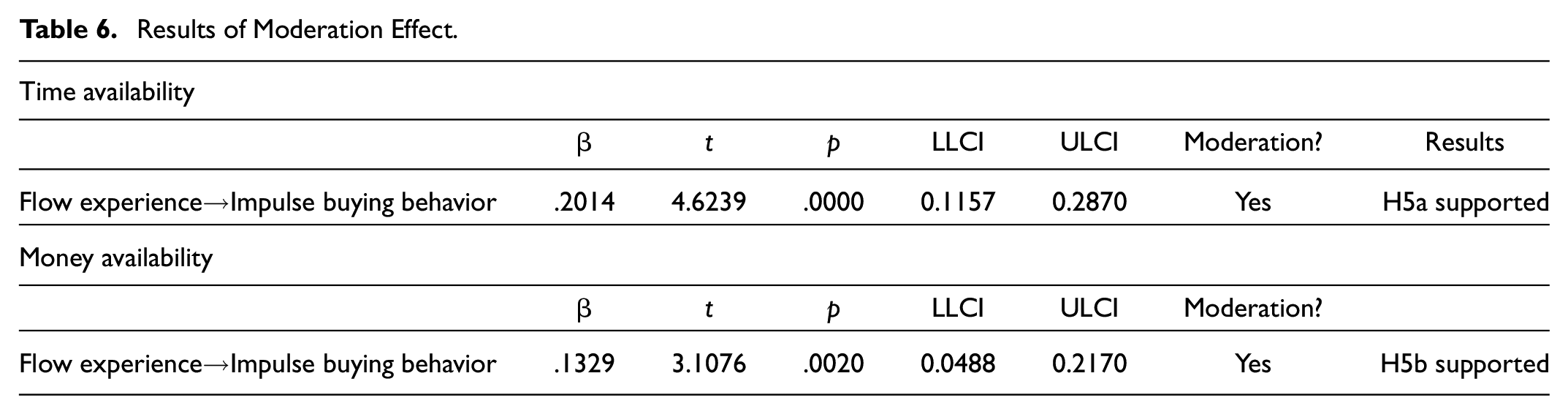
We added time availability and money availability as a moderator in this study. The moderation test was done by bootstrapping5,000 times. The result in Table 6 supports H5a that time availability positively moderates flow experience-impulse buying behavior relationship (β = .2014; p < .001, LLCI = 0.1157, ULCI = 0.2870). Moreover, the finding that money availability moderates the relationship between flow experience and impulse buying behavior supports H5b (β = .1329; p < .005, LLCI = 0.0488, ULCI = 0.2170). The findings confirm that time and money availability can strengthen the relationship between flow experience and impulse buying behavior.
Results of Moderation Effect.
Discussion and Implications
Three hypotheses assessing the direct effects are confirmed by the empirical data analysis (H1-H3). In addition, we also find flow experience (O) serves as a mediator (H4a and H4b). Furthermore, our findings also confirm that time availability and money availability positively moderate flow experience-impulse buying behavior association (H5a and H5b). The results highlighted the direct and indirect relationship among social presence, sales promotion, flow experience, and impulse buying behavior within the S-O-R framework, which situational characteristics also interact and motivate this behavior.
Firstly, following Ang et al. (2018)’s, Bandyopadhyay et al. (2021)’s and H. Gao et al. (2022)’s research, we identified the social presence and sales promotion as important environmental cues in motivating consumers’ preference for live-streaming shopping. The results empirically confirm that social presence and sales promotion significantly authenticate consumers’ flow experience, which in turn impacts consumers’ impulse buying behavior as proposed through H1 and H2. The support for H1 implies that live streaming emphasizing real-time social viewing generates perceived social presence, which plays an important role in influencing consumers’ internal state. Social presence created from live streaming shopping usually derives from imitating the real-world shopping environment, information transmission, and authentic interaction, which can motivate consumers’ flow experience in live streaming. Live streaming is such high in generating social presence, when consumers take part in live streaming, they must devote time and be in full concentration on the presented content and real-time interactions. At this point, consumers experience a continuous process of attention, self-control loss, and enjoyment achievement. Thus, social presence generated from live streaming authenticates consumers’ flow experience. The support of H1 is aligned with previous studies linking the social presence to consumers’ psychological responses, and consequential behavioral intentions (Algharabat et al., 2018; M. Li et al., 2022; X. Ma et al., 2022). Our findings regarding the positive effect of social presence on flow experience support those of prior research contend that social presence inherent live streaming could enhance consumers’ high attention and shape their emotional response (Ang et al., 2018; Zhu et al., 2020). In addition, the statistical result supports H2, verifying that sales promotion is another key factor in affecting consumers’ flow experience. This result is supportive of existing literature that sales in important in satisfying consumers’ psychological demand to pursue affordable prices and extra benefits (Bandyopadhyay et al., 2021), enhancing the participation of consumers in live-streaming shopping. This finding indicates that under the incentive of preferential sales promotion, consumers are more eager to get information related to the products from live streaming shopping, where the flow experience is much easier to be generated. The result also confirms that sales promotion acts as a motivator and causes consumers to spend more time engaging in live-streaming shopping. It supports Goel et al. (2022)’s finding that consumers are positive to lucrative deals when shopping online without knowing about promotions and offers.
Secondly, the result empirically confirms that flow experience positively affects consumers’ impulse buying behavior and supports H3. This is consistent with Huang (2016)’s, Wu et al. (2020)’s, and Bao and Yang (2022)’s research that consumers’ flow experience is more likely to produce impulsive consumption behavior. This finding indicates that consumers’ flow experience increases their unintended buying behavior in live streaming shopping. It further implies when consumers are under stress in real life, they are more likely to temporarily escape from the real pressure through shopping in live streaming and pursue the multifactorial experiences of personal mental concentration and enjoyment. To elaborate further, as flow experience is commonly associated with consumers’ attention and hedonism, it will prolong their watching time and affects their purchase behavior (Zhou et al., 2021). In addition, the mediation analysis conducted to examine H4a and H4b revealed the mediation effect of flow experience supporting H4a and H4b. The mediating role of flow experience indicates when consumers perceive the intimacy of interpersonal interaction and the attraction of sales promotion, their impulse buying behavior is mediated by flow experience. Our finding is in line with Hsu et al. (2017)’s research and X. Liu et al. (2022)’s research, which studies flow experience as a mediator among impulse buying related phenomena. This finding suggests that the effect of social presence and sales promotion on impulse buying is mediated by flow experience. It provides a more comprehensive understanding of how social presence and sales promotion cause impulse buying behavior.
Third and importantly, the results confirm the hypotheses testing proposing the positive moderation effects of time availability and money availability between consumers’ flow experience and impulse buying (H5a and H5b). This finding supplements the research on live streaming by highlighting that consumers’ impulse buying might not always be behavioral but situational. This result supports the proposition prosed by Chang et al. (2014) that the situational variables can moderate the association of internal state on impulse buying. The impact of flow experience on consumers’ impulse buying in live streaming is higher for consumers with higher time availability than those with lower time availability. This result enables live-streaming sellers to further understand consumers’ live streaming impulse buying behavior based on their time situations. In addition, the impact of flow experience on impulse buying in live streaming is strengthened if consumers’ money availability is higher. It indicates when consumers have more money, even if there are certain consumption risks in live-streaming shopping, it will not generate a relatively higher negative impact on such consumers.
Theoretical Implications
We theoretically filled the gap in the existing literature related to consumers’ e-commerce impulse buying. First, we explored the influence mechanism of impulse purchase in live streaming. Extant research proves that live streaming can drive consumers’ impulse purchases. However, limited studies gave theoretical intention. We investigated the influence mechanism of consumers’ impulse buying within the condition of live-streaming shopping by applying a revised S-O-R framework. Second, we proposed a theoretical framework by combining social presence, sales promotion, flow experience, situational characteristics within a modified S-O-R model. We investigated how social, marketing, psychological, and situational variables induce and motivate consumers’ impulse buying in live streaming. Social presence (Ang et al., 2018) and sales promotion (Wongkitrungrueng et al., 2020) are ubiquitous traits of electronic shopping, but limited attention has been paid to their role together in affecting consumers’ perceived values, which in turn change their impulse buying. We identified social presence and sales promotion as two important environmental stimuli and examined their impact on consumers’ flow experience and impulse buying. It supplements previous studies that exclusively either consider marketing or technological or social factors. Third, our research advanced the current knowledge on the moderating effect of time availability and money availability in the O-R path, which has been primarily tested in the S-O path (Eroglu et al., 2003). The addition and findings of the moderating variables contribute to a better and more complete perception of consumers’ impulse buying in live streaming. Consumers’ time availability and money availability can be included when investigating consumers’ impulse buying, in particular, in the electronic shopping environment, as those specific situational factors can either strengthen or weaken the correlation between consumers’ positive emotional perception and intention as well as behavior.
Managerial Implication
In addition to the above-emphasized theoretical implications, streamers and live streaming merchants can implement the understanding of environmental stimulus in creating a strategy for enhancing the sales of their products. First, the research highlights the importance of increasing social presence. Therefore, live streaming merchants need to manage the ambient design of the live streaming room to imitate the real shopping environment and train the streamers to better interact with the consumers from time to time. For example, when streamers are selling furniture such as a sofa, it is better to decorate the broadcast room looks like a living room, which streamers and consumers can introduce and ask questions like in a real selling world. Moreover, streamers need professional training to answer and explain consumers’ product-related questions and worries without ambiguity. Therefore, a better interaction atmosphere can be created, further raising consumers to make an impulse purchase. Second, this study also reveals that sales promotion is an important environmental cue. Thus, streamers need to tell and emphasize the special promotion that the consumers can get through live streaming. For example, streamers can compare the price the live streaming, the traditional online store, and the offline store offered, which consumers can directly perceive through the product presentation. Appropriate sales promotion strategy along with social presence together, can increase consumers’ perceived values and further increase their impulse purchases. Third, the moderating role of situational characteristics was interesting finding, revealing the importance of watching time prolonged and streamers’ language intervention. On the one hand, the streamer selected by the merchant needs to prolong watching time of consumers in a proper way to generate virtual closeness. Appropriate language intervention is advised, as it can reduce consumers’ buying hesitation. On the other hand, large-scale sales promotional activities are suggested to choose days when consumers have more time and money, such as salary days, bonus days, and holidays. Finally, the live streaming merchants are suggested to be concerned about the difference the special offers against low prices, as potential consumers can be convinced that the low price corresponds to low product quality.
Conclusion
Live streaming is an important mode of e-commerce within the flourishing and dynamic online and mobile shopping environment. To explore the influence mechanism of consumers’ impulse buying behavior in live streaming, we answered the research question by examining five hypotheses based on the extant literature and empirically testing through a revised S-O-R framework. The understanding of how social presence, sales promotion, and flow experience affects impulse buying was enhanced within the S-O-R framework. We also found empirical evidence to support the mediating role of flow experience and the moderation effect of time availability and money availability. Important theoretical and practical implications are thus provided by the research findings.
Limitations and Future Scope
The limitations of this study provide opportunities for future studies. First, although sales promotion is defined as one of the important promotional factors based on the previous research, the supply of goods and limits of purchasing time can also be extended to better understanding consumers’ impulse buying in live streaming. Second, we only focused on pure impulse buying behavior in this research. The future study can include the other three forms of impulse buying (reminder, suggestion and unplanned), and investigate the difference. Third, the data we collected was from a single country, though live streaming is a global e-commerce phenomenon. The social-cultural difference is also an important factor in distinguishing an individual’s different impulse buying that future studies can include it as a moderator.
Supplemental Material
sj-docx-1-sgo-10.1177_21582440231172678 – Supplemental material for Exploring Factors Affecting Consumer’s Impulse Buying Behavior in Live-Streaming Shopping: An Interactive Research Based Upon SOR Model
Supplemental material, sj-docx-1-sgo-10.1177_21582440231172678 for Exploring Factors Affecting Consumer’s Impulse Buying Behavior in Live-Streaming Shopping: An Interactive Research Based Upon SOR Model by Chunhui Huo, Xiaorui Wang, Muhammad Waqas Sadiq and Ming Pang in SAGE Open
Footnotes
Declaration of Conflicting Interests
The author(s) declared no potential conflicts of interest with respect to the research, authorship, and/or publication of this article.
Funding
The author(s) disclosed receipt of the following financial support for the research, authorship, and/or publication of this article: The authors would like to acknowledge that financial support for the writing of this article came from National Office for Philosophy and Social Sciences (grant number: 21BGL047).

Supplemental Material
Supplemental material for this article is available online.
References
Supplementary Material
Please find the following supplemental material available below.
For Open Access articles published under a Creative Commons License, all supplemental material carries the same license as the article it is associated with.
For non-Open Access articles published, all supplemental material carries a non-exclusive license, and permission requests for re-use of supplemental material or any part of supplemental material shall be sent directly to the copyright owner as specified in the copyright notice associated with the article.
