




Abstract
This article utilizing unique data on 37,655 public complaints in South Korea from April 2021 to March 2022 aims to unveil the association between sentiments in public complaints or petitions and government response speed. We estimate sentiments in each complaint with five morphological analyzers and employ negative binomial regression models. The empirical results demonstrate that public complaints with the sentiment of Fear tend to receive faster governmental responses while complaints with the sentiment of Sorrow are more likely to be addressed slowly. The influence of the sentiment of Fear and Sorrow is consistently robust in logistic event history models, while the sentiment of Anger is not statistically significant anymore. The results contribute to the literature on political psychology by demonstrating that facing public complaints dominated by different sentiments can influence the efficiency of civil servants. At the same time, this article suggests providing periodical counseling and education for civil servants who continuously face waves of negative sentiments to treat public complaints expertly.
Introduction
Do sentiments expressed in public complaints influence the government response speed and do types of sentiments such as anger, fear, and sorrow matter? As one of the most important characteristics of democracy (Dahl, 1971; Powell, 2004; Verba & Nie, 1972), government responsiveness has been widely examined by previous studies. Recently, with the emerging importance of public complaints or petitions (Simmons & Brennan, 2017), government response speed toward the complaints and petitions has received academic attention (J. Chen et al., 2016; Su & Meng, 2016). However, few studies empirically examine the association between the sentiments in public complaints and the government response speed. In this article, we examine whether the sentiments in public complaints determine the government response speed and investigate which types of sentiments affect the response speed.
Literature Review
Emerging Importance of Public Complaints
With the growing importance of political participation shaping the politics of the present and the future (Carpenter & Moore, 2014; S. Lee et al., 2022; McDonnell, 2020; Willeck & Mendelberg, 2022), public complaints or petitions have been widely examined as one of the most important contemporary forms of political participation. Public attention expressed by complaints and petitions is conducive to the improvement of government accountability and responsibility at the same time (Li et al., 2022). Along with accountability and responsibility, public complaints are regarded as powerful tools to enhance government efficiency.
Previous studies on public complaints or petitions have not been geographically limited to certain geopolitical regions but have covered various countries regardless of regime types over the globe such as China (Cai & Zhou, 2019; J. Chen et al., 2016; Jiang & Xu, 2009; Meng & Yang, 2020; Su & Meng, 2016; Wu et al., 2022), Germany (Jungherr & Jürgens, 2010; Lueders, 2022), Russia (Henry, 2012; Kabanov & Vidiasova, 2019), South Korea (H. Kim, 2007; E. Lee et al., 2019; J. Lee et al., 2022; Min et al., 2019), Uganda (Grossman et al., 2017), and the United States (Carpenter, 2023; Carpenter & Moore, 2014; Dumas et al., 2015; Herring, 2019).
Topics of Research on Public Complaints
Together with the wide geographical range of previous studies on public complaints or petitions, a variety of topics has been examined in the existing literature on public complaints (Dumas et al., 2015; Meng & Yang, 2020; Min et al., 2019). For instance, Min et al. (2019) conducting a semantic network analysis determined significant keywords concerning environmental complaints and identified salient local environmental issues in Shiheung City in South Korea. Also, Dumas et al. (2015) applying punctuated equilibrium and social network analysis demonstrated that tragic events can trigger the surge of e-petitions proposing diverse policy responses. In addition, concerning the quality of responses toward public complaints or petitions, Meng and Yang (2020) showed that the types of responsive institutions including party office, government office, inclusive agency, functional agency, supervision agency, and petition office tend to influence the quality of responses.
Furthermore, Merson and Mary (2017) employing a text mining approach analyze prominent issues from public complaints by analyzing the complaints posted on social networking sites. In the case of South Korea, J. K. Lee and Kwon (2020) showed that issues in public complaints are heterogenous based on regions even in a country. Moreover, J. Lee et al. (2022) using Latent Dirichlet Allocation (LDA) models analyzed news big data from 2000 to 2021 in South Korea and demonstrated that public complaints expressed in comments on the news tend to affect government policy outcomes. Furthermore, they revealed that topics in public complaints have changed continuously according to issue salience in countries.
Public Complaints and Government Responsiveness
Government responsiveness toward complaints is one of the main themes in the existing literature on public complaints. Government responsiveness is considered one of the most important features of democracy (Dahl, 1971; Powell, 2004; Verba & Nie, 1972) and previous studies have examined what kinds of variables explain variations in government responsiveness. It has been revealed that government responsiveness tends to be determined by social media (Ennser-Jedenastik et al., 2022; Eom et al., 2018; Panagiotopoulos et al., 2013), regime types (Cleary, 2007; Grossman & Slough, 2022; Powell, 2004), party organization (Linde & Peters, 2020), cabinet ministers’ professional backgrounds (Alexiadou, 2022), and socio-economic conditions of countries or provinces (Itani et al., 2022; Speer, 2012).
Also, some previous studies have focused on unveiling factors of variations in government response speed, regarded as one of the most crucial qualities of responsiveness, toward public complaints or petitions. For example, the crucial study from Su and Meng (2016) explained variations in government responsiveness in China by relying on the full records of citizen-government interactions from 2008 to early 2014. They demonstrated that public demands expressed collectively and closely related to economic growth are more likely to be responded. In addition, some have demonstrated that the forms of e-government tend to improve government response speed (Gajendra et al., 2012; Lessa, 2019). More recently, Tavares et al. (2022) analyzing data on2,139 public complaints submitted to the Ombudsman in Portugal (2012–2015) showed that government responsiveness toward public complaints is highly conditioned on local conditions including unemployment, crime, and aging populations.
Research Question
Even though previous studies have broadened our understanding of the potential determinants of government response speed toward public complaints or petitions, the link between sentiments in the complaints and government response speed has not been thoroughly examined. Given that sentiments in texts including public complaints or postings have been regarded as a factor in determining viewers’ reactions toward the texts (S. Chen et al., 2019) and in formulating the mode of political communication (Ceron et al., 2014; O’Connor et al., 2010), such academic lacuna is unexpected. Therefore, this article aims to fill this research void by examining the link between sentiments expressed in the complaints and government response speed toward civil petitions. Below are the two research questions examined throughout this article.
This article relies on the unique public complaints data provided by the Anti-Corruption & Civil Rights Commission in South Korea to unveil the influence of sentiments in the complaints on the government response speed. According to the definition from the Civil Petitions Treatment Act in South Korea, this article defines civil petition as “a request by a civil petitioner to an administrative agency to take a disposition or other specific action.” The availability of South Korean public complaints data provides us with a valuable opportunity to examine the influence of sentiments in complaints on the government response speed. We conduct multidimensional sentiment analysis to measure sentiments in each complaint and estimate negative binomial regression models to statistically evaluate the association between sentiments in public complaints and government response speed.
The rest of this article proceeds with the following orders. In the next Theoretical Framework and Hypotheses section, we introduce our theories and hypotheses related to the association between government response speed and sentiments of public complaints. In the Research Data and Methodology section, explanations of variables and data including public complaints big data collected by the Anti-Corruption & Civil Rights Commission, and modeling strategies will be presented. Then, we present the empirical results from negative binomial regression models and those from robustness checks with discussions about how the empirical findings contribute to the previous literature. Finally, we conclude with practical implications based on the results and recommendations for future research directions.
Theoretical Framework and Hypotheses
This article borrows the theoretical framework of a cognitive evaluation theory embodied by Deci and Ryan (1985) to theorize the relationship between sentiments expressed in public complaints on government response speed. The cognitive evaluation theory developed as a subtheory within a self-determination theory (Ryan & Deci, 2000). According to the self-determination theory, individual behaviors are guided by two types of motivations: extrinsic motivation which is to gain external rewards or positive consequences, and intrinsic motivation defined as “doing something because the activity itself is interesting, spontaneously enjoyable, and satisfying” (Moller et al., 2006, p. 105).
Related to intrinsic motivation, the cognitive evaluation theory suggests that “social environments can facilitate or forestall intrinsic motivation by supporting versus thwarting people’s innate psychological needs” (Ryan & Deci, 2000, p. 71). Based on the assumption that intrinsic motivation tends to be catalyzed when individuals are in conditions leading to the expression of the motivation, the main thrust of the cognitive evaluation theory is that the intrinsic motivation of individuals is determined by the three critical factors: competence, autonomy, and relatedness. The three factors of intrinsic motivation are prone to be affected by the social-contextual events including feedback and communication (Deci & Ryan, 2013; Ryan & Deci, 2000). Especially, interpersonal climates and communication styles have been considered important social-contextual events affecting individuals’ intrinsic motivation related to autonomy as below.
“Interpersonal climates and communication styles that pressure people to behave, dictating what they should do or how they should do it, have also been found to undermine autonomous motivation, whereas interpersonal climates and communication styles that are supportive and encouraging of volition and choice tend to enhance autonomous motivation.” (Moller et al., 2006, p. 105)
The argument that the influence of sentiment or emotion in communication can affect individual behaviors has been qualitatively demonstrated by some influential studies. For instance, it has been revealed that there is a correlation between autonomous and internalized motivation and communications with positive emotionality (Ryan & Connell, 1989), resulting in increased achievement, effort, and well-being (Koestner & Losier, 2002).
Based on the cognitive evaluation theory, we expect that the sentiment expressed in public complaints which is one of the ways for the public to communicate with governments influences the government response speed by affecting the intrinsic motivation of civil servants. Rather than previous studies have focused on the extent of sentiment polarity based on a continuous scale between the poles of positive and negative sentiments (e.g., Su & Meng, 2016), this article examines the influence of Fear, Sorrow, and Anger which have been widely detected in public complaints or petitions, given that public complaints are largely dominated by negative sentiment instead of positive one.
First, concerning the sentiment of fear, we expect that civil servants handling public complaints are more likely to treat complaints dominated by the sentiment of fear fast. This expectation is rooted in the assumption that civil servants in a position of treating public complaints are in a position based on their desire to serve the public regardless of some variations among the servants (H. J. Lee et al., 2020). Even though some of them are not originally in a position to serve the public, they are trained and promoted based on their performance to successfully handle public complaints (P. Kim, 2016). One of the typical examples of complaints with the sentiment of fear is “I am Frightened of receiving threats and insulting staff of a social welfare center” (Moller et al., 2006). Facing such complaints with the sentiment of fear can facilitate the intrinsic motivation of treating public complaints because citizens filing complaints with fear need help from civil servants to solve their problems and to get advice or guidance from the servants.
We also empirically examine whether sorrow and anger expressed in public complaints affect government response speed or not. Even though anger is powerful, both sorrow and anger have been regarded as harmful emotions which can affect service providers and civil servants handling public complaints in our case (Averill, 1983). In the line with the main thrust of the cognitive evaluation theory, it has been demonstrated that the expression of anger along with sadness to service providers is highly likely to negatively affect their job satisfaction and emotions, and lead to exhaustion or absenteeism (Grandey et al., 2004; Harris & Daunt, 2013). In addition, some previous studies have shown that facing the expression of sadness and anger tends to threaten service providers’ self-interest and social identity (Cropanzano & Rupp, 2003).
A series of studies also provided a clue for the negative impacts of sorrow and anger on government response speed. For instance, some have argued that the sentiments of sorrow and anger tend to be carried over and be diffused to recipients of the sentiments, which is called as mood congruency effect or carry-over effect (Forgas, 2003; Grant, 2018). Especially, Small and Lerner (2008) mentioned that negative emotions related to sorrow and anger tend to cause negatively biased attention. Thus, based on the prediction of the cognitive evaluation theory and other previous studies, we expect that civil servants handling public complaints tend to be negatively affected by the sentiment of sorrow and anger expressed in the complaints. In turn, the servants are being less attentive to those complaints and less motivated to treat them by being pressured to answer the complaints. Thus, public complaints with the sentiments of sorrow and anger entail slower government response speed toward the complaints. The specific hypotheses we test in this article are listed below.
Research Data and Methodology
In this section, we first introduce data and variables along with their operationalizations and ways to estimate sentiments in complaints. Then, modeling strategies employed in the empirical analysis will be presented.
Data and Variables
Dependent Variable
To evaluate the influence of sentiments in complaints on government response speed, this article constructs a count dependent variable based on the information about 37,655 public complaints received from April 1, 2021, to March 31, 2022, provided by the Anti-Corruption & Civil Rights Commission in South Korea. Given that the data on public complaints is highly sensitive and includes personal information (Deacon et al., 2021), we remove identifying information in the complaints including phone number, vehicle identification number, name, and so on. The dependent variable, Days, indicates the number of days between each public complaint to be posted and to be responded. Therefore, the dependent variable has values of natural numbers, capturing how fast each public complaint is responded.
Independent Variables
This article applies sentiment analysis to construct our independent variables: Fear, Sorrow, and Anger. Sentiment analysis growing area of Natural Language Processing (NLP) has been used both to analyze and to extract information from given texts (Ceron et al., 2014; O’Connor et al., 2010; Su & Meng, 2016). To be specific, sentiment analysis is a computation process of identifying and categorizing opinions or attitudes in given texts (Yaakub et al., 2019). For instance, O’Connor et al. (2010) derived sentiment scores by counting positive and negative messages in surveys, while Sang and Bos (2012) relying on sentiment analysis on 1,333 tweets demonstrated that sentiment analysis of tweets is effective to predict the results of the 2011 Dutch senate election as well as polls are. Rather than categorizing the sentiments in the public complaints into positive and negative sentiments, we conduct multidimensional sentiment analysis which enables us to measure the degrees of fear, sorrow, and anger in each complaint.
There are mainly two types of Sentiment classification algorithms: machine learning Approach and lexicon-based approaches (Patel & Choksi, 2015). The machine learning approach uses trained models to determine the sentiment of a given text, while the lexicon-based approach uses a pre-defined sentiment lexicon to compare with the target text (Nasim et al., 2017; Nguyen & Yim, 2018). Machine learning and lexicon-based methods both have their advantages and disadvantages. While one advantage of learning-based methods is their ability to adapt and create trained models for specific purposes and contexts, their drawback is the availability of labeled data and hence the low applicability of the method on new data (Gonçalves et al., 2013). Lexicon-based approach, on the other hand, has a major advantage as it can help to find domain-specific opinion words and their orientations if a corpus from only the specific domain is used in the discovery process (Zhang et al., 2014). Since the data we handle shows particular characteristics compared with other domains, the lexicon-based approach seemed to be the most adequate methodology.
In this article, we constructed our emotion lexicon related to public complaints using a Word2Vec method which has been auspiciously applied to sentiment analysis (Liu, 2017). Based on the distribution hypothesis that words appearing in similar positions have similar meanings (Hinton, 1984; Liu, 2017), the Word2Vec method enables us to obtain a vector of words by training a text corpus (Mikolov et al., 2013). We apply the Word2Vec method through Python’s Gensim package. After the vectorization of the words, we trained the collected civil complaint data based on the results of a part-of-speech (POS) tagging through five morphological analyzers (Mecab, Okt, Kkma, Khaii, and Komoran) which are responsible to identify meaningful parts of the words (Sawalha, 2011).
Rather than relying on one morphological analyzer and losing the relative strengths of other analyzers (see Woo and Jeong (2019) for a thorough review of each morphological analyzer), we combine the estimated sentiment scores from the five morphological analyzers (Mecab, Okt, Kkma, Khaii, and Komoran) through a principal component analysis (PCA) according to the window sizes (10, 25, and 50) and sentiments (Fear, Sorrow, and Anger). The window size in sentiment analysis is the length of the text sequence analyzed at each time. In this article, we set window sizes by 10, 25, and 50 to see whether the empirical results differ according to the window sizes or not (Huang et al., 2022). The PCA enables us to reduce the dimensions of the data with the consideration of the underlying structure of the components (Afifi et al., 2019). At the same time, the PCA improve on the weaknesses of the five morphological analyzers by integrating them into one indicator (Van Belle et al., 2004).
Table 1 shows how each sentiment score from the five different morphological analyzers is loaded onto each PCA-generated sentiment index. For instance, Fear (Window Size 10) is composed of the five sentiment scores concerning fear from Mecab, Okt, Kkama, Khaii, and Komoran, and the loadings are 0.5281, 0.5686, 0.5500, 0.3064, and 0.0387 respectively. The loadings are in positive directions, which makes sense given that all morphological analyzers aim to measure Fear. The same interpretations are applied to other PCA-generated sentiment indexes such as Sorrow (Window Size 25) and Anger (Window Size 50).
Explanatory Power of Principal Components.

Control Variables
To isolate the influence of sentiments in public complaints, a series of control variables are included based on previous literature on government responsiveness toward public demands (Distelhorst & Hou, 2014, 2017; Meng & Yang, 2020; Su & Meng, 2016). First, we include the logged length of the public complaints to parcel out the possibility that the lengthy complaints take much time to be answered or handled. In addition, this article also controls channels of how each complaint was filed. In South Korea, petitioners can file their complaints through diverse channels including traditional means of communication (mail, fax, and phone), website, mobile app, or mail to the presidential secretary’s office. The inclusion of the channels as controls not merely parcels out the potential impacts of the channels but also enables us to isolate the influence of sentiments in public complaints on government response speed.
Third, given that some previous studies demonstrated that government response speed toward public demand differs by issue areas (Su & Meng, 2016) and that issue salience can affect government response speed (Williams, 2018; Wolfe, 2012), this article using fixed effects also controls issue areas of each public complaint. According to the Anti-Corruption & Civil Rights Commission, the complaints based on the business references model (BRM) are categorized into 28 issue areas including education, national defense, scientific technology, and social welfare.
Also, we control year-by-month fixed effects. By including year-by-month fixed effects, we aim to account for unexplained variation over time and to allow for flexible seasonality in public complaints. Moreover, given that previous studies have argued that regional characteristics such as socio-economic development, internet users, social stability, population, and leadership transition (Distelhorst & Hou, 2014, 2017; Su & Meng, 2016), we include regional fixed effects for 17 provinces in South Korea based on the positions of processing departments answering each public complaint. The inclusion of regional fixed effects prevents the estimates of beta coefficients from being biased due to unobserved or unmeasured variations across regions.
Furthermore, we also control whether the complaints are public or private and whether the complaints are repeated or not. As Su and Meng (2016) demonstrated that real-name petitions are more likely to pressure governments to respond, we expect that private complaints tend to be more slowly responded than non-private ones. In addition, we anticipate that repeated complaints tend to be responded quickly given that no additional answers from the government might not be required. The control variables, Private Complaint and Repeated Complaint, are binary. We assign 1 to Private Complaint and Repeated Complaint if a complaint is private and repeated respectively; otherwise, 0 is assigned.
Table 2 provides information on descriptive statistics concerning all variables, except binary variables for all issue areas and provincial-level divisions, employed in the next empirical analysis section. It should be noted that the gender and age of individuals who filed each complaint are not included as control variables. It is because individuals can arbitrarily fill in their gender and age when they deliver their complaints to processing departments, meaning that the information about gender and age collected by the Anti-Corruption & Civil Rights Commission is not reliable. We conduct the variance inflation factor (VIF) test to evaluate whether there is a problematic correlation (multicollinearity) among independent and control variables or not. The VIFs of individual explanatory variables do not exceed 4.00, indicating that there is no significant multicollinearity problem (Hair, 2009).
Descriptive Statistics of All Variables.

Note. The means of independent variables are centered at zero (or mean normalized) during the PCA.
Modeling Strategies
To examine the influence of sentiments in complaints on governmental response speed, this article given that the nature of our dependent variable relies on the negative binomial regression models. The negative binomial regression models are employed instead of the ordinary least squares (OLS) regression models, because the application of OLS regression models on the count dependent variable leads to nonsensical estimations and predictions, and introduces bias in the estimates of standard errors (Dougherty, 2011). Due to the limitations of OLS regression models, negative binomial regression models along with Poisson regression models have been widely applied to investigate count data (Beck & Tolnay, 1995; Ghazal & Zulkhibri, 2015; Moghimbeigi et al., 2008). In the negative binomial regression models the log of the expected outcome will be predicted with a series of right-hand variables (Hilbe, 2011). The methodological expression of negative binomial regression models is below.

Results and Discussion
In this section, we will introduce the empirical results from negative binomial regression models and robustness checks based on logistic event history models. Moreover, the academic contributions of this article will be discussed.
Empirical Results
Table 3 presents the empirical results from the three negative binomial regression models where each sentiment is estimated based on different Window Sizes. The empirical results concerning the three independent variables vary across the three models. Given that Model 3 has the lowest AIC and BIC indicating Model 3 has a better model fit compared to Model 1 and Model 2, we focus on interpreting the estimates in Model 3.
Estimations From Negative Binomial Regression Models.

Note. Standard errors are in parentheses. Akaike’s Information Criteria (AIC) and Bayesian Information Criteria (BIC) are presented for model comparison.
p <.05. **p < .01. ***p < .001.
While the three independent variables are not statistically significant in Model 1 (Window Size 10) and only Anger has a statistically significant relationship at the level of p < .001 with the number of days of being responded in Model 2 (Window Size 25), the three variables turn out to be statistically significant in Model 3 (Window Size 50). In Model 3, Fear is statistically significant in a negative direction, and Sorrow and Anger have statistically significant positive relationships with the dependent variable. The estimated coefficient of Fear is −0.054, meaning that one unit increase in Fear decreases the logs of the number of days of being responded by 0.054. This finding is consistent with our argument that complaints with the sentiment of fear tend to facilitate civil servants’ intrinsic motivation of handling public complaints. In addition, the estimated coefficients for Sorrow and Anger are 0.008 and 0.057, indicating that an increase in those two independent variables increases the logs of the number of days by 0.008 and 0.057 respectively. It provides empirical support for our expectation that public complaints with sentiments of sorrow and anger tend to be responded slowly because civil servants are less attentive to those complaints and less motivated to handle such complaints.
With regard to control variables, there are also noteworthy findings. Concerning the method of receipt, public complaints filed through websites and mobile applications tend to be responded faster compared to those submitted through traditional channels (Mail, Fax, and Phone) and visits. This finding provides empirical evidence for the argument that e-platforms or e-governments are more effective to handle public complaints. Moreover, Mail to Presidential Secretary’s Office also expedites the government response speed. This result is not surprising given that there are strict guidelines on dealing with complaints filed through Mail to Presidential Secretary’s Office across the South Korean ministries such as the Ministry of Environment.
Moreover, Private Complaint has a statistically significant relationship with a positive sign, meaning that complaints which are not open to the public are more likely to be responded slowly compared to open complaints. Also, Repeated Complaint is statistically significant at the level of p < .001 in a negative direction as predicted.
To evaluate the substantial influences of Anger, Sorrow, and Fear sentiments on the government response speed, we estimate the average marginal effects (AMEs) of each emotion. Figure 1 presents the point estimates of the AMEs with 95% confidence intervals. The AMEs of Anger, Sorrow, and Fear are 0.124, 0.421, and −1.185 respectively. It means that one unit increase in Anger and Sorrow increases the number of days of being responded by 0.124 and 0.421. Moreover, one unit increase in Fear decreases the number of days by 1.185. Given that the maximum values of each emotion measure (Window Size 50) are higher than 25 (see Table 2), such increase and decrease followed by the unit increase are not negligible. Thus, the influence Anger, Sorrow, and Fear is not merely statistically significant, but also substantially meaningful.
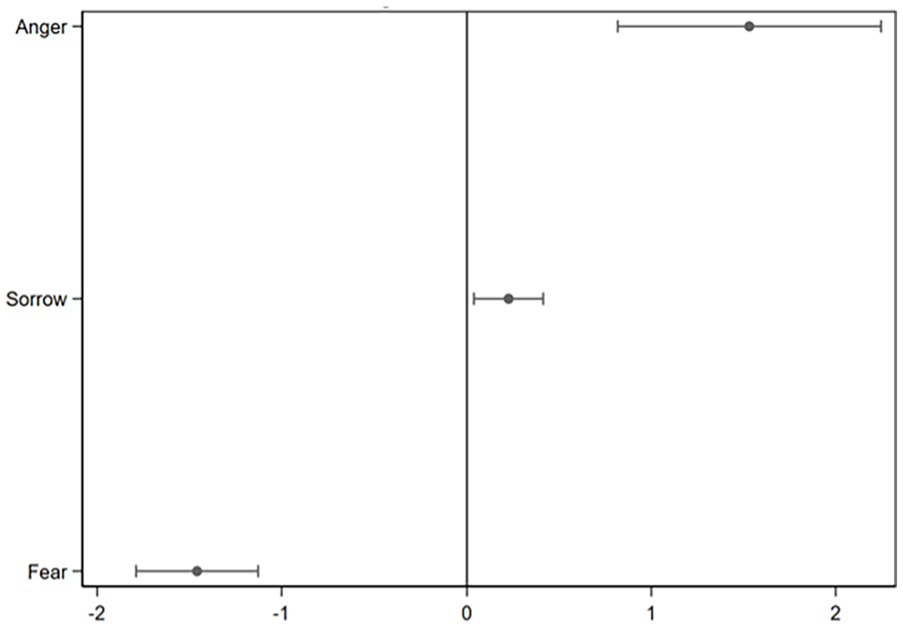
Average marginal effects of each emotion.
Robustness Check
Rather than concluding with the estimations only from the negative binomial regression models, this article estimates a logistic (or discrete) event history model (also called a duration model). Our decision on the alternative modeling strategy is based on the possibility that the number of days passed after each complaint filed might expedite governmental response speed toward public complaints. The application of logistic event history models enables us to parcel out the impacts of time passed (Box-Steffensmeier & Jones, 1997; Kreitzer & Boehmke, 2016). Even though there are other duration models such as the Cox Proportional Hazards Model (Cox, 1972), we rely on the logistic event history model given that the exact time when each public complaint is responded cannot be observed innately.
In the logistic event history model, the dependent variable is a binary variable indicating whether a complaint is responded or not. In addition, time polynomial functions are included as control variables to parcel out the influence of time on the government response. The inclusion of time polynomials enables us to any influence of time which can be recovered by the Cox model (Carter & Signorino, 2010). The variable, Time, measures the number of days after a complaint is filed. Each observation is dropped from the dataset after the complaint is responded. The sample dataset is presented in Appendix. The formula for the logistic event history model is below where

Table 4 presents the result from the logistic event history model. The AIC and BIC of the model indicate that the logistic event model has a better model fit than the negative binomial models presented in Table 3. The empirical results are also slightly different. Concerning the three independent variables, Fear and Sorrow have statistically significant relationships with the log-odds ratio of being responded in a positive and negative direction respectively. It means that complaints with a higher Fear sentiment score are more likely to be responded, while complaints with a higher Sorrow sentiment score are less likely to be handled. These results are consistent with the previous findings that Fear decreases, but Sorrow increases the government response speed. However, Anger is not statistically significant anymore in the logistic event history model.
Estimations From Logistic Event History Model.

Note. The Akaike’s Information Criteria (AIC) and Bayesian Information Criteria (BIC) are presented for model comparison. Again, the sentiment scores estimated with the window size 50 are employed as independent variables given that the model in Table 3 estimated with the window size 50 has the higher AIC and BIC scores.
Turning to control variables, only Mail to Presidential Secretary’s Office and etc. are statistically different from the conventional method of receipt (Mail, Fax, and Phone). Other control variables including Private Complaint, Ln (Length), and Repeated Complaint are statistically significant at the level of p < .001, as they are in the models in Table 3. It should be noted that the time polynomials are also statistically significant, meaning that the influence of time passed after each complaint is filed should be modeled to isolate the influence of emotions in complaints on government response speed.
Discussion
To sum up the empirical results, we employing negative binomial regression models found that the government response speed tends to increase when public complaints include the sentiment of Fear, while the speed decreases if the complaints are dominated by the sentiment of Sorrow and Anger. In the logistic event history model, the findings concerning Fear and Sorrow are consistently robust while the sentiment of Anger turns out to be not statistically significant. These empirical results are consistent with hypothesis 1 (public complaints with the sentiment of fear are more likely to be responded fast by the government) and provide partial support for hypothesis 3 (public complaints with the sentiment of anger are more likely to be responded slowly by the government). Concerning hypothesis 2 (public complaints with the sentiment of sorrow are more likely to be responded slowly by the government), we find an opposite influence of the sentiment of sorrow.
While echoing the voice of previous studies which emphasize the mood congruency effect and carry-over effect (Forgas, 2003; Grant, 2018), this article contributes to the broad literature on political psychology by demonstrating that facing public complaints dominated by different sentiments can influence the efficiency of civil servants handling the complaints by affecting the intrinsic motivation of the servants. In addition, given that the existing literature on responsiveness has focused on the influence of institutional factors such as regime types and the forms of e-government, and the socio-economic conditions of local governments (Cleary, 2007; Linde & Peters, 2020; Powell, 2004; Speer, 2012), this article contributes to the previous literature on responsiveness by unveiling the non-neglectable impacts of expressed sentiments in public complaints themselves on the government response speed.
At the same time, this article also emphasizes the importance of multidimensional sentiment analysis. Sentiment analysis has been broadly used to classify whether given texts are in negative or positive tones (Cevik et al., 2022; Jamil et al., 2022; J. Kim et al., 2022). However, the empirical results from this article that negative sentiments such as Fear, Sorrow, and Anger have heterogenous impacts on government response speed urge scholars not to handle negative sentiments as identical sentiments but to further examine each negative sentiment separately.
Recommendations and Conclusion
Recommendations
With the academic contributions mentioned earlier, this article also suggests some practical implications for the government’s human resources management and recommendations for future research directions. The civil servants who handle public complaints continuously face waves of negative sentiments including sorrow and anger, which affects negatively their intrinsic motivation (U. Kim & Park, 2006; H. Kim et al., 2022). In turn, it results in the loss of government efficiency concerning public complaints. Given that humanistic counseling and recurrent education are important to preserve intrinsic motivation (Jeon et al., 2022), providing periodical counseling and education for civil servants to treat public complaints expertly should be considered. Even though this article focuses on the case of South Korea, the implications and recommendations can be applied to other countries. Moreover, the finding that the government response speed toward public complaints filed through visits is slower than those filed through mail, fax, or phone emphasizes the need to improve the government response speed toward the complaints received in person.
Despite the policy implications and contributions of this article, there is a limitation of this research that we want to emphasize. Even though the influences of the sentiment of Fear and Sorrow on the government response speed are statistically and substantially significant in both negative binomial regression models and logistic event history models, a statistical approach does not test theories themselves innately (Lijphart, 1971). Therefore, future research using a qualitative approach such as interviews or surveys on civil servants handling public complaints will be promising. Moreover, given that the cognitive evaluation theory emphasizes the role of previous experience on self-determination and intrinsic motivation (Ryan & Deci, 2000), studies on the link between the evaluations of civil servants on their previous experience of handling public complaints and their response speeds toward the complaints will be a natural extension of this article. In addition, considering that this article focuses on the independent influences of each sentiment, it is valuable to examine the influence of the amalgamation of sentiments or emotions in public complaints on government response speed.
Conclusion
Even though the growing importance of handling public complaints or petitions and academic attention toward potential determinants of government response speed, the influence of the sentiment in public complaints on government response speed has not been thoroughly and empirically examined. Given that the non-neglectable impacts of the sentiment in communication on the sentiment recipients and those on service providers’ behaviors have been studied continuously (Forgas, 2003; Grant, 2018; Small & Lerner, 2008), the shortage of studies on this topic is surprising. To fill the academic void, this article using the unique data on public complaints in South Korea analyzes the relationship between sentiments of public complaints and government response speed. As results from negative binomial regression models and logistic event history models, we demonstrate that public complaints with the emotion of fear tend to receive faster government response, while those with sorrow and anger responded slowly. The findings contribute to the literature on political psychology and sentiment analysis. At the same time, we recommend providing both periodical counseling and education for the civil servants handling public complaints to maintain the professionalism and efficiency of public officials.
Footnotes
Appendix
The Sample Dataset for the Logistic Event History Analysis.

| Complaint identifier | Fear (size 50) | Sorrow (size 50) | Anger (size 50) | Responded | Time | Time2 | Time3 |
|---|---|---|---|---|---|---|---|
| ⁝ | |||||||
| 334 | −0.434 | −0.378 | −0.190 | 0 | 0 | 0 | 0 |
| 334 | −0.434 | −0.378 | −0.190 | 0 | 1 | 1 | 1 |
| 334 | −0.434 | −0.378 | −0.190 | 0 | 2 | 4 | 8 |
| 334 | −0.434 | −0.378 | −0.190 | 0 | 3 | 9 | 27 |
| 334 | −0.434 | −0.378 | −0.190 | 0 | 4 | 16 | 64 |
| 334 | −0.434 | −0.378 | −0.190 | 1 | 5 | 25 | 125 |
| 527 | 2.168 | 3.979 | 0.802 | 0 | 0 | 0 | 0 |
| 527 | 2.168 | 3.979 | 0.802 | 0 | 1 | 1 | 1 |
| 527 | 2.168 | 3.979 | 0.802 | 0 | 2 | 4 | 8 |
| 527 | 2.168 | 3.979 | 0.802 | 0 | 3 | 9 | 27 |
| ⁝ | |||||||
| 527 | 2.168 | 3.979 | 0.802 | 0 | 44 | 1936 | 85184 |
| 527 | 2.168 | 3.979 | 0.802 | 0 | 45 | 2025 | 91125 |
| 527 | 2.168 | 3.979 | 0.802 | 0 | 46 | 2116 | 97336 |
| 527 | 2.168 | 3.979 | 0.802 | 1 | 47 | 2209 | 103823 |
| ⁝ | |||||||
Declaration of Conflicting Interests
The author(s) declared no potential conflicts of interest with respect to the research, authorship, and/or publication of this article.
Funding
The author(s) received no financial support for the research, authorship, and/or publication of this article.
