




Abstract
This study analyzed the effect of intellectual capital on Chinese exporters’ performance and the joint mediating effect of two-way capabilities to explain the relationships. With a sample of 197 firms responsible for exporting Chinese high-tech products, we empirically evaluated higher-order constructs in a partial least squares structural equation model using a two-stage approach. The results show that firms’ intellectual capital generates dynamic capabilities, which lead human, structural, and relational capital to improve overseas export performance. Furthermore, the study shows risk management capability also has a complementary mediating role in improving overseas export performance. These findings point to the significant role of two-way capabilities, clarifying how risk management capabilities can be used to enhance export performance and highlighting the role of dynamic capabilities in leveraging export performance. Our findings hold managerial implications on how Chinese high-tech exporting businesses adapt to fast-changing environments.
Introduction
With the rapid development of knowledge economy, intellectual capital, which is main strategic resources, plays an essential role in upgrading business performance (Bontis, 1998; Bontis et al., 2000; Bontis & Serenko, 2009; Campos et al., 2022; Youndt et al., 2004), especially for knowledge-based firms (Dai et al., 2022; Kianto et al., 2010). As a knowledge-intensive industry, high-tech enterprises have become the main force of the national innovation-driven development strategy and intellectual capital has replaced the conventional material capital that become the core resource for high-tech firms (Xu & Li, 2019). Under the new normal, China’s economy has entered a new phase, in which lower costs, higher efficiency, and high-tech firms are considered to be the new driving force of China’s economic growth (Xu & Li, 2019; Zhou et al., 2020), thus, Chinese enterprises gradually enhanced their intellectual capital accumulation. However, compared with the developed countries in Europe and America, Chinese firms should pay more attention to intellectual capital (Buenechea-Elberdin et al., 2018; Xu et al., 2019). In recent years, along with the changes in international business environments, especially the effect of COVID-19, the export profits of many Chinese enterprises have continued to decline, even have gone bankrupt, but some of them also keep a sustainable growth trend (Xu & Li, 2019). Therefore, does intellectual capital work for export enterprises directly? How intellectual capital affect enterprises export performance is undoubtedly a real problem that needs to be solved urgently.
In existing research, the benefits of implementing intellectual capital to realize firms’ superior performance have been extensively reviewed (Sardo & Serrasqueiro, 2018; Sydler et al., 2014). However, the implementation of intellectual capital may require a major transformation that leads to export performance improvements in a fast-moving technological environment (L. C. Hsu & Wang, 2012; Wu et al., 2007). This study supports the argument that intellectual capital cannot generate benefits directly on its own (Asiaei et al., 2020; Burt, 1997; Firer & Mitchell Williams, 2003). Firms need high-tech-based capabilities to operate and transform intellectual capital to achieve substantial organizational change (Marr & Spender, 2004). Based on the resource-based view, dynamic capabilities as integrated resources can be tailored to firms’ specific internationalization processes, whether incremental or accelerated, suggesting that differential capabilities build in a predefined path to affect corporate performance (Monferrer et al., 2015). However, the impact of intellectual capital on export performance is not fully understood, and a considerable number of firms do not perform satisfactorily when attempting to adopt intellectual capital. For example, many Chinese enterprises are still in pursuit of low-cost profits, mainly processing leather from Europe and the United States. As labor costs rise in China, some manufacturers have moved their factories to Southeast Asia, where labor is cheaper. However, in a cross-cultural environment with a variety of exogenous risks which are difficult to predict and quantify. Therefore, the resilience of the firm to confront those strategic risks should stem from firm-specific capabilities (Helfat et al., 2007; Zollo & Winter, 2002). Moreover, for export high-tech enterprises, risk management capabilities become the basis of their success in overseas markets. Developing more efficiency and reasonable risk management mechanisms enables organizations to maximize business opportunities created while reducing risks in a turbulent environment (Sen et al., 2020). And the mediating effect of risk management capabilities between logistics capabilities and supplier performance is also examined (Tukamuhabwa et al., 2023). Thus, risk management capability reflects an enterprise’s ability to identify the threat, analyze risks, and application of standardized threat management process and system (Lu et al., 2014; Nair et al., 2014; Ullah et al., 2019), which play a crucial role to export firm (Dias et al., 2021). But there is few existing research exploring whether or how do risk management capabilities mediate the relationships between intellectual capital and export performance, and the dual mediation with dynamic capabilities. For the purposes of this study, we defined high-tech exports as products with high R&D intensity, such as aerospace products, computers, pharmaceuticals, scientific instruments, and electrical machinery. Those firms face unique challenges in implementing intellectual capital in overseas business markets, as they may lack the risk management capabilities necessary to understand these issues (Nair et al., 2014). Risk management capabilities represent a significant channel for responding to risks and may help manage profitable opportunities available to exporting firms (Kunc & Bhandari, 2011; Nair et al., 2014); risk management also facilitates access to overseas markets (Lu et al., 2014; Ullah et al., 2019).
This empirical analysis uses a sample of Chinese discrete firms that export high-tech products. Firms exporting high-tech products cannot, on their own, generate critical changes in export performance directly in which the ability to mobilize high-tech-based capital resources is necessary to motivate organizational change (Kontoghiorghes, 2016).Therefore, this study aims to shed light on the relationship between intellectual capital and export performance in the context of Chinese firms that export high-tech products. Drawing on the intellectual capital literature (Ali et al., 2021; Asiaei & Jusoh, 2015; Y. H. Hsu & Fang, 2009; McDowell et al., 2018) and research on dynamic capabilities (Elsharnouby & Elbanna, 2021; Teece et al., 1997; Wang & Hsu, 2010), we examine the effect of Chinese high-tech firms’ intellectual capital on export performance via dynamic capabilities. Drawing on the risk management literature (Faedfar et al., 2022; Shad et al., 2019; Zou et al., 2010), we examine the mediating effects of risk management capabilities on the relationship between intellectual capital and export performance. Finally, we integrate resources-based view with export performance research to develop a model explicating how intellectual capital is linked to firm performance through a dual route by dynamic and risk management capabilities. And further analysis and results, conclusion and limitations.
Literature Review and Hypothesis Development
Conceptual Background
Resource-based view as a basis for competitive advantage of a firm in the application of content with tangible and intangible resources at the firm’s disposal, which explains performance correlative with firm resources and capabilities (Corbett & Claridge, 2002). The rare, irreplaceable, and non-immitigable strategic resources are, the higher the credibility of enterprises to obtain competitive advantage and achieve high-level performance (Bayraktaroglu et al., 2019). This study also claims to underpin the theme of resource-based view in terms of firms’ capabilities including intellectual capital, dynamic capability, and risk management capability. Within resource-based view, intellectual capital as a collection of intangible assets is the core strategic resource of companies’ innovation, which aggregates relevant knowledge, experience, technology, and customer relationship to enhance the competitive advantage of firms (Ali et al., 2021; Massaro et al., 2019; Stewart & Ruckdeschel, 1998; Sydler et al., 2014). It is considered a less risky resource for firm investment and value creation in emerging markets (Anwar et al., 2018), which is accepted in academia as a multidimensional construct, and it is widely cited as a construct of human capital, relational capital, and structural capital (Asiaei et al., 2018; Edvinsson & Sullivan, 1996). Based on the essentially static nature of the resources-based view, Teece et al. (1997) extended the resource-based view to dynamic capability view as the firm integrate resource, reconfigure internal and external competences in constantly changing marketplace (Lütjen et al., 2019). Eisenhardt and Martin (2000) believe that dynamic ability is rooted in the whole process of organizational entrepreneurial behavior, continuously strengthened with the help of endogenous learning, and acts on other competitive abilities. Dynamic capabilities are multidimensional conceptions, which are used in various academic disciplines based on the conceptual framework of Teece (2007). In the context of high-tech export sectors, we followed adaptation, absorption, integration, and innovation capability suggested by Wang and Ahmed (2007), Teece (2007), and Monferrer et al. (2015). Risk management capability reflects an enterprise’s understanding of the content of risks and the complexity of how to manage those risks (Mu et al., 2014; Zou et al., 2010) that runs through the orderly process of systematically identifying, analyzing, and responding to risks to achieve optimal risk elimination, mitigation, and/or control in an enterprise (Wang et al., 2004). Risk management is the basis for achieving enterprise objectives. It can help enterprises stay away from risks, but also play as a guide to maximize performance (Mu et al., 2014). Therefore, Enterprises with effective risk management capability will better control internal and external risks, to minimize operational efficiency and operating costs (Khan et al., 2020; Song et al., 2019). Subsequently, this will improve its overseas competitiveness and thus improve its export performance. Export performance of firms manufacturing high-tech products is affected by the business or technology environment. Intellectual capital, which utilizes intangible resources and capacities that affect firm performance, is a key evaluation indicator in the knowledge-based management literature (Edvinsson & Sullivan, 1996; Harrison & Sr, 2000). However, intellectual capital, which directly or indirectly affects a business’s financial performance, is not itself sufficient to connect opportunities from new business environments to firm performance directly. Based on the resource-based view, dynamic capabilities that operate existing intellectual capital efficiently in response to changing circumstances can influence performance and create the proper conditions for this connection. In a changing environment, firms may encounter positive opportunities, but also negative conditions that entail risks. For firms that export high-tech products in a fast-moving and competitive environment, the ability to effectively manage the risks of doing business may have a profound influence on the firms’ export performances. Therefore, intellectual capital, dynamic capabilities, and risk management capabilities can be expected to affect export performance directly. We propose that dynamic capabilities and risk management capabilities mediate the relationship with export performance and that risk management capability is an antecedent to dynamic capabilities (see Figure 1).

Conceptual framework.
Intellectual Capital and Export Performance
John Kenneth Galbraith (1967) first proposed the concept of intellectual capital, explaining it as the ability of a company to capitalize on opportunities (Massaro et al., 2019; Stewart & Ruckdeschel, 1998; Sydler et al., 2014). Utilizing all tangible and intangible assets available in the market—natural resources, machinery, or even financial capital—firms have the foundation to gain sustainable competitive advantage (Guthrie, 2001). Intellectual capital is an important driver of performance (Ali et al., 2021; Bontis, 1998; Bontis et al., 2000; Bontis & Serenko, 2009; Kianto et al., 2010; Lu et al., 2021; Secundo et al., 2018; Youndt et al., 2004), especially for knowledge-intensive firms (Khalique et al., 2018). Generally, intellectual capital is effective corporate performance through efficient operation and management of intangible resources (S.Cohen & Kaimenakis, 2007). With effective identification and management of intellectual capital, companies can improve financial performance (Kristandl & Bontis, 2007). Stewart (2001) argued that intelligence and knowledge are regarded as intellectual capital in a real economy and that intangible assets are handled carefully to obtain specific financial benefits. Especially in the information technology business, which relies on knowledge of the latest science and technology, intellectual capital is an essential intangible asset that stimulates innovation and creativity to generate value that can provide a competitive advantage in the market. A study examining the influence of intellectual capital on export performance showed that intellectual capital, which applied a value-added intellectual coefficient, affected industrial export growth (Pucar, 2012). In an emerging market like India, intellectual capital made a significant contribution to productivity and export performance in the textile and IT industry (Kamath, 2017), and similar results emerged in the Turkish automotive supplier industry (Zerenler & Gozlu, 2008). The export performance of Chinese firms was found to be higher when firms acquired and operated external technologies than when they used domestically developed technologies (Wang et al., 2013). Intellectual capital is accepted in academia as a multidimensional construct, and it is widely cited as a construct of human capital, relational capital, and structural capital (Edvinsson & Sullivan, 1996; Rajabalizadeh & Oradi, 2022). One way to evaluate intellectual capital, utilizing intangible resources strategically as a means of creating value to gain competitive advantage, is how it encompasses the effect on corporate performance of utilizing the human capital, relational capital, and structural capital of firms. Based on the above discussion, the following hypothesis is proposed.
H1: Intellectual capital has a positive influence on export performance.
Intellectual Capital and Dynamic Capabilities
In the rapidly changing business environment, companies with high levels of intellectual capital in the past experienced crises or bankruptcy. If existing intellectual capital is not quickly and appropriately assimilated within the latest business technology environment, the problem of sustainable growth becomes more serious. Therefore, intellectual capital is a necessary but not sufficient condition for improving firm performance (Campos et al., 2022). In a study targeting listed high-tech Taiwanese companies, L. C. Hsu and Wang (2012) suggested that the intellectual capital components of a company should be considered from a dynamic perspective. Dynamic capabilities capture the changes in existing resources and capabilities in fast-changing business or technological environments that companies encounter (Helfat et al., 2007; Teece, 2007; Teece et al., 1997). The interaction of intangible resources that a firm has accumulated results in the development of new and existing capabilities. Intellectual capital, a form of knowledge asset, is an important source of organizational routines, production processes, core competence, and dynamic capabilities that generate performance (Roos & Roos, 1997; Wang & Hsu, 2010; Wang et al., 2019). Knowledge-intensive service companies compete in a changing environment; therefore, the mechanism in which intellectual capital affects performance is determined by whether the firm has dynamic capabilities and the role of those capabilities (Farzaneh et al., 2022; Kianto et al., 2010). With dynamic capabilities, companies can create an organizational mechanism to respond to environmental changes and even create new business changes. The possibility of a firm continuing to evolve may depend on its ability to aggregate intellectual assets, source of core competency, something that is vital to the performance of high-tech companies in a competitive market environment (Pemberton & Stonehouse, 2000; Wang & Hsu, 2010). The transformation of existing intellectual capital and resources into new operational capabilities is the basis for dynamic capabilities (Makkonen et al., 2014; Pavlou & El Sawy, 2011). Therefore, dynamic capability through intellectual capital represents the firm’s ability to adapt to a changing external environment (Mehta et al., 2020). Human capital is the core of intellectual capital, which is defined as the comprehensive knowledge, skills, innovation, and ability of employees (Bontis et al., 2000) and it is the essential that drive the dynamic capabilities of an enterprise, especially in a rapidly changing environment (Dadashinasab & Sofian, 2014). Relational capital is created through joint relation-specific assets, which can help enterprises get more effective information and dynamic capabilities tend to be the relationship spanners that collectively shape and are inevitably influenced by the RC in social network (Elsharnouby & Elbanna, 2021; L. C. Hsu & Wang, 2012; Mowery et al., 1996) . Structural capital is an organizational environment, process and routines that enable members to apply their knowledge and skills to their work, and it is possible to apply resources sooner and more effective to affect DC (L. C. Hsu & Wang, 2012). Dynamic capabilities are multidimensional conceptions; the term is used in various academic disciplines based on the conceptual framework of Teece (2007). In a study on the export market, the ability of companies to acquire new overseas markets was classified into two categories: the ability to explore export markets as simple exploration and the ability to exploit export markets to modify, develop, and expand existing overseas markets, customer knowledge, technology, and processes. This second category of overseas market acquisition emphasizes the internationalization process by which companies are involved in the operational part of the borders (Skarmeas et al., 2016; Welch & Luostarinen, 1988). Similarly, Prange and Verdier (2011) classified dynamic capabilities related to firms’ internationalization processes into international exploitation and international exploration processes. Monferrer et al. (2015) focused on three capabilities: adaptation, absorption, and innovation dynamic capability. Our study relies on the dynamic capabilities conceptual framework suggested by Wang and Ahmed (2007) and Teece (2007). Adaptive capabilities allow a company to focus on identifying opportunities and responding flexibly to changes (Chakravarthy, 1982; Hooley et al., 1992; Wang & Ahmed, 2007); absorptive capabilities permit the assimilation of external information into the firm’s internal knowledge base (W. M. Cohen & Levinthal, 1990); innovative capabilities encourage firms to shift existing knowledge and resources to gain an edge in the competitive market and encourage actions related to products, mechanisms, and processes that help the firm lead in the market (Wang & Ahmed, 2007). Integrative capabilities focus on combining internal and external stakeholders’ individually held knowledge to enhance the performance of new products (Okhuysen & Eisenhardt, 2002). Knowledge integration and innovation play central roles in the knowledge management process responsible for developing new products (Eisenhardt & Martin, 2000). The goal of the process is to secure a competitive advantage by acquiring a knowledge advantage through knowledge integration. We suggest that four sub-dimensional constructs, including adaptive capabilities, absorptive capabilities, innovative capabilities, and integrative capabilities, can be integrated into a single construct and posit that intellectual capital has an influence on dynamic capabilities, leading to the following hypothesis:
H2: Intellectual capital has a positive influence on dynamic capabilities.
Intellectual Capital and Risk Management Capabilities
The emerging risks created by business or technological environmental changes are barriers that companies cannot avoid. Companies producing and exporting high-tech products are particularly susceptible to losses that cannot be recovered due to these unintended barriers. If a company continuously implements a strategic system across all departments within the organization in order to overcome risk, by establishing an institutional system such as risk management support for overseas markets in response to potential threats or risks, it can expect to reduce significantly the level of risk that will occur in the future. For high-tech enterprises, intellectual capital promoted their innovation and improved their risk management capabilities (Faedfar et al., 2022; Jafari et al., 2011) Human capital is the primary factor that leads to successful risk management for small and medium enterprises; human capital continuously improves skills and knowledge through risk management education (Alquier & Tignol, 2006). With a risk management approach based on human capital, firms can manage risks inside or outside the organization efficiently, using the relational capital of interactions with stakeholders and structural capital through adaptations to organizational culture and process. Since business units that manage high-tech products or services have cultures that are established through local field learning or informal knowledge sharing within the community, this human capital approach works in the relational network among those who determine the efficiency of knowledge retrieval and transfer (Yli-Renko et al., 2001). Relational capital plays an essential role in establishing the necessary capacity to coordinate and manage risks that cannot be grasped within the organization. Structural capital that supports human capital exists within the organization and is constructed to facilitate knowledge sharing of accumulated experience. The goal is to use that knowledge against risks occurring inside and outside the organization; this strategy may allow an organization to gain competitive advantage. Knowledge about risk management accumulated from the organization’s infrastructure and the process of sharing and storing knowledge formally or informally increase the growth and productivity of the organization. We propose the following hypothesis:
H3: Intellectual capital positively impacts risk management capabilities.
Mediation Hypotheses Development
Mediation of Dynamic Capabilities
Teece et al. (1997) assumed a direct relationship between dynamic capabilities and performance to explain the competitive advantage and its source over time (Teece, 2007). Researchers looking to prove the importance of dynamic capabilities as a source of long-term survival and success contend that dynamic capabilities improve company performance because they transform the resource base of companies in a changing environment, create market changes, and support the mechanisms of resource acquisition and resource construction (Andriopoulos & Lewis, 2010; Fang & Zou, 2009; Luo, 2002; Ma et al., 2021; O’Reilly & Tushman, 2008). In contrast, other researchers have suggested an indirect link between dynamic capability and performance, asserting that it is a necessary condition but not a sufficient condition for competitive advantage, explaining that dynamic capability does not itself bring about a rise in firm performance (Ambrosini et al., 2009; Eisenhardt & Martin, 2000; Mostafiz et al., 2019; Zahra et al., 2006; Zott, 2003). Dynamic capabilities can show differentiated performance for individual companies in the same industry (Zott, 2003). In the existing research, exports have been discussed extensively as a strategy for internationalization, with the main focus on export-oriented and export performance (Mostafiz et al., 2019). Studying export performance and dynamic capabilities in high-tech industries, it is first necessary to identify the low-performance problems of Chinese high-tech companies and identify how they influence dynamic capabilities and export performance. There is no literary agreement on the importance of the many variables identified as determinants of export success (Aaby & Slater, 1989; Bilkey, 1978; Samiee & Walters, 1990). However, there is a consensus that claims that high export performance depends on the context in which the enterprise operates; a universally valid prescription for success should consider the essence of the company’s business position and the environmental context. Companies with dynamic capabilities are concerned with achieving competitive advantage and export performance in the context of management and technological change.
H4.1: Dynamic capabilities positively impact export performance.
As can be inferred from Hypotheses 1 and 2, dynamic capabilities have the possibility of mediating the relationship between intellectual capital and export performance. Despite many studies that have concluded that intellectual capital positively affects the performance of a company, if intellectual capital does not adapt to environmental change, it may not play this role and may eventually disappear (Ahmad et al., 2022; Juma & McGee, 2006; Juma & Sequeira, 2017; Nhon et al., 2020). Intellectual capital can be faced with the loss of opportunities for emerging business by generating costs corresponding to changes in business or technological flow in terms of time and cost of developing and maintaining capitals in human, relational, and structural aspects that affect firm performance. These problems may lead to a situation where a high-tech company’s export performance drops. When or if there is a lack of intellectual capital, dynamic capabilities can facilitate solutions to problems that high-tech companies face with market changes. Utilizing human capital and relational capital, companies can acquire the latest information and knowledge from customers and partners (L. C. Hsu & Wang, 2012; Ripamonti et al., 2021) These structural relationships allow companies to use the acquired information to meet market opportunities and boost organizational activities focused on the development and operation of products and services. Therefore, companies that acquire dynamic capabilities, through the continuous update process of intellectual capital and utilizing internal and external knowledge, will create complementary or innovative functions (Muhammad & Salma, 2021). These functions make possible the processes of adaptation, absorption, innovation, and integration, a virtuous cycle that can result in higher export performance. In short, strengthening intellectual capital through dynamic capacity is a mechanism that high-tech companies can use to increase export performance; in this way, they can sense, seize, and transform emerging business and technological opportunities (Teece, 2007). Companies that develop and export high-tech products and services can maintain higher export performance only if they improve or transform the intangible resources obtained through intellectual capital that supports changes in business and technological environments. In this way, and regardless of the direct effect of intellectual capital, companies that are oriented toward the development of dynamic capabilities will be able to strengthen their export performance. Therefore, we propose the following hypotheses:
H4.2: Dynamic capabilities play a mediating role between intellectual capital and export performance.
Mediation of Risk Management Capabilities
As put forth in Hypotheses 1 and 3, risk management capabilities allow for the possibility of a mediating relationship between intellectual capital and export performance. If a firm’s dynamic capabilities to transform existing intellectual capital into market opportunities and change are insufficient, the firm will decline in the market. If the firm cannot cope with market threats, even existing intellectual capital will not be able to play its role. This circumstance may lead to a situation where a high-tech firm’s export performance decreases. High-tech manufacturing firms face risks related to changes in the market environment. However, if risks are managed efficiently, firms producing high-tech products and services may maintain a market competitive advantage or even gain a competitive advantage. Risk management is an orderly process for supervising and controlling a project’s lifecycle (Wang et al., 2004). Companies that introduce and implement a comprehensive approach to risk management can use a risk management system strategically to mitigate risks and manage predictions of new risks. Risk management is the basis for achieving enterprise objectives. It can help enterprises stay away from risks, but also play as a guide to maximize performance (Mu et al., 2014). Therefore, Enterprises with effective risk management capabilities will better control internal and external risks, to minimize operational efficiency and operating costs (Khan et al., 2020; Song et al., 2019). Subsequently, this will improve its overseas competitiveness and thus improve its export performance. The following hypothesis is proposed:
H5.1: Risk management capabilities positively impact export performance.
Through human capital and relational capital, it is possible to monitor the current or potential risks that exist in overseas markets, in order to cope with market threats or even prevent them in advance, and to coordinate activities related to the development and production of products and services through internal and external structural relationships. Risk management capabilities can contribute to minimizing risks and improving profitability (Anagnostopoulos et al., 2005). Therefore, it is possible to recognize, resist, and reduce the factors that hinder export performance when supplemental intellectual capital is exposed to potential risks.
H5.2: Risk management capabilities play a mediating role between intellectual capital and export performance.
Along with Andrews’ SWOT model, strength and opportunity (S/O) sides, the source of companies’ competitive advantage, to explore the success key factors, that positive effect to firm performance. The dynamic capability proposed comprise internal and external capabilities required by SMEs to adapt to changing markets and opportunities (Masnan et al., 2018; Mostafiz et al., 2019). On the other side of SWOT model, weakness and threat (W/T), follows with interest focusing on the roots of threats and weakness as well as the construction of an organizational defense system. Thus, risk management capability reflects an enterprise’s ability to identify threat, analyze risk, and application of standardized threat management process/system (Lu et al., 2014; Nair et al., 2014; Ullah et al., 2019), that play a crucial role to export firm (Dias et al., 2021). So we choose another mediator that is risk management capability. While dynamic capabilities focus on the process of changing existing operational capabilities by identifying environmental changes, risk management capabilities focus on the process of identifying, responding to, and removing threats from environmental changes (Mu et al., 2014). Together, dynamic capabilities and risk management form a relationship that maintains or improves performance. In other words, strengthening intellectual capital through risk management capabilities is a mechanism by which high-tech companies can update existing intellectual capital to strengthen export performance, thereby avoiding potential business and technological barriers. We argue that risk management capabilities play a role in improving the performance of companies exporting high-tech products. The adaptive and responsive abilities of the company faced with a change in the technology and business environments are directly related to the performance of the company. The risk management capabilities of companies help high-tech exporters create value. Identifying and responding to risk in the company’s environment can improve the management capability required for product development and company operations. Risk management capabilities are sources of support for export companies. Regardless of the direct effect of intellectual capital, if companies are oriented toward developing risk management capabilities, export performance is improved. The following hypothesis is proposed:
H5.3: Risk management capabilities and dynamic capabilities play a joint mediating role between intellectual capital and export performance.
Method
Sample and Data Description
A quantitative survey technique was adopted for data collection. The survey was composed of questions designed to capture and reflect the subjective perceptions and behaviors of the respondents. To select and organize the questionnaire, five working-level officials who exported high-tech products for more than 5 years were interviewed. We asked them to confirm key items related to dynamic capabilities and risk management capabilities in overseas markets and to confirm those survey items prepared through a literature review were consistent. All participants provided written informed consent. After receiving reviews of the survey items from three researchers who studied dynamic capabilities, a pilot test was conducted to crosscheck the reliability and validity of the items. Pilot test participants included five high-tech product exporters and 10 graduate students attending the Hebei University of Economics and Business (HUEB) in China. Based on the pilot test preliminary research, we removed six tautological items within the risk management capabilities and dynamic capabilities constructs. To ensure that questionnaire contents were accurate and uniform, bilingual back translations using English and Chinese were conducted. In high-tech industries where direct access to target respondents is limited and potential respondents are often unwilling to spend time on response questionnaires, random sampling may decrease response rates. Therefore, this study sought to increase response rates by using non-probability snowball sampling methods to secure access to data for high-tech exporting firms who are aware of the authors through personal relationships (Nearchou et al., 2020). We tested our hypotheses in the context of Chinese high-tech firms, deriving data from multiple sources. Valid surveys were at the first stage completed by MBA students of the HUEB who work in high-tech export firms; in the second survey stage, we were introduced to respondents in charge of high-tech exporting through their relationships. We explained the necessity of this research to high-tech product export managers who participated in the survey, asking them to specify their major high-tech exporting product type and posing survey questions about their intellectual capital, dynamic capabilities, risk management capabilities, and export performance. To reduce the likelihood of bias, the questionnaire did not require a respondent’s personal profile. We assured respondents that the information would be used only for academic purposes and would not be shared with or leaked to others. The 10X Rule was applied to determine the suitability of the sample in terms of the reliability and validity of the parameter estimates, model fit, and statistical power. The sample size selection was also determined by applying Cohen’s rule corresponding to 80% statistical power (J. Cohen, 1992). The 197 firms recruited for the study met the minimum sample size. A response rate of 85% was obtained from the 250 distributed questionnaires. The 197 responses analyzed in this study excluded questionnaires that were missing information and companies that did not meet the study’s definition of Chinese high-tech firms. Within the sample, 59% of firms were privately owned, 32% were state-owned, and others originated in Hong Kong, Macao, and Taiwan. In addition, 70% of the firms were more than 3 years old; only 9% were less than 1 year old. All targeted respondents were at manager levels in high-tech export firms; one quarter were senior managers. In terms of firm size, 77% had more than 200 full-time employees. Table 1 presents the details of the study’s sample.
Description of Respondents.

Measures
Measurement instruments were selected based on previous studies and adjusted to the specific context of this study. Scales used to measure the constructs were also obtained from the existing literature. All items were measured using five-point Likert scale, ranging from 1 (strongly disagree) to 5 (strongly agree), as shown in Tables 2 and 3. Intellectual capital was measured through three constructs: human capital, structural capital, and relational capital. Measurement tools were based on Delgado-Verde et al. (2016) and Cummings et al. (2022). The human capital scale measured the characteristics and intellectual qualities of the respondents whose responsibilities within their firms were to respond to changes in overseas markets and customer needs. The structural capital scale measured components that explain the infrastructure and management system necessary to export products and services in overseas markets. The relational capital scale measured the ability of the firm to establish relationships with stakeholders, including government, customers, and partners in overseas business markets. We used the classification proposed by Monferrer et al. (2015) to measure dynamic capabilities. We distinguished four categories of capabilities: adaptive capability, absorptive capability, innovative capability, and integrative capability. The first three dimensions of the construct were measured through a scale of 12 items proposed by Monferrer et al. (2015) that consider these three specific knowledge-based dynamic capabilities. We used the scale proposed by Jiang et al. (2015) and L. C. Hu et al. (2012) to measure integrative capability. The adaptive capability scale measures a firm’s ability to adapt to changes in levels of technology trends, competitors, and government policies, in effect measuring the degree of adaptability to new environments: how quickly can a firm grasp customer needs and market opportunities in overseas local markets?(Liu et al., 2021) The absorptive capability scale measures a firm’s ability to absorb advanced technology, information, and knowledge and to employ continuous learning efforts, in effect measuring the firm’s ability to acquire and absorb, not just know of, valuable external information. The integrative capability scale measures a firm’s ability to converge and integrate into regional market patterns within the overseas market through localization of the firm’s culture and management system as well as the technology of the region. The innovative capability scale assesses innovation spirit, innovation activities, and innovative product launches to measure a firm’s ability to develop new products and/or markets by matching strategic innovation orientation with innovation behavior and processes. We created a reflective-formative hierarchical component model with these four sub-capabilities. We opted to measure risk management capabilities based on existing studies in the context of Chinese high-tech exporting and measured them reflectively using five indicators, drawn from those suggested by Mu et al. (2014) and Wang and Zhao (2010), as shown in Table 2. To measure export performance, we used three indicators that were applied by Robertson and Chetty (2000): export intensity, defined as export sales as a percent of total sales (Boughanmi et al., 2007; Fenwick & Amine, 1979; Gil et al., 2022); export profitability (Bilkey, 1978, 1982; Christensen et al., 1987; Leung & Sharma, 2021); and export growth rate (Robertson & Chetty, 2000). In this study, export performance was measured using subjective information in place of objective data (Churchill & Peter, 1984; Gil et al., 2022) since it is not easy to obtain “hard” financial data from companies and it is impossible to publicly verify the accuracy of financial performance figures (Fiorito & LaForge, 1986; Sapienza et al., 1988). As a five-point Likert scale was used in the previous studies cited above, the scale was also used in this research.
Measurement Model Results.
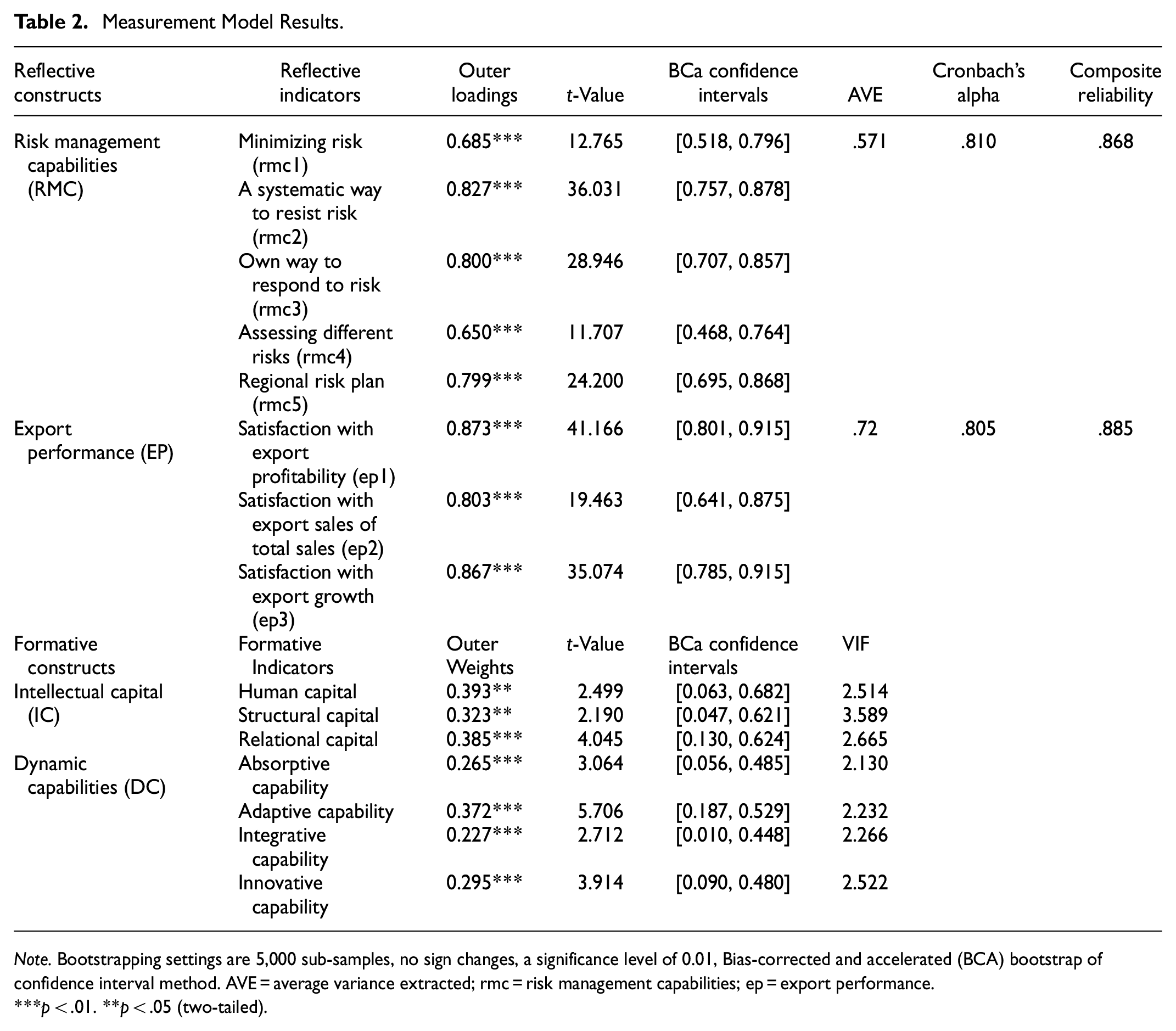
Note. Bootstrapping settings are 5,000 sub-samples, no sign changes, a significance level of 0.01, Bias-corrected and accelerated (BCA) bootstrap of confidence interval method. AVE = average variance extracted; rmc = risk management capabilities; ep = export performance.
p < .01. **p < .05 (two-tailed).
Formative Lower-Order Construct Testing Results.
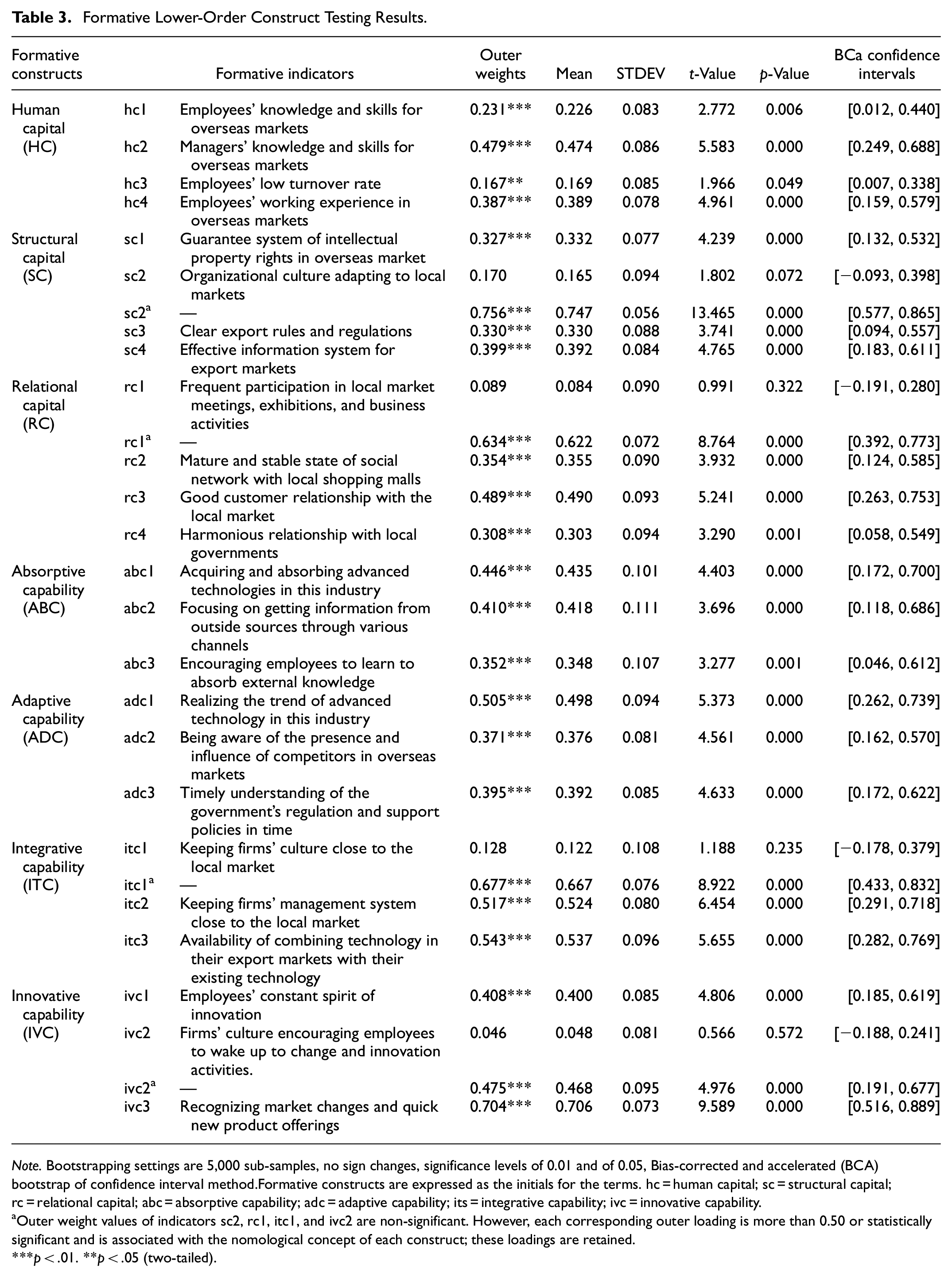
Note. Bootstrapping settings are 5,000 sub-samples, no sign changes, significance levels of 0.01 and of 0.05, Bias-corrected and accelerated (BCA) bootstrap of confidence interval method.Formative constructs are expressed as the initials for the terms. hc = human capital; sc = structural capital; rc = relational capital; abc = absorptive capability; adc = adaptive capability; its = integrative capability; ivc = innovative capability.
Outer weight values of indicators sc2, rc1, itc1, and ivc2 are non-significant. However, each corresponding outer loading is more than 0.50 or statistically significant and is associated with the nomological concept of each construct; these loadings are retained.
p < .01. **p < .05 (two-tailed).
Common Method Bias
In the data collection process that used a self-evaluation questionnaire, to minimize common method bias that may occur in cross-sectional studies, first, we made clear that the anonymity and confidentiality of questionnaire respondents were guaranteed and that there were no incorrect or correct answers to the survey questions. A full collinearity test was performed to determine to what extent common method variance could affect the relationship of the PLS path model or contaminate the observed variance; results indicated that the variance inflation factors (1.3 ≤ VIF ≤ 2.9) did not exceed the cut-off criterion of 3.3 (Kock, 2015). Harman’s (1976) single-factor test was also conducted to check for common method bias (Podsakoff & Organ, 1986). The first factor was found to account for 41% of the overall variance, indicating that it is unlikely that common method variance would affect the results (Podsakoff & Organ, 1986). Therefore, common method bias in this study is not a serious concern.
Testing Higher-Order Constructs
To realize a single abstraction layer concept, in this study, seven lower-order constructs were reduced to four higher-order constructs in order to achieve model parsimony (Polites et al., 2012) and to overcome bandwidth fidelity (Cronbach & Gleser, 1957; Hair et al., 2018). An extended repeated indicator approach or two-stage approach can generally be used to specify and estimate higher-order constructs in partial least squares structural equation modeling (PLS-SEM) (Sarstedt et al., 2019). A two-stage approach was applied to show better parameter estimates in the path model consisting of higher-order constructs with reflective-formative types (Becker et al., 2012; Schirmer et al., 2018). In the first stage, the intellectual capital measurement model was comprised of three formative indicators representing the latent variable scores of human, relational, and structural capital. The dynamic capabilities measurement model consisted of four formative indicators representing latent variable scores of absorptive, adaptive, integrative, and innovative capabilities, again in the first stage. After saving the latent variable scores of each construct and constructing a data set consisting of new variables, the embedded two-stage approach was applied. The second stage analyzed the data in the measurement model of the high-order constructs (Sarstedt et al., 2019). The model was estimated and analyzed by SmartPLS 3 (Ringle et al., 2015).
Results
Evaluation of the Measurement Model
To evaluate the reliability and validity of the reflective measures, we first assessed outer loadings to represent each indicator’s reliability; all indicators exceeded the required thresholds of 0.7 (Fornell & Larcker, 1981; Nunnally, 1978). To evaluate internal consistency reliability, Cronbach’s alpha was estimated. For each construct, values were above the threshold of .7, showing reliable levels. We also reviewed composite reliability; all values exceed the threshold of 0.8 (Nunnally, 1978), showing a strict reliability. To evaluate convergent validity, average variance extracted (AVE) was assessed. For each construct, AVE was above the recommended value of .5 (Fornell & Larcker, 1981). To examine whether each construct was satisfactorily distinct from the others, discriminant validity was tested using the heterotrait monotrait (HTMT) ratio of correlations (Henseler et al., 2015). The HTMT statistic of the reflective constructs, that is, risk management capabilities and export performance, was 0.816, below the critical values (i.e., 0.85 or 0.90). By applying the HTMT inference criterion, discriminant validity between the two reflective constructs was established with bias-corrected and accelerated (BCa) confidence intervals between 0.698 (2.5%) and 0.912 (97.5%). These figures were derived from bootstrapping with 5,000 samples and the no sign change option (Franke & Sarstedt, 2019). In addition, we developed a confirmatory tetrad analysis for PLS (CTA-PLS) to confirm these measures’ reflective modes (Gudergan et al., 2008). Taken together, the results obtained confirm acceptable reliability and validity. The reflective measurement model was well suited for the data, as shown in Tables 2 and 3. The assessment of formative measures used a different set of criteria, namely the significance of the outer weights and the collinearity of the indicators (Hair et al., 2017; Sarstedt et al., 2016). The results presented in Tables 2 and 3 show that the indicators of the formative measures (i.e., intellectual capital and dynamic capabilities) are significant and that the collinearity, determined by the variance inflation factor (VIF), is below the critical value of 5. The same findings hold for the formative lower-order constructs, intellectual capital (i.e., human capital, structural capital, and relational capital) and dynamic capabilities (i.e., absorptive capability, adaptive capability, integrative capability, and innovative capability). The findings hold for the formative relationships between the lower-order constructs and the higher-order constructs as well.
Evaluation of the Structural Model
All estimations in the structural model relationships were significant and are shown in Table 4, thus validating all hypotheses except for H1. Intellectual capital has the strongest influence on risk management capabilities (0.692), followed by dynamic capabilities (0.491). All three constructs explain more than 50% of export performance (R 2 = .538). The evaluation of the structural model results included the predictive relevance of Q2 statistic and the effect sizes f 2 and q 2 (Hair et al., 2017). Finally, the constructs’ discriminant validity (Henseler et al., 2015) and model fit were examined via the standardized root mean square residual (SRMR) (Henseler et al., 2015). The blindfolding procedure with a pre-specified distance of seven obtained cross-validated redundancy to determine the Q2 statistic (Hair et al., 2017). The Q2 statistic of export performance (0.359) was above zero; thus, the model has predictive relevance. Table 4 includes the f 2 and the q 2 effect size results. These results show a similar rank order as the PLS path coefficients. The SRMR is the basis for determining the model fit (Henseler et al., 2015). While an SRMR value of zero indicates a perfect model fit, a value of <0.08 reflects a good fit (C. T. Hu & Bentler, 1998). The SRMR value of 0.058 in this study implies that the model has a good fit.
Structural Model Results.

Note.***p < .01 (two-tailed).
Bootstrapping settings are 5,000 sub-samples, no sign changes, a significance level of 0.01, Bias-corrected and accelerated (BCA) bootstrap of confidence interval method. f 2 or q 2values of 0.02, 0.15, and 0.35 show that an exogenous construct has a small, medium, and large effect (or predictive relevance) on an endogenous construct.
Mediation Analysis
To verify the hypotheses comprehensively, a step-by-step analysis of the structural model was conducted. In the first stage, the relationship between intellectual capital and export performance was analyzed (H1 for Model 1). In the second stage, each mediator was divided and analyzed; we separately assessed the roles of dynamic capabilities and risk management capabilities as mediators of intellectual capital’s direct effects on a key target construct, export performance (H4.2 and H5.2). Figure 3 presents the estimates for two PLS path models, each of which includes one mediator construct (dynamic capabilities for Model 2a, risk management capabilities for Model 2b). Finally, two mediators combined with the entire PLS path model were evaluated in a third stage (Model 3). The PLS-SEM mediator analysis complied with general recommendations provided by Hair et al. (2017) and Schirmer et al. (2018). First, Model 1 was estimated without the mediators. The remaining direct relationship between intellectual capital and export performance (0.602, p < .001) is strong and significant. R2, a criterion for evaluating the structural model, was found to have a value of 0.363 for the key target construct (export performance), confirming the predictive accuracy of the model (Henseler et al., 2012). The model’s accuracy is also supported by the Q2 value of predictive relevance (Geisser, 1974; Stone, 1974), which produced an above-zero value for export performance (0.252, p < .001) using the blindfolding procedure, empirically substantiating Hypothesis 1. Next, the mediator dynamic capabilities were included to estimate Model 2a. We found that intellectual capital has a strong and significant effect on dynamic capabilities, which in turn have a strong and significant relationship with export performance. Intellectual capital’s indirect effect on export performance via the mediator construct dynamic capabilities (0.525, p < .001) is significant. The previously significant relationship between intellectual capital and export performance (0.602, p < .001) becomes non-significant in the presence of dynamic capabilities (0.071, p < .001). Consequently, with 88% of the variance accounted for (VAF), dynamic capabilities fully mediate the relationship between intellectual capital and export performance, providing empirical evidence for Hypothesis 4.2. Model 2b examines the hypothesized mediator risk management capabilities. Intellectual capital’s indirect effect on export performance via risk management capabilities (0.341, p < .001) is significant, supporting Hypothesis 5.2. It also has a significant influence on export performance (0.260, p < .001), supporting Hypothesis 5.1. In comparison with the dynamic capabilities’ mediator, we find that the partial mediation of risk management capabilities is not much stronger regarding the relationship between intellectual capital and export performance. Finally, the simultaneous inclusion of both constructs (dynamic capabilities and risk management capabilities) in the structural equation model (Model 3) suggests that intellectual capital’s direct effect on export performance (0.028, p < .001) remains non-significant. However, the indirect effect via dynamic capabilities and risk management capabilities (0.569, p < .001) is significant and translates into a VAF of 95.3% (Table 5). The coefficient of determination R2 has a value of 0.538 for the key target construct, export performance, substantiating the model’s predictive validity. The model is also supported by the Q2 value of the predictive relevance (omission distance D = 7, 0.374), which is well above zero. Figures 2 and 3 show all structural relationships and their significance levels. Assessing the joint role of dynamic capabilities and risk management capabilities as mediators of intellectual capital’s direct effect on export performance (Model 3), it is important to compare those results with to results estimating without the two-mediator construct, as shown in Figure 3. Intellectual capital’s direct effect on export performance decreases significantly (Δ = .574) from a significant relationship with a value of 0.602 (Model 1) to a low and non-significant level of 0.028 (Model 3). Therefore, a joint consideration of dynamic capabilities and risk management capabilities fully mediates the relationship between intellectual capital and export performance. That analysis substantiates our findings regarding each mediator and provides evidence to support Hypothesis 5.3, indicating that the joint mediating role has much more influence on the relationship between intellectual capital and export performance in high-tech firms. The findings suggest that companies with intellectual capital can improve their export performance by utilizing a combination of dynamic capabilities to leverage new business opportunities and risk management capabilities to manage emerging risk factors in a high-tech business environment.
Mediation Analysis Results.

Note. The hypotheses regarding the mediating effects concern the two path relationships a and b, whereby the product of path a and b represents the mediating effect (i.e., indirect effect); the total effect is the sum of the direct and indirect effects; we used a bootstrapping routine (Hair et al., 2017) with 5000 sub-samples, 197 observations per subsample, and the no sign change option to determine the significance of the path coefficients.
p < .01 (two-sided test); VAF = variance accounted for.
Model 1: PLS path model without a mediator.

Structural equation model.
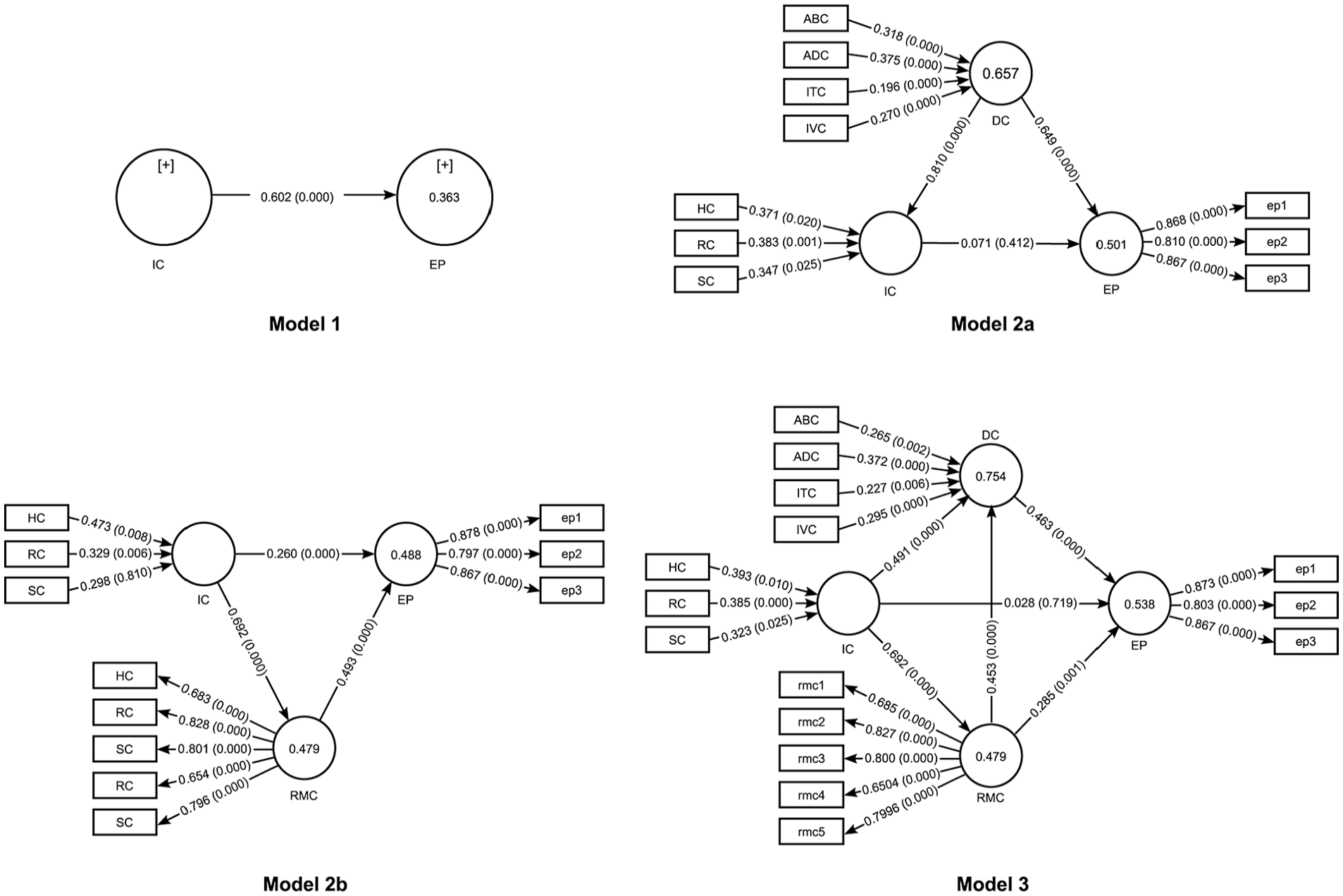
Structural equation model analysis with joint mediators. Model 2a: Model 1 with the additional mediator construct dynamic capabilities (DC). Model 2b: Model 1 with the additional mediator construct risk management capabilities (RMC). Model 3: Model 1 with the joint mediators of dynamic capabilities and risk management capabilities (DC & RMC).
Discussion and Conclusion
Main Findings
Intellectual capital, dynamic capabilities, and risk management capabilities on a business basis have taken much scholarly concern over the recent years; however, research combining these three in relation with export performance is very scarce. To fill its gap, the major objective of this study was to investigate, and thereby statistically test the mediation of dynamic capabilities and risk management capabilities in the relationship between intellectual capital and export performance. Overall, intellectual capital had a positive effect on the export performance of high-tech export companies in model 1, model 2a, and model 2b. We also focused on capabilities’ two-way role: both opportunity and risk impact the relationship between intellectual capital and export performance. Our findings revealed that both dynamic capabilities and risk management capabilities mediated the association between intellectual capital and export performance. Further, the full mediating effect of intellectual capital via the dual mediators of dynamic capabilities and risk management capabilities was found in model 3. Initially, the study tested the relationship between intellectual capital and export performance in model 1 whereby, a significant positive relationship was found thus supporting H1. The findings are in line with Pucar (2012) description that intellectual capital affects industrial export growth and Kamath (2017) explanation that intellectual capital impact export performance in the IT industry in India. Accordingly, the study has empirically highlighted that the presence of intellectual capital promotes innovation and creativity to generate value that can provide a competitive advantage in the high-tech exporting market. In assessing the relationship between intellectual capital and dynamic capabilities (H2), and risk management capabilities (H3), it shows intellectual capital has the strongest influence on risk management capabilities (0.692), followed by dynamic capabilities (0.491), which confirmed significant positive results of the H2 and H3. H2 is in line with L. C. Hsu and Wang (2012), outlining that intellectual capital whereby, human capital such as knowledgeable, skillful, and innovative abilities; relational capital created through joint relation-specific assets; structural capital applied knowledge and skills to the work, it then results in enhancing dynamic capabilities. Accordingly, the study has empirically highlighted that presence of intellectual capital facilitates to accelerate of absorptive, adaptive, integrative, and innovative activities as dynamic capabilities in the high-tech business environments (W. M. Cohen & Levinthal, 1990; Okhuysen & Eisenhardt, 2002; Wang & Ahmed, 2007). H3 is in line with Yli-Renko et al. (2001) and Alquier and Tignol (2006), describing that intellectual capital whereby, continuous improvement through risk management education; relational network through efficient knowledge retrieval and transfer; relational capital to coordinate and manage ungraspable risks; structural capital to facilitate sharing accumulated experience, it then increases risk management capabilities under the uncertain environmental change (Nair et al., 2014). In particular, significant positive results of the H4.1 and H4.2 have confirmed the mediation of dynamic capabilities in the relationship between intellectual capital and export performance. It has been empirically informed that high-tech firms possessing intellectual capital are likely to sensing, seizing, transforming business resources and capacities with dynamic capabilities and in-turn have effective export performance (Juma & Sequeira, 2017; Teece, 2007). We also identified and confirmed the dual mediating effects of dynamic capabilities and risk management capabilities on the relationship between intellectual capital and export performance among Chinese high-tech exporting firms. It is important to minimize the risk from the uncertainty and to respond differential risk under the fast-moving IT sectors as much as dynamic capabilities. However, there is little evidence regarding mechanism modeling export performance using two-way capabilities among high-tech firms. The current study identified underlying pathways between intellectual capital and export performance by considering a dual mediation model. H5.1 to H5.3 indicate that the joint mediating role has much more influence on the relationship between intellectual capital and export performance in high-tech firms. Our findings suggest that companies with intellectual capital can improve their export performance by utilizing a combination of dynamic capabilities to leverage new business opportunities and risk management capabilities to manage emerging risk factors in a high-tech business environment.
Theoretical Implications
Our research findings offer theoretical insights and contributions to the existing literature.
First, our findings contribute to research by showing that both dynamic and risk management capabilities are important to the success of high-tech companies, each having unique influences. In response to changes in business and technical environments, a dynamic capability perspective has resulted in inconsistencies in the assessment of enterprise performance (Ambrosini et al., 2009; Eisenhardt & Martin, 2000; Zahra et al., 2006; Zott, 2003). Second, this study revealed two important capabilities that can change the business environment and export performance: dynamic capabilities on the opportunity side and risk management capabilities on the threat side. Both capabilities are important mediators in determining the relationship between intellectual capital and export performance in high-tech firms’ performance models. Our results expand existing research on dynamic capabilities by highlighting the characteristics of risk management in the business environment, information that has not appeared in prior studies about dynamic capabilities. Even more importantly, our results show the critical mediating role of risk management capabilities in the dynamic capabilities model. According to our research, companies that need to address specific issues that arise from business risk can improve their export performances by aligning resources and capabilities. The specific nature of the range of issues that may be associated with sudden change, combined with specific external situations, appears to add difficulty to problems that companies must solve. By aligning resources and capabilities with risks faced in exporting high-tech products and by providing internal solutions for business risks at different stages, a firm’s export performance can be improved. Third, the relationship between intellectual capital and export performance is coordinated by a complex and sequential capabilities process. Previous studies have examined the dynamic capabilities process of coordinating the relationship between intellectual capital and performance (Aminu & Mahmood, 2015; L. C. Hsu & Wang, 2012). However, we explored the sequential mediating path through which risk management capabilities mediate the relationship between dynamic capabilities, simultaneously looking at the effect of the relationship between intellectual capital and export performance. Risk management capabilities can improve the deployment of corporate resources by uncovering relevant knowledge and ideas about the company’s ability to address the risks it faces. Thus, a company’s resources and capabilities facilitate risk management both internally and externally. Companies succeed with risk management within the overseas business by applying what is known about current exporting risks to corresponding operations tasks, providing sufficient opportunity to gain additional risk response knowledge of issues inherent in the business context, and exploring solutions. These two-way capabilities contribute to solutions that offer flexibility as firms adapt to changing business market needs. Ultimately, this perspective and approach can lead to elevated performance and results related to exporting.
Managerial Implications
Utilizing the relationship between intellectual capital and management performance through dynamic capabilities has become a new management strategy for high-tech companies. To manage this relationship effectively, companies should consider matching any existing operational and dynamic capabilities of intellectual capital to risk responses facing emerging business or technological opportunities. This study can be used to introduce another perspective to practitioners’ existing knowledge of how the intellectual capital of a company relates to dynamic capabilities, using that perspective to achieve the ultimate goal of securing competitive advantage. Managers of high-tech companies and export performance can benefit from our findings that combine dynamic capabilities with risk management capabilities. Export performance influenced by risk management capabilities can strengthen the presence of high-tech manufacturing companies and help them gain a competitive advantage. Combining capabilities is a strategic approach that can highlight transformative management performance. It is important for managers to understand that intellectual capital, including human capital, structural capital, and relational capital, is not enough to affect export performance. Therefore, the dynamic capabilities of high-tech manufacturing companies should be emphasized in forming overseas sales strategies. Managers should ensure that intellectual capital is not lost in the process of utilizing dynamic capabilities; they should continue to impact overseas export performance through associations with absorption, adaptation, integration, and innovation capabilities. Managers should also understand that while dynamic capabilities are essential in changing business environments, they are not enough to result in competitive advantage. High-tech companies try to deploy their resources and capabilities to suit the consumer market in relation to environmental changes. However, shifting existing operational capabilities to meet the demands of changing environments is limited when it comes to realizing a sustainable competitive advantage. Overseas sales managers of high-tech products may believe that the efficient allocation and operation of risk management resources, managing and measuring export profitability, export sales, and export growth, as suggested in this study, will offer a more sustainable competitive advantage than their competitors. Managers can achieve this result if they are able to stimulate the ability to respond to internal and external risks with risk management capabilities. To promote participation and response to risk management, managers should devise overseas sales plans and share the risks and threats in the export environment with employees, utilize the shared resources between departments, and exert integrative capabilities. This focus on an in-house atmosphere can facilitate proactive and reactive participation from representatives in overseas sales areas. Managers of overseas sales exports looking for improved export performance and paying attention to changes in opportunities and threats in the business or technological environment should focus on providing transformative operating capabilities to existing intellectual capital. Specifically, high-tech companies should provide institutional measures that lower employee turnover rate by offering enriching experience in overseas markets and continuously developing and implementing programs to strengthen ties with overseas sales communities. If human capital, structural capital, and relational capital all operate well, in concert, and with transformational capabilities in overseas sales regions, this coordination will lead to a more competitive export advantage that will ultimately support the sustained development of the enterprise. Finally, high-tech exporting managers can implement this study’s results regarding the joint role played by the combined operation of dynamic and risk management capabilities. Specifically, they should adjust strategies to make dynamic and risk management capabilities appear to be synchronized, considering each aspect of human capital, structural capital, and relational capital that exists within their high-tech companies.
Conclusion
Our research extends the literature on strategic management in the context of high-tech sectors by highlighting the impact of intellectual capital on risk management capabilities and dynamic capabilities of Chinese high-tech exporting firms. We present a mediation framework and explore the mechanism by which intellectual capital influences export performance. Furthermore, our research findings show how intellectual capitals influence export performance via a two-way capabilities mechanism to decrease facing business risk and increase business opportunities. The findings show a positive relationship between intellectual capitals and export performance, whereas two-way capabilities as dynamic capabilities and risk management capabilities are found to mediate the relationship of intellectual capital with the export performance of high-tech exporting sector. The study outcomes will apply to the context of Chinese high-tech exporting. We expect that our findings will encourage academic scholars to further explore our model in other high-tech business contexts.
Limitations and Future Research
Despite precautions taken in the preparation stage, this study has some limitations. We extracted heterogeneous samples, as opposed to samples from the same industry group, using a non-probability snowball sampling method of companies exporting Chinese high-tech products to overseas markets. Therefore, we caution against generalizing the results of this study. Subsequent research is required to identify and study new and different high-tech product lines in varying business contexts. Also, this study encountered practical difficulties contacting all the people registered in and identified from high-tech industry associations who were responsible for exporting high-tech products. There were many cases in which working-level officials in charge of high-tech rejected attempts to contact each other based on concerns about competitive structure. Therefore, we selected contactable personnel, namely working-level managers within the high-tech industry, applying the snowball sampling method to form our sample. Due to the cross-sectional design of the study, there may be limitations in the causal interpretation of the relationship among constructs. To assess our proposed hypotheses and demonstrated conclusions, the causal effects between variables should be checked against results from the longitudinal future studies. In particular, dynamic capabilities require the consideration of longer-term study results that represent the passage of time. Future studies should focus on each construct separately in the path relationship between intellectual capital and export performance. In terms of the variables within risk management capabilities, additional studies are needed that add variables such as political or social risks that are applied in practice or that investigate risk factors that companies truly face. Future studies should identify the mediating effect of two-way capabilities on the relationship between lower-order constructs and dependent variables (Nitzl et al., 2016; Sarstedt et al., 2019). Also suggested is a plan to confirm the proposed reflective-formative model using a CTA-PLS approach in other business contexts. Confirmation of convergent validity through redundancy analysis using a global single item to verify the validity of the formative measurement model of the higher-order constructs is also necessary.
Footnotes
Declaration of Conflicting Interests
The author(s) declared no potential conflicts of interest with respect to the research, authorship, and/or publication of this article.
Funding
The author(s) disclosed receipt of the following financial support for publication of/or publication of this article: This work was supported by grants from Research on the Development of Social Science in Hebei Province (No. 20220303066); Soft Science Research of Hebei provincial Science and Technology Program (22557699D); Hebei University of Economics and Business Beijing-Tianjin-Hebei coordinated development project (No. JXT2020ZD05)
